EP0948871B1 - Apparatus and method in a communication network - Google Patents
Apparatus and method in a communication network Download PDFInfo
- Publication number
- EP0948871B1 EP0948871B1 EP97951360A EP97951360A EP0948871B1 EP 0948871 B1 EP0948871 B1 EP 0948871B1 EP 97951360 A EP97951360 A EP 97951360A EP 97951360 A EP97951360 A EP 97951360A EP 0948871 B1 EP0948871 B1 EP 0948871B1
- Authority
- EP
- European Patent Office
- Prior art keywords
- bcch
- signal strength
- bcch4
- mobile station
- bcch carrier
- Prior art date
- Legal status (The legal status is an assumption and is not a legal conclusion. Google has not performed a legal analysis and makes no representation as to the accuracy of the status listed.)
- Expired - Lifetime
Links
Images




Classifications
-
- H—ELECTRICITY
- H04—ELECTRIC COMMUNICATION TECHNIQUE
- H04W—WIRELESS COMMUNICATION NETWORKS
- H04W36/00—Hand-off or reselection arrangements
- H04W36/0005—Control or signalling for completing the hand-off
- H04W36/0083—Determination of parameters used for hand-off, e.g. generation or modification of neighbour cell lists
- H04W36/0085—Hand-off measurements
- H04W36/0088—Scheduling hand-off measurements
-
- H—ELECTRICITY
- H04—ELECTRIC COMMUNICATION TECHNIQUE
- H04W—WIRELESS COMMUNICATION NETWORKS
- H04W36/00—Hand-off or reselection arrangements
- H04W36/12—Reselecting a serving backbone network switching or routing node
-
- H—ELECTRICITY
- H04—ELECTRIC COMMUNICATION TECHNIQUE
- H04W—WIRELESS COMMUNICATION NETWORKS
- H04W48/00—Access restriction; Network selection; Access point selection
- H04W48/08—Access restriction or access information delivery, e.g. discovery data delivery
- H04W48/12—Access restriction or access information delivery, e.g. discovery data delivery using downlink control channel
Definitions
- the present invention relates to a method and a mobile station for use in a communications network of GSM type, or of a type derived from GSM.
- the invention enables a faster handover from one cell to another.
- GSM Global System for Mobile Communications
- a mobile station for which a call has been established that is carried by a bidirectional (radio)communications channel in an active cell, is not disconnected when the mobile station moves to another cell.
- a change of communications channels must be made, to a communications channel in the other cell.
- the function of changing communications channels during an ongoing call is called handover.
- the decision to initiate a handover is made in the GSM network based on, among other things, measurement data reported from the mobile station.
- the mobile station measures the signal strengths of so called BCCH carriers transmitted from base stations serving cells in the vicinity of the active cell. Average values for the signal strengths are formed for each of said BCCH carriers during a measuring period, and the signal strength average values of the six strongest BCCH carriers are reported to the GSM network. Before the mobile station can report the signal strength for a certain BCCH carrier, the mobile station must identify this BCCH carrier. The identification of the BCCH carrier is initiated after the carrier has been found to be one of the six strongest BCCH carriers in a comparison of the signal strength average values obtained during one measuring period.
- the identification of the BCCH carrier takes approximately one or a few seconds, this time interval causing a corresponding delay from the time when the signal strength of the BCCH carrier is found to be interesting to report, until the time when the mobile station can report the signal strength of the BCCH carrier.
- British Patent Specification GB 2 225 196 describes a cellular radio system in which a serving base station can reserve channels in the surrounding cells. At handover to a base station in one of the surrounding cells, a reserved channel can be used, which reduces the time from the handover decision until the handover has been completed.
- the present invention attacks the problem of reducing the delay from the time when a mobile station finds the signal strength average value for a BCCH carrier to be interesting to report to the network until the mobile station has identified the BCCH carrier and is able to report the signal strength average value.
- the object of the present invention is thus to enable the mobile station to report measurement data for a cell in the vicinity of the active cell faster.
- the problem is solved in general terms by a method in which the mobile station initiates the identification of a received BCCH carrier when it is predicted in the mobile station that the BCCH carrier will probably soon be among the strongest BCCH carriers.
- the invention relates both to said method and to a mobile station having the necessary means to implement the method.
- One advantage of the invention is that the delay from the point in time when a BCCH carrier has become one of the strongest BCCH carriers, when taking into account the signal strength average values, until the BCCH carrier has been identified, may in many cases be reduced and in some cases eliminated. Consequently the mobile station is able to report measurement data for the BCCH carrier faster, allowing handover to the corresponding cell to be made faster. Because the handover can be made faster, the chances of maintaining an established call in situations when the radio conditions are changing fast are improved. Examples of such situations are turning a comer in a sky scraper area or entering an underground railway station.
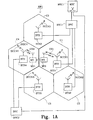
- Figure 1A shows a part of a GSM network NW1 and a subset of the different types of units found in such a network NW1.
- the geographical area covered by the network is divided into cells C1-C5.
- Each cell provides radio coverage in a certain area and has assigned to it a set of frequencies for communication in that area.
- Each cell C1-C5 is served by a base transceiver station BTS1-BTS5 having means to communicate, by radio, with a mobile station MS1 currently located in the cell.
- the cell C1 in which the mobile station MS I is found is called the serving cell and the corresponding base station BTS1 is called the serving base station.
- a communication channel CH1 is allocated for radio communication between the mobile station MS1 and the serving base station BTS1. If the mobile station MS1 moves into a second cell C4 during the call, a new communication channel CH4 in this second cell C4 must be allocated in order for the call not to be disconnected.
- the function of changing communication channels during an established call is called handover. The decision to initiate a handover is made by the base station controller BSC1 controlling the serving base station BTS1.
- the mobile station MS I Before the base station controller BSC1 can make a decision about handover, the mobile station MS I must first report what cells are suitable candidates for handover.
- the mobile station measures the signal strengths of so called BCCH carriers BCCH2-BCCH5 transmitted by the base stations BTS2-BTS5 in the surrounding cells C2-C5.
- BCCH2-BCCH5 For each of the BCCH carriers BCCH2-BCCH5 a signal strength average value is formed over a measuring period and the average values of the strongest BCCH carriers are reported to the base station controller BSC1.
- the mobile station MS 1 Before the mobile station MS1 can report the signal strength of a certain BCCH carrier BCCH4, the mobile station MS 1 must, according to GSM specifications, identify the BCCH carrier BCCH4. This is done by the mobile station reading identity information BSIC4 carried by the BCCH carrier BCCH4.
- An ordinary mobile station reports measurement data for the six strongest BCCH carriers with a known BSIC.
- a parameter called multiband reporting is used for determining the BCCH carriers for which measurement data is to be reported.
- the selection criterion may then be modified so that the selection, in addition to the signal strength average values also takes into account the frequency band to which each BCCH carrier belongs.
- the identification of an unidentified BCCH carrier is initiated after this BCCH carrier is among the strongest BCCH carriers in a comparison of the signal strength average values during a measuring period. Because the mobile station must identify the BCCH carrier before it is possible to report measurement data for the BCCH carrier to the base station controller, this causes a delay from the point in time when the BCCH carrier is among the strongest BCCH carriers, so that it is desirable to report measurement data for the BCCH carrier, until the mobile station can report measurement data for the BCCH carrier to the base station controller.
- the basic idea of the invention is not to wait until the BCCH carrier is among the strongest BCCH carriers, with regard to the signal strength average values over a measuring period, before initiating the identification of a BCCH carrier. Instead, the identification of the BCCH carrier is initiated when it is predicted. based on the measured signal strengths. that it will soon be one of the strongest BCCH carriers with regard to the signal strength average values over a measuring period. Thus, the identification of the BCCH carrier is made while its signal strength average value is growing, enabling the delay to be reduced and, in some cases, eliminated.
- Figure 3A shows, in step 301, how a communication channel is allocated for communication between a first base station and a mobile station.
- the communication channel is made up of a physical channel carrying two logical channels: a traffic channel TCH and a slow associated control channel SACCH.
- the traffic channel is used for the transfer of user information such as speech or data, whereas the associated control channel is used, among other things, for the above mentioned reporting of signal strength average values of BCCH carriers. See GSM 05.01 and GSM 05.02 for further detail.
- the mobile station measures the signal strengths of each of the BCCH carriers comprised in a BCCH Allocation (BA) list received from the first base station.
- BA BCCH Allocation
- the network operator determines which BCCH carriers are to be on the BA list.
- the BA list is specified to include the BCCH carrier in the active cell, causing the mobile station to perform measurements and report measurement data for this BCCH carrier as well.
- the BCCH carriers are measured in sequence one by one, and when the sequence has been completed a new one is started. The measurements are carried out between a transmission time slot and the following reception time slot belonging to the allocated communication channel.
- step 305 the measurement values obtained in step 303 during the measuring period are used to form a signal strength average value for each of the BCCH carriers over the completed measuring period.
- step 306 it is checked whether or not any of the six strongest BCCH carriers is unidentified. If this is the case (result YES), in step 307 an identification of the unidentified BCCH carrier is initiated.
- step 309 the communication of the signal strength average value over the completed measuring period and the BSIC for each of the selected BCCH carriers to the first base station is initiated. This information is transferred on the slow associated control channel during the next measuring period. If the control channel is needed during the next measuring period for transferring other information, this measurement data is not communicated. Measurement data is, however, always reported for at least every second measuring period.
- step 309 the procedure returns to step 304, waiting for the next measuring period to come to an end.
- Figure 3A The method steps 301-309 shown in Figure 3A correspond to what happens in a prior art mobile station.
- Figure 3B illustrates the method steps 310-315 that are new according to the invention.
- step 310 a division of each measuring period into a number of subintervals is made.
- Step 311 prescribes waiting until a subinterval has come to an end.
- step 312 the measurement values obtained in step 303 during the subinterval are used to form, for each of the unidentified BCCH carriers, a signal strength average value over the completed subinterval.
- step 313 for each of the unidentified BCCH carriers the signal strength average value over the subinterval is compared to the signal strength average value over the immediately preceding subinterval. If the signal strength average value for any of the BCCH carriers has grown by a value larger than a first predetermined threshold value (result YES), it is predicted that this BCCH carrier will probably soon be one of the six strongest BCCH carriers considering the signal strength average value over a measuring period.
- a first predetermined threshold value (result YES)
- step 313 If in step 313 no unidentified BCCH carrier was found to have an increase in signal strength average value larger than the first threshold value (result NO), in step 314, for each of the unidentified BCCH carriers the signal strength average value over the subinterval is compared to the signal strength average value over the subinterval two subintervals earlier. If the signal strength average value of any of the BCCH carriers has increased by a value larger than a second predetermined threshold value (result YES), it is predicted that this BCCH carrier will probably soon be one of the six strongest BCCH carriers considering the signal strength average value over a measuring period.
- a second predetermined threshold value result YES
- the first threshold value is selected so that in the comparison in step 313 a BCCH carrier is pointed out if it has grown very much in signal strength over the last subinterval.
- the second threshold value is set in such a way that in the comparison in step 314 a BCCH carrier is pointed out if it has grown very much in signal strength during the two last subintervals but not quite fast enough to have been pointed out during any of the two latest subintervals in step 313.
- step 313 or 314 If in step 313 or 314 a BCCH carrier has been pointed out as probably soon to be one of the six strongest BCCH carriers measured over a measuring period, probably the measurement data of the BCCH carrier that was pointed out will be due for reporting. In step 315 therefore, the identification of the BCCH carrier is initiated.
- step 315 If in step 313 or step 314, respectively, more than one BCCH carriers are found to have grown in signal strength average value faster than the first or the second threshold value, respectively, in step 315 an identification of the BCCH carriers having the fastest growing signal strength is initiated.
- step 315 or if no unidentified BCCH carrier has been pointed ou: in the comparison in step 314 (result NO), the procedure returns to step 311 and waits for the next subinterval to come to an end.
- the method steps 303, 304-309 and 310-314 are repeated until the allocated channel is released.
- the identification of an unidentified BCCH carrier is initiated not only when it is predicted that the BCCH carrier will probably soon be one of the strongest BCCH carriers (step 315); the identification of an unidentified BCCH carrier found to be one of the strongest BCCH carriers over a measuring period is also initiated in the way known in the art (step 307).
- Figure 1B shows that the network NW1 comprises three cells C6-C8 in addition to the cells C1-C5 shown in Figure 1A.
- the cells C6-C8 are served by base transceiver stations BTS6-BTS8, each transmitting a BCCH carrier BCCH6-BCCH8.
- Figure 1B also shows the mutual location of the cells in more detail.
- the cell C4, delimited by dashes, provides radio coverage in an underground railway station. A call is established when the mobile station MS1 is located in the cell C1, and the mobile station MS 1 then moves to the cell C4.
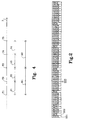
- Figure 4 shows how, in the mobile station MS1 the time T after the allocation of the communication channel CH1 is divided into measuring periods and subintervals.
- Figure 4 shows two subsequent measuring periods M1-M2 each of which has been divided into two subintervals S1-S2, S3-S4.
- the subintervals S1-S4 arc of equal lengths, each corresponding to half a measuring period.
- a number of points in time T1-T5 are shown along the time axis T and mark the beginning and the end of each of the subintervals S1-S4.
- the points in time for which the reference is an odd number, T1, T3, T5 also mark the beginning and the end of the measuring periods M1-M2.
- the mobile station MS1 measures the signal strengths of each of the BCCH carriers on the BA list received from the serving base station BTS 1.
- the BA list comprises the BCCH carriers BCCH2-BCCH8 shown in Figure 1B.
- Figures 5A-5D show the variation of the signal strength average values over the subintervals S1-S4.
- Figure 5A is a bar chart showing the signal strength average values 501 determined by the mobile station MS1 over the subinterval S1 for each of the BCCH carriers BCCH2-BCCH8 on the BA list. It is assumed that the six strongest BCCH carriers BCCH2-BCCH3, BCCH5-BCCH8 over the subinterval were also the six strongest BCCH carriers over the previous measuring period and that the mobile station MS1 during the current measuring period M 1 reports measurement data for these BCCH carriers to the base station controller BSC1 through the serving base station BTS1.
- Figures 5B-5D show corresponding information for each of the subintervals S2-S4 (the order of the bars being the same as in Figure 5A).
- Figures 7A and 7B show the signal strength average values after the measuring periods M1 and M2, respectively. From Figure 7A it may be seen that the unidentified BCCH carrier BCCH4 is not among the six strongest BCCH carriers in a comparison of the signal strength average values 701 over the measuring period M1. Figure 7B shows that the above mentioned BCCH carrier BCCH4 is among the six strongest BCCH carriers in a comparison of the signal strength average values over the measuring period M2.
- a prior art mobile station would initiate the identification of the BCCH carrier BCCH4 after the measuring period M2 had come to an end, that is, at the point in time T5. This should be compared to the inventive mobile station MS1 which, according to the above, initiates the identification of the BCCH carrier BCCH4 at the point in time T3.
- Figures 5A-5D, 6 and 7A-7B are only intended to illustrate the inventive principle and should not be taken to show actual values of signal strength levels and the first threshold value.
- the inventive mobile station MS1 comprises:
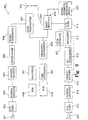
- FIG. 8 is a hardware block diagram of the mobile station MS1.
- the mobile station MS1 comprises a microphone 801 converting recorded sound to an analogue electric signal.
- An analogue to digital (A/D) converter 802 converts the analogue signal from the microphone 801 to digital information.
- a speech encoder 803 compresses the data flow out from the A/D converter 802. After the speech encoder 803 there is a channel encoder 804 which introduces information for detecting and correcting signal errors introduced when communicating on the communication channel CH1, into the data flow.
- An interleaver 805 takes the encoded words received from the channel encoder 804 and distributes the information of each encoded word to a number of information bursts.
- a burst generator 806 retrieves output data from the interleaver 805 to be sent in a burst and uses this information to form a corresponding analogue base band signal.
- a radio transmitter 807 converts the base band signal from the burst generator 806 to a radio signal by modulating a carrier the frequency of which is determined by a frequency synthesizer 808.
- the radio transmitter 807 amplifies the modulated radio signal to a suitable power level.
- the mobile station also comprises a radio receiver 809 receiving radio signals the frequency of which is determined by the frequency synthesizer 808.
- the radio receiver 809 converts the received radio signals to an analogue base band signal.
- the output signal from the radio receiver 809 is sampled by a second A/D converter 810.
- the output data from the second A/D converter 810 is processed by an equalizer 811 to compensate for any time dispersion that has been introduced.
- a de-interleaver 812 receives the output data from the equalizer 811 and gathers information from a number of bursts and forms encoded words from this information.
- a channel decoder 813 performs error detection and error correction on the output data from the de-interleaver 812.
- a speech decoder 814 expands the output data from the channel decoder 813.
- a D/A converter 815 converts the output data from the speech decoder to an analogue signal used by an earphone 816 to generate sound.
- a switch 823 connects either the radio transmitter 807 or the radio receiver 809 to an antenna 824.
- the mobile station MS1 further comprises a processor, or Central Processing Unit (CPU) 817, executing program instructions stored in a Read Only Memory (ROM) 818.
- the processor 817 has the overall responsibility for the operation of the mobile station MS1 and controls the other units in accordance with the program instructions.
- the result, in the form of digital data created by the units, is exchanged through a Random Access Memory (RAM) 819.
- RAM Random Access Memory
- the output data from the speech encoder 803 is stored in the RAM 819 and the channel encoder 804 retrieves this data from the RAM 819.
- a timing generator 820 is used as a time reference in the mobile station.
- the mobile station MS1 comprises both a data bus for the exchange of data between the units and memories 818, 819 and a control bus through which the processor 817 can control the units.
- the two buses are not shown in Figure 8.
- the exchange of data between the units is made by storing data in, and retrieving data from, the RAM 819.
- the logical flow of data between different units is illustrated with dashed lines in Figure 8.
- Control information such as measurement data reports from the mobile station or the BA list, is transferred between the mobile station MS 1 and the serving base station BTS1 in signalling messages.
- This information is given from the processor 817 to the channel encoder 804, respectively is received by the processor 817 from the channel decoder 813.
- the description above corresponds to what occurs at transmission and reception of information also in this case.
- the frequency synthesizer 808 When the mobile station MS I is to measure the signal strength of a BCCH carrier, the frequency synthesizer 808 is tuned to the frequency of the BCCH carrier BCCH4. The radio receiver 809 then receives the BCCH carrier BCCH4. The energy received is accumulated in a signal strength measuring device 822 and after a certain period of time the second A/D converter 810 reads the signal strength measuring device 822. The read value is stored in the RAM 819.
- the frequency correction control channel carried by the BCCH carrier BCCH4 and then the synchronization channel are detected and decoded.
- the detection and decoding of said logical channels are carried out during idle TDMA frames not used for communication with the serving base station BS1 on the allocated communication channel CH1.
- the frequency synthesizer 808 is tuned to the frequency of the BCCH carrier BCCH4.
- the radio receiver 809 is then started and receives data during a whole TDMA frame.
- the received data is converted to digital form by the second A/D converter 810 and is then processed by an FCCH detector 821.
- the result from the FCCH detector is stored in the RAM 819.
- the processor After gathering data during the idle TDMA frame in eleven 26 multiframes, the processor analyses the stored data to determine whether or not a frequency correction burst has been received. If this is the case, the necessary frequency correction will be carried out in the mobile station MS1, before proceeding with the detection and decoding of the synchronization channel.
- the frequency synthesizer 808 is tuned to the frequency of the BCCH carrier BCCH4, before the radio receiver 809 is started and receives data for the full duration of a TDMA frame.
- the received data is converted to digital form by the second AID converter 810.
- the equalizer 811 processes the output data from the A/D converter 810.
- the channel decoder 813 searches the output data from the equalizer 811 for a synchronization burst.
- Output data from the channel decoder 813 indicates whether or not a synchronization burst has been detected and, if that is the case, also comprises the BSIC data mentioned above. For the detection of the synchronization channel it may be necessary to use the idle TDMA frame in up to eleven 26 multiframes.
- the received radio signal is not a BCCH carrier. In this case the gathered measurement data related to the received radio signal is deleted.
- Swedish patent application SE 9602459-1 describes a method in which the time for the actual detection of the frequency correction control channel and the synchronization channel may be reduced compared to the known method of performing these tasks, described above.
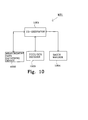
- FIG 10 is a functional block diagram of the mobile station MS1. It should be noted that only function blocks related to the present invention are illustrated in Figure 10.
- the mobile station MS1 comprises four function blocks: a co-ordinator 1001, a measurement data gathering device 1002, an FCCH/SCH decoder 1003 and an SACCH mailbox 1004.
- the co-ordinator function block is implemented in software only, whereas the other function blocks comprise both hardware and software.
- the measurement data gathering device 1002 performs signal strength measurements on BCCH carriers.
- the measurement data gathering device receives a signal from the co-ordinator giving an order to carry out signal strength measurements on the BCCH carriers BCCH2 - BCCH8.
- the signal also comprises information about how often the gathered measurement data is to be reported to the co-ordinator, which in this case should be done after each subinterval corresponding to half an SACCH multiframe (240 milliseconds).
- the measurement data gathering device 1002 measures the signal strengths of the BCCH carriers BCCH2-BCCH8 in turn. For each of the BCCH carriers BCCH2-BCCH8 to be measured by the measuring data gathering device 1002, there are two variables: a signal strength accumulator and a counter.
- the measurement data gathering device 1002 Every time the measurement data gathering device 1002 has measured the signal strength of a BCCH carrier the measured value is added to the signal strength accumulator corresponding to the BCCH carrier, and the counter is incremented by one. When a subinterval has passed, the measurement data gathering device 1002 reports the content of the signal strength accumulators and the counters for each of the BCCH carriers BCCH2-BCCH8 to the co-ordinator 1001. The measurement data gathering device then resets all signal strength accumulators and counters to zero and starts gathering new measurement values.
- the FCCH/SCH decoder 1003 identifies the BCCH carriers.
- a signal is sent to the FCCH/SCH decoder 1003 comprising information about the BCCH carrier to be identified and information about whether the identification should be given a high or a low priority. If the identification of the BCCH carrier BCCH4 wave has been given a low priority, the identification may be interrupted if a request for identification of a second BCCH carrier is received from the co-ordinator before the first identification has been completed. If the identification of the BCCH carrier BCCH4 has been given a high priority, the identification is always completed before the next identification is started.
- the FCCH/SCH decoder 1003 reads the BSIC data BSIC4 carried by the BCCH carrier BCCH4 in a way known in the art.
- the FCCH/SCH decoder then passes a signal to the co-ordinator 1001 comprising the identity BSIC4 of the BCCH carrier BCCH4.
- the SACCH mailbox 1004 handles the reception and transmission of signalling messages on the corresponding control channel carried by the communication channel CH1.
- the above mentioned signalling messages comprising measurement data reports from the mobile station MS1 are transmitted on the slow associated control channel.
- the co-ordinator 1001 sends a signal to the SACCH mailbox comprising data for those of the BCCH carriers whose signal strength average values for the measuring period are to be reported.
- the SACCH mailbox checks if the slow associated control channel can be used to transmit a so called measurement report message during the next SACCH multiframe. If the control channel is free, the SACCH mailbox compiles and transmits said message during the next SACCH multiframe. If not, the information from the co-ordinator 1001 is deleted.
- the SACCH mailbox makes sure that at least every second SACCH multiframe is used for transmitting measurement report messages.
- the co-ordinator 1001 has the overall responsibility for the function in the mobile station MS1. It gives orders and information to, and receives information from, the other function blocks 1002-1004. After the allocation of the communication channel CH1 the co-ordinator 1001 transmits a signal to the measurement data gathering device 1002 giving orders to measure the signal strengths of the BCCH carriers BCCH2-BCCH8 on the BA list, and to report the measured signal strengths after each subinterval corresponding to half an SACCH multiframe. If a changed BA list is later received from the SACCH mailbox 1004, a new signal is sent to the measurement data gathering device 1002 comprising new information as to what BCCH carriers measurements are to be carried out for.
- step 901 the co-ordinator 1001 receives a measurement data report from the measurement data gathering device 1002 it carries out the steps shown in Figure 9.
- step 901 the co-ordinator first determines whether or not the received measurement data report corresponds to a measuring period having been completed. If that is the case (result YES), the steps 902-906 are carried out. These steps correspond to the steps 305-309 of Figure 3A and therefore will not be described in more detail, except the steps 904 and 906.
- step 904 the co-ordinator 1001 transmits a signal to the FCCH/SCH decoder 1003 giving the order to identity the BCCH carrier pointed out in step 903. In connection with the given order the co-ordinator 1001 indicates to the FCCH/SCH decoder 1003 that the identification of the BCCH carrier has a high priority.
- step 906 the co-ordinator 1001 transmits a signal to the SACCH mailbox 1004 comprising data for those BCCH carriers that were selected in step 905.
- step 906 the steps 907-910 are carried out. These steps correspond to the steps 312-315 in Figure 3A and therefore will not be described in more detail, except step 910.
- step 910 the co-ordinator 1001 sends a signal to the FCCH/SCH decoder 1003 giving the order to identify the BCCH carrier pointed out in step 908 or step 909. In connection with the given order the co-ordinator 1001 indicates to the FCCH/SCH decoder 1003 that the identification of the BCCH carrier has a low priority.
- the co-ordinator receives a signal from the FCCH/SCH decoder comprising the identity, that is, the BSIC data for the BCCH carrier. Even in the case when the FCCH/SCH decoder 1003 has interrupted or failed in the identification a signal is sent to the co-ordinator 1001 comprising information about the event.
- step 3C the method steps 316-317 and 320 correspond directly to the steps 310-311 and 315 in Figure 3B and will therefore not be described in more detail in connection with Figure 3C.
- the difference in Figure 3C compared to Figure 3B consists of the reasons for pointing out an unidentified BCCH carrier for identification.
- step 318 signal strength average values arc formed over the subinterval for all BCCH carriers.
- step 319 the signal strength average values for the BCCH carriers over the last subinterval are then compared to each other.
- step 320 If anyone of the six strongest BCCH carriers is unidentified, it is predicted that this BCCH carrier will probably soon be one of the strongest BCCH carriers when taking into account the signal strength average values over a measuring period, and the BCCH carrier is therefore pointed out for identification (result YES), which is then initiated in step 320. If more than one of the six strongest BCCH carriers are unidentified, the strongest one of these carriers is pointed out. After step 320, or if in step 319 no unidentified BCCH carrier was found among the six strongest ones (result NO), the process returns to step 317 and waits for the next subinterval to be completed.
- step 307 If the signal strength average value for any of the BCCH carriers has increased by a value greater than a predetermined threshold value (result YES), then it is predicted that the BCCH carrier will probably soon be one of the strongest BCCH carriers when taking into account the signal strength average values over a measuring period (result YES), causing the identification of the BCCH carrier to be initiated in Step 307. In the opposite case (result NO), the process proceeds with step 308.
- the invention is applicable in communication networks of GSM type or of types derived from GSM, including the network types DCS1800 and PCS1900, which is a GSM-based variant of PCS.
Landscapes
- Engineering & Computer Science (AREA)
- Computer Networks & Wireless Communication (AREA)
- Signal Processing (AREA)
- Mobile Radio Communication Systems (AREA)
- Data Exchanges In Wide-Area Networks (AREA)
Applications Claiming Priority (3)
| Application Number | Priority Date | Filing Date | Title |
|---|---|---|---|
| SE9604683A SE510940C2 (sv) | 1996-12-19 | 1996-12-19 | Anordning och förfarande i ett kommunikationsnät för snabb handover genom identifiering av predikterad bärvågssignal |
| SE9604683 | 1996-12-19 | ||
| PCT/SE1997/002116 WO1998027779A1 (en) | 1996-12-19 | 1997-12-16 | Apparatus and method in a communication network |
Publications (2)
| Publication Number | Publication Date |
|---|---|
| EP0948871A1 EP0948871A1 (en) | 1999-10-13 |
| EP0948871B1 true EP0948871B1 (en) | 2003-11-05 |
Family
ID=20405049
Family Applications (1)
| Application Number | Title | Priority Date | Filing Date |
|---|---|---|---|
| EP97951360A Expired - Lifetime EP0948871B1 (en) | 1996-12-19 | 1997-12-16 | Apparatus and method in a communication network |
Country Status (17)
| Country | Link |
|---|---|
| US (1) | US6101383A (pl) |
| EP (1) | EP0948871B1 (pl) |
| JP (1) | JP3898230B2 (pl) |
| KR (1) | KR100537420B1 (pl) |
| CN (1) | CN1113572C (pl) |
| AU (1) | AU731031B2 (pl) |
| BR (1) | BR9714152B1 (pl) |
| CA (1) | CA2275600C (pl) |
| DE (1) | DE69726008D1 (pl) |
| EE (1) | EE03628B1 (pl) |
| MY (1) | MY117018A (pl) |
| NO (1) | NO992959L (pl) |
| PL (1) | PL185522B1 (pl) |
| RU (1) | RU2214071C2 (pl) |
| SE (1) | SE510940C2 (pl) |
| TR (1) | TR199901339T2 (pl) |
| WO (1) | WO1998027779A1 (pl) |
Families Citing this family (24)
| Publication number | Priority date | Publication date | Assignee | Title |
|---|---|---|---|---|
| FR2774842B1 (fr) * | 1998-02-06 | 2000-03-03 | Alsthom Cge Alcatel | Procede de selection de cellule dans un systeme cellulaire de radiocommunications mobiles |
| DE69927198T2 (de) * | 1998-03-19 | 2006-06-29 | Hitachi, Ltd. | Rundfunk-Informationsversorgungssystem |
| FI106836B (fi) * | 1998-05-25 | 2001-04-12 | Nokia Networks Oy | Menetelmä kanavien käyttämiseksi aikajakomonikäyttöradiojärjestelmässä ja aikajakomonikäyttöradiojärjestelmä |
| CN1135867C (zh) * | 1998-06-30 | 2004-01-21 | 三菱电机株式会社 | 移动通信终端 |
| GB9922204D0 (en) * | 1999-09-20 | 1999-11-17 | Nokia Telecommunications Oy | Reporting communication link information |
| US6754487B1 (en) * | 2000-02-28 | 2004-06-22 | Telecom Network Optimization, Inc. | Radio network test analysis system |
| US8321542B1 (en) * | 2000-05-05 | 2012-11-27 | Ipr Licensing, Inc. | Wireless channel allocation in a base station processor |
| USRE43871E1 (en) | 2000-08-15 | 2012-12-25 | Pctel, Inc. | System and method for identifying co-channel interference in a radio network |
| US20040185786A1 (en) * | 2001-04-25 | 2004-09-23 | Ramin Mirbaha | Quality of service state predictor for and advanced mobile devices |
| US7269414B2 (en) | 2002-05-28 | 2007-09-11 | Motorola, Inc. | Dynamic mobile station configuration in wireless communications systems and methods therefor |
| US7212843B2 (en) * | 2003-05-15 | 2007-05-01 | Motorola Inc. | Current reduction in a communication device |
| US7321749B2 (en) * | 2003-10-09 | 2008-01-22 | Qualcomm Incorporated | Cell selection techniques for frequency division multiple access systems |
| US7620029B2 (en) * | 2003-10-09 | 2009-11-17 | Qualcomm Incorporated | Parallel cell ID acquisition in frequency division multiple access systems |
| TWI280064B (en) * | 2003-12-05 | 2007-04-21 | Mediatek Inc | Timing method for mobile station in wireless communication system and related devices |
| CN100342750C (zh) * | 2003-12-05 | 2007-10-10 | 联发科技股份有限公司 | 改善移动台在无线通讯系统的断话率的控制方法及电路 |
| TWI275311B (en) | 2003-12-05 | 2007-03-01 | Mediatek Inc | Control method capable of improving call dropped rate of mobile station in wireless communication system, control circuit thereof, and mobile station |
| US7675891B2 (en) * | 2004-09-23 | 2010-03-09 | Telefonakiebolaget L M Ericsson (Publ) | Multimedia reception in communication networks |
| US7821997B2 (en) * | 2005-03-15 | 2010-10-26 | Nokia Corporation | Computer implemented method, system, and intergrated circuitry for determining a characteristic of a received signal to have fallen beneth a threshold |
| KR100725056B1 (ko) * | 2005-11-09 | 2007-06-08 | 삼성전자주식회사 | 이동통신 단말기의 인접 셀 관리 방법 |
| KR100846796B1 (ko) * | 2006-10-02 | 2008-07-16 | 삼성전자주식회사 | 고주파 대역을 통하여 데이터를 송수신하기 위한 무선네트워크에서의 핸드오버 방법 및 장치 |
| JP2008172584A (ja) * | 2007-01-12 | 2008-07-24 | Nec Corp | 移動通信システム及びこれにおける無線基地局選択方法 |
| CN101790232B (zh) * | 2009-01-22 | 2016-03-30 | 中兴通讯股份有限公司 | 基于多载波系统的扫描报告发送方法、终端 |
| US8630582B2 (en) * | 2009-09-02 | 2014-01-14 | Sony Corporation | Out-of-band radio link protocol and network architecture for a wireless network composed of wireless terminals with millimetre wave frequency range radio units |
| CN110572222B (zh) * | 2019-07-24 | 2022-02-11 | 浙江三维通信科技有限公司 | 基于滤波器的gsm载波中带有bcch载波的识别方法和系统 |
Family Cites Families (9)
| Publication number | Priority date | Publication date | Assignee | Title |
|---|---|---|---|---|
| GB2225196A (en) * | 1988-11-16 | 1990-05-23 | Philips Electronic Associated | Cellular radio system |
| GB9012044D0 (en) * | 1990-05-30 | 1990-07-18 | British Telecomm | Cellular radio |
| GB9028108D0 (en) * | 1990-12-27 | 1991-02-13 | British Telecomm | Mobile radio handover initiation determination |
| US5305468A (en) * | 1992-03-18 | 1994-04-19 | Motorola, Inc. | Power control method for use in a communication system |
| GB2268854A (en) * | 1992-07-15 | 1994-01-19 | Orbitel Mobile Communications | Telecommunication system |
| CA2119199C (en) * | 1993-05-07 | 2003-05-27 | Steven J. Willhoff | Dual stage rssi handoff trigger |
| US5608780A (en) * | 1993-11-24 | 1997-03-04 | Lucent Technologies Inc. | Wireless communication system having base units which extracts channel and setup information from nearby base units |
| US5634192A (en) * | 1995-02-23 | 1997-05-27 | Northern Telecom Limited | Mobile-assisted handoff technique |
| US5768267A (en) * | 1995-10-18 | 1998-06-16 | Telefonaktiebolaget Lm Ericsson | Method for system registration and cell reselection |
-
1996
- 1996-12-19 SE SE9604683A patent/SE510940C2/sv not_active IP Right Cessation
-
1997
- 1997-11-25 MY MYPI97005680A patent/MY117018A/en unknown
- 1997-12-16 CN CN97181691A patent/CN1113572C/zh not_active Expired - Lifetime
- 1997-12-16 PL PL97333923A patent/PL185522B1/pl unknown
- 1997-12-16 RU RU99115828/09A patent/RU2214071C2/ru active
- 1997-12-16 AU AU55019/98A patent/AU731031B2/en not_active Expired
- 1997-12-16 DE DE69726008T patent/DE69726008D1/de not_active Expired - Lifetime
- 1997-12-16 WO PCT/SE1997/002116 patent/WO1998027779A1/en not_active Ceased
- 1997-12-16 TR TR1999/01339T patent/TR199901339T2/xx unknown
- 1997-12-16 JP JP52761698A patent/JP3898230B2/ja not_active Expired - Lifetime
- 1997-12-16 KR KR10-1999-7005375A patent/KR100537420B1/ko not_active Expired - Lifetime
- 1997-12-16 EP EP97951360A patent/EP0948871B1/en not_active Expired - Lifetime
- 1997-12-16 CA CA002275600A patent/CA2275600C/en not_active Expired - Lifetime
- 1997-12-16 EE EEP199900245A patent/EE03628B1/xx unknown
- 1997-12-16 BR BRPI9714152-6A patent/BR9714152B1/pt not_active IP Right Cessation
- 1997-12-18 US US08/993,782 patent/US6101383A/en not_active Expired - Lifetime
-
1999
- 1999-06-17 NO NO992959A patent/NO992959L/no not_active Application Discontinuation
Also Published As
| Publication number | Publication date |
|---|---|
| SE9604683D0 (sv) | 1996-12-19 |
| KR20000069505A (ko) | 2000-11-25 |
| SE9604683L (sv) | 1998-06-20 |
| MY117018A (en) | 2004-04-30 |
| CN1113572C (zh) | 2003-07-02 |
| TR199901339T2 (xx) | 1999-09-21 |
| NO992959L (no) | 1999-08-18 |
| AU5501998A (en) | 1998-07-15 |
| JP2001506442A (ja) | 2001-05-15 |
| DE69726008D1 (de) | 2003-12-11 |
| PL333923A1 (en) | 2000-01-31 |
| BR9714152A (pt) | 2000-02-08 |
| EE03628B1 (et) | 2002-02-15 |
| EP0948871A1 (en) | 1999-10-13 |
| KR100537420B1 (ko) | 2005-12-19 |
| CA2275600A1 (en) | 1998-06-25 |
| JP3898230B2 (ja) | 2007-03-28 |
| PL185522B1 (pl) | 2003-05-30 |
| CN1245626A (zh) | 2000-02-23 |
| SE510940C2 (sv) | 1999-07-12 |
| WO1998027779A1 (en) | 1998-06-25 |
| HK1026101A1 (zh) | 2000-12-01 |
| RU2214071C2 (ru) | 2003-10-10 |
| EE9900245A (et) | 1999-12-15 |
| BR9714152B1 (pt) | 2011-03-09 |
| CA2275600C (en) | 2005-12-06 |
| US6101383A (en) | 2000-08-08 |
| NO992959D0 (no) | 1999-06-17 |
| AU731031B2 (en) | 2001-03-22 |
Similar Documents
| Publication | Publication Date | Title |
|---|---|---|
| EP0948871B1 (en) | Apparatus and method in a communication network | |
| JP2994527B2 (ja) | 無線接続のハンドオーバー手順 | |
| US6138020A (en) | Quality-based handover | |
| FI103081B (fi) | Kanavanvaihto matkaviestinjärjestelmässä | |
| JP2799244B2 (ja) | セルラー移動無線システムの同期方法 | |
| CN101351048B (zh) | 硬越区切换和无线系统 | |
| KR100276519B1 (ko) | 채널전환 방법 | |
| JP3081681B2 (ja) | セル式移動無線電話システムにおける通信およびハンドオフの方法 | |
| FI111113B (fi) | Mittaustiedon välittäminen tiedonsiirtojärjestelmässä | |
| FI108600B (fi) | Menetelmä kuittaustiedon muodostamiseksi langattomassa tiedonsiirtojärjestelmässä sekä langaton tiedonsiirtojärjestelmä | |
| HUP0104078A2 (hu) | Eljárás mobil rádiótelefon-rendszerben adatok átvitelére, mobilállomás és bázisállomás | |
| JPH11355200A (ja) | 移動通信システム及びその通信制御方法並びにそれに用いる基地局及び移動局 | |
| JP3313573B2 (ja) | 移動通信システムにおける拡散コードの同期確立方法および移動局装置と基地局装置 | |
| JPH06164470A (ja) | 自動車無線電話システム内の移動局送信の初期電力制御 | |
| JPH11215538A (ja) | 移動局装置及び基地局装置、並びに移動通信システム | |
| US6415157B1 (en) | Personal handyphone system (PHS) mobile radio station with efficient resynchronization capability | |
| HUP0104234A2 (hu) | Adatátviteli eljárás, valamint bázisállomás és mobilállomás mobiltelefonos rendszerhez | |
| EP2109997A1 (en) | Parallel transmission of handover message | |
| KR20010022486A (ko) | 이동국에서의 데이터 패킷 수신을 제어하는 방법 및 장치 | |
| JP2000078640A (ja) | ハンドオーバ方法 | |
| JPH04245723A (ja) | デジタル無線電話システム | |
| JP2546897B2 (ja) | 移動局主導ハンドオフシステムの干渉検出方式 | |
| HK1026101B (en) | Apparatus and method in a communication network | |
| JP2001168791A (ja) | 移動通信システム及びその通信制御方法並びにそれに用いる基地局 | |
| MXPA97004857A (es) | Metodo de conmutacion habilitante |
Legal Events
| Date | Code | Title | Description |
|---|---|---|---|
| PUAI | Public reference made under article 153(3) epc to a published international application that has entered the european phase |
Free format text: ORIGINAL CODE: 0009012 |
|
| 17P | Request for examination filed |
Effective date: 19990526 |
|
| AK | Designated contracting states |
Kind code of ref document: A1 Designated state(s): BE DE DK ES FI FR GB GR IT NL PT |
|
| GRAH | Despatch of communication of intention to grant a patent |
Free format text: ORIGINAL CODE: EPIDOS IGRA |
|
| GRAS | Grant fee paid |
Free format text: ORIGINAL CODE: EPIDOSNIGR3 |
|
| GRAA | (expected) grant |
Free format text: ORIGINAL CODE: 0009210 |
|
| AK | Designated contracting states |
Kind code of ref document: B1 Designated state(s): BE DE DK ES FI FR GB GR IT NL PT |
|
| PG25 | Lapsed in a contracting state [announced via postgrant information from national office to epo] |
Ref country code: NL Free format text: LAPSE BECAUSE OF FAILURE TO SUBMIT A TRANSLATION OF THE DESCRIPTION OR TO PAY THE FEE WITHIN THE PRESCRIBED TIME-LIMIT Effective date: 20031105 Ref country code: IT Free format text: LAPSE BECAUSE OF FAILURE TO SUBMIT A TRANSLATION OF THE DESCRIPTION OR TO PAY THE FEE WITHIN THE PRE;WARNING: LAPSES OF ITALIAN PATENTS WITH EFFECTIVE DATE BEFORE 2007 MAY HAVE OCCURRED AT ANY TIME BEFORE 2007. THE CORRECT EFFECTIVE DATE MAY BE DIFFERENT FROM THE ONE RECORDED.SCRIBED TIME-LIMIT Effective date: 20031105 Ref country code: FR Free format text: LAPSE BECAUSE OF FAILURE TO SUBMIT A TRANSLATION OF THE DESCRIPTION OR TO PAY THE FEE WITHIN THE PRESCRIBED TIME-LIMIT Effective date: 20031105 Ref country code: FI Free format text: LAPSE BECAUSE OF FAILURE TO SUBMIT A TRANSLATION OF THE DESCRIPTION OR TO PAY THE FEE WITHIN THE PRESCRIBED TIME-LIMIT Effective date: 20031105 Ref country code: BE Free format text: LAPSE BECAUSE OF FAILURE TO SUBMIT A TRANSLATION OF THE DESCRIPTION OR TO PAY THE FEE WITHIN THE PRESCRIBED TIME-LIMIT Effective date: 20031105 |
|
| REG | Reference to a national code |
Ref country code: GB Ref legal event code: FG4D |
|
| REF | Corresponds to: |
Ref document number: 69726008 Country of ref document: DE Date of ref document: 20031211 Kind code of ref document: P |
|
| PG25 | Lapsed in a contracting state [announced via postgrant information from national office to epo] |
Ref country code: GR Free format text: LAPSE BECAUSE OF FAILURE TO SUBMIT A TRANSLATION OF THE DESCRIPTION OR TO PAY THE FEE WITHIN THE PRESCRIBED TIME-LIMIT Effective date: 20040205 Ref country code: DK Free format text: LAPSE BECAUSE OF FAILURE TO SUBMIT A TRANSLATION OF THE DESCRIPTION OR TO PAY THE FEE WITHIN THE PRESCRIBED TIME-LIMIT Effective date: 20040205 |
|
| PG25 | Lapsed in a contracting state [announced via postgrant information from national office to epo] |
Ref country code: DE Free format text: LAPSE BECAUSE OF FAILURE TO SUBMIT A TRANSLATION OF THE DESCRIPTION OR TO PAY THE FEE WITHIN THE PRESCRIBED TIME-LIMIT Effective date: 20040206 |
|
| PG25 | Lapsed in a contracting state [announced via postgrant information from national office to epo] |
Ref country code: ES Free format text: LAPSE BECAUSE OF FAILURE TO SUBMIT A TRANSLATION OF THE DESCRIPTION OR TO PAY THE FEE WITHIN THE PRESCRIBED TIME-LIMIT Effective date: 20040216 |
|
| NLV1 | Nl: lapsed or annulled due to failure to fulfill the requirements of art. 29p and 29m of the patents act | ||
| RAP2 | Party data changed (patent owner data changed or rights of a patent transferred) |
Owner name: TELEFONAKTIEBOLAGET LM ERICSSON (PUBL) |
|
| PLBE | No opposition filed within time limit |
Free format text: ORIGINAL CODE: 0009261 |
|
| STAA | Information on the status of an ep patent application or granted ep patent |
Free format text: STATUS: NO OPPOSITION FILED WITHIN TIME LIMIT |
|
| 26N | No opposition filed |
Effective date: 20040806 |
|
| EN | Fr: translation not filed | ||
| PG25 | Lapsed in a contracting state [announced via postgrant information from national office to epo] |
Ref country code: PT Free format text: LAPSE BECAUSE OF NON-PAYMENT OF DUE FEES Effective date: 20040405 |
|
| PGFP | Annual fee paid to national office [announced via postgrant information from national office to epo] |
Ref country code: GB Payment date: 20161228 Year of fee payment: 20 |
|
| REG | Reference to a national code |
Ref country code: GB Ref legal event code: PE20 Expiry date: 20171215 |
|
| PG25 | Lapsed in a contracting state [announced via postgrant information from national office to epo] |
Ref country code: GB Free format text: LAPSE BECAUSE OF EXPIRATION OF PROTECTION Effective date: 20171215 |