EP0942074A2 - Kalt-Plattierungsverfahren zur Bildung einer polykristallinen Zink-Eisen-Schicht mittels mechanischem Spritzens eines Verbundmaterials - Google Patents
Kalt-Plattierungsverfahren zur Bildung einer polykristallinen Zink-Eisen-Schicht mittels mechanischem Spritzens eines Verbundmaterials Download PDFInfo
- Publication number
- EP0942074A2 EP0942074A2 EP98304066A EP98304066A EP0942074A2 EP 0942074 A2 EP0942074 A2 EP 0942074A2 EP 98304066 A EP98304066 A EP 98304066A EP 98304066 A EP98304066 A EP 98304066A EP 0942074 A2 EP0942074 A2 EP 0942074A2
- Authority
- EP
- European Patent Office
- Prior art keywords
- composite material
- zinc
- iron alloy
- particles
- projection
- Prior art date
- Legal status (The legal status is an assumption and is not a legal conclusion. Google has not performed a legal analysis and makes no representation as to the accuracy of the status listed.)
- Granted
Links
- 239000002131 composite material Substances 0.000 title claims abstract description 87
- 238000000034 method Methods 0.000 title claims abstract description 50
- 238000007747 plating Methods 0.000 title claims abstract description 34
- 230000008569 process Effects 0.000 title claims abstract description 33
- KFZAUHNPPZCSCR-UHFFFAOYSA-N iron zinc Chemical compound [Fe].[Zn] KFZAUHNPPZCSCR-UHFFFAOYSA-N 0.000 title claims description 43
- 239000002245 particle Substances 0.000 claims abstract description 76
- XEEYBQQBJWHFJM-UHFFFAOYSA-N Iron Chemical compound [Fe] XEEYBQQBJWHFJM-UHFFFAOYSA-N 0.000 claims abstract description 73
- 239000011701 zinc Substances 0.000 claims abstract description 54
- 239000000758 substrate Substances 0.000 claims abstract description 51
- HCHKCACWOHOZIP-UHFFFAOYSA-N Zinc Chemical compound [Zn] HCHKCACWOHOZIP-UHFFFAOYSA-N 0.000 claims abstract description 35
- 229910052725 zinc Inorganic materials 0.000 claims abstract description 29
- 229910000640 Fe alloy Inorganic materials 0.000 claims description 90
- 239000000203 mixture Substances 0.000 claims description 30
- 239000000126 substance Substances 0.000 claims description 21
- 239000000463 material Substances 0.000 claims description 18
- 239000011541 reaction mixture Substances 0.000 claims description 10
- 239000010935 stainless steel Substances 0.000 claims description 10
- 229910001220 stainless steel Inorganic materials 0.000 claims description 10
- 238000004519 manufacturing process Methods 0.000 claims description 7
- 238000009826 distribution Methods 0.000 claims description 6
- 238000000926 separation method Methods 0.000 claims description 6
- 238000004064 recycling Methods 0.000 claims description 4
- 239000010419 fine particle Substances 0.000 claims 3
- 206010068516 Encapsulation reaction Diseases 0.000 claims 2
- 229910001297 Zn alloy Inorganic materials 0.000 abstract description 51
- 229910052742 iron Inorganic materials 0.000 abstract description 19
- 230000001464 adherent effect Effects 0.000 abstract 2
- 239000000843 powder Substances 0.000 description 17
- 238000006243 chemical reaction Methods 0.000 description 15
- 238000012546 transfer Methods 0.000 description 11
- 230000015572 biosynthetic process Effects 0.000 description 8
- 239000000428 dust Substances 0.000 description 8
- 229910052782 aluminium Inorganic materials 0.000 description 7
- 238000000576 coating method Methods 0.000 description 7
- 230000035939 shock Effects 0.000 description 7
- XAGFODPZIPBFFR-UHFFFAOYSA-N aluminium Chemical compound [Al] XAGFODPZIPBFFR-UHFFFAOYSA-N 0.000 description 6
- 239000011248 coating agent Substances 0.000 description 6
- 230000006872 improvement Effects 0.000 description 6
- 238000005422 blasting Methods 0.000 description 5
- 238000005275 alloying Methods 0.000 description 4
- 230000000694 effects Effects 0.000 description 4
- 238000001816 cooling Methods 0.000 description 3
- 238000012545 processing Methods 0.000 description 3
- 238000004381 surface treatment Methods 0.000 description 3
- 238000012360 testing method Methods 0.000 description 3
- 229910000831 Steel Inorganic materials 0.000 description 2
- RTAQQCXQSZGOHL-UHFFFAOYSA-N Titanium Chemical compound [Ti] RTAQQCXQSZGOHL-UHFFFAOYSA-N 0.000 description 2
- 239000000956 alloy Substances 0.000 description 2
- 230000008901 benefit Effects 0.000 description 2
- 239000013065 commercial product Substances 0.000 description 2
- 150000001875 compounds Chemical class 0.000 description 2
- 239000010949 copper Substances 0.000 description 2
- 238000005260 corrosion Methods 0.000 description 2
- 230000007797 corrosion Effects 0.000 description 2
- 238000013461 design Methods 0.000 description 2
- 238000009792 diffusion process Methods 0.000 description 2
- 238000004880 explosion Methods 0.000 description 2
- 239000012535 impurity Substances 0.000 description 2
- 239000011777 magnesium Substances 0.000 description 2
- 238000002360 preparation method Methods 0.000 description 2
- 239000000047 product Substances 0.000 description 2
- 238000000746 purification Methods 0.000 description 2
- 239000010959 steel Substances 0.000 description 2
- 239000011135 tin Substances 0.000 description 2
- 239000010936 titanium Substances 0.000 description 2
- 229910052719 titanium Inorganic materials 0.000 description 2
- 239000002699 waste material Substances 0.000 description 2
- RYGMFSIKBFXOCR-UHFFFAOYSA-N Copper Chemical compound [Cu] RYGMFSIKBFXOCR-UHFFFAOYSA-N 0.000 description 1
- FYYHWMGAXLPEAU-UHFFFAOYSA-N Magnesium Chemical compound [Mg] FYYHWMGAXLPEAU-UHFFFAOYSA-N 0.000 description 1
- ATJFFYVFTNAWJD-UHFFFAOYSA-N Tin Chemical compound [Sn] ATJFFYVFTNAWJD-UHFFFAOYSA-N 0.000 description 1
- 238000005299 abrasion Methods 0.000 description 1
- 239000000853 adhesive Substances 0.000 description 1
- 230000001070 adhesive effect Effects 0.000 description 1
- 229910045601 alloy Inorganic materials 0.000 description 1
- 238000010420 art technique Methods 0.000 description 1
- 230000004888 barrier function Effects 0.000 description 1
- 239000000919 ceramic Substances 0.000 description 1
- 230000008859 change Effects 0.000 description 1
- 238000002288 cocrystallisation Methods 0.000 description 1
- 238000010924 continuous production Methods 0.000 description 1
- 229910052802 copper Inorganic materials 0.000 description 1
- 230000008030 elimination Effects 0.000 description 1
- 238000003379 elimination reaction Methods 0.000 description 1
- 238000005538 encapsulation Methods 0.000 description 1
- 239000012530 fluid Substances 0.000 description 1
- 238000005246 galvanizing Methods 0.000 description 1
- 238000010348 incorporation Methods 0.000 description 1
- 239000004615 ingredient Substances 0.000 description 1
- 239000007788 liquid Substances 0.000 description 1
- 229910052749 magnesium Inorganic materials 0.000 description 1
- 238000007885 magnetic separation Methods 0.000 description 1
- 229910052748 manganese Inorganic materials 0.000 description 1
- 238000002844 melting Methods 0.000 description 1
- 230000008018 melting Effects 0.000 description 1
- 230000004048 modification Effects 0.000 description 1
- 238000012986 modification Methods 0.000 description 1
- 238000010951 particle size reduction Methods 0.000 description 1
- 230000000750 progressive effect Effects 0.000 description 1
- 239000012798 spherical particle Substances 0.000 description 1
- 238000003756 stirring Methods 0.000 description 1
- 238000007669 thermal treatment Methods 0.000 description 1
- 229910052718 tin Inorganic materials 0.000 description 1
- 239000002351 wastewater Substances 0.000 description 1
Images
Classifications
-
- C—CHEMISTRY; METALLURGY
- C23—COATING METALLIC MATERIAL; COATING MATERIAL WITH METALLIC MATERIAL; CHEMICAL SURFACE TREATMENT; DIFFUSION TREATMENT OF METALLIC MATERIAL; COATING BY VACUUM EVAPORATION, BY SPUTTERING, BY ION IMPLANTATION OR BY CHEMICAL VAPOUR DEPOSITION, IN GENERAL; INHIBITING CORROSION OF METALLIC MATERIAL OR INCRUSTATION IN GENERAL
- C23C—COATING METALLIC MATERIAL; COATING MATERIAL WITH METALLIC MATERIAL; SURFACE TREATMENT OF METALLIC MATERIAL BY DIFFUSION INTO THE SURFACE, BY CHEMICAL CONVERSION OR SUBSTITUTION; COATING BY VACUUM EVAPORATION, BY SPUTTERING, BY ION IMPLANTATION OR BY CHEMICAL VAPOUR DEPOSITION, IN GENERAL
- C23C24/00—Coating starting from inorganic powder
- C23C24/02—Coating starting from inorganic powder by application of pressure only
- C23C24/04—Impact or kinetic deposition of particles
-
- C—CHEMISTRY; METALLURGY
- C23—COATING METALLIC MATERIAL; COATING MATERIAL WITH METALLIC MATERIAL; CHEMICAL SURFACE TREATMENT; DIFFUSION TREATMENT OF METALLIC MATERIAL; COATING BY VACUUM EVAPORATION, BY SPUTTERING, BY ION IMPLANTATION OR BY CHEMICAL VAPOUR DEPOSITION, IN GENERAL; INHIBITING CORROSION OF METALLIC MATERIAL OR INCRUSTATION IN GENERAL
- C23C—COATING METALLIC MATERIAL; COATING MATERIAL WITH METALLIC MATERIAL; SURFACE TREATMENT OF METALLIC MATERIAL BY DIFFUSION INTO THE SURFACE, BY CHEMICAL CONVERSION OR SUBSTITUTION; COATING BY VACUUM EVAPORATION, BY SPUTTERING, BY ION IMPLANTATION OR BY CHEMICAL VAPOUR DEPOSITION, IN GENERAL
- C23C10/00—Solid state diffusion of only metal elements or silicon into metallic material surfaces
Definitions
- the invention describes a new dry plating process with high efficiency used to form with high yield, in a short time, an important film of polycrystalline structure zinc-iron alloy on the surface of metallic substrates; mainly iron, iron alloys, stainless steel and titanium.
- the coating of the metallic surface is obtained by mechanical projection of selected composite material in defined conditions, in order to reduce the treatment time, to decrease the dust formation, and globally increase the yield of the treatment.
- the treatment time is long, the ejections of material are multiple, the yield of the transfer of the zinc or zinc alloy on to the surface of the substrate is low, and the earlier described processes generate overly high amounts of wastes.
- the cold dry plating method discovered and disclosed herein is of interest in metallic surface treatment since dry conditions of processing do not induce and do not require waste water disposal (electro galvanizing method).
- the amount of metallic substrates treated by cold dry plating method has in the past been limited due to an unsatisfactorily low yield from the process:
- the present invention describes an improved method for projecting a selected ejection powder named composite material for cold dry plating of metallic substrates, wherein the improved process for composite material application uses high mechanical energy to provoke an efficient shock of the composite material on to the substrate's surface for a high adhesion of the zinc onto the metallic surface; and,
- the zinc alloy surrounding the iron alloy particles are composed of several different phases without any control of the amount of these different phases in the zinc alloy.
- This earlier technique of ejection powders used for dry plating is disclosed in United States Patent No. 5,354,579 where a thermal treatment is applied to the ejection powders to increase HV hardness of the zinc alloy around the iron alloy nucleus.
- the zinc alloy content of the ejection powders described in the prior patents disclosed above is 42% maximum but, in practice, due to difficulties of processing the particle size reduction zinc is lost, and in reality the ejection powders contain only between 32 and 40% of zinc.
- Table 2 indicates the particle size distribution and chemical composition of the composite material produced. Iron Alloy Particle Chemical Composition +500 ⁇ 250 ⁇ 150 ⁇ Fe C Mn 1% 63% 36% 97.7% 0.8% 1.0% Particle Size Of The Composite Material Chemical Composition Of The Composite Material 1000 ⁇ 250 ⁇ 150 ⁇ Zn Fe Al traces 88.2% 11.5% 67.5% 31.4% 2.1%
- Example 2 of cold dry plating:
- the composite material manufactured according to the present invention description above is compared to an earlier commercially available ejection powder using an air blaster (air pressure 5 atm with 5 mm nozzle).
- the amount of material blasted is 500 g and the nozzle-substrate distance is 140 mm.
- the test consists in measuring the deposit of the zinc alloy on the substrate after different numbers of blastings.
- the zinc alloy amount deposed on the substrate is measured by a gravimetric method: determination of the weight of the dry coated substrate before and after alkaline peeling off.
- Table 3 indicates the amount of film formed in function of the number of blastings using the composite material of the present invention and a commercial product. Amount of Film (mg/dm 2 )/Number of Ejections Number Of Blastings 1 5 10 15 20 25 Composite Material Of The Present Invention 151 174 193 196 160 148 Commercial Product 157 127 105 94 78 69
- Aluminum is added in an amount not exceeding 5% by weight of the zinc content, more preferably 3%, for two reasons: (1) aluminum absorbs preferably on the iron alloy, and reacts to form a defined compound Fe Al 3 acting as a diffusion barrier and limits the reaction of iron with the liquid zinc alloy; and (2) the second effect of the aluminum is to improve the corrosion resistance of the polycrystalline structured film obtained by cold dry plating method using the described inventive composite material.
- An inert substance for a good control of the reaction of alloying zinc to iron is added into the zinc melt containing 5%, or better 3%, of aluminum before addition of the iron alloy particles.
- the inert substance is defined as a material which does not, or is difficult to be, alloyed with zinc or zinc alloys, and with a melting point higher than 700°C.
- the inert substance is added to the molten zinc alloy in a proportion of about 5 to 50% of the total preparation of the composite material, and preferably within the range of about 10% to 45% by weight.
- the inert substance has an average particle size approximately 1.5 times to 5 times larger (preferably about 2.5 to 4.5 times larger) than the iron alloy particles used for the reaction and have to be non reactive with any material entering in the composition of the composite material.
- the inert substance is selected from the group consisting of ceramic particles and/or stainless steel particles.
- the stainless steel particles type particularly suitable for this application is stainless steel type SUS 305.
- the reaction of alloying iron to zinc to form a defined alloy composition Fe Zn 13 and Fe Zn 7 encapsulating iron alloy particles is carried at a temperature between about 470°C and 700°C, by adding to the molten zinc with an efficient stirring the inert substance and afterwards, the iron alloy particles.
- the reaction is carried on until an increase of viscosity of the reaction mixture is observed; and at this point, the reaction mixture is rapidly cooled to stop further alloying reaction of zinc and iron.
- the viscosity increase of the reaction mixture is due to the progressive diminution of the quantity of molten zinc alloy which is reacting with the iron and crystallizes on the iron alloy particles. Therefore, the iron alloy particles are rapidly encapsulated by the zinc-iron alloy and simultaneously their diameter is growing.
- the inert substance added to the reaction mixture avoids the encapsulated iron alloy particles to stick together and allow the mixture to stay in a semi-fluid form.
- the increase of viscosity of the reaction mixture is observed, it indicates that the majority of the zinc available for reaction has been transformed to Fe Zn 13 and Fe Zn 7 and the reaction has to be stopped by rapid cooling. If the reaction is not stopped at the right time, the alloying of zinc and iron continues and the zinc-iron alloy composition becomes richer in iron. such a product has a poor efficiency in a cold dry coating process because the zinc content of the layer encapsulating the iron alloy particle is low.
- the cold dry plating method for forming a polycrystalline film of zinc-iron alloy on metallic substrates using a composite material consists in a continuous process of projection of the described composite material on the substrate.
- the continuous projection process consists in giving enough energy to the composite material in order to provoke an effective shock of the material on the substrate and to cause the transfer of the zinc-iron alloy from the composite material to the substrate surface.
- a continuous cold dry plating consists in an efficient system of projection of the composite material with a magnetic separation of the iron alloy particles after transfer of all the zinc alloy on the substrate.
- the design of the system of projection of the composite material is done in such a way as to minimize the distance between the projection system and the substrate surface and to have a preferred projection angle of the composite material on the surface near 80-90°.
- the design of the recycling equipment of composite material is realized to have continuous projection of efficient material: therefore, the particles of composite material which have transferred all their zinc-iron alloy to the substrate are separated magnetically and all the small particles of a diameter of 2 to 3 microns generated by the shocks during the projection process are separated from the recycled material and blocked in a dust separator.
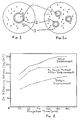
- the composite material used for cold dry plating is a mixture of mono nucleus iron alloy particle encapsulated by a zinc iron alloy (simply referred to as mono nucleus particles) and zinc-iron alloy encapsulating several iron alloy particles (simply referred to as poly nuclei particles), Figure 1 and Figure 1a.
- the composite material of this invention when compared with the earlier conventional ejection powders, especially those using zinc or zinc alloy as the coating material, the composite material of this invention has higher adhesivity to the surface to be treated, is able to form a strong polycrystalline structured coating film with a higher coating amount, and a defined composition of the zinc-iron alloy. In order to achieve such effects, the composite material must satisfy the conditions specified below.
- the composite material is composed of mono nucleus particles and poly nuclei particles, the first consisting in one single iron alloy particle encapsulated by a zinc-iron alloy and the second type of particles are composed by several iron alloy particles encapsulated by a zinc-iron alloy (see Figure 1 and Figure 1a).
- the composite material has total zinc content between 45% and 80%, aluminum content between 1.4 and 2.4% and a total concentration of the three elements copper, magnesium and tin, between about 2.3 and 4.0% (preferably between about 2.5% and 3.8%), the balance being iron alloy and incidental impurities.
- the zinc-iron alloy encapsulating the iron alloy particles is composed of two defined compounds: Fe Zn 13 and Fe Zn 7 comprising 6% to 13% Fe, not more than 5.0% Al, and not more than 5% of Cu + Mg + Sn; the balance being Zn and incidental impurities.
- the iron alloy particles encapsulated have a typical chemical composition of Fe 97.7%, C 0.8%, Mn 1.0% and a micro Vickers hardness of 790 HV at least.
- the shape of the iron alloy particles has to be free of sharp angles, regular and with multiple facets; and better they have to be spherical.
- the two defined substances and Fe Zn 13 and Fe Zn 7 are developed on the surface of the iron or iron alloy nuclei and encapsulate the iron or iron alloy particle by cocrystallization on the iron alloy nucleus.
- the iron or iron alloy particles are encapsulated by an homogeneous layer of a zinc-iron alloy of defined composition containing between about 6% and 13% of iron.
- the inert substance acts as a reaction controller and also prevents or avoids the iron or iron alloy encapsulated particles to stick strongly together.
- the reaction mixture is cooled, crushed and afterwards, milled; at this step, the inert substance acts as an assistance for particle separation, and therefore, allows the manufacture of a composite material with a narrow particle size distribution in the range of about 40 to 2000 microns with an uniform zinc-iron alloy layer covering the spherical iron or iron alloy nuclei.
- the cold dry zinc alloy plating method refers to a process of projection of the composite material onto the surface of a substrate to be treated to operate a transfer of the zinc or zinc alloy from the composite material to the surface of the substrate.
- the particles of the composite material collide against the surface to be treated with a high energy (high speed).
- the surface of the composite material coming in close contact with the substrate is bonded to the substrate and separates from the rest of the composite material.
- the bonding strength of the zinc-iron alloy to the substrate is greater than the breaking strength of zinc-iron alloy from the composite material.
- the transfer is improved b y the presence of the release layer of Fe Al 3 on the iron core.
- This effect is achieved by a good control of the reaction allowing a defined composition of the zinc-iron alloy: Fe Zn 13 and Fe Zn 7 , wherein during the cooling of the composite material after manufacture, intergranular fractures occurs at the grain boundaries into the zinc iron alloy structure and, therefore, the breaking strength is reduced.
- the hardness of zinc alloy is suitable for the easy transfer of zinc alloy from the ejection powder on to the substrate, but the hardness of the zinc alloy is a significant factor for limitation of the importance of the zinc alloy film formation on the substrate.
- the quantity of zinc alloy adhering to the substrate has a limitation: when the number of applications is increased, the quantity of zinc alloy fixed on the substrate decrease.
- the amount of zinc alloy deposed on the substrate by dry plating is at present limited in the earlier prior art techniques, because the zinc alloy content of the ejection powder is limited to the range 32 to 40%; the particle size distribution is broad and the chemical composition of the zinc alloy is not really defined.
- the improved zinc iron alloy film formation on metallic substrates uses a cold dry plating process which involves a special composite material.
- the special composite material has a spherical shape with a multilayer structure as shown in Figure 1 (or Figure 1a) of the drawings.
- the spherical core 1 is comprised of iron alloy material.
- the layer 2 encapsulating the spherical iron core is defined as Fe Al 3 and acts as a release layer to help the separation of the zinc alloy (layer 3) from the spherical iron core onto the metallic substrate during the cold plating process.
- the layer 3 is composed of zinc iron ally defined as a blend of Fe Zn 13 and Fe Zn 7 .
- the projection material used in the past for dry plating have the following disadvantages:
- the present invention solves these problems through incorporation of the following;
- the composite material with a spherical shape of steel core covered with an uniform layer of a defined composition of zinc iron alloy is projected on the surface to be treated with a speed of 30 m/s (meters/second) at least; and preferably within the range of 30 to about 100 m/s.
- the shock of the composite material on the surface provokes a transfer of zinc alloy from the composite material on to the metallic surface; this transfer is made easier by the presence of the release layer 2 on the spherical iron core.
- the improvement of this invention makes the treatment much more advantageous, shortens the treatment time and reduces the formation of zinc alloy dust by using spherical particle cores.
Landscapes
- Chemical & Material Sciences (AREA)
- Chemical Kinetics & Catalysis (AREA)
- Engineering & Computer Science (AREA)
- Materials Engineering (AREA)
- Mechanical Engineering (AREA)
- Metallurgy (AREA)
- Organic Chemistry (AREA)
- Other Surface Treatments For Metallic Materials (AREA)
- Electroplating Methods And Accessories (AREA)
- Chemically Coating (AREA)
- Electroplating And Plating Baths Therefor (AREA)
- Coating By Spraying Or Casting (AREA)
Applications Claiming Priority (2)
| Application Number | Priority Date | Filing Date | Title |
|---|---|---|---|
| US09/026,330 US6015586A (en) | 1998-02-19 | 1998-02-19 | Cold dry plating process for forming a polycrystalline structure film of zinc-iron by mechanical projection of a composite material |
| US26330 | 1998-02-19 |
Publications (3)
| Publication Number | Publication Date |
|---|---|
| EP0942074A2 true EP0942074A2 (de) | 1999-09-15 |
| EP0942074A3 EP0942074A3 (de) | 2001-10-17 |
| EP0942074B1 EP0942074B1 (de) | 2006-02-22 |
Family
ID=21831211
Family Applications (1)
| Application Number | Title | Priority Date | Filing Date |
|---|---|---|---|
| EP98304066A Expired - Lifetime EP0942074B1 (de) | 1998-02-19 | 1998-05-21 | Kalt-Plattierungsverfahren zur Bildung einer polykristallinen Zink-Eisen-Schicht mittels mechanischem Spritzens eines Verbundmaterials |
Country Status (8)
| Country | Link |
|---|---|
| US (1) | US6015586A (de) |
| EP (1) | EP0942074B1 (de) |
| JP (1) | JPH11264060A (de) |
| KR (1) | KR19990072726A (de) |
| AT (1) | ATE318331T1 (de) |
| BR (1) | BR9900735A (de) |
| DE (1) | DE69833527T2 (de) |
| ES (1) | ES2255131T3 (de) |
Cited By (1)
| Publication number | Priority date | Publication date | Assignee | Title |
|---|---|---|---|---|
| EP1726684A3 (de) * | 2005-05-23 | 2007-07-11 | Dowa Mining Co., Ltd. | Bestrahlungspulver zum mechanischen Beschichten und korrosionsfeste Beschichtung |
Families Citing this family (8)
| Publication number | Priority date | Publication date | Assignee | Title |
|---|---|---|---|---|
| JP3468739B2 (ja) * | 1999-12-27 | 2003-11-17 | 新東ブレーター株式会社 | 高耐食性かつ対カーボン低接触抵抗性金属の燃料電池用セパレーターへの付着方法 |
| US6365222B1 (en) | 2000-10-27 | 2002-04-02 | Siemens Westinghouse Power Corporation | Abradable coating applied with cold spray technique |
| US6491208B2 (en) | 2000-12-05 | 2002-12-10 | Siemens Westinghouse Power Corporation | Cold spray repair process |
| US6444259B1 (en) | 2001-01-30 | 2002-09-03 | Siemens Westinghouse Power Corporation | Thermal barrier coating applied with cold spray technique |
| US6780458B2 (en) * | 2001-08-01 | 2004-08-24 | Siemens Westinghouse Power Corporation | Wear and erosion resistant alloys applied by cold spray technique |
| US6706319B2 (en) | 2001-12-05 | 2004-03-16 | Siemens Westinghouse Power Corporation | Mixed powder deposition of components for wear, erosion and abrasion resistant applications |
| US6815642B2 (en) * | 2001-12-19 | 2004-11-09 | Delphi Technologies, Inc. | Apparatus and method for heating a steering wheel |
| GB2492831A (en) | 2011-07-14 | 2013-01-16 | Hkpb Scient Ltd | Workpiece surface modification during ultrasonic peening |
Family Cites Families (17)
| Publication number | Priority date | Publication date | Assignee | Title |
|---|---|---|---|---|
| USRE23861E (en) | 1954-08-31 | Cladding metal | ||
| US23861A (en) * | 1859-05-03 | Improvement in revolving fire-arms | ||
| US2149253A (en) * | 1937-05-19 | 1939-03-07 | Harry A Cooper | Method of treating metal surfaces to inhibit corrosion |
| US2640002A (en) * | 1951-04-17 | 1953-05-26 | Tainton Company | Cladding metal |
| US3447950A (en) * | 1966-02-03 | 1969-06-03 | Valley Metallurg Processing | Production of encapsulated powders |
| GB1377484A (en) * | 1970-12-14 | 1974-12-18 | Hempels Skibsfarvefabrik As J | Method of and composition for the blast cleaning and the simultan eous corrosion-protection of metal surfaces |
| US3754976A (en) * | 1971-12-06 | 1973-08-28 | Nasa | Peen plating |
| JPS55107703A (en) * | 1979-02-10 | 1980-08-19 | Dowa Teppun Kogyo Kk | Production of zinc base powder |
| JPS599312B2 (ja) * | 1979-09-13 | 1984-03-01 | 同和鉄粉工業株式会社 | ブラスト用材料およびこの材料を使用した表面処理法 |
| JPS6138870A (ja) * | 1984-07-30 | 1986-02-24 | Dowa Teppun Kogyo Kk | メカニカルプレ−テイング用混合粉体およびこれを使用した連続メカニカルプレ−テイング法 |
| JPS62140788A (ja) * | 1985-12-16 | 1987-06-24 | 株式会社東芝 | 工業用ロボツトのハンド |
| JPS63250472A (ja) * | 1987-04-06 | 1988-10-18 | Sumitomo Metal Ind Ltd | 高耐食性を有する鋼材の製造方法 |
| JPH01283388A (ja) * | 1988-05-10 | 1989-11-14 | Sumitomo Metal Ind Ltd | ブラスト材料と高耐食性金属材料と製造法 |
| JP2890599B2 (ja) * | 1990-02-06 | 1999-05-17 | ソニー株式会社 | 加工方法 |
| DE69016433T2 (de) * | 1990-05-19 | 1995-07-20 | Papyrin Anatolij Nikiforovic | Beschichtungsverfahren und -vorrichtung. |
| JP2963272B2 (ja) * | 1992-02-14 | 1999-10-18 | 同和鉄粉工業株式会社 | メカニカルプレーティング用投射材及びこれを使用するメカニカルプレーティング方法 |
| JPH0953168A (ja) * | 1995-07-27 | 1997-02-25 | Shigeru Omori | 常温乾式亜鉛合金メッキ用投射材の製造方法およびその投射材を使用した表面処理方法。 |
-
1998
- 1998-02-19 US US09/026,330 patent/US6015586A/en not_active Expired - Fee Related
- 1998-05-21 AT AT98304066T patent/ATE318331T1/de not_active IP Right Cessation
- 1998-05-21 EP EP98304066A patent/EP0942074B1/de not_active Expired - Lifetime
- 1998-05-21 DE DE69833527T patent/DE69833527T2/de not_active Expired - Fee Related
- 1998-05-21 ES ES98304066T patent/ES2255131T3/es not_active Expired - Lifetime
-
1999
- 1999-01-05 JP JP11000667A patent/JPH11264060A/ja active Pending
- 1999-02-18 BR BR9900735-5A patent/BR9900735A/pt not_active IP Right Cessation
- 1999-02-18 KR KR1019990005396A patent/KR19990072726A/ko not_active Ceased
Cited By (1)
| Publication number | Priority date | Publication date | Assignee | Title |
|---|---|---|---|---|
| EP1726684A3 (de) * | 2005-05-23 | 2007-07-11 | Dowa Mining Co., Ltd. | Bestrahlungspulver zum mechanischen Beschichten und korrosionsfeste Beschichtung |
Also Published As
| Publication number | Publication date |
|---|---|
| ATE318331T1 (de) | 2006-03-15 |
| KR19990072726A (ko) | 1999-09-27 |
| EP0942074B1 (de) | 2006-02-22 |
| DE69833527D1 (de) | 2006-04-27 |
| ES2255131T3 (es) | 2006-06-16 |
| BR9900735A (pt) | 1999-12-14 |
| DE69833527T2 (de) | 2006-11-02 |
| EP0942074A3 (de) | 2001-10-17 |
| JPH11264060A (ja) | 1999-09-28 |
| US6015586A (en) | 2000-01-18 |
Similar Documents
| Publication | Publication Date | Title |
|---|---|---|
| KR900002575B1 (ko) | 기계적 플레이팅용 블라스트 재료 및 연속 기계적 플레이팅 법 | |
| US10092953B2 (en) | Method of controlling the corrosion rate of alloy particles, alloy particle with controlled corrosion rate, and articles comprising the particle | |
| US6015586A (en) | Cold dry plating process for forming a polycrystalline structure film of zinc-iron by mechanical projection of a composite material | |
| WO2008057710A2 (en) | Method for coating a substrate and coated product | |
| EP0556065B1 (de) | Verfahren zur Herstellung von Bestrahlungspulver zum mechanischen Beschichten und Bestrahlungsverfahren zu seiner Anwendung | |
| Mousavian et al. | A comparison study of applying metallic coating on SiC particles for manufacturing of cast aluminum matrix composites | |
| EP0719184B1 (de) | Kompositpulver zum thermischen sprühbeschichten | |
| JP2015533864A (ja) | 亜鉛−マグネシウム合金耐食性顔料、耐食性ペイント、および前記耐食性顔料の製造方法 | |
| CA2029436A1 (en) | Zinc powder for alkaline batteries | |
| WO2001004373A1 (en) | Sprayed copper-aluminum composite material and method for producing the same | |
| KR101188120B1 (ko) | 기계 도금용 투사재 및 고내식성 피막 | |
| CN108342622A (zh) | 一种稀土涂层复合铝硅铜合金的制备方法 | |
| JPH0317899B2 (de) | ||
| JPH07224370A (ja) | 青銅系軸受材料及びその製造方法 | |
| JPS6296601A (ja) | シヨツト用金属粉末 | |
| JPH02265222A (ja) | 高耐食性希土類系永久ボンド磁石、希土類系永久磁石粉末およびその製造方法 | |
| RU2335380C2 (ru) | Способ получения металлов и сплавов в виде порошков | |
| JPH0953168A (ja) | 常温乾式亜鉛合金メッキ用投射材の製造方法およびその投射材を使用した表面処理方法。 | |
| JP3135893B2 (ja) | 銅−アルミニウム複合溶射層 | |
| PL191938B1 (pl) | Stop cynku, zwłaszcza do cynkowania ogniowego i sposób jego wytwarzania | |
| JPH0716877B2 (ja) | 防錆用ブラスト材およびこのブラスト材の製造方法ならびにこのブラスト材を使用した金属体の防錆方法 | |
| PL191939B1 (pl) | Stop cynku i sposób jego wytwarzania |
Legal Events
| Date | Code | Title | Description |
|---|---|---|---|
| PUAI | Public reference made under article 153(3) epc to a published international application that has entered the european phase |
Free format text: ORIGINAL CODE: 0009012 |
|
| AK | Designated contracting states |
Kind code of ref document: A2 Designated state(s): AT BE CH CY DE DK ES FI FR GB GR IE IT LI LU MC NL PT SE Kind code of ref document: A2 Designated state(s): AT BE CH DE ES FR GB IT LI NL SE |
|
| AX | Request for extension of the european patent |
Free format text: AL;LT;LV;MK;RO;SI |
|
| PUAL | Search report despatched |
Free format text: ORIGINAL CODE: 0009013 |
|
| RIC1 | Information provided on ipc code assigned before grant |
Free format text: 7C 23C 24/04 A, 7B 22F 1/02 B |
|
| AK | Designated contracting states |
Kind code of ref document: A3 Designated state(s): AT BE CH CY DE DK ES FI FR GB GR IE IT LI LU MC NL PT SE |
|
| AX | Request for extension of the european patent |
Free format text: AL;LT;LV;MK;RO;SI |
|
| 17P | Request for examination filed |
Effective date: 20020405 |
|
| AKX | Designation fees paid |
Free format text: AT BE CH DE ES FR GB IT LI NL SE |
|
| 17Q | First examination report despatched |
Effective date: 20020920 |
|
| GRAP | Despatch of communication of intention to grant a patent |
Free format text: ORIGINAL CODE: EPIDOSNIGR1 |
|
| GRAS | Grant fee paid |
Free format text: ORIGINAL CODE: EPIDOSNIGR3 |
|
| RAP1 | Party data changed (applicant data changed or rights of an application transferred) |
Owner name: ACHESON INDUSTRIES, INC. |
|
| GRAA | (expected) grant |
Free format text: ORIGINAL CODE: 0009210 |
|
| AK | Designated contracting states |
Kind code of ref document: B1 Designated state(s): AT BE CH DE ES FR GB IT LI NL SE |
|
| REG | Reference to a national code |
Ref country code: GB Ref legal event code: FG4D |
|
| REG | Reference to a national code |
Ref country code: CH Ref legal event code: EP |
|
| REF | Corresponds to: |
Ref document number: 69833527 Country of ref document: DE Date of ref document: 20060427 Kind code of ref document: P |
|
| REG | Reference to a national code |
Ref country code: CH Ref legal event code: NV Representative=s name: PATENTANWAELTE SCHAAD, BALASS, MENZL & PARTNER AG |
|
| REG | Reference to a national code |
Ref country code: SE Ref legal event code: TRGR |
|
| REG | Reference to a national code |
Ref country code: ES Ref legal event code: FG2A Ref document number: 2255131 Country of ref document: ES Kind code of ref document: T3 |
|
| ET | Fr: translation filed | ||
| PLBI | Opposition filed |
Free format text: ORIGINAL CODE: 0009260 |
|
| PLAX | Notice of opposition and request to file observation + time limit sent |
Free format text: ORIGINAL CODE: EPIDOSNOBS2 |
|
| 26 | Opposition filed |
Opponent name: DOWA IRON POWDER CO.,LTD. Effective date: 20061122 |
|
| NLR1 | Nl: opposition has been filed with the epo |
Opponent name: DOWA IRON POWDER CO.,LTD. |
|
| PLAF | Information modified related to communication of a notice of opposition and request to file observations + time limit |
Free format text: ORIGINAL CODE: EPIDOSCOBS2 |
|
| PLBB | Reply of patent proprietor to notice(s) of opposition received |
Free format text: ORIGINAL CODE: EPIDOSNOBS3 |
|
| PGFP | Annual fee paid to national office [announced via postgrant information from national office to epo] |
Ref country code: ES Payment date: 20080513 Year of fee payment: 11 Ref country code: DE Payment date: 20080530 Year of fee payment: 11 Ref country code: CH Payment date: 20080425 Year of fee payment: 11 |
|
| PGFP | Annual fee paid to national office [announced via postgrant information from national office to epo] |
Ref country code: AT Payment date: 20080407 Year of fee payment: 11 |
|
| PGFP | Annual fee paid to national office [announced via postgrant information from national office to epo] |
Ref country code: BE Payment date: 20080606 Year of fee payment: 11 Ref country code: IT Payment date: 20080513 Year of fee payment: 11 |
|
| PGFP | Annual fee paid to national office [announced via postgrant information from national office to epo] |
Ref country code: SE Payment date: 20080505 Year of fee payment: 11 Ref country code: NL Payment date: 20080410 Year of fee payment: 11 |
|
| PGFP | Annual fee paid to national office [announced via postgrant information from national office to epo] |
Ref country code: GB Payment date: 20080407 Year of fee payment: 11 |
|
| BERE | Be: lapsed |
Owner name: *ACHESON INDUSTRIES INC. Effective date: 20090531 |
|
| REG | Reference to a national code |
Ref country code: CH Ref legal event code: PL |
|
| GBPC | Gb: european patent ceased through non-payment of renewal fee |
Effective date: 20090521 |
|
| PG25 | Lapsed in a contracting state [announced via postgrant information from national office to epo] |
Ref country code: LI Free format text: LAPSE BECAUSE OF NON-PAYMENT OF DUE FEES Effective date: 20090531 Ref country code: CH Free format text: LAPSE BECAUSE OF NON-PAYMENT OF DUE FEES Effective date: 20090531 Ref country code: AT Free format text: LAPSE BECAUSE OF NON-PAYMENT OF DUE FEES Effective date: 20090521 |
|
| NLV4 | Nl: lapsed or anulled due to non-payment of the annual fee |
Effective date: 20091201 |
|
| PG25 | Lapsed in a contracting state [announced via postgrant information from national office to epo] |
Ref country code: NL Free format text: LAPSE BECAUSE OF NON-PAYMENT OF DUE FEES Effective date: 20091201 |
|
| REG | Reference to a national code |
Ref country code: FR Ref legal event code: ST Effective date: 20100129 |
|
| PG25 | Lapsed in a contracting state [announced via postgrant information from national office to epo] |
Ref country code: FR Free format text: LAPSE BECAUSE OF NON-PAYMENT OF DUE FEES Effective date: 20090602 |
|
| PGFP | Annual fee paid to national office [announced via postgrant information from national office to epo] |
Ref country code: FR Payment date: 20080424 Year of fee payment: 11 |
|
| PG25 | Lapsed in a contracting state [announced via postgrant information from national office to epo] |
Ref country code: GB Free format text: LAPSE BECAUSE OF NON-PAYMENT OF DUE FEES Effective date: 20090521 |
|
| PG25 | Lapsed in a contracting state [announced via postgrant information from national office to epo] |
Ref country code: DE Free format text: LAPSE BECAUSE OF NON-PAYMENT OF DUE FEES Effective date: 20091201 Ref country code: BE Free format text: LAPSE BECAUSE OF NON-PAYMENT OF DUE FEES Effective date: 20090531 |
|
| REG | Reference to a national code |
Ref country code: ES Ref legal event code: FD2A Effective date: 20090522 |
|
| PG25 | Lapsed in a contracting state [announced via postgrant information from national office to epo] |
Ref country code: ES Free format text: LAPSE BECAUSE OF NON-PAYMENT OF DUE FEES Effective date: 20090522 |
|
| PG25 | Lapsed in a contracting state [announced via postgrant information from national office to epo] |
Ref country code: IT Free format text: LAPSE BECAUSE OF NON-PAYMENT OF DUE FEES Effective date: 20090521 |
|
| PG25 | Lapsed in a contracting state [announced via postgrant information from national office to epo] |
Ref country code: SE Free format text: LAPSE BECAUSE OF NON-PAYMENT OF DUE FEES Effective date: 20090522 |
|
| PLBD | Termination of opposition procedure: decision despatched |
Free format text: ORIGINAL CODE: EPIDOSNOPC1 |
|
| PLBM | Termination of opposition procedure: date of legal effect published |
Free format text: ORIGINAL CODE: 0009276 |
|
| STAA | Information on the status of an ep patent application or granted ep patent |
Free format text: STATUS: OPPOSITION PROCEDURE CLOSED |
|
| 27C | Opposition proceedings terminated |
Effective date: 20120921 |