EP0928617B1 - Appareil pour récupérer des composants sanguins et méthode associée - Google Patents
Appareil pour récupérer des composants sanguins et méthode associée Download PDFInfo
- Publication number
- EP0928617B1 EP0928617B1 EP98123520A EP98123520A EP0928617B1 EP 0928617 B1 EP0928617 B1 EP 0928617B1 EP 98123520 A EP98123520 A EP 98123520A EP 98123520 A EP98123520 A EP 98123520A EP 0928617 B1 EP0928617 B1 EP 0928617B1
- Authority
- EP
- European Patent Office
- Prior art keywords
- blood
- filter
- pressing member
- recovering
- recovering apparatus
- Prior art date
- Legal status (The legal status is an assumption and is not a legal conclusion. Google has not performed a legal analysis and makes no representation as to the accuracy of the status listed.)
- Expired - Lifetime
Links
- 210000004369 blood Anatomy 0.000 title claims description 158
- 239000008280 blood Substances 0.000 title claims description 158
- 239000012503 blood component Substances 0.000 title claims description 29
- 238000000034 method Methods 0.000 title claims description 29
- 210000000265 leukocyte Anatomy 0.000 claims description 90
- 238000003825 pressing Methods 0.000 claims description 90
- 239000000835 fiber Substances 0.000 claims description 76
- 238000001914 filtration Methods 0.000 claims description 68
- 230000017531 blood circulation Effects 0.000 claims description 52
- 210000003743 erythrocyte Anatomy 0.000 claims description 35
- 238000005406 washing Methods 0.000 claims description 25
- 229920005989 resin Polymers 0.000 claims description 8
- 239000011347 resin Substances 0.000 claims description 8
- 210000004700 fetal blood Anatomy 0.000 claims description 7
- 239000010410 layer Substances 0.000 description 43
- 239000000243 solution Substances 0.000 description 32
- 239000004745 nonwoven fabric Substances 0.000 description 21
- 210000001772 blood platelet Anatomy 0.000 description 16
- 239000002504 physiological saline solution Substances 0.000 description 16
- 210000004027 cell Anatomy 0.000 description 12
- 230000003394 haemopoietic effect Effects 0.000 description 12
- 238000011084 recovery Methods 0.000 description 10
- 239000012530 fluid Substances 0.000 description 9
- 210000003958 hematopoietic stem cell Anatomy 0.000 description 9
- 239000000463 material Substances 0.000 description 9
- 239000003146 anticoagulant agent Substances 0.000 description 7
- 239000002243 precursor Substances 0.000 description 7
- IJRKANNOPXMZSG-SSPAHAAFSA-N 2-hydroxypropane-1,2,3-tricarboxylic acid;(2r,3s,4r,5r)-2,3,4,5,6-pentahydroxyhexanal Chemical compound OC[C@@H](O)[C@@H](O)[C@H](O)[C@@H](O)C=O.OC(=O)CC(O)(C(O)=O)CC(O)=O IJRKANNOPXMZSG-SSPAHAAFSA-N 0.000 description 5
- 210000001185 bone marrow Anatomy 0.000 description 5
- 150000001875 compounds Chemical class 0.000 description 5
- 210000005259 peripheral blood Anatomy 0.000 description 5
- 239000011886 peripheral blood Substances 0.000 description 5
- 241000283690 Bos taurus Species 0.000 description 4
- LFQSCWFLJHTTHZ-UHFFFAOYSA-N Ethanol Chemical compound CCO LFQSCWFLJHTTHZ-UHFFFAOYSA-N 0.000 description 4
- -1 for instance Substances 0.000 description 4
- 210000003714 granulocyte Anatomy 0.000 description 4
- 210000001616 monocyte Anatomy 0.000 description 4
- 239000011148 porous material Substances 0.000 description 4
- HTTJABKRGRZYRN-UHFFFAOYSA-N Heparin Chemical compound OC1C(NC(=O)C)C(O)OC(COS(O)(=O)=O)C1OC1C(OS(O)(=O)=O)C(O)C(OC2C(C(OS(O)(=O)=O)C(OC3C(C(O)C(O)C(O3)C(O)=O)OS(O)(=O)=O)C(CO)O2)NS(O)(=O)=O)C(C(O)=O)O1 HTTJABKRGRZYRN-UHFFFAOYSA-N 0.000 description 3
- WOBHKFSMXKNTIM-UHFFFAOYSA-N Hydroxyethyl methacrylate Chemical compound CC(=C)C(=O)OCCO WOBHKFSMXKNTIM-UHFFFAOYSA-N 0.000 description 3
- 229960002897 heparin Drugs 0.000 description 3
- 229920000669 heparin Polymers 0.000 description 3
- 229920000139 polyethylene terephthalate Polymers 0.000 description 3
- 239000005020 polyethylene terephthalate Substances 0.000 description 3
- 238000002360 preparation method Methods 0.000 description 3
- 238000000926 separation method Methods 0.000 description 3
- 238000002560 therapeutic procedure Methods 0.000 description 3
- 239000012981 Hank's balanced salt solution Substances 0.000 description 2
- 206010028980 Neoplasm Diseases 0.000 description 2
- 206010037660 Pyrexia Diseases 0.000 description 2
- 208000007536 Thrombosis Diseases 0.000 description 2
- 201000011510 cancer Diseases 0.000 description 2
- 238000006243 chemical reaction Methods 0.000 description 2
- 229920001577 copolymer Polymers 0.000 description 2
- 230000000694 effects Effects 0.000 description 2
- 239000006260 foam Substances 0.000 description 2
- 239000011229 interlayer Substances 0.000 description 2
- 210000004698 lymphocyte Anatomy 0.000 description 2
- 229920000728 polyester Polymers 0.000 description 2
- 229920000642 polymer Polymers 0.000 description 2
- 229920000098 polyolefin Polymers 0.000 description 2
- 229920000915 polyvinyl chloride Polymers 0.000 description 2
- 239000004800 polyvinyl chloride Substances 0.000 description 2
- 210000000130 stem cell Anatomy 0.000 description 2
- 229920002818 (Hydroxyethyl)methacrylate Polymers 0.000 description 1
- SJIXRGNQPBQWMK-UHFFFAOYSA-N 2-(diethylamino)ethyl 2-methylprop-2-enoate Chemical compound CCN(CC)CCOC(=O)C(C)=C SJIXRGNQPBQWMK-UHFFFAOYSA-N 0.000 description 1
- 108091003079 Bovine Serum Albumin Proteins 0.000 description 1
- 206010008531 Chills Diseases 0.000 description 1
- 229920000742 Cotton Polymers 0.000 description 1
- 108091006905 Human Serum Albumin Proteins 0.000 description 1
- 102000008100 Human Serum Albumin Human genes 0.000 description 1
- 241001465754 Metazoa Species 0.000 description 1
- 239000004952 Polyamide Substances 0.000 description 1
- 239000004793 Polystyrene Substances 0.000 description 1
- 208000003251 Pruritus Diseases 0.000 description 1
- 238000004220 aggregation Methods 0.000 description 1
- 230000002776 aggregation Effects 0.000 description 1
- 230000000735 allogeneic effect Effects 0.000 description 1
- 229910052782 aluminium Inorganic materials 0.000 description 1
- XAGFODPZIPBFFR-UHFFFAOYSA-N aluminium Chemical compound [Al] XAGFODPZIPBFFR-UHFFFAOYSA-N 0.000 description 1
- 239000011324 bead Substances 0.000 description 1
- 210000000601 blood cell Anatomy 0.000 description 1
- 229940098773 bovine serum albumin Drugs 0.000 description 1
- 239000007853 buffer solution Substances 0.000 description 1
- 229920002678 cellulose Polymers 0.000 description 1
- 239000001913 cellulose Substances 0.000 description 1
- 229920002301 cellulose acetate Polymers 0.000 description 1
- 238000005119 centrifugation Methods 0.000 description 1
- 238000002512 chemotherapy Methods 0.000 description 1
- 230000006835 compression Effects 0.000 description 1
- 238000007906 compression Methods 0.000 description 1
- 239000000470 constituent Substances 0.000 description 1
- 230000003247 decreasing effect Effects 0.000 description 1
- 230000001419 dependent effect Effects 0.000 description 1
- 239000002657 fibrous material Substances 0.000 description 1
- 230000008014 freezing Effects 0.000 description 1
- 238000007710 freezing Methods 0.000 description 1
- 125000000524 functional group Chemical group 0.000 description 1
- 239000003365 glass fiber Substances 0.000 description 1
- 230000005484 gravity Effects 0.000 description 1
- 230000002949 hemolytic effect Effects 0.000 description 1
- 125000002887 hydroxy group Chemical group [H]O* 0.000 description 1
- 229910052588 hydroxylapatite Inorganic materials 0.000 description 1
- 230000036046 immunoreaction Effects 0.000 description 1
- 239000012784 inorganic fiber Substances 0.000 description 1
- 230000007803 itching Effects 0.000 description 1
- 208000032839 leukemia Diseases 0.000 description 1
- 239000007788 liquid Substances 0.000 description 1
- 229920001684 low density polyethylene Polymers 0.000 description 1
- 239000004702 low-density polyethylene Substances 0.000 description 1
- 229910052751 metal Inorganic materials 0.000 description 1
- 239000002184 metal Substances 0.000 description 1
- 150000002739 metals Chemical class 0.000 description 1
- CERQOIWHTDAKMF-UHFFFAOYSA-M methacrylate group Chemical group C(C(=C)C)(=O)[O-] CERQOIWHTDAKMF-UHFFFAOYSA-M 0.000 description 1
- QJGQUHMNIGDVPM-UHFFFAOYSA-N nitrogen group Chemical group [N] QJGQUHMNIGDVPM-UHFFFAOYSA-N 0.000 description 1
- XYJRXVWERLGGKC-UHFFFAOYSA-D pentacalcium;hydroxide;triphosphate Chemical compound [OH-].[Ca+2].[Ca+2].[Ca+2].[Ca+2].[Ca+2].[O-]P([O-])([O-])=O.[O-]P([O-])([O-])=O.[O-]P([O-])([O-])=O XYJRXVWERLGGKC-UHFFFAOYSA-D 0.000 description 1
- 239000008363 phosphate buffer Substances 0.000 description 1
- 229920001200 poly(ethylene-vinyl acetate) Polymers 0.000 description 1
- 229920002239 polyacrylonitrile Polymers 0.000 description 1
- 229920002647 polyamide Polymers 0.000 description 1
- 229920000515 polycarbonate Polymers 0.000 description 1
- 239000004417 polycarbonate Substances 0.000 description 1
- 229920002223 polystyrene Polymers 0.000 description 1
- 229920002635 polyurethane Polymers 0.000 description 1
- 239000004814 polyurethane Substances 0.000 description 1
- 102000004169 proteins and genes Human genes 0.000 description 1
- 108090000623 proteins and genes Proteins 0.000 description 1
- 229910001220 stainless steel Inorganic materials 0.000 description 1
- 239000010935 stainless steel Substances 0.000 description 1
- 229920002994 synthetic fiber Polymers 0.000 description 1
- 239000012209 synthetic fiber Substances 0.000 description 1
- 229920003002 synthetic resin Polymers 0.000 description 1
- 239000000057 synthetic resin Substances 0.000 description 1
- 238000003466 welding Methods 0.000 description 1
Images
Classifications
-
- A—HUMAN NECESSITIES
- A61—MEDICAL OR VETERINARY SCIENCE; HYGIENE
- A61M—DEVICES FOR INTRODUCING MEDIA INTO, OR ONTO, THE BODY; DEVICES FOR TRANSDUCING BODY MEDIA OR FOR TAKING MEDIA FROM THE BODY; DEVICES FOR PRODUCING OR ENDING SLEEP OR STUPOR
- A61M1/00—Suction or pumping devices for medical purposes; Devices for carrying-off, for treatment of, or for carrying-over, body-liquids; Drainage systems
- A61M1/36—Other treatment of blood in a by-pass of the natural circulatory system, e.g. temperature adaptation, irradiation ; Extra-corporeal blood circuits
- A61M1/3621—Extra-corporeal blood circuits
- A61M1/3627—Degassing devices; Buffer reservoirs; Drip chambers; Blood filters
- A61M1/3633—Blood component filters, e.g. leukocyte filters
-
- A—HUMAN NECESSITIES
- A61—MEDICAL OR VETERINARY SCIENCE; HYGIENE
- A61M—DEVICES FOR INTRODUCING MEDIA INTO, OR ONTO, THE BODY; DEVICES FOR TRANSDUCING BODY MEDIA OR FOR TAKING MEDIA FROM THE BODY; DEVICES FOR PRODUCING OR ENDING SLEEP OR STUPOR
- A61M2202/00—Special media to be introduced, removed or treated
- A61M2202/04—Liquids
- A61M2202/0413—Blood
- A61M2202/0439—White blood cells; Leucocytes
Definitions
- the present invention relates to an apparatus for recovering blood components such as leukocytes from blood containing the blood components and in particular to an apparatus for recovering hematopoietic stem cell- and/or hematopoietic precursor cell-derived leukocytes from umbilical cord blood, bone marrow blood, peripheral blood etc., and a method of recovering blood components using the same.
- Blood preparations from which leukocytes have been removed have been utilized in blood transfusion in order to prevent non-hemolytic fever reactions such as fever, chill, itching etc. These reactions occur as side effects of blood transfusion, especially, in treatment of patients who frequently undergo blood transfusion, which result from allogeneic immunoreaction by leukocytes.
- Such blood preparations from which leukocytes have been removed have been produced by a centrifugation method utilizing the difference in specific gravity among blood components, or a recovery method of using a leukocyte-removing filter and the like.
- the method of using a leukocyte-removing filter has been used widely because blood preparations from which leukocytes are removed to a high degree can be obtained in a simple operation. Leukocytes adsorbed onto the filter were discarded along with the filter.
- hematopoietic stem cells and hematopoietic precursor cells contained in bone marrow blood and peripheral blood have been transplanted in patients in order to overcome the hematopoietic obstacles.
- hematopoietic stem cells and/or hematopoietic precursor cells are also contained in umbilical cord blood, and therapy by transplanting umbilical cord blood stem cells is also expected to be a promising method.
- cryopreserved blood cells are thawed to be transplanted into patients with hematopoietic obstacles (WO 96/17514). If cryopreserved blood is contaminated with erythrocytes, after the blood is thawed the erythrocytes are lyzed to cause side effects. Therefore, the erythrocytes should previously be removed from blood before freezing.
- the method comprises passing a cell population containing erythrocytes, hematopoietic stem cells and hematopoietic precursor cells through a filter which is capable of passing erythrocytes but capturing leukocytes, causing a fluid flow in the opposite direction to the passing fluid, and recovering the captured leukocytes.
- a filter which is capable of passing erythrocytes but capturing leukocytes, causing a fluid flow in the opposite direction to the passing fluid, and recovering the captured leukocytes.
- 121,849/1987 discloses a method of obtaining hematopoietic stem cells, which comprises passing a cell population containing erythrocytes, hematopoietic stem cells, monocytes and granulocytes through a first capturing means which is capable of passing erythrocytes but capable of capturing leukocytes, recovering the captured leukocytes in a recovery solution, passing the recovered leukocytes through a second capturing means which is capable of capturing monocytes and granulocytes but passing hematopoietic stem cells, and obtaining hematopoietic stem cells from said capturing means.
- a similar apparatus for recovering leucocytes is also disclosed in US-A-4,416,777.
- the method of passing a recovering solution in the same direction as that of the first passing solution requires raising the liquid pressure of the recovering solution in order to wash out leukocytes captured in the fibers, thus making it difficult to recover leukocytes in high yield.
- the method of recovering leukocytes captured by causing a fluid flow in the opposite direction to the first passing fluid permits spaces between the fibers to be disordered thus achieving a higher yield of leukocytes than the method of passing a fluid flow in the same direction as the first passing fluid, but nevertheless the captured leukocytes cannot sufficiently be recovered.
- a different type of blood-recovering apparatus is known from US patent no. 3,747,769.
- the apparatus disclosed therein is adapted to filter blood clots from blood flowing through the apparatus while letting normal constituents pass.
- a filter material a foam is used. Pressing means are provided to compress the filter, thus varying the size of pores in the foam. After use, the apparatus is discarded together with the filtered blood clots or emboli.
- An object of the present invention is to provide an apparatus for high-yield recovery of leukocytes captured in a filter and a method for recovering leukocytes using the same.
- the present invention relates to a blood component-recovering apparatus comprising a housing accommodating (a) a filtration portion charged with (b) a filter which is capable of passing erythrocytes but capturing leukocytes and (c) a pressing member for pressing said filter, the housing being provided in the sidewall thereof with (d) a blood flow inlet and (e) a blood flow outlet communicating with said filtration portion.
- the housing of said blood component-recovering apparatus is further provided in the upper wall thereof with (f) a means capable of transferring, or moving, the pressing member vertically.
- the pressing member of said blood components-recovering apparatus is transferred to a downward position and a blood containing desired blood components is passed through the filtration portion.
- the pressing member is then transferred upward to increase the volume of said filtration portion, and a washing solution is then passed to recover leukocytes.
- One embodiment of this invention is a blood component-recovering apparatus comprising a housing accommodating (a) a filtration portion charged with (b) a filter which is capable of passing erythrocytes but capturing leukocytes and (c) a pressing member for pressing said filter, the housing being provided in the sidewall thereof with (d) a blood flow inlet and (e) a blood flow outlet communicating with said filtration portion, and further being provided in the upper wall thereof with (f) a means capable of transferring the pressing member vertically, wherein (c) said pressing member is in a downward position while a blood containing blood components is passed through the filtration portion, and is then transferred upward to increase the volume of said filtration portion.
- a blood component-recovering apparatus comprising a housing accommodating (a) a filtration portion charged with (b) a filter which is capable of passing erythrocytes but capturing leukocytes and (c) a pressing member for pressing said filter, the housing being provided in the sidewall thereof with (d) a blood flow inlet and (e) a blood flow outlet communicating with said filtration portion, and further being provided in the upper wall thereof with (f) a means capable of transferring the pressing member vertically, wherein (c) said pressing member is transferred to a downward position and a blood containing blood components is passed through the filtration portion.
- said means capable of transferring the pressing member vertically comprises (g) a bolt portion consisting of (h) a rod-shaped member having (i)a male screw formed on the sidewall thereof extending in a longitudinal direction above the pressing member, and (j)a hole through which the rod-shaped member can be transferred vertically being formed in the bottom of (k)a concave portion on the upper wall of the housing, and (l)a nut portion having (m)a female screw formed on the inner wall of a cylinder, said nut portion having an outer diameter permitting the cylinder to be inserted into said concave portion and capable of being screw-engaged with the male screw in said bolt portion.
- a blood component-recovering apparatus comprising a housing accommodating (a) a filtration portion charged with (b) a filter which is capable of passing erythrocytes but capturing leukocytes and (c) a pressing member for pressing said filter, the housing being provided in the sidewall thereof with (d) a blood flow inlet and (e) a blood flow outlet communicating with said filtration portion, and being further provided in the upper wall thereof with (f) a means capable of transferring the pressing member vertically, wherein (c) said pressing member is transferred downward while a blood containing desired blood components is passed through the filtration portion, then transferred upward to increase the volume of said filtration portion, and wherein (f) said means capable of transferring the pressing member vertically consists of (n) a rod-shaped member extending in a longitudinal direction above the pressing member, having (o) a lock portion at the bottom and having (p) a male screw formed on the sidewall thereof, (q) a chamber being provided on the pressing member, having (r)
- FIG. 1 Another embodiment of this invention is a blood component-recovering apparatus having a housing comprising (v) an upper lid portion and (w) a lower lid portion, wherein (v) the upper lid portion accommodates (x) a spring body for pressing (a)a filtration portion charged with (b)a filter which is capable of passing erythrocytes but capturing leukocytes and (c) a pressing member is connected to the end of said spring body and is capable of being transferred to the inside of (w)a lower lid portion, and (w)said lower lid portion accommodates (c)said filtration portion, is provided with (d)a blood inlet and (e) a blood outlet and is screw-engaged or fitted to the upper lid portion.
- the upper lid portion accommodates (x) a spring body for pressing (a)a filtration portion charged with (b)a filter which is capable of passing erythrocytes but capturing leukocytes and (c) a pressing member is connected to the end of said spring body and is capable of being transferred to the
- FIG. 1 Another embodiment of this invention is a blood component-recovering apparatus having a housing comprising (v) an upper lid portion and (w) a lower lid portion, wherein (v) an upper lid portion accommodates (x) a spring body for pressing (a)a filtration portion charged with (b)a filter which is capable of passing erythrocytes but capturing leukocytes, and(w)the lower lid portion accommodates (a)said filtration portion and (c) a pressing member placed on (a)the filtration portion, and is provided with (d)a blood inlet and (e)a blood outlet and is screw-engaged or fitted to the upper lid portion.
- a housing comprising (v) an upper lid portion and (w) a lower lid portion, wherein (v) an upper lid portion accommodates (x) a spring body for pressing (a)a filtration portion charged with (b)a filter which is capable of passing erythrocytes but capturing leukocytes, and(w)the lower lid portion accommodates (a)said
- the outer wall of the lower lid portion is provided with a protruding portion
- the sidewall of the upper lid portion is provided with a hole portion consisting of a lengthwise long hole extending in a longitudinal direction and at least one crosswise long hole communicating with said lengthwise long hole, wherein the protruding portion slides along the lengthwise long hole and is locked with the crosswise long hole.
- the present invention is a method of recovering blood components, which comprises passing a blood containing blood components through an apparatus according to anyone of claims 1 to 13, further enlarging or increasing the inner volume of said filtration portion, and passing a washing solution to recover leukocytes.
- the filter capable of passing erythrocytes but capturing leukocytes in the present invention is a fibrous or porous aggregate, for instance, synthetic fibers such as polyester, polyamide, polyacrylonitrile fiber etc., regenerated fibers such as cellulose, cellulose acetate fiber etc., inorganic fibers such as glass fiber, etc., natural fibers such as cotton fiber etc., porous materials such as a foamed molded article, sintered material etc., spherical materials such as hydroxyapatite beads etc.
- the surface of the aggregate constituting said filter is coated with a polymer of a non-ionic hydrophilic group-containing compound such as hydroxyethyl methacrylate and a basic nitrogenous functional group-containing compound such as diethylaminoethyl methacrylate, as described in Japanese Patent Publication No. 51060/1994.
- fibers constituting the filter are obtained from a polymer copolymerized or graft-copolymerized with a hydroxyl group-containing compound or a methacrylate group-containing compound and other polymerizable compounds, as described in Japanese Laid-Open Patent Publication No. 249063/1989.
- the fiber diameter is 25 ⁇ m or less, preferably 10 ⁇ m or less, and more preferably 0.5 to 3 ⁇ m. If the fiber diameter exceeds 25 ⁇ m, the yield of leukocytes captured in the filter tends to decrease.
- the bulk density of the fiber aggregate ranges from 0.05 to 0.50 g/cm 3 , preferably 0.08 to 0.30 g/cm 3 , and more preferably 0.10 to 0.20 g/cm 3 .
- the bulk density of the filter means the bulk density before enlarging the volume of the filtration portion.
- the filter is composed of a multi-layer fiber aggregate, at least one layer has a fiber diameter of 25 ⁇ m or less and a bulk density of 0.05 to 0.50 g/cm 3 .
- the multi-layer structure is composed of 2 to 6 layers, where a layer adjacent to the blood flow inlet having a large fiber diameter and a high bulk density and a layer adjacent to the blood flow outlet having a small fiber diameter and a low bulk density are preferably arranged so that leukocytes can be captured in the order of a decreasing diameter through the layers.
- the filter is a multi-layer fiber aggregate consisting of a fiber aggregate with a fiber diameter of 10 ⁇ m and a bulk density of 0.23 g/cm 3 as a first layer, a fiber aggregate with a fiber diameter of 3.5 ⁇ m and a bulk density of 0.11 g/cm 3 as a second layer and a fiber aggregate with a fiber diameter of 1.5 ⁇ m and a bulk density of 0.12 g/cm 3 as a third layer, then blood components with large diameters will be captured by the first layer, monocytes and granulocytes by the second layer and lymphocytes by the third layer.
- the filter material consists of a porous material, its pore ranges preferably from 1 to 500 ⁇ m.
- the blood which can be treated according to the present invention includes human blood, animal blood, bone marrow blood, peripheral blood, umbilical cord blood, etc. and the blood components include monocytes, granulocytes, lymphocytes, leukocytes derived from hematopoietic stem cells or hematopoietic precursor cells, erythrocytes, platelets, etc.
- the washing solution is preferably physiological saline, Hank's solution (HBSS), a buffer solution such as Dulbecco phosphate buffer (D-PBS) etc., which may optionally contain proteins such as human serum albumin or an anti-coagulation agent.
- HBSS Hank's solution
- D-PBS Dulbecco phosphate buffer
- the present invention provides a blood component-recovering apparatus in which a blood containing these blood components is passed through a filtration portion charged with a filter which is capable of passing erythrocytes but capturing leukocytes, then the inner volume of said filtration portion is increased, and the washing solution is then passed to recover leukocytes.
- the filter may be charged directly in the filtration portion in the rigid housing, or may be charged in a bag consisting of a flexible resin and having a blood flow inlet tube and a blood flow outlet tube, wherein said bag is accommodated in the filtration portion in the rigid housing.
- the bag consisting of a flexible resin is charged with the filter in a compressed condition, and the inner volume of the filtration portion is increased by moving the pressing member upward to increase the inner volume of the bag.
- the housing may be made of a material including a synthetic resin such as polycarbonate, polystyrene, polyolefin, hard polyvinyl chloride etc. and metals such as stainless steel, aluminum etc.
- the bag is formed by welding two sheets of a flexible resin along the edge thereof, and the end of the edge is provided with rigid ports, that is, a blood flow inlet and a blood flow outlet.
- the flexible resin constituting the bag includes polyester, polyolefin, polyurethane, ethylene-vinyl acetate copolymers, and soft polyvinyl chloride.
- the inner volume of the filtration portion in the housing is increased thus further increasing the inner volume of the filter in the housing, and then the washing solution is passed therethrough to recover leukocytes captured in the filter.
- the inner volume of the filtration portion after expansion is at least 1.10-fold, preferably 1.20- to 1.80-fold, and more preferably 1.30- to 1.60-fold relative to the inner volume of the filtration portion before the blood is passed through the filter. If the magnification of expansion of the filtration portion is less than 1.10-fold, there is the possibility that leukocytes captured in the filter cannot sufficiently be recovered, while if the magnification is too high, the housing tends to become large.
- the blood component-recovering apparatus of the present invention is described with reference to the blood component-recovering apparatus shown in Fig. 1.
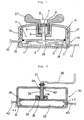
- Fig. 1 is a schematic view of the blood component-recovering apparatus where an upper lid portion (14) and a lower lid portion (15) are completely screw-engaged to form housing (4), and filter (2) is pressed just before blood is passed.
- the lower lid portion (15) is provided with a filtration portion (3) accommodating a filter (2), and its sidewall is provided with blood flow inlet (10) and blood flow outlet (11), and the pressing member (1) is placed on the upper part of the filter (2).
- the pressing member (1) comprises a rod-shaped member (5) extending upward in a longitudinal direction, and the top of the rod-shaped member (5) has a head (7) with a larger diameter than the rod-shaped member (5), and a male screw is formed on the sidewall of the head (7).
- the upper lid portion (14) is provided with a concave portion (6) on the upper wall of the housing (4), and the bottom of the upper lid portion (14) is provided with a hole (19) through which the rod-shaped member (5) can move vertically.
- a nut portion (8) is used to transfer the pressing member (1) vertically.
- the nut portion (8) comprises a cylinder having an outer diameter permitting it to be inserted into the concave portion (6) and has a grasping portion (27) provided with a female screw (9) capable of screw-engagement with the male screw on the head (7) in the inner wall of the cylinder.
- the pressing member (1) is disk-shaped and provided therearound with an O-ring (18) sliding liquid-tightly along the inner wall of the lower lid portion (15).
- a female screw (17) is formed on the inner wall of the opening of the upper lid portion (14), and a male screw (16) is formed on the outer wall of the opening of the lower lid portion, and the female screw (17) and the male screw (16) are screw-engaged to form the housing (4).
- the housing (4) is formed by screw-engagement, but may also be formed by adhesion after fitting.
- the rod-shaped member (5) is provided at the top thereof with the head (7) and the male screw is formed on the sidewall of the head (7), but the male screw may be formed on the sidewall of the rod-shaped member (5).
- the nut portion (8) may be provided with a lock so that screw-engagement between the female screw (9) in the nut portion and the male screw in the head (7) in the rod-shaped member (5) is not loosened after fixing.
- the nut portion (8) is inserted into the concave portion (6), and the female screw (9) on the nut portion (8) is screw-engaged with the male screw on the head (7) of the bar-shaped member (5), and the nut portion (8) is then rotated to transfer the bar-shaped member (5) downward so that the pressing member (1) presses the filter (2).
- the filtration portion (3) reaches a predetermined volume, blood is passed from the blood flow inlet tube (12) through the blood flow inlet (10) to the filter (2) where leukocytes are captured.
- the nut portion (8) is rotated in the opposite direction to transfer the rod-shaped member (5) upward thereby enlarging the volume of the filtration portion (3), and a washing solution is then passed through the filter (2) so that along with the washing solution, leukocytes captured in the filter (2) flow through the blood flow outlet (11), and are recovered from the blood flow outlet tube (13).
- Fig. 2 is a schematic view showing another embodiment of the blood component-recovering apparatus of the present invention, where filter (32) is pressed just before blood is passed.
- the filter (32) is accommodated in bag (31) made of a flexible resin, and a blood flow inlet tube (42) is connected via bag (31) to a blood flow outlet tube (43).
- the blood flow inlet tube (42) and blood flow outlet tube (43) are connected to the outside via a blood flow inlet (44) and a blood flow outlet (45) respectively formed on the sidewall of a housing (30).
- a pressing member (33) is placed on the upper part of the filter (32).
- the upper part of the pressing member (33) is provided with a chamber (34) having a first hole (41) for accommodating a lock portion (35) and permitting a rod-shaped member (36) to penetrate therethrough.
- the lock portion (35) is formed at the bottom of the bar-shaped member (36) and possesses a larger diameter than that of the rod-shaped member (36) and can be freely rotated in the chamber (34).
- the rod-shaped member (36) is provided therearound with a male screw (39) which is screw-engaged with the female screw in a second hole (40) formed on the upper wall of the housing (30) thereby transferring the bar-shaped member (36) vertically.
- the upper end of the rod-shaped member (36) is provided with a head (37) having a larger diameter than that of the rod-shaped member (36) and connected to a grasping portion (38) for rotating the rod-shaped member (36).
- the periphery of the pressing member (33) unlike the pressing member (1) in Fig. 1 does not necessarily require an O-ring (18) because the filter (32) is accommodated in the bag (31).
- the grasping portion (38) is rotated to transfer the rod-shaped member (36) downward to permit the pressing member (33) to press the filter (32).
- bag (31) reaches a predetermined volume, a blood is passed from the blood flow inlet tube (42) to the bag (31) whereby leukocytes are captured in the filter (32).
- the grasping portion (38) is rotated in the opposite direction to transfer the rod shaped member (36) upward thereby enlarging the volume of the bag (31), and a washing solution is then passed through the bag (31) whereby leukocytes captured in the filter (32) flows with the washing solution, and are discharged through the blood flow outlet (45) and recovered outside from the blood flow outlet tube (43).
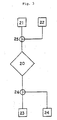
- Fig. 3 is a drawing showing a method of collecting blood components by use of the blood component-recovering apparatus in Fig. 1.
- a blood bag (21) in which whole blood is accommodated the whole blood is passed through a 3-directional stopcock (25) to blood component-recovering apparatus (20) in Fig.3, that is the whole blood is passed through blood flow inlet tube (12), and introduced to the inside of the filter (2) from the blood flow inlet (10) in the blood component-recovering apparatus in Fig. 1, wherein the filtration portion (3) accommodating the filter (2) has been compressed to a predetermined volume.
- Leukocytes are captured in the filter (2), e.g., spaces between the fibers therein, while erythrocytes are passed through the fiber aggregate, the blood flow outlet (11) , and the blood flow outlet tube (13) of the blood component-recovering apparatus in Fig. 1 and through a 3-directional stopcock (26), and are accommodated in the small blood bag (23) in Fig. 3.
- the small blood bag (23) can also accommodate platelets in addition to erythrocytes, depending on the type of the filter material.
- a washing solution in a washing bag (22) is passed through the 3-directional stopcock (25) into the blood component-recovering apparatus (20) in Fig. 3.
- introduction of the washing solution into the leukocyte-accommodating bag (24) is temporarily stopped by the 3-directional stopcock (26) so that the inside of the filter (2) is filled with the washing solution to increase spaces between the fibers, and then the 3-directional stopcock (26) is opened to pass the fluid toward a leukocyte-accommodating bag (24).
- the leukocytes captured in spaces between the fibers in the filter (2) in the blood component-recovering apparatus (20) are washed with the washing solution, passed through the 3-directional stopcock (26), and recovered in the leukocyte-accommodating bag (24)
- filter (2) consists of a disk-shaped 3-layer nonwoven fabric (diameter 4.86 cm) of polyethylene terephthalate fibers.
- the three layers when the filter (2) is compressed to a predetermined volume by the pressing member (1) include a nonwoven fabric with a fiber diameter of 10 ⁇ m and a bulk density of 0.23 g/cm 3 in a first layer (upper layer), a nonwoven fabric with a fiber diameter of 3.5 ⁇ m and a bulk density of 0.11 g/cm 3 in a second layer (interlayer) and a nonwoven fabric with a fiber diameter of 1.5 ⁇ m and a bulk density of 0.12 g/cm 3 in a third layer (sublayer).
- the volume ratio of the layers was 30: 22: 48, and the total thickness was 8.1 mm.
- 100 ml bovine blood containing an ACD (acid-citrate dextrose) solution as an anti-coagulation agent was passed therethrough at a flow rate of 5 ml/min. to capture leukocytes in the inside of the filter (2), while erythrocytes were passed through the bag filter (2) and recovered in the small blood bag (23).
- the yield of erythrocytes recovered in the small blood bag (23) was 95 %, and the yield of platelets therein was 19 %.
- the 3-directional stopcock (26) was closed and the grasping portion (27) in Fig. 1 was then rotated in the opposite direction to transfer the pressing member (1) upward.
- the filter (2) was filled with physiological saline to increase spaces between the fibers, and then 150 ml physiological saline was passed at a flow rate of 5 ml/min. through the filtration portion (3) and recovered in the leukocyte-accommodating bag (24).
- the ratio of expansion of the filtration portion (3) charged with the filter (2), due to upward transfer of the pressing member (1), and the yield of leukocytes recovered in the leukocyte-accommodating bag (24) are shown in Table 1.
- the volume expansion ratio is the ratio of the distance between the bottom of the lower lid portion and the pressing member when their screw-engagement was loosened to transfer the pressing member upward/the thickness of the filter (2) before whole blood was passed through the filter (2) (distance between the bottom of the lower lid portion and the pressing member).
- the leukocyte recovery ratio is the ratio of the number of leukocytes in the physiological saline accommodated in the leukocyte-accommodating bag (24)/the number of leukocytes in blood accommodated in the blood bag (21). Volume expansion ratio (fold) 1 1.17 1.28 1.41 1.50 Leukocyte recovery ratio (%) 45.1 80.6 83.2 85.0 86.7
- the 2-layer nonwoven fabric had the nonwoven fabric having a fiber diameter of 10 ⁇ m and a bulk density of 0.23 g/cm 3 as the first layer and the nonwoven fabric with a fiber diameter of 1.5 ⁇ m and a bulk density of 0.12 g/cm 3 as the second layer when the bag (31) was compressed to a predetermined volume by the pressing member (33) .
- a disk-shaped filter (diameter 3.82 cm, thickness 8.6 mm) consisting of the first layer as the upper layer and the second layer as the sublayer (volume ratio 60: 40) was accommodated in a low-density polyethylene bag (31) in the blood component-recovering apparatus shown in Fig. 2.
- the bag (31) was filled with physiological saline to enlarge spaces between the fibers, and 120 ml physiological saline was passed at a flow rate of 5 ml/min. through the bag (31) charged with the filter (32) and recovered via the blood flow outlet tube (43) in the leukocyte-accommodating bag (24).
- the volume expansion ratio of the bag (31), attained by upward transfer of the pressing member and the yield of leukocytes recovered in the leukocyte-accommodating bag (24) are shown in Table 2.
- Volume expansion ratio (fold) 1.00 1.18 1.33 1.49 1.61
- Leukocyte recovery ratio (%) 27.7 66.3 71.5 76.2 78.8
- the blood component-recovering apparatus of the present invention is an easily handled and compact apparatus by which leukocytes captured in the filter can be recovered in high yield.
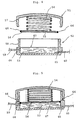
- Fig. 4 is a schematic view where an upper lid portion (51) is separated from a lower lid portion (52), and the lower lid portion (52) is provided with a filtration portion (67) accommodating a filter (53), and the sidewall of the lower lid portion (52) is provided with the a flow inlet (64) and a blood flow outlet (65), and the upper lid portion (51) accommodates a spring body (54) for pressing the filter (53), the end (55) of the spring body (54) being connected to a pressing member (56) capable of being transferred to the inside of the lower lid portion (52).
- the pressing member (56) is shaped into a disk whose edge is provided with an O-ring (66) sliding liquid-tightly along the inner wall of the lower lid portion (52).
- a female screw (57) is formed on the inner wall of the opening of the upper lid portion (51), and a male screw (58) is formed on the outer wall of the opening of the lower lid portion, and as the male screw (58) is screw-engaged with the female screw (57), the spring body is compressed to press the pressing member (56) whereby the filter (53) is compressed.
- Fig. 5 is a schematic view of the blood component-recovering apparatus where the upper lid portion (51) is completely screw-engaged with the lower lid portion (52).
- the whole blood is passed through the 3-directional stopcock (25) to the blood component-recovering apparatus (20) in Fig. 3, i.e., the whole blood is passed through a blood flow inlet tube (59), and introduced to the inside of the filter (53) from the blood flow inlet (64) in the blood component-recovering apparatus in Fig.5 wherein the upper lid portion (51) is completely screw-engaged with the lower lid portion (52).
- Leukocytes in the filter material (53) are captured in the filter, e.g.
- the small blood bag (23) can also accommodate platelets in addition to erythrocytes, depending on the type of the filter material.
- introduction of the washing solution into the blood component-recovering apparatus (20) is temporarily stopped by the 3-directional stopcock (26) so that the inside of the filter (53) is filled with the washing solution to increase spaces between the fibers, and then the 3-directional stopcock (26) is opened to pass the fluid toward the leukocyte-accommodating bag (24). Due to the increase in spaces between the fibers and the flow pressure of the washing solution, the leukocytes captured in spaces between the fibers in the filter (53) in the blood component-recovering apparatus (20) are washed with the washing solution, passed through the 3-directional stopcock (26), and recovered in the blood-recovering bag (24).
- the pressing member (56) connected to the end (55) of the spring body (54) is accommodated in the upper lid portion (51).
- Another example is a blood component-recovering apparatus in which the pressing member (56) is separated from the spring body (54) and placed on the filter (53).
- the spring body (54) presses the pressing member (56).
- the pressing member (56) is previously provided liquid-tightly with the O-ring (66) on the inner wall of the lower lid portion (52), it is not necessary to fit the pressing member (56) to the inner wall of the lower lid portion (52).
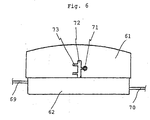
- Fig. 6 is another example of the blood component-recovering apparatus of the present invention where the upper lid portion (61) is set to the lower lid portion (62).
- the outer wall of the lower lid portion (62) is provided with a protruding portion (71)
- the sidewall of the upper lid portion (61) is provided with a hole portion consisting of a lengthwise long hole (72) extending in a lengthwise direction and three crosswise long holes (73) communicating with said lengthwise long hole (72), where the protruding portion (71) slides along the lengthwise long hole (72) and is locked with the crosswise long holes (73).
- Hole portions are formed preferably on the sidewall of the upper lid portion (61) and in opposite positions to each other.
- the protruding portion (71) are formed preferably in opposite positions to each other on the outer wall of the lower lid portion (62).
- the inside of the blood component-recovering apparatus consisting of the upper lid portion (61) and the lower lid portion (62) is the same as in Fig. 4 except for the male screw (58) and the female screw (57) and is formed by screw-engaging the upper lid portion (61) with the lower lid portion (62) in Fig. 6.
- the filter (53) is accommodated in a bag made of flexible resin, and the blood flow inlet tube (59) and the blood flow outlet tube (60) are connected to the bag and arranged in the filtration portion (67) in the lower lid portion (52) in Fig. 4.
- the blood flow inlet tube (59) extends from the blood flow inlet (64) in Fig. 4 to the outside of the blood component-recovering apparatus, and the blood flow outlet tube (60) extends from the blood flow outlet (65) to the outside of the blood component-recovering apparatus.
- the pressing member (56) is provided at the edge thereof with the O-ring (66), and the O-ring (66) slides liquid-tightly along the inner wall of the lower lid portion (52), thus preventing blood components in the filtration portion (67) from leaking into the upper lid portion (51), but if the filter (53) is accommodated in a bag, it is not always necessary for the edge of the pressing member (56) to slide liquid-tightly along the inner wall of the lower lid portion (52), so the O-ring (66) may be absent.
- filter (53) consists of a disk-shaped 3-layer nonwoven fabric (diameter 4.86 cm) of polyethylene terephthalate fibers.
- the three layers (Fig. 5) when the filter (53) is compressed to a predetermined volume by the pressing member (56) has a nonwoven fabric with a fiber diameter of 10 ⁇ m and a bulk density of 0.23 g/cm 3 in a first layer (upper layer), a nonwoven fabric with a fiber diameter of 3.5 ⁇ m and a bulk density of 0.11 g/cm 3 in a second layer (interlayer) and a nonwoven fabric with a fiber diameter of 1.5 ⁇ m and a bulk density of 0.12 g/cm 3 in a third layer (sublayer).
- the volume ratio was 30: 22: 48, and the total thickness was 8.3 mm.
- 100 ml bovine blood containing an ACD solution as an anti-coagulation agent was passed therethrough at a flow rate of 5 ml/min. to capture leukocytes in the inside of the filter (53), while erythrocytes were passed through the filter (53) and recovered in the small blood bag (23).
- the yield of erythrocytes recovered in the small blood bag (23) was 97 %, and the yield of platelets therein was 18 %.
- the 3-directional stopcock (26) was closed and then the engagement between the upper lid portion (51) and the lower lid portion (52) in Fig. 5 was loosened to transfer the pressing member (56) upward.
- the filter (53) was filled with physiological saline to increase spaces between the fibers, and then 150 ml physiological saline was passed at a flow rate of 5 ml/min. through the filtration portion (67) and recovered in the leukocyte-accommodating bag (24).
- the expansion ratio of the filtration portion (67) charged with filter (53), attained by upward transfer of the pressing member (56), and the recovery ratio of leukocytes recovered in the leukocyte-accommodating bag (24) are shown in Table 3.
- the volume expansion ratio is the ratio of the distance between the bottom of the lower lid portion and the pressing member when their screw-engagement was loosened to transfer the pressing member upward/the thickness of the filter (53) when the upper lid portion (51) was completely screw-engaged with the lower lid portion (52) (distance between the bottom of the lower lid portion and the pressing member).
- the leukocyte recovery ratio is the ratio of the number of leukocytes in the physiological saline accommodated in the leukocyte-accommodating bag (24)/the number of leukocytes in blood accommodated in the blood bag (21). Volume expansion ratio (fold) 1.00 1.06 1.14 1.32 1.53 1.73 1.92 Leukocyte recovery ratio (%) 47.2 78.7 82.1 87.7 89.8 91.9 93.3
- a nonwoven fabric with a fiber diameter of 10 ⁇ m and a nonwoven fabric with a fiber diameter of 1.5 ⁇ m were immersed in 0.25 % 2-hydroxyethyl methacrylate/diethylaminoethyl methacrylate copolymer in ethanol.
- the protruding portion (71) of the lower lid portion (62) of the blood-components recovering apparatus shown in Fig.6 was locked at the uppermost crosswise long hole (73) of the upper lid portion (61) to fit the upper lid portion (61) to the lower lid portion (62) thereby compressing the filter by the pressing member.
- a disk-shaped, 2-layer filter (diameter 3.82 cm) had the nonwoven fabric having a fiber diameter of 10 ⁇ m and a bulk density of 0.23 g/cm 3 as an upper layer (first layer) and the nonwoven fabric with a fiber diameter of 1.5 ⁇ m and a bulk density of 0.12 g/cm 3 as a sublayer (second layer).
- This filter was arranged in the filtration portion in the apparatus shown in Fig. 6.
- the thickness of the filter when the protruding portion (71) was placed at the uppermost crosswise long hole (73) was 9.7 mm.
- the filtration portion was filled with physiological saline to enlarge spaces between the fibers, and 150 ml physiological saline was passed through the filtration portion at a flow rate of 5 ml/min. and recovered in the leukocyte-accommodating bag (24).
- the volume expansion ratio of the filtration portion attained by upward transfer of the protruding portion (71) to the crosswise long hole (73), and the yield of leukocytes recovered in the Leukocyte-accommodating bag (24) were determined.
- the distance between the lowermost crosswise long hole and the middle crosswise long hole was 6.4 mm and the distance between the lowermost crosswise long hole and the uppermost crosswise long hole was 12.3 mm.
- the blood component-recovering apparatus in Fig. 5 was used, and the filter in Example 4 (diameter 3.82 cm, thickness 8.6 mm) was used.
- 50 ml umbilical cord blood containing a heparin solution as an anti-coagulation agent was passed therethrough at a flow rate of 5 ml/min. whereby leukocytes were captured in the filter, while erythrocytes and platelets were passed through the filter and recovered in the small blood bag (23).
- the yield of erythrocytes recovered in the small blood bag (23) was 91 % and the yield of platelets therein was 75 %.
- the 3-directional stopcock (26) was closed, and then the engagement between the upper lid portion and the. lower lid portion in Fig.
- the apparatus of the present invention is an easily handled and compact apparatus and suitable for carrying out the method of the present invention.
- the filter consisting of disk-shaped 2-layer fibrous aggregates (diameter 5.6 cm) of polyethylene terephthalate fibers was used.
- the two layers have two sheets of nonwoven fabric with a fiber diameter of 10 ⁇ m and a thickness of 0.82 mm in an upper layer and 30 sheets of nonwoven fabric with a fiber diameter of 3.5 ⁇ m and a thickness of 0.38 mm in a lower layer.
- the bulk density of the filter was 0.19 g/cm 3 .
- 120 ml bovine blood containing an ACD solution as an anti-coagulation agent was passed through the filter from the blood flow inlet to the blood flow outlet at a flow rate of 5 ml/min. to capture leukocytes in the inside of the filter, while erythrocytes were passed through the filter.
- 40 ml of physiological saline solution was passed through the filter to wash out erythrocytes and platelets remaining in the filter and the inner volume of the filter was enlarged to have a bulk density of 0.11 g/cm 3 and then 80 ml physiological saline solution containing bovine serum albumin was passed through the filter to recover leukocytes.
- the inner volume of the filter was not changed and the washing solution and the physiological saline solution were passed through the filter to recover leukocytes in the same manner as in the above method.
- Example 6 50 ml bovine blood containing an ACD solution was passed through the filter in the same manner as in Example 6. The yields of leukocytes recovered are shown in Table 6. Bulk density (g/cm 3 ) Yield of leukocytes (%) Captured Recovered 0.19 0.11 85.2 0.19 0.19 79.3
Landscapes
- Health & Medical Sciences (AREA)
- Heart & Thoracic Surgery (AREA)
- Vascular Medicine (AREA)
- Biomedical Technology (AREA)
- Engineering & Computer Science (AREA)
- Anesthesiology (AREA)
- Cardiology (AREA)
- Hematology (AREA)
- Life Sciences & Earth Sciences (AREA)
- Animal Behavior & Ethology (AREA)
- General Health & Medical Sciences (AREA)
- Public Health (AREA)
- Veterinary Medicine (AREA)
- External Artificial Organs (AREA)
Claims (19)
- Appareil destiné à récupérer des composants sanguins comprenant un boítier (4 ; 30) dans lequel est reçue une partie de filtration (3 ; 67) chargée avec un filtre (2 ; 32 ; 53) qui est capable de laisser passer les érythrocytes, mais de retenir les leucocytes, ledit boítier (4 ; 30) étant prévu dans sa paroi latérale avec une entrée d'écoulement de sang (10 ; 44 ; 64) et une sortie d'écoulement de sang (11 ; 45 ; 65) communiquant avec ladite partie de filtration (3 ; 67),
caractérisé en ce que l'appareil comprend, en outre, un élément de compression (1 ; 33 ; 56) destiné à comprimer ledit filtre (2 ; 32 ; 53), dans lequel le boítier est prévu dans sa paroi supérieure avec des moyens (5, 7, 8, 9, 27 ; 34 à 41 ; 54) capables de déplacer l'élément de compression (1 ; 33 ; 56) dans une direction verticale. - Appareil destiné à récupérer des composants sanguins selon la revendication 1, dans lequel l'élément de compression (1 ; 33) peut être agencé dans une position aval alors qu'un sang contenant des composants sanguins traverse la partie de filtration (3 ; 67), et peut être transféré vers une position amont de manière à augmenter le volume de ladite partie de filtration (3 ; 67) et à permettre qu'une solution de lavage traverse ledit filtre (2 ; 32 ; 53) afin de récupérer les leucocytes.
- Appareil destiné à récupérer des composants sanguins selon la revendication 1 ou la revendication 2, dans lequel les moyens capables de déplacer l'élément de compression (1) dans une direction verticale comportent une partie de boulon comprenant un élément en forme de barreau (5) présentant une vis mâle formée sur sa paroi latérale s'étendant dans une direction longitudinale au-dessus de l'élément de compression (1), un trou (19) à travers lequel l'élément en forme de barreau peut être transféré verticalement et qui est ménagé dans la base d'une partie concave (6) prévue sur la paroi supérieure du boítier (4), et une partie d'écrou (8) comprenant une partie de cylindre et une partie de préhension (27), ladite partie de cylindre comportant une vis femelle (9) formée sur sa paroi intérieure et ayant un diamètre extérieur qui permet que ladite partie de cylindre soit introduite dans ladite partie concave (6) et soit capable de venir en prise, grâce à un filetage, avec la vis mâle de ladite partie de boulon.
- Appareil destiné à récupérer des composants sanguins selon la revendication 1 ou la revendication 2, dans lequel les moyens capables de déplacer l'élément de compression (33) dans une direction verticale comprennent un élément en forme de barreau (39) s'étendant dans une direction longitudinale au-dessus de l'élément de compression (33) et comportant une partie de verrou (35) à la base et une vis mâle (39) formée sur sa paroi latérale ; une chambre (34) prévue sur l'élément de compression (33) présentant un premier trou (41) à travers lequel ledit élément en forme de barreau (39) pénètre, et recevant ladite partie de verrou (35), et une vis femelle formée sur la paroi intérieure d'un deuxième trou (40) prévu sur la paroi supérieure du boítier et étant capable de venir en prise, grâce à un filetage, avec la vis mâle (39) dudit élément en forme de barreau (39).
- Appareil destiné à récupérer des composants sanguins selon l'une quelconque des revendications précédentes, dans lequel l'élément de compression (1 ; 33) se présente sous la forme d'un disque prévu sur son bord latéral, un joint d'étanchéité torique (18) étant capable de coulisser en étant étanche aux liquides le long de la paroi intérieure du boítier (4 ; 30).
- Appareil destiné à récupérer des composants sanguins selon l'une quelconque des revendications précédentes, dans lequel le boítier (4) comprend une partie de couvercle (14 ; 51) supérieure et une partie de couvercle (15 ; 52) inférieure.
- Appareil destiné à récupérer des composants sanguins selon la revendication 6, dans lequel ladite partie de couvercle (51) supérieure reçoit un corps de ressort (54) formant lesdits moyens capables de déplacer l'élément de compression dans une direction verticale, destiné à comprimer ladite partie de filtration (67), et ledit élément de compression (56) est relié à l'extrémité dudit corps de ressort (54) et peut être placé à l'intérieur de ladite partie de couvercle (52) inférieure, et ladite partie de couvercle (52) inférieure reçoit ledit filtre (53), et est prévue avec une entrée de sang (64) et une sortie de sang (65), et peut venir en prise avec la partie de couvercle (51) supérieure.
- Appareil destiné à récupérer des composants sanguins selon la revendication 6, dans lequel ladite partie de couvercle (51) supérieure reçoit un corps de ressort (54) formant lesdits moyens capables de déplacer l'élément de compression dans une direction verticale, destiné à comprimer ladite partie de filtration (67), et ladite partie de couvercle (52) inférieure reçoit ladite partie de filtration (67) et un élément de compression (56) agencé sur la partie de filtration (67), et est prévue avec une entrée de sang (64) et une sortie de sang (65) et peut venir en prise avec la partie de couvercle (51) supérieure.
- Appareil destiné à récupérer des composants sanguins selon la revendication 8, dans lequel une paroi extérieure de ladite partie de couvercle (62) inférieure est prévue avec une partie saillante (71), et une paroi latérale de la partie de couvercle (61) supérieure est prévue avec une partie à trous constituée d'un premier trou (72) s'étendant dans le sens de la longueur dans une direction longitudinale, et d'au moins un deuxième trou (73) s'étendant dans le sens de la longueur dans une direction latérale par rapport audit premier trou (72) et communiquant avec celui-ci ; et la partie saillante (71) pouvant coulisser le long dudit premier trou (72) et étant verrouillée avec ledit deuxième trou (73).
- Appareil destiné à récupérer des composants sanguins selon la revendication 1 ou la revendication 4, dans lequel le filtre (32) est reçu dans un sac (31) réalisé avec une résine souple, et ledit sac (31) est relié à un tube d'entrée (42) d'écoulement de sang et à un tube de sortie (43) d'écoulement de sang.
- Appareil destiné à récupérer des composants sanguins selon l'une quelconque des revendications précédentes, dans lequel le filtre (2 ; 32 ; 53) comprend un agrégat fibreux de fibres ayant un diamètre de fibre de 25 µm, ou moins, ledit agrégat fibreux ayant une densité apparente de 0,05 à 0,50 g/cm3.
- Appareil destiné à récupérer des composants sanguins selon l'une quelconque des revendications 1 à 10, dans lequel le filtre (2 ; 32 ; 53) comprend un agrégat fibreux multicouche, et au moins une couche comprend un agrégat fibreux de fibres ayant un diamètre de fibre de 25 µm, ou moins, ledit agrégat fibreux ayant une densité apparente de 0,05 à 0,50 g/cm3.
- Appareil destiné à récupérer des composants sanguins selon l'une quelconque des revendications précédentes, dans lequel le volume intérieur de la partie de filtration (3 ; 67) située dans l'appareil destiné à récupérer des composants sanguins, lorsque ledit élément de compression (1 ; 33 ; 56) est dans une position amont, est au moins égal à 1,10 fois le volume intérieur de la partie de filtration (3 ; 67) lorsque ledit élément de compression (1 ; 33 ; 56) est dans une position aval.
- Procédé pour récupérer des composants sanguins, qui comprend le passage d'un sang contenant des composants sanguins à travers un appareil destiné à récupérer des composants sanguins selon l'une quelconque des revendications 1 à 13, puis l'agrandissement du volume intérieur de ladite partie de filtration (3; 67) et, ensuite, le passage d'une solution de lavage à travers ladite partie de filtration (3 ; 67) afin de récupérer les leucocytes.
- Procédé pour récupérer des composants sanguins selon la revendication 14, dans lequel le filtre (32) est reçu dans un sac (31) réalisé avec une résine souple, et ledit sac est relié à un tube d'entrée de sang (42) et à un tube de sortie de sang (43).
- Procédé pour récupérer des composants sanguins selon la revendication 14 ou la revendication 15, dans lequel le filtre (2 ; 32 ; 53) comprend un agrégat fibreux de fibres ayant un diamètre de fibre de 25 µm, ou moins, ledit agrégat fibreux ayant une densité apparente de 0,05 à 0,50 g/cm3.
- Procédé pour récupérer des composants sanguins selon la revendication 14 ou la revendication 15, dans lequel le filtre (2 ; 32 ; 53) comprend un agrégat fibreux multicouche, et au moins une couche comprend un agrégat fibreux de fibres ayant un diamètre de fibre de 25 µm, ou moins, ledit agrégat fibreux ayant une densité apparente de 0,05 à 0,50 g/cm3.
- Procédé pour récupérer des composants sanguins selon l'une quelconque des revendications 14 à 17, dans lequel le volume intérieur de la partie de filtration (3 ; 67) située dans l'appareil destiné à récupérer des composants sanguins, après avoir été agrandi, est au moins égal à 1,10 fois le volume intérieur de la partie de filtration (3 ; 67) avant que le sang ait traversé l'appareil destiné à récupérer des composants sanguins.
- Procédé pour récupérer des composants sanguins selon l'une quelconque des revendications 14 à 18, dans lequel ledit sang est le sang du cordon ombilical.
Applications Claiming Priority (4)
| Application Number | Priority Date | Filing Date | Title |
|---|---|---|---|
| JP34458597 | 1997-12-15 | ||
| JP34458597 | 1997-12-15 | ||
| JP35876697 | 1997-12-26 | ||
| JP35876697 | 1997-12-26 |
Publications (2)
| Publication Number | Publication Date |
|---|---|
| EP0928617A1 EP0928617A1 (fr) | 1999-07-14 |
| EP0928617B1 true EP0928617B1 (fr) | 2004-06-16 |
Family
ID=26577807
Family Applications (1)
| Application Number | Title | Priority Date | Filing Date |
|---|---|---|---|
| EP98123520A Expired - Lifetime EP0928617B1 (fr) | 1997-12-15 | 1998-12-15 | Appareil pour récupérer des composants sanguins et méthode associée |
Country Status (3)
| Country | Link |
|---|---|
| US (1) | US6120474A (fr) |
| EP (1) | EP0928617B1 (fr) |
| DE (1) | DE69824541T2 (fr) |
Cited By (1)
| Publication number | Priority date | Publication date | Assignee | Title |
|---|---|---|---|---|
| US8308340B2 (en) | 2004-11-23 | 2012-11-13 | Smith & Nephew, Inc. | Composite mixer |
Families Citing this family (14)
| Publication number | Priority date | Publication date | Assignee | Title |
|---|---|---|---|---|
| EP0973873B1 (fr) | 1997-04-08 | 2006-06-07 | Pall Corporation | Procede de prelevement de cellules rares dans des produits sanguins |
| JP3517359B2 (ja) * | 1998-09-14 | 2004-04-12 | テルモ株式会社 | 細胞分離・回収装置および細胞の分離・回収方法 |
| JP2000180443A (ja) * | 1998-12-15 | 2000-06-30 | Fuji Photo Film Co Ltd | 血液濾過残留物の回収方法 |
| US6719717B1 (en) | 2000-03-17 | 2004-04-13 | Advanced Research & Technology Institute, Inc. | Thrombectomy treatment system and method |
| US6776770B1 (en) * | 2000-09-07 | 2004-08-17 | Advanced Research & Technology Institute | Thromboaspiration valve-filter device and methods |
| US20040152190A1 (en) * | 2001-05-31 | 2004-08-05 | Masaya Sumita | Method of separating and concentrating cells for kidney regfneration |
| US6926828B2 (en) | 2002-01-25 | 2005-08-09 | Inoac Corporation | Fluid filter |
| WO2004033396A2 (fr) * | 2002-10-08 | 2004-04-22 | American National Red Cross | Procede d'enrichissement de populations de monocytes adherents |
| US7291450B2 (en) | 2003-03-28 | 2007-11-06 | Smith & Nephew, Inc. | Preparation of a cell concentrate from a physiological solution |
| EP1484390A1 (fr) * | 2003-06-02 | 2004-12-08 | Blutspendedienst des Bayerischen Roten Kreuzes | Méthode de préparation de cellules-souches périphériques à partir de filtres de réduction des leucocytes |
| WO2013070899A1 (fr) | 2011-11-08 | 2013-05-16 | Auxocell Laboratories, Inc. | Systèmes et procédés pour le traitement de cellules |
| WO2013102165A2 (fr) * | 2011-12-29 | 2013-07-04 | Delcath Systems, Inc. | Appareil filtrant réglable |
| US9993748B2 (en) | 2014-08-11 | 2018-06-12 | Auxocell Laboratories, Inc. | Centrifuge clip and method |
| USD748462S1 (en) | 2014-08-11 | 2016-02-02 | Auxocell Laboratories, Inc. | Centrifuge clip |
Citations (1)
| Publication number | Priority date | Publication date | Assignee | Title |
|---|---|---|---|---|
| EP0919249A1 (fr) * | 1997-11-20 | 1999-06-02 | Nissho Corporation | Ensemble de filtre à sang et méthode de récupération de composants sanguins utilisant un tel filtre |
Family Cites Families (6)
| Publication number | Priority date | Publication date | Assignee | Title |
|---|---|---|---|---|
| US3747769A (en) * | 1971-08-02 | 1973-07-24 | R Brumfield | Compressible disposable filter press for blood |
| JPS5854131B2 (ja) * | 1978-03-17 | 1983-12-02 | 旭化成株式会社 | 白血球の分離方法 |
| JPS603367B2 (ja) * | 1979-10-09 | 1985-01-28 | 旭化成株式会社 | 白血球分離法および白血球分離材 |
| JPH08104643A (ja) | 1994-10-05 | 1996-04-23 | Asahi Medical Co Ltd | 赤血球除去方法 |
| US5789147A (en) | 1994-12-05 | 1998-08-04 | New York Blood Center, Inc. | Method for concentrating white cells from whole blood by adding a red cell sedimentation reagent to whole anticoagulated blood |
| JP3322595B2 (ja) * | 1996-03-28 | 2002-09-09 | テルモ株式会社 | フィルター装置および生体微細組織の分離・回収方法 |
-
1998
- 1998-12-14 US US09/210,571 patent/US6120474A/en not_active Expired - Fee Related
- 1998-12-15 EP EP98123520A patent/EP0928617B1/fr not_active Expired - Lifetime
- 1998-12-15 DE DE69824541T patent/DE69824541T2/de not_active Expired - Fee Related
Patent Citations (1)
| Publication number | Priority date | Publication date | Assignee | Title |
|---|---|---|---|---|
| EP0919249A1 (fr) * | 1997-11-20 | 1999-06-02 | Nissho Corporation | Ensemble de filtre à sang et méthode de récupération de composants sanguins utilisant un tel filtre |
Cited By (1)
| Publication number | Priority date | Publication date | Assignee | Title |
|---|---|---|---|---|
| US8308340B2 (en) | 2004-11-23 | 2012-11-13 | Smith & Nephew, Inc. | Composite mixer |
Also Published As
| Publication number | Publication date |
|---|---|
| US6120474A (en) | 2000-09-19 |
| EP0928617A1 (fr) | 1999-07-14 |
| DE69824541T2 (de) | 2004-10-14 |
| DE69824541D1 (de) | 2004-07-22 |
Similar Documents
| Publication | Publication Date | Title |
|---|---|---|
| EP0928617B1 (fr) | Appareil pour récupérer des composants sanguins et méthode associée | |
| EP0987034B1 (fr) | Méthode pour isoler et récupérer des cellules | |
| US7140497B2 (en) | Selective deleukocytation unit for a platelet product | |
| EP0919249B1 (fr) | Ensemble de filtre à sang et méthode de récupération de composants sanguins utilisant un tel filtre | |
| AU729610B2 (en) | Systems and methods for on-line finishing of cellular blood products like platelets harvested for therapeutic purposes | |
| EP1683857B1 (fr) | Methode de preparation d'un concentrat cellulaire et composition cellulaire associee | |
| WO2001072369A1 (fr) | Systeme et procede de traitement de moelle osseuse | |
| AU741438B2 (en) | Method for removing tumor cells from tumor cell-contaminated stem cell products | |
| JPH0534337A (ja) | 白血球分離用フイルター | |
| WO1989002304A1 (fr) | Filtre separateur de leucocytes | |
| JP2001000178A (ja) | 細胞分離方法及び細胞分離装置 | |
| JP4245324B2 (ja) | 単球の分離回収方法 | |
| JP2019024426A (ja) | 細胞分離装置、及び単核球を含む細胞含有液を取得する方法 | |
| JP3635654B2 (ja) | 血液成分採取器具 | |
| JP2020195330A (ja) | 細胞分離フィルター装置、及び細胞濃縮液の製造方法 | |
| JPH03173824A (ja) | 白血球分離器 | |
| JP3758012B2 (ja) | 血液成分採取方法およびその採取器具 | |
| JPH11290060A (ja) | 細胞回収に適した細胞分離フィルター、細胞分離システム及び細胞分離方法 | |
| JP3740690B2 (ja) | 血液フィルターセット及びそれを用いた血液成分回収方法 | |
| JPH11206875A (ja) | フィルターセットおよびこれを用いた血液成分回収方法 | |
| JP2004166749A (ja) | 白血球除去フィルターに残留する白血球が除去された血液を回収する方法、回収装置および回収システム | |
| JP2001078757A (ja) | 細胞分離方法及び細胞分離用流体 | |
| JPH09603A (ja) | 血液成分分離方法 | |
| Sueoka | Present status of apheresis technologies: part 4. Leukocyte filter | |
| JP2018186813A (ja) | 単球を含む細胞含有液の取得方法 |
Legal Events
| Date | Code | Title | Description |
|---|---|---|---|
| PUAI | Public reference made under article 153(3) epc to a published international application that has entered the european phase |
Free format text: ORIGINAL CODE: 0009012 |
|
| AK | Designated contracting states |
Kind code of ref document: A1 Designated state(s): DE FR GB IT |
|
| AX | Request for extension of the european patent |
Free format text: AL;LT;LV;MK;RO;SI |
|
| 17P | Request for examination filed |
Effective date: 19990830 |
|
| AKX | Designation fees paid |
Free format text: DE FR GB IT |
|
| RAP1 | Party data changed (applicant data changed or rights of an application transferred) |
Owner name: NIPRO CORPORATION |
|
| 17Q | First examination report despatched |
Effective date: 20030304 |
|
| GRAP | Despatch of communication of intention to grant a patent |
Free format text: ORIGINAL CODE: EPIDOSNIGR1 |
|
| GRAS | Grant fee paid |
Free format text: ORIGINAL CODE: EPIDOSNIGR3 |
|
| GRAA | (expected) grant |
Free format text: ORIGINAL CODE: 0009210 |
|
| AK | Designated contracting states |
Kind code of ref document: B1 Designated state(s): DE FR GB IT |
|
| REG | Reference to a national code |
Ref country code: GB Ref legal event code: FG4D |
|
| REF | Corresponds to: |
Ref document number: 69824541 Country of ref document: DE Date of ref document: 20040722 Kind code of ref document: P |
|
| PG25 | Lapsed in a contracting state [announced via postgrant information from national office to epo] |
Ref country code: GB Free format text: LAPSE BECAUSE OF NON-PAYMENT OF DUE FEES Effective date: 20041215 |
|
| ET | Fr: translation filed | ||
| PLBE | No opposition filed within time limit |
Free format text: ORIGINAL CODE: 0009261 |
|
| STAA | Information on the status of an ep patent application or granted ep patent |
Free format text: STATUS: NO OPPOSITION FILED WITHIN TIME LIMIT |
|
| 26N | No opposition filed |
Effective date: 20050317 |
|
| PG25 | Lapsed in a contracting state [announced via postgrant information from national office to epo] |
Ref country code: DE Free format text: LAPSE BECAUSE OF NON-PAYMENT OF DUE FEES Effective date: 20050701 |
|
| GBPC | Gb: european patent ceased through non-payment of renewal fee |
Effective date: 20041215 |
|
| PG25 | Lapsed in a contracting state [announced via postgrant information from national office to epo] |
Ref country code: FR Free format text: LAPSE BECAUSE OF NON-PAYMENT OF DUE FEES Effective date: 20050831 |
|
| REG | Reference to a national code |
Ref country code: FR Ref legal event code: ST |
|
| PG25 | Lapsed in a contracting state [announced via postgrant information from national office to epo] |
Ref country code: IT Free format text: LAPSE BECAUSE OF NON-PAYMENT OF DUE FEES;WARNING: LAPSES OF ITALIAN PATENTS WITH EFFECTIVE DATE BEFORE 2007 MAY HAVE OCCURRED AT ANY TIME BEFORE 2007. THE CORRECT EFFECTIVE DATE MAY BE DIFFERENT FROM THE ONE RECORDED. Effective date: 20051215 |