EP0919299A2 - Vorrichtung zum Abtragen einer Schweissnahtüberhöhung - Google Patents
Vorrichtung zum Abtragen einer Schweissnahtüberhöhung Download PDFInfo
- Publication number
- EP0919299A2 EP0919299A2 EP98120733A EP98120733A EP0919299A2 EP 0919299 A2 EP0919299 A2 EP 0919299A2 EP 98120733 A EP98120733 A EP 98120733A EP 98120733 A EP98120733 A EP 98120733A EP 0919299 A2 EP0919299 A2 EP 0919299A2
- Authority
- EP
- European Patent Office
- Prior art keywords
- tool
- workpiece
- cutting
- tools
- rotary head
- Prior art date
- Legal status (The legal status is an assumption and is not a legal conclusion. Google has not performed a legal analysis and makes no representation as to the accuracy of the status listed.)
- Withdrawn
Links
Images


Classifications
-
- B—PERFORMING OPERATIONS; TRANSPORTING
- B23—MACHINE TOOLS; METAL-WORKING NOT OTHERWISE PROVIDED FOR
- B23K—SOLDERING OR UNSOLDERING; WELDING; CLADDING OR PLATING BY SOLDERING OR WELDING; CUTTING BY APPLYING HEAT LOCALLY, e.g. FLAME CUTTING; WORKING BY LASER BEAM
- B23K37/00—Auxiliary devices or processes, not specially adapted for a procedure covered by only one of the other main groups of this subclass
- B23K37/08—Auxiliary devices or processes, not specially adapted for a procedure covered by only one of the other main groups of this subclass for flash removal
-
- B—PERFORMING OPERATIONS; TRANSPORTING
- B21—MECHANICAL METAL-WORKING WITHOUT ESSENTIALLY REMOVING MATERIAL; PUNCHING METAL
- B21C—MANUFACTURE OF METAL SHEETS, WIRE, RODS, TUBES, PROFILES OR LIKE SEMI-MANUFACTURED PRODUCTS OTHERWISE THAN BY ROLLING; AUXILIARY OPERATIONS USED IN CONNECTION WITH METAL-WORKING WITHOUT ESSENTIALLY REMOVING MATERIAL
- B21C37/00—Manufacture of metal sheets, rods, wire, tubes, profiles or like semi-manufactured products, not otherwise provided for; Manufacture of tubes of special shape
- B21C37/06—Manufacture of metal sheets, rods, wire, tubes, profiles or like semi-manufactured products, not otherwise provided for; Manufacture of tubes of special shape of tubes or metal hoses; Combined procedures for making tubes, e.g. for making multi-wall tubes
- B21C37/08—Making tubes with welded or soldered seams
- B21C37/0807—Tube treating or manipulating combined with, or specially adapted for use in connection with tube making machines, e.g. drawing-off devices, cutting-off
- B21C37/0811—Tube treating or manipulating combined with, or specially adapted for use in connection with tube making machines, e.g. drawing-off devices, cutting-off removing or treating the weld bead
-
- B—PERFORMING OPERATIONS; TRANSPORTING
- B23—MACHINE TOOLS; METAL-WORKING NOT OTHERWISE PROVIDED FOR
- B23D—PLANING; SLOTTING; SHEARING; BROACHING; SAWING; FILING; SCRAPING; LIKE OPERATIONS FOR WORKING METAL BY REMOVING MATERIAL, NOT OTHERWISE PROVIDED FOR
- B23D79/00—Methods, machines, or devices not covered elsewhere, for working metal by removal of material
- B23D79/02—Machines or devices for scraping
- B23D79/021—Machines or devices for scraping for removing welding, brazing or soldering burrs, e.g. flash, on pipes or rods
Definitions
- the invention relates to a device for removing a Excess weld seam, in particular on the outside of continuously formed from a strip material and at the strip edges welded pipes, profiles or similar workpieces of a cutting tool during production Feed of the respective workpiece.
- a Strip material continuously, for example to a tube or profile shaped.
- the strip edges are heated and by means of compression rolls compressed. This creates on the outside and inside of the workpiece each a weld seam elevation on the The outside is machined, preferably by planing.
- a device of the type mentioned at the outset is, for example, in DE-OS 23 01 640 described. With the one described there Device can have a strip material bent into a tube at its Band edges are welded. In the feed direction behind the Welding device is a sharpening knife as a cutting tool to remove the outside of the band edges when welding the resulting weld seam superposition.
- the cutting Tool When removing the weld seam elevation, the cutting Tool worn continuously. With such a worn one Cutting tool cannot be used to increase the weld seam remove more optimally, which leads to a reduction in the quality of the Surface of the workpiece leads. The cutting tool must therefore be changed at regular intervals.
- the cutting tool is usually changed in such a way that the tool moves away from the workpiece and from an operator is replaced. This change process takes usually several minutes. During this time the Excess weld seam on the workpiece is not removed, so that a high scrap of unprocessed workpiece sections arises. This committee could be avoided if during the exchange of the cutting tool the feed of the Workpiece would be interrupted. Production would have to do this, however stopped with every tool change and then started again become what is complex and time-consuming and thus reduces productivity is. It is also possible to have an additional device to provide for the removal of the weld superelevation with which during the change of the cutting tool on the first device the excess weld seam on the workpiece is removed. A such additional ablation device that only during the Change of the cutting tool of the first device required , however, causes considerable cost and constructive Extra effort.
- a change of the cutting tool with continuous Feeding the workpiece also poses a significant risk of accident, because the replacement of the cutting tool in immediate Closeness of the workpiece is done at high speed is advanced and its weld seam temperature several 100 ° C can be.
- the solution to this problem according to the invention consists in particular in that at least two during the feed of the workpiece alternately in a respective working position to remove the Machining tools can be used to increase the weld seam are.
- One of the cutting tools is located in a working position in which it removes the weld seam elevation. If this tool is worn out so far that the weld seam is excessive is no longer sufficiently well removed, this becomes Tool moved from its working position to a rest position and instead another, not worn, cutting one Tool placed in a working position, which then increases the weld seam removes.
- the device according to the invention in addition to one cutting tool located one or more except Has engaging tools that by means of appropriate Mounts but are movable in the working position while a the tool previously used can only be moved out of engagement, the tool change can be done very quickly and requires not disassembling the worn tool in the place of it Working position. Rather, this worn tool can save Intervention moved and then dismantled at any time become, while a tool that has not been worn until now engaged. This means that there is practically no committee unprocessed workpiece sections, even if the feed of the Workpiece during the change of the cutting tool continues continuously.
- changing the cutting tool can be done automatically take place so that at least in the area of the tools Operator is necessary. This reduces the risk of accidents. Only when all of the cutting devices arranged on the device Tools are worn out, they must be replaced. This can take place, for example, in a production break, so that for the operator replacing the cutting tools does not There is a risk of accident due to the feed of the workpiece. The more cutting tools are provided on the device, the more the longer the time after which the total number of tools needs to be replaced.
- the cutting tools on one common tool carrier are arranged to alternately Deliver one of the tools to a working position a positioning device is connected.
- the change of cutting tool is particularly easy to carry out.
- the worn cutting tool is out of its working position is moved into a rest position, it is simultaneously a another tool from a rest position to its working position brought to the removal of the weld seam elevation.
- a single common positioning device is sufficient for positioning of the tool carrier.
- the tool carrier as a turret is formed and when the cutting tools on the rotary head along a concentric around the axis of rotation of the turret running circular paths are arranged.
- the change of cutting tool or the delivery in each case of a new tool in a working position can simple rotary movement of the turret.
- the constructive The effort for the positioning device is thus reduced. Nevertheless, a precise delivery is always a cutting Possible in a working position.
- the positioning device has a lifting and Rotary actuator for alternately feeding one of the has cutting tools in a working position. That I in the working position cutting tool can then to First change the tool from the workpiece to a Stroke movement can be spaced and then by a Rotary movement and subsequent, opposite to the lifting movement Infeed movement of the tool carrier the next cutting Tool in the working position.
- the cutting Tools are so during the rotational movement of the tool holder spaced from the workpiece, causing damage to the surface of the workpiece during tool change is avoided.
- a particularly favorable embodiment provides that the Turret by means of the lifting and rotating drive between a first Stroke position, in each of which is arranged on the rotary head cutting tools on the workpiece to be machined is approximated and this is applied and a second stroke position, in which this cutting tool is spaced from the workpiece is adjustable and that the rotary head in the second stroke position for the delivery of another one arranged on the rotary head cutting tools to the workpiece by means of the lifting and Rotary drive is rotatable about its axis of rotation.
- the axis of rotation of the rotary head can be transverse to the feed direction of the workpiece.
- a constructive and easy to handle embodiment can consist in the fact that the axis of rotation of the rotary head is vertical is oriented.
- the design of the lifting and rotary drive simplified because the stroke and rotation axes can coincide.
- the lifting and rotary drive can be operated by a lifting and Be formed rotary cylinder, the piston rod on the one hand for a lifting and on the other hand is designed for a rotary movement.
- the lifting and rotary drive can be particularly space-saving to construct.
- the workpiece can be placed on a below the Workpiece arranged workpiece guide lie on it and will in spite of the top loading by the machining company Tool not moved from this position. It may be even possible the cutting tool with a meterable Pushing force against the workpiece and also the material the workpiece accordingly.
- the positioning device is a Adjustment spindle for automatic or manual adjustment of the Distance of the respective cutting tool from the surface of the workpiece in the first stroke position of the lifting and rotary drive having.
- This tool can be used with the cutting tool Adjusting spindle to be approximated to the surface of the workpiece, so as to counteract the deterioration of the cutting effect and a constant quality of the surface of the workpiece ensure.
- the time span between the change of two cutting tools can be extended if necessary. Each individual cutting tool can last longer Period are used, which means that fewer tools are required overall and thus costs can be saved.
- the individual cutting tools on the rotary head assigned recordings for a relative to the axis of rotation of the rotary head firmly positioned engaging element are provided, the Engagement element with cutting in the working position Tool for fixing the rotary head in the respective cutting tool engages associated recording.
- the engaging element can for example, a locking device or an index cylinder.
- At least one sensor for detection the position of the tool carrier is provided. With the sensor can be checked whether the tool carrier when changing the cutting tool has been positioned correctly and whether after the delivery of a new tool this new tool exactly in its working position for removing the weld seam elevation located. If a positioning error is detected, then can be given a signal and / or the feed of the Workpiece to be stopped to avoid unnecessary rejects.
- the delivery of the cutting tools and their positioning is simplified if adjacent to each other in the feed direction cutting tools on the rotary head each the same distance to each other. Those for changing the cutting tool The required positioning movement is always the same for all tools the same, so that the control of the positioning device is simplified is.
- a particularly favorable embodiment provides that the Turret four cutting tools are arranged. With A total of four cutting tools can be operated using one sufficient time to increase the weld seam on the workpiece remove before all tools are worn and replaced have to. This exchange of cutting tools can for example during a production break when the plant is down respectively. The change of the cutting tools can then without Time pressure and can be carried out without rejects. Moreover exists when the system is at a standstill for those replacing the tools Operator no risk of accident. But it is also possible to get worn out Exchange tools during production because at one Such a number of tools at least that the located tool on a diameter axis of the rotary head opposite tool from the workpiece a relatively large Takes up distance, so that a carried out at this point Tool changes can also be carried out easily.
- the turret is cruciform is.
- the cutting tools can be used on the free Arrange the ends of the cross-shaped turret so that two directly neighboring tools have the same distance from each other.
- the turret as such can also be reduced Manufacture material costs.
- the removal of the weld seam elevation can be particularly thorough take place when a planing tool is used as the cutting tool is provided. This can be done with a planing tool Weld seam elevation compared to a cutting, grinding or remove the same tool particularly thoroughly and evenly.
- a planing steel, for example, can be used as a planing tool become.
- the workpiece at least in Area of the respective metal-cutting machined workpiece Tool between and / or on guide rollers and / or Slideways guided and is held by these.
- the workpiece is absolutely quiet of these guide rollers and / or sliding guides held so that when feeding the workpiece and when removing no vibrations occur when the weld seam is raised and so one optimal surface quality when removing the weld seam elevation is achieved.
- a further inventive idea can consist in that at least two spaced apart in the feed direction Tool carriers with at least two each alternatively or alternatively Cutting tools that can be set in the working position are. It is possible to have one on each of the tool carriers to bring cutting tool into working position, so that several tools arranged one behind the other simultaneously in one Are working position and apply the workpiece. The This can increase the weld seam in at least two steps can be removed by using a tool first only a part and the one behind it in the feed direction next tool another part or the rest of the weld seam elevation removes. This can be especially the case with relatively large ones Weld seams and weld seam elevations can be cheap. Are the in engagement in the feed direction cutting tools blunt or worn, they can each in the manner described above, also during the further production.
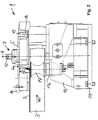
- FIGS. 1 to 3 one is denoted as a whole by 1 Device for removing a weld seam 2 welded pipes, profiles or similar workpieces 3 by means of a cutting tool 4, 4a, 4b during the production-related Feed of the respective workpiece 3 shown.
- a common tool carrier 5 are arranged. Is this respective, the machining of the weld seam elevation 2 Tool 4a worn out, can be done by adjusting the tool holder 5 the next tool 4b in a working position for removal the weld seam elevation 2 are delivered.
- the Tool carrier 5 formed as an approximately cross-shaped turret which a total of four cutting tools 4, 4a, 4b along one Circular path concentric about the axis of rotation 6 of the rotary head are arranged (Figure 3).
- the cutting tools 4, 4a, 4b are planing steels with which the weld seam elevation 2 is special can be removed well and thoroughly.
- the positioning device 7 has a lifting and Rotary drive 8, its axis of rotation 6 and its stroke direction collapse and are vertically oriented. That each in Machining tool 4a located working position the workpiece 3 on the top.
- the tool carrier 5 with the lifting and Rotary drive 8 raised from this first stroke position and brought into a second lifting position in which the worn cutting tool 4a is spaced from the workpiece 3.
- the tool carrier 5 around its Rotation axis 6 can be rotated in the direction of rotation (Pf2, Fig. 3) to deliver new cutting tool 4b to the working position.
- the tool carrier 5 is again in the first stroke position lowered, in which the new cutting tool 4b the workpiece 3 applied to remove the weld seam 2.
- the change of the cutting tool 4 with the Positioning device 7 can automatically and therefore in a short time Time, for example in a few seconds. This makes it fall even with continued feed of the workpiece 3, only a small amount of waste on.
- An exchange of the arranged on the tool carrier 5 cutting tools 4, 4a, 4b is only required when all four tools 4, 4a, 4b are worn.
- the positioning device 7 is operated by a hydraulic motor 11 driven.
- An adjusting spindle 12 is located on the positioning device 7 provided which engages in an inner cavity of the piston rod 10 and with which the vertical position of the tool carrier 5 is adjusted can be. This can, for example, with increasing wear of the cutting tool 4a whose position relative to Surface of the workpiece 3 are readjusted to a constant quality of the workpiece surface when removing the Ensure weld seam elevation 2.
- the individual cutting tools 4, 4a, 4b assigned receptacles 13 for a relative to the axis of rotation 6 of the Turret fixedly positioned engagement element 14 is provided.
- Figure 3 is the arrangement of the receptacles 13 on the tool carrier 5 recognizable and in FIG. 2 the engagement element 14 is shown, that engages in one of the receptacles 13.
- the Engagement element 14 in one of the receptacles 13 becomes the tool carrier 5 with the cutting tool 4a in the working position fixed. This ensures that the cutting Tool 4a is always in the correct position to the Remove excess weld seam 2 thoroughly and an accidental Adjustment of the tool carrier 5 is prevented.
- a sensor 15 For detecting and checking the position of the tool holder 5, a sensor 15 is also provided ( Figure 1, Figure 3). To the Tool carriers 5 are several control elements 16, 16a, 16b for arranged the sensor, the number of control elements 16, 16a, 16b the number of cutting tools 4, 4a, 4b corresponds. Becomes the tool carrier at the beginning of the tool change 5 raised from the first stroke position to the second stroke position, the sensor 15 is controlled by one of the control elements 16a. When the tool carrier 5 rotates about its axis of rotation 6 this control element 16a outside the control range of the Sensor 15, so that the sensor 15 is no longer activated.
- next control element 16b in the control range of the sensor 15 arrives and controls the sensor 15, the next one is cutting tool 4b in the correct working position for Removal of the weld seam elevation 2 and only has to be done Lowering the tool carrier 5 in the first stroke position to the Workpiece 3 can be approximated.
- the tool holder 5 must therefore Change of the cutting tool 4a in each case as far as his Rotation axis 6 are rotated until the next control element 16b controls the sensor 15. This is an additional positioning aid given to the next cutting tool 4b in the correct working position for removing the weld seam elevation Bring 2.
- the sensor 15 can be, for example mechanical, optical or inductive sensor.
- the positioning of the tool carrier 5 and the infeed each a cutting tool 4a is also in the working position simplified by the fact that two directly adjacent cutting Tools 4, 4a, 4b on the tool carrier 5 each have the same distance from each other.
- For the delivery of a next tool 4b is for everyone on the tool carrier 5th arranged cutting tools 4, 4a, 4b the same Positioning movement required so that the control of the Positioning device 7 is simplified.
- Figure 1 it can be seen that the workpiece 3 in Area of the respective machining 3 acting on the workpiece 3 Tool 4a between and on guide rollers 17, 17a managed and held by them.
- Figure 3 shows the device 1 without workpiece 3, so that the lower guide roller 17a on the workpiece when removing the weld seam elevation 2 is visible.
- the lower guide roller 17a can also be designed as a slider.
- the guide rollers 17, 17a are arranged on a holder 18, which in turn is mounted on a device carrier 19.
- the Positioning device 7 is also via a connecting element 20 connected to the device carrier 19.
- the device carrier and thus also the positioning device 7 are one Swivel axis 21 pivotable. By pivoting the positioning device 7 about the pivot axis 21, the position of the in Machining tool 4a located relative to the weld seam elevation 2 of the workpiece 3, always to ensure optimal removal of the weld seam elevation 2.
Landscapes
- Engineering & Computer Science (AREA)
- Mechanical Engineering (AREA)
- Physics & Mathematics (AREA)
- Optics & Photonics (AREA)
- Milling Processes (AREA)
- Butt Welding And Welding Of Specific Article (AREA)
Abstract
Description
- Fig.1
- eine teilweise im Schnitt gehaltene Frontansicht einer erfindungsgemäßen Vorrichtung zum Abtragen einer Schweißnahtüberhöhung mit einem Werkzeugträger, der mit einer Positioniereinrichtung verbunden ist sowie mit einem Rohr als Werkstück, das auf und zwischen Führungsrollen gehalten ist, wobei die Blickrichtung der Vorschubrichtung des Werkstückes entspricht,
- Fig.2
- eine Seitenansicht der Vorrichtung gemäß Figur 1 und
- Fig.3
- eine Draufsicht der Vorrichtung gemäß Figur 1 und 2.
Claims (17)
- Vorrichtung zum Abtragen einer Schweißnahtüberhöhung insbesondere auf der Außenseite von kontinuierlich aus einem Bandmaterial geformten und an den Bandkanten geschweißten Rohren, Profilen oder dergleichen Werkstücken mittels eines spanabhebenden Werkzeugs während des herstellungsbedingten Vorschubes des jeweiligen Werkstückes, dadurch gekennzeichnet, daß zumindest zwei während des Vorschubes des Werkstückes (3) wechselweise in eine jeweilige Arbeitsposition zum Abtragen der Schweißnahtüberhöhung (2) bringbare spanabhebende Werkzeuge (4, 4a, 4b) vorgesehen sind.
- Vorrichtung nach Anspruch 1, dadurch gekennzeichnet, daß die spanabhebenden Werkzeuge (4, 4a, 4b) an einem gemeinsamen Werkzeugträger (5) angeordnet sind, der zum wechselweise Zustellen jeweils eines der Werkzeuge (4, 4a, 4b) in eine Arbeitsposition mit einer Positioniereinrichtung (7) verbunden ist.
- Vorrichtung nach Anspruch 2, dadurch gekennzeichnet, daß der Werkzeugträger (5) als Drehkopf ausgebildet ist und daß die spanabhebenden Werkzeuge (4, 4a, 4b) an dem Drehkopf entlang einer konzentrisch um die Drehachse (6) des Drehkopfes verlaufenden Kreisbahn angeordnet sind.
- Vorrichtung nach Anspruch 2 oder 3, dadurch gekennzeichnet, daß die Positioniereinrichtung (7) einen Hub- und Drehantrieb (8) zumwechselweise Zustellen jeweils eines der spanabhebenden Werkzeuge (4, 4a, 4b) in eine Arbeitsposition aufweist.
- Vorrichtung nach Anspruch 4, dadurch gekennzeichnet, daß der Drehkopf mittels des Hub- und Drehantriebs (8) zwischen einer ersten Hubposition, in der jeweils eines der an dem Drehkopf angeordneten spanabhebenden Werkzeuge (4, 4a, 4b) an das zu bearbeitende Werkstück (3) angenähert ist und dieses beaufschlagt, und einer zweiten Hubposition, in der dieses spanabhebende Werkzeug von dem Werkstück (3) beabstandet ist, verstellbar ist und daß der Drehkopf in der zweiten Hubposition zur Zustellung eines anderen der an dem Drehkopf angeordneten spanabhebenden Werkzeuge (4, 4a, 4b) an das Werkstück (3) mittels des Hub- und Drehantriebs (8) um seine Drehachse (6) drehbar ist.
- Vorrichtung nach einem der Ansprüche 3 bis 5, dadurch gekennzeichnet, daß die Drehachse (6) des Drehkopfes quer zur Vorschubrichtung (Pf1) des Werkstückes (3) orientiert ist.
- Vorrichtung nach Anspruch 4, 5 oder 6, dadurch gekennzeichnet, daß das jeweilige, sich in Arbeitsposition befindliche spanabhebende Werkzeug (4, 4a, 4b) das Werkstück (3) auf seiner oberen Seite beaufschlagt und daß die Hubrichtung des Hub- und Drehantriebs (8) vertikal orientiert ist.
- Vorrichtung nach Anspruch 6 oder 7, dadurch gekennzeichnet, daß die Drehachse (6) des Drehkopfes vertikal orientiert ist.
- Vorrichtung nach einem der Ansprüche 5 bis 8, dadurch gekennzeichnet, daß die Positioniereinrichtung (7) eine Einstellspindel (12) zum automatischen oder manuellen Justieren des Abstandes des jeweiligen spanabhebenden Werkzeugs (4, 4a, 4b) von der Oberfläche des Werkstückes (3) in der ersten Hubposition des Hub- und Drehantriebes (8) aufweist.
- Vorrichtung nach einem der Ansprüche 3 bis 9, dadurch gekennzeichnet, daß an dem Drehkopf mehrere, den einzelnen spanabhebenden Werkzeugen (4, 4a, 4b) zugeordnete Aufnahmen (13) für ein relativ zur Drehachse (6) des Drehkopfes festpositioniertes Eingriffselement (14) vorgesehen sind, wobei das Eingriffselement (14) bei in Arbeitsposition befindlichem spanabhebenden Werkzeug zur Fixierung des Drehkopfes in die dem jeweiligen spanabhebenden Werkzeug (4, 4a, 4b) zugeordnete Aufnahme (13) eingreift.
- Vorrichtung nach einem der Ansprüche 2 bis 10, dadurch gekennzeichnet, daß zumindest ein Sensor (15) zum Erfassen der Position des Werkzeugträgers (5) vorgesehen ist.
- Vorrichtung nach einem der Ansprüche 3 bis 11, dadurch gekennzeichnet, daß einander benachbarte spanabhebende Werkzeuge (4, 4a, 4b) an dem Drehkopf jeweils denselben Abstand zueinander haben.
- Vorrichtung nach einem der Ansprüche 3 bis 12, dadurch gekennzeichnet, daß an dem Drehkopf vier spanabhebende Werkzeuge (4, 4a, 4b) angeordnet sind.
- Vorrichtung nach Anspruch 13, dadurch gekennzeichnet, daß der Drehkopf kreuzförmig ausgebildet ist.
- Vorrichtung nach einem der Ansprüche 1 bis 14, dadurch gekennzeichnet, daß als spanabhebendes Werkzeug (4, 4a, 4b) jeweils ein Hobelwerkzeug vorgesehen ist.
- Vorrichtung nach einem der Ansprüche 1 bis 15, dadurch gekennzeichnet, daß das Werkstück (3) zumindest im Bereich des jeweiligen, das Werkstück (3) beaufschlagenden spanabhebenden Werkzeugs (4, 4a, 4b) zwischen und/oder auf Führungsrollen (17, 17a) oder Gleitführungen geführt und von diesen gehalten ist.
- Vorrichtung nach einem der Ansprüche 2 bis 16, dadurch gekennzeichnet, daß zumindest zwei in Vorschubrichtung (Pf1) voneinander beabstandete Werkzeugträger (5) mit jeweils wenigstens zwei wahl- oder wechselweise in Arbeitsposition zustellbaren spanabhebenden Werkzeugen (4, 4a, 4b) vorgesehen sind.
Applications Claiming Priority (2)
| Application Number | Priority Date | Filing Date | Title |
|---|---|---|---|
| DE1997153102 DE19753102C1 (de) | 1997-11-29 | 1997-11-29 | Vorrichtung zum Abtragen einer Schweißnahtüberhöhung |
| DE19753102 | 1997-11-29 |
Publications (2)
| Publication Number | Publication Date |
|---|---|
| EP0919299A2 true EP0919299A2 (de) | 1999-06-02 |
| EP0919299A3 EP0919299A3 (de) | 2000-02-23 |
Family
ID=7850297
Family Applications (1)
| Application Number | Title | Priority Date | Filing Date |
|---|---|---|---|
| EP98120733A Withdrawn EP0919299A3 (de) | 1997-11-29 | 1998-10-31 | Vorrichtung zum Abtragen einer Schweissnahtüberhöhung |
Country Status (2)
| Country | Link |
|---|---|
| EP (1) | EP0919299A3 (de) |
| DE (1) | DE19753102C1 (de) |
Cited By (2)
| Publication number | Priority date | Publication date | Assignee | Title |
|---|---|---|---|---|
| DE102005022244A1 (de) * | 2005-05-13 | 2006-11-16 | Eroform Edelstahl Gmbh | Führungs- und Verformungssystem |
| WO2008014740A1 (de) | 2006-08-01 | 2008-02-07 | Eroform Edelstahl Gmbh | Aufhängung für ein laserschweissgerät |
Families Citing this family (1)
| Publication number | Priority date | Publication date | Assignee | Title |
|---|---|---|---|---|
| DE20003048U1 (de) * | 2000-02-19 | 2000-05-25 | Maschinenbau Horn GmbH, 46244 Bottrop | Verputzvorrichtung, insbesondere Schweißraupenputzmaschine |
Family Cites Families (6)
| Publication number | Priority date | Publication date | Assignee | Title |
|---|---|---|---|---|
| DE936084C (de) * | 1953-04-16 | 1955-12-07 | Kronprinz Ag | Einrichtung zum Herstellen von Rohren aus laengsnahtgeschweissten, einem Ziehvorgangzu unterwerfenden Ausgangsrohren mit einer Vorrichtung zum Entfernen des Schweissgrates |
| DE1013606B (de) * | 1955-04-04 | 1957-08-14 | Mannesmann Ag | Vorrichtung zum Entfernen des Innengrates laengsnahtgeschweisster Rohre |
| US2959842A (en) * | 1957-12-06 | 1960-11-15 | Bundy Tubing Co | Tube scarfing device |
| BE793124A (fr) * | 1972-06-23 | 1973-04-16 | Wheeling Pittsburgh Steel Corp | Tubes protecteurs metalliques pour canalisations electriques |
| IT8020698V0 (it) * | 1980-02-07 | 1980-02-07 | Vanzetti Metalloceramica | Utensile per la scordatura di tubi. |
| EP0158692A1 (de) * | 1984-04-18 | 1985-10-23 | Schweissindustrie Oerlikon Bührle AG | Verfahren und Maschine zur Bearbeitung eines bewegten Rohres an seiner Längsschweissnaht |
-
1997
- 1997-11-29 DE DE1997153102 patent/DE19753102C1/de not_active Expired - Fee Related
-
1998
- 1998-10-31 EP EP98120733A patent/EP0919299A3/de not_active Withdrawn
Cited By (5)
| Publication number | Priority date | Publication date | Assignee | Title |
|---|---|---|---|---|
| DE102005022244A1 (de) * | 2005-05-13 | 2006-11-16 | Eroform Edelstahl Gmbh | Führungs- und Verformungssystem |
| DE102005022244B4 (de) * | 2005-05-13 | 2007-07-19 | Eroform Edelstahl Gmbh | Führungs- und Verformungssystem, dessen Verwendung sowie Verfahren zur Herstellung von geschweißten Rohren |
| US8829384B2 (en) | 2005-05-13 | 2014-09-09 | Wuppermann Edelstahltechnik Gmbh | Guiding and shaping system |
| WO2008014740A1 (de) | 2006-08-01 | 2008-02-07 | Eroform Edelstahl Gmbh | Aufhängung für ein laserschweissgerät |
| DE102006035702A1 (de) * | 2006-08-01 | 2008-02-21 | Eroform Edelstahl Gmbh | Aufhängung für ein Laserschweißgerät |
Also Published As
| Publication number | Publication date |
|---|---|
| DE19753102C1 (de) | 1999-01-28 |
| EP0919299A3 (de) | 2000-02-23 |
Similar Documents
| Publication | Publication Date | Title |
|---|---|---|
| DE10234707B4 (de) | Verfahren und Vorrichtung zum Schleifen eines rotationssymmetrischen Maschinenbauteils | |
| DE69732808T2 (de) | Schleifvorrichtung | |
| EP2082813B1 (de) | Maschinelle Anordnung zur Wartung und/oder Reinigung von Auflageleisten einer Werkstückauflage | |
| DE2828168A1 (de) | Numerisch steuerbare schleifmaschine | |
| EP3412393B1 (de) | Vorrichtung und verfahren zum anfasen eines innenverzahnten werkstücks | |
| EP3388179A1 (de) | Verfahren zur verzahnbearbeitung eines werkstücks | |
| EP1526946A1 (de) | Verfahren und vorrichtung zum aussen- und innenschleifen eines mit einer l ngsbohrung versehenen rotationssymmetrischen masch inenbauteils | |
| DE2602262A1 (de) | Kantenschneidmaschine fuer das abkanten von topffoermigen, metallenen werkstuecken, wie dosenruempfe u.dgl. | |
| EP0463201A1 (de) | Stahlstranggiessanlage mit mechanischer Entfernungseinrichtung für Sauerstoffschneidbärte | |
| EP1286794B1 (de) | Kaltwalzmaschine | |
| DE2530813A1 (de) | Bearbeitungsvorrichtung fuer kolben | |
| DE102007012765B4 (de) | Umformmaschine und Verfahren zum Drücken/Drückwalzen | |
| DE19753102C1 (de) | Vorrichtung zum Abtragen einer Schweißnahtüberhöhung | |
| DE69228809T2 (de) | Maschine zum schaerfen von saegeblaettern | |
| EP1518631B1 (de) | Verfahren zur Formgebung und/oder zum mechanischen Entfernen von Ablagerungen, insbesondere von Ablagerungen an Schweisselektroden für das Widerstandsschweissen | |
| WO2024099987A1 (de) | Verfahren zur verzahnungsbearbeitung mit darauffolgendem anfasen | |
| DE102016120139B4 (de) | Verfahren, Werkzeugmaschine und Schlitzwerkzeug zum mehrhubig fortschreitenden Schlitzen von plattenförmigen Werkstücken | |
| EP3291939B1 (de) | Erodieren der innenverzahnung an planetwalzenextrudern | |
| EP0086934B1 (de) | Verfahren und Walzgerüst zum Auswalzen von Bandmaterial unterschiedlicher Breite | |
| DE2452233A1 (de) | Konturenschleifmaschine | |
| DE19744486A1 (de) | Fräsvorrichtung zum Anfasen und Entgraten von schräg- und/oder bogenverzahnten Kegelrädern | |
| DE3937913C1 (en) | Radial rolling press - has rolling mandrel with roll pass defined by upper and lower mandrel plates | |
| DE4116873A1 (de) | Werkzeugmaschinen zur bearbeitung von werkstuecken mittels rundlaufender werkzeuge | |
| EP1419840A1 (de) | Vorrichtung zum Bearbeiten, insbesondere Schaben der Ränder von Bandmaterial sowie Verfahren zum Laserschweissen | |
| DE102016119464A1 (de) | Werkzeug und Werkzeugmaschine sowie Verfahren zur Bearbeitung von plattenförmigen Werkstücken |
Legal Events
| Date | Code | Title | Description |
|---|---|---|---|
| PUAI | Public reference made under article 153(3) epc to a published international application that has entered the european phase |
Free format text: ORIGINAL CODE: 0009012 |
|
| AK | Designated contracting states |
Kind code of ref document: A2 Designated state(s): AT BE CH CY DE DK ES FI FR GB GR IE IT LI LU MC NL PT SE |
|
| AX | Request for extension of the european patent |
Free format text: AL;LT;LV;MK;RO;SI |
|
| PUAL | Search report despatched |
Free format text: ORIGINAL CODE: 0009013 |
|
| AK | Designated contracting states |
Kind code of ref document: A3 Designated state(s): AT BE CH CY DE DK ES FI FR GB GR IE IT LI LU MC NL PT SE |
|
| AX | Request for extension of the european patent |
Free format text: AL;LT;LV;MK;RO;SI |
|
| RIC1 | Information provided on ipc code assigned before grant |
Free format text: 7B 21C 37/08 A, 7B 23D 79/02 B |
|
| STAA | Information on the status of an ep patent application or granted ep patent |
Free format text: STATUS: THE APPLICATION HAS BEEN WITHDRAWN |
|
| 18W | Application withdrawn |
Withdrawal date: 20000222 |