EP0888262B1 - Cycloalkylderivate und ihre synthese an fester phase - Google Patents
Cycloalkylderivate und ihre synthese an fester phase Download PDFInfo
- Publication number
- EP0888262B1 EP0888262B1 EP97908184A EP97908184A EP0888262B1 EP 0888262 B1 EP0888262 B1 EP 0888262B1 EP 97908184 A EP97908184 A EP 97908184A EP 97908184 A EP97908184 A EP 97908184A EP 0888262 B1 EP0888262 B1 EP 0888262B1
- Authority
- EP
- European Patent Office
- Prior art keywords
- methyl
- formula
- butenyl
- cycloalkyl
- substituted
- Prior art date
- Legal status (The legal status is an assumption and is not a legal conclusion. Google has not performed a legal analysis and makes no representation as to the accuracy of the status listed.)
- Expired - Lifetime
Links
Classifications
-
- C—CHEMISTRY; METALLURGY
- C40—COMBINATORIAL TECHNOLOGY
- C40B—COMBINATORIAL CHEMISTRY; LIBRARIES, e.g. CHEMICAL LIBRARIES
- C40B50/00—Methods of creating libraries, e.g. combinatorial synthesis
- C40B50/14—Solid phase synthesis, i.e. wherein one or more library building blocks are bound to a solid support during library creation; Particular methods of cleavage from the solid support
-
- C—CHEMISTRY; METALLURGY
- C07—ORGANIC CHEMISTRY
- C07C—ACYCLIC OR CARBOCYCLIC COMPOUNDS
- C07C29/00—Preparation of compounds having hydroxy or O-metal groups bound to a carbon atom not belonging to a six-membered aromatic ring
- C07C29/132—Preparation of compounds having hydroxy or O-metal groups bound to a carbon atom not belonging to a six-membered aromatic ring by reduction of an oxygen containing functional group
- C07C29/136—Preparation of compounds having hydroxy or O-metal groups bound to a carbon atom not belonging to a six-membered aromatic ring by reduction of an oxygen containing functional group of >C=O containing groups, e.g. —COOH
- C07C29/147—Preparation of compounds having hydroxy or O-metal groups bound to a carbon atom not belonging to a six-membered aromatic ring by reduction of an oxygen containing functional group of >C=O containing groups, e.g. —COOH of carboxylic acids or derivatives thereof
-
- C—CHEMISTRY; METALLURGY
- C07—ORGANIC CHEMISTRY
- C07C—ACYCLIC OR CARBOCYCLIC COMPOUNDS
- C07C69/00—Esters of carboxylic acids; Esters of carbonic or haloformic acids
- C07C69/608—Esters of carboxylic acids having a carboxyl group bound to an acyclic carbon atom and having a ring other than a six-membered aromatic ring in the acid moiety
-
- C—CHEMISTRY; METALLURGY
- C40—COMBINATORIAL TECHNOLOGY
- C40B—COMBINATORIAL CHEMISTRY; LIBRARIES, e.g. CHEMICAL LIBRARIES
- C40B40/00—Libraries per se, e.g. arrays, mixtures
- C40B40/04—Libraries containing only organic compounds
-
- C—CHEMISTRY; METALLURGY
- C07—ORGANIC CHEMISTRY
- C07B—GENERAL METHODS OF ORGANIC CHEMISTRY; APPARATUS THEREFOR
- C07B2200/00—Indexing scheme relating to specific properties of organic compounds
- C07B2200/11—Compounds covalently bound to a solid support
-
- C—CHEMISTRY; METALLURGY
- C07—ORGANIC CHEMISTRY
- C07C—ACYCLIC OR CARBOCYCLIC COMPOUNDS
- C07C2601/00—Systems containing only non-condensed rings
- C07C2601/06—Systems containing only non-condensed rings with a five-membered ring
- C07C2601/08—Systems containing only non-condensed rings with a five-membered ring the ring being saturated
-
- C—CHEMISTRY; METALLURGY
- C07—ORGANIC CHEMISTRY
- C07C—ACYCLIC OR CARBOCYCLIC COMPOUNDS
- C07C2601/00—Systems containing only non-condensed rings
- C07C2601/12—Systems containing only non-condensed rings with a six-membered ring
- C07C2601/14—The ring being saturated
Definitions
- the invention relates to cycloalkyl derivatives, a process for their Manufacture and its use.
- a modern automated test system enables one Mass screening testing 100,000 or more chemicals per year on their biological effects.
- the combinatorial Chemistry make a contribution, especially if they are automated solid-phase synthesis methods (see e.g. review article J. Med. Chem. 1994, 37, 1233 and 1994, 37, 1385).
- Combinatorial chemistry enables the synthesis of a wide range Diversity of different chemical compounds, so-called Compound libraries.
- the synthesis on the solid phase has the advantage that by-products and excess reactants are easily removed can be, so that no complex cleaning of the products necessary is.
- the finished synthesis products can be directly i.e. carrier-bound, or after separation from the solid phase be put to mass screening. Also intermediate products can be checked in mass screening.
- No. 5,288,514 describes one of the first combinatorial solid-phase syntheses in organic chemistry outside of peptide and nucleotide chemistry is reported.
- US 5 288 514 describes the sequential synthesis of 1,4-benzodiazepines on solid phase.
- WO 95/16712 describes others Solid phase synthesis of potential active ingredients in the combinatorial Chemistry.
- the object of the present invention was to provide a fast and efficient production process of cycloalkyl derivatives on the Provide solid phase that meets the requirements of combinatorial Chemistry fulfilled.
- the invention also relates to new cycloalkyl derivatives and their Use.
- the solid phase (P) can be used in the process according to the invention
- Carriers as are known from solid phase peptide synthesis, be used.
- Usable carriers can as far as they are used Synthetic chemicals are compatible from a variety of Materials exist.
- the size of the straps can vary depending on the material can be varied widely. Particles are preferred Range from 1 micron to 1.5 cm used as a carrier, particularly preferred for polymeric carriers, particles in the range between 1 ⁇ m and 100 ⁇ m.
- the shape of the carrier is arbitrary, spherical are preferred Particle.
- the size of the supports can be homogeneous or be heterogeneous, homogeneous particle sizes are preferred.
- Suitable solid phases (P) are ceramic, glass, latex, cross-linked Polystyrenes, polyacrylamides, silica gels, cellulose particles, Resins, gold or colloidal metal particles.
- Suitable carriers or carrier-linker conjugates are, for example, chlorobenzyl resin (Merrifield resin), Rink resin (Novabiochem), Sieber resin (Novabiochem), Wang resin (Bachem), tentagel resins (Rapp polymers), Pega resin (Polymer Laboratories) or polyacrylamides. Chlorobenzyl resins, tentagel resins or polyacrylamides are particularly preferred as carriers.
- linker HO-L ⁇ -OH with 2 to 12 carbon atoms on the solid phase
- this is optionally to be modified in a manner known to the person skilled in the art.
- the linker can be branched or unbranched, chiral or achiral.
- diols are ethylene glycol, 1,3-propanediol, 1,2-propanediol, 1,2-butanediol, 1,3-butanediol, 1,4-butanediol, 2,3-butanediol, 1,2-pentanediol, 1,3-pentanediol, 1,4-pentanediol, 1,5-pentanediol, 2,4-pentanediol, 2-methyl-1,4-butanediol, 1,2-hexanediol, 1,3-hexanediol, 1,4-hexanediol, 1,5-hexanediol, 1,6-hexanediol, 2,3-hexanediol, 2,4-hexanediol, 2,5-hexanediol, Called 2-methyl-1,5-pentaned
- the nitrogen determination of the ester obtained is a measure of the hydroxyl group concentration. This is in the Range from 0.5 to 0.85 mmol hydroxyl groups per gram of resin.
- Polyacrylamides [(P) -NH 2 ] can, for example, be derivatized with 4-chloromethylbenzoic acid in such a way that the double deprotonated linker can be attached (Scheme I).
- Suitable solvents for the formation of the functionalized solid phase are aprotic, non-polar or polar solvents, for example DMF, CH 2 Cl 2 , DMSO or THF. Individual solvents or mixtures can be used.
- the preferred linker can be coupled directly to Merifield resin in the double-deprotonated form of the linker (Scheme I, 2) in In the presence of the solvents described above.
- the reaction (2) is between 30 and 150 ° C, preferably between 60 and 100 ° C carried out.
- the synthesis product I can be split off from the solid phase by reduction, transesterification, amidation or base catalysis.
- R 1 in the compounds of the formulas I, III, IV and VI denotes hydrogen or a low molecular weight organic radical which may contain 1 to 26 carbon atoms in addition to optionally at least one oxygen and / or at least one heteroatom.
- organic radicals for R 1 are optionally substituted alkyl, alkenyl, alkynyl, cycloalkyl, cycloalkenyl, cycloalkynyl, aryl, hetaryl, alkylaryl, alkylhetaryl, alkylcarbonyl, arylcarbonyl, alkylsulfonyl or arylsulfonyl radicals called.
- alkyl radicals are branched or unbranched C 1 -C 8 alkyl chains such as methyl, ethyl, n-propyl, 1-methylethyl, n-butyl, 1-methylpropyl, 2-methylpropyl, 1,1-dimethylethyl, n-pentyl, 1-methylbutyl, 2-methylbutyl, 3-methylbutyl, 2,2-dimethylpropyl, 1-ethylpropyl, n-hexyl, 1,1-dimethylpropyl, 1,2-dimethylpropyl, 1-methylpentyl, 2-methylpentyl, 3-methylpentyl, 4-methylpentyl, 1,1-dimethylbutyl, 1,2-dimethylbutyl, 1,3-dimethylbutyl, 2,2-dimethylbutyl, 2,3-dimethylbutyl, 3,3-dimethylbutyl, 1-ethylbutyl, 2-ethylbutyl, 1,
- Halogen such as fluorine, chlorine or bromine, cyano, nitro, amino, Hydroxy, thio, alkyl, aryl, alkoxy, carboxy, benzyloxy, phenyl or benzyl in question.
- Alkenyl radicals include branched or unbranched C 2 -C 8 alkenyl chains such as, for example, ethenyl, propenyl, 1-butenyl, 2-butenyl, 3-butenyl, 2-methylpropenyl, 1-pentenyl, 2-pentenyl, 3-pentenyl, 4-pentenyl , 1-methyl.-1-butenyl, 2-methyl-1-butenyl, 3-methyl-1-butenyl, 1-methyl-2-butenyl, 2-methyl-2-butenyl, 3-methyl-2-butenyl, 1-methyl-3-butenyl, 2-methyl-3-butenyl, 3-methyl-3-butenyl, 1,1-dimethyl-2-propenyl, 1,2-dimethyl-1-propenyl, 1,2-dimethyl 2-propenyl, 1-ethyl, 1-propenyl, 1-ethyl-2-propenyl, 1-hexenyl, 2-hexenyl, 3-hexeny
- Halogen such as fluorine, chlorine or bromine, cyano, nitro, amino, hydroxy,
- alkynyl are C 2 -C 6 alkynyl radicals such as ethynyl, prop-1-in-1-yl, prop-2-in-1-yl, n-but-1-in-1-yl, n-but -1-in-3-yl, n-but-1-in-4-yl, n-but-2-in-1-yl, n-pent-1-in-1-yl, n-pent-1 -in-3-yl, n-pent-1-in-4-yl, n-pent-1-in-5-yl, n-pent-2-in-1-yl, n-pent-2-in -4-yl, n-pent-2-yn-5-yl, 3-methyl-but-1-yn-3-yl, 3-methyl-but-1-yn-4-yl, n-hex-1 -in-1-yl, n-hex-1-in-3-yl, n-hex-1-in-4-y
- the alkynyl radical can optionally be combined with one or more Substituents such as halogen, such as fluorine, chlorine or bromine, cyano, Nitro, amino, hydroxy, thio, alkyl, aryl, alkoxy, carboxy, Benzyloxy, phenyl or benzyl may be substituted.
- halogen such as fluorine, chlorine or bromine
- cyano cyano
- C 3 -C 8 cycloalkyl chains such as cyclopropyl, cyclobutyl, cycloheptyl, cyclohexyl, cycloheptyl or cyclooctyl may be mentioned as cycloalkyl radicals.
- radicals such as halogen come as substituents, such as fluorine, chlorine or bromine, cyano, nitro, amino, hydroxy, thio, Alkyl, aryl, alkoxy, carboxy, benzyloxy, phenyl or benzyl in Question.
- Aryl radicals include simple or condensed aromatic ones To understand ring systems, if necessary with one or several residues such as halogen such as fluorine, chlorine or bromine, cyano, Nitro, amino, hydroxy, thio, alkyl, alkoxy or other radicals can be substituted.
- Preferred aryl radicals are phenyl or naphthyl.
- hetaryl residues are simple or condensed aromatic Ring systems with one or more heteroaromatic 3- to To understand 7-membered rings, possibly with a or several residues such as halogen such as fluorine, chlorine or bromine, Cyano, nitro, amino, hydroxy, thio, alkyl, alkoxy or others Residues can be substituted.
- One or more nitrogen, sulfur and and / or oxygen atoms can be contained in the ring or ring system.
- alkylaryl radicals are branched or unbranched C 1 -C 6 alkylphenyl or C 1 -C 6 alkylnaphthyl radicals such as methylphenyl, ethylphenyl, propylphenyl, 1-methylethylphenyl, butylphenyl, 1-methylpropylphenyl, 2-methylpropylphenyl, 1,1 -Dimethylethylphenyl, pentylphenyl, 1-methylbutylphenyl, 2-methylbutylphenyl, 3-methylbutylphenyl, 2,2-dimethylpropylphenyl, 1-ethylpropylphenyl, n-hexylphenyl, 1,1-dimethylpropylphenyl, 1,2-dimethylpropylphenyl, 1-methylpentylphenylphen, 2 , 3-methylpentylphenyl, 4-methylpentylphenyl, 1,1-dimethyl
- the alkylaryl radicals can optionally with one or more Residues such as halogen such as fluorine, chlorine or borm, cyano, nitro, Amino, hydroxy, thio, alkyl, alkoxy or other radicals substituted his.
- Residues such as halogen such as fluorine, chlorine or borm, cyano, nitro, Amino, hydroxy, thio, alkyl, alkoxy or other radicals substituted his.
- Alkylhetaryl is understood to mean branched or unbranched C 1 -C 8 -alkylhetaryl radicals which contain one or more nitrogen, sulfur and / or oxygen atoms in the ring or ring system.
- the alkyl heteryl radicals can optionally be used with one or more Residues such as halogen such as fluorine, chlorine or bromine, cyano, nitro, Amino, hydroxy, thio, alkyl, alkoxy or other radicals substituted his.
- Residues such as halogen such as fluorine, chlorine or bromine, cyano, nitro, Amino, hydroxy, thio, alkyl, alkoxy or other radicals substituted his.
- alkylcarbonyl radicals branched or unbranched C 1 -C 4 -alkylcarbonyl chains such as acetyl, ethylcarbonyl, n-propylcarbonyl, 1-methylethylcarbonyl, n-butylcarbonyl, 1-methylpropylcarbonyl, 2-methylpropylcarbonyl or 1,1-dimethylethylcarbonyl may be mentioned.
- Benzoyl or naphthoyl are suitable as arylcarbonyl radical.
- Alkylsulfonyl stands for example for methylsulfonyl, ethylsulfonyl, n-propylsulfonyl, 1-methylethylsulfonyl, n-butylsulfonyl, 1-methylpropylsulfonyl, 2-methylpropylsulfonyl or 1,1-dimethylethylsulfonyl.
- Phenylsulfonyl or naphthylsulfonyl are arylsulfonyl radicals called.
- alkylcarbonyl, arylcarbonyl, alkylsulfonyl and arylsulfonyl residues can optionally with one or more radicals such as Halogen such as fluorine, chlorine or bromine, cyano, nitro, amino, hydroxy, Thio, alkyl, alkoxy or other radicals can be substituted.
- Halogen such as fluorine, chlorine or bromine, cyano, nitro, amino, hydroxy, Thio, alkyl, alkoxy or other radicals can be substituted.
- R 1 and R 2 can together form an optionally substituted 4- to 8-membered ring.
- radicals R 2 mentioned can optionally be substituted with at least one further radical from the group halogen such as fluorine, chlorine or bromine, cyano, nitro, amino, hydroxy, thio or further radicals.
- halogen such as fluorine, chlorine or bromine, cyano, nitro, amino, hydroxy, thio or further radicals.
- radicals mentioned can optionally contain at least one further radical from the group halogen such as fluorine, chlorine or bromine, Cyano, nitro, amino, hydroxy, thio or other radicals are substituted his.
- halogen such as fluorine, chlorine or bromine
- Cyano nitro, amino, hydroxy, thio or other radicals are substituted his.
- R denotes in the compounds of the formula I, III, IV and VI a low molecular weight organic radical containing 1 to 26 carbon atoms in addition to at least one oxygen and / or can contain at least one heteroatom.
- organic radicals for R are optionally substituted alkyl, alkenyl, alkynyl, cycloalkyl, aryl, hetaryl, Alkylaryl, alkylhetaryl, alkylcarbonyl, arylcarbonyl, alkylsulfonyl or called arylsulfonyl.
- alkyl radicals are branched or unbranched C 1 -C 8 alkyl chains such as methyl, ethyl, n-propyl, 1-methylethyl, n-butyl, 1-methylpropyl, 2-methylpropyl, 1,1-dimethylethyl, n-pentyl, 1-methylbutyl, 2-methylbutyl, 3-methylbutyl, 2,2-dimethylpropyl, 1-ethylpropyl, n-hexyl, 1,1-dimethylpropyl, 1,2-dimethylpropyl, 1-methylpentyl, 2-methylpentyl, 3-methylpentyl, 4-methylpentyl, 1,1-dimethylbutyl, 1,2-dimethylbutyl, 1,3-dimethylbutyl, 2,2-dimethylbutyl, 2,3-dimethylbutyl, 3,3-dimethylbutyl, 1-ethylbutyl, 2-ethylbutyl, 1,
- Halogen such as fluorine, chlorine or bromine, cyano, nitro, amino, Hydroxy, thio, alkyl, aryl, alkoxy, carboxy, benzyloxy, phenyl or benzyl in question.
- Alkenyl radicals include branched or unbranched C 2 -C 8 alkenyl chains such as, for example, ethenyl, propenyl, 1-butenyl, 2-butenyl, 3-butenyl, 2-methylpropenyl, 1-pentenyl, 2-pentenyl, 3-pentenyl, 4-pentenyl , 1-methyl-1-butenyl, 2-methyl-1-butenyl, 3-methyl-1-butenyl, 1-methyl-2-butenyl, 2-methyl-2-butenyl, 3-methyl-2-butenyl, 1 -Methyl-3-butenyl, 2-methyl-3-butenyl, 3-methyl-3-butenyl, 1,1-dimethyl-2-propenyl, 1,2-dimethyl-1-propenyl, 1,2-dimethyl-2 -propenyl, 1-ethyl-1-propenyl, 1-ethyl-2-propenyl, 1-hexenyl, 2-hexenyl
- Halogen such as fluorine, chlorine or bromine, cyano, nitro, amino, hydroxy, Thio, alkyl, aryl, alkoxy, carboxy, benzyloxy, phenyl or benzyl in question.
- alkynyl are C 2 -C 6 alkynyl radicals such as ethynyl, prop-1-in-1-yl, prop-2-in-1-yl, n-but-1-in-1-yl, n-but -1-in-3-yl, n-but-1-in-4-yl, n-but-2-in-1-yl, n-pent-1-in-1-yl, n-pent-1 -in-3-yl, n-pent-1-in-4-yl, n-pent-1-in-5-yl, n-pent-2-in-1-yl, n-pent-2-in -4-yl, n-pent-2-yn-5-yl, 3-methyl-but-1-yn-3-yl, 3-methyl-but-1-yn-4-yl, n-hex-1 -in-1-yl, n-hex-1-in-3-yl, n-hex-1-in-4-y
- the alkynyl radical can optionally be combined with one or more Substituents such as halogen, such as fluorine, chlorine or bromine, cyano, Nitro, amino, hydroxy, thio, alkyl, aryl, alkoxy, carboxy, Benzyloxy, phenyl or benzyl may be substituted.
- halogen such as fluorine, chlorine or bromine
- cyano cyano
- C 3 -C 8 cycloalkyl chains such as cyclopropyl, cyclobutyl, cycloheptyl, cyclohexyl, cycloheptyl or cyclooctyl may be mentioned as cycloalkyl radicals.
- radicals such as halogen come as substituents, such as fluorine, chlorine or bromine, cyano, nitro, amino, hydroxy, thio, Alkyl, aryl, alkoxy, carboxy, benzyloxy, phenyl or benzyl in Question.
- Aryl radicals include simple or condensed aromatic ones To understand ring systems, if necessary with one or several residues such as halogen such as fluorine, chlorine or bromine, cyano, nitro, amino, hydroxy, thio, alkyl, alkoxy or other radicals can be substituted.
- halogen such as fluorine, chlorine or bromine
- cyano nitro, amino, hydroxy, thio, alkyl, alkoxy or other radicals
- Preferred aryl radicals are phenyl or naphthyl.
- hetaryl residues are simple or condensed aromatic Ring systems with one or more heteroaromatic 3- to 7-link rings to understand, if necessary with a or several residues such as halogen such as fluorine, chlorine or bromine, Cyano, nitro, amino, hydroxy, thio, alkyl, alkoxy or others Residues can be substituted.
- One or more nitrogen, sulfur and and / or oxygen atoms can be contained in the ring or ring system.
- alkylaryl radicals are branched or unbranched C 1 -C 6 alkylphenyl or C 1 -C 6 alkylnaphthyl radicals such as methylphenyl, ethylphenyl, propylphenyl, 1-methylethylphenyl, butylphenyl, 1-methylpropylphenyl, 2-methylpropylphenyl, 1,1 -Dimethylethylphenyl, pentylphenyl, 1-methylbutylphenyl, 2-methylbutyl.
- the alkylaryl radicals can optionally with one or more Residues such as halogen such as fluorine, chlorine or borm, cyano, nitro, Amino, hydroxy, thio, alkyl, alkoxy or other residues substituted his.
- Residues such as halogen such as fluorine, chlorine or borm, cyano, nitro, Amino, hydroxy, thio, alkyl, alkoxy or other residues substituted his.
- Alkylhetaryl is understood to mean branched or unbranched C 1 -C 8 -alkylhetaryl radicals which contain one or more nitrogen, sulfur and / or oxygen atoms in the ring or ring system.
- alkylhetaryl radicals can optionally with or several residues such as halogen such as fluorine, chlorine or bromine, cyano, Nitro, amino, hydroxy, thio, alkyl, alkoxy or other radicals be substituted.
- alkylcarbonyl radicals branched or unbranched C 1 -C 4 -alkylcarbonyl chains such as acetyl, ethylcarbonyl, n-propylcarbonyl, 1-methylethylcarbonyl, n-butylcarbonyl, 1-methylpropylcarbonyl, 2-methylpropylcarbonyl or 1,1-dimethylethylcarbonyl may be mentioned.
- Benzoyl or naphthoyl are suitable as arylcarbonyl radical.
- Alkylsulfonyl stands for example for methylsulfonyl, ethylsulfonyl, n-propylsulfonyl, 1-methylethylsulfonyl, n-butylsulfonyl, 1-methylpropylsulfonyl, 2-methylpropylsulfonyl or 1,1-dimethylethylsulfonyl.
- Phenylsulfonyl or naphthylsulfonyl are arylsulfonyl radicals called.
- All alkylcarbonyl, arylcarbonyl, alkylsulfonyl and arylsulfonyl residues can optionally with one or more Residues such as halogen such as fluorine, chlorine or bromine, cyano, nitro, Amino, hydroxy, thio, alkyl, alkoxy or other radicals substituted his.
- Residues such as halogen such as fluorine, chlorine or bromine, cyano, nitro, Amino, hydroxy, thio, alkyl, alkoxy or other radicals substituted his.
- Two adjacent radicals R together can optionally one form substituted carbo- or heterocyclic ring.
- the Rings can be saturated, unsaturated with at least one double bond or be aromatic.
- the rings can have 3 to 8 members his.
- One or more nitrogen, sulfur and and / or oxygen atoms can be contained in the ring.
- Halogen substituents are, for example, halogen such as Fluorine, chlorine or bromine, cyano, nitro, amino, hydroxy or thio called.
- n stands for 0 to 4, preferably for 1 or 2.
- variable m of the remainder R stands for 0 to n + 2.
- the process according to the invention for the preparation of the cycloalkyl derivatives can be done in three separate steps according to Scheme II be performed; or all three steps can be done in one consecutive sequence can be performed together.
- the method according to the invention can be carried out in a series of parallel automated synthesis approaches. Reactant mixtures can also be used in a synthesis batch or parallel synthesis batches.
- the synthesis can also be stopped at the stage of product IV and the product is isolated directly or after being split off and be tested in mass screening.
- Reaction (a) is carried out in the presence of a base, preferably tertiary amine bases such as (iPr) 2 NEt, pyridine, NEt 3 or DBU. Any aprotic solvents, for example DMF, THF, CH 2 Cl 2 or mixtures thereof, may be mentioned as solvents.
- the reaction takes place in a temperature range from -20 to + 40 ° C. preferably from -10 to + 10 °.
- Reaction (b) is carried out in a temperature range from +10 to + 130 ° C, preferably +20 to + 70 ° C, in the presence of salts from amines and carboxylic acids, such as EDDA (ethylenediamine diacetate) or piperidinium acetate. If necessary, the addition of dehydrating agents such as Na 2 SO 4 or orthoesters is advantageous.
- the subsequent cyclization takes place in the presence of a Lewis acid in a temperature range from -10 to + 130 ° C, preferably from 0 to + 40 ° C.
- the cyclization can also be carried out purely thermally without the presence of a catalyst.
- Preferred Lewis acids are AlCl 3 , AlBr 3 , ZnBr 2 , ZnCl 2 , BF 3 , BF 2 x0Et 2 , SnCl 4 , Et 2 AlCl or TiCl 4 .
- Any aprotic solvents which are stable against Lewis acids can be used as solvents for the reactions (a) and (b).
- Compound II can in principle be used as a CH-acidic compound for all known C-C linkage reactions of CH-acidic compounds (Organikum, Barth Verlagsgesellschaft mbH, 1993, 459-503) like that Michael addition, aldol condensation, Robinson annulation, Palladium-catalyzed allylic substitutions or the Knoevenagel reaction be used.
- the preferred reaction is Knoevenagel reaction.
- Product I can undergo mass screening directly or after being split off from the carrier are fed.
- the synthesis product I can be split off from the solid phase by reduction, transesterification, amidation or base catalysis (Scheme III).
- Reaction (d) is suitably carried out in a temperature range from -20 to + 40 ° C, preferably -10 to + 20 ° C, in the presence of a solvent and a suitable reducing agent, for example DIBAH, LiAlH 4 or LiBH 4 .
- a solvent and a suitable reducing agent for example DIBAH, LiAlH 4 or LiBH 4 .
- the product is the symmetrical diols. Any aprotic or protic solvents such as THF, ether, MeOH or toluene are suitable as solvents.
- Any aprotic solvents such as CH 2 Cl 2 , toluene, THF or mixtures thereof are suitable as solvents.
- the compound I preferably under base catalysis from the support split.
- Any bases are suitable as bases, for example NaOH, LiOH or KOH.
- the reaction is preferred under Reflux in the presence of a water-miscible solvent such as dimethoxyethane, THF, EtOH or MeOH.
- Temperature range is 60 to 130 ° C, preferably 95 to 110 ° C, suitable.
- the aminolysis (reaction (f)) is carried out in the presence of a suitable amine of the formula NHR 5 R 6 in a temperature range from 60 to 130 ° C., preferably 70 to 90 ° C., optionally in an aprotic solvent such as toluene.
- the process according to the invention is very suitable for producing a large number of structurally diverse compounds of the formulas I, IV and VI, since the substituents R, R 1 to R 7 can be varied widely and easily in a simple manner.
- the process is also particularly suitable for production defined mixtures of cycloalkyl derivatives of the formula I.
- one does not start from a single substance that is attached to the solid Phase is bound, but binds a mixture, preferably mixture known according to stoichiometry and substances, to the solid Phase.
- the solid phase-bound reaction partner is then according to the described Process implemented with the other reactant and then cycled if necessary.
- the substance mixtures can either be separated beforehand are used or used directly in the form of a mixture.
- a potential is identified Active substance after testing.
- Another object of the invention is the use of Manufacturing method according to the invention for bound or free Cycloalkyl derivatives of the formulas I or IV for generating Compound libraries.
- Another object of the invention are carrier-bound Cycloalkyl derivatives of the general formulas I, II or IV. These Connections can be made by doing the above Production process without elimination of the cycloalkyl obtained of formula I or of intermediates II or IV of the solid Phase.
- the cycloalkyls or the intermediates remain the solid phase bound and as such can easily be used in test procedures, are preferably used in in-vitro test systems.
- carrier-bound cycloalkyl derivatives and intermediates lies in their easy handling. For example can easily be removed from the reaction solution by filtration or Centrifugation can be isolated.
- the reactions i.e. the reaction of the aldehydes
- 1-Dodecene can be followed as an internal standard by GC.
- the resin 5 (1 g) swollen in toluene (5 ml) is cooled to 0 ° C. under a protective gas atmosphere and added dropwise with 10 ml of a 1.2 molar diisobutylaluminum hydride solution (DIBAH) in toluene (12 mmol, 4 equiv. / Ester function). After the addition has ended, the mixture is allowed to come to 20 ° C. overnight. To destroy excess DIBAH, the reaction mixture is carefully mixed with methanol while cooling with ice (reaction mixture can become a gel-like solid). Then the same volume (based on the entire reaction mixture) of a potassium sodium tartrate solution is shaken vigorously and the organic phase is separated off.
- DIBAH diisobutylaluminum hydride solution
- the resin mainly collects at the phase boundary and does not have to be separated in a separate step.
- the aqueous phase is maintained with tert. -Butyl -methyl ether extracted until no more diol can be detected.
- the combined organic phases are concentrated in vacuo and the residue is dried in an oil pump vacuum.
- the malonate-functionalized polymer 3 (1 g), which has been swollen in methyl chloride (6 ml), is mixed with the corresponding aldehydes (3 equiv.) In a glass apparatus under a protective atmosphere. The mixture is stirred at 20 ° C for 30 min. 8.6 ⁇ l of 99.9% glacial acetic acid (0.15 mmol, 0.2 equiv., Based on polymeric malonate) and 14.8 ⁇ l of freshly distilled piperidine (0.15 mmol, o. 2 equiv.) Are added in succession ., based on polymeric malonate). The mixture is left to react for 2 hours and then the same amount of catalyst is added and the mixture is stirred for a further hour.
Landscapes
- Chemical & Material Sciences (AREA)
- Organic Chemistry (AREA)
- Chemical Kinetics & Catalysis (AREA)
- Life Sciences & Earth Sciences (AREA)
- Health & Medical Sciences (AREA)
- Biochemistry (AREA)
- General Chemical & Material Sciences (AREA)
- Medicinal Chemistry (AREA)
- Molecular Biology (AREA)
- Engineering & Computer Science (AREA)
- Structural Engineering (AREA)
- Organic Low-Molecular-Weight Compounds And Preparation Thereof (AREA)
- Catalysts (AREA)
- Liquid Crystal Substances (AREA)
- Addition Polymer Or Copolymer, Post-Treatments, Or Chemical Modifications (AREA)
Description

- (P)
- eine feste Phase, ausgewählt aus der Gruppe Keramik, Glas, Latex, quervernetzte Polystyrole, Polyacrylamide, Silicagele, Cellulosepartikel, Harze, Gold oder colloidale Metallpartikel,
- (L)
- einen Linker mit 2 bis 12 Kohlenstoffatomen oder der Struktur - CH2-CH2 (-O-CH2-CH2- )1-100-,
- R1
- Wasserstoff oder einen niedermolekularen organischen Rest,
- R2
- Wasserstoff oder gegebenenfalls substituiertes Alkyl, Alkenyl, Alkinyl oder Cycloalkyl oder
- R1 und R2
- zusammen einen gegebenenfalls substituierten 4 bis 8-gliedrigen Ring
- R3
- ggf. subst. C1-C10-Alkyl, C3-C8-Cycloalkyl oder Aryl,
- R
- einen niedermolekularen organischen Rest oder zwei benachbarte Reste R zusammen einen gegebenenfalls substituierten carbo- oder heterocyclischen Ring bilden
- n =
- 0 bis 4
- m =
- 0 bis n + 2,


Alkyl verzweigte oder unverzweigte C1-C8-Alkylketten wie beispielsweise Methyl, Ethyl, n-Propyl, 1-Methylethyl, n-Butyl, 1-Methylpropyl-, 2-Methylpropyl, 1,1-Dimethylethyl, n-Pentyl, 1-Methylbutyl, 2-Methylbutyl, 3-Methylbutyl, 2,2-Dimethylpropyl, 1-Ethylpropyl, n-Hexyl, 1,1-Dimethylpropyl, 1,2-Dimethylpropyl, 1-Methylpentyl, 2-Methylpentyl, 3-Methylpentyl, 4-Methylpentyl, 1,1-Dimethylbutyl, 1,2-Dimethylbutyl, 1,3-Dimethylbutyl, 2,2-Dimethylbutyl, 2,3-Dimethylbutyl, 3,3-Dimethylbutyl, 1-Ethylbutyl, 2-Ethylbutyl, 1,1,2-Trimethylpropyl, 1,2,2-Trimethylpropyl, 1-Ethyl-1-methylpropyl, 1-Ethyl-2-methylpropyl, n-Heptyl oder n-Octyl;
Alkenyl verzweigte oder unverzweigte C2-C8-Alkenylketten wie beispielsweise Ethenyl, Propenyl, 1-Butenyl, 2-Butenyl, 3-Butenyl, 2-Methylpropenyl, 1-Pentenyl, 2-Pentenyl, 3-Pentenyl, 4-Pentenyl, 2-Methyl-1-butenyl, 2-Methyl-1-butenyl, 3-Methyl-1-butenyl, 1-Methyl-2-butenyl, 2-Methyl-2-butenyl, 3-Methyl-2-butenyl, 1-Methyl-3-butenyl, 2-Methyl-3-butenyl, 3-Methyl-3-butenyl, 1,1-Dimethyl-2-propenyl, 1,2-Dimethyl-1-propenyl, 1,2-Dimethyl-2-propenyl, 1-Ethyl-1-propenyl, 1-Ethyl-2-propenyl, 1-Hexenyl, 2-Hexenyl, 3-Hexenyl, 4-Hexenyl, 5-Hexenyl, 1-Methyl-1-pentenyl, 2-Methyl-2-pentenyl, 3-Methyl-1-pentenyl, 4-Methyl-1-pentenyl, 1-Methyl-2-pentenyl, 2-Methyl-2-pentenyl, 3-Methyl-2-pentenyl, 4-Methyl-2-pentenyl, 1-Methyl-3-pentenyl, 2-Methyl-3-pentenyl, 3-Methyl-3-pentenyl, 4-Methyl-3-pentenyl, 1-Methyl-4-pentenyl, 2-Methyl-4-pentenyl, 3-Methyl-4-pentenyl, 4-Methyl-4-pentenyl, 1,1-Dimethyl-2-butenyl, 1,1-Dimethyl-3-butenyl, 1,2-Dimethyl-1-butenyl, 1,2-Dimethyl-2-butenyl, 2,2-Dimethyl-3-butenyl, 1,3-Dimethyl-1-butenyl, 1,3-Dimethyl-2-butenyl, 1,3-Dimethyl-3-butenyl, 2,2-Dimethyl-3-butenyl, 2,3-Dimethyl-1-butenyl, 2,3-Dimethyl-2-butenyl, 2,3-Dimethyl-3-butenyl, 3,3-Dimethyl-1-butenyl, 3,3-Dimethyl-2-butenyl, 1-Ethyl-1-butenyl, 1-Ethyl-2-butenyl, 1-Ethyl-3-butenyl, 2-Ethyl-1-butenyl, 2-Ethyl-2-butenyl, 2-Ethyl-3-butenyl, 1,1,2-Trimethyl-2-propenyl, 1 -Ethyl-1-methyl-2-propenyl, 2-Ethyl-2-methyl-1-propenyl, 1-Ethyl-2-methyl-2-propenyl, 1-Heptenyl, 2-Heptenyl, 3-Heptenyl, 4-Heptenyl, 5-Heptenyl, 6-Heptenyl, 1-Octenyl, 2-Octenyl, 3-Octenyl, 4-Octenyl, 5-Octenyl, 6-Octenyl, 7-Octenyl.
- Alkinyl verzweigte oder unverzweigte C2-C6-Alkinylketten wie beispielswiese Ethinyl, Prop-1-in-1-yl, Prop-2-in-1-yl, n-But-1-in-1-yl, n-But-1-in-3-yl, n-But-1-in-4-yl, n-But-2-in-1-yl, n-Pent-1-in-1-yl, n-Pent-1-in-3-yl, n-Pent-1-in-4-yl, n-Pent-1-in-5-yl, n-Pent-2-in-1-yl, n-Pent-2-in-4-yl, n-Pent-2-in-5-yl, 3-Methyl-but-1-in-3-yl, 3-Methyl-but-1-in-4-yl, n-Hex-1-in-1-yl, n-Hex-1-in-3-yl, n-Hex-1-in-4-yl, n-Hex-1-in-5-yl, n-Hex-1-in-6-yl, n-Hex-2-in-1-yl, n-Hex-2-in-4-yl, n-Hex-2-in-5-yl, n-Hex-2-in-6-yl, n-Hex-3-in-1-yl, n-Hex-3-in-2-yl, 3-Methyl-pent-1-in-1-yl, 3-Methyl-pent-1-in-3-yl, 3-Methyl-pent-1-in-4-yl, 3-Methyl-pent-1-in-5-yl, 4-Methyl-pent-1-in-1-yl, 4-Methyl-pent-2-in-4-yl oder 4-Methyl-pent-2-in-5-yl und
- Cycloalkyl C3-C8-Cycloalkylketten wie beispielsweise Cyclopropyl, Cyclobutyl, Cycloheptyl, Cyclohexyl, Cycloheptyl oder Cyclooctyl bedeuten.
- Alykl verzweite oder unverzweigte C1-C10-Alkylketten, wie beispielsweise Methyl, Ethyl, n-Propyl, 1-Methylethyl, n-Butyl, 1-Methylpropyl-, 2-Methylpropyl, 1,1-Dimethylethyl, n-Pentyl, 1-Methylbutyl, 2-Methylbutyl, 3-Methylbutyl, 2,2-Dimethylpropyl, 1-Ethylpropyl, n-Hexyl, 1,1-Dimethylpropyl, 1,2-Dimethylpropyl, 1-Methylpentyl, 2-Methylpentyl, 3-Methylpentyl, 4-Methylpentyl, 1,1-Dimethylbutyl, 1,2-Dimethylbutyl, 1,3-Dimethylbutyl, 2,2-Dimethylbutyl, 2,3-Dimethylbutyl, 3,3-Dimethylbutyl, 2-Ethylbutyl, 2-Ethylbutyl, 1,1,2-Trimethylpropyl, 1,2,2-Trimethylpropyl, 1-Ethyl-1-methylpropyl, 1-Ethyl-2-methylpropyl, n-Heptyl, n-Octyl, n-Nonyl oder n-Decyl, wobei der Alkyrest mit einem ggf. subst. aromatischen oder heteroaromatischen Ring substituiert sein kann;
- Cycloalkyl beispielsweise Cyclopropan. Cyclobutan, Cyclopentan, Cyclohexan, Cycloheptan oder Cyclooctan
- Aryl Phenyl oder Naphthyl bedeutet.


- Wasserstoff
- C1-C10-Alkyl, wie beispielsweise Methyl, Ethyl, n-Propyl, 1-Methylethyl, n-Butyl, 1-Methylpropyl, 2-Methylpropyl, 1,1-Dimethylethyl, n-Pentyl, 1-Methylbutyl, 2-Methylbutyl, 3-Methylbutyl, 2,2-Dimethylpropyl, 1-Ethylpropyl, n-Hexyl, 1,1-Dimethylpropyl, 1,2-Dimethylpropyl, 1-Methylpentyl, 2-Methylpentyl, 3-Methylpentyl, 4-Methylpentyl, 1,1-Dimethylbutyl, 1,2-Dimethylbutyl, 1,3-Dimethylbutyl, 2,2-Dimethylbutyl, 2,3-Dimethylbutyl, 3,3-Dimethylbutyl, 1-Ethylbutyl, 2Ethylbutyl, 1,21,2-Trimethylpropyl, 1,2,2-Trimethylpropyl, 1-Ethyl-1-methylpropyl, 1-Ethyl-2-methylpropyl, n-Heptyl, n-Octyl, n-Nonyl oder n-Decyl, gegebenenfalls substituiert durch einen gegebenenfalls substituierten aromatischen oder heteroaromatischen Rest mit 3 bis 10 Kohlenstoffatomen. Als Heteroatome können ein oder mehrere Stickstoff-, Schwefel- und/oder Sauerstoffatome im Ring enthalten sein.
- C3-C8-Cycloalkyl, wie beispielsweise Cyclopropyl, Cyclobutyl, Cycloheptyl, Cyclohexyl, Cycloheptyl oder Cyclooctyl.
- Aryl wie Phenyl oder Naphthyl, die gegebenenfalls substituiert mit Halogen wie Fluor, Chlor oder Brom, Cyano, Nitro, Amino, Hydroxy oder Thio sein können.
- wasserstoff
- C1-C10-Alkyl, wie beispielsweise Methyl, Ethyl, n-Propyl, n-Butyl, 1-Methylpropyl, 1-Methylethyl, 2-Methylpropyl, 1,1-Dimethylethyl, n-Pentyl, 1-Methylbutyl, 2-Methylbutyl, 3-Methylbutyl, 2,2-Dimethylpropyl, 1-Ethylpropyl, n-Hexyl, 1,1-Dimechylpropyl, 1,2-Dimethylpropyl, 1-Methylpentyl, 2-Methylpentyl, 3-Methylpentyl, 4-Methylpentyl, 1,1-Dimethylbutyl, 1,2-Dimethylbutyl, 1,3-Dimethylbutyl, 2,2-Dimethylbutyl, 2,3-Dimethylbutyl, 3,3-Dimethylbutyl, 1-Ethylbutyl, 2Ethylbutyl, 1,21,2-Trimethylpropyl, 1,2,2-Trimethylpropyl, 1-Ethyl-1-methylpropyl, 1-Ethyl-2-methylpropyl, n-Heptyl, n-Octyl, n-Nonyl oder n-Decyl, gegebenenfalls substituiert durch einen gegebenenfalls substituierten aromatischen oder heteroaromatischen Rest mit 3 bis 10 Kohlenstoffatomen. Als Heteroatome können ein oder mehrere Stickstoff-, Schwefel- und/oder Sauerstoffatome im Ring enthalten sein.
- C3-C8-Cycloalkyl, wie beispielsweise Cyclopropyl, Cyclobutyl, Cycloheptyl, Cyclohexyl, Cycloheptyl oder Cyclooctyl.
- Aryl wie Phenyl oder Naphthyl, die gegebenenfalls substituiert mit Halogen wie Fluor, Chlor oder Brom, Cyano, Nitro, Amino, Hydroxy oder Thio sein können.


- 1H-NMR
- (CDCl3, 200 MHz): δ = 0.89 (d, J = 6 Hz; 3 H, 3' -CH3) , 0.96 - 1.89 (m; 7 H, übrige Protonen), 1.68 (mc; 3 H, 2" -CH3), 1.98 (mc; 1 H), 2.38 (s br; 2 H, OH, mit D2O austauschbar), 3.53 - 3.93 (m; 4 H, 1-H2, 3-H2), 4.82 (mc; 2 H, 1" -H2) .
- 13C-NMR
- (CDCl3, 20 MHz): δ = 18.21 und 18.91 (C-3" und 3'-CH3), 27.51 (C-5'). 32.83 (C-4'), 38.68 (C-3'), 41.43 (C-1'), 45.64 (C-2), 60.42 (C-2'), 63.53 und 64.58 (C-1 und C-3), 112,44 (C-1" ) , 146.75 (C-2" ) .
- MS (70 eV):
- m/e = 198 (1 %, M+), 183 (2 %, M-CH3), 180 (9 %, M-H2O), 165 (10 %, 180-CH3), 123 (100 %, C9H15) , 109 (41 %), 107 (42 %, C8H11) , 93 (36 %, C7H9), 83 (45 %, C6H11) , 82 (35 %), 81 (80 %, C6H9) , 79 (37 %, C6H7), 67 (54 %, C5H7) , 55 (58 %, C4H7), 43 (34 %, C3H7), 41 (65 %, C3H5) .

- 1H-NMR
- (CDCl3, 200 MHz): δ = 0.64 (q, J = 12 Hz; 1 H, 6' -Hax) , 0.87 (d, J = 6.5 Hz; 3 H, 5'-CH3), 0.91 (d q, J = 4, 12 Hz; 1 H, 3'-Hax oder 4'-Hax), 1.14 - 1.82 (m; 6 H, übrige Protonen), 1.66 (mc; 3 H, 2''-CH3), 1.84 - 2.06 (m; 2 H), 2.17 (mc; 1 H, OH, mit D2O austauschbar), 2.37 (mc; 1 H, OH, mit D2O austauschbar), 3.56 - 3.76 (m; 2 H, 1-H2 oder 3-H2, nach D2O-Austausch Signalverschärfung), 3.78 - 4.00 (m; 2 H, 1-H2 oder 3-H2, nach D2O-Austausch Signalverschärfung), 4.78 (s br; 2 H, 1" -H2) .
- 13C-NMR
- (CDCl3, 50 MHz): δ = 18.43 (C-3" ) , 22.72 (5' -CH3) , 32.65 (C-3'), 32.97 (C-5'), 34.93 (C-4' ), 35.96 (C-6'), 39.60 (C-1'), 42.96 (C-2), 49.14 (C-2'), 62.96 und 66.73 (C-3), 111.76 (C-1''), 148.50 (C-2").
- MS (70 eV):
- m/e = 212 (0.3 %, M+, HA), 194 (8 %, M-H2O) , 151 (17 %, M-C2H5O2) , 137 (67 %, C10H17) , 109 (43 %), 107 (41 %), 95 (79 %, C7H11) , 93 (49 %), 81 (100 %, C6H9, 69 (51 %, C5H9), 67 (51 %, C5H7), 55 (51 %, C4H7) ,41 (60%, C3H5) .

- 1H- NMR
- (CDCl3, 200 MHz): δ = 0.91 (d, J = 6,5 Hz; 3 H, 5'-CH3), 0.95 (d q, J = 3.5, 12 Hz; 1 H, 4'-Hax), 1.11 (q, J = 11.5 Hz; 1 H, 6' -Hax) , 1.24 - 1.57 (m; 2 H, 3' -Hax, 5'-Hax), 1.65 (mc; 3 H, 2'' -CH3) , 1.57 - 1.94 (m; 3 H, 3'-Heq' 4'-Heq, 6' Heq) , 2.05 (d t, J = 3.0, 11.5 Hz; 1 H, 2'H), 2.13 (t t, J = 3.5, 11.5 Hz; 1 H, 1'H) , 3.56 (d, J. = 3.5 Hz; 1 H, 2-H), 3.73 (s; 6 H, OCH3). 4.74 (mc; 1 H, 1" :H) , 4.79 (m; 1 H, 1' 'H) .
- 13C -NMR
- (CDCl3, 50 MHz) : δ = 18.96 (C-3") , 22, 54 (5' - CH3) , 32.35 (C-3'), 32.73 (C-5'), 34.68 (C-4'), 36.59 (C-6'), 39.88 (C-1'), 48.68 (C-2'), 51.80 und 52.22 (OCH3), 53.22 (C-2), 112.43 (C-1"), 147.52 (C-2"), 169.03 und 170.11 (C-1 und C-3).
- MS (70 eV):
- m/e = 268 (4 %, M+), 250 (1%, M-H2O), 237 (3 %, M-CH3O), 236 (3 %, M-CH3OH) , 209 (3 %, M-C2H3O2) , 208 (7 %, M-C2H4O2), 137 (19 %, C10H17) , 136 (100 %, C10H16, McL, HA), 133 (29 %), 132 (16 %, C5H8O4) , 121 (35 %, C9H13) , 107 (41 %, C8H11) , 94 (14 %, C7H10, RDA), 93 (34 %, C7H9) , 79 (21 %, C6J7) , 59 (10 %, C2H3O2).
Claims (11)
- Verfahren zur Herstellung von Cycloalkylderivaten der Formel Iin der die Variablen und Substituenten folgende Bedeutung haben:

- (P)
- eine feste Phase ausgewählt aus der Gruppe Keramik, Glas, Latex, quervernetzte Polystyrole, Polyacrylamide, Silicagele, Cellulosepartikel, Harze, Gold oder colloidale Metallpartikel,
- (L)
- einen Linker mit 2 bis 12 Kohlenstoffatomen oder der Struktur -CH2-CH2(-O-CH2-CH2-)1-100-,
- R1
- Wasserstoff oder einen niedermolekularen organischen Rest,
- R2
- Wasserstoff oder gegebenenfalls substituiertes Alkyl, Alkenyl, Alkinyl oder Cyclkoalkyl oder
- R1 und R2
- zusammen einen gegebenenfalls substituierten 4 bis 8-gliedrigen Ring
- R3
- ggf. substit. C1-C10-Alkyl, C3-C8-Cycloalkyl oder Aryl,
- R
- einen niedermolekularen organischen Rest oder zwei benachbarte Reste R zusammen einen gegebenenfalls substituierten carbo- oder heterocyclischen Ring bilden
- n =
- 0 bis 4
- m =
- 0 bis n + 2,
mit Aldehyden der Formel III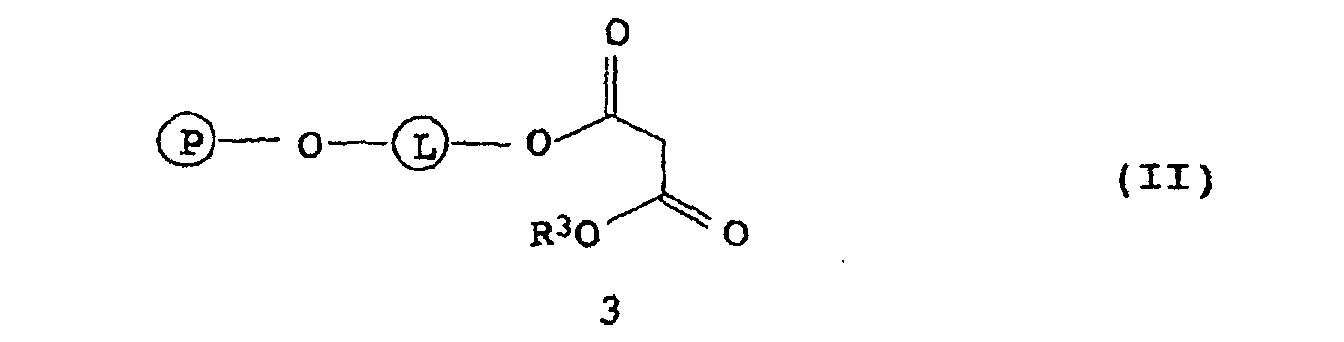 in Gegenwart einer Base zu Verbindungen der Formel IV
 umsetzt, und das erhaltene Produkt IV in Gegenwart einer Lewis-Säure zyklisiert.
- Verbindungen der Formel I gemäß Anspruch 1.
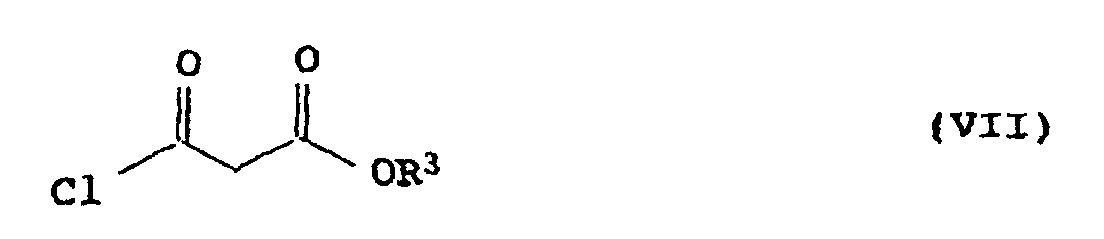
- Verfahren zur Herstellung von Verbindungen der Formel II gemäß Anspruch I, dadurch gekennzeichnet, daß man Verbindungen der Formel VIIan eine funktionalisierte feste Phase der Formel V
- (P)
- eine feste Phase ausgewählt aus der Gruppe Keramik, Glas, Latex, quervernetzte Polystyrole, Polyacrylamide, Silicagele, Cellulosepartikel, Harze, Gold oder colloidale Metallpartikel und
- (L)
- einen Linker mit 2 bis 12 Kohlenstoffatomen oder der Struktur -(-O-CH2-CH2-)1-100- bedeutet,
- Verbindung der allgemeinen Formel V gemäß Anspruch 3
- (P)
- eine feste Phase ausgewählt aus der Gruppe Keramik, Glas, Latex, quervernetzte Polystyrole, Polyacrylamide, Silicagele, Cellulosepartikel, Harze, Gold oder colloidale Metallpartikel und
- (L)
- einen Linker mit 2 bis 12 Kohlenstoffatomen bedeutet.
- Verbindungen der Formel II gemäß Anspruch 1.
- Verbindungen der Formel IV gemäß Anspruch 1.
- Verfahren gemäß Anspruch 1 zur Herstellung von Substanzbibliotheken.
- Verwendung von Verbindungen der Formel I gemäß Anspruch 1 zur Herstellung von Substanzbibliotheken der allgemeinen Formel VIwobei

- X
- -COOR4, -CONR5R6, -CH2OH bedeutet und
- R4, R5 und R6
- unabhängig voneinander Wasserstoff, C1-C10-Alkyl-, gegebenenfalls substituiert durch einen gegebenenfalls substituierten aromatischen oder heteroaromatischen Rest, C3-C8-Cycloalkyl-, ggf. subst. Aryl-, R1, R2, Rm, n, m die in Anspruch 1 angegebene Bedeutung besitzen dadurch gekennzeichnet, daß Verbindungen der Formel I unter Reduktion, Umesterung, Amidierung oder Basenkatalyse von der festen Phase abgespalten werden.
- Verwendung von Verbindungen der Formel IV gemäß Anspruch 6 zur Herstellung von Substanzbibliotheken.
- Verwendung von Verbindungen der Formel II gemäß Anspruch 5 als CH-acide Komponente in C-C-Verknüpfungsreaktionen.
- Verwendung der Verbindungen v als feste Phase gemäß Anspruch 4, als funktionalisierter Träger für organische Synthesen, für chromatographische Verfahren, zur Immobilisierung von Wirkstoffen oder Antigenen.
Applications Claiming Priority (3)
| Application Number | Priority Date | Filing Date | Title |
|---|---|---|---|
| DE19610103A DE19610103A1 (de) | 1996-03-15 | 1996-03-15 | Cycloalkylderivate und ihre Synthese an fester Phase |
| DE19610103 | 1996-03-15 | ||
| PCT/EP1997/001127 WO1997034852A1 (de) | 1996-03-15 | 1997-03-06 | Cycloalkylderivate und ihre synthese an fester phase |
Publications (2)
| Publication Number | Publication Date |
|---|---|
| EP0888262A1 EP0888262A1 (de) | 1999-01-07 |
| EP0888262B1 true EP0888262B1 (de) | 2004-06-02 |
Family
ID=7788313
Family Applications (1)
| Application Number | Title | Priority Date | Filing Date |
|---|---|---|---|
| EP97908184A Expired - Lifetime EP0888262B1 (de) | 1996-03-15 | 1997-03-06 | Cycloalkylderivate und ihre synthese an fester phase |
Country Status (11)
| Country | Link |
|---|---|
| US (1) | US6521780B1 (de) |
| EP (1) | EP0888262B1 (de) |
| JP (1) | JP2000507933A (de) |
| CN (1) | CN1140485C (de) |
| AT (1) | ATE268318T1 (de) |
| AU (1) | AU712164B2 (de) |
| CA (1) | CA2248600A1 (de) |
| DE (2) | DE19610103A1 (de) |
| NO (1) | NO310066B1 (de) |
| RU (1) | RU2197458C2 (de) |
| WO (1) | WO1997034852A1 (de) |
Families Citing this family (3)
| Publication number | Priority date | Publication date | Assignee | Title |
|---|---|---|---|---|
| NZ532579A (en) * | 2001-11-21 | 2006-11-30 | Sunesis Pharmaceuticals Inc | Methods for ligand discovery based on tethering process |
| JP5220012B2 (ja) * | 2006-07-21 | 2013-06-26 | ソルヴェイ(ソシエテ アノニム) | ペプチドを製造するための方法 |
| US20250154123A1 (en) * | 2022-01-07 | 2025-05-15 | V. Mane Fils | Cooling compounds and compositions |
Family Cites Families (7)
| Publication number | Priority date | Publication date | Assignee | Title |
|---|---|---|---|---|
| US5650489A (en) * | 1990-07-02 | 1997-07-22 | The Arizona Board Of Regents | Random bio-oligomer library, a method of synthesis thereof, and a method of use thereof |
| US5288514A (en) * | 1992-09-14 | 1994-02-22 | The Regents Of The University Of California | Solid phase and combinatorial synthesis of benzodiazepine compounds on a solid support |
| US5565324A (en) * | 1992-10-01 | 1996-10-15 | The Trustees Of Columbia University In The City Of New York | Complex combinatorial chemical libraries encoded with tags |
| EP0734398B1 (de) * | 1993-12-15 | 2002-02-27 | Smithkline Beecham Corporation | Verbindungen und verfahren |
| CA2189634A1 (en) | 1994-05-06 | 1995-11-16 | John J. Baldwin | Combinatorial dihydrobenzopyran library |
| US5549974A (en) * | 1994-06-23 | 1996-08-27 | Affymax Technologies Nv | Methods for the solid phase synthesis of thiazolidinones, metathiazanones, and derivatives thereof |
| WO1996000391A1 (en) | 1994-06-23 | 1996-01-04 | Affymax Technologies N.V. | Methods for the synthesis of diketopiperazines |
-
1996
- 1996-03-15 DE DE19610103A patent/DE19610103A1/de not_active Withdrawn
-
1997
- 1997-03-06 JP JP9533086A patent/JP2000507933A/ja not_active Withdrawn
- 1997-03-06 DE DE59711686T patent/DE59711686D1/de not_active Expired - Lifetime
- 1997-03-06 EP EP97908184A patent/EP0888262B1/de not_active Expired - Lifetime
- 1997-03-06 US US09/142,775 patent/US6521780B1/en not_active Expired - Fee Related
- 1997-03-06 WO PCT/EP1997/001127 patent/WO1997034852A1/de not_active Ceased
- 1997-03-06 AU AU20244/97A patent/AU712164B2/en not_active Ceased
- 1997-03-06 AT AT97908184T patent/ATE268318T1/de not_active IP Right Cessation
- 1997-03-06 CN CNB971946280A patent/CN1140485C/zh not_active Expired - Fee Related
- 1997-03-06 RU RU98119085/04A patent/RU2197458C2/ru not_active IP Right Cessation
- 1997-03-06 CA CA002248600A patent/CA2248600A1/en not_active Abandoned
-
1998
- 1998-09-14 NO NO984227A patent/NO310066B1/no unknown
Also Published As
| Publication number | Publication date |
|---|---|
| CN1140485C (zh) | 2004-03-03 |
| JP2000507933A (ja) | 2000-06-27 |
| DE59711686D1 (en) | 2004-07-08 |
| NO310066B1 (no) | 2001-05-14 |
| CN1218448A (zh) | 1999-06-02 |
| AU2024497A (en) | 1997-10-10 |
| US6521780B1 (en) | 2003-02-18 |
| CA2248600A1 (en) | 1997-09-25 |
| ATE268318T1 (de) | 2004-06-15 |
| NO984227D0 (no) | 1998-09-14 |
| AU712164B2 (en) | 1999-10-28 |
| DE19610103A1 (de) | 1997-09-18 |
| NO984227L (no) | 1998-09-14 |
| RU2197458C2 (ru) | 2003-01-27 |
| EP0888262A1 (de) | 1999-01-07 |
| WO1997034852A1 (de) | 1997-09-25 |
Similar Documents
| Publication | Publication Date | Title |
|---|---|---|
| EP1458670B1 (de) | Verfahren zur herstellung von 2-halogenacyl-3-amino-acrylsäure- derivaten | |
| DE69705295T2 (de) | Kombinatorische festphasensynthese einer bibliothek von benzofuranderivaten | |
| DE69430006T2 (de) | Verbindungen und verfahren | |
| JPH09506857A (ja) | 多成分組合せアレイ合成による有機化合物の組合せアレイの合成 | |
| WO1998001406A1 (de) | Enzymatisch spaltbare linker für festphasensynthesen | |
| SU1547707A3 (ru) | Способ получени транс-этил-1,2,3,4-тетрагидро-6,7-метилендиокси-4-оксо-1-/3,4,5-триметоксифенил/нафталин-2-карбоксилата | |
| EP0888262A1 (de) | Cycloalkylderivate und ihre synthese an fester phase | |
| EP0135162B1 (de) | Weinsäuremonoester von optisch aktiven Alkanolaminen, Verfahren zu ihrer Herstellung und ihre Verwendung | |
| DE60033050T2 (de) | Acetalsulfonat-derivate, verfahren zu ihrer herstellung und verfahren zur herstellung eines styroloxid-derivats | |
| CN112299981A (zh) | 一种α,α-二氟酮类衍生物的制备方法 | |
| KR102513022B1 (ko) | L-(+)-타르타르산을 이용한 (+)-디스파루어의 제조방법 | |
| DE19724983A1 (de) | Verfahren zur Herstellung von Chinazolindionen an fester Phase und ihre Verwendung | |
| DE19627002A1 (de) | Verfahren zur Herstellung von Pyrazolonderivaten | |
| DE3486032T2 (de) | Synthese von nizatidin. | |
| DE69614838T2 (de) | Verfahren zur herstellung von anhydroecgonin-estern | |
| KR100625886B1 (ko) | 입체선택적 분리방법을 이용하는 엘-무스콘 또는디-무스콘의 정제방법 | |
| AT392272B (de) | Verfahren zur herstellung eines pleuromutilinderivats und seiner saeureadditionssalze | |
| Zohrabi-Kalantari et al. | 4-Aminocyclopentane-1, 3-diols as platforms for diversity: synthesis of a screening library | |
| JPH01100147A (ja) | 光学活性マロン酸エステル誘導体 | |
| SU622395A3 (ru) | Способ получени аминов или их солей | |
| DE2264663C3 (de) | Ungesättigte Sulfoxyde und Verfahren zu ihrer Herstellung | |
| Lahouar et al. | Asymmetric synthesis and spectroscopic characterization of various N-substituted phthaloyl and tosyl derivatives | |
| CN105820119B (zh) | 一种5,6-二氢苯并菲啶衍生物及其制备方法 | |
| CN117777020A (zh) | 一种磺酸片段修饰的水溶性点击化学试剂及其合成方法 | |
| RU2237662C1 (ru) | Способ получения 1-ацетил-2-имидазолидона |
Legal Events
| Date | Code | Title | Description |
|---|---|---|---|
| PUAI | Public reference made under article 153(3) epc to a published international application that has entered the european phase |
Free format text: ORIGINAL CODE: 0009012 |
|
| 17P | Request for examination filed |
Effective date: 19980814 |
|
| AK | Designated contracting states |
Kind code of ref document: A1 Designated state(s): AT BE CH DE ES FI FR GB IT LI NL SE |
|
| 17Q | First examination report despatched |
Effective date: 20021024 |
|
| GRAP | Despatch of communication of intention to grant a patent |
Free format text: ORIGINAL CODE: EPIDOSNIGR1 |
|
| GRAS | Grant fee paid |
Free format text: ORIGINAL CODE: EPIDOSNIGR3 |
|
| GRAA | (expected) grant |
Free format text: ORIGINAL CODE: 0009210 |
|
| AK | Designated contracting states |
Kind code of ref document: B1 Designated state(s): AT BE CH DE ES FI FR GB IT LI NL SE |
|
| PG25 | Lapsed in a contracting state [announced via postgrant information from national office to epo] |
Ref country code: NL Free format text: LAPSE BECAUSE OF FAILURE TO SUBMIT A TRANSLATION OF THE DESCRIPTION OR TO PAY THE FEE WITHIN THE PRESCRIBED TIME-LIMIT Effective date: 20040602 Ref country code: IT Free format text: LAPSE BECAUSE OF FAILURE TO SUBMIT A TRANSLATION OF THE DESCRIPTION OR TO PAY THE FEE WITHIN THE PRE;WARNING: LAPSES OF ITALIAN PATENTS WITH EFFECTIVE DATE BEFORE 2007 MAY HAVE OCCURRED AT ANY TIME BEFORE 2007. THE CORRECT EFFECTIVE DATE MAY BE DIFFERENT FROM THE ONE RECORDED.SCRIBED TIME-LIMIT Effective date: 20040602 Ref country code: FI Free format text: LAPSE BECAUSE OF FAILURE TO SUBMIT A TRANSLATION OF THE DESCRIPTION OR TO PAY THE FEE WITHIN THE PRESCRIBED TIME-LIMIT Effective date: 20040602 |
|
| REG | Reference to a national code |
Ref country code: GB Ref legal event code: FG4D Free format text: NOT ENGLISH |
|
| REG | Reference to a national code |
Ref country code: CH Ref legal event code: EP |
|
| REF | Corresponds to: |
Ref document number: 59711686 Country of ref document: DE Date of ref document: 20040708 Kind code of ref document: P |
|
| GBT | Gb: translation of ep patent filed (gb section 77(6)(a)/1977) |
Effective date: 20040701 |
|
| PG25 | Lapsed in a contracting state [announced via postgrant information from national office to epo] |
Ref country code: SE Free format text: LAPSE BECAUSE OF FAILURE TO SUBMIT A TRANSLATION OF THE DESCRIPTION OR TO PAY THE FEE WITHIN THE PRESCRIBED TIME-LIMIT Effective date: 20040902 |
|
| PG25 | Lapsed in a contracting state [announced via postgrant information from national office to epo] |
Ref country code: ES Free format text: LAPSE BECAUSE OF FAILURE TO SUBMIT A TRANSLATION OF THE DESCRIPTION OR TO PAY THE FEE WITHIN THE PRESCRIBED TIME-LIMIT Effective date: 20040913 |
|
| NLV1 | Nl: lapsed or annulled due to failure to fulfill the requirements of art. 29p and 29m of the patents act | ||
| PGFP | Annual fee paid to national office [announced via postgrant information from national office to epo] |
Ref country code: GB Payment date: 20050302 Year of fee payment: 9 |
|
| ET | Fr: translation filed | ||
| PGFP | Annual fee paid to national office [announced via postgrant information from national office to epo] |
Ref country code: DE Payment date: 20050304 Year of fee payment: 9 |
|
| PG25 | Lapsed in a contracting state [announced via postgrant information from national office to epo] |
Ref country code: AT Free format text: LAPSE BECAUSE OF NON-PAYMENT OF DUE FEES Effective date: 20050306 |
|
| PGFP | Annual fee paid to national office [announced via postgrant information from national office to epo] |
Ref country code: FR Payment date: 20050308 Year of fee payment: 9 |
|
| PGFP | Annual fee paid to national office [announced via postgrant information from national office to epo] |
Ref country code: CH Payment date: 20050316 Year of fee payment: 9 |
|
| PG25 | Lapsed in a contracting state [announced via postgrant information from national office to epo] |
Ref country code: BE Free format text: LAPSE BECAUSE OF NON-PAYMENT OF DUE FEES Effective date: 20050331 |
|
| PLBE | No opposition filed within time limit |
Free format text: ORIGINAL CODE: 0009261 |
|
| STAA | Information on the status of an ep patent application or granted ep patent |
Free format text: STATUS: NO OPPOSITION FILED WITHIN TIME LIMIT |
|
| 26N | No opposition filed |
Effective date: 20050303 |
|
| BERE | Be: lapsed |
Owner name: *BASF A.G. Effective date: 20050331 |
|
| PG25 | Lapsed in a contracting state [announced via postgrant information from national office to epo] |
Ref country code: GB Free format text: LAPSE BECAUSE OF NON-PAYMENT OF DUE FEES Effective date: 20060306 |
|
| PG25 | Lapsed in a contracting state [announced via postgrant information from national office to epo] |
Ref country code: LI Free format text: LAPSE BECAUSE OF NON-PAYMENT OF DUE FEES Effective date: 20060331 Ref country code: CH Free format text: LAPSE BECAUSE OF NON-PAYMENT OF DUE FEES Effective date: 20060331 |
|
| PG25 | Lapsed in a contracting state [announced via postgrant information from national office to epo] |
Ref country code: DE Free format text: LAPSE BECAUSE OF THE APPLICANT RENOUNCES Effective date: 20060425 |
|
| REG | Reference to a national code |
Ref country code: CH Ref legal event code: PL |
|
| GBPC | Gb: european patent ceased through non-payment of renewal fee |
Effective date: 20060306 |
|
| REG | Reference to a national code |
Ref country code: FR Ref legal event code: ST Effective date: 20061130 |
|
| BERE | Be: lapsed |
Owner name: *BASF A.G. Effective date: 20050331 |
|
| PG25 | Lapsed in a contracting state [announced via postgrant information from national office to epo] |
Ref country code: FR Free format text: LAPSE BECAUSE OF NON-PAYMENT OF DUE FEES Effective date: 20060331 |