EP0872735A1 - Verfahren zum Aufbringen von Reagenzspots - Google Patents
Verfahren zum Aufbringen von Reagenzspots Download PDFInfo
- Publication number
- EP0872735A1 EP0872735A1 EP98106611A EP98106611A EP0872735A1 EP 0872735 A1 EP0872735 A1 EP 0872735A1 EP 98106611 A EP98106611 A EP 98106611A EP 98106611 A EP98106611 A EP 98106611A EP 0872735 A1 EP0872735 A1 EP 0872735A1
- Authority
- EP
- European Patent Office
- Prior art keywords
- reagent
- solid phase
- binding
- metal
- spots
- Prior art date
- Legal status (The legal status is an assumption and is not a legal conclusion. Google has not performed a legal analysis and makes no representation as to the accuracy of the status listed.)
- Granted
Links
Images


Classifications
-
- G—PHYSICS
- G01—MEASURING; TESTING
- G01N—INVESTIGATING OR ANALYSING MATERIALS BY DETERMINING THEIR CHEMICAL OR PHYSICAL PROPERTIES
- G01N33/00—Investigating or analysing materials by specific methods not covered by groups G01N1/00 - G01N31/00
- G01N33/48—Biological material, e.g. blood, urine; Haemocytometers
- G01N33/50—Chemical analysis of biological material, e.g. blood, urine; Testing involving biospecific ligand binding methods; Immunological testing
- G01N33/53—Immunoassay; Biospecific binding assay; Materials therefor
- G01N33/543—Immunoassay; Biospecific binding assay; Materials therefor with an insoluble carrier for immobilising immunochemicals
- G01N33/551—Immunoassay; Biospecific binding assay; Materials therefor with an insoluble carrier for immobilising immunochemicals the carrier being inorganic
- G01N33/553—Metal or metal coated
-
- B—PERFORMING OPERATIONS; TRANSPORTING
- B01—PHYSICAL OR CHEMICAL PROCESSES OR APPARATUS IN GENERAL
- B01J—CHEMICAL OR PHYSICAL PROCESSES, e.g. CATALYSIS OR COLLOID CHEMISTRY; THEIR RELEVANT APPARATUS
- B01J19/00—Chemical, physical or physico-chemical processes in general; Their relevant apparatus
- B01J19/0046—Sequential or parallel reactions, e.g. for the synthesis of polypeptides or polynucleotides; Apparatus and devices for combinatorial chemistry or for making molecular arrays
-
- B—PERFORMING OPERATIONS; TRANSPORTING
- B82—NANOTECHNOLOGY
- B82Y—SPECIFIC USES OR APPLICATIONS OF NANOSTRUCTURES; MEASUREMENT OR ANALYSIS OF NANOSTRUCTURES; MANUFACTURE OR TREATMENT OF NANOSTRUCTURES
- B82Y30/00—Nanotechnology for materials or surface science, e.g. nanocomposites
-
- B—PERFORMING OPERATIONS; TRANSPORTING
- B01—PHYSICAL OR CHEMICAL PROCESSES OR APPARATUS IN GENERAL
- B01J—CHEMICAL OR PHYSICAL PROCESSES, e.g. CATALYSIS OR COLLOID CHEMISTRY; THEIR RELEVANT APPARATUS
- B01J2219/00—Chemical, physical or physico-chemical processes in general; Their relevant apparatus
- B01J2219/00274—Sequential or parallel reactions; Apparatus and devices for combinatorial chemistry or for making arrays; Chemical library technology
- B01J2219/00277—Apparatus
- B01J2219/00351—Means for dispensing and evacuation of reagents
- B01J2219/00364—Pipettes
- B01J2219/00371—Pipettes comprising electrodes
-
- B—PERFORMING OPERATIONS; TRANSPORTING
- B01—PHYSICAL OR CHEMICAL PROCESSES OR APPARATUS IN GENERAL
- B01J—CHEMICAL OR PHYSICAL PROCESSES, e.g. CATALYSIS OR COLLOID CHEMISTRY; THEIR RELEVANT APPARATUS
- B01J2219/00—Chemical, physical or physico-chemical processes in general; Their relevant apparatus
- B01J2219/00274—Sequential or parallel reactions; Apparatus and devices for combinatorial chemistry or for making arrays; Chemical library technology
- B01J2219/00277—Apparatus
- B01J2219/00497—Features relating to the solid phase supports
-
- B—PERFORMING OPERATIONS; TRANSPORTING
- B01—PHYSICAL OR CHEMICAL PROCESSES OR APPARATUS IN GENERAL
- B01J—CHEMICAL OR PHYSICAL PROCESSES, e.g. CATALYSIS OR COLLOID CHEMISTRY; THEIR RELEVANT APPARATUS
- B01J2219/00—Chemical, physical or physico-chemical processes in general; Their relevant apparatus
- B01J2219/00274—Sequential or parallel reactions; Apparatus and devices for combinatorial chemistry or for making arrays; Chemical library technology
- B01J2219/00277—Apparatus
- B01J2219/00497—Features relating to the solid phase supports
- B01J2219/00527—Sheets
-
- B—PERFORMING OPERATIONS; TRANSPORTING
- B01—PHYSICAL OR CHEMICAL PROCESSES OR APPARATUS IN GENERAL
- B01J—CHEMICAL OR PHYSICAL PROCESSES, e.g. CATALYSIS OR COLLOID CHEMISTRY; THEIR RELEVANT APPARATUS
- B01J2219/00—Chemical, physical or physico-chemical processes in general; Their relevant apparatus
- B01J2219/00274—Sequential or parallel reactions; Apparatus and devices for combinatorial chemistry or for making arrays; Chemical library technology
- B01J2219/00583—Features relative to the processes being carried out
- B01J2219/00585—Parallel processes
-
- B—PERFORMING OPERATIONS; TRANSPORTING
- B01—PHYSICAL OR CHEMICAL PROCESSES OR APPARATUS IN GENERAL
- B01J—CHEMICAL OR PHYSICAL PROCESSES, e.g. CATALYSIS OR COLLOID CHEMISTRY; THEIR RELEVANT APPARATUS
- B01J2219/00—Chemical, physical or physico-chemical processes in general; Their relevant apparatus
- B01J2219/00274—Sequential or parallel reactions; Apparatus and devices for combinatorial chemistry or for making arrays; Chemical library technology
- B01J2219/00583—Features relative to the processes being carried out
- B01J2219/0059—Sequential processes
-
- B—PERFORMING OPERATIONS; TRANSPORTING
- B01—PHYSICAL OR CHEMICAL PROCESSES OR APPARATUS IN GENERAL
- B01J—CHEMICAL OR PHYSICAL PROCESSES, e.g. CATALYSIS OR COLLOID CHEMISTRY; THEIR RELEVANT APPARATUS
- B01J2219/00—Chemical, physical or physico-chemical processes in general; Their relevant apparatus
- B01J2219/00274—Sequential or parallel reactions; Apparatus and devices for combinatorial chemistry or for making arrays; Chemical library technology
- B01J2219/00583—Features relative to the processes being carried out
- B01J2219/00596—Solid-phase processes
-
- B—PERFORMING OPERATIONS; TRANSPORTING
- B01—PHYSICAL OR CHEMICAL PROCESSES OR APPARATUS IN GENERAL
- B01J—CHEMICAL OR PHYSICAL PROCESSES, e.g. CATALYSIS OR COLLOID CHEMISTRY; THEIR RELEVANT APPARATUS
- B01J2219/00—Chemical, physical or physico-chemical processes in general; Their relevant apparatus
- B01J2219/00274—Sequential or parallel reactions; Apparatus and devices for combinatorial chemistry or for making arrays; Chemical library technology
- B01J2219/00583—Features relative to the processes being carried out
- B01J2219/00603—Making arrays on substantially continuous surfaces
- B01J2219/00605—Making arrays on substantially continuous surfaces the compounds being directly bound or immobilised to solid supports
-
- B—PERFORMING OPERATIONS; TRANSPORTING
- B01—PHYSICAL OR CHEMICAL PROCESSES OR APPARATUS IN GENERAL
- B01J—CHEMICAL OR PHYSICAL PROCESSES, e.g. CATALYSIS OR COLLOID CHEMISTRY; THEIR RELEVANT APPARATUS
- B01J2219/00—Chemical, physical or physico-chemical processes in general; Their relevant apparatus
- B01J2219/00274—Sequential or parallel reactions; Apparatus and devices for combinatorial chemistry or for making arrays; Chemical library technology
- B01J2219/00583—Features relative to the processes being carried out
- B01J2219/00603—Making arrays on substantially continuous surfaces
- B01J2219/00605—Making arrays on substantially continuous surfaces the compounds being directly bound or immobilised to solid supports
- B01J2219/00612—Making arrays on substantially continuous surfaces the compounds being directly bound or immobilised to solid supports the surface being inorganic
-
- B—PERFORMING OPERATIONS; TRANSPORTING
- B01—PHYSICAL OR CHEMICAL PROCESSES OR APPARATUS IN GENERAL
- B01J—CHEMICAL OR PHYSICAL PROCESSES, e.g. CATALYSIS OR COLLOID CHEMISTRY; THEIR RELEVANT APPARATUS
- B01J2219/00—Chemical, physical or physico-chemical processes in general; Their relevant apparatus
- B01J2219/00274—Sequential or parallel reactions; Apparatus and devices for combinatorial chemistry or for making arrays; Chemical library technology
- B01J2219/00583—Features relative to the processes being carried out
- B01J2219/00603—Making arrays on substantially continuous surfaces
- B01J2219/00605—Making arrays on substantially continuous surfaces the compounds being directly bound or immobilised to solid supports
- B01J2219/00623—Immobilisation or binding
- B01J2219/0063—Other, e.g. van der Waals forces, hydrogen bonding
-
- B—PERFORMING OPERATIONS; TRANSPORTING
- B01—PHYSICAL OR CHEMICAL PROCESSES OR APPARATUS IN GENERAL
- B01J—CHEMICAL OR PHYSICAL PROCESSES, e.g. CATALYSIS OR COLLOID CHEMISTRY; THEIR RELEVANT APPARATUS
- B01J2219/00—Chemical, physical or physico-chemical processes in general; Their relevant apparatus
- B01J2219/00274—Sequential or parallel reactions; Apparatus and devices for combinatorial chemistry or for making arrays; Chemical library technology
- B01J2219/00583—Features relative to the processes being carried out
- B01J2219/00603—Making arrays on substantially continuous surfaces
- B01J2219/00605—Making arrays on substantially continuous surfaces the compounds being directly bound or immobilised to solid supports
- B01J2219/00632—Introduction of reactive groups to the surface
- B01J2219/00637—Introduction of reactive groups to the surface by coating it with another layer
-
- B—PERFORMING OPERATIONS; TRANSPORTING
- B01—PHYSICAL OR CHEMICAL PROCESSES OR APPARATUS IN GENERAL
- B01J—CHEMICAL OR PHYSICAL PROCESSES, e.g. CATALYSIS OR COLLOID CHEMISTRY; THEIR RELEVANT APPARATUS
- B01J2219/00—Chemical, physical or physico-chemical processes in general; Their relevant apparatus
- B01J2219/00274—Sequential or parallel reactions; Apparatus and devices for combinatorial chemistry or for making arrays; Chemical library technology
- B01J2219/00583—Features relative to the processes being carried out
- B01J2219/00603—Making arrays on substantially continuous surfaces
- B01J2219/00659—Two-dimensional arrays
-
- B—PERFORMING OPERATIONS; TRANSPORTING
- B01—PHYSICAL OR CHEMICAL PROCESSES OR APPARATUS IN GENERAL
- B01J—CHEMICAL OR PHYSICAL PROCESSES, e.g. CATALYSIS OR COLLOID CHEMISTRY; THEIR RELEVANT APPARATUS
- B01J2219/00—Chemical, physical or physico-chemical processes in general; Their relevant apparatus
- B01J2219/00274—Sequential or parallel reactions; Apparatus and devices for combinatorial chemistry or for making arrays; Chemical library technology
- B01J2219/00583—Features relative to the processes being carried out
- B01J2219/00603—Making arrays on substantially continuous surfaces
- B01J2219/00677—Ex-situ synthesis followed by deposition on the substrate
-
- B—PERFORMING OPERATIONS; TRANSPORTING
- B01—PHYSICAL OR CHEMICAL PROCESSES OR APPARATUS IN GENERAL
- B01J—CHEMICAL OR PHYSICAL PROCESSES, e.g. CATALYSIS OR COLLOID CHEMISTRY; THEIR RELEVANT APPARATUS
- B01J2219/00—Chemical, physical or physico-chemical processes in general; Their relevant apparatus
- B01J2219/00274—Sequential or parallel reactions; Apparatus and devices for combinatorial chemistry or for making arrays; Chemical library technology
- B01J2219/0068—Means for controlling the apparatus of the process
- B01J2219/00702—Processes involving means for analysing and characterising the products
-
- B—PERFORMING OPERATIONS; TRANSPORTING
- B01—PHYSICAL OR CHEMICAL PROCESSES OR APPARATUS IN GENERAL
- B01J—CHEMICAL OR PHYSICAL PROCESSES, e.g. CATALYSIS OR COLLOID CHEMISTRY; THEIR RELEVANT APPARATUS
- B01J2219/00—Chemical, physical or physico-chemical processes in general; Their relevant apparatus
- B01J2219/00274—Sequential or parallel reactions; Apparatus and devices for combinatorial chemistry or for making arrays; Chemical library technology
- B01J2219/00718—Type of compounds synthesised
- B01J2219/0072—Organic compounds
-
- C—CHEMISTRY; METALLURGY
- C40—COMBINATORIAL TECHNOLOGY
- C40B—COMBINATORIAL CHEMISTRY; LIBRARIES, e.g. CHEMICAL LIBRARIES
- C40B60/00—Apparatus specially adapted for use in combinatorial chemistry or with libraries
- C40B60/14—Apparatus specially adapted for use in combinatorial chemistry or with libraries for creating libraries
-
- Y—GENERAL TAGGING OF NEW TECHNOLOGICAL DEVELOPMENTS; GENERAL TAGGING OF CROSS-SECTIONAL TECHNOLOGIES SPANNING OVER SEVERAL SECTIONS OF THE IPC; TECHNICAL SUBJECTS COVERED BY FORMER USPC CROSS-REFERENCE ART COLLECTIONS [XRACs] AND DIGESTS
- Y10—TECHNICAL SUBJECTS COVERED BY FORMER USPC
- Y10S—TECHNICAL SUBJECTS COVERED BY FORMER USPC CROSS-REFERENCE ART COLLECTIONS [XRACs] AND DIGESTS
- Y10S435/00—Chemistry: molecular biology and microbiology
- Y10S435/973—Simultaneous determination of more than one analyte
Definitions
- the invention relates to a method for applying spatially defined Reagent areas or reagent spots on a solid phase with a metal or Metal oxide surface and a solid phase binding matrix, which different Solid phase reactants and / or solid phase reactants in different Concentrations in spatially defined reagent spots included.
- a number of methods are known by which small amounts of reagent are applied different surfaces, such as glass or plastic substrates can be. Such methods lead to microstructuring of the Surface reagents, e.g. B. in the form of spatially from each other separate reagent spots.
- arrays in which the individual reagent spots z.
- B. different reactants such as DNA fragments or include antibodies.
- WO 92/10 092 describes a method described with which through photoreactive compounds and radiation Masks created a variety of different structures on a glass slide can be.
- US-4,877,745 a method is described in which means Ink-Jet (ink jet) on plastic carriers with differently functionalized spots can be applied.
- a self-assembling Monolayer forms e.g. in the adsorption of organic Alkylthiols on a gold surface, the spontaneous organization of a such a densely packed monolayer on strong specific interactions between the carrier material and the adsorbent (Nuzzo et al., J.Am.Chem.Soc. 105 (1983) 4481).
- SAM Self-assembling Monolayer
- a well-defined Monolayer of a binding matrix on the surface of metals such as. B. Gold or silver.
- the specific binding ability of self-assembled solid phases can also be diluted by the specific Solid phase reactants can be further optimized, as in EP-A-0 515 615 described.
- the object of the invention was therefore to provide a method with the simple array structures of reagent spots on metal or Metal oxide surfaces can be applied.
- This object is achieved by a method for applying spatially defined reagent areas dissolved on a solid phase, which is characterized in that an adsorbable binding reagent containing liquid in the area of spatially defined areas with a Solid phase, which is a substantially continuous metal or Metal oxide surface covers for a sufficient amount of time to complete the formation to enable adsorptive bonds between binding reagent and solid phase in Is brought into contact.
- reagent spots can, for. B. by ink-jet method (Ink jet method) or with an automatic micropipetting device respectively.
- the reagent solution is in the form of small droplets, preferably in Form of microdroplets applied to the surface.
- the surface After applying the reagent solution, the surface is left for a certain Duration, e.g. Incubated for 1 to 60 min, preferably 5 to 10 minutes Formation of adsorptive bonds between binding reagent and metal or Allow metal oxide surface.
- the incubation period depends on that used binding reagent and from the surface, being long enough is incubated to allow the formation of adsorptive bonds.
- a self-assembled monolayer of the binding reagent on the metal or Metal oxide surface formed in the form of spatially delimited areas. After incubating, the surface quickly becomes large Excess solvent washed to prevent smudging of each other to avoid adjacent areas.
- Binder reagent aqueous or / and organic solvents be used.
- adsorbent binders Reagents on a continuous metal or metal oxide layer in the form of Spots to form spatially delimited areas, neither during the Applying a significant smearing of neighboring ones afterwards Reagent spots occur.
- Discrete spots are formed between the surface and the binding reagent because the adsorbable binding reagent is surprisingly stationary.
- An essential one The advantage of the method is that it is simple Surface regions with different assignments or functionalities that can be produced for multiparameter assays in detection methods, e.g. used in immunological or nucleic acid hybridization assays can be.
- binding reagent after Completion of the self-assembly by the washing process does not go through the Carrier is carried to other reagent spots. It was also found that even after completion of the functionalized surfaces, the individual spatially delimited areas are stable, i.e. the adsorbed Binding reagents remain in the same place and do not migrate to unoccupied places on the metal or metal oxide surface.
- the areas of the reagent spots applied preferably have one Diameter of ⁇ 5 mm, particularly preferably a diameter of ⁇ 1 mm on.
- the preferred surface is a noble metal surface, particularly preferably one Gold or silver surface and most preferred a gold surface.
- a such a metal surface can be deposited, for example, by vapor deposition
- Metal layer can be formed on a carrier, for example a glass carrier.
- Such an evaporated layer is preferably 10 to 100 nm thick.
- a precious metal surface is used as an adsorbable binding reagent preferably an SH or SS reagent used.
- Such thiol or Disulfide reagents are e.g. described in detail in DE 40 39 677.
- Biotinylated thiol reagents adsorbed onto a surface as SAM can then be treated with streptavidin, with a different Biotin content in different spots for different streptavidin layers leads.
- a metal oxide as the surface.
- suitable metal oxide surfaces are SiO 2 , TiO 2 , Al 2 O 3 , Sn 2 O 3 , Ag 2 O, La 2 O 3 , Ta 2 O 5 and mixtures thereof.
- a metal oxide surface made of SiO 2 and / or TiO 2 is preferably used.
- a compound containing a silane group is preferably used as the adsorbable binding reagent. Such compounds are described, for example, in EP-A-0 664 452. When adsorbing compounds containing silane groups on metal oxide surfaces, covalent crosslinking takes place after the adsorption, for example by heating.
- the adsorbable binding reagents used according to the invention preferably contain at least one specifically bindable group, such as biotin, a biotin derivative, streptavidin, a hapten, an antigen and / or one Nucleic acid sequence which bind specifically with a binding partner, for example an analyte to be detected.
- the binding of analytes to a functionalized solid phase matrix according to the invention can be demonstrated, for example, by confocal scanner fluorescence microscopy or by plasmon resonance spectroscopy. Detection is preferably carried out by means of plasmon resonance microscopy (B.
- the simultaneous determination of plasmon resonance and fluorescence detection is particularly preferably used to detect the binding of an analyte.
- the plasmon resonance signal and the fluorescence signal are obtained independently of one another, which makes it possible to determine reaction kinetics in addition to a high sensitivity (10 -14 mol / l).
- Another object of the invention is a solid phase matrix a carrier which is essentially continuous with a metal or Metal oxide layer is coated on the spatially defined reagent surfaces are arranged which (a) contain different solid phase reactants or / and (b) a solid phase reactant in different concentrations contain.
- a solid phase binding matrix preferably comprises at least three differently functionalized areas on one surface, especially preferably at least 5 differently functionalized areas.
- the Reagent spot diameters are preferably 5 5 mm, more preferably ⁇ 1 mm and most preferably ⁇ 500 ⁇ m.
- Such a solid phase matrix with reagent spots in the ⁇ m range can also be referred to as a microarray.
- Another object of the invention is a method for the detection of a Binding or / and interaction of analytes, wherein an inventive Solid phase matrix is used.
- an inventive Solid phase matrix is used.
- Plasmon resonance spectroscopy or / and plasmon resonance microscopy as Detection method
- real-time detection is possible, with one Marking is not necessary since the layer thickness can be measured.
- a Such a method can be used in molecular diagnostics to determine Allergies, used in immunology and for nucleic acid hybridization will. It is particularly preferably used to detect the binding or / and interaction of the analyte a combination of Plasmon resonance spectroscopy and fluorescence detection or a Combination of plasmon resonance microscopy and fluorescence detection.
- a microtiter plate (6) is also attached to the working surface of the XYZ table (2) and contains the various adsorbable binding reagents to be applied dissolved in a solvent and the pure solvents in different wells.
- a water-soluble thiol system consisting of HS-Prop-DADOO-X-Biotin (bindable reagent) (FIG. 2a) and HS-C2-aminoethoxyethanol (thinner component) (FIG. 2b) in a concentration of 5 ⁇ were used as substances for the adsorption 10 -4 molar in water and an ethanol-soluble thiol system consisting of HS-C12-DADOO-biotin (bindable biotin component) (Fig.
- the gold surface on which the reagent spots are applied were allowed to sit for approx. 10 min Forms a self-assembled monolayer. Then the Gold surface rinsed all over with pure solvent, so as not wash off adsorbed molecules. This way you can quickly Surfaces with spatially delimited reaction spots are generated. Of the The diameter of the spots is approx. 200 ⁇ m.
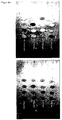
- FIG. 4 shows that using a CCD camera obtained images of the spots coated with thiol before and after Streptavidin binding.
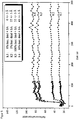
- Figure 5 is the time course of the Image evaluation obtained intensities of a streptavidin connection differently loaded spots are shown.
- Figure 4a six shots are closed see which each have twelve equally functionalized thiol spots in different Show the angle of incidence of the laser light.
- Figure 4b is one with 16 reagent spots coated carrier, 4 of the spots being the same Have functionalization, the image on the left before the binding of Streptavidin, the picture is taken right after the binding of streptavidin.
- the method according to the invention it is possible with the method according to the invention to spatially separated, differently functionalized reagent spots on one to apply a continuous surface.
- FIG. 5 shows the time course of the adsorption of streptavidin to one four different hydrophilic thiol mixtures occupied surface by evaluating the reflection intensity of plasmon resonance microscopy
- K1 represents a reagent spot on which a pure Solvent solution was incubated. This spot was then with Streptavidin treated.
- K2 provides a reagent spot with a solution consisting of 1% biotinylated thiol and 99% Diluent thiol was incubated and then treated with streptavidin. It a significantly higher streptavidin binding than in curve K1 can be seen.
- K3 represents a reagent spot with 100% biotinylated thiol, i.e. without Diluent was incubated and then treated with streptavidin has been. There is a significant increase in the layer thickness to 33 ⁇ 3 ⁇ im Relation to K2, where the layer thickness was 22 ⁇ 3 ⁇ .
- K4 finally poses is a reagent spot containing 10% biotinylated thiol and 90% Diluent was treated. This creates a dilute homogeneous binding layer, which after treatment with streptavidin has the highest reflection, resulting in a layer thickness of 43 ⁇ 3 angstroms can be calculated.
- Figure 6 can be on a single flat gold carrier reagent spots with different assignments applied which creates an array system. It is also possible to go to Use of such an array of bonds and / or interactions Detect analytes, with both the layer thickness (occupancy) and the reaction kinetics (adsorption rate) can also be determined.
Landscapes
- Chemical & Material Sciences (AREA)
- Engineering & Computer Science (AREA)
- Health & Medical Sciences (AREA)
- Immunology (AREA)
- Life Sciences & Earth Sciences (AREA)
- Biomedical Technology (AREA)
- Organic Chemistry (AREA)
- Nanotechnology (AREA)
- General Physics & Mathematics (AREA)
- Hematology (AREA)
- Physics & Mathematics (AREA)
- Molecular Biology (AREA)
- Urology & Nephrology (AREA)
- Medicinal Chemistry (AREA)
- Pathology (AREA)
- Microbiology (AREA)
- Analytical Chemistry (AREA)
- Biochemistry (AREA)
- General Health & Medical Sciences (AREA)
- Cell Biology (AREA)
- Food Science & Technology (AREA)
- Composite Materials (AREA)
- Condensed Matter Physics & Semiconductors (AREA)
- Materials Engineering (AREA)
- Crystallography & Structural Chemistry (AREA)
- Biotechnology (AREA)
- Inorganic Chemistry (AREA)
- Chemical Kinetics & Catalysis (AREA)
- Measuring Or Testing Involving Enzymes Or Micro-Organisms (AREA)
Abstract
Description
- Figur 1
- das Prinzip des Aufbringens der Reagenzspots veranschaulicht,
- Figur 2
- Reagenzien, welche zur Bildung von selbstassemblierten Monoschichten geeignet sind, darstellt,
- Figur 3
- den experimentellen Aufbau eines Oberflächenplasmonenmikroskops zeigt,
- Figur 4
- mit einem Plasmonen-Mikroskop erhaltene Aufnahmen von erfindungsgemäß auf eine Goldoberfläche aufgebrachten Reagenzspots zeigt und
- Figur 5
- die zeitabhängige Reflexionsintensität gegen die Zeit einer Matrix mit vier verschiedenen hydrophilen Thiolgemischen, erhalten durch Oberflächenplasmonenmikroskopie darstellt.
Claims (8)
- Verfahren zum Aufbringen von räumlich definierten Reagenzflächen auf eine Festphase,
dadurch gekennzeichnet,
daß eine ein adsorptionsfähiges Bindereagenz enthaltende Flüssigkeit im Bereich von räumlich definierten Flächen mit einer Festphase, die eine im wesentlichen kontinuierliche Metall- oder Metalloxidoberfläche umfaßt, für eine ausreichende Zeitdauer, um die Ausbildung adsorptiver Bindungen zwischen Bindereagenz und Festphase zu ermöglichen, in Kontakt gebracht wird. - Verfahren nach Anspruch 1,
dadurch gekennzeichnet,
daß eine Metalloberfläche verwendet wird. - Verfahren nach Anspruch 2,
dadurch gekennzeichnet,
daß als adsorptionsfähiges Bindereagenz eine eine Thiol- oder Disulfidgruppe enthaltende Verbindung verwendet wird. - Verfahren nach Anspruch 1,
dadurch gekennzeichnet,
daß eine Metalloxidoberfläche verwendet wird. - Verfahren nach Anspruch 4,
dadurch gekennzeichnet,
daß als adsorptionsfähiges Bindereagenz eine eine Silangruppe enthaltende Verbindung verwendet wird. - Verfahren nach einem der vorhergehenden Ansprüche,
dadurch gekennzeichnet,
daß das adsorptionsfähige Bindereagenz in Form einer selbstassemblierenden Monoschicht aufgebracht wird. - Festphasenmatrix umfassend einen Träger, welcher im wesentlichen kontinuierlich mit einer Metall- oder Metalloxidschicht überzogen ist, auf der räumlich definierte Reagenzflächen angeordnet sind, welche(a) jeweils unterschiedliche Festphasenreaktanten enthalten oder/und(b) einen Festphasenreaktanten in jeweils unterschiedlichen Konzentrationen enthalten.
- Verfahren zum Nachweis einer Bindung oder/und Wechselwirkung von Analyten,
dadurch gekennzeichnet,
daß man eine Festphasenmatrix nach Anspruch 7 verwendet und die Bindung oder/und Wechselwirkung des Analyten auf an sich bekannte Weise nachweist.
Applications Claiming Priority (2)
| Application Number | Priority Date | Filing Date | Title |
|---|---|---|---|
| DE19715484 | 1997-04-14 | ||
| DE19715484A DE19715484A1 (de) | 1997-04-14 | 1997-04-14 | Verfahren zum Aufbringen von Reagenzspots |
Publications (2)
| Publication Number | Publication Date |
|---|---|
| EP0872735A1 true EP0872735A1 (de) | 1998-10-21 |
| EP0872735B1 EP0872735B1 (de) | 2004-09-22 |
Family
ID=7826434
Family Applications (1)
| Application Number | Title | Priority Date | Filing Date |
|---|---|---|---|
| EP98106611A Expired - Lifetime EP0872735B1 (de) | 1997-04-14 | 1998-04-09 | Verfahren zum Aufbringen von Reagenzspots |
Country Status (4)
| Country | Link |
|---|---|
| US (1) | US6221674B1 (de) |
| EP (1) | EP0872735B1 (de) |
| JP (1) | JPH10307139A (de) |
| DE (2) | DE19715484A1 (de) |
Cited By (3)
| Publication number | Priority date | Publication date | Assignee | Title |
|---|---|---|---|---|
| WO2001013096A1 (de) * | 1999-08-13 | 2001-02-22 | Zeptosens Ag | Vorrichtung und verfahren zur multianalytbestimmung |
| WO2000073796A3 (de) * | 1999-05-28 | 2001-07-05 | Graffinity Pharm Design Gmbh | Ligand-anker-konjugate zur generierung einer biosensor-schicht |
| EP1143252A4 (de) * | 1999-10-22 | 2007-01-24 | Ngk Insulators Ltd | Biochip |
Families Citing this family (11)
| Publication number | Priority date | Publication date | Assignee | Title |
|---|---|---|---|---|
| US6984522B2 (en) | 2000-08-03 | 2006-01-10 | Regents Of The University Of Michigan | Isolation and use of solid tumor stem cells |
| JP2002153272A (ja) * | 2000-11-24 | 2002-05-28 | Inst Of Physical & Chemical Res | 生体分子マイクロアレイ |
| JP2002350447A (ja) * | 2001-05-24 | 2002-12-04 | Wako Pure Chem Ind Ltd | 生理活性物質固定化担体及びその製造方法、固定化生理活性物質、試料中の対象成分分析方法、並びに試料中の対象成分分析用キット |
| US20030153010A1 (en) * | 2002-01-10 | 2003-08-14 | Orth Reid N. | Patterned biological molecules on inner surface of enclosed tubes |
| US20040137608A1 (en) * | 2002-11-27 | 2004-07-15 | Aaron Garzon | Chemical microarrays and method for constructing same |
| US7611908B2 (en) * | 2005-05-02 | 2009-11-03 | Bioscale, Inc. | Method and apparatus for therapeutic drug monitoring using an acoustic device |
| US7648844B2 (en) * | 2005-05-02 | 2010-01-19 | Bioscale, Inc. | Method and apparatus for detection of analyte using an acoustic device |
| US7749445B2 (en) * | 2005-05-02 | 2010-07-06 | Bioscale, Inc. | Method and apparatus for analyzing bioprocess fluids |
| US7300631B2 (en) * | 2005-05-02 | 2007-11-27 | Bioscale, Inc. | Method and apparatus for detection of analyte using a flexural plate wave device and magnetic particles |
| WO2009033056A1 (en) * | 2007-09-06 | 2009-03-12 | Bioscale, Inc. | Reusable detection surfaces and methods of using same |
| EP2739138A4 (de) * | 2011-08-05 | 2015-03-25 | Janssen Diagnostics Llc | Neue verfahren zur kopplung von molekülen an metall-/metalloxid oberflächen |
Citations (2)
| Publication number | Priority date | Publication date | Assignee | Title |
|---|---|---|---|---|
| DE4039677A1 (de) * | 1990-12-12 | 1992-06-17 | Boehringer Mannheim Gmbh | Universalbindefilm |
| EP0664452A2 (de) * | 1994-01-19 | 1995-07-26 | Roche Diagnostics GmbH | Biotinsilan-Verbindungen und diese Verbindungen enthaltende Bindematrix |
Family Cites Families (10)
| Publication number | Priority date | Publication date | Assignee | Title |
|---|---|---|---|---|
| US5149626A (en) * | 1987-05-14 | 1992-09-22 | Mclean Hospital Corporation | Multiple antigen immunoassay |
| JPH06509417A (ja) * | 1991-07-16 | 1994-10-20 | トランスメッド バイオテック インコーポレイテッド | 多重検体の同時分析の方法と構成 |
| US5512131A (en) * | 1993-10-04 | 1996-04-30 | President And Fellows Of Harvard College | Formation of microstamped patterns on surfaces and derivative articles |
| GB9326450D0 (en) * | 1993-12-24 | 1994-02-23 | Multilyte Ltd | Binding assay |
| US5514501A (en) * | 1994-06-07 | 1996-05-07 | The United States Of America As Represented By The Secretary Of Commerce | Process for UV-photopatterning of thiolate monolayers self-assembled on gold, silver and other substrates |
| US5620850A (en) * | 1994-09-26 | 1997-04-15 | President And Fellows Of Harvard College | Molecular recognition at surfaces derivatized with self-assembled monolayers |
| US5879878A (en) * | 1995-06-20 | 1999-03-09 | Australian Membrane And Biotechnology Research Institute | Method of producing a first layer electrode membrane for a biosensor |
| US5922550A (en) * | 1996-12-18 | 1999-07-13 | Kimberly-Clark Worldwide, Inc. | Biosensing devices which produce diffraction images |
| US5827748A (en) * | 1997-01-24 | 1998-10-27 | The United States Of America As Represented By The Secretary Of The Navy | Chemical sensor using two-dimensional lens array |
| US5858801A (en) * | 1997-03-13 | 1999-01-12 | The United States Of America As Represented By The Secretary Of The Navy | Patterning antibodies on a surface |
-
1997
- 1997-04-14 DE DE19715484A patent/DE19715484A1/de not_active Withdrawn
-
1998
- 1998-04-09 DE DE59811976T patent/DE59811976D1/de not_active Expired - Lifetime
- 1998-04-09 EP EP98106611A patent/EP0872735B1/de not_active Expired - Lifetime
- 1998-04-13 US US09/059,219 patent/US6221674B1/en not_active Expired - Lifetime
- 1998-04-14 JP JP10103121A patent/JPH10307139A/ja active Pending
Patent Citations (2)
| Publication number | Priority date | Publication date | Assignee | Title |
|---|---|---|---|---|
| DE4039677A1 (de) * | 1990-12-12 | 1992-06-17 | Boehringer Mannheim Gmbh | Universalbindefilm |
| EP0664452A2 (de) * | 1994-01-19 | 1995-07-26 | Roche Diagnostics GmbH | Biotinsilan-Verbindungen und diese Verbindungen enthaltende Bindematrix |
Cited By (5)
| Publication number | Priority date | Publication date | Assignee | Title |
|---|---|---|---|---|
| WO2000073796A3 (de) * | 1999-05-28 | 2001-07-05 | Graffinity Pharm Design Gmbh | Ligand-anker-konjugate zur generierung einer biosensor-schicht |
| WO2001013096A1 (de) * | 1999-08-13 | 2001-02-22 | Zeptosens Ag | Vorrichtung und verfahren zur multianalytbestimmung |
| US7708945B1 (en) | 1999-08-13 | 2010-05-04 | Bayer Technology Services Gmbh | Device and method for determining multiple analytes |
| US7927868B2 (en) | 1999-08-13 | 2011-04-19 | Bayer Technology Services Gmbh | Device and method for determining multiple analytes |
| EP1143252A4 (de) * | 1999-10-22 | 2007-01-24 | Ngk Insulators Ltd | Biochip |
Also Published As
| Publication number | Publication date |
|---|---|
| US6221674B1 (en) | 2001-04-24 |
| EP0872735B1 (de) | 2004-09-22 |
| DE59811976D1 (de) | 2004-10-28 |
| JPH10307139A (ja) | 1998-11-17 |
| DE19715484A1 (de) | 1998-10-15 |
Similar Documents
| Publication | Publication Date | Title |
|---|---|---|
| DE60037267T2 (de) | Oberflächenverstärkte spektroskopie-aktive zusammengesetzte nanopartikel | |
| DE60037671T2 (de) | Kolloidale stabpartikel als nanobarcodes | |
| EP0872735B1 (de) | Verfahren zum Aufbringen von Reagenzspots | |
| EP1556695B1 (de) | Analytische plattform und nachweisverfahren mit gegebenenfalls nach fraktionierung in einer probe nachzuweisenden analyten als immobilisierten spezifischen bindungspartnern | |
| EP0872733A1 (de) | Methode zur gleichzeitigen Bestimmung von biomolekularen Wechselwirkungen mittels Plasmonenresonanz und Fluoreszenzdetektion | |
| DE4435728A1 (de) | Biotinsilan-Verbindungen und diese Verbindungen enthaltende Bindematrix | |
| EP1941276A1 (de) | Verfahren zur bestimmung eines oder mehrerer analyten in komplex zusammengesetzten proben biologischen ursprungs und dessen verwendung | |
| DE60225593T2 (de) | Immobilisierung von bindungsstoffen | |
| EP0469377A2 (de) | Analysesystem und Verfahren zur Bestimmung eines Analyten in einer fluiden Probe | |
| EP0664452B1 (de) | Biotinsilan-Verbindungen und diese Verbindungen enthaltende Bindematrix | |
| EP0515615A1 (de) | Universalbindefilm. | |
| DE10049901C2 (de) | Vorrichtung und Verfahren zur elektrisch beschleunigten Immobilisierung und zur Detektion von Molekülen | |
| DE112005003134B4 (de) | Elektrisch aktiver kombinatorisch-chemischer (electrically-active combinatorial-chemical; eacc) Chip zur biochemischen Analytbestimmung | |
| EP1561109A1 (de) | Analytische plattform und nachweisverfahren mit den in einer probe nachzuweisenden analyten als immobilisierten spezifischen bindungspartnern | |
| DE19853640C2 (de) | Mehrgefäßanordnung mit verbesserter Empfindlichkeit für die optische Analytik, Verfahren zu ihrer Herstellung sowie ihre Verwendung in optischen Analyseverfahren | |
| EP1287361B1 (de) | Oberfläche zur immobilisierung von liganden | |
| DE19827900A1 (de) | Verfahren zur Beschichtung von Oberflächen | |
| DE60214118T2 (de) | Verfahren zum Nachweis eines Analyten | |
| EP0911088A2 (de) | Verfahren zur Beschichtung von Oberflächen | |
| DE60222430T2 (de) | Biochip und verfahren zu seiner herstellung | |
| DE29923907U1 (de) | Miniaturisierter Objektträger zur Durchführung einer Vielzahl von Testreihen im Submikroliterbereich | |
| WO2002031482A2 (de) | Vorrichtung und verfahren zur elektrisch beschleunigten immobilisierung von molekülen | |
| EP1454127A1 (de) | Optisch transparentes trägersubstrat für eine maldi-messanordnung und dessen verwendung | |
| DE4435727A1 (de) | Bindematrix und Analyseelement zur Simultananalyse verschiedener Analyte | |
| DE10312670A1 (de) | Substrat zur kontrollierten Benetzung vorbestimmter Benetzungsstellen mit kleinen Flüssigkeitsvolumina, Substratabdeckung und Flusskammer |
Legal Events
| Date | Code | Title | Description |
|---|---|---|---|
| PUAI | Public reference made under article 153(3) epc to a published international application that has entered the european phase |
Free format text: ORIGINAL CODE: 0009012 |
|
| 17P | Request for examination filed |
Effective date: 19980409 |
|
| AK | Designated contracting states |
Kind code of ref document: A1 Designated state(s): DE ES FR GB IT |
|
| AX | Request for extension of the european patent |
Free format text: AL;LT;LV;MK;RO;SI |
|
| RAP3 | Party data changed (applicant data changed or rights of an application transferred) |
Owner name: ROCHE DIAGNOSTICS GMBH |
|
| AKX | Designation fees paid |
Free format text: DE ES FR GB IT |
|
| 17Q | First examination report despatched |
Effective date: 20010920 |
|
| GRAP | Despatch of communication of intention to grant a patent |
Free format text: ORIGINAL CODE: EPIDOSNIGR1 |
|
| RAP1 | Party data changed (applicant data changed or rights of an application transferred) |
Owner name: BIACORE AKTIEBOLAG |
|
| GRAS | Grant fee paid |
Free format text: ORIGINAL CODE: EPIDOSNIGR3 |
|
| GRAA | (expected) grant |
Free format text: ORIGINAL CODE: 0009210 |
|
| RAP1 | Party data changed (applicant data changed or rights of an application transferred) |
Owner name: BIACORE AB |
|
| AK | Designated contracting states |
Kind code of ref document: B1 Designated state(s): DE ES FR GB IT |
|
| PG25 | Lapsed in a contracting state [announced via postgrant information from national office to epo] |
Ref country code: IT Free format text: LAPSE BECAUSE OF FAILURE TO SUBMIT A TRANSLATION OF THE DESCRIPTION OR TO PAY THE FEE WITHIN THE PRE;WARNING: LAPSES OF ITALIAN PATENTS WITH EFFECTIVE DATE BEFORE 2007 MAY HAVE OCCURRED AT ANY TIME BEFORE 2007. THE CORRECT EFFECTIVE DATE MAY BE DIFFERENT FROM THE ONE RECORDED.SCRIBED TIME-LIMIT Effective date: 20040922 |
|
| REG | Reference to a national code |
Ref country code: GB Ref legal event code: FG4D Free format text: NOT ENGLISH |
|
| GBT | Gb: translation of ep patent filed (gb section 77(6)(a)/1977) |
Effective date: 20040922 |
|
| REF | Corresponds to: |
Ref document number: 59811976 Country of ref document: DE Date of ref document: 20041028 Kind code of ref document: P |
|
| PG25 | Lapsed in a contracting state [announced via postgrant information from national office to epo] |
Ref country code: ES Free format text: LAPSE BECAUSE OF FAILURE TO SUBMIT A TRANSLATION OF THE DESCRIPTION OR TO PAY THE FEE WITHIN THE PRESCRIBED TIME-LIMIT Effective date: 20050102 |
|
| PLBE | No opposition filed within time limit |
Free format text: ORIGINAL CODE: 0009261 |
|
| STAA | Information on the status of an ep patent application or granted ep patent |
Free format text: STATUS: NO OPPOSITION FILED WITHIN TIME LIMIT |
|
| ET | Fr: translation filed | ||
| 26N | No opposition filed |
Effective date: 20050623 |
|
| REG | Reference to a national code |
Ref country code: FR Ref legal event code: TP |
|
| REG | Reference to a national code |
Ref country code: DE Ref legal event code: R082 Ref document number: 59811976 Country of ref document: DE Ref country code: DE Ref legal event code: R082 Ref document number: 59811976 Country of ref document: DE Representative=s name: J D REYNOLDS & CO., GB |
|
| REG | Reference to a national code |
Ref country code: FR Ref legal event code: PLFP Year of fee payment: 19 |
|
| REG | Reference to a national code |
Ref country code: FR Ref legal event code: PLFP Year of fee payment: 20 |
|
| REG | Reference to a national code |
Ref country code: DE Ref legal event code: R082 Ref document number: 59811976 Country of ref document: DE |
|
| PGFP | Annual fee paid to national office [announced via postgrant information from national office to epo] |
Ref country code: DE Payment date: 20170427 Year of fee payment: 20 Ref country code: FR Payment date: 20170426 Year of fee payment: 20 Ref country code: GB Payment date: 20170427 Year of fee payment: 20 |
|
| REG | Reference to a national code |
Ref country code: DE Ref legal event code: R071 Ref document number: 59811976 Country of ref document: DE |
|
| REG | Reference to a national code |
Ref country code: GB Ref legal event code: PE20 Expiry date: 20180408 |
|
| PG25 | Lapsed in a contracting state [announced via postgrant information from national office to epo] |
Ref country code: GB Free format text: LAPSE BECAUSE OF EXPIRATION OF PROTECTION Effective date: 20180408 |