EP0859286A1 - Elektrophotographisches lichtempfindliches Element, auswechselbares Teilelement und elektrophotographischer Apparat - Google Patents
Elektrophotographisches lichtempfindliches Element, auswechselbares Teilelement und elektrophotographischer Apparat Download PDFInfo
- Publication number
- EP0859286A1 EP0859286A1 EP98400311A EP98400311A EP0859286A1 EP 0859286 A1 EP0859286 A1 EP 0859286A1 EP 98400311 A EP98400311 A EP 98400311A EP 98400311 A EP98400311 A EP 98400311A EP 0859286 A1 EP0859286 A1 EP 0859286A1
- Authority
- EP
- European Patent Office
- Prior art keywords
- polymerization initiator
- photosensitive member
- recurring structure
- aid
- member according
- Prior art date
- Legal status (The legal status is an assumption and is not a legal conclusion. Google has not performed a legal analysis and makes no representation as to the accuracy of the status listed.)
- Granted
Links
Images
Classifications
-
- G—PHYSICS
- G03—PHOTOGRAPHY; CINEMATOGRAPHY; ANALOGOUS TECHNIQUES USING WAVES OTHER THAN OPTICAL WAVES; ELECTROGRAPHY; HOLOGRAPHY
- G03G—ELECTROGRAPHY; ELECTROPHOTOGRAPHY; MAGNETOGRAPHY
- G03G21/00—Arrangements not provided for by groups G03G13/00 - G03G19/00, e.g. cleaning, elimination of residual charge
- G03G21/16—Mechanical means for facilitating the maintenance of the apparatus, e.g. modular arrangements
- G03G21/18—Mechanical means for facilitating the maintenance of the apparatus, e.g. modular arrangements using a processing cartridge, whereby the process cartridge comprises at least two image processing means in a single unit
-
- G—PHYSICS
- G03—PHOTOGRAPHY; CINEMATOGRAPHY; ANALOGOUS TECHNIQUES USING WAVES OTHER THAN OPTICAL WAVES; ELECTROGRAPHY; HOLOGRAPHY
- G03G—ELECTROGRAPHY; ELECTROPHOTOGRAPHY; MAGNETOGRAPHY
- G03G5/00—Recording-members for original recording by exposure, e.g. to light, to heat or to electrons; Manufacture thereof; Selection of materials therefor
- G03G5/14—Inert intermediate or cover layers for charge-receiving layers
- G03G5/147—Cover layers
- G03G5/14708—Cover layers comprising organic material
- G03G5/14713—Macromolecular material
- G03G5/14791—Macromolecular compounds characterised by their structure, e.g. block polymers, reticulated polymers, or by their chemical properties, e.g. by molecular weight or acidity
-
- G—PHYSICS
- G03—PHOTOGRAPHY; CINEMATOGRAPHY; ANALOGOUS TECHNIQUES USING WAVES OTHER THAN OPTICAL WAVES; ELECTROGRAPHY; HOLOGRAPHY
- G03G—ELECTROGRAPHY; ELECTROPHOTOGRAPHY; MAGNETOGRAPHY
- G03G5/00—Recording-members for original recording by exposure, e.g. to light, to heat or to electrons; Manufacture thereof; Selection of materials therefor
- G03G5/14—Inert intermediate or cover layers for charge-receiving layers
- G03G5/147—Cover layers
- G03G5/14708—Cover layers comprising organic material
- G03G5/14713—Macromolecular material
- G03G5/14717—Macromolecular material obtained by reactions only involving carbon-to-carbon unsaturated bonds
- G03G5/14734—Polymers comprising at least one carboxyl radical, e.g. polyacrylic acid, polycrotonic acid, polymaleic acid; Derivatives thereof, e.g. their esters, salts, anhydrides, nitriles, amides
Definitions
- the present invention relates to an electrophotographic photosensitive member, more particularly an electrophotographic photosensitive member having a specific protective layer.
- the present invention also relates to a process cartridge and an electrophotographic apparatus including such a photosensitive member.
- An electrophotographic photosensitive member is required to show prescribed levels of sensitivity, electrical properties and optical characteristics depending on an electrophotographic process to which the photosensitive member is applied.
- the surface layer of a photosensitive member subjected to repetition of electrophotographic steps is directly supplied with electrical, mechanical and chemical forces during steps, such as charging, development, transfer and cleaning, thus requiring resistances to such forces.
- the surface layer is required to exhibit resistances to surface wearing or damages by rubbing, surface deterioration due to ozone occurring at the time of charging, etc. Further, the surface layer is required to cause little toner attachment, thus exhibiting an improved cleanability.
- JP-A 57-30843 discloses a protective layer having a suppressed resistivity by inclusion of electroconductive particles of a metal oxide. A principal effect thereof is to prevent an increase of residual potential in the photosensitive member during a repeated use.
- a protective layer by application of a liquid composition comprising at least a curable monomer and a present invention, followed by drying and curing under application of light or heat, in order to provide a protective layer with an improved dispersibility of electroconductive particles, an improved hardness and an improved cleanability (e.g., in JP-A 3-246553).
- An object of the present invention is to provide an electrophotographic photosensitive member showing excellent durability against the occurrence of surface wearing and/or damages due to rubbing, and also stable electrophotographic performances free from an increase in residual potential.
- a further object of the present invention is to provide a process cartridge and an electrophotographic apparatus including such an electrophotographic photosensitive member.
- an electrophotographic photosensitive member comprising: a support, and a photosensitive layer and a protective layer disposed in this order on the support, wherein the protective layer comprises an applied and cured product of the following solution (A) or (B):
- the present invention further provides a process cartridge and an electrophotographic apparatus including the above-mentioned electrophotographic photosensitive member.
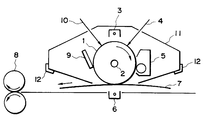
- the sole figure in the drawing is a schematic illustration of an electrophotographic apparatus including a process cartridge, which in turn includes an electrophotographic photosensitive member, to which the present invention is applicable.
- the electrophotographic photosensitive member according to the present invention comprises a support, a photosensitive layer and a protective layer disposed in this order, and the protective layer comprises a cured product of the following solution (A) or (B):
- the protective layer in the present invention may be formed by coating a photosensitive layer with a solution comprising a curable resin component, a polymerization initiator, and optionally polymerization initiator aid, followed optionally by drying, and then curing the coating under application of light or heat, wherein at least one of the polymerization initiator and polymerization initiator aid (when used) has a polymeric recurring structure.
- a polymerization initiator refers to a compound capable of generating radicals under application of an energy, such as light or heat
- a polymerization initiator aid is a compound capable of enhancing the ability of generating radicals of the polymerization initiator, i.e., increasing (or sensitizing) the sensitivity of a polymerization initiator to light, heat, etc., under application of an energy, such as light or heat.
- This relationship can be a relative one, so that a single compound can function as a polymerization initiator or a polymerization initiator aid depending on a compound used in combination therewith.
- the entire structure of such a compound may be roughly divided into a polymeric recurring structure portion, a polymerization initiator structure portion or polymerization initiator aid structure portion, and optionally a bonding group portion bonding these structure portions.
- the polymeric recurring structure portion is a structure portion including a number of bonded recurring units formed by polymerization (in a sense of including "oligomerization") of a polymerizable group, and examples thereof may include: polymerized acrylic units (in a sense of including "methacrylic units"), liquid polybutadiene units, unsaturated polyester units and polyene-polythiol units.
- polymerization initiator or polymerization initiator aid having a polymerized acrylic unit in view of reactivity and compatibility with a preferred class of curable resin components described hereinafter.
- the polymerization initiator structure portion may be any structure portion capable of generating radicals on application of an energy, such as light or heat, and may comprise a structure including an ordinary mono-molecular polymerization initiator with its atom used for bonding with another polymeric recurring structure or another bond group.
- Examples of such mono-molecular polymerization initiators providing such polymerization initiator structure may include: benzophenone, Michler's ketone, thioxanthone, benzoin butyl ether, acyloxime-ester and dibenzosuberone
- the polymerization initiator aid structure portion may be any structure portion capable of sensitizing a polymerization initiator used in combination therewith and may comprise a structure including an ordinary mono-molecular polymerization initiator aid with its atom used for bonding with another polymeric recurring structure or another bond portion.
- mono-molecular polymerization initiator aid may include: triethanolamine, Michler's ketone, 2-diethylaminobenzoic acid, 4,4'-diethylaminobenzophenone, and isoamyl 4-diethylaminobenzoate.
- the bonding group portion is a structure portion originated from a group which has been introduced in advance into a mono-molecular polymerization initiator or a mono-molecular polymerization initiator aid so as to facilitate the introduction of a polymerizable group.
- the group introduced in advance may have any structure suited for this purpose and providing a polymerization initiator or a polymerization initiator aid having a polymeric recurring structure used in the present invention.
- the polymerization initiator or polymerization initiator aid used in the present invention may be prepared by introducing a polymerizable group, such as an acryloyl group or a methacryloyl group, into a mono-molecular polymerization initiator or polymerization initiator aid optionally via a bonding group, and polymerizing the resultant polymerizable polymerization initiator or polymerization initiator aid to some extent.
- the resultant polymerization initiator or polymerization initiator aid may preferably have an average polymerization degree of 2 - 10, particularly 2 - 5.
- a polymerization initiator structure portion or a polymerization initiator aid structure portion is not required to be possessed by every recurring unit but may preferably be possessed by at least a half of the recurring units in the resultant polymerization initiator or polymerization initiator aid having a polymeric recurring structure.
- the polymerization initiator or polymerization initiator aid having ia polymeric recurring structure used in the present invention may be characterized by a recurring unit structure represented by the following formula (I): wherein P represents a recurring unit providing a polymeric recurring structure, B1 represents a bonding group portion, I represents a polymerization initiator structure portion or polymerization initiator aid structure portion, and n is 0 or 1.
- P in the above formula is an acrylic recurring unit, that is the polymerization initiator or polymerization initiator aid having a polymeric recurring structure has a recurring unit structure represented by the following formula (II): wherein B2 represents a bonding group, I represents a polymerization initiator structure portion or a polymerization initiator aid structure portion, R represents a hydrogen atom or a methyl group, and n is 0 or 1.
- a polymerization initiator and a polymerization initiator aid are used in combination, and it is further preferred that both of these have a polymeric recurring structure.
- polymerization initiator or polymerization initiator aid preferably used in the present invention may include those having recurring units represented by the following formulae:
- a polymerization initiator having a recurring unit of Formula (1) or (2) it is particularly preferred to use a polymerization initiator having a recurring unit of Formula (1) or (2), and a polymerization initiator aid having a recurring unit of Formula (3).
- a polymerization initiator having a recurring unit of Formula (2) above may be synthesized through reactions represented by the following reaction scheme.
- Other polymerization initiators or polymerization initiator aids may be synthesized in similar manners.
- the polymerization initiator may preferably be used in a proportion of 0.1 - 30 wt. %, particularly 0.5 - 20 wt. %, of the curable resin component, and the polymerization initiator may preferably be used in a proportion of 0.1 - 30 wt. %, particularly 0.5 - 20 wt. %, of the curable resin component.
- the polymerization initiator aid when used, may preferably be used in a proportion of 20 - 300 mol. %, particularly 50 - 200 mol. %, of the polymerization initiator.
- the polymerization initiator and the polymerization initiator having a polymeric recurring structure can respectively be used in two or more species, and can also be used in mixture with another polymerization initiator or polymerization initiator aid.
- another polymerization initiator or polymerization initiator aid may include: benzophenone, Michler's ketone, thioxanthone, benzoin butyl ether, acyloxime ester, dibenzosuberone, 2-diethylaminobenzoic acid, 4,4'-diethylaminobenzophenone, and isoamyl 4-diethylaminobenzoate.
- the curable resin component for providing the protective layer of the present invention may be any monomer or oligomer capable of curing through radical polymerization, and examples thereof may include: acrylic (in a sense of including "methacrylic") monomers or oligomers, liquid polybutadiene oligomers, unsaturated polyester oligomers, and polyene-polythiol oligomers. Among these, acrylic monomers or oligomers are particularly preferred in view of the reactivity and the hardness of the resultant resin.
- curable resin component examples are enumerated by way of listing monomer structure formulae. These monomers and corresponding oligomers may preferably be used.
- an acrylic monomer of Formula (i) or (ii), or an oligomer originated therefrom is particularly preferred.
- the curable resin component can be used in combination with another resin, such as a polyester, a polycarbonate, a polyurethane, epoxy resin, silicone resin, alkyd resin, or vinyl chloride-vinyl acetate copolymer, in the form of a resin or its precursor.
- another resin such as a polyester, a polycarbonate, a polyurethane, epoxy resin, silicone resin, alkyd resin, or vinyl chloride-vinyl acetate copolymer, in the form of a resin or its precursor.
- the electroconductive particles may preferably comprise particles of an electroconductive material, specific examples of which may include: zinc oxide, titanium oxide, tin oxide, indium oxide, bismuth oxide, tin-doped indium oxide, antimony-doped tin oxide, and zirconium oxide. These metal oxide particles may be used alone or in combination of two or more species. In the case of a combination of two or more species, the metal oxide particles may assume a form of a solid solution or melt-sticked particles.
- the electroconductive particles may preferably have an average particle size of at most 0.3 ⁇ m, particularly at most 0.1 ⁇ m.
- the surface-treating agent may include: fluorine-containing silane coupling agents, fluorinated silicone oils, fluorinated surfactants, and fluorine-containing graft polymers.
- the content of the electroconductive particles in the protective layer is a principal factor for determining the resistivity of the protective layer and may preferably be controlled to provide a resistivity of 10 10 - 10 15 ohm.cm of the protective layer.
- fluorine-containing resin particles may preferably comprise one or more species selected from tetrafluoroethylene resin, trifluorochloroethylene resin, hexafluorochloroethylene-propylene resin, vinylidene fluoride resin, difluorochloroethylene resin, and copolymers of monomers giving such resins. It is particularly preferred to use particles of tetrafluoroethylene resin or vinylidene fluoride resin.
- the fluorine-containing resin particles may be contained in a portion of 5 - 70 wt. %, particularly 10 - 60 wt. %, of the resultant protective layer. The molecular weight of the resin and the particle size may be appropriately selected without particular restriction.
- the protective layer can further contain another additive, such as an anti-oxidant, e.g., for the purpose of improving the weatherability.
- another additive such as an anti-oxidant, e.g., for the purpose of improving the weatherability.
- the protective layer may preferably be formed in a thickness of 0.2 - 7 ⁇ m, particularly 0.5 - 5 ⁇ m.
- the photosensitive layer of the electrophotographic photosensitive member of the present invention may comprise a single layer containing both a charge-generating substance and a charge-transporting substance, or a laminated structure including a charge generation layer containing a charge-generating substance and a charge transport layer containing a charge-transporting substance.
- the lamination type photosensitive layer will be first described.
- the lamination type photosensitive layer include a type wherein the charge generation layer and the charge-transport layer are disposed in this order on the support, and another type wherein reversely the charge transport layer and the charge generation layer are disposed in this order.
- the former type is preferred.
- the support may comprise any material showing electroconductivity.
- the support may comprise a metal or alloy, such as aluminum, copper, chromium, nickel, zinc, aluminum or stainless steel shaped into a drum form or a sheet form, a plastic film laminated with a foil of a metal, such as aluminum or copper, a plastic film coated with a vapor deposition layer of aluminum, indium oxide or tin oxide, or a substrate of a metal, plastic film or paper coated with a mixture of a metal or alloy as described above with a binder resin.
- a metal or alloy such as aluminum, copper, chromium, nickel, zinc, aluminum or stainless steel shaped into a drum form or a sheet form
- a plastic film laminated with a foil of a metal such as aluminum or copper
- a plastic film coated with a vapor deposition layer of aluminum, indium oxide or tin oxide or a substrate of a metal, plastic film or paper coated with a mixture of a metal or alloy as described above with a binder resin
- the charge transport layer may be formed by applying a solution of a charge-transporting substance together with a binder resin to form a coating layer and drying the coating layer.
- a charge-transporting substance may include: polycyclic aromatic compounds having in their main chain or side chain a structure, such as biphenylene, anthracene, or phenanthrene; nitrogen-containing cyclic compounds, such as indole, carbazole, oxadiazole, and pyrazoline; hydrazones; and styryl compounds.
- the binder resin may for example comprise a polyester, a polycarbonate, polystyrene or a polymethacrylate ester.
- the charge transport layer may preferably be formed in a thickness of 5 - 40 ⁇ m, more preferably 10 - 30 ⁇ m.
- the charge generation layer may be formed by applying and drying a layer of a solution of a charge generating substance together with a binder resin, or by vapor deposition of a charge-generating substance as described above,
- the charge-generating substance may include: azo pigments, such as Sudan Red and Dian Blue; quinone pigments, such as pyrene quinone, and anthanthrone; quinocyanine pigments; perylene pigments; indigo pigments, such as indigo and thioindigo; and phthalocyanine pigments.
- the binder resin may for example comprise polyvinyl butyral, polystyrene, polyvinyl acetate or acrylic resin.
- the charge generation layer may preferably be formed in a thickness of at most 5 ⁇ m, more preferably in a range of 0.05 - 3 ⁇ m.
- the single layer-type photosensitive layer may be formed by applying and drying a layer of a solution containing a charge-generating substance and a charge-transporting substance as described above dispersed or dissolved therein together with a binder resin as described above.
- the photosensitive layer may preferably be formed in a thickness of 5 - 40 ⁇ m, more preferably 10 - 30 ⁇ m.
- an undercoating layer having a barrier function and an adhesive function between the support (or an electroconductive layer thereon) and the photosensitive layer may for example comprise a material, such as casein, polyvinyl alcohol, nitrocellulose, ethylene-acrylic acid copolymer, alcohol-soluble polyamide, polyurethane or gelatin.
- the undercoating layer may for example be formed in a thickness of 0.1 - 3 ⁇ m.
- the electrophotographic photosensitive member according to the present invention can be applicable to electrophotographic apparatus in general, inclusive of copying machines, laser beam printers, LED printers, and liquid crystal shutter-type printers, and further to apparatus for display, recording, light-weight printing, plate forming and facsimile apparatus to which electrophotography is applied.
- the sole figure in the drawing shows a schematic structural view of an electrophotographic apparatus including a process cartridge using an electrophotographic photosensitive member of the invention.
- a photosensitive member 1 in the form of a drum is rotated about an axis 2 at a prescribed peripheral speed in the direction of the arrow shown inside of the photosensitive member 1.
- the peripheral surface of the photosensitive member 1 is uniformly charged by means of a primary charger 3 to have a prescribed positive or negative potential.
- the photosensitive member 1 is imagewise exposed to light 4 (as by slit exposure or laser beam-scanning exposure) by using an image exposure means (not shown), whereby an electrostatic latent image is successively formed on the surface of the photosensitive member 1.
- the thus formed electrostatic latent image is developed by using a developing means 5 to form a toner image.
- the toner image is successively transferred to a transfer (-receiving) material 7 which is supplied from a supply part (not shown) to a position between the photosensitive member 1 and a transfer charger 5 in synchronism with the rotation speed of the photosensitive member 1, by means of the transfer charger 6.
- the transfer material 7 carrying the toner image thereon is separated from the photosensitive member 1 to be conveyed to a fixing device 8, followed by image fixing to print out the transfer material 7 as a copy outside the electrophotographic apparatus.
- Residual toner particles remaining on the surface of the photosensitive member 1 after the transfer operation are removed by a cleaning means 9 to provide a cleaned surface, and residual charge on the surface of the photosensitive member 1 is erased by a pre-exposure means issuing pre-exposure light 10 to prepare for the next cycle.
- a contact charging means is used as the primary charger 3 for charging the photosensitive member 1 uniformly, when a contact (or proximity) charging means is used, the pre-exposure means may be omitted, as desired.
- the electrophotographic apparatus in the electrophotographic apparatus, it is possible to integrally assemble a plurality of elements or components thereof, such as the above-mentioned photosensitive member 1, the primary charger (charging means) 3, the developing means and the cleaning means 9, into a process cartridge detachably mountable to the apparatus main body, such as a copying machine or a laser beam printer.
- the process cartridge may, for example, be composed of the photosensitive member 1 and at least one of the primary charging means 3, the developing means 5 and cleaning means 9, which are integrally assembled into a single unit capable of being attached to or detached from the apparatus body by the medium of a guiding means such as a rail of the apparatus body.
- a coating liquid for providing a charge generation layer was prepared by dispersing 4 parts of oxytitanium phthalocyanine showing strong peaks at diffraction angles (2 ⁇ ⁇ 0.2 deg.) of 9.0 deg., 14.2 deg., 23.9 deg., and 27.1 deg. according to CuK ⁇ -characteristic X-ray diffractometry, 2 parts polyvinyl butyral ("S-LEC BM-2", available from Sekisui Kagaku K.K.) and 80 parts of cyclohexanone in a sand mill apparatus using 1 mm-dia. glass beads for 4 hours, followed by dilution with 115 parts of methyl ethyl ketone.
- the coating liquid was applied by dipping onto the intermediate layer and dried to form a 0.3 ⁇ m-thick charge generation layer.
- 100 parts of the surface-treated antimony-containing tin oxide particles, 60 parts of an acrylic resin monomer of the before-mentioned Formula (i), 30 parts of a photo-polymerization initiator having a recurring unit represented by the before-mentioned Formula (1) (Pav (average degree of polymerization) 3) and 30 parts of a photo-polymerization initiator aid of the following formula: were dispersed together with 300 parts of ethanol for 96 hours in a sandmill apparatus to form a dispersion liquid, into which 100 parts of tetrafluoroethylene resin particles ("Lublon L-2", available from Daikin Kogyo K.K.) was added and dispersed for further 2 hours in the sandmill apparatus to form a coating liquid for a polymerization initiator.
- tetrafluoroethylene resin particles (“Lublon L-2", available from Daikin Kogyo K.K.
- the coating liquid was applied by dipping onto the above-formed charge transport layer and, after drying, exposed for 60 sec. to ultraviolet rays at an intensity of 160 W/cm 2 from a metal halide lamp to form a 3 ⁇ m-thick protective layer.
- the thus-prepared electrophotographic photosensitive member was incorporated in a laser beam printer and subjected to evaluation of electrophotographic performances and a successive image formation test.
- the evaluation of electrophotographic performances was performed by using a cartridge from which a developing means and a cleaning means had been removed.
- the photosensitive member was subjected to primary charging to measure a surface potential (i.e., dark-part potential) V D .
- the photosensitive member was subjected to electrophotographic cycles (primary charging and whole-area exposure) for forming solid black images on 5 A4-size sheets, and the surface potential thereafter was measured as a light part potential V L .
- the photosensitive member was further subjected to whole-area exposure with laser beam without primary charging for 4 revolutions, and the surface potential of the photosensitive member thereafter was measured as a residual potential V R .
- An electrophotographic photosensitive member was prepared and evaluated in the same manner as in Example 3 except for replacing the photo-polymerization initiator with a compound of the following formula:
- Electrophotographic photosensitive members were prepared and evaluated in the same manner as in Example 1 except for replacing the acrylic resin monomer with those represented by the before-mentioned Formulae (ii) - (xvii), respectively.
- An electrophotographic photosensitive member was prepared and evaluated in the same manner as in Example 1 except for replacing the photo-polymerization initiator with a compound of the following formula: and replacing the polymerization initiator aid with a compound of the following formula:
- An electrophotographic photosensitive member was prepared and evaluated in the same manner as in Comparative Example 1 except for replacing the photo-polymerization initiator with a compound of the following formula:
- An electrophotographic photosensitive member was prepared and evaluated in the same manner as in Comparative Example 1 except for replacing the photo-polymerization initiator with a compound of the following formula:
- Electrophotographic photosensitive members were prepared and evaluated in the same manner as in Comparative Examples 1 - 3, respectively, except for replacing the photo-polymerization initiator aid used therein respectively with a compound of the following formula:
Landscapes
- Physics & Mathematics (AREA)
- Spectroscopy & Molecular Physics (AREA)
- General Physics & Mathematics (AREA)
- Chemical & Material Sciences (AREA)
- Chemical Kinetics & Catalysis (AREA)
- Engineering & Computer Science (AREA)
- Computer Vision & Pattern Recognition (AREA)
- Photoreceptors In Electrophotography (AREA)
- Materials For Photolithography (AREA)
Applications Claiming Priority (3)
| Application Number | Priority Date | Filing Date | Title |
|---|---|---|---|
| JP41382/97 | 1997-02-12 | ||
| JP4138297 | 1997-02-12 | ||
| JP4138297 | 1997-02-12 |
Publications (2)
| Publication Number | Publication Date |
|---|---|
| EP0859286A1 true EP0859286A1 (de) | 1998-08-19 |
| EP0859286B1 EP0859286B1 (de) | 2001-08-08 |
Family
ID=12606852
Family Applications (1)
| Application Number | Title | Priority Date | Filing Date |
|---|---|---|---|
| EP98400311A Expired - Lifetime EP0859286B1 (de) | 1997-02-12 | 1998-02-11 | Elektrophotographisches lichtempfindliches Element, auswechselbares Teilelement und elektrophotographischer Apparat |
Country Status (5)
| Country | Link |
|---|---|
| US (1) | US6004710A (de) |
| EP (1) | EP0859286B1 (de) |
| KR (1) | KR100272213B1 (de) |
| CN (1) | CN1135439C (de) |
| DE (1) | DE69801292T2 (de) |
Families Citing this family (7)
| Publication number | Priority date | Publication date | Assignee | Title |
|---|---|---|---|---|
| US6479207B1 (en) * | 1999-04-22 | 2002-11-12 | Konica Corporation | Printing plate element and production method thereof |
| US6656652B2 (en) | 2000-09-29 | 2003-12-02 | Canon Kabushiki Kaisha | Electrophotographic photosensitive member, process cartridge, and electrophotographic apparatus |
| US6741824B2 (en) | 2002-04-23 | 2004-05-25 | Canon Kabushiki Kaisha | Charging system, process cartridge and image forming apparatus |
| JP4546055B2 (ja) * | 2002-09-24 | 2010-09-15 | キヤノン株式会社 | クリーニングブラシのブラシ密度と静電像の1画素面積の設定方法 |
| JP6128908B2 (ja) | 2013-03-19 | 2017-05-17 | キヤノン株式会社 | 現像剤補給キット及び現像剤補給装置及び画像形成装置 |
| JP5854016B2 (ja) * | 2013-09-24 | 2016-02-09 | コニカミノルタ株式会社 | 有機感光体およびその製造方法 |
| JP7129238B2 (ja) * | 2018-06-22 | 2022-09-01 | キヤノン株式会社 | 電子写真感光体、電子写真装置、プロセスカートリッジおよび電子写真感光体の製造方法 |
Citations (2)
| Publication number | Priority date | Publication date | Assignee | Title |
|---|---|---|---|---|
| EP0006356A1 (de) * | 1978-06-16 | 1980-01-09 | EASTMAN KODAK COMPANY (a New Jersey corporation) | Elektrophotografisches Material mit verbesserter Schutzschicht |
| EP0460558A1 (de) * | 1990-06-04 | 1991-12-11 | Canon Kabushiki Kaisha | Lichtempfindliches Element zur Elektrophotographie |
Family Cites Families (4)
| Publication number | Priority date | Publication date | Assignee | Title |
|---|---|---|---|---|
| JPS5730843A (en) * | 1980-07-31 | 1982-02-19 | Fuji Xerox Co Ltd | Electrophotographic receptor |
| JPH03246553A (ja) * | 1990-02-23 | 1991-11-01 | Idemitsu Petrochem Co Ltd | 電子写真感光体 |
| US5455135A (en) * | 1992-12-18 | 1995-10-03 | Canon Kabushiki Kaisha | Electrophotographic photosensitive member with overlayer and electrophotographic apparatus employing same |
| US5693443A (en) * | 1995-11-24 | 1997-12-02 | Canon Kabushiki Kaisha | Electrophotographic photosensitive member, and process cartridge and electrophotographic apparatus having the same |
-
1998
- 1998-02-09 US US09/021,068 patent/US6004710A/en not_active Expired - Lifetime
- 1998-02-11 EP EP98400311A patent/EP0859286B1/de not_active Expired - Lifetime
- 1998-02-11 DE DE69801292T patent/DE69801292T2/de not_active Expired - Lifetime
- 1998-02-12 KR KR1019980004139A patent/KR100272213B1/ko not_active Expired - Fee Related
- 1998-02-12 CN CNB981064566A patent/CN1135439C/zh not_active Expired - Fee Related
Patent Citations (2)
| Publication number | Priority date | Publication date | Assignee | Title |
|---|---|---|---|---|
| EP0006356A1 (de) * | 1978-06-16 | 1980-01-09 | EASTMAN KODAK COMPANY (a New Jersey corporation) | Elektrophotografisches Material mit verbesserter Schutzschicht |
| EP0460558A1 (de) * | 1990-06-04 | 1991-12-11 | Canon Kabushiki Kaisha | Lichtempfindliches Element zur Elektrophotographie |
Also Published As
| Publication number | Publication date |
|---|---|
| EP0859286B1 (de) | 2001-08-08 |
| DE69801292T2 (de) | 2002-04-18 |
| US6004710A (en) | 1999-12-21 |
| KR19980071283A (ko) | 1998-10-26 |
| KR100272213B1 (ko) | 2000-11-15 |
| DE69801292D1 (de) | 2001-09-13 |
| CN1135439C (zh) | 2004-01-21 |
| CN1195790A (zh) | 1998-10-14 |
Similar Documents
| Publication | Publication Date | Title |
|---|---|---|
| JP6949620B2 (ja) | 電子写真感光体、該電子写真感光体を有する電子写真装置およびプロセスカートリッジ | |
| EP0606035B1 (de) | Elektrophotographischer lichtempfindliches Element, elektrophotographischer Apparat und Gerätebauteil die es einsetzen | |
| US5693443A (en) | Electrophotographic photosensitive member, and process cartridge and electrophotographic apparatus having the same | |
| EP0606074A1 (de) | Elektrophotographisches, lichtempfindliches Element, elektrophotographischer Apparat, und Vorrichtungseinheit, die dieses Element umfassen | |
| EP0798599B9 (de) | Elektrophotographisches photoempfindliches Element, elektrophotographischer Apparat und Prozesskassette unter Verwendung desselben | |
| EP0464749A1 (de) | Element für die Bildherstellung | |
| JP2790382B2 (ja) | 像保持部材、それを装着した電子写真装置及びファクシミリ | |
| JP2005062300A (ja) | 電子写真感光体、プロセスカートリッジ及び電子写真装置 | |
| EP0859286B1 (de) | Elektrophotographisches lichtempfindliches Element, auswechselbares Teilelement und elektrophotographischer Apparat | |
| JP2000275889A (ja) | 電子写真感光体、該電子写真感光体を有するプロセスカートリッジ及び電子写真装置 | |
| JP2000310871A (ja) | 電子写真感光体及びその製造方法、プロセスカートリッジ、電子写真装置 | |
| JP3740310B2 (ja) | 電子写真感光体、プロセスカートリッジ及び電子写真装置 | |
| JPH06258857A (ja) | 電子写真感光体、該電子写真感光体を有する電子写真装置および装置ユニット | |
| JP2003186227A (ja) | 電子写真感光体、電子写真装置及びプロセスカートリッジ | |
| JPH0611876A (ja) | 電子写真感光体、該電子写真感光体を備えた電子写真装置並びにファクシミリ | |
| JPH0588399A (ja) | 電子写真感光体、それを用いた電子写真装置、装置ユニツトおよびフアクシミリ | |
| JPH11288121A (ja) | 電子写真感光体及び電子写真感光体を備えた電子写真装置 | |
| JPH11184103A (ja) | 電子写真感光体、プロセスカートリッジ及び電子写真装置 | |
| JP3563953B2 (ja) | 電子写真感光体、該電子写真感光体を有するプロセスカートリッジ及び電子写真装置 | |
| JP2000310872A (ja) | 電子写真感光体、プロセスカートリッジ及び電子写真装置 | |
| JP2004045540A (ja) | 電子写真感光体、該電子写真感光体を有するプロセスカートリッジ及び電子写真装置 | |
| JP2004219924A (ja) | 電子写真感光体、プロセスカートリッジ及び電子写真装置 | |
| JP3192550B2 (ja) | 電子写真感光体、該電子写真感光体を有する電子写真装置及びプロセスカートリッジ | |
| JPH10246977A (ja) | 電子写真感光体、プロセスカートリッジ及び電子写真装置 | |
| JP3402960B2 (ja) | 電子写真感光体、プロセスカートリッジ及び電子写真装置 |
Legal Events
| Date | Code | Title | Description |
|---|---|---|---|
| PUAI | Public reference made under article 153(3) epc to a published international application that has entered the european phase |
Free format text: ORIGINAL CODE: 0009012 |
|
| AK | Designated contracting states |
Kind code of ref document: A1 Designated state(s): DE FR GB IT |
|
| AX | Request for extension of the european patent |
Free format text: AL;LT;LV;MK;RO;SI |
|
| 17P | Request for examination filed |
Effective date: 19990115 |
|
| AKX | Designation fees paid |
Free format text: DE FR GB IT |
|
| RBV | Designated contracting states (corrected) |
Designated state(s): DE FR GB IT |
|
| GRAG | Despatch of communication of intention to grant |
Free format text: ORIGINAL CODE: EPIDOS AGRA |
|
| 17Q | First examination report despatched |
Effective date: 20000530 |
|
| GRAG | Despatch of communication of intention to grant |
Free format text: ORIGINAL CODE: EPIDOS AGRA |
|
| GRAG | Despatch of communication of intention to grant |
Free format text: ORIGINAL CODE: EPIDOS AGRA |
|
| GRAH | Despatch of communication of intention to grant a patent |
Free format text: ORIGINAL CODE: EPIDOS IGRA |
|
| GRAH | Despatch of communication of intention to grant a patent |
Free format text: ORIGINAL CODE: EPIDOS IGRA |
|
| GRAA | (expected) grant |
Free format text: ORIGINAL CODE: 0009210 |
|
| AK | Designated contracting states |
Kind code of ref document: B1 Designated state(s): DE FR GB IT |
|
| REF | Corresponds to: |
Ref document number: 69801292 Country of ref document: DE Date of ref document: 20010913 |
|
| ET | Fr: translation filed | ||
| REG | Reference to a national code |
Ref country code: GB Ref legal event code: IF02 |
|
| PLBE | No opposition filed within time limit |
Free format text: ORIGINAL CODE: 0009261 |
|
| STAA | Information on the status of an ep patent application or granted ep patent |
Free format text: STATUS: NO OPPOSITION FILED WITHIN TIME LIMIT |
|
| 26N | No opposition filed | ||
| PGFP | Annual fee paid to national office [announced via postgrant information from national office to epo] |
Ref country code: IT Payment date: 20090205 Year of fee payment: 12 |
|
| PGFP | Annual fee paid to national office [announced via postgrant information from national office to epo] |
Ref country code: FR Payment date: 20090223 Year of fee payment: 12 |
|
| REG | Reference to a national code |
Ref country code: FR Ref legal event code: ST Effective date: 20101029 |
|
| PG25 | Lapsed in a contracting state [announced via postgrant information from national office to epo] |
Ref country code: FR Free format text: LAPSE BECAUSE OF NON-PAYMENT OF DUE FEES Effective date: 20100301 |
|
| PG25 | Lapsed in a contracting state [announced via postgrant information from national office to epo] |
Ref country code: IT Free format text: LAPSE BECAUSE OF NON-PAYMENT OF DUE FEES Effective date: 20100211 |
|
| PGFP | Annual fee paid to national office [announced via postgrant information from national office to epo] |
Ref country code: DE Payment date: 20140228 Year of fee payment: 17 |
|
| PGFP | Annual fee paid to national office [announced via postgrant information from national office to epo] |
Ref country code: GB Payment date: 20140220 Year of fee payment: 17 |
|
| REG | Reference to a national code |
Ref country code: DE Ref legal event code: R119 Ref document number: 69801292 Country of ref document: DE |
|
| GBPC | Gb: european patent ceased through non-payment of renewal fee |
Effective date: 20150211 |
|
| PG25 | Lapsed in a contracting state [announced via postgrant information from national office to epo] |
Ref country code: GB Free format text: LAPSE BECAUSE OF NON-PAYMENT OF DUE FEES Effective date: 20150211 Ref country code: DE Free format text: LAPSE BECAUSE OF NON-PAYMENT OF DUE FEES Effective date: 20150901 |