EP0853141B1 - Method for surface treatment - Google Patents
Method for surface treatment Download PDFInfo
- Publication number
- EP0853141B1 EP0853141B1 EP98300245A EP98300245A EP0853141B1 EP 0853141 B1 EP0853141 B1 EP 0853141B1 EP 98300245 A EP98300245 A EP 98300245A EP 98300245 A EP98300245 A EP 98300245A EP 0853141 B1 EP0853141 B1 EP 0853141B1
- Authority
- EP
- European Patent Office
- Prior art keywords
- protective layer
- transparent protective
- appearance
- coating liquid
- glass coating
- Prior art date
- Legal status (The legal status is an assumption and is not a legal conclusion. Google has not performed a legal analysis and makes no representation as to the accuracy of the status listed.)
- Expired - Lifetime
Links
- 238000000034 method Methods 0.000 title claims description 57
- 238000004381 surface treatment Methods 0.000 title description 22
- 239000011241 protective layer Substances 0.000 claims description 87
- 238000000576 coating method Methods 0.000 claims description 60
- 239000011248 coating agent Substances 0.000 claims description 57
- 238000005530 etching Methods 0.000 claims description 56
- 239000000126 substance Substances 0.000 claims description 53
- 239000011521 glass Substances 0.000 claims description 52
- 239000007788 liquid Substances 0.000 claims description 51
- 239000010936 titanium Substances 0.000 claims description 45
- 238000012545 processing Methods 0.000 claims description 38
- 238000001035 drying Methods 0.000 claims description 30
- 238000005406 washing Methods 0.000 claims description 28
- 229910052719 titanium Inorganic materials 0.000 claims description 22
- 229910001069 Ti alloy Inorganic materials 0.000 claims description 21
- 239000000203 mixture Substances 0.000 claims description 19
- 238000005498 polishing Methods 0.000 claims description 12
- 238000007865 diluting Methods 0.000 claims description 9
- 239000002904 solvent Substances 0.000 claims description 5
- RTAQQCXQSZGOHL-UHFFFAOYSA-N Titanium Chemical compound [Ti] RTAQQCXQSZGOHL-UHFFFAOYSA-N 0.000 claims description 4
- 239000000243 solution Substances 0.000 description 62
- 238000011282 treatment Methods 0.000 description 53
- 239000010410 layer Substances 0.000 description 29
- 238000006748 scratching Methods 0.000 description 21
- 230000002393 scratching effect Effects 0.000 description 21
- 238000010276 construction Methods 0.000 description 19
- 238000010790 dilution Methods 0.000 description 19
- 239000012895 dilution Substances 0.000 description 19
- QAOWNCQODCNURD-UHFFFAOYSA-N Sulfuric acid Chemical compound OS(O)(=O)=O QAOWNCQODCNURD-UHFFFAOYSA-N 0.000 description 18
- 238000007654 immersion Methods 0.000 description 18
- XLYOFNOQVPJJNP-UHFFFAOYSA-N water Substances O XLYOFNOQVPJJNP-UHFFFAOYSA-N 0.000 description 17
- GRYLNZFGIOXLOG-UHFFFAOYSA-N Nitric acid Chemical compound O[N+]([O-])=O GRYLNZFGIOXLOG-UHFFFAOYSA-N 0.000 description 16
- 229910017604 nitric acid Inorganic materials 0.000 description 16
- 229910052751 metal Inorganic materials 0.000 description 14
- 239000002184 metal Substances 0.000 description 14
- 238000005868 electrolysis reaction Methods 0.000 description 13
- 239000008151 electrolyte solution Substances 0.000 description 13
- 229940021013 electrolyte solution Drugs 0.000 description 13
- NBIIXXVUZAFLBC-UHFFFAOYSA-N Phosphoric acid Chemical compound OP(O)(O)=O NBIIXXVUZAFLBC-UHFFFAOYSA-N 0.000 description 11
- VYPSYNLAJGMNEJ-UHFFFAOYSA-N Silicium dioxide Chemical compound O=[Si]=O VYPSYNLAJGMNEJ-UHFFFAOYSA-N 0.000 description 11
- 230000000694 effects Effects 0.000 description 11
- 238000005299 abrasion Methods 0.000 description 10
- 230000001070 adhesive effect Effects 0.000 description 10
- 238000005260 corrosion Methods 0.000 description 10
- 230000007797 corrosion Effects 0.000 description 10
- 239000000463 material Substances 0.000 description 10
- 239000011247 coating layer Substances 0.000 description 8
- 150000002739 metals Chemical class 0.000 description 8
- 230000008569 process Effects 0.000 description 8
- 238000012360 testing method Methods 0.000 description 8
- 230000000052 comparative effect Effects 0.000 description 7
- 239000002253 acid Substances 0.000 description 6
- 239000000758 substrate Substances 0.000 description 6
- 238000011109 contamination Methods 0.000 description 5
- 230000003247 decreasing effect Effects 0.000 description 5
- 239000000377 silicon dioxide Substances 0.000 description 5
- 229910052910 alkali metal silicate Inorganic materials 0.000 description 4
- 239000011259 mixed solution Substances 0.000 description 4
- 230000003405 preventing effect Effects 0.000 description 4
- 230000003746 surface roughness Effects 0.000 description 4
- UHOVQNZJYSORNB-UHFFFAOYSA-N Benzene Chemical compound C1=CC=CC=C1 UHOVQNZJYSORNB-UHFFFAOYSA-N 0.000 description 3
- YXFVVABEGXRONW-UHFFFAOYSA-N Toluene Chemical compound CC1=CC=CC=C1 YXFVVABEGXRONW-UHFFFAOYSA-N 0.000 description 3
- 229910045601 alloy Inorganic materials 0.000 description 3
- 239000000956 alloy Substances 0.000 description 3
- 229910000147 aluminium phosphate Inorganic materials 0.000 description 3
- 239000007864 aqueous solution Substances 0.000 description 3
- 230000015572 biosynthetic process Effects 0.000 description 3
- 230000008859 change Effects 0.000 description 3
- 239000000356 contaminant Substances 0.000 description 3
- 238000010438 heat treatment Methods 0.000 description 3
- 230000006872 improvement Effects 0.000 description 3
- 239000003960 organic solvent Substances 0.000 description 3
- 235000019353 potassium silicate Nutrition 0.000 description 3
- 125000006239 protecting group Chemical group 0.000 description 3
- 238000007788 roughening Methods 0.000 description 3
- NTHWMYGWWRZVTN-UHFFFAOYSA-N sodium silicate Chemical compound [Na+].[Na+].[O-][Si]([O-])=O NTHWMYGWWRZVTN-UHFFFAOYSA-N 0.000 description 3
- 239000007787 solid Substances 0.000 description 3
- 229910001220 stainless steel Inorganic materials 0.000 description 3
- KRHYYFGTRYWZRS-UHFFFAOYSA-N Fluorane Chemical compound F KRHYYFGTRYWZRS-UHFFFAOYSA-N 0.000 description 2
- 239000004111 Potassium silicate Substances 0.000 description 2
- 239000004115 Sodium Silicate Substances 0.000 description 2
- 229910052782 aluminium Inorganic materials 0.000 description 2
- 238000003486 chemical etching Methods 0.000 description 2
- 239000003086 colorant Substances 0.000 description 2
- 239000006059 cover glass Substances 0.000 description 2
- 238000005520 cutting process Methods 0.000 description 2
- 238000005238 degreasing Methods 0.000 description 2
- 230000003292 diminished effect Effects 0.000 description 2
- 238000004090 dissolution Methods 0.000 description 2
- 230000008030 elimination Effects 0.000 description 2
- 238000003379 elimination reaction Methods 0.000 description 2
- 238000011156 evaluation Methods 0.000 description 2
- 238000001746 injection moulding Methods 0.000 description 2
- 238000002156 mixing Methods 0.000 description 2
- 238000000465 moulding Methods 0.000 description 2
- 238000006386 neutralization reaction Methods 0.000 description 2
- 230000003647 oxidation Effects 0.000 description 2
- 238000007254 oxidation reaction Methods 0.000 description 2
- TWNQGVIAIRXVLR-UHFFFAOYSA-N oxo(oxoalumanyloxy)alumane Chemical compound O=[Al]O[Al]=O TWNQGVIAIRXVLR-UHFFFAOYSA-N 0.000 description 2
- 238000007747 plating Methods 0.000 description 2
- 229910052913 potassium silicate Inorganic materials 0.000 description 2
- NNHHDJVEYQHLHG-UHFFFAOYSA-N potassium silicate Chemical compound [K+].[K+].[O-][Si]([O-])=O NNHHDJVEYQHLHG-UHFFFAOYSA-N 0.000 description 2
- 230000002035 prolonged effect Effects 0.000 description 2
- 230000001681 protective effect Effects 0.000 description 2
- 239000011347 resin Substances 0.000 description 2
- 229920005989 resin Polymers 0.000 description 2
- 229910052911 sodium silicate Inorganic materials 0.000 description 2
- 239000007921 spray Substances 0.000 description 2
- 239000010935 stainless steel Substances 0.000 description 2
- 238000003756 stirring Methods 0.000 description 2
- 238000009736 wetting Methods 0.000 description 2
- 229910001369 Brass Inorganic materials 0.000 description 1
- 206010013786 Dry skin Diseases 0.000 description 1
- LFQSCWFLJHTTHZ-UHFFFAOYSA-N Ethanol Chemical compound CCO LFQSCWFLJHTTHZ-UHFFFAOYSA-N 0.000 description 1
- 229910000831 Steel Inorganic materials 0.000 description 1
- QCWXUUIWCKQGHC-UHFFFAOYSA-N Zirconium Chemical compound [Zr] QCWXUUIWCKQGHC-UHFFFAOYSA-N 0.000 description 1
- 150000007513 acids Chemical class 0.000 description 1
- 150000001298 alcohols Chemical class 0.000 description 1
- 239000003513 alkali Substances 0.000 description 1
- 239000012670 alkaline solution Substances 0.000 description 1
- CSDREXVUYHZDNP-UHFFFAOYSA-N alumanylidynesilicon Chemical compound [Al].[Si] CSDREXVUYHZDNP-UHFFFAOYSA-N 0.000 description 1
- XAGFODPZIPBFFR-UHFFFAOYSA-N aluminium Chemical compound [Al] XAGFODPZIPBFFR-UHFFFAOYSA-N 0.000 description 1
- 239000011324 bead Substances 0.000 description 1
- 230000008901 benefit Effects 0.000 description 1
- 238000005422 blasting Methods 0.000 description 1
- 239000010951 brass Substances 0.000 description 1
- 238000005266 casting Methods 0.000 description 1
- 229910052804 chromium Inorganic materials 0.000 description 1
- 235000019646 color tone Nutrition 0.000 description 1
- 239000012141 concentrate Substances 0.000 description 1
- 229910052802 copper Inorganic materials 0.000 description 1
- 238000005034 decoration Methods 0.000 description 1
- 230000007423 decrease Effects 0.000 description 1
- 230000007547 defect Effects 0.000 description 1
- 230000002542 deteriorative effect Effects 0.000 description 1
- 238000007598 dipping method Methods 0.000 description 1
- 230000002708 enhancing effect Effects 0.000 description 1
- 238000001704 evaporation Methods 0.000 description 1
- 230000008020 evaporation Effects 0.000 description 1
- 229910010272 inorganic material Inorganic materials 0.000 description 1
- 239000011147 inorganic material Substances 0.000 description 1
- 238000007733 ion plating Methods 0.000 description 1
- 229910052742 iron Inorganic materials 0.000 description 1
- 230000000873 masking effect Effects 0.000 description 1
- 201000005299 metal allergy Diseases 0.000 description 1
- 238000012986 modification Methods 0.000 description 1
- 230000004048 modification Effects 0.000 description 1
- 229910052750 molybdenum Inorganic materials 0.000 description 1
- 239000003921 oil Substances 0.000 description 1
- 229910052763 palladium Inorganic materials 0.000 description 1
- 229910052697 platinum Inorganic materials 0.000 description 1
- 239000002861 polymer material Substances 0.000 description 1
- 239000000843 powder Substances 0.000 description 1
- 238000004663 powder metallurgy Methods 0.000 description 1
- 230000002265 prevention Effects 0.000 description 1
- 230000003449 preventive effect Effects 0.000 description 1
- 230000003678 scratch resistant effect Effects 0.000 description 1
- 229910052814 silicon oxide Inorganic materials 0.000 description 1
- 229910052709 silver Inorganic materials 0.000 description 1
- 238000005507 spraying Methods 0.000 description 1
- 239000007858 starting material Substances 0.000 description 1
- 239000010959 steel Substances 0.000 description 1
- 239000002344 surface layer Substances 0.000 description 1
- 238000010301 surface-oxidation reaction Methods 0.000 description 1
- -1 temperature Substances 0.000 description 1
- 229910052721 tungsten Inorganic materials 0.000 description 1
- 229910052720 vanadium Inorganic materials 0.000 description 1
- 238000009423 ventilation Methods 0.000 description 1
- 229910052725 zinc Inorganic materials 0.000 description 1
- 229910052726 zirconium Inorganic materials 0.000 description 1
Images



Classifications
-
- C—CHEMISTRY; METALLURGY
- C23—COATING METALLIC MATERIAL; COATING MATERIAL WITH METALLIC MATERIAL; CHEMICAL SURFACE TREATMENT; DIFFUSION TREATMENT OF METALLIC MATERIAL; COATING BY VACUUM EVAPORATION, BY SPUTTERING, BY ION IMPLANTATION OR BY CHEMICAL VAPOUR DEPOSITION, IN GENERAL; INHIBITING CORROSION OF METALLIC MATERIAL OR INCRUSTATION IN GENERAL
- C23D—ENAMELLING OF, OR APPLYING A VITREOUS LAYER TO, METALS
- C23D5/00—Coating with enamels or vitreous layers
- C23D5/06—Coating with enamels or vitreous layers producing designs or letters
-
- C—CHEMISTRY; METALLURGY
- C23—COATING METALLIC MATERIAL; COATING MATERIAL WITH METALLIC MATERIAL; CHEMICAL SURFACE TREATMENT; DIFFUSION TREATMENT OF METALLIC MATERIAL; COATING BY VACUUM EVAPORATION, BY SPUTTERING, BY ION IMPLANTATION OR BY CHEMICAL VAPOUR DEPOSITION, IN GENERAL; INHIBITING CORROSION OF METALLIC MATERIAL OR INCRUSTATION IN GENERAL
- C23D—ENAMELLING OF, OR APPLYING A VITREOUS LAYER TO, METALS
- C23D3/00—Chemical treatment of the metal surfaces prior to coating
-
- C—CHEMISTRY; METALLURGY
- C25—ELECTROLYTIC OR ELECTROPHORETIC PROCESSES; APPARATUS THEREFOR
- C25F—PROCESSES FOR THE ELECTROLYTIC REMOVAL OF MATERIALS FROM OBJECTS; APPARATUS THEREFOR
- C25F1/00—Electrolytic cleaning, degreasing, pickling or descaling
Definitions
- the present invention relates to a method of surface treatment, an ornament and to a device having such a treated surface or including such an ornament.
- Japanese Unexamined Utility Model Publication No. 56-74060 Japanese Unexamined Patent Publication No. 58-96869 and Japanese Unexamined Patent Publication No. 62-263977
- Such methods are known in the art as to coat a metal surface such as aluminum with a rigid transparent coating film for the purpose of acquiring corrosion resistant, abrasion resistant and impact resistant properties.
- This transparent coating film is composed of a variety of organic resins and inorganic substances.
- a transparent coating layer of rigid inorganic materials comprising aluminum oxide or aluminum silicon has been conventionally coated on the surface of facing cases composed of metals in the field of, for example, watches and clocks.
- machine works such as mirror finishing, nicking processing and honing processing are applied on the surface of facing cases comprising various kind of metals such as stainless steel, brass and other metals, thereby a transparent protective layer is formed on their surface.
- a transparent surface protective layer may be formed on the surface of the facing case made of Ti.
- a coating for forming a protective layer is applied on the surface which has become blackish and uneven as a result of the honing processing, there would arise a problem on appearance of commodities that blackening further proceeds due to wetting phenomenon as seen when an uneven surface is wetted with water. This is a serious defect for the facing of watches which are intended to have a high ornamental value since such blackening generally gives the impression of an inferior product.
- GB 1116707A discloses the use of a protective, transparent coating consisting exclusively of potassium silicate on surfaces of titanium, zirconium or alloys thereof.
- the present invention seeks to mitigate at least some of the above mentioned disadvantages which arise with known arrangements.
- This invention can enable scratches and surface contaminations to be avoided while providing a good quality appearance.
- the appearance becomes whitish and glossy because a transparent protective layer is formed after removal of surface adhesion substances such as oxide layers.
- the transparent protective layer has a high adhesive property and good durability.
- This construction of the invention enables a surface to be formed with a sufficient amount of hardness having an excellent scratch resistance, protecting contaminations like adhesion of fingerprints and mechanical damage to a high level.
- the transparent protective layer is formed by allowing a glass coating liquid to adhere on the surface which has been subjected to the treatment of removing surface adhesion substances, followed by drying.
- This construction of the invention provides an easily formed transparent protective layer with a high adhesive property.
- the glass coating liquid is used after diluting its original liquid. It is especially preferable that the transparent protective layer is formed by allowing the glass coating liquid prepared by diluting its original liquid in a dilution ratio corresponding to the machine works to adhere, followed by drying.
- This construction of the invention enables to improve further the degree of whiteness and glossiness while maintaining a high degree of corrosion resistance, abrasion resistance and scratching resistance.
- This construction of the invention further improves corrosion resistance, abrasion resistance and scratching resistance.
- drying is carried out twice or more under different drying conditions.
- This construction of the invention improves film quality and the adhesive property of the transparent protective layer.
- the treatment for removing surface adhesion substances is a chemical polishing with an etching solution.
- This construction of the invention enables effective removal of the surface adhesion substances, especially a layer of Ti oxide.
- the etching solution comprises a mixed solution containing HF, HNO 3 and H 2 SO 4 .
- This construction of the invention enables the surface to be made white without roughening the surface of Ti or Ti alloys.
- the etching solution is an aqueous solution containing 1 to 10 vol% of HF, 15 to 40 vol% of HNO 3 and 30 to 60 vol% of H 2 SO 4 .
- This construction of the invention makes it possible to constantly produce an ornament having a high quality in appearance with a high productivity.
- the temperature of the etching solution is 30 to 75 °C and the treatment time with the etching solution is 5 to 60 seconds.
- This construction of the invention also makes it possible to obtain a better quality in appearance besides improving the productivity.
- the treatment for removing surface adhesion substances is an electropolishing.
- This construction of the invention enables effective removal of the surface adhesion substances, especially foreign materials and a layer of Ti oxide.
- the electrolyte solution used for the electropolishing contains H 3 PO 4 .
- This construction of the invention makes surface properties after the electrolysis treatment especially good.
- the electropolishing is carried out at an anodic current density of 0.5 to 10 A/cm 2 .
- This construction of the invention makes it possible to allow an electropolishing with a high whiteness and high quality in appearance to be rapidly carried out.
- the time for the electrolysis treatment is 3 seconds to 2 minutes.
- This construction of the invention makes it possible to sufficiently apply a required electropolishing without decreasing the productivity.
- the treatment for removing surface adhesion substances is a treatment at least containing surface washing.
- This construction of the invention enables easy removal of surface adhesion substances, especially surface contaminants and foreign materials having a weak adhering strength.
- the surface adhesion substances removed are those containing Ti oxide that causes blackening.
- This construction of the invention enhances the degree of whiteness, improving the quality in appearance.
- an ornament formed by the above-described method.
- the machine work is any one of honing processing, nicking processing or mirror finishing.
- This construction of the invention enables a surface to be formed with a sufficient amount of hardness, highly preventing contamination such as adhesion of fingerprints and from other damage.
- the thickness of the transparent protective layer is 0.2 to 15 ⁇ m.
- This construction of the invention enables a sufficient amount of protective effect to be obtained as well as endowing the transparent protective group with a good film quality with few faults.
- the transparent protective layer has a Vickers hardness of 180 to 700.
- This construction of the invention further improves the abrasion resistance and scratching resistance of the transparent protective layer.
- the ornament is a facing member for watches and clocks.
- this invention is applied so as to provide an electronic device at least a portion of which is decorated with the ornament as described previously.
- the electronic device is a watch or a clock.
- Tables 1 to 7 set out details of certain examples, as described below;
- Embodiments to be described hereinafter are examples when this invention was applied for the facing cases of wristwatches (portable watches).
- the facing case of the watch is produced by assembling facing members of watches such as a case body, rear cover, cover glass and the like, a bezel being provided around the periphery of the cover glass in some watches.
- At least one of the case body and bezel of the facing members of watches may be produced with Ti (pure titanium) or titanium alloys. This invention is applicable to a facing member of watches made of Ti or Ti alloys.
- Ti alloys contain Ti as a main component in which one or two or more kinds of metals are incorporated.
- the metal to be incorporated into Ti are one or two or more kinds of metals such as Al, V, Mo, W, Fe, Co, Cr, Cu, Ag, Pt, Pd and Zn, but are not limited thereto.
- the content of these metals is not especially limited so long as the metals do not alter the intrinsic properties of Ti.
- the facing members of the wristwatch are produced by a press molding, casting, powder metallurgy process, lost wax process and metal injection molding (MIM) using the foregoing Ti or Ti alloy as a starting material.
- An appropriate cutting process is especially applied to the facing member produced by the press molding, if required.
- a machine work is applied, if necessary, on the surface of the facing member of watches.
- Examples of such machine work are a honing processing by blasting fine grains, a nicking processing and a mirror finishing by buff finishing or barrel finishing.
- Ti is a metal so liable to be oxidized that an oxide layer (color change layer) mainly comprising Ti oxide is often formed by surface oxidation. Formation of this oxide layer becomes evident when the machine works described above are applied. Formation of this oxide layer makes the surface blackish and deteriorates the quality in appearance, therefore it should be avoided as much as possible.
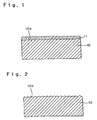
- FIG. 1 is an illustrative view of the surface of a facing member of a watch where a machine work described above, especially honing processing, has been applied.
- this oxide layer 11 causes blackening, allowing this portion to remain would affect the appearance of the facing case, thereby deteriorating a high class sense of the facing case of watches, even when a transparent protective layer 12 such as a glass coating is applied on the surface.
- the oxide layer 11 is removed from the surface 10a by applying, for example, a chemical polishing as shown in Fig. 2.
- This chemical polishing is carried out, for example, by allowing the surface 10a to contact an etching solution.
- a transparent protective layer 12 is formed as shown in Fig. 3, on the surface 10a from which an oxide layer 11 has been removed, thereby an ornament (a facing member of watches) according to this invention is completed.
- a layer containing glass such as a glass coating layer is preferable as the transparent protective layer 12. This allows an wetting effect arising from refractive indices to be displayed, to make the appearance whitish and to give a high glossiness. Spoiling the appearance due to traces of fingerprints adhered to the surface 10a can be also prevented by this coating layer.
- the thickness of the transparent protective layer 12 represented by the glass coating layer is not especially limited, but a thickness of about 0.2 to 15 ⁇ m is preferable and a thickness of about 0.8 to 5.0 ⁇ m is more preferable.
- a thickness of the transparent protective layer 12 is too large, cracks caused by an impact force are prone to be generated because the inner stress is enhanced in the transparent protective layer while, when it is too thin, the effects for preventing fingerprints from adhering and tiny scratches from appearing are diminished.
- the hardness of the transparent protective layer 12 is not especially limited, it is preferably in the range of 180 to 700 expressed by a Vickers hardness defined in JIS Z 2244, the range of 300 to 500 being more preferable. This enables to an excellent abrasion resistance and scratching resistance to be obtained.
- Treatments for removing the surface adhesion substances are 1 ⁇ chemical polishing with an etching solution, 2 ⁇ electropolishing and 3 ⁇ washing (washing with acids, alkali or water). These treatments will be described in turn hereinafter.
- a chemical etching is carried out by allowing the facing member of watches to contact an etching solution, for example by immersing in the etching solution.
- composition of the etching solution, temperature and immersing time are not especially limited, their preferable examples are described hereinafter.
- the etching solution preferably comprises a mixed solution containing HF, HNO 3 and H 2 SO 4 .
- a mixed solution of HF and HNO 3 may be used, but further adding H 2 SO 4 makes it possible to make the surface whitish without giving any roughness on the surface of Ti or Ti alloys.
- the etching solution is especially an aqueous solution containing 1 to 10 vol% of HF, 15 to 40 vol% of HNO 3 and 30 to 60 vol% of H 2 SO 4 .
- optimum range the surface of the facing member of watches can be processed to sufficiently whitish with glossiness within a comparative short treatment time, or with a high productivity, without causing any surface roughness (skin roughness).
- etching will not be substantially proceeded or slowly proceeds.
- the content of HF is less than 1 vol% or the content of HNO 3 is less than 15 vol%, little etching effect can be obtained besides the treatment time is prolonged.
- the surface roughness becomes liable to occur.
- the surface roughness also becomes liable to occur when the content of H 2 SO 4 is less than 30 vol% and, when the content is more than 60 vol%, the etching effect is diminished.
- the composition of the etching solution is 1 to 5 vol%, 15 to 35 vol% and 40 to 60 vol% for HF, HNO 3 and H 2 SO 4 , respectively.
- etching solution is prepared by mixing 5 vol% of commercially available 45 to 50 vol% HF (hydrofluoric acid), 45 vol% of commercially available 60 to 70 vol% HNO 3 (nitric acid) and 50 vol% of commercially available 98 vol% H 2 SO 4 (conc. sulfuric acid).
- the composition of this etching solution is 2.25 to 2.5 vol% of HF, 27 to 31.5 vol% of HNO 3 and 49 vol% of H 2 SO 4 with a balance of water, satisfying the optimum range.
- the facing member of watches is immersed in this etching solution for, for example, about 30 seconds for a chemical etching.
- Example 8 to 14 As shown in Example 8 to 14 below, a good appearance could be obtained by appropriately adjusting the immersion time in the etching solution or other conditions such as the temperature of the solution even when the composition of the etching solution is out of the optimum range described above. Therefore, the composition of the etching solution to be used in this invention is not necessarily limited to the optimum range.
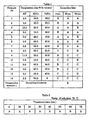
- the quality in appearance of the polished face was investigated, after washing with water, by variously changing the composition of the etching solution and immersion time in the etching solution. The results are listed in Table 1 below together with the etching conditions.
- the substrate for the facing member of watches was a sintered body formed by a metal powder injection molding, the constituting material being an alloy containing 6 wt% of Ti and 1 wt% of Al. A honing processing was applied on the entire surface of the facing member.
- the etching temperature was 70°C in all cases.
- the product evaluated as rank A and B have no problem at all when they are used for commercial commodities while the product of rank C are applicable without any problem for the product except those for which an especially high grade of quality is required like a high class commodity.
- Examples 1 to 7 correspond to the products produced using the etching solution within the optimum range and Examples 8 to 14 correspond to the product produced using the etching solution out of the optimum range.
- the products in Examples 1 to 7 have superior quality in appearance to the products in Examples 8 to 14.
- Example 8 a good appearance was obtained when the immersion time in the etching solution is as long as 60 seconds because the content of HF is relatively small. On the other hand, the content of HF is relatively so large in Example 9 that a good appearance was obtained when the immersion time in the etching solution is as short as 5 seconds.
- Example 10 a good appearance was obtained when the immersion time in the etching solution is as long as 60 seconds because the content of HNO 3 is relatively small. On the other hand, the content of HNO 3 is relatively so large in Example 11 that a good appearance was obtained when the immersion time in the etching solution is as short as 5 seconds.
- Example 12 a good appearance was obtained when the immersion time in the etching solution is as short as 5 seconds because the content of H 2 SO 4 is relatively small. On the other hand, the content of H 2 SO 4 is relatively so large in Example 11 that a good appearance was obtained when the immersion time in the etching solution is as long as 60 seconds.
- Example 14 the appearance becomes normal at an immersion time of up to 60 seconds because H 2 SO 4 is not added, but a longer immersion time results in a good appearance.
- the preferable treatment time is 5 to 50 seconds, a treatment time of 5 to 30 seconds being more preferable, when it is taken into account to obtain a best surface aspect thus attempting to improve productivity.
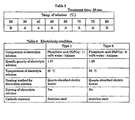
- the whiteness slightly decreases when the solution temperature is as low as 25°C while, when the temperature is as high as 80°C, the etching effect is so enhanced that there is a tendency to exhibit a little roughness. Therefore, the preferable solution temperature is 30 to 75°C and more preferable temperature is 30 to 60°C when it is taken into account to obtain a best surface appearance and to treat at as low a temperature as possible for the reason of safety.
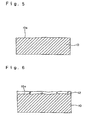
- An electropolishing is applied to the facing member of watches comprising Ti or Ti alloys. This electropolishing is carried out by allowing the facing member of watches to dissolve (anode dissolution) in an electrolyte solution by using the facing member as an anode. Electropolishing is described hereinafter referring to Fig. 4 to Fig. 6.
- Foreign substances 13 other than the substrate metals of the facing member of watches 10 adhere on the surface 10a made of Ti or Ti alloys by applying the machine works described previously. Especially, foreign substances bombarded into the surface are present in the case of the facing member of watches 10 after being subjected to a honing processing.
- the adhesive property of a transparent protective layer 12 will be decreased and durability is deteriorated when the transparent protective layer 12 such as a coating glass layer is formed if this foreign substances 13 are allowed to remain on the surface 10a.
- a transparent protective layer 12 is formed on the surface 10a from which this foreign material 13 has been removed by applying an electropolishing as shown in Fig. 5, thereby completing a facing member of watches according to this invention.
- the oxide layer can be removed together with the foreign substances 13.
- the film quality and adhesive property to the surface 10a of the transparent protective layer 12 can be improved by making the surface 10a uniform and substantially smooth after the foreign materials 13 have been removed from the surface 10a. Accordingly, a transparent protective layer 12 being excellent in fingerprint adhesion preventing property and scratching resistant property can be formed with a high durability.
- composition of the etching solution (etching treatment solution), temperature, electric current density and treatment time are not especially limited, but their suitable examples will be described below.
- the composition of the electrolyte solution is not especially limited but it is preferable that the solution contains H 3 PO 4 (phosphoric acid).
- the electrolyte solution containing H 3 PO 4 is especially suitable for the electrolysis treatment for Ti or Ti containing alloys, making the surface after the treatment good.
- the preferable concentration in the electrolyte solution in this case is 8 to 12 vol%.
- concentration of H 3 PO 4 is too low, foreign substances are not fully eliminated within a short time since polishing strength is lowered while, when the concentration is too high, the polishing strength is so enhanced that the appearance is easily subjected to color changes.
- pH of the electrolyte solution is not limited but the preferable range is usually 1.0 to 1.2, pH range of 1.05 to 1.1 being more preferable.
- the temperature of the electrolyte solution is not especially limited and it may be in the range of 25 to 30°C .
- the electrolysis treatment time is not especially limited and is determined depending on the composition of the electrolyte solution and electric current density.
- the preferable time is usually 3 seconds to 2 minutes but more preferable time is 5 seconds to 1 minute.
- the anode electric current density in the electropolishing is not especially limited, but a current density of 0.5 to 10 a/cm 2 is preferable and a density of 1 to 5 a/cm 2 is more preferable.
- a sufficient electropolishing can not be carried out in a short time while, when the current density is too low, the color of the surface 10a of the facing member of watches 10 is often changed (turn to yellow) lowering its whiteness especially when the time for the electropolishing treatment is prolonged.
- the conditions such as the composition of the electrolyte solution, pH and electric current density are not limited to the conditions described above.
- a facing member of watches was produced via a press processing and cutting processing and a honing processing was applied on the entire surface of the member.
- the composition of the metal substrate of this facing member of watches is pure Ti.
- the product evaluated as rank A and B have no problem at all when they are used for commercial commodities while the product of rank C are applicable without any problem for the product except those for which an especially high grade of quality is required like a high class commodity.
- Washing methods include acid washing, alkaline washing (including alkaline degreasing and neutralization with an acid), water washing, warm water washing, washing with organic solvents such as alcohol and oil washing.
- alkaline washing including alkaline degreasing and neutralization with an acid
- water washing warm water washing
- washing with organic solvents such as alcohol and oil washing.
- One of these methods or an appropriate combination of two or more kind of these method can be used.
- the acid washing solution for the foregoing acid washing that can be properly used is, for example, 3 to 5 % of sulfuric acid while the alkaline solution for the foregoing alkaline washing that can be properly used is, for example, 3.5 to 5 % of Deepsol 41C (made by Deepsol Co.).
- the method for washing is not especially limited but any one of shower washing, jet washing, ultrasonic washing, precision washing, or simply immersing in a washing solution or immersing in the washing solution with stirring can be used.
- the temperature of the washing solution is also not especially limited and any temperature ranging from room temperature washing to a high temperature washing at about 100°C may be used.
- the treatments in 1 ⁇ to 3 ⁇ can be used by an arbitrary times of combination in any order of them.
- 3 ⁇ may applied after applying 1 ⁇ or 2 ⁇ , thereby the appearance of the surface 10a can be made good or more clean.
- the appearance of the surface 10a can be delicately adjusted, thereby improving the adhesive property of the transparent protective layer 12 to be described hereinafter.
- a transparent protective layer 12 is formed on the surface 10a of the facing member of watches 10 as shown in Fig. 3 and Fig. 6.
- the transparent protective layer 12 is constructed with a glass coating layer. The method for forming the layer will be described hereinafter.
- a glass coating liquid is allowed to adhere on the surface of the surface 10a of the facing member of watches 10 by, for example, a coating method followed by drying, thereby a transparent glass coating layer is formed.
- a glass coating liquid comprising a product obtained by dissolving an alkali silicate as a main component and fine granular silica with heating (a transparent glass coating agent made by Okuno Seiyaku Kogyo Co., trade name CRM Coat 100) can be used.
- This kind of glass coating liquid (an original liquid) is produced by dissolving 100 part by weight (as converted to solid fraction) of an alkali silicate such as sodium silicate or potassium silicate and 5 to 100 part by weight of fine granular silica having a mean grain diameter of 40 ⁇ m preferably with heating at 50 to 100°C, more preferably at 80 to 100°C, for about 1 to 2 hours to allow the fine granular silica to dissolve (disperse) into the alkali silicate.
- an alkali silicate such as sodium silicate or potassium silicate
- fine granular silica having a mean grain diameter of 40 ⁇ m preferably with heating at 50 to 100°C, more preferably at 80 to 100°C, for about 1 to 2 hours to allow the fine granular silica to dissolve (disperse) into the alkali silicate.
- Water may be added at an upper limit of 600 part by weight against 100 part by weight of the total solid fraction described above, which makes dissolution easy and rapid.
- the inorganic transparent glass coating liquid can be used as an original liquid or by diluting with a diluting solvent, it is preferable to use a solution diluted with a diluting solvent. This not only enhances the workability of the coating process but also improves the film quality of the transparent protective layer, especially hardness and corrosion resistance of the film.
- the dilution ratio of the glass coating liquid is preferably selected depending on the kind of the machine works applied to the facing member of watches, i. e. a honing processing, nicking processing or mirror finishing. This will enable to improve color tones such as degree of whiteness and glossiness while keeping the corrosion resistant, abrasion resistant and scratch resistant properties of the transparent protective layer to a high level.
- the preferable range of the dilution ratio depending on the kind of the machine works is as follows. There would be also a preferable range in the viscosity of the glass coating liquid to be coated. This viscosity range corresponds to the dilution ratio described above and the former is described hereinafter together with the latter.
- the preferable dilution ratio is 85 % or less and the ratio of 30 to 70% is more preferable.
- the viscosity of the diluted solution is preferably 150 x 10 -3 Pa.s (150 cps) at 25°C or more, the viscosity of 200 x 10 -3 Pa.s to 500 x 10 -3 Pa.s (200 to 500 cps) at 25°C being more preferable.
- the preferable dilution ratio is 85% or less and the ratio of 30 to 70% is more preferable.
- the viscosity of the diluted solution is preferably 150 x 10 -3 Pa.s (150 cps) at 25°C or more, the viscosity of 200 x 10 -3 Pa.s to 500 x 10 -3 Pa.s (200 to 500 cps) at 25°C being more preferable.
- the preferable dilution ratio is 50 to 98% and the ratio of 90 to 98% is more preferable.
- the viscosity of the diluted solution is preferably 150 to 400 x 10 -3 Pa.s (150 to 400cps) at 25°C or more, the viscosity of 150 x 10 -3 Pa.s to 250 x 10 -3 Pa.s (150 to 250cps) at 25°C being more preferable.
- the corrosion resistant property and abrasion resistant property of the transparent protective layer obtained from the glass coating liquid may be sometimes decreased while, when the dilution ratio is too low (the viscosity is too high), the degree of whiteness or glossiness is decreased especially in the members being subjected to a mirror finishing.
- the dilution solvent applicable for coating is organic solvents other than water such as alcohols, benzene and toluene. These organic solvents can be used by mixing with water.
- Examples of the coating methods of the glass coating liquid include immersion (dipping), spraying, roll coating and coating with a brush.
- the coating liquid coated on the surface 10a is then dried.
- the drying condition is not especially limited, but it is preferable that the drying is usually carried out at a temperature of room temperature to 250°C for 1 to 20 minutes, the temperature range of 150 to 230°C for 5 to 15 minutes being more preferable.
- Such drying may be carried out twice or more under the same or different drying conditions.
- the method contributes to the film qualities (especially denseness, homogeneity and uniformity of thickness) and adhesive property of the transparent protective layer 12.
- One example of this steps is that; the coating liquid that has been diluted to a desired dilution ratio is sprayed on the front surface 10a of the wristwatch case using a spray gun followed by a temporary drying at 150°C for 10 minutes. Then, the same glass coating liquid is also sprayed on the rear surface (inner surface) 10a followed by a temporary drying at 150°C for 10 minutes. Next, the coated case is subjected to a final drying at 180°C for 10 minutes by allowing a drying fan and ventilation fan to operate, thereby a transparent protective layer made of a glass layer is formed.
- This transparent protective layer has a good corrosion resistance, abrasion resistance, scratching resistance, impact resistance, fingerprint adhesion preventing property and adhesive property.
- a plurality of coating with the glass coating liquid (coating liquid) may be repeated.
- a concentrate of the glass coating liquid was obtained by dissolving 100 part by weight (as converted to a solid fraction) of sodium silicate and 50 part by weight of fine granular silica having a mean grain diameter of 30 ⁇ m at 85°C with heating followed by stirring for about 1 hour to dissolve (disperse) the fine granular silica into alkali silicate, thereby an original liquid for a glass coating liquid is obtained.
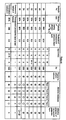
- This original liquid of the glass coating liquid was diluted with water to prepare the glass coating solutions by variously changing their dilution ratio and viscosity (25° C) as shown in Table 6 below.
- the quality in appearance was visually evaluated and classified into 5 ranks.
- the product evaluated as rank A and B have no problem at all when they are used for commercial commodities while the product of rank C are applicable without any problem for the product except those for which an especially high grade of quality is required like a high class commodity.
- the fingerprint adhesion resistance in Table 6 was evaluated by the degree of fingerprint adhesion by a light touch of fingers when the machine works corresponds to H and M were applied, and the results were classified into 4 ranks below.
- Test 1 indicates the result of 1.5 H 10 4 times of scratching test with a sheet of cowhide under an applied pressure of 500 g/cm 2 .
- Test 2 indicates the result of a scratching test with an A1 piece.
- Test 3 indicate the result of a scratch test with BS steel.
- Test 4 indicates the result of a scratch test with stainless steel wire. The results were evaluated by classifying into the following 4 ranks.
- the adhesive property of the transparent protective layer in the case of the machine work defined by S and M in Table 6 was judged by the degree of peeling of the transparent protective layer when an adhering tape adhered on the layer was peeled off.
- the adhesive property was evaluated by classifying into the following 4 ranks.
- Example 29 to 35 an excellent quality in appearance, finger print adhesion resistance, scratching resistance and adhesion property of the transparent protective layer were obtained in all of Example 29 to 35. Especially, selection of a proper dilution ratio in accordance with the kind of the machine works (H, S and M) allows whiteness and glossiness to be enhanced while improving the quality in appearance.
- Comparative Example 3 where no transparent protective layer has not been formed has a bad fingerprint adhesion resistance and scratching resistance.
- Example 36 to 42 an excellent quality in appearance, fingerprint adhesion resistance, scratching resistance and adhesion property of the transparent protective layer were obtained in all of Example 36 to 42. Especially, selection of a proper dilution ratio in accordance with the kind of the machine works (H, S and M) allows whiteness and glossiness to be enhanced while improving the quality in appearance.
- Comparative Example 5 where no transparent protective layer has not been formed has a bad fingerprint adhesion resistance and scratching resistance.
- Comparative Example 6 where a transparent protective layer is formed without applying any electropolishing (treatment for removing surface adhesion substances) has a bad quality in appearance besides being inferior in the adhesion property of the transparent protective layer.
- the coating liquid for forming the transparent protective layer is not limited to those previously described, but any condition such as composition of the coating liquid, temperature, dilution ratio viscosity, methods of coating can be adopted.
- various kinds of coating liquids containing inorganic substances such as aluminum oxide, silicon oxide or water glass can be used.
- the transparent protective group is not limited to inorganic substances but it may be composed of a polymer material (an organic film) such as a rigid resin.
- the method for forming the transparent protective layer is not limited to the coating method (coating) described above but the layer may be formed by various kind of wet plating or dry plating (for example: evaporation, spattering, ion plating and CVD).
- the transparent protective layer it is usually preferable to form the transparent protective layer within 144 hours after completing the elimination step of the surface adhesion substances described above. This is because an oxidation film starts to be formed on the surface when the time lapse exceeds 144 hours, having a possibility to start slight color changes.
- Applications of this invention are not limited to coating of the approximately entire surface of the facing member of watches or the facing case constructed by assembling the same with a transparent protective layer, but a transparent protective layer such as a glass coating layer may be formed on the surface or a part of the surface, or at a plurality of portions on the surface, of the facing member of watches, facing case or other ornaments.
- the transparent protective layer When a treatment for forming a transparent protective layer is applied by providing a masking on the inner face of the facing case of watches, the transparent protective layer is not formed on the inner face of the facing case of watches. Accordingly, a precise positioning of mechanical parts (movements) is made possible when the mechanical parts are assembled and fixed in the case, thereby a bad influence of the component of the transparent protective layer on the mechanical parts can be prevented.
- Application of this invention is not limited to the product where a transparent protective layer is formed on the substrate of Ti or Ti alloys, but the transparent protective layer may be formed on layers of Ti or Ti alloy that has been formed on a desired substrate.
- While this invention is not only applicable for the facing case of wristwatches, band or completed watches using thereof, but also to other kind of watches and clocks such as a portable watch, table clock or wall clock as well.
- Apps other than clocks and watches are eye glass frames, tiepins, cuff links, lighters or their cases, pens, rings, necklaces, bracelets, brooches, pendants, earrings, piercing rings, coronets, ornaments, decorations, decorative goods such as interior products (being more or less decorative) and accessories.
- the object of this invention is also electronic devices a part of which is provided with ornaments (ornaments used for at least displaying an decorative effect at a part of the device).
- ornaments ornaments used for at least displaying an decorative effect at a part of the device.
- Examples of such electronic devices are electronic watches and clocks, portable phones, pocket bells, calculators, personal computers, word processors, printers, copy machines, cameras, video equipments, televisions, audio equipments, electronic toys and a variety of measuring apparatus.
- This invention is applicable not only to ornaments, accessories and electronic devices but also to various kind of members made of Ti or Ti alloys.
- this invention may provide the following effects.
- An excellent scratching resistance and fingerprint adhesion resistance can be obtained by forming a transparent protective layer.
- Forming the transparent protective layer with a layer containing a glass like a glass coating layer makes it possible to easily form a transparent protective layer as well as forming a highly rigid transparent protective layer being excellent in corrosion resistance and abrasion resistance.
- a proper selection of the composition of the electrolyte solution, electric current density and other treatment conditions makes it possible to obtain a smooth and good surface, improving its degree of whiteness.
Landscapes
- Chemical & Material Sciences (AREA)
- Engineering & Computer Science (AREA)
- Materials Engineering (AREA)
- Metallurgy (AREA)
- Organic Chemistry (AREA)
- Mechanical Engineering (AREA)
- Chemical Kinetics & Catalysis (AREA)
- Electrochemistry (AREA)
- General Chemical & Material Sciences (AREA)
- ing And Chemical Polishing (AREA)
- Other Surface Treatments For Metallic Materials (AREA)
- Application Of Or Painting With Fluid Materials (AREA)
Applications Claiming Priority (6)
| Application Number | Priority Date | Filing Date | Title |
|---|---|---|---|
| JP5008/97 | 1997-01-14 | ||
| JP500897 | 1997-01-14 | ||
| JP500897 | 1997-01-14 | ||
| JP27783997A JP3557868B2 (ja) | 1997-01-14 | 1997-10-09 | 装飾品の表面処理方法、装飾品および電子機器 |
| JP27783997 | 1997-10-09 | ||
| JP277839/97 | 1997-10-09 |
Publications (3)
| Publication Number | Publication Date |
|---|---|
| EP0853141A2 EP0853141A2 (en) | 1998-07-15 |
| EP0853141A3 EP0853141A3 (en) | 2000-02-23 |
| EP0853141B1 true EP0853141B1 (en) | 2005-07-06 |
Family
ID=26338883
Family Applications (1)
| Application Number | Title | Priority Date | Filing Date |
|---|---|---|---|
| EP98300245A Expired - Lifetime EP0853141B1 (en) | 1997-01-14 | 1998-01-14 | Method for surface treatment |
Country Status (6)
| Country | Link |
|---|---|
| US (1) | US6087018A (enExample) |
| EP (1) | EP0853141B1 (enExample) |
| JP (1) | JP3557868B2 (enExample) |
| CN (2) | CN1079300C (enExample) |
| DE (1) | DE69830758T2 (enExample) |
| SG (1) | SG54617A1 (enExample) |
Families Citing this family (29)
| Publication number | Priority date | Publication date | Assignee | Title |
|---|---|---|---|---|
| DE19962136A1 (de) * | 1999-12-22 | 2001-06-28 | Merck Patent Gmbh | Verfahren zur Rauhätzung von Siliziumsolarzellen |
| EP1423868A2 (en) * | 2001-08-17 | 2004-06-02 | ACM Research, Inc. | Forming a semiconductor structure using a combination of planarizing methods and electropolishing |
| US20040200805A1 (en) * | 2002-12-06 | 2004-10-14 | Ulland William Charles | Metal engraving method, article, and apparatus |
| US8063142B2 (en) | 2004-03-02 | 2011-11-22 | Bridgestone Corporation | Method of making nano-particles of selected size distribution |
| US8581108B1 (en) | 2006-08-23 | 2013-11-12 | Rockwell Collins, Inc. | Method for providing near-hermetically coated integrated circuit assemblies |
| US7915527B1 (en) | 2006-08-23 | 2011-03-29 | Rockwell Collins, Inc. | Hermetic seal and hermetic connector reinforcement and repair with low temperature glass coatings |
| US8076185B1 (en) * | 2006-08-23 | 2011-12-13 | Rockwell Collins, Inc. | Integrated circuit protection and ruggedization coatings and methods |
| US8166645B2 (en) * | 2006-08-23 | 2012-05-01 | Rockwell Collins, Inc. | Method for providing near-hermetically coated, thermally protected integrated circuit assemblies |
| US8174830B2 (en) * | 2008-05-06 | 2012-05-08 | Rockwell Collins, Inc. | System and method for a substrate with internal pumped liquid metal for thermal spreading and cooling |
| US8084855B2 (en) | 2006-08-23 | 2011-12-27 | Rockwell Collins, Inc. | Integrated circuit tampering protection and reverse engineering prevention coatings and methods |
| US8637980B1 (en) | 2007-12-18 | 2014-01-28 | Rockwell Collins, Inc. | Adhesive applications using alkali silicate glass for electronics |
| US8617913B2 (en) * | 2006-08-23 | 2013-12-31 | Rockwell Collins, Inc. | Alkali silicate glass based coating and method for applying |
| US8363189B2 (en) * | 2007-12-18 | 2013-01-29 | Rockwell Collins, Inc. | Alkali silicate glass for displays |
| US8616266B2 (en) * | 2008-09-12 | 2013-12-31 | Rockwell Collins, Inc. | Mechanically compliant thermal spreader with an embedded cooling loop for containing and circulating electrically-conductive liquid |
| US8650886B2 (en) * | 2008-09-12 | 2014-02-18 | Rockwell Collins, Inc. | Thermal spreader assembly with flexible liquid cooling loop having rigid tubing sections and flexible tubing sections |
| US8205337B2 (en) * | 2008-09-12 | 2012-06-26 | Rockwell Collins, Inc. | Fabrication process for a flexible, thin thermal spreader |
| US8119040B2 (en) * | 2008-09-29 | 2012-02-21 | Rockwell Collins, Inc. | Glass thick film embedded passive material |
| US8516663B2 (en) | 2010-05-12 | 2013-08-27 | Hollenwolff, Llc | Cufflink technology |
| CN102896825A (zh) * | 2011-07-29 | 2013-01-30 | 鸿富锦精密工业(深圳)有限公司 | 镀膜件及其制造方法 |
| US9435915B1 (en) | 2012-09-28 | 2016-09-06 | Rockwell Collins, Inc. | Antiglare treatment for glass |
| WO2014138393A1 (en) * | 2013-03-06 | 2014-09-12 | Covalent Coating Technologies, LLC | Fusion of biocompatible glass/ceramic to metal substrate |
| CN103540948A (zh) * | 2013-09-12 | 2014-01-29 | 云南钛业股份有限公司 | 一种钛及钛合金冷压制品表面氧化层的清洗方法 |
| US20150140297A1 (en) * | 2013-11-19 | 2015-05-21 | Steven E. Johnson | Surface preparation using optical energy |
| US10399166B2 (en) | 2015-10-30 | 2019-09-03 | General Electric Company | System and method for machining workpiece of lattice structure and article machined therefrom |
| US10927473B2 (en) | 2016-09-22 | 2021-02-23 | Apple Inc. | Oxide coatings for metal surfaces |
| EP3708384A1 (fr) * | 2019-03-14 | 2020-09-16 | Omega SA | Element d'habillage ou cadran d'horlogerie ou de bijouterie en materiau conducteur |
| EP3754435B1 (fr) | 2019-06-21 | 2021-12-29 | The Swatch Group Research and Development Ltd | Piece d'horlogerie a cornes rapportees |
| CH717987B1 (fr) * | 2020-10-22 | 2023-11-30 | Patek Philippe Sa Geneve | Procédé de traitement d'une surface d'un support en métal en vue de son émaillage. |
| CN115029697B (zh) * | 2022-06-10 | 2023-03-24 | 合肥升滕半导体技术有限公司 | 一种酸蚀液及其应用 |
Family Cites Families (12)
| Publication number | Priority date | Publication date | Assignee | Title |
|---|---|---|---|---|
| US2959503A (en) * | 1958-05-23 | 1960-11-08 | Nat Lead Co | Method for treating titanium metal |
| FR92532E (fr) * | 1964-04-27 | 1968-11-22 | Contimet Gmbh | Revêtement de protection pour le titane et les alliages de titane |
| FR1455097A (fr) * | 1964-04-27 | 1966-04-01 | Continental Titanium Metals Co | Revêtement de protection pour le titane et les alliages de titane |
| GB1116707A (en) * | 1965-05-24 | 1968-06-12 | Continental Titanium Metals Co | Protective coating for titanium and zirconium |
| GB1498810A (en) * | 1974-08-31 | 1978-01-25 | Rolls Royce | Heat resistant protective coating for metals |
| US4692385A (en) * | 1986-04-14 | 1987-09-08 | Materials Development Corporation | Triplex article |
| US4906524A (en) * | 1987-05-29 | 1990-03-06 | Orient Watch Co., Ltd. | Surface-coated article and a method for the preparation thereof |
| US5079089A (en) * | 1988-07-28 | 1992-01-07 | Nippon Steel Corporation | Multi ceramic layer-coated metal plate and process for manufacturing same |
| DE3926151C1 (enExample) * | 1989-02-28 | 1990-05-10 | Mtu Muenchen Gmbh | |
| EP0414458A1 (en) * | 1989-08-21 | 1991-02-27 | Corning Incorporated | Glass-ceramic coatings for titanium aluminide surfaces |
| DE4139006C3 (de) * | 1991-11-27 | 2003-07-10 | Electro Chem Eng Gmbh | Verfahren zur Erzeugung von Oxidkeramikschichten auf sperrschichtbildenden Metallen und auf diese Weise erzeugte Gegenstände aus Aluminium, Magnesium, Titan oder deren Legierungen mit einer Oxidkeramikschicht |
| FR2699555B1 (fr) * | 1992-12-23 | 1995-02-03 | Ebauchesfabrik Eta Ag | Objet présentant un revêtement de coloration rosée. |
-
1997
- 1997-10-09 JP JP27783997A patent/JP3557868B2/ja not_active Expired - Lifetime
-
1998
- 1998-01-10 SG SG1998000081A patent/SG54617A1/en unknown
- 1998-01-13 CN CN98103764A patent/CN1079300C/zh not_active Expired - Lifetime
- 1998-01-14 DE DE69830758T patent/DE69830758T2/de not_active Expired - Lifetime
- 1998-01-14 EP EP98300245A patent/EP0853141B1/en not_active Expired - Lifetime
- 1998-01-14 US US09/007,129 patent/US6087018A/en not_active Expired - Lifetime
-
2001
- 2001-07-10 CN CNB011217936A patent/CN1192828C/zh not_active Expired - Lifetime
Also Published As
| Publication number | Publication date |
|---|---|
| CN1354400A (zh) | 2002-06-19 |
| US6087018A (en) | 2000-07-11 |
| DE69830758T2 (de) | 2005-12-01 |
| CN1079300C (zh) | 2002-02-20 |
| SG54617A1 (en) | 1998-11-16 |
| JPH10259486A (ja) | 1998-09-29 |
| HK1010220A1 (en) | 1999-06-17 |
| CN1198368A (zh) | 1998-11-11 |
| DE69830758D1 (de) | 2005-08-11 |
| CN1192828C (zh) | 2005-03-16 |
| JP3557868B2 (ja) | 2004-08-25 |
| EP0853141A3 (en) | 2000-02-23 |
| EP0853141A2 (en) | 1998-07-15 |
Similar Documents
| Publication | Publication Date | Title |
|---|---|---|
| EP0853141A2 (en) | Method for surface treatment, an ornament and a device | |
| US6800326B1 (en) | Method of treating a surface of a surface of a substrate containing titanium for an ornament | |
| KR100599640B1 (ko) | 백색 피막을 갖는 장신구 및 그 제조 방법 | |
| RU2743680C1 (ru) | Внешний элемент или циферблат для часов или ювелирных изделий, выполненный из проводящего материала | |
| US20140044990A1 (en) | Decorative article and timepiece | |
| US20130075262A1 (en) | Method of forming anodic titanium oxide layers having dual-color appearance and article having the same | |
| KR101413254B1 (ko) | 금속 유리 부품의 표면 처리 방법과 상기 방법으로 표면 처리된 금속 유리 부품 | |
| JP2003253473A (ja) | 白色被膜を有する装飾品およびその製造方法 | |
| EP1146136B1 (en) | Ornament and method for preparation thereof | |
| JP2002120495A (ja) | 表面処理方法、装飾品および電子機器 | |
| JP4067434B2 (ja) | 白色被膜を有する装飾品及びその製造方法 | |
| HK1010220B (en) | Method for surface treatment | |
| CN120335269A (zh) | 钟表用部件、钟表以及钟表用部件的制造方法 | |
| JPH10259487A (ja) | 表面処理方法、装飾品および電子機器 | |
| JP4693045B2 (ja) | 金属ガラス部品の表面処理方法と該方法で表面処理された金属ガラス部品 | |
| JP2666404B2 (ja) | 装飾体の製造方法 | |
| JP2002129358A (ja) | 表面処理方法、装飾品および電子機器 | |
| JP2002249887A (ja) | 装飾品の表面処理方法および装飾品 | |
| JPH05156425A (ja) | 装飾部材およびその製造方法 | |
| JPS6350497A (ja) | チタン材の彩色方法 | |
| JP2004143577A (ja) | 装飾品の表面処理方法、装飾品および時計 | |
| JP2003138384A (ja) | 表面処理方法および装飾品 | |
| HK40121608A (en) | External element or dial for horology or jewellery made of conductive material | |
| JP4589772B2 (ja) | 白色被膜を有する装飾品 | |
| US4403016A (en) | Gold-colored silver-cadmium-nickel alloy for electrodeposited duplex coating |
Legal Events
| Date | Code | Title | Description |
|---|---|---|---|
| PUAI | Public reference made under article 153(3) epc to a published international application that has entered the european phase |
Free format text: ORIGINAL CODE: 0009012 |
|
| AK | Designated contracting states |
Kind code of ref document: A2 Designated state(s): CH DE FR GB LI |
|
| AX | Request for extension of the european patent |
Free format text: AL;LT;LV;MK;RO;SI |
|
| PUAL | Search report despatched |
Free format text: ORIGINAL CODE: 0009013 |
|
| AK | Designated contracting states |
Kind code of ref document: A3 Designated state(s): AT BE CH DE DK ES FI FR GB GR IE IT LI LU MC NL PT SE |
|
| AX | Request for extension of the european patent |
Free format text: AL;LT;LV;MK;RO;SI |
|
| 17P | Request for examination filed |
Effective date: 20000717 |
|
| AKX | Designation fees paid |
Free format text: CH DE FR GB LI |
|
| 17Q | First examination report despatched |
Effective date: 20020617 |
|
| GRAP | Despatch of communication of intention to grant a patent |
Free format text: ORIGINAL CODE: EPIDOSNIGR1 |
|
| RTI1 | Title (correction) |
Free format text: METHOD FOR SURFACE TREATMENT |
|
| GRAA | (expected) grant |
Free format text: ORIGINAL CODE: 0009210 |
|
| GRAS | Grant fee paid |
Free format text: ORIGINAL CODE: EPIDOSNIGR3 |
|
| AK | Designated contracting states |
Kind code of ref document: B1 Designated state(s): CH DE FR GB LI |
|
| REG | Reference to a national code |
Ref country code: GB Ref legal event code: FG4D |
|
| REG | Reference to a national code |
Ref country code: CH Ref legal event code: EP |
|
| REF | Corresponds to: |
Ref document number: 69830758 Country of ref document: DE Date of ref document: 20050811 Kind code of ref document: P |
|
| REG | Reference to a national code |
Ref country code: HK Ref legal event code: GR Ref document number: 1010220 Country of ref document: HK |
|
| REG | Reference to a national code |
Ref country code: CH Ref legal event code: NV Representative=s name: PATENTANWAELTE SCHAAD, BALASS, MENZL & PARTNER AG |
|
| ET | Fr: translation filed | ||
| PLBE | No opposition filed within time limit |
Free format text: ORIGINAL CODE: 0009261 |
|
| STAA | Information on the status of an ep patent application or granted ep patent |
Free format text: STATUS: NO OPPOSITION FILED WITHIN TIME LIMIT |
|
| 26N | No opposition filed |
Effective date: 20060407 |
|
| REG | Reference to a national code |
Ref country code: FR Ref legal event code: PLFP Year of fee payment: 19 |
|
| REG | Reference to a national code |
Ref country code: FR Ref legal event code: PLFP Year of fee payment: 20 |
|
| PGFP | Annual fee paid to national office [announced via postgrant information from national office to epo] |
Ref country code: FR Payment date: 20161215 Year of fee payment: 20 |
|
| PGFP | Annual fee paid to national office [announced via postgrant information from national office to epo] |
Ref country code: DE Payment date: 20170110 Year of fee payment: 20 Ref country code: CH Payment date: 20170112 Year of fee payment: 20 |
|
| PGFP | Annual fee paid to national office [announced via postgrant information from national office to epo] |
Ref country code: GB Payment date: 20170111 Year of fee payment: 20 |
|
| REG | Reference to a national code |
Ref country code: DE Ref legal event code: R071 Ref document number: 69830758 Country of ref document: DE |
|
| REG | Reference to a national code |
Ref country code: CH Ref legal event code: PL |
|
| REG | Reference to a national code |
Ref country code: GB Ref legal event code: PE20 Expiry date: 20180113 |
|
| PG25 | Lapsed in a contracting state [announced via postgrant information from national office to epo] |
Ref country code: GB Free format text: LAPSE BECAUSE OF EXPIRATION OF PROTECTION Effective date: 20180113 |