EP0845470A2 - Verfahren zur kontinuierlichen Herstellung von Carbonoyloxysilanen - Google Patents
Verfahren zur kontinuierlichen Herstellung von Carbonoyloxysilanen Download PDFInfo
- Publication number
- EP0845470A2 EP0845470A2 EP97117095A EP97117095A EP0845470A2 EP 0845470 A2 EP0845470 A2 EP 0845470A2 EP 97117095 A EP97117095 A EP 97117095A EP 97117095 A EP97117095 A EP 97117095A EP 0845470 A2 EP0845470 A2 EP 0845470A2
- Authority
- EP
- European Patent Office
- Prior art keywords
- carbonoyl
- metal
- carbonoyloxysilane
- oxides
- chlorine
- Prior art date
- Legal status (The legal status is an assumption and is not a legal conclusion. Google has not performed a legal analysis and makes no representation as to the accuracy of the status listed.)
- Withdrawn
Links
Images

Classifications
-
- C—CHEMISTRY; METALLURGY
- C07—ORGANIC CHEMISTRY
- C07F—ACYCLIC, CARBOCYCLIC OR HETEROCYCLIC COMPOUNDS CONTAINING ELEMENTS OTHER THAN CARBON, HYDROGEN, HALOGEN, OXYGEN, NITROGEN, SULFUR, SELENIUM OR TELLURIUM
- C07F7/00—Compounds containing elements of Groups 4 or 14 of the Periodic Table
- C07F7/02—Silicon compounds
- C07F7/08—Compounds having one or more C—Si linkages
- C07F7/18—Compounds having one or more C—Si linkages as well as one or more C—O—Si linkages
- C07F7/1896—Compounds having one or more Si-O-acyl linkages
-
- B—PERFORMING OPERATIONS; TRANSPORTING
- B01—PHYSICAL OR CHEMICAL PROCESSES OR APPARATUS IN GENERAL
- B01J—CHEMICAL OR PHYSICAL PROCESSES, e.g. CATALYSIS OR COLLOID CHEMISTRY; THEIR RELEVANT APPARATUS
- B01J2219/00—Chemical, physical or physico-chemical processes in general; Their relevant apparatus
- B01J2219/00002—Chemical plants
- B01J2219/00027—Process aspects
- B01J2219/00033—Continuous processes
Definitions
- the invention relates to a process for the continuous production of Carbonoyloxysilanes by reacting organochlorosilanes with essentially excess monocarboxylic anhydride at elevated temperature, separating the at the reaction as a by-product of carboxylic acid chloride and workup of the remaining reaction mixture.
- Carbonoyloxysilanes have many uses in the chemical industry found. They are suitable for. B. as crosslinking silicon compounds in the Manufactured in the absence of water, storable and in the presence of moisture compositions curable at room temperature. Examples include compounds such as methyl, Ethyl and propyl tris (ethanoyloxy) silane.
- One procedure uses the implementation of organochlorosilanes Carboxylic acids to the corresponding organocarbonoyloxysilanes.
- the other procedure for the production of carbonoyloxysilanes in technical The scale uses the implementation of organochlorosilane with carboxylic anhydrides to the corresponding organocarbonoyloxysilanes.
- FR-PS 1 003 073 describes the discontinuous and simultaneous production of Carbonoyloxysilanes and carboxylic acid chlorides by reacting Organochlorosilanes described with monocarboxylic anhydrides, according to 8 hours implementation time unsatisfactory product yields with undetectable Residual chlorine levels can be obtained.
- the present invention was therefore based on the task, essentially continuous, economical process for the production of carbonoyloxysilanes via the carboxylic anhydride route, which makes it possible to use a product with to produce a residual acid chlorine content of less than 2 ppm by weight of chlorine.
- the object is achieved according to the information in the Claims resolved.
- the present invention therefore relates to a process for continuous Production of carbonoyloxysilanes by reacting organochlorosilanes with im essential excess monocarboxylic acid anhydride at elevated temperature, Separation of the carboxylic acid chloride formed as a by-product during the reaction and working up the remaining reaction mixture, whereupon working up the reaction mixture is transferred to the middle of a separation column, under reduced pressure at the top of the column excess carboxylic anhydride distilled off, carbonoyloxysilane uniformly discharged from the column bubble, which in removed carbonoyloxysilane present residual amount of acidic chlorine Addition of metal carbonoyloxides is implemented almost quantitatively and the formed Separates metal chlorides.
- R 1 and R 2 here are suitably hydrogen or saturated or unsaturated hydrocarbon radicals each having 1 to 10 carbon atoms, which may contain functional groups, for. B. halogen, which can not be attacked under the given reaction conditions, and for cyclic saturated or unsaturated hydrocarbon radicals with 6 carbon atoms.
- R 1 and R 2 in the present formula may be the same or different.
- R 3 in the aforementioned formula in particular represents a hydrogen, methyl, ethyl or propyl radical.
- the process according to the invention can be carried out in such a way that an organochlorosilane with substantially excess monocarboxylic anhydride with the addition of organic bases, their salts or organic acid amides, the are suitably soluble in the present mixture at a temperature in the range from 25 to 100 ° C through one or more reactors, then the created carboxylic acid chloride removed, for example under vacuum in one Distillation reactor.
- organic bases for example tertiary, secondary or primary amines, unsubstituted and / or N-substituted Acid amides
- B. triethylamine, N, N-dimethylformamide are added.
- all known metal carbonoyl oxides of the elements of the periodic table can be used in the process according to the invention, which form salt-like metal chlorides in a suitable manner, some preferred examples of which are listed below.
- a carbonoyl oxide is particularly preferred as the metal carbonoyl oxide Alkali elements and / or alkaline earth elements used. Are very particularly preferred carbonoyl oxides of sodium.
- the metal carbonoyl oxides are suitably used dissolved in the carboxylic acid corresponding to the carbonoyl oxide used.
- the remaining amount of acidic chlorine is reacted in the Carbonoyloxysilane with at least one metal carbonoyl oxide continuously at one Temperature in the range from 0 to 200 ° C, preferably at 0 to 130 ° C, particularly preferably at 20 to 80 ° C, by.
- the reaction temperature should be chosen such that the reaction time and the solubility of the resulting metal salts in the substrate are minimized.
- the reaction can take place both under reduced pressure, for example above 400 mbar abs., as well as at normal pressure and increased pressure, for example up to 2 bar abs. It may also be beneficial to Reaction of the organocarbonoyloxysilanes with the metal carbonoyloxides with stirring perform.
- the carbonoyl oxides are preferably used in such amounts that none Excess over the stoichiometrically necessary amount, based on the content of acidic chlorine in the substrate to be treated.
- the complete removal of the The content of acidic chlorine in organocarbonoyloxysilanes can be determined either by a achieve a single addition of an appropriate amount of a metal carbonoyl oxide or in the form that one suitably moves from the one to complete removal the content of acidic chlorine in the substrate stoichiometrically required amount
- Carbonoyl oxide only about 70 - 80% added, can be reacted, the residual content again acidic chlorine determined and again, depending on the amount remaining in the substrate acidic chlorine, 70 - 80% of the stoichiometrically required amount of carbonoyl oxide dosed, d. H. a continuous product refurbishment under Inclusion of a quasi-continuous titration.
- the metal chlorides formed during the reaction can also be separated off be carried out continuously in various ways, for example by filtration or Centrifuge or decant.
- the metal salts are preferably removed by Centrifuge using a continuously operating separator.
- the method of distillation can also be used to separate product and metal salt be applied. This method is used particularly when Process according to the invention receive products with a particularly low siloxane content should be.
- Organocarbonoyloxysilanes are understood as such products, their content of acidic chlorine generally less than 2 ppm by weight, especially less than 1 ppm by weight, preferably less than 0.5 ppm by weight of acidic chlorine, particularly preferably less than or equal to 0.1 ppm by weight.
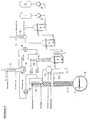
- FIG. 1 shows the diagram of a plant for the production of carbonoyloxysilanes.
- Ethyltrichlorosilane is filled in the reservoir 1 , ethanoic anhydride in the reservoir 2 .
- the reaction mixture passes through the cooler 16 into the reactor 6 (vol.
- the withdrawn in the upper part of the distillation reactor 9 product is introduced 11 of the column into the central inlet of the distillation column consisting cm of a 1.60 m long glass tube with a diameter of 5 and is filled with saddle bodies of 6 mm in diameter.
- the cooler 19 of the column head and the distillate receiver 12 are charged with a cooling liquid ( ⁇ 27 ° C.).
- the lower end of the column is formed by a 4 l jacketed piston 13 , heated by a thermostat (circulation temperature about 125 ° C).
- the raw product fed in is worked up.
- Ethyl tris (ethanoyloxy) silane is steadily decreased to a degree from the half-filled with liquid jacketed flask 13, that the liquid level remains unchanged in the piston. 13
- excess ethanoic anhydride distills off, which is collected in the distillate receiver 12 .
- the remaining ethanoyl chloride is distilled off into the receiver 14 provided with the cooler 17 via the cooler 19 and the vacuum pump 15 .
- the product removed from the double-jacket piston 13 consists of Ethyl tris (ethanoyloxy) silane 97.2% by weight Siloxanes 1.7% by weight Ethanoic anhydride 1.1% by weight Chlorine, acid 3 ppm
- the product removed from the double-jacket piston 13 consists of: Ethyl tris (ethanoyloxy) silane approx. 97.7% by weight Siloxanes approx. 1.2% by weight Ethanoic anhydride approx. 1.1% by weight Chlorine, acid about 35 ppm
Landscapes
- Chemical & Material Sciences (AREA)
- Organic Chemistry (AREA)
Abstract
Description
b den Wert 1 oder 0 haben kann und a + b ≤ 3 sind,
bevorzugt werden solche mit a = 1 und b = 0.
Natriumformiat, Natriumacetat, Natriumpropionat, Natriumbutyrat, Kaliumacetat, Magnesiumacetat, Calciumacetat, Bariumacetat, Zinkacetat.
| Ethyl-tris(ethanoyloxy)silan | 97,2 Gew.-% |
| Siloxane | 1,7 Gew.-% |
| Ethansäureanhydrid | 1,1 Gew.-% |
| Chlor, acid | 3 ppm |
| Ethyl-tris(ethanoyloxy)silan | ca. 97,7 Gew.-% |
| Siloxane | ca. 1,2 Gew.-% |
| Ethansäureanhydrid | ca. 1,1 Gew.-% |
| Chlor, acid | ca. 35 ppm |
| Ethyl-tris(ethanoyloxy)silan | 97,6 Gew.-% |
| Siloxane | 1,1 Gew.-% |
| Ethansäureanhydrid | 1,2 Gew.-% |
| Ethansäure | 0,1 Gew.-% |
| Chlor, acid | ca. 0,1 Gew.-ppm |
Claims (10)
- Verfahren zur kontinuierlichen Herstellung von Carbonoyloxysilanen durch Umsetzen von Organochlorsilanen mit im wesentlichen überschüssigem Monocarbonsäureanhydrid bei erhöhter Temperatur, Abtrennen des bei der Umsetzung als Nebenprodukt entstandenen Carbonsäurechlorides und Aufarbeitung des verbleibenden Reaktionsgemisches,
dadurch gekennzeichnet,
daß man zur Aufarbeitung das Reaktionsgemisch in den Mittellauf einer Trennkolonne überführt, unter vermindertem Druck am Kolonnenkopf überschüssiges Carbonsäureanhydrid abdestilliert, Carbonoyloxysilan aus der Kolonnenblase gleichförmig abführt, die im entnommenen Carbonoyloxysilan vorliegende Restmenge an acidem Chlor durch Zugabe von Metallcarbonoyloxiden nahezu quantitativ umsetzt und die gebildeten Metallchloride abtrennt. - Verfahren nach Anspruch 1,
dadurch gekennzeichnet,
daß man die vorliegende Restmenge an acidem Chlor durch Zugabe von mindestens einem Metallcarbonoyloxid nahezu quantitativ umsetzt und das jeweilig eingesetzte Metallcarbonoyloxid in seiner Carbonoyloxy-Komponente mit der Carbonoyloxy-Komponente des Carbonoyloxysilans korrespondiert. - Verfahren nach Anspruch 1 oder 2,
dadurch gekennzeichnet,
daß man die Metallcarbonoyloxide in gelöster Form dem entnommenen Carbonoyloxysilan zugibt - Verfahren nach Anspruch 3,
dadurch gekennzeichnet,
daß man das Metallcarbonoyloxid in der zu dem jeweiligen Carbonoyloxid korrespondierenden Carbonsäure löst. - Verfahren nach mindestens einem der Ansprüche 1 bis 4,
dadurch gekennzeichnet,
daß man als Metallcarbonoyloxid ein Carbonoyloxid eines Alkalielementes und/oder eines Erdalkalielementes einsetzt. - Verfahren nach mindestens einem der Ansprüche 1 bis 5,
dadurch gekennzeichnet,
daß man die Metallcarbonoyloxide oder deren Lösungen in bis zu äquivalenter Menge bezüglich der jeweils aktuell vorliegenden Menge an acidem Chlor dem Carbonoyloxysilan zugibt. - Verfahren nach mindestens einem der Ansprüche 1 bis 6,
dadurch gekennzeichnet,
daß man die Umsetzung des aciden Chlors mit Metallcarbonoyloxiden bei einer Temperatur zwischen 0 bis 130 °C kontinuierlich durchführt. - Verfahren nach Anspruch 7,
dadurch gekennzeichnet,
daß man die Umsetzung des aciden Chlors mit Metallcarbonoyloxiden bei einer Temperatur zwischen 20 bis 80 °C kontinuierlich durchführt. - Verfahren nach mindestens einem der Ansprüche 1 bis 8,
dadurch gekennzeichnet,
daß man die Umsetzung des aciden Chlors mit Metallcarbonoyloxiden unter Rühren durchführt. - Verfahren nach mindestens einem der Ansprüche 1 bis 9,
dadurch gekennzeichnet,
daß das Abtrennen der bei der Umsetzung gebildeten Metallchloride durch eine kontinuierliche betriebene Filtration erfolgt.
Applications Claiming Priority (2)
| Application Number | Priority Date | Filing Date | Title |
|---|---|---|---|
| DE19649028 | 1996-11-27 | ||
| DE19649028A DE19649028A1 (de) | 1996-11-27 | 1996-11-27 | Verfahren zur kontinuierlichen Herstellung von Carbonoyloxysilanen |
Publications (2)
| Publication Number | Publication Date |
|---|---|
| EP0845470A2 true EP0845470A2 (de) | 1998-06-03 |
| EP0845470A3 EP0845470A3 (de) | 1999-08-04 |
Family
ID=7812862
Family Applications (1)
| Application Number | Title | Priority Date | Filing Date |
|---|---|---|---|
| EP97117095A Withdrawn EP0845470A3 (de) | 1996-11-27 | 1997-10-02 | Verfahren zur kontinuierlichen Herstellung von Carbonoyloxysilanen |
Country Status (5)
| Country | Link |
|---|---|
| US (1) | US5939575A (de) |
| EP (1) | EP0845470A3 (de) |
| JP (1) | JPH10158278A (de) |
| KR (1) | KR19980042748A (de) |
| DE (1) | DE19649028A1 (de) |
Cited By (1)
| Publication number | Priority date | Publication date | Assignee | Title |
|---|---|---|---|---|
| EP0845473A3 (de) * | 1996-11-27 | 1999-08-11 | Hüls Aktiengesellschaft | Verfahren zur Entfernung von Restmengen an acidem Chlor in Carbonoyloxysilanen |
Families Citing this family (7)
| Publication number | Priority date | Publication date | Assignee | Title |
|---|---|---|---|---|
| KR20020055796A (ko) * | 2000-12-29 | 2002-07-10 | 정종순 | 아실옥시실란의 제조방법 |
| FR2836473B1 (fr) * | 2002-02-26 | 2004-07-30 | Atofina | Procede de fabrication d'organoacyloxysilanes |
| KR100506998B1 (ko) * | 2002-06-21 | 2005-08-08 | 애경유화 주식회사 | 아실옥시실란의 제조방법 |
| DE102004025766A1 (de) * | 2004-05-26 | 2005-12-22 | Degussa Ag | Herstellung von Organosilanestern |
| DE102007050199A1 (de) * | 2007-10-20 | 2009-04-23 | Evonik Degussa Gmbh | Entfernung von Fremdmetallen aus anorganischen Silanen |
| US20200056044A1 (en) | 2016-10-31 | 2020-02-20 | Wacker Chemie Ag | One-part room-temperature curable compositions on the basis of organosilicon compounds and titanium curing catalysts |
| CN114315890B (zh) * | 2022-01-05 | 2023-11-17 | 湖北江瀚新材料股份有限公司 | 一种甲基丙烯酰氧丙基三乙酰氧基硅烷的制备方法 |
Family Cites Families (9)
| Publication number | Priority date | Publication date | Assignee | Title |
|---|---|---|---|---|
| GB640834A (en) * | 1947-07-23 | 1950-07-26 | Rhone Poulenc Sa | Improvements in or relating to the production organo-silicon derivatives |
| DE870554C (de) * | 1949-01-21 | 1953-03-16 | Hellmuth Holz Dr | Verfahren zur Herstellung von Carbonsaeurederivaten siliciumorganischer Verbindungen |
| DE4112650A1 (de) * | 1991-04-18 | 1992-10-22 | Huels Chemische Werke Ag | Verfahren zur gleichzeitigen und kontinuierlichen herstellung von carbonoyloxysilanen und carbonsaeurechloriden |
| US5387706A (en) * | 1994-06-27 | 1995-02-07 | Dow Corning Corporation | Process for preparing acyloxysilanes |
| DE4434200C2 (de) * | 1994-09-24 | 2002-06-27 | Degussa | Verfahren zur Herstellung von 3-Acryloxypropylalkoxysilanen |
| DE4435390C2 (de) * | 1994-10-04 | 2001-07-26 | Degussa | Verfahren zur Herstellung von Aminopropylalkoxysilanen in Gegenwart von geformten polymeren Rhodiumkomplex-Katalysatoren und deren Verwendung |
| US5523446A (en) * | 1995-10-03 | 1996-06-04 | General Electric Company | Process for preparing a mixture of alkoxyacyloxy silane and alkyltriacyloxsilane |
| DE19632483A1 (de) * | 1996-08-12 | 1998-02-19 | Basf Ag | Verfahren zur Herstellung von Acyloxyalkoxysilanen |
| DE19649023A1 (de) * | 1996-11-27 | 1998-05-28 | Huels Chemische Werke Ag | Verfahren zur Entfernung von Restmengen an acidem Chlor in Carbonoyloxysilanen |
-
1996
- 1996-11-27 DE DE19649028A patent/DE19649028A1/de not_active Withdrawn
-
1997
- 1997-10-02 EP EP97117095A patent/EP0845470A3/de not_active Withdrawn
- 1997-11-25 JP JP9322924A patent/JPH10158278A/ja active Pending
- 1997-11-25 US US08/978,189 patent/US5939575A/en not_active Expired - Fee Related
- 1997-11-26 KR KR1019970062941A patent/KR19980042748A/ko not_active Withdrawn
Cited By (1)
| Publication number | Priority date | Publication date | Assignee | Title |
|---|---|---|---|---|
| EP0845473A3 (de) * | 1996-11-27 | 1999-08-11 | Hüls Aktiengesellschaft | Verfahren zur Entfernung von Restmengen an acidem Chlor in Carbonoyloxysilanen |
Also Published As
| Publication number | Publication date |
|---|---|
| KR19980042748A (ko) | 1998-08-17 |
| EP0845470A3 (de) | 1999-08-04 |
| US5939575A (en) | 1999-08-17 |
| DE19649028A1 (de) | 1998-05-28 |
| JPH10158278A (ja) | 1998-06-16 |
Similar Documents
| Publication | Publication Date | Title |
|---|---|---|
| EP0999214B1 (de) | Verfahren zur Herstellung von chloridarmen oder chloridfreien Alkoxysilanen | |
| EP2307428B1 (de) | Verfahren zur herstellung von alkylaminoalkylalkoxysilanen | |
| EP0702017A1 (de) | Verfahren zur Herstellung von chloridarmen bzw. chloridfreien aminofunktionellen Organosilanen | |
| EP0150769B1 (de) | Verfahren zur Herstellung von Polyisocyanaten mit Biuretstruktur | |
| DE3544601C2 (de) | ||
| EP2291385B1 (de) | Verfahren zur wässrigen aufarbeitung eines ammoniumhalogenide und/oder organische aminhydrohalogenide enthaltenden aminofunktionellen organosilans | |
| EP0845473A2 (de) | Verfahren zur Entfernung von Restmengen an acidem Chlor in Carbonoyloxysilanen | |
| DE2638765A1 (de) | Verfahren zur herstellung cyclischer siloxane | |
| EP2285813B1 (de) | Verfahren zur aufarbeitung salzhaltiger rückstände aus der herstellung von aminofunktionellen organosilanen | |
| DE2753124C2 (de) | ||
| EP0845470A2 (de) | Verfahren zur kontinuierlichen Herstellung von Carbonoyloxysilanen | |
| EP2176273B1 (de) | Verfahren zur herstellung von aminoorganosilanen | |
| DE1518934A1 (de) | Verfahren zur Herstellung von Silylgruppenhaltigen Verbindungen | |
| DE2005309C3 (de) | Verfahren zur Herstellung von 1,3-Cyclohexylendiisocyanaten | |
| EP3046925B2 (de) | Verfahren zur herstellung von carbamatoorganosilanen | |
| EP0509213B1 (de) | Verfahren zur gleichzeitigen und kontinuierlichen Herstellung von Carbonoyloxysilanen und Carbonsäurechloriden | |
| EP1831233B1 (de) | Verfahren zur kontinuierlichen herstellung von amino-gruppen tragenden silicium-verbindungen | |
| EP0845469A2 (de) | Verfahren zur Herstellung von Organocarbonoyloxysilanen | |
| DE1643555A1 (de) | Verfahren zur Herstellung von Bis-[ss-(N,N-dimethyl-amino)-alkyl]-aethern | |
| WO1988005778A1 (fr) | Procede pour la fabrication d'oximosilanes | |
| DE1156809B (de) | Verfahren zur Herstellung von Cyanalkylfluorsilanen | |
| DE69505332T2 (de) | Verfahren zur Herstellung von Amidverbindungen | |
| EP0465723B1 (de) | Verfahren zur Herstellung von Ditertiärbutoxydiacetoxysilan | |
| DE69221586T2 (de) | Verfahren zur Herstellung von Oximinosilanverbindung | |
| DE3443961A1 (de) | Verfahren zur gleichzeitigen herstellung von carbonsaeuretrimethylsilylestern und silylierten carbonsaeureamiden |
Legal Events
| Date | Code | Title | Description |
|---|---|---|---|
| PUAI | Public reference made under article 153(3) epc to a published international application that has entered the european phase |
Free format text: ORIGINAL CODE: 0009012 |
|
| AK | Designated contracting states |
Kind code of ref document: A2 Designated state(s): BE DE ES FR GB IT NL |
|
| AX | Request for extension of the european patent |
Free format text: AL;LT;LV;RO;SI |
|
| PUAL | Search report despatched |
Free format text: ORIGINAL CODE: 0009013 |
|
| AK | Designated contracting states |
Kind code of ref document: A3 Designated state(s): AT BE CH DE DK ES FI FR GB GR IE IT LI LU MC NL PT SE |
|
| AX | Request for extension of the european patent |
Free format text: AL;LT;LV;RO;SI |
|
| RAP1 | Party data changed (applicant data changed or rights of an application transferred) |
Owner name: DEGUSSA-HUELS AKTIENGESELLSCHAFT |
|
| 17P | Request for examination filed |
Effective date: 20000114 |
|
| AKX | Designation fees paid |
Free format text: BE DE ES FR GB IT NL |
|
| STAA | Information on the status of an ep patent application or granted ep patent |
Free format text: STATUS: THE APPLICATION HAS BEEN WITHDRAWN |
|
| 18W | Application withdrawn |
Withdrawal date: 20010113 |