EP0830530B1 - Sealing strip suitable for sealing a hem flange - Google Patents
Sealing strip suitable for sealing a hem flange Download PDFInfo
- Publication number
- EP0830530B1 EP0830530B1 EP96918423A EP96918423A EP0830530B1 EP 0830530 B1 EP0830530 B1 EP 0830530B1 EP 96918423 A EP96918423 A EP 96918423A EP 96918423 A EP96918423 A EP 96918423A EP 0830530 B1 EP0830530 B1 EP 0830530B1
- Authority
- EP
- European Patent Office
- Prior art keywords
- layer
- strip
- sealing
- tacky material
- panel
- Prior art date
- Legal status (The legal status is an assumption and is not a legal conclusion. Google has not performed a legal analysis and makes no representation as to the accuracy of the status listed.)
- Expired - Lifetime
Links
- 238000007789 sealing Methods 0.000 title claims abstract description 46
- 239000000463 material Substances 0.000 claims abstract description 37
- 239000003566 sealing material Substances 0.000 claims abstract description 32
- 238000000034 method Methods 0.000 claims description 9
- 229920002635 polyurethane Polymers 0.000 claims description 5
- 239000004814 polyurethane Substances 0.000 claims description 5
- 229920005549 butyl rubber Polymers 0.000 claims description 3
- 239000000853 adhesive Substances 0.000 description 10
- 230000001070 adhesive effect Effects 0.000 description 10
- 230000008439 repair process Effects 0.000 description 6
- 238000001125 extrusion Methods 0.000 description 3
- 239000007788 liquid Substances 0.000 description 3
- 239000003973 paint Substances 0.000 description 3
- 239000004593 Epoxy Substances 0.000 description 2
- 230000007797 corrosion Effects 0.000 description 2
- 238000005260 corrosion Methods 0.000 description 2
- 238000002788 crimping Methods 0.000 description 2
- 238000001035 drying Methods 0.000 description 2
- 125000003700 epoxy group Chemical group 0.000 description 2
- 239000012948 isocyanate Substances 0.000 description 2
- 150000002513 isocyanates Chemical class 0.000 description 2
- 238000000465 moulding Methods 0.000 description 2
- 229920000647 polyepoxide Polymers 0.000 description 2
- -1 polyethylene Polymers 0.000 description 2
- NIXOWILDQLNWCW-UHFFFAOYSA-M Acrylate Chemical compound [O-]C(=O)C=C NIXOWILDQLNWCW-UHFFFAOYSA-M 0.000 description 1
- 239000004831 Hot glue Substances 0.000 description 1
- 239000004698 Polyethylene Substances 0.000 description 1
- 239000004743 Polypropylene Substances 0.000 description 1
- 150000001252 acrylic acid derivatives Chemical class 0.000 description 1
- 229920000800 acrylic rubber Polymers 0.000 description 1
- 239000011324 bead Substances 0.000 description 1
- 239000011248 coating agent Substances 0.000 description 1
- 238000000576 coating method Methods 0.000 description 1
- 230000001934 delay Effects 0.000 description 1
- 229920001971 elastomer Polymers 0.000 description 1
- 238000004519 manufacturing process Methods 0.000 description 1
- 239000013521 mastic Substances 0.000 description 1
- 239000000155 melt Substances 0.000 description 1
- 238000010422 painting Methods 0.000 description 1
- 229920001084 poly(chloroprene) Polymers 0.000 description 1
- 229920000058 polyacrylate Polymers 0.000 description 1
- 229920000573 polyethylene Polymers 0.000 description 1
- 229920000098 polyolefin Polymers 0.000 description 1
- 229920001155 polypropylene Polymers 0.000 description 1
- 229920001021 polysulfide Polymers 0.000 description 1
- 229920000915 polyvinyl chloride Polymers 0.000 description 1
- 238000003825 pressing Methods 0.000 description 1
- 230000001681 protective effect Effects 0.000 description 1
- 230000005855 radiation Effects 0.000 description 1
- 210000003660 reticulum Anatomy 0.000 description 1
- 239000005060 rubber Substances 0.000 description 1
- 239000000565 sealant Substances 0.000 description 1
- 229920002379 silicone rubber Polymers 0.000 description 1
- 238000005728 strengthening Methods 0.000 description 1
- 229920001169 thermoplastic Polymers 0.000 description 1
- 229920001187 thermosetting polymer Polymers 0.000 description 1
- 239000004416 thermosoftening plastic Substances 0.000 description 1
- XLYOFNOQVPJJNP-UHFFFAOYSA-N water Substances O XLYOFNOQVPJJNP-UHFFFAOYSA-N 0.000 description 1
Images

Classifications
-
- B—PERFORMING OPERATIONS; TRANSPORTING
- B60—VEHICLES IN GENERAL
- B60J—WINDOWS, WINDSCREENS, NON-FIXED ROOFS, DOORS, OR SIMILAR DEVICES FOR VEHICLES; REMOVABLE EXTERNAL PROTECTIVE COVERINGS SPECIALLY ADAPTED FOR VEHICLES
- B60J10/00—Sealing arrangements
- B60J10/45—Assembling sealing arrangements with vehicle parts
-
- F—MECHANICAL ENGINEERING; LIGHTING; HEATING; WEAPONS; BLASTING
- F16—ENGINEERING ELEMENTS AND UNITS; GENERAL MEASURES FOR PRODUCING AND MAINTAINING EFFECTIVE FUNCTIONING OF MACHINES OR INSTALLATIONS; THERMAL INSULATION IN GENERAL
- F16J—PISTONS; CYLINDERS; SEALINGS
- F16J15/00—Sealings
- F16J15/16—Sealings between relatively-moving surfaces
- F16J15/18—Sealings between relatively-moving surfaces with stuffing-boxes for elastic or plastic packings
- F16J15/24—Sealings between relatively-moving surfaces with stuffing-boxes for elastic or plastic packings with radially or tangentially compressed packing
-
- B—PERFORMING OPERATIONS; TRANSPORTING
- B05—SPRAYING OR ATOMISING IN GENERAL; APPLYING FLUENT MATERIALS TO SURFACES, IN GENERAL
- B05B—SPRAYING APPARATUS; ATOMISING APPARATUS; NOZZLES
- B05B12/00—Arrangements for controlling delivery; Arrangements for controlling the spray area
- B05B12/16—Arrangements for controlling delivery; Arrangements for controlling the spray area for controlling the spray area
- B05B12/20—Masking elements, i.e. elements defining uncoated areas on an object to be coated
- B05B12/24—Masking elements, i.e. elements defining uncoated areas on an object to be coated made at least partly of flexible material, e.g. sheets of paper or fabric
-
- B—PERFORMING OPERATIONS; TRANSPORTING
- B05—SPRAYING OR ATOMISING IN GENERAL; APPLYING FLUENT MATERIALS TO SURFACES, IN GENERAL
- B05B—SPRAYING APPARATUS; ATOMISING APPARATUS; NOZZLES
- B05B12/00—Arrangements for controlling delivery; Arrangements for controlling the spray area
- B05B12/16—Arrangements for controlling delivery; Arrangements for controlling the spray area for controlling the spray area
- B05B12/20—Masking elements, i.e. elements defining uncoated areas on an object to be coated
- B05B12/26—Masking elements, i.e. elements defining uncoated areas on an object to be coated for masking cavities
-
- B—PERFORMING OPERATIONS; TRANSPORTING
- B05—SPRAYING OR ATOMISING IN GENERAL; APPLYING FLUENT MATERIALS TO SURFACES, IN GENERAL
- B05B—SPRAYING APPARATUS; ATOMISING APPARATUS; NOZZLES
- B05B12/00—Arrangements for controlling delivery; Arrangements for controlling the spray area
- B05B12/16—Arrangements for controlling delivery; Arrangements for controlling the spray area for controlling the spray area
- B05B12/20—Masking elements, i.e. elements defining uncoated areas on an object to be coated
- B05B12/26—Masking elements, i.e. elements defining uncoated areas on an object to be coated for masking cavities
- B05B12/265—Masking elements, i.e. elements defining uncoated areas on an object to be coated for masking cavities between a door and a post, e.g. foam strips
-
- B—PERFORMING OPERATIONS; TRANSPORTING
- B60—VEHICLES IN GENERAL
- B60J—WINDOWS, WINDSCREENS, NON-FIXED ROOFS, DOORS, OR SIMILAR DEVICES FOR VEHICLES; REMOVABLE EXTERNAL PROTECTIVE COVERINGS SPECIALLY ADAPTED FOR VEHICLES
- B60J10/00—Sealing arrangements
- B60J10/30—Sealing arrangements characterised by the fastening means
- B60J10/34—Sealing arrangements characterised by the fastening means using adhesives
- B60J10/35—Sealing arrangements characterised by the fastening means using adhesives using adhesive tapes, e.g. double-sided tapes
-
- B—PERFORMING OPERATIONS; TRANSPORTING
- B60—VEHICLES IN GENERAL
- B60R—VEHICLES, VEHICLE FITTINGS, OR VEHICLE PARTS, NOT OTHERWISE PROVIDED FOR
- B60R13/00—Elements for body-finishing, identifying, or decorating; Arrangements or adaptations for advertising purposes
- B60R13/04—External Ornamental or guard strips; Ornamental inscriptive devices thereon
- B60R13/043—Door edge guards
-
- B—PERFORMING OPERATIONS; TRANSPORTING
- B60—VEHICLES IN GENERAL
- B60R—VEHICLES, VEHICLE FITTINGS, OR VEHICLE PARTS, NOT OTHERWISE PROVIDED FOR
- B60R13/00—Elements for body-finishing, identifying, or decorating; Arrangements or adaptations for advertising purposes
- B60R13/06—Sealing strips
-
- F—MECHANICAL ENGINEERING; LIGHTING; HEATING; WEAPONS; BLASTING
- F16—ENGINEERING ELEMENTS AND UNITS; GENERAL MEASURES FOR PRODUCING AND MAINTAINING EFFECTIVE FUNCTIONING OF MACHINES OR INSTALLATIONS; THERMAL INSULATION IN GENERAL
- F16J—PISTONS; CYLINDERS; SEALINGS
- F16J15/00—Sealings
- F16J15/02—Sealings between relatively-stationary surfaces
- F16J15/14—Sealings between relatively-stationary surfaces by means of granular or plastic material, or fluid
Definitions
- the present invention relates to a sealing strip suitable for use in sealing a joint between two surfaces lying adjacent one another in generally parallel planes, for example surfaces (such as panels) that are butted together or overlap one another.
- the invention is particularly, but not exclusively, applicable to a sealing strip suitable for use in sealing a hem flange, such as may be found on a vehicle body.
- the invention also relates to a method of sealing a joint between two adjacent surfaces.
- a hem flange between two panels is formed by turning an extended edge portion of one panel back over an edge portion of the other panel.
- Hem flanges can be found in various locations in vehicle bodies where two panels are joined together, for example on doors, boot lids and bonnets.
- a vehicle door for example, may be formed from an inner panel and an outer panel joined together along their outer edges by a hem flange which is formed by turning the extended edge portion of the outer panel back over the edge portion of the inner panel to form an overlap joint, and crimping the edges together.
- a seal is then needed between the edge of the outer panel and the adjacent surface of the inner panel, to keep moisture out of the space between the panels and prevent corrosion.
- a vehicle door If a vehicle door is damaged, it can sometimes be repaired by replacing only the outer panel but, if that is done, it is clearly desirable (from the point of view of the vehicle owner) that the repaired door should match the original as closely as possible not only in quality but also in appearance.
- one of the most difficult parts of the repair job is to seal the hem flange effectively and in such a way that it closely resembles the seal on the original door, which would generally have been formed by an automated process.
- a vehicle repairer to seal a hem flange is by using a liquid sealer which is extruded (for example, from a sachet or a cartridge using an extrusion gun) on to the hem flange.
- the repairer requires skill, when using the sealer, to produce a seal which is of a regular shape and matches the original.
- the liquid sealer requires a long drying/curing time before it can be handled, which not only delays completion of the repair work but also leaves the seal open to damage during the drying/curing period.
- An additional problem, when liquid sealer is applied from a cartridge using an air-powered applicator, is that the finished seal may contain air bubbles.
- US-A-4 575 147 describes an elastic molding which is secured to the hem flange on the upper edge of a vehicle door to protect the flange and also to intercept water flowing down off the vehicle roof. The elastic molding does not seal the hem flange.
- US-A-4 888 919 describes a seal member which is located adjacent the hem flange on a vehicle door so that it will engage the vehicle body when the door is closed. In that case, the seal member requires an upstanding flange to be provided on the turned-back edge portion of the outer door panel. Preformed sealing strips for use in other locations are also known.
- US-A-4 629 648 and US-A-4 654 250 both describe a caulking strip for use as a sealant between a bath and an adjacent wall, the strip comprising a body, having a trapezoidal cross-section, which is made of a tacky rubber-based material with a protective strip of a non-tacky polymeric film material on one side.
- FR-A-2 275 707 describes the use, in various locations, of a profiled strip provided on the inside, along its length, with a bead of a mastic material which holds the strip in place over the junction between two structures.
- the present invention is concerned with the problem of enabling a joint between adjacent, generally parallel, surfaces (especially a hem flange between two panels) to be sealed comparatively quickly and easily, and in a predictable and reproducible manner, thereby in particular enabling the cost of vehicle repairs to be reduced.
- This problem is solved with the sealed joint according to claims 1 to 8 and the method of claim 9.
- the present invention provides a sealing strip for sealing a joint between two adjacent, generally parallel surfaces, the sealing strip having an inner surface for securing the strip over the joint, and a rounded, shape-retaining, outer surface; the profile of the strip being such that, when the strip is secured in position over the joint, the outer surface of the strip extends from one of the said adjacent surfaces to the other.
- “Shape-retaining" means that the outer surface substantially maintains its rounded shape when subjected to manual pressure, or rapidly reverts substantially to its rounded shape when that manual pressure is released.
- the profile of the strip is such that, when the strip is secured in position over the joint, the outer surface of the strip extends between the exposed surfaces of the panels.
- the present invention provides a sealing strip for sealing a joint between two adjacent, generally parallel surfaces, the strip having an inner portion comprising a sealing material for securing over the joint, and a rounded outer surface comprising a non-tacky material which extends from one side of the inner surface of the strip to the other.
- the present invention also provides a method of sealing a joint between two adjacent, generally parallel surfaces, the method comprising securing a preformed sealing strip along the joint by means of an adhesive/sealing material, the preformed strip having a rounded, shape-retaining, outer surface and being secured along the joint so that the outer surface of the strip extends from one of the said adjacent surfaces to the other and covers the adhesive/sealing material.
- the strip is secured along one side of the joint so that the outer surface of the strip extends between the exposed surfaces of the panels and covers the adhesive/sealing material.
- a joint between two adjacent, generally parallel surfaces includes a seal which comprises a preformed strip secured over the joint by an adhesive/sealing material, wherein the outer surface of the strip is rounded and extends from one of the said adjacent surfaces to the other, covering the adhesive/sealing material.
- the strip is secured along one side of the joint and the outer surface of the strip extends between the exposed surfaces of the panels, covering the adhesive/sealing material.
- Fig. 1 shows a cross-section of a hem flange which, for the purposes of the present description, is assumed to be at the edge of a vehicle door.
- the present invention is, however, applicable to any hem flange (whether located in a vehicle body or elsewhere) and, indeed, to any joint between two adjacent, generally parallel, surfaces.
- the hem flange shown in Fig. 1 joins together the inner panel 1 and the outer panel 2 of a vehicle door and is formed by turning the extended edge portion 3 of the outer panel 2 back over the edge portion of the inner panel 1 and crimping the edges together.
- a seal (not shown) is then formed on the inside of the door, in the region 4 between the edge of the outer panel 2 and the adjacent surface of the inner panel 1, to impede the entry of moisture into the space between the panels. If the outer panel 2 is a replacement panel (i.e. because the vehicle door is being repaired), it is necessary for the repairer to replace the seal in the region 4 as well.
- Fig. 2 is a general view of a preformed sealing strip 5 for use in the region 4 of the hem flange shown in Fig. 1.
- the strip 5 has a curved outer surface 6 and a flat inner surface 7 although various other cross-sectional shapes are possible as will be described below.
- the strip 5 is supplied on a release liner 8 (which contacts the flat surface 7) and it may be supplied in individual lengths, or it may be a continuous length supplied, for example, from a roll.
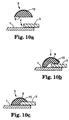
- the manner in which the strip 5 is used is illustrated in Figs. 10 a , 10 b and 10 c and will be described below.
- the strip 5 (with the release liner 8 omitted) is shown in greater detail in Fig. 3, with a slightly different cross-section. It can be seen that, in this case, the outer surface 6 of the strip is not completely curved but has a flattened central section 6 a , although that is not essential.
- the strip comprises a tacky sealing material 9 (for example a butyl rubber), providing a flat inner surface 7 which will adhere to the door panels 1, 2, and a comparatively-thin outer layer 10 of a non-tacky, harder material (for example polyurethane) providing the outer surface 6.
- a tacky sealing material 9 for example a butyl rubber
- a non-tacky, harder material for example polyurethane
- the layer 10 extends completely across the outer surface 6 of the strip 5, that is from the junction with the flat surface 7 on one side to the junction with the flat surface on the other side, and in some cases may even extend further than the flat surface 7 so that it projects slightly on both sides of the strip.
- the strip 5 has a width of about 10mm and a maximum height of about 2mm; the width of the flattened section 6a of the outer surface is about 4mm, and the layer 10 has a thickness in the range of from about 0.1 to 1.0mm.
- the strip may be formed by coextruding the sealing material 9 and the outer layer 10 on to the release liner 8 (Fig. 2), with the extrudate then being forcibly cooled or allowed to cool naturally.
- the strip 5 To use the strip 5, it is simply peeled from the release liner 8, positioned at the region 4 of the hem flange along the edge 3 of the outer panel 2 as illustrated in Fig. 10 a and then pressed into place as indicated in Fig. 10 b so that the material 9 seals against both the inner and the outer panels 1, 2 while the outer layer 10 extends from the surface of the inner panel 1 of the door to the surface of the outer panel 2, as shown in Fig. 10 c, and covers the sealing material.
- the outer layer 10 on the strip being comparatively hard, is not deformed when the strip is pressed into place but retains its uniform appearance along the length of the hem flange.
- the seal 5 is then immediately ready for the next stage of the repair process (for example, painting).
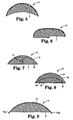
- FIG. 4 to 9 Alternative shapes for the cross-section of the strip 5 are shown in Figs. 4 to 9, with the release liner 8 being omitted from Figs. 4 to 7 and 9, but included in Fig. 8.
- the dimensions of the strip are similar to those given above for the strip shown in Fig. 3.
- Corresponding parts of the strips carry the same reference numerals.
- the shape shown in Fig. 4 is generally similar to that shown in Fig. 3 but the flattened central section 6 a of the outer layer 10 is extended, for example to a width of about 6mm.
- the cross-section shown in Fig. 5 is similar to that shown in Fig. 2 except that the inner surface 7 is concave rather than flat, while the cross-section shown in Fig. 6 is similar to that shown in Fig. 4 except that the inner surface 7 is stepped to match the profile of the hem flange.
- Fig. 7 shows the cross-section of a strip which is similar to that shown in Fig. 2 but in which the outer layer 10 extends into the sealing material 9 in the central region of the strip to form a strengthening rib 11.
- the rib 11 does not extend to the inner surface 7 of the strip (typically, the height of the rib is about 1.5mm) and so will not prevent the strip being pressed into place on the hem flange: however, the rib does give a harder feel to the strip and reduces the risk that the sealing material 9 will extend beyond the edges of the outer layer 10 when the strip is being pressed into place.
- the outer layer 10 takes the form of an outer strip of polyurethane or a similar, comparatively-hard, non-tacky, material, having a curved outer surface 14 and a concave inner surface 15, the latter containing the sealing material 9 which is covered by the release liner 8. As shown in Fig. 8, the outer layer 10 extends beyond, and so completely covers, the sealing material 9.
- the sealing strip shown in Fig. 8 could be formed by co-extrusion of the outer layer 10 and the sealing material 9, it could also be assembled by applying the sealing material 9 in a separate operation to a preformed outer strip 10 using, for examples an extrusion device. That assembly operation could be carried out by the manufacturer or by the end user.
- Fig. 9 shows a sealing strip which is generally similar in cross-section to that shown in Fig. 2 except that, in this case also, the outer layer 10 extends beyond the sealing material 9.
- the inner surface of the layer 10 is tacky to ensure that the extended edges 10 a of the layer 10 adhere to the surfaces to which they are applied. It will be appreciated that the outer layer 10 of any of the strips shown in Figs. 3 to 7 could have similarly-extended edges 10 a .
- the preformed strips 5 shown in Figs. 4 to 9 are all applied to a hem flange in the same way as the strip shown in Fig. 2, that is: the release liner 8 (not shown in Figs. 4 to 7 and 9) is removed, the strip 5 is positioned at the region 4 of the hem flange along the edge 3 of the outer panel 2 of the vehicle door as illustrated in Fig 10 a , and is then pressed into place as indicated in Fig. 10 b .
- the material 9 seals against both the inner and outer panels 1, 2 of the vehicle door and is covered by the outer layer 10 of the strip, which still has its original rounded shape (at least substantially) and extends from the inner panel 1 to the outer panel 2, as shown in Fig. 10 c .
- the seal can then be handled immediately.
- the outer layer 10 of the strip 5 actually touches the surface of the inner panel 1 at one side and the surface of the outer panel 2 at the other side so that it extends continuously from one surface to the other.
- Such a gap may be covered by any coating, for example paint, that is subsequently applied over the strip.
- the sealing material 9 and the outer layer 10 could be supplied, and applied to a hem flange, as separate components (the sealing material being supplied in strip form on a release liner). A hem flange would then be sealed by applying the sealing material to the region 4 of the hem flange along the edge 3 of the outer panel 2, removing the liner, and then applying the outer layer 10 to the sealing material.
- the finished seal would be the same as that achieved using the preformed strip 5 shown in Fig. 8.
- the sealing material 9 of the strip 5 is tacky and does not normally require an adhesive to secure it to the panels 1, 2, it is possible to use an adhesive if preferred.
- the adhesive could be coated onto the inner surface 7 of the strip as the latter is being formed on the release liner 8 (Fig. 2) or it could be coated onto the region 4 of the hem flange before the strip is applied to the flange.
- Any suitable adhesive could be used (including, for example, a hot-melt adhesive), and in this case the inner surface 7 of the strip is preferably stepped as shown in Fig. 6 to match the profile of the hem flange.
- the strip could be formed completely from a thermoplastics material and would be secured to the hem flange by first applying heat to the inner surface of the strip so that it melts and then pressing the molten surface against the hem flange.
- suitable alternative materials to the butyl rubber mentioned above include polysulphide, polychloroprene, silicone and acrylic rubbers.
- the tacky sealing material could be one that does not remain tacky but will cure, for example in response to applied heat, radiation or moisture, after it has been pressed into place on the hem flange.
- Suitable thermosetting materials include blocked polyurethane, and blocked isocyanates and epoxies;
- suitable radiation-curable materials include acrylates, epoxies and acrylate hybrids, and suitable moisture-curable materials include isocyanates and alkoxysilanes.
- Suitable alternative materials to polyurethanes for the outer part 10 of the sealing strip include polyolefins (for example, polyethylene and polypropylene) and polyvinyl resins.
- the rounded outer surface of the strip 5 should substantially maintain its rounded shape when subjected to manual pressure (for example when being pressed into place over a joint) or should substantially revert to that rounded shape when the manual pressure is released.
- the strip 5 has an outer layer 10 that extends beyond the sealing material 9 as shown in Figs. 8 and 9, the extended edges of the outer layer may deflect slightly when the strip is pressed over a joint, although the generally rounded shape of the outer layer should be maintained. It is desirable to be able to reposition the strip when it is being applied but also desirable that the adhesion of the strip to the panels 1, 2 should become permanent once the strip is in place. It is also desirable that the final seal should be able to withstand temperatures over at least the range -30° C to +90° C.
- the outer surface of the part 10 of the sealing strip could be textured, if desired.
- sealing strips described are not restricted to that location or, indeed, to use on hem flanges.
- the sealing strips could, if appropriate, be used for any similar sealing job in any location, for example the sealing of a lapped joint or any other joint between two adjacent, generally parallel, panels or surfaces.
- the various shapes described for the sealing strips can be modified to suit the locations in which they are to be used.
- Each of the sealing strips 5 described above with reference to the drawings enables a hem flange to be sealed quickly and easily, and can be handled as soon as it has been applied. Sealing strips of the type described can be applied satisfactorily, without puckering, even when the line of the hem flange is curved (for example, at the top of a vehicle door). The resulting seal is effective in that it provides good corrosion resistance, and is uniform in appearance. Moreover, although the above description refers to the sealing strips being used in the repair of vehicles ( in which case the shape of a sealing strip can be selected so that the finished seal will closely resemble the original) they could also be used to seal the hem flanges of new vehicles.
- the paint applied over the seal will generally be one that cures at a comparatively low baking temperature (typically a temperature of about 60 to 80°C) and the sealing strip used should be able to withstand at least such a temperature.
- a paint with a higher bake temperature typically a temperature of about 140°C would be used and a sealing strip that can withstand those higher temperatures would be required.
Landscapes
- Engineering & Computer Science (AREA)
- Mechanical Engineering (AREA)
- General Engineering & Computer Science (AREA)
- Seal Device For Vehicle (AREA)
- Sealing Material Composition (AREA)
- Flanged Joints, Insulating Joints, And Other Joints (AREA)
- Building Environments (AREA)
- Gasket Seals (AREA)
Applications Claiming Priority (3)
| Application Number | Priority Date | Filing Date | Title |
|---|---|---|---|
| US08/492,596 US5730446A (en) | 1995-06-20 | 1995-06-20 | Sealing strip suitable for sealing a hem flange |
| US492596 | 1995-06-20 | ||
| PCT/US1996/009900 WO1997001052A1 (en) | 1995-06-20 | 1996-06-11 | Sealing strip suitable for sealing a hem flange |
Publications (2)
| Publication Number | Publication Date |
|---|---|
| EP0830530A1 EP0830530A1 (en) | 1998-03-25 |
| EP0830530B1 true EP0830530B1 (en) | 2000-08-16 |
Family
ID=23956864
Family Applications (1)
| Application Number | Title | Priority Date | Filing Date |
|---|---|---|---|
| EP96918423A Expired - Lifetime EP0830530B1 (en) | 1995-06-20 | 1996-06-11 | Sealing strip suitable for sealing a hem flange |
Country Status (9)
| Country | Link |
|---|---|
| US (1) | US5730446A (enExample) |
| EP (1) | EP0830530B1 (enExample) |
| JP (1) | JPH11508349A (enExample) |
| KR (1) | KR100440516B1 (enExample) |
| AU (1) | AU699209B2 (enExample) |
| BR (1) | BR9608620A (enExample) |
| DE (1) | DE69609833T2 (enExample) |
| ES (1) | ES2149483T3 (enExample) |
| WO (1) | WO1997001052A1 (enExample) |
Cited By (2)
| Publication number | Priority date | Publication date | Assignee | Title |
|---|---|---|---|---|
| DE102016220237A1 (de) | 2016-10-17 | 2018-04-19 | Tesa Se | Verfahren zur Herstellung einer versiegelten Falzverbindung |
| US11440077B2 (en) | 2018-08-16 | 2022-09-13 | Tesa Se | Method for producing a sealed folded connection |
Families Citing this family (38)
| Publication number | Priority date | Publication date | Assignee | Title |
|---|---|---|---|---|
| MY120112A (en) | 1996-04-02 | 2005-09-30 | Meguro Chemical Industry Co Ltd | Sealing tape and method and apparatus for its production, and method of repairs with it |
| US6073938A (en) * | 1997-11-06 | 2000-06-13 | Kokusan Parts Industry Co., Ltd. | Sealing structure |
| US5938375A (en) * | 1997-12-17 | 1999-08-17 | Sevonson Environmental Services, Inc. | Method of sealing joints between adjacent sheet piling sections to form a continuous barrier and barriers formed using said method |
| US6115979A (en) * | 1998-04-02 | 2000-09-12 | Horstketter; Eugene A. | Grout sealing apparatus for concrete panels, decks, and support beams and methods for their manufacture |
| US6000118A (en) * | 1998-10-30 | 1999-12-14 | Chrysler Corporation | Method of forming a sealed edge joint between two metal panels |
| US6428081B1 (en) * | 1999-04-28 | 2002-08-06 | Cadillac Products, Inc. | Water shield having integrated wiring |
| WO2001029457A1 (en) * | 1999-10-15 | 2001-04-26 | Siemens Canada Limited | Method to create a hot melt form for use with an air induction assembly |
| US6787221B2 (en) | 2000-03-24 | 2004-09-07 | Chemque Incorporated | Co-dispensed compositions for gaskets and other objects |
| AU2001244003A1 (en) * | 2000-03-24 | 2001-10-03 | Chemque, Inc. | Gasket, method of manufacturing and apparatus for manufacturing same |
| JP4618620B2 (ja) * | 2000-05-19 | 2011-01-26 | 日本発條株式会社 | ハードディスクドライブケースの筺体と蓋体との間のシーリング構造 |
| US6368008B1 (en) | 2000-05-24 | 2002-04-09 | Daimlerchrysler Corporation | Sealed edge joint between two metal panels |
| US20060032163A1 (en) * | 2000-06-09 | 2006-02-16 | Doris Korn | Gap seal for building structures |
| US6948287B2 (en) * | 2000-06-09 | 2005-09-27 | Doris Korn | Gap seal on a building structure |
| GB0018174D0 (en) * | 2000-07-26 | 2000-09-13 | Jevtec Limited | Sealant bead |
| EP1556272B1 (de) * | 2002-10-31 | 2008-11-05 | ThyssenKrupp Drauz Nothelfer GmbH | Dachmodul fur eine kfz-karosserie |
| FR2851193B1 (fr) * | 2003-02-17 | 2006-08-04 | Hutchinson | Procede de fabrication d'un joint d'etancheite de type adhesive, en particulier pour l'industrie automobile |
| US20050023772A1 (en) * | 2003-07-28 | 2005-02-03 | Gary England | Shaped sealing gasket |
| US7690527B2 (en) * | 2003-07-28 | 2010-04-06 | Gary Englund | Shaped sealing gasket |
| US8088480B2 (en) | 2003-09-29 | 2012-01-03 | Shieldmark, Inc. | Adhesive tape |
| DE102005017744B4 (de) * | 2005-04-12 | 2011-05-19 | Süddeutsche Aluminium Manufaktur GmbH | Verwendung eines Sichtteils eines Kraftfahrzeugaußenteils |
| CN104893609A (zh) * | 2005-04-22 | 2015-09-09 | 因赛特解决方案有限责任公司 | 地面标示胶带 |
| JP4602280B2 (ja) * | 2006-04-03 | 2010-12-22 | 市光工業株式会社 | 車両用部品およびシール部材 |
| JP4367477B2 (ja) * | 2006-10-30 | 2009-11-18 | トヨタ自動車株式会社 | 燃料電池 |
| DE202007008718U1 (de) * | 2007-06-19 | 2008-10-30 | Rehau Ag + Co. | Magnetband |
| GB2455292A (en) | 2007-12-03 | 2009-06-10 | Zephyros Inc | Improvements in or relating to the production of joints |
| US9783999B2 (en) | 2009-07-27 | 2017-10-10 | Gregory A Amundson | Flexible corner trim product |
| US8895132B2 (en) | 2010-01-05 | 2014-11-25 | Volvo Group North America, Llc | Hemmed panel |
| DE102011083932A1 (de) * | 2011-09-30 | 2013-04-04 | Bayerische Motoren Werke Aktiengesellschaft | Abdichtungseinrichtung für eine Rohbauöffnung einer Klappe, insbesondere einer Heckklappe eines Kraftfahrzeugs |
| US9126547B2 (en) * | 2011-12-21 | 2015-09-08 | Honda Motor Co., Ltd. | Cover structure of vehicle body outer panel coupling part |
| GB201201943D0 (en) | 2012-02-03 | 2012-03-21 | Zephyros Inc | Improvements in or relating to the production of joints |
| GB201207511D0 (en) * | 2012-04-30 | 2012-06-13 | Airbus Operations Ltd | Bush assembly |
| US9765960B2 (en) | 2015-08-31 | 2017-09-19 | Gregory A. Amundson | Inside corner trim product |
| ES2887114T5 (en) | 2016-05-12 | 2025-03-05 | 3M Innovative Properties Company | Structural adhesive film |
| US10294715B1 (en) * | 2018-01-02 | 2019-05-21 | Diana L. Hertel | Methods of forming a temporary seal for flood protection |
| CN110762049B (zh) * | 2019-12-03 | 2021-03-09 | 长沙三昌泵业有限公司 | 一种水泵填料压盖 |
| US10895104B1 (en) | 2020-02-11 | 2021-01-19 | Diana L. Hertel | Device for forming a temporary seal for flood protection |
| BE1028848B1 (nl) * | 2020-12-01 | 2022-07-05 | Bashkim Krasniqi | Werkwijze voor het afdichten van een naad in een voertuigcarrosserie en bijhorend afdichtmiddel |
| JP7768821B2 (ja) * | 2022-04-11 | 2025-11-12 | 矢崎総業株式会社 | 成形品の製造方法 |
Family Cites Families (14)
| Publication number | Priority date | Publication date | Assignee | Title |
|---|---|---|---|---|
| US1417487A (en) * | 1921-03-21 | 1922-05-30 | Fed Cement Tile Company | Roof structure |
| US1605573A (en) * | 1925-03-06 | 1926-11-02 | James H Stedman | Building element |
| US3401486A (en) * | 1966-05-16 | 1968-09-17 | U S Products Dev | Ornamental and protective molding for motor vehicle doors |
| BE792210A (fr) * | 1971-12-03 | 1973-06-01 | Inmont Corp | Perfectionnements aux procedes, dispositifs et compositions pour la realisation de joints etanches |
| US3872548A (en) * | 1971-12-03 | 1975-03-25 | Inmont Corp | Sealant |
| FR2275707A1 (fr) * | 1974-06-20 | 1976-01-16 | Silvatrim Sa | Profile couvre-joint a garniture etanche et adhesive |
| JPS5225317A (en) * | 1975-08-15 | 1977-02-25 | Toyota Motor Corp | Method and apparatus for forming seam of outer body |
| GB2024294B (en) * | 1978-06-30 | 1982-11-17 | Draftex Dev Ag | Channel-shaped sealing |
| DE3238651C2 (de) * | 1982-10-19 | 1985-07-18 | Volkswagenwerk Ag, 3180 Wolfsburg | Verfahren zum Herstellen einer dichten Falzverbindung |
| JPS59172018U (ja) * | 1983-05-02 | 1984-11-17 | 本田技研工業株式会社 | 自動車のドア |
| US4654250A (en) * | 1985-03-18 | 1987-03-31 | Black Robert J | Composite caulking |
| US4629648A (en) * | 1985-10-01 | 1986-12-16 | Minnesota Mining And Manufacturing Co. | Extruded caulk strip |
| US4888919A (en) * | 1989-01-12 | 1989-12-26 | Ford Motor Company | Closure panel for automative bodies |
| JPH0495590A (ja) * | 1990-08-11 | 1992-03-27 | Daihatsu Motor Co Ltd | せぎり接合部構造 |
-
1995
- 1995-06-20 US US08/492,596 patent/US5730446A/en not_active Expired - Lifetime
-
1996
- 1996-06-11 ES ES96918423T patent/ES2149483T3/es not_active Expired - Lifetime
- 1996-06-11 EP EP96918423A patent/EP0830530B1/en not_active Expired - Lifetime
- 1996-06-11 AU AU61092/96A patent/AU699209B2/en not_active Ceased
- 1996-06-11 KR KR1019970709479A patent/KR100440516B1/ko not_active Expired - Fee Related
- 1996-06-11 WO PCT/US1996/009900 patent/WO1997001052A1/en not_active Ceased
- 1996-06-11 JP JP9503868A patent/JPH11508349A/ja not_active Withdrawn
- 1996-06-11 BR BR9608620A patent/BR9608620A/pt not_active Application Discontinuation
- 1996-06-11 DE DE69609833T patent/DE69609833T2/de not_active Expired - Fee Related
Cited By (4)
| Publication number | Priority date | Publication date | Assignee | Title |
|---|---|---|---|---|
| DE102016220237A1 (de) | 2016-10-17 | 2018-04-19 | Tesa Se | Verfahren zur Herstellung einer versiegelten Falzverbindung |
| WO2018073140A2 (de) | 2016-10-17 | 2018-04-26 | Tesa Se | Verfahren zur herstellung einer versiegelten falzverbindung |
| US11148407B2 (en) | 2016-10-17 | 2021-10-19 | Tesa Se | Method for producing a sealed folded joint |
| US11440077B2 (en) | 2018-08-16 | 2022-09-13 | Tesa Se | Method for producing a sealed folded connection |
Also Published As
| Publication number | Publication date |
|---|---|
| DE69609833T2 (de) | 2000-12-21 |
| DE69609833D1 (de) | 2000-09-21 |
| AU699209B2 (en) | 1998-11-26 |
| KR19990023009A (ko) | 1999-03-25 |
| WO1997001052A1 (en) | 1997-01-09 |
| JPH11508349A (ja) | 1999-07-21 |
| AU6109296A (en) | 1997-01-22 |
| BR9608620A (pt) | 1999-06-15 |
| EP0830530A1 (en) | 1998-03-25 |
| ES2149483T3 (es) | 2000-11-01 |
| MX9710205A (es) | 1998-03-29 |
| KR100440516B1 (ko) | 2004-09-30 |
| US5730446A (en) | 1998-03-24 |
Similar Documents
| Publication | Publication Date | Title |
|---|---|---|
| EP0830530B1 (en) | Sealing strip suitable for sealing a hem flange | |
| EP0745000B1 (en) | A sealing strip and method of sealing | |
| JP5792618B2 (ja) | 接着剤ビーズまたはプロットでの接合 | |
| RU2646182C2 (ru) | Способ изготовления шва с отбортовкой кромок | |
| EP0390568B1 (en) | Covered welt for vehicle | |
| CZ282782B6 (cs) | Způsob provedení lepeného spoje u dílů spojených záhybem | |
| US6243990B1 (en) | Connecting element with an extruded seal | |
| GB2024294A (en) | Improvements in and relating to channel-shaped sealing strips | |
| US5871835A (en) | Cellular material strip | |
| CN104603475A (zh) | 用于形成凸形接缝的方法 | |
| US20160288735A1 (en) | Exterior assembly and method for coupling an exterior assembly to a vehicular frame | |
| US20060162257A1 (en) | Weather strip for motor vehicle | |
| EP0613934A1 (de) | Abdeckband, insbes. für Lackierarbeiten im Bereich von Diechtelementen für Fenstereinfawsungen und Karosseriebauteilen an Kraftfahrzeugen oder dergleichen | |
| CA2156037A1 (en) | Sealing strip suitable for sealing a hem flange | |
| MXPA97010205A (en) | Right hermetic tape to seal a ribete rebor | |
| EP1582783B1 (en) | Sealing tape | |
| US5968298A (en) | Automobile roof repair method | |
| KR100498080B1 (ko) | 실링테이프와,이것의제조방법및장치와,이실링테이프를이용한보수방법 | |
| JP3275028B2 (ja) | シーリングテープ及びシーリングテープを使用した自動車ボデー内側部分の補修方法 | |
| JP4229247B2 (ja) | ルーフモール及びその塗装方法 | |
| JP4120115B2 (ja) | バス天井部のシール方法 | |
| GB2287046A (en) | Jointing system for gutter | |
| EP0460586A1 (en) | Paintable vehicle sealer patch | |
| JPH07215140A (ja) | パネルの被覆構造およびその被覆方法 | |
| JPH08145180A (ja) | シーリングテープ |
Legal Events
| Date | Code | Title | Description |
|---|---|---|---|
| PUAI | Public reference made under article 153(3) epc to a published international application that has entered the european phase |
Free format text: ORIGINAL CODE: 0009012 |
|
| 17P | Request for examination filed |
Effective date: 19980115 |
|
| AK | Designated contracting states |
Kind code of ref document: A1 Designated state(s): DE ES FR GB IT |
|
| 17Q | First examination report despatched |
Effective date: 19981119 |
|
| GRAG | Despatch of communication of intention to grant |
Free format text: ORIGINAL CODE: EPIDOS AGRA |
|
| GRAG | Despatch of communication of intention to grant |
Free format text: ORIGINAL CODE: EPIDOS AGRA |
|
| GRAG | Despatch of communication of intention to grant |
Free format text: ORIGINAL CODE: EPIDOS AGRA |
|
| GRAH | Despatch of communication of intention to grant a patent |
Free format text: ORIGINAL CODE: EPIDOS IGRA |
|
| GRAH | Despatch of communication of intention to grant a patent |
Free format text: ORIGINAL CODE: EPIDOS IGRA |
|
| GRAA | (expected) grant |
Free format text: ORIGINAL CODE: 0009210 |
|
| AK | Designated contracting states |
Kind code of ref document: B1 Designated state(s): DE ES FR GB IT |
|
| REF | Corresponds to: |
Ref document number: 69609833 Country of ref document: DE Date of ref document: 20000921 |
|
| ET | Fr: translation filed | ||
| REG | Reference to a national code |
Ref country code: ES Ref legal event code: FG2A Ref document number: 2149483 Country of ref document: ES Kind code of ref document: T3 |
|
| ITF | It: translation for a ep patent filed | ||
| PG25 | Lapsed in a contracting state [announced via postgrant information from national office to epo] |
Ref country code: ES Free format text: LAPSE BECAUSE OF NON-PAYMENT OF DUE FEES Effective date: 20010612 |
|
| PLBE | No opposition filed within time limit |
Free format text: ORIGINAL CODE: 0009261 |
|
| STAA | Information on the status of an ep patent application or granted ep patent |
Free format text: STATUS: NO OPPOSITION FILED WITHIN TIME LIMIT |
|
| 26N | No opposition filed | ||
| REG | Reference to a national code |
Ref country code: GB Ref legal event code: IF02 |
|
| REG | Reference to a national code |
Ref country code: ES Ref legal event code: FD2A Effective date: 20020711 |
|
| PGFP | Annual fee paid to national office [announced via postgrant information from national office to epo] |
Ref country code: GB Payment date: 20050608 Year of fee payment: 10 |
|
| PG25 | Lapsed in a contracting state [announced via postgrant information from national office to epo] |
Ref country code: IT Free format text: LAPSE BECAUSE OF NON-PAYMENT OF DUE FEES Effective date: 20050611 |
|
| PGFP | Annual fee paid to national office [announced via postgrant information from national office to epo] |
Ref country code: FR Payment date: 20050617 Year of fee payment: 10 |
|
| PGFP | Annual fee paid to national office [announced via postgrant information from national office to epo] |
Ref country code: DE Payment date: 20050801 Year of fee payment: 10 |
|
| PG25 | Lapsed in a contracting state [announced via postgrant information from national office to epo] |
Ref country code: GB Free format text: LAPSE BECAUSE OF NON-PAYMENT OF DUE FEES Effective date: 20060611 |
|
| PG25 | Lapsed in a contracting state [announced via postgrant information from national office to epo] |
Ref country code: DE Free format text: LAPSE BECAUSE OF NON-PAYMENT OF DUE FEES Effective date: 20070103 |
|
| GBPC | Gb: european patent ceased through non-payment of renewal fee |
Effective date: 20060611 |
|
| REG | Reference to a national code |
Ref country code: FR Ref legal event code: ST Effective date: 20070228 |
|
| PG25 | Lapsed in a contracting state [announced via postgrant information from national office to epo] |
Ref country code: FR Free format text: LAPSE BECAUSE OF NON-PAYMENT OF DUE FEES Effective date: 20060630 |