EP0826775B1 - Vektoren zur konditionalen Genexpression - Google Patents
Vektoren zur konditionalen Genexpression Download PDFInfo
- Publication number
- EP0826775B1 EP0826775B1 EP97114569A EP97114569A EP0826775B1 EP 0826775 B1 EP0826775 B1 EP 0826775B1 EP 97114569 A EP97114569 A EP 97114569A EP 97114569 A EP97114569 A EP 97114569A EP 0826775 B1 EP0826775 B1 EP 0826775B1
- Authority
- EP
- European Patent Office
- Prior art keywords
- tta
- vector
- promoter
- cells
- gene
- Prior art date
- Legal status (The legal status is an assumption and is not a legal conclusion. Google has not performed a legal analysis and makes no representation as to the accuracy of the status listed.)
- Expired - Lifetime
Links
- 239000013598 vector Substances 0.000 title claims abstract description 103
- 230000014509 gene expression Effects 0.000 title claims abstract description 60
- 108090000623 proteins and genes Proteins 0.000 claims abstract description 55
- 108091023040 Transcription factor Proteins 0.000 claims abstract description 52
- 102000040945 Transcription factor Human genes 0.000 claims abstract description 51
- 101150024821 tetO gene Proteins 0.000 claims abstract description 18
- 239000004098 Tetracycline Substances 0.000 claims abstract description 17
- 235000019364 tetracycline Nutrition 0.000 claims abstract description 17
- 210000003527 eukaryotic cell Anatomy 0.000 claims abstract description 16
- 229960002180 tetracycline Drugs 0.000 claims abstract description 16
- 229930101283 tetracycline Natural products 0.000 claims abstract description 16
- 150000003522 tetracyclines Chemical class 0.000 claims abstract description 15
- 238000013518 transcription Methods 0.000 claims abstract description 13
- 230000035897 transcription Effects 0.000 claims abstract description 13
- 230000010502 episomal replication Effects 0.000 claims abstract description 12
- 229920001184 polypeptide Polymers 0.000 claims abstract description 10
- 102000004196 processed proteins & peptides Human genes 0.000 claims abstract description 10
- 108090000765 processed proteins & peptides Proteins 0.000 claims abstract description 10
- 108700020534 tetracycline resistance-encoding transposon repressor Proteins 0.000 claims abstract description 10
- 230000008488 polyadenylation Effects 0.000 claims abstract description 9
- 239000002245 particle Substances 0.000 claims abstract description 8
- 230000003362 replicative effect Effects 0.000 claims abstract description 7
- 108020004414 DNA Proteins 0.000 claims abstract description 6
- 239000003550 marker Substances 0.000 claims abstract description 4
- 102000053602 DNA Human genes 0.000 claims abstract description 3
- 210000001236 prokaryotic cell Anatomy 0.000 claims abstract 4
- 210000004027 cell Anatomy 0.000 claims description 74
- 102000040430 polynucleotide Human genes 0.000 claims description 23
- 108091033319 polynucleotide Proteins 0.000 claims description 23
- 239000002157 polynucleotide Substances 0.000 claims description 23
- 102000004169 proteins and genes Human genes 0.000 claims description 20
- 238000000034 method Methods 0.000 claims description 12
- 241000206602 Eukaryota Species 0.000 claims description 10
- 210000003719 b-lymphocyte Anatomy 0.000 claims description 10
- 230000010076 replication Effects 0.000 claims description 10
- 101150113929 EBNA2 gene Proteins 0.000 claims description 9
- 230000027455 binding Effects 0.000 claims description 9
- 101150059079 EBNA1 gene Proteins 0.000 claims description 8
- 101710135898 Myc proto-oncogene protein Proteins 0.000 claims description 8
- 102100038895 Myc proto-oncogene protein Human genes 0.000 claims description 8
- 101710150448 Transcriptional regulator Myc Proteins 0.000 claims description 8
- 230000003612 virological effect Effects 0.000 claims description 8
- 239000012190 activator Substances 0.000 claims description 7
- YQYJSBFKSSDGFO-UHFFFAOYSA-N Epihygromycin Natural products OC1C(O)C(C(=O)C)OC1OC(C(=C1)O)=CC=C1C=C(C)C(=O)NC1C(O)C(O)C2OCOC2C1O YQYJSBFKSSDGFO-UHFFFAOYSA-N 0.000 claims description 6
- 230000002101 lytic effect Effects 0.000 claims description 6
- 238000001890 transfection Methods 0.000 claims description 6
- 238000004806 packaging method and process Methods 0.000 claims description 5
- 101710094648 Coat protein Proteins 0.000 claims description 4
- 206010028980 Neoplasm Diseases 0.000 claims description 4
- 230000003993 interaction Effects 0.000 claims description 4
- 230000008569 process Effects 0.000 claims description 4
- 239000000427 antigen Substances 0.000 claims description 3
- 108091007433 antigens Proteins 0.000 claims description 3
- 102000036639 antigens Human genes 0.000 claims description 3
- 108020001507 fusion proteins Proteins 0.000 claims description 3
- 102000037865 fusion proteins Human genes 0.000 claims description 3
- 230000006698 induction Effects 0.000 claims description 3
- 230000001052 transient effect Effects 0.000 claims description 3
- 108010077805 Bacterial Proteins Proteins 0.000 claims description 2
- 102100032768 Complement receptor type 2 Human genes 0.000 claims description 2
- 102000004190 Enzymes Human genes 0.000 claims description 2
- 108090000790 Enzymes Proteins 0.000 claims description 2
- 101000941929 Homo sapiens Complement receptor type 2 Proteins 0.000 claims description 2
- ONIBWKKTOPOVIA-BYPYZUCNSA-N L-Proline Chemical compound OC(=O)[C@@H]1CCCN1 ONIBWKKTOPOVIA-BYPYZUCNSA-N 0.000 claims description 2
- 229930193140 Neomycin Natural products 0.000 claims description 2
- 108700020796 Oncogene Proteins 0.000 claims description 2
- 102000043276 Oncogene Human genes 0.000 claims description 2
- ONIBWKKTOPOVIA-UHFFFAOYSA-N Proline Natural products OC(=O)C1CCCN1 ONIBWKKTOPOVIA-UHFFFAOYSA-N 0.000 claims description 2
- MTCFGRXMJLQNBG-UHFFFAOYSA-N Serine Natural products OCC(N)C(O)=O MTCFGRXMJLQNBG-UHFFFAOYSA-N 0.000 claims description 2
- 102000006467 TATA-Box Binding Protein Human genes 0.000 claims description 2
- 108010044281 TATA-Box Binding Protein Proteins 0.000 claims description 2
- AYFVYJQAPQTCCC-UHFFFAOYSA-N Threonine Natural products CC(O)C(N)C(O)=O AYFVYJQAPQTCCC-UHFFFAOYSA-N 0.000 claims description 2
- 239000004473 Threonine Substances 0.000 claims description 2
- HCHKCACWOHOZIP-UHFFFAOYSA-N Zinc Chemical compound [Zn] HCHKCACWOHOZIP-UHFFFAOYSA-N 0.000 claims description 2
- 230000002378 acidificating effect Effects 0.000 claims description 2
- 230000001413 cellular effect Effects 0.000 claims description 2
- ZDXPYRJPNDTMRX-UHFFFAOYSA-N glutamine Natural products OC(=O)C(N)CCC(N)=O ZDXPYRJPNDTMRX-UHFFFAOYSA-N 0.000 claims description 2
- 208000015181 infectious disease Diseases 0.000 claims description 2
- 229960004927 neomycin Drugs 0.000 claims description 2
- 210000004881 tumor cell Anatomy 0.000 claims description 2
- 210000004602 germ cell Anatomy 0.000 claims 2
- 238000000338 in vitro Methods 0.000 claims 2
- 239000008194 pharmaceutical composition Substances 0.000 claims 2
- 239000006228 supernatant Substances 0.000 claims 2
- 208000009889 Herpes Simplex Diseases 0.000 claims 1
- 101150003725 TK gene Proteins 0.000 claims 1
- 230000001580 bacterial effect Effects 0.000 claims 1
- 238000003306 harvesting Methods 0.000 claims 1
- 230000011664 signaling Effects 0.000 claims 1
- 108091006106 transcriptional activators Proteins 0.000 claims 1
- 230000002463 transducing effect Effects 0.000 claims 1
- 241000701044 Human gammaherpesvirus 4 Species 0.000 abstract description 24
- 230000001419 dependent effect Effects 0.000 abstract description 7
- 108091028043 Nucleic acid sequence Proteins 0.000 abstract description 3
- 150000007523 nucleic acids Chemical group 0.000 abstract 3
- 230000000694 effects Effects 0.000 description 25
- 108060001084 Luciferase Proteins 0.000 description 16
- 239000013612 plasmid Substances 0.000 description 14
- 239000005089 Luciferase Substances 0.000 description 10
- 229940011871 estrogen Drugs 0.000 description 9
- 239000000262 estrogen Substances 0.000 description 9
- 238000002474 experimental method Methods 0.000 description 8
- 239000012634 fragment Substances 0.000 description 8
- 238000003146 transient transfection Methods 0.000 description 8
- 102100033479 RAF proto-oncogene serine/threonine-protein kinase Human genes 0.000 description 7
- 101710141955 RAF proto-oncogene serine/threonine-protein kinase Proteins 0.000 description 7
- 239000013604 expression vector Substances 0.000 description 7
- 239000006143 cell culture medium Substances 0.000 description 6
- 238000013461 design Methods 0.000 description 6
- 238000001262 western blot Methods 0.000 description 6
- 238000013459 approach Methods 0.000 description 5
- 239000000284 extract Substances 0.000 description 5
- 230000001105 regulatory effect Effects 0.000 description 5
- 108020005202 Viral DNA Proteins 0.000 description 4
- 230000033228 biological regulation Effects 0.000 description 4
- 230000010354 integration Effects 0.000 description 4
- 230000035755 proliferation Effects 0.000 description 4
- 108090000695 Cytokines Proteins 0.000 description 3
- 108700008625 Reporter Genes Proteins 0.000 description 3
- 238000010276 construction Methods 0.000 description 3
- 239000013613 expression plasmid Substances 0.000 description 3
- 230000004927 fusion Effects 0.000 description 3
- 229940088597 hormone Drugs 0.000 description 3
- 239000005556 hormone Substances 0.000 description 3
- 108700024542 myc Genes Proteins 0.000 description 3
- 108091008146 restriction endonucleases Proteins 0.000 description 3
- 230000010473 stable expression Effects 0.000 description 3
- 238000003153 stable transfection Methods 0.000 description 3
- 238000012360 testing method Methods 0.000 description 3
- 101150061166 tetR gene Proteins 0.000 description 3
- 238000012546 transfer Methods 0.000 description 3
- 208000011691 Burkitt lymphomas Diseases 0.000 description 2
- 108010077544 Chromatin Proteins 0.000 description 2
- 102000004127 Cytokines Human genes 0.000 description 2
- 230000010190 G1 phase Effects 0.000 description 2
- 101000882584 Homo sapiens Estrogen receptor Proteins 0.000 description 2
- 241000700584 Simplexvirus Species 0.000 description 2
- 241000700605 Viruses Species 0.000 description 2
- 230000004913 activation Effects 0.000 description 2
- 238000004113 cell culture Methods 0.000 description 2
- 210000003483 chromatin Anatomy 0.000 description 2
- 238000003776 cleavage reaction Methods 0.000 description 2
- 238000001514 detection method Methods 0.000 description 2
- 201000010099 disease Diseases 0.000 description 2
- 208000037265 diseases, disorders, signs and symptoms Diseases 0.000 description 2
- 229910001385 heavy metal Inorganic materials 0.000 description 2
- 230000001939 inductive effect Effects 0.000 description 2
- 150000002500 ions Chemical class 0.000 description 2
- 238000005259 measurement Methods 0.000 description 2
- 238000002703 mutagenesis Methods 0.000 description 2
- 231100000350 mutagenesis Toxicity 0.000 description 2
- 230000002829 reductive effect Effects 0.000 description 2
- 230000007017 scission Effects 0.000 description 2
- OFVLGDICTFRJMM-WESIUVDSSA-N tetracycline Chemical compound C1=CC=C2[C@](O)(C)[C@H]3C[C@H]4[C@H](N(C)C)C(O)=C(C(N)=O)C(=O)[C@@]4(O)C(O)=C3C(=O)C2=C1O OFVLGDICTFRJMM-WESIUVDSSA-N 0.000 description 2
- 108091032973 (ribonucleotides)n+m Proteins 0.000 description 1
- JKMHFZQWWAIEOD-UHFFFAOYSA-N 2-[4-(2-hydroxyethyl)piperazin-1-yl]ethanesulfonic acid Chemical compound OCC[NH+]1CCN(CCS([O-])(=O)=O)CC1 JKMHFZQWWAIEOD-UHFFFAOYSA-N 0.000 description 1
- 241000894006 Bacteria Species 0.000 description 1
- 241000283690 Bos taurus Species 0.000 description 1
- 108010035563 Chloramphenicol O-acetyltransferase Proteins 0.000 description 1
- 108091026890 Coding region Proteins 0.000 description 1
- 102000007644 Colony-Stimulating Factors Human genes 0.000 description 1
- 108010071942 Colony-Stimulating Factors Proteins 0.000 description 1
- 241000701022 Cytomegalovirus Species 0.000 description 1
- 230000004543 DNA replication Effects 0.000 description 1
- 230000004568 DNA-binding Effects 0.000 description 1
- 108010031111 EBV-encoded nuclear antigen 1 Proteins 0.000 description 1
- 241000409898 Empodisma minus Species 0.000 description 1
- 108700024394 Exon Proteins 0.000 description 1
- 241001295925 Gegenes Species 0.000 description 1
- 108700039691 Genetic Promoter Regions Proteins 0.000 description 1
- 241000282412 Homo Species 0.000 description 1
- 101001030211 Homo sapiens Myc proto-oncogene protein Proteins 0.000 description 1
- 108700002232 Immediate-Early Genes Proteins 0.000 description 1
- 102000014150 Interferons Human genes 0.000 description 1
- 108010050904 Interferons Proteins 0.000 description 1
- 102000015696 Interleukins Human genes 0.000 description 1
- 108010063738 Interleukins Proteins 0.000 description 1
- 108091092195 Intron Proteins 0.000 description 1
- ROHFNLRQFUQHCH-YFKPBYRVSA-N L-leucine Chemical compound CC(C)C[C@H](N)C(O)=O ROHFNLRQFUQHCH-YFKPBYRVSA-N 0.000 description 1
- 108010054278 Lac Repressors Proteins 0.000 description 1
- ROHFNLRQFUQHCH-UHFFFAOYSA-N Leucine Natural products CC(C)CC(N)C(O)=O ROHFNLRQFUQHCH-UHFFFAOYSA-N 0.000 description 1
- 102000008072 Lymphokines Human genes 0.000 description 1
- 108010074338 Lymphokines Proteins 0.000 description 1
- 206010025323 Lymphomas Diseases 0.000 description 1
- 241000713869 Moloney murine leukemia virus Species 0.000 description 1
- 101710150912 Myc protein Proteins 0.000 description 1
- 241001631646 Papillomaviridae Species 0.000 description 1
- 101710172711 Structural protein Proteins 0.000 description 1
- 102000006601 Thymidine Kinase Human genes 0.000 description 1
- 108020004440 Thymidine kinase Proteins 0.000 description 1
- 108010067390 Viral Proteins Proteins 0.000 description 1
- 230000006978 adaptation Effects 0.000 description 1
- 230000003321 amplification Effects 0.000 description 1
- 238000010171 animal model Methods 0.000 description 1
- 230000010455 autoregulation Effects 0.000 description 1
- 238000005460 biophysical method Methods 0.000 description 1
- 230000015572 biosynthetic process Effects 0.000 description 1
- 101150055766 cat gene Proteins 0.000 description 1
- 230000021164 cell adhesion Effects 0.000 description 1
- 238000010370 cell cloning Methods 0.000 description 1
- 230000022131 cell cycle Effects 0.000 description 1
- 229940047120 colony stimulating factors Drugs 0.000 description 1
- 239000002299 complementary DNA Substances 0.000 description 1
- 238000011161 development Methods 0.000 description 1
- 231100000673 dose–response relationship Toxicity 0.000 description 1
- 239000003623 enhancer Substances 0.000 description 1
- 238000001415 gene therapy Methods 0.000 description 1
- 239000003102 growth factor Substances 0.000 description 1
- 108091008039 hormone receptors Proteins 0.000 description 1
- 230000006872 improvement Effects 0.000 description 1
- 238000001727 in vivo Methods 0.000 description 1
- 230000002458 infectious effect Effects 0.000 description 1
- 238000003780 insertion Methods 0.000 description 1
- 230000037431 insertion Effects 0.000 description 1
- 238000002743 insertional mutagenesis Methods 0.000 description 1
- 229940047124 interferons Drugs 0.000 description 1
- 229940047122 interleukins Drugs 0.000 description 1
- 230000007774 longterm Effects 0.000 description 1
- 238000012423 maintenance Methods 0.000 description 1
- 230000003211 malignant effect Effects 0.000 description 1
- 238000004519 manufacturing process Methods 0.000 description 1
- 230000007246 mechanism Effects 0.000 description 1
- 230000001404 mediated effect Effects 0.000 description 1
- 230000011987 methylation Effects 0.000 description 1
- 238000007069 methylation reaction Methods 0.000 description 1
- 231100000957 no side effect Toxicity 0.000 description 1
- 238000003199 nucleic acid amplification method Methods 0.000 description 1
- 230000036961 partial effect Effects 0.000 description 1
- 239000013600 plasmid vector Substances 0.000 description 1
- 230000004983 pleiotropic effect Effects 0.000 description 1
- 230000023603 positive regulation of transcription initiation, DNA-dependent Effects 0.000 description 1
- 230000006798 recombination Effects 0.000 description 1
- 238000005215 recombination Methods 0.000 description 1
- 230000000284 resting effect Effects 0.000 description 1
- 230000000717 retained effect Effects 0.000 description 1
- 230000002441 reversible effect Effects 0.000 description 1
- 239000013605 shuttle vector Substances 0.000 description 1
- 230000008054 signal transmission Effects 0.000 description 1
- 239000000126 substance Substances 0.000 description 1
- 229940040944 tetracyclines Drugs 0.000 description 1
- 238000002560 therapeutic procedure Methods 0.000 description 1
- 230000002103 transcriptional effect Effects 0.000 description 1
- 241001529453 unidentified herpesvirus Species 0.000 description 1
- 241001430294 unidentified retrovirus Species 0.000 description 1
- 229910052725 zinc Inorganic materials 0.000 description 1
- 239000011701 zinc Substances 0.000 description 1
Images









Classifications
-
- C—CHEMISTRY; METALLURGY
- C12—BIOCHEMISTRY; BEER; SPIRITS; WINE; VINEGAR; MICROBIOLOGY; ENZYMOLOGY; MUTATION OR GENETIC ENGINEERING
- C12N—MICROORGANISMS OR ENZYMES; COMPOSITIONS THEREOF; PROPAGATING, PRESERVING, OR MAINTAINING MICROORGANISMS; MUTATION OR GENETIC ENGINEERING; CULTURE MEDIA
- C12N15/00—Mutation or genetic engineering; DNA or RNA concerning genetic engineering, vectors, e.g. plasmids, or their isolation, preparation or purification; Use of hosts therefor
- C12N15/09—Recombinant DNA-technology
- C12N15/63—Introduction of foreign genetic material using vectors; Vectors; Use of hosts therefor; Regulation of expression
- C12N15/79—Vectors or expression systems specially adapted for eukaryotic hosts
- C12N15/85—Vectors or expression systems specially adapted for eukaryotic hosts for animal cells
- C12N15/86—Viral vectors
-
- C—CHEMISTRY; METALLURGY
- C07—ORGANIC CHEMISTRY
- C07K—PEPTIDES
- C07K14/00—Peptides having more than 20 amino acids; Gastrins; Somatostatins; Melanotropins; Derivatives thereof
- C07K14/82—Translation products from oncogenes
-
- C—CHEMISTRY; METALLURGY
- C12—BIOCHEMISTRY; BEER; SPIRITS; WINE; VINEGAR; MICROBIOLOGY; ENZYMOLOGY; MUTATION OR GENETIC ENGINEERING
- C12N—MICROORGANISMS OR ENZYMES; COMPOSITIONS THEREOF; PROPAGATING, PRESERVING, OR MAINTAINING MICROORGANISMS; MUTATION OR GENETIC ENGINEERING; CULTURE MEDIA
- C12N15/00—Mutation or genetic engineering; DNA or RNA concerning genetic engineering, vectors, e.g. plasmids, or their isolation, preparation or purification; Use of hosts therefor
- C12N15/09—Recombinant DNA-technology
- C12N15/63—Introduction of foreign genetic material using vectors; Vectors; Use of hosts therefor; Regulation of expression
- C12N15/635—Externally inducible repressor mediated regulation of gene expression, e.g. tetR inducible by tetracyline
-
- C—CHEMISTRY; METALLURGY
- C12—BIOCHEMISTRY; BEER; SPIRITS; WINE; VINEGAR; MICROBIOLOGY; ENZYMOLOGY; MUTATION OR GENETIC ENGINEERING
- C12N—MICROORGANISMS OR ENZYMES; COMPOSITIONS THEREOF; PROPAGATING, PRESERVING, OR MAINTAINING MICROORGANISMS; MUTATION OR GENETIC ENGINEERING; CULTURE MEDIA
- C12N15/00—Mutation or genetic engineering; DNA or RNA concerning genetic engineering, vectors, e.g. plasmids, or their isolation, preparation or purification; Use of hosts therefor
- C12N15/09—Recombinant DNA-technology
- C12N15/63—Introduction of foreign genetic material using vectors; Vectors; Use of hosts therefor; Regulation of expression
- C12N15/79—Vectors or expression systems specially adapted for eukaryotic hosts
- C12N15/85—Vectors or expression systems specially adapted for eukaryotic hosts for animal cells
-
- C—CHEMISTRY; METALLURGY
- C07—ORGANIC CHEMISTRY
- C07K—PEPTIDES
- C07K2319/00—Fusion polypeptide
-
- C—CHEMISTRY; METALLURGY
- C12—BIOCHEMISTRY; BEER; SPIRITS; WINE; VINEGAR; MICROBIOLOGY; ENZYMOLOGY; MUTATION OR GENETIC ENGINEERING
- C12N—MICROORGANISMS OR ENZYMES; COMPOSITIONS THEREOF; PROPAGATING, PRESERVING, OR MAINTAINING MICROORGANISMS; MUTATION OR GENETIC ENGINEERING; CULTURE MEDIA
- C12N2710/00—MICROORGANISMS OR ENZYMES; COMPOSITIONS THEREOF; PROPAGATING, PRESERVING, OR MAINTAINING MICROORGANISMS; MUTATION OR GENETIC ENGINEERING; CULTURE MEDIA dsDNA viruses
- C12N2710/00011—Details
- C12N2710/16011—Herpesviridae
- C12N2710/16211—Lymphocryptovirus, e.g. human herpesvirus 4, Epstein-Barr Virus
- C12N2710/16241—Use of virus, viral particle or viral elements as a vector
- C12N2710/16243—Use of virus, viral particle or viral elements as a vector viral genome or elements thereof as genetic vector
-
- C—CHEMISTRY; METALLURGY
- C12—BIOCHEMISTRY; BEER; SPIRITS; WINE; VINEGAR; MICROBIOLOGY; ENZYMOLOGY; MUTATION OR GENETIC ENGINEERING
- C12N—MICROORGANISMS OR ENZYMES; COMPOSITIONS THEREOF; PROPAGATING, PRESERVING, OR MAINTAINING MICROORGANISMS; MUTATION OR GENETIC ENGINEERING; CULTURE MEDIA
- C12N2800/00—Nucleic acids vectors
- C12N2800/10—Plasmid DNA
- C12N2800/108—Plasmid DNA episomal vectors
-
- C—CHEMISTRY; METALLURGY
- C12—BIOCHEMISTRY; BEER; SPIRITS; WINE; VINEGAR; MICROBIOLOGY; ENZYMOLOGY; MUTATION OR GENETIC ENGINEERING
- C12N—MICROORGANISMS OR ENZYMES; COMPOSITIONS THEREOF; PROPAGATING, PRESERVING, OR MAINTAINING MICROORGANISMS; MUTATION OR GENETIC ENGINEERING; CULTURE MEDIA
- C12N2830/00—Vector systems having a special element relevant for transcription
- C12N2830/001—Vector systems having a special element relevant for transcription controllable enhancer/promoter combination
- C12N2830/002—Vector systems having a special element relevant for transcription controllable enhancer/promoter combination inducible enhancer/promoter combination, e.g. hypoxia, iron, transcription factor
- C12N2830/003—Vector systems having a special element relevant for transcription controllable enhancer/promoter combination inducible enhancer/promoter combination, e.g. hypoxia, iron, transcription factor tet inducible
-
- C—CHEMISTRY; METALLURGY
- C12—BIOCHEMISTRY; BEER; SPIRITS; WINE; VINEGAR; MICROBIOLOGY; ENZYMOLOGY; MUTATION OR GENETIC ENGINEERING
- C12N—MICROORGANISMS OR ENZYMES; COMPOSITIONS THEREOF; PROPAGATING, PRESERVING, OR MAINTAINING MICROORGANISMS; MUTATION OR GENETIC ENGINEERING; CULTURE MEDIA
- C12N2840/00—Vectors comprising a special translation-regulating system
- C12N2840/20—Vectors comprising a special translation-regulating system translation of more than one cistron
Definitions
- the present invention relates to eukaryotic cells episomal replicating vectors for conditional gene expression in eukaryotes, uses of these vectors as well Process for the conditional expression of genes of interest using an episomally replicating in eukaryotic cells Vector.
- a general problem when using temperature, Heavy metal ions and hormones to induce gene expression consists in the pleiotropic effects of these conditions or Substances.
- a first requirement for a conditional gene expression system is therefore that the inducing conditions if possible have no undesirable side effects.
- This system requires for the conditional expression of a gene of interest (GOI) a intact expression cassette for tTA and an intact transcription unit for the GOI, consisting of a promoter that tetO contains the reading frame of the gene and a polyadenylation site (PA).
- GOI gene of interest
- PA polyadenylation site
- Figures 1 to 29 show graphical representations of the Experimental results of the examples as well as vectors that are in the the following examples are described in more detail.
- an episomal replication in eukaryotes thus becomes Vector for conditional gene expression in eukaryotes provided, containing, in functional connection, on a DNA molecule, at least one polynucleotide sequence that for a Tetracycline or its derivatives or analogues regulable Transactivator fusion protein (tTA) encoded, where tTA is a prokaryotic Tet repressor and a transcription activator comprises a tTA-responsive promoter, which contains the tet operator sequence (tetO) to the tTA can bind a polynucleotide sequence that is for at least one Gene of interest (GOI) encodes a polyadenylation site (PAA), a polynucleotide sequence for at least one selectable Markers, and polynucleotide sequences that indicate episomal replication of the vector in eukaryotes cause.
- tTA is a prokaryotic Tet repressor
- a transcription activator comprises
- the TTA repressor may preferably be one derived from Tn10 Be a repressor.
- polypeptide of tTA that translates into eukaryotic Cells activated directly or indirectly can be derived from the herpes simplex virus virion protein 16 come.
- It can consist of at least one element from the group of acidic, proline-rich, serine / threonine-rich and glutamine-rich transcription activator polypeptides be selected.
- the polypeptide of tTA that translates into eukaryotic Cells activated directly or indirectly can be an interaction domain be selected from at least one element of the group, consisting of a leucine zipper domain, a helix loop helix domain and a zinc finger domain.
- the invention is an interaction domain a TATA binding protein.
- the polynucleotide sequence coding for tTA has a promoter which is preferably selected from an element of the group, consisting of CMV, tk and myc promoters.
- the transcription activator that can be regulated by tetracycline is thus a fusion protein (referred to as tTA) consisting of two Polypeptides is composed.
- the first polypeptide is a tet repressor that can bind to tet operator sequences. In In one embodiment of the invention, it binds in the absence of Tetracycline, but not in the presence of tetracycline. In a further embodiment of the invention binds the tet repressor an tet operator sequences in the presence of tetracycline, but not in the absence of tetracycline.
- the second polypeptide directly or indirectly activates transcription in eukaryotic cells.
- a preferred example of the second polypeptide is the transcription activator domain of the herpes simplex virus virion protein 16th
- the polynucleotide sequence coding for tTA is preferred under the control of a constitutively active promoter, the is preferably selected from an element of the group consisting of from CMV, tk and c-myc promoters, or the tTA coding Polynucleotide sequence is under the control of a tTA-responsible Promotors (autoregulation).
- the tTA responsible promoter consists of at least one tet operator sequence and a promoter, preferably a minimal promoter, which initiates the transcription of the gene of interest.
- a partial promoter sequence is closed under a "minimal promoter" understand that defines the start of transcription, but that itself is not sufficiently capable of transcription initiate effectively.
- the activity of such minimal promoters depends on the binding of activators to functional related binding sites, for example from Binding of the tetracycline-regulated transactivator.
- the tTA responsible promoter includes at least one sequence Promoter function and a sequence with operator function to which can bind tetR.
- the tTA-responsible promoter contains of the invention, the TP promoter of the Epstein-Barr virus (EBV).
- EBV Epstein-Barr virus
- the tTA-responsible comprises Promoter is the TP promoter of EBV in which the EBNA2-responsible Element replaced by the tet operator sequence (tetO) or was added.
- tetO tet operator sequence
- the function of the EBNA2-responsible element is known (see, for example, Zimber-Strobl 1993, 1994).
- tTA responsible promoter is linked to the tet operator sequence (tetO).
- tetO is preferably in multiple Number of copies before, particularly preferably in a 7-fold copy.
- the promoter responsible for tTA thus comprises the tet operator sequence and a promoter to initiate transcription of the Gene of interest, which is preferably a minimal promoter is.
- the gene of interest generated by the transactivator according to the invention is controllable for a human, a viral or encode a bacterial protein.
- the gene code of interest for a polypeptide selected from at least one an element of the group consisting of transcription factors, Oncogenes, signal transmission molecules, enzymes, cytokines, Cell adhesion proteins, tumor antigens, co-stimulatory Signal molecules and one not identical to the receiver HLA.
- the cytokines can be interleukins, interferons, colony stimulating factors, lymphokines and growth factors act.
- the proteins expressed by the vector according to the invention are often medically valuable proteins that either come from the cells are isolated or remain in the cells so that they are therapeutically effective in vivo.
- the vector according to the invention contains a selectable one Markers which are known per se from the prior art. Examples for this are polynucleotide sequences which are necessary for a Tk protein, encode a neomycin protein or a hygromycin protein.
- the vector according to the invention contains such polynucleotide sequences those for the episomal replication of the vector in eukaryotes.
- the invention Vector also contains such polynucleotide sequences that allow replication of the vector in prokaryotes, so that it is in the vector system of the invention Shuttle vector acts.
- polynucleotide sequences responsible in eukaryotes include in one embodiment of the invention Origin of replication (ori) from EBV (oriP) or from BPV (Bovines Papilloma virus).
- Origin of replication from EBV (oriP) or from BPV (Bovines Papilloma virus).
- BPV Bovines Papilloma virus
- the genome of the EBV is basically in infected cells two states before: the state of latency and virus production (lytic condition).
- the latter condition is marked by duplicating viral DNA (replication) and the expression of a variety of viral gene products, e.g. of the structural proteins of the viral particles.
- Lytic replication viral DNA begins with defined DNA structures: den so-called “lytic origins of DNA replication” that duplicates present in the genome of the virus (orilyt) (Hammerschmidt et al., 1988).
- the amplification of the viral DNA by replication is A prerequisite for efficient packaging.
- the so-called “terminal repetitions” (TR) is required (Hammerschmidt et al., 1989).
- Vectors around these two structures allows packaging in viral particles. After transfer of the Vectors in an EBV positive cell and the induction of the lytic Cycle these are in the form of multimers in infectious Particles packed. These particles can then be used to infect cells carrying the EBV receptor are used. This Procedure can be used when the desired ones Target cells are not using conventional biophysical methods let transfect.
- the vector according to the invention can be used to therapeutically valuable genes, for example cytokine genes or Tumor antigens to be introduced into cells, preferably B cells. Furthermore, the vectors according to the invention are for therapy malignant and viral diseases of humans, especially of Diseases associated with tumors of the B cells use. The vectors according to the invention are suitable especially for gene therapy use.
- the vectors defined according to the invention can also be used as Gene constructs are called.
- the invention uses that in a preferred embodiment System of tetracycline-dependent gene regulation together with EBV vectors that allow episomal replication.
- the genome of the EBV is usually in the infected cell episomal with a copy number between 10 and 100.
- replication of the viral genome proceeds from latency an origin of replication (oriP) from (Ytes et al., 1984).
- the maintenance of episomal replication is still the Binding of the EBNA1 protein to the oriP (Yates et al., 1985) necessary.
- the vectors derived from EBV consist of, for example pBR sequences or other plasmid sequences, oriP, an expression cassette for EBNA1 and a selection marker for eukaryotic cells (e.g. the hygromycin resistance gene). This Vectors also have the capacity for 20 to 30 kb additional foreign sequences.
- the Vector according to the invention introduced into EBV-positive cells.
- EBV-positive cells express those proteins that for an episomal replication of the vector system according to the invention are necessary. In this case it is not necessary for example that EBNA1 protein by the invention Let vector express.
- tTA more constitutive Promoter, polynucleotide sequence that codes for a gene (here: tTA) and polyadenylation site) under the control of the cytomegalovirus "immediate early gene" promoter (CMV) or the Thymidine kinase (tk) promoter in vom Epstein-Barr virus (EBV) derived vector pHEBOPL cloned.
- CMV cytomegalovirus "immediate early gene" promoter
- tk Thymidine kinase
- EBV Epstein-Barr virus
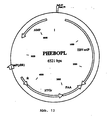
- the CMV expression vector for tTA pUHD15-1 (Gossen and Bujard, 1992) was used as an XhoI and HpaI fragment (sequence position 1 to 1924) into the restriction enzyme cleavage sites SalI and NaeI (sequence position 47 to 79) of the vector pHEBOPL (Fig. 13) (first description: (Polack et al., 1991).
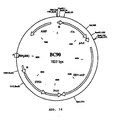
- the tk expression vector for tTA pUHD15-20 (Fig. 12) (Gossen and Bujard, 1992) was used as an XhoI and HpaI fragment (sequence position 1 to 1924) into the restriction enzyme cleavage sites SalI and NaeI (sequence position 47 to 79) of the vector pHEBOPL cloned (BC90).
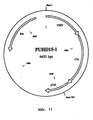
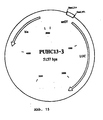
- the expression plasmids BC89 (Fig. 10) and BC90 (Fig. 14) were initially transient in Raji cells together with pUHC13-3 (Fig. 15) cf. Gossen and Bujard, 1992) transfected. The transfection approaches were then carried out treated with and without tetracycline (TC) 1 ⁇ g / ml for 48 hours. Measurement of luciferase activity in extracts from these Cells showed that plasmids BC89 and BC90 also expressed tTA like the starting plasmids pUHD15-1 (Fig. 11) and pUHD15-20 (Fig. 12) (data Not shown).
- Burkitt lymphoma cell line Raji with the plasmids BC89 and BC90 transfected.
- hygromycin By selection with hygromycin several sublines (A - D) were established.
- This experiment shows that in lymphoma cells by stable Transfection of an episomally replicating expression vector functional amounts of tTa can be expressed.
- the four or show three different transfectants with BC89 or BC90 no differences among each other in terms of basic activity of the CMV tetO7 promoter or its inducibility.
- the experiment shows that the tk promoter (BC90) is not sufficient Expression of the transactivator allowed.
- Tc is in these cells (BC90A-C) only by the luciferase expression modulates the factor 2 in contrast to the 60- to 100-fold difference in the cell lines carrying the CMV-tTA (BC89A-D).
- the experiment further proves that the basic activity (i.e. minus TC) of the pUHC13-3 construct is not essential due to the amount of tTA being affected.
- the promoter of CMV-tetO7-LUC (pUHC13-3) was in the uninduced State (without Tc) about a third as active as the standard expression vector CMV-LTR-LUC (Fig. 2).
- CMV-LTR-LUC the standard expression vector
- pUHC13-3 was even about 90 times stronger than CMV-LTR-LUC.
- For functional analyzes appeared the "basal activity" as well as the maximum expression much too high.
- the one from Gossen and Bujard-made tk promoter with tetO7 (pT7t81) showed im Lower basal activity compared to pUHC13-3, however Activation was the worst in comparison with a factor of 26 with the other promoters tested (Fig. 3).
- a preferred object of the present invention is the use of the episomally replicating vectors according to the invention in B cells.
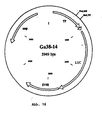
- the EBNA2 responsible site in the TP-LUC promoter construct Ga38-14 was via the restriction enzyme interfaces NruI and BclI away.
- the protruding ends were treated with Klenow polymerase and then the tet operon (tetO7) as SmaI-SmaI fragment from the original clone (pUHC13-3) (Fig. 15) used by Gossen and Bujard (1992).
- the TPtetO7-Luc construct CR276 (Fig. 20) was transient into the tTA-expressing Raji cell line BC89C transfected (Fig. 3).
- the comparison with pUHC13-3 shows that the "basal activity" by a factor 4 to 5 and the maximum (induced) activity by the factor 6 to 7 was lower.
- the conditional system proposed by Gossen and Bujard (1992) Gene expression provides that first the transactivator (tTA) producing cell line is produced. The optimal cell line becomes more suitable through transient transfection Reporter gene constructs determined. In a second transfection approach then the GOI should be under the control of the tet operon in this cell will be introduced. By testing different subclones is the appropriate, conditionally expressing the GOI Cell line can be identified. This procedure presupposes that it is possible to use larger integrating vectors To produce the number of stable transfectants of a particular cell line, the constant amounts of the tTA molecule over a long period of time to produce. Furthermore, the GOI construct must in such a way integrate the host genome so that it is over a long period of time for tTA is accessible.
- a plasmid was therefore created according to the invention that replicates episomally, that expresses tTA and that carries a GOI (here, for example, the luciferase gene) under the control of the TP-tetO7 promoter.
- a GOI here, for example, the luciferase gene
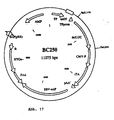
- the TP-tetO7 promoter and parts of the luciferase gene as XmnI-ClaI fragment in BC89 also via XmnI and ClaI cloned in (BC250) (Fig. 17).
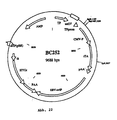
- the BC250 became the luciferase gene BglII and ClaI removed and a BglII linker ("New England Biolabs" # 1066) inserted (BC252).
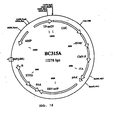
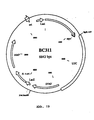
- the Lucifera gene became together with the SV40 polyadenylation site as a BamHI-BglII fragment cloned from BC311 into the BglII interface of BC252 (BC315A) (Fig. 18).
- Clone BC315B was also used as the control plasmid generated that contains the luciferase gene in reverse orientation.
- the stable line BC322-2 was in terms of time The course and the dose-response relationship were examined in more detail.
- the cells were treated with different concentrations of Tc and the luciferase activity after 4, 8, 16, 24 and 48 hours certainly.
- the result of the experiment shows (Fig. 6) that the maximum effect is achieved after 48 hours at 1 ⁇ g / ml Tc becomes. Since both the stability of the luciferase RNA and the Proteins going into this experiment can be about the actual Speed of regulation of promoter activity due to no statement can be made in this experiment. own unpublished observations of the stability of the luciferase protein have shown that the half-life of the protein is several Hours. It can therefore be assumed that the maximum Regulation of promoter activity within a few hours after adding Tc.
- .bglII interface of the vector BC252 (Fig. 22) was inserted 1st introns, the 2nd and 3rd exons, and the polyadenylation site of the human c-myc gene (sequence positions 4077 to 8082 after (Gazin et al., 1984) as a BamHI-BamHI fragment.
- the c-myc gene comes from Burkitt's lymphoma BL60 (Polack et al., 1991).
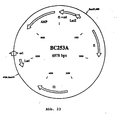
- the BamHI interface at NheI (position 4077) was introduced with the help of a linker (BC253) (Fig. 23).
- the 3 'by EcoRI BamHI site comes from the polylinker of the vector.
- the conditional expression of Myc protein by BC266 was by transient transfection and subsequent Western blot analysis checked (data Not shown).
- the cell line ER / EB2-5 (Kempkes et al., 1995) transfected stably with BC266.
- the target cell was ER / EB2-5 chosen because the c-myc expression in this cell line under the Control of a conditional mutant of the EBNA2 gene is available.
- the conditional EBNA2 mutant (ER-EBNA2) was created by fusion with the Estrogen binding part of the human estrogen receptor.
- the function of ER-EBNA2 depends on the presence of Estrogen in the cell culture medium. In this cell you can endogenous Myc expression almost completely due to estrogen deprivation switch off (Kempkes et al., 1995).
- the Myc expression in this cell line can be determined by the Addition of Tc to the cell culture medium can be strongly modulated (Fig. 7).
- the Tc mediated shutdown of Myc is due to a proliferation stop accompanied.
- the experiment shown in Fig. 7 was in the absence of estrogen, i.e. when the EBNA2 function is switched off, carried out.
- the endogenous c-myc gene is in this state almost not active.
- This application example shows that with the help of the vector BC252 conditional expression of a non-reporter gene (c-myc) can be reached.
- Tc-controlled transactivator was by Mutagenesis changed so that it no longer represses by Tc, but is activated. This molecule (rtTA) binds after addition from Tc to the cell culture medium to the operator (tetO7).
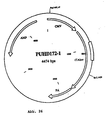
- BC252 large parts of the CMV promoter were via BspI407 and SplI and the coding region for tTA by rtTA pUHD172-1 (Fig. 26) also exchanged via BspI407 and SplI.
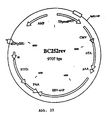
- BC252rev Fig. 25
- BglII polyadenylation site from BC311
- MS2a BamHI fragment cloned in
- the two vectors presented here are suitable for conditional expression in EBV-positive cells to reach from any genes.
- EBNA-1 must either be expressed in the cell via a second plasmid or the EBNA1 expression cassette must still be in the vectors BC252 and BC252rev are inserted.
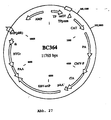
- BC364 (Fig. 27) is a derivative of BC252 (Fig. 22), which also has the CAT gene (chloramphenicol acetyl transferase) and one Contains polyadenylation site.
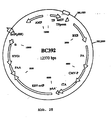
- the BC392 construct (Fig. 28) was transfected into the ER / EB2-5 cell line. After selection with hygromycin, two stable lines were established; BC415-1 and BC415-2. These cell lines were in and Absence of estrogen and Tc for those shown in Fig. 8 Cultivated times and extracted protein extracts. The protein extracts were examined using the Western blot technique. How Fig. 8 shows BXB is dependent on Tc in the cell culture medium is expressed in BC 415-1 and -2.
- the ER / EB2-5 cells only grow in the presence of estrogen Cell culture medium (Kempkes et al., 1995). Estrogen deprivation leads to a proliferation arrest. Expression of the TPtet07 promoter is not affected by the state of proliferation of the cells. The Vector therefore also enables expression in resting cells.
Landscapes
- Health & Medical Sciences (AREA)
- Genetics & Genomics (AREA)
- Life Sciences & Earth Sciences (AREA)
- Engineering & Computer Science (AREA)
- Chemical & Material Sciences (AREA)
- Organic Chemistry (AREA)
- Zoology (AREA)
- General Engineering & Computer Science (AREA)
- Bioinformatics & Cheminformatics (AREA)
- Biotechnology (AREA)
- Wood Science & Technology (AREA)
- Biomedical Technology (AREA)
- Molecular Biology (AREA)
- Biochemistry (AREA)
- General Health & Medical Sciences (AREA)
- Biophysics (AREA)
- Microbiology (AREA)
- Plant Pathology (AREA)
- Physics & Mathematics (AREA)
- Oncology (AREA)
- Gastroenterology & Hepatology (AREA)
- Medicinal Chemistry (AREA)
- Proteomics, Peptides & Aminoacids (AREA)
- Virology (AREA)
- Micro-Organisms Or Cultivation Processes Thereof (AREA)
- Preparation Of Compounds By Using Micro-Organisms (AREA)
- Structure Of Belt Conveyors (AREA)
- Medicines That Contain Protein Lipid Enzymes And Other Medicines (AREA)
- Medicines Containing Material From Animals Or Micro-Organisms (AREA)
Description
- In manchen Zielzellen kommt es nach physikalischem DNA-Transfer nicht oder nur sehr selten zu einer Integration des Konstruktes in das Genom der Zielzelle;
- das Ausmaß der Expression wird in besonderem Maße durch den Integrationsort bestimmt ("Positionseffekt").
- keine Nebenwirkungen der Induktions- oder Abschaltungsbedingungen;
- die Menge des zu regulierenden Genproduktes sollte uninduziert möglichst gering sein ("leakiness");
- Regulierbarkeit möglichst über mehrere Größenordnungen.
- Auch nach stabiler Transfektion und der damit verbundenen Ausbildung einer geordneten Chromatinstruktur des eingeführten Plasmids bleibt die Induzierbarkeit des Promotors erhalten. Die räumliche Nähe des CMV-Promotor/Enhancer-Bereichs, der die Expression des tTA-Moleküls gewährleistet, zum TPtetO7-Promotor führt nicht zu dessen unmodulierbarer konstitutiver Expression.
- Die vier unabhängig voneinander entstandenen Sublinien zeigen nur eine geringgradige Variation hinsichtlich der Basalaktivität und der Induzierbarkeit der Luziferaseaktivität.
- Abb. 1:
- Durch Tc modulierte Luziferase Aktivität in verschiedenen stabil mit BC89 bzw. BC90 transfizierten Raji Zellinien (BC89A-D und BC90A-C) nach transienter Transfektion von pUHC13-3 (CMV-tet07-LUC).
- Abb. 2:
- Vergleich der Promotoraktivität von pUHC13-3 mit CMV-LTR-LUC nach transienter Transfektion in BC89C.
- Abb. 3:
- Vergleich der Promotoraktivität der angegebenen Konstrukte nach transienter Transfektion in BC89C.
- Abb. 4:
- Transiente Transfektion von BC315A und B in Raji.
- Abb. 5:
- Luziferaseaktivität in verschiedenen Sublinien (BC322-1 bis -4) von stabil mit BC315A transfizierten Raji Zellen vor und nach Tc Behandlung.
- Abb. 6:
- Die Sublinie BC322-2 (Raji x BC315A) wurde für die angegebenen Zeiten mit verschiedenen Konzentrationen Tc behandelt. Jeweils 3 verschiedene Ansätze wurden getrennt gemessen. Die verschiedenen Symbolpunkte geben den Mittelwert und die schwarzen senkrechten Linien die halbe Standardabweichung der Messungen an.
- Abb. 7:
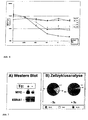
- Konditionale c-myc Expression in stabil mit BC266 transfizierten ER/EB2-5 Zellen (P493-6). A) Western Blot Analyse: Nachweis des Myc und EBNA1 Proteins in Extrakten von P493-6 Zellen, die für 48 Stunden mit (+) und ohne (-) Tc behandelt wurden. B) Zellzyklusverteilung: nach 48 Stunden Behandlung mit Tc von P493-6 Zellen befindet sich die Mehrzahl der Zellen in der G1 Phase.
- Abb. 8:
- Konditionale BXB Expression in stabil mit BC392 transfizierten ER/EB2-5 Zellen (BC415-1 und -2). Western Blot Analyse: Nachweis des BXB Proteins in Extrakten von BC415-1 und -2 Zellen, die für 24 und 48 Stunden mit (+) und ohne (-) Tc bzw. für 4, 24, 48 und 72 Stunden mit (+) und ohne (-) Östrogen (E) behandelt wurden. Die Raf-Mutante BXB ist kleiner als das endogen von den Zellen produzierte Raf-1. In den untransfizierten Ausgangszellen (ER/EB2-5) wird durch den monoklonalen Antikörper, der gegen Raf-1 gerichtet ist, nur das Raf-1 Protein detektiert. In BC415-1 und -2 wird ein zusätzliches Protein angefärbt, das in seiner Größe der Mutante BXB entspricht. Durch Zugabe von Tc zum Zellkulturmedium wird die Expression dieses Proteins nach 48 Stunden vollständig abgeschaltet. Der Entzug von Östrogen, der in diesen Zellen zu einem Proliferationsstop führt (Kempkes et al., 1995), beeinflusst weder die Expression von BXB noch von endogenem Raf-1.
- Abb. 9:
- Luziferaseaktivität in verschiedenen Sublinien (BC389-2 bis -10) von stabil mit MS2a transfizierten Raji Zellen vor und nach Behandlung mit Doxyciclin (DC).
- Abb. 10:
- Vektor BC89
- Abb. 11:
- Vektor PUHD15-1
- Abb. 12:
- Vektor PUHD15-20
- Abb. 13:
- Vektor PHEBOPL
- Abb. 14:
- Vektor BC90
- Abb. 15:
- Vektor PUHC13-3
- Abb. 16:
- Vektor Ga38-14
- Abb. 17:
- Vektor BC250
- Abb. 18:
- Vektor BC315A
- Abb. 19:
- Vektor BC311
- Abb. 20:
- Vektor CR276
- Abb. 21:
- Vektor tetrunivA
- Abb. 22:
- Vektor BC252
- Abb. 23:
- Vektor BC253A
- Abb. 24:
- Vektor BC266A
- Abb. 25:
- Vektor BC252rev
- Abb. 26:
- Vektor PUHD172-1
- Abb. 27:
- Vektor BC364
- Abb. 28:
- Vektor BC392
- Abb. 29:
- Vektor CR276ri
Claims (20)
- In Eukaryontenzellen episomal replizierender, nicht integrierender Vektor zur konditionalen Genexpression in Eukaryonten, enthaltend, in funktioneller Verbindung, auf einem DNA-Molekül , zumindest eine Polynukleotidsequenz, die für ein mit Tetrazyklin oder seinen Derivaten oder Analogen regulierbares Transaktivator-fusionsprotein (tTA) kodiert, wobei tTA einen prokaryontischen Tet-Repressor und einen Transkriptionsaktivator, umfaßt einen tTA-responsiblen Promotor, der die tet-Operator-Sequenz (tetO) enthält, an die tTA binden kann, eine Polynukleotidsequenz, die für mindestens ein Gen von Interesse (GOI) kodiert, eine Polyadenylierungsstelle (PAA), eine Polynukleotidsequenz für zumindest einen selektierbaren Marker und Polynukleotidsequenzen, die eine episomale Replikation des Vektors in Eukaryonten bewirken.
- Vektor nach Anspruch 1
dadurch gekennzeichnet, daß der Tet-Repressor von tTA ein von Tn10-stammender Tet-Repressor ist. - Vektorem nach Ansprüch 1 oder 2,
dadurch gekennzeichnet, daß der Transkriptionsaktivator aus dem Herpes simplex-Virus-Virionprotein 16 stammt oder aus mindestens einem Element der Gruppe saurer, prolinreicher, serin/threonin-reicher und glutaminreicher Transkriptionsaktivatorpolypeptide ausgewählt ist, oder eine Interaktionsdomäne ist, ausgewählt aus mindestens einem Element der Gruppe, bestehend aus einer Leucin-Zipper-Domäne, einer Helix-Loop-Helix-Domäne und einer Zinkfinger-Domäne, oder
eine Interaktionsdomäne aus einem TATA-Bindungsprotein ist. - Vektor nach einem oder mehreren der vorhergehenden Ansprüche,
dadurch gekennzeichnet, daß die für tTA kodierende Polynukleotidsequenz unter Kontrolle eines konstitutiv aktiven Promotors steht, bevorzugt eines CMV-, tk- oder c-myc-Promotors oder Teilen hiervon, oder die tTA-kodierende Polynukleotidsequenz unter Kontrolle eines tTA-responsiblen Promotors steht. - Vektor nach einem oder mehreren der vorhergehenden Ansprüche,
dadurch gekennzeichnet, daß das Gen von Interesse für ein humanes oder ein virales oder ein bakterielles Protein kodiert, bevorzugt ausgewählt aus mindestens einem Element der Gruppe, bestehend aus Transkriptionsfaktoren, Onkogenen, Signalübertragungsmolekülen, Enzymen, Cytokinen, Zelladhäsionsproteinen, Tumorantigenen, co-stimulatorischen Signalmolekülen und ein nicht mit dem Empfänger identisches HLA. - Vektor nach einem oder mehreren der vorhergehenden Ansprüche,
dadurch gekennzeichnet, daß der tTA-responsible Promotor einen Minimalpromotor enthält oder
daß der tTA-responsible Promotor zumindest Teile des TP-Promotors des EBV, des CMV-, tk- oder c-myc-Promotors enthält oder
daß der tTA-responsible Promotor den TP-Promotor von EBV enthält, bei dem das EBNA2-responsible Element durch die tet-Operator-Sequenz (tetO) ersetzt oder ergänzt wurde, oder
daß der tTA-responsible Promotor ein Minimalpromotor in funktioneller Verbindung mit tetO ist, oder
daß der tTA-responsible Promotor ein CMV oder tk-Minimalpromotor oder ein TP-Minimalpromotor des EBV, je in funktioneller Verbindung mit tetO, ist, oder
daß der tTA-responsible Promotor ein c-myc-P1-Promotor in funktioneller Verbindung mit tetO ist. - Vektor nach einem oder mehreren der vorhergehenden Ansprüche,
dadurch gekennzeichnet, daß die tet-Operator-Sequenz (tetO) in multipler Kopienanzahl vorliegt, bevorzugt in sieben Kopien. - Vektor nach einem oder mehreren der vorhergehenden Ansprüche,
dadurch gekennzeichnet, daß die Polynukleotidsequenz, die für einen selektierbaren Marker kodiert, das tk-Gen oder das Neomycin-Resistenzgen oder das Hygromycin-Resistenzgen ist. - Vektor nach einem oder mehreren der vorhergehenden Ansprüche,
dadurch gekennzeichnet, daß die Polynukleotidsequenzen, die eine episomale Replikation des Vektors in Eukaryonten bewirken, den Replikationsursprung (ori) von EBV (oriP) oder von BPV enthalten, oder
daß die Polynukleotidsequenz, die eine episomale Replikation des Vektors in Eukaryonten bewirkt, für EBNA1 kodiert. - Vektor nach einem oder mehreren der vorhergehenden Ansprüche,
dadurch gekennzeichnet, daß der Vektor die Sequenzen für den lytischen Origin des EBV und die terminale Repeat-Struktur als Verpackungssequenz (TR) enthält, oder
daß der Vektor Sequenzen für die Replikation in Bakterienzellen enthält. - Vektor nach einem oder mehreren der vorhergehenden Ansprüche,
dadurch gekennzeichnet, daß tetO im tTA-responsiblen Promotor durch Bindung des Tet-Repressors positiv oder negativ regulierbar ist. - Prokaryontenzelle oder Eukaryontenzelle, ausgenommen Keimbahnzellen, enthaltend einen Vektor nach einem oder mehreren der vorhergehenden Ansprüche.
- B-Zelle, die EBV-positiv sein kann, enthaltend einem Vektor nach einem oder mehreren des Ansprüche 1-11.
- EBV-positive Eukaryontenzelle, ausgenommen Keimbahnzellen, oder Prokaryontenzelle, enthaltend einen Vektor nach einem oder mehreren des Ansprüchs 1-11.
- Arzneimittel, enthaltend einen Vektor nach einem oder mehreren des Ansprüche 1-11.
- Arzneimittel, enthaltend eine Prokaryontenzelle oder Eukaryontenzelle nach Anspruch 12, 13 oder 14.
- Verfahren zur konditionalen Expression eines oder mehrerer Gene von Interesse in vitro mit den nachfolgenden Schritten:(a) Transfektion eines Vektors nach einen oder mehreren Ansprüche 1-11 in Eukaryontenzellen in stabiler oder transienter Form;(b) Behandlung der Zellen mit Tetracyclin oder seinen Derivaten oder Analogen in einer solchen Konzentration, die die gewünschte Expression des Gens von Interesse ermöglicht; wahlweise(c) Isolieren des produzierten Proteins aus der Zelle.
- Verfahren zur konditionalen Expression eines oder mehrerer Gene von Interesse in vitro mit den nachfolgenden Schritten:(a) Transfektion eines Vektors nach Anspruch 10 in eine EBV-positive Zelle;(b) Induktion des lytischen Zyklus;(c) Ernten des Überstandes;(d) wahlweise Konzentrieren des Überstandes;(e) Infektion von EBV-Rezeptoren tragenden Zellen;(f) Behandlung der Zellen mit Tetracyclin oder seinen Derivaten oder Analogen in einer solchen Konzentration, die die gewünschte Expression des Gens von Interesse ermöglicht; wahlweise(g) Isolieren des produzierten Proteins aus der Zelle.
- Verfahren nach Anspruch 18,
dadurch gekennzeichnet, daß als Zellen B-Zellen oder von B-Zellen abgeleitete Tumorzellen verwendet werden. - EBV-Viruspartikel, enthaltend einen oder mehrere der Vektoren nach einem oder mehreren der vorhergehenden Ansprüche.
Applications Claiming Priority (2)
| Application Number | Priority Date | Filing Date | Title |
|---|---|---|---|
| DE19635568 | 1996-09-02 | ||
| DE19635568A DE19635568C1 (de) | 1996-09-02 | 1996-09-02 | Vektorsysteme zur konditionalen Genexpression |
Publications (2)
| Publication Number | Publication Date |
|---|---|
| EP0826775A1 EP0826775A1 (de) | 1998-03-04 |
| EP0826775B1 true EP0826775B1 (de) | 2003-04-23 |
Family
ID=7804393
Family Applications (1)
| Application Number | Title | Priority Date | Filing Date |
|---|---|---|---|
| EP97114569A Expired - Lifetime EP0826775B1 (de) | 1996-09-02 | 1997-08-22 | Vektoren zur konditionalen Genexpression |
Country Status (4)
| Country | Link |
|---|---|
| EP (1) | EP0826775B1 (de) |
| JP (1) | JPH10113178A (de) |
| AT (1) | ATE238424T1 (de) |
| DE (2) | DE19635568C1 (de) |
Cited By (1)
| Publication number | Priority date | Publication date | Assignee | Title |
|---|---|---|---|---|
| US10221396B2 (en) | 2009-06-05 | 2019-03-05 | FUJIFILM Cellular Dynamics, Inc. | Reprogramming T cells and hematopoietic cells |
Families Citing this family (9)
| Publication number | Priority date | Publication date | Assignee | Title |
|---|---|---|---|---|
| DE19808453C2 (de) * | 1998-02-27 | 2000-12-14 | Gsf Forschungszentrum Umwelt | Expressionsvektor zur konditionalen Regulation der Expression der großen Untereinheit der RNA-Polymerase II |
| DE19816116C2 (de) * | 1998-04-09 | 2000-06-29 | Gsf Forschungszentrum Umwelt | Verfahren zur Immortalisation von Zellen mit Hilfe konditional transformierter Helferzellen |
| DE19845420C2 (de) * | 1998-10-02 | 2000-11-16 | Deutsches Krebsforsch | Interzelluläre Ausbreitung rekombinanter DNA |
| DE602004010112T2 (de) * | 2004-09-14 | 2008-09-18 | Helmholtz Zentrum München Deutsches Forschungszentrum Für Gesundheit Und Umwelt (Gmbh) | In cis regulierte konditionelle Genvektoren |
| DE102006011918A1 (de) * | 2006-02-07 | 2007-08-09 | Universität Zu Köln | Verfahren und Vektor zur steuerbaren Genexpression |
| ATE498008T1 (de) * | 2006-10-23 | 2011-02-15 | Res Org Information & Systems | Verfahren zur herstellung eines zellstamms mit fähigkeit zur tetracyclin-induzierten genexpression oder eines zellstamms mit konditionalem gen-knockout sowie verwendung der zellstämme |
| CA2726990C (en) | 2008-06-04 | 2020-09-08 | Cellular Dynamics International, Inc. | Methods for the production of ips cells using extra-chromosomal vectors |
| JP2012500005A (ja) | 2008-08-12 | 2012-01-05 | セルラー ダイナミクス インターナショナル, インコーポレイテッド | iPS細胞を生成するための方法 |
| KR101813981B1 (ko) * | 2009-10-22 | 2018-01-04 | 다우 아그로사이언시즈 엘엘씨 | 지방산 생합성에 포함된 식물 유전자를 표적하는 조작된 징크 핑거 단백질 |
Family Cites Families (9)
| Publication number | Priority date | Publication date | Assignee | Title |
|---|---|---|---|---|
| US5639596A (en) * | 1991-08-16 | 1997-06-17 | Gsf-Forschungszentrum Fur Umweltund Gesundheit | DNA construct and in vitro test for detecting tumor promoters by means of said DNA construct |
| CA2143326A1 (en) * | 1992-08-26 | 1994-03-03 | Guerard Byrne | Tetracycline repressor-mediated binary regulation system for control of gene expression in transgenic animals |
| AU6014094A (en) * | 1992-12-02 | 1994-06-22 | Baylor College Of Medicine | Episomal vectors for gene therapy |
| US5589362A (en) * | 1993-06-14 | 1996-12-31 | Basf Aktiengesellschaft | Tetracycline regulated transcriptional modulators with altered DNA binding specificities |
| CA2165162C (en) * | 1993-06-14 | 2000-05-23 | Hermann Bujard | Tight control of gene expression in eucaryotic cells by tetracycline-responsive promoters |
| US5866755A (en) * | 1993-06-14 | 1999-02-02 | Basf Aktiengellschaft | Animals transgenic for a tetracycline-regulated transcriptional inhibitor |
| CA2193488A1 (en) * | 1994-05-20 | 1995-11-30 | Michele P. Calos | An autonomous replication system for mammalian cells |
| US5851796A (en) * | 1995-06-07 | 1998-12-22 | Yale University | Autoregulatory tetracycline-regulated system for inducible gene expression in eucaryotes |
| US5891718A (en) * | 1996-03-27 | 1999-04-06 | Vical Incorporated | Tetracycline inducible/repressible systems |
-
1996
- 1996-09-02 DE DE19635568A patent/DE19635568C1/de not_active Expired - Fee Related
-
1997
- 1997-08-22 DE DE59709895T patent/DE59709895D1/de not_active Expired - Fee Related
- 1997-08-22 AT AT97114569T patent/ATE238424T1/de not_active IP Right Cessation
- 1997-08-22 EP EP97114569A patent/EP0826775B1/de not_active Expired - Lifetime
- 1997-09-02 JP JP9237453A patent/JPH10113178A/ja active Pending
Cited By (1)
| Publication number | Priority date | Publication date | Assignee | Title |
|---|---|---|---|---|
| US10221396B2 (en) | 2009-06-05 | 2019-03-05 | FUJIFILM Cellular Dynamics, Inc. | Reprogramming T cells and hematopoietic cells |
Also Published As
| Publication number | Publication date |
|---|---|
| DE19635568C1 (de) | 1998-03-26 |
| JPH10113178A (ja) | 1998-05-06 |
| DE59709895D1 (de) | 2003-05-28 |
| EP0826775A1 (de) | 1998-03-04 |
| ATE238424T1 (de) | 2003-05-15 |
Similar Documents
| Publication | Publication Date | Title |
|---|---|---|
| DE69635992T2 (de) | Ein autoreguliertes tetracyclin-reguliertes system fur die induzierte genexpression in eukaryoten | |
| DE69835085T2 (de) | Regulation der transcription in säugetierzellen und viraler replikation durch eine tetracyclinrepressor | |
| DE69027526T2 (de) | Herstellung von proteinen mittels homologer rekombination | |
| DE69729481T2 (de) | Induzierbares expressionssystem zur erzeugung von verpackungszelllinien für pseudotypisierte retrovirale vektoren | |
| DE69029812T2 (de) | Elemente für retinsäureantwortzusammensetzung und nachweisverfahren | |
| DE69615650T2 (de) | Virale vektoren für die gentherapie | |
| DE60219221T2 (de) | DNS-Sequenzen mit anti-repressor Aktivität | |
| DE69402863T2 (de) | Regulierung der stellen-spezifischen rekombination durch stellen-spezifische fusionsproteine, die aus rekombinase und nuklearem rezeptor bestehen | |
| US7745592B2 (en) | Cumate-inducible expression system for eukaryotic cells | |
| DE69619110T2 (de) | Adenovirale vektoren für die gentherapie | |
| DE69433034T2 (de) | Expression von heterologen genen nach einem ziel-expressionsprofil | |
| EP1464705B1 (de) | Optimierung von Zellen für die endogene Genaktivierung | |
| DE69331931T2 (de) | Synthetische eukaryotische Promotoren welche zwei induzierbare Elemente enthalten | |
| DE19733364A1 (de) | Verfahren zur Klonierung eines großen Virusgenoms | |
| DE69834565T2 (de) | Schnell erzeugung von stabilen säugertier-zellinien mit gewinnung eines hohen gehalts von recombinanten proteine | |
| DE19635568C1 (de) | Vektorsysteme zur konditionalen Genexpression | |
| DE60312039T2 (de) | Mittel und methoden zur produktion eines proteins durch chromatin-öffner, die chromatin zugänglicher für transkriptionsfaktoren machen können | |
| WO2000017334A9 (en) | Analysis of ligand activated nuclear receptors i(in vivo) | |
| DE69936867T2 (de) | Dns sequenz, verfahren für dessen nachweis und herstellung und benutzung | |
| DE602005003369T2 (de) | Neue sequenz um die expression einer nukleinsäure zu erhöhen | |
| WO1996033272A1 (de) | Vektoren zur transfektion von eukaryotischen zellen, deren verwendung und damit transfizierte zielzellen | |
| DE69231689T2 (de) | Zusammensetzung von antwortelementen und ihre verwendung als proben | |
| DE19808453C2 (de) | Expressionsvektor zur konditionalen Regulation der Expression der großen Untereinheit der RNA-Polymerase II | |
| DE602004010112T2 (de) | In cis regulierte konditionelle Genvektoren | |
| DE69830594T2 (de) | Dna expression in transfizierten zellen und testverfahren in transfizierten zellen |
Legal Events
| Date | Code | Title | Description |
|---|---|---|---|
| PUAI | Public reference made under article 153(3) epc to a published international application that has entered the european phase |
Free format text: ORIGINAL CODE: 0009012 |
|
| AK | Designated contracting states |
Kind code of ref document: A1 Designated state(s): AT BE CH DE DK ES FI FR GB IE IT LI NL SE |
|
| 17P | Request for examination filed |
Effective date: 19980902 |
|
| AKX | Designation fees paid |
Free format text: AT BE CH DE DK ES FI FR GB IE IT LI NL SE |
|
| RBV | Designated contracting states (corrected) |
Designated state(s): AT BE CH DE DK ES FI FR GB IE IT LI NL SE |
|
| 17Q | First examination report despatched |
Effective date: 20020221 |
|
| GRAH | Despatch of communication of intention to grant a patent |
Free format text: ORIGINAL CODE: EPIDOS IGRA |
|
| RTI1 | Title (correction) |
Free format text: VECTOR FOR CONDITIONAL GENE EXPRESSION |
|
| GRAH | Despatch of communication of intention to grant a patent |
Free format text: ORIGINAL CODE: EPIDOS IGRA |
|
| GRAA | (expected) grant |
Free format text: ORIGINAL CODE: 0009210 |
|
| AK | Designated contracting states |
Designated state(s): AT BE CH DE DK ES FI FR GB IE IT LI NL SE |
|
| PG25 | Lapsed in a contracting state [announced via postgrant information from national office to epo] |
Ref country code: NL Free format text: LAPSE BECAUSE OF FAILURE TO SUBMIT A TRANSLATION OF THE DESCRIPTION OR TO PAY THE FEE WITHIN THE PRESCRIBED TIME-LIMIT Effective date: 20030423 Ref country code: IT Free format text: LAPSE BECAUSE OF FAILURE TO SUBMIT A TRANSLATION OF THE DESCRIPTION OR TO PAY THE FEE WITHIN THE PRE;WARNING: LAPSES OF ITALIAN PATENTS WITH EFFECTIVE DATE BEFORE 2007 MAY HAVE OCCURRED AT ANY TIME BEFORE 2007. THE CORRECT EFFECTIVE DATE MAY BE DIFFERENT FROM THE ONE RECORDED.SCRIBED TIME-LIMIT Effective date: 20030423 Ref country code: IE Free format text: LAPSE BECAUSE OF NON-PAYMENT OF DUE FEES Effective date: 20030423 Ref country code: GB Free format text: LAPSE BECAUSE OF FAILURE TO SUBMIT A TRANSLATION OF THE DESCRIPTION OR TO PAY THE FEE WITHIN THE PRESCRIBED TIME-LIMIT Effective date: 20030423 Ref country code: FR Free format text: LAPSE BECAUSE OF FAILURE TO SUBMIT A TRANSLATION OF THE DESCRIPTION OR TO PAY THE FEE WITHIN THE PRESCRIBED TIME-LIMIT Effective date: 20030423 Ref country code: FI Free format text: LAPSE BECAUSE OF FAILURE TO SUBMIT A TRANSLATION OF THE DESCRIPTION OR TO PAY THE FEE WITHIN THE PRESCRIBED TIME-LIMIT Effective date: 20030423 |
|
| REG | Reference to a national code |
Ref country code: GB Ref legal event code: FG4D Free format text: NOT ENGLISH |
|
| REG | Reference to a national code |
Ref country code: CH Ref legal event code: EP |
|
| REG | Reference to a national code |
Ref country code: CH Ref legal event code: NV Representative=s name: HEPP, WENGER & RYFFEL AG |
|
| REF | Corresponds to: |
Ref document number: 59709895 Country of ref document: DE Date of ref document: 20030528 Kind code of ref document: P |
|
| REG | Reference to a national code |
Ref country code: IE Ref legal event code: FG4D Free format text: GERMAN |
|
| PG25 | Lapsed in a contracting state [announced via postgrant information from national office to epo] |
Ref country code: SE Free format text: LAPSE BECAUSE OF FAILURE TO SUBMIT A TRANSLATION OF THE DESCRIPTION OR TO PAY THE FEE WITHIN THE PRESCRIBED TIME-LIMIT Effective date: 20030723 Ref country code: DK Free format text: LAPSE BECAUSE OF FAILURE TO SUBMIT A TRANSLATION OF THE DESCRIPTION OR TO PAY THE FEE WITHIN THE PRESCRIBED TIME-LIMIT Effective date: 20030723 |
|
| PG25 | Lapsed in a contracting state [announced via postgrant information from national office to epo] |
Ref country code: AT Free format text: LAPSE BECAUSE OF NON-PAYMENT OF DUE FEES Effective date: 20030822 |
|
| PG25 | Lapsed in a contracting state [announced via postgrant information from national office to epo] |
Ref country code: LI Free format text: LAPSE BECAUSE OF NON-PAYMENT OF DUE FEES Effective date: 20030831 Ref country code: CH Free format text: LAPSE BECAUSE OF NON-PAYMENT OF DUE FEES Effective date: 20030831 Ref country code: BE Free format text: LAPSE BECAUSE OF NON-PAYMENT OF DUE FEES Effective date: 20030831 |
|
| NLV1 | Nl: lapsed or annulled due to failure to fulfill the requirements of art. 29p and 29m of the patents act | ||
| GBV | Gb: ep patent (uk) treated as always having been void in accordance with gb section 77(7)/1977 [no translation filed] |
Effective date: 20030423 |
|
| PG25 | Lapsed in a contracting state [announced via postgrant information from national office to epo] |
Ref country code: ES Free format text: LAPSE BECAUSE OF FAILURE TO SUBMIT A TRANSLATION OF THE DESCRIPTION OR TO PAY THE FEE WITHIN THE PRESCRIBED TIME-LIMIT Effective date: 20031030 |
|
| REG | Reference to a national code |
Ref country code: IE Ref legal event code: FD4D Ref document number: 0826775E Country of ref document: IE |
|
| PLBE | No opposition filed within time limit |
Free format text: ORIGINAL CODE: 0009261 |
|
| STAA | Information on the status of an ep patent application or granted ep patent |
Free format text: STATUS: NO OPPOSITION FILED WITHIN TIME LIMIT |
|
| BERE | Be: lapsed |
Owner name: FORSCHUNGSZENTRUM FUR UMWELT UND GESUNDHEIT G.M.B. Effective date: 20030831 |
|
| PG25 | Lapsed in a contracting state [announced via postgrant information from national office to epo] |
Ref country code: DE Free format text: LAPSE BECAUSE OF NON-PAYMENT OF DUE FEES Effective date: 20040302 |
|
| 26N | No opposition filed |
Effective date: 20040126 |
|
| REG | Reference to a national code |
Ref country code: CH Ref legal event code: PL |
|
| EN | Fr: translation not filed |