EP0818512B1 - Chinolinderivate und ihre Anwendung - Google Patents
Chinolinderivate und ihre Anwendung Download PDFInfo
- Publication number
- EP0818512B1 EP0818512B1 EP97110593A EP97110593A EP0818512B1 EP 0818512 B1 EP0818512 B1 EP 0818512B1 EP 97110593 A EP97110593 A EP 97110593A EP 97110593 A EP97110593 A EP 97110593A EP 0818512 B1 EP0818512 B1 EP 0818512B1
- Authority
- EP
- European Patent Office
- Prior art keywords
- substituted
- unsubstituted
- formula
- group
- branched
- Prior art date
- Legal status (The legal status is an assumption and is not a legal conclusion. Google has not performed a legal analysis and makes no representation as to the accuracy of the status listed.)
- Expired - Lifetime
Links
- 125000002943 quinolinyl group Chemical class N1=C(C=CC2=CC=CC=C12)* 0.000 title 1
- -1 quinoline compound Chemical class 0.000 claims description 506
- 150000001875 compounds Chemical class 0.000 claims description 74
- 125000004432 carbon atom Chemical group C* 0.000 claims description 68
- 239000011701 zinc Substances 0.000 claims description 67
- HCHKCACWOHOZIP-UHFFFAOYSA-N Zinc Chemical compound [Zn] HCHKCACWOHOZIP-UHFFFAOYSA-N 0.000 claims description 61
- SMWDFEZZVXVKRB-UHFFFAOYSA-N anhydrous quinoline Natural products N1=CC=CC2=CC=CC=C21 SMWDFEZZVXVKRB-UHFFFAOYSA-N 0.000 claims description 61
- 229910052725 zinc Inorganic materials 0.000 claims description 61
- 238000002360 preparation method Methods 0.000 claims description 58
- 239000000463 material Substances 0.000 claims description 40
- 238000005401 electroluminescence Methods 0.000 claims description 37
- JLTDJTHDQAWBAV-UHFFFAOYSA-N N,N-dimethylaniline Chemical compound CN(C)C1=CC=CC=C1 JLTDJTHDQAWBAV-UHFFFAOYSA-N 0.000 claims description 36
- XKJCHHZQLQNZHY-UHFFFAOYSA-N phthalimide Chemical class C1=CC=C2C(=O)NC(=O)C2=C1 XKJCHHZQLQNZHY-UHFFFAOYSA-N 0.000 claims description 32
- 150000003248 quinolines Chemical class 0.000 claims description 31
- 125000006165 cyclic alkyl group Chemical group 0.000 claims description 28
- 125000004122 cyclic group Chemical group 0.000 claims description 26
- SMUQFGGVLNAIOZ-UHFFFAOYSA-N quinaldine Chemical compound C1=CC=CC2=NC(C)=CC=C21 SMUQFGGVLNAIOZ-UHFFFAOYSA-N 0.000 claims description 26
- 125000003545 alkoxy group Chemical group 0.000 claims description 21
- 125000003118 aryl group Chemical group 0.000 claims description 21
- 125000004104 aryloxy group Chemical group 0.000 claims description 19
- 125000005843 halogen group Chemical group 0.000 claims description 19
- 125000004435 hydrogen atom Chemical group [H]* 0.000 claims description 18
- JUJWROOIHBZHMG-UHFFFAOYSA-N Pyridine Chemical compound C1=CC=NC=C1 JUJWROOIHBZHMG-UHFFFAOYSA-N 0.000 claims description 16
- 239000002904 solvent Substances 0.000 claims description 16
- GGSUCNLOZRCGPQ-UHFFFAOYSA-N diethylaniline Chemical compound CCN(CC)C1=CC=CC=C1 GGSUCNLOZRCGPQ-UHFFFAOYSA-N 0.000 claims description 14
- 150000007522 mineralic acids Chemical class 0.000 claims description 14
- 238000010521 absorption reaction Methods 0.000 claims description 13
- 125000000753 cycloalkyl group Chemical group 0.000 claims description 13
- AWJUIBRHMBBTKR-UHFFFAOYSA-N isoquinoline Chemical compound C1=NC=CC2=CC=CC=C21 AWJUIBRHMBBTKR-UHFFFAOYSA-N 0.000 claims description 12
- 239000000203 mixture Substances 0.000 claims description 12
- 239000000460 chlorine Substances 0.000 claims description 11
- 238000010438 heat treatment Methods 0.000 claims description 11
- 239000003960 organic solvent Substances 0.000 claims description 9
- OJGMBLNIHDZDGS-UHFFFAOYSA-N N-Ethylaniline Chemical compound CCNC1=CC=CC=C1 OJGMBLNIHDZDGS-UHFFFAOYSA-N 0.000 claims description 8
- AFBPFSWMIHJQDM-UHFFFAOYSA-N N-methylaniline Chemical compound CNC1=CC=CC=C1 AFBPFSWMIHJQDM-UHFFFAOYSA-N 0.000 claims description 8
- GDTBXPJZTBHREO-UHFFFAOYSA-N bromine Chemical compound BrBr GDTBXPJZTBHREO-UHFFFAOYSA-N 0.000 claims description 8
- UMJSCPRVCHMLSP-UHFFFAOYSA-N pyridine Natural products COC1=CC=CN=C1 UMJSCPRVCHMLSP-UHFFFAOYSA-N 0.000 claims description 8
- KZBUYRJDOAKODT-UHFFFAOYSA-N Chlorine Chemical compound ClCl KZBUYRJDOAKODT-UHFFFAOYSA-N 0.000 claims description 7
- PXGOKWXKJXAPGV-UHFFFAOYSA-N Fluorine Chemical compound FF PXGOKWXKJXAPGV-UHFFFAOYSA-N 0.000 claims description 7
- 150000001412 amines Chemical class 0.000 claims description 7
- 229910052801 chlorine Inorganic materials 0.000 claims description 7
- 239000011737 fluorine Substances 0.000 claims description 7
- 229910052731 fluorine Inorganic materials 0.000 claims description 7
- 229940027991 antiseptic and disinfectant quinoline derivative Drugs 0.000 claims description 6
- QDFXRVAOBHEBGJ-UHFFFAOYSA-N 3-(cyclononen-1-yl)-4,5,6,7,8,9-hexahydro-1h-diazonine Chemical compound C1CCCCCCC=C1C1=NNCCCCCC1 QDFXRVAOBHEBGJ-UHFFFAOYSA-N 0.000 claims description 4
- WADSJYLPJPTMLN-UHFFFAOYSA-N 3-(cycloundecen-1-yl)-1,2-diazacycloundec-2-ene Chemical compound C1CCCCCCCCC=C1C1=NNCCCCCCCC1 WADSJYLPJPTMLN-UHFFFAOYSA-N 0.000 claims description 4
- ZCYVEMRRCGMTRW-UHFFFAOYSA-N 7553-56-2 Chemical group [I] ZCYVEMRRCGMTRW-UHFFFAOYSA-N 0.000 claims description 4
- 150000001448 anilines Chemical class 0.000 claims description 4
- 229910052794 bromium Inorganic materials 0.000 claims description 4
- 229910052740 iodine Inorganic materials 0.000 claims description 4
- 238000000034 method Methods 0.000 description 92
- OKKJLVBELUTLKV-UHFFFAOYSA-N Methanol Chemical compound OC OKKJLVBELUTLKV-UHFFFAOYSA-N 0.000 description 54
- VEXZGXHMUGYJMC-UHFFFAOYSA-N Hydrochloric acid Chemical compound Cl VEXZGXHMUGYJMC-UHFFFAOYSA-N 0.000 description 32
- JIAARYAFYJHUJI-UHFFFAOYSA-L zinc dichloride Chemical compound [Cl-].[Cl-].[Zn+2] JIAARYAFYJHUJI-UHFFFAOYSA-L 0.000 description 28
- IJGRMHOSHXDMSA-UHFFFAOYSA-N nitrogen Substances N#N IJGRMHOSHXDMSA-UHFFFAOYSA-N 0.000 description 27
- 239000007787 solid Substances 0.000 description 25
- 229910052757 nitrogen Inorganic materials 0.000 description 24
- 238000006243 chemical reaction Methods 0.000 description 23
- 239000011521 glass Substances 0.000 description 22
- 239000000758 substrate Substances 0.000 description 22
- 238000001816 cooling Methods 0.000 description 18
- XLYOFNOQVPJJNP-UHFFFAOYSA-N water Substances O XLYOFNOQVPJJNP-UHFFFAOYSA-N 0.000 description 18
- 229910052782 aluminium Inorganic materials 0.000 description 15
- XAGFODPZIPBFFR-UHFFFAOYSA-N aluminium Chemical compound [Al] XAGFODPZIPBFFR-UHFFFAOYSA-N 0.000 description 15
- 239000011541 reaction mixture Substances 0.000 description 15
- 238000001228 spectrum Methods 0.000 description 15
- 230000005684 electric field Effects 0.000 description 14
- 239000011592 zinc chloride Substances 0.000 description 14
- 235000005074 zinc chloride Nutrition 0.000 description 14
- 238000009423 ventilation Methods 0.000 description 13
- 238000003756 stirring Methods 0.000 description 11
- 239000013078 crystal Substances 0.000 description 10
- 229920000139 polyethylene terephthalate Polymers 0.000 description 10
- 239000005020 polyethylene terephthalate Substances 0.000 description 10
- 239000000843 powder Substances 0.000 description 10
- 239000011347 resin Substances 0.000 description 10
- 229920005989 resin Polymers 0.000 description 10
- VNDYJBBGRKZCSX-UHFFFAOYSA-L zinc bromide Chemical compound Br[Zn]Br VNDYJBBGRKZCSX-UHFFFAOYSA-L 0.000 description 10
- 238000000921 elemental analysis Methods 0.000 description 9
- 238000002441 X-ray diffraction Methods 0.000 description 8
- 125000000217 alkyl group Chemical group 0.000 description 8
- 0 CC1C(*)=C2C(*)=C(*)C(*)=C(*)C2NC1C=ClC1=C(C(N)=O)C(*)=*C(C)C1=* Chemical compound CC1C(*)=C2C(*)=C(*)C(*)=C(*)C2NC1C=ClC1=C(C(N)=O)C(*)=*C(C)C1=* 0.000 description 7
- 238000002834 transmittance Methods 0.000 description 7
- 239000011358 absorbing material Substances 0.000 description 6
- JHIVVAPYMSGYDF-UHFFFAOYSA-N cyclohexanone Chemical compound O=C1CCCCC1 JHIVVAPYMSGYDF-UHFFFAOYSA-N 0.000 description 6
- LPUUYZVKCMCHLO-UHFFFAOYSA-N 4,5,6,7-tetrachloroisoindole-1,3-dione Chemical compound ClC1=C(Cl)C(Cl)=C2C(=O)NC(=O)C2=C1Cl LPUUYZVKCMCHLO-UHFFFAOYSA-N 0.000 description 5
- 239000012065 filter cake Substances 0.000 description 5
- 229930192419 itoside Natural products 0.000 description 5
- 229940102001 zinc bromide Drugs 0.000 description 5
- RFFLAFLAYFXFSW-UHFFFAOYSA-N 1,2-dichlorobenzene Chemical compound ClC1=CC=CC=C1Cl RFFLAFLAYFXFSW-UHFFFAOYSA-N 0.000 description 4
- QAOWNCQODCNURD-UHFFFAOYSA-N Sulfuric acid Chemical compound OS(O)(=O)=O QAOWNCQODCNURD-UHFFFAOYSA-N 0.000 description 4
- 229910052738 indium Inorganic materials 0.000 description 4
- APFVFJFRJDLVQX-UHFFFAOYSA-N indium atom Chemical compound [In] APFVFJFRJDLVQX-UHFFFAOYSA-N 0.000 description 4
- 229910052751 metal Inorganic materials 0.000 description 4
- 239000002184 metal Substances 0.000 description 4
- 125000001424 substituent group Chemical group 0.000 description 4
- NAWXUBYGYWOOIX-SFHVURJKSA-N (2s)-2-[[4-[2-(2,4-diaminoquinazolin-6-yl)ethyl]benzoyl]amino]-4-methylidenepentanedioic acid Chemical compound C1=CC2=NC(N)=NC(N)=C2C=C1CCC1=CC=C(C(=O)N[C@@H](CC(=C)C(O)=O)C(O)=O)C=C1 NAWXUBYGYWOOIX-SFHVURJKSA-N 0.000 description 3
- NYNZQNWKBKUAII-KBXCAEBGSA-N (3s)-n-[5-[(2r)-2-(2,5-difluorophenyl)pyrrolidin-1-yl]pyrazolo[1,5-a]pyrimidin-3-yl]-3-hydroxypyrrolidine-1-carboxamide Chemical compound C1[C@@H](O)CCN1C(=O)NC1=C2N=C(N3[C@H](CCC3)C=3C(=CC=C(F)C=3)F)C=CN2N=C1 NYNZQNWKBKUAII-KBXCAEBGSA-N 0.000 description 3
- DWKNOLCXIFYNFV-HSZRJFAPSA-N 2-[[(2r)-1-[1-[(4-chloro-3-methylphenyl)methyl]piperidin-4-yl]-5-oxopyrrolidine-2-carbonyl]amino]-n,n,6-trimethylpyridine-4-carboxamide Chemical compound CN(C)C(=O)C1=CC(C)=NC(NC(=O)[C@@H]2N(C(=O)CC2)C2CCN(CC=3C=C(C)C(Cl)=CC=3)CC2)=C1 DWKNOLCXIFYNFV-HSZRJFAPSA-N 0.000 description 3
- WXLFOFRDXHNZFG-UHFFFAOYSA-N 2-methyl-5-phenylquinoline Chemical compound C=1C=CC2=NC(C)=CC=C2C=1C1=CC=CC=C1 WXLFOFRDXHNZFG-UHFFFAOYSA-N 0.000 description 3
- UXHQLGLGLZKHTC-CUNXSJBXSA-N 4-[(3s,3ar)-3-cyclopentyl-7-(4-hydroxypiperidine-1-carbonyl)-3,3a,4,5-tetrahydropyrazolo[3,4-f]quinolin-2-yl]-2-chlorobenzonitrile Chemical compound C1CC(O)CCN1C(=O)C1=CC=C(C=2[C@@H]([C@H](C3CCCC3)N(N=2)C=2C=C(Cl)C(C#N)=CC=2)CC2)C2=N1 UXHQLGLGLZKHTC-CUNXSJBXSA-N 0.000 description 3
- RRUNUZOMEZXGPY-UHFFFAOYSA-N 4-ethoxyisoindole-1,3-dione Chemical compound CCOC1=CC=CC2=C1C(=O)NC2=O RRUNUZOMEZXGPY-UHFFFAOYSA-N 0.000 description 3
- WKBOTKDWSSQWDR-UHFFFAOYSA-N Bromine atom Chemical group [Br] WKBOTKDWSSQWDR-UHFFFAOYSA-N 0.000 description 3
- SJRJJKPEHAURKC-UHFFFAOYSA-N N-Methylmorpholine Chemical compound CN1CCOCC1 SJRJJKPEHAURKC-UHFFFAOYSA-N 0.000 description 3
- YXFVVABEGXRONW-UHFFFAOYSA-N Toluene Chemical compound CC1=CC=CC=C1 YXFVVABEGXRONW-UHFFFAOYSA-N 0.000 description 3
- MCRWZBYTLVCCJJ-DKALBXGISA-N [(1s,3r)-3-[[(3s,4s)-3-methoxyoxan-4-yl]amino]-1-propan-2-ylcyclopentyl]-[(1s,4s)-5-[6-(trifluoromethyl)pyrimidin-4-yl]-2,5-diazabicyclo[2.2.1]heptan-2-yl]methanone Chemical compound C([C@]1(N(C[C@]2([H])C1)C(=O)[C@@]1(C[C@@H](CC1)N[C@@H]1[C@@H](COCC1)OC)C(C)C)[H])N2C1=CC(C(F)(F)F)=NC=N1 MCRWZBYTLVCCJJ-DKALBXGISA-N 0.000 description 3
- 125000003277 amino group Chemical group 0.000 description 3
- 125000001495 ethyl group Chemical group [H]C([H])([H])C([H])([H])* 0.000 description 3
- 150000002894 organic compounds Chemical class 0.000 description 3
- 125000001997 phenyl group Chemical group [H]C1=C([H])C([H])=C(*)C([H])=C1[H] 0.000 description 3
- 150000003222 pyridines Chemical class 0.000 description 3
- 125000002023 trifluoromethyl group Chemical group FC(F)(F)* 0.000 description 3
- QIVUCLWGARAQIO-OLIXTKCUSA-N (3s)-n-[(3s,5s,6r)-6-methyl-2-oxo-1-(2,2,2-trifluoroethyl)-5-(2,3,6-trifluorophenyl)piperidin-3-yl]-2-oxospiro[1h-pyrrolo[2,3-b]pyridine-3,6'-5,7-dihydrocyclopenta[b]pyridine]-3'-carboxamide Chemical compound C1([C@H]2[C@H](N(C(=O)[C@@H](NC(=O)C=3C=C4C[C@]5(CC4=NC=3)C3=CC=CN=C3NC5=O)C2)CC(F)(F)F)C)=C(F)C=CC(F)=C1F QIVUCLWGARAQIO-OLIXTKCUSA-N 0.000 description 2
- OCJBOOLMMGQPQU-UHFFFAOYSA-N 1,4-dichlorobenzene Chemical compound ClC1=CC=C(Cl)C=C1 OCJBOOLMMGQPQU-UHFFFAOYSA-N 0.000 description 2
- YMJFJWVRTQHVDB-UHFFFAOYSA-N 1-N,1-N,4-N,4-N-tetrakis[4-(2-methyl-N-(2-methylphenyl)anilino)phenyl]benzene-1,4-diamine Chemical compound CC1=CC=CC=C1N(C=1C(=CC=CC=1)C)C1=CC=C(N(C=2C=CC(=CC=2)N(C=2C=CC(=CC=2)N(C=2C(=CC=CC=2)C)C=2C(=CC=CC=2)C)C=2C=CC(=CC=2)N(C=2C(=CC=CC=2)C)C=2C(=CC=CC=2)C)C=2C=CC(=CC=2)N(C=2C(=CC=CC=2)C)C=2C(=CC=CC=2)C)C=C1 YMJFJWVRTQHVDB-UHFFFAOYSA-N 0.000 description 2
- PAMIQIKDUOTOBW-UHFFFAOYSA-N 1-methylpiperidine Chemical compound CN1CCCCC1 PAMIQIKDUOTOBW-UHFFFAOYSA-N 0.000 description 2
- OISVCGZHLKNMSJ-UHFFFAOYSA-N 2,6-dimethylpyridine Chemical compound CC1=CC=CC(C)=N1 OISVCGZHLKNMSJ-UHFFFAOYSA-N 0.000 description 2
- DILISPNYIVRDBP-UHFFFAOYSA-N 2-[3-[2-(2-hydroxypropylamino)pyrimidin-4-yl]-2-naphthalen-2-ylimidazol-4-yl]acetonitrile Chemical compound OC(CNC1=NC=CC(=N1)N1C(=NC=C1CC#N)C1=CC2=CC=CC=C2C=C1)C DILISPNYIVRDBP-UHFFFAOYSA-N 0.000 description 2
- BSKHPKMHTQYZBB-UHFFFAOYSA-N 2-methylpyridine Chemical compound CC1=CC=CC=N1 BSKHPKMHTQYZBB-UHFFFAOYSA-N 0.000 description 2
- QDRFIDSUGRGGAY-UHFFFAOYSA-N 4-(3,5-dimethyl-4-oxocyclohexa-2,5-dien-1-ylidene)-2,6-dimethylcyclohexa-2,5-dien-1-one Chemical compound C1=C(C)C(=O)C(C)=CC1=C1C=C(C)C(=O)C(C)=C1 QDRFIDSUGRGGAY-UHFFFAOYSA-N 0.000 description 2
- FKNQCJSGGFJEIZ-UHFFFAOYSA-N 4-methylpyridine Chemical compound CC1=CC=NC=C1 FKNQCJSGGFJEIZ-UHFFFAOYSA-N 0.000 description 2
- IPIOTZDJIIDRBQ-UHFFFAOYSA-N 4-methylpyridine;pyridine Chemical compound C1=CC=NC=C1.CC1=CC=NC=C1 IPIOTZDJIIDRBQ-UHFFFAOYSA-N 0.000 description 2
- BONIIQYTWOPUQI-UHFFFAOYSA-N 4-nitroisoindole-1,3-dione Chemical compound [O-][N+](=O)C1=CC=CC2=C1C(=O)NC2=O BONIIQYTWOPUQI-UHFFFAOYSA-N 0.000 description 2
- RSIWALKZYXPAGW-NSHDSACASA-N 6-(3-fluorophenyl)-3-methyl-7-[(1s)-1-(7h-purin-6-ylamino)ethyl]-[1,3]thiazolo[3,2-a]pyrimidin-5-one Chemical compound C=1([C@@H](NC=2C=3N=CNC=3N=CN=2)C)N=C2SC=C(C)N2C(=O)C=1C1=CC=CC(F)=C1 RSIWALKZYXPAGW-NSHDSACASA-N 0.000 description 2
- UFHFLCQGNIYNRP-UHFFFAOYSA-N Hydrogen Chemical compound [H][H] UFHFLCQGNIYNRP-UHFFFAOYSA-N 0.000 description 2
- PXHVJJICTQNCMI-UHFFFAOYSA-N Nickel Chemical compound [Ni] PXHVJJICTQNCMI-UHFFFAOYSA-N 0.000 description 2
- KDLHZDBZIXYQEI-UHFFFAOYSA-N Palladium Chemical compound [Pd] KDLHZDBZIXYQEI-UHFFFAOYSA-N 0.000 description 2
- NBIIXXVUZAFLBC-UHFFFAOYSA-N Phosphoric acid Chemical compound OP(O)(O)=O NBIIXXVUZAFLBC-UHFFFAOYSA-N 0.000 description 2
- GWEVSGVZZGPLCZ-UHFFFAOYSA-N Titan oxide Chemical compound O=[Ti]=O GWEVSGVZZGPLCZ-UHFFFAOYSA-N 0.000 description 2
- XLOMVQKBTHCTTD-UHFFFAOYSA-N Zinc monoxide Chemical compound [Zn]=O XLOMVQKBTHCTTD-UHFFFAOYSA-N 0.000 description 2
- 239000000956 alloy Substances 0.000 description 2
- 229910045601 alloy Inorganic materials 0.000 description 2
- 150000004945 aromatic hydrocarbons Chemical class 0.000 description 2
- MVPPADPHJFYWMZ-UHFFFAOYSA-N chlorobenzene Chemical compound ClC1=CC=CC=C1 MVPPADPHJFYWMZ-UHFFFAOYSA-N 0.000 description 2
- 125000004663 dialkyl amino group Chemical group 0.000 description 2
- 229940117389 dichlorobenzene Drugs 0.000 description 2
- 230000005284 excitation Effects 0.000 description 2
- 229910052739 hydrogen Inorganic materials 0.000 description 2
- 239000001257 hydrogen Substances 0.000 description 2
- 238000002329 infrared spectrum Methods 0.000 description 2
- 150000002739 metals Chemical class 0.000 description 2
- LQNUZADURLCDLV-UHFFFAOYSA-N nitrobenzene Chemical compound [O-][N+](=O)C1=CC=CC=C1 LQNUZADURLCDLV-UHFFFAOYSA-N 0.000 description 2
- BASFCYQUMIYNBI-UHFFFAOYSA-N platinum Chemical compound [Pt] BASFCYQUMIYNBI-UHFFFAOYSA-N 0.000 description 2
- 239000002798 polar solvent Substances 0.000 description 2
- 239000002244 precipitate Substances 0.000 description 2
- 230000035484 reaction time Effects 0.000 description 2
- BHHYHSUAOQUXJK-UHFFFAOYSA-L zinc fluoride Chemical compound F[Zn]F BHHYHSUAOQUXJK-UHFFFAOYSA-L 0.000 description 2
- UAYWVJHJZHQCIE-UHFFFAOYSA-L zinc iodide Chemical compound I[Zn]I UAYWVJHJZHQCIE-UHFFFAOYSA-L 0.000 description 2
- 125000005919 1,2,2-trimethylpropyl group Chemical group 0.000 description 1
- JYEUMXHLPRZUAT-UHFFFAOYSA-N 1,2,3-triazine Chemical group C1=CN=NN=C1 JYEUMXHLPRZUAT-UHFFFAOYSA-N 0.000 description 1
- 125000005918 1,2-dimethylbutyl group Chemical group 0.000 description 1
- RMSGQZDGSZOJMU-UHFFFAOYSA-N 1-butyl-2-phenylbenzene Chemical group CCCCC1=CC=CC=C1C1=CC=CC=C1 RMSGQZDGSZOJMU-UHFFFAOYSA-N 0.000 description 1
- 125000006218 1-ethylbutyl group Chemical group [H]C([H])([H])C([H])([H])C([H])([H])C([H])(*)C([H])([H])C([H])([H])[H] 0.000 description 1
- 125000006219 1-ethylpentyl group Chemical group [H]C([H])([H])C([H])([H])C([H])([H])C([H])([H])C([H])(*)C([H])([H])C([H])([H])[H] 0.000 description 1
- HAIUDCAMWHQJSW-UHFFFAOYSA-N 1-n-propylbutyl Chemical group [CH2+]CC[CH]CC[CH2-] HAIUDCAMWHQJSW-UHFFFAOYSA-N 0.000 description 1
- 125000003562 2,2-dimethylpentyl group Chemical group [H]C([H])([H])C([H])([H])C([H])([H])C(C([H])([H])[H])(C([H])([H])[H])C([H])([H])* 0.000 description 1
- 125000001617 2,3-dimethoxy phenyl group Chemical group [H]C1=C([H])C(*)=C(OC([H])([H])[H])C(OC([H])([H])[H])=C1[H] 0.000 description 1
- 125000003660 2,3-dimethylpentyl group Chemical group [H]C([H])([H])C([H])([H])C([H])(C([H])([H])[H])C([H])(C([H])([H])[H])C([H])([H])* 0.000 description 1
- 125000005808 2,4,6-trimethoxyphenyl group Chemical group [H][#6]-1=[#6](-[#8]C([H])([H])[H])-[#6](-*)=[#6](-[#8]C([H])([H])[H])-[#6]([H])=[#6]-1-[#8]C([H])([H])[H] 0.000 description 1
- 125000003764 2,4-dimethylpentyl group Chemical group [H]C([H])([H])C([H])(C([H])([H])[H])C([H])([H])C([H])(C([H])([H])[H])C([H])([H])* 0.000 description 1
- KLIDCXVFHGNTTM-UHFFFAOYSA-N 2,6-dimethoxyphenol Chemical group COC1=CC=CC(OC)=C1O KLIDCXVFHGNTTM-UHFFFAOYSA-N 0.000 description 1
- 125000006176 2-ethylbutyl group Chemical group [H]C([H])([H])C([H])([H])C([H])(C([H])([H])*)C([H])([H])C([H])([H])[H] 0.000 description 1
- KGDCTAGRMJOMHA-UHFFFAOYSA-N 2-methyl-6-propan-2-ylquinoline Chemical compound N1=C(C)C=CC2=CC(C(C)C)=CC=C21 KGDCTAGRMJOMHA-UHFFFAOYSA-N 0.000 description 1
- 125000003229 2-methylhexyl group Chemical group [H]C([H])([H])C([H])([H])C([H])([H])C([H])([H])C([H])(C([H])([H])[H])C([H])([H])* 0.000 description 1
- 125000005916 2-methylpentyl group Chemical group 0.000 description 1
- 125000004336 3,3-dimethylpentyl group Chemical group [H]C([H])([H])C([H])([H])C(C([H])([H])[H])(C([H])([H])[H])C([H])([H])C([H])([H])* 0.000 description 1
- 125000005809 3,4,5-trimethoxyphenyl group Chemical group [H]C1=C(OC([H])([H])[H])C(OC([H])([H])[H])=C(OC([H])([H])[H])C([H])=C1* 0.000 description 1
- 125000003762 3,4-dimethoxyphenyl group Chemical group [H]C1=C([H])C(OC([H])([H])[H])=C(OC([H])([H])[H])C([H])=C1* 0.000 description 1
- 125000004337 3-ethylpentyl group Chemical group [H]C([H])([H])C([H])([H])C([H])(C([H])([H])C([H])([H])[H])C([H])([H])C([H])([H])* 0.000 description 1
- 125000004207 3-methoxyphenyl group Chemical group [H]C1=C([H])C(*)=C([H])C(OC([H])([H])[H])=C1[H] 0.000 description 1
- 125000003469 3-methylhexyl group Chemical group [H]C([H])([H])C([H])([H])C([H])([H])C([H])(C([H])([H])[H])C([H])([H])C([H])([H])* 0.000 description 1
- 125000005917 3-methylpentyl group Chemical group 0.000 description 1
- HVCNXQOWACZAFN-UHFFFAOYSA-N 4-ethylmorpholine Chemical class CCN1CCOCC1 HVCNXQOWACZAFN-UHFFFAOYSA-N 0.000 description 1
- 125000004172 4-methoxyphenyl group Chemical group [H]C1=C([H])C(OC([H])([H])[H])=C([H])C([H])=C1* 0.000 description 1
- OYPRJOBELJOOCE-UHFFFAOYSA-N Calcium Chemical compound [Ca] OYPRJOBELJOOCE-UHFFFAOYSA-N 0.000 description 1
- VYZAMTAEIAYCRO-UHFFFAOYSA-N Chromium Chemical compound [Cr] VYZAMTAEIAYCRO-UHFFFAOYSA-N 0.000 description 1
- 238000005684 Liebig rearrangement reaction Methods 0.000 description 1
- WHXSMMKQMYFTQS-UHFFFAOYSA-N Lithium Chemical compound [Li] WHXSMMKQMYFTQS-UHFFFAOYSA-N 0.000 description 1
- FYYHWMGAXLPEAU-UHFFFAOYSA-N Magnesium Chemical compound [Mg] FYYHWMGAXLPEAU-UHFFFAOYSA-N 0.000 description 1
- KWYHDKDOAIKMQN-UHFFFAOYSA-N N,N,N',N'-tetramethylethylenediamine Chemical compound CN(C)CCN(C)C KWYHDKDOAIKMQN-UHFFFAOYSA-N 0.000 description 1
- GRYLNZFGIOXLOG-UHFFFAOYSA-N Nitric acid Chemical compound O[N+]([O-])=O GRYLNZFGIOXLOG-UHFFFAOYSA-N 0.000 description 1
- CTQNGGLPUBDAKN-UHFFFAOYSA-N O-Xylene Chemical compound CC1=CC=CC=C1C CTQNGGLPUBDAKN-UHFFFAOYSA-N 0.000 description 1
- 239000004734 Polyphenylene sulfide Substances 0.000 description 1
- BUGBHKTXTAQXES-UHFFFAOYSA-N Selenium Chemical compound [Se] BUGBHKTXTAQXES-UHFFFAOYSA-N 0.000 description 1
- ATJFFYVFTNAWJD-UHFFFAOYSA-N Tin Chemical compound [Sn] ATJFFYVFTNAWJD-UHFFFAOYSA-N 0.000 description 1
- OCBFFGCSTGGPSQ-UHFFFAOYSA-N [CH2]CC Chemical compound [CH2]CC OCBFFGCSTGGPSQ-UHFFFAOYSA-N 0.000 description 1
- MKAMGCXXQJEDPI-UHFFFAOYSA-N [Zn].OC=1C2=CC=CC=C2N=C2C=CC=CC12 Chemical compound [Zn].OC=1C2=CC=CC=C2N=C2C=CC=CC12 MKAMGCXXQJEDPI-UHFFFAOYSA-N 0.000 description 1
- ZOIORXHNWRGPMV-UHFFFAOYSA-N acetic acid;zinc Chemical compound [Zn].CC(O)=O.CC(O)=O ZOIORXHNWRGPMV-UHFFFAOYSA-N 0.000 description 1
- 125000006524 alkoxy alkyl amino group Chemical group 0.000 description 1
- 125000003418 alkyl amino alkoxy group Chemical group 0.000 description 1
- 125000003282 alkyl amino group Chemical group 0.000 description 1
- 229910000147 aluminium phosphate Inorganic materials 0.000 description 1
- 125000005427 anthranyl group Chemical group 0.000 description 1
- 150000001491 aromatic compounds Chemical class 0.000 description 1
- RWCCWEUUXYIKHB-UHFFFAOYSA-N benzophenone Chemical compound C=1C=CC=CC=1C(=O)C1=CC=CC=C1 RWCCWEUUXYIKHB-UHFFFAOYSA-N 0.000 description 1
- 239000012965 benzophenone Substances 0.000 description 1
- QRUDEWIWKLJBPS-UHFFFAOYSA-N benzotriazole Chemical compound C1=CC=C2N[N][N]C2=C1 QRUDEWIWKLJBPS-UHFFFAOYSA-N 0.000 description 1
- 239000012964 benzotriazole Substances 0.000 description 1
- 125000005998 bromoethyl group Chemical group 0.000 description 1
- 125000004799 bromophenyl group Chemical group 0.000 description 1
- YFNONBGXNFCTMM-UHFFFAOYSA-N butoxybenzene Chemical group CCCCOC1=CC=CC=C1 YFNONBGXNFCTMM-UHFFFAOYSA-N 0.000 description 1
- 125000006226 butoxyethyl group Chemical group 0.000 description 1
- 229910052791 calcium Inorganic materials 0.000 description 1
- 239000011575 calcium Substances 0.000 description 1
- 125000002603 chloroethyl group Chemical group [H]C([*])([H])C([H])([H])Cl 0.000 description 1
- 125000004218 chloromethyl group Chemical group [H]C([H])(Cl)* 0.000 description 1
- 125000000068 chlorophenyl group Chemical group 0.000 description 1
- 229910052804 chromium Inorganic materials 0.000 description 1
- 239000011651 chromium Substances 0.000 description 1
- 230000000052 comparative effect Effects 0.000 description 1
- 229920001940 conductive polymer Polymers 0.000 description 1
- GBRBMTNGQBKBQE-UHFFFAOYSA-L copper;diiodide Chemical compound I[Cu]I GBRBMTNGQBKBQE-UHFFFAOYSA-L 0.000 description 1
- 125000000113 cyclohexyl group Chemical group [H]C1([H])C([H])([H])C([H])([H])C([H])(*)C([H])([H])C1([H])[H] 0.000 description 1
- 125000001511 cyclopentyl group Chemical group [H]C1([H])C([H])([H])C([H])([H])C([H])(*)C1([H])[H] 0.000 description 1
- 125000006612 decyloxy group Chemical group 0.000 description 1
- 125000004772 dichloromethyl group Chemical group [H]C(Cl)(Cl)* 0.000 description 1
- 125000004188 dichlorophenyl group Chemical group 0.000 description 1
- 125000004212 difluorophenyl group Chemical group 0.000 description 1
- HPYNZHMRTTWQTB-UHFFFAOYSA-N dimethylpyridine Natural products CC1=CC=CN=C1C HPYNZHMRTTWQTB-UHFFFAOYSA-N 0.000 description 1
- 238000004821 distillation Methods 0.000 description 1
- 125000006232 ethoxy propyl group Chemical group [H]C([H])([H])C([H])([H])OC([H])([H])C([H])([H])C([H])([H])* 0.000 description 1
- 125000005448 ethoxyethyl group Chemical group [H]C([H])([H])C([H])([H])OC([H])([H])C([H])([H])* 0.000 description 1
- 125000005745 ethoxymethyl group Chemical group [H]C([H])([H])C([H])([H])OC([H])([H])* 0.000 description 1
- 125000006351 ethylthiomethyl group Chemical group [H]C([H])([H])C([H])([H])SC([H])([H])* 0.000 description 1
- 238000002189 fluorescence spectrum Methods 0.000 description 1
- 125000003784 fluoroethyl group Chemical group [H]C([H])(F)C([H])([H])* 0.000 description 1
- 125000004785 fluoromethoxy group Chemical group [H]C([H])(F)O* 0.000 description 1
- 125000004216 fluoromethyl group Chemical group [H]C([H])(F)* 0.000 description 1
- 125000001207 fluorophenyl group Chemical group 0.000 description 1
- PCHJSUWPFVWCPO-UHFFFAOYSA-N gold Chemical compound [Au] PCHJSUWPFVWCPO-UHFFFAOYSA-N 0.000 description 1
- 229910052737 gold Inorganic materials 0.000 description 1
- 239000010931 gold Substances 0.000 description 1
- 150000008282 halocarbons Chemical group 0.000 description 1
- 230000005525 hole transport Effects 0.000 description 1
- 229930195733 hydrocarbon Natural products 0.000 description 1
- 150000002430 hydrocarbons Chemical class 0.000 description 1
- 239000012535 impurity Substances 0.000 description 1
- 150000002484 inorganic compounds Chemical class 0.000 description 1
- 229910010272 inorganic material Inorganic materials 0.000 description 1
- 239000000543 intermediate Substances 0.000 description 1
- 125000006303 iodophenyl group Chemical group 0.000 description 1
- 229910052741 iridium Inorganic materials 0.000 description 1
- GKOZUEZYRPOHIO-UHFFFAOYSA-N iridium atom Chemical compound [Ir] GKOZUEZYRPOHIO-UHFFFAOYSA-N 0.000 description 1
- 125000000959 isobutyl group Chemical group [H]C([H])([H])C([H])(C([H])([H])[H])C([H])([H])* 0.000 description 1
- 125000004491 isohexyl group Chemical group C(CCC(C)C)* 0.000 description 1
- 125000001972 isopentyl group Chemical group [H]C([H])([H])C([H])(C([H])([H])[H])C([H])([H])C([H])([H])* 0.000 description 1
- 125000001449 isopropyl group Chemical group [H]C([H])([H])C([H])(*)C([H])([H])[H] 0.000 description 1
- 239000011133 lead Substances 0.000 description 1
- 239000003446 ligand Substances 0.000 description 1
- 229910052744 lithium Inorganic materials 0.000 description 1
- 125000000040 m-tolyl group Chemical group [H]C1=C([H])C(*)=C([H])C(=C1[H])C([H])([H])[H] 0.000 description 1
- 229910052749 magnesium Inorganic materials 0.000 description 1
- 239000011777 magnesium Substances 0.000 description 1
- 125000004184 methoxymethyl group Chemical group [H]C([H])([H])OC([H])([H])* 0.000 description 1
- 125000002496 methyl group Chemical group [H]C([H])([H])* 0.000 description 1
- 125000004372 methylthioethyl group Chemical group [H]C([H])([H])SC([H])([H])C([H])([H])* 0.000 description 1
- 125000004092 methylthiomethyl group Chemical group [H]C([H])([H])SC([H])([H])* 0.000 description 1
- 125000004373 methylthiopropyl group Chemical group [H]C([H])([H])SC([H])([H])C([H])([H])C([H])([H])* 0.000 description 1
- 125000004108 n-butyl group Chemical group [H]C([H])([H])C([H])([H])C([H])([H])C([H])([H])* 0.000 description 1
- 125000003136 n-heptyl group Chemical group [H]C([H])([H])C([H])([H])C([H])([H])C([H])([H])C([H])([H])C([H])([H])C([H])([H])* 0.000 description 1
- 125000001280 n-hexyl group Chemical group C(CCCCC)* 0.000 description 1
- 125000000740 n-pentyl group Chemical group [H]C([H])([H])C([H])([H])C([H])([H])C([H])([H])C([H])([H])* 0.000 description 1
- 125000001624 naphthyl group Chemical group 0.000 description 1
- 229910052759 nickel Inorganic materials 0.000 description 1
- 229910017604 nitric acid Inorganic materials 0.000 description 1
- 125000003261 o-tolyl group Chemical group [H]C1=C([H])C(*)=C(C([H])=C1[H])C([H])([H])[H] 0.000 description 1
- 150000007530 organic bases Chemical class 0.000 description 1
- 125000001037 p-tolyl group Chemical group [H]C1=C([H])C(=C([H])C([H])=C1*)C([H])([H])[H] 0.000 description 1
- 229910052763 palladium Inorganic materials 0.000 description 1
- 125000006340 pentafluoro ethyl group Chemical group FC(F)(F)C(F)(F)* 0.000 description 1
- 125000000538 pentafluorophenyl group Chemical group FC1=C(F)C(F)=C(*)C(F)=C1F 0.000 description 1
- 125000005815 pentoxymethyl group Chemical group [H]C([H])([H])C([H])([H])C([H])([H])C([H])([H])C([H])([H])OC([H])([H])* 0.000 description 1
- 239000002985 plastic film Substances 0.000 description 1
- 229920006255 plastic film Polymers 0.000 description 1
- 229910052697 platinum Inorganic materials 0.000 description 1
- 229920003227 poly(N-vinyl carbazole) Polymers 0.000 description 1
- 229920000548 poly(silane) polymer Polymers 0.000 description 1
- 229920000767 polyaniline Polymers 0.000 description 1
- 229920000642 polymer Polymers 0.000 description 1
- 229920000069 polyphenylene sulfide Polymers 0.000 description 1
- 125000006233 propoxy propyl group Chemical group [H]C([H])([H])C([H])([H])C([H])([H])OC([H])([H])C([H])([H])C([H])([H])* 0.000 description 1
- DSNYFFJTZPIKFZ-UHFFFAOYSA-N propoxybenzene Chemical group CCCOC1=CC=CC=C1 DSNYFFJTZPIKFZ-UHFFFAOYSA-N 0.000 description 1
- 125000006225 propoxyethyl group Chemical group [H]C([H])([H])C([H])([H])C([H])([H])OC([H])([H])C([H])([H])* 0.000 description 1
- 125000005767 propoxymethyl group Chemical group [H]C([H])([H])C([H])([H])C([H])([H])[#8]C([H])([H])* 0.000 description 1
- 125000001436 propyl group Chemical group [H]C([*])([H])C([H])([H])C([H])([H])[H] 0.000 description 1
- 238000000746 purification Methods 0.000 description 1
- 150000003219 pyrazolines Chemical class 0.000 description 1
- 238000001953 recrystallisation Methods 0.000 description 1
- 238000011160 research Methods 0.000 description 1
- 150000003839 salts Chemical class 0.000 description 1
- 125000002914 sec-butyl group Chemical group [H]C([H])([H])C([H])([H])C([H])(*)C([H])([H])[H] 0.000 description 1
- 125000003548 sec-pentyl group Chemical group [H]C([H])([H])C([H])([H])C([H])([H])C([H])(*)C([H])([H])[H] 0.000 description 1
- 229910052711 selenium Inorganic materials 0.000 description 1
- 239000011669 selenium Substances 0.000 description 1
- 229910052709 silver Inorganic materials 0.000 description 1
- 239000004332 silver Substances 0.000 description 1
- 150000003384 small molecules Chemical class 0.000 description 1
- 239000000126 substance Substances 0.000 description 1
- 125000000999 tert-butyl group Chemical group [H]C([H])([H])C(*)(C([H])([H])[H])C([H])([H])[H] 0.000 description 1
- 125000001973 tert-pentyl group Chemical group [H]C([H])([H])C([H])([H])C(*)(C([H])([H])[H])C([H])([H])[H] 0.000 description 1
- 150000003512 tertiary amines Chemical class 0.000 description 1
- 229910052718 tin Inorganic materials 0.000 description 1
- 239000011135 tin Substances 0.000 description 1
- XOLBLPGZBRYERU-UHFFFAOYSA-N tin dioxide Chemical compound O=[Sn]=O XOLBLPGZBRYERU-UHFFFAOYSA-N 0.000 description 1
- 229910001887 tin oxide Inorganic materials 0.000 description 1
- 239000004408 titanium dioxide Substances 0.000 description 1
- 125000006007 trichloroethoxy group Chemical group 0.000 description 1
- 125000003866 trichloromethyl group Chemical group ClC(Cl)(Cl)* 0.000 description 1
- 125000004205 trifluoroethyl group Chemical group [H]C([H])(*)C(F)(F)F 0.000 description 1
- 125000004360 trifluorophenyl group Chemical group 0.000 description 1
- 150000001651 triphenylamine derivatives Chemical class 0.000 description 1
- 239000008096 xylene Substances 0.000 description 1
- 239000004246 zinc acetate Substances 0.000 description 1
- 239000011787 zinc oxide Substances 0.000 description 1
Images




Classifications
-
- C—CHEMISTRY; METALLURGY
- C07—ORGANIC CHEMISTRY
- C07D—HETEROCYCLIC COMPOUNDS
- C07D401/00—Heterocyclic compounds containing two or more hetero rings, having nitrogen atoms as the only ring hetero atoms, at least one ring being a six-membered ring with only one nitrogen atom
- C07D401/02—Heterocyclic compounds containing two or more hetero rings, having nitrogen atoms as the only ring hetero atoms, at least one ring being a six-membered ring with only one nitrogen atom containing two hetero rings
- C07D401/06—Heterocyclic compounds containing two or more hetero rings, having nitrogen atoms as the only ring hetero atoms, at least one ring being a six-membered ring with only one nitrogen atom containing two hetero rings linked by a carbon chain containing only aliphatic carbon atoms
-
- C—CHEMISTRY; METALLURGY
- C09—DYES; PAINTS; POLISHES; NATURAL RESINS; ADHESIVES; COMPOSITIONS NOT OTHERWISE PROVIDED FOR; APPLICATIONS OF MATERIALS NOT OTHERWISE PROVIDED FOR
- C09B—ORGANIC DYES OR CLOSELY-RELATED COMPOUNDS FOR PRODUCING DYES, e.g. PIGMENTS; MORDANTS; LAKES
- C09B23/00—Methine or polymethine dyes, e.g. cyanine dyes
- C09B23/02—Methine or polymethine dyes, e.g. cyanine dyes the polymethine chain containing an odd number of >CH- or >C[alkyl]- groups
- C09B23/04—Methine or polymethine dyes, e.g. cyanine dyes the polymethine chain containing an odd number of >CH- or >C[alkyl]- groups one >CH- group, e.g. cyanines, isocyanines, pseudocyanines
-
- C—CHEMISTRY; METALLURGY
- C09—DYES; PAINTS; POLISHES; NATURAL RESINS; ADHESIVES; COMPOSITIONS NOT OTHERWISE PROVIDED FOR; APPLICATIONS OF MATERIALS NOT OTHERWISE PROVIDED FOR
- C09B—ORGANIC DYES OR CLOSELY-RELATED COMPOUNDS FOR PRODUCING DYES, e.g. PIGMENTS; MORDANTS; LAKES
- C09B57/00—Other synthetic dyes of known constitution
- C09B57/04—Isoindoline dyes
-
- C—CHEMISTRY; METALLURGY
- C09—DYES; PAINTS; POLISHES; NATURAL RESINS; ADHESIVES; COMPOSITIONS NOT OTHERWISE PROVIDED FOR; APPLICATIONS OF MATERIALS NOT OTHERWISE PROVIDED FOR
- C09B—ORGANIC DYES OR CLOSELY-RELATED COMPOUNDS FOR PRODUCING DYES, e.g. PIGMENTS; MORDANTS; LAKES
- C09B57/00—Other synthetic dyes of known constitution
- C09B57/10—Metal complexes of organic compounds not being dyes in uncomplexed form
-
- C—CHEMISTRY; METALLURGY
- C09—DYES; PAINTS; POLISHES; NATURAL RESINS; ADHESIVES; COMPOSITIONS NOT OTHERWISE PROVIDED FOR; APPLICATIONS OF MATERIALS NOT OTHERWISE PROVIDED FOR
- C09K—MATERIALS FOR MISCELLANEOUS APPLICATIONS, NOT PROVIDED FOR ELSEWHERE
- C09K11/00—Luminescent, e.g. electroluminescent, chemiluminescent materials
- C09K11/06—Luminescent, e.g. electroluminescent, chemiluminescent materials containing organic luminescent materials
-
- H—ELECTRICITY
- H05—ELECTRIC TECHNIQUES NOT OTHERWISE PROVIDED FOR
- H05B—ELECTRIC HEATING; ELECTRIC LIGHT SOURCES NOT OTHERWISE PROVIDED FOR; CIRCUIT ARRANGEMENTS FOR ELECTRIC LIGHT SOURCES, IN GENERAL
- H05B33/00—Electroluminescent light sources
- H05B33/12—Light sources with substantially two-dimensional radiating surfaces
- H05B33/14—Light sources with substantially two-dimensional radiating surfaces characterised by the chemical or physical composition or the arrangement of the electroluminescent material, or by the simultaneous addition of the electroluminescent material in or onto the light source
-
- Y—GENERAL TAGGING OF NEW TECHNOLOGICAL DEVELOPMENTS; GENERAL TAGGING OF CROSS-SECTIONAL TECHNOLOGIES SPANNING OVER SEVERAL SECTIONS OF THE IPC; TECHNICAL SUBJECTS COVERED BY FORMER USPC CROSS-REFERENCE ART COLLECTIONS [XRACs] AND DIGESTS
- Y10—TECHNICAL SUBJECTS COVERED BY FORMER USPC
- Y10S—TECHNICAL SUBJECTS COVERED BY FORMER USPC CROSS-REFERENCE ART COLLECTIONS [XRACs] AND DIGESTS
- Y10S428/00—Stock material or miscellaneous articles
- Y10S428/917—Electroluminescent
Definitions
- the present invention relates to a quinoline compound suited for use in a luminous layer of an electro-luminescence element, the electro-luminescence element and fluorescent material by using said compound, and a preparation process of said compound.
- the invention also relates to a zinc halogenide complex suited for use in a luminous layer of an electro-luminescence element or an ultraviolet absorption material, the electro-luminescence element and the ultraviolet absorption material by using said complex, and a preparation process of said complex.
- the invention further relates to a zinc complex suited for use in a luminous layer of an electro-luminescence element or an ultraviolet absorption material, the electro-luminescence element and the ultraviolet absorption material by using said complex, and a preparation process of said complex.
- a quinoline having the formula (7) has been known to have fluorescent property as described in Liebigs Ann. Chem., vol.315, p.303(1901) and Chem. Ber., vol.100, p. 2261-2273 (1967).
- This compound is also referred to in JP-A-56-147784 as a luminescing substance, as are further ⁇ -quinonaphtalines in DE-OS-1544646.
- EP-A-652 274 discloses a 10-hydroxybenzo [b] quinoline zinc complex for use is the luminescent layer of an EL device.
- Aromatic compounds which exhibit fluorescence in the ultraviolet to visible region have been known [I.B. Berlman, Handbook of Fluorescence Spectra of Aromatic Molecules, published from Academic Press].
- inorganic compounds such as titanium dioxide and zinc oxide
- organic compounds such as benzophenone, benzotriazole and other compounds having a triazine structure
- ultraviolet absorption materials as disclosed in JP-A-64-20248.
- the first object of the invention is to provide an excellent material as an EL material and a useful preparation process of the material.
- the second object of the invention is to provide an excellent material as a fluorescent material and a useful preparation process of the material.
- the third object of the invention is to provide an excellent material as an ultraviolet absorption material and a useful preparation process of the material.
- the present invention provides the compound represented by the formulas (2), (3) and a tautomer of the same as an EL material which has a strong luminescent intensity, the compound represented by the formulas (2) and (3) and a tautomer of the same as a specific ultraviolet absorption material which has absorption at a wave length of 400 nm or less, and further an electro-luminescent element, wherein the luminous layer is the compound represented by the formula (4) and a tautomer of the same as an excellent fluorescent material which has a strong luminescent intensity.
- the present invention can prepare these useful materials by each other related preparation processes directly from the quinoline derivative represented by the formula (5) and the phthalimide derivative represented by the formula (6), or by way of the quinoline compound represented by the formula (4) which is obtained from these derivatives.
- the invention provides excellent materials for the EL material, ultraviolet absorption material and fluorescent material, and a useful process of preparing these materials.
- the quinoline compound and the tautomer of the same, and the complex having these compounds as ligands that is, the zinc halogenide complex and tautomer of the same and the zinc complex and the tautomer of the same can be prepared by way of the process A, process B, process C, process D, process E, process F and process G as illustrated in the reaction step figure.
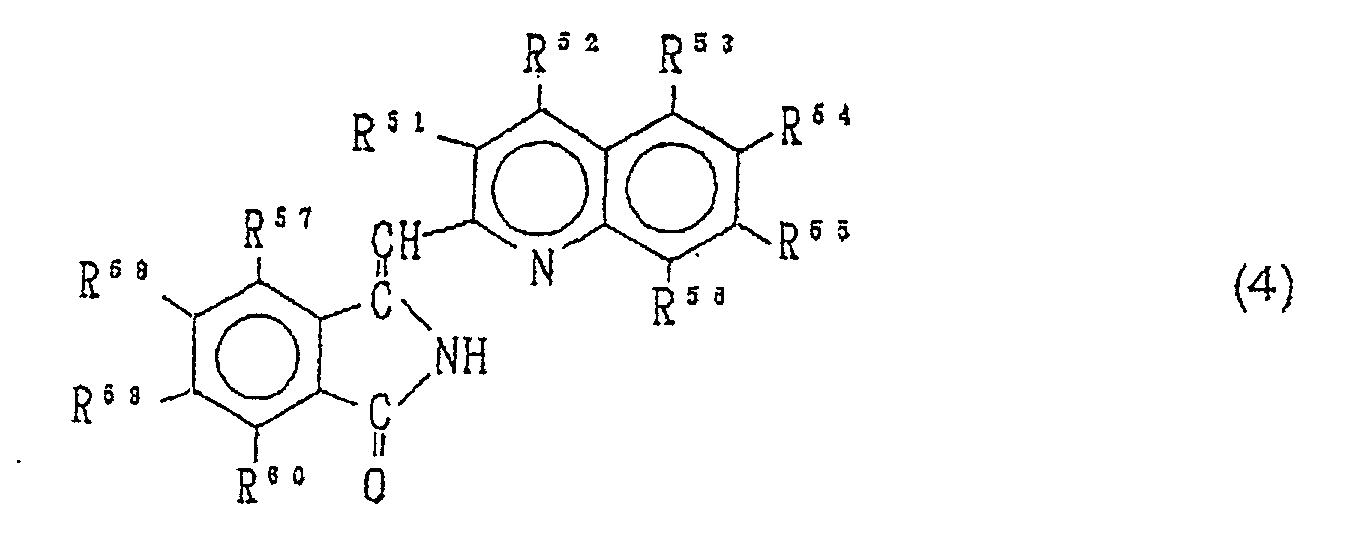
- the quinoline compound of the formula (4) and the tautomer of the same can be obtained by reacting the quinoline derivative of the formula (5) and the phthalimide derivative of the formula (6) with zinc halogenide in an organic base solvent and successively treating with an inorganic acid.
- Compound (1) is obtained from compounds (5a) and (6a) correspondingly.
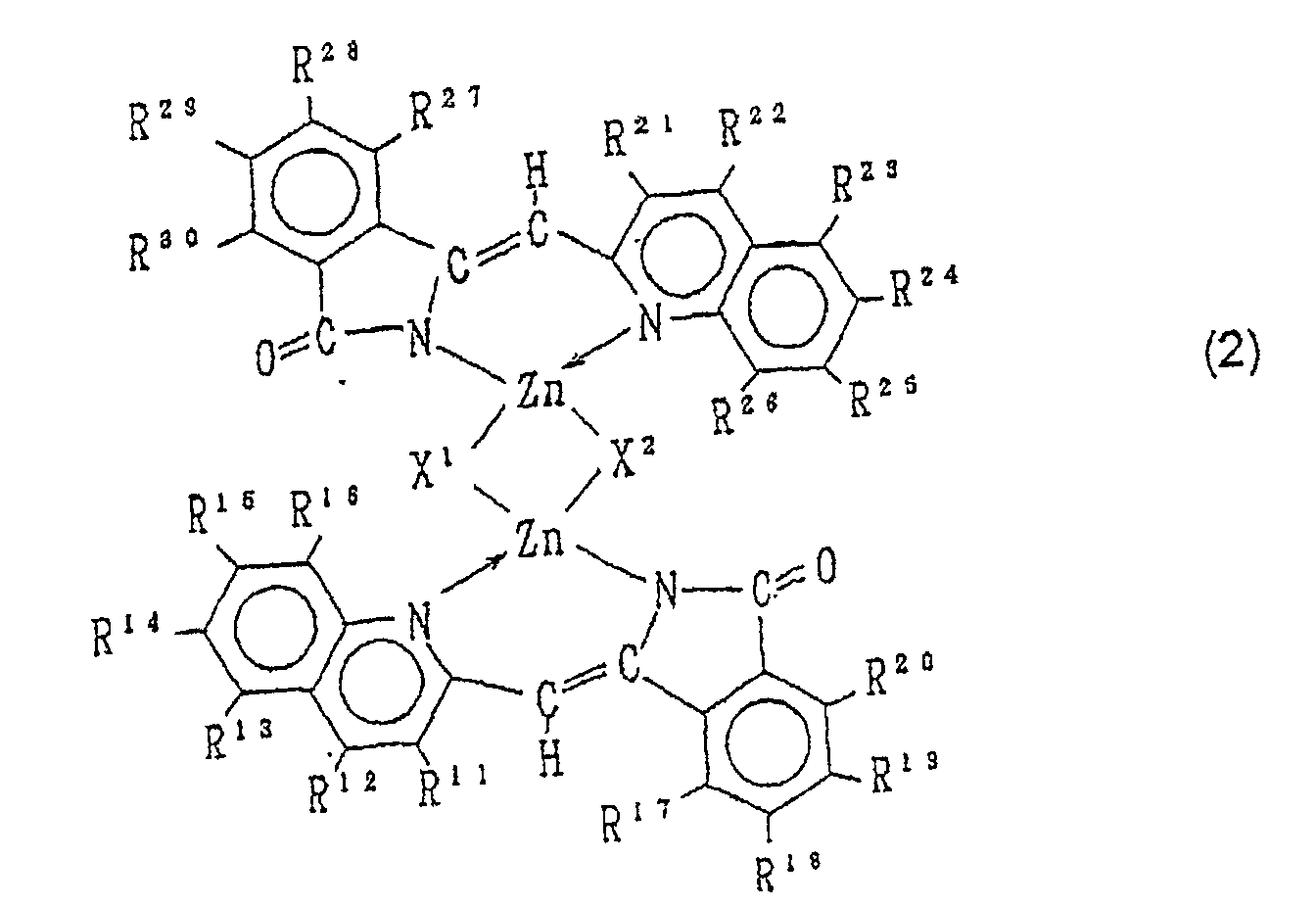
- the zinc halogenide complex of the formula (2) and the tautomer of the same can be obtained by reacting one or two kinds of the quinoline derivative of the formula (5) and one or two kinds of the phthalimide derivative of the formula (6) with zinc halogenide in an organic solvent.
- the zinc halogenide complex of the formula (2) and the tautomer of the same can be obtained by reacting the quinoline compound of the formula (4) and the tautomer of the same with zinc halogenide in an organic solvent.
- the zinc complex of the formula (3) and the tautomer of the same can be obtained by heating the zinc halogenide complex of the formula (2) and the tautomer of the same in an organic amine.
- the zinc complex of the formula (3) and the tautomer of the same can be obtained by reacting one or two kinds of the quinoline derivative of the formula (5) and one or two kinds of the phthalimide derivative of the formula (6) with zinc halogenide in an organic solvent.
- the quinoline compound of the formula (4) can be obtained by successively carrying out Process D and Process B without isolating the zinc halogenide complex of the formula (2).
- the quinoline compound of the formula (4) can be obtained by successively carrying out Process D, Process F and Process C without isolating the zinc halogenide complex of the formula (2) and zinc complex of the formula (3).
- each substituent of the compound (1) is shown by R 1 , R 2 , R 3 , R 4 , R 5 , R 6 , R 7 , R 8 , R 9 and R 10 , and is individually a hydrogen atom, halogen atom, cyano, amino, substituted or unsubstituted alkyl having two or more carbon atoms, substituted or unsubstituted aryl, substituted or unsubstituted alkoxy, substituted or unsubstituted aryloxy, substituted or unsubstituted N-alkyl amino, substituted or unsubstituted N,N-dialkyl amino, substituted or unsubstituted N-aryl amino, substituted or unsubstituted N,N-diaryl amino or substituted or unsubstituted N-alkyl-N-aryl amino group, with the proviso that not all of R 1 -R 10 are hydrogen atoms at the same time.
- halogen atoms include a fluorine, chlorine, bromine or iodine atom.
- Substituted or unsubstituted alkyl groups include methyl, ethyl, n-propyl radical, iso-propyl, n-butyl, iso-butyl, tert-butyl, sec-butyl, n-pentyl, iso-pentyl, tert-pentyl, sec-pentyl, cyclopentyl, n-hexyl, 1-methylpentyl, 2-methylpentyl, 3-methylpentyl, 4-methylpentyl, 1,1-dimethylbutyl, 1,2-dimethylbutyl, 1,3-dimethylbutyl, 2,3-dimethylbutyl, 1,1,2-trimethylpropyl, 1,2,2-trimethylpropyl, 1-ethylbutyl, 2-ethylbutyl, 1-ethyl-2-methylpropyl, cyclohexyl, methylcyclopentyl, n-heptyl
- substituted or unsubstituted aryl groups include, for example, a phenyl, naphthyl, anthranyl, 2-methylphenyl, 3-methylphenyl, 4-methylphenyl, 2,3-dimethylphenyl, 2,4-dimethylphenyl, 2,5-dimethylphenyl, 2,6-dimethylphenyl, 3,4-dimethylphenyl, 3,5-dimethylphenyl, 3,6-dimethylphenyl, 2,3,4-trimethylphenyl, 2,3,5-trimethylphenyl, 2,3,6-trimethylphenyl, 2,4,5-trimethylphenyl, 2,4,6-trimethylphenyl, 3,4,5-trimethylphenyl, 2-ethylphenyl, propylphenyl, butylphenyl, hexylphenyl, cyclohexylphenyl, octylphenyl, 2-methyl-1-naphthyl, 3-methyl-1-nap
- Substituted or unsubstituted alkoxy groups include, a methoxy, ethoxy, propoxy, butoxy, pentoxy, 1-methylbutoxy, 2-methylbutoxy, 3-methylbutoxy, 1,1-dimethylbutoxy, 1,2-dimethylbutoxy, 2,2-dimethylbutoxy, 1-ethylpropoxy, 2-ethylpropoxy, hexyloxy, cyclohexyloxy, heptyloxy, methylcyclohexyloxy, octyloxy, ethylcyclohexyloxy, dimethylcyclohexyloxy, nonyloxy, 2-ethylhexyloxy, 3,5,5-trimethylhexyloxy and decyloxy group, and other straight, branched or cyclic alkoxy groups which have 1 to 10 carbon atoms; a fluoromethoxy, trifluoromethoxy, fluoroethoxy, trifluoroethoxy, hexaflu
- Exemplary substituted or unsubstituted aryloxy groups include, for example, a phenyloxy, naphthyloxy, anthranyloxy, 2-methylphenyloxy, 3-methylphenyloxy, 4-methylphenyloxy, 2,3-dimethylphenyloxy, 2,4-dimethylphenyloxy, 2,5-dimethylphenyloxy, 2,6-dimethylphenyloxy, 3,4-dimethylphenyloxy, 3,5-dimethylphenyloxy, 3,6-dimethylphenyloxy, 2,3,4-trimethylphenyloxy, 2,3,5-trimethylphenyloxy, 2,3,6-trimethylphenyloxy, 2,4,5-trimethylphenyloxy, 2,4,6-trimethylphenyloxy, 3,4,5-trimethylphenyloxy, 2-ethylphenyloxy, propylphenyloxy, butylphenyloxy, hexylphenyloxy, cyclohexylphenyloxy, o
- Substituted or unsubstituted N-alkylamino groups include a N-methylamino, N-ethylamino, N-n-propylamino, N-iso-propylamino, N-n-butylamino, N-iso-butylamino, N-sec-butylamino, N-n-pentylamino, N-1-methylbutylamino, N-2-methylbutylamino, N-3-methylbutylamino, N-1,1-dimethylbutylamino, N-1,2-dimethylbutylamino, N-2,2-dimethylbutylamino, N-1-ethylpropylamino, N-2-ethylpropylamino, N-n-hexylamino, N-cyclohexylamino, N-n-heptylamino, N-methylcyclohexylamino, N-n-octylamino
- Substituted or unsubstituted N,N-dialkylamino groups include a N,N-dimethylamino, N,N-diethylamino, N,N- di(n-propyl)amino, N,N-di(iso-propyl)amino, N,N-di(n-butyl)amino, N,N-di(iso-butyl)amino, N,N-di(sec-butyl)amino, N,N-di(n-pentyl)amino, N,N-di(1-methylbutyl)amino, N,N-di(2-methylbutyl)amino, N,N-di(3-methylbutyl)amino, N,N-di(1,1-dimethylbutyl)amino, N,N-di(1,2-dimethylbutyl)amino, N,N-di(2,2-
- N-arylamino groups include, for example, a N-phenylamino, N-tolylamino, N-chlorophenylamino ,N-trifluorophenylamino, N-naphthylamino, N-methylnaphthylamino and N-chloronaphthylamino group.
- Exemplary substituted or unsubstituted N,N-diarylamino group include, for example, a N,N-diphenylamino, N,N-ditolylamino, N,N-dichlorophenylamino, N,N-ditrifluorophenylamino, N,N-dinaphthylamino, N,N-dimethylnaphthylamino and N,N-dichloronaphthylamino group.
- Exemplary substituted or unsubstituted N-alkyl-N-arylamino group include a N-methyl-N-phenylamino, N-ethyl-N-tolylamino, N-methoxyethyl-N-chlorophenylamino, N-ethyl-N-trifluorophenylamino, N-cyclohexyl-N-naphthylamino, N-ethyl-N-naphthylamino, N-2-ethylhexyl-N-methylnaphthylamino, N-methyl-N-chloronaphthylamino group.
- Substituents of R 1 to R 10 are preferably a hydrogen, fluorine, chlorine and bromine atom and a hydroxy, amino, methyl, ethyl, propyl, trifluoromethyl, phenyl, N,N-dimethylamino, N,N-diphenylamino and N,N-ditolylamino group.
- Substituents of R 11 to R 60 are preferably and Y 1 to Y 10 are preferably a hydrogen, fluorine, chlorine and bromine atom, and a nitro, amino, hydroxy, methyl, ethyl and trifluoromethyl group, and phenyl group.
- Preferred X 1 and X 2 are fluorine, chlorine and bromine atom.
- the organic basic solvent used in Process A includes at least one of N,N-dimethylaniline, N,N-diethylaniline, N-methylaniline, N-ethylaniline and other aniline derivatives ; pyridine and other pyridine derivatives ; quinoline, methylquinoline, isoquinoline and other quinoline derivatives ; diazabicycloundecene, diazabicyclononene, N-ethylmorpholine and other cyclic amine derivatives.
- N,N-dimethylaniline and N,N-diethylaniline are preferably used.
- the solvents can be used singly or as a mixture.
- the amount of the solvent is 1 to 50 parts by weight, preferably 4 to 21 parts by weight for a part of the quinoline derivative of the formula (5).
- organic solvent used n Process D, Process E and Process G include N,N-dimethylaniline, N,N-diethylaniline, N-methylaniline, N-ethylaniline and other aniline derivatives ; pyridine and other pyridine derivatives ; quinoline, methylquinoline, isoquinoline and other quinoline derivatives ; toluene, xylene and other aromatic hydrocarbons ; chlorobenzene, dichlorobenzene and other halogenated aromatic hydrocarbons ; and nitrobenzene and other nitroaromatic hydrocarbons.
- Preferred solvents are N,N-dimethylaniline, N,N-diethylaniline, dichlorobenzene and quinoline.
- the amount of the solvent is 1 to 50 parts by weight, preferably 4 to 16 parts by weight for a part by weight of the quinoline derivative of the formula (5) or the quinoline compound of the formula (4).
- organic amine for use in Process F include, pyridine, picoline, lutidine and other pyridine derivatives ; quinoline, isoquinoline and other quinoline derivatives ; diazabicyclo-undecene, diazabicyclo-nonene, N-methylmorpholine, N,N'-dimethylmorpholine, N-methylpiperidine, N,N'-dimethylpiperidine and other nitrogen heterocyclic compounds.
- Pyridine, picoline and butidine are preferably used in these organic amines, and can be used singly or as a mixture.
- the amount of the organic amine is 3 to 100 parts by weight, preferably 5 to 50 parts by weight for a part by weight of the zinc halogenide complex of the formula (2).
- inorganic acids which can be used in Process A, Process B and Process C include hydrochloric acid, sulfuric acid, nitric acid and phosphoric acid. Hydrochloric acid and sulfuric acid are preferably used in these inorganic acids.
- the amount in Process A is 1 to 200 molar ratio, preferably 6 to 35 molar ratio to the amount of the quinoline derivative of the formula (5).
- the amount in Process B is 2 to 200 molar ratio to the amount of the zinc halogenide complex of the formula (2).
- the amount in Process C is 2 to 200 molar ratio to the amount of the zinc complex of the formula (3).
- zinc halogenide which are used in Process A, Process D, Process E and Process G include zinc fluoride, zinc chloride, zinc bromide and zinc iodide. Zinc chloride and zinc bromide are preferably used.
- the amount in Process A, Process D and Process G is 0.1 to 50 molar ratio, preferably 0.5 to 10 molar ratio to the amount of the quinoline derivative of the formula (5).
- the amount in Process E is 0.1 to 50 molar ratio, preferably 0.2 to 10 molar ratio, more preferably 0.5 to 2.5 molar ratio to the amount of the quinoline compound of the formula (4).
- the amount of the phthalimide derivative of the formula (6) which is used in Process A is 0.2 to 10 molar ratio, preferably 0.5 to 2 molar ratio, more preferably 1.1 to 2.0 molar ratio to the amount of the quinoline derivative of the formula (5).
- the amount of the phthalimide derivative which is used in Process D and Process G is 0.2 to 10 molar ratio, preferably 0.5 to 2 molar ratio to the amount of the quinoline derivative of the formula (5).
- the reaction temperature with zinc halogenide in Process A, Process D and Process E is usually 100 to 250°C, preferably 130 to 180 °C.
- the reaction time is usually 5 to 50 hours.
- the reaction temperature with zinc halogenide in Process G is usually 100 to 250°C, preferably 110 to 180 °C.
- the reaction time is usually 5 to 50 hours.
- the temperature for treating with the inorganic acid in Process A, Process B and Process C is usually 50 to 100°C, preferably 80 to 95 °C.
- the treating time is usually 0.1 to 10 hours.
- the temperature for heating with the organic amine in Process F is 30 ⁇ 200 °C, preferably 50 ⁇ 150 °C.
- the treating time is usually 0.1 ⁇ 10 hours.
- Process B As to the post-treatment after finishing the reaction in Process A, Process B and Process C, precipitated solid is filtered as intact, washed and dried, and subjected to purification such as sludging with a polar solvent or recrystallization, when necessary.
- Process D Process E, Process F and Process G, the precipitated solid is filtered as intact or after removing the solvent by distillation, washed, dried and, when necessary, purified by sludging with a polar solvent.
- the quinoline compound of the formula (7) obtained by the process A isa crystal having a peak at least at a Bragg angle(2 ⁇ ) of 12.8 °, 15.2° , 18.3° , 22.5° , 25° and 28.4 °.
- the crystal where the intensity ratio of the peak at 12.8° is 0.7 or less to peak at 15.2° has brightness of 180 % or more in the solid state for the brightness of Lumogen Brilliant Yellow and is thus a compound being excellent in luminescent property.
- the EL element has structure wherein as anode (4), positive hole transporting layer (3) which is composed of an organic compound, luminescent layer (2) which consists of the compound of the invention, and a metal cathode (1) are successively stacked up on a glass substrate (ITO glass substrate) (5).
- the EL element can also have structure wherein an anode (4), positive hole transporting layer (3) which is composed of an organic compound, luminescent layer (2) which consists of the compound of the invention, electron transporting layer (6) and a metal cathode (1) are successively stacked up on a glass substrate (IT0 glass substrate) (5).
- the positive hole transporting compounds which can be used for the positive hole transporting layer (3) in the above structure of the element are compounds containing tertiary amine which bonds to one or more aromatic rings, or other low-molecular weight compounds or high polymers which have positive hole transporting property.
- the transporting compounds are preferably triphenylamine derivatives represented by the formula (8) or the formula (9), or pyrazoline derivative, polyvinyl carbazole and polysilane. These compounds can be used singly or as a mixture. where each of a, b, c, d, e, f, g, h, and k is individually 0 or an integer of 1, 2, or 3.
- each of l, m, n, p, q, r, s, t, u, v, w, x, y, z, ⁇ , and ⁇ is individually 0 or 1; and A is a non-ring forming divalent hydrogen atom, -CH 2 -, or -C(CH 3 ) 2 -.
- the materials used for the anode of the EL element in the invention preferably have a work function as large as possible and include, for example, nickel, gold, platinum, palladium, selenium, iridium, an alloy of these metals, tin oxide, ITO, and copper iodide.
- Polyphenylene sulfide, polyaniline and other conductive polymers can also be used.
- the materials used for the cathode preferably have a small work function and include, for example, silver, lead, tin, magnesium, aluminum, calcium, indium, chromium, lithium and an alloy of these metals.
- One of a pair of materials used for the anode and cathode desirably has transmittance of 50% or more in the oscillating wave length region of the element.
- Glass and a plastic film can be used for a substrate of transparent electrodes which are used in the invention.
- the compounds (7) had purity of 100% and purity reduced yield for quinaldine was 86%.
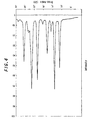
- the X-ray diffraction spectrum of the compound (7) is shown in Figure 1.
- the peak intensity ratio at Bragg angle 12.8° was 0.46 for the intensity at Bragg angle 15.2° .
- the crystal was measured in the solid state as intact with a fluorophotometer: UM-2S, manufactured by Hekisa Kagaku Co. The crystal had brightness of 220 % for the brightness of Lumogen Brilliant Yellow.
- the compounds had purity of 100% and purity reduced yield for phthalimide was 77%.
- the X-ray diffraction spectrum of the compound is shown in Figure 2.
- the peak intensity ratio at Bragg angle 12.8° was 0.46 for the intensity at Bragg angle 15.2° .
- the crystal was measured in the solid state as intact with a fluorophotometer: UM-2S, manufactured by Hekisa Kagaku Co.
- the crystal has brightness of 204 % for the brightness of Lumogen Brilliant Yellow.
- the compounds had purity of 100% and purity reduced yield for phthalimide was 75%.
- the X-ray diffraction spectrum of the compound is shown in Figure 3.
- the peak intensity ratio at Bragg angle 12.8° was 0.70 for the intensity at Bragg angle 15.2°.
- the crystal was measured in the solid state as intact with a fluorophotometer: UM-2S, manufactured by Hekisa Kagaku Co. The crystal had brightness of 189% for the brightness of Lumogen Brilliant Yellow.
- the compounds had purity of 97% and purity reduced yield for phthalimide was 84%.
- the X-ray diffraction spectrum of the compound is shown in Figure 4.
- the peak intensity ratio at Bragg angle 12.8° was 0.70 for the intensity at Bragg angle 15.2° .
- the crystal was measured in the solid state as intact with a fluorophotometer: UM-2S, manufactured by Hekisa Kagaku Co. The crystal had brightness of 180% for the brightness of Lumogen Brilliant Yellow.
- N,N'-diphenyl-N,N'-ditolyl-1,1-diphenyl-4,4'-diamine was stacked to a film thickness of 50nm under vacuum of 5 ⁇ 10 -5 torr by a resistance heating method.
- the quinoline compound of the formula (7) was stacked to a film thickness of 50nm and further, an aluminum electrode was deposited to a film thickness of 150nm under vacuum of 6 ⁇ 10 -5 torr.
- a positive electric field was applied to the ITO side of the element and a negative electric field was applied to the aluminum side.
- the emission from the surface of ITO glass substrate of the element was observed. As a voltage of 19V and a current density of 26mA/cm 2 , the emission was green and stable and the brightness was 115 Cd/m 2 .
- the compound of the formula (7) was added to polyethylene terephthalate resin powder, hot pressed at 280°C and cooled to obtain a sheet having thickness of 0.5mm.
- the sheet was measured with a fluorophotometer: FP-770, manufactured by Nippon Bunko Co. ⁇ em was 523nm.
- N,N'-diphenyl-N,N'-ditolyl-1,1-diphenyl-4,4'-diamine was stacked to a film thickness of 50nm under vacuum of 5 ⁇ 10 -5 torr by a resistance heating method.
- the quinoline compound of the formula (10) was stacked to a film thickness of 50nm and further, an aluminum electrode was deposited to a film thickness of 150nm under vacuum of 6 ⁇ 10 -5 torr.
- a positive electric field was applied to the ITO side of the element and a negative electric field was applied to the aluminum side.
- the emission from the surface of ITO glass substrate of the element was observed. As a voltage of 19V and a current density of 26mA/cm 2 , the emission was green and stable and the brightness was 115 Cd/m 2 .
- the quinoline compound of the formula (10) was added to polyethylene terephthalate resin powder, hot pressed at 280 °C and cooled to obtain a sheet having thickness of 0.5mm.
- the sheet was measured with a fluorophotometer: FP-770, manufactured by Nippon Bunko Co. Emission at 520 nm and excitatioin at 375 nm were obtained.
- 1,1-bis(4-N,N-ditolylaminophenyl)cyclohexanone was stacked to a film thickness of 50nm.
- the quinoline compound of the formula (11) was stacked to a film thickness of 50nm and further, 2,2',6,6'-tetramethylphenoquinone was stacked to a film thickness of 50nm.
- a back electrode was formed by stacking indium to a film thickness of 150nm. When a voltage of 8V was applied, emission of 280Cd/m 2 was obtained.
- the quinoline compound of the formula (11) was added to polyethylene terephthalate resin powder, hot pressed at 280 °C and cooled to obtain a sheet having thickness of 0.5mm.
- the sheet was measured with a fluorophotometer: FP-770, manufactured by Nippon Bunko Co. Emission at 530 nm and excitation at 383 nm were obtained.
- N,N,N',N'-tetra(4-ditolylaminophenyl)-1,4-phenylenediamine was stacked to a film thickness of 50nm under vacuum of 5 ⁇ 10 -6 torr by a resistance heating method.
- the quinoline compound of the formula (12) was stacked to a film thickness of 50nm and further, an aluminum electrode was deposited to a film thickness of 150nm under vacuum of 6 ⁇ 10 -5 torr.
- a positive electric field was applied to the ITO side of the element and a negative electric field was applied to the aluminum side.
- the emission from the surface of ITO glass substrate of the element was observed. When a voltage of 19V was applied, the emission was stable and the emission of 118Cd/m 2 was obtained.
- the quinoline compound of the formula (12) was added to polyethylene terephthalate resin powder, hot pressed at 280 °C and cooled to obtain a sheet having thickness of 0.5mm.
- the sheet was measured with a fluorophotometer: FP-770, manufactured by Nippon Bunko C o. Emission at 530 nm and excitation at 380 nm were obtained.
- N,N'-diphenyl-N,N'-ditolyl-1,1'-diphenyl-4,4'-diamine was stacked to a film thickness of 50nm under vacuum of 5 ⁇ 10 -5 torr by a resistance heating method.
- the quinoline compound of the formula (13) was stacked to a film thickness of 50nm and further, an aluminum electrode was deposited to a film thickness of 150nm under vacuum of 6 ⁇ 10 -5 torr.
- a positive electric field was applied to the ITO side of the element and a negative electric field was applied to the aluminum side.
- the emission from the surface of ITO glass substrate of the element was observed. As a voltage of 19V and a current density of 26mA/cm 2 , the emission was stable and the emission of 115 Cd/m 2 was obtained.
- the compound of the formula (13) was added to polyethylene terephthalate resin powder, hot pressed at 280 °C, and cooled to obtain a sheet having thickness of 0.5nm.
- the sheet was measured with a spectrophotometer: UV-3100 PC, manufactured by Shimadzu Seisakusho Co. Ultraviolet transmittance at 380nm was 2%.
- 1,1-bis(4-N,N-ditolylaminophenyl)cyclohexanone was stacked to a film thickness of 50nm.
- the quinoline compound of the formula (13) was stacked to a film thickness of 50nm, and further 2,2',6,6'-tetramethyldiphenoquinone was stacked to a film thickness of 50 nm.
- a back electrode was formed by stacking indium to a film thickness of 150nm. When a voltage of 8V was applied, emission of 300Cd/m 2 was obtained.
- the compound of the formula (14) was added to polyethylene terephthalate resin powder, hot pressed at 280 °C, and cooled to obtain a sheet having thickness of 0.5nm.
- the sheet was measured with a spectrophotometer: UV-3100PC, manufactured by Shimadzu Seisakusho Co. Ultraviolet transmittance at 380nm was 4%.
- N,N,N',N'-tetra(4-ditrylaminophenyl)-1,4-phenylenediamine was stacked to a film thickness of 50nm under vacuum of 5 ⁇ 10 -6 torr by a resistance heating method.
- the compound of the formula (15) was stacked to a film thickness of 50nm and further, an aluminum electrode was deposited to a film thickness of 150nm under vacuum of 6 ⁇ 10 -5 torr.
- a positive electric field was applied to the ITC side of the element and a negative electric field was applied to the aluminum side.
- the emission from the surface of ITO glass substrate of the element was observed. As a voltage of 9 V, the emission was stable and the emission of 120 Cd/m 2 was obtained.
- the compound of the formula (15) was added to polyethylene terephthalate resin powder, hot pressed at 280 °C, and cooled to obtain a sheet having thickness of 0.5 mm.
- the sheet was measured with a spectrophotometer: UV-3100PC, manufactured by Shimadzu Seisakusho Co. Ultraviolet transmittance at 370nm was 3%.
- Figure 6 illustrates an NMR chart
- Figure 7 illustrates an IR spectrum
- Figure 8 illustrates an MS spectrum of the compound having the formula (16), respectively.
- N,N'-diphenyl-N,N'-ditolyl-1,1'-diphenyl-4,4'-diamine was stacked to a film thickness of 50nm under vacuum of 5 ⁇ 10 -5 torr by a resistance heating method.
- the compound of the formula (16) was stacked to a film thickness of 50nm and further, an aluminum electrode was deposited to a film thickness of 150nm under vacuum of 6 ⁇ 10 -5 torr.
- a positive electric field was applied to the ITO side of the element and a negative electric field was applied to the aluminum side.
- the emission from the surface of ITO glass substrate of the element was observed. As a voltage of 19 V and a current density of 26 mA/cm 2 , the emission was stable and the emission of 115 Cd/m 2 was obtained.
- the compound of the formula (16) was added to polyethylene terephthalate resin powder, hot pressed at 280 °C, and cooled to obtain a sheet having thickness of 0.5mm.
- the sheet was measured with a spectrophotometer: UV-3100PC, manufactured by Shimadzu Seisakusho Co. Ultraviolet transmittance at 380nm was 5%.
- 1,1-bis(4-N,N-ditolylaminophenyl)cyclohexanone was stacked to a film thickness of 50nm.
- the quinoline compound of the formula (17) was stacked to a film thickness of 50nm, and further 2,2', 6,6'-tetramethyldiphenoquinone was stacked to a film thickness of 50 nm.
- a back electrode was formed by stacking indium to a film thickness of 150nm. When a voltage of 8 V was applied, emission of 300 Cd/m 2 was obtained.
- the compound of the formula (17) was added to polyethylene terephthalate resin powder, hot pressed at 280 °C, and cooled to obtain a sheet having thickness of 0.5mm.
- the sheet was measured with a spectrophotometer: UV-3100PC, manufactured by Shimadzu Seisakusho Co. Ultraviolet transmittance at 380nm was 4%.
- N,N,N',N'-tetra(4-ditolylaminophenyl)-1,4-phenylenediamine was stacked to a film thickness of 50nm under vacuum of 5 ⁇ 10 -6 torr by a resistance heating method.
- the compound of the formula (18) was stacked to a film thickness of 50nm and further, an aluminum electrode was deposited to a film thickness of 150nm under vacuum of 6 ⁇ 10 -5 torr.
- a positive electric field was applied to the ITC side of the element and a negative electric field was applied to the aluminum side.
- the emission from the surface of ITO glass substrate of the element was observed. As a voltage of 9 V, the emission was stable and the emission of 120 Cd/m 2 was obtained.
- the compound of the formula (18) was added to polyethylene terephthalate resin powder, hot pressed at 280 °C, and cooled to obtain a sheet having thickness of 0.5 mm.
- the sheet was measured with a spectrophotometer: UV-3100PC, manufactured by Shimadzu Seisakusho Co. Ultraviolet transmittance at 375nm was 2%.
- An EL element was prepared by stacking the compound having the formula below in place of the compound (7) in Example 1.
- the EL element had an emission intensity of 80Cd/m 2 .
Landscapes
- Chemical & Material Sciences (AREA)
- Organic Chemistry (AREA)
- Engineering & Computer Science (AREA)
- Materials Engineering (AREA)
Claims (18)
- Chinolinverbindung und ein Tautomer derselben, die durch die Formel (1) wiedergegeben werden:wobei jeder der Reste R1, R2, R3, R4, R5, R6, R7, R8, R9 und R10 jeweils ein Wasserstoffatom, ein Halogenatom, eine Cyanogruppe, eine Aminogruppe, einen substituierten oder unsubstituierten geraden, verzweigten oder cyclischen Kohlenwasserstoffrest mit 2 bis 10 Kohlenstoffatomen, einen substituierten oder unsubstituierten Arylrest, einen substituierten oder unsubstituierten geraden, verzweigten oder cyclischen Alkoxyrest mit 1 bis 10 Kohlenstoffatomen, einen substituierten oder unsubstituierten Aryloxyrest, einen substituierten oder unsubstituierten N-Alkylaminorest mit einem geraden, verzweigten oder cyclischen Alkylrest mit 1 bis 10 Kohlenstoffatomen, einen substituierten oder unsubstituierten N,N-Dialkylaminorest mit geraden, verzweigten oder cyclischen Alkylresten mit 1 bis 10 Kohlenstoffatomen, einen substituierten oder unsubstituierten N-Arylaminorest, einen substituierten oder unsubstituierten N,N-Diarylaminorest oder einen substituierten oder unsubstituierten N-Alkyl-N-arylaminorest bedeutet, bis auf den Fall, wo alle Reste R1, R2, R3, R4, R5, R6, R7, R8, R9 und R10 ein Wasserstoffatom darstellen.

- Zinkhalogenidkomplex und ein Tautomer desselben, die durch die Formel (2) wiedergegeben werden:wobei jeder der Reste R11, R12, R13, R14, R15, R16, R17, R18, R19, R20, R21, R22, R23, R24, R25, R26, R27, R28, R29 und R30 jeweils ein Wasserstoffatom, ein Halogenatom, eine Nitrogruppe, eine Cyanogruppe, eine Hydroxygruppe, eine Aminogruppe, einen substituierten oder unsubstituierten geraden, verzweigten oder cyclischen Kohlenwasserstoffrest mit 1 bis 10 Kohlenstoffatomen, einen substituierten oder unsubstituierten Arylrest, einen substituierten oder unsubstituierten geraden, verzweigten oder cyclischen Alkoxyrest mit 1 bis 10 Kohlenstoffatomen, einen substituierten oder unsubstituierten Aryloxyrest, einen substituierten oder unsubstituierten N-Alkylaminorest mit einem geraden, verzweigten oder cyclischen Alkylrest mit 1 bis 10 Kohlenstoffatomen, einen substituierten oder unsubstituierten N,N-Dialkylaminorest mit geraden, verzweigten oder cyclischen Alkylresten mit 1 bis 10 Kohlenstoffatomen, einen substituierten oder unsubstituierten N-Arylaminorest, einen substituierten oder unsubstituierten N,N-Diarylaminorest oder einen substituierten oder unsubstituierten N-Alkyl-N-arylaminorest bedeutet und jeder der Reste X1 und X2 jeweils ein Fluor-, Chlor-, Brom- oder Jodatom darstellt.
- Zinkkomplex und Tautomer desselben, die durch die Formel (3) wiedergegeben werden:wobei jeder der Reste R31, R32, R33, R34, R35, R36, R37, R38, R39, R40, R41, R42, R43, R44, R45, R46, R47, R48, R49 und R50 jeweils ein Wasserstoffatom, ein Halogenatom, eine Nitrogruppe, eine Cyanogruppe, eine Hydroxygruppe, eine Aminogruppe, einen

substituierten oder unsubstituierten geraden, verzweigten oder cyclischen Kohlenwasserstoffrest mit 1 bis 10 Kohlenstoffatomen, einen substituierten oder unsubstituierten Arylrest, einen substituierten oder unsubstituierten geraden, verzweigten oder cyclischen Alkoxyrest mit 1 bis 10 Kohlenstoffatomen, einen substituierten oder unsubstituierten Aryloxyrest, einen substituierten oder unsubstituierten N-Alkylaminorest mit einem geraden, verzweigten oder cyclischen Alkylrest mit 1 bis 10 Kohlenstoffatomen, einen substituierten oder unsubstituierten N,N-Dialkylaminorest mit geraden, verzweigten oder cyclischen Alkylresten mit 1 bis 10 Kohlenstoffatomen, einen substituierten oder unsubstituierten N-Arylaminorest, einen substituierten oder unsubstituierten N,N-Diarylaminorest oder einen substituierten oder unsubstituierten N-Alkyl-N-arylaminorest bedeutet. - Herstellungsverfahren einer Chinolinverbindung und eines Tautomeren derselben, die durch die Formel (1) des Anspruchs 1 wiedergegeben werden, das das Umsetzen eines Chinolinderivates, das durch die Formel (5a) wiedergegeben wird:wobei jeder der Reste R1, R2, R3, R4, R5 und R6 wie in Anspruch 1 definiert ist, und eines Phthalimidderivates, das durch die Formel (6a) wiedergegeben wird:
 wobei jeder der Reste R7, R8, R9 und R10 wie in Anspruch 1 definiert ist,
mit Zinkhalogenid in einem organischen basischen Lösungsmittel, das aus N,N-Dimethylanilin, N,N-Diethylanilin, N-Methylanilin, N-Ethylanilin und anderen Anilinderivaten, Pyridin und seinen Derivaten, Chinolin, Methylchinolin, Isochinolin und anderen Chinolinderivaten, Diazabicycloundecen, Diazabicyclononen, N-Ethylmorpholin und anderen cyclischen Aminderivaten ausgewählt ist, oder Gemischen der vorstehenden Lösungsmittel und danach das Behandeln mit einer anorganischen Säure umfasst. - Herstellungsverfahren nach Anspruch 4, wobei das Phthalimidderivat in einem Molverhältnis von 0,5 bis 2,0 zum Chinolinderivat vorliegt.
- Herstellungsverfahren nach Anspruch 4, wobei das Phthalimidderivat in einem Molverhältnis von 1,1 bis 2,0 zum Chinolinderivat vorliegt.
- Herstellungsverfahren einer Chinolinverbindung und eines Tautomeren derselben, die durch Formel (1) des Anspruchs 1 wiedergegeben werden, das das Behandeln eines Zinkhalogenidkomplexes und eines Tautomeren desselben, die durch die Formel (2a) wiedergegeben werden:wobei R1, R2, R3, R4, R5, R6, R7, R8, R9 und R10 wie in Anspruch 1 definiert sind und X1 und X2 wie in Anspruch 2 definiert sind, mit einer anorganischen Säure umfasst.

- Herstellungsverfahren einer Chinolinverbindung und eines Tautomeren derselben, die durch Formel (1) des Anspruchs 1 wiedergegeben werden, das das Behandeln eines Zinkkomplexes und eines Tautomeren desselben, die durch die Formel (3a) wiedergegeben werden:wobei R1, R2, R3, R4, R5, R6, R7, R8, R9 und R10 wie in Anspruch 1 definiert sind, mit einer anorganischen Säure umfasst.

- Elektrolumineszenzelement, wobei die Leuchtschicht eine Verbindung, die durch die Formel (4) wiedergegeben wirdund ein Tautomer derselben ist, wobei jeder der Reste R51, R52, R53, R54, R55, R56, R57, R58, R59 und R60 jeweils ein Wasserstoffatom, ein Halogenatom, eine Nitrogruppe, eine Cyanogruppe, eine Hydroxygruppe, eine Aminogruppe, einen substituierten oder unsubstituierten geraden, verzweigten oder cyclischen Kohlenwasserstoffrest mit 1 bis 10 Kohlenstoffatomen, einen substituierten oder unsubstituierten Arylrest, einen substituierten oder unsubstituierten geraden, verzweigten oder cyclischen Alkoxyrest mit 1 bis 10 Kohlenstoffatomen, einen substituierten oder unsubstituierten Aryloxyrest, einen substituierten oder unsubstituierten N-Alkylaminorest mit einem geraden, verzweigten oder cyclischen Alkylrest mit 1 bis 10 Kohlenstoffatomen, einen substituierten oder unsubstituierten N,N-Dialkylaminorest mit geraden, verzweigten oder cyclischen Alkylresten mit 1 bis 10 Kohlenstoffatomen, einen substituierten oder unsubstituierten N-Arylaminorest, einen substituierten oder unsubstituierten N,N-Diarylaminorest oder einen substituierten oder unsubstituierten N-Alkyl-N-arylaminorest bedeutet.
- Leuchtstoff, der eine Chinolinverbindung, die durch die wie in Anspruch 1 definierte Formel (1) wiedergegeben wird, und ein Tautomer derselben umfasst.
- Herstellungsverfahren eines Zinkhalogenidkomplexes, der durch die wie in Anspruch 2 definierte Formel (2) wiedergegeben wird, und eines Tautomeren desselben, das das Umsetzen von ein oder zwei Arten eines Chinolinderivates, das durch die Formel (5) wiedergegeben wird:wobei jeder der Reste Y1, Y2, Y3, Y4, Y5 und Y6 ein Wasserstoffatom, ein Halogenatom, eine Nitrogruppe, eine Cyanogruppe, eine Hydroxygruppe, eine Aminogruppe, einen substituierten oder unsubstituierten geraden, verzweigten oder cylischen Kohlenwasserstoffrest mit 1 bis 10 Kohlenstoffatomen, einen substituierten oder unsubstituierten Arylrest, einen substituierten oder unsubstituierten geraden, verzweigten oder cyclischen Alkoxyrest mit 1 bis 10 Kohlenstoffatomen, einen substituierten oder unsubstituierten Aryloxyrest, einen substituierten oder unsubstituierten N-Alkylaminorest mit einem geraden, verzweigten oder cyclischen Alkylrest mit 1 bis 10 Kohlenstoffatomen, einen substituierten oder unsubstituierten N,N-Dialkylaminorest mit geraden, verzweigten oder cyclischen Alkylresten mit 1 bis 10 Kohlenstoffatomen, einen substituierten oder unsubstituierten N-Arylaminorest, einen substituierten oder unsubstituierten N,N-Diarylaminorest oder einen substituierten oder unsubstituierten N-Alkyl-N-arylaminorest bedeutet,

und ein oder zwei Arten eines Phthalimidderivates, das durch die Formel (6) wiedergegeben wird:wobei jeder der Reste Y7, Y8, Y9 und Y10 jeweils ein Wasserstoffatom, ein Halogenatom, eine Nitrogruppe, eine Cyanogruppe, eine Hydroxygruppe, eine Aminogruppe, einen substituierten oder unsubstituierten geraden, verzweigten oder cyclischen Kohlenwasserstoffrest mit 1 bis 10 Kohlenstoffatomen, einen substituierten oder unsubstituierten Arylrest, einen substituierten oder unsubstituierten geraden, verzweigten oder cyclischen Alkoxyrest mit 1 bis 10 Kohlenstoffatomen, einen substituierten oder unsubstituierten Aryloxyrest, einen substituierten oder unsubstituierten N-Alkylaminorest mit einem geraden, verzweigten oder cyclischen Alkylrest mit 1 bis 10 Kohlenstoffatomen, einen substituierten oder unsubstituierten N,N-Dialkylaminorest mit geraden, verzweigten oder cyclischen Alkylresten mit 1 bis 10 Kohlenstoffatomen, einen substituierten oder unsubstituierten N-Arylaminorest, einen substituierten oder unsubstituierten N,N-Diarylaminorest oder einen substituierten oder unsubstituierten N-Alkyl-N-arylaminorest bedeutet,
mit Zinkhalogenid in einem organischen basischen Lösungsmittel umfasst. - Herstellungsverfahren eines Zinkhalogenidkomplexes, der durch die Formel (2) wiedergegeben wird, und eines Tautomeren desselben, das das Umsetzen eines Chinolinderivates, das durch die Formel (4) wiedergegeben wird:wobei R51, R52, R53, R54, R55, R56, R57, R58, R59 und R60 wie in Anspruch 9 definiert sind, und eines Tautomeren desselben, mit Zinkhalogenid in einem organischen Lösungsmittel umfasst.

- Elektrolumineszenzelement, wobei die Leuchtschicht ein Zinkhalogenidkomplex, der durch die wie in Anspruch 2 definierte Formel (2) wiedergegeben wird, und ein Tautomer desselben ist.
- Ultraviolettabsorptionsmaterial, das einen Zinkhalogenidkomplex, der durch die wie in Anspruch 2 definierte Formel (2) wiedergegeben wird, und ein Tautomer desselben umfasst.
- Herstellungsverfahren eines Zinkkomplexes, der durch die wie in Anspruch 3 definierte Formel (3) wiedergegeben wird, und eines Tautomeren desselben, das das Erhitzen eines Zinkhalogenidkomplexes, der durch die Formel (2) wiedergegeben wird,wobei R11, R12, R13, R14, R15, R16, R17, R18, R19, R20, R21, R22, R23, R24, R25, R26, R27, R28, R29, R30, X1 und X2 wie in Anspruch 2 definiert sind, und eines Tautomeren desselben in organischem Amin umfasst.

- Herstellungsverfahren eines Zinkkomplexes, der durch die wie in Anspruch 3 definierte allgemeine Formel (3) wiedergegeben wird, und eines Tautomeren desselben, das das Umsetzen von ein oder zwei Arten eines Chinolinderivates, das durch die Formel (5) wiedergegeben wirdwobei Y1, Y2, Y3, Y4, Y5 und Y6 wie in Anspruch 11 definiert sind, und das Umsetzen von ein oder zwei Arten eines Phthalimidderivates, das durch die Formel (6) wiedergegeben wird:
 wobei Y7, Y8, Y9 und Y10 wie in Anspruch 11 definiert sind, mit Zinkalogenid in einem organischen Lösungsmittel umfasst.
- Elektrolumineszenzelement, wobei die Leuchtschicht ein Zinkkomplex, der durch die wie in Anspruch 3 definierte Formel (3) wiedergegeben wird, und ein Tautomer desselben ist.
- Ultraviolettabsorptionsmaterial, das einen Zinkkomplex, der durch die in Anspruch 3 wiedergegebene Formel (3) wiedergegeben wird, und ein Tautomer desselben umfasst.
Applications Claiming Priority (15)
| Application Number | Priority Date | Filing Date | Title |
|---|---|---|---|
| JP16886196 | 1996-06-28 | ||
| JP16686096 | 1996-06-28 | ||
| JP168861/96 | 1996-06-28 | ||
| JP166860/96 | 1996-06-28 | ||
| JP16886196 | 1996-06-28 | ||
| JP16886096 | 1996-06-28 | ||
| JP26859296 | 1996-10-09 | ||
| JP26859296 | 1996-10-09 | ||
| JP268592/96 | 1996-10-09 | ||
| JP325402/96 | 1996-12-05 | ||
| JP32540296 | 1996-12-05 | ||
| JP32540296 | 1996-12-05 | ||
| JP332135/96 | 1996-12-12 | ||
| JP33213596 | 1996-12-12 | ||
| JP33213596 | 1996-12-12 |
Publications (2)
| Publication Number | Publication Date |
|---|---|
| EP0818512A1 EP0818512A1 (de) | 1998-01-14 |
| EP0818512B1 true EP0818512B1 (de) | 2002-10-02 |
Family
ID=27528467
Family Applications (1)
| Application Number | Title | Priority Date | Filing Date |
|---|---|---|---|
| EP97110593A Expired - Lifetime EP0818512B1 (de) | 1996-06-28 | 1997-06-27 | Chinolinderivate und ihre Anwendung |
Country Status (4)
| Country | Link |
|---|---|
| US (1) | US6132640A (de) |
| EP (1) | EP0818512B1 (de) |
| KR (2) | KR100255281B1 (de) |
| DE (1) | DE69715979T2 (de) |
Families Citing this family (4)
| Publication number | Priority date | Publication date | Assignee | Title |
|---|---|---|---|---|
| US6420057B1 (en) | 1999-07-05 | 2002-07-16 | Konica Corporation | Organic electroluminescent element |
| EP1881050B1 (de) | 2000-11-30 | 2013-01-09 | Canon Kabushiki Kaisha | Lumineszenzvorrichtung und Anzeigeapparat |
| US7189989B2 (en) * | 2002-08-22 | 2007-03-13 | Fuji Photo Film Co., Ltd. | Light emitting element |
| CN118165397B (zh) * | 2024-04-08 | 2024-08-30 | 东莞市嘉上实业有限公司 | 一种塑料桶用聚乙烯复合材料及其制备方法 |
Family Cites Families (4)
| Publication number | Priority date | Publication date | Assignee | Title |
|---|---|---|---|---|
| DE1544646A1 (de) * | 1964-09-25 | 1970-04-09 | Basf Ag | Im UV-Licht fluoreszierende Pigmente |
| JPS56147784A (en) * | 1980-04-18 | 1981-11-16 | Tokushu Toryo Kk | Preparation of beta-quinophthalone |
| JP2875463B2 (ja) * | 1993-11-10 | 1999-03-31 | 新光電気工業株式会社 | El素子用発光材料及びel素子 |
| EP0761772B1 (de) * | 1995-07-28 | 2000-03-15 | Ciba SC Holding AG | Lösliche Chromophore mit leicht abspaltbaren löslichmachenden Gruppen |
-
1997
- 1997-06-18 US US08/877,913 patent/US6132640A/en not_active Expired - Fee Related
- 1997-06-27 KR KR1019970028250A patent/KR100255281B1/ko not_active Expired - Fee Related
- 1997-06-27 DE DE69715979T patent/DE69715979T2/de not_active Expired - Fee Related
- 1997-06-27 EP EP97110593A patent/EP0818512B1/de not_active Expired - Lifetime
-
1999
- 1999-08-24 KR KR1019990035300A patent/KR100281247B1/ko not_active Expired - Fee Related
Also Published As
| Publication number | Publication date |
|---|---|
| US6132640A (en) | 2000-10-17 |
| DE69715979D1 (de) | 2002-11-07 |
| EP0818512A1 (de) | 1998-01-14 |
| KR100255281B1 (ko) | 2000-05-01 |
| KR980002042A (ko) | 1998-03-30 |
| DE69715979T2 (de) | 2003-08-07 |
| KR100281247B1 (ko) | 2001-02-01 |
Similar Documents
| Publication | Publication Date | Title |
|---|---|---|
| US5484922A (en) | Internal junction organic electroluminescent device with a novel composition | |
| DE69811303T2 (de) | Elektrolumineszente Vorrichtungen | |
| KR101506761B1 (ko) | 유기 화합물 및 이를 이용한 유기 전계 발광 소자 | |
| EP0869700A2 (de) | Elektrolumineszente Vorrichtungen | |
| KR20140007610A (ko) | 신규 화합물 및 이를 포함하는 유기 전계 발광 소자 | |
| KR20110116184A (ko) | 피리딜기가 연결된 트리아졸환 구조를 갖는 화합물 및 유기 전계 발광 소자 | |
| JPH1112205A (ja) | フルオランテン誘導体および有機電界発光素子 | |
| KR20130125182A (ko) | 신규 화합물 및 이를 포함하는 유기 전계 발광 소자 | |
| EP0818512B1 (de) | Chinolinderivate und ihre Anwendung | |
| JPH10312073A (ja) | Elデバイス、光導電性画像形成部材、及びスターバースト芳香族アミン化合物の製造方法 | |
| US6407242B1 (en) | Quinoline derivative and use of same | |
| DE112004001667T5 (de) | Polymer-Komplex-Verbindung und Licht emittierendes Polymerbauteil, das dieselbe verwendet | |
| KR101418146B1 (ko) | 신규 화합물 및 이를 포함하는 유기 전계 발광 소자 | |
| JP3808175B2 (ja) | キノリン誘導体とその用途 | |
| JP2009542893A (ja) | 有機ルミネッセンス物質を含むエレクトロルミネッセンス材料 | |
| JP3341086B2 (ja) | 電界発光素子 | |
| JPH11158185A (ja) | キノリン誘導体の製造方法 | |
| JPH11116569A (ja) | キノリン誘導体の製造方法 | |
| JPH11158176A (ja) | ピコリン化合物の製造方法 | |
| JPH11116568A (ja) | キノリン化合物の製造方法 | |
| JPH11140080A (ja) | キノリン誘導体の製造方法 | |
| KR20140033485A (ko) | 유기 화합물 및 이를 이용한 유기 전계 발광 소자 | |
| KR101650294B1 (ko) | 신규한 유기 발광 화합물 및 이를 포함하는 유기 전계 발광 소자 | |
| JP3707081B2 (ja) | 高分子蛍光体および有機エレクトロルミネッセンス素子 | |
| KR101552477B1 (ko) | 신규한 유기 발광 화합물 및 이를 포함하는 유기 전계 발광 소자 |
Legal Events
| Date | Code | Title | Description |
|---|---|---|---|
| PUAI | Public reference made under article 153(3) epc to a published international application that has entered the european phase |
Free format text: ORIGINAL CODE: 0009012 |
|
| AK | Designated contracting states |
Kind code of ref document: A1 Designated state(s): CH DE FR GB LI NL |
|
| RAP1 | Party data changed (applicant data changed or rights of an application transferred) |
Owner name: MITSUI CHEMICALS, INC. |
|
| 17P | Request for examination filed |
Effective date: 19980626 |
|
| AKX | Designation fees paid |
Free format text: CH DE FR GB LI NL |
|
| RBV | Designated contracting states (corrected) |
Designated state(s): CH DE FR GB LI NL |
|
| 17Q | First examination report despatched |
Effective date: 19991222 |
|
| GRAG | Despatch of communication of intention to grant |
Free format text: ORIGINAL CODE: EPIDOS AGRA |
|
| GRAG | Despatch of communication of intention to grant |
Free format text: ORIGINAL CODE: EPIDOS AGRA |
|
| GRAH | Despatch of communication of intention to grant a patent |
Free format text: ORIGINAL CODE: EPIDOS IGRA |
|
| GRAH | Despatch of communication of intention to grant a patent |
Free format text: ORIGINAL CODE: EPIDOS IGRA |
|
| GRAA | (expected) grant |
Free format text: ORIGINAL CODE: 0009210 |
|
| AK | Designated contracting states |
Kind code of ref document: B1 Designated state(s): CH DE FR GB LI NL |
|
| REG | Reference to a national code |
Ref country code: GB Ref legal event code: FG4D |
|
| REG | Reference to a national code |
Ref country code: CH Ref legal event code: EP |
|
| REF | Corresponds to: |
Ref document number: 69715979 Country of ref document: DE Date of ref document: 20021107 |
|
| REG | Reference to a national code |
Ref country code: CH Ref legal event code: NV Representative=s name: ISLER & PEDRAZZINI AG |
|
| ET | Fr: translation filed | ||
| PGFP | Annual fee paid to national office [announced via postgrant information from national office to epo] |
Ref country code: GB Payment date: 20030605 Year of fee payment: 7 |
|
| PGFP | Annual fee paid to national office [announced via postgrant information from national office to epo] |
Ref country code: NL Payment date: 20030617 Year of fee payment: 7 |
|
| PGFP | Annual fee paid to national office [announced via postgrant information from national office to epo] |
Ref country code: FR Payment date: 20030618 Year of fee payment: 7 |
|
| PG25 | Lapsed in a contracting state [announced via postgrant information from national office to epo] |
Ref country code: LI Free format text: LAPSE BECAUSE OF NON-PAYMENT OF DUE FEES Effective date: 20030630 Ref country code: CH Free format text: LAPSE BECAUSE OF NON-PAYMENT OF DUE FEES Effective date: 20030630 |
|
| PLBE | No opposition filed within time limit |
Free format text: ORIGINAL CODE: 0009261 |
|
| STAA | Information on the status of an ep patent application or granted ep patent |
Free format text: STATUS: NO OPPOSITION FILED WITHIN TIME LIMIT |
|
| 26N | No opposition filed |
Effective date: 20030703 |
|
| PGFP | Annual fee paid to national office [announced via postgrant information from national office to epo] |
Ref country code: DE Payment date: 20031124 Year of fee payment: 7 |
|
| REG | Reference to a national code |
Ref country code: CH Ref legal event code: PL |
|
| PG25 | Lapsed in a contracting state [announced via postgrant information from national office to epo] |
Ref country code: GB Free format text: LAPSE BECAUSE OF NON-PAYMENT OF DUE FEES Effective date: 20040627 |
|
| PG25 | Lapsed in a contracting state [announced via postgrant information from national office to epo] |
Ref country code: NL Free format text: LAPSE BECAUSE OF NON-PAYMENT OF DUE FEES Effective date: 20050101 Ref country code: DE Free format text: LAPSE BECAUSE OF NON-PAYMENT OF DUE FEES Effective date: 20050101 |
|
| GBPC | Gb: european patent ceased through non-payment of renewal fee |
Effective date: 20040627 |
|
| PG25 | Lapsed in a contracting state [announced via postgrant information from national office to epo] |
Ref country code: FR Free format text: LAPSE BECAUSE OF NON-PAYMENT OF DUE FEES Effective date: 20050228 |
|
| NLV4 | Nl: lapsed or anulled due to non-payment of the annual fee |
Effective date: 20050101 |
|
| REG | Reference to a national code |
Ref country code: FR Ref legal event code: ST |