EP0815819B1 - Perforated multilayer topsheet - Google Patents
Perforated multilayer topsheet Download PDFInfo
- Publication number
- EP0815819B1 EP0815819B1 EP97304538A EP97304538A EP0815819B1 EP 0815819 B1 EP0815819 B1 EP 0815819B1 EP 97304538 A EP97304538 A EP 97304538A EP 97304538 A EP97304538 A EP 97304538A EP 0815819 B1 EP0815819 B1 EP 0815819B1
- Authority
- EP
- European Patent Office
- Prior art keywords
- fibrous layer
- layers
- fibrous
- topsheet
- fibers
- Prior art date
- Legal status (The legal status is an assumption and is not a legal conclusion. Google has not performed a legal analysis and makes no representation as to the accuracy of the status listed.)
- Expired - Lifetime
Links
- 239000000835 fiber Substances 0.000 claims description 45
- 239000002250 absorbent Substances 0.000 claims description 22
- 230000002745 absorbent Effects 0.000 claims description 18
- 239000012209 synthetic fiber Substances 0.000 claims description 12
- 229920002994 synthetic fiber Polymers 0.000 claims description 12
- 230000002209 hydrophobic effect Effects 0.000 claims description 10
- 210000001124 body fluid Anatomy 0.000 claims description 6
- 239000010839 body fluid Substances 0.000 claims description 6
- 230000002093 peripheral effect Effects 0.000 claims description 5
- 229920001169 thermoplastic Polymers 0.000 claims description 2
- 239000004416 thermosoftening plastic Substances 0.000 claims description 2
- 239000004745 nonwoven fabric Substances 0.000 description 8
- 230000000694 effects Effects 0.000 description 5
- 239000004744 fabric Substances 0.000 description 5
- 239000004750 melt-blown nonwoven Substances 0.000 description 5
- 239000004743 Polypropylene Substances 0.000 description 3
- -1 polypropylene Polymers 0.000 description 3
- 229920001155 polypropylene Polymers 0.000 description 3
- 210000002700 urine Anatomy 0.000 description 3
- 239000002131 composite material Substances 0.000 description 2
- 238000004049 embossing Methods 0.000 description 2
- 239000007788 liquid Substances 0.000 description 2
- XLYOFNOQVPJJNP-UHFFFAOYSA-N water Substances O XLYOFNOQVPJJNP-UHFFFAOYSA-N 0.000 description 2
- 239000004831 Hot glue Substances 0.000 description 1
- 206010021639 Incontinence Diseases 0.000 description 1
- 239000004698 Polyethylene Substances 0.000 description 1
- 241000347389 Serranus cabrilla Species 0.000 description 1
- 239000000853 adhesive Substances 0.000 description 1
- 230000001070 adhesive effect Effects 0.000 description 1
- 230000015572 biosynthetic process Effects 0.000 description 1
- 230000004927 fusion Effects 0.000 description 1
- 229920000573 polyethylene Polymers 0.000 description 1
- 238000003466 welding Methods 0.000 description 1
- 239000002759 woven fabric Substances 0.000 description 1
Images
Classifications
-
- A—HUMAN NECESSITIES
- A61—MEDICAL OR VETERINARY SCIENCE; HYGIENE
- A61F—FILTERS IMPLANTABLE INTO BLOOD VESSELS; PROSTHESES; DEVICES PROVIDING PATENCY TO, OR PREVENTING COLLAPSING OF, TUBULAR STRUCTURES OF THE BODY, e.g. STENTS; ORTHOPAEDIC, NURSING OR CONTRACEPTIVE DEVICES; FOMENTATION; TREATMENT OR PROTECTION OF EYES OR EARS; BANDAGES, DRESSINGS OR ABSORBENT PADS; FIRST-AID KITS
- A61F13/00—Bandages or dressings; Absorbent pads
- A61F13/15—Absorbent pads, e.g. sanitary towels, swabs or tampons for external or internal application to the body; Supporting or fastening means therefor; Tampon applicators
- A61F13/51—Absorbent pads, e.g. sanitary towels, swabs or tampons for external or internal application to the body; Supporting or fastening means therefor; Tampon applicators characterised by the outer layers of the pads
- A61F13/511—Topsheet, i.e. the permeable cover or layer facing the skin
- A61F13/512—Topsheet, i.e. the permeable cover or layer facing the skin characterised by its apertures, e.g. perforations
-
- A—HUMAN NECESSITIES
- A61—MEDICAL OR VETERINARY SCIENCE; HYGIENE
- A61F—FILTERS IMPLANTABLE INTO BLOOD VESSELS; PROSTHESES; DEVICES PROVIDING PATENCY TO, OR PREVENTING COLLAPSING OF, TUBULAR STRUCTURES OF THE BODY, e.g. STENTS; ORTHOPAEDIC, NURSING OR CONTRACEPTIVE DEVICES; FOMENTATION; TREATMENT OR PROTECTION OF EYES OR EARS; BANDAGES, DRESSINGS OR ABSORBENT PADS; FIRST-AID KITS
- A61F13/00—Bandages or dressings; Absorbent pads
- A61F13/15—Absorbent pads, e.g. sanitary towels, swabs or tampons for external or internal application to the body; Supporting or fastening means therefor; Tampon applicators
- A61F13/51—Absorbent pads, e.g. sanitary towels, swabs or tampons for external or internal application to the body; Supporting or fastening means therefor; Tampon applicators characterised by the outer layers of the pads
- A61F13/511—Topsheet, i.e. the permeable cover or layer facing the skin
- A61F13/51104—Topsheet, i.e. the permeable cover or layer facing the skin the top sheet having a three-dimensional cross-section, e.g. corrugations, embossments, recesses or projections
-
- A—HUMAN NECESSITIES
- A61—MEDICAL OR VETERINARY SCIENCE; HYGIENE
- A61F—FILTERS IMPLANTABLE INTO BLOOD VESSELS; PROSTHESES; DEVICES PROVIDING PATENCY TO, OR PREVENTING COLLAPSING OF, TUBULAR STRUCTURES OF THE BODY, e.g. STENTS; ORTHOPAEDIC, NURSING OR CONTRACEPTIVE DEVICES; FOMENTATION; TREATMENT OR PROTECTION OF EYES OR EARS; BANDAGES, DRESSINGS OR ABSORBENT PADS; FIRST-AID KITS
- A61F13/00—Bandages or dressings; Absorbent pads
- A61F13/15—Absorbent pads, e.g. sanitary towels, swabs or tampons for external or internal application to the body; Supporting or fastening means therefor; Tampon applicators
- A61F13/51—Absorbent pads, e.g. sanitary towels, swabs or tampons for external or internal application to the body; Supporting or fastening means therefor; Tampon applicators characterised by the outer layers of the pads
- A61F13/511—Topsheet, i.e. the permeable cover or layer facing the skin
- A61F13/513—Topsheet, i.e. the permeable cover or layer facing the skin characterised by its function or properties, e.g. stretchability, breathability, rewet, visual effect; having areas of different permeability
- A61F13/51305—Topsheet, i.e. the permeable cover or layer facing the skin characterised by its function or properties, e.g. stretchability, breathability, rewet, visual effect; having areas of different permeability having areas of different permeability
Definitions
- This invention relates generally to disposable body fluids absorbent articles and more particularly to such articles such as disposable diapers, sanitary napkins, incontinent pads and the like.
- US-A-5171238 discloses a body fluids absorbent article including a liquid - permeable topsheet on a skin-contactable side, a liquid-impermeable backsheet on a non-skin-contactable side and a liquid absorbent core disposed therebetween, wherein the topsheet is formed with at plurality of recesses.
- a topsheet having a plurality of openings in the above-mentioned articles.
- a topsheet of a body fluids absorbent article disclosed in Japanese Laid-Open Patent Application No Sho61-176346 comprises a nonwoven fabric provided with a plurality of openings.
- This nonwoven fabric is made of thermally meltable fibers each being as fine as less than 10 ⁇ m (approximately 0.04 d).
- the open area ratio of said openings to the topsheet as a whole is 10 - 50 % and the minimum diameter of each opening is 0.3 ⁇ 2 mm.
- These openings are formed by subjecting a fibrous web placed on support means havingelements to help the formation of the openings to high pressure water jets or by driving heated projections into the nonwoven fabric.
- the thermally meltable fibers having a fiber diameter less than 10 ⁇ m and the woven fabric made of such fibers are commonly known as the melt-blown fibers and the melt-blown nonwoven fabric, respectively.
- the melt-blown fibers are extremely soft and therefore the nonwoven fabric made of such fibers are suitable as the topsheet of the absorbent article because of its soft touch.
- such fibers have a poor rigidity and it is difficult for the nonwoven fabric made of such fibers to provide a desired bulk as well as a desired cushioning effect.
- the topsheet of the absorbent article even if such nonwoven fabric is employed as the topsheet of the absorbent article, it will be difficult for the topsheet to make the best use of the soft touch peculiar to this nonwoven fabric unless the fibrous layer selected to be bonded to the lower surface of this topsheet and the fibers selected to form a liquid-absorbent core of the article which comes in close contact with the topsheet have an adequate cushioning effect.
- the fibrous layer selected to be bonded to the lower surface of this topsheet and the fibers selected to form a liquid-absorbent core of the article which comes in close contact with the topsheet have an adequate cushioning effect.
- synthetic fibers having a fineness of 2.7dtex (3 d) or larger to the lower surface of the topsheet.
- the surface of the melt-blown nonwoven fabric is, in general, insufficiently fluffy to be reliably intertwined with fibers of such large fineness. While this problem may be solved by using a large amount of adhesive or by subjecting the topsheet and the web underlying this
- a disposable body fluids absorbent article including a liquid-permeable topsheet on a skin-contactable side, a liquid-impermeable backsheet on a non-skin contactable side and a liquid-absorbent core disposed therebetween, wherein the topsheet is formed with a plurality of recesses, characterised in that: said topsheet comprises a hydrophobic first fibrous layer made of thermally meltable synthetic fibers having a fineness of 0.018 - 0.036 dtex (0.02 ⁇ 0.04)d, a hydrophobic second fibrous layer underlying said first fibrous layer and made of thermoplastic synthetic fibers and having a fineness of 0.9 - 2.25 dtex (1.0 ⁇ 2.5d) and a hydrophilic third fibrous layer underlying said second fibrous layer and made of thermally meltable synthetic fibers and having a fineness of 2.7 - 5.4 dtex (3 ⁇ 6 d) ; an upper surface of said first fibrous layer made of thermally meltable synthetic fibers having a
- said first and second fibrous layers have the individual fibers thereof mechanically intertwined and fused together along the interface of these layers.
- each of said first, second and third fibrous layers has a fiber density of 5 ⁇ 40 g/m 2 , respectively.
- said open regions have an open area ratio of 10 - 50 % to said topsheet.
- the individual fibers of said first fibrous layer and/or said second fibrous layer circumferentially extend along peripheral edges of said open regions.
- the individual fibers of said second fibrous layer are in crimped state.
- the individual fibers of said second and third fibrous layers are in crimped state.
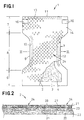
- a diaper 1 shown by Fig. 1 in a plan view as partially broken away comprises a liquid-permeable topsheet 2, a liquid-impermeable backsheet 3 and a liquid-absorbent core 4 extending between these two sheets 2, 3.
- the diaper 1 has a front waist region 6, a rear waist region 7 and a crotch region 8 extending between these two regions 6, 7. Transversely opposite side edges of the crotch region 8 are inwardly curved so as to define peripheral edges 9 of respective leg-openings.
- the topsheet 2 and the backsheet 3 are bonded together at portions thereof extending outward beyond a peripheral edge of the absorbent core 4.
- the peripheral edges 9 of the respective leg-openings and a longitudinal end 11 of the rear waist region 7 are provided with elastic members 12 adapted to fit the diaper 1 around the legs and an elastic member 13 adapted to fit the diaper 1 along the waist of the wearer. These elastic members 12, 13 are secured in elastically stretched conditions to an inner surface of at least one of the topsheet 2 and the backsheets 3.
- a tape fastener 16 is attached to each of transversely opposite side edges 14 of the rear waist region 14.
- Fig. 2 is a sectional view showing the topsheet 2 taken along line II-II in Fig. 1.
- the topsheet 2 structurally comprises a top layer 21 adopted to come in contact with the wearer's skin, a bottom layer 22 overlying the absorbent core 4 and an intermediate layer 23 interposed between the top and bottom layers 21, 22.
- a plurality of hollows (recesses) 24 extending through both the top layer 21 and the intermediate layer 23 so that the bottom layer 22 closes these openings 24 and thereby forms a plurality of recesses.
- the top layer 21 comprises a hydrophobic melt-blown nonwoven fabric formed by bonding melt-blown fibers of polypropylene having a fineness of 0.018 - 0.036 dtex (0.02 ⁇ 0.04d).
- the top layer 21 has a fiber density of 5 ⁇ 40 g/m 2 .
- the intermediate layer 23 comprises a hydrophobic web made of core-sheath type composite fibers of polypropylene/polyetheylene having a fineness of 0.9 - 2.25 dtex (1.0 ⁇ 2.5d).
- the intermediate layer 23 has a fiber density of 5 ⁇ 40 g/m 2 .
- the top layer 21 and the intermediate layer 23 are bonded together through a mechanical intertwinement (entanglement) and/or fusion (weld) among individual fibers of these layers 21, 23.
- the hollows 24 extending through these layers 21, 23 have top openings 28 in an upper surface (skin-contactable surface) 27 of the top layer 21 and bottom openings 29 in a lower surface of the intermediate layer 23.
- Each of the top openings 28 has an open are of 1.0 ⁇ 2.0 mm 2 , preferably 1.3 ⁇ 1.8 mm 2 and the top openings 28 as a whole have an open area ration of 10 ⁇ 50%, preferably 15 ⁇ 30 % to the entire upper surface 27.
- Each of the bottom openings 29 has an open area of 50 ⁇ 120%, preferably 70 ⁇ 100 % of the top opening 28.
- the bottom layer 22 comprises a hydrophilic web made of core-sheath type composite fibers of polypropylene/polyethylene having a fineness of 2.7 - 5.4 dtex (3 ⁇ 6 d).
- the bottom layer 22 has a fiber density of 5 ⁇ 40 g/m 2 .
- the bottom layer 22 and the intermediate layer 23 are bonded together by fusing (welding) the individual fibers of these layers.
- the topsheet 2 structurally composed as has been described above is placed upon the absorbent core 4 with the bottom layer 22 closely in contact with a skin-contactable side of the absorbent core 4. If tissue paper or the like is used as a layer covering the absorbent core 4, it is preferable that the bottom layer 22 is intermittently bonded to this tissue paper by suitable means such as hot melt adhesive.
- the top layer 21 of the topsheet 2 advantageously provides a soft touch peculiar to the fibers of a relatively small fineness.
- Urine discharged on the diaper 1 is guided through the hollows 24 to the bottom layer 22 and then absorbed by the absorbent core 4.
- Rewetting i.e., a phenomenon that a quantity of urine once absorbed by the absorbent core 4 flows back toward the wearer's skin, is reliably prevented by the hydrophobic top and intermediate layers 21, 23.
- the melt-blown nonwoven fabric forming the top layer 21 is not suitable means to keep the wearer's skin spaced apart from the bottom layer 22 as well as from the absorbent core 4 which are wetted with urine, since such nonwoven fabric is composed of the individual fibers which are poor not only their fineness but also their rigidity and tends to become excessively thin.
- the topsheet 2 of this diaper 1 includes the intermediate layer 23 bonded to the lower surface of the top layer 21, which is hydrophobic and made of the fibers having a fineness larger than the fineness of individual fibers in the top layer 21. The problem which might occur when the top layer 21 alone is used is reliably compensated by the intermediate layer 23 which is hydrophobic and relatively thick.
- the wearer's skin is easily kept spaced apart from the wet absorbent core 4.
- the intermediate layer 23 comprises a relatively bulky fiber web which can be easily produced by using machines such as a comber or card.
- the intermediate layer 23 preferably has a relatively high fiber density and sufficiently large surface areas adopted to come in contact with the top and bottom layers 21, 22 so that the intermediate layer 23 may be reliably bonded to the top and bottom layers 21, 22. To achieve this, the fibers of a fineness smaller than that in the bottom layer 22 are used for the intermediate layer 23.
- Both the top layer 21 and the bottom layer 22 have a relatively large fineness and relatively high rigidity, so it will be difficult to bond these two layers directly to each other.
- the interposition of the intermediate layer 23 between these top and bottom layers 21, 22 facilitates these two layers to be integrally laminated.
- these fibrous layers put one upon another may be heated so as to fuse (weld) the individual fibers one another or subjected to high pressure water jets to achieve a desired mechanical intertwinement (entanglement) among the individual fibers. It will be also effective to treat the fibrous layers to a set of heat embossing rollers. In the case of the diaper shown by Fig.
- the bottom layer 22 may be intermittently fusion-bonded to the intermediate layer 23 at a plurality of spots.
- These spots may be dimensioned to have a diameter of 1 - 2 mm, respectively, and arranged at regular intervals of approximately 10 mm adjacent the longitudinally opposite ends of the front and rear waist regions 6, 7 and at regular intervals of approximately 18 mm in the crotch region 8.
- the interval of the spots is relatively larger in order to avoid a problem that crowed spots might make the topsheet 2 hard and thereby deteriorate the feeling to wear the diaper 1.
- the individual fibers of the top, bottom and intermediate layers 21, 22, 23 are not limited to those as have been described in reference with the illustrated embodiment and those of any other types which are well known or usually employed in this technical field may be also employed.
- crimped fibers may be employed for the bottom layer 22 and the intermediate layer 23 to improve a cushioning effect of the bottom layer 22 and simultaneously to increase a thickness of the intermediate layer 23.
Landscapes
- Health & Medical Sciences (AREA)
- Epidemiology (AREA)
- Engineering & Computer Science (AREA)
- Biomedical Technology (AREA)
- Heart & Thoracic Surgery (AREA)
- Vascular Medicine (AREA)
- Life Sciences & Earth Sciences (AREA)
- Animal Behavior & Ethology (AREA)
- General Health & Medical Sciences (AREA)
- Public Health (AREA)
- Veterinary Medicine (AREA)
- Absorbent Articles And Supports Therefor (AREA)
- Orthopedics, Nursing, And Contraception (AREA)
Applications Claiming Priority (3)
| Application Number | Priority Date | Filing Date | Title |
|---|---|---|---|
| JP170408/96 | 1996-06-28 | ||
| JP17040896A JP3258909B2 (ja) | 1996-06-28 | 1996-06-28 | 使い捨ての体液吸収性物品 |
| JP17040896 | 1996-06-28 |
Publications (3)
| Publication Number | Publication Date |
|---|---|
| EP0815819A2 EP0815819A2 (en) | 1998-01-07 |
| EP0815819A3 EP0815819A3 (en) | 1998-12-09 |
| EP0815819B1 true EP0815819B1 (en) | 2001-12-05 |
Family
ID=15904377
Family Applications (1)
| Application Number | Title | Priority Date | Filing Date |
|---|---|---|---|
| EP97304538A Expired - Lifetime EP0815819B1 (en) | 1996-06-28 | 1997-06-26 | Perforated multilayer topsheet |
Country Status (7)
| Country | Link |
|---|---|
| US (1) | US5885267A (enExample) |
| EP (1) | EP0815819B1 (enExample) |
| JP (1) | JP3258909B2 (enExample) |
| KR (1) | KR100453788B1 (enExample) |
| CN (1) | CN1135960C (enExample) |
| AU (1) | AU714743B2 (enExample) |
| ID (1) | ID18704A (enExample) |
Families Citing this family (52)
| Publication number | Priority date | Publication date | Assignee | Title |
|---|---|---|---|---|
| US6168849B1 (en) * | 1997-11-14 | 2001-01-02 | Kimberly-Clark Worldwide, Inc. | Multilayer cover system and method for producing same |
| US7772455B1 (en) | 1997-11-14 | 2010-08-10 | The Procter & Gamble Company | Disposable article providing improved management of bodily exudates |
| US6703537B1 (en) * | 1997-11-15 | 2004-03-09 | The Procter & Gamble Company | Absorbent article having improved fecal storage structure |
| JP3587677B2 (ja) * | 1998-03-26 | 2004-11-10 | ユニ・チャーム株式会社 | 体液吸収性物品の透液性表面シート |
| EP0953324A1 (en) * | 1998-04-28 | 1999-11-03 | The Procter & Gamble Company | Apertured laminate web |
| US6160200A (en) * | 1998-06-29 | 2000-12-12 | The Procter & Gamble Company | Directionally preferential waste passage member for use with disposable absorbent article |
| DE19846857C1 (de) * | 1998-10-12 | 2000-03-02 | Freudenberg Carl Fa | Perforierter Vliesstoff und Verfahren zu dessen Herstellung |
| US6125476A (en) * | 1999-01-07 | 2000-10-03 | Jerome; Sandra A. | Male undergarment |
| US6319455B1 (en) | 1999-08-13 | 2001-11-20 | First Quality Nonwovens, Inc. | Nonwoven fabric with high CD elongation and method of making same |
| KR20020025254A (ko) * | 1999-09-07 | 2002-04-03 | 로날드 디. 맥크레이 | 흡수용품용 엠보싱된 라이너 |
| DE19945548C1 (de) * | 1999-09-23 | 2001-01-18 | Sandler C H Gmbh | Einweg-Hygieneartikel |
| AR028271A1 (es) * | 2000-03-24 | 2003-04-30 | Kimberly Clark Co | Un sistema para un producto higienico y una almohadilla para la higiene de la mujer que comprende dicho sistema |
| JP3681320B2 (ja) * | 2000-03-31 | 2005-08-10 | ユニ・チャーム株式会社 | 体液吸収性着用物品 |
| JP2001340382A (ja) * | 2000-05-31 | 2001-12-11 | Uni Charm Corp | 吸収性物品 |
| JP3734407B2 (ja) | 2000-06-19 | 2006-01-11 | ユニ・チャーム株式会社 | 吸収性物品 |
| JP3964611B2 (ja) * | 2000-08-25 | 2007-08-22 | ユニ・チャーム株式会社 | 衛生物品用の体液吸収性パネル |
| US6781027B2 (en) | 2001-12-14 | 2004-08-24 | Kimberly-Clark Worldwide, Inc. | Mixed denier fluid management layers |
| JP4153204B2 (ja) * | 2001-12-28 | 2008-09-24 | 王子製紙株式会社 | 吸収体製品とその製造方法およびこれに用いられる内袋とその製造方法 |
| JP2003245304A (ja) * | 2002-02-25 | 2003-09-02 | Toray Ind Inc | おむつ |
| JP3883460B2 (ja) * | 2002-03-25 | 2007-02-21 | 花王株式会社 | 立体シート |
| JP4486300B2 (ja) * | 2002-07-25 | 2010-06-23 | ユニ・チャーム株式会社 | 吸収性物品のトップシート |
| US7185726B2 (en) * | 2003-07-21 | 2007-03-06 | Young Grant E | Bicycle with optional power assist |
| JP2007521168A (ja) * | 2003-12-08 | 2007-08-02 | トレドガー フィルム プロダクツ コーポレイション | 差分エネルギ複合材およびその製造方法 |
| JP4229869B2 (ja) * | 2004-04-27 | 2009-02-25 | 花王株式会社 | 吸収性物品 |
| US20090131896A1 (en) * | 2005-06-16 | 2009-05-21 | Daio Parer Corporation | Absorbent Article |
| EP1767177B1 (en) * | 2005-09-23 | 2016-06-15 | The Procter & Gamble Company | Apertured liquid acquisition layer with caliper recovery |
| EP1776940B1 (en) * | 2005-09-23 | 2012-06-06 | The Procter & Gamble Company | Apertured liquid acquisition dual layer |
| ATE418949T1 (de) * | 2005-09-23 | 2009-01-15 | Procter & Gamble | Perforierte deck- und flüssigkeitsaufnahmeschicht |
| JP2007159943A (ja) * | 2005-12-15 | 2007-06-28 | Kao Corp | 使い捨ておむつ |
| JP4726773B2 (ja) * | 2006-12-15 | 2011-07-20 | 花王株式会社 | 吸収性物品用のシート |
| JP5479784B2 (ja) * | 2009-06-05 | 2014-04-23 | 大王製紙株式会社 | 吸収性物品 |
| CN102564659B (zh) * | 2012-01-14 | 2014-09-10 | 江苏舒恒管夹制造有限公司 | 冷挤压模具预应力圈应力监测预警方法及系统 |
| US9861533B2 (en) | 2013-05-08 | 2018-01-09 | The Procter & Gamble Company | Apertured nonwoven materials and methods for forming the same |
| CN106604710A (zh) * | 2014-09-10 | 2017-04-26 | 宝洁公司 | 非织造纤维网 |
| CN107072831B (zh) * | 2014-10-17 | 2020-04-14 | 花王株式会社 | 吸收性物品 |
| EP3215085B1 (en) | 2014-11-06 | 2019-10-09 | The Procter and Gamble Company | Crimped fiber spunbond nonwoven webs / laminates |
| EP3215093B1 (en) * | 2014-11-06 | 2019-07-24 | The Procter and Gamble Company | Moiré effect laminates and methods for making the same |
| AU2015390007B2 (en) | 2015-03-30 | 2020-02-27 | Kimberly-Clark Worldwide, Inc. | Absorbent article with three dimensional shape retaining structure |
| JP6214598B2 (ja) * | 2015-05-29 | 2017-10-18 | ユニ・チャーム株式会社 | 吸収性物品 |
| JP5938138B1 (ja) * | 2015-12-25 | 2016-06-22 | ユニ・チャーム株式会社 | 吸収性物品 |
| JP6001207B1 (ja) * | 2016-06-30 | 2016-10-05 | ユニ・チャーム株式会社 | 吸収性物品 |
| CN106539648A (zh) * | 2016-12-07 | 2017-03-29 | 广东茵茵股份有限公司 | 具有纵向导流的吸收芯体和一次性吸湿用品 |
| US10737459B2 (en) * | 2016-12-14 | 2020-08-11 | Pfnonwovens Llc | Hydraulically treated nonwoven fabrics and method of making the same |
| US10767296B2 (en) * | 2016-12-14 | 2020-09-08 | Pfnonwovens Llc | Multi-denier hydraulically treated nonwoven fabrics and method of making the same |
| WO2018152272A1 (en) | 2017-02-16 | 2018-08-23 | The Procter & Gamble Company | Absorbent articles with substrates having repeating patterns of apertures comprising a plurality of repeat units |
| JP7157525B2 (ja) * | 2017-11-29 | 2022-10-20 | 花王株式会社 | 吸収性物品 |
| US12127925B2 (en) | 2018-04-17 | 2024-10-29 | The Procter & Gamble Company | Webs for absorbent articles and methods of making the same |
| JP7271150B2 (ja) * | 2018-11-30 | 2023-05-11 | ユニ・チャーム株式会社 | 吸収性物品 |
| JP7370151B2 (ja) * | 2019-03-27 | 2023-10-27 | 大王製紙株式会社 | 使い捨ておむつ |
| EP3958809B1 (en) | 2019-04-24 | 2025-10-29 | The Procter & Gamble Company | Highly extensible nonwoven webs and absorbent articles having such webs |
| WO2022088041A1 (en) * | 2020-10-30 | 2022-05-05 | The Procter & Gamble Company | Nonwoven and absorbent articles containing the same |
| WO2022088058A1 (en) * | 2020-10-30 | 2022-05-05 | The Procter & Gamble Company | Absorbent article with hybrid nonwoven web |
Family Cites Families (6)
| Publication number | Priority date | Publication date | Assignee | Title |
|---|---|---|---|---|
| JPS61176346A (ja) * | 1985-01-29 | 1986-08-08 | ユニ・チヤ−ム株式会社 | 吸収性物品の表面材の製法 |
| US5019064A (en) * | 1989-01-17 | 1991-05-28 | Kasriel Eilender | Low friction multilayer pad with foam backing |
| US5171238A (en) * | 1989-03-16 | 1992-12-15 | The Transzonic Companies | Absorbent pad with fibrous facing sheet |
| US5486167A (en) * | 1991-01-03 | 1996-01-23 | The Procter & Gamble Company | Absorbent article having blended multi-layer absorbent structure with improved integrity |
| CA2073815C (en) * | 1991-07-23 | 1998-05-05 | Clemson University Research Foundation | Absorbent articles, especially catamenials, having improved fluid directionality, comfort and fit |
| US5437653A (en) * | 1993-05-12 | 1995-08-01 | Kimberly-Clark Corporation | Absorbent article having two coapertured layers and a method of making the article |
-
1996
- 1996-06-28 JP JP17040896A patent/JP3258909B2/ja not_active Expired - Lifetime
-
1997
- 1997-06-24 AU AU26207/97A patent/AU714743B2/en not_active Ceased
- 1997-06-26 ID IDP972200A patent/ID18704A/id unknown
- 1997-06-26 EP EP97304538A patent/EP0815819B1/en not_active Expired - Lifetime
- 1997-06-26 US US08/882,786 patent/US5885267A/en not_active Expired - Lifetime
- 1997-06-27 CN CNB971171440A patent/CN1135960C/zh not_active Expired - Fee Related
- 1997-06-28 KR KR1019970028542A patent/KR100453788B1/ko not_active Expired - Fee Related
Also Published As
| Publication number | Publication date |
|---|---|
| EP0815819A2 (en) | 1998-01-07 |
| CN1175395A (zh) | 1998-03-11 |
| KR100453788B1 (ko) | 2005-04-06 |
| AU2620797A (en) | 1998-01-15 |
| JP3258909B2 (ja) | 2002-02-18 |
| ID18704A (id) | 1998-04-30 |
| US5885267A (en) | 1999-03-23 |
| AU714743B2 (en) | 2000-01-13 |
| JPH1014979A (ja) | 1998-01-20 |
| EP0815819A3 (en) | 1998-12-09 |
| KR980000394A (ko) | 1998-03-30 |
| CN1135960C (zh) | 2004-01-28 |
Similar Documents
| Publication | Publication Date | Title |
|---|---|---|
| US5885267A (en) | Disposable body fluids absorbent article | |
| EP1208828B1 (en) | Absorbent article | |
| KR950005342B1 (ko) | 흡수패드용 유동 분배 시스템 | |
| US5613960A (en) | Disposable body fluids absorbent padding | |
| RU2197934C2 (ru) | Перфорированный покрывающий лист для поглощающего изделия и способ производства покрывающего листа | |
| JP3967873B2 (ja) | 連続フィラメントおよび吸収シートを用いた吸収性物品 | |
| KR100804559B1 (ko) | 체액 흡수성 착용 물품 | |
| EP0868895B1 (en) | Disposable absorbent undergarment | |
| JPH1014979A5 (enExample) | ||
| JPH11318983A (ja) | 吸収性物品 | |
| JP3922877B2 (ja) | 吸収性物品 | |
| JP6004723B2 (ja) | 使い捨ておむつ | |
| WO2000028929A1 (en) | Absorbent article having an apertured liner | |
| JP2002177330A (ja) | 連続フィラメントの表面材を用いた吸収性物品 | |
| JP3564246B2 (ja) | 使い捨て体液吸収性物品の表面層 | |
| JP2020048828A (ja) | 吸収性物品及びその製造方法 | |
| JP2002177327A (ja) | 使い捨ての体液吸収性物品 | |
| JP6757607B2 (ja) | 吸収性物品 | |
| JP4145692B2 (ja) | 吸収性物品 | |
| AU782499B2 (en) | Absorbent article | |
| JP2004049918A (ja) | 吸収性物品 | |
| JP2020137764A (ja) | 吸収性物品 | |
| CA2289243A1 (en) | A method of manufacturing an absorbent article |
Legal Events
| Date | Code | Title | Description |
|---|---|---|---|
| PUAI | Public reference made under article 153(3) epc to a published international application that has entered the european phase |
Free format text: ORIGINAL CODE: 0009012 |
|
| AK | Designated contracting states |
Kind code of ref document: A2 Designated state(s): FR GB NL SE |
|
| PUAL | Search report despatched |
Free format text: ORIGINAL CODE: 0009013 |
|
| AK | Designated contracting states |
Kind code of ref document: A3 Designated state(s): AT BE CH DE DK ES FI FR GB GR IE IT LI LU MC NL PT SE |
|
| 17P | Request for examination filed |
Effective date: 19990525 |
|
| AKX | Designation fees paid |
Free format text: FR GB NL SE |
|
| REG | Reference to a national code |
Ref country code: DE Ref legal event code: 8566 |
|
| 17Q | First examination report despatched |
Effective date: 19991229 |
|
| GRAG | Despatch of communication of intention to grant |
Free format text: ORIGINAL CODE: EPIDOS AGRA |
|
| GRAG | Despatch of communication of intention to grant |
Free format text: ORIGINAL CODE: EPIDOS AGRA |
|
| GRAH | Despatch of communication of intention to grant a patent |
Free format text: ORIGINAL CODE: EPIDOS IGRA |
|
| GRAH | Despatch of communication of intention to grant a patent |
Free format text: ORIGINAL CODE: EPIDOS IGRA |
|
| GRAA | (expected) grant |
Free format text: ORIGINAL CODE: 0009210 |
|
| AK | Designated contracting states |
Kind code of ref document: B1 Designated state(s): FR GB NL SE |
|
| REG | Reference to a national code |
Ref country code: GB Ref legal event code: IF02 |
|
| ET | Fr: translation filed | ||
| PLBE | No opposition filed within time limit |
Free format text: ORIGINAL CODE: 0009261 |
|
| STAA | Information on the status of an ep patent application or granted ep patent |
Free format text: STATUS: NO OPPOSITION FILED WITHIN TIME LIMIT |
|
| 26N | No opposition filed | ||
| PGFP | Annual fee paid to national office [announced via postgrant information from national office to epo] |
Ref country code: SE Payment date: 20130612 Year of fee payment: 17 Ref country code: GB Payment date: 20130626 Year of fee payment: 17 |
|
| PGFP | Annual fee paid to national office [announced via postgrant information from national office to epo] |
Ref country code: FR Payment date: 20130624 Year of fee payment: 17 Ref country code: NL Payment date: 20130615 Year of fee payment: 17 |
|
| REG | Reference to a national code |
Ref country code: NL Ref legal event code: V1 Effective date: 20150101 |
|
| PG25 | Lapsed in a contracting state [announced via postgrant information from national office to epo] |
Ref country code: SE Free format text: LAPSE BECAUSE OF NON-PAYMENT OF DUE FEES Effective date: 20140627 |
|
| REG | Reference to a national code |
Ref country code: SE Ref legal event code: EUG |
|
| GBPC | Gb: european patent ceased through non-payment of renewal fee |
Effective date: 20140626 |
|
| REG | Reference to a national code |
Ref country code: FR Ref legal event code: ST Effective date: 20150227 |
|
| PG25 | Lapsed in a contracting state [announced via postgrant information from national office to epo] |
Ref country code: NL Free format text: LAPSE BECAUSE OF NON-PAYMENT OF DUE FEES Effective date: 20150101 |
|
| PG25 | Lapsed in a contracting state [announced via postgrant information from national office to epo] |
Ref country code: FR Free format text: LAPSE BECAUSE OF NON-PAYMENT OF DUE FEES Effective date: 20140630 Ref country code: GB Free format text: LAPSE BECAUSE OF NON-PAYMENT OF DUE FEES Effective date: 20140626 |