EP0808798B1 - Nichtwässrige Sekundärbatterie und Verfahren zur Herstellung eines activen Materials for eine negative Electrode - Google Patents
Nichtwässrige Sekundärbatterie und Verfahren zur Herstellung eines activen Materials for eine negative Electrode Download PDFInfo
- Publication number
- EP0808798B1 EP0808798B1 EP97303557A EP97303557A EP0808798B1 EP 0808798 B1 EP0808798 B1 EP 0808798B1 EP 97303557 A EP97303557 A EP 97303557A EP 97303557 A EP97303557 A EP 97303557A EP 0808798 B1 EP0808798 B1 EP 0808798B1
- Authority
- EP
- European Patent Office
- Prior art keywords
- graphite particles
- negative electrode
- active material
- graphite
- amorphous carbon
- Prior art date
- Legal status (The legal status is an assumption and is not a legal conclusion. Google has not performed a legal analysis and makes no representation as to the accuracy of the status listed.)
- Expired - Lifetime
Links
- 239000007773 negative electrode material Substances 0.000 title claims description 46
- 238000004519 manufacturing process Methods 0.000 title claims description 30
- OKTJSMMVPCPJKN-UHFFFAOYSA-N Carbon Chemical compound [C] OKTJSMMVPCPJKN-UHFFFAOYSA-N 0.000 claims description 186
- 239000002245 particle Substances 0.000 claims description 142
- 229910002804 graphite Inorganic materials 0.000 claims description 140
- 239000010439 graphite Substances 0.000 claims description 140
- 229910003481 amorphous carbon Inorganic materials 0.000 claims description 76
- 238000000034 method Methods 0.000 claims description 52
- RUOJZAUFBMNUDX-UHFFFAOYSA-N propylene carbonate Chemical compound CC1COC(=O)O1 RUOJZAUFBMNUDX-UHFFFAOYSA-N 0.000 claims description 50
- KMTRUDSVKNLOMY-UHFFFAOYSA-N Ethylene carbonate Chemical compound O=C1OCCO1 KMTRUDSVKNLOMY-UHFFFAOYSA-N 0.000 claims description 42
- 229910052744 lithium Inorganic materials 0.000 claims description 40
- 230000001590 oxidative effect Effects 0.000 claims description 40
- WHXSMMKQMYFTQS-UHFFFAOYSA-N Lithium Chemical compound [Li] WHXSMMKQMYFTQS-UHFFFAOYSA-N 0.000 claims description 32
- 239000012286 potassium permanganate Substances 0.000 claims description 31
- 239000010416 ion conductor Substances 0.000 claims description 28
- -1 alkali metal salt Chemical class 0.000 claims description 19
- 230000008021 deposition Effects 0.000 claims description 19
- 239000002253 acid Substances 0.000 claims description 17
- 239000011149 active material Substances 0.000 claims description 15
- GRYLNZFGIOXLOG-UHFFFAOYSA-N Nitric acid Chemical compound O[N+]([O-])=O GRYLNZFGIOXLOG-UHFFFAOYSA-N 0.000 claims description 14
- 229910017604 nitric acid Inorganic materials 0.000 claims description 12
- 238000010438 heat treatment Methods 0.000 claims description 10
- 239000012046 mixed solvent Substances 0.000 claims description 10
- MHAJPDPJQMAIIY-UHFFFAOYSA-N Hydrogen peroxide Chemical compound OO MHAJPDPJQMAIIY-UHFFFAOYSA-N 0.000 claims description 7
- 238000002156 mixing Methods 0.000 claims description 6
- 229910052759 nickel Inorganic materials 0.000 claims description 6
- 239000000126 substance Substances 0.000 claims description 6
- KRHYYFGTRYWZRS-UHFFFAOYSA-N Fluorane Chemical class F KRHYYFGTRYWZRS-UHFFFAOYSA-N 0.000 claims description 5
- 229910052723 transition metal Inorganic materials 0.000 claims description 5
- 150000003624 transition metals Chemical class 0.000 claims description 5
- 239000007864 aqueous solution Substances 0.000 claims description 4
- 238000004438 BET method Methods 0.000 claims description 3
- 229910003005 LiNiO2 Inorganic materials 0.000 claims description 3
- 229910052783 alkali metal Inorganic materials 0.000 claims description 3
- 229910032387 LiCoO2 Inorganic materials 0.000 claims description 2
- 229910010584 LiFeO2 Inorganic materials 0.000 claims description 2
- 229910014379 LiMn2-z Inorganic materials 0.000 claims description 2
- 229910002993 LiMnO2 Inorganic materials 0.000 claims description 2
- 229910002097 Lithium manganese(III,IV) oxide Inorganic materials 0.000 claims description 2
- 229910017033 LixM1-y Inorganic materials 0.000 claims description 2
- 229910017042 LixM1−y Inorganic materials 0.000 claims description 2
- 150000001340 alkali metals Chemical class 0.000 claims description 2
- 229930195733 hydrocarbon Natural products 0.000 claims description 2
- 150000002430 hydrocarbons Chemical class 0.000 claims description 2
- 229910052742 iron Inorganic materials 0.000 claims description 2
- 229910044991 metal oxide Inorganic materials 0.000 claims 3
- 150000004706 metal oxides Chemical class 0.000 claims 3
- 239000004215 Carbon black (E152) Substances 0.000 claims 1
- 238000000197 pyrolysis Methods 0.000 claims 1
- 239000012266 salt solution Substances 0.000 claims 1
- 238000000151 deposition Methods 0.000 description 29
- 230000000052 comparative effect Effects 0.000 description 28
- 238000011156 evaluation Methods 0.000 description 28
- 239000003575 carbonaceous material Substances 0.000 description 27
- 239000002904 solvent Substances 0.000 description 26
- 150000003839 salts Chemical class 0.000 description 23
- 239000008151 electrolyte solution Substances 0.000 description 22
- 239000007789 gas Substances 0.000 description 22
- 229910052799 carbon Inorganic materials 0.000 description 21
- 239000000203 mixture Substances 0.000 description 20
- OIFBSDVPJOWBCH-UHFFFAOYSA-N Diethyl carbonate Chemical compound CCOC(=O)OCC OIFBSDVPJOWBCH-UHFFFAOYSA-N 0.000 description 18
- 229910021383 artificial graphite Inorganic materials 0.000 description 18
- 239000011230 binding agent Substances 0.000 description 18
- QAOWNCQODCNURD-UHFFFAOYSA-N Sulfuric acid Chemical compound OS(O)(=O)=O QAOWNCQODCNURD-UHFFFAOYSA-N 0.000 description 14
- 239000000243 solution Substances 0.000 description 14
- 239000004570 mortar (masonry) Substances 0.000 description 13
- 239000004020 conductor Substances 0.000 description 12
- JBTWLSYIZRCDFO-UHFFFAOYSA-N ethyl methyl carbonate Chemical compound CCOC(=O)OC JBTWLSYIZRCDFO-UHFFFAOYSA-N 0.000 description 12
- 239000000463 material Substances 0.000 description 12
- 230000003647 oxidation Effects 0.000 description 11
- 238000007254 oxidation reaction Methods 0.000 description 11
- 238000005406 washing Methods 0.000 description 11
- XKRFYHLGVUSROY-UHFFFAOYSA-N Argon Chemical compound [Ar] XKRFYHLGVUSROY-UHFFFAOYSA-N 0.000 description 10
- 239000007774 positive electrode material Substances 0.000 description 10
- IJGRMHOSHXDMSA-UHFFFAOYSA-N Atomic nitrogen Chemical compound N#N IJGRMHOSHXDMSA-UHFFFAOYSA-N 0.000 description 9
- PXHVJJICTQNCMI-UHFFFAOYSA-N Nickel Chemical compound [Ni] PXHVJJICTQNCMI-UHFFFAOYSA-N 0.000 description 9
- 238000007599 discharging Methods 0.000 description 9
- SECXISVLQFMRJM-UHFFFAOYSA-N N-Methylpyrrolidone Chemical compound CN1CCCC1=O SECXISVLQFMRJM-UHFFFAOYSA-N 0.000 description 8
- ATUOYWHBWRKTHZ-UHFFFAOYSA-N Propane Chemical compound CCC ATUOYWHBWRKTHZ-UHFFFAOYSA-N 0.000 description 8
- 239000003513 alkali Substances 0.000 description 8
- 238000000354 decomposition reaction Methods 0.000 description 8
- 230000007423 decrease Effects 0.000 description 8
- 239000000843 powder Substances 0.000 description 8
- 239000012298 atmosphere Substances 0.000 description 7
- 150000002697 manganese compounds Chemical class 0.000 description 7
- RYGMFSIKBFXOCR-UHFFFAOYSA-N Copper Chemical compound [Cu] RYGMFSIKBFXOCR-UHFFFAOYSA-N 0.000 description 6
- WMFOQBRAJBCJND-UHFFFAOYSA-M Lithium hydroxide Chemical compound [Li+].[OH-] WMFOQBRAJBCJND-UHFFFAOYSA-M 0.000 description 6
- 239000002033 PVDF binder Substances 0.000 description 6
- HEMHJVSKTPXQMS-UHFFFAOYSA-M Sodium hydroxide Chemical compound [OH-].[Na+] HEMHJVSKTPXQMS-UHFFFAOYSA-M 0.000 description 6
- 239000000853 adhesive Substances 0.000 description 6
- 230000001070 adhesive effect Effects 0.000 description 6
- IEJIGPNLZYLLBP-UHFFFAOYSA-N dimethyl carbonate Chemical compound COC(=O)OC IEJIGPNLZYLLBP-UHFFFAOYSA-N 0.000 description 6
- 229910021382 natural graphite Inorganic materials 0.000 description 6
- 239000012071 phase Substances 0.000 description 6
- 229920001343 polytetrafluoroethylene Polymers 0.000 description 6
- 239000004810 polytetrafluoroethylene Substances 0.000 description 6
- 229920002981 polyvinylidene fluoride Polymers 0.000 description 6
- 238000012360 testing method Methods 0.000 description 6
- XLYOFNOQVPJJNP-UHFFFAOYSA-N water Substances O XLYOFNOQVPJJNP-UHFFFAOYSA-N 0.000 description 6
- 239000004743 Polypropylene Substances 0.000 description 5
- 229910052786 argon Inorganic materials 0.000 description 5
- 239000003792 electrolyte Substances 0.000 description 5
- 239000007770 graphite material Substances 0.000 description 5
- 239000007791 liquid phase Substances 0.000 description 5
- MHCFAGZWMAWTNR-UHFFFAOYSA-M lithium perchlorate Chemical compound [Li+].[O-]Cl(=O)(=O)=O MHCFAGZWMAWTNR-UHFFFAOYSA-M 0.000 description 5
- 229910001486 lithium perchlorate Inorganic materials 0.000 description 5
- 229910052751 metal Inorganic materials 0.000 description 5
- 239000002184 metal Substances 0.000 description 5
- 229920001155 polypropylene Polymers 0.000 description 5
- 238000002360 preparation method Methods 0.000 description 5
- 238000007669 thermal treatment Methods 0.000 description 5
- VEXZGXHMUGYJMC-UHFFFAOYSA-N Hydrochloric acid Chemical compound Cl VEXZGXHMUGYJMC-UHFFFAOYSA-N 0.000 description 4
- 239000006230 acetylene black Substances 0.000 description 4
- 239000000956 alloy Substances 0.000 description 4
- 238000006243 chemical reaction Methods 0.000 description 4
- 229910052802 copper Inorganic materials 0.000 description 4
- 239000010949 copper Substances 0.000 description 4
- 210000001787 dendrite Anatomy 0.000 description 4
- 238000009826 distribution Methods 0.000 description 4
- 239000000835 fiber Substances 0.000 description 4
- 229910001416 lithium ion Inorganic materials 0.000 description 4
- 150000007522 mineralic acids Chemical class 0.000 description 4
- 229910052757 nitrogen Inorganic materials 0.000 description 4
- 238000012856 packing Methods 0.000 description 4
- 239000000047 product Substances 0.000 description 4
- 239000001294 propane Substances 0.000 description 4
- QTBSBXVTEAMEQO-UHFFFAOYSA-N Acetic acid Chemical compound CC(O)=O QTBSBXVTEAMEQO-UHFFFAOYSA-N 0.000 description 3
- WEVYAHXRMPXWCK-UHFFFAOYSA-N Acetonitrile Chemical compound CC#N WEVYAHXRMPXWCK-UHFFFAOYSA-N 0.000 description 3
- RTZKZFJDLAIYFH-UHFFFAOYSA-N Diethyl ether Chemical compound CCOCC RTZKZFJDLAIYFH-UHFFFAOYSA-N 0.000 description 3
- 229910000733 Li alloy Inorganic materials 0.000 description 3
- 239000004698 Polyethylene Substances 0.000 description 3
- KWYUFKZDYYNOTN-UHFFFAOYSA-M Potassium hydroxide Chemical compound [OH-].[K+] KWYUFKZDYYNOTN-UHFFFAOYSA-M 0.000 description 3
- RTAQQCXQSZGOHL-UHFFFAOYSA-N Titanium Chemical compound [Ti] RTAQQCXQSZGOHL-UHFFFAOYSA-N 0.000 description 3
- 229910052782 aluminium Inorganic materials 0.000 description 3
- XAGFODPZIPBFFR-UHFFFAOYSA-N aluminium Chemical compound [Al] XAGFODPZIPBFFR-UHFFFAOYSA-N 0.000 description 3
- 230000015572 biosynthetic process Effects 0.000 description 3
- 238000009835 boiling Methods 0.000 description 3
- 238000001354 calcination Methods 0.000 description 3
- 239000007833 carbon precursor Substances 0.000 description 3
- 239000012159 carrier gas Substances 0.000 description 3
- 238000001035 drying Methods 0.000 description 3
- 239000004744 fabric Substances 0.000 description 3
- 239000011888 foil Substances 0.000 description 3
- 238000002844 melting Methods 0.000 description 3
- 230000008018 melting Effects 0.000 description 3
- 230000010287 polarization Effects 0.000 description 3
- 229920000573 polyethylene Polymers 0.000 description 3
- 229920000642 polymer Polymers 0.000 description 3
- 239000011148 porous material Substances 0.000 description 3
- 238000010298 pulverizing process Methods 0.000 description 3
- 239000007784 solid electrolyte Substances 0.000 description 3
- 229920003002 synthetic resin Polymers 0.000 description 3
- 239000000057 synthetic resin Substances 0.000 description 3
- YEJRWHAVMIAJKC-UHFFFAOYSA-N 4-Butyrolactone Chemical compound O=C1CCCO1 YEJRWHAVMIAJKC-UHFFFAOYSA-N 0.000 description 2
- XTHFKEDIFFGKHM-UHFFFAOYSA-N Dimethoxyethane Chemical compound COCCOC XTHFKEDIFFGKHM-UHFFFAOYSA-N 0.000 description 2
- IAZDPXIOMUYVGZ-UHFFFAOYSA-N Dimethylsulphoxide Chemical compound CS(C)=O IAZDPXIOMUYVGZ-UHFFFAOYSA-N 0.000 description 2
- 229910001290 LiPF6 Inorganic materials 0.000 description 2
- HBBGRARXTFLTSG-UHFFFAOYSA-N Lithium ion Chemical compound [Li+] HBBGRARXTFLTSG-UHFFFAOYSA-N 0.000 description 2
- ISWSIDIOOBJBQZ-UHFFFAOYSA-N Phenol Chemical compound OC1=CC=CC=C1 ISWSIDIOOBJBQZ-UHFFFAOYSA-N 0.000 description 2
- NBIIXXVUZAFLBC-UHFFFAOYSA-N Phosphoric acid Chemical compound OP(O)(O)=O NBIIXXVUZAFLBC-UHFFFAOYSA-N 0.000 description 2
- WYURNTSHIVDZCO-UHFFFAOYSA-N Tetrahydrofuran Chemical compound C1CCOC1 WYURNTSHIVDZCO-UHFFFAOYSA-N 0.000 description 2
- 150000007513 acids Chemical class 0.000 description 2
- 150000001447 alkali salts Chemical class 0.000 description 2
- 229910045601 alloy Inorganic materials 0.000 description 2
- ADCOVFLJGNWWNZ-UHFFFAOYSA-N antimony trioxide Chemical compound O=[Sb]O[Sb]=O ADCOVFLJGNWWNZ-UHFFFAOYSA-N 0.000 description 2
- QVGXLLKOCUKJST-UHFFFAOYSA-N atomic oxygen Chemical compound [O] QVGXLLKOCUKJST-UHFFFAOYSA-N 0.000 description 2
- 150000004649 carbonic acid derivatives Chemical class 0.000 description 2
- 210000004027 cell Anatomy 0.000 description 2
- 239000011280 coal tar Substances 0.000 description 2
- 239000011294 coal tar pitch Substances 0.000 description 2
- 239000011889 copper foil Substances 0.000 description 2
- 239000013078 crystal Substances 0.000 description 2
- 125000004122 cyclic group Chemical group 0.000 description 2
- 238000009831 deintercalation Methods 0.000 description 2
- 238000003795 desorption Methods 0.000 description 2
- 238000010586 diagram Methods 0.000 description 2
- XBDQKXXYIPTUBI-UHFFFAOYSA-N dimethylselenoniopropionate Natural products CCC(O)=O XBDQKXXYIPTUBI-UHFFFAOYSA-N 0.000 description 2
- VUPKGFBOKBGHFZ-UHFFFAOYSA-N dipropyl carbonate Chemical compound CCCOC(=O)OCCC VUPKGFBOKBGHFZ-UHFFFAOYSA-N 0.000 description 2
- 239000002270 dispersing agent Substances 0.000 description 2
- 239000006185 dispersion Substances 0.000 description 2
- 238000004090 dissolution Methods 0.000 description 2
- GNTDGMZSJNCJKK-UHFFFAOYSA-N divanadium pentaoxide Chemical compound O=[V](=O)O[V](=O)=O GNTDGMZSJNCJKK-UHFFFAOYSA-N 0.000 description 2
- 229920002313 fluoropolymer Polymers 0.000 description 2
- 230000008014 freezing Effects 0.000 description 2
- 238000007710 freezing Methods 0.000 description 2
- 125000000524 functional group Chemical group 0.000 description 2
- GAEKPEKOJKCEMS-UHFFFAOYSA-N gamma-valerolactone Chemical compound CC1CCC(=O)O1 GAEKPEKOJKCEMS-UHFFFAOYSA-N 0.000 description 2
- 238000009413 insulation Methods 0.000 description 2
- 238000009830 intercalation Methods 0.000 description 2
- 238000004898 kneading Methods 0.000 description 2
- WABPQHHGFIMREM-UHFFFAOYSA-N lead(0) Chemical compound [Pb] WABPQHHGFIMREM-UHFFFAOYSA-N 0.000 description 2
- NUJOXMJBOLGQSY-UHFFFAOYSA-N manganese dioxide Chemical compound O=[Mn]=O NUJOXMJBOLGQSY-UHFFFAOYSA-N 0.000 description 2
- 238000005259 measurement Methods 0.000 description 2
- BDAGIHXWWSANSR-UHFFFAOYSA-N methanoic acid Natural products OC=O BDAGIHXWWSANSR-UHFFFAOYSA-N 0.000 description 2
- TZIHFWKZFHZASV-UHFFFAOYSA-N methyl formate Chemical compound COC=O TZIHFWKZFHZASV-UHFFFAOYSA-N 0.000 description 2
- JKQOBWVOAYFWKG-UHFFFAOYSA-N molybdenum trioxide Chemical compound O=[Mo](=O)=O JKQOBWVOAYFWKG-UHFFFAOYSA-N 0.000 description 2
- 239000004745 nonwoven fabric Substances 0.000 description 2
- 150000007524 organic acids Chemical class 0.000 description 2
- 239000001301 oxygen Substances 0.000 description 2
- 229910052760 oxygen Inorganic materials 0.000 description 2
- 230000000737 periodic effect Effects 0.000 description 2
- 239000010453 quartz Substances 0.000 description 2
- 230000035484 reaction time Effects 0.000 description 2
- VYPSYNLAJGMNEJ-UHFFFAOYSA-N silicon dioxide Inorganic materials O=[Si]=O VYPSYNLAJGMNEJ-UHFFFAOYSA-N 0.000 description 2
- VWDWKYIASSYTQR-UHFFFAOYSA-N sodium nitrate Chemical compound [Na+].[O-][N+]([O-])=O VWDWKYIASSYTQR-UHFFFAOYSA-N 0.000 description 2
- 239000007787 solid Substances 0.000 description 2
- 239000010935 stainless steel Substances 0.000 description 2
- 229910001220 stainless steel Inorganic materials 0.000 description 2
- 238000003756 stirring Methods 0.000 description 2
- 229920003051 synthetic elastomer Polymers 0.000 description 2
- 239000005061 synthetic rubber Substances 0.000 description 2
- 239000010936 titanium Substances 0.000 description 2
- 229910052719 titanium Inorganic materials 0.000 description 2
- ZZXUZKXVROWEIF-UHFFFAOYSA-N 1,2-butylene carbonate Chemical compound CCC1COC(=O)O1 ZZXUZKXVROWEIF-UHFFFAOYSA-N 0.000 description 1
- LZDKZFUFMNSQCJ-UHFFFAOYSA-N 1,2-diethoxyethane Chemical compound CCOCCOCC LZDKZFUFMNSQCJ-UHFFFAOYSA-N 0.000 description 1
- RYHBNJHYFVUHQT-UHFFFAOYSA-N 1,4-Dioxane Chemical compound C1COCCO1 RYHBNJHYFVUHQT-UHFFFAOYSA-N 0.000 description 1
- JWUJQDFVADABEY-UHFFFAOYSA-N 2-methyltetrahydrofuran Chemical compound CC1CCCO1 JWUJQDFVADABEY-UHFFFAOYSA-N 0.000 description 1
- PPDFQRAASCRJAH-UHFFFAOYSA-N 2-methylthiolane 1,1-dioxide Chemical compound CC1CCCS1(=O)=O PPDFQRAASCRJAH-UHFFFAOYSA-N 0.000 description 1
- OSWFIVFLDKOXQC-UHFFFAOYSA-N 4-(3-methoxyphenyl)aniline Chemical compound COC1=CC=CC(C=2C=CC(N)=CC=2)=C1 OSWFIVFLDKOXQC-UHFFFAOYSA-N 0.000 description 1
- OTMSDBZUPAUEDD-UHFFFAOYSA-N Ethane Chemical compound CC OTMSDBZUPAUEDD-UHFFFAOYSA-N 0.000 description 1
- XBDQKXXYIPTUBI-UHFFFAOYSA-M Propionate Chemical compound CCC([O-])=O XBDQKXXYIPTUBI-UHFFFAOYSA-M 0.000 description 1
- 238000001069 Raman spectroscopy Methods 0.000 description 1
- 235000011054 acetic acid Nutrition 0.000 description 1
- KXKVLQRXCPHEJC-UHFFFAOYSA-N acetic acid trimethyl ester Natural products COC(C)=O KXKVLQRXCPHEJC-UHFFFAOYSA-N 0.000 description 1
- PNEYBMLMFCGWSK-UHFFFAOYSA-N aluminium oxide Inorganic materials [O-2].[O-2].[O-2].[Al+3].[Al+3] PNEYBMLMFCGWSK-UHFFFAOYSA-N 0.000 description 1
- 229910000147 aluminium phosphate Inorganic materials 0.000 description 1
- 229910052787 antimony Inorganic materials 0.000 description 1
- WATWJIUSRGPENY-UHFFFAOYSA-N antimony atom Chemical compound [Sb] WATWJIUSRGPENY-UHFFFAOYSA-N 0.000 description 1
- 125000004432 carbon atom Chemical group C* 0.000 description 1
- 239000006229 carbon black Substances 0.000 description 1
- UBAZGMLMVVQSCD-UHFFFAOYSA-N carbon dioxide;molecular oxygen Chemical compound O=O.O=C=O UBAZGMLMVVQSCD-UHFFFAOYSA-N 0.000 description 1
- 239000006231 channel black Substances 0.000 description 1
- 239000011248 coating agent Substances 0.000 description 1
- 238000000576 coating method Methods 0.000 description 1
- 229910017052 cobalt Inorganic materials 0.000 description 1
- GSOLWAFGMNOBSY-UHFFFAOYSA-N cobalt Chemical compound [Co][Co][Co][Co][Co][Co][Co][Co] GSOLWAFGMNOBSY-UHFFFAOYSA-N 0.000 description 1
- 239000010941 cobalt Substances 0.000 description 1
- 229910021446 cobalt carbonate Inorganic materials 0.000 description 1
- ZOTKGJBKKKVBJZ-UHFFFAOYSA-L cobalt(2+);carbonate Chemical compound [Co+2].[O-]C([O-])=O ZOTKGJBKKKVBJZ-UHFFFAOYSA-L 0.000 description 1
- 238000002485 combustion reaction Methods 0.000 description 1
- 150000001875 compounds Chemical class 0.000 description 1
- 150000005676 cyclic carbonates Chemical class 0.000 description 1
- 230000006866 deterioration Effects 0.000 description 1
- 238000011161 development Methods 0.000 description 1
- 229910001873 dinitrogen Inorganic materials 0.000 description 1
- 230000000694 effects Effects 0.000 description 1
- 239000007772 electrode material Substances 0.000 description 1
- 150000002170 ethers Chemical class 0.000 description 1
- KLKFAASOGCDTDT-UHFFFAOYSA-N ethoxymethoxyethane Chemical compound CCOCOCC KLKFAASOGCDTDT-UHFFFAOYSA-N 0.000 description 1
- PQVSTLUFSYVLTO-UHFFFAOYSA-N ethyl n-ethoxycarbonylcarbamate Chemical compound CCOC(=O)NC(=O)OCC PQVSTLUFSYVLTO-UHFFFAOYSA-N 0.000 description 1
- 238000002474 experimental method Methods 0.000 description 1
- 235000019253 formic acid Nutrition 0.000 description 1
- 150000002240 furans Chemical class 0.000 description 1
- 230000004927 fusion Effects 0.000 description 1
- 239000003365 glass fiber Substances 0.000 description 1
- 238000000227 grinding Methods 0.000 description 1
- 239000011261 inert gas Substances 0.000 description 1
- 230000002401 inhibitory effect Effects 0.000 description 1
- 229910003480 inorganic solid Inorganic materials 0.000 description 1
- 230000002687 intercalation Effects 0.000 description 1
- 150000002596 lactones Chemical class 0.000 description 1
- 150000002641 lithium Chemical group 0.000 description 1
- 239000001989 lithium alloy Substances 0.000 description 1
- XGZVUEUWXADBQD-UHFFFAOYSA-L lithium carbonate Chemical compound [Li+].[Li+].[O-]C([O-])=O XGZVUEUWXADBQD-UHFFFAOYSA-L 0.000 description 1
- 229910052808 lithium carbonate Inorganic materials 0.000 description 1
- GLXDVVHUTZTUQK-UHFFFAOYSA-M lithium hydroxide monohydrate Substances [Li+].O.[OH-] GLXDVVHUTZTUQK-UHFFFAOYSA-M 0.000 description 1
- 229940040692 lithium hydroxide monohydrate Drugs 0.000 description 1
- 229910003002 lithium salt Inorganic materials 0.000 description 1
- 159000000002 lithium salts Chemical class 0.000 description 1
- MCVFFRWZNYZUIJ-UHFFFAOYSA-M lithium;trifluoromethanesulfonate Chemical compound [Li+].[O-]S(=O)(=O)C(F)(F)F MCVFFRWZNYZUIJ-UHFFFAOYSA-M 0.000 description 1
- 239000011159 matrix material Substances 0.000 description 1
- 239000013081 microcrystal Substances 0.000 description 1
- 239000011259 mixed solution Substances 0.000 description 1
- BFDHFSHZJLFAMC-UHFFFAOYSA-L nickel(ii) hydroxide Chemical compound [OH-].[OH-].[Ni+2] BFDHFSHZJLFAMC-UHFFFAOYSA-L 0.000 description 1
- 235000005985 organic acids Nutrition 0.000 description 1
- 239000007800 oxidant agent Substances 0.000 description 1
- 239000012466 permeate Substances 0.000 description 1
- 239000011295 pitch Substances 0.000 description 1
- 238000000634 powder X-ray diffraction Methods 0.000 description 1
- 235000019260 propionic acid Nutrition 0.000 description 1
- IUVKMZGDUIUOCP-BTNSXGMBSA-N quinbolone Chemical compound O([C@H]1CC[C@H]2[C@H]3[C@@H]([C@]4(C=CC(=O)C=C4CC3)C)CC[C@@]21C)C1=CCCC1 IUVKMZGDUIUOCP-BTNSXGMBSA-N 0.000 description 1
- 238000010992 reflux Methods 0.000 description 1
- 229910052709 silver Inorganic materials 0.000 description 1
- 239000004332 silver Substances 0.000 description 1
- 239000004317 sodium nitrate Substances 0.000 description 1
- 235000010344 sodium nitrate Nutrition 0.000 description 1
- 239000007790 solid phase Substances 0.000 description 1
- HXJUTPCZVOIRIF-UHFFFAOYSA-N sulfolane Chemical compound O=S1(=O)CCCC1 HXJUTPCZVOIRIF-UHFFFAOYSA-N 0.000 description 1
- YLQBMQCUIZJEEH-UHFFFAOYSA-N tetrahydrofuran Natural products C=1C=COC=1 YLQBMQCUIZJEEH-UHFFFAOYSA-N 0.000 description 1
- 239000006234 thermal black Substances 0.000 description 1
- 239000002759 woven fabric Substances 0.000 description 1
Images


Classifications
-
- H—ELECTRICITY
- H01—ELECTRIC ELEMENTS
- H01M—PROCESSES OR MEANS, e.g. BATTERIES, FOR THE DIRECT CONVERSION OF CHEMICAL ENERGY INTO ELECTRICAL ENERGY
- H01M4/00—Electrodes
- H01M4/02—Electrodes composed of, or comprising, active material
- H01M4/36—Selection of substances as active materials, active masses, active liquids
- H01M4/58—Selection of substances as active materials, active masses, active liquids of inorganic compounds other than oxides or hydroxides, e.g. sulfides, selenides, tellurides, halogenides or LiCoFy; of polyanionic structures, e.g. phosphates, silicates or borates
- H01M4/583—Carbonaceous material, e.g. graphite-intercalation compounds or CFx
- H01M4/587—Carbonaceous material, e.g. graphite-intercalation compounds or CFx for inserting or intercalating light metals
-
- H—ELECTRICITY
- H01—ELECTRIC ELEMENTS
- H01M—PROCESSES OR MEANS, e.g. BATTERIES, FOR THE DIRECT CONVERSION OF CHEMICAL ENERGY INTO ELECTRICAL ENERGY
- H01M10/00—Secondary cells; Manufacture thereof
- H01M10/05—Accumulators with non-aqueous electrolyte
- H01M10/052—Li-accumulators
- H01M10/0525—Rocking-chair batteries, i.e. batteries with lithium insertion or intercalation in both electrodes; Lithium-ion batteries
-
- H—ELECTRICITY
- H01—ELECTRIC ELEMENTS
- H01M—PROCESSES OR MEANS, e.g. BATTERIES, FOR THE DIRECT CONVERSION OF CHEMICAL ENERGY INTO ELECTRICAL ENERGY
- H01M10/00—Secondary cells; Manufacture thereof
- H01M10/05—Accumulators with non-aqueous electrolyte
- H01M10/056—Accumulators with non-aqueous electrolyte characterised by the materials used as electrolytes, e.g. mixed inorganic/organic electrolytes
- H01M10/0564—Accumulators with non-aqueous electrolyte characterised by the materials used as electrolytes, e.g. mixed inorganic/organic electrolytes the electrolyte being constituted of organic materials only
- H01M10/0566—Liquid materials
- H01M10/0569—Liquid materials characterised by the solvents
-
- H—ELECTRICITY
- H01—ELECTRIC ELEMENTS
- H01M—PROCESSES OR MEANS, e.g. BATTERIES, FOR THE DIRECT CONVERSION OF CHEMICAL ENERGY INTO ELECTRICAL ENERGY
- H01M4/00—Electrodes
- H01M4/02—Electrodes composed of, or comprising, active material
- H01M4/36—Selection of substances as active materials, active masses, active liquids
- H01M4/362—Composites
-
- C—CHEMISTRY; METALLURGY
- C01—INORGANIC CHEMISTRY
- C01P—INDEXING SCHEME RELATING TO STRUCTURAL AND PHYSICAL ASPECTS OF SOLID INORGANIC COMPOUNDS
- C01P2002/00—Crystal-structural characteristics
- C01P2002/60—Compounds characterised by their crystallite size
-
- C—CHEMISTRY; METALLURGY
- C01—INORGANIC CHEMISTRY
- C01P—INDEXING SCHEME RELATING TO STRUCTURAL AND PHYSICAL ASPECTS OF SOLID INORGANIC COMPOUNDS
- C01P2002/00—Crystal-structural characteristics
- C01P2002/70—Crystal-structural characteristics defined by measured X-ray, neutron or electron diffraction data
- C01P2002/72—Crystal-structural characteristics defined by measured X-ray, neutron or electron diffraction data by d-values or two theta-values, e.g. as X-ray diagram
-
- C—CHEMISTRY; METALLURGY
- C01—INORGANIC CHEMISTRY
- C01P—INDEXING SCHEME RELATING TO STRUCTURAL AND PHYSICAL ASPECTS OF SOLID INORGANIC COMPOUNDS
- C01P2002/00—Crystal-structural characteristics
- C01P2002/80—Crystal-structural characteristics defined by measured data other than those specified in group C01P2002/70
- C01P2002/82—Crystal-structural characteristics defined by measured data other than those specified in group C01P2002/70 by IR- or Raman-data
-
- C—CHEMISTRY; METALLURGY
- C01—INORGANIC CHEMISTRY
- C01P—INDEXING SCHEME RELATING TO STRUCTURAL AND PHYSICAL ASPECTS OF SOLID INORGANIC COMPOUNDS
- C01P2004/00—Particle morphology
- C01P2004/60—Particles characterised by their size
- C01P2004/61—Micrometer sized, i.e. from 1-100 micrometer
-
- C—CHEMISTRY; METALLURGY
- C01—INORGANIC CHEMISTRY
- C01P—INDEXING SCHEME RELATING TO STRUCTURAL AND PHYSICAL ASPECTS OF SOLID INORGANIC COMPOUNDS
- C01P2004/00—Particle morphology
- C01P2004/60—Particles characterised by their size
- C01P2004/62—Submicrometer sized, i.e. from 0.1-1 micrometer
-
- C—CHEMISTRY; METALLURGY
- C01—INORGANIC CHEMISTRY
- C01P—INDEXING SCHEME RELATING TO STRUCTURAL AND PHYSICAL ASPECTS OF SOLID INORGANIC COMPOUNDS
- C01P2006/00—Physical properties of inorganic compounds
- C01P2006/12—Surface area
-
- C—CHEMISTRY; METALLURGY
- C01—INORGANIC CHEMISTRY
- C01P—INDEXING SCHEME RELATING TO STRUCTURAL AND PHYSICAL ASPECTS OF SOLID INORGANIC COMPOUNDS
- C01P2006/00—Physical properties of inorganic compounds
- C01P2006/40—Electric properties
-
- H—ELECTRICITY
- H01—ELECTRIC ELEMENTS
- H01M—PROCESSES OR MEANS, e.g. BATTERIES, FOR THE DIRECT CONVERSION OF CHEMICAL ENERGY INTO ELECTRICAL ENERGY
- H01M2300/00—Electrolytes
- H01M2300/0017—Non-aqueous electrolytes
- H01M2300/0025—Organic electrolyte
- H01M2300/0028—Organic electrolyte characterised by the solvent
- H01M2300/0037—Mixture of solvents
-
- H—ELECTRICITY
- H01—ELECTRIC ELEMENTS
- H01M—PROCESSES OR MEANS, e.g. BATTERIES, FOR THE DIRECT CONVERSION OF CHEMICAL ENERGY INTO ELECTRICAL ENERGY
- H01M4/00—Electrodes
- H01M4/02—Electrodes composed of, or comprising, active material
- H01M4/36—Selection of substances as active materials, active masses, active liquids
- H01M4/48—Selection of substances as active materials, active masses, active liquids of inorganic oxides or hydroxides
- H01M4/50—Selection of substances as active materials, active masses, active liquids of inorganic oxides or hydroxides of manganese
- H01M4/505—Selection of substances as active materials, active masses, active liquids of inorganic oxides or hydroxides of manganese of mixed oxides or hydroxides containing manganese for inserting or intercalating light metals, e.g. LiMn2O4 or LiMn2OxFy
-
- H—ELECTRICITY
- H01—ELECTRIC ELEMENTS
- H01M—PROCESSES OR MEANS, e.g. BATTERIES, FOR THE DIRECT CONVERSION OF CHEMICAL ENERGY INTO ELECTRICAL ENERGY
- H01M4/00—Electrodes
- H01M4/02—Electrodes composed of, or comprising, active material
- H01M4/36—Selection of substances as active materials, active masses, active liquids
- H01M4/48—Selection of substances as active materials, active masses, active liquids of inorganic oxides or hydroxides
- H01M4/52—Selection of substances as active materials, active masses, active liquids of inorganic oxides or hydroxides of nickel, cobalt or iron
- H01M4/525—Selection of substances as active materials, active masses, active liquids of inorganic oxides or hydroxides of nickel, cobalt or iron of mixed oxides or hydroxides containing iron, cobalt or nickel for inserting or intercalating light metals, e.g. LiNiO2, LiCoO2 or LiCoOxFy
-
- Y—GENERAL TAGGING OF NEW TECHNOLOGICAL DEVELOPMENTS; GENERAL TAGGING OF CROSS-SECTIONAL TECHNOLOGIES SPANNING OVER SEVERAL SECTIONS OF THE IPC; TECHNICAL SUBJECTS COVERED BY FORMER USPC CROSS-REFERENCE ART COLLECTIONS [XRACs] AND DIGESTS
- Y02—TECHNOLOGIES OR APPLICATIONS FOR MITIGATION OR ADAPTATION AGAINST CLIMATE CHANGE
- Y02E—REDUCTION OF GREENHOUSE GAS [GHG] EMISSIONS, RELATED TO ENERGY GENERATION, TRANSMISSION OR DISTRIBUTION
- Y02E60/00—Enabling technologies; Technologies with a potential or indirect contribution to GHG emissions mitigation
- Y02E60/10—Energy storage using batteries
-
- Y—GENERAL TAGGING OF NEW TECHNOLOGICAL DEVELOPMENTS; GENERAL TAGGING OF CROSS-SECTIONAL TECHNOLOGIES SPANNING OVER SEVERAL SECTIONS OF THE IPC; TECHNICAL SUBJECTS COVERED BY FORMER USPC CROSS-REFERENCE ART COLLECTIONS [XRACs] AND DIGESTS
- Y02—TECHNOLOGIES OR APPLICATIONS FOR MITIGATION OR ADAPTATION AGAINST CLIMATE CHANGE
- Y02P—CLIMATE CHANGE MITIGATION TECHNOLOGIES IN THE PRODUCTION OR PROCESSING OF GOODS
- Y02P70/00—Climate change mitigation technologies in the production process for final industrial or consumer products
- Y02P70/50—Manufacturing or production processes characterised by the final manufactured product
Definitions
- the present invention relates to a nonaqueous secondary battery and to a method of manufacturing a negative electrode active material. More particularly, it relates to a nonaqueous secondary battery where graphite particles in which intercalation and deintercalation of lithium are possible are used in an negative electrode and also to a method of manufacturing a negative electrode active material.
- Examples are the use of the carbon material of a graphite type as an active material for the negative electrode as disclosed in J. Electrochem. Soc., Vol. 127, 2009 (1990) and the Laid-Open Japanese Patent Laid-Open Nos. 4(1992)-115,457, 4(1992)-115,458, 4(1992)-237,971, etc. and also the use of surface-processed carbon material of a graphite type as an active material for the negative electrode as disclosed in the Japanese Patent Laid-Open Nos. 4(1992)-368,778, 5(1993)-28,996 and 5(1993)-114,421.
- the material of a graphite type affords a discharge capacity which is nearly the same as the theoretical capacity in an organic electrolytic solution mainly consisting of ethylene carbonate (EC).
- its potential in a charge- discharge cycle is slightly higher than the potential in a dissolution-deposition of lithium and is very uniform whereby, when a battery which is prepared using the carbon material of a graphite type is used as an active material for the negative electrode, the battery having a high capacity and also a highly uniform battery voltage can be materialized.
- the carbon material can achieve a high capacity as mentioned above, there is still a problem that, due to its high crystallinity, it causes a decomposition of an electrolytic solution (a nonaqueous ionic conductor).
- an electrolytic solution a nonaqueous ionic conductor
- PC propylene carbonate
- PC which is one of the solvents for organic electrolytic solutions has been widely used as a solvent for the electrolytic solution for lithium batteries because of its wide potential range, low freezing point (-48.8°C) and high chemical stability.
- PC propylene carbonate
- the negative electrode consisting of a carbon material of a graphite type is not capable of being charged and discharged in case PC of as little as 10% is present in the electrolytic solution.
- a carbon material of a graphite type can be used as a negative electrode for lithium secondary batteries only when an electrolytic solution of a mixed solvent type consisting of an EC and a solvent having a low viscosity is used.
- an electrolytic solution mainly comprising an EC has a low ionic conductivity at low temperatures and, when a secondary battery using said electrolytic solution and a carbon material of a graphite type as a negative electrode is prepared, it is very difficult to improve the temperature characteristics or the current characteristics of said battery by means of selection of the electrolytic solutions because the choices for the solvents which can be used for secondary batteries are very little.
- the present inventors have conducted an intensive study and, as a result, they have found that, when graphite particles are oxtdized prior to adhering the amorphous carbon on the surface of the graphite particles, the amorphous carbon can be adhered more strongly whereupon the present invention has been achieved. It has been also found that, as a result of oxidation of the graphite particles, the amorphous carbon can be quickly sedimented in adhering the amorphous carbon to the surface of the graphite particles by means of a gas-phase pyrolytic deposition method.
- the present invention provides a nonaqueous secondary battery comprising a negative electrode, a positive electrode in which a chalcogenated substance containing lithium is used as a positive electrode active material and a nonaqueous ion conductor, said negative electrode containing a negative electrode active material which is a carbon material where an amorphous carbon is adhered on the surface of graphite particles 'which are subjected to an oxidizing treatment.
- the present invention further provides a method of manufacturing a negative electrode active material comprising the steps of: oxidizing the graphite particles and; adhering an amorphous carbon on the surface of graphite particles to form a negative electrode active material.
- the graphite particles used in the present invention are capable of intercalating and deintrecalating the lithium.
- the graphite particles are natural graphite, artificial graphite and expanded graphite. More preferred graphite particles are those in which the average lattice spacing (d 002 ) of the plane (002) by an X-ray wide angle diffraction before the oxidizing treatment is 0.335-0.340 nm, the crystallite thickness (Lc) in the direction of the plane (002) is not less than 10 nm and the crystallite thickness (La) in the direction of the plane (110) is not less than 10 nm and/or those in which the ratio of the peak intensities at 1360 cm -1 to 1580 cm -1 by a Raman scattering using an argon laser before the oxidizing treatment is not more than 0.4 and said intensity ratio posterior to the adhesion of the amorphous carbon is not less than 0.4.
- both Lc and La are less than 10 nm and the ratio of the peak intensities of 1360cm -1 to 1580cm -1 is more than 0.4, that is not preferred because the crystallinity becomes low and the particles are unable to achieve the high capacity as the negative electrode active material.
- the specific surface area of the graphite particles before the oxidizing treatment as measured by a BET method is 5-150 cm 2 /g and the average particle size is 0.7-80 ⁇ m. Parameters outside the above range are not preferred because, when the specific surface area of the graphite particles is less than 5 m 2 /g, the contacting area with the nonaqueous ionic conductor becomes small and the current characteristics of the electrode become low while, when it is more than 150 m 2 /g, the contacting area with the nonaqueous ionic conductor becomes too large and the self discharge becomes big as well.
- the average particle size of the graphite particles is smaller than 0.7 ⁇ m, there is a big possibility that the graphite particles permeate through the pores of the separator of the battery resulting in an internal short circuit while, when it is more than 80 ⁇ m, handling in the steps for manufacturing the electrode becomes bad. Thus, they are not preferred too. More preferred average particle size is 3-50 ⁇ m.
- the graphite particles are subjected to an oxidizing treatment before adhering the amorphous carbon to the surface of the graphite particles.
- an oxidizing treatment it is considered that functional groups containing oxygen may be formed on the surface and the amorphous carbon may be chemically bonded via said functional groups whereby the graphite particles and the amorphous carbon are more tightly adhered.
- the surface becomes physically rough whereby the adhesive strength of the amorphous carbon to the surface is increased.
- Examples of such an oxidizing treatment are a method where the graphite particles are oxidized in an air or in an atmosphere of oxidizing gas such as oxygen, carbon dioxide and aqueous vapor; a method where they are oxidized in a solution of an inorganic acid (e.g., nitric acid, sulfuric acid, hydrochloric acid or hydrofluoric acid), an organic acid (e.g., formic acid, acetic acid, propionic acid or phenol) or an oxidizing agent (e.g., potassium permanganate or hydrogen peroxide); and a method where they are oxidized by a thermal treatment in an aqueous alkali solution of potassium hydroxide, sodium hydroxide or lithium hydroxide, or with a solid of such alkali salt, although the present invention is not limited thereto.
- an inorganic acid e.g., nitric acid, sulfuric acid, hydrochloric acid or hydrofluoric acid
- an organic acid e.g., formic
- the oxidizing temperature is preferably 200-700°C, more preferably 500-700°C.
- the temperature range outside the above is not preferred because, when the oxidizing temperature is lower than 200°C, the oxidation time becomes longer resulting in a high production cost while, when it is higher than 700°C, combustion of the graphite may take place.
- the atmosphere of oxidizing gas is used, the above condition shall be properly modified.
- the preferred oxidizing temperature is 20-130°C.
- Preferred concentration of nitric acid is 5-99% by weight.
- Concentration of the commercially-available fuming nitric acid is 99% by weight and it is difficult to obtain the nitric acid having the higher concentration than said concentration whereby that is not preferred.
- Preferred time for the oxidation is not longer than 20 hours but the present invention is not limited thereto.
- appropriate condition shall be selected taking due consideration of the above condition.
- a heating treatment is conducted by mixing a alkali salt of solid state with the graphite particles, or the graphite particles are dispersed in the alkali solution, dried and then subjected to a heating treatment although the present invention is not limited thereto.
- Preferred temperature for the heating treatment is near the melting point of the alkali and, preferably, it is 300-700°C. The temperature range outside that is not preferred because, when the temperature is lower than 300°C, the alkali does not melt while, when it is higher than 700°C, the chamber for the heating treatment is significantly corroded.
- potassium permanganate is used in the form of an aqueous solution having a concentration of 0.01-1 mole/liter.
- concentration of potassium permanganate is too low, it is necessary to oxidize at high temperature or for long time. That is not preferred because the high temperature makes the manufacturing steps troublesome while an oxidation for long time makes the production cost high.
- too high concentration of potassium permanganate is not preferred because, after the treatment, much manganese compounds may remain in the graphite particles whereby it is necessary to wash with an acid for long time and, moreover, the capacity per gram of the active material is reduced.
- the temperature is preferably in the range of room temperature to 100°C.
- washing with an acid is preferably conducted because the residues after the oxidizing treatment are removed and, at the same time, the amorphous carbon can be more strongly and quickly adhered to the graphite particles resulting in a negative electrode active material having a high capacity.
- the acids used for washing are inorganic acids such as sulfuric acid, nitric acid, hydrochloric acid, phosphoric acid or hydrofluoric acid. Those acids may be used either solely or jointly. In addition, either diluted acid or concentrated one may be used so far as the acid is capable of dissolving the residues after the oxidizing treatment.
- amorphous carbon is adhered on the surface of the oxidized graphite particles to give a negative electrode active material.
- Preferred examples of methods for adhering the amorphous carbon onto the surface of the oxidized graphite particles are a method in which the amorphous carbon is adhered by means of a gas-phase pyrolytic deposition of hydrocarbons; a method in which a carbon precursor is mixed with the graphite particles in a liquid phase followed by calcinating; and a method in which a carbon precursor which is carbonized in a solid phase is mixed with the graphite particles followed by calcinating although the present invention is not limited to the above-exemplified ones only.
- a gas-phase pyrolytic deposition method is preferred because the amorphous carbon can be quickly deposited by said method.
- the thickness of the amorphous carbon is 0.001-1 ⁇ m.
- the thickness range outside the above is not preferred because, when it is less than 0.001 ⁇ m, the area of the graphite particles which decomposes the electrolytic solution is not inactivated while, when it is more than 1 ⁇ m, the rate of the graphite particles which constitute the nuclei decreases whereby the capacity as a negative electrode is lowered.
- amorphous carbon used in the present invention means the carbon wherein the hexagonal net planes of the crystallites are irregularly layered as compared with the graphite particles, wherein microcrystals are accumulated or wherein the binding state is other than the sp2 hybrid orbit whereby the average lattice space as measured by an X-ray powder diffraction are larger than those of the graphite particles.
- the negative electrode may be prepared by mixing the above-mentioned carbon material (a negative electrode active material) where the amorphous carbon is adhered on the surface of the graphite particles together with a binder.
- a binder examples include a fluorinated polymer such as polyvinylidene fluoride and polytetrafluoroethylene; an olefinic polymer such as polyethylene and polypropylene; synthetic rubbers; and the like, which are usually used in the mixture or solution form using a solvent, although the present invention is not limited thereto.
- the mixing ratio (by weight) of the carbon material to the binder is from 99:1 to 70:30.
- the ratio range outside the above is not preferred because, when the ratio by weight of the binder is more than 70:30, the internal resistance or polarization of the electrodes becomes larger to decrease the discharging capacity whereby the practical lithium secondary battery cannot be manufactured while, when it is less than 99:1, the binding ability of the negative electrode active material itself or of said material with the collector is not sufficient resulting in a detachment of the negative electrode substance and a decrease in the mechanical strength whereby the manufacture of the battery becomes difficult.
- the heating treatment is conducted in vacuo , in an inert gas or in an air at the temperature of not lower than the boiling point ofthe solvent and of around the melting point of the binder.
- Collectors for the negative electrode may be made of copper, nickel or the like.
- the collector may be also in a film form, sheet form, mesh form, punched form, lath form, porous form, foamed form or form of a molded article of fibers.
- the thickness of the collector which is usually used is from 1 ⁇ m to 1 mm although the present invention is not particularly limited thereto.
- nonaqueous ionic conductors used in the present invention are organic electrolytic solutions, high-molecular solid electrolytes, inorganic solid electrolytes, fused salts.
- the organic electrolytic solutions can be preferably used.
- the solvent for the nonaqueous ionic conductor contains a mixed solvent comprising at least propylene carbonate (PC) and ethylene carbonate (EC) in a ratio (by volume) of from 9:1 to 1:9 and is optionally combined with other solvents. More preferred solvent is a mixed solvent of PC and EC in a ratio (by volume) of from 9:1 to 5:5 and other solvents if desired.
- PC propylene carbonate
- EC ethylene carbonate
- the freezing point of PC is -48.8°C while that of EC is 36.4°C.
- the above-mentioned other optional solvents are those having a low viscosity and there is no particular limitation as to the mixing ratio of the above-mentioned mixed solvent to the lowly viscous solvents.
- the use of such lowly viscous solvents is preferred because, as compared with the sole use of a mixed solvent of PC with EC, the viscosity of the nonaqueous ionic conductor decreases and the conductivity of lithium ion becomes high.
- cyclic carbonates such as butylene carbonate
- chain structure carbonates such as dimethyl carbonate, diethyl carbonate, ethyl methyl carbonate and dipropyl carbonate
- lactones such as gamma-butyrolactone and gamma-valerolactone
- furans such as tetrahydrofuran and 2-methyltetrahydrofuran
- ethers such as diethyl ether, 1,2-dimethoxyethane, 1,2-diethoxyethane, ethoxymethoxyethane and dioxane
- dimethyl sulfoxide sulfolane; methylsulfolane; acetonitrile; methyl formate; methyl acetate.
- chain structure carbonates such as dimethyl carbonate, diethyl carbonate, ethyl methyl carbonate and dipropyl carbonate and a particularly preferred example is ethyl methyl carbonate.
- electrolytic salts for the nonaqueous ionic conductors are lithium salts including lithium perchlorate, lithium borofluoride, lithium hexafluorophosphate, lithium hexafluoroarsenate, lithium trifluoromethanesulfonate, lithium halides and lithium chloroaluminate. They may be used either solely or jointly.
- the nonaqueous ionic conductor may be prepared by dissolving the electrolytic salt into the above-mentioned solvent.
- the solvents and the electrolytic salts which are used for preparing the nonaqueous ionic conductors are not limited to those which are listed hereinabove.
- the positive electrode for the nonaqueous secondary battery of the present invention consists of a positive-electrode active material, a conductive material, a binder and, if necessary, a solid electrolyte.
- a lithium-containing chalcogenated compound As the positive electrode active material, it is preferred to use a lithium-containing chalcogenated compound as the positive electrode active material.
- a lithium-containing transition metal chalcogenate When a lithium-containing transition metal chalcogenate is used, the battery is completed in a charged state and, therefore, that is preferred when the safety during the manufacturing stage is taken into consideration.
- MnO 2 , MoO 3 , V 2 O 5 , V 6 O 13 and the like as an oxide containing no lithium but that is not preferred since lithium is to be previously contained in a negative or positive electrode whereby the manufacturing steps become complicated.
- lithium-containing chalcogenate applicable examples include a chalcogenate represented by the formula Li x M 1-y N y O 2 (in which M is any of Fe, Co and Ni; N is a transition metal or, preferably, a metal belonging to a group 4B or 5B of the periodic chart of the elements; 0 ⁇ x ⁇ 1; and 0 ⁇ y ⁇ 1).
- LiCoO 2 , LiNiO 2 , LiFeO 2 , LiMnO 2 and the like may be exemplified.
- LiMn 2-z N z O 4 (in which N is a transition metal or, preferably, a metal belonging to a group 4B or 5B of the periodic chart of the elements; and 0 ⁇ z ⁇ 2).
- N is a transition metal or, preferably, a metal belonging to a group 4B or 5B of the periodic chart of the elements; and 0 ⁇ z ⁇ 2).
- LiMn 2 O 4 and the like may be exemplified.
- Examples of the conductive material applicable are carbons such as carbon black (acetylene black, thermal black, channel black, and the like), graphite powder, metal powder, although the present invention is not limited thereto.
- binder examples include fluorinated polymers such as polytetrafluoroethylene and polyvinylidene fluoride; olefinic polymers such as polyethylene and polypropylene; synthetic rubber; and the like although the present invention is not limited thereto.
- the mixing ratio of the conductive material and the binder to 100 parts by weight of the positive-electrode active material may be 5-50 parts of the conductive material and 1-30 parts by weight of the binder.
- the ratio outside the above range is not preferred because, when the conductive material is less than 5 parts by weight or the binder is more than 30 parts by weight, the internal resistance or the polarization of the electrode becomes large and the discharging capacity of the electrode becomes lower whereby the practically usable lithium secondary battery cannot be prepared while, when the conductive material is more than 50 parts by weight, the relative amount of the active material contained in the electrode decreases and the discharging capacity as the positive electrode becomes lower and, when the binder is less than 1 part by weight, binding ability is lost and the manufacture of the battery becomes difficult due to a disintercalation of the active material and a lowering in the mechanical strength.
- the binder is more than 30 parts by weight, that is not practical because, like in the case of the conductive material, the amount of the active material contained in the electrode decreases and, in addition, the internal resistance or polarization of the electrode becomes larger whereby the discharging capacity becomes low.
- a heating treatment is conducted at a temperature which is around melting point of each binder and is not lower than boiling point of the solvent.
- Examples of materials to collectors applicable for the positive electrode are a metal alone or alloys. Specific examples are titanium, aluminum and stainless steel. Other examples are copper, aluminum and stainless steel wherein their surface is coated with titanium or silver as well as oxidized products thereof.
- the collector may be in a foil form, film form, sheet form, mesh form, punched form, lath form, porous form, foamed form, molded article of fibers. The thickness may be from 1 ⁇ m to 1mm but there is no particular limitation thereto.
- a separator is used for retaining the nonaqueous ionic conductive material.
- materials for the separator are nonwoven and woven fabrics of electrically insulating synthetic resin fibers, glass fibers, natural fibers, etc., molded products of powder of alumina, etc. and the like.
- nonwoven fabrics of synthetic resins such as polyethylene and polypropylene are particularly preferred in terms of the quality stability of the battery.
- Some of the above-mentioned unwoven synthetic resin fabrics have a function of shutting off the space between the positive and the negative electrodes as a result of fusion of the separator by heat when the battery is abnormally heated and, in terms of safety of the battery, separators of such a type may be preferably used.
- the thickness of the separator is not particularly limited so far as the separator is capable of retaining a necessary amount of the nonaqueous ionic conductive material and also of preventing the short circuit between the positive and the negative electrodes.
- the thickness may be around 0.01-1 mm and, preferably, around 0.02-0.05 mm.
- the graphite particles having a prominently uniform potential are used as the negative electrode active material for combining with the nonaqueous ionic conductive material mainly comprising propylene carbonate and having an excellent characteristic property at low temperature. Accordingly, the nonaqueous secondary batteries which have a highly uniform discharging potential of the battery and have an excellent property at low temperature can be now provided.
- the excellent characteristic property of the graphite particles to which the amorphous carbon is added is not deteriorated even when a powdering or kneading step is conducted in the manufacture of the battery whereby it is possible to reduce the cost for the manufacture of the materials.
- a method for measuring the average lattice space (d 002 ) or crystallite sizes (Lc and La) by means of an X-ray wide angle diffraction may be conducted by known ones such as a method which is mentioned in "Tanso Zairyo Jikken Gijutsu (Experimental Methods of Carbon Materials), Vol. 1, pages 55-63, edited by Tanso Zairyo Gakkai (Association for Carbon Materials), published by Kagaku Gijutsusha".
- the shape factor (K) used was 0.9.
- the specific surface area of the particles was measured by a BET method while the particle size was measured by a laser diffraction particle size distribution measuring apparatus and the peak of the particle size distribution was defined as an average particle size.
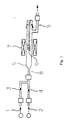
- the above-mentioned graphite powder (5 g) was placed on a plate for a sample in a box furnace and oxidized in an air at 600°C for five hours. As a result thereof, the graphite powder weight became 4.9 g. Then 1 g of the oxidized graphite powder was placed on a plate 6 for a sample in an electric furnace as shown in Fig. 1, argon gas and propane gas were supplied into a quartz tube 5 using a carrier gas supplying line 1 and a material gas supplying line 2, respectively and then the needle valves 3 and 4 were operated to make the material gas concentration 5% by volume. The flow rate of the gas in the chamber was made 12 cm/minute.
- the graphite powder was heated by a heating furnace 7 at 800°C on the sample plate 6 and the propane gas supplied from a gas inlet 8 was thermally decomposed to deposit the amorphous carbon onto the surface of the graphite particles whereupon a negative electrode active material was prepared.
- Time for the deposition was three hours and the increasing rate in weight at that time was 11%.
- Fig. 1, 9 means a gas outlet.
- the negative electrode active material prepared as such was dispersed in a solution which was prepared by dissolving polyvinylidene fluoride (a binder) in N-methyl-2-pyrrolidone (a solvent) in a mortar to knead a paste of the negative electrode active material.
- the paste was coated on both sides of the collector made of copper foil, preliminarily dried in an air at 60°C and dried in vacuo at 240°C to prepare a negative electrode in a form of a sheet. This was further dried in vacuo at 200°C to remove moisture therefrom and the product was used as a negative electrode.
- An apparent surface area and thickness of the resulting negative electrode were 8 cm 2 and 150 ⁇ m (including the thickness of the collector which was 50 ⁇ m), respectively.
- a lead wire was electrically connected with the copper collector of the negative electrode for evaluating the single electrode.
- the evaluation was conducted using a three-electrode cell in a glove box under an atmosphere of argon where lithium was used as a counter electrode and a reference electrode.
- the nonaqueous ionic conductive material used here was a solution which was prepared by dissolving lithium perchlorate (an electrolytic salt) in a mixed solvent consisting of PC, EC and diethyl carbonate (DEC) to make the electrolyte salt concentration 1 mole/liter.
- the ratio by volume of a mixture of PC and EC to DEC was made 1:1 and an evaluation of the electrode was conducted using a solvent composition as shown in Table 1.
- the charge-discharge test was conducted in such a manner that a charge was carried out at the current density of 30 mA/g of the negative electrode active material to an extent of zero volt (to Li/Li + ) and then a discharge was carried out at the same current density until 2.5 volts.
- the results are given in Table 1 and in Fig. 2.
- Example 2 The surface of the graphite particles (artificial graphite) used in Example 1 which were not subjected to an oxidizing treatment was deposited with the amorphous carbon under the same conditions as in Example 1 and the resulting negative electrode active material was subjected to an evaluation as a negative electrode by the same manner as in Example 1. An increase in weight after deposition of the carbon in that case was 9%. The results are shown in Fig. 2.
- a negative electrode was manufactured by the same operations as in Example 1 except that natural graphite (made in Madagascar; flakes; particle size: 12 ⁇ m; d 002 : 0.336 nm; Lc: 17 nm; La: 27 nm; specific surface area: 8 m 2 /g) was used as a starting graphite particles, oxidizing temperature was 700°C and the time required for the oxidation was 2.5 hours and was subjected to an evaluation. In this case, an increase in weight after deposition of the amorphous carbon was 70%.
- the nonaqueous ion conductor used here was prepared by dissolving lithium hexafluorophosphate (an electrolyte salt) in a 2:1:2 (by volume) mixture of PC, EC and dimethyl carbonate (DMC) to make the concentration of the electrolyte salt 1 mole/liter.
- the results are shown in Table 1.
- a negative electrode active material was prepared by depositing the amorphous carbon on the surface of the graphite particles (which was the same natural graphite [made in Madagascar] as used in Example 2 though unoxidized in this case) under the same conditions as in Example 1 and was subjected to an evaluation by the same manner as in Example 2. An increase in weight in this case after deposition of the amorphous carbon was 11%. The results are shown in Table 1.
- a negative electrode was manufactured and subjected to an evaluation by the same operations as in Example 1 except that an artificial graphite (flakes; particle size: 0.7 ⁇ m; d 002 : 0.338 nm; Lc: 14 nm; La: 25 nm; specific surface area: 150 m 2 /g) was used as a starting graphite particles.
- An increase in weight after deposition of the amorphous carbon in this case was 38%.
- the nonaqueous ion conductor used here was prepared by dissolving lithium borofluoride (an electrolyte salt) in a 2:1:5 (by volume) mixture of PC, EC and ethyl methyl carbonate (EMC) to make the concentration of the electrolyte salt 1 mole/liter.
- the results are shown in Table 1.
- a negative electrode active material was prepared by depositing the amorphous carbon on the surface of the graphite particles (which was the same artificial graphite as used in Example 3 although unoxidized in this case) under the same conditions as in Example 1 and was subjected to an evaluation by the same manner as in Example 3. An increase in weight in this case after deposition of the amorphous carbon was 29%. The results are shown in Table 1.
- a negative electrode active material was prepared by adhering the amorphous carbon on the surface of the graphite particles (which was the same artificial graphite as used in Example 4 although unoxidized in this case) under the same conditions as in Example 4 and was subjected to an evaluation by the same manner as in Example 4. The results are shown in Table 1.
- the above-mentioned graphite powder (5 g) was heated to reflux in 200 ml of 70% nitric acid at 110°C for ten hours, washed with water and dried to give an oxidized graphite powder. There was no increase in weight after the treatment. Then this was calcinated using an electric furnace as shown in Fig. 1 wherein nitrogen gas and ethane gas were used as a carrier gas and a material gas, respectively. Concentration of the starting gas was made 3%. The reaction temperature and the depositing time were made 830°C and 2.5 hours, respectively.
- a negative electrode active material was prepared by adhering the amorphous carbon on the surface of the graphite particles (which was the same graphite particles as used in Example 1 although unoxidized in this case) under the same conditions as in Example 5 and was subjected to an evaluation by the same manner as in Example 5. The results are shown in Table 1.
- Oxidized graphite powder was prepared by the same manner as in Example 5 except that, in oxidizing the graphite particles, fuming nitric acid (99% by weight of nitric acid) was used and the reaction temperature was 20°C.
- Example 5 The same operations as in Example 5 were conducted for adhering the amorphous carbon to the above-prepared graphite power and also for evaluating the single negative electrode. The results are shown in Table 1.
- the artificial graphite used in Example 1 was used as the graphite particles and a carbon material wherein amorphous carbon was adhered on the surface of the graphite particles was prepared by the following method.
- Example 5 The same operations as in Example 5 were conducted for adhering the amorphous carbon to the surface of the above graphite powder and also for evaluating the single negative electrode. The results are shown in Table 1.
- the graphite particles used in Example 1 were oxidized by the following method.
- Example 5 The same operations as in Example 5 were conducted for adhering the amorphous carbon to the surface of the above graphite powder and also for evaluating the single negative electrode. The results are shown in Table 1.
- the graphite powder used in Example 1 was oxidized by the following method.
- Example 5 The same operations as in Example 5 were conducted for adhering the amorphous carbon to the surface of the above graphite powder and also for evaluating the single negative electrode. The results are shown in Table 1. Discharging Capacity ( mAh/g) Charge/Discharge Efficiency(%) Increase in Weight (%) Example 1 297 65 11 Example 2 334 68 70 Example 3 283 60 38 Example 4 305 65 17 Example 5 297 65 11 Example 6 298 63 11 Example 7 295 63 11 Example 8 293 67 12 Example 9 295 66 12 Example 10 296 64 11 Comparative Example 1 250 50 9 Comparative Example 2 261 48 11 Comparative Example 3 223 38 29 Comparative Example 4 290 52 11 Comparative Example 5 255 50 8
- An artificial graphite (flakes; particle size: 9 ⁇ m; d 002 : 0.337 nm; Lc: 100 nm; La: 100 nm; specific surface area: 14 m 2 /g) was used as graphite particles and then amorphous carbon was adhered on the surface of the graphite particles to prepare a carbon material according to the following method.
- a solution prepared by dispersing 25 g of the artificial graphite in an aqueous solution of 0.06 mole/liter potassium permanganate was mixed with a solution of 0.1 mole/liter of sulfuric acid at 20 °C and the reaction was conducted by stirring at 50°C for 25 hours.
- 3 g of the graphite oxidized with potassium permanganate was placed in a mixed solution of nitric acid and hydrogen peroxide solution and washed with the acid by stirring at 25°C for three hours.
- the graphite which was washed was filtered and well dried. It was confirmed at that time that no manganese compound was present in the graphite particles.
- the negative electrode active material prepared by the above-mentioned method was dispersed in a solution which was prepared by dissolving polyvinylidene fluoride (a binder) in N-methyl-2-pyrrolidone (a solvent) in a mortar and then kneaded to prepare a paste of the negative electrode active material.
- This paste was coated on both sides of the collector made of copper foil, preliminarily dried at 60°C in an air and then dried in vacuo at 240°C to prepare a negative electrode in a sheet form. This was further dried in vacuo at 200°C for removing the moisture therefrom and the product was used as a negative electrode.
- An apparent surface area and an electrode thickness of the resulting negative electrode were 8 cm 2 and 150 ⁇ m (including the collector thickness of 50 ⁇ m), respectively.
- a lead wire was electrically connected with the copper collector of the negative electrode for evaluating the single negative electrode.
- the evaluation was conducted using a three-electrode cell in a glove box under an atmosphere of argon where lithium was used in a counter electrode and a reference electrode.
- the nonaqueous ionic conductive material used here was a solution which was prepared by dissolving lithium perchlorate (an electrolytic salt) in a mixed solvent consisting of PC, EC and diethyl carbonate (DEC) to make the electrolytic salt concentration 1 mole/liter.
- the ratio by volume of a mixture of PC:EC:DEC was made 2:1:3 and an evaluation of the electrode was conducted.
- the charge-discharge test was conducted in such a manner that a charge was carried out at the current density of 30 mA/g of the active material to an extent of zero volt (to Li/Li + ) and, after a pause of 30 minutes, a discharge was carried out at the same current density until 2.5 volts.
- the results are given in Table 2.
- Example 11 The surface of the graphite particles (artificial graphite) used in Example 11 which were not subjected to an oxidizing treatment was deposited with the carbon under the same conditions as in Example 11 and the resulting negative electrode active material was subjected to an evaluation as an electrode by the same manner as in Example 11. An increase in weight after deposition of the carbon in that case was 9%. The results are shown in Table 2.
- An electrode was manufactured and evaluated by the same manner as in Example 11 with an exception that no washing with acid was conducted. An increase in weight in this case after deposition of the carbon was 12%. The results are shown in Table 2. At that time, the presence of manganese compounds in the graphite particles was confirmed.
- Example 11 when the amorphous carbon is adhered under the same conditions, the deposited amount is more in the case of being oxidized with potassium permanganate. It is therefore noted that the depositing efficiency is higher when an oxidizing treatment is conducted with potassium permanganate.
- Example 11 The same operations as in Example 11 were conducted except that natural graphite (made in Madagascar; flakes; particle size: 12 ⁇ m; d 002 : 0.336 nm; Lc: 17 nm; La: 27 nm; specific surface area: 7.5 m 2 /g) was used as the starting graphite particles, concentration of potassium permanganate was 0.13 mole/liter, treating temperature was 50°C, reaction temperature was two hours and the washing with acid after treating with potassium permanganate was conducted with sulfuric acid whereupon an electrode was manufactured and subjected to an evaluation. An increase in weight in that case after deposition of the carbon was 13%.
- the nonaqueous ion conductor used here was prepared by dissolving lithium hexafluorophoshate (an electrolytic salt) in a 2:2:1 (by volume) mixture of PC, EC and ethyl methyl carbonate (EMC) to make the concentration of the electrolytic salt 1 mole/liter. At that time, it was confirmed that no manganese compound was present in the graphite particles. The results are shown in Table 2.
- Example 13 The surface of the natural graphite (made in Madagascar) used in Example 13 which were not subjected to an oxidizing treatment was deposited with the amorphous carbon under the same conditions as in Example 11 and the resulting negative electrode active material was subjected to an evaluation as an electrode by the same manner as in Example 13. An increase in weight after deposition of the carbon in that case was 11%. The results are shown in Table 2.
- Example 11 The same operations as in Example 11 were conducted except that spherical graphite (particle size: 6 ⁇ m; d 002 : 0.337 nm; Lc: 13 nm; La: 11 nm; specific surface area: 8 m 2 /g) was used as the starting graphite particles, concentration of potassium permanganate was 0.06 mole/liter, treating temperature was 50°C, reaction time was 25 hours and the washing with acid after treating with potassium permanganate was conducted with sulfuric acid whereupon an electrode was manufactured and subjected to an evaluation. An increase in weight in that case after deposition of the carbon was 18%.
- the electrolytic solution used here was prepared by dissolving lithium borofluoride (an electrolytic salt) in a 3:1:4 (by volume) mixture of PC, EC and dimethyl carbonate (DMC) to make the concentration of the electrolytic salt 1 mole/liter. At that time, it was confirmed that no manganese compound was present in the graphite particles. The results are shown in Table 2.
- Example 13 The surface of the spherical graphite used in Example 13 which was not subjected to an oxidizing treatment was deposited with the amorphous carbon under the same conditions as in Example 11 and the resulting negative electrode active material was subjected to an evaluation as an electrode by the same manner as in Example 14. An increase in weight after deposition of the carbon in that case was 10%. The results are shown in Table 2.
- the artificial graphite used in Example 11 was used as a starting graphite, subjected to the same oxidizing treatment with potassium permanganate under the same conditions as in Example 11 and mixed with coal tar pitch and the mixture was calcinated at 300°C in an atmosphere of nitrogen for two hours and then at 1,000°C for three hours.
- the resulting sample was taken out from the electric furnace, pulverized in a mortar, sieved to collect the particles of the uniform diameters and then an electrode was manufactured from the resulting powder and subjected to an evaluation by the same manners as in Example 11.
- the electrolytic solution used here was prepared by dissolving lithium perchlorate in a 1:1:2 (by volume) mixture of PC, EC and DEC to make the salt concentration 1 mole/liter. At that time, it was confirmed that no manganese compound was present in the graphite particles. The results are shown in Table 2.
- Example 15 The surface of the artificial graphite used in Example 15 which was not subjected to an oxidizing treatment was deposited with the amorphous carbon under the same conditions as in Example 5 and the resulting negative electrode active material was subjected to an evaluation as an electrode by the same manner as in Example 15. The results are shown in Table 2.
- Example 11 The same operations as in Example 11 were conducted except that artificial graphite (flakes; particle size: 12 ⁇ m; d 002 : 0.337 nm; Lc: 20 nm; La: 50 nm; specific surface area: 8 m 2 /g) was used as the starting graphite particles, concentration of potassium permanganate was 0.3 mole/liter, treating temperature was 50°C, reaction time was five hours and the washing with acid after treating with potassium permanganate was conducted with sulfuric acid whereupon an electrode was manufactured. Evaluation of the electrode was conducted by the same manner as in Example 11. An increase in weight in that case after deposition of the carbon was 14%.
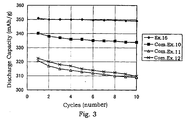
- the electrolytic solution used here was prepared by dissolving lithium hexafluorophoshate (an electrolytic salt) in a 1:2:3 (by volume) mixture of PC, EC and EMC to make the concentration of the electrolytic salt 1 mole/liter. At that time, it was confirmed that no manganese compound was present in the graphite particles. The results are shown in Table 3. The cycle characteristics at 25°C are shown in Fig. 3.
- Example 16 The surface of the graphite particles used in Example 16 which were not subjected to an oxidizing treatment was deposited with the amorphous carbon under the same conditions as in Example 16 and the resulting negative electrode active material was subjected to an evaluation as an electrode by the same manner as in Example 16. An increase in weight after deposition of the carbon in that case was 10%.
- Table 3 and Fig. 3 The results are shown in Table 3 and Fig. 3.
- Example 16 The surface of the artificial graphite used in Example 16 which was subjected to an oxidizing treatment by potassium permanganate under the same conditions as in Example 16 was deposited with the amorphous carbon under the same conditions as in Example 16 and the resulting negative electrode active material was subjected to an evaluation as an electrode by the same manner as in Example 16. The results are shown in Table 3 and Fig. 3.
- Example 16 The artificial graphite used in Example 16 was used as a starting graphite, subjected to the same oxidizing treatment with potassium permanganate under the same conditions as in Example 16 and mixed with coal tar and the mixture of coal tar and graphite was calcinated at 400°C in an atmosphere of nitrogen for five hours and then at 1,000°C for three hours.
- the resulting sample was taken out from the electric furnace, pulverized in a mortar, sieved to collect the powder of the uniform diameters and an electrode was manufactured from the resulting powder by the same operations as in Example 16 and subjected to an evaluation by the same operations as in Example 16. The results are shown in Table 3 and Fig. 3.
- lithium carbonate, cobalt carbonate and antimony trioxide were weighed to make the atomic ratio of lithium:cobalt:antimony 1:9.95:0.05. They were mixed in a mortar, calcinated in an air at 900°C for 20 hours and pulverized in a mortar to give a positive electrode active material powder. This active material had a composition of Li 0.98 Co 0.95 Sb 0.05 O 2 .
- the positive electrode active material prepared as such was mixed with acetylene black, a dispersing agent of a nonionic type was added thereto, then a dispersion of polytetrafluoroethylene was added (the ratio by weight of the positive electrode active material:acetylene black:polytetrafluoroethylene after drying was 100:10:5) and the resulting paste was coated on a titanium mesh collector.
- This was preliminarily dried at 60°C, subjected to a thermal treatment at 240°C, pressed and dried in vacuo at 200°C for removing the moisture therefrom to give a positive electrode.
- This positive electrode was in a tablet form having a diameter of 15 mm and a thickness of 0.9 mm.
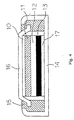
- a positive electrode 13 was press-fitted to a positive electrode case 14 wherein the positive electrode collector 17 was press-molded to the inner bottom and a seal packing 15 was installed.
- a separator 12 made of nonwoven polypropylene fabric was placed thereupon and impregnated with a nonaqueous ion conductor prepared by dissolving 1 mole/liter of LiPF 6 (an electrolytic salt) in a 1:1:2 (by volume) mixture of PC, EC and DEC.
- a negative electrode collector 10 was press-molded to the inner surface of the negative electrode cover 16 and then a negative electrode 11 was press-fitted to the negative electrode collector. After that, said negative electrode 11 was placed on the above-mentioned separator 12 and then the positive electrode case 14 and the negative electrode cover 16 were caulked together via a seal packing 15 to fabricate a coin-type battery.
- Charge-discharge current and upper-limit charge voltage of the coin-type battery fabricated as such were made 1 mA and 4.2 volts, respectively and then charged at a constant-voltage of 4.2 volts where the charge time was made 12 hours.
- a charge-discharge test was conducted after making the lower-limit discharge voltage 2.5 volts. The temperature-dependency of the capacity of the resulting battery was measured and the results are shown in Table 4.
- a negative electrode was prepared by the same method as mentioned in Example 17 except that the carbon material of Example 5 was used as a negative electrode active material. Both size and thickness of the prepared negative electrode were made as same as those mentioned in Example 17. Method for preparing the positive electrode and method for fabricating the battery were the same as those mentioned in Example 17 as well.
- the fabricated battery was evaluated by the same method as mentioned in Example 17. The results are shown in Table 4.
- a negative electrode was prepared by the same method as mentioned in Example 17 except that the carbon material of Example 9 was used as a negative electrode active material. Both size and thickness of the prepared negative electrode were made as same as those mentioned in Example 17. Method for preparing the positive electrode and method for fabricating the battery were the same as those mentioned in Example 17 as well.
- the fabricated battery was evaluated by the same method as mentioned in Example 17. The results are shown in Table 4.
- a negative electrode was prepared by the same method as mentioned in Example 17 except that the carbon material of Comparative Example 1 was used as a negative electrode active material. Both size and thickness of the prepared negative electrode were made as same as those mentioned in Example 17. Method for preparing the positive electrode and method for fabricating the battery were the same as those mentioned in Example 17 as well.
- Example 17 The fabricated battery was evaluated by the method mentioned in Example 17. The results are shown in Table 4. Measuring Temperature (°C) Examples Comp.Ex. 13 17 18 19 40 17 17 17 17 17 (mAh) 25 16 15 15 15 (mAh) 0 11 9 9 7 (mAh) -25 5 4 4 0 (mAh) 25 (after 100 cycles) 15 14 15 12 (mAh) 25 (after 200 cycles) 15 13 14 9 (mAh)
- a negative electrode active material wherein the surface was adhered with an amorphous carbon was prepared by the same method as in Example 11, dispersed in a solution which were prepared by dissolving polyvinylidene fluoride (a binder) in N-methyl-2-pyrrolidone (a solvent) in a mortar and the resulting paste was placed into the pores of a nickel three-dimensional porous collector. This was preliminarily dried at 60°C, subjected to a thermal treatment at 240°C, pressed and dried in vacuo for removing the moisture therefrom to give a negative electrode. The resulting negative electrode was in a tablet form having a diameter of 15 mm and an electrode thickness of 0.50 mm.
- lithium hydroxide and nickel hydroxide were weighed to make the atomic ratio of lithium:nickel 1:2. They were mixed in a mortar, calcinated in an oxygen stream at 700°C for 20 hours and pulverized in a mortar to give LiNiO 2 which was a positive electrode active material powder.
- the positive electrode active material prepared as such was mixed with acetylene black, dispersed in a solution which was prepared by dissolving polyvinylidene fluoride (a binder) in N-methyl-2-pyrrolidone (a solvent) in a mortar and the resulting paste was coated on an aluminum foil collector.
- This positive electrode was preliminarily dried at 60°C, subjected to a thermal treatment at 240°C, pressed and dried in vacuo at 200°C for removing the moisture therefrom to give a positive electrode.
- This positive electrode was in a tablet form having a diameter of 14.8 mm and a thickness of 0.90 mm.
- a positive electrode 13 was press-fitted to a positive electrode case 14 wherein the positive electrode collector 17 was press-molded to the inner bottom and an insulation packing 15 was installed.
- a separator 12 made of nonwoven polypropylene fabric was placed thereupon and impregnated with a nonaqueous ion conductor prepared by dissolving 1 mole/liter of LiPF 6 (an electrolytic salt) in a 2:1:3 (by volume) mixture of PC, EC and EMC.
- a negative electrode collector 10 was press-molded to the inner surface of the negative electrode cover 16 and then a negative electrode 11 was press-fitted to the negative electrode collector.
- Charge-discharge current and upper-limit charge voltage of the coin-type battery fabricated as such were made 1 mA and 4.2 volts, respectively and then charged at a constant-voltage of 4.2 volts where the charge time was made 12 hours.
- a charge-discharge test was conducted after making the lower-limit discharge voltage 2.5 volts. The temperature-dependency of the capacity of the resulting battery was measured.
- the charge-discharge test was conducted in a thermostat which was kept at 40°C, 25°C, 0°C and -20°C. The results are shown in Table 5. Moreover, the results of the cycle test conducted at 0 are °C shown in Fig. 5.
- a negative electrode was prepared by the same method as mentioned in Example 20 except that the carbon material of Comparative Example 6 was used as a negative electrode active material. Both size and thickness of the prepared negative electrode were made the same as those mentioned in Example 20. Method for preparing the positive electrode and method for fabricating the battery were the same as those mentioned in Example 20 as well.
- the resulting battery was evaluated by a method mentioned in Example 20. The results are shown in Table 5 and Fig. 5.
- Example 20 A battery was manufactured and an evaluation of the battery was conducted by the same manner as in Example 20 except that a 2:1:3 (by volume) mixture of PC, EC and DEC was used as the nonaqueous ion conductor. The results are shown in Table 5 and Fig. 5. Temperature Example 20 Comp.Ex.14 Comp.Ex.15 40°C 16 15 16 25°C 14 12 14 0°C 10 8 8 -20°C 6 1 4
- the graphite particles which were subjected to an oxidizing treatment with potassium permanganate had good cycle characteristics at low temperatures whereby it is noted that an oxidizing treatment of the graphite particles with potassium permanganate gave rise to an improvement in an adhesion strength between the graphite particles with the amorphous carbon on the surface.
- the nonaqueous secondary battery of the present invention consists of a negative electrode, a positive electrode in which a chalcogenated substance containing lithium is used as a positive electrode active material, and a nonaqueous ion conductor; arid said negative electrode contains a negative electrode active material which is a carbon material where an amorphous carbon is adhered on the surface of the oxidized graphite particles.
Landscapes
- Chemical & Material Sciences (AREA)
- General Chemical & Material Sciences (AREA)
- Chemical Kinetics & Catalysis (AREA)
- Electrochemistry (AREA)
- Engineering & Computer Science (AREA)
- Inorganic Chemistry (AREA)
- Manufacturing & Machinery (AREA)
- General Physics & Mathematics (AREA)
- Condensed Matter Physics & Semiconductors (AREA)
- Physics & Mathematics (AREA)
- Composite Materials (AREA)
- Materials Engineering (AREA)
- Battery Electrode And Active Subsutance (AREA)
- Secondary Cells (AREA)
Claims (18)
- Aktives Material für eine negative Elektrode für eine Sekundärbatterie, das amorphen Kohlenstoff aufweist, der an der oxidierten Oberfläche von Graphitteilchen zur Anhaftung gebracht ist.
- Aktives Material nach Anspruch 1, bei dem die Graphitteilchen einen durch Weitwinkel-Röntgenbeugung bestimmten mittleren Abstand (d002) der (002)-Gitterebene von 0,335 - 0,340 nm, eine Kristallitdicke (Lc) in der Richtung der (002)-Ebene nicht unter 10 nm und eine Kristallitdicke (La) in der Richtung der (110)-Ebene nicht unter 10 nm aufweisen.
- Aktives Material nach Anspruch 1 oder Anspruch 2, bei dem die Graphitteilchen eine spezifische Oberfläche von 5 - 150 m2/g, gemessen gemäß dem BET-Verfahren, und eine mittlere Teilchengröße von 0,7 - 80 µm aufweisen.
- Verfahren zum Herstellen eines aktiven Materials für eine negative Elektrode, mit den Schritten des Oxidierens von Graphitteilchen und des Anhaftens amorphen Kohlenstoffs an der Oberfläche der Graphitteilchen.
- Verfahren nach Anspruch 4, bei dem der Oxidationsschritt in Luft bei 500 - 700°C ausgeführt wird.
- Verfahren nach Anspruch 4, bei dem der Oxidationsschritt dadurch ausgeführt wird, dass die Graphitteilchen mit einem geschmolzenen Alkalimetallsalz gemischt werden oder die Graphitteilchen in einer Alkalimetallsalzlösung dispergiert werden, die Graphitteilchen abgetrennt werden und sie an Luft auf 300 - 700°C erhitzt werden.
- Verfahren nach Anspruch 4, bei dem der Oxidationsschritt dadurch ausgeführt wird, dass die Graphitteilchen mit einer wässrigen Lösung von Kaliumpermanganat von 0,01 - 1 Mol/Liter bei einer Temperatur von der Umgebungstemperatur bis 100°C behandelt werden.
- Verfahren nach Anspruch 6 oder Anspruch 7, bei dem die oxidierten Graphitteilchen mit Säure gewaschen werden, bevor der amorphe Kohlenstoff an ihrer Oberfläche zum Anhaften gebracht wird.
- Verfahren nach Anspruch 8, bei dem die Säure aus Schwefelsäure, Salpetersäure, Chlorwasserstoffsäure, Phosphorsäure und Fluorwasserstoffsäure und Wasserstoffperoxid ausgewählt wird.
- Verfahren nach Anspruch 4, bei dem der Oxidationsschritt dadurch ausgeführt wird, dass die Graphitteilchen bei einer Temperatur von 20 - 130°C mit 5 - 99 Gewichts-% Salpetersäure behandelt werden.
- Verfahren nach einem der Ansprüche 4 bis 10, bei dem der amorphe Kohlenstoff dadurch an der Oberfläche der Graphitteilchen zum Anhaften gebracht wird, dass ein Kohlenwasserstoff-Gasphasenpyrolyse-Erzeugnis abgeschieden wird.
- Nichtwässrige Sekundärbatterie mit einer negativen Elektrode, einer positiven Elektrode mit einem aktiven Material mit einer chalcogenierten, lithiumhaltigen Substanz und einem nichtwässrigen Ionenleiter, wobei die negative Elektrode ein aktives Material gemäß einem der Ansprüche 1 bis 3 oder ein solches enthält, das gemäß einem der Ansprüche 4 bis 11 hergestellt wurde.
- Nichtwässrige Sekundärbatterie nach Anspruch 12, bei der der nichtwässrige Ionenleiter ein Lösungsgemisch aufweist, das zumindest Propylencarbonat und Ethylencarbonat enthält.
- Nichtwässrige Sekundärbatterie nach Anspruch 13, bei der das Volumenverhältnis von Propylencarbonat zu Ethylencarbonat von 9:1 bis 1:9 beträgt.
- Nichtwässrige Sekundärbatterie nach Anspruch 14, bei der das Volumenverhältnis von Propylencarbonat zu Ethylencarbonat von 9:1 bis 5:5 beträgt.
- Nichtwässrige Sekundärbatterie nach einem der Ansprüche 12 bis 15, bei der die chalcogenierte Substanz ein lithiumhaltiges Metalloxid ist.
- Nichtwässrige Sekundärbatterie nach Anspruch 16, bei der das lithiumhaltige Metalloxid LixM1-yNyO2 (wobei M Fe, Co oder Ni ist; N ein Übergangsmetall ist; 0 < x ≤ 1; und 0 ≤ y ≤ 1 gelten) oder LiMn2-zNzO4 (wobei N ein Übergangsmetall ist und 0 ≤ z ≤ 2 gilt) ist.
- Nichtwässrige Sekundärbatterie nach Anspruch 17, bei der das lithiumhaltige Metalloxid LiCoO2, LiNiO2, LiFeO2, LiMnO2 oder LiMn2O4 ist.
Applications Claiming Priority (9)
| Application Number | Priority Date | Filing Date | Title |
|---|---|---|---|
| JP12875896 | 1996-05-23 | ||
| JP12875896 | 1996-05-23 | ||
| JP128758/96 | 1996-05-23 | ||
| JP26807496A JP3304267B2 (ja) | 1996-05-23 | 1996-10-09 | 非水系二次電池及び負極活物質の製造方法 |
| JP26807496 | 1996-10-09 | ||
| JP268074/96 | 1996-10-09 | ||
| JP01697397A JP3340337B2 (ja) | 1997-01-30 | 1997-01-30 | 非水系二次電池及び負極活物質の製造方法 |
| JP1697397 | 1997-01-30 | ||
| JP16973/97 | 1997-01-30 |
Publications (3)
| Publication Number | Publication Date |
|---|---|
| EP0808798A2 EP0808798A2 (de) | 1997-11-26 |
| EP0808798A3 EP0808798A3 (de) | 1998-02-11 |
| EP0808798B1 true EP0808798B1 (de) | 2000-01-26 |
Family
ID=27281642
Family Applications (1)
| Application Number | Title | Priority Date | Filing Date |
|---|---|---|---|
| EP97303557A Expired - Lifetime EP0808798B1 (de) | 1996-05-23 | 1997-05-23 | Nichtwässrige Sekundärbatterie und Verfahren zur Herstellung eines activen Materials for eine negative Electrode |
Country Status (4)
| Country | Link |
|---|---|
| US (1) | US5965296A (de) |
| EP (1) | EP0808798B1 (de) |
| CA (1) | CA2205767C (de) |
| DE (1) | DE69701202T2 (de) |
Families Citing this family (36)
| Publication number | Priority date | Publication date | Assignee | Title |
|---|---|---|---|---|
| JP3481063B2 (ja) * | 1995-12-25 | 2003-12-22 | シャープ株式会社 | 非水系二次電池 |
| US6455199B1 (en) * | 1997-05-30 | 2002-09-24 | Matsushita Electric Industrial Co., Ltd. | Nonaqueous electrolyte secondary battery and method for manufacturing negative electrode of the same |
| WO1998054779A1 (en) * | 1997-05-30 | 1998-12-03 | Matsushita Electric Industrial Co., Ltd. | Nonaqueous electrolyte secondary battery |
| JP4187347B2 (ja) * | 1998-04-02 | 2008-11-26 | 三星エスディアイ株式会社 | リチウムイオン電池用負極活物質の製造方法 |
| JP4282107B2 (ja) * | 1998-05-01 | 2009-06-17 | 三星エスディアイ株式会社 | リチウム二次電池負極用炭素材及びこれを用いたリチウム二次電池 |
| WO1999060652A1 (en) * | 1998-05-20 | 1999-11-25 | Osaka Gas Company Limited | Nonaqueous secondary cell and method for controlling the same |
| US6482547B1 (en) * | 1998-05-21 | 2002-11-19 | Samsung Display Devices Co., Ltd. | Negative active material for lithium secondary battery and lithium secondary battery using the same |
| JP3152226B2 (ja) * | 1998-08-27 | 2001-04-03 | 日本電気株式会社 | 非水電解液二次電池、その製造法および炭素材料組成物 |
| US6506518B1 (en) * | 1999-04-27 | 2003-01-14 | Shin-Kobe Electric Machinery Co., Ltd. | Lithium secondary battery |
| AU761199B2 (en) * | 1999-05-14 | 2003-05-29 | Synthes Gmbh | Bone fixation device with a rotation joint |
| DK1341247T3 (da) * | 2000-11-17 | 2011-11-21 | Asahi Chemical Ind | Ikke-vandig lithium-sekundærcelle |
| US20030160215A1 (en) * | 2002-01-31 | 2003-08-28 | Zhenhua Mao | Coated carbonaceous particles particularly useful as electrode materials in electrical storage cells, and methods of making the same |
| JP4183472B2 (ja) | 2002-10-10 | 2008-11-19 | 三洋電機株式会社 | 非水電解質二次電池 |
| US20040124402A1 (en) * | 2002-12-25 | 2004-07-01 | Showa Denko K.K. | Negative electrode material, and production method and use thereof |
| EP1652250B1 (de) * | 2003-07-22 | 2011-12-28 | Byd Company Limited | Herstellungsverfahren von modifizierten graphit-körner |
| TWI467840B (zh) * | 2005-09-02 | 2015-01-01 | A123 Systems Inc | 奈米組成電極以及其相關裝置 |
| KR101483123B1 (ko) * | 2006-05-09 | 2015-01-16 | 삼성에스디아이 주식회사 | 금속 나노결정 복합체를 포함하는 음극 활물질, 그 제조방법 및 이를 채용한 음극과 리튬 전지 |
| US7820328B1 (en) * | 2006-07-27 | 2010-10-26 | Greatbatch Ltd. | Electrochemical cell electrode with improved particle-to-particle contact and method of manufacturing |
| US20080070120A1 (en) * | 2006-09-14 | 2008-03-20 | Shin-Etsu Chemical Co., Ltd. | Non-aqueous electrolyte secondary battery and making method |
| JP2008210719A (ja) * | 2007-02-27 | 2008-09-11 | Seiko Instruments Inc | 扁平形アルカリ一次電池 |
| JP2008210720A (ja) * | 2007-02-27 | 2008-09-11 | Seiko Instruments Inc | 扁平形アルカリ一次電池 |
| JP5623686B2 (ja) | 2007-06-01 | 2014-11-12 | パナソニック株式会社 | 複合負極活物質および非水電解質二次電池 |
| US9029019B2 (en) * | 2007-08-17 | 2015-05-12 | Nanotek Instruments, Inc. | Carbon anode compositions for lithium ion batteries |
| US7993780B2 (en) | 2007-10-05 | 2011-08-09 | Nanotek Instruments, Inc. | Process for producing carbon anode compositions for lithium ion batteries |
| US7745047B2 (en) * | 2007-11-05 | 2010-06-29 | Nanotek Instruments, Inc. | Nano graphene platelet-base composite anode compositions for lithium ion batteries |
| US8119288B2 (en) * | 2007-11-05 | 2012-02-21 | Nanotek Instruments, Inc. | Hybrid anode compositions for lithium ion batteries |
| US20090148773A1 (en) * | 2007-12-06 | 2009-06-11 | Ener1, Inc. | Lithium-ion secondary battery cell, electrode for the battery cell, and method of making the same |
| US9564629B2 (en) * | 2008-01-02 | 2017-02-07 | Nanotek Instruments, Inc. | Hybrid nano-filament anode compositions for lithium ion batteries |
| US8435676B2 (en) * | 2008-01-09 | 2013-05-07 | Nanotek Instruments, Inc. | Mixed nano-filament electrode materials for lithium ion batteries |
| US9190667B2 (en) | 2008-07-28 | 2015-11-17 | Nanotek Instruments, Inc. | Graphene nanocomposites for electrochemical cell electrodes |
| US8900755B2 (en) * | 2010-09-23 | 2014-12-02 | Nanotek Instruments, Inc. | Lithium super-battery with a chemically functionalized disordered carbon cathode |
| PL2791057T3 (pl) * | 2011-12-14 | 2018-03-30 | National University Of Singapore | Sposób wytwarzania ekspandowanych heksagonalnych minerałów warstwowych przy użyciu ładowania elektrochemicznego i kompozycja do sposobu elektrochemicznego |
| JP6555123B2 (ja) | 2013-03-29 | 2019-08-07 | 日本電気株式会社 | リチウム二次電池用負極炭素材料及びその製造方法、並びにリチウム二次電池用負極およびリチウム二次電池 |
| US12334397B2 (en) * | 2021-05-13 | 2025-06-17 | Taiwan Semiconductor Manufacturing Co., Ltd. | Interconnect structure including graphite and method forming same |
| CN113921784A (zh) * | 2021-09-29 | 2022-01-11 | 湖北亿纬动力有限公司 | 一种负极材料及其制备方法和应用 |
| CN116969452B (zh) * | 2023-06-26 | 2025-10-17 | 碳一新能源集团有限责任公司 | 一种高容量石墨及其制备方法、锂离子电池负极材料 |
Family Cites Families (15)
| Publication number | Priority date | Publication date | Assignee | Title |
|---|---|---|---|---|
| US4136213A (en) * | 1975-10-16 | 1979-01-23 | Exxon Research & Engineering Co. | Carbon article including electrodes and methods of making the same |
| DE3466837D1 (en) * | 1983-05-19 | 1987-11-19 | Lorraine Carbone | Graphite intercalation compounds with improved performance, and electrochemical application of these compounds |
| US4740433A (en) * | 1986-09-29 | 1988-04-26 | American Telephone And Telegraph Co., At&T Bell Laboratories | Nonaqueous battery with special separator |
| JP2884746B2 (ja) * | 1990-09-03 | 1999-04-19 | 松下電器産業株式会社 | 非水電解液2次電池 |
| JP2943287B2 (ja) * | 1990-09-04 | 1999-08-30 | 株式会社ブリヂストン | 非水電解質二次電池の製造方法 |
| EP0508689B1 (de) * | 1991-04-05 | 2000-01-26 | Sharp Kabushiki Kaisha | Sekundärbatterie |
| JP2643035B2 (ja) * | 1991-06-17 | 1997-08-20 | シャープ株式会社 | 非水系二次電池用炭素負極およびその製造方法 |
| JP3233417B2 (ja) * | 1991-07-25 | 2001-11-26 | 富士写真フイルム株式会社 | 有機電解液二次電池 |
| JPH05114421A (ja) * | 1991-10-24 | 1993-05-07 | Sanyo Electric Co Ltd | アルカリ二次電池 |
| JPH05121066A (ja) * | 1991-10-29 | 1993-05-18 | Asahi Chem Ind Co Ltd | 非水電池負極 |
| EP0573266B1 (de) * | 1992-06-01 | 1999-12-08 | Kabushiki Kaisha Toshiba | Verfahren zur Herstellung von Kohlenstoffhaltigem Material für negative Elektroden und Lithium-Sekundärbatterien, die dieses enthält |
| JPH0620690A (ja) * | 1992-07-07 | 1994-01-28 | Toray Ind Inc | 電極材料およびそれを用いた二次電池 |
| JPH0684516A (ja) * | 1992-09-03 | 1994-03-25 | Sanyo Electric Co Ltd | 非水電解液二次電池 |
| US5776610A (en) * | 1993-02-03 | 1998-07-07 | Sharp Kabushiki Kaisha | Carbon composite electrode material and method of making thereof |
| US5776633A (en) * | 1995-06-22 | 1998-07-07 | Johnson Controls Technology Company | Carbon/carbon composite materials and use thereof in electrochemical cells |
-
1997
- 1997-05-21 CA CA002205767A patent/CA2205767C/en not_active Expired - Fee Related
- 1997-05-23 DE DE69701202T patent/DE69701202T2/de not_active Expired - Lifetime
- 1997-05-23 EP EP97303557A patent/EP0808798B1/de not_active Expired - Lifetime
- 1997-05-23 US US08/862,677 patent/US5965296A/en not_active Expired - Lifetime
Also Published As
| Publication number | Publication date |
|---|---|
| EP0808798A2 (de) | 1997-11-26 |
| CA2205767C (en) | 2001-04-03 |
| DE69701202D1 (de) | 2000-03-02 |
| EP0808798A3 (de) | 1998-02-11 |
| DE69701202T2 (de) | 2000-06-15 |
| US5965296A (en) | 1999-10-12 |
| CA2205767A1 (en) | 1997-11-23 |
Similar Documents
| Publication | Publication Date | Title |
|---|---|---|
| US5965296A (en) | Nonaqueous secondary battery and a method of manufacturing a negative electrode active material | |
| JP3481063B2 (ja) | 非水系二次電池 | |
| KR101038637B1 (ko) | 음극 활성 물질, 그것을 이용한 음극, 그것을 이용한비수성 전해질 전지, 및 음극 활성 물질의 제조 방법 | |
| EP0713256B1 (de) | Lithium Sekundärbatterie und Verfahren zur Herstellung des Materials für die negative Elektrode zur Verwendung darin. | |
| US8158282B2 (en) | Method of producing prelithiated anodes for secondary lithium ion batteries | |
| JP3556270B2 (ja) | リチウム二次電池 | |
| US6156457A (en) | Lithium secondary battery and method for manufacturing a negative electrode | |
| JP3685364B2 (ja) | 炭素被覆黒鉛粒子の製造方法及び非水系二次電池 | |
| JP3304267B2 (ja) | 非水系二次電池及び負極活物質の製造方法 | |
| EP1024544A2 (de) | Anodenmaterial für Lithiumsekundärbatterie, Lithiumsekundärbatterie mit diesem Anodenmaterial , und Verfahren zur Aufladung dieser Sekundärbatterie | |
| EP0690518B1 (de) | Nichtwässrige Sekundärbatterie und Negativelektrode | |
| JP3311104B2 (ja) | リチウム二次電池 | |
| JP2019220350A (ja) | リチウムイオン電池用負極材料、リチウムイオン電池用負極及びリチウムイオン電池 | |
| JPH06349482A (ja) | リチウム二次電池 | |
| JP3340337B2 (ja) | 非水系二次電池及び負極活物質の製造方法 | |
| KR101632358B1 (ko) | ZnO-MnO-C 복합체, 산화아연 및 산화망간을 포함하는 복합체의 제조방법 및 이를 포함하는 리튬 이차 전지용 음극 활물질 | |
| EP0434402B1 (de) | Verfahren zur Herstellung einer Kohlenstoffelektrode | |
| JP3140880B2 (ja) | リチウム二次電池 | |
| JPH087895A (ja) | リチウム二次電池電極用炭素材料及びその製造方法 | |
| JP2002241117A (ja) | 黒鉛系炭素材料、その製造方法、リチウム二次電池用負極材料およびリチウム二次電池 | |
| JP2001143691A (ja) | 黒鉛系炭素材料、その製造方法、リチウム二次電池用負極材料およびリチウム二次電池 | |
| JP3055892B2 (ja) | リチウム二次電池 | |
| JP3720959B2 (ja) | 二次電池用電極材料 | |
| JPH08180873A (ja) | 負極材料の製造方法及び非水電解液二次電池 | |
| JPH07320785A (ja) | 非水電解液二次電池 |
Legal Events
| Date | Code | Title | Description |
|---|---|---|---|
| PUAI | Public reference made under article 153(3) epc to a published international application that has entered the european phase |
Free format text: ORIGINAL CODE: 0009012 |
|
| AK | Designated contracting states |
Kind code of ref document: A2 Designated state(s): DE FR GB |
|
| PUAL | Search report despatched |
Free format text: ORIGINAL CODE: 0009013 |
|
| AK | Designated contracting states |
Kind code of ref document: A3 Designated state(s): DE FR GB |
|
| 17P | Request for examination filed |
Effective date: 19980423 |
|
| GRAG | Despatch of communication of intention to grant |
Free format text: ORIGINAL CODE: EPIDOS AGRA |
|
| 17Q | First examination report despatched |
Effective date: 19990311 |
|
| GRAG | Despatch of communication of intention to grant |
Free format text: ORIGINAL CODE: EPIDOS AGRA |
|
| GRAH | Despatch of communication of intention to grant a patent |
Free format text: ORIGINAL CODE: EPIDOS IGRA |
|
| GRAH | Despatch of communication of intention to grant a patent |
Free format text: ORIGINAL CODE: EPIDOS IGRA |
|
| GRAA | (expected) grant |
Free format text: ORIGINAL CODE: 0009210 |
|
| AK | Designated contracting states |
Kind code of ref document: B1 Designated state(s): DE FR GB |
|
| REF | Corresponds to: |
Ref document number: 69701202 Country of ref document: DE Date of ref document: 20000302 |
|
| ET | Fr: translation filed | ||
| PLBE | No opposition filed within time limit |
Free format text: ORIGINAL CODE: 0009261 |
|
| STAA | Information on the status of an ep patent application or granted ep patent |
Free format text: STATUS: NO OPPOSITION FILED WITHIN TIME LIMIT |
|
| 26N | No opposition filed | ||
| REG | Reference to a national code |
Ref country code: GB Ref legal event code: IF02 |
|
| PGFP | Annual fee paid to national office [announced via postgrant information from national office to epo] |
Ref country code: GB Payment date: 20140521 Year of fee payment: 18 |
|
| PGFP | Annual fee paid to national office [announced via postgrant information from national office to epo] |
Ref country code: FR Payment date: 20140509 Year of fee payment: 18 Ref country code: DE Payment date: 20140521 Year of fee payment: 18 |
|
| REG | Reference to a national code |
Ref country code: DE Ref legal event code: R119 Ref document number: 69701202 Country of ref document: DE |
|
| GBPC | Gb: european patent ceased through non-payment of renewal fee |
Effective date: 20150523 |
|
| REG | Reference to a national code |
Ref country code: FR Ref legal event code: ST Effective date: 20160129 |
|
| PG25 | Lapsed in a contracting state [announced via postgrant information from national office to epo] |
Ref country code: DE Free format text: LAPSE BECAUSE OF NON-PAYMENT OF DUE FEES Effective date: 20151201 Ref country code: GB Free format text: LAPSE BECAUSE OF NON-PAYMENT OF DUE FEES Effective date: 20150523 |
|
| PG25 | Lapsed in a contracting state [announced via postgrant information from national office to epo] |
Ref country code: FR Free format text: LAPSE BECAUSE OF NON-PAYMENT OF DUE FEES Effective date: 20150601 |