EP0801151B1 - Alliage amorphe à base de métaux précieux, déformable plastiquement et utilisable comme matériau pour anodes d'électrolyse - Google Patents
Alliage amorphe à base de métaux précieux, déformable plastiquement et utilisable comme matériau pour anodes d'électrolyse Download PDFInfo
- Publication number
- EP0801151B1 EP0801151B1 EP97302397A EP97302397A EP0801151B1 EP 0801151 B1 EP0801151 B1 EP 0801151B1 EP 97302397 A EP97302397 A EP 97302397A EP 97302397 A EP97302397 A EP 97302397A EP 0801151 B1 EP0801151 B1 EP 0801151B1
- Authority
- EP
- European Patent Office
- Prior art keywords
- amorphous
- precious metal
- alloy
- amorphous alloy
- electrode material
- Prior art date
- Legal status (The legal status is an assumption and is not a legal conclusion. Google has not performed a legal analysis and makes no representation as to the accuracy of the status listed.)
- Expired - Lifetime
Links
Images



Classifications
-
- C—CHEMISTRY; METALLURGY
- C22—METALLURGY; FERROUS OR NON-FERROUS ALLOYS; TREATMENT OF ALLOYS OR NON-FERROUS METALS
- C22C—ALLOYS
- C22C45/00—Amorphous alloys
- C22C45/003—Amorphous alloys with one or more of the noble metals as major constituent
-
- C—CHEMISTRY; METALLURGY
- C25—ELECTROLYTIC OR ELECTROPHORETIC PROCESSES; APPARATUS THEREFOR
- C25B—ELECTROLYTIC OR ELECTROPHORETIC PROCESSES FOR THE PRODUCTION OF COMPOUNDS OR NON-METALS; APPARATUS THEREFOR
- C25B11/00—Electrodes; Manufacture thereof not otherwise provided for
- C25B11/04—Electrodes; Manufacture thereof not otherwise provided for characterised by the material
Definitions
- the present invention relates to an electrode for anode electrolysis having a high corrosion resistance and a long service life suitable for use in various caustic solutions such as a sodium chloride solution, and in particular it relates to manufacture and provision of such electrodes using a precious metal-based amorphous alloy which has a good plasticity processibility and is applicable to a large-sized component.
- a precious metal-based amorphous alloy which has a good plasticity processibility and is applicable to a large-sized component.
- Use of such electrodes enables its application in chemical and other industries. Further, due to its excellent corrosion resistance, this alloy can be used as an anti-corrosion material.
- a precious metal such as platinum (Pt) is generally used.
- an electrode for use in electrolysis it is required for an electrode for use in electrolysis to have a high electrolysis efficiency to its target object, ensure a stable electrolysis efficiency for a long time, and exhibit a high corrosion resistance in a stringent oxidization environment.
- JP-B Publication No.59-35417 discloses a method of manufacturing amorphous alloy wires comprehensively including compositions of transition metal-semimetal amorphous alloys.
- Electrode materials using amorphous alloys are disclosed in JP-A No.62-96633, JP-A No.4-68394 and JP-A No.5-65604. Although they have improved properties as anodic electrolysis materials, they inherently involve the following problems.
- the present invention is contemplated to provide an electrode material for use electrolysis, which utilizes newly discovered amorphous alloys referred to above, has a high electrolysis efficiency and a long service life without need of activation processing, and is capable of being formed into various shapes.
- Corrosion resistance indicates a property to ensure that there occurs no corrosion in the surface of an alloy even in a stringent caustic environment such as in gases of Cl 2 , H 2 S, SO 2 or NO 2 .
- the alloying compositions of the above-mentioned amorphous alloy according to the invention have such advantages over the prior art disclosed in JP-B Publication No.59-35417 that (1) anodic electrolysis electrode materials of the invention can be formed into various shapes since they have an excellent plasticity processibility and are readily applicable to a large-sized component, that (2) they exhibit excellent properties required for the anodic electrolysis electrode materials of a high corrosion resistance and a long service life, and that both advantages of the above (1) and (2) are satisfied at the same time.
- the amorphous alloy inherently has a unique structural feature due to its amorphous atomic arrangement and a unique feature in compositions that allows a homogeneous distribution of various alloying elements, thereby exhibiting excellent functions such as high strength, corrosion resistance, soft magnetism and the like. This, eventually, allows various combinations of unique alloying compositions that cannot be obtained by crystalline metals, and also it is implied that there takes place a change in their electrochemical properties from observation of changes in electron distributions therein.
- the inventors focused on a novel concept that the atomic liquid structure, i.e., amorphous structure, can be stabilized when the melting point of its alloy is lowered thereby advantageously improving the amorphous formation capability thereof remarkably. Then, as a result of study, the inventors discovered a new fact that when proportions of Ni and Cu in the alloying compositions according to the invention satisfy a certain proportion, the melting point of the alloy drastically is caused to fall, thereby improving its amorphous formation capability substantially.
- the present inventors discovered that at the certain proportion of Ni and Cu described above, resistance to crystallization is found to increase since a resulting precipitation phase increases its complexity at a time of crystallization. This implies that heat energy required for crystallization increases, thereby increasing the crystallization temperature. However, since the glass transition temperature does not change substantially, the temperature width ⁇ T in the supercooled liquid region expands remarkably. Therefore, the supercooled liquid state is more stabilized, thereby facilitating plasticity processing of the amorphous alloy after manufacture thereof.
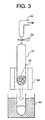
- Fig. 3 depicts a schematic diagram of an apparatus for providing amorphous alloys according to the invention.
- a raw material 52 having a prescribed alloying composition is loaded in quartz tube 51 which has a predetermined diameter, then inside the quartz tube 51 is degassed through an open end thereof using a vacuum pump 53, then the open end thereof is sealed by a burner, thereby forming the quartz tube into a capsule.
- This capsule is heated in an oven 54 to a predetermined temperature such that raw material of alloy 52 is completely melted therein.
- a melted raw material of alloy 52 is either cast in a die having a cavity having a shape of a product, or quenched in cooling medium 55 together with the quartz tube to be solidified by an appropriate cooling method. Since the amorphous formation capability according to the invention has been substantially improved over the conventional amorphous alloy production methods, a preferred amorphous phase can be formed effectively at a smaller cooling rate. In other word, a larger product of amorphous alloy can be obtained at the same cooling rate as conventional one.
- alloys of the invention can be obtained by a conventional vapor deposition method such as sputtering or by a solid method such as mechanical alloying or the like as well.
- an amorphous alloy of the invention When used as an electrode material for anode electrolysis, its alloying composition is required to be specified due to the following reasons.
- Semimetal element P is a basic element which allows manufacture of the amorphous alloy of the invention. However, when its amount of addition is less than 18 atomic percent (at.%) or over 25 at.%, there can be hardly formed an amorphous phase, therefore, its amount of addition is controlled within a range of 18 to 25 at.%.
- a total amount of addition of Ni and Cu is controlled within a range from 30 to 45 at.% since outside the range, i.e., less than 30 at.% or more than 45 at.%, its amorphous formation capability is lowered.
- a proportion of Cu to Ni in the alloying compositions contributing to the main advantage of the invention will be described.
- a proportion of Cu to Ni is less than 1, the melting point of the alloy does not decrease sufficiently so as to be able to improve its amorphous formation capability.
- the proportion thereof is between 1 and 3 or more than 7, a resultant crystalline phase structure becomes rather simple which is less resistive to or more prone to crystallization, thereby narrowing its supercooled liquid region. This, eventually, deteriorates plasticity processibility of the amorphous alloy after its manufacture.
- a proportion of Cu to Ni is defined to be within a range of 3 to 7.
- the amount of its addition is determined to be within a range of 10 to 30 at.%.
- amorphous alloys and electrode materials of the invention which include small amounts, for example, approximately 2 at.%, of other elements such as Fe, Co, Si, Cr, Mn, Ti or the like should be construed within the scope of the invention.
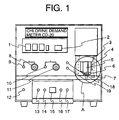
- Figure 1 indicates a schematic block diagram of a chlorine demand meter CD-20 which utilizes an amorphous alloy of the invention.
- Figure 2 indicates a measurement mechanism in part of Fig. 1 in detail.
- Chlorine demand meter CD-20 is well known and available in the market.
- numerical 1 depicts an indicator for indicating measured values
- 2 depicts an indicator for indicating time
- 3 depicts a measurement beaker (100 ml)
- 4 depicts an electrode for electrolysis
- 5 depicts a ultraviolet lamp
- 6 depicts sensing electrode
- 7 depicts a stirrer
- 8 depicts a blank setting dial
- 9 depicts a blank setting switch
- 10 depicts a span setting switch
- 11 depicts a span setting dial
- 12 depicts a power switch
- 13 depicts a stirrer switch
- 14 depicts a measurement stop switch
- 15 depicts a measurement time set switch
- 16 depicts a electrolysis electrode activation switch
- 17 depicts a control system breaker switch
- 18 depicts a measurement lamp
- 19 depicts a measurement start switch
- 20 depicts a measurement lamp power source
- 21 depicts a controller
- 22 depicts an electrolysis current
- 23 depicts
- respective measurement portions are immersed in NaCl solution, and when current 22 is caused to flow through electrode 4 according to the invention with ultraviolet lamp 5 turned on and stirrer 7 operating, mainly a chlorine gas is produced at electrode 4.
- the chlorine gas produced at electrode 4 reacts with organic substances, ammonium and the like present in the solution.
- a rate of production of the chlorine gas is faster than a reaction speed of the chlorine gas with the organic substance and ammonium, thereby the chlorine gas becomes temporarily excessive and is liberated as a residual chlorine.
- This liberated residual chlorine gas is sensed by sensing electrode 6.
- controller 21 is activated to interrupt electrolysis current 22. Since the liberated chlorine gas is caused gradually to react with the organic substances and ammonium present in the solution, the amount of the residual chlorine decreases accordingly. When the amount of the residual chlorine gas becomes less than 1 mg/l, the controller 21 restarts operation causing electrolysis current 22 to flow to the electrode 4, thereby repeating the above-mentioned reaction.
- DSC differential scanning calorimeter
- Comparison samples Nos.1-7 were found thermally unstable since their ⁇ Tx is smaller than 70 K, thereby crystallization proceeded during temperature rising, and thus, did not provide a good and sound deformation product showing a crack propagation initiating from a crystalline phase in the deformed portion thereof.
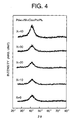
- FIG. 4 An example of test results of X-ray diffraction tests on cross sections of a bar sample made of amorphous alloys according to the invention is shown in Fig. 4, and a DSC curve measured by the differential scanning calorimeter is shown in Fig. 5.
- Amorphous alloys were prepared by the above-mentioned method and their chlorine production efficiencies were measured and compared with each other between the above-mentioned alloys of embodiment samples, comparison alloys and pure Pt.
- comparison alloy No.5 alone showed a chlorine production efficiency of 70-80 % after surface activation processing
- all of the amorphous alloys of the invention in the table showed a chlorine production efficiency of 90 % or more without the activation processing.
- the amorphous alloys manufactured according to the invention have been found to show a high chlorine production efficiency more than 90% comparable to pure platinum even though contained amount of Pt which contributes to the production of chlorine is very small.
- Pure Pt was subjected to anode electrolysis in 2.5M NaCl solution with pH 5-6 at room temperatures to measure its holding time, while the amorphous alloys of the invention were subjected to continuous anode electrolysis in 6.3M NaCl solutions of pH 5-6 at room temperatures to measure their holding times.
- Figure 6 shows a result of the measurements.
- an amorphous alloying sample of the invention is confirmed to have an extended efficiency holding time longer than twice that of pure Pt.
- the amorphous alloy sample manufactured according to the invention ensures a more stable chlorine production efficiency to be obtained compared to pure Pt, and provide a material therefor at a reduced cost.
- the amorphous alloy of embodiment sample No.1 of the invention shown in Fig. 6 is confirmed to have a chlorine production efficiency over 90% and a stable holding time of its chlorine production efficiency twice or more of the holding time of pure Pt.
- the above-mentioned characteristics of the amorphous alloy may change due to occurrence of a partial crystallization therein due to a problem attributable to a cooling rate or the like, which impairs manufacture of a bulk material using this amorphous alloy.
- alloy structures inclusive of both amorphous and crystalline structures are artificially fabricated by appropriate heat treatment, and experiments were conducted as to whether or not changes in the above-mentioned characteristics are observable.
- a result prior to heat treatment indicates that an amorphous monolayer was obtained, while a result after the heat treatment (upper curve) indicates that a structure inclusive of both amorphous and crystalline phases was obtained.
- the alloys subjected to the heat treatment were examined of their chlorine production efficiencies and stabilities of the efficiencies, then compared with those prior to the heat treatment.
- the amorphous alloy according to the invention inherently has a property that its characteristics of the high chlorine production efficiency and its stable holding time are retained even if the amorphous alloy does not have a completely amorphous structure.
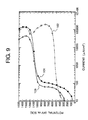
- Corrosion resistances of the alloys of the embodiment samples of the invention, comparative alloys and pure Pt were examined and compared by measuring their anode polarization characteristics and by chronopotentiometry measurements.
- Anode polarization measurements of these alloys were carried out by immersing these alloys in 2.5M NaCl solutions of pH 5-6 at room temperatures, causing anode polarization to take place therein, and examining current behaviors by changing potentials from 0 to 1500 mV.
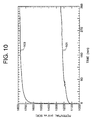
- the chronopotentiometry measurements were carried out by examining behaviors of potential in the same solutions as above with a constant current of 20 mA/cm 2 .
- Chlorine gas production potentials are in a range of 1000 to 1300 mV.
- a result of measurements by chronopotentiometry of the sample 101 embodying the invention and pure platinum 103 both of which exhibited high corrosion resistance in the anode polarization measurements is indicated.
- pure platinum a rapid rise of potential from its initial potential at 1220 mV is already observed after elapse of time of 1-2 minutes as shown in Fig. 10, and its potential reaches 1700 mV or more after elapse of time of 60 minutes.
- This increase in potential is due to an increase in the surface resistance on the surface of Pt due to a progress of an oxidation film formation thereon.
- an increase in potential is very small, namely, it increased from its initial potential at 1120 mM to a final potential at 1230 mV after elapse of time of 6 hours, thereby verifying that its oxidation film formation on the alloy surface is substantially retarded.
- the amorphous alloys embodying the invention ensure the gas production potentials effective for production of a chlorine gas or the like to be maintained stably for a long duration of time
Landscapes
- Chemical & Material Sciences (AREA)
- Engineering & Computer Science (AREA)
- Materials Engineering (AREA)
- Metallurgy (AREA)
- Organic Chemistry (AREA)
- Chemical Kinetics & Catalysis (AREA)
- Electrochemistry (AREA)
- Mechanical Engineering (AREA)
- Electrolytic Production Of Metals (AREA)
- Electrodes For Compound Or Non-Metal Manufacture (AREA)
Claims (4)
- Matériau d'électrode pour électrolyse à anodes utilisant un alliage amorphe à base de métaux précieux comprenant :
une composition pour l'alliage qui satisfait une formule générale de NM100-a-b-cNiaCubPc, dans laquelle :NM est un ou deux éléments de métaux précieux sélectionnés parmi Pd et Pt ;a, b et c étant le pourcentage atomique, satisfont que 30 ≤a+b≤45, 3≤b/a≤7 et 18≤c≤25, respectivement ;Pt est présent de 10 à 30 pour cent atomiques ; et oùune largeur de température ΔTx dudit matériau d'électrode dans une région liquide superrefroidie a une largeur de 70 K ou plus, ledit ΔTx étant défini par ΔTx=Tx-Tg, où Tx est une température de cristallisation, et Tg est une température de transition de verre. - Matériau d'électrode pour électrolyse à anodes utilisant un alliage amorphe à base de métaux précieux selon la revendication 1, où ladite électrode a une zone en section transversale de 20 mm2 ou plus et une longueur de 50 mm ou plus et contient une phase amorphe de 90% ou plus en pour cent volumique.
- Matériau d'électrode pour électrolyse à anodes en utilisant un alliage amorphe à base de métaux précieux selon la revendication 1, où ledit matériau d'électrode est soumis à un traitement de déformation en utilisant un écoulement visqueux dans une région liquide superrefroidie.
- Matériau d'électrode pour électrolyse à anodes utilisant un alliage à base de métaux précieux selon l'une des revendications 1 à 3, où ledit alliage à base de métaux précieux a une structure qui présente une monocouche amorphe avant un traitement thermique, et une structure mélangée de phases amorphe et cristalline après le traitement thermique.
Applications Claiming Priority (3)
| Application Number | Priority Date | Filing Date | Title |
|---|---|---|---|
| JP8842696 | 1996-04-10 | ||
| JP8088426A JPH09279380A (ja) | 1996-04-10 | 1996-04-10 | 塑性加工性に優れ,大型部材に適用可能な貴金属基非晶質合金を用いた陽極電解電極材料 |
| JP88426/96 | 1996-04-10 |
Publications (2)
| Publication Number | Publication Date |
|---|---|
| EP0801151A1 EP0801151A1 (fr) | 1997-10-15 |
| EP0801151B1 true EP0801151B1 (fr) | 2001-07-11 |
Family
ID=13942465
Family Applications (1)
| Application Number | Title | Priority Date | Filing Date |
|---|---|---|---|
| EP97302397A Expired - Lifetime EP0801151B1 (fr) | 1996-04-10 | 1997-04-08 | Alliage amorphe à base de métaux précieux, déformable plastiquement et utilisable comme matériau pour anodes d'électrolyse |
Country Status (4)
| Country | Link |
|---|---|
| US (1) | US5807468A (fr) |
| EP (1) | EP0801151B1 (fr) |
| JP (1) | JPH09279380A (fr) |
| DE (1) | DE69705574T2 (fr) |
Families Citing this family (6)
| Publication number | Priority date | Publication date | Assignee | Title |
|---|---|---|---|---|
| EP1308527A4 (fr) * | 2000-08-07 | 2004-08-25 | Tanaka Precious Metal Ind | Alliages amorphe base de m tal noble |
| US8828155B2 (en) | 2002-12-20 | 2014-09-09 | Crucible Intellectual Property, Llc | Bulk solidifying amorphous alloys with improved mechanical properties |
| WO2004059019A1 (fr) * | 2002-12-20 | 2004-07-15 | Liquidmetal Technologies, Inc. | Alliages amorphes a base de pt, a solidification en masse |
| US7896982B2 (en) * | 2002-12-20 | 2011-03-01 | Crucible Intellectual Property, Llc | Bulk solidifying amorphous alloys with improved mechanical properties |
| US11371108B2 (en) | 2019-02-14 | 2022-06-28 | Glassimetal Technology, Inc. | Tough iron-based glasses with high glass forming ability and high thermal stability |
| CN113134623B (zh) * | 2021-04-28 | 2022-06-03 | 西北工业大学 | 一种水溶性无定型贵金属纳米粒子及其制备方法 |
Family Cites Families (10)
| Publication number | Priority date | Publication date | Assignee | Title |
|---|---|---|---|---|
| US1779602A (en) * | 1924-05-16 | 1930-10-28 | Western Electric Co | Alloy for electrical contacts |
| JPS5935417A (ja) * | 1982-08-23 | 1984-02-27 | 松下電器産業株式会社 | 複合電子部品の製造法 |
| US4560454A (en) * | 1984-05-01 | 1985-12-24 | The Standard Oil Company (Ohio) | Electrolysis of halide-containing solutions with platinum based amorphous metal alloy anodes |
| US4781803A (en) * | 1985-02-26 | 1988-11-01 | The Standard Oil Company | Electrolytic processes employing platinum based amorphous metal alloy oxygen anodes |
| US4609442A (en) * | 1985-06-24 | 1986-09-02 | The Standard Oil Company | Electrolysis of halide-containing solutions with amorphous metal alloys |
| JPS6296633A (ja) * | 1985-08-02 | 1987-05-06 | Daiki Rubber Kogyo Kk | 溶液電解の電極用表面活性化非晶質合金及びその活性化処理方法 |
| US4696731A (en) * | 1986-12-16 | 1987-09-29 | The Standard Oil Company | Amorphous metal-based composite oxygen anodes |
| JPH07122120B2 (ja) * | 1989-11-17 | 1995-12-25 | 健 増本 | 加工性に優れた非晶質合金 |
| JP3029645B2 (ja) * | 1990-07-10 | 2000-04-04 | 富士通株式会社 | 画像表示制御装置 |
| JPH0565604A (ja) * | 1991-09-09 | 1993-03-19 | Daiki Rubber Kogyo Kk | 貴金属を複合添加した塩素発生電極用表面合金及び該合金の活性化処理方法 |
-
1996
- 1996-04-10 JP JP8088426A patent/JPH09279380A/ja active Pending
-
1997
- 1997-04-08 DE DE69705574T patent/DE69705574T2/de not_active Expired - Fee Related
- 1997-04-08 EP EP97302397A patent/EP0801151B1/fr not_active Expired - Lifetime
- 1997-04-09 US US08/831,791 patent/US5807468A/en not_active Expired - Fee Related
Also Published As
| Publication number | Publication date |
|---|---|
| JPH09279380A (ja) | 1997-10-28 |
| US5807468A (en) | 1998-09-15 |
| DE69705574T2 (de) | 2002-05-16 |
| DE69705574D1 (de) | 2001-08-16 |
| EP0801151A1 (fr) | 1997-10-15 |
Similar Documents
| Publication | Publication Date | Title |
|---|---|---|
| Pang et al. | Formation of bulk glassy Fe75–x–yCrxMoyC15B10 alloys and their corrosion behavior | |
| JP3731600B2 (ja) | 銅合金およびその製造方法 | |
| CN100564559C (zh) | 电子材料用Cu-Ni-Si-Co-Cr系铜合金及其制造方法 | |
| US20200283874A1 (en) | High-Performance Corrosion-Resistant High-Entropy Alloys | |
| JPS6028899B2 (ja) | 高い結晶化温度および高い硬度を有する非晶質金属合金 | |
| JP2010270395A (ja) | 薄肉チューブ用アルミニウム合金ろう付けシート | |
| Gebert et al. | Corrosion behaviour of Mg65Y10Cu25 metallic glass | |
| EP0801151B1 (fr) | Alliage amorphe à base de métaux précieux, déformable plastiquement et utilisable comme matériau pour anodes d'électrolyse | |
| Duarte et al. | Experimental study of the Fe–Ni–Ti system | |
| EP3719165A1 (fr) | Procédé de fabrication d'un alliage à base de ni, et alliage à base de ni | |
| Tsuru et al. | Corrosion Resistance of Microcrystalline Stainless Steels | |
| Tam et al. | Corrosion behavior and glass-forming ability of Cu–Zr–Al–Nb alloys | |
| KR100334253B1 (ko) | 고온 용융염에서 내부식성이 우수한 합금강 | |
| JP6010366B2 (ja) | 高圧水素ガス用のAl−Mg系合金材 | |
| JPS58197241A (ja) | 耐溶融金属侵食性にすぐれた高強度高導電性Cu合金 | |
| Lee | Hydrogen overpotential on zinc containing small amounts of impurities in concentrated alkaline solution | |
| Đekić et al. | Microhardness and corrosion behavior of thermally treated Fe 38 Ni 36 B 18 Si 8 metallic glass. | |
| Shepherd et al. | Potentiostatic Current‐Potential Measurements on Iron and Platinum Electrodes in High‐Purity Closed Alkaline Systems | |
| Gebert et al. | Electrode characteristics of two-phase glass-forming Ni–Nb–Y alloys | |
| Lopachak et al. | Electrochemical behavior of cobalt-based nanostructured amorphous alloys in alkaline solution | |
| JPS602641A (ja) | 耐孔食、耐隙間腐食、耐全面腐食用高耐食アモルフアスニツケル基合金 | |
| JP5321999B2 (ja) | Ni基金属ガラス合金 | |
| SU1650781A1 (ru) | Способ получени оксидных бронз вольфрама или молибдена | |
| JP3738076B2 (ja) | 塑性加工性に優れ、大型部材に適用可能な貴金属基非 晶質合金及びその加工方法 | |
| JP2006253089A (ja) | 燃料電池用メタルセパレータとその製造方法 |
Legal Events
| Date | Code | Title | Description |
|---|---|---|---|
| PUAI | Public reference made under article 153(3) epc to a published international application that has entered the european phase |
Free format text: ORIGINAL CODE: 0009012 |
|
| 17P | Request for examination filed |
Effective date: 19970428 |
|
| AK | Designated contracting states |
Kind code of ref document: A1 Designated state(s): DE FR GB |
|
| GRAG | Despatch of communication of intention to grant |
Free format text: ORIGINAL CODE: EPIDOS AGRA |
|
| 17Q | First examination report despatched |
Effective date: 20001124 |
|
| GRAG | Despatch of communication of intention to grant |
Free format text: ORIGINAL CODE: EPIDOS AGRA |
|
| GRAH | Despatch of communication of intention to grant a patent |
Free format text: ORIGINAL CODE: EPIDOS IGRA |
|
| GRAH | Despatch of communication of intention to grant a patent |
Free format text: ORIGINAL CODE: EPIDOS IGRA |
|
| GRAA | (expected) grant |
Free format text: ORIGINAL CODE: 0009210 |
|
| AK | Designated contracting states |
Kind code of ref document: B1 Designated state(s): DE FR GB |
|
| REF | Corresponds to: |
Ref document number: 69705574 Country of ref document: DE Date of ref document: 20010816 |
|
| ET | Fr: translation filed | ||
| REG | Reference to a national code |
Ref country code: GB Ref legal event code: IF02 |
|
| PLBE | No opposition filed within time limit |
Free format text: ORIGINAL CODE: 0009261 |
|
| STAA | Information on the status of an ep patent application or granted ep patent |
Free format text: STATUS: NO OPPOSITION FILED WITHIN TIME LIMIT |
|
| 26N | No opposition filed | ||
| PGFP | Annual fee paid to national office [announced via postgrant information from national office to epo] |
Ref country code: GB Payment date: 20050329 Year of fee payment: 9 |
|
| PGFP | Annual fee paid to national office [announced via postgrant information from national office to epo] |
Ref country code: FR Payment date: 20050421 Year of fee payment: 9 |
|
| PGFP | Annual fee paid to national office [announced via postgrant information from national office to epo] |
Ref country code: DE Payment date: 20050427 Year of fee payment: 9 |
|
| PG25 | Lapsed in a contracting state [announced via postgrant information from national office to epo] |
Ref country code: GB Free format text: LAPSE BECAUSE OF NON-PAYMENT OF DUE FEES Effective date: 20060408 |
|
| PG25 | Lapsed in a contracting state [announced via postgrant information from national office to epo] |
Ref country code: DE Free format text: LAPSE BECAUSE OF NON-PAYMENT OF DUE FEES Effective date: 20061101 |
|
| GBPC | Gb: european patent ceased through non-payment of renewal fee |
Effective date: 20060408 |
|
| REG | Reference to a national code |
Ref country code: FR Ref legal event code: ST Effective date: 20061230 |
|
| PG25 | Lapsed in a contracting state [announced via postgrant information from national office to epo] |
Ref country code: FR Free format text: LAPSE BECAUSE OF NON-PAYMENT OF DUE FEES Effective date: 20060502 |