EP0800587B1 - Comparative hybridisation to nucleic acid arrays - Google Patents
Comparative hybridisation to nucleic acid arrays Download PDFInfo
- Publication number
- EP0800587B1 EP0800587B1 EP95943084A EP95943084A EP0800587B1 EP 0800587 B1 EP0800587 B1 EP 0800587B1 EP 95943084 A EP95943084 A EP 95943084A EP 95943084 A EP95943084 A EP 95943084A EP 0800587 B1 EP0800587 B1 EP 0800587B1
- Authority
- EP
- European Patent Office
- Prior art keywords
- nucleic acids
- target
- sequences
- nucleic acid
- labeled
- Prior art date
- Legal status (The legal status is an assumption and is not a legal conclusion. Google has not performed a legal analysis and makes no representation as to the accuracy of the status listed.)
- Expired - Lifetime
Links
- 238000009396 hybridization Methods 0.000 title abstract description 51
- 238000003499 nucleic acid array Methods 0.000 title description 7
- 230000000052 comparative effect Effects 0.000 title description 5
- 150000007523 nucleic acids Chemical class 0.000 claims abstract description 143
- 108020004707 nucleic acids Proteins 0.000 claims abstract description 131
- 102000039446 nucleic acids Human genes 0.000 claims abstract description 131
- 238000000034 method Methods 0.000 claims abstract description 74
- 239000007787 solid Substances 0.000 claims abstract description 25
- 108020004414 DNA Proteins 0.000 claims description 56
- 210000004027 cell Anatomy 0.000 claims description 34
- 210000000349 chromosome Anatomy 0.000 claims description 27
- 230000000295 complement effect Effects 0.000 claims description 23
- 239000002299 complementary DNA Substances 0.000 claims description 18
- 238000012360 testing method Methods 0.000 claims description 18
- 230000003252 repetitive effect Effects 0.000 claims description 14
- 239000011521 glass Substances 0.000 claims description 13
- 125000003729 nucleotide group Chemical group 0.000 claims description 12
- 108020004999 messenger RNA Proteins 0.000 claims description 11
- 230000027455 binding Effects 0.000 claims description 10
- 206010028980 Neoplasm Diseases 0.000 claims description 9
- 238000002372 labelling Methods 0.000 claims description 9
- 230000031864 metaphase Effects 0.000 claims description 9
- 239000002773 nucleotide Substances 0.000 claims description 9
- 239000011324 bead Substances 0.000 claims description 7
- 101100384865 Neurospora crassa (strain ATCC 24698 / 74-OR23-1A / CBS 708.71 / DSM 1257 / FGSC 987) cot-1 gene Proteins 0.000 claims description 6
- 108091028043 Nucleic acid sequence Proteins 0.000 claims description 5
- 230000000903 blocking effect Effects 0.000 claims description 3
- 210000003754 fetus Anatomy 0.000 claims description 2
- 201000010099 disease Diseases 0.000 abstract description 15
- 208000037265 diseases, disorders, signs and symptoms Diseases 0.000 abstract description 15
- 238000010561 standard procedure Methods 0.000 abstract description 7
- 206010008805 Chromosomal abnormalities Diseases 0.000 abstract description 3
- 208000031404 Chromosome Aberrations Diseases 0.000 abstract description 3
- 238000013507 mapping Methods 0.000 abstract description 2
- 239000000523 sample Substances 0.000 description 59
- 239000002245 particle Substances 0.000 description 31
- 101100239628 Danio rerio myca gene Proteins 0.000 description 15
- 238000001514 detection method Methods 0.000 description 15
- 108090000623 proteins and genes Proteins 0.000 description 15
- 210000001519 tissue Anatomy 0.000 description 13
- 239000012528 membrane Substances 0.000 description 12
- 239000000463 material Substances 0.000 description 11
- 101150006442 21D7 gene Proteins 0.000 description 10
- 230000002759 chromosomal effect Effects 0.000 description 10
- 239000012634 fragment Substances 0.000 description 10
- MHMNJMPURVTYEJ-UHFFFAOYSA-N fluorescein-5-isothiocyanate Chemical compound O1C(=O)C2=CC(N=C=S)=CC=C2C21C1=CC=C(O)C=C1OC1=CC(O)=CC=C21 MHMNJMPURVTYEJ-UHFFFAOYSA-N 0.000 description 9
- 238000004458 analytical method Methods 0.000 description 8
- 239000000203 mixture Substances 0.000 description 8
- 230000035945 sensitivity Effects 0.000 description 8
- 230000003321 amplification Effects 0.000 description 7
- 230000002559 cytogenic effect Effects 0.000 description 7
- 230000014509 gene expression Effects 0.000 description 7
- 230000002068 genetic effect Effects 0.000 description 7
- 238000003199 nucleic acid amplification method Methods 0.000 description 7
- 238000003752 polymerase chain reaction Methods 0.000 description 7
- MPLHNVLQVRSVEE-UHFFFAOYSA-N texas red Chemical compound [O-]S(=O)(=O)C1=CC(S(Cl)(=O)=O)=CC=C1C(C1=CC=2CCCN3CCCC(C=23)=C1O1)=C2C1=C(CCC1)C3=[N+]1CCCC3=C2 MPLHNVLQVRSVEE-UHFFFAOYSA-N 0.000 description 7
- YBJHBAHKTGYVGT-ZKWXMUAHSA-N (+)-Biotin Chemical compound N1C(=O)N[C@@H]2[C@H](CCCCC(=O)O)SC[C@@H]21 YBJHBAHKTGYVGT-ZKWXMUAHSA-N 0.000 description 6
- 108700020796 Oncogene Proteins 0.000 description 6
- BFMYDTVEBKDAKJ-UHFFFAOYSA-L disodium;(2',7'-dibromo-3',6'-dioxido-3-oxospiro[2-benzofuran-1,9'-xanthene]-4'-yl)mercury;hydrate Chemical compound O.[Na+].[Na+].O1C(=O)C2=CC=CC=C2C21C1=CC(Br)=C([O-])C([Hg])=C1OC1=C2C=C(Br)C([O-])=C1 BFMYDTVEBKDAKJ-UHFFFAOYSA-L 0.000 description 6
- 108091033319 polynucleotide Proteins 0.000 description 6
- 102000040430 polynucleotide Human genes 0.000 description 6
- 239000002157 polynucleotide Substances 0.000 description 6
- 108090001008 Avidin Proteins 0.000 description 5
- 238000003491 array Methods 0.000 description 5
- 230000005856 abnormality Effects 0.000 description 4
- 238000012217 deletion Methods 0.000 description 4
- 230000037430 deletion Effects 0.000 description 4
- 230000005284 excitation Effects 0.000 description 4
- 102000004169 proteins and genes Human genes 0.000 description 4
- 239000000126 substance Substances 0.000 description 4
- 239000000758 substrate Substances 0.000 description 4
- 210000004881 tumor cell Anatomy 0.000 description 4
- 108091032973 (ribonucleotides)n+m Proteins 0.000 description 3
- 108020004711 Nucleic Acid Probes Proteins 0.000 description 3
- 239000004677 Nylon Substances 0.000 description 3
- 238000013459 approach Methods 0.000 description 3
- 238000001574 biopsy Methods 0.000 description 3
- 229960002685 biotin Drugs 0.000 description 3
- 235000020958 biotin Nutrition 0.000 description 3
- 239000011616 biotin Substances 0.000 description 3
- 239000003153 chemical reaction reagent Substances 0.000 description 3
- 150000001875 compounds Chemical class 0.000 description 3
- 230000003247 decreasing effect Effects 0.000 description 3
- 125000000524 functional group Chemical group 0.000 description 3
- 238000007901 in situ hybridization Methods 0.000 description 3
- 230000009871 nonspecific binding Effects 0.000 description 3
- 238000007899 nucleic acid hybridization Methods 0.000 description 3
- 239000002853 nucleic acid probe Substances 0.000 description 3
- 229920001778 nylon Polymers 0.000 description 3
- -1 polyethylene Polymers 0.000 description 3
- 238000002360 preparation method Methods 0.000 description 3
- VYPSYNLAJGMNEJ-UHFFFAOYSA-N silicon dioxide Inorganic materials O=[Si]=O VYPSYNLAJGMNEJ-UHFFFAOYSA-N 0.000 description 3
- 108010077544 Chromatin Proteins 0.000 description 2
- 239000003298 DNA probe Substances 0.000 description 2
- ZHNUHDYFZUAESO-UHFFFAOYSA-N Formamide Chemical compound NC=O ZHNUHDYFZUAESO-UHFFFAOYSA-N 0.000 description 2
- 239000000020 Nitrocellulose Substances 0.000 description 2
- 239000004743 Polypropylene Substances 0.000 description 2
- 108091081062 Repeated sequence (DNA) Proteins 0.000 description 2
- 238000002105 Southern blotting Methods 0.000 description 2
- 108010090804 Streptavidin Proteins 0.000 description 2
- 230000002159 abnormal effect Effects 0.000 description 2
- 238000007792 addition Methods 0.000 description 2
- 210000004436 artificial bacterial chromosome Anatomy 0.000 description 2
- 210000001106 artificial yeast chromosome Anatomy 0.000 description 2
- 201000011510 cancer Diseases 0.000 description 2
- 210000003483 chromatin Anatomy 0.000 description 2
- 230000008878 coupling Effects 0.000 description 2
- 238000010168 coupling process Methods 0.000 description 2
- 238000005859 coupling reaction Methods 0.000 description 2
- 230000007423 decrease Effects 0.000 description 2
- 230000001419 dependent effect Effects 0.000 description 2
- 238000003745 diagnosis Methods 0.000 description 2
- 238000011496 digital image analysis Methods 0.000 description 2
- 238000005516 engineering process Methods 0.000 description 2
- 239000000835 fiber Substances 0.000 description 2
- 230000003100 immobilizing effect Effects 0.000 description 2
- 239000003446 ligand Substances 0.000 description 2
- 230000004807 localization Effects 0.000 description 2
- 238000010369 molecular cloning Methods 0.000 description 2
- 229920001220 nitrocellulos Polymers 0.000 description 2
- 230000036961 partial effect Effects 0.000 description 2
- 239000004033 plastic Substances 0.000 description 2
- 229920003023 plastic Polymers 0.000 description 2
- 229920001155 polypropylene Polymers 0.000 description 2
- 239000011148 porous material Substances 0.000 description 2
- 238000012545 processing Methods 0.000 description 2
- 239000010453 quartz Substances 0.000 description 2
- 230000008707 rearrangement Effects 0.000 description 2
- 230000002829 reductive effect Effects 0.000 description 2
- 241000894007 species Species 0.000 description 2
- 238000010186 staining Methods 0.000 description 2
- 208000011580 syndromic disease Diseases 0.000 description 2
- 238000013519 translation Methods 0.000 description 2
- FWBHETKCLVMNFS-UHFFFAOYSA-N 4',6-Diamino-2-phenylindol Chemical compound C1=CC(C(=N)N)=CC=C1C1=CC2=CC=C(C(N)=N)C=C2N1 FWBHETKCLVMNFS-UHFFFAOYSA-N 0.000 description 1
- 229920000936 Agarose Polymers 0.000 description 1
- 102000002260 Alkaline Phosphatase Human genes 0.000 description 1
- 108020004774 Alkaline Phosphatase Proteins 0.000 description 1
- 108091023043 Alu Element Proteins 0.000 description 1
- 108091003079 Bovine Serum Albumin Proteins 0.000 description 1
- 206010006187 Breast cancer Diseases 0.000 description 1
- 208000026310 Breast neoplasm Diseases 0.000 description 1
- 108020004635 Complementary DNA Proteins 0.000 description 1
- 102000053602 DNA Human genes 0.000 description 1
- 230000004544 DNA amplification Effects 0.000 description 1
- SHIBSTMRCDJXLN-UHFFFAOYSA-N Digoxigenin Natural products C1CC(C2C(C3(C)CCC(O)CC3CC2)CC2O)(O)C2(C)C1C1=CC(=O)OC1 SHIBSTMRCDJXLN-UHFFFAOYSA-N 0.000 description 1
- 201000010374 Down Syndrome Diseases 0.000 description 1
- 238000002965 ELISA Methods 0.000 description 1
- 108090000790 Enzymes Proteins 0.000 description 1
- 102000004190 Enzymes Human genes 0.000 description 1
- 108010010803 Gelatin Proteins 0.000 description 1
- 108010033040 Histones Proteins 0.000 description 1
- 108010001336 Horseradish Peroxidase Proteins 0.000 description 1
- 206010027476 Metastases Diseases 0.000 description 1
- 101710163270 Nuclease Proteins 0.000 description 1
- 108010047956 Nucleosomes Proteins 0.000 description 1
- 108091034117 Oligonucleotide Proteins 0.000 description 1
- 102000043276 Oncogene Human genes 0.000 description 1
- 241001494479 Pecora Species 0.000 description 1
- 239000004698 Polyethylene Substances 0.000 description 1
- 239000004793 Polystyrene Substances 0.000 description 1
- 108020004518 RNA Probes Proteins 0.000 description 1
- 239000003391 RNA probe Substances 0.000 description 1
- 108091028664 Ribonucleotide Proteins 0.000 description 1
- 108020004682 Single-Stranded DNA Proteins 0.000 description 1
- 206010044688 Trisomy 21 Diseases 0.000 description 1
- 102000044209 Tumor Suppressor Genes Human genes 0.000 description 1
- 108700025716 Tumor Suppressor Genes Proteins 0.000 description 1
- 239000002253 acid Substances 0.000 description 1
- 150000007513 acids Chemical class 0.000 description 1
- 230000004913 activation Effects 0.000 description 1
- 150000001299 aldehydes Chemical class 0.000 description 1
- 125000003277 amino group Chemical group 0.000 description 1
- 230000000890 antigenic effect Effects 0.000 description 1
- 238000003556 assay Methods 0.000 description 1
- 238000002820 assay format Methods 0.000 description 1
- 238000006664 bond formation reaction Methods 0.000 description 1
- 229940098773 bovine serum albumin Drugs 0.000 description 1
- 150000001735 carboxylic acids Chemical class 0.000 description 1
- 231100000504 carcinogenesis Toxicity 0.000 description 1
- 229920002678 cellulose Polymers 0.000 description 1
- 239000001913 cellulose Substances 0.000 description 1
- 229920002301 cellulose acetate Polymers 0.000 description 1
- 239000000919 ceramic Substances 0.000 description 1
- 230000008859 change Effects 0.000 description 1
- 238000006243 chemical reaction Methods 0.000 description 1
- 239000011248 coating agent Substances 0.000 description 1
- 238000000576 coating method Methods 0.000 description 1
- 238000004590 computer program Methods 0.000 description 1
- 238000009833 condensation Methods 0.000 description 1
- 230000005494 condensation Effects 0.000 description 1
- 230000021615 conjugation Effects 0.000 description 1
- 239000005289 controlled pore glass Substances 0.000 description 1
- 238000007796 conventional method Methods 0.000 description 1
- 125000004093 cyano group Chemical group *C#N 0.000 description 1
- 238000004163 cytometry Methods 0.000 description 1
- 238000004925 denaturation Methods 0.000 description 1
- 230000036425 denaturation Effects 0.000 description 1
- 239000005547 deoxyribonucleotide Substances 0.000 description 1
- 125000002637 deoxyribonucleotide group Chemical group 0.000 description 1
- 238000000151 deposition Methods 0.000 description 1
- 229960000633 dextran sulfate Drugs 0.000 description 1
- 230000009274 differential gene expression Effects 0.000 description 1
- 230000004069 differentiation Effects 0.000 description 1
- QONQRTHLHBTMGP-UHFFFAOYSA-N digitoxigenin Natural products CC12CCC(C3(CCC(O)CC3CC3)C)C3C11OC1CC2C1=CC(=O)OC1 QONQRTHLHBTMGP-UHFFFAOYSA-N 0.000 description 1
- SHIBSTMRCDJXLN-KCZCNTNESA-N digoxigenin Chemical compound C1([C@@H]2[C@@]3([C@@](CC2)(O)[C@H]2[C@@H]([C@@]4(C)CC[C@H](O)C[C@H]4CC2)C[C@H]3O)C)=CC(=O)OC1 SHIBSTMRCDJXLN-KCZCNTNESA-N 0.000 description 1
- 238000010790 dilution Methods 0.000 description 1
- 239000012895 dilution Substances 0.000 description 1
- 239000000975 dye Substances 0.000 description 1
- 238000013399 early diagnosis Methods 0.000 description 1
- 238000001962 electrophoresis Methods 0.000 description 1
- 239000002158 endotoxin Substances 0.000 description 1
- 230000002255 enzymatic effect Effects 0.000 description 1
- 238000002474 experimental method Methods 0.000 description 1
- 238000001917 fluorescence detection Methods 0.000 description 1
- 238000000799 fluorescence microscopy Methods 0.000 description 1
- 239000007850 fluorescent dye Substances 0.000 description 1
- 238000012632 fluorescent imaging Methods 0.000 description 1
- 239000005350 fused silica glass Substances 0.000 description 1
- 239000000499 gel Substances 0.000 description 1
- 229920000159 gelatin Polymers 0.000 description 1
- 235000019322 gelatine Nutrition 0.000 description 1
- 235000011852 gelatine desserts Nutrition 0.000 description 1
- 238000010353 genetic engineering Methods 0.000 description 1
- 239000008187 granular material Substances 0.000 description 1
- 229910052739 hydrogen Inorganic materials 0.000 description 1
- 239000001257 hydrogen Substances 0.000 description 1
- 125000002887 hydroxy group Chemical group [H]O* 0.000 description 1
- 229910052588 hydroxylapatite Inorganic materials 0.000 description 1
- 238000010191 image analysis Methods 0.000 description 1
- 230000000984 immunochemical effect Effects 0.000 description 1
- 238000011065 in-situ storage Methods 0.000 description 1
- 230000002779 inactivation Effects 0.000 description 1
- 238000011534 incubation Methods 0.000 description 1
- 229920000592 inorganic polymer Polymers 0.000 description 1
- UQSXHKLRYXJYBZ-UHFFFAOYSA-N iron oxide Inorganic materials [Fe]=O UQSXHKLRYXJYBZ-UHFFFAOYSA-N 0.000 description 1
- 229920006008 lipopolysaccharide Polymers 0.000 description 1
- 229920002521 macromolecule Polymers 0.000 description 1
- 230000036210 malignancy Effects 0.000 description 1
- 238000004519 manufacturing process Methods 0.000 description 1
- 238000005259 measurement Methods 0.000 description 1
- 230000001404 mediated effect Effects 0.000 description 1
- 238000002844 melting Methods 0.000 description 1
- 230000008018 melting Effects 0.000 description 1
- 239000002184 metal Substances 0.000 description 1
- 229910052751 metal Inorganic materials 0.000 description 1
- 229910052752 metalloid Inorganic materials 0.000 description 1
- 150000002738 metalloids Chemical class 0.000 description 1
- 150000002739 metals Chemical class 0.000 description 1
- 230000009401 metastasis Effects 0.000 description 1
- 230000001394 metastastic effect Effects 0.000 description 1
- 206010061289 metastatic neoplasm Diseases 0.000 description 1
- MYWUZJCMWCOHBA-VIFPVBQESA-N methamphetamine Chemical compound CN[C@@H](C)CC1=CC=CC=C1 MYWUZJCMWCOHBA-VIFPVBQESA-N 0.000 description 1
- 238000012986 modification Methods 0.000 description 1
- 230000004048 modification Effects 0.000 description 1
- 230000010309 neoplastic transformation Effects 0.000 description 1
- 210000001623 nucleosome Anatomy 0.000 description 1
- 230000003287 optical effect Effects 0.000 description 1
- 229920000620 organic polymer Polymers 0.000 description 1
- NDLPOXTZKUMGOV-UHFFFAOYSA-N oxo(oxoferriooxy)iron hydrate Chemical compound O.O=[Fe]O[Fe]=O NDLPOXTZKUMGOV-UHFFFAOYSA-N 0.000 description 1
- 238000012856 packing Methods 0.000 description 1
- 239000000123 paper Substances 0.000 description 1
- 230000005298 paramagnetic effect Effects 0.000 description 1
- XYJRXVWERLGGKC-UHFFFAOYSA-D pentacalcium;hydroxide;triphosphate Chemical compound [OH-].[Ca+2].[Ca+2].[Ca+2].[Ca+2].[Ca+2].[O-]P([O-])([O-])=O.[O-]P([O-])([O-])=O.[O-]P([O-])([O-])=O XYJRXVWERLGGKC-UHFFFAOYSA-D 0.000 description 1
- 230000009984 peri-natal effect Effects 0.000 description 1
- 229920002401 polyacrylamide Polymers 0.000 description 1
- 229920000573 polyethylene Polymers 0.000 description 1
- 229920000642 polymer Polymers 0.000 description 1
- 229920006324 polyoxymethylene Polymers 0.000 description 1
- 229920001296 polysiloxane Polymers 0.000 description 1
- 229920002223 polystyrene Polymers 0.000 description 1
- 230000037452 priming Effects 0.000 description 1
- 230000002285 radioactive effect Effects 0.000 description 1
- 230000002040 relaxant effect Effects 0.000 description 1
- 108091008146 restriction endonucleases Proteins 0.000 description 1
- 230000002441 reversible effect Effects 0.000 description 1
- PYWVYCXTNDRMGF-UHFFFAOYSA-N rhodamine B Chemical compound [Cl-].C=12C=CC(=[N+](CC)CC)C=C2OC2=CC(N(CC)CC)=CC=C2C=1C1=CC=CC=C1C(O)=O PYWVYCXTNDRMGF-UHFFFAOYSA-N 0.000 description 1
- 239000002336 ribonucleotide Substances 0.000 description 1
- 125000002652 ribonucleotide group Chemical group 0.000 description 1
- 238000005070 sampling Methods 0.000 description 1
- 238000012216 screening Methods 0.000 description 1
- 238000011896 sensitive detection Methods 0.000 description 1
- 238000012163 sequencing technique Methods 0.000 description 1
- 238000013207 serial dilution Methods 0.000 description 1
- 150000004760 silicates Chemical class 0.000 description 1
- 239000000243 solution Substances 0.000 description 1
- 230000004797 therapeutic response Effects 0.000 description 1
- 125000003396 thiol group Chemical group [H]S* 0.000 description 1
- 238000013518 transcription Methods 0.000 description 1
- 230000035897 transcription Effects 0.000 description 1
- 230000005945 translocation Effects 0.000 description 1
- 239000013598 vector Substances 0.000 description 1
- 238000005406 washing Methods 0.000 description 1
Images
Classifications
-
- C—CHEMISTRY; METALLURGY
- C12—BIOCHEMISTRY; BEER; SPIRITS; WINE; VINEGAR; MICROBIOLOGY; ENZYMOLOGY; MUTATION OR GENETIC ENGINEERING
- C12Q—MEASURING OR TESTING PROCESSES INVOLVING ENZYMES, NUCLEIC ACIDS OR MICROORGANISMS; COMPOSITIONS OR TEST PAPERS THEREFOR; PROCESSES OF PREPARING SUCH COMPOSITIONS; CONDITION-RESPONSIVE CONTROL IN MICROBIOLOGICAL OR ENZYMOLOGICAL PROCESSES
- C12Q1/00—Measuring or testing processes involving enzymes, nucleic acids or microorganisms; Compositions therefor; Processes of preparing such compositions
- C12Q1/68—Measuring or testing processes involving enzymes, nucleic acids or microorganisms; Compositions therefor; Processes of preparing such compositions involving nucleic acids
- C12Q1/6813—Hybridisation assays
- C12Q1/6816—Hybridisation assays characterised by the detection means
-
- C—CHEMISTRY; METALLURGY
- C12—BIOCHEMISTRY; BEER; SPIRITS; WINE; VINEGAR; MICROBIOLOGY; ENZYMOLOGY; MUTATION OR GENETIC ENGINEERING
- C12Q—MEASURING OR TESTING PROCESSES INVOLVING ENZYMES, NUCLEIC ACIDS OR MICROORGANISMS; COMPOSITIONS OR TEST PAPERS THEREFOR; PROCESSES OF PREPARING SUCH COMPOSITIONS; CONDITION-RESPONSIVE CONTROL IN MICROBIOLOGICAL OR ENZYMOLOGICAL PROCESSES
- C12Q1/00—Measuring or testing processes involving enzymes, nucleic acids or microorganisms; Compositions therefor; Processes of preparing such compositions
- C12Q1/68—Measuring or testing processes involving enzymes, nucleic acids or microorganisms; Compositions therefor; Processes of preparing such compositions involving nucleic acids
- C12Q1/6813—Hybridisation assays
- C12Q1/6834—Enzymatic or biochemical coupling of nucleic acids to a solid phase
- C12Q1/6837—Enzymatic or biochemical coupling of nucleic acids to a solid phase using probe arrays or probe chips
-
- G—PHYSICS
- G16—INFORMATION AND COMMUNICATION TECHNOLOGY [ICT] SPECIALLY ADAPTED FOR SPECIFIC APPLICATION FIELDS
- G16B—BIOINFORMATICS, i.e. INFORMATION AND COMMUNICATION TECHNOLOGY [ICT] SPECIALLY ADAPTED FOR GENETIC OR PROTEIN-RELATED DATA PROCESSING IN COMPUTATIONAL MOLECULAR BIOLOGY
- G16B25/00—ICT specially adapted for hybridisation; ICT specially adapted for gene or protein expression
Definitions
- the present invention relates to methods for detecting and mapping genetic abnormalities associated with various diseases.
- it relates to the use of nucleic acid hybridization methods for comparing copy numbers of particular nucleic acid sequences in a collection of sequences relative the copy number of these sequences in other collections of sequences.
- perinatal genetic problems frequently result from loss or gain of chromosome segments such as trisomy 21 or the micro deletion syndromes.
- methods of prenatal detection of such abnormalities can be helpful in early diagnosis of disease.
- Cytogenetics is the traditional method for detecting amplified or deleted chromosomal regions.
- the resolution of cytogenetic techniques is limited, however, to regions larger than approximately 10 Mb (approximately the width of a band in Giemsa-stained chromosomes).
- regions larger than approximately 10 Mb approximately the width of a band in Giemsa-stained chromosomes.
- traditional cytogenetic analysis is of little utility because karyotype information cannot be fully interpreted.
- cytogenetic banding analysis is time consuming, labor intensive, and frequently difficult or impossible due to difficulties in obtaining adequate metaphase chromosomes.
- cytogenetic signatures of gene amplification, homogeneously staining regions (HSR), or double minute chromosomes do not provide any information that contributes to the identification of the sequences that are amplified.
- More recent methods permit assessing the amount of a given nucleic acid sequence in a sample using molecular techniques.
- These methods e . g ., Southern blotting
- Southern blotting and related techniques are effective even if the genome is heavily rearranged so as to eliminate useful karyotype information.
- these methods require use of a probe specific for the sequence to be analyzed.
- CGH Comparative genomic hybridization
- Chromosomal regions in the test cells which are at increased or decreased copy number can be quickly identified by detecting regions where the ratio of signal from the two DNAs is altered. For example, those regions that have been decreased in copy number in the test cells will show relatively lower signal from the test DNA than the reference compared to other regions of the genome. Regions that have been increased in copy number in the test cells will show relatively higher signal from the test DNA.
- CGH discovers and maps the location of the sequences with variant copy number without prior knowledge of the sequences. No probes for specific sequences are required and only a single hybridization is required. Where a decrease or an increase in copy number is limited to the loss or gain of one copy of a sequence, the CGH resolution is usually about 5-10 Mb.
- US 4,981,783 provides a method for the analysis of gene expression in human biopsy.
- An array of cloned DNA sequences is hybridized to a radioactive probe made using RNA isolated from biopsy tissue. The extent of hybridization is proportional to the level of expression of the cloned sequence in the biopsy tissue.
- New techniques which provide increased sensitivity, more precise localization of chromosomal abnormalities and which can detect differences in levels of gene expression are particularly desirable for the diagnosis of disease.
- the present invention provides these and other benefits.
- the present invention provides a method for comparing copy number of nucleic acid sequences in two or more collections of nucleic acid molecules, the method comprising:
- kits for quantifying nucleic acid sequences in a nucleic acid sample comprising:
- Each target element comprises target nucleic acid molecules bound to a solid support.
- One or more copies of each sequence in a target element may be present.
- the sequence complexity of the target nucleic acids in the target element are much less than the sequence complexity of the first and second collections of labeled nucleic acids.
- the nucleic acids for both the target elements and the probes may be, for example, RNA, DNA, or cDNA.
- the nucleic acids may be derived from any organism. Usually the nucleic acid in the target elements and the probes are from the same species.
- the target elements may be on separate supports, such as a plurality of beads, or an array of target elements may be on a single solid surface, such as a glass microscope slide.
- the nucleic acid sequences of the target nucleic acids in a target element are those for which comparative copy number information is desired.
- the sequence of an element may originate from a chromosomal location known to be associated with disease, may be selected to be representative of a chromosomal region whose association with disease is to be tested, or may correspond to genes whose transcription is to be assayed.
- the amount of binding of each, and the binding ratio is determined for each target element.
- the greater the ratio of the binding to a target element the greater the copy number ratio of sequences in the two probes that bind to that element.
- comparison of the ratios among target elements permits comparison of copy number ratios of different sequences in the probes.
- the methods are typically carried out using techniques suitable for fluorescence in situ hybridization.
- the first and second labels are usually fluorescent labels.
- unlabeled blocking nucleic acids e . g ., Cot-1 DNA
- the invention focuses on the analysis of the non-repetitive sequences in a genome.
- one collection of probe nucleic acids is prepared from a test cell, cell population, or tissue under study; and the second collection of probe nucleic acids is prepared from a reference cell, cell population, or tissue.
- Reference cells can be normal non-diseased cells, or they can be from a sample of diseased tissue that serves as a standard for other aspects of the disease.
- the reference probe is genomic DNA isolated from normal cells, then the copy number of each sequence in that probe relative to the others is known (e.g ., two copies of each autosomal sequence, and one or two copies of each sex chromosomal sequence depending on gender). Comparison of this to a test probe permits detection in variations from normal.
- the reference probe may be prepared from genomic DNA from a primary tumor which may contain substantial variations in copy number among its different sequences
- the test probe may prepared from genomic DNA of metastatic cells from that tumor, so that the comparison shows the differences between the primary tumor and its metastasis.
- both probes may be prepared from normal cells. For example comparison of mRNA populations between normal cells of different tissues permits detection of differential gene expression that is a critical feature of tissue differentiation.
- test and reference are used for convenience to distinguish the two probes, but they do not imply other characteristics of the nucleic acids they contain.
- kits comprising materials useful for carrying out the methods of the invention.
- Kits of the invention comprise a solid support having an array of target nucleic acids bound thereto and a container containing nucleic acids representing a normal reference genome, or cDNA from a reference cell type, and the like.
- the kit further comprises two different fluorochromes, reagents for labeling the test genomes, alternate reference genomes and the like.
- a “nucleic acid array” is a plurality of target elements, each comprising one or more target nucleic acid molecules immobilized on a solid surface to which probe nucleic acids are hybridized.
- Target nucleic acids of a target element typically have their origin in a defined region of the genome (for example a c lone or several contiguous clones from a genomic library), or correspond to a functional genetic unit, which may or may not be complete (for example a full or partial cDNA).
- the target nucleic acids can also comprise inter- Alu or Degenerate oligonucleotide Primer PCR products derived from such clones. If gene expression is being analyzed, a target element can comprise a full or partial cDNA.
- the target nucleic acids of a target element may, for example, contain specific genes or, be from a chromosomal region suspected of being present at increased or decreased copy number in cells of interest, e.g. , tumor cells.
- the target element may also contain an mRNA, or cDNA derived from such mRNA, suspected of being transcribed at abnormal levels.
- a target element may comprise nucleic acids of unknown significance or location.
- An array of such elements could represent locations that sample, either continuously or at discrete points, any desired portion of a genome, including, but not limited to, an entire genome, a single chromosome, or a portion of a chromosome.
- the number of target elements and the complexity of the nucleic acids in each would determine the density of sampling. For example an array of 300 target elements, each target containing DNA from a different genomic clone, could sample the entire human genome at 10 megabase intervals. An array of 30,000 elements, each containing 100kb of genomic DNA could give complete coverage of the human genome.
- an array of targets elements comprising nucleic acids from anonymous cDNA clones would permit identification of those that might be differentially expressed in some cells of interest, thereby focusing attention on study of these genes.
- Target elements of various dimensions can be used in the arrays of the invention. Generally, smaller, target elements are preferred. Typically, a target element will be less than about 1cm in diameter. Generally element sizes are from 1 ⁇ m to about 3mm, preferably between about 5 ⁇ m and about 1mm.
- the target elements of the arrays may be arranged on the solid surface at different densities.
- the target element densities will depend upon a number of factors, such as the nature of the label, the solid support, and the like.
- each target element may comprise a mixture of target nucleic acids of different lengths and sequences.
- a target element may contain more than one copy of a cloned piece of DNA, and each copy may be broken into fragments of different lengths.
- the length and complexity of the target sequences of the invention is not critical to the invention.
- One of skill can adjust these factors to provide optimum hybridization and signal production for a given hybridization procedure, and to provide the required resolution among different genes or genomic locations.
- the target sequences will have a complexity between about 1 kb and about 1 Mb.
- the targets of the invention are nucleic acids which substantially lack superstructure associated with condensed metaphase chromosomes from which they are derived.
- the general nature of the packing of DNA into eukaryotic chromosomes is well known to those of skill in the art. Briefly, the superstructure of a eukaryotic chromosome comprises many orders of complexity. DNA is wrapped around a histone core to form regular repeating nucleosomes, which, in turn, are packed one upon another to generate more tightly condensed 30nm chromatin fibers. The chromatin fibers are then further packed in a variety of looped domains to produce higher orders of folding and condensation in the metaphase chromosome.
- nucleic acid targets of the invention lack some or all of the these features of naturally occurring condensed, metaphase chromosomes.
- eukaryotic chromosomes see , Alberts et al . Molecular Biology of the Cell 2nd ed. pp 496-506, Garland Publishing Inc. New York, 1989).
- nucleic acid or “nucleic acid molecule” refer to a deoxyribonucleotide or ribonucleotide polymer in either single- or double-stranded form, and unless otherwise limited, would encompass known analogs of natural nucleotides that can function in a similar manner as naturally occurring nucleotides.
- a "probe” is defined as a collection of nucleic acid molecules (either RNA or DNA) capable of binding to a target nucleic acid of complementary sequence through one or more types of chemical bonds, usually through hydrogen bond formation.
- the probes are preferably directly or indirectly labelled as described below. They are typically of high complexity, for instance, being prepared from total genomic DNA or mRNA isolated from a cell or cell population.
- Bind(s) substantially refers to complementary hybridization between a probe nucleic acid and a target nucleic acid and embraces minor mismatches that can be accommodated by reducing the stringency of the hybridization media to achieve the desired detection of the target polynucleotide sequence.
- hybridization or “specifically hybridizes with” refers to hybridization in which a probe nucleic acid binds substantially to target nucleic acid and does not bind substantially to other nucleic acids in the array under defined stringency conditions.
- stringency One of skill will recognize that relaxing the stringency of the hybridizing conditions will allow sequence mismatches to be tolerated. The degree of mismatch tolerated can be controlled by suitable adjustment of the hybridization conditions.
- polynucleotide sequences means that a polynucleotide comprises a sequence that has at least 90% sequence identity, and more preferably at least 95%, compared to a reference sequence using the methods described below using standard parameters.
- nucleic acid sequences are said to be “identical” if the sequence of nucleotides in the two sequences is the same when aligned for maximum correspondence as described below.
- complementary to is used herein to mean that the complementary sequence is complementary to all or a portion of a reference polynucleotide sequence.
- Sequence comparisons between two (or more) polynucleotides are typically performed by comparing sequences of the two sequences over a “comparison window” to identify and compare local regions of sequence similarity.
- a “comparison window”, as used herein, refers to a segment of at least about 20 contiguous positions, usually about 50 to about 200, more usually about 100 to about 150 in which a sequence may be compared to a reference sequence of the same number of contiguous positions after the two sequences are optimally aligned.
- Optimal alignment of sequences for comparison may be conducted by the local homology algorithm of Smith and Waterman Adv. Appl. Math. 2: 482 (1981), by the homology alignment algorithm of Needleman and Wunsch J. Mol. Biol . 48:443 (1970), by the search for similarity method of Pearson and Lipman Proc. Natl . Acad. Sci . (U.S.A.) 85: 2444 (1988), by computerized implementations of these algorithms.
- Percentage of sequence identity is determined by comparing two optimally aligned sequences over a comparison window, wherein the portion of the polynucleotide sequence in the comparison window may comprise additions or deletions (i.e., gaps) as compared to the reference sequence (which does not comprise additions or deletions) for optimal alignment of the two sequences. The percentage is calculated by determining the number of positions at which the identical nucleic acid base occurs in both sequences to yield the number of matched positions, dividing the number of matched positions by the total number of positions in the window of comparison and multiplying the result by 100 to yield the percentage of sequence identity.
- nucleotide sequences are substantially identical if two molecules hybridize to the same sequence under stringent conditions.
- Stringent conditions are sequence dependent and will be different in different circumstances.
- stringent conditions are selected to be about 5° C lower than the thermal melting point (Tm) for the specific sequence at a defined ionic strength and pH.
- Tm is the temperature (under defined ionic strength and pH) at which 50% of the target sequence hybridizes to a perfectly matched probe.
- the present invention provides methods for comparing abnormal nucleic acid copy number.
- the methods of the invention use target nucleic acids immobilized on a solid support, to which differentially labeled probe nucleic acids are hybridized. The hybridization of the labeled nucleic acids to the target is then detected using standard techniques.
- the methods of the invention compare the copy numbers of sequences capable of binding to the target elements. Variations in copy number detectable by the methods of the invention may arise in different ways. For example, copy number may be altered as a result of amplification or deletion of a chromosomal region. Alternatively, copy number may be reduced by genetic rearrangements that alter the sequences in the probe or target nucleic acids sufficiently to reduce their binding.
- Target nucleic acids of the invention can be derived from virtually any source.
- the targets will be nucleic aid molecules derived from representative locations along a chromosome of interest, a chromosomal region of interest, a cDNA library, and the like.
- These target nucleic acids may be relatively long (typically thousands of bases) fragments of nucleic acid obtained from, for instance, inter- Alu PCR products of genomic clones, restriction digests of genomic clone, cDNA clones and the like.
- the target nucleic acids are a previously mapped library of clones spanning a particular region of interest.
- target nucleic acids may be influenced by prior knowledge of the association of a particular chromosome or chromosomal region with certain disease conditions.
- International Application WO 93/18186, supra provides a list of chromosomal abnormalities and associated diseases, which are described in the scientific literature.
- whole genome screening to identify new region subject to frequent changes in copy number can be performed using the methods of the present invention.
- target elements usually contain nucleic acids representative of locations distributed over the entire genome. In some embodiments ( e.g. , using a large number of target elements of high complexity) all sequences in the genome can be present in the array.
- previously mapped clones from a particular chromosomal region of interest are used as targets. Such clones are becoming available as a result of rapid progress of the worldwide initiative in genomics.
- Mapped clones can be prepared from libraries constructed from single chromosomes, multiple chromosomes, or from a segment of a chromosome. Standard techniques are used to clone suitably sized fragments in vectors such as cosmids, yeast artificial chromosomes (YACs), bacterial artificial chromosomes (BACs) and P1 phage.
- YACs yeast artificial chromosomes
- BACs bacterial artificial chromosomes
- P1 phage P1 phage.
- chromosome-specific libraries from the human and other genomes are available for clonetech (South San Francisco, CA) or from The American Type Culture Collection (see, ATCC / NIH Repository of Catalogue of Human and Mouse DNA Probes and Libraries , 7th ed. 1993).
- clones described above may be genetically or physically mapped.
- FISH and digital image analysis can be used to localize cosmids along the desired chromosome. This method is described, for instance, in Lichter et al ., Science, 247:64-69 (1990).
- the physically mapped clones can then be used to more finally map a region of interest identified using CGH or other methods.
- the solid surface may be a membrane, glass, plastic, or a bead.
- the desired component may be covalently bound or noncovalently attached through nonspecific binding.
- the immobilization of nucleic acids on solid surfaces is discussed more fully below.
- Illustrative solid surfaces include nitrocellulose, nylon, glass, diazotized membranes (paper or nylon), silicones, polyformaldehyde, cellulose, and cellulose acetate.
- plastics such as polyethylene, polypropylene, polystyrene, and the like can be used.
- Other materials which may be employed include paper, ceramics, metals, metalloids, semiconductive materials, cermets or the like.
- substances that form gels can be used. Such materials include proteins ( e.g. , gelatins), lipopolysaccharides, silicates, agarose and polyacrylamides.
- various pore sizes may be employed depending upon the nature of the system.
- a plurality of different materials may be employed, particularly as laminates, to obtain various properties.
- proteins e . g ., bovine serum albumin
- macromolecules e . g ., Denhardt's solution
- proteins e . g ., bovine serum albumin
- macromolecules e . g ., Denhardt's solution
- the surface will usually be polyfunctional or be capable of being polyfunctionalized.
- Functional groups which may be present on the surface and used for linking can include carboxylic acids, aldehydes, amino groups, cyano groups, ethylenic groups, hydroxyl groups, mercapto groups and the like.
- the manner of linking a wide variety of compounds to various surfaces is well known and is amply illustrated in the literature. For example, methods for immobilizing nucleic acids by introduction of various functional groups to the molecules is known ( see , e . g ., Bischoff et al ., Anal. Biochem . 164:336-344 (1987); Kremsky et al ., Nuc . Acids Res. 15:2891-2910 (1987)). Modified nucleotides can be placed on the target using PCR primers containing the modified nucleotide, or by enzymatic end labeling with modified nucleotides.
- membrane supports e.g ., nitrocellulose, nylon, polypropylene
- Use of membrane supports e.g ., nitrocellulose, nylon, polypropylene
- membrane supports e.g ., nitrocellulose, nylon, polypropylene
- Such membranes are generally available and protocols and equipment for hybridization to membranes is well known.
- Many membrane materials however, have considerable fluorescence emission, where fluorescent labels are used to detect hybridization.
- the sensitivity for detection of spots of various diameters on the candidate membranes can be readily determined by, for example, spotting a dilution series of fluorescently end labeled DNA fragments. These spots are then imaged using conventional fluorescence microscopy. The sensitivity, linearity, and dynamic range achievable from the various combinations of fluorochrome and membranes can thus be determined. Serial dilutions of pairs of fluorochrome in known relative proportions can also be analyzed to determine the accuracy with which fluorescence ratio measurements reflect actual fluorochrome ratios over the dynamic range permitted by the detectors and membrane fluorescence.
- Arrays on substrates with much lower fluorescence than membranes, such as glass, quartz, or small beads, can achieve much better sensitivity.
- elements of various sizes ranging from the -1mm diameter down to -1 ⁇ m can be used with these materials.
- Small array members containing small amounts of concentrated target DNA are conveniently used for high complexity comparative hybridizations since the total amount of probe available for binding to each element will be limited.
- Such small array members are typically used in arrays with densities greater than 10 4 /cm 2 .
- Covalent attachment of the target nucleic acids to glass or synthetic fused silica can be accomplished according to a number of known techniques. Such substrates provide a very low fluorescence substrate, and a highly efficient hybridization environment.
- the targets can also be immobilized on commercially available coated beads or other surfaces.
- biotin end-labelled nucleic acids can be bound to commercially available avidin-coated beads.
- Streptavidin or anti-digoxigenin antibody can also be attached to silanized glass slides by protein-mediated coupling using e.g. , protein A following standard protocols (see, e.g. , Smith et al . Science, 258:1122-1126 (1992)).
- Biotin or digoxigenin end-labeled nucleic acids can be prepared according to standard techniques.
- Hybridization to nucleic acids attached to beads is accomplished by suspending them in the hybridization mix, and then depositing them on the glass substrate for analysis after washing.
- paramagnetic particles such as ferric oxide particles, with or without avidin coating, can be used.
- probe nucleic acids can be used as probe nucleic acids in the methods of the present invention.
- the probes may be comprise, for example, genomic DNA representing the entire genome from a particular organism, tissue or cell type or may comprise a portion of the genome, such as a single chromosome.
- the probes nucleic acids can be derived from mRNA or cDNA prepared from an organism, tissue, or cell of interest. For instance, test cDNA or mRNA, along with mRNA or cDNA from normal reference cells, can be hybridized to an array of clones from a normalized cDNA library. In addition, probes made from genomic DNA from two cell populations can be hybridized to a cDNA array to detect those cDNAs that come from regions of variant DNA copy number in the genome.
- the methods of the invention are suitable for comparing copy number of particular sequences in any combination of two or more populations of nucleic acids.
- One of skill will recognize that the particular populations of sample nucleic acids being compared is not critical to the invention. For instance, genomic or cDNA can be compared from two related species. Alternatively, levels of expression of particular genes in two or more tissue or cell types can be compared. As noted above, the methods are particularly useful in the diagnosis of disease.
- the particular cells or tissue from which the nucleic acids are isolated will depend upon the particular application. Typically, for detection of abnormalities associated with cancer, genomic DNA is isolated from tumor cells. For prenatal detection of disease, fetal tissue will be used.
- amplification techniques such as the polymerase chain reaction (PCR) using degenerate primers can be used.
- PCR polymerase chain reaction
- PCR Protocols Innis et al . eds. Academic Press, 1990.
- PCR can be used to selectively amplify sequences between high copy repetitive sequences. These methods use primers complementary to highly repetitive interspersed sequences ( e.g. , Alu ) to selectively amplify sequences that are between two members of the Alu family ( see , Nelson et al ., Proc. Natl . Acad. Sci. USA 86:6686 (1989)).
- CGH at the cytogenetic level is facilitating the search for disease genes by identifying regions of differences in copy number between a normal and tumor genome, for example.
- CGH studies have been applied to the analysis of copy number variation in breast cancer (see , e . g ., Kallioniemi et al . Proc . Natl. Acad . Sci. USA 91:2156-2160 (1994)).
- the resolution with which a copy number change can be mapped is on the order of several megabases.
- the resolution is a function of the length of the genomic DNA segments in the target elements and the difference in map position between neighboring clones. Resolution of more than a factor of 10 better than with standard CGH can be achieved with the present invention. This improved localization will facilitate efforts to identify the critical genes involved in a disease, and permit more sensitive detection of abnormalities involving a small region of the genome, such as in microdeletion syndromes.
- the nucleic acids which are hybridized to the target nucleic acids are preferably labelled to allow detection of hybridization complexes.
- the nucleic acid probes used in the hybridization described below may be detectably labeled prior to the hybridization reaction. Alternatively, a detectable label may be selected which binds to the hybridization product.
- the target nucleic acid array is hybridized to two or more probe nucleic acids, either simultaneously or serially. Thus, the probes are each labeled with a separate and distinguishable label.
- the particular label or detectable group attached to the probe nucleic acids is not a critical aspect of the invention, so long as it does not significantly interfere with the hybridization of the probe to the target sequence.
- the detectable group can be any material having a detectable physical or chemical property.
- detectable labels have been well-developed in the field of nucleic acid hybridizations and in general most any label useful in such methods can be applied to the present invention.
- a label is any composition detectable by spectroscopic, photochemical, biochemical, immunochemical, electrical, optical or chemical means.
- Useful labels in the present invention include fluorescent dyes (e . g ., fluorescein isothiocyanate, texas red, rhodamine, and the like) radiolabels ( e . g ., 3 H, 125 I, 35 S, 14 C, or 32 P), enzymes ( e . g ., horse radish peroxidase, alkaline phosphatase and others commonly used in an
- the nucleic acids can be indirectly labeled using ligands for which detectable anti-ligands are available.
- biotinylated nucleic acids can be detected using labeled avidin or streptavidin according to techniques well known in the art.
- antigenic or haptenic molecules can be detected using labeled antisera or monoclonal antibodies.
- N-acetoxy-N-2-acetylaminofluorene-labelled or digoxigenin-labelled probes can be detected using antibodies specifically immunoreactive with these compounds ( e.g. , FITC-labeled sheep anti-digoxigenin antibody (Boehringer Mannheim)).
- labeled antibodies to thymidine-thymidine dimers can be used (Nakane et al . ACTA Histochem. Cytochem. 20:229 (1987)).
- labels which are detectable in as low a copy number as possible, thereby maximizing the sensitivity of the assay, and yet be detectable above any background signal are preferred.
- a label is preferably chosen that provides a localized signal, thereby providing spatial resolution of the signal from each target element.
- the labels may be coupled to the DNA in a variety of means known to those of skill in the art.
- the probe will be labeled using nick translation or random primer extension (Rigby, et al . J. Mol. Biol ., 113: 237 (1977) or Sambrook, et al ., Molecular Cloning - A Laboratory Manual, Cold Spring Harbor Laboratory, Cold Spring Harbor, N.Y. (1985)).
- the copy number of particular nucleic acid sequences in two probes are compared by hybridizing the probes to one or more target nucleic acid arrays.
- the hybridization signal intensity, and the ratio of intensities, produced by the probes on each of the target elements is determined.
- the greater the ratio of the signal intensities on a target element the greater the copy number ratio of sequences in the two probes that bind to that element.
- comparison of the signal intensity ratios among target elements permits comparison of copy number ratios of different sequences in the probes.
- Standard hybridization techniques are used to probe a target nucleic acid array. Suitable methods are described in references describing CGH techniques (Kallioniemi et al ., Science 258: 818-821 (1992) and WO 93/18186). Several guides to general techniques are available, e.g. , Tijssen, Hybridization with Nucleic Acid Probes, Parts I and II (Elsevier, Amsterdam 1993). For a descriptions of techniques suitable for in situ hybridizations see, Gall et al . Meth. Enzymol ., 21:470-480 (1981) and Angerer et al . in Genetic Engineering: Principles and Methods Setlow and Hollaender, Eds. Vol 7, pgs 43-65 (plenum Press, New York 1985).
- nucleic acid hybridizations comprise the following major steps: (1) immobilization of target nucleic acids; (2) prehybridization treatment to increase accessibility of target DNA, and to reduce nonspecific binding; (3) hybridization of the mixture of nucleic acids to the nucleic acid on the solid surface; (4) posthybridization washes to remove nucleic acid fragments not bound in the hybridization and (5) detection of the hybridized nucleic acid fragments.
- the reagent used in each of these steps and their conditions for use vary depending on the particular application.
- unlabeled sequences which are complementary to the sequences whose hybridization capacity is to be inhibited can be added to the hybridization mixture.
- This method can be used to inhibit hybridization of repetitive sequences as well as other sequences.
- "Cot-1" DNA can be used to selectively inhibit hybridization of repetitive sequences in a sample.
- DNA is extracted, sheared, denatured and renatured to a C 0 t ⁇ 1 (for description of reassociation kinetics and C 0 t values, see, Tijssen, supra at pp 48-54). Because highly repetitive sequences reanneal more quickly, the resulting hybrids are highly enriched for these sequences. The remaining single stranded ( i .
- Cot-1 DNA is digested with S1 nuclease and the double stranded Cot-1 DNA is purified and used to block hybridization of repetitive sequences in a sample.
- Cot-1 DNA can be prepared as described above, it is also commercially available (BRL).
- Standard methods for detection and analysis of signals generated by labeled probes can be used. The particular methods will depend upon the labels used in the probes. Generally, fluorescent labels are preferred. Thus, methods suitable in fluorescence in situ hybridization (FISH) are suitable in the present invention.
- FISH fluorescence in situ hybridization
- the nucleic acid arrays are imaged in a fluorescence microscope with a polychromatic beam-splitter to avoid color-dependent image shifts.
- the different color images are acquired with a CCD camera and the digitized images are stored in a computer. A computer program is then used to analyze the signals produced by the array.
- QUIPS an acronym for quantitative image processing system
- the filterwheel is mounted in the fluorescence excitation path of the microscope for selection of the excitation wavelength.
- Special filters Chroma Technology, Brattleboro, VT) in the dichroic block allow excitation of the multiple dyes without image registration shift.
- the microscope has two camera ports, one of which has an intensified CCD camera (Quantex Corp., Sunnyvale, CA) for sensitive high-speed video image display which is used for finding interesting areas on a slide as well as for focusing.
- the other camera port has a cooled CCD camera (model 200 by Photometrics Ltd., Arlington, AZ) which is used for the actual image acquisition at high resolution and sensitivity.
- the cooled CCD camera is interfaced to a SUM 4/330 workstation (SUN Microsystems, Inc., Mountain View, CA) through a VME bus.
- SUM 4/330 workstation SUN Microsystems, Inc., Mountain View, CA
- SCIL-Image Image Processing software package
- This example demonstrates detection of the amplification of a specific sequence in a tumor cell line, Colo-320, which contains an amplification of the cMYC oncogene.
- Colo-320 DNA was labeled by nick translation with FITC-dUTP and a second with Texas red-dUTP nucleotides. Normal human DNA, was used as the reference genome. Two aliquots were labeled similarly to the test genome.
- the hybridization array consisted of two target elements. One contained cMYC oncogene sequences, and the other sequences from a region of the human genome (21D7) known to be unamplified in the Colo-320 cell line. DNA from P1 clones (insert length -80 kb) for these two loci (obtained from the LBL/UCSF Resource for Molecular Cytogenics) was isolated and cut to completion with the restriction enzyme HindIII, resulting in fragments ranging in length from several hundred bp to over 10 kb. One base of the resulting overhang was filled using biotin-dATP, and the DNA was denatured. Thus each single stranded fragment was end labeled with a single biotin.
- the single stranded fragments corresponding to each clone were reacted with different aliquots of avidin coated controlled pore glass (CPG Inc.) "5 ⁇ m particles" (very heterogeneous in size and shape).
- CPG Inc. avidin coated controlled pore glass
- one population of particles contained cMYC target sequences, and the other contained 21D7 sequences.
- Random priming labeling of the single stranded DNA on the particles using FITC-dUTP showed that it was confined to the surface. These large fragments evidently did not substantially penetrate into the pores in the particles.
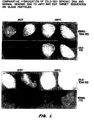
- the upper panel shows that the Texas red labeled normal genomic DNA yielded approximately equal intensities on the two different 21D7 particles and the two cMYC particles.
- the intensity of hybridization of the FITC-labeled Colo-320 DNA to the cMYC particles was substantially higher than to the 21D7 particles. This indicates the presence of more copies of cMYC than 21D7 sequences in the cell line since the ratio of Colo to normal signal on the cMYC particles is substantially higher than on the 21D7 particles.
- the FITC signal on the cMYC particles formed a ring at the edge of the particle, indicating predominant surface staining.
- the lower panel with reverse labelling shows that signal due to the FITC-labeled normal genomic DNA was approximately equal on all of the particles, while the Texas red-labeled Colo-320 DNA yielded a brighter signal on the cMYC particles. Thus the amplification detected was independent of the labeling scheme used.
Landscapes
- Chemical & Material Sciences (AREA)
- Life Sciences & Earth Sciences (AREA)
- Organic Chemistry (AREA)
- Health & Medical Sciences (AREA)
- Engineering & Computer Science (AREA)
- Wood Science & Technology (AREA)
- Proteomics, Peptides & Aminoacids (AREA)
- Zoology (AREA)
- Physics & Mathematics (AREA)
- Biophysics (AREA)
- Biotechnology (AREA)
- General Health & Medical Sciences (AREA)
- Bioinformatics & Cheminformatics (AREA)
- Molecular Biology (AREA)
- Genetics & Genomics (AREA)
- Immunology (AREA)
- Analytical Chemistry (AREA)
- Microbiology (AREA)
- Biochemistry (AREA)
- General Engineering & Computer Science (AREA)
- Theoretical Computer Science (AREA)
- Spectroscopy & Molecular Physics (AREA)
- Medical Informatics (AREA)
- Evolutionary Biology (AREA)
- Bioinformatics & Computational Biology (AREA)
- Measuring Or Testing Involving Enzymes Or Micro-Organisms (AREA)
- Heterocyclic Carbon Compounds Containing A Hetero Ring Having Oxygen Or Sulfur (AREA)
Priority Applications (1)
| Application Number | Priority Date | Filing Date | Title |
|---|---|---|---|
| DK95943084T DK0800587T3 (da) | 1994-12-09 | 1995-12-08 | Komparativ hybridisering af nukleinsyrerækker |
Applications Claiming Priority (3)
| Application Number | Priority Date | Filing Date | Title |
|---|---|---|---|
| US08/353,018 US5830645A (en) | 1994-12-09 | 1994-12-09 | Comparative fluorescence hybridization to nucleic acid arrays |
| US353018 | 1994-12-09 | ||
| PCT/US1995/016155 WO1996017958A1 (en) | 1994-12-09 | 1995-12-08 | Comparative fluorescence hybridization to nucleic acid arrays |
Publications (3)
| Publication Number | Publication Date |
|---|---|
| EP0800587A1 EP0800587A1 (en) | 1997-10-15 |
| EP0800587A4 EP0800587A4 (en) | 2001-11-14 |
| EP0800587B1 true EP0800587B1 (en) | 2005-03-02 |
Family
ID=23387401
Family Applications (1)
| Application Number | Title | Priority Date | Filing Date |
|---|---|---|---|
| EP95943084A Expired - Lifetime EP0800587B1 (en) | 1994-12-09 | 1995-12-08 | Comparative hybridisation to nucleic acid arrays |
Country Status (9)
| Country | Link |
|---|---|
| US (5) | US5830645A (da) |
| EP (1) | EP0800587B1 (da) |
| JP (1) | JP4338783B2 (da) |
| AT (1) | ATE290102T1 (da) |
| CA (1) | CA2206102C (da) |
| DE (1) | DE69534046T2 (da) |
| DK (1) | DK0800587T3 (da) |
| ES (1) | ES2235177T3 (da) |
| WO (1) | WO1996017958A1 (da) |
Families Citing this family (370)
| Publication number | Priority date | Publication date | Assignee | Title |
|---|---|---|---|---|
| US5721098A (en) * | 1986-01-16 | 1998-02-24 | The Regents Of The University Of California | Comparative genomic hybridization |
| US6346413B1 (en) | 1989-06-07 | 2002-02-12 | Affymetrix, Inc. | Polymer arrays |
| US6919211B1 (en) | 1989-06-07 | 2005-07-19 | Affymetrix, Inc. | Polypeptide arrays |
| US6406844B1 (en) | 1989-06-07 | 2002-06-18 | Affymetrix, Inc. | Very large scale immobilized polymer synthesis |
| US5143854A (en) | 1989-06-07 | 1992-09-01 | Affymax Technologies N.V. | Large scale photolithographic solid phase synthesis of polypeptides and receptor binding screening thereof |
| US6309822B1 (en) * | 1989-06-07 | 2001-10-30 | Affymetrix, Inc. | Method for comparing copy number of nucleic acid sequences |
| US6955915B2 (en) | 1989-06-07 | 2005-10-18 | Affymetrix, Inc. | Apparatus comprising polymers |
| US6040138A (en) | 1995-09-15 | 2000-03-21 | Affymetrix, Inc. | Expression monitoring by hybridization to high density oligonucleotide arrays |
| US5744101A (en) | 1989-06-07 | 1998-04-28 | Affymax Technologies N.V. | Photolabile nucleoside protecting groups |
| US6551784B2 (en) | 1989-06-07 | 2003-04-22 | Affymetrix Inc | Method of comparing nucleic acid sequences |
| US5424186A (en) | 1989-06-07 | 1995-06-13 | Affymax Technologies N.V. | Very large scale immobilized polymer synthesis |
| US5800992A (en) | 1989-06-07 | 1998-09-01 | Fodor; Stephen P.A. | Method of detecting nucleic acids |
| US6416952B1 (en) | 1989-06-07 | 2002-07-09 | Affymetrix, Inc. | Photolithographic and other means for manufacturing arrays |
| US6506558B1 (en) | 1990-03-07 | 2003-01-14 | Affymetrix Inc. | Very large scale immobilized polymer synthesis |
| EP0834575B1 (en) | 1990-12-06 | 2001-11-28 | Affymetrix, Inc. (a Delaware Corporation) | Identification of nucleic acids in samples |
| US6468740B1 (en) | 1992-11-05 | 2002-10-22 | Affymetrix, Inc. | Cyclic and substituted immobilized molecular synthesis |
| US7534567B2 (en) * | 1992-03-04 | 2009-05-19 | The Regents Of The University Of California | Detection of nucleic acid sequence differences by comparative genomic hybridization |
| EP1134293A3 (en) | 1992-03-04 | 2004-01-07 | The Regents of The University of California | Comparative genomic hybridization (CGH) |
| DE4344726C2 (de) * | 1993-12-27 | 1997-09-25 | Deutsches Krebsforsch | Verfahren zum Nachweis von nicht balanciertem genetischen Material einer Spezies oder zum Nachweis der Genexpression in Zellen einer Spezies |
| US5807522A (en) * | 1994-06-17 | 1998-09-15 | The Board Of Trustees Of The Leland Stanford Junior University | Methods for fabricating microarrays of biological samples |
| US7378236B1 (en) | 1994-06-17 | 2008-05-27 | The Board Of Trustees Of The Leland Stanford Junior University | Method for analyzing gene expression patterns |
| US7625697B2 (en) * | 1994-06-17 | 2009-12-01 | The Board Of Trustees Of The Leland Stanford Junior University | Methods for constructing subarrays and subarrays made thereby |
| US7323298B1 (en) * | 1994-06-17 | 2008-01-29 | The Board Of Trustees Of The Leland Stanford Junior University | Microarray for determining the relative abundances of polynuceotide sequences |
| US20030220748A1 (en) * | 1994-10-21 | 2003-11-27 | Affymetrix, Inc., A California Corporation | Computer-aided techniques for analyzing biological sequences |
| US8236493B2 (en) | 1994-10-21 | 2012-08-07 | Affymetrix, Inc. | Methods of enzymatic discrimination enhancement and surface-bound double-stranded DNA |
| US5830645A (en) * | 1994-12-09 | 1998-11-03 | The Regents Of The University Of California | Comparative fluorescence hybridization to nucleic acid arrays |
| US5690894A (en) * | 1995-05-23 | 1997-11-25 | The Regents Of The University Of California | High density array fabrication and readout method for a fiber optic biosensor |
| US7455964B1 (en) | 1996-07-15 | 2008-11-25 | The Hospital For Sick Children | Genes from the 20q13 amplicon and their uses |
| JP2000500021A (ja) * | 1995-11-13 | 2000-01-11 | アンスティテュ、パストゥール | コームドdna繊維との超高解析度比較核酸ハイブリッド形成 |
| EP0880598A4 (en) | 1996-01-23 | 2005-02-23 | Affymetrix Inc | RAPID EVALUATION OF NUCLEIC ACID ABUNDANCE DIFFERENCE, WITH A HIGH-DENSITY OLIGONUCLEOTIDE SYSTEM |
| US6881571B1 (en) * | 1998-03-11 | 2005-04-19 | Exonhit Therapeutics S.A. | Qualitative differential screening |
| FR2755149B1 (fr) * | 1996-10-30 | 1999-01-15 | Pasteur Institut | Procede de diagnostic de maladies genetiques par peignage moleculaire et coffret de diagnostic |
| FR2755147B1 (fr) * | 1996-10-30 | 1999-01-15 | Pasteur Institut | Procede de diagnostic de maladies genetiques par peignage moleculaire et coffret de diagnostic |
| GB9622665D0 (en) * | 1996-10-31 | 1997-01-08 | Zeneca Ltd | Methods |
| US6277563B1 (en) | 1997-01-16 | 2001-08-21 | The Regents Of The University Of California | Genetic alterations associated with cancer |
| US7670767B1 (en) * | 1997-01-16 | 2010-03-02 | The Regents Of The University Of California | Genetic alterations associated with cancer |
| NO972006D0 (no) * | 1997-04-30 | 1997-04-30 | Forskningsparken I Aas As | Ny metode for diagnose av sykdommer |
| US6466923B1 (en) | 1997-05-12 | 2002-10-15 | Chroma Graphics, Inc. | Method and apparatus for biomathematical pattern recognition |
| EP0878552A1 (en) | 1997-05-13 | 1998-11-18 | Erasmus Universiteit Rotterdam | Molecular detection of chromosome aberrations |
| NZ502303A (en) * | 1997-06-18 | 2002-02-01 | Ulrich J Krull | Nucleic acid biosensor system & diagnostic use |
| NZ516848A (en) | 1997-06-20 | 2004-03-26 | Ciphergen Biosystems Inc | Retentate chromatography apparatus with applications in biology and medicine |
| AU8177398A (en) * | 1997-06-30 | 1999-01-19 | Government of the United States of America, as represented by The Secretary of the Department of Health and Human Services and His Successors, The | Spectral cloning-a new technical approach to the cloning and characterization ofevery chromosomal aberration in cancer samples |
| US6210878B1 (en) | 1997-08-08 | 2001-04-03 | The Regents Of The University Of California | Array-based detection of genetic alterations associated with disease |
| US6223127B1 (en) | 1997-08-15 | 2001-04-24 | Affymetrix, Inc. | Polymorphism detection utilizing clustering analysis |
| DE19743301A1 (de) * | 1997-09-30 | 1999-04-01 | Metasystems Hard & Software Gm | Verfahren zum Vergleich der Kopienzahl von Nukleinsäuresequenzen |
| WO1999023256A1 (en) * | 1997-10-30 | 1999-05-14 | Cold Spring Harbor Laboratory | Probe arrays and methods of using probe arrays for distinguishing dna |
| ES2306485T3 (es) * | 1997-11-25 | 2008-11-01 | Oryzon Genomics, S.A. | Procedimiento de cribado en paralelo de mutantes de insecion y un dispositivo para llevar a cabo dicho procedimiento. |
| US6087102A (en) * | 1998-01-07 | 2000-07-11 | Clontech Laboratories, Inc. | Polymeric arrays and methods for their use in binding assays |
| US6265163B1 (en) | 1998-01-09 | 2001-07-24 | Lynx Therapeutics, Inc. | Solid phase selection of differentially expressed genes |
| AU756357B2 (en) * | 1998-01-26 | 2003-01-09 | Genzyme Corporation | Methods for identifying therapeutic targets |
| US6077673A (en) * | 1998-03-31 | 2000-06-20 | Clontech Laboratories, Inc. | Mouse arrays and kits comprising the same |
| US6979728B2 (en) * | 1998-05-04 | 2005-12-27 | Baylor College Of Medicine | Articles of manufacture and methods for array based analysis of biological molecules |
| JP2002513587A (ja) | 1998-05-04 | 2002-05-14 | ダコ エー エス | 染色体異常を検出するための方法およびプローブ |
| US6306589B1 (en) * | 1998-05-27 | 2001-10-23 | Vysis, Inc. | Biological assays for analyte detection |
| EP1090293B2 (en) | 1998-06-24 | 2019-01-23 | Illumina, Inc. | Decoding of array sensors with microspheres |
| US7981599B1 (en) | 1998-07-31 | 2011-07-19 | Boston Probes, Inc. | Non-nucleic acid probes, probe sets, methods and kits pertaining to the detection of individual human chromosomes X, Y, 1, 2, 3, 4, 6, 7, 8, 9, 10, 11, 12, 16, 17, 18 and 20 as 13/21 as a pair |
| FR2783253B1 (fr) * | 1998-09-16 | 2002-03-01 | Commissariat Energie Atomique | Procede et trousse pour la detection d'un desequilibre intrachromosomique dans des noyaux interphasiques et leurs applications |
| US6593084B2 (en) * | 1998-10-13 | 2003-07-15 | Robert E. Bird | Carcinogen assay |
| AU6074999A (en) | 1998-10-14 | 2000-05-01 | Agriculture And Agrifood Canada | Hybrid alfalfa ((medicago sativa)) |
| US6545264B1 (en) | 1998-10-30 | 2003-04-08 | Affymetrix, Inc. | Systems and methods for high performance scanning |
| US6251601B1 (en) * | 1999-02-02 | 2001-06-26 | Vysis, Inc. | Simultaneous measurement of gene expression and genomic abnormalities using nucleic acid microarrays |
| US6410231B1 (en) * | 1999-02-26 | 2002-06-25 | Incyte Genomics, Inc. | SNP detection |
| US7008768B1 (en) * | 1999-02-26 | 2006-03-07 | The United States Of America As Represented By The Department Of Health And Human Services | Method for detecting radiation exposure |
| US6465180B1 (en) * | 1999-03-17 | 2002-10-15 | The Regents Of The University Of California | Detection of premalignant melanocytes |
| US20060275782A1 (en) | 1999-04-20 | 2006-12-07 | Illumina, Inc. | Detection of nucleic acid reactions on bead arrays |
| US6465182B1 (en) * | 1999-04-29 | 2002-10-15 | The Regents Of The University Of California | Comparative fluorescence hybridization to oligonucleotide microarrays |
| FR2798673B1 (fr) * | 1999-09-16 | 2004-05-28 | Exonhit Therapeutics Sa | Methodes et compositions pour la detection d'evenements pathologiques |
| WO2001020043A1 (en) * | 1999-09-17 | 2001-03-22 | Affymetrix, Inc. | Method of cluster analysis of gene expression profiles |
| US7217573B1 (en) * | 1999-10-05 | 2007-05-15 | Hitachi, Ltd. | Method of inspecting a DNA chip |
| US6613516B1 (en) | 1999-10-30 | 2003-09-02 | Affymetrix, Inc. | Preparation of nucleic acid samples |
| US7167615B1 (en) | 1999-11-05 | 2007-01-23 | Board Of Regents, The University Of Texas System | Resonant waveguide-grating filters and sensors and methods for making and using same |
| US7041445B2 (en) | 1999-11-15 | 2006-05-09 | Clontech Laboratories, Inc. | Long oligonucleotide arrays |
| US7611869B2 (en) | 2000-02-07 | 2009-11-03 | Illumina, Inc. | Multiplexed methylation detection methods |
| US7582420B2 (en) | 2001-07-12 | 2009-09-01 | Illumina, Inc. | Multiplex nucleic acid reactions |
| ATE412774T1 (de) * | 2000-02-16 | 2008-11-15 | Illumina Inc | Parallele genotypisierung mehrerer patientenproben |
| CA2408094A1 (en) * | 2000-05-04 | 2001-11-08 | The Center For Blood Research, Inc. | Colloid compositions for solid phase biomolecular analytical, preparative and identification systems |
| EP1158057A1 (en) * | 2000-05-18 | 2001-11-28 | Centre National De La Recherche Scientifique | Compositions and methods applicable to genetic analyses |
| EP1158058A1 (en) * | 2000-05-19 | 2001-11-28 | Centre National De La Recherche Scientifique | Compositions and methods suitable for nucleic acid analyses |
| US6785614B1 (en) * | 2000-05-31 | 2004-08-31 | The Regents Of The University Of California | End sequence profiling |
| JP2004500867A (ja) * | 2000-06-07 | 2004-01-15 | ベイラー カレッジ オブ メディシン | アレイ利用型核酸ハイブリダイゼーションのための新規な組成物および方法 |
| KR100865664B1 (ko) | 2000-06-14 | 2008-10-29 | 비스타겐 인코포레이티드 | 간 줄기 세포를 사용하는 독성 타이핑 |
| US6913879B1 (en) | 2000-07-10 | 2005-07-05 | Telechem International Inc. | Microarray method of genotyping multiple samples at multiple LOCI |
| US6789040B2 (en) | 2000-08-22 | 2004-09-07 | Affymetrix, Inc. | System, method, and computer software product for specifying a scanning area of a substrate |
| US6965704B2 (en) * | 2000-08-22 | 2005-11-15 | Affymetrix, Inc. | System, method, and computer software product for grid alignment of multiple scanned images |
| WO2002033068A1 (en) * | 2000-10-18 | 2002-04-25 | Canon Kabushiki Kaisha | Method of analyzing nucleic acid base sequence |
| DE60131903T2 (de) | 2000-10-24 | 2008-11-27 | The Board of Trustees of the Leland S. Stanford Junior University, Palo Alto | Direkte multiplex charakterisierung von genomischer dna |
| US20020150887A1 (en) * | 2000-11-09 | 2002-10-17 | National Institute Of Advanced Industrial Science And Technology | Methods and nucleic acid probes for molecular genetic analysis of polluted environments and environmental samples |
| US20020137074A1 (en) * | 2000-11-21 | 2002-09-26 | Piunno Paul A.E. | Selectivity of nucleic acid diagnostic and microarray technologies by control of interfacial nucleic acid film chemistry |
| US6905816B2 (en) | 2000-11-27 | 2005-06-14 | Intelligent Medical Devices, Inc. | Clinically intelligent diagnostic devices and methods |
| US20020086294A1 (en) * | 2000-12-29 | 2002-07-04 | Ellson Richard N. | Device and method for tracking conditions in an assay |
| US20040009487A1 (en) * | 2001-08-31 | 2004-01-15 | Kadushin James M. | Methods for blocking nonspecific hybridizations of nucleic acid sequences |
| SE0101934D0 (sv) * | 2001-06-01 | 2001-06-01 | Pharmacia Ab | New methods |
| AU2002327236A1 (en) | 2001-07-12 | 2003-01-29 | Illumina, Inc. | Multiplex nucleic acid reactions |
| US20030082606A1 (en) * | 2001-09-04 | 2003-05-01 | Lebo Roger V. | Optimizing genome-wide mutation analysis of chromosomes and genes |
| US7439346B2 (en) | 2001-10-12 | 2008-10-21 | Perkinelmer Las Inc. | Nucleic acids arrays and methods of use therefor |
| CA2463725A1 (en) * | 2001-10-12 | 2003-11-06 | Spectral Genomics, Inc. | Compilations of nucleic acids and arrays and methods of using them |
| US20030124542A1 (en) * | 2001-12-28 | 2003-07-03 | Spectral Genomics, Inc. | Methods for mapping the chromosomal loci of genes expressed by a cell |
| US6783944B2 (en) | 2002-01-04 | 2004-08-31 | The Regents Of The University Of California | Genetic changes in atypical nodular proliferations in congenital melanocytic nevi |
| US7383134B2 (en) | 2002-01-15 | 2008-06-03 | Piper James R | Method and/or system for analyzing biological samples using a computer system |
| AU2003207611B2 (en) * | 2002-01-18 | 2008-05-08 | Syngenta Participations Ag | Probe correction for gene expression level detection |
| US6916621B2 (en) * | 2002-03-27 | 2005-07-12 | Spectral Genomics, Inc. | Methods for array-based comparitive binding assays |
| US7226771B2 (en) | 2002-04-19 | 2007-06-05 | Diversa Corporation | Phospholipases, nucleic acids encoding them and methods for making and using them |
| PT1497418E (pt) | 2002-04-19 | 2013-01-25 | Dsm Ip Assets Bv | Fosfolípases, ácidos nucleicos que as codificam e métodos para as preparar e utilizar |
| US9388459B2 (en) * | 2002-06-17 | 2016-07-12 | Affymetrix, Inc. | Methods for genotyping |
| US20070065830A1 (en) * | 2002-09-04 | 2007-03-22 | Children's Hospital Medical Center Of Akron, Inc. | Cloning multiple control sequences into chromosomes or into artificial centromeres |
| AU2003272548A1 (en) * | 2002-09-16 | 2004-04-30 | Plexxikon, Inc. | Crystal structure of pim-1 kinase |
| US7011949B2 (en) * | 2002-09-30 | 2006-03-14 | Agilent Technologies, Inc. | Methods and compositions for producing labeled probe nucleic acids for use in array based comparative genomic hybridization applications |
| US6863822B2 (en) * | 2002-10-16 | 2005-03-08 | Anthony Pipes | Method and apparatus for parallel desalting |
| US7822555B2 (en) | 2002-11-11 | 2010-10-26 | Affymetrix, Inc. | Methods for identifying DNA copy number changes |
| GB0227238D0 (en) * | 2002-11-21 | 2002-12-31 | Diagenic As | Product and method |
| US20060240430A1 (en) * | 2002-12-04 | 2006-10-26 | Ying Wu | Method for hybridisation of immobilized genomic dna |
| US7549817B2 (en) * | 2002-12-18 | 2009-06-23 | World Wide Stationery Mfg. Co., Ltd. | Ready lock ring binder mechanism |
| AU2003303396A1 (en) | 2002-12-23 | 2004-07-22 | Agilent Technologies, Inc. | Comparative genomic hybridization assays using immobilized oligonucleotide features and compositions for practicing the same |
| US20040166518A1 (en) * | 2003-01-02 | 2004-08-26 | The Regents Of The University Of California | Multilabeling mouse FISH assay for detecting structural and numerical chromosomal abnormalities |
| US20050048573A1 (en) * | 2003-02-03 | 2005-03-03 | Plexxikon, Inc. | PDE5A crystal structure and uses |
| JP2007524374A (ja) * | 2003-02-28 | 2007-08-30 | プレキシコン,インコーポレーテッド | Pyk2結晶構造および使用 |
| CN102618564B (zh) | 2003-03-06 | 2014-10-29 | 维莱尼姆公司 | 淀粉酶、编码它们的核酸及其制备和应用方法 |
| CA3007908A1 (en) | 2003-03-07 | 2005-04-14 | Dsm Ip Assets B.V. | Hydrolases, nucleic acids encoding them and methods for making and using them |
| HUE030493T2 (en) | 2003-04-04 | 2017-05-29 | Basf Enzymes Llc | Pectate lyases, nucleic acids and processes encoding them for their production and use |
| WO2004097371A2 (en) * | 2003-04-25 | 2004-11-11 | Board Of Regents, The University Of Texas System | System and method for the detection of analytes |
| US9317922B2 (en) | 2003-05-16 | 2016-04-19 | Board Of Regents The University Of Texas System | Image and part recognition technology |
| JP2006525814A (ja) * | 2003-05-23 | 2006-11-16 | コールド スプリング ハーバー ラボラトリー | ヌクレオチド配列の実質的表示 |
| US7211384B2 (en) * | 2003-05-28 | 2007-05-01 | Agilent Technologies, Inc. | Comparative genomic hybridization assays using immobilized oligonucleotide targets with initially small sample sizes and compositions for practicing the same |
| US7960148B2 (en) | 2003-07-02 | 2011-06-14 | Verenium Corporation | Glucanases, nucleic acids encoding them and methods for making and using them |
| AU2003903417A0 (en) * | 2003-07-04 | 2003-07-17 | Genera Biosystems Pty Ltd | Multiplex detection |
| US20050079548A1 (en) * | 2003-07-07 | 2005-04-14 | Plexxikon, Inc. | Ligand development using PDE4B crystal structures |
| CA2535526C (en) | 2003-08-11 | 2015-09-29 | Diversa Corporation | Laccases, nucleic acids encoding them and methods for making and using them |
| WO2005028624A2 (en) * | 2003-09-15 | 2005-03-31 | Plexxikon, Inc. | Molecular scaffolds for kinase ligand development |
| EP1678329A4 (en) * | 2003-10-30 | 2008-07-02 | Tufts New England Medical Ct | PRENATAL DIAGNOSIS USING CELL-FREE FEDERAL DNA IN FRUIT WATER |
| US7534875B2 (en) | 2003-11-03 | 2009-05-19 | Exagen Diagnostics, Inc. | Compositions for glioma classification |
| US20070066641A1 (en) * | 2003-12-19 | 2007-03-22 | Prabha Ibrahim | Compounds and methods for development of RET modulators |
| CN1925855B (zh) * | 2003-12-19 | 2010-06-16 | 普莱希科公司 | 开发Ret调节剂的化合物和方法 |
| WO2005079474A2 (en) * | 2004-02-17 | 2005-09-01 | The Regents Of The University Of California | Detection of nucleic acid sequence differences by comparative genomic hybridization |
| US8321138B2 (en) * | 2005-07-29 | 2012-11-27 | Agilent Technologies, Inc. | Method of characterizing quality of hybridized CGH arrays |
| US20070031883A1 (en) * | 2004-03-04 | 2007-02-08 | Kincaid Robert H | Analyzing CGH data to identify aberrations |
| US20050233338A1 (en) * | 2004-04-20 | 2005-10-20 | Barrett Michael T | Methods and compositions for assessing chromosome copy number |
| US20050233339A1 (en) * | 2004-04-20 | 2005-10-20 | Barrett Michael T | Methods and compositions for determining the relationship between hybridization signal of aCGH probes and target genomic DNA copy number |
| EP1742627A4 (en) | 2004-05-06 | 2009-08-26 | Plexxikon Inc | PDE4B HEMMER AND ITS USE |
| US8911942B2 (en) * | 2004-05-20 | 2014-12-16 | Quest Diagnostics Investments Incorporated | Single label comparative hybridization |
| EP2290073A3 (en) | 2004-05-28 | 2011-08-31 | Asuragen, Inc. | Methods and compositions involving microRNA |
| EP1774043A4 (en) * | 2004-05-28 | 2009-09-02 | Dana Farber Cancer Inst Inc | COMPOSITIONS, KITS AND METHODS OF IDENTIFICATION, ASSESSMENT, PREVENTION AND THERAPY OF CANCER |
| GB0412301D0 (en) * | 2004-06-02 | 2004-07-07 | Diagenic As | Product and method |
| AU2005264938B2 (en) | 2004-06-16 | 2011-11-24 | Verenium Corporation | Compositions and methods for enzymatic decolorization of chlorophyll |
| JP2008503473A (ja) * | 2004-06-17 | 2008-02-07 | プレキシコン,インコーポレーテッド | C−kit活性を調節する化合物 |
| US7498342B2 (en) | 2004-06-17 | 2009-03-03 | Plexxikon, Inc. | Compounds modulating c-kit activity |
| WO2006026754A2 (en) * | 2004-09-03 | 2006-03-09 | Plexxikon, Inc. | Bicyclic heteroaryl pde4b inhibitors |
| US20070099227A1 (en) * | 2004-10-12 | 2007-05-03 | Curry Bo U | Significance analysis using data smoothing with shaped response functions |
| US20060080043A1 (en) * | 2004-10-12 | 2006-04-13 | Sampas Nicholas M | Comparative genomic hybridization significance analysis using data smoothing with shaped response functions |
| US20060078899A1 (en) * | 2004-10-12 | 2006-04-13 | Scheffer Alicia F | Methods and compositions for reducing label variation in array-based comparative genome hybridization assays |
| EP1815021A2 (en) * | 2004-11-03 | 2007-08-08 | Almac Diagnostics Limited | Transcriptome microarray technology and methods of using the same |
| EP2302055B1 (en) | 2004-11-12 | 2014-08-27 | Asuragen, Inc. | Methods and compositions involving miRNA and miRNA inhibitor molecules |
| US20060110744A1 (en) | 2004-11-23 | 2006-05-25 | Sampas Nicolas M | Probe design methods and microarrays for comparative genomic hybridization and location analysis |
| US8021888B2 (en) * | 2005-01-27 | 2011-09-20 | Quest Diagnostics Investments Incorporated | Rapid comparative genomic hybridization using acoustic surface waves |
| US7541144B2 (en) * | 2005-01-31 | 2009-06-02 | Agilent Technologies, Inc. | RNA labeling method |
| US20060172314A1 (en) * | 2005-01-31 | 2006-08-03 | Song Min-Sun | Quantification of amplified nucleic acids |
| US8409808B2 (en) | 2005-02-18 | 2013-04-02 | The United States Of America, As Represented By The Secretary, Department Of Health And Human Services | Method for detecting risk of progression of low grade cervical dysplasia |
| EP2886658A1 (en) | 2005-03-10 | 2015-06-24 | BASF Enzymes LLC | Lyase enzymes, nucleic acids encoding them and methods for making and using them |
| CA2611859C (en) | 2005-03-15 | 2015-03-31 | Verenium Corporation | Cellulases, nucleic acids encoding them and methods for making and using them |
| US7557198B2 (en) | 2005-05-04 | 2009-07-07 | Exagen Diagnostics, Inc. | Acute myelogenous leukemia biomarkers |
| US7846941B2 (en) * | 2005-05-17 | 2010-12-07 | Plexxikon, Inc. | Compounds modulating c-kit and c-fms activity and uses therefor |
| UA95244C2 (ru) * | 2005-06-22 | 2011-07-25 | Плексикон, Инк. | Соединения и способ модулирования активности киназ, и показания для их применения |
| US7544471B2 (en) * | 2005-07-30 | 2009-06-09 | Agilent Technologies, Inc. | Preparing RNA from a wax-embedded tissue specimen |
| US20070048743A1 (en) * | 2005-08-26 | 2007-03-01 | Sampas Nicholas M | Methods and compositions for assessing candidate aCGH probe nucleic acids |
| US20070087355A1 (en) * | 2005-10-14 | 2007-04-19 | Barrett Michael T | Comparative genomic hybridization assays and compositions for practicing the same |
| US8076074B2 (en) | 2005-11-29 | 2011-12-13 | Quest Diagnostics Investments Incorporated | Balanced translocation in comparative hybridization |
| US11306351B2 (en) | 2005-12-21 | 2022-04-19 | Affymetrix, Inc. | Methods for genotyping |
| US20070166739A1 (en) * | 2005-12-23 | 2007-07-19 | Perkinelmer Las, Inc. | Comparative genomic hybridization on encoded multiplex particles |
| US7932037B2 (en) * | 2007-12-05 | 2011-04-26 | Perkinelmer Health Sciences, Inc. | DNA assays using amplicon probes on encoded particles |
| US20090104613A1 (en) * | 2005-12-23 | 2009-04-23 | Perkinelmer Las, Inc. | Methods and compositions relating to multiplexed genomic gain and loss assays |
| US20100009373A1 (en) * | 2005-12-23 | 2010-01-14 | Perkinelmer Health Sciences, Inc. | Methods and compositions relating to multiplex genomic gain and loss assays |
| WO2007075910A2 (en) * | 2005-12-23 | 2007-07-05 | Perkinelmer Las, Inc. | Methods and compositions for detecting enzymatic activity |
| EP1969337A4 (en) * | 2005-12-23 | 2010-01-27 | Perkinelmer Las Inc | MULTIPLEX ANALYSIS CARRIED OUT BY MEANS OF MAGNETIC PARTICLES AND NON-MAGNETIC PARTICLES |
| US20090156431A1 (en) * | 2007-12-12 | 2009-06-18 | Si Lok | Methods for Nucleic Acid Mapping and Identification of Fine Structural Variations in Nucleic Acids |
| US7932029B1 (en) | 2006-01-04 | 2011-04-26 | Si Lok | Methods for nucleic acid mapping and identification of fine-structural-variations in nucleic acids and utilities |
| ATE483804T1 (de) | 2006-01-04 | 2010-10-15 | Si Lok | Verfahren zur zuordnung von nukleinsäuren und zur identifikation fein strukturierter variationen in nukleinsäuren sowie hilfsmittel dafür |
| WO2007082352A1 (en) | 2006-01-20 | 2007-07-26 | Child Health Research Institute Inc | Method of treatment, prophylaxis and diagnosis of pathologies of the bone |
| EP1987142A4 (en) | 2006-02-02 | 2009-07-15 | Verenium Corp | ESTERASES AND ASSOCIATED NUCLEIC ACIDS AND METHODS |
| NZ595497A (en) | 2006-02-10 | 2013-09-27 | Verenium Corp | Cellulolytic enzymes, nucleic acids encoding them and methods for making and using them |
| TR201809912T4 (tr) | 2006-02-14 | 2018-07-23 | Bp Corp North America Inc | Ksilanazlar, bunları kodlayan nükleik asitler ve bunları yapmak ve kullanmak için yöntemler. |
| CN101384901A (zh) | 2006-02-16 | 2009-03-11 | 文塔纳医疗系统公司 | 用于癌症预后和病理分期的试剂和方法 |
| AU2007223086B2 (en) | 2006-03-07 | 2013-09-26 | Basf Enzymes Llc | Aldolases, nucleic acids encoding them and methods for making and using them |
| MX2008011477A (es) | 2006-03-07 | 2008-09-23 | Cargill Inc | Aldolasas, acidos nucleicos que las codifican y metodos para hacerlas y usarlas. |
| US20070232556A1 (en) * | 2006-03-31 | 2007-10-04 | Montine Thomas J | Methods and compositions for the treatment of neurological diseases and disorders |
| US20070231803A1 (en) * | 2006-03-31 | 2007-10-04 | Jensen Mark A | Multiplex pcr mixtures and kits containing the same |
| US20070238106A1 (en) * | 2006-04-07 | 2007-10-11 | Agilent Technologies, Inc. | Systems and methods of determining alleles and/or copy numbers |
| US8058055B2 (en) * | 2006-04-07 | 2011-11-15 | Agilent Technologies, Inc. | High resolution chromosomal mapping |
| US20070238104A1 (en) * | 2006-04-07 | 2007-10-11 | Agilent Technologies, Inc. | Competitive oligonucleotides |
| US20080058218A1 (en) * | 2006-05-03 | 2008-03-06 | Gordon David B | Arrays of compound probes and methods using the same |
| US20070259347A1 (en) * | 2006-05-03 | 2007-11-08 | Agilent Technologies, Inc. | Methods of increasing the effective probe densities of arrays |
| US20070259345A1 (en) * | 2006-05-03 | 2007-11-08 | Agilent Technologies, Inc. | Target determination using compound probes |
| US20070259344A1 (en) * | 2006-05-03 | 2007-11-08 | Agilent Technologies, Inc. | Compound probes and methods of increasing the effective probe densities of arrays |
| US20070259346A1 (en) * | 2006-05-03 | 2007-11-08 | Agilent Technologies, Inc. | Analysis of arrays |
| US8261507B2 (en) * | 2006-05-12 | 2012-09-11 | Columbia Insurance Company | Flooring profile |
| DK2069389T3 (da) | 2006-08-04 | 2015-01-12 | Bp Corp North America Inc | Glucanaser, nucleinsyrer, som koder for dem, og fremgangsmåder til fremstilling og anvendelse af disse |
| US20090131348A1 (en) | 2006-09-19 | 2009-05-21 | Emmanuel Labourier | Micrornas differentially expressed in pancreatic diseases and uses thereof |
| WO2008036776A2 (en) | 2006-09-19 | 2008-03-27 | Asuragen, Inc. | Mir-15, mir-26, mir -31,mir -145, mir-147, mir-188, mir-215, mir-216 mir-331, mmu-mir-292-3p regulated genes and pathways as targets for therapeutic intervention |
| ES2531135T3 (es) | 2006-09-21 | 2015-03-11 | Basf Enzymes Llc | Fitasas, ácidos nucleicos que las codifican y métodos para su producción y uso |
| EP2057274B1 (en) | 2006-09-21 | 2013-12-11 | DSM IP Assets B.V. | Phospholipases, nucleic acids encoding them and methods for making and using them |
| CA3018520C (en) * | 2006-10-10 | 2022-05-17 | The Henry M. Jackson Foundation For The Advancement Of Military Medicine, Inc. | Prostate cancer-specific alterations in erg gene expression and detection and treatment methods based on those alterations |
| US20080090236A1 (en) * | 2006-10-13 | 2008-04-17 | Yakhini Zohar H | Methods and systems for identifying tumor progression in comparative genomic hybridization data |
| US20080102453A1 (en) * | 2006-10-31 | 2008-05-01 | Jayati Ghosh | Methods and systems and analysis of CGH data |
| US8618248B2 (en) | 2006-10-31 | 2013-12-31 | President And Fellows Of Harvard College | Phosphopeptide compositions and anti-phosphopeptide antibody compositions and methods of detecting phosphorylated peptides |
| DK2444807T3 (da) | 2006-11-01 | 2014-08-11 | Ventana Med Syst Inc | Mono- og dinitropyrazolhaptenkonjugater |
| US7741045B2 (en) * | 2006-11-16 | 2010-06-22 | General Electric Company | Sequential analysis of biological samples |
| US9201063B2 (en) | 2006-11-16 | 2015-12-01 | General Electric Company | Sequential analysis of biological samples |
| US7629125B2 (en) | 2006-11-16 | 2009-12-08 | General Electric Company | Sequential analysis of biological samples |
| US8305579B2 (en) | 2006-11-16 | 2012-11-06 | Thomas Pirrie Treynor | Sequential analysis of biological samples |
| US7662566B2 (en) * | 2006-11-22 | 2010-02-16 | Myriad Genetics, Inc. | Gene copy number profiling |
| WO2008063888A2 (en) | 2006-11-22 | 2008-05-29 | Plexxikon, Inc. | Compounds modulating c-fms and/or c-kit activity and uses therefor |
| US8349167B2 (en) | 2006-12-14 | 2013-01-08 | Life Technologies Corporation | Methods and apparatus for detecting molecular interactions using FET arrays |
| US8262900B2 (en) | 2006-12-14 | 2012-09-11 | Life Technologies Corporation | Methods and apparatus for measuring analytes using large scale FET arrays |
| US11339430B2 (en) | 2007-07-10 | 2022-05-24 | Life Technologies Corporation | Methods and apparatus for measuring analytes using large scale FET arrays |
| GB2457851B (en) | 2006-12-14 | 2011-01-05 | Ion Torrent Systems Inc | Methods and apparatus for measuring analytes using large scale fet arrays |
| PL2479267T3 (pl) | 2006-12-21 | 2017-06-30 | Basf Enzymes Llc | Amylazy i glukoamylazy, kwasy nukleinowe kodujące te związki oraz sposoby wytwarzania tych związków oraz stosowania ich |
| WO2008079909A1 (en) * | 2006-12-21 | 2008-07-03 | Plexxikon, Inc. | Pyrrolo [2,3-b] pyridines as kinase modulators |
| PE20121126A1 (es) * | 2006-12-21 | 2012-08-24 | Plexxikon Inc | Compuestos pirrolo [2,3-b] piridinas como moduladores de quinasa |
| JP2010514695A (ja) | 2006-12-21 | 2010-05-06 | プレキシコン,インコーポレーテッド | キナーゼ調節のための化合物および方法およびそのための適応症 |
| NZ598285A (en) | 2007-01-30 | 2013-10-25 | Syngenta Participations Ag | Enzymes for the treatment of lignocellulosics, nucleic acids encoding them and methods for making and using them |
| US20080241829A1 (en) * | 2007-04-02 | 2008-10-02 | Milligan Stephen B | Methods And Kits For Producing Labeled Target Nucleic Acid For Use In Array Based Hybridization Applications |
| AU2008239594B2 (en) | 2007-04-13 | 2013-10-24 | Beth Israel Deaconess Medical Center | Methods for treating cancer resistant to ErbB therapeutics |
| US8916745B2 (en) | 2007-04-27 | 2014-12-23 | The Regents Of The University Of California | Plant CO2 sensors, nucleic acids encoding them, and methods for making and using them |
| US8200440B2 (en) | 2007-05-18 | 2012-06-12 | Affymetrix, Inc. | System, method, and computer software product for genotype determination using probe array data |
| US20080293589A1 (en) * | 2007-05-24 | 2008-11-27 | Affymetrix, Inc. | Multiplex locus specific amplification |
| WO2009012283A1 (en) | 2007-07-17 | 2009-01-22 | Plexxikon Inc. | Compounds and methods for kinase modulation, and indications therefor |
| US7507539B2 (en) * | 2007-07-30 | 2009-03-24 | Quest Diagnostics Investments Incorporated | Substractive single label comparative hybridization |
| NZ582941A (en) * | 2007-08-13 | 2012-05-25 | Almac Diagnostics Ltd | A 3' -based sequencing approach for microarray manufacture |
| US20090088330A1 (en) * | 2007-09-28 | 2009-04-02 | Leproust Emily M | Methods And Kits For Producing Labeled Target Nucleic Acids For Use In Array Based Hybridization Applications |
| BRPI0817811A2 (pt) | 2007-10-03 | 2014-10-14 | Verenium Corp | Xilanases, ácidos nucleicos que codificam as mesmas e métodos para fabricação e uso das mesmas. |
| AU2008323649A1 (en) * | 2007-11-08 | 2009-05-14 | University Of Washington | DNA microarray based identification and mapping of balanced translocation breakpoints |
| AU2014203712B2 (en) * | 2007-12-05 | 2016-12-08 | Revvity Health Sciences, Inc. | Multiplexed genomic gain and loss assays |
| WO2009079857A1 (en) * | 2007-12-24 | 2009-07-02 | Honeywell International Inc. | A reactor for the quantitative analysis of nucleic acids |
| CN104651381A (zh) | 2008-01-03 | 2015-05-27 | 巴斯夫酶有限责任公司 | 转移酶和氧化还原酶、编码它们的核酸以及其制备和应用方法 |
| US20110118125A1 (en) * | 2008-05-03 | 2011-05-19 | Tufts Medical Center, Inc. | Neonatal salivary genomics |
| WO2009137807A2 (en) | 2008-05-08 | 2009-11-12 | Asuragen, Inc. | Compositions and methods related to mirna modulation of neovascularization or angiogenesis |
| WO2010003132A1 (en) | 2008-07-02 | 2010-01-07 | Illumina Cambridge Ltd. | Using populations of beads for the fabrication of arrays on surfaces |
| EP2310524A4 (en) * | 2008-07-10 | 2013-07-24 | Versitech Ltd | METHODS OF CARTOGRAPHY OF NUCLEIC ACIDS AND IDENTIFICATION OF FINE STRUCTURAL VARIATIONS IN NUCLEIC ACIDS |
| US8153391B2 (en) | 2008-08-29 | 2012-04-10 | Bunge Oils, Inc. | Hydrolases, nucleic acids encoding them and methods for making and using them |
| US8357503B2 (en) | 2008-08-29 | 2013-01-22 | Bunge Oils, Inc. | Hydrolases, nucleic acids encoding them and methods for making and using them |
| DK2329259T3 (da) | 2008-08-29 | 2016-05-09 | Janssen Biotech Inc | Markører og fremgangsmåder til bedømmelse og behandling af ulcerativ colitis og beslægtede sygdomme under anvendelse af et 20-genpanel |
| US8198062B2 (en) | 2008-08-29 | 2012-06-12 | Dsm Ip Assets B.V. | Hydrolases, nucleic acids encoding them and methods for making and using them |
| JP2012501658A (ja) * | 2008-09-05 | 2012-01-26 | ライフ テクノロジーズ コーポレーション | 核酸配列決定の検証、較正、および標準化のための方法およびシステム |
| US20100137143A1 (en) | 2008-10-22 | 2010-06-03 | Ion Torrent Systems Incorporated | Methods and apparatus for measuring analytes |
| US20100301398A1 (en) | 2009-05-29 | 2010-12-02 | Ion Torrent Systems Incorporated | Methods and apparatus for measuring analytes |
| US20120052066A1 (en) | 2008-11-07 | 2012-03-01 | Cesar Calderon | Markers and methods for assessing and treating lupus patients susceptible to photoprovocation |
| CN102369296A (zh) | 2009-03-09 | 2012-03-07 | 生物蛋白有限公司 | Mirac蛋白 |
| MY172424A (en) | 2009-04-03 | 2019-11-25 | Hoffmann La Roche | Propane- i-sulfonic acid {3- (4-chloro-phenyl)-1h-pyrrolo [2, 3-b] pyridine-3-carconyl] -2, 4-difluoro-phenyl} -amide compositions and uses thereof |
| NZ596459A (en) | 2009-05-21 | 2013-11-29 | Verenium Corp | Phytases, nucleic acids encoding them and methods for making and using them |
| CA2763199A1 (en) | 2009-05-29 | 2010-12-02 | The Regents Of The Univeristy Of California | B cell signature associated with tolerance in transplant recipients |
| AU2010276236B2 (en) | 2009-07-21 | 2014-03-20 | Gen-Probe Incorporated | Methods and compositions for quantitative detection of nucleic acid sequences over an extended dynamic range |
| US8329724B2 (en) | 2009-08-03 | 2012-12-11 | Hoffmann-La Roche Inc. | Process for the manufacture of pharmaceutically active compounds |
| AU2010298000A1 (en) | 2009-09-25 | 2012-04-05 | Signature Genomics Laboratories Llc | Multiplex (+/-) stranded arrays and assays for detecting chromosomal abnormalities associated with cancer and other diseases |
| UA111708C2 (uk) | 2009-10-16 | 2016-06-10 | Бандж Ойлз, Інк. | Спосіб рафінування олії |
| UA109884C2 (uk) | 2009-10-16 | 2015-10-26 | Поліпептид, що має активність ферменту фосфатидилінозитол-специфічної фосфоліпази с, нуклеїнова кислота, що його кодує, та спосіб його виробництва і застосування | |
| EP2491139A1 (en) | 2009-10-19 | 2012-08-29 | Stichting Het Nederlands Kanker Instituut | Predicting benefit of anti-cancer therapy via array comparative genomic hybridization |
| EP2491141A2 (en) | 2009-10-19 | 2012-08-29 | Stichting Het Nederlands Kanker Instituut | Differentiation between brca2-associated tumours and sporadic tumours via array comparative genomic hybridization |
| EP2491140A1 (en) | 2009-10-19 | 2012-08-29 | Stichting Het Nederlands Kanker Instituut | Predicting response to anti-cancer therapy via array comparative genomic hybridization |
| US9677125B2 (en) * | 2009-10-21 | 2017-06-13 | General Electric Company | Detection of plurality of targets in biological samples |
| JP2013507989A (ja) | 2009-10-26 | 2013-03-07 | アボット・ラボラトリーズ | 非小細胞肺癌の予後に関連する染色体異常の検出 |
| CN106220623A (zh) | 2009-11-06 | 2016-12-14 | 普莱希科公司 | 用于激酶调节的化合物和方法及其适应症 |
| US9587278B2 (en) | 2010-01-08 | 2017-03-07 | Oxford Gene Technology (Operations) Ltd. | Combined CGH and allele specific hybridisation method |
| CN102791882A (zh) * | 2010-01-20 | 2012-11-21 | 霍尼韦尔国际公司 | 用于核酸定量分析的反应器 |
| EP2529033B1 (en) | 2010-01-26 | 2017-05-24 | National Jewish Health | Methods for risk prediction, diagnosis, prognosis of pulmonary disorders |
| US9169515B2 (en) * | 2010-02-19 | 2015-10-27 | Life Technologies Corporation | Methods and systems for nucleic acid sequencing validation, calibration and normalization |
| EP2542678B1 (en) | 2010-03-04 | 2017-04-12 | InteRNA Technologies B.V. | A MiRNA MOLECULE DEFINED BY ITS SOURCE AND ITS THERAPEUTIC USES IN CANCER ASSOCIATED WITH EMT |
| US8774488B2 (en) | 2010-03-11 | 2014-07-08 | Cellscape Corporation | Method and device for identification of nucleated red blood cells from a maternal blood sample |
| US9652585B2 (en) | 2010-03-16 | 2017-05-16 | Bluegnome Limited | Comparative genomic hybridization array method for preimplantation genetic screening |
| US20110301051A1 (en) | 2010-04-09 | 2011-12-08 | Exagen Diagnostics, Inc. | Biomarkers for Ulcerative Colitis and Crohn's Disease |
| WO2011142818A1 (en) | 2010-05-10 | 2011-11-17 | Abbott Laboratories | Detection of chromosomal abnormalities associated with endometrial cancer |
| TWI465716B (zh) | 2010-06-30 | 2014-12-21 | 生命技術公司 | 用於檢測及測量化學反應及化合物之電晶體電路 |
| EP2588851B1 (en) | 2010-06-30 | 2016-12-21 | Life Technologies Corporation | Ion-sensing charge-accumulation circuit and method |
| US11307166B2 (en) | 2010-07-01 | 2022-04-19 | Life Technologies Corporation | Column ADC |
| EP2591106A1 (en) | 2010-07-06 | 2013-05-15 | InteRNA Technologies B.V. | Mirna and its diagnostic and therapeutic uses in diseases or conditions associated with melanoma, or in diseases or conditions associated with activated braf pathway |
| CN105886657B (zh) | 2010-09-13 | 2019-11-01 | 临床基因组学股份有限公司 | 结直肠癌的外遗传标记以及使用它们的诊断方法 |
| US20140018251A1 (en) | 2010-09-20 | 2014-01-16 | Stichting Het Nederlands Kanker Instituut | Methods for Predicting Response to Anti-Cancer Therapy in Cancer Patients |
| US9096871B2 (en) | 2010-10-06 | 2015-08-04 | Bp Corporation North America Inc. | Variant CBH I polypeptides with reduced product inhibition |
| BR112013012265A2 (pt) | 2010-11-17 | 2016-08-02 | Asuragen Inc | mirnas como biomarcadores para distinguir neoplasmas de tireoide benignos de malignos |
| EP2474617A1 (en) | 2011-01-11 | 2012-07-11 | InteRNA Technologies BV | Mir for treating neo-angiogenesis |
| US9624213B2 (en) | 2011-02-07 | 2017-04-18 | Plexxikon Inc. | Compounds and methods for kinase modulation, and indications therefor |
| AR085279A1 (es) | 2011-02-21 | 2013-09-18 | Plexxikon Inc | Formas solidas de {3-[5-(4-cloro-fenil)-1h-pirrolo[2,3-b]piridina-3-carbonil]-2,4-difluor-fenil}-amida del acido propano-1-sulfonico |
| EP2681566A2 (en) | 2011-02-28 | 2014-01-08 | University of Iowa Research Foundation | Anti-müllerian hormone changes in pregnancy and prediction ofadverse pregnancy outcomes and gender |
| US20140106354A1 (en) | 2011-04-18 | 2014-04-17 | Garvan Institute Of Medical Research | Method of Diagnosing Cancer |
| JP6113151B2 (ja) | 2011-05-17 | 2017-04-12 | プレキシコン インコーポレーテッドPlexxikon Inc. | キナーゼ調節およびその適応症 |
| WO2012174419A2 (en) | 2011-06-17 | 2012-12-20 | Dana-Farber Cancer Institute, Inc. | Signatures for predicting the survivability of myelodysplastic syndrome subjects |
| WO2013040251A2 (en) | 2011-09-13 | 2013-03-21 | Asurgen, Inc. | Methods and compositions involving mir-135b for distinguishing pancreatic cancer from benign pancreatic disease |
| US20130078632A1 (en) | 2011-09-23 | 2013-03-28 | Academisch Medisch Centrum | Materials and methods for prognosis of progression of barrett's esophagus |
| US10378060B2 (en) | 2011-10-14 | 2019-08-13 | Dana-Farber Cancer Institute, Inc. | ZNF365/ZFP365 biomarker predictive of anti-cancer response |
| WO2013063519A1 (en) | 2011-10-26 | 2013-05-02 | Asuragen, Inc. | Methods and compositions involving mirna expression levels for distinguishing pancreatic cysts |
| WO2013063544A1 (en) | 2011-10-27 | 2013-05-02 | Asuragen, Inc. | Mirnas as diagnostic biomarkers to distinguish benign from malignant thyroid tumors |
| EP2788768A1 (en) | 2011-12-10 | 2014-10-15 | Abbott Molecular Inc. | Materials and methods for diagnosis of malignant melanoma and prognosis of metastasis of malignant melanoma |
| WO2013101613A1 (en) | 2011-12-30 | 2013-07-04 | Abbott Molecular Inc. | Materials and methods for diagnosis, prognosis, monitoring of recurrence, and assessment of therapeutic/prophylactic treatment of pancreatobiliary cancer |
| ES2601460T3 (es) | 2011-12-30 | 2017-02-15 | Abbott Molecular Inc. | Materiales y métodos para el diagnóstico del cáncer de vejiga y el control de la recurrencia del mismo |
| EP2798082B1 (en) | 2011-12-30 | 2017-04-12 | Abbott Molecular Inc. | Materials and methods for diagnosis, prognosis and assessment of therapeutic/prophylactic treatment of prostate cancer |
| WO2013124740A2 (en) | 2012-02-23 | 2013-08-29 | Stichting Vu-Vumc | BRCA DEFICIENCY PROTEIN AND mRNA SIGNATURES USEFUL IN IDENTIFICATION OF PATIENTS WITH BRCA-DEFICIENT TUMORS AND PREDICTING BENEFIT OF ANTI-CANCER THERAPY IN CANCER PATIENTS |
| WO2013144202A1 (en) | 2012-03-29 | 2013-10-03 | Roche Diagnostics Gmbh | Biomarkers for discriminating healthy and/or non-malignant neoplastic colorectal cells from colorectal cancer cells |
| EP4001436B1 (en) | 2012-05-11 | 2024-03-13 | Clinical Genomics Pty. Ltd. | Diagnostic gene marker panel |
| GB201208726D0 (en) * | 2012-05-17 | 2012-07-04 | Oxford Gene Tech Ip Ltd | Methods and materials |
| DK2850212T3 (da) | 2012-05-18 | 2020-03-23 | Clinical Genomics Pty Ltd | Fremgangsmåde til screening for colorektal cancer |
| US9150570B2 (en) | 2012-05-31 | 2015-10-06 | Plexxikon Inc. | Synthesis of heterocyclic compounds |
| WO2014007623A1 (en) | 2012-07-03 | 2014-01-09 | Interna Technologies B.V. | Diagnostic portfolio and its uses |
| ES2817897T3 (es) | 2012-07-23 | 2021-04-08 | La Jolla Inst Allergy & Immunology | PTPRS y proteoglicanos en enfermedad autoinmune |
| WO2014055117A1 (en) | 2012-10-04 | 2014-04-10 | Asuragen, Inc. | Diagnostic mirnas for differential diagnosis of incidental pancreatic cystic lesions |
| WO2014100626A1 (en) | 2012-12-21 | 2014-06-26 | Hutman Diagnostics AG | Microarrays |
| US9266797B2 (en) * | 2013-02-12 | 2016-02-23 | Ecolab Usa Inc. | Online monitoring of polymerization inhibitors for control of undesirable polymerization |
| US9267171B2 (en) | 2013-02-28 | 2016-02-23 | New York University | DNA photolithography with cinnamate crosslinkers |
| US8963216B2 (en) | 2013-03-13 | 2015-02-24 | Life Technologies Corporation | Chemical sensor with sidewall spacer sensor surface |
| US20140272969A1 (en) | 2013-03-14 | 2014-09-18 | Abbott Molecular Inc. | Cell preparations and cell supports and their use in theranosis |
| CA2907377A1 (en) | 2013-03-15 | 2014-09-18 | Baylor Research Institute | Tissue and blood-based mirna biomarkers for the diagnosis, prognosis and metastasis-predictive potential in colorectal cancer |
| US9944992B2 (en) | 2013-03-15 | 2018-04-17 | The University Of Chicago | Methods and compositions related to T-cell activity |
| CN105264366B (zh) | 2013-03-15 | 2019-04-16 | 生命科技公司 | 具有一致传感器表面区域的化学传感器 |
| US9758835B2 (en) | 2013-03-15 | 2017-09-12 | Baylor Research Institute | Ulcerative colitis (UC)-associated colorectal neoplasia markers |
| WO2014191976A1 (en) | 2013-05-31 | 2014-12-04 | Si Lok | Molecular identity tags and uses thereof in identifying intermolecular ligation products |
| US10328062B2 (en) | 2014-04-04 | 2019-06-25 | Amgen, Inc. | Biomarkers and use of MET inhibitor for treatment of cancer |
| EP3134546A4 (en) | 2014-04-24 | 2017-12-06 | Dana-Farber Cancer Institute, Inc. | Tumor suppressor and oncogene biomarkers predictive of anti-immune checkpoint inhibitor response |
| ES2913205T3 (es) | 2014-05-13 | 2022-06-01 | Bioatla Inc | Proteínas biológicas activas condicionalmente |
| US9994912B2 (en) | 2014-07-03 | 2018-06-12 | Abbott Molecular Inc. | Materials and methods for assessing progression of prostate cancer |
| DK4074735T3 (da) | 2014-08-28 | 2025-07-14 | Bioatla Inc | Betinget aktive kimæriske antigenreceptorer til modificerede t-celler |
| US11111288B2 (en) | 2014-08-28 | 2021-09-07 | Bioatla, Inc. | Conditionally active chimeric antigen receptors for modified t-cells |
| WO2016036916A1 (en) | 2014-09-03 | 2016-03-10 | Bioatla, Llc | Discovering and producing conditionally active biologic proteins in the same eukaryotic cell production hosts |
| EP3194624B1 (en) | 2014-09-15 | 2022-02-16 | Garvan Institute of Medical Research | Methods for diagnosis, prognosis and monitoring of breast cancer and reagents therefor |
| CA2963091A1 (en) | 2014-10-06 | 2016-04-14 | Dana-Farber Cancer Institute, Inc. | Angiopoietin-2 biomarkers predictive of anti-immune checkpoint response |
| WO2016057651A1 (en) | 2014-10-09 | 2016-04-14 | Dana-Farber Cancer Institute, Inc. | Multiple-variable il-2 dose regimen for treating immune disorders |
| EP3204882B1 (en) | 2014-10-10 | 2025-01-01 | Life Technologies Corporation | Methods, systems, and computer-readable media for calculating corrected amplicon coverages |
| CN107106697B (zh) | 2014-10-15 | 2021-06-18 | 希望之城 | Pdgfr rna适体 |
| JP2017533733A (ja) | 2014-11-11 | 2017-11-16 | アボツト・モレキユラー・インコーポレイテツド | ハイブリダイゼーションプローブおよび方法 |
| ES2965764T3 (es) | 2015-02-24 | 2024-04-16 | Hope City | Plataformas de cribado de bibliotecas abordadas espacialmente codificadas químicamente |
| EP3262217A4 (en) | 2015-02-24 | 2018-07-18 | BioAtla LLC | Conditionally active biological proteins |
| WO2016144673A1 (en) | 2015-03-06 | 2016-09-15 | Dana-Farber Cancer Institute, Inc. | Pd-l2 biomarkers predictive of pd-1 pathway inhibitor responses in esophagogastric cancers |
| WO2016164641A1 (en) | 2015-04-08 | 2016-10-13 | Plexxikon Inc. | Compounds and methods for kinase modulation, and indications therefor |
| US10829484B2 (en) | 2015-07-28 | 2020-11-10 | Plexxikon Inc. | Compounds and methods for kinase modulation, and indications therefor |
| EP3362102A1 (en) | 2015-10-14 | 2018-08-22 | Life Technologies Corporation | Ribonucleoprotein transfection agents |
| MX2018006856A (es) | 2015-12-07 | 2018-08-01 | Plexxikon Inc | Compuestos y metodos para modulacion de la quinasa, e indicaciones de los mismos. |
| US10519442B2 (en) | 2016-02-11 | 2019-12-31 | City Of Hope | Twist signaling inhibitor compositions and methods of using the same |
| US11845938B2 (en) | 2016-03-31 | 2023-12-19 | City Of Hope | Aptamer compositions and the use thereof |
| PL3455261T3 (pl) | 2016-05-13 | 2022-12-12 | Bioatla, Inc. | Przeciwciała anty-ror2, fragmenty przeciwciał, ich immunokoniugaty oraz ich zastosowania |
| WO2017222834A1 (en) | 2016-06-10 | 2017-12-28 | City Of Hope | Compositions and methods for mitochondrial genome editing |
| EP3485032B1 (en) | 2016-07-12 | 2021-02-17 | Life Technologies Corporation | Compositions and methods for detecting nucleic acid regions |
| ES3033182T3 (en) | 2016-09-20 | 2025-07-31 | Dana Farber Cancer Inst Inc | Compositions and methods for identification, assessment, prevention, and treatment of aml using usp10 biomarkers and modulators |
| TW201815766A (zh) | 2016-09-22 | 2018-05-01 | 美商普雷辛肯公司 | 用於ido及tdo調節之化合物及方法以及其適應症 |
| WO2018089829A1 (en) | 2016-11-10 | 2018-05-17 | Fortis Therapeutics, Inc. | Cd46-specific effector cells and uses thereof |
| CA3043277A1 (en) | 2016-11-11 | 2018-05-17 | The Regents Of The University Of California | Anti-cd46 antibodies and methods of use |
| US10646540B2 (en) | 2016-11-18 | 2020-05-12 | City Of Hope | Peptide inhibitors of twist |
| EP3558991A2 (en) | 2016-12-23 | 2019-10-30 | Plexxikon Inc. | Compounds and methods for cdk8 modulation and indications therefor |
| US11820822B2 (en) | 2017-06-06 | 2023-11-21 | Dana-Farber Cancer Institute, Inc. | Methods for sensitizing cancer cells to T cell-mediated killing by modulating molecular pathways |
| WO2018226846A1 (en) | 2017-06-07 | 2018-12-13 | Plexxikon Inc. | Compounds and methods for kinase modulation |
| KR20200068647A (ko) | 2017-08-11 | 2020-06-15 | 시티 오브 호프 | 트랜스페린 수용체 (TfR)에 대한 RNA 앱타머 |
| EP3679144A1 (en) | 2017-09-08 | 2020-07-15 | Life Technologies Corporation | Methods for improved homologous recombination and compositions thereof |
| EP3679143A1 (en) | 2017-09-08 | 2020-07-15 | Life Technologies Corporation | Methods for improved homologous recombination and compositions thereof |
| CN111566212A (zh) | 2017-11-03 | 2020-08-21 | 因特尔纳技术有限公司 | miRNA分子,等同物,安塔够妙或其来源用于治疗和/或诊断与神经元缺陷相关的病症和/或疾病或用于神经元生成和/或再生 |
| WO2019104155A2 (en) | 2017-11-22 | 2019-05-31 | The University Of Chicago | Chemical probe-dependent evaluation of protein activity and uses thereof |
| WO2019126037A1 (en) | 2017-12-19 | 2019-06-27 | City Of Hope | Modified tracrrnas grnas, and uses thereof |
| WO2019168897A2 (en) | 2018-02-28 | 2019-09-06 | Dana-Farber Cancer Institute, Inc. | Methods for treating cancer using combinations of anti-btnl2 and immune checkpoint blockade agents |
| JP7429192B2 (ja) | 2018-04-06 | 2024-02-07 | デイナ ファーバー キャンサー インスティチュート,インコーポレイテッド | Hhla2受容体としてのkir3dl3、抗hhla2抗体、およびその使用 |
| WO2019200326A1 (en) | 2018-04-13 | 2019-10-17 | Rarecyte, Inc. | Kits for labeling of biomarkers and methods of using the same |
| WO2020061381A1 (en) | 2018-09-19 | 2020-03-26 | La Jolla Institute For Immunology | Ptprs and proteoglycans in rheumatoid arthritis |
| JP2022513082A (ja) | 2018-11-19 | 2022-02-07 | デイナ ファーバー キャンサー インスティチュート,インコーポレイテッド | 免疫応答を調節するためのIRE1α-XBP1シグナル伝達経路バイオマーカーの使用 |
| EP3947727A4 (en) | 2019-04-05 | 2023-01-04 | Board of Regents, The University of Texas System | METHODS AND APPLICATIONS OF CELL BARCODING |
| JP7566775B2 (ja) | 2019-04-12 | 2024-10-15 | ザ リージェンツ オブ ザ ユニバーシティ オブ カリフォルニア | 筋肉量及び酸化的代謝を増加させるための組成物及び方法 |
| EP3962529A4 (en) | 2019-04-30 | 2023-11-01 | Dana-Farber Cancer Institute, Inc. | Methods for treating cancer using combinations of anti-cx3cr1 and immune checkpoint blockade agents |
| WO2020230047A1 (en) | 2019-05-15 | 2020-11-19 | Affinito Alessadra | Aptamers against glioblastoma |
| WO2020245198A1 (en) | 2019-06-04 | 2020-12-10 | Apterna Limited | APTAMERS AGAINST TRANSFERRIN RECEPTOR (TfR) |
| WO2021053556A1 (en) | 2019-09-18 | 2021-03-25 | Novartis Ag | Nkg2d fusion proteins and uses thereof |
| EP4093513A4 (en) | 2020-01-24 | 2024-05-08 | Dana-Farber Cancer Institute, Inc. | Uses of biomarkers for improving immunotherapy |
| EP4192511A1 (en) | 2020-08-07 | 2023-06-14 | Fortis Therapeutics, Inc. | Immunoconjugates targeting cd46 and methods of use thereof |
| GB202019692D0 (en) | 2020-12-14 | 2021-01-27 | Apterna Ltd | Aptamer-sirna fusions |
| WO2022187374A1 (en) | 2021-03-02 | 2022-09-09 | Dana-Farber Cancer Institute, Inc. | Methods of treating red blood cell disorders |
| US20240280561A1 (en) | 2021-06-08 | 2024-08-22 | Dana-Farber Cancer Institute, Inc. | Compositions and methods for treating and/or identifying an agent for treating intestinal cancers |
| WO2023097119A2 (en) | 2021-11-29 | 2023-06-01 | Dana-Farber Cancer Institute, Inc. | Methods and compositions to modulate riok2 |
| WO2024028794A1 (en) | 2022-08-02 | 2024-02-08 | Temple Therapeutics BV | Methods for treating endometrial and ovarian hyperproliferative disorders |
| WO2025034542A1 (en) | 2023-08-04 | 2025-02-13 | Cornell University | Gene signature panel predicting cancer response to immune checkpoint blockade and radiation therapy |
| WO2025248505A1 (en) | 2024-05-31 | 2025-12-04 | Wayne State University | Methods for treating endometrial and ovarian hyperproliferative disorders |
Family Cites Families (62)
| Publication number | Priority date | Publication date | Assignee | Title |
|---|---|---|---|---|
| FR2422956A1 (fr) | 1978-04-13 | 1979-11-09 | Pasteur Institut | Procede de detection et de caracterisation d'un acide nucleique ou d'une sequence de celui-ci, et reactif enzymatique pour la mise en oeuvre de ce procede |
| US4358535A (en) | 1980-12-08 | 1982-11-09 | Board Of Regents Of The University Of Washington | Specific DNA probes in diagnostic microbiology |
| US4711955A (en) | 1981-04-17 | 1987-12-08 | Yale University | Modified nucleotides and methods of preparing and using same |
| US4681840A (en) | 1984-01-18 | 1987-07-21 | The United States Of America As Represented By The Secretary Of Commerce | Deoxyribonucleic acid molecules useful as probes for detecting oncogenes incorporated into chromosomal DNA |
| US4707440A (en) | 1984-01-30 | 1987-11-17 | Enzo Biochem, Inc. | Nucleic acid hybridization assay and detectable molecules useful in such assay |
| US4647529A (en) | 1984-06-01 | 1987-03-03 | Rodland Karin D | Hybridization method of detecting nucleic acid sequences with probe containing thionucleotide |
| US4755458A (en) | 1984-08-30 | 1988-07-05 | Enzo Biochem, Inc. | Composition and method for the detection of the presence of a polynucleotide sequence of interest |
| US4721669A (en) | 1985-01-18 | 1988-01-26 | The Trustees Of Columbia University In The City Of New York | Chemical probes for left-handed DNA and chiral metal complexes as Z-specific anti-tumor agents |
| US4675286A (en) | 1985-01-28 | 1987-06-23 | Aspen Diagnostics, Inc. | Fetal cell separation and testing |
| US5851767A (en) | 1985-03-04 | 1998-12-22 | The Regents Of The University Of California | Detection of prokaryotic organism by DNA hybridization |
| US4683202A (en) | 1985-03-28 | 1987-07-28 | Cetus Corporation | Process for amplifying nucleic acid sequences |
| US4683195A (en) | 1986-01-30 | 1987-07-28 | Cetus Corporation | Process for amplifying, detecting, and/or-cloning nucleic acid sequences |
| US4772691A (en) | 1985-06-05 | 1988-09-20 | The Medical College Of Wisconsin, Inc. | Chemically cleavable nucleotides |
| US4725536A (en) | 1985-09-19 | 1988-02-16 | Genetics Institute, Inc. | Reagent polynucleotide complex with multiple target binding regions, and kit and methods |
| US4888278A (en) | 1985-10-22 | 1989-12-19 | University Of Massachusetts Medical Center | In-situ hybridization to detect nucleic acid sequences in morphologically intact cells |
| US4770992A (en) | 1985-11-27 | 1988-09-13 | Den Engh Gerrit J Van | Detection of specific DNA sequences by flow cytometry |
| US5447841A (en) * | 1986-01-16 | 1995-09-05 | The Regents Of The Univ. Of California | Methods for chromosome-specific staining |
| US5721098A (en) | 1986-01-16 | 1998-02-24 | The Regents Of The University Of California | Comparative genomic hybridization |
| US6280929B1 (en) | 1986-01-16 | 2001-08-28 | The Regents Of The University Of California | Method of detecting genetic translocations identified with chromosomal abnormalities |
| US5756696A (en) | 1986-01-16 | 1998-05-26 | Regents Of The University Of California | Compositions for chromosome-specific staining |
| WO1987005027A1 (en) | 1986-02-21 | 1987-08-27 | Whitehead Institute For Biomedical Research | Y-specific dna hybridization probes and uses therefor |
| US4981783A (en) * | 1986-04-16 | 1991-01-01 | Montefiore Medical Center | Method for detecting pathological conditions |
| US5028525A (en) * | 1986-11-24 | 1991-07-02 | Regents Of The University Of California | Method of preparing and applying single stranded DNA probes to double stranded target DNAs in situ |
| US5085983A (en) | 1988-08-19 | 1992-02-04 | City Of Hope | Detection of human tumor progression and drug resistance |
| US5194300A (en) * | 1987-07-15 | 1993-03-16 | Cheung Sau W | Methods of making fluorescent microspheres |
| US5064948A (en) | 1988-02-12 | 1991-11-12 | The United States Of America As Represented By The Department Of Energy | Chromosome specific repetitive dna sequences |
| US5700637A (en) | 1988-05-03 | 1997-12-23 | Isis Innovation Limited | Apparatus and method for analyzing polynucleotide sequences and method of generating oligonucleotide arrays |
| US5869237A (en) | 1988-11-15 | 1999-02-09 | Yale University | Amplification karyotyping |
| ES2018959A6 (es) | 1988-11-15 | 1991-05-16 | Univ Yale | Metodo de delineacion de cromosomas humanos individuales en celulas metafasicas e interfasicas mediante hibridacion de suspension in situ. |
| ES2112833T3 (es) | 1988-12-06 | 1998-04-16 | Flinders Technologies Pty Ltd | Aislamiento de celulas fetales a partir de sangre materna para permitir el diagnostico prenatal. |
| WO1990008664A1 (en) | 1989-02-01 | 1990-08-09 | Vbg Produkter Ab | A coupling device for a motor vehicle |
| US5800992A (en) | 1989-06-07 | 1998-09-01 | Fodor; Stephen P.A. | Method of detecting nucleic acids |
| US5143854A (en) | 1989-06-07 | 1992-09-01 | Affymax Technologies N.V. | Large scale photolithographic solid phase synthesis of polypeptides and receptor binding screening thereof |
| US5424186A (en) | 1989-06-07 | 1995-06-13 | Affymax Technologies N.V. | Very large scale immobilized polymer synthesis |
| US6416952B1 (en) | 1989-06-07 | 2002-07-09 | Affymetrix, Inc. | Photolithographic and other means for manufacturing arrays |
| US5925525A (en) | 1989-06-07 | 1999-07-20 | Affymetrix, Inc. | Method of identifying nucleotide differences |
| US5871928A (en) | 1989-06-07 | 1999-02-16 | Fodor; Stephen P. A. | Methods for nucleic acid analysis |
| US5744101A (en) | 1989-06-07 | 1998-04-28 | Affymax Technologies N.V. | Photolabile nucleoside protecting groups |
| AU647741B2 (en) | 1989-12-01 | 1994-03-31 | Regents Of The University Of California, The | Methods and compositions for chromosome-specific staining |
| US5173260A (en) * | 1990-09-17 | 1992-12-22 | Eastman Kodak Company | Beads fused to a test device support |
| US5491224A (en) | 1990-09-20 | 1996-02-13 | Bittner; Michael L. | Direct label transaminated DNA probe compositions for chromosome identification and methods for their manufacture |
| US5789161A (en) * | 1990-09-20 | 1998-08-04 | Amoco Corporation | Methods for genome identification using direct label probe composition |
| EP0834575B1 (en) | 1990-12-06 | 2001-11-28 | Affymetrix, Inc. (a Delaware Corporation) | Identification of nucleic acids in samples |
| US5427932A (en) | 1991-04-09 | 1995-06-27 | Reagents Of The University Of California | Repeat sequence chromosome specific nucleic acid probes and methods of preparing and using |
| EP1134293A3 (en) * | 1992-03-04 | 2004-01-07 | The Regents of The University of California | Comparative genomic hybridization (CGH) |
| US5976790A (en) | 1992-03-04 | 1999-11-02 | The Regents Of The University Of California | Comparative Genomic Hybridization (CGH) |
| US5633137A (en) * | 1992-12-01 | 1997-05-27 | The University Of South Florida | Method for measuring specific gene expression: transcriptional activity per gene dose |
| US20020048749A1 (en) | 1998-04-15 | 2002-04-25 | Robert J. Lipshutz | Methods for polymorphism identifcation and profiling |
| US6027880A (en) | 1995-08-02 | 2000-02-22 | Affymetrix, Inc. | Arrays of nucleic acid probes and methods of using the same for detecting cystic fibrosis |
| WO1995011995A1 (en) | 1993-10-26 | 1995-05-04 | Affymax Technologies N.V. | Arrays of nucleic acid probes on biological chips |
| WO1995005458A1 (en) * | 1993-08-12 | 1995-02-23 | Perlin Mark W | A system and method for producing maps and cloning genes therefrom |
| US5472842A (en) | 1993-10-06 | 1995-12-05 | The Regents Of The University Of California | Detection of amplified or deleted chromosomal regions |
| US6309823B1 (en) | 1993-10-26 | 2001-10-30 | Affymetrix, Inc. | Arrays of nucleic acid probes for analyzing biotransformation genes and methods of using the same |
| DE4344726C2 (de) | 1993-12-27 | 1997-09-25 | Deutsches Krebsforsch | Verfahren zum Nachweis von nicht balanciertem genetischen Material einer Spezies oder zum Nachweis der Genexpression in Zellen einer Spezies |
| US5631734A (en) | 1994-02-10 | 1997-05-20 | Affymetrix, Inc. | Method and apparatus for detection of fluorescently labeled materials |
| US5807522A (en) | 1994-06-17 | 1998-09-15 | The Board Of Trustees Of The Leland Stanford Junior University | Methods for fabricating microarrays of biological samples |
| US5795716A (en) | 1994-10-21 | 1998-08-18 | Chee; Mark S. | Computer-aided visualization and analysis system for sequence evaluation |
| US5830645A (en) | 1994-12-09 | 1998-11-03 | The Regents Of The University Of California | Comparative fluorescence hybridization to nucleic acid arrays |
| US5690894A (en) | 1995-05-23 | 1997-11-25 | The Regents Of The University Of California | High density array fabrication and readout method for a fiber optic biosensor |
| US5801021A (en) | 1995-10-20 | 1998-09-01 | The Regents Of The University Of California | Amplifications of chromosomal region 20q13 as a prognostic indicator in breast cancer |
| US5837196A (en) | 1996-01-26 | 1998-11-17 | The Regents Of The University Of California | High density array fabrication and readout method for a fiber optic biosensor |
| US6210878B1 (en) | 1997-08-08 | 2001-04-03 | The Regents Of The University Of California | Array-based detection of genetic alterations associated with disease |
-
1994
- 1994-12-09 US US08/353,018 patent/US5830645A/en not_active Expired - Lifetime
-
1995
- 1995-12-08 JP JP51781596A patent/JP4338783B2/ja not_active Expired - Lifetime
- 1995-12-08 DK DK95943084T patent/DK0800587T3/da active
- 1995-12-08 AT AT95943084T patent/ATE290102T1/de not_active IP Right Cessation
- 1995-12-08 DE DE69534046T patent/DE69534046T2/de not_active Expired - Lifetime
- 1995-12-08 WO PCT/US1995/016155 patent/WO1996017958A1/en not_active Ceased
- 1995-12-08 CA CA002206102A patent/CA2206102C/en not_active Expired - Lifetime
- 1995-12-08 ES ES95943084T patent/ES2235177T3/es not_active Expired - Lifetime
- 1995-12-08 EP EP95943084A patent/EP0800587B1/en not_active Expired - Lifetime
-
1996
- 1996-06-26 US US08/670,953 patent/US6562565B1/en not_active Expired - Lifetime
-
2002
- 2002-08-28 US US10/229,158 patent/US20030008318A1/en not_active Abandoned
-
2004
- 2004-12-03 US US11/002,789 patent/US20050084898A1/en not_active Abandoned
-
2007
- 2007-03-29 US US11/727,935 patent/US7776536B2/en not_active Expired - Fee Related
Also Published As
| Publication number | Publication date |
|---|---|
| US5830645A (en) | 1998-11-03 |
| US20070172883A1 (en) | 2007-07-26 |
| WO1996017958A1 (en) | 1996-06-13 |
| DE69534046T2 (de) | 2006-06-01 |
| JPH11510681A (ja) | 1999-09-21 |
| US20030008318A1 (en) | 2003-01-09 |
| JP4338783B2 (ja) | 2009-10-07 |
| EP0800587A4 (en) | 2001-11-14 |
| DK0800587T3 (da) | 2005-06-27 |
| US20050084898A1 (en) | 2005-04-21 |
| US6562565B1 (en) | 2003-05-13 |
| CA2206102C (en) | 2009-02-03 |
| ATE290102T1 (de) | 2005-03-15 |
| ES2235177T3 (es) | 2005-07-01 |
| EP0800587A1 (en) | 1997-10-15 |
| CA2206102A1 (en) | 1996-06-13 |
| US7776536B2 (en) | 2010-08-17 |
| DE69534046D1 (de) | 2005-04-07 |
Similar Documents
| Publication | Publication Date | Title |
|---|---|---|
| EP0800587B1 (en) | Comparative hybridisation to nucleic acid arrays | |
| EP1173621B1 (en) | Comparative fluorescence hybridization to oligonucleotide microarrays | |
| US7732143B2 (en) | Method for the diagnosis of genetic diseases by molecular combing and diagnostic kit | |
| US8663917B2 (en) | Use of representations of DNA for genetic analysis | |
| US7534567B2 (en) | Detection of nucleic acid sequence differences by comparative genomic hybridization | |
| Snijders et al. | Current status and future prospects of array-based comparative genomic hybridisation | |
| US9809841B2 (en) | Detection of nucleic acid sequence differences by comparative genomic hybridization | |
| Beheshti et al. | Microarray cgh | |
| WO2001083822A2 (en) | Use of representations of dna for genetic analysis | |
| Pestova et al. | Microarray-based CGH in cancer | |
| Pollack | Parallel analysis of gene copy number and expression using cDNA microarrays | |
| Kallioniemi et al. | Comparative genomic hybridization |
Legal Events
| Date | Code | Title | Description |
|---|---|---|---|
| PUAI | Public reference made under article 153(3) epc to a published international application that has entered the european phase |
Free format text: ORIGINAL CODE: 0009012 |
|
| 17P | Request for examination filed |
Effective date: 19970708 |
|
| AK | Designated contracting states |
Kind code of ref document: A1 Designated state(s): AT BE CH DE DK ES FR GB IE IT LI NL SE |
|
| RIN1 | Information on inventor provided before grant (corrected) |
Inventor name: ALBERTSON, DONNA Inventor name: GRAY, JOE W. Inventor name: PINKEL, DANIEL |
|
| RIN1 | Information on inventor provided before grant (corrected) |
Inventor name: ALBERTSON, DONNA Inventor name: GRAY, JOE W. Inventor name: PINKEL, DANIEL |
|
| RAP1 | Party data changed (applicant data changed or rights of an application transferred) |
Owner name: THE MEDICAL RESEARCH COUNCIL Owner name: THE REGENTS OF THE UNIVERSITY OF CALIFORNIA |
|
| A4 | Supplementary search report drawn up and despatched |
Effective date: 20011002 |
|
| AK | Designated contracting states |
Kind code of ref document: A4 Designated state(s): AT BE CH DE DK ES FR GB IE IT LI NL SE |
|
| 17Q | First examination report despatched |
Effective date: 20020425 |
|
| GRAP | Despatch of communication of intention to grant a patent |
Free format text: ORIGINAL CODE: EPIDOSNIGR1 |
|
| RIC1 | Information provided on ipc code assigned before grant |
Ipc: 7C 12Q 1/68 A |
|
| RTI1 | Title (correction) |
Free format text: COMPARATIVE HYBRIDISATION TO NUCLEIC ACID ARRAYS |
|
| GRAP | Despatch of communication of intention to grant a patent |
Free format text: ORIGINAL CODE: EPIDOSNIGR1 |
|
| GRAS | Grant fee paid |
Free format text: ORIGINAL CODE: EPIDOSNIGR3 |
|
| RAP1 | Party data changed (applicant data changed or rights of an application transferred) |
Owner name: THE MEDICAL RESEARCH COUNCIL Owner name: THE REGENTS OF THE UNIVERSITY OF CALIFORNIA |
|
| GRAA | (expected) grant |
Free format text: ORIGINAL CODE: 0009210 |
|
| AK | Designated contracting states |
Kind code of ref document: B1 Designated state(s): AT BE CH DE DK ES FR GB IE IT LI NL SE |
|
| PG25 | Lapsed in a contracting state [announced via postgrant information from national office to epo] |
Ref country code: AT Free format text: LAPSE BECAUSE OF FAILURE TO SUBMIT A TRANSLATION OF THE DESCRIPTION OR TO PAY THE FEE WITHIN THE PRESCRIBED TIME-LIMIT Effective date: 20050302 |
|
| REG | Reference to a national code |
Ref country code: GB Ref legal event code: FG4D |
|
| REG | Reference to a national code |
Ref country code: CH Ref legal event code: EP |
|
| REG | Reference to a national code |
Ref country code: IE Ref legal event code: FG4D |
|
| REF | Corresponds to: |
Ref document number: 69534046 Country of ref document: DE Date of ref document: 20050407 Kind code of ref document: P |
|
| REG | Reference to a national code |
Ref country code: CH Ref legal event code: NV Representative=s name: R. A. EGLI & CO. PATENTANWAELTE |
|
| REG | Reference to a national code |
Ref country code: DK Ref legal event code: T3 |
|
| REG | Reference to a national code |
Ref country code: ES Ref legal event code: FG2A Ref document number: 2235177 Country of ref document: ES Kind code of ref document: T3 |
|
| ET | Fr: translation filed | ||
| PLBE | No opposition filed within time limit |
Free format text: ORIGINAL CODE: 0009261 |
|
| STAA | Information on the status of an ep patent application or granted ep patent |
Free format text: STATUS: NO OPPOSITION FILED WITHIN TIME LIMIT |
|
| 26N | No opposition filed |
Effective date: 20051205 |
|
| PG25 | Lapsed in a contracting state [announced via postgrant information from national office to epo] |
Ref country code: SE Free format text: LAPSE BECAUSE OF FAILURE TO SUBMIT A TRANSLATION OF THE DESCRIPTION OR TO PAY THE FEE WITHIN THE PRESCRIBED TIME-LIMIT Effective date: 20050602 |
|
| PGFP | Annual fee paid to national office [announced via postgrant information from national office to epo] |
Ref country code: IE Payment date: 20141229 Year of fee payment: 20 Ref country code: ES Payment date: 20141226 Year of fee payment: 20 Ref country code: DK Payment date: 20141230 Year of fee payment: 20 Ref country code: GB Payment date: 20141229 Year of fee payment: 20 Ref country code: CH Payment date: 20141229 Year of fee payment: 20 |
|
| PGFP | Annual fee paid to national office [announced via postgrant information from national office to epo] |
Ref country code: FR Payment date: 20141217 Year of fee payment: 20 Ref country code: NL Payment date: 20141226 Year of fee payment: 20 |
|
| PGFP | Annual fee paid to national office [announced via postgrant information from national office to epo] |
Ref country code: DE Payment date: 20141230 Year of fee payment: 20 Ref country code: IT Payment date: 20141224 Year of fee payment: 20 |
|
| PGFP | Annual fee paid to national office [announced via postgrant information from national office to epo] |
Ref country code: BE Payment date: 20141229 Year of fee payment: 20 |
|
| REG | Reference to a national code |
Ref country code: DE Ref legal event code: R071 Ref document number: 69534046 Country of ref document: DE |
|
| REG | Reference to a national code |
Ref country code: NL Ref legal event code: MK Effective date: 20151207 |
|
| REG | Reference to a national code |
Ref country code: DK Ref legal event code: EUP Effective date: 20151208 |
|
| REG | Reference to a national code |
Ref country code: CH Ref legal event code: PL |
|
| REG | Reference to a national code |
Ref country code: GB Ref legal event code: PE20 Expiry date: 20151207 |
|
| REG | Reference to a national code |
Ref country code: IE Ref legal event code: MK9A |
|
| PG25 | Lapsed in a contracting state [announced via postgrant information from national office to epo] |
Ref country code: GB Free format text: LAPSE BECAUSE OF EXPIRATION OF PROTECTION Effective date: 20151207 |
|
| REG | Reference to a national code |
Ref country code: ES Ref legal event code: FD2A Effective date: 20160329 |
|
| PG25 | Lapsed in a contracting state [announced via postgrant information from national office to epo] |
Ref country code: IE Free format text: LAPSE BECAUSE OF EXPIRATION OF PROTECTION Effective date: 20151208 Ref country code: ES Free format text: LAPSE BECAUSE OF EXPIRATION OF PROTECTION Effective date: 20151209 |