EP0796005B1 - Elektronische Kamera mit einem kleinen Sensor für Hochgeschwindigkeitsbildaufnahme - Google Patents
Elektronische Kamera mit einem kleinen Sensor für Hochgeschwindigkeitsbildaufnahme Download PDFInfo
- Publication number
- EP0796005B1 EP0796005B1 EP97301517A EP97301517A EP0796005B1 EP 0796005 B1 EP0796005 B1 EP 0796005B1 EP 97301517 A EP97301517 A EP 97301517A EP 97301517 A EP97301517 A EP 97301517A EP 0796005 B1 EP0796005 B1 EP 0796005B1
- Authority
- EP
- European Patent Office
- Prior art keywords
- imaging device
- electronic camera
- imaging
- subscanning
- camera according
- Prior art date
- Legal status (The legal status is an assumption and is not a legal conclusion. Google has not performed a legal analysis and makes no representation as to the accuracy of the status listed.)
- Expired - Lifetime
Links
Images



Classifications
-
- H—ELECTRICITY
- H04—ELECTRIC COMMUNICATION TECHNIQUE
- H04N—PICTORIAL COMMUNICATION, e.g. TELEVISION
- H04N3/00—Scanning details of television systems; Combination thereof with generation of supply voltages
- H04N3/02—Scanning details of television systems; Combination thereof with generation of supply voltages by optical-mechanical means only
- H04N3/08—Scanning details of television systems; Combination thereof with generation of supply voltages by optical-mechanical means only having a moving reflector
-
- H—ELECTRICITY
- H04—ELECTRIC COMMUNICATION TECHNIQUE
- H04N—PICTORIAL COMMUNICATION, e.g. TELEVISION
- H04N25/00—Circuitry of solid-state image sensors [SSIS]; Control thereof
- H04N25/70—SSIS architectures; Circuits associated therewith
- H04N25/71—Charge-coupled device [CCD] sensors; Charge-transfer registers specially adapted for CCD sensors
- H04N25/711—Time delay and integration [TDI] registers; TDI shift registers
-
- H—ELECTRICITY
- H04—ELECTRIC COMMUNICATION TECHNIQUE
- H04N—PICTORIAL COMMUNICATION, e.g. TELEVISION
- H04N23/00—Cameras or camera modules comprising electronic image sensors; Control thereof
- H04N23/50—Constructional details
- H04N23/55—Optical parts specially adapted for electronic image sensors; Mounting thereof
-
- H—ELECTRICITY
- H04—ELECTRIC COMMUNICATION TECHNIQUE
- H04N—PICTORIAL COMMUNICATION, e.g. TELEVISION
- H04N25/00—Circuitry of solid-state image sensors [SSIS]; Control thereof
- H04N25/10—Circuitry of solid-state image sensors [SSIS]; Control thereof for transforming different wavelengths into image signals
- H04N25/11—Arrangement of colour filter arrays [CFA]; Filter mosaics
-
- H—ELECTRICITY
- H04—ELECTRIC COMMUNICATION TECHNIQUE
- H04N—PICTORIAL COMMUNICATION, e.g. TELEVISION
- H04N2209/00—Details of colour television systems
- H04N2209/04—Picture signal generators
- H04N2209/041—Picture signal generators using solid-state devices
- H04N2209/048—Picture signal generators using solid-state devices having several pick-up sensors
- H04N2209/049—Picture signal generators using solid-state devices having several pick-up sensors having three pick-up sensors
Definitions
- the invention relates to a electronic camera for forming images by mechanically scanning an imaging device.
- Imaging methods used by conventional still-camera type image input devices include the common method using a two-dimensional imaging device (commonly called an "area sensor”), and methods whereby a two-dimensional image is obtained by mechanically scanning an image using a one-dimensional imaging device (commonly called a "line sensor”) as disclosed in Japanese laid-open ( tokkai ) patent number H5-316302.
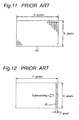
- An area sensor 60 with an imaging area of H pixels by V pixels is shown in Fig. 11, and a V-pixel long line sensor 61 which is driven in the direction of the arrow to subscan H pixels wide to image an area of H pixels by V pixels is shown in Fig. 12. If the per-pixel sensitivity of these sensors is equal, the line sensor requires an imaging time of H times that of the area sensor due to the charge storage time in order to achieve the same sensitivity. On the other hand, the line sensor has 1/H as many pixels as the area sensor, can therefore be achieved with a smaller sensor chip, and is thus used in image input devices having a large pixel count.
- US 5227888 discloses a still image pickup device including a moving two-dimensional sensor wherein the sensor forms an image of part of an image field and is then moved to a new position within the field, where another image of part of the image field is formed, until the sensor has covered the whole image field.
- an image moving continuously across an area sensor is obtained by a time-delay integration (TDI) operation.
- TDI time-delay integration
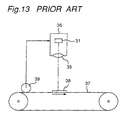
- Examples of devices using this TDI operation are disclosed in U.S. Patent No. 4,740,681, an apparatus for capturing images of stars that are moving due to the rotation of the imaging satellite, and U.S. Patent No. 4,922,337, an apparatus for capturing images of objects moving at a constant rate on a conveyor as shown in Fig. 13.
- a subject 38 on a conveyor 37 moving at a constant rate of speed is imaged by a camera 36 comprising a lens 35 and an area sensor 31.
- the area sensor 31 executes a TDI operation synchronized to the output of a tachometer 39 detecting the speed of the conveyor 37 to capture a still image of the subject 38.
- images are captured of subjects moving at a constant speed in a constant direction relative to a camera comprising a sensor that is in a fixed position relative to the lens.
- the object of the present invention is therefore to resolve the above-noted problems by providing a high resolution electronic camera that is capable of capturing images of common subjects from a hand-held position with an exposure time of less than one of several tenths of a second using a sensor chip that is sufficiently smaller than that of an area sensor.
- an electronic camera having a lens system for forming an image of the subject comprises a charge-. transfer type two-dimensional (X, Y) imaging device; a scanning means for subscanning the imaging device in the opposite-X direction and only in that direction, over the imaging plane of the lens system at a constant speed for at least the period from when the leading edge of the imaging device receptor enters the imaging area of the imaging plane until the trailing edge of the receptor leaves said imaging area with a subscanning time not greater than one tenth of a second; an X clock generator for transferring the photoelectric charges of the imaging device parallel to the X direction at the same speed as the subscanning operation; a Y clock generator for serially transferring in the Y direction the charge collected at the X end of the imaging device; and, an image signal circuit for processing the Y direction output of the imaging device.
- X, Y transfer type two-dimensional
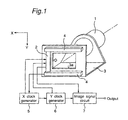
- Fig. 1 is a basic overview of a electronic camera according to the invention.
- a charge-transfer type two-dimensional imaging device 2 is provided at the imaging plane of the lens system 1, and is driven in the direction of the arrow by the scanning device 4 fixed to camera chassis 3 to subscan the imaging plane 3a defined by an opening formed in the camera chassis.
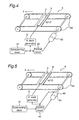
- the scanning device 4 comprises a motor 43, linear slide mechanism 44, position detector 45, subscanning clock 41 and control circuit 42. A detail of the scanning device 4 will be described later in connection with Fig. 4.
- An X clock generator 5 supplies the X clock enabling TDI operation in parallel to the imaging device 2, and a Y clock generator 6 supplies a Y clock to the imaging device 2 causing the imaging device 2 to serially output the image signal.
- the image signal circuit 7 applies various common signal processing operations, such as amplification and compensation, to the image signal to generate the output signal of the camera.
- Fig. 2 shows the imaging device 2 and is used to describe the TDI operation thereof.
- the imaging device 2 comprises a receptor 20 comprising a V-row X register 22, a Y register 23 for serially outputting the signal charges collected in parallel at the X end of the X register 22, and an output circuit 24 for converting the collected signal charges to voltage values.
- Each X register 22 has P pixels aligned horizontally. There are V rows of X register 22.
- the receptor 20 includes P ⁇ V pixels.
- the subject image 21, such as letter "A" formed by the lens system 1 shown in Fig. 1 is still relative to the camera chassis 3, and is therefore moving in direction X as seen from the imaging device 2 when the imaging device 2 subscans in the opposite-X direction. Therefore, if X registers 22 are transferred in the opposite direction at the same speed as the movement, i.e., the subscanning, of the image 21, sensitivity corresponding to the pixel count P in the X direction is obtained as a result of TDI operation.
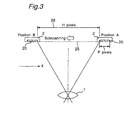
- the subscanning operation is shown in Fig. 3 in a cross section through the X axis.
- An H pixel wide image area 26 is defined on the imaging plane 25 of the lens system 1. This image area 26 corresponds to the effective output signal area of the camera.
- Position A at which the leading edge of the P pixel wide receptor 20 of the imaging device 2 meets the image area 26 is the imaging start position, and position B at which the trailing edge of the receptor 20 leaves the image area 26 is the imaging end position.
- the imaging device 2 subscans leftwardly in Fig. 3.
- the pixels in the first column will carry cumulated charges resulting from one unit time exposure.
- the imaging device 2 When the imaging device 2 is subscanned for another one pixel width distance, all the charges cumulated in the first column pixels are shifted or transferred in the scan direction X by one pixel width distance, i.e., to the second column pixels.
- the pixels in the first column will carry cumulated charges resulting from one unit time exposure
- the pixels in the second column will carry cumulated charges resulting from two unit time exposure.
- all the charges cumulated in the first and second column pixels are transferred in the scan direction X by one pixel width distance, i.e., respectively, to the second and third column pixels.
- the pixels in the first column will carry cumulated charges resulting from one unit time exposure
- the pixels in the second column will carry cumulated charges resulting from two unit time exposure
- the pixels in the third column will carry cumulated charges resulting from three unit time exposure.
- the pixels in the first column will carry cumulated charges resulting from one unit time exposure
- the pixels in the second column will carry cumulated charges resulting from two unit time exposure
- the pixels in the (P-1)th column will carry cumulated charges resulting from (P-1) unit time exposure
- the pixels in the Pth column will carry cumulated charges resulting from P unit time exposure.
- the charges in the Pth column representing the image data in the first column in the imaging plane 3a, are shifted to Y register 23, and all the remaining charges are transferred in the scan direction X by one pixel width distance. Since there will be no exposure being done in the Y register 23, the charges shifted to Y register 23 are resulted from P unit time exposure.
- the imaging device 2 is thus driven by the scanning device 4 at a constant speed D in the opposite-X direction to subscan the imaging plane 3a from at least position A to position B. Also, the imaging device 2 is driven by drive clocks produced from X clock generator 5 so that the charges are transferred at the same constant speed D in the X direction from one side of the imaging device 2 to the opposite side thereof.
- the imaging device 2 with a P pixel wide receptor compares favorably with the full area sensor having an H pixel wide receptor 60 such as shown in Fig. 11. Specifically, if the per-pixel sensitivity of both imaging devices 60 and 2 is the same, the per-pixel charge storage time will be the same and the same output signal voltage will be obtained if the sensor having an H pixel wide receptor subscans at a rate equal to (H+P)/P times the exposure time of the full area sensor.
- the characteristics of a electronic camera having a 1920 pixel (H) by 1080 pixel (V) image area are described below.
- the reference characteristics against which this electronic camera is compared are obtained from a 1/60 sec. /frame progressive scan HDTV camera that uses a full area sensor.
- the sensitivity of the imaging device 2 of the electronic camera is equal to the per-pixel sensitivity of the full area sensor of the HDTV camera.
- the receptor 20 of the electronic camera measures 384 pixels (H) by 1080 pixel (V), and the subscanning speed can be freely set.
- the maximum sensitivity of the HDTV camera is obtained when the charge storage time is 1/60 second.
- a 1/10 second shutter speed with a conventional silver halide film camera will produce noticeable image blurring due to hand movement during hand-held exposures.
- the subscanning time of the electronic camera of the present embodiment does not correspond to the lens shutter speed.
- the equivalent shutter speed, i.e., per-pixel exposure time (charge storage time), when the subscanning speed is 1/10 second is 1/60 second, a speed at which there is minimal blurring due to hand movement and which is fast enough for practical hand-held photography.
- the above operation applies when recording the darkest subjects that can be captured by a TV camera.
- the required charge storage time of the typical TV camera sensor decreases with the electronic shutter, which controls the charge storage time, operating at 1/120 second, 1/240 second, or faster.
- the subscanning time of the electronic camera of the invention also decreases to 1/20 second, 1/40 second, and faster. As the subscanning time decreases so do the effects of hand movement and subject movement.
- the electronic shutter of the imaging device 2 is used above the upper limit of the subscanning speed.
- the total pixel count of the imaging device 2 in the electronic camera of the present embodiment is approximately 410,000, or approximately 1/5 the pixel count of the above-noted full area sensor.
- the imaging device 2 can therefore be achieved with a smaller chip, the smaller chip area and resulting yield improvements combine to significantly reduce the cost of the imaging device, and it is therefore possible to construct a low cost, high resolution electronic camera.
- the scanning device 4 comprises a motor 43 that is synchronously driven by a control circuit 42 based on a subscanning clock 41, and a slide mechanism 44 having a support 8 on which the imaging device 2 is mounted.
- Motor 43 provides a driving power so that the imaging device 2 is transported in opposite-X direction at a constant speed D.
- the motor 43 may be a stepping motor or other motor that operates at a rotational or linear speed determined by the drive frequency, or a motor that is synchronously controlled by the control circuit 42.
- the subscanning speed D of the slide mechanism 44 is synchronized to the subscanning clock 41.
- the X drive clock for transferring the charges in the imaging device 2 in X direction at the speed D is generated by the X clock generator 5, which is also based on the subscanning clock 41.
- the subscanning speed D and the charge transfer speed D in the X register 22 of the imaging device 2 are controlled to the same speed, but in opposite direction.
- TDI operation can therefore be achieved.
- the scanning device 4 additionally comprises a position detector 45 for detecting the position of the imaging device 2 along the slide mechanism 44.
- the motor 43 is controlled by the control circuit 42 based on the subscanning clock 41 and referenced to the output from the position detector 45 to transport the scanning device 4 at a constant speed through the subscanning area.
- the X clock of the imaging device 2 is generated by the X clock generator 5 based on the output pulse from the position detector 45.
- the scanning device 4 of Fig. 4 since there is no position detector 45, the position of the imaging device 2 is controlled by the number of drive pulses supplied to the stepping motor 43. Thus, the scanning device 4 of Fig. 4 required a precise control of the drive pulse applied to the stepping motor, as well as the precise movement of the stepping motor.
- motor 43 can be a DC motor with the drive signal being a DC current. In this case the motor is not required to have a precise movement as the stepping motor.
- the charge transferring speed is also varied so as to keep charging the same location within the imaging plane 3a. In this manner stable TDI operation can be achieved even if there is a slight variation in the subscanning speed D.
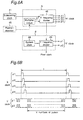
- a block diagram of the X clock generator 5 and the Y clock generator 6 is shown.
- the four-phase X clocks ⁇ 1, ⁇ 2, ⁇ 3, ⁇ 4 supplied to the imaging device 2 is obtained by the X frequency divider 46 of the X clock generator 5.
- Four overlapping pulses of the four-phase X clocks ⁇ 1, ⁇ 2, ⁇ 3, ⁇ 4 are used to transfer or shift the charge in X direction by one pixel pitch.
- the X frequency divider 46 devices the frequency of the subscanning clock 41 or the output pulse from the position detector 45.
- the four phase X clocks ⁇ 1, ⁇ 2, ⁇ 3, ⁇ 4 are shown in Fig. 6B.
- the output pulse is frequency divided after multiplying by a multiplier circuit 47 which may have a PLL circuit.
- the position detection pitch is therefore an integral multiple of the electrode pitch or pixel pitch of the X register 22 of the imaging device 2.
- the Y clock generator 6 generates a two-phase Y clocks ⁇ 1 and ⁇ 2 by frequency dividing the system clock 48 using Y frequency divider 49 so that the Y register 23 transfers V pixels during the time the X register 22 of the imaging device 2 transfers one pixel.
- the Y clock generator 6 also outputs a pixel clock to the image signal circuit 7.
- the two-phase Y clocks ⁇ 1 and ⁇ 2 are also shown in Fig. 6B. Note that during one pulse repetition period t of the X clock, there are V pulses for transferring all the charges shifted to the Y register 23 to output circuit 24.
- the imaging device 2 is arranged to take black and white images. Next, an arrangement for obtaining color images is described.
- a color filter 50 having RGB (red, green and blue) color filter stripes is shown.
- the RGB color filter stripes are aligned with the X register 22 on the surface of the receptor 20 of the imaging device 2 shown in Fig. 2. Note that the same color filter is used for the pixels aligned horizontally along one X register 22.
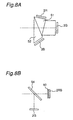
- Fig. 8A shows an optical color separation system in which color separation prisms are used instead of the color filter. More specifically, imaging devices 2R, 2B and 2G are fixed in position to the R-selective prism 51, B-selective prism 52, and G-transmitting prism 53, respectively. Each prism 51, 52, 53 has a size so as to cover, not the full imaging plane, but only the imaging device.
- the optical color separation system shown in Fig. 8A is formed integrally and mounted on the support 8, and subscans the image with the scanning device 4. Because the width of the imaging device 2 in the X direction is narrower than that of a conventional area sensor, smaller prisms can be used to achieve this color separation system, and the camera can therefore be built smaller.
- Fig. 8B shows another optical color separation system in which mirrors are used instead of the prisms. More specifically, a color separation mirror 54 reflects green light and has transparent characteristics with respect to red and blue lights. The reflected green lights are detected by imaging device 2G. The red and blue lights passed through the mirror 54 pass through red and blue stripe color filter 50 and are detected by imaging device 2RB.
- color imaging method of the invention can be achieved in various ways other than that described above depending upon the number of imaging devices used and the method of providing filters.
- FIG. 9 a modification of the electronic camera is shown.
- the electronic camera of the invention as shown in Fig. 1 is used connected to a video recording device in a manner similar to that of a conventional TV camera.
- the scanner-type electronic camera of the present embodiment as shown in Fig. 9, however, can be used as a stand-alone camera.
- This electronic camera is identical to that of the first embodiment in Fig. 1 from the lens system 1 to the image signal circuit 7.
- the electronic camera of Fig. 9 differs from the first embodiment of Fig. 1 in having an image memory 8 and display device 10 connected to the image signal circuit 7 with camera power supplied from a battery 9.
- the image memory 8 can store plural imaged pictures, and the display device 10 is used to present the image signal on a display for viewing.
- the image memory 8, battery 9, and display device 10 are built in to the camera to enable portable, stand-alone use of the electronic camera.
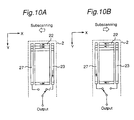
- the imaging device 2 of a electronic camera according to Fig. 10A or 10B comprises the X register 22 and Y register 23 of the imaging device 2 as shown in Fig. 2, and an additional Y register 27 on the side of the X register 22 opposite that of the first Y register 23.
- images are captured by means of bidirectional subscanning as shown in Figs. 10A and 10B.
- the subscanning operation in Fig. 10A is identical to the subscanning operation shown in Fig. 2. During this subscanning operation the output port is switched to Y register 23, and the output from the second Y register 27 is not used.
- the phase of the X clock supplied to the X register 22 is inverted, the charge transfer direction is reversed, and the output port is switched to obtain output from the second Y register 27. While the right and left sides of the image are reversed in the output signals obtained from the two Y registers 23 and 27, this right-left side inversion can be corrected by appropriately addressing the memory when storing the image signal.
- Constructing a electronic camera as described in connection with Figs. 10A and 10B achieves a scanner-type electronic camera that is capable of imaging in both scanning directions, and is advantageous with respect to improving the continuous imaging speed and reducing power consumption.
- the present invention provides an effective means of achieving a high resolution electronic camera enabling hand-held imaging of common, indeterminately moving subjects by means of low cost imaging devices having significantly fewer pixels than a common area sensor of comparable sensitivity.
Landscapes
- Engineering & Computer Science (AREA)
- Multimedia (AREA)
- Signal Processing (AREA)
- Facsimile Scanning Arrangements (AREA)
- Transforming Light Signals Into Electric Signals (AREA)
- Color Television Image Signal Generators (AREA)
- Facsimile Heads (AREA)
- Solid State Image Pick-Up Elements (AREA)
Claims (11)
- Elektronische Kamera, die ein Linsensystem zur Bildung einer Abbildung des Gegenstandes aufweist, mit:einer zweidimensionalen (X, Y) Aufnahmevorrichtung (2) vom Ladungstransfer-Typ;einem Scanmittel (4) zum Subscannen der Aufnahmevorrichtung ausschließlich entgegen der X-Richtung über die Abbildungsebene des Linsensystems mit einer konstanten Geschwindigkeit für zumindest den Zeitraum vom Eintreten der vorderen Kante des Empfängers der Aufnahmevorrichtung in den Abbildungsbereich der Abbildungsebene bis zum Austreten der hinteren Kante des Empfängers aus dem Abbildungsbereich mit einer Subscanzeit, die nicht größer ist als Zehntel einer Sekunde;einem X-Taktgenerator (5) zum Übertragen der photoelektrischen Ladungen der Aufnahmevorrichtung parallel zur X-Richtung mit der gleichen Geschwindigkeit wie die des Subscanvorgangs;einem Y-Taktgenerator (6) zum seriellen Übertragen der am X-Ende der Aufnahmevorrichtung gesammelten Ladung in Y-Richtung; undeiner Abbildungssignalschaltung (7) zur Verarbeitung der Y-Richtungsausgabe der Aufnahmevorrichtung.
- Elektronische Kamera nach Anspruch 1,
wobei das Scanmittel einen Motor (43) aufweist, der synchronisiert zum Subscantakt arbeitet, und wobei der X-Takt aus dem Subscantakt erzeugt wird. - Elektronische Kamera nach Anspruch 1,
wobei das Scanmittel einen Positionsdetektor (45) zum Erkennen der Scanposition der Aufnahmevorrichtung aufweist und wobei der X-Takt synchronisiert zum Ausgabepuls des Positionsdetektors erzeugt wird. - Elektronische Kamera nach Anspruch 3,
wobei das Scanmittel einen Motor (43) aufweist, der gemäß dem Ausgabepuls des Positionsdetektors gesteuert wird. - Elektronische Kamera nach Anspruch 3 oder 4,
wobei der Positionserkennungsabstand des Positionsdetektors (45) ein ganzzahliges Vielfaches des Pixelabstandes der Aufnahmevorrichtung in X-Richtung ist. - Elektronische Kamera nach einem der vorstehenden Ansprüche,
wobei streifenförmige Farbfilter (50) derselben Farbe in X-Richtung auf der Oberfläche der Aufnahmevorrichtung angebracht sind. - Elektronische Kamera nach einem der Ansprüche 1 bis 5,
wobei Farbtrennungsprismen (51, 52) vor der Vielzahl von Aufnahmevorrichtungen angebracht sind und wobei die Farbtrennungsprismen mit den Aufnahmevorrichtungen verbunden subscannen. - Elektronische Kamera nach einem der Ansprüche 1 bis 5,
wobei Farbtrennungsspiegel (54) vor der Vielzahl von Aufnahmevorrichtungen angebracht sind und wobei die Farbtrennungsspiegel mit den Aufnahmevorrichtungen verbunden subscannen. - Elektronische Kamera nach einem der vorstehenden Ansprüche,
wobei eine Batterie (9) zur Stromversorgung und ein Bildspeicher (8) mit der Fähigkeit zur Speicherung einer Vielzahl von Bildern in die Kamera eingebaut sind. - Elektronische Kamera nach einem der vorstehenden Ansprüche,
wobei eine Anzeigevorrichtung (10) zum Anzeigen des aufgenommenen Bildsignals in die Kamera eingebaut ist. - Elektronische Kamera nach einem der vorstehenden Ansprüche,
die weiterhin ein weiteres Y-Richtung-Ladungstransferregister (27) aufweist, das von der Aufnahmevorrichtung aus entgegen der X-Richtung angebracht ist, und das eine bidirektionale Aufnahme durch Umschalten der X-Richtung-Ladungstransferrichtung und der Subscanrichtung des Scanmittels erlaubt.
Applications Claiming Priority (3)
| Application Number | Priority Date | Filing Date | Title |
|---|---|---|---|
| JP8052771A JPH09247545A (ja) | 1996-03-11 | 1996-03-11 | スキャナ型電子カメラ |
| JP52771/96 | 1996-03-11 | ||
| JP5277196 | 1996-03-11 |
Publications (3)
| Publication Number | Publication Date |
|---|---|
| EP0796005A2 EP0796005A2 (de) | 1997-09-17 |
| EP0796005A3 EP0796005A3 (de) | 1998-08-12 |
| EP0796005B1 true EP0796005B1 (de) | 2004-09-29 |
Family
ID=12924139
Family Applications (1)
| Application Number | Title | Priority Date | Filing Date |
|---|---|---|---|
| EP97301517A Expired - Lifetime EP0796005B1 (de) | 1996-03-11 | 1997-03-06 | Elektronische Kamera mit einem kleinen Sensor für Hochgeschwindigkeitsbildaufnahme |
Country Status (4)
| Country | Link |
|---|---|
| US (1) | US6005617A (de) |
| EP (1) | EP0796005B1 (de) |
| JP (1) | JPH09247545A (de) |
| DE (1) | DE69730890T2 (de) |
Cited By (3)
| Publication number | Priority date | Publication date | Assignee | Title |
|---|---|---|---|---|
| US8755579B2 (en) | 2000-05-03 | 2014-06-17 | Leica Biosystems Imaging, Inc. | Fully automatic rapid microscope slide scanner |
| US8805050B2 (en) | 2000-05-03 | 2014-08-12 | Leica Biosystems Imaging, Inc. | Optimizing virtual slide image quality |
| US9235041B2 (en) | 2005-07-01 | 2016-01-12 | Leica Biosystems Imaging, Inc. | System and method for single optical axis multi-detector microscope slide scanner |
Families Citing this family (39)
| Publication number | Priority date | Publication date | Assignee | Title |
|---|---|---|---|---|
| US6847729B1 (en) | 1999-04-21 | 2005-01-25 | Fairfield Imaging Limited | Microscopy |
| US7518652B2 (en) | 2000-05-03 | 2009-04-14 | Aperio Technologies, Inc. | Method and apparatus for pre-focus in a linear array based slide scanner |
| US7738688B2 (en) | 2000-05-03 | 2010-06-15 | Aperio Technologies, Inc. | System and method for viewing virtual slides |
| TW526660B (en) * | 2000-08-07 | 2003-04-01 | Matsushita Electric Industrial Co Ltd | Device and method for reading image, and recording medium for image reading program |
| US20060023219A1 (en) * | 2001-03-28 | 2006-02-02 | Meyer Michael G | Optical tomography of small objects using parallel ray illumination and post-specimen optical magnification |
| US6591003B2 (en) * | 2001-03-28 | 2003-07-08 | Visiongate, Inc. | Optical tomography of small moving objects using time delay and integration imaging |
| US7907765B2 (en) | 2001-03-28 | 2011-03-15 | University Of Washington | Focal plane tracking for optical microtomography |
| US6944322B2 (en) | 2001-03-28 | 2005-09-13 | Visiongate, Inc. | Optical tomography of small objects using parallel ray illumination and post-specimen optical magnification |
| US7009163B2 (en) | 2001-06-22 | 2006-03-07 | Orbotech Ltd. | High-sensitivity optical scanning using memory integration |
| JP2003046862A (ja) | 2001-08-01 | 2003-02-14 | Hamamatsu Photonics Kk | X線撮像装置 |
| US6741730B2 (en) | 2001-08-10 | 2004-05-25 | Visiongate, Inc. | Method and apparatus for three-dimensional imaging in the fourier domain |
| SE523681C2 (sv) * | 2002-04-05 | 2004-05-11 | Integrated Vision Prod | System och sensor för avbildning av egenskaper hos ett objekt |
| US7811825B2 (en) * | 2002-04-19 | 2010-10-12 | University Of Washington | System and method for processing specimens and images for optical tomography |
| US7197355B2 (en) | 2002-04-19 | 2007-03-27 | Visiongate, Inc. | Variable-motion optical tomography of small objects |
| US20050085708A1 (en) * | 2002-04-19 | 2005-04-21 | University Of Washington | System and method for preparation of cells for 3D image acquisition |
| US7260253B2 (en) * | 2002-04-19 | 2007-08-21 | Visiongate, Inc. | Method for correction of relative object-detector motion between successive views |
| US7738945B2 (en) * | 2002-04-19 | 2010-06-15 | University Of Washington | Method and apparatus for pseudo-projection formation for optical tomography |
| US6697508B2 (en) | 2002-05-10 | 2004-02-24 | Visiongate, Inc. | Tomographic reconstruction of small objects using a priori knowledge |
| US6770893B2 (en) * | 2002-05-13 | 2004-08-03 | Visiongate, Inc. | Method and apparatus for emission computed tomography using temporal signatures |
| US6782334B1 (en) | 2003-04-01 | 2004-08-24 | Lockheed Martin Corporation | Method and system for calibration of time delay integration imaging devices |
| US7687167B2 (en) * | 2003-07-18 | 2010-03-30 | Panasonic Corporation | Power supply unit |
| JP2005197922A (ja) * | 2004-01-06 | 2005-07-21 | Fuji Xerox Co Ltd | 画像読取装置 |
| DE102004007911B3 (de) * | 2004-02-13 | 2005-02-03 | Deutsches Zentrum für Luft- und Raumfahrt e.V. | Vorrichtung zur digitalen Abtastung von farbigen Bildvorlagen |
| JP5134365B2 (ja) | 2004-05-27 | 2013-01-30 | アペリオ・テクノロジーズ・インコーポレイテッド | 三次元仮想スライドを生成しかつ可視化するためのシステム及び方法 |
| US6991738B1 (en) | 2004-10-13 | 2006-01-31 | University Of Washington | Flow-through drum centrifuge |
| US20060096358A1 (en) * | 2004-10-28 | 2006-05-11 | University Of Washington | Optical projection tomography microscope |
| US7494809B2 (en) * | 2004-11-09 | 2009-02-24 | Visiongate, Inc. | Automated cell sample enrichment preparation method |
| WO2008067509A1 (en) * | 2006-11-30 | 2008-06-05 | Westar Display Technologies, Inc. | Motion artifact measurement for display devices |
| US7835561B2 (en) | 2007-05-18 | 2010-11-16 | Visiongate, Inc. | Method for image processing and reconstruction of images for optical tomography |
| JP4602380B2 (ja) * | 2007-07-25 | 2010-12-22 | アドバンスド・マスク・インスペクション・テクノロジー株式会社 | 蓄積型センサを用いた画像入力方法およびその装置 |
| US7787112B2 (en) | 2007-10-22 | 2010-08-31 | Visiongate, Inc. | Depth of field extension for optical tomography |
| JP4968227B2 (ja) * | 2008-10-03 | 2012-07-04 | 三菱電機株式会社 | イメージセンサ及びその駆動方法 |
| WO2010048584A2 (en) | 2008-10-24 | 2010-04-29 | Aperio Technologies, Inc. | Whole slide fluorescence scanner |
| US8254023B2 (en) | 2009-02-23 | 2012-08-28 | Visiongate, Inc. | Optical tomography system with high-speed scanner |
| US9503606B2 (en) | 2011-09-28 | 2016-11-22 | Semiconductor Components Industries, Llc | Time-delay-and-integrate image sensors having variable integration times |
| JP5941659B2 (ja) * | 2011-11-02 | 2016-06-29 | 浜松ホトニクス株式会社 | 固体撮像装置 |
| FR3002715B1 (fr) * | 2013-02-28 | 2016-06-03 | E2V Semiconductors | Procede de production d'images et camera a capteur lineaire |
| US11069054B2 (en) | 2015-12-30 | 2021-07-20 | Visiongate, Inc. | System and method for automated detection and monitoring of dysplasia and administration of immunotherapy and chemotherapy |
| RU2706008C1 (ru) * | 2019-03-12 | 2019-11-13 | Вячеслав Михайлович Смелков | Устройство компьютерной системы для панорамного сканирования монохромного изображения |
Family Cites Families (10)
| Publication number | Priority date | Publication date | Assignee | Title |
|---|---|---|---|---|
| JPS5455324A (en) * | 1977-10-13 | 1979-05-02 | Sony Corp | Color pickup unit |
| US4280141A (en) * | 1978-09-22 | 1981-07-21 | Mccann David H | Time delay and integration detectors using charge transfer devices |
| JPS6157176A (ja) * | 1984-08-29 | 1986-03-24 | Dainippon Screen Mfg Co Ltd | 倍率可変制御方法 |
| US4882619A (en) * | 1986-04-07 | 1989-11-21 | Olympus Optical Co., Ltd. | High resolution image pickup system with color dispersion means |
| JPH07105872B2 (ja) * | 1987-04-30 | 1995-11-13 | 株式会社日立製作所 | 電子フアイリング装置 |
| JP2753541B2 (ja) * | 1990-02-19 | 1998-05-20 | 株式会社ニコン | 静止画撮像装置 |
| US5454102A (en) * | 1993-01-19 | 1995-09-26 | Canon Information Systems, Inc. | Method and apparatus for transferring structured data using a self-generating node network |
| JP3262441B2 (ja) * | 1994-02-04 | 2002-03-04 | キヤノン株式会社 | リニアイメージセンサ及び画像読取装置 |
| US5481300A (en) * | 1994-04-29 | 1996-01-02 | Motta; Ricardo J. | Image capture system |
| JPH09116818A (ja) * | 1995-10-17 | 1997-05-02 | Purotetsuku Japan Kk | 撮像回路 |
-
1996
- 1996-03-11 JP JP8052771A patent/JPH09247545A/ja active Pending
-
1997
- 1997-03-06 EP EP97301517A patent/EP0796005B1/de not_active Expired - Lifetime
- 1997-03-06 DE DE69730890T patent/DE69730890T2/de not_active Expired - Fee Related
- 1997-03-10 US US08/813,188 patent/US6005617A/en not_active Expired - Fee Related
Cited By (5)
| Publication number | Priority date | Publication date | Assignee | Title |
|---|---|---|---|---|
| US8755579B2 (en) | 2000-05-03 | 2014-06-17 | Leica Biosystems Imaging, Inc. | Fully automatic rapid microscope slide scanner |
| US8805050B2 (en) | 2000-05-03 | 2014-08-12 | Leica Biosystems Imaging, Inc. | Optimizing virtual slide image quality |
| US9386211B2 (en) | 2000-05-03 | 2016-07-05 | Leica Biosystems Imaging, Inc. | Fully automatic rapid microscope slide scanner |
| US9535243B2 (en) | 2000-05-03 | 2017-01-03 | Leica Biosystems Imaging, Inc. | Optimizing virtual slide image quality |
| US9235041B2 (en) | 2005-07-01 | 2016-01-12 | Leica Biosystems Imaging, Inc. | System and method for single optical axis multi-detector microscope slide scanner |
Also Published As
| Publication number | Publication date |
|---|---|
| EP0796005A3 (de) | 1998-08-12 |
| DE69730890D1 (de) | 2004-11-04 |
| JPH09247545A (ja) | 1997-09-19 |
| DE69730890T2 (de) | 2006-02-23 |
| EP0796005A2 (de) | 1997-09-17 |
| US6005617A (en) | 1999-12-21 |
Similar Documents
| Publication | Publication Date | Title |
|---|---|---|
| EP0796005B1 (de) | Elektronische Kamera mit einem kleinen Sensor für Hochgeschwindigkeitsbildaufnahme | |
| US5650813A (en) | Panoramic time delay and integration video camera system | |
| CA2097179C (en) | Electro-optical imaging array with motion compensation | |
| US6108032A (en) | System and method for image motion compensation of a CCD image sensor | |
| EP0599470B1 (de) | System für eine Panorama-Kamera | |
| JP3000308B2 (ja) | ビデオカメラ | |
| US4920418A (en) | Imaging system having a swing-driven image sensor | |
| JP2753541B2 (ja) | 静止画撮像装置 | |
| JPH03502755A (ja) | 光電カラーイメージセンサ | |
| JPH01280977A (ja) | テレビジョンシステムの子画面表示方法及びその装置 | |
| US5936668A (en) | Color image display device | |
| TWI242365B (en) | Solid photographing element and digital camera | |
| JPH1169209A (ja) | 撮像装置 | |
| EP0082406B1 (de) | Einrichtung mit Variooptik | |
| US4151560A (en) | Apparatus and method for displaying moving film on a television receiver | |
| US6118481A (en) | Solid state image pick-up device and image pick-up apparatus | |
| US5497195A (en) | Electronic color snapshot technique and structure using very high resolution monochrome full frame CCD imagers | |
| GB2162019A (en) | Compensating for camera movement | |
| JPH08242410A (ja) | 電子カメラの順次走査センサからインタレースされた画像を作成する電子カメラ | |
| JP2002287197A (ja) | 撮像装置における画像安定化装置 | |
| JP4110236B2 (ja) | Ccd撮像デバイス及びその駆動方法、並びにフイルムスキャナー | |
| US20020063869A1 (en) | Image display apparatus or image printing apparatus | |
| JPH0377483A (ja) | 画振れ防止カメラ | |
| JP2615237B2 (ja) | 電子ファインダ付きカメラ | |
| EP0828382B1 (de) | Hochauflösende Bildaufnahmevorrichtung |
Legal Events
| Date | Code | Title | Description |
|---|---|---|---|
| PUAI | Public reference made under article 153(3) epc to a published international application that has entered the european phase |
Free format text: ORIGINAL CODE: 0009012 |
|
| 17P | Request for examination filed |
Effective date: 19970327 |
|
| AK | Designated contracting states |
Kind code of ref document: A2 Designated state(s): DE FR GB |
|
| PUAL | Search report despatched |
Free format text: ORIGINAL CODE: 0009013 |
|
| AK | Designated contracting states |
Kind code of ref document: A3 Designated state(s): DE FR GB |
|
| 17Q | First examination report despatched |
Effective date: 20021210 |
|
| GRAP | Despatch of communication of intention to grant a patent |
Free format text: ORIGINAL CODE: EPIDOSNIGR1 |
|
| GRAS | Grant fee paid |
Free format text: ORIGINAL CODE: EPIDOSNIGR3 |
|
| GRAA | (expected) grant |
Free format text: ORIGINAL CODE: 0009210 |
|
| AK | Designated contracting states |
Kind code of ref document: B1 Designated state(s): DE FR GB |
|
| REG | Reference to a national code |
Ref country code: GB Ref legal event code: FG4D |
|
| REF | Corresponds to: |
Ref document number: 69730890 Country of ref document: DE Date of ref document: 20041104 Kind code of ref document: P |
|
| ET | Fr: translation filed | ||
| PLBE | No opposition filed within time limit |
Free format text: ORIGINAL CODE: 0009261 |
|
| STAA | Information on the status of an ep patent application or granted ep patent |
Free format text: STATUS: NO OPPOSITION FILED WITHIN TIME LIMIT |
|
| 26N | No opposition filed |
Effective date: 20050630 |
|
| PGFP | Annual fee paid to national office [announced via postgrant information from national office to epo] |
Ref country code: GB Payment date: 20090304 Year of fee payment: 13 |
|
| PGFP | Annual fee paid to national office [announced via postgrant information from national office to epo] |
Ref country code: DE Payment date: 20090226 Year of fee payment: 13 |
|
| PGFP | Annual fee paid to national office [announced via postgrant information from national office to epo] |
Ref country code: FR Payment date: 20090316 Year of fee payment: 13 |
|
| GBPC | Gb: european patent ceased through non-payment of renewal fee |
Effective date: 20100306 |
|
| REG | Reference to a national code |
Ref country code: FR Ref legal event code: ST Effective date: 20101130 |
|
| PG25 | Lapsed in a contracting state [announced via postgrant information from national office to epo] |
Ref country code: FR Free format text: LAPSE BECAUSE OF NON-PAYMENT OF DUE FEES Effective date: 20100331 |
|
| PG25 | Lapsed in a contracting state [announced via postgrant information from national office to epo] |
Ref country code: DE Free format text: LAPSE BECAUSE OF NON-PAYMENT OF DUE FEES Effective date: 20101001 |
|
| PG25 | Lapsed in a contracting state [announced via postgrant information from national office to epo] |
Ref country code: GB Free format text: LAPSE BECAUSE OF NON-PAYMENT OF DUE FEES Effective date: 20100306 |