EP0794826B1 - Verfahren und katalysator zur zersetzung von stickoxiden - Google Patents
Verfahren und katalysator zur zersetzung von stickoxiden Download PDFInfo
- Publication number
- EP0794826B1 EP0794826B1 EP95938349A EP95938349A EP0794826B1 EP 0794826 B1 EP0794826 B1 EP 0794826B1 EP 95938349 A EP95938349 A EP 95938349A EP 95938349 A EP95938349 A EP 95938349A EP 0794826 B1 EP0794826 B1 EP 0794826B1
- Authority
- EP
- European Patent Office
- Prior art keywords
- catalyst
- nitrogen oxides
- silicate
- nitrogen
- lanthanum
- Prior art date
- Legal status (The legal status is an assumption and is not a legal conclusion. Google has not performed a legal analysis and makes no representation as to the accuracy of the status listed.)
- Expired - Lifetime
Links
- MWUXSHHQAYIFBG-UHFFFAOYSA-N Nitric oxide Chemical compound O=[N] MWUXSHHQAYIFBG-UHFFFAOYSA-N 0.000 title claims abstract description 99
- 239000003054 catalyst Substances 0.000 title claims abstract description 37
- 238000000034 method Methods 0.000 title claims abstract description 32
- 230000008569 process Effects 0.000 title abstract description 11
- 229910052746 lanthanum Inorganic materials 0.000 claims abstract description 14
- FZLIPJUXYLNCLC-UHFFFAOYSA-N lanthanum atom Chemical compound [La] FZLIPJUXYLNCLC-UHFFFAOYSA-N 0.000 claims abstract description 13
- 229910052684 Cerium Inorganic materials 0.000 claims abstract description 10
- GWXLDORMOJMVQZ-UHFFFAOYSA-N cerium Chemical compound [Ce] GWXLDORMOJMVQZ-UHFFFAOYSA-N 0.000 claims abstract description 8
- 229910001428 transition metal ion Inorganic materials 0.000 claims abstract description 7
- BPQQTUXANYXVAA-UHFFFAOYSA-N Orthosilicate Chemical compound [O-][Si]([O-])([O-])[O-] BPQQTUXANYXVAA-UHFFFAOYSA-N 0.000 claims abstract description 6
- 238000000354 decomposition reaction Methods 0.000 claims abstract description 6
- 239000010445 mica Substances 0.000 claims abstract description 5
- 229910052618 mica group Inorganic materials 0.000 claims abstract description 5
- 239000005995 Aluminium silicate Substances 0.000 claims abstract 6
- 235000012211 aluminium silicate Nutrition 0.000 claims abstract 6
- PZZYQPZGQPZBDN-UHFFFAOYSA-N aluminium silicate Chemical compound O=[Al]O[Si](=O)O[Al]=O PZZYQPZGQPZBDN-UHFFFAOYSA-N 0.000 claims abstract 6
- 229910000323 aluminium silicate Inorganic materials 0.000 claims abstract 6
- GWEVSGVZZGPLCZ-UHFFFAOYSA-N Titan oxide Chemical compound O=[Ti]=O GWEVSGVZZGPLCZ-UHFFFAOYSA-N 0.000 claims description 18
- VYPSYNLAJGMNEJ-UHFFFAOYSA-N Silicium dioxide Chemical compound O=[Si]=O VYPSYNLAJGMNEJ-UHFFFAOYSA-N 0.000 claims description 14
- 229910052751 metal Inorganic materials 0.000 claims description 9
- 239000002184 metal Substances 0.000 claims description 9
- 239000000395 magnesium oxide Substances 0.000 claims description 8
- CPLXHLVBOLITMK-UHFFFAOYSA-N magnesium oxide Inorganic materials [Mg]=O CPLXHLVBOLITMK-UHFFFAOYSA-N 0.000 claims description 8
- 239000000377 silicon dioxide Substances 0.000 claims description 7
- 239000004408 titanium dioxide Substances 0.000 claims description 7
- AXZKOIWUVFPNLO-UHFFFAOYSA-N magnesium;oxygen(2-) Chemical compound [O-2].[Mg+2] AXZKOIWUVFPNLO-UHFFFAOYSA-N 0.000 claims description 5
- 235000012239 silicon dioxide Nutrition 0.000 claims description 5
- 229910000831 Steel Inorganic materials 0.000 claims description 4
- 239000010959 steel Substances 0.000 claims description 4
- 239000000126 substance Substances 0.000 claims description 4
- XAGFODPZIPBFFR-UHFFFAOYSA-N aluminium Chemical compound [Al] XAGFODPZIPBFFR-UHFFFAOYSA-N 0.000 claims description 3
- 229910052782 aluminium Inorganic materials 0.000 claims description 2
- 239000002734 clay mineral Substances 0.000 claims description 2
- 239000002657 fibrous material Substances 0.000 claims description 2
- 229910052681 coesite Inorganic materials 0.000 claims 2
- 229910052906 cristobalite Inorganic materials 0.000 claims 2
- 229910052682 stishovite Inorganic materials 0.000 claims 2
- 229960005196 titanium dioxide Drugs 0.000 claims 2
- 235000010215 titanium dioxide Nutrition 0.000 claims 2
- 229910052905 tridymite Inorganic materials 0.000 claims 2
- 239000004411 aluminium Substances 0.000 claims 1
- 239000003795 chemical substances by application Substances 0.000 claims 1
- 239000002270 dispersing agent Substances 0.000 claims 1
- 239000010408 film Substances 0.000 claims 1
- 230000003340 mental effect Effects 0.000 claims 1
- 229910052845 zircon Inorganic materials 0.000 claims 1
- GFQYVLUOOAAOGM-UHFFFAOYSA-N zirconium(iv) silicate Chemical compound [Zr+4].[O-][Si]([O-])([O-])[O-] GFQYVLUOOAAOGM-UHFFFAOYSA-N 0.000 claims 1
- QGZKDVFQNNGYKY-UHFFFAOYSA-N Ammonia Chemical compound N QGZKDVFQNNGYKY-UHFFFAOYSA-N 0.000 abstract description 14
- 238000006243 chemical reaction Methods 0.000 abstract description 13
- 239000003638 chemical reducing agent Substances 0.000 abstract description 13
- UGFAIRIUMAVXCW-UHFFFAOYSA-N Carbon monoxide Chemical compound [O+]#[C-] UGFAIRIUMAVXCW-UHFFFAOYSA-N 0.000 abstract description 12
- 239000003546 flue gas Substances 0.000 abstract description 12
- IJGRMHOSHXDMSA-UHFFFAOYSA-N Atomic nitrogen Chemical compound N#N IJGRMHOSHXDMSA-UHFFFAOYSA-N 0.000 abstract description 10
- 229910021529 ammonia Inorganic materials 0.000 abstract description 7
- 229910052760 oxygen Inorganic materials 0.000 abstract description 7
- 229910052757 nitrogen Inorganic materials 0.000 abstract description 6
- 230000003197 catalytic effect Effects 0.000 abstract description 5
- 239000001301 oxygen Substances 0.000 abstract description 5
- QVGXLLKOCUKJST-UHFFFAOYSA-N atomic oxygen Chemical compound [O] QVGXLLKOCUKJST-UHFFFAOYSA-N 0.000 abstract description 4
- 238000002485 combustion reaction Methods 0.000 abstract description 3
- 238000010531 catalytic reduction reaction Methods 0.000 abstract description 2
- XLYOFNOQVPJJNP-UHFFFAOYSA-N water Substances O XLYOFNOQVPJJNP-UHFFFAOYSA-N 0.000 abstract description 2
- 239000002912 waste gas Substances 0.000 abstract 2
- 230000002411 adverse Effects 0.000 abstract 1
- 238000005201 scrubbing Methods 0.000 abstract 1
- YKTSYUJCYHOUJP-UHFFFAOYSA-N [O--].[Al+3].[Al+3].[O-][Si]([O-])([O-])[O-] Chemical compound [O--].[Al+3].[Al+3].[O-][Si]([O-])([O-])[O-] YKTSYUJCYHOUJP-UHFFFAOYSA-N 0.000 description 15
- 229910052902 vermiculite Inorganic materials 0.000 description 11
- 239000010455 vermiculite Substances 0.000 description 11
- 235000019354 vermiculite Nutrition 0.000 description 11
- 238000006467 substitution reaction Methods 0.000 description 9
- 239000000725 suspension Substances 0.000 description 9
- 239000007789 gas Substances 0.000 description 7
- 230000002378 acidificating effect Effects 0.000 description 6
- -1 magnesium cations Chemical group 0.000 description 6
- 229910052749 magnesium Inorganic materials 0.000 description 5
- 239000011777 magnesium Substances 0.000 description 5
- FYYHWMGAXLPEAU-UHFFFAOYSA-N Magnesium Chemical compound [Mg] FYYHWMGAXLPEAU-UHFFFAOYSA-N 0.000 description 4
- 239000000654 additive Substances 0.000 description 4
- 150000001768 cations Chemical class 0.000 description 4
- 150000003839 salts Chemical class 0.000 description 3
- CURLTUGMZLYLDI-UHFFFAOYSA-N Carbon dioxide Chemical compound O=C=O CURLTUGMZLYLDI-UHFFFAOYSA-N 0.000 description 2
- 150000000703 Cerium Chemical class 0.000 description 2
- 229910052626 biotite Inorganic materials 0.000 description 2
- HSJPMRKMPBAUAU-UHFFFAOYSA-N cerium(3+);trinitrate Chemical compound [Ce+3].[O-][N+]([O-])=O.[O-][N+]([O-])=O.[O-][N+]([O-])=O HSJPMRKMPBAUAU-UHFFFAOYSA-N 0.000 description 2
- 238000010586 diagram Methods 0.000 description 2
- 238000002386 leaching Methods 0.000 description 2
- 238000005259 measurement Methods 0.000 description 2
- 150000002739 metals Chemical class 0.000 description 2
- 230000009467 reduction Effects 0.000 description 2
- 238000006722 reduction reaction Methods 0.000 description 2
- 229910001220 stainless steel Inorganic materials 0.000 description 2
- 239000010935 stainless steel Substances 0.000 description 2
- MYMOFIZGZYHOMD-UHFFFAOYSA-N Dioxygen Chemical compound O=O MYMOFIZGZYHOMD-UHFFFAOYSA-N 0.000 description 1
- 229910020851 La(NO3)3.6H2O Inorganic materials 0.000 description 1
- ZOKXTWBITQBERF-UHFFFAOYSA-N Molybdenum Chemical compound [Mo] ZOKXTWBITQBERF-UHFFFAOYSA-N 0.000 description 1
- GRYLNZFGIOXLOG-UHFFFAOYSA-N Nitric acid Chemical compound O[N+]([O-])=O GRYLNZFGIOXLOG-UHFFFAOYSA-N 0.000 description 1
- 229910004298 SiO 2 Inorganic materials 0.000 description 1
- 229910010413 TiO 2 Inorganic materials 0.000 description 1
- RTAQQCXQSZGOHL-UHFFFAOYSA-N Titanium Chemical compound [Ti] RTAQQCXQSZGOHL-UHFFFAOYSA-N 0.000 description 1
- XSQUKJJJFZCRTK-UHFFFAOYSA-N Urea Chemical compound NC(N)=O XSQUKJJJFZCRTK-UHFFFAOYSA-N 0.000 description 1
- 238000002441 X-ray diffraction Methods 0.000 description 1
- XHCLAFWTIXFWPH-UHFFFAOYSA-N [O-2].[O-2].[O-2].[O-2].[O-2].[V+5].[V+5] Chemical compound [O-2].[O-2].[O-2].[O-2].[O-2].[V+5].[V+5] XHCLAFWTIXFWPH-UHFFFAOYSA-N 0.000 description 1
- 239000002253 acid Substances 0.000 description 1
- 238000007792 addition Methods 0.000 description 1
- 239000007900 aqueous suspension Substances 0.000 description 1
- 230000000712 assembly Effects 0.000 description 1
- 238000000429 assembly Methods 0.000 description 1
- 230000015572 biosynthetic process Effects 0.000 description 1
- 239000004202 carbamide Substances 0.000 description 1
- 239000001569 carbon dioxide Substances 0.000 description 1
- 229910002092 carbon dioxide Inorganic materials 0.000 description 1
- 239000012876 carrier material Substances 0.000 description 1
- XMPZTFVPEKAKFH-UHFFFAOYSA-P ceric ammonium nitrate Chemical compound [NH4+].[NH4+].[Ce+4].[O-][N+]([O-])=O.[O-][N+]([O-])=O.[O-][N+]([O-])=O.[O-][N+]([O-])=O.[O-][N+]([O-])=O.[O-][N+]([O-])=O XMPZTFVPEKAKFH-UHFFFAOYSA-P 0.000 description 1
- 229910000420 cerium oxide Inorganic materials 0.000 description 1
- VYLVYHXQOHJDJL-UHFFFAOYSA-K cerium trichloride Chemical compound Cl[Ce](Cl)Cl VYLVYHXQOHJDJL-UHFFFAOYSA-K 0.000 description 1
- OZECDDHOAMNMQI-UHFFFAOYSA-H cerium(3+);trisulfate Chemical compound [Ce+3].[Ce+3].[O-]S([O-])(=O)=O.[O-]S([O-])(=O)=O.[O-]S([O-])(=O)=O OZECDDHOAMNMQI-UHFFFAOYSA-H 0.000 description 1
- 230000008859 change Effects 0.000 description 1
- 238000004140 cleaning Methods 0.000 description 1
- 239000000567 combustion gas Substances 0.000 description 1
- 230000000052 comparative effect Effects 0.000 description 1
- 239000013078 crystal Substances 0.000 description 1
- GUJOJGAPFQRJSV-UHFFFAOYSA-N dialuminum;dioxosilane;oxygen(2-);hydrate Chemical compound O.[O-2].[O-2].[O-2].[Al+3].[Al+3].O=[Si]=O.O=[Si]=O.O=[Si]=O.O=[Si]=O GUJOJGAPFQRJSV-UHFFFAOYSA-N 0.000 description 1
- 239000002737 fuel gas Substances 0.000 description 1
- 230000006872 improvement Effects 0.000 description 1
- 238000010348 incorporation Methods 0.000 description 1
- 239000011261 inert gas Substances 0.000 description 1
- FYDKNKUEBJQCCN-UHFFFAOYSA-N lanthanum(3+);trinitrate Chemical compound [La+3].[O-][N+]([O-])=O.[O-][N+]([O-])=O.[O-][N+]([O-])=O FYDKNKUEBJQCCN-UHFFFAOYSA-N 0.000 description 1
- VQEHIYWBGOJJDM-UHFFFAOYSA-H lanthanum(3+);trisulfate Chemical compound [La+3].[La+3].[O-]S([O-])(=O)=O.[O-]S([O-])(=O)=O.[O-]S([O-])(=O)=O VQEHIYWBGOJJDM-UHFFFAOYSA-H 0.000 description 1
- 238000004519 manufacturing process Methods 0.000 description 1
- 150000007522 mineralic acids Chemical class 0.000 description 1
- 239000000203 mixture Substances 0.000 description 1
- 229910052750 molybdenum Inorganic materials 0.000 description 1
- 239000011733 molybdenum Substances 0.000 description 1
- 229910000476 molybdenum oxide Inorganic materials 0.000 description 1
- 229910052901 montmorillonite Inorganic materials 0.000 description 1
- 150000002823 nitrates Chemical class 0.000 description 1
- 229910017604 nitric acid Inorganic materials 0.000 description 1
- QGLKJKCYBOYXKC-UHFFFAOYSA-N nonaoxidotritungsten Chemical compound O=[W]1(=O)O[W](=O)(=O)O[W](=O)(=O)O1 QGLKJKCYBOYXKC-UHFFFAOYSA-N 0.000 description 1
- BMMGVYCKOGBVEV-UHFFFAOYSA-N oxo(oxoceriooxy)cerium Chemical compound [Ce]=O.O=[Ce]=O BMMGVYCKOGBVEV-UHFFFAOYSA-N 0.000 description 1
- PQQKPALAQIIWST-UHFFFAOYSA-N oxomolybdenum Chemical compound [Mo]=O PQQKPALAQIIWST-UHFFFAOYSA-N 0.000 description 1
- 229910052628 phlogopite Inorganic materials 0.000 description 1
- 239000011148 porous material Substances 0.000 description 1
- 229910000275 saponite Inorganic materials 0.000 description 1
- 229910052719 titanium Inorganic materials 0.000 description 1
- 239000010936 titanium Substances 0.000 description 1
- WFKWXMTUELFFGS-UHFFFAOYSA-N tungsten Chemical compound [W] WFKWXMTUELFFGS-UHFFFAOYSA-N 0.000 description 1
- 229910052721 tungsten Inorganic materials 0.000 description 1
- 239000010937 tungsten Substances 0.000 description 1
- 229910001930 tungsten oxide Inorganic materials 0.000 description 1
- 230000007306 turnover Effects 0.000 description 1
- 229910052720 vanadium Inorganic materials 0.000 description 1
- LEONUFNNVUYDNQ-UHFFFAOYSA-N vanadium atom Chemical compound [V] LEONUFNNVUYDNQ-UHFFFAOYSA-N 0.000 description 1
- 229910001935 vanadium oxide Inorganic materials 0.000 description 1
- 238000005406 washing Methods 0.000 description 1
- 210000000051 wattle Anatomy 0.000 description 1
- 229910001928 zirconium oxide Inorganic materials 0.000 description 1
Images
Classifications
-
- B—PERFORMING OPERATIONS; TRANSPORTING
- B01—PHYSICAL OR CHEMICAL PROCESSES OR APPARATUS IN GENERAL
- B01J—CHEMICAL OR PHYSICAL PROCESSES, e.g. CATALYSIS OR COLLOID CHEMISTRY; THEIR RELEVANT APPARATUS
- B01J21/00—Catalysts comprising the elements, oxides, or hydroxides of magnesium, boron, aluminium, carbon, silicon, titanium, zirconium, or hafnium
- B01J21/16—Clays or other mineral silicates
-
- B—PERFORMING OPERATIONS; TRANSPORTING
- B01—PHYSICAL OR CHEMICAL PROCESSES OR APPARATUS IN GENERAL
- B01D—SEPARATION
- B01D53/00—Separation of gases or vapours; Recovering vapours of volatile solvents from gases; Chemical or biological purification of waste gases, e.g. engine exhaust gases, smoke, fumes, flue gases, aerosols
- B01D53/34—Chemical or biological purification of waste gases
- B01D53/74—General processes for purification of waste gases; Apparatus or devices specially adapted therefor
- B01D53/86—Catalytic processes
- B01D53/8621—Removing nitrogen compounds
- B01D53/8625—Nitrogen oxides
- B01D53/8628—Processes characterised by a specific catalyst
-
- B—PERFORMING OPERATIONS; TRANSPORTING
- B01—PHYSICAL OR CHEMICAL PROCESSES OR APPARATUS IN GENERAL
- B01D—SEPARATION
- B01D53/00—Separation of gases or vapours; Recovering vapours of volatile solvents from gases; Chemical or biological purification of waste gases, e.g. engine exhaust gases, smoke, fumes, flue gases, aerosols
- B01D53/34—Chemical or biological purification of waste gases
- B01D53/92—Chemical or biological purification of waste gases of engine exhaust gases
- B01D53/94—Chemical or biological purification of waste gases of engine exhaust gases by catalytic processes
- B01D53/9404—Removing only nitrogen compounds
- B01D53/9409—Nitrogen oxides
- B01D53/9413—Processes characterised by a specific catalyst
Definitions
- the invention relates to a method and a catalyst for reducing agent-free nitrogen oxides, in particular NO, NO 2 and N 2 O, in a flow medium, for example the exhaust gas of an internal combustion engine or the flue gas of an incineration plant.
- Nitrogen oxides essentially arise when oxygen and nitrogen come into contact at temperatures well above 600 ° C, for example during combustion. This mainly results in N 2 O and NO and small amounts of NO 2 and NO 3 . Because the emission of nitrogen oxides is subject to strict limit values in individual countries, primary and secondary measures are used to limit the nitrogen oxide content in exhaust gas or flue gas.
- Secondary measures are understood to mean measures at which reduces the nitrogen oxides contained in the flow medium will. This includes measures such as washing out the Nitrogen oxides from the flue gas or the reduction of nitrogen oxides by the process of selective catalytic reduction (SCR process).
- the Flue gas is a reducing agent, preferably ammonia or an ammonia releasing substance, e.g. Urea, added, taking the nitrogen oxides together by contacting with reducing agent on a selective catalyst Nitrogen and water implemented.
- titanium dioxide acts as a catalyst mostly titanium dioxide with additions of vanadium oxide and / or molybdenum oxide and / or tungsten oxide, or ternary and / or quaternary Mixed oxides of titanium, vanadium, molybdenum and tungsten used.
- the SCR process is currently used worldwide. It has because of the use of ammonia as a reducing agent however, the disadvantage that a generally complex control technology is required to meet the stochiometric needs of ammonia exactly the respective nitrogen oxide content of the exhaust gas adapt.
- nitrogen oxides in particular NO and N 2 O
- a catalyst which essentially contains an aluminum silicate with a three-layer structure as the catalytically active component.
- conversion rates in the range of 60% can be achieved.
- the conversion rates that can be achieved with the SCR process which are in the region of 90%, the conversion rates that can be achieved with catalysts that work without reducing agents are currently still comparatively low.
- the invention is therefore based on the object of a method and a reductant-free decomposition catalyst of nitrogen oxides, with which the decomposition of Nitrogen oxides in exhaust gas or flue gas can be improved to the use of reducing agents in the reduction of Nitrogen oxides in exhaust gas or flue gas, such as the one he uses with the SCR process is necessary to make redundant.
- this object is achieved according to the invention in that the nitrogen oxides at a temperature between 100 and 800 ° C are contacted with a catalyst, essentially as a catalytically active component an aluminum silicate with a layer structure, in particular one Mica, wherein transition metal ions into the silicate lattice, preferably lanthanum and / or cerium are integrated.
- a catalyst essentially as a catalytically active component an aluminum silicate with a layer structure, in particular one Mica, wherein transition metal ions into the silicate lattice, preferably lanthanum and / or cerium are integrated.
- the catalytically active component essentially an aluminum silicate with a layered structure in particular without aluminum and / or zirconium oxide bridges between the layers comprises a mica, being in the silicate grid as Transition metal ions lanthanum or lanthanum and cerium, installed are.
- the proportion of aluminum silicate with layer structures between 50 and 100% by weight, preferably between 95 and 96 % By weight.
- the high proportion of aluminum silicate in the catalyst becomes high Turnover rates achieved with nitrogen oxide conversion.
- one or more of the additives titanium dioxide TiO 2 , magnesium oxide MgO, silicon dioxide SiO 2 , fiber material, clay mineral, dispersing aid and film-forming aid can be provided.
- the aluminum silicate with a layer structure and optionally one or more of the additives can be applied to an oxidic carrier, in particular magnesium oxide, titanium dioxide, silicon dioxide.
- the aluminum silicate with a layer structure and optionally one or more of the additives can be applied to a metallic carrier, in particular to perforated steel sheet, expanded metal, metallic wattle, preferably made of stainless steel.
- honeycomb catalysts which is particularly meant by the application to an oxidic support, and to form plate catalysts.
- Such catalysts are particularly suitable for converting the nitrogen oxides contained in flue gas from an incineration plant.
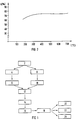
- a vermiculite in particular a vermiculite formed by the weathering of biotite, is prepared in a first method step 2, in order to subsequently proceed in a strongly acidic suspension in a method step 4 or in a strongly alkaline suspension in a method step 8.
- the substitution of the magnesium cations bound relatively strongly to the crystal lattice in the case of vermiculite takes place depending on the substitution atom in the strongly acidic suspension or the strongly alkaline suspension.
- the vermiculite is in a process step 6 in the strongly acidic suspension with solutions of tetravalent cerium salts, such as cerium ammonium nitrate or cerium oxide or cerium sulfate, or with solutions of trivalent cerium. Salts such as cerium chloride or cerium nitrate are added.
- the leaching out of the magnesium from the vermiculite can be carried out, for example, in this process step 6 using strong inorganic acids, such as, for example, nitric acid HNO 3 . It is important here that the leaching process does not lead to a structural change in the silicate structure of the vermiculite.
- Lanthanum is used as an additional substitution atom with particularly good catalytic properties with regard to the conversion of nitrogen oxides.
- this is introduced into the strongly acidic suspension in the process step in the form of lanthanum nitrate La (NO 3 ) 3 .6H 2 O or also in the form of lanthanum sulfate La 2 (SO 4 ) 3 .9H 2 O.
- the octahedral hydroxomagnesium complexes contained in the vermiculite are in acidic aqueous suspensions against such complexes of lanthanum or lanthanum and cer. These complexes are characterized by a particularly high catalytic Activity related to the implementation of nitrogen oxides out.
- these metals are used in a process step 12 in the form of salts, e.g. Oxohydrates or nitrates, in given the acidic or alkaline suspension.
- This exchange can be based on the known exchange isotherms be followed. In the case of vermiculite, the speed depends this exchange essentially of the excess affinity of the exchange cation compared to that exchange cation, here magnesium.
- an exchange reaction with metals in the form of salts and / or a substitution reaction Lanthanum cations or lanthanum and cerium cations if necessary in acid Suspension or in alkaline Suspension takes place.
- the exchange reaction and / or the substitution reaction is that obtained Vermiculite in a process step 14 at about 150 ° C dried and then in a process step 16 calcined at a temperature between 400 and 500 ° C for a few hours. Then the one obtained in this way is exchanged and / or substituted aluminum silicate with a three-layer structure, here vermiculite, in one process step 18 ground and mixed with additives and then in a process step 20 on an oxidic carrier, such as.
- the aluminum silicate obtained in this way can also be used with three-layer structure in one process step 22 also with film-forming aids, dispersing aids, Pore formers and titanium dioxide as an oxidic carrier material added, mixed and extruded into catalyst cells will.
- the Process steps 20-24 are common, that after completion this process step the proportion of aluminum silicate with a three-layer structure between 50 and 100 wt .-%, based on the weight of the catalyst.
- FIG. 2 shows the typical course of the catalytic conversion rate ⁇ as a function of the temperature T using a diagram. This is based on the measurement on a vermiculite catalyst which has been prepared in the manner described above and contains lanthanum and cerium cations.
- FIG. 2 shows that the catalytic conversion rate ⁇ between 200 and 600 ° C. increases only slightly with the temperature T.
- FIG. 2 shows that conversion rates for nitrogen oxides, in particular for NO and for N 2 O, of about 70% and more can be achieved with this catalyst, which works without reducing agents.
- the measurement curve shown was in detail for the following Conditions added: The test gas mixture on the input side 450 ppm NO, 15 vol.% Carbon dioxide and 40 vol.% Oxygen and 100% nitrogen was added. Of the Pressure of the test gas was 1 bar and the operating speed in the catalyst 10,000 per hour.
- vermiculic as aluminum silicate with three-layer structure also phlogopite, Moskovite, pyrophylite, saponite, batavite, montmorillonite and biotite can be used.
Landscapes
- Chemical & Material Sciences (AREA)
- Engineering & Computer Science (AREA)
- Environmental & Geological Engineering (AREA)
- Chemical Kinetics & Catalysis (AREA)
- Oil, Petroleum & Natural Gas (AREA)
- Biomedical Technology (AREA)
- Analytical Chemistry (AREA)
- General Chemical & Material Sciences (AREA)
- Health & Medical Sciences (AREA)
- Combustion & Propulsion (AREA)
- Dispersion Chemistry (AREA)
- Materials Engineering (AREA)
- Organic Chemistry (AREA)
- Catalysts (AREA)
- Exhaust Gas Treatment By Means Of Catalyst (AREA)
- Organic Low-Molecular-Weight Compounds And Preparation Thereof (AREA)
Applications Claiming Priority (3)
| Application Number | Priority Date | Filing Date | Title |
|---|---|---|---|
| DE4442012 | 1994-11-28 | ||
| DE4442012A DE4442012C1 (de) | 1994-11-28 | 1994-11-28 | Verfahren und Katalysator zur Zersetzung von Stickoxiden |
| PCT/DE1995/001681 WO1996016723A1 (de) | 1994-11-28 | 1995-11-28 | Verfahren und katalysator zur zersetzung von stickoxiden |
Publications (2)
| Publication Number | Publication Date |
|---|---|
| EP0794826A1 EP0794826A1 (de) | 1997-09-17 |
| EP0794826B1 true EP0794826B1 (de) | 1998-07-29 |
Family
ID=6534152
Family Applications (1)
| Application Number | Title | Priority Date | Filing Date |
|---|---|---|---|
| EP95938349A Expired - Lifetime EP0794826B1 (de) | 1994-11-28 | 1995-11-28 | Verfahren und katalysator zur zersetzung von stickoxiden |
Country Status (6)
| Country | Link |
|---|---|
| EP (1) | EP0794826B1 (da) |
| JP (1) | JPH10509645A (da) |
| AT (1) | ATE168901T1 (da) |
| DE (2) | DE4442012C1 (da) |
| DK (1) | DK0794826T3 (da) |
| WO (1) | WO1996016723A1 (da) |
Families Citing this family (4)
| Publication number | Priority date | Publication date | Assignee | Title |
|---|---|---|---|---|
| DE19636747A1 (de) * | 1996-09-10 | 1998-03-12 | Siemens Ag | Verfahren zur Minderung der Stickoxide im Abgas von Verbrennungsanlagen und Anordnung zur Durchführung dieses Verfahrens |
| AUPO787797A0 (en) * | 1997-07-15 | 1997-08-07 | University Of Queensland, The | Catalytic conversion of gases via cation-exchangeable alumino-silicate materials |
| DE19808433A1 (de) * | 1998-03-02 | 1999-09-09 | Fresenius | Verfahren und Vorrichtung zur Entfernung oder Reduzierung des Ammonium-Anteils aus Abwässern |
| DE102015205843A1 (de) * | 2015-03-31 | 2016-10-06 | Johnson Matthey Catalysts (Germany) Gmbh | Katalysator insbesondere zur Abgasreinigung |
Family Cites Families (9)
| Publication number | Priority date | Publication date | Assignee | Title |
|---|---|---|---|---|
| JPS56152741A (en) * | 1980-04-28 | 1981-11-26 | Gosei Kagaku Kenkyusho:Kk | Oxidation catalyst and its production |
| US4497903A (en) * | 1982-12-17 | 1985-02-05 | Gulf Research & Development Company | Activated cobalt-substituted layered aluminosilicate for synthesis gas conversion |
| EP0258465A1 (de) * | 1986-08-09 | 1988-03-09 | Süd-Chemie Ag | Katalysator zur Verringerung des Stickoxidgehalts von Verbrennungsabgasen |
| DE3532226A1 (de) * | 1985-08-13 | 1987-03-19 | Sued Chemie Ag | Katalysator zur verringerung des stickoxidgehalts von verbrennungsabgasen |
| FR2589143B1 (fr) * | 1985-10-28 | 1990-06-01 | Elf France | Argiles pontees a stabilite thermique amelioree, procede pour leur preparation et leur utilisation comme catalyseurs |
| DE3544476A1 (de) * | 1985-12-16 | 1987-06-19 | Sued Chemie Ag | Eisenhaltiger katalysator zur verringerung des stickoxidgehalts von verbrennungsabgasen |
| US4980137A (en) * | 1989-04-03 | 1990-12-25 | Sanitech, Inc. | Process for NOx and CO control |
| JP2506579B2 (ja) * | 1991-01-08 | 1996-06-12 | 財団法人石油産業活性化センター | 窒素酸化物含有排ガスの浄化処理方法 |
| DE4317581C2 (de) * | 1993-05-27 | 1998-02-26 | Siemens Ag | Verfahren und Katalysator zur Zersetzung von Stickoxiden |
-
1994
- 1994-11-28 DE DE4442012A patent/DE4442012C1/de not_active Expired - Fee Related
-
1995
- 1995-11-28 AT AT95938349T patent/ATE168901T1/de not_active IP Right Cessation
- 1995-11-28 DK DK95938349T patent/DK0794826T3/da active
- 1995-11-28 EP EP95938349A patent/EP0794826B1/de not_active Expired - Lifetime
- 1995-11-28 JP JP8518040A patent/JPH10509645A/ja active Pending
- 1995-11-28 WO PCT/DE1995/001681 patent/WO1996016723A1/de not_active Ceased
- 1995-11-28 DE DE59503017T patent/DE59503017D1/de not_active Expired - Fee Related
Also Published As
| Publication number | Publication date |
|---|---|
| DK0794826T3 (da) | 1999-05-03 |
| WO1996016723A1 (de) | 1996-06-06 |
| EP0794826A1 (de) | 1997-09-17 |
| DE4442012C1 (de) | 1996-08-29 |
| DE59503017D1 (de) | 1998-09-03 |
| ATE168901T1 (de) | 1998-08-15 |
| JPH10509645A (ja) | 1998-09-22 |
Similar Documents
| Publication | Publication Date | Title |
|---|---|---|
| DE68904053T2 (de) | Abgaskatalysatortraeger, verfahren zu seiner herstellung und abgaskatalysator, der diesen traeger enthaelt. | |
| DE3438367C2 (de) | Katalysator für die Reinigung eines Abgases | |
| EP0762925B1 (de) | Katalysator zur stickoxidminderung in einem strömungsmedium und verfahren zu seiner herstellung | |
| DE69208206T2 (de) | Katalysatorsystem zur Behandlung von Abgasen aus Brennkraftmaschinen mit Verbrennung eines armen Gemisches | |
| DE69101951T2 (de) | Komplex-Oxid seltener Erde vom Perovskitetyp enthaltender Verbrennungskatalysator. | |
| DE3619337C2 (da) | ||
| DE69519137T2 (de) | Verfahren zur Denitrierung von Abgasen | |
| DE2257228A1 (de) | Katalysator | |
| DE3856024T2 (de) | Verfahren zur Behandlung von Abgasen mit einem Kupfer- und Ceroxid enthaltenden Katalysator | |
| DE69413615T2 (de) | Katalysator und Verfahren zur Entfernung von Stickstoffoxiden | |
| DE102015206125A1 (de) | Eisen- und kupferhaltiger Chabazit-Zeolith-Katalysator zur Verwendung bei der NOx-Reduktion | |
| DE68927770T2 (de) | Katalytischer Verbundstoff auf der Basis von Delafosite zur Reinigung von Abgasen und Verfahren zu seiner Herstellung | |
| DE2212616A1 (de) | Katalysator | |
| DE60014506T2 (de) | Verfahren zur Entfernung von Organohalogenverbindungen | |
| DE2253070A1 (de) | Katalysator | |
| DE2912269A1 (de) | Zeolithhaltige feuerfeste verbundstoffe mit honigwaben-struktur und verfahren zu deren herstellung | |
| EP0263399B1 (de) | Verfahren zur katalytischen Reduktion von Stickoxiden | |
| EP0239778B1 (de) | Katalysatormaterial zur Minderung der Stickoxide in Rauchgasen | |
| DE102018204688A1 (de) | Selektiver katalytischer Reduktionskatalysator | |
| EP0794826B1 (de) | Verfahren und katalysator zur zersetzung von stickoxiden | |
| DE2229210A1 (de) | Katalysator | |
| EP0472014B1 (de) | Verfahren zur Herstellung von Katalysatoren | |
| EP0348768B1 (de) | Verfahren zur Entfernung von Stickoxiden aus Verbrennungsabgasen | |
| DE19630250C1 (de) | Vollmetallischer Oxidationskatalysator | |
| EP3974059A1 (de) | Verfahren zur herstellung eines katalysators zur oxidation von ammoniak |
Legal Events
| Date | Code | Title | Description |
|---|---|---|---|
| PUAI | Public reference made under article 153(3) epc to a published international application that has entered the european phase |
Free format text: ORIGINAL CODE: 0009012 |
|
| 17P | Request for examination filed |
Effective date: 19970520 |
|
| AK | Designated contracting states |
Kind code of ref document: A1 Designated state(s): AT CH DE DK GB IT LI |
|
| GRAG | Despatch of communication of intention to grant |
Free format text: ORIGINAL CODE: EPIDOS AGRA |
|
| GRAG | Despatch of communication of intention to grant |
Free format text: ORIGINAL CODE: EPIDOS AGRA |
|
| GRAH | Despatch of communication of intention to grant a patent |
Free format text: ORIGINAL CODE: EPIDOS IGRA |
|
| 17Q | First examination report despatched |
Effective date: 19971218 |
|
| GRAH | Despatch of communication of intention to grant a patent |
Free format text: ORIGINAL CODE: EPIDOS IGRA |
|
| GRAA | (expected) grant |
Free format text: ORIGINAL CODE: 0009210 |
|
| AK | Designated contracting states |
Kind code of ref document: B1 Designated state(s): AT CH DE DK GB IT LI |
|
| REF | Corresponds to: |
Ref document number: 168901 Country of ref document: AT Date of ref document: 19980815 Kind code of ref document: T |
|
| REG | Reference to a national code |
Ref country code: CH Ref legal event code: NV Representative=s name: SIEMENS SCHWEIZ AG Ref country code: CH Ref legal event code: EP |
|
| REF | Corresponds to: |
Ref document number: 59503017 Country of ref document: DE Date of ref document: 19980903 |
|
| PGFP | Annual fee paid to national office [announced via postgrant information from national office to epo] |
Ref country code: AT Payment date: 19981021 Year of fee payment: 4 |
|
| GBT | Gb: translation of ep patent filed (gb section 77(6)(a)/1977) |
Effective date: 19981009 |
|
| PGFP | Annual fee paid to national office [announced via postgrant information from national office to epo] |
Ref country code: DK Payment date: 19981113 Year of fee payment: 4 |
|
| PGFP | Annual fee paid to national office [announced via postgrant information from national office to epo] |
Ref country code: DE Payment date: 19990120 Year of fee payment: 4 |
|
| REG | Reference to a national code |
Ref country code: DK Ref legal event code: T3 |
|
| PLBE | No opposition filed within time limit |
Free format text: ORIGINAL CODE: 0009261 |
|
| STAA | Information on the status of an ep patent application or granted ep patent |
Free format text: STATUS: NO OPPOSITION FILED WITHIN TIME LIMIT |
|
| 26N | No opposition filed | ||
| PG25 | Lapsed in a contracting state [announced via postgrant information from national office to epo] |
Ref country code: GB Free format text: LAPSE BECAUSE OF NON-PAYMENT OF DUE FEES Effective date: 19991128 Ref country code: DK Free format text: LAPSE BECAUSE OF NON-PAYMENT OF DUE FEES Effective date: 19991128 Ref country code: AT Free format text: LAPSE BECAUSE OF NON-PAYMENT OF DUE FEES Effective date: 19991128 |
|
| PG25 | Lapsed in a contracting state [announced via postgrant information from national office to epo] |
Ref country code: LI Free format text: LAPSE BECAUSE OF NON-PAYMENT OF DUE FEES Effective date: 19991130 Ref country code: CH Free format text: LAPSE BECAUSE OF NON-PAYMENT OF DUE FEES Effective date: 19991130 |
|
| REG | Reference to a national code |
Ref country code: CH Ref legal event code: PL |
|
| GBPC | Gb: european patent ceased through non-payment of renewal fee |
Effective date: 19991128 |
|
| REG | Reference to a national code |
Ref country code: DK Ref legal event code: EBP |
|
| PG25 | Lapsed in a contracting state [announced via postgrant information from national office to epo] |
Ref country code: DE Free format text: LAPSE BECAUSE OF NON-PAYMENT OF DUE FEES Effective date: 20000901 |
|
| PG25 | Lapsed in a contracting state [announced via postgrant information from national office to epo] |
Ref country code: IT Free format text: LAPSE BECAUSE OF NON-PAYMENT OF DUE FEES;WARNING: LAPSES OF ITALIAN PATENTS WITH EFFECTIVE DATE BEFORE 2007 MAY HAVE OCCURRED AT ANY TIME BEFORE 2007. THE CORRECT EFFECTIVE DATE MAY BE DIFFERENT FROM THE ONE RECORDED. Effective date: 20051128 |