EP0793063A1 - Heizanlage mit Wärmetauscher - Google Patents
Heizanlage mit Wärmetauscher Download PDFInfo
- Publication number
- EP0793063A1 EP0793063A1 EP97810081A EP97810081A EP0793063A1 EP 0793063 A1 EP0793063 A1 EP 0793063A1 EP 97810081 A EP97810081 A EP 97810081A EP 97810081 A EP97810081 A EP 97810081A EP 0793063 A1 EP0793063 A1 EP 0793063A1
- Authority
- EP
- European Patent Office
- Prior art keywords
- burner
- heat exchanger
- heating system
- fresh air
- gases
- Prior art date
- Legal status (The legal status is an assumption and is not a legal conclusion. Google has not performed a legal analysis and makes no representation as to the accuracy of the status listed.)
- Granted
Links
- 238000010438 heat treatment Methods 0.000 title claims description 12
- 238000009434 installation Methods 0.000 title 1
- 239000002737 fuel gas Substances 0.000 claims description 9
- 238000002485 combustion reaction Methods 0.000 claims description 8
- 239000000567 combustion gas Substances 0.000 claims description 4
- 238000001816 cooling Methods 0.000 claims description 2
- 239000000523 sample Substances 0.000 claims description 2
- 238000007599 discharging Methods 0.000 claims 1
- 239000003546 flue gas Substances 0.000 claims 1
- 238000006386 neutralization reaction Methods 0.000 claims 1
- 239000000126 substance Substances 0.000 claims 1
- 239000007789 gas Substances 0.000 abstract description 13
- 239000003344 environmental pollutant Substances 0.000 description 6
- 231100000719 pollutant Toxicity 0.000 description 6
- 230000015572 biosynthetic process Effects 0.000 description 2
- 238000009833 condensation Methods 0.000 description 2
- 230000005494 condensation Effects 0.000 description 2
- 230000001105 regulatory effect Effects 0.000 description 2
- 239000004071 soot Substances 0.000 description 2
- 235000008282 Sanguisorba officinalis Nutrition 0.000 description 1
- 244000173853 Sanguisorba officinalis Species 0.000 description 1
- 238000009825 accumulation Methods 0.000 description 1
- 238000006243 chemical reaction Methods 0.000 description 1
- 238000004140 cleaning Methods 0.000 description 1
- 238000010276 construction Methods 0.000 description 1
- 238000005260 corrosion Methods 0.000 description 1
- 230000007797 corrosion Effects 0.000 description 1
- 238000005259 measurement Methods 0.000 description 1
- 238000000034 method Methods 0.000 description 1
- 238000011084 recovery Methods 0.000 description 1
Images
Classifications
-
- F—MECHANICAL ENGINEERING; LIGHTING; HEATING; WEAPONS; BLASTING
- F24—HEATING; RANGES; VENTILATING
- F24H—FLUID HEATERS, e.g. WATER OR AIR HEATERS, HAVING HEAT-GENERATING MEANS, e.g. HEAT PUMPS, IN GENERAL
- F24H9/00—Details
- F24H9/0084—Combustion air preheating
-
- F—MECHANICAL ENGINEERING; LIGHTING; HEATING; WEAPONS; BLASTING
- F24—HEATING; RANGES; VENTILATING
- F24H—FLUID HEATERS, e.g. WATER OR AIR HEATERS, HAVING HEAT-GENERATING MEANS, e.g. HEAT PUMPS, IN GENERAL
- F24H8/00—Fluid heaters characterised by means for extracting latent heat from flue gases by means of condensation
-
- Y—GENERAL TAGGING OF NEW TECHNOLOGICAL DEVELOPMENTS; GENERAL TAGGING OF CROSS-SECTIONAL TECHNOLOGIES SPANNING OVER SEVERAL SECTIONS OF THE IPC; TECHNICAL SUBJECTS COVERED BY FORMER USPC CROSS-REFERENCE ART COLLECTIONS [XRACs] AND DIGESTS
- Y02—TECHNOLOGIES OR APPLICATIONS FOR MITIGATION OR ADAPTATION AGAINST CLIMATE CHANGE
- Y02B—CLIMATE CHANGE MITIGATION TECHNOLOGIES RELATED TO BUILDINGS, e.g. HOUSING, HOUSE APPLIANCES OR RELATED END-USER APPLICATIONS
- Y02B30/00—Energy efficient heating, ventilation or air conditioning [HVAC]
Definitions
- the invention relates to a heating system with a boiler heated by a burner and a heat exchanger connected downstream thereof for cooling the combustion gases and for preheating fresh air supplied by the burner.
- the purpose of such a combination is both to clean the exhaust gases emerging in the chimney from a large part of their pollutants, such as fire ash, soot and the like, and to reduce the heat losses. This allows saved heat energy to be saved. Due to the partial condensation of the exhaust gases in the heat exchanger, the pollutants in the condensate are progressively collected in the fuel gas pipes and finally fed to a separator.
- a heating system has become known.
- a plurality of tubes for guiding the fuel gases in the heat exchanger are formed from horizontal straight tube sections and elbows connecting them, while the fresh air is guided in superimposed, horizontal channels.
- This has the disadvantage that the condensate with the pollutants remains in the horizontal pipe sections and bends and can settle.
- the heat exchanger's resistance to accumulation can extinguish the flame, and the heat transfer between the exhaust gas and fresh air is not optimal.
- the invention aims to overcome these disadvantages. It achieves this through the features of patent claim 1.
- the fan which conveys the fuel gases into the heat exchanger and, on the other hand, draws the heated fresh air out of the same, achieves optimal heating of the fresh air flowing around the pipe coil in cross flow, which is further increased by turbulence in the pipe coil.
- the negative pressure generated by the fan in the combustion chamber prevents the flame from extinguishing and keeps it stable.
- the flame can additionally be cooled by an additional line for returning part of the cooled fuel gases to the burner, which leads to a further improvement in the exhaust gas values.
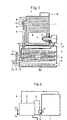
- FIG. 1 of the drawing an embodiment of a heating system according to the invention is shown in section. 2 shows an example of an arrangement of the components of the system.
- Fig. 1 the boiler with the heating coil 2, the burner 3 and the combustion chamber 4 is designated.
- the boiler is followed by a heat exchanger 5.
- the fuel gases are fed into the coil 7 in the exchanger 5, which is continuously bent from top to bottom without deflections.
- Fresh air is introduced from below through line 8 into the exchanger housing. The fresh air exits the tube downwards through a large number of openings 8a, so that a good distribution in the exchanger space is ensured.
- a blower 9 is arranged between the combustion chamber 4 and the exhaust gas line 6 and actively promotes the combustion gases into the coil 7. This creates a negative pressure in the combustion chamber 4 and an excess pressure in the coil 7.
- the fresh air supplied is sucked in at D and fed to the burner E after it flows around the tube coil 7 from bottom to top in a cross flow and is heated in the process.
- the fuel gases are cooled to around 30 - 40 ° C. They condense progressively, the pollutants being bound in the condensate and escaping at 10 together with the cooled fuel gases.
- the continuously draining condensate is separated out in a separator 11 and flows into a collector 12, where it is neutralized in a manner known per se by chemical reaction to such an extent that it can be discharged into the sewer 13 in a pH-neutral manner.
- the exhaust gases reach the chimney at 14.
- the power of the blower motor 15 is regulated by an electronic control 16, which is connected to a pressure probe in the burner chamber 4. It is regulated in such a way that a stable flame is guaranteed with constant combustion conditions. As a result, there is no starting soot and great burner reliability is achieved.
- the delivery pressure creates turbulence in the coil 7. This causes an even higher heat transfer and an even better drainage of the condensate with the pollutants. The heat of condensation is also given off to the fresh air.
- a plurality of coils 7 guided in parallel can also be provided.
- a differently designed heat exchanger device could also be provided with any flow cross-sections and flow guides deviating from spiral shapes, which always enable a continuous condensate drain. Variants also without fan motor.
- a subset of the cooled exhaust gas is returned to the burner flame through a line 17 in order to cool it.
- the temperature thereof can be kept below 1000 ° C, which reduces the formation of NOx.
- the pipe coil has no dead zones in which the condensate could get stuck. It is therefore self-cleaning. Because of the low exhaust gas temperatures, it can be made of plastic, which prevents corrosion. In a system designed according to the invention, the following operating temperatures were measured, for example, at points A - E: A: ⁇ 1000 ° C B: 81 ° C C: 40 ° C D: -9 ° C E: 48 ° C
- the heat recovery for oil or gas burners is approx. 20%
- the heat exchanger does not necessarily have to be located under the boiler. In the exemplary arrangement of the components according to FIG. 2, the heat exchanger is at the same level as the boiler. Other arrangements are possible depending on the structural situation.
Landscapes
- Engineering & Computer Science (AREA)
- Physics & Mathematics (AREA)
- Thermal Sciences (AREA)
- Chemical & Material Sciences (AREA)
- Combustion & Propulsion (AREA)
- Mechanical Engineering (AREA)
- General Engineering & Computer Science (AREA)
- Chimneys And Flues (AREA)
- Heat-Exchange Devices With Radiators And Conduit Assemblies (AREA)
- Sorption Type Refrigeration Machines (AREA)
- Air Supply (AREA)
Abstract
Description
- Die Erfindung betrifft eine Heizanlage mit einem durch einen Brenner beheizten Kessel und einem diesem nachgeschalteten Wärmetauscher zur Kühlung der Brenngase und zum Vorwärmen von dem Brenner zugeführter Frischluft. Der Zweck einer solchen Kombination ist es, sowohl die in den Kamin austretenden Abgase von einem grossen Teil ihrer Schadstoffe wie Brandasche, Russ und dgl. zu reinigen als auch die Wärmeverluste zu reduzieren. Dadurch kann zugeführte Wärmeenergie gespart werden. Durch die teilweise Kondensierung der Abgase im Wärmetauscher werden die Schadstoffe im Kondensat in den Brenngasrohren fortschreitend gesammelt und schliesslich einem Abscheider zugeführt. Es ist eine derartige Heizanlage bekannt geworden. Bei dieser sind eine Vielzahl von Rohren zur Führung der Brenngase im Wärmetauscher aus waagrechten geraden Rohrabschnitten und diese verbindenden Krümmern gebildet, während die Frischluft in übereinanderliegenden, waagrechten Kanälen geführt ist. Dies hat den Nachteil, dass das Kondensat mit den Schadstoffen in den waagrechten Rohrabschnitten und Krümmern liegen bleibt und sich festsetzen kann. Zudem kann durch den Stau-Widerstand des Wärmetauschers die Flamme erlöschen, und der Wärmeübergang zwischen Abgas und Frischluft ist nicht optimal.
- Die Erfindung bezweckt diese Nachteile zu überwinden. Sie erreicht dies durch die Merkmale des Patentanspruchs 1. Infolge der Ausbildung der Rohrschlange ohne scharfe Umlenkungen und mit stetigem Gefälle ist der kontinuierliche Abfluss des Schadstoffe führenden Kondensats gewährleistet. Durch das Gebläse, das die Brenngase in den Wärmetauscher fördert und andererseits die erwärmte Frischluft aus demselben herauszieht, wird eine optimale Erwärmung der die Rohrschlange im Querstrom umspülenden Frischluft erreicht, die noch durch Turbulenzbildung in der Rohrschlange erhöht wird. Zudem verhindert der durch das Gebläse erzeugte Unterdruck im Brennraum ein Erlöschen der Flamme und hält diese stabil. Durch eine zusätzliche Leitung zur Rückführung eines Teils der gekühlten Brenngase zum Brenner kann überdies die Flamme zusätzlich gekühlt werden, was zur weiteren Verbesserung der Abgaswerte führt.
- In Fig. 1 der Zeichnung ist ein Ausführungsbeispiel einer erfindungsgemässen Heizanlage im Schnitt dargestellt. Fig. 2 zeigt eine beispielsweise Anordnung der Komponenten der Anlage.
- Mit 1 ist in Fig. 1 der Kessel mit der Heizschlange 2, dem Brenner 3 und dem Brennraum 4 bezeichnet. dem Kessel ist ein Wärmetauscher 5 nachgeschaltet. Durch die Abgasleitung 6 werden die Brenngase in die Rohrschlange 7 im Tauscher 5 geführt, die von oben nach unten ohne Umlenkungen kontinuierlich gebogen ist. Von unten wird Frischluft durch Leitung 8 in das Tauschergehäuse eingeführt. Die Frischluft tritt durch eine Vielzahl von Öffnungen 8a aus dem Rohr nach unten aus, sodass eine gute Verteilung im Tauscherraum gewährleistet ist. Zwischen Brennraum 4 und Abgasleitung 6 ist ein Gebläse 9 angeordnet, das die Brenngase aktiv in die Rohrschlange 7 fördert. Dadurch wird im Brennraum 4 ein Unterdruck und in der Rohrschlange 7 ein Überdruck erzeugt. Durch den Unterdruck wird die zugeführte Frischluft bei D angesaugt und dem Brenner E zugeführt, nachdem sie die Rohrschlange 7 von unten nach oben im Querstrom umspült und dabei erwärmt wird. Gleichzeitig werden die Brenngase auf etwa 30 - 40° C abgekühlt. Dabei kondensieren sie fortschreitend, wobei die Schadstoffe im Kondensat gebunden werden und zusammen mit den gekühlten Brenngasen bei 10 austreten.
In einem Abscheider 11 wird das kontinuierlich abfliessende Kondensat ausgeschieden und fliesst in einen Sammler 12, wo es in an sich bekannter Weise durch chemische Reaktion soweit neutralisiert wird, dass es pH-neutral in die Kanalisation 13 abgeführt werden kann. Die Abgase gelangen bei 14 gereinigt in den Kamin.
Die Leistung des Gebläsemotors 15 wird durch eine elektronische Steuerung 16 geregelt, die mit einer Drucksonde im Brennerraum 4 verbunden ist. Sie wird so geregelt, dass eine stabile Flamme bei konstanten Verbrennungsbedingungen gewährleistet wird. Dadurch ensteht kein Startruss und es wird eine grosse Brenner-Zuverlässigkeit erreicht. Durch den Förderdruck entsteht Turbulenz in der Rohrschlange 7. Diese bewirkt einen noch höheren Wärmeübergang und einen noch besseren Abfluss des Kondensates mit den Schadstoffen. Auch die entstehende Kondensationswärme wird an die Frischluft abgegeben. - Es können auch mehrere parallel geführte Rohrschlangen 7 vorgesehen sein.
Anstelle der Rohrschlange als Wärmetauscher könnte auch eine anders ausgebildete Wärmetauscher- Vorrichtung vorgesehen sein mit beliebigen Strömungsquerschnitten und von Spiralformen abweichenden Strömungsführungen die immer einen kontinuierlichen Kondensatabfluss ermöglichen. Varianten auch ohne Gebläsemotor. - Bei einer besonders vorteilhaften Ausführung wird eine Teilmenge des gekühlten Abgases durch eine Leitung 17 zur Brenner-Flamme zurückgeführt, um diese zu kühlen. Dadurch kann die Temperatur derselben unter 1000° C gehalten werden, wodurch die Bildung von NOx reduziert wird.
Die Rohrschlange weist keine toten Zonen auf, in denen sich das Kondensat festsetzen könnte. Sie ist demzufolge selbstreinigend. Wegen der tiefen Abgas-Temperaturen kann sie aus Kunststoff bestehen, wodurch Korrosion vermieden wird. Bei einer erfindungsgemäss ausgeführten Anlage wurden z.B. an den Stellen A - E die folgenden Betriebs-Temperaturen gemessen:A: < 1000°C B: 81°C C: 40°C D: -9°C E: 48°C - Die Wärme-Rückgewinnung beträgt bei Oel- bzw. Gasbrennern ca. 20 %
- Die besondere Konstruktion verhindert in den Brennpausen das Entweichen von Wärme durch den Kamin. Das System wird deshalb nicht durch Zugluft ausgekühlt. Messungen ergaben Abgas-Wärmeverluste von unter 1%. DieAbgaswerte (CO, CO2, NOx) blieben weit unter der gesetzlich (LRV 1992) vorgeschriebenen Grenze. Das System arbeitet ganzjährig im Brennwertbereich.
- Der Wärmetauscher muss nicht zwingend unter dem Kessel angeordnet werden. Bei der beispielsweisen Anordnung der Komponenten gemäss Fig. 2 befindet sich der Wärmetauscher auf gleicher Höhe mit dem Kessel. Andere Anordnungen sind möglich je nach der baulichen Situation.
Claims (6)
- Heizanlage mit einem durch einen Brenner beheizten Kessel und einem diesem nachgeschalteten Wärmetauscher zur Kühlung der Brenngase und zum Vorwärmen von dem Brenner zugeführter Frischluft, dadurch gekennzeichnet, dass das die Brenngase aufnehmende Rohr (7) eine von oben nach unten kontinuierlich gebogene Rohrschlange ohne Umlenkungen bildet, derart, dass die unten in den Wärmetauscher (5) eintretende und oben dem Brenner zugeführte Frischluft die Rohrschlange im Querstrom umspült, wobei ein Gebläse (9) zur Erzeugung eines Unterdrucks im Brennraum (4) und eines Überdrucks in der Rohrschlange vorgesehen ist.
- Heizanlage nach Anspruch 1, dadurch gekennzeichnet, dass das Gebläse (9) zwischen Kessel (1) und Wärmetauscher (5) angeordnet ist, derart, dass es die Brenngase zwangsweise durch die Rohrschlange fördert und die vorgewärmte Frischluft zum Brenner zieht.
- Heizanlage nach Anspruch 2, dadurch gekennzeichnet, dass das Gebläse mit einer Leistungssteuerung (16) versehen ist, die zwecks Aufrechterhaltung eines einstellbaren stabilen Unterdrucks im Brennraum mit einer Drucksonde im Brennraum verbunden ist.
- Heizanlage nach Anspruch 1, gekenzeichnet durch eine Leitung ( 17 ) zur Rückführung eines Teils der gekühlten Brenngase zum Brenner.
- Heizanlage nach Anspruch 1, gekennzeichnet durch einen Kondensat-Abscheider (11) am Ende der Rohrschlange (7) zur Abführung der Rauchgase in den Kamin, welcher Abscheider ein Sammler (12) zum Sammeln des Kondensates nachgeschaltet ist.
- Heizanlage nach Anspruch 5, dadurch gekenzeichnet, dass der Sammler Mittel zur chemischen Neutralisierung des Kondensates enthält.
Applications Claiming Priority (3)
| Application Number | Priority Date | Filing Date | Title |
|---|---|---|---|
| CH00531/96A CH690136A5 (de) | 1996-03-01 | 1996-03-01 | Heizanlage mit Wärmetauscher. |
| CH53196 | 1996-03-01 | ||
| CH531/96 | 1996-03-01 |
Publications (2)
| Publication Number | Publication Date |
|---|---|
| EP0793063A1 true EP0793063A1 (de) | 1997-09-03 |
| EP0793063B1 EP0793063B1 (de) | 2000-05-31 |
Family
ID=4189149
Family Applications (1)
| Application Number | Title | Priority Date | Filing Date |
|---|---|---|---|
| EP97810081A Expired - Lifetime EP0793063B1 (de) | 1996-03-01 | 1997-02-19 | Heizanlage mit Wärmetauscher |
Country Status (4)
| Country | Link |
|---|---|
| EP (1) | EP0793063B1 (de) |
| AT (1) | ATE193593T1 (de) |
| CH (1) | CH690136A5 (de) |
| DE (1) | DE59701792D1 (de) |
Cited By (5)
| Publication number | Priority date | Publication date | Assignee | Title |
|---|---|---|---|---|
| EP0986721A1 (de) * | 1996-11-13 | 2000-03-22 | Jan Ericson | Verfahren und heizkessel für verbesserte verbrennung |
| DE10025729A1 (de) * | 2000-05-25 | 2002-01-17 | Ryll Heizungs Gmbh | Heizkessel |
| DE102006004506A1 (de) * | 2005-10-27 | 2007-05-10 | Worgas Bruciatori S.R.L. | Brennvorrichtung für Luft-Gas-Gemische |
| EP2295862A3 (de) * | 2009-08-21 | 2014-06-11 | Vaillant GmbH | Kombinierte Luftzufuhr- und Abgasführung eines Heizgerätes |
| EP4443054A1 (de) | 2023-04-05 | 2024-10-09 | Vaillant GmbH | Heizungsanlage, verfahren zum betreiben einer heizungsanlage und computerprogramm |
Citations (6)
| Publication number | Priority date | Publication date | Assignee | Title |
|---|---|---|---|---|
| GB2043850A (en) * | 1978-12-22 | 1980-10-08 | Nederlandse Gasunie Nv | Boilers for Central Heating Systems |
| EP0106344A2 (de) * | 1982-10-19 | 1984-04-25 | Hans Dr. Viessmann | Kondensationsheizkessel |
| US4541410A (en) * | 1983-07-20 | 1985-09-17 | Columbia Gas System Service Corporation | Apparatus and method for burning a combustible gas, and a heat exchanger for use in this apparatus |
| US4677939A (en) * | 1985-01-21 | 1987-07-07 | Gaz De France | Heat exchanger and application to a fluid heating apparatus, particularly a domestic hot water accumulator |
| FR2616215A1 (fr) * | 1987-06-05 | 1988-12-09 | Sueddeutsche Kuehler Behr | Echangeur de chaleur circulaire |
| EP0699878A1 (de) * | 1994-09-01 | 1996-03-06 | EWFE HEIZSYSTEME GmbH | Brennwertkessel zum Erwärmen und Speichern von Trinkwasser und Heizungswasser |
-
1996
- 1996-03-01 CH CH00531/96A patent/CH690136A5/de not_active IP Right Cessation
-
1997
- 1997-02-19 AT AT97810081T patent/ATE193593T1/de not_active IP Right Cessation
- 1997-02-19 DE DE59701792T patent/DE59701792D1/de not_active Expired - Lifetime
- 1997-02-19 EP EP97810081A patent/EP0793063B1/de not_active Expired - Lifetime
Patent Citations (6)
| Publication number | Priority date | Publication date | Assignee | Title |
|---|---|---|---|---|
| GB2043850A (en) * | 1978-12-22 | 1980-10-08 | Nederlandse Gasunie Nv | Boilers for Central Heating Systems |
| EP0106344A2 (de) * | 1982-10-19 | 1984-04-25 | Hans Dr. Viessmann | Kondensationsheizkessel |
| US4541410A (en) * | 1983-07-20 | 1985-09-17 | Columbia Gas System Service Corporation | Apparatus and method for burning a combustible gas, and a heat exchanger for use in this apparatus |
| US4677939A (en) * | 1985-01-21 | 1987-07-07 | Gaz De France | Heat exchanger and application to a fluid heating apparatus, particularly a domestic hot water accumulator |
| FR2616215A1 (fr) * | 1987-06-05 | 1988-12-09 | Sueddeutsche Kuehler Behr | Echangeur de chaleur circulaire |
| EP0699878A1 (de) * | 1994-09-01 | 1996-03-06 | EWFE HEIZSYSTEME GmbH | Brennwertkessel zum Erwärmen und Speichern von Trinkwasser und Heizungswasser |
Cited By (6)
| Publication number | Priority date | Publication date | Assignee | Title |
|---|---|---|---|---|
| EP0986721A1 (de) * | 1996-11-13 | 2000-03-22 | Jan Ericson | Verfahren und heizkessel für verbesserte verbrennung |
| DE10025729A1 (de) * | 2000-05-25 | 2002-01-17 | Ryll Heizungs Gmbh | Heizkessel |
| DE102006004506A1 (de) * | 2005-10-27 | 2007-05-10 | Worgas Bruciatori S.R.L. | Brennvorrichtung für Luft-Gas-Gemische |
| EP2295862A3 (de) * | 2009-08-21 | 2014-06-11 | Vaillant GmbH | Kombinierte Luftzufuhr- und Abgasführung eines Heizgerätes |
| EP4443054A1 (de) | 2023-04-05 | 2024-10-09 | Vaillant GmbH | Heizungsanlage, verfahren zum betreiben einer heizungsanlage und computerprogramm |
| DE102023108717A1 (de) | 2023-04-05 | 2024-10-10 | Vaillant Gmbh | Heizungsanlage, Verfahren zum Betreiben einer Heizungsanlage und Computerprogramm |
Also Published As
| Publication number | Publication date |
|---|---|
| ATE193593T1 (de) | 2000-06-15 |
| EP0793063B1 (de) | 2000-05-31 |
| DE59701792D1 (de) | 2000-07-06 |
| CH690136A5 (de) | 2000-05-15 |
Similar Documents
| Publication | Publication Date | Title |
|---|---|---|
| DE2950901C2 (de) | Zentralheizungsanlage | |
| DE4321878C1 (de) | Verfahren und Vorrichtung zur Rückgewinnung von Wärme aus den Abgasen von Feuerungsanlagen mit einem Wärmetauscher | |
| EP0264907A2 (de) | Heizkessel für flüssige Brennstoffe | |
| CH690136A5 (de) | Heizanlage mit Wärmetauscher. | |
| DE3738622C1 (en) | Heating furnace with equipment for recirculating flue gas | |
| EP2292975A2 (de) | Einrichtung zum Induzieren von Zug in einer Holzfeuerung | |
| AT411622B (de) | Heizgerät mit einer brennkammer | |
| EP1411295A1 (de) | Ofen oder Kleinfeuerungsanlage | |
| DE2056825A1 (de) | Kombinationsverfahren zur Reinhaltung der Luft, Abgasverwertung und Abgasführung, insbesondere für Ölheizungsanlagen | |
| AT400980B (de) | Heizkessel | |
| DE102010046858B4 (de) | Heizkessel und Wärmeversorgungsanlage für Festbrennstoffe sowie ein Verfahren zur Verbrennung von Festbrennstoffen | |
| EP3798513B1 (de) | Heizeinrichtung | |
| EP1939530B1 (de) | Zusatzeinrichtung für Kaminöfen | |
| DE3507252C2 (de) | ||
| DE666664C (de) | Fuellschachtfeuerung mit Einrichtungen zur Rueckleitung der Schwel- und Rauchgase zur Nachverbrennung unter den Rost | |
| DE3444665A1 (de) | Vorrichtung zur entschwefelung heisser, schadstoffhaltiger abgase | |
| AT397856B (de) | Heizungsanlage für heizung und brauchwassererwärmung | |
| DE19516409C2 (de) | Mehrzug-Abhitzekessel mit Zusatzfeuerung | |
| DE3720421C1 (en) | Fuel-oil burner for a furnace | |
| DE102012004711A1 (de) | Biomasse Zyklonfeuerung | |
| DE4006806A1 (de) | Brenner mit abgasrueckfuehrung, insbesondere geblaesebrenner | |
| DE2836251B2 (de) | Anordnung zur Rauchgasführung und Rauchgasentnahme in einem Wärmekessel | |
| DE2720397A1 (de) | Kesselanlage einer zentralheizung | |
| DE19601012A1 (de) | Verfahren zur Anhebung der Abgastemperatur eines Wassererhitzers | |
| DE202006015512U1 (de) | Holzpellet-Blockheizkraftwerk |
Legal Events
| Date | Code | Title | Description |
|---|---|---|---|
| PUAI | Public reference made under article 153(3) epc to a published international application that has entered the european phase |
Free format text: ORIGINAL CODE: 0009012 |
|
| AK | Designated contracting states |
Kind code of ref document: A1 Designated state(s): AT CH DE FR LI |
|
| 17P | Request for examination filed |
Effective date: 19971223 |
|
| 17Q | First examination report despatched |
Effective date: 19981202 |
|
| GRAG | Despatch of communication of intention to grant |
Free format text: ORIGINAL CODE: EPIDOS AGRA |
|
| GRAG | Despatch of communication of intention to grant |
Free format text: ORIGINAL CODE: EPIDOS AGRA |
|
| GRAH | Despatch of communication of intention to grant a patent |
Free format text: ORIGINAL CODE: EPIDOS IGRA |
|
| GRAH | Despatch of communication of intention to grant a patent |
Free format text: ORIGINAL CODE: EPIDOS IGRA |
|
| GRAA | (expected) grant |
Free format text: ORIGINAL CODE: 0009210 |
|
| AK | Designated contracting states |
Kind code of ref document: B1 Designated state(s): AT CH DE FR LI |
|
| REF | Corresponds to: |
Ref document number: 193593 Country of ref document: AT Date of ref document: 20000615 Kind code of ref document: T |
|
| REG | Reference to a national code |
Ref country code: CH Ref legal event code: EP |
|
| REG | Reference to a national code |
Ref country code: CH Ref legal event code: NV Representative=s name: BRAUN & PARTNER PATENT-, MARKEN-, RECHTSANWAELTE |
|
| REF | Corresponds to: |
Ref document number: 59701792 Country of ref document: DE Date of ref document: 20000706 |
|
| ET | Fr: translation filed | ||
| PLBE | No opposition filed within time limit |
Free format text: ORIGINAL CODE: 0009261 |
|
| STAA | Information on the status of an ep patent application or granted ep patent |
Free format text: STATUS: NO OPPOSITION FILED WITHIN TIME LIMIT |
|
| 26N | No opposition filed | ||
| PGFP | Annual fee paid to national office [announced via postgrant information from national office to epo] |
Ref country code: FR Payment date: 20050318 Year of fee payment: 9 |
|
| PGFP | Annual fee paid to national office [announced via postgrant information from national office to epo] |
Ref country code: AT Payment date: 20050322 Year of fee payment: 9 |
|
| PG25 | Lapsed in a contracting state [announced via postgrant information from national office to epo] |
Ref country code: AT Free format text: LAPSE BECAUSE OF NON-PAYMENT OF DUE FEES Effective date: 20060219 |
|
| REG | Reference to a national code |
Ref country code: FR Ref legal event code: ST Effective date: 20061031 |
|
| PG25 | Lapsed in a contracting state [announced via postgrant information from national office to epo] |
Ref country code: FR Free format text: LAPSE BECAUSE OF NON-PAYMENT OF DUE FEES Effective date: 20060228 |
|
| REG | Reference to a national code |
Ref country code: CH Ref legal event code: PFA Owner name: RIS, WERNER Free format text: RIS, WERNER#UNTER DEM ADLER 10#4133 PRATTELN (CH) -TRANSFER TO- RIS, WERNER#UNTER DEM ADLER 10#4133 PRATTELN (CH) |
|
| PGFP | Annual fee paid to national office [announced via postgrant information from national office to epo] |
Ref country code: DE Payment date: 20100429 Year of fee payment: 14 |
|
| REG | Reference to a national code |
Ref country code: DE Ref legal event code: R119 Ref document number: 59701792 Country of ref document: DE Effective date: 20110901 |
|
| PGFP | Annual fee paid to national office [announced via postgrant information from national office to epo] |
Ref country code: CH Payment date: 20130319 Year of fee payment: 17 |
|
| PG25 | Lapsed in a contracting state [announced via postgrant information from national office to epo] |
Ref country code: DE Free format text: LAPSE BECAUSE OF NON-PAYMENT OF DUE FEES Effective date: 20110901 |
|
| REG | Reference to a national code |
Ref country code: CH Ref legal event code: PCAR Free format text: NEW ADDRESS: HOLBEINSTRASSE 36-38, 4051 BASEL (CH) |
|
| REG | Reference to a national code |
Ref country code: CH Ref legal event code: PL |
|
| PG25 | Lapsed in a contracting state [announced via postgrant information from national office to epo] |
Ref country code: LI Free format text: LAPSE BECAUSE OF NON-PAYMENT OF DUE FEES Effective date: 20140228 Ref country code: CH Free format text: LAPSE BECAUSE OF NON-PAYMENT OF DUE FEES Effective date: 20140228 |