EP0785677B1 - Verfahren und Vorrichtung zur Umwandlung progressiv abgetasteter Daten in Zeilensprungdaten - Google Patents
Verfahren und Vorrichtung zur Umwandlung progressiv abgetasteter Daten in Zeilensprungdaten Download PDFInfo
- Publication number
- EP0785677B1 EP0785677B1 EP97300371A EP97300371A EP0785677B1 EP 0785677 B1 EP0785677 B1 EP 0785677B1 EP 97300371 A EP97300371 A EP 97300371A EP 97300371 A EP97300371 A EP 97300371A EP 0785677 B1 EP0785677 B1 EP 0785677B1
- Authority
- EP
- European Patent Office
- Prior art keywords
- data
- color difference
- line
- luminance
- link
- Prior art date
- Legal status (The legal status is an assumption and is not a legal conclusion. Google has not performed a legal analysis and makes no representation as to the accuracy of the status listed.)
- Expired - Lifetime
Links
- 230000000750 progressive effect Effects 0.000 title claims description 14
- 238000000034 method Methods 0.000 title claims description 10
- 230000001360 synchronised effect Effects 0.000 claims description 7
- 238000005070 sampling Methods 0.000 description 9
- 230000005540 biological transmission Effects 0.000 description 6
- 230000015654 memory Effects 0.000 description 5
- 238000006243 chemical reaction Methods 0.000 description 4
- 238000010586 diagram Methods 0.000 description 4
- 238000010276 construction Methods 0.000 description 2
- 238000005516 engineering process Methods 0.000 description 2
- 239000000284 extract Substances 0.000 description 2
- 230000002411 adverse Effects 0.000 description 1
- 230000006866 deterioration Effects 0.000 description 1
- 238000001914 filtration Methods 0.000 description 1
- 238000012544 monitoring process Methods 0.000 description 1
- 238000011084 recovery Methods 0.000 description 1
Images



Classifications
-
- H—ELECTRICITY
- H04—ELECTRIC COMMUNICATION TECHNIQUE
- H04N—PICTORIAL COMMUNICATION, e.g. TELEVISION
- H04N7/00—Television systems
- H04N7/01—Conversion of standards, e.g. involving analogue television standards or digital television standards processed at pixel level
- H04N7/0117—Conversion of standards, e.g. involving analogue television standards or digital television standards processed at pixel level involving conversion of the spatial resolution of the incoming video signal
- H04N7/012—Conversion between an interlaced and a progressive signal
-
- H—ELECTRICITY
- H04—ELECTRIC COMMUNICATION TECHNIQUE
- H04N—PICTORIAL COMMUNICATION, e.g. TELEVISION
- H04N9/00—Details of colour television systems
- H04N9/64—Circuits for processing colour signals
Definitions
- the present invention relates to the conversion of progressive scan data into interlaced data. More specifically, this invention relates to the conversion of 4:2:0p or 4:2:2p serial data into 4:2:2 interlaced data described in SMPTE294M.
- the digital interface of the aforementioned progressive scan system has two types, 4:2:2p system and 4:2:0p system.
- EP-A-0 692 915 describes conversion from the 4:4:2p system to the 4:2:0p system and vice versa.
- the 4:2:2p system contains a pair of interlaced data obtained by demultiplexing the aforementioned 8:4:4 data on each line into an interlacing manner.
- a line complementing the demultiplexed line is set as another interlaced data. Then they are extended twice on a time axis for two bit-serial interfaces having the same data structure as that of 525 interlace digital component signals sampled at 13.5 MHz, respectively.
- the 4:2:0p serial data is generated by filtering only a color difference signal of the aforementioned 8:4:4 data with a vertical low-pass filter and subsample the 8:4:4 data that has been filtered into interlacing manner.
- a luminance signal has progressive scan data at 27 MHz sampling.
- the color difference signal has interlaced data at 6.75 MHz sampling in 4:2:0p.
- This 4:2:0p system executes transmission at 360 Mb/s that is the same as the transmission rate executed in the 4:2:2 interlace at 18MHz sampling. Therefore the 4:2:0p system that can use the equipment or IC originally designed for the 18MHz sample 4:2:2 system has become the object of attention in the relevant field.
- all video signals have not been already shifted into the progressive scan system.
- the conventional interlace system has been used in the TV station as well. In case of simple monitoring, the interlace monitor is usually used in spite of the progressive scan system.
- a particular method to be described below by way of example in illustration of the invention for converting 4:2:0p data containing a first line multiplexing luminance data and color difference data and a second line multiplexing only luminance data in pairs into 4:2:2 interlaced data includes the steps of demultiplexing 4:2:0p data into luminance data and color difference data at a predetermined horizontal picture element position on a first line, demultiplexing 4:2:0p data into luminance data at the predetermined horizontal picture element position on a second line, obtaining an arithmetic mean value of the demultiplexed luminance data on a first line and the demultiplexed luminance data on a second line, and generating 4:2:2 interlaced data at the predetermined horizontal picture element position by multiplexing the obtained arithmetic mean value as luminance data and the demultiplexed color difference data in pairs.
- a particular unit to be described below by way of example in illustration of the invention for converting 4:2:0p data containing a first line multiplexing luminance data and color difference data and a second line multiplexing only luminance data in pairs into 4:2:2 interlaced data includes means for demultiplexing 4:2:0p data into luminance data and color difference data at a predetermined horizontal picture element position on a first line, means for demultiplexing 4:2:0p data into luminance data at the predetermined horizontal picture element position on a second line, means for calculating an arithmetic mean value of the demultiplexed luminance data on a first line and the demultiplexed luminance data on a second line, and means for generating 4:2:2 interlaced data at the predetermined horizontal picture element position by demultiplexing the obtained arithmetic mean value as luminance data and the demultiplexed color difference data in pairs.
- a particular method to be described below by way of example in illustration of the invention for converting 4:2:2p data containing a link A signal and a link B signal into 4:2:2 interlaced data includes the steps of demultiplexing a link A signal of 4:2:2p data into luminance data and color difference data at a predetermined horizontal picture element position; demultiplexing a link B signal of 4:2:2p data into luminance data and color difference data at the predetermined horizontal picture element position; obtaining luminance data of 4:2:2 interlaced data by calculating an arithmetic mean value of the demultiplexed luminance data of the link A signal and the demultiplexed luminance data of the link B signal, obtaining color difference data of 4:2:2 interlaced data by calculating an arithmetic mean value of the demultiplexed color difference data of the link A signal and the demultiplexed color difference data of the link B signal, and generating 4:2:2 interlaced data at the predetermined horizontal picture
- a particular unit to be described below by way of example in illustration of the invention for converting data of progressive scan system that converts 4:2:2p data containing a link A signal and a link B signal into 4:2:2 interlaced data includes means for demultiplexing a link A signal of 4:2:2p data into luminance data and color difference data at a predetermined horizontal picture element position, means for demultiplexing a link B signal of 4:2:2p data into luminance data and color difference data at the predetermined horizontal picture element position, means for obtaining luminance data as 4:2:2 interlaced data by calculating an arithmetic mean value of the demultiplexed luminance data of the link A signal and the demultiplexed luminance data of the link B signal, means for obtaining color difference data of 4:2:2 interlaced data by calculating an arithmetic mean value of the demultiplexed color difference data of the link A signal and the demultiplexed color difference data of the link B signal, and means for generating
- the converter to be described below has a simple construction, resulting in cost reduction.
- the 4:2:0p data has line multiplexing luminance data Y 1 and color difference data C BV and C RV combined with a line multiplexing only luminance data Y 2 in pairs.
- the color difference data C BV and C RV are calculated by band limiting the color difference data CB and CR of the 8:4:4 data vertically to 1/2 of the luminance data and sub-sampling at every one line in an interlacing manner.
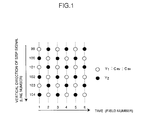
- Fig. 1 is a two-dimensional figure showing a location relationship between luminance data Y 1 , Y 2 and color difference data C BV , C RV .
- the luminance data Y 1 marked as white circles are arranged on each line. That is, in the first field, the luminance data Y 1 are arranged on lines 99, 101, 103 and so on. In the second field, the luminance data Y 1 are arranged on lines 100, 102, 104 and so on.
- the luminance data Y 2 marked as black circles are arranged on each line.
- the luminance data Y 2 are arranged on lines 100, 102, 104, ..., 522, 524 and so on.
- the luminance data Y 2 are arranged on lines 99, 101, 103, ... 523, 525 and so on.
- each of the color difference data C BV and C RV has the same sampling point as that of the luminance data Y 1 on the line of the white circle. That is, in the first field, the color difference data C BV and C RV are arranged on lines 99, 101, 103 and so on. In the second field, the color difference data C BV and C RV are arranged on lines 100, 102, 104 and so on. Therefore the sampling data of the color difference data C BV and C RV locate at the same position as that in the interlace system. In other words, the color difference data C BV and C RV are arranged on lines 99, 103, 107 and so on in the first field and the color difference data C BV and C RV are arranged on lines 101, 105, 109 and so on in the second field.
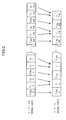
- Fig. 2 shows charts explaining the 4:2:0p serial data and converted 4:2:2 interlaced serial data, respectively.
- a line multiplexing the luminance data Y 1 and color difference data C BV , C RV is combined with a line multiplexing only luminance data Y 2 in pairs and the color difference data C BV , C RV , the luminance data Y 1 and Y 2 at the same horizontal picture element position as C BV , C RV and Y 1 are progressively multiplexed in the order on a transmission package equivalent to one interlaced line period.
- the color difference data C BV and the luminance data Y 1 at the horizontal picture element position 0 on the line 99 are combined with the luminance data Y 2 at the horizontal picture element position 0 on the line 100 in pairs.
- the color difference data C BV and C RV , luminance data Y 1 and luminance data Y 2 are progressively multiplexed in the order on the transmission package equivalent to one interlaced line period.
- the color difference data C BV , C RV and the luminance data Y 1 at the horizontal picture element position 1 on the line 99 are combined with the luminance data Y 2 at the horizontal picture element position 1 on the line 100 in pairs.
- the 4:2:0p serial data are generated as aforementioned.
- One of two adjacent lines of 4:2:0p data is set to a first line for multiplexing the luminance data Y 1 and the color difference data C BV , C RV .
- the other line is set to a second line for multiplexing the luminance data Y 2 only.
- the first line is combined with the second line in a pair.
- a pair of the luminance data Y 1 and the color difference data C BV , C RV on the first line and the luminance data Y 1 at the same horizontal picture element position as Y 1 C BV and C RV on the second line is demultiplexed from the 4:2:0p serial data.
- pairs of the luminance data Y 1 and the color difference data C BV at the horizontal picture element position 0 on the line 99 and the luminance data Y 2 at the horizontal picture element position 0 on the line 100 are demultiplexed from the 4:2:0p serial data.
- An arithmetic mean value of the luminance data Y 1 on the first line and the luminance data Y 2 on the second line is calculated.
- the arithmetic mean value of the luminance data Y 1 at the horizontal picture element position 0 on the line 99 and the luminance data Y 2 at the horizontal picture element position 0 on the line 100 is calculated.
- the calculated arithmetic mean value is set as the luminance data containing 4:2:2 signals.
- the above-obtained luminance data and the demultiplexed color difference data C BV on the second line are combined in pairs.
- the color difference data C BV and the calculated luminance data are multiplexed progressively in the order, generating 4:2:2 serial data at a horizontal picture element position 0.
- the arithmetic mean value of the luminance data Y 1 at the horizontal picture element position 0 on the line 99 and the luminance data Y 2 at the horizontal picture element position 0 on the line 100 is combined with the color difference data C BV at the horizontal picture element position 0 on the line 99 for multiplexing as shown in Fig. 2.
- the 4:2:2 serial data at the horizontal picture element position 0 are generated.
- the 4:2:2 serial data at the horizontal picture element position 1 are generated by using the luminance data Y 1 and the color difference data C RV at the horizontal picture element position 1 on the line 99 and the luminance data Y 2 at the horizontal picture element position 1 on the line 100.
- the luminance data for multiplexing are defined by the arithmetic mean value of the luminance data Y 1 and the luminance data Y 2 . Therefore the location of the luminance data resulting from this calculation is at a center between the first and the second lines imaginarily. Although the luminance data are shifted from the color difference data by a half of one line, the video quality is hardly influenced by such shifting.
- Fig. B is a block diagram of the converter.
- a reference numeral 1 is a demultiplex circuit. Upon receiving an input of 4:2:0p serial data, the demultiplex circuit 1 extracts luminance data Y 1 , color difference data C BV , C RV on the first line and the luminance data Y 2 at the same horizontal picture element position as Y 1 , C BV , C RV on the second line.
- Reference numeral 2 and 3 are an adder and a multiplier, respectively.
- An arithmetic mean value of the luminance data Y 1 and Y 2 is calculated by the adder 2 and the multiplier 3. That is, the demultiplexed luminance data Y 1 and Y 2 are summed up and output by the adder 2.
- the output of the adder 2 is multiplied by 1/2 by the multiplier 3 that outputs the arithmetic mean value of the luminance data Y 1 and Y 2 .
- a reference numeral 4 is a data multiplex circuit which combines the output from the multiplier 3 (the arithmetic mean value of the luminance data Y 1 and Y 2 ) with the color difference data C BV , C RV at the same horizontal picture element position as the output in pairs and generates 4:2:2 interlace serial data by multiplexing the color difference data C BV , C RV and the luminance data (calculated arithmetic mean value) in the order.
- a reference numeral 5 is a clock recovery circuit which extracts a clock at 360 MHz from the input data.
- a reference numeral 6 is a PLL circuit which generates a clock at 270 MHz synchronized with the input data rate at 360 Mb/s.
- a pair of interlaced data is calculated by demultiplexing the 8:4:4 video data at every line in an interlacing manner and isolating the line complementing the demultiplexed line as another interlaced data.
- the respective data are extended twice on the time axis and transmitted as dual-link interface (Link A signal and Link B signal) having the same data structure as that of 525 interlace digital component signals at 13.5 MHz sampling for transmission.
- Fig. 4 shows a relationship between the link A signal and the link B signal in a vertical-time direction.
- the link A signal is formed of the luminance data and color difference data on lines 99, 101, 103 and so on in the first field and the luminance data and the color difference data on lines 100, 102, 104 and so on in the second field.
- the link B signal is formed of the luminance data and color difference data on lines 100, 102, 104 and so on in the first field and the luminance data and the color difference data on lines 99, 101, 103 and so on in the second field.
- the color difference data and the luminance data on each line are sequentially multiplexed in the order from the horizontal picture element position 0 to 719.
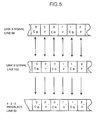
- Fig. 5 shows 4:2:2p transmission data and converted 4:2:2 interlace serial data, respectively.
- the color difference data CB and the luminance data Y at the horizontal picture element position 0 on the line 99 and then the color difference data CR and the luminance data Y at the horizontal picture element position 1 on the line 99 are arranged in the order progressively.
- the color difference data CB' and the luminance data Y' at the horizontal picture element position 0 on the line 100 and then the color difference data CR' and the luminance data Y' at the horizontal picture element 1 on the line 100 are arranged in the order progressively.
- the 4:2:2 interlace serial data are generated in the following manner.
- An arithmetic mean value of the color difference data CB of the link A signal at the horizontal picture element position 0 on the line 99 and the color difference data CB' of the link B signal at the horizontal picture element position 0 on the line 100 is calculated.
- the resultant arithmetic mean value is set as the color difference data CB" at the horizontal picture element position 0 on the line 50 in the 4:2:2 interlace.
- an arithmetic mean value of the luminance data Y of the link A signal at the horizontal picture element position 0 on the line 99 and the luminance data Y' of the link B signal at the horizontal picture element position 0 on the line 100 is calculated.
- the resultant arithmetic mean value is set as the luminance data Y" at the horizontal picture element position 0 on the line 50 in the 4:2:2 interlace.
- An arithmetic mean value of the color difference data CR of the link A signal at the horizontal picture element position 1 on the line 99 and the color difference data CR' of the link B signal at the horizontal picture element position 1 on the line 100 is calculated.
- the resultant arithmetic mean value is set as the color difference data CR" at the horizontal picture element position 1 on the line 50 in 4:2:2 interlace.
- an arithmetic mean value of the luminance data Y of the link A signal at the horizontal picture element position 1 on the line 99 and the luminance data Y' of the link B signal at the horizontal picture element position 1 on the line 100 is calculated.
- the resultant arithmetic mean value is set as the luminance data Y" at the horizontal picture element position 1 on the line 50 in 4:2:2 interlace.
- the above generated data are arranged in the order of the color difference data CB", luminance data Y", color difference data CR" and the luminance data Y" as shown in Fig. 5, generating the 4:2:2 interlace serial data.
- Fig. 6 is a block diagram of the converter.
- a reference numeral 21 is a reception circuit for receiving the link A signal.
- the reception circuit 21 receives the 4:2:2p link A signal and generates a clock at 270 MHz synchronized with the link A signal.
- a reference numeral 22 is a reception circuit for receiving the link B signal.
- the reception circuit 22 receives the 4:2:2p link B signal and generates a clock at 270 MHz synchronized with the link B signal.
- a reference numeral 23 is a serial-parallel converter for the link A signal.
- the serial-parallel converter 23 converts serial data of the link A signal received by the reception circuit 21 into 10-bit parallel data based on the clock at 270 MHz.
- a reference numeral 24 is a serial-parallel converter for the link B signal.
- the serial-parallel converter 24 converts serial data of the link B signal received by the reception circuit 22 into 10-bit parallel data based on the clock at 270 MHz.
- a reference numeral 25 is a buffer memory for the link A signal.
- the buffer memory 25 outputs accumulated 10-bit parallel data of the link A signal synchronized with a clock at 270 MHz.
- a reference numeral 26 is a buffer memory for the link B signal.
- the buffer memory 26 outputs accumulated 10-bit parallel data of the link B signal synchronized with a clock at 270 MHz.
- the buffer memories 25 and 26 output color difference data and luminance data at the same horizontal picture element position.
- Reference numerals 27 and 28 are an adder and a multiplier, respectively.
- An arithmetic mean value of the link A signal and the link B signal is obtained by the adder 27 and the multiplier 28. That is, the color difference data CB, CR of the link A signal are added to the color difference data CB', CR' of the link B signal at the same horizontal picture element position as CB and CR by the adder 27 for outputting.
- the luminance data Y of the link A signal are also added to the luminance data Y' of the link B signal at the same horizontal picture element position as Y by the adder 27 for outputting.
- the multiplier 28 multiplies each output of the adder 27 by 1/2, thus providing the arithmetic mean value of the link A signal and the link B signal.
- a reference numeral 29 is a parallel-serial converter for converting the parallel data from the multiplier 28 into serial data.
- a reference numeral 30 is an output driver for outputting 4:2:2 serial data.
Landscapes
- Engineering & Computer Science (AREA)
- Multimedia (AREA)
- Signal Processing (AREA)
- Computer Graphics (AREA)
- Color Television Systems (AREA)
- Television Systems (AREA)
Claims (5)
- Verfahren zur Umwandlung von 4:2:0p-Daten, die paarweise eine Luminanzdaten und Farbdifferenzdaten multiplexende erste Zeile und eine lediglich Luminanzdaten multiplexende zweite Zeile enthalten, in 4:2:2-Zeilensprung-Daten, mit folgenden Schritten:Demultiplexen von 4:2:0p-Daten in Luminanzdaten und Farbdifferenzdaten an einer vorbestimmten horizontalen Bildelementposition auf einer ersten Zeile,Demultiplexen von 4:2:0p-Daten in Luminanzdaten an der genannten vorbestimmten horizontalen Bildelementposition auf einer zweiten Zeile,Gewinnen eines arithmetischen Mittelwerts der Demultiplex-Luminanzdaten auf einer ersten Zeile und der Demultiplex-Luminanzdaten auf einer zweiten Zeile, undErzeugen von 4:2:2-Zeilensprung-Daten an der vorbestimmten horizontalen Bildelementposition durch Multiplexen des gewonnenen arithmetischen Mittelwerts als Luminanzdaten und der Demultiplex-Farbdifferenzdaten in Paaren.
- Verfahren zum Umwandeln von 4:2:2p-Daten, die ein Link-A-Signal und ein Link-B-Signal enthalten, in 4:2:2-Zeilensprung-Daten, mit folgenden Schritten:Demultiplexen eines Link-A-Signals von 4:2:2p-Daten in Luminanzdaten und Farbdifferenzdaten an einer vorbestimmten horizontalen Bildelementposition,Demultiplexen eines Link-B-Signals von 4:2:2p-Daten in Luminanzdaten und Farbdifferenzdaten an der vorbestimmten horizontalen Bildelementposition,Gewinnen von Luminanzdaten von 4:2:2-Zeilensprung-Daten durch Berechnen eines arithmetischen Mittelwerts der Demultiplex-Luminanzdaten des Link-A-Signals und der Demultiplex-Luminanzdaten des Link-B-Signals,Gewinnen von Farbdifferenzdaten von 4:2:2-Zeilensprung-Daten durch Berechnen eines arithmetischen Mittelwerts der Demultiplex-Farbdifferenzdaten des Link-A-Signals und der Demultiplex-Farbdifferenzdaten des Link-B-Signals, undErzeugen von 4:2:2-Zeilensprung-Daten bei der vorbestimmten horizontalen Bildelementposition durch Multiplexen der gewonnenen Luminanzdaten und der berechneten Farbdifferenzdaten in Paaren.
- Einheit zum Umwandeln von 4:2:0p-Daten, die paarweise eine Luminanzdaten und Farbdifferenzdaten multiplexende erste Zeile und eine lediglich Luminanzdaten multiplexende zweite Zeile enthalten, in 4:2:2-Zeilensprung-Daten, aufweisend:eine Einrichtung (1) zum Demultiplexen von 4:2:0p-Daten in Luminanzdaten und Farbdifferenzdaten an einer vorbestimmten horizontalen Bildelementposition auf einer ersten Zeile,eine Einrichtung (4) zum Demultiplexen von 4:2:0p-Daten in Luminanzdaten an der vorbestimmten horizontalen Bildelementposition auf einer zweiten Zeile,eine Einrichtung (2, 3) zum Berechnen eines arithmetischen Mittelwerts der Demultiplex-Luminanzdaten auf einer ersten Zeile und der Demultiplex-Luminanzdaten auf einer zweiten Zeile, undeine Einrichtung (4) zum Erzeugen von 4:2:2-Zeilensprung-Daten an der vorbestimmten horizontalen Bildelementposition durch Multiplexen des gewonnenen arithmetischen Mittelwerts als Luminanzdaten und der Demultiplex-Farbdifferenzdaten in Paaren.
- Einheit zum Umwandeln von 4:2:0p-Daten, die paarweise eine Luminanzdaten und Farbdifferenzdaten multiplexende erste Zeile in Kombination mit einer lediglich Luminanzdaten multiplexenden zweiten Zeile enthalten, in 4:2:2-Zeilensprung-Daten, aufweisen:eine Einrichtung (5) zum Erzeugen eines mit 4:2:0p-Daten synchronisierten ersten Takts,eine Einrichtung (6) zum Erzeugen eines mit 4:2:2-Zeilensprung-Daten synchronisierten zweiten Takts aufgrund des ersten Takts,eine Einrichtung (1) zum Demultiplexen von 4:2:0p-Daten in Luminanzdaten und Farbdifferenzdaten an einer vorbestimmten horizontalen Bildelementposition auf einer ersten Zeile und Luminanzdaten an der vorbestimmten horizontalen Bildelementposition auf einer zweiten Zeile aufgrund des ersten Takts,einen Addierer (2) zum Addieren der Demultiplex-Luminanzdaten auf einer ersten Zeile zu den Demultiplex-Luminanzdaten auf einer zweiten Zeile,einen Multiplizierer (3) zum Multiplizieren einer Ausgabe des Addierers mit 1/2, undeine Multiplex-Einrichtung (4) zum Erzeugen von 4:2:2-Zeilensprung-Daten an der vorbestimmten horizontalen Bildelementposition durch Multiplexen eines Paars von von dem Multiplizierer ausgegebenen Luminanzdaten und der Demultiplex-Farbdifferenzdaten aufgrund des zweiten Takts.
- Einheit zum Umwandeln von Daten eines progressiven Abtastungssystems zur Umwandlung von 4:2:2p-Daten mit einem Link-A-Signal und einem Link-B-Signal in 4:2:2-Zeilensprung-Daten, aufweisend:eine Einrichtung (21, 23, 25) zum Demultiplexen eines Link-A-Signals von 4:2:2p-Daten in Luminanzdaten und Farbdifferenzdaten an einer vorbestimmten horizontalen Bildelementposition,eine Einrichtung (22, 24, 26) zum Demultiplexen eines Link-B-Signals von 4:2:2p-Daten in Luminanzdaten und Farbdifferenzdaten an der vorbestimmten horizontalen Bildelementposition,eine Einrichtung (27, 28) zum Gewinnen von Luminanzdaten als 4:2:2-Zeilensprung-Daten durch Berechnen eines arithmetischen Mittelwerts der Demultiplex-Luminanzdaten des Link-A-Signals und der Demultiplex-Luminanzdaten des Link-B-Signals,eine Einrichtung (27, 28) zum Gewinnen von Farbdifferenzdaten von 4:2:2-Zeilensprung-Daten durch Berechnen eines arithmetischen Mittelwerts der Demultiplex-Farbdifferenzdaten des Link-A-Signals und der Demultiplex-Farbdifferenzdaten des Link-B-Signals, undeine Einrichtung (30) zum Erzeugen von 4:2:2-Zeilensprung-Daten an der vorbestimmten horizontalen Bildelementposition durch Multiplexen der berechneten Luminanzdaten und der berechneten Farbdifferenzdaten in Paaren.
Applications Claiming Priority (3)
| Application Number | Priority Date | Filing Date | Title |
|---|---|---|---|
| JP801196 | 1996-01-22 | ||
| JP8011/96 | 1996-01-22 | ||
| JP8008011A JP2936315B2 (ja) | 1996-01-22 | 1996-01-22 | 順次走査方式の伝送データの変換方法、及びその変換装置 |
Publications (3)
| Publication Number | Publication Date |
|---|---|
| EP0785677A2 EP0785677A2 (de) | 1997-07-23 |
| EP0785677A3 EP0785677A3 (de) | 1998-07-01 |
| EP0785677B1 true EP0785677B1 (de) | 2002-01-02 |
Family
ID=11681418
Family Applications (1)
| Application Number | Title | Priority Date | Filing Date |
|---|---|---|---|
| EP97300371A Expired - Lifetime EP0785677B1 (de) | 1996-01-22 | 1997-01-21 | Verfahren und Vorrichtung zur Umwandlung progressiv abgetasteter Daten in Zeilensprungdaten |
Country Status (5)
| Country | Link |
|---|---|
| US (1) | US5835152A (de) |
| EP (1) | EP0785677B1 (de) |
| JP (1) | JP2936315B2 (de) |
| CA (1) | CA2195612A1 (de) |
| DE (1) | DE69709415T2 (de) |
Families Citing this family (7)
| Publication number | Priority date | Publication date | Assignee | Title |
|---|---|---|---|---|
| US6529244B1 (en) | 1999-12-22 | 2003-03-04 | International Business Machines Corporation | Digital video decode system with OSD processor for converting graphics data in 4:4:4 format to 4:2:2 format by mathematically combining chrominance values |
| TWI249359B (en) * | 2004-12-22 | 2006-02-11 | Realtek Semiconductor Corp | Method and apparatus for simultaneous progressive and interlaced display |
| JP5232319B2 (ja) | 2011-10-20 | 2013-07-10 | 株式会社東芝 | 通信装置及び通信方法 |
| JP5694412B2 (ja) * | 2011-10-20 | 2015-04-01 | 株式会社東芝 | 送信装置、受信装置、送信方法及び受信方法 |
| JP5390667B2 (ja) | 2012-06-11 | 2014-01-15 | 株式会社東芝 | 映像送信機器及び映像受信機器 |
| JP5689938B2 (ja) * | 2013-10-07 | 2015-03-25 | 株式会社東芝 | 映像送信機器 |
| JP5808509B2 (ja) * | 2015-01-22 | 2015-11-10 | 株式会社東芝 | 映像受信機器 |
Family Cites Families (6)
| Publication number | Priority date | Publication date | Assignee | Title |
|---|---|---|---|---|
| US4335393A (en) * | 1980-04-15 | 1982-06-15 | Harris Video Systems, Inc. | Method and system using sequentially encoded color and luminance processing of video type signals to improve picture quality |
| DE3930964A1 (de) * | 1989-09-15 | 1991-03-28 | Thomson Brandt Gmbh | Fernsehuebertragungssystem |
| GB2238688B (en) * | 1989-11-27 | 1994-01-12 | Sony Corp | Methods of and apparatus for digital video signal processing |
| JP2936299B2 (ja) * | 1993-07-22 | 1999-08-23 | 日本テレビ放送網株式会社 | 信号伝送・記録、及び入力・出力方法 |
| US5677981A (en) * | 1994-06-14 | 1997-10-14 | Matsushita Electric Industrial Co., Ltd. | Video signal recording apparatus which receives a digital progressive scan TV signal and switches the progressive signal frame by frame alternately |
| JP2933487B2 (ja) * | 1994-07-15 | 1999-08-16 | 松下電器産業株式会社 | クロマフォーマット変換の方法 |
-
1996
- 1996-01-22 JP JP8008011A patent/JP2936315B2/ja not_active Expired - Fee Related
-
1997
- 1997-01-21 CA CA002195612A patent/CA2195612A1/en not_active Abandoned
- 1997-01-21 DE DE69709415T patent/DE69709415T2/de not_active Expired - Fee Related
- 1997-01-21 EP EP97300371A patent/EP0785677B1/de not_active Expired - Lifetime
- 1997-01-22 US US08/785,948 patent/US5835152A/en not_active Expired - Fee Related
Also Published As
| Publication number | Publication date |
|---|---|
| JP2936315B2 (ja) | 1999-08-23 |
| DE69709415T2 (de) | 2002-09-05 |
| EP0785677A2 (de) | 1997-07-23 |
| JPH09200801A (ja) | 1997-07-31 |
| CA2195612A1 (en) | 1997-07-23 |
| US5835152A (en) | 1998-11-10 |
| EP0785677A3 (de) | 1998-07-01 |
| DE69709415D1 (de) | 2002-02-07 |
Similar Documents
| Publication | Publication Date | Title |
|---|---|---|
| EP0076547B1 (de) | Hochzeiliges Fernsehsystem und Fernsehsender und -empfänger hierfür | |
| US5136380A (en) | Display signal device and method for providing compatibility between ntsc television and hdtv | |
| US6266093B1 (en) | Color video camera method and system | |
| EP0523299A1 (de) | Verfahren zum Kombinieren verschiedener BAS-Signale | |
| US4967272A (en) | Bandwidth reduction and multiplexing of multiple component TV signals | |
| WO1990013980A1 (en) | Scan converter for a high definition television system | |
| JPH0372796A (ja) | テレビジョン信号処理装置 | |
| KR970008461B1 (ko) | 텔레비젼 신호 발생 장치 및 비디오 신호 처리 장치 | |
| EP0785677B1 (de) | Verfahren und Vorrichtung zur Umwandlung progressiv abgetasteter Daten in Zeilensprungdaten | |
| CA1258524A (en) | Method and system for improved reconstruction of video images in line sequential chroma format | |
| US5128750A (en) | Television signal converter for converting a high definition television signal into a television signal for display by a standard television receiver | |
| US5227879A (en) | Apparatus for transmitting an extended definition TV signal having compatibility with a conventional TV system | |
| JPH03198593A (ja) | テレビジョン方式 | |
| CA2000709A1 (en) | Compatible extended-definition television | |
| EP0329976A2 (de) | Fernsehsystem mit mehreren analogen Komponenten | |
| EP0804029A2 (de) | Vorrichtung zur Verarbeitung von Videosignalen | |
| JP2638380B2 (ja) | 高品位テレビジョン受信装置 | |
| JPH04504790A (ja) | 付加信号によるテレビ伝送システム | |
| JPH04192692A (ja) | テレビジョン信号伝送方式 | |
| JPH04185085A (ja) | テレビジョン信号伝送方式 | |
| Bathe | HDMAC encoder—first generation: Experience and applications | |
| EP0804041A2 (de) | Vorrichtung zum Verarbeiten eines Videosignals für Fernsehempfänger mit höherer Bildauflösung | |
| JP2001275131A (ja) | 映像信号伝送方法ならびにそれを実行するための送信装置および受信装置 | |
| JPH11112951A (ja) | 画像信号送信装置及び画像信号受信装置 | |
| JPS63114389A (ja) | Edtv方式のエンコ−ダ |
Legal Events
| Date | Code | Title | Description |
|---|---|---|---|
| PUAI | Public reference made under article 153(3) epc to a published international application that has entered the european phase |
Free format text: ORIGINAL CODE: 0009012 |
|
| AK | Designated contracting states |
Kind code of ref document: A2 Designated state(s): DE GB IT NL |
|
| PUAL | Search report despatched |
Free format text: ORIGINAL CODE: 0009013 |
|
| AK | Designated contracting states |
Kind code of ref document: A3 Designated state(s): DE GB IT NL |
|
| 17P | Request for examination filed |
Effective date: 19980609 |
|
| GRAG | Despatch of communication of intention to grant |
Free format text: ORIGINAL CODE: EPIDOS AGRA |
|
| 17Q | First examination report despatched |
Effective date: 20010315 |
|
| GRAG | Despatch of communication of intention to grant |
Free format text: ORIGINAL CODE: EPIDOS AGRA |
|
| GRAH | Despatch of communication of intention to grant a patent |
Free format text: ORIGINAL CODE: EPIDOS IGRA |
|
| GRAH | Despatch of communication of intention to grant a patent |
Free format text: ORIGINAL CODE: EPIDOS IGRA |
|
| GRAA | (expected) grant |
Free format text: ORIGINAL CODE: 0009210 |
|
| REG | Reference to a national code |
Ref country code: GB Ref legal event code: IF02 |
|
| AK | Designated contracting states |
Kind code of ref document: B1 Designated state(s): DE GB IT NL |
|
| PGFP | Annual fee paid to national office [announced via postgrant information from national office to epo] |
Ref country code: GB Payment date: 20020115 Year of fee payment: 6 |
|
| PGFP | Annual fee paid to national office [announced via postgrant information from national office to epo] |
Ref country code: NL Payment date: 20020131 Year of fee payment: 6 |
|
| REF | Corresponds to: |
Ref document number: 69709415 Country of ref document: DE Date of ref document: 20020207 |
|
| PGFP | Annual fee paid to national office [announced via postgrant information from national office to epo] |
Ref country code: DE Payment date: 20020326 Year of fee payment: 6 |
|
| PLBE | No opposition filed within time limit |
Free format text: ORIGINAL CODE: 0009261 |
|
| STAA | Information on the status of an ep patent application or granted ep patent |
Free format text: STATUS: NO OPPOSITION FILED WITHIN TIME LIMIT |
|
| 26N | No opposition filed | ||
| PG25 | Lapsed in a contracting state [announced via postgrant information from national office to epo] |
Ref country code: GB Free format text: LAPSE BECAUSE OF NON-PAYMENT OF DUE FEES Effective date: 20030121 |
|
| PG25 | Lapsed in a contracting state [announced via postgrant information from national office to epo] |
Ref country code: NL Free format text: LAPSE BECAUSE OF NON-PAYMENT OF DUE FEES Effective date: 20030801 Ref country code: DE Free format text: LAPSE BECAUSE OF NON-PAYMENT OF DUE FEES Effective date: 20030801 |
|
| GBPC | Gb: european patent ceased through non-payment of renewal fee | ||
| NLV4 | Nl: lapsed or anulled due to non-payment of the annual fee |
Effective date: 20030801 |
|
| PG25 | Lapsed in a contracting state [announced via postgrant information from national office to epo] |
Ref country code: IT Free format text: LAPSE BECAUSE OF NON-PAYMENT OF DUE FEES Effective date: 20050121 |