EP0779906B1 - Epoxidharzmischungen für prepregs und verbundwerkstoffe - Google Patents
Epoxidharzmischungen für prepregs und verbundwerkstoffe Download PDFInfo
- Publication number
- EP0779906B1 EP0779906B1 EP95928985A EP95928985A EP0779906B1 EP 0779906 B1 EP0779906 B1 EP 0779906B1 EP 95928985 A EP95928985 A EP 95928985A EP 95928985 A EP95928985 A EP 95928985A EP 0779906 B1 EP0779906 B1 EP 0779906B1
- Authority
- EP
- European Patent Office
- Prior art keywords
- epoxy resin
- mass
- epoxy
- mixtures according
- phosphorus
- Prior art date
- Legal status (The legal status is an assumption and is not a legal conclusion. Google has not performed a legal analysis and makes no representation as to the accuracy of the status listed.)
- Expired - Lifetime
Links
Classifications
-
- H—ELECTRICITY
- H05—ELECTRIC TECHNIQUES NOT OTHERWISE PROVIDED FOR
- H05K—PRINTED CIRCUITS; CASINGS OR CONSTRUCTIONAL DETAILS OF ELECTRIC APPARATUS; MANUFACTURE OF ASSEMBLAGES OF ELECTRICAL COMPONENTS
- H05K1/00—Printed circuits
- H05K1/02—Details
- H05K1/03—Use of materials for the substrate
- H05K1/0313—Organic insulating material
- H05K1/032—Organic insulating material consisting of one material
- H05K1/0326—Organic insulating material consisting of one material containing O
-
- C—CHEMISTRY; METALLURGY
- C08—ORGANIC MACROMOLECULAR COMPOUNDS; THEIR PREPARATION OR CHEMICAL WORKING-UP; COMPOSITIONS BASED THEREON
- C08G—MACROMOLECULAR COMPOUNDS OBTAINED OTHERWISE THAN BY REACTIONS ONLY INVOLVING UNSATURATED CARBON-TO-CARBON BONDS
- C08G59/00—Polycondensates containing more than one epoxy group per molecule; Macromolecules obtained by polymerising compounds containing more than one epoxy group per molecule using curing agents or catalysts which react with the epoxy groups
- C08G59/14—Polycondensates modified by chemical after-treatment
- C08G59/1433—Polycondensates modified by chemical after-treatment with organic low-molecular-weight compounds
- C08G59/1488—Polycondensates modified by chemical after-treatment with organic low-molecular-weight compounds containing phosphorus
-
- C—CHEMISTRY; METALLURGY
- C08—ORGANIC MACROMOLECULAR COMPOUNDS; THEIR PREPARATION OR CHEMICAL WORKING-UP; COMPOSITIONS BASED THEREON
- C08G—MACROMOLECULAR COMPOUNDS OBTAINED OTHERWISE THAN BY REACTIONS ONLY INVOLVING UNSATURATED CARBON-TO-CARBON BONDS
- C08G59/00—Polycondensates containing more than one epoxy group per molecule; Macromolecules obtained by polymerising compounds containing more than one epoxy group per molecule using curing agents or catalysts which react with the epoxy groups
- C08G59/18—Macromolecules obtained by polymerising compounds containing more than one epoxy group per molecule using curing agents or catalysts which react with the epoxy groups ; e.g. general methods of curing
- C08G59/20—Macromolecules obtained by polymerising compounds containing more than one epoxy group per molecule using curing agents or catalysts which react with the epoxy groups ; e.g. general methods of curing characterised by the epoxy compounds used
- C08G59/22—Di-epoxy compounds
- C08G59/30—Di-epoxy compounds containing atoms other than carbon, hydrogen, oxygen and nitrogen
- C08G59/304—Di-epoxy compounds containing atoms other than carbon, hydrogen, oxygen and nitrogen containing phosphorus
-
- C—CHEMISTRY; METALLURGY
- C08—ORGANIC MACROMOLECULAR COMPOUNDS; THEIR PREPARATION OR CHEMICAL WORKING-UP; COMPOSITIONS BASED THEREON
- C08G—MACROMOLECULAR COMPOUNDS OBTAINED OTHERWISE THAN BY REACTIONS ONLY INVOLVING UNSATURATED CARBON-TO-CARBON BONDS
- C08G59/00—Polycondensates containing more than one epoxy group per molecule; Macromolecules obtained by polymerising compounds containing more than one epoxy group per molecule using curing agents or catalysts which react with the epoxy groups
- C08G59/18—Macromolecules obtained by polymerising compounds containing more than one epoxy group per molecule using curing agents or catalysts which react with the epoxy groups ; e.g. general methods of curing
- C08G59/40—Macromolecules obtained by polymerising compounds containing more than one epoxy group per molecule using curing agents or catalysts which react with the epoxy groups ; e.g. general methods of curing characterised by the curing agents used
- C08G59/44—Amides
- C08G59/444—Sulfonamides
-
- C—CHEMISTRY; METALLURGY
- C08—ORGANIC MACROMOLECULAR COMPOUNDS; THEIR PREPARATION OR CHEMICAL WORKING-UP; COMPOSITIONS BASED THEREON
- C08L—COMPOSITIONS OF MACROMOLECULAR COMPOUNDS
- C08L63/00—Compositions of epoxy resins; Compositions of derivatives of epoxy resins
-
- H—ELECTRICITY
- H10—SEMICONDUCTOR DEVICES; ELECTRIC SOLID-STATE DEVICES NOT OTHERWISE PROVIDED FOR
- H10W—GENERIC PACKAGES, INTERCONNECTIONS, CONNECTORS OR OTHER CONSTRUCTIONAL DETAILS OF DEVICES COVERED BY CLASS H10
- H10W70/00—Package substrates; Interposers; Redistribution layers [RDL]
- H10W70/60—Insulating or insulated package substrates; Interposers; Redistribution layers
- H10W70/67—Insulating or insulated package substrates; Interposers; Redistribution layers characterised by their insulating layers or insulating parts
- H10W70/69—Insulating materials thereof
- H10W70/695—Organic materials
-
- Y—GENERAL TAGGING OF NEW TECHNOLOGICAL DEVELOPMENTS; GENERAL TAGGING OF CROSS-SECTIONAL TECHNOLOGIES SPANNING OVER SEVERAL SECTIONS OF THE IPC; TECHNICAL SUBJECTS COVERED BY FORMER USPC CROSS-REFERENCE ART COLLECTIONS [XRACs] AND DIGESTS
- Y10—TECHNICAL SUBJECTS COVERED BY FORMER USPC
- Y10S—TECHNICAL SUBJECTS COVERED BY FORMER USPC CROSS-REFERENCE ART COLLECTIONS [XRACs] AND DIGESTS
- Y10S428/00—Stock material or miscellaneous articles
- Y10S428/901—Printed circuit
-
- Y—GENERAL TAGGING OF NEW TECHNOLOGICAL DEVELOPMENTS; GENERAL TAGGING OF CROSS-SECTIONAL TECHNOLOGIES SPANNING OVER SEVERAL SECTIONS OF THE IPC; TECHNICAL SUBJECTS COVERED BY FORMER USPC CROSS-REFERENCE ART COLLECTIONS [XRACs] AND DIGESTS
- Y10—TECHNICAL SUBJECTS COVERED BY FORMER USPC
- Y10T—TECHNICAL SUBJECTS COVERED BY FORMER US CLASSIFICATION
- Y10T428/00—Stock material or miscellaneous articles
- Y10T428/31504—Composite [nonstructural laminate]
- Y10T428/31511—Of epoxy ether
-
- Y—GENERAL TAGGING OF NEW TECHNOLOGICAL DEVELOPMENTS; GENERAL TAGGING OF CROSS-SECTIONAL TECHNOLOGIES SPANNING OVER SEVERAL SECTIONS OF THE IPC; TECHNICAL SUBJECTS COVERED BY FORMER USPC CROSS-REFERENCE ART COLLECTIONS [XRACs] AND DIGESTS
- Y10—TECHNICAL SUBJECTS COVERED BY FORMER USPC
- Y10T—TECHNICAL SUBJECTS COVERED BY FORMER US CLASSIFICATION
- Y10T428/00—Stock material or miscellaneous articles
- Y10T428/31504—Composite [nonstructural laminate]
- Y10T428/31511—Of epoxy ether
- Y10T428/31515—As intermediate layer
- Y10T428/31518—Next to glass or quartz
-
- Y—GENERAL TAGGING OF NEW TECHNOLOGICAL DEVELOPMENTS; GENERAL TAGGING OF CROSS-SECTIONAL TECHNOLOGIES SPANNING OVER SEVERAL SECTIONS OF THE IPC; TECHNICAL SUBJECTS COVERED BY FORMER USPC CROSS-REFERENCE ART COLLECTIONS [XRACs] AND DIGESTS
- Y10—TECHNICAL SUBJECTS COVERED BY FORMER USPC
- Y10T—TECHNICAL SUBJECTS COVERED BY FORMER US CLASSIFICATION
- Y10T428/00—Stock material or miscellaneous articles
- Y10T428/31504—Composite [nonstructural laminate]
- Y10T428/31511—Of epoxy ether
- Y10T428/31525—Next to glass or quartz
Definitions
- the invention relates to epoxy resin mixtures for production of prepregs and composite materials as well as from these epoxy resin mixtures manufactured prepregs and composite materials.
- Composite materials based on epoxy resins and inorganic or organic reinforcement materials have in many areas of technology and daily life gained great importance. The reasons for this are, on the one hand, the relative simple and safe processing of epoxy resins and on the other hand the good level of mechanical and chemical properties the hardened epoxy resin molding materials, which is an adjustment to different uses and an advantageous one Use of the properties of all materials involved in the composite allowed.
- the epoxy resins are processed into composite materials advantageous about the production of prepregs.
- the purpose is to use inorganic or organic reinforcing materials or storage components in the form of fibers, Nonwovens and fabrics or impregnated with fabrics with the resin. In most cases, this is done with a solution of the resin in an easily evaporable or volatile Solvent.
- the prepregs obtained in this way may be used after this Process no longer sticky, but also not yet hardened rather, the resin matrix should only be in are in a prepolymerized state. You also have to the prepregs are sufficiently stable in storage. For example Storage stability for the production of printed circuit boards of at least three months.
- prepregs must also be used for composite materials when the temperature rises, melt and mix with the reinforcing materials or storage components and with the materials intended for the composite under pressure if possible connect firmly and permanently, i.e. the networked Epoxy resin matrix must have a high interface adhesion to the Reinforcement materials or storage components as well the materials to be connected, such as metallic, ceramic, mineral and organic materials.
- the composite materials In the hardened state, the composite materials generally high mechanical and thermal strength as well as chemical Resistance and heat resistance or aging resistance required.
- electrotechnical and electronic Applications comes the demand for permanently high electrical insulation properties and for special purposes add a variety of additional requirements.
- high dimensional stability over a wide temperature range good adhesion to glass and copper, high surface resistance, low dielectric loss factor, good Machining behavior (punchability, drillability), low Water absorption and high corrosion resistance required.
- the flame retardants are halogen-free Melamine resins or organic phosphoric acid esters, in particular Melamine cyanurates, melamine phosphates, triphenyl phosphate and Diphenyl cresyl phosphate and mixtures thereof. This too is but a less promising solution because the ones used Fillers always increase water absorption and therefore PCB-specific tests can no longer be passed.
- EP-PS 0 384 940 contains epoxy resin mixtures known, the commercially available epoxy resin, the aromatic polyamine 1,3,5-tris (3-amino-4-alkylphenyl) -2,4,6-trioxo-hexahydrotriazine and an epoxy group Phosphorus compound based on glycidyl phosphate, glycidyl phosphonate or contain glycidylphosphinate.
- Epoxy resin mixtures can be - without adding halogen - flame-retardant laminates or UL 94 V-0 classifiable Manufacture composites that have a glass transition temperature of> 200 ° C.
- these epoxy resin mixtures comparable to those in use Process epoxy resins.
- Printed circuit boards are the basis for the production of electronic PCBs. They serve the most varied electronic and microelectronic components with each other to connect to electronic circuits. In doing so the components - using complex, highly automated Assembly processes - by gluing or soldering to the circuit board connected. Also with the assembly of printed circuit boards there is a trend towards ever more rational manufacturing methods. Therefore, IR reflow soldering is increasingly used in SMD technology applied that the other soldering processes largely in the future will replace. With this procedure, the entire PCB by IR radiation within a few seconds heated to temperatures> 260 ° C; in the circuit board absorbed water is evaporated suddenly. Only survive laminates with very good interlaminar adhesion IR soldering processes without destruction by delamination. To decrease Elaborate conditioning processes became this danger proposed (see: "Galvanotechnik", Vol. 84 (1993), pages 3865 to 3870).
- Multilayer circuit boards which are a large part of today's make up printed circuit boards. These circuit boards contain a variety of ladder levels through Epoxy resin composites spaced apart and isolated are. The trend in ML technology is now moving towards one ever increasing number of ladder levels; this is how multilayer printed circuit boards are currently made made with more than 20 ladder levels. Because the overall thickness of these circuit boards is too high for technical reasons Reasons must be avoided, the distance between the ladder levels are getting lower and therefore the interlaminar Adhesion and copper adhesion with ML laminates are becoming increasingly problematic. When IR soldering to this type of printed circuit boards also particularly high requirements with regard to Resistance to solder bath provided.
- HPCT printed circuit board technology
- Solder bath resistance used to determine the suitability of laminates for to test a high thermal resilience.
- HPCT will a copper-free laminate sample (5 x 5 cm) at 120 ° C and about 1.4 bar water vapor pressure for 2 h and then stored floating in a 260 ° C solder bath, whereby the time until delamination is measured.
- Good quality Laminates show no delamination up to> 20 s.
- the Resistance to solder bath is demonstrated on 2 x 10 cm laminate samples determined by immersing them in a 288 ° C hot solder bath and the time until delamination is determined.
- the object of the invention is to make it technically simple and therefore to provide inexpensive accessible epoxy resin mixtures that comparable to the epoxy resins currently in use processable and for the production of prepregs and Laminates are suitable for multilayer technology, which-without Halogen - flame retardant, i.e. according to UL 94 specification V-0 classifiable molding materials result and at the same time so have high solder bath resistance that IR soldering processes the production of printed circuit boards without delamination.
- P refers bisphenol A diglycidyl ether, bisphenol F diglycidyl ether, Polyglycidyl ethers of phenol / formaldehyde and cresol / formaldehyde novolaks, Diglycidyl esters of phthalic, isophthalic, Terephthalic and tetrahydrophthalic acid and mixtures used from these epoxy resins. More usable Polyepoxides are in Henry Lee's "Handbook of Epoxy Resins" and Kris Neville, McGraw-Hill Book Company 1967, and in the Monograph by Henry Lee "Epoxy Resins", American Chemical Society 1970.
- phosphonic acid modified epoxy resins such as Methyl, ethyl and propylphosphonic acid modified epoxy resins
- Phosphorus-modified epoxy resins can be obtained by reacting Epoxy novolak resins with a functionality of approx. 3 to 4 be made with phosphonic anhydrides.
- the phosphor modified Epoxy resins contain 0.5 to 13% by mass of phosphorus, preferably 1 to 8 mass%.
- the phosphorus content of the Total epoxy resin mixtures, i.e. the impregnating resin mixtures, is 0.5 to 5 mass%, preferably 1 to 4 mass%.
- the epoxy resin mixtures according to the invention advantageously contain additionally a phosphorus-free epoxy resin or Glycidyl group-free compound with phenolic OH groups.
- the phosphorus-free epoxy resin is obtained by reacting bisphenol A diglycidyl ether obtained with a deficit of bisphenol-A.
- the glycidyl group-free compound is bisphenol-A, Bisphenol-F or a high molecular phenoxy resin, which by Condensation of bisphenol-A or bisphenol-F with epichlorohydrin will be produced.
- the addition of the phosphorus-free epoxy resin serves to achieve this certain properties of those from the epoxy resin mixtures manufactured laminates.
- the manufacture and the structural Structure of such solid resins is in H. Batzer "Polymers Materials ", Volume III (Technology 2), Georg Thieme Verlag, Stuttgart, 1984, pages 178 ff. It is about high molecular weight, chain-extended bisphenol A diglycidyl ether with an epoxy value of 0.22 to 0.29 equivalents / 100 G.
- In the epoxy resin mixtures according to the invention are preferred phosphorus-free epoxy resins with an epoxy value from 0.22 to 0.25 equivalents / 100 g.
- the Viscosity of these resins, measured at 120 ° C, is between 300 and 900 mPa ⁇ s.
- the content of the phosphorus-free epoxy resin the total epoxy resin mixture is between 0 and 30 % By mass, preferably between 0 and 10% by mass.
- the phosphorus-free Epoxy resin component may only be used in such an amount be mixed in that the total mixture is still so much phosphorus contains that the demand for flame retardancy according to UL 94 V-0 specification is met. In the presence of phosphor modified Epoxy resins with a high phosphorus content can therefore more phosphorus-free epoxy resin should be added than for epoxy resins with low phosphorus content.
- glycidyl group-free compound with phenolic OH groups are also used to achieve certain Characteristics.
- Bisphenol-A and Bisphenol-F serve as well Phenoxy resins. These are linear condensation products Bisphenol-A or bisphenol-F and epichlorohydrin in the form of high molecular weight Compounds with a molecular weight up to 30000; the content of terminal phenolic OH functions is very low at ⁇ 1%.
- Phenoxy resins of this type are known (see: "Encyclopedia of Polymer Science and Engineering "(Second Edition), Vol. 6, pages 331 and 332, John Wiley & Sons, Inc., 1986).
- the compound with phenolic OH groups is the invention Epoxy resin mixtures in amounts of 0 to 20% by mass, preferably from 0 to 10% by mass added.
- Epoxy resin mixtures in amounts of 0 to 20% by mass, preferably from 0 to 10% by mass added.
- the glycidyl group-free phenolic Components can only be mixed in up to a proportion in which the requirement for flame retardance according to UL 94 V-0 specification is met.
- hardeners are used amine substituted aromatic sulfonic acid amides and -hydrazides used.
- hardeners are 2-aminobenzenesulfonic acid amide, 4-aminobenzenesulfonic acid amide (Sulfanilamide), 4-aminobenzenesulfonic acid dimethylamide, 4-amino-2-methylbenzenesulfonic acid amide and 4-aminobenzenesulfonic acid hydrazide as well as mixtures of these compounds.
- the hardener component is used in such concentrations that the equivalent ratio between epoxy functions and NH functions in the epoxy resin mixtures according to the invention 1: 0.4 to 1: 1.1, preferably 1: 0.5 to 1: 0.8.
- a phenolic component that is phosphorus-free is to take into account that the concentration of the epoxy groups according to the phenolic content OH groups reduced.
- the salary is the resin mixture of hardener 0.5 to 35% by mass, preferably 2 to 12 mass%.
- Curable reaction resin mixtures are known from US Pat. No. 4,618,526 known on the basis of aromatic polyglycidyl compounds, which are characterized by amine-substituted sulfonamides, such as Sulfanilamide, let harden. These mixtures are suitable although also for the production of laminates, since these have no flame retardancy according to UL 94 V, they are considered Electrolaminates unsuitable according to today's requirements. In WO 86/00627 describes epoxy resin mixtures which also hardened with sulfanilamide and to form electrolaminates can be processed. However, the mixtures contain Halogen components, so that these laminates are today's Requirements in electrical engineering for flame retardancy without Halogen addition does not do it justice.
- Suitable amines are, for example, tetramethylethylenediamine, Dimethyloctylamine, dimethylaminoethanol, Dimethylbenzylamine, 2,4,6-tris (dimethylaminomethyl) phenol, N, N'-tetramethyldiaminodiphenylmethane, N, N'-dimethylpiperazine, N-methylmorpholine, N-methylpiperidine, N-ethylpyrrolidine, 1,4-diazabicyclo (2,2,2) octane and quinolines.
- Suitable imidazoles are, for example, 1-methylimidazole, 2-methylimidazole, 1,2-dimethylimidazole, 1,2,4,5-tetramethylimidazole, 2-ethyl-4-methylimidazole, 1-cyanoethyl-2-phenylimidazole and 1- (4,6-diamino-s-triazinyl-2-ethyl) -2-phenylimidazole.
- the accelerator is in a concentration of 0.01 to 2 mass%, preferably 0.05 to 1 mass%, used, each based on the epoxy resin mixture.
- the various components for prepreg production are separately or together - in inexpensive solvents, such as acetone, methyl ethyl ketone, ethyl acetate, methoxyethanol, Dimethylformamide and toluene, or in mixtures of such Solvent dissolved, optionally combined into a solution.
- the solution is then applied to common impregnation systems processed, i.e. for impregnating fibers from inorganic or organic materials such as glass, metal, minerals, Carbon, aramid, polyphenylene sulfide and cellulose, as well of fabrics or nonwovens made therefrom or for coating of flat materials, such as foils made of metals or Plastics.
- the impregnation solutions also other flame retardants contain halogen-free additives, some of which are homogeneously dissolved or can be dispersed.
- halogen-free additives can, for example Melamine cyanurates, melamine phosphates, powdered Be polyetherimide, polyether sulfone and polyimide.
- Glass fabric is predominantly used to manufacture prepregs for printed circuit board technology.
- prepregs made of glass fabric types with a basis weight of 25 to 200 g / m 2 are used in particular.
- prepregs with low basis weights can also be produced as required.
- the impregnated or coated reinforcing materials or intercalation components are dried at elevated temperature, the solvent being removed on the one hand and the impregnating resin being prepolymerized on the other. Overall, this results in an extremely favorable ratio of effort to achievable properties.
- the coatings and prepregs obtained are non-tacky and at room temperature for three months and more stable in storage, i.e. they have sufficient storage stability on. They can be used at temperatures up to 220 ° C to composites, which are characterized by high glass transition temperatures of up to 170 ° C and by inherent Characterize flame resistance.
- a solution of A MT of a phosphorus-modified epoxy resin (P / EP resin) in the form of a reaction product (epoxy value: 0.34 mol / 100 g; phosphorus content: 3.2%) from an epoxidized novolak (epoxy value: 0.56 mol / 100 g; average functionality: 3.6) and propanephosphonic anhydride - in D MT methyl ethyl ketone (MEK), E MT dimethylformamide (DMF) and F MT ethyl acetate (EA) - is combined with B MT sulfanilamide (SulfAm) and C MT 2-methylimidazole (MeIm ) offset.
- P / EP resin phosphorus-modified epoxy resin
- G MT of a reaction product (epoxy value: 0.32 mol / 100 g; phosphorus content: 3.8%) from an epoxidized novolak (epoxy value: 0.56 mol / 100 g; average functionality: 3.6) and propanephosphonic anhydride ( P / EP resin) - in D MT methyl ethyl ketone (MEK), E MT dimethylformamide (DMF) and F MT ethyl acetate (EA) - B MT sulfanilamide (SulfAm) and C MT 2-methylimidazole (MeIm) are added.
- MEK D MT methyl ethyl ketone
- EMF dimethylformamide
- EA F MT ethyl acetate
- SulfAm B MT sulfanilamide
- MeIm 2-methylimidazole
- H MT bisphenol-A (bis-A) or I MT araldite B (epoxy value: 0.25 equivalent / 100 g; viscosity at 120 ° C.: 380 mPa ⁇ s), ie a commercial high-molecular epoxy resin, are added to the solution obtained in this way based on bisphenol A (Aral B) or J MT of a phenoxy resin with a molecular weight of 30,000 and a hydroxyl value of 6% (phen resin).
- the composition of the impregnation resin solutions and the properties of the prepregs produced therefrom - in accordance with Examples 1 and 2 - can be found in Table 1. Composition of the impregnation resin solutions and properties of the prepregs Example No.
- Components (MT): A (P / EP resin) 90 90 - - - 90 B (SulfAm) 11 7 8th 8th 8th - C (MeIm) 0.1 0.1 0.1 0.1 0.1 0.1 0.2 0.2 D (MEK) 40 40 40 40 40 40 40 40 40 40 40 40 40 40 40 40 40 40 40 40 40 40 40 40 40 40 40 40 40 40 40 40 40 40 40 40 40 40 40 40 40 40 40 40 40 40 40 40 40 40 40 40 40 40 40 40 40 40 40 40 40 40 40 40 40 40 40 40 40 40 40 40 40 40 40 40 40 40 40 40 40 40 40 40 40 40 40 40 40 40 40 40 40 40 40 40 40 40 40 40 40 40 40 40 40 40 40 40 40 40 40 40 40 40 40 40 40 40 40 40 40 40 40 40 40 40 40 40 40 40 40 40 40 40 40 40 40 40 40 40 40 40 40 40 40 40 40 40 40 40 40 40 40 40 40 40 40 40 40 40 40 40 40 40 40 40 40 40 40 40 40 40 40 40 40 40 40 40 40 40 40 40 40 40 40
- the remaining gel time is determined in such a way that of the Prepregs mechanically detached, glass fiber-free impregnation resin (0.2 to 0.3 g) on a hot plate preheated to 170 ° C is applied. After about 30 s, the melted Resin sample evenly stirred with a glass or wooden stick. The viscosity change is made by pulling about 50 mm long threads from the melt were observed. The gelation has occurred when it is no longer possible to pull threads. The time (in s) from application, determined with a stopwatch of the resin on the heating plate until premature tearing off the thread is the gel time.
- a solution of A MT of a reaction product (epoxy value: 0.34 mol / 100 g; Phosphorus content 3.2%) from an epoxidized Novolak (epoxy value: 0.56 mol / 100 g; medium functionality: 3,6) and propanephosphonic anhydride (P / EP resin) - in D MT Methyl ethyl ketone (MEK), E MT dimethylformamide (DMF) and F MT Ethyl acetate (EA) - is used with K MT dicyandiamide (Dicy) and C MT 2-methylimidazole (MeIm) added.
- the one received Resin solution becomes - according to Examples 1 and 2 Prepregs processed.
- the composition of the impregnation resin solution and the properties of the prepregs are shown in Table 1 remove.
- Prepregs produced in accordance with Examples 1 to 6 are pressed into laminates 1.5 to 1.6 mm thick, which consist of eight layers of prepregs, laminated on both sides with a 35 ⁇ m Cu foil, are built up (pressing parameters: 175 ° C, 30 to 35 bar, 40 min); then post-annealing at 190 ° C for 2 h.
- the glass transition temperature T G (by means of DMTA, ie dynamic mechanical analysis), the mean burning time according to UL 94 V, the adhesion of the copper foil, the measuring test, the high pressure cooker test and the solder bath resistance are determined on the laminates. The values obtained are shown in Table 3.
Landscapes
- Chemical & Material Sciences (AREA)
- Medicinal Chemistry (AREA)
- Organic Chemistry (AREA)
- Polymers & Plastics (AREA)
- Health & Medical Sciences (AREA)
- Chemical Kinetics & Catalysis (AREA)
- General Chemical & Material Sciences (AREA)
- Engineering & Computer Science (AREA)
- Microelectronics & Electronic Packaging (AREA)
- Reinforced Plastic Materials (AREA)
- Epoxy Resins (AREA)
- Laminated Bodies (AREA)
- Compositions Of Macromolecular Compounds (AREA)
Description
- ein phosphormodifiziertes Epoxidharz mit einem Epoxidwert
von 0,02 bis 1 mol/100 g, aufgebaut aus Struktureinheiten,
die sich ableiten
- (A) von Polyepoxidverbindungen mit mindestens zwei Epoxidgruppen pro Molekül und
- (B) von Phosphinsäureanhydriden; Phosphonsäureanhydriden oder Phosphonsaurehalbestern;
- ein aromatisches Amin folgender Struktur als Härter:
wobei folgendes gilt:

- X ist ein H-Atom und Y eine Alkylgruppe mit 1 bis 3 C-Atomen und m bzw. n bedeutet eine ganze Zahl von 0 bis 4 mit der Maßgabe: m + n = 4,
- die Reste R1 und R2 sind - unabhängig voneinander - ein H-Atom oder eine Alkylgruppe mit 1 bis 3 C-Atomen oder einer der Reste R1 und R2 hat diese Bedeutung und der andere Rest ist eine NR3R4-Gruppe mit R3 bzw. R4 = H oder Alkyl mit 1 bis 3 C-Atomen;
- einen aminischen Härtungsbeschleuniger.
- Phosphinsaureanhydride: Anhydride von Phosphinsäuren mit Alkyl-, Alkenyl-, Cycloalkyl-, Aryl- oder Aralkylresten; beispielhaft seien genannt: Dimethylphosphinsäureanhydrid, Methylethylphosphinsäureanhydrid, Diethylphosphinsäureanhydrid, Dipropylphosphinsäureanhydrid, Ethylphenylphosphinsäureanhydrid und Diphenylphosphinsäureanhydrid;
- Bis-phosphinsäureanhydride: Anhydride von Bis-phosphinsäuren, insbesondere von Alkan-bis-phosphinsäuren mit 1 bis 10 Kohlenstoffatomen in der Alkangruppierung; beispielhaft seien genannt: Methan-1,1-bis-methylphosphinsäureanhydrid, Ethan-1,2-bis-methylphosphinsäureanhydrid, Ethan-1,2-bis-phenylphosphinsäureanhydrid und Butan-1,4-bis-methylphosphinsäureanhydrid;
- Phosphonsäureanhydride: Anhydride von Phosphonsäuren mit Alkyl-, Alkenyl-, Cycloalkyl-, Aryl- oder Aralkylresten; beispielhaft seien genannt: Methanphosphonsäureanhydrid, Ethanphosphonsäureanhydrid, Propanphosphonsaureanhydrid, Hexanphosphonsäureanhydrid und Benzolphosphonsäureanhydrid;
- Phosphonsäurehalbester: bevorzugt eingesetzt werden Halbester,
d.h. Monoester, von Phosphonsäuren mit Alkylresten
(vorzugsweise mit 1 bis 6 Kohlenstoffatomen) oder mit Arylresten
(insbesondere Benzolphosphonsäure) mit aliphatischen
Alkoholen, insbesondere niedrig siedenden aliphatischen
Alkoholen, wie Methanol und Ethanol;
beispielhaft seien genannt: Methanphosphonsäuremonomethylester, Propanphosphonsäuremonoethylester und Benzolphosphonsäuremonomethylester;
Phosphonsäurehalbester können durch partielle Hydrolyse der entsprechenden Phosphonsäurediester, insbesondere mittels Natronlauge, oder durch partielle Veresterung der freien Phosphonsäuren mit dem entsprechenden Alkohol hergestellt werden.
| Zusammensetzung der Imprägnierharzlösungen und Eigenschaften der Prepregs | ||||||
| Beispiel Nr. | 1 | 2 | 3 | 4 | 5 | 6 (Vergl.) |
| Komponenten (MT): | ||||||
| A (P/EP-Harz) | 90 | 90 | - | - | - | 90 |
| B (SulfAm) | 11 | 7 | 8 | 8 | 8 | - |
| C (MeIm) | 0,1 | 0,1 | 0,1 | 0,1 | 0,1 | 0,2 |
| D (MEK) | 40 | 40 | 40 | 40 | 40 | 40 |
| E (DMF) | 10 | 10 | 20 | 20 | 20 | 10 |
| F (EA) | 5 | 5 | 6 | 6 | 6 | 5 |
| G (P/EP-Harz) | - | - | 90 | 90 | 90 | - |
| H (Bis-A) | - | - | 11 | - | - | - |
| I (Aral B) | - | - | - | 11 | - | - |
| J (Phen-Harz) | - | - | - | - | 11 | - |
| K (Dicy) | - | - | - | - | - | 5 |
| Meßwerte: | ||||||
| Restgehalt an Lösungsmittel (%) | 0,1 | 0,2 | 0,2 | 0,2 | 0,1 | 0,22 |
| Restgelierzeit der Prepregs bei 170°C (s) | 110 | 120 | 130 | 115 | 107 | 110 |
| Reaktivität der Imprägnierharzlösung | |||||
| Beispiel Nr. | 7 | 8 | 9 | 10 | 11 |
| C (MT) | - | 0,05 | 0,1 | 0,2 | 0,4 |
| B-Zeit bei 170°C (s) | 840 | 400 | 305 | 220 | 160 |
| Eigenschaften der Laminate | ||||||
| Beispiel Nr. | 12 | 13 | 14 | 15 | 16 | 17 (Vergl.) |
| Prepregs entsprechend Beispiel Nr. | 1 | 2 | 3 | 4 | 5 | 6 (Vergl.) |
| Meßwerte: | ||||||
| TG (°C) | 172 | 153 | 143 | 140 | 144 | 170 |
| mittlere Brenndauer | ||||||
| nach UL 94 V (s) | 4,0 | 3,3 | 4,2 | 4,3 | 4,4 | 4,9 |
| Einstufung | V-0 | V-0 | V-0 | V-0 | V-0 | V-0 |
| Haftvermögen der Cu- | ||||||
| Folie bei RT (N/mm) | 1,9 | 1,8 | 2,2 | 2,0 | 2,1 | 1,9 |
| Measling-Test (LT26) | + | + | + | + | + | - |
| High-Pressure-Cooker- | ||||||
| Test (s) | >20 | >20 | >20 | >20 | >20 | 9 |
| Lötbadbeständigkeit | ||||||
| bei 288°C (s) | >600 | >600 | >600 | >600 | >600 | 85 |
- Haftvermögen der Kupferkaschierung Ein 25 mm breiter und 100 mm langer Streifen der Kupferfolie wird auf 20 mm Länge vom Glashartgewebe gelöst und mittels einer geeigneten Vorrichtung mit einer Abzugsgeschwindigkeit von 50 mm/min senkrecht abgezogen; gemessen wird die hierzu erforderliche Kraft F (N).
- Measling-Test Die Prüfung erfolgt an Probekörpern ohne Kupferkaschierung (Größe: 20 mm x 100 mm). Die Probekörper werden 3 min in eine 65°C heiße LT26-Lösung (Zusammensetzung: 850 ml entionisiertes H2O, 50 ml HCl p.a., 100 g SnCl2 · 2 H2O, 50 g Thioharnstoff) getaucht, mit fließendem Wasser abgespült und anschließend 20 min in kochendes Wasser gelegt. Nach Trocknung an der Luft (2 bis 3 min) wird die Probe 10 s in ein 260°C heißes Lötbad getaucht. Das Laminat darf dabei nicht delaminieren.
- High-Pressure-Cooker-Test Zwei Probekörper der Größe 50 mm x 50 mm werden 2 h in einer Wasserdampfatmosphäre mit einer Temperatur von 120 bis 125°C im Hochdruckautoklav gelagert. Nachfolgend werden die getrockneten Proben innerhalb von 2 min für 20 s auf ein 260 C heißes Lötbad gelegt. Die Probekörper dürfen dabei nicht delaminieren.
- Lötbadbeständigkeit Die Prüfung erfolgt nach DIN IEC 259 unter Verwendung eines Lötbades nach Abschnitt 3.7.2.3. Es werden Probekörper der Größe 25 mm x 100 mm verwendet, die in ein Lötbad mit einer Temperatur von 288°C eingetaucht werden, und es wird die Zeit bis zur Entstehung von Delaminierungen oder Blasen gemessen.
Claims (10)
- Epoxidharzmischungen zur Herstellung von Prepregs und Verbundwerkstoffen, die folgende Komponenten enthalten:ein phosphormodifiziertes Epoxidharz mit einem Epoxidwert von 0,02 bis 1 mol/100 g, aufgebaut aus Struktureinheiten, die sich ableiten(A) von Polyepoxidverbindungen mit mindestens zwei Epoxidgruppen pro Molekül und(B) von Phosphinsäureanhydriden, Phosphonsäureanhydriden oder Phosphonsäurehalbestern;ein aromatisches Amin folgender Struktur als Härter:wobei folgendes gilt:
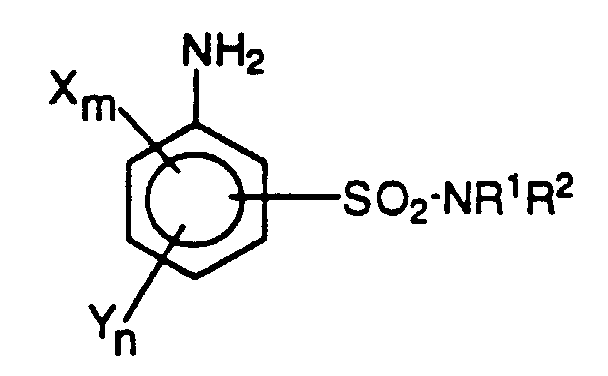 X ist ein H-Atom und Y eine Alkylgruppe mit 1 bis 3 C-Atomen und m bzw. n bedeutet eine ganze Zahl von 0 bis 4 mit der Maßgabe: m + n = 4,die Reste R1 und R2 sind - unabhängig voneinander - ein H-Atom oder eine Alkylgruppe mit 1 bis 3 C-Atomen oder einer der Reste R1 und R2 hat diese Bedeutung und der andere Rest ist eine NR3R4-Gruppe mit R3 bzw. R4 = H oder Alkyl mit 1 bis 3 C-Atomen;einen aminischen Härtungsbeschleuniger.
 - Epoxidharzmischungen nach Anspruch 1, dadurch gekennzeichnet, daß sie ein phosphorfreies Epoxidharz, hergestellt durch Umsetzung von Bisphenol-A-diglycidylether mit einem Unterschuß an Bisphenol-A, oder eine glycidylgruppenfreie Verbindung mit phenolischen OH-Gruppen in Form von Bisphenol-A, Bisphenol-F oder einem durch Kondensation von Bisphenol-A oder Bisphenol-F mit Epichlorhydrin erhaltenen hochmolekularen Phenoxyharz enthalten.
- Epoxidharzmischungen nach Anspruch 2, dadurch gekennzeichnet, daß der Anteil des phosphorfreien Epoxidharzes in der Harzmischung bis zu 30 Masse-% beträgt, vorzugsweise bis zu 10 Masse-%.
- Epoxidharzmischungen nach Anspruch 2 oder 3, dadurch gekennzeichnet, daß der Anteil der glycidylgruppenfreien Verbindung in der Harzmischung bis zu 20 Masse-% beträgt, vorzugsweise bis zu 10 Masse-%.
- Epoxidharzmischungen nach einem oder mehreren der Ansprüche 1 bis 4, dadurch gekennzeichnet, daß der Phosphorgehalt 0,5 bis 5 Masse-% beträgt, vorzugsweise 1 bis 4 Masse-%, jeweils bezogen auf die Harzmischung.
- Epoxidharzmischungen nach einem oder mehreren der Ansprüche 1 bis 5, dadurch gekennzeichnet, daß das Äquivalentverhältnis zwischen Epoxid-Funktionen und NH-Funktionen 1:0,4 bis 1:1,1 beträgt, vorzugsweise 1:0,5 bis 1:0,8.
- Epoxidharzmischungen nach einem oder mehreren der Ansprüche 1 bis 6, dadurch gekennzeichnet, daß der Gehalt der Harzmischung an Härter 0,5 bis 35 Masse-% beträgt, vorzugsweise 2 bis 12 Masse-%.
- Epoxidharzmischungen nach einem oder mehreren der Ansprüche 1 bis 7, dadurch gekennzeichnet, daß der Härter 2-Aminobenzolsulfonsäureamid, 4-Aminobenzolsulfonsäureamid, 4-Aminobenzolsulfonsäuredimethylamid, 4-Amino-2-methylbenzolsulfonsäureamid oder 4-Aminobenzolsulfonsäurehydrazid ist.
- Prepregs und Verbundwerkstoffe auf der Basis von anorganischen oder organischen Verstärkungsmaterialien in Form von Fasern, Vliesen oder Geweben bzw. von Flächenstoffen, hergestellt aus Epoxidharzmischungen nach einem oder mehreren der Ansprüche 1 bis 8.
- Leiterplatten aus Prepregs, hergestellt aus Glasfasergewebe und Epoxidharzmischungen nach einem oder mehreren der Ansprüche 1 bis 8.
Applications Claiming Priority (3)
| Application Number | Priority Date | Filing Date | Title |
|---|---|---|---|
| DE4432190 | 1994-09-09 | ||
| DE4432190 | 1994-09-09 | ||
| PCT/DE1995/001137 WO1996007686A1 (de) | 1994-09-09 | 1995-08-25 | Epoxidharzmischungen für prepregs und verbundwerkstoffe |
Publications (2)
| Publication Number | Publication Date |
|---|---|
| EP0779906A1 EP0779906A1 (de) | 1997-06-25 |
| EP0779906B1 true EP0779906B1 (de) | 1998-07-08 |
Family
ID=6527845
Family Applications (1)
| Application Number | Title | Priority Date | Filing Date |
|---|---|---|---|
| EP95928985A Expired - Lifetime EP0779906B1 (de) | 1994-09-09 | 1995-08-25 | Epoxidharzmischungen für prepregs und verbundwerkstoffe |
Country Status (9)
| Country | Link |
|---|---|
| US (1) | US5759690A (de) |
| EP (1) | EP0779906B1 (de) |
| JP (1) | JPH10505121A (de) |
| CN (1) | CN1068348C (de) |
| AT (1) | ATE168120T1 (de) |
| CZ (1) | CZ70597A3 (de) |
| DE (1) | DE59502777D1 (de) |
| TW (1) | TW297034B (de) |
| WO (1) | WO1996007686A1 (de) |
Cited By (1)
| Publication number | Priority date | Publication date | Assignee | Title |
|---|---|---|---|---|
| ES2178588A1 (es) * | 2000-12-29 | 2002-12-16 | Lear Automotive Eeds Spain | Caja de interconexion, control y gestion para automovil, con impacto medioambiental reducido. |
Families Citing this family (22)
| Publication number | Priority date | Publication date | Assignee | Title |
|---|---|---|---|---|
| KR20000048654A (ko) | 1996-09-26 | 2000-07-25 | 칼 하인쯔 호르닝어 | 에폭시 수지 혼합물 |
| US6353080B1 (en) | 1997-06-26 | 2002-03-05 | The Dow Chemical Company | Flame retardant epoxy resin composition |
| WO2001042359A1 (en) | 1999-12-13 | 2001-06-14 | Dow Global Technologies Inc. | Flame retardant phosphorus element-containing epoxy resin compositions |
| AU2089701A (en) * | 1999-12-13 | 2001-06-18 | Dow Chemical Company, The | Phosphorus element-containing crosslinking agents and flame retardant phosphoruselement-containing epoxy resin compositions prepared therewith |
| DE10043205A1 (de) * | 2000-09-01 | 2002-03-28 | Siemens Ag | Epoxidharzmischung |
| US7070861B2 (en) * | 2000-12-18 | 2006-07-04 | Mitsubishi Rayon Co., Ltd. | Flame retardant epoxy resin composition, and prepreg and fiber-reinforced composite materials made by using the composition |
| AU2003226414A1 (en) * | 2002-05-30 | 2003-12-19 | Dow Global Technologies, Inc. | Halogen free ignition resistant thermoplastic resin compositions |
| FR2848016B1 (fr) * | 2002-11-29 | 2005-01-28 | Nexans | Cable ignifuge |
| US20050075024A1 (en) * | 2003-10-01 | 2005-04-07 | Ranken Paul F. | Flame retardant epoxy prepregs, laminates, and printed wiring boards of enhanced thermal stability |
| CN102653598B (zh) | 2004-05-28 | 2015-05-13 | 陶氏环球技术有限责任公司 | 可用于制造无卤素抗引燃聚合物的含磷化合物 |
| US20100294429A1 (en) * | 2007-09-28 | 2010-11-25 | Dow Global Technologies Inc. | Epoxy resin formulations |
| US20110065870A1 (en) * | 2009-09-11 | 2011-03-17 | Chemtura Corporation | Tris(Hydroxoxyphenyl) Phosphine Oxides and their Use as Flame Retardants for Epoxy Resins |
| US20110065838A1 (en) | 2009-09-11 | 2011-03-17 | Chemtura Corporation | Hydroxyphenyl Phosphine Oxide Mixtures and their use as Flame Retardants for Epoxy Resins |
| WO2012064703A1 (en) | 2010-11-12 | 2012-05-18 | Albemarle Corporation | Dopo-derived flame retardant and synthetic hydrogarnets for epoxy resin compositions |
| CN103382242B (zh) | 2013-06-25 | 2015-06-24 | 江苏雅克科技股份有限公司 | 含磷阻燃酚醛树脂及以其为原料制备的阻燃环氧树脂固化物 |
| CN104592467A (zh) | 2014-08-15 | 2015-05-06 | 江苏雅克科技股份有限公司 | 含磷酚醛树脂化合物及以其为原料制备的含磷阻燃环氧树脂固化物 |
| CN105623238B (zh) | 2014-11-06 | 2018-07-27 | 江苏雅克科技股份有限公司 | 含磷官能化聚(亚芳基醚)及以其为原料制备组合物 |
| CN106750226B (zh) | 2014-11-11 | 2019-01-08 | 江苏雅克科技股份有限公司 | 含磷聚酯化合物组成及含磷阻燃环氧树脂固化物的制备方法 |
| US9534108B2 (en) | 2015-03-13 | 2017-01-03 | Chemtura Corporation | Flame retardant epoxy resins comprising phosphorus containing flame retardants |
| WO2016166226A1 (de) | 2015-04-17 | 2016-10-20 | Alzchem Ag | Härter und härtungsbeschleuniger mit flammschutzwirkung zur härtung von epoxidharzen |
| WO2018164833A1 (en) | 2017-03-07 | 2018-09-13 | Icl-Ip America Inc. | Non-migratory, high-melting/softening polymeric phosphorus-containing flame retardant for printed wiring boards |
| JP7582859B2 (ja) * | 2020-12-21 | 2024-11-13 | 富士フイルム株式会社 | 熱伝導材料形成用組成物、熱伝導材料、熱伝導シート、熱伝導層付きデバイス |
Family Cites Families (18)
| Publication number | Priority date | Publication date | Assignee | Title |
|---|---|---|---|---|
| US2712001A (en) * | 1952-03-17 | 1955-06-28 | Devoe & Raynolds Co | Sulfonamide-epoxide compositions |
| US2766139A (en) * | 1955-04-13 | 1956-10-09 | Masonite Corp | Method of producing fire resistant lignocellulose hardboard products |
| US3398019A (en) * | 1963-02-21 | 1968-08-20 | Monsanto Co | Method for fireproofing cellulosic material |
| US3373135A (en) * | 1964-12-01 | 1968-03-12 | Kalk Chemische Fabrik Gmbh | Shaped articles of self-extinguishing epoxy resins |
| GB1112139A (en) * | 1967-01-13 | 1968-05-01 | Shell Int Research | Curable polyepoxide compositions for making flame retardant articles |
| US4111909A (en) * | 1977-04-11 | 1978-09-05 | Celanese Polymer Specialties Company | Controlled reactivity epoxy resin compositions |
| DE2933343A1 (de) * | 1979-08-17 | 1981-03-26 | Bayer Ag, 51373 Leverkusen | Faerben von wolle/cellulosefasermischungen |
| US4528359A (en) * | 1984-05-16 | 1985-07-09 | The Dow Chemical Company | Adducts of epoxy resins and amino-substituted aromatic sulfonic acid amides |
| NZ212747A (en) * | 1984-07-17 | 1989-01-27 | Dow Chemical Co | Partially advanced epoxy resin compositions |
| US4618526A (en) * | 1985-07-22 | 1986-10-21 | The Dow Chemical Company | Curable compositions containing multiglycidyl ethers and a sulfonic acid amide |
| US4799983A (en) * | 1987-07-20 | 1989-01-24 | International Business Machines Corporation | Multilayer ceramic substrate and process for forming therefor |
| JPH01123892A (ja) * | 1987-11-09 | 1989-05-16 | Dai Ichi Kogyo Seiyaku Co Ltd | 新規な反応性難燃剤 |
| DE3836409A1 (de) * | 1988-10-26 | 1990-05-03 | Ferrozell Sachs & Co Gmbh | Prepregs fuer selbstverloeschende verbundwerkstoffe und verfahren zu deren herstellung |
| ATE107677T1 (de) * | 1989-03-03 | 1994-07-15 | Siemens Ag | Epoxidharzmischungen. |
| DE4308187A1 (de) * | 1993-03-15 | 1994-09-22 | Siemens Ag | Epoxidharzmischungen |
| DE4308184A1 (de) * | 1993-03-15 | 1994-09-22 | Siemens Ag | Epoxidharzmischungen |
| DE4308185A1 (de) * | 1993-03-15 | 1994-09-22 | Siemens Ag | Phosphormodifizierte Epoxidharze, Verfahren zu ihrer Herstellung sowie deren Verwendung |
| DE4336235A1 (de) * | 1993-10-23 | 1995-04-27 | Bosch Gmbh Robert | Verfahren zur Herstellung von Keramik-Multilayern |
-
1995
- 1995-07-21 TW TW084107569A patent/TW297034B/zh active
- 1995-08-25 US US08/793,287 patent/US5759690A/en not_active Expired - Fee Related
- 1995-08-25 WO PCT/DE1995/001137 patent/WO1996007686A1/de not_active Ceased
- 1995-08-25 CN CN95194926A patent/CN1068348C/zh not_active Expired - Fee Related
- 1995-08-25 EP EP95928985A patent/EP0779906B1/de not_active Expired - Lifetime
- 1995-08-25 AT AT95928985T patent/ATE168120T1/de not_active IP Right Cessation
- 1995-08-25 CZ CZ97705A patent/CZ70597A3/cs unknown
- 1995-08-25 DE DE59502777T patent/DE59502777D1/de not_active Expired - Fee Related
- 1995-08-25 JP JP8509101A patent/JPH10505121A/ja active Pending
Cited By (2)
| Publication number | Priority date | Publication date | Assignee | Title |
|---|---|---|---|---|
| ES2178588A1 (es) * | 2000-12-29 | 2002-12-16 | Lear Automotive Eeds Spain | Caja de interconexion, control y gestion para automovil, con impacto medioambiental reducido. |
| ES2178588B1 (es) * | 2000-12-29 | 2004-08-16 | Lear Automotive (Eeds) Spain, S.L. | Caja de interconexion, control y gestion para automovil, con impacto medioambiental reducido. |
Also Published As
| Publication number | Publication date |
|---|---|
| CN1157628A (zh) | 1997-08-20 |
| WO1996007686A1 (de) | 1996-03-14 |
| ATE168120T1 (de) | 1998-07-15 |
| DE59502777D1 (de) | 1998-08-13 |
| EP0779906A1 (de) | 1997-06-25 |
| TW297034B (de) | 1997-02-01 |
| US5759690A (en) | 1998-06-02 |
| CN1068348C (zh) | 2001-07-11 |
| JPH10505121A (ja) | 1998-05-19 |
| CZ70597A3 (en) | 1997-06-11 |
Similar Documents
| Publication | Publication Date | Title |
|---|---|---|
| EP0779905B1 (de) | Epoxidharzmischungen für prepregs und verbundwerkstoffe | |
| EP0779906B1 (de) | Epoxidharzmischungen für prepregs und verbundwerkstoffe | |
| EP0689557B1 (de) | Epoxidharzmischungen | |
| EP0384940B1 (de) | Epoxidharzmischungen | |
| EP0689559B1 (de) | Epoxidharzmischungen | |
| EP0779904B1 (de) | Epoxidharzmischungen für prepregs und verbundwerkstoffe | |
| DE60025883T2 (de) | Epoxidharz-Zusammensetzung, Prepreg und mehrschichtige Platte für gedruckte Schaltungen | |
| DE112010001422B4 (de) | Phosphorhaltiges Phenolnovolakharz, selbiges umfassendes Härtungsmittel und Epoxyharzzusammensetzung | |
| DE4308184A1 (de) | Epoxidharzmischungen | |
| EP0799845B1 (de) | Phosphormodifizierte Epoxidharzmischungen | |
| EP1046661B1 (de) | Flammwidrige phosphormodifizierte Epoxidharze | |
| DE69610771T2 (de) | Epoxidharzzusammensetzung für gedrückte leiterplatten und damit hergestellte schichtstoffplatten | |
| DE19857697A1 (de) | Epoxidharzmischung für Prepregs und Verbundwerkstoffe | |
| EP0428863B1 (de) | Epoxidharzmischungen | |
| EP1583788A1 (de) | Phosphormodifiziertes epoxidharz | |
| DE19856397A1 (de) | Epoxidharzmischung für Prepregs und Verbundwerkstoffe | |
| DE10043205A1 (de) | Epoxidharzmischung | |
| EP2014720A1 (de) | Polymerzusammensetzung |
Legal Events
| Date | Code | Title | Description |
|---|---|---|---|
| PUAI | Public reference made under article 153(3) epc to a published international application that has entered the european phase |
Free format text: ORIGINAL CODE: 0009012 |
|
| 17P | Request for examination filed |
Effective date: 19970107 |
|
| AK | Designated contracting states |
Kind code of ref document: A1 Designated state(s): AT BE CH DE FR GB IT LI NL SE |
|
| GRAG | Despatch of communication of intention to grant |
Free format text: ORIGINAL CODE: EPIDOS AGRA |
|
| 17Q | First examination report despatched |
Effective date: 19970825 |
|
| GRAG | Despatch of communication of intention to grant |
Free format text: ORIGINAL CODE: EPIDOS AGRA |
|
| GRAH | Despatch of communication of intention to grant a patent |
Free format text: ORIGINAL CODE: EPIDOS IGRA |
|
| GRAH | Despatch of communication of intention to grant a patent |
Free format text: ORIGINAL CODE: EPIDOS IGRA |
|
| GRAA | (expected) grant |
Free format text: ORIGINAL CODE: 0009210 |
|
| AK | Designated contracting states |
Kind code of ref document: B1 Designated state(s): AT BE CH DE FR GB IT LI NL SE |
|
| REF | Corresponds to: |
Ref document number: 168120 Country of ref document: AT Date of ref document: 19980715 Kind code of ref document: T |
|
| REG | Reference to a national code |
Ref country code: CH Ref legal event code: NV Representative=s name: SIEMENS SCHWEIZ AG Ref country code: CH Ref legal event code: EP |
|
| REF | Corresponds to: |
Ref document number: 59502777 Country of ref document: DE Date of ref document: 19980813 |
|
| GBT | Gb: translation of ep patent filed (gb section 77(6)(a)/1977) |
Effective date: 19980824 |
|
| ET | Fr: translation filed | ||
| PLBE | No opposition filed within time limit |
Free format text: ORIGINAL CODE: 0009261 |
|
| STAA | Information on the status of an ep patent application or granted ep patent |
Free format text: STATUS: NO OPPOSITION FILED WITHIN TIME LIMIT |
|
| 26N | No opposition filed | ||
| PGFP | Annual fee paid to national office [announced via postgrant information from national office to epo] |
Ref country code: AT Payment date: 20010718 Year of fee payment: 7 |
|
| PGFP | Annual fee paid to national office [announced via postgrant information from national office to epo] |
Ref country code: GB Payment date: 20010808 Year of fee payment: 7 |
|
| PGFP | Annual fee paid to national office [announced via postgrant information from national office to epo] |
Ref country code: NL Payment date: 20010814 Year of fee payment: 7 |
|
| PGFP | Annual fee paid to national office [announced via postgrant information from national office to epo] |
Ref country code: BE Payment date: 20010820 Year of fee payment: 7 |
|
| PGFP | Annual fee paid to national office [announced via postgrant information from national office to epo] |
Ref country code: FR Payment date: 20010823 Year of fee payment: 7 |
|
| PGFP | Annual fee paid to national office [announced via postgrant information from national office to epo] |
Ref country code: SE Payment date: 20010829 Year of fee payment: 7 |
|
| PGFP | Annual fee paid to national office [announced via postgrant information from national office to epo] |
Ref country code: DE Payment date: 20011022 Year of fee payment: 7 |
|
| PGFP | Annual fee paid to national office [announced via postgrant information from national office to epo] |
Ref country code: CH Payment date: 20011112 Year of fee payment: 7 |
|
| REG | Reference to a national code |
Ref country code: GB Ref legal event code: IF02 |
|
| PG25 | Lapsed in a contracting state [announced via postgrant information from national office to epo] |
Ref country code: GB Free format text: LAPSE BECAUSE OF NON-PAYMENT OF DUE FEES Effective date: 20020825 Ref country code: AT Free format text: LAPSE BECAUSE OF NON-PAYMENT OF DUE FEES Effective date: 20020825 |
|
| PG25 | Lapsed in a contracting state [announced via postgrant information from national office to epo] |
Ref country code: SE Free format text: LAPSE BECAUSE OF NON-PAYMENT OF DUE FEES Effective date: 20020826 |
|
| PG25 | Lapsed in a contracting state [announced via postgrant information from national office to epo] |
Ref country code: LI Free format text: LAPSE BECAUSE OF NON-PAYMENT OF DUE FEES Effective date: 20020831 Ref country code: CH Free format text: LAPSE BECAUSE OF NON-PAYMENT OF DUE FEES Effective date: 20020831 Ref country code: BE Free format text: LAPSE BECAUSE OF NON-PAYMENT OF DUE FEES Effective date: 20020831 |
|
| BERE | Be: lapsed |
Owner name: *SIEMENS A.G. Effective date: 20020831 |
|
| PG25 | Lapsed in a contracting state [announced via postgrant information from national office to epo] |
Ref country code: NL Free format text: LAPSE BECAUSE OF NON-PAYMENT OF DUE FEES Effective date: 20030301 Ref country code: DE Free format text: LAPSE BECAUSE OF NON-PAYMENT OF DUE FEES Effective date: 20030301 |
|
| EUG | Se: european patent has lapsed | ||
| REG | Reference to a national code |
Ref country code: CH Ref legal event code: PL |
|
| GBPC | Gb: european patent ceased through non-payment of renewal fee |
Effective date: 20020825 |
|
| PG25 | Lapsed in a contracting state [announced via postgrant information from national office to epo] |
Ref country code: FR Free format text: LAPSE BECAUSE OF NON-PAYMENT OF DUE FEES Effective date: 20030430 |
|
| NLV4 | Nl: lapsed or anulled due to non-payment of the annual fee |
Effective date: 20030301 |
|
| REG | Reference to a national code |
Ref country code: FR Ref legal event code: ST |
|
| PG25 | Lapsed in a contracting state [announced via postgrant information from national office to epo] |
Ref country code: IT Free format text: LAPSE BECAUSE OF NON-PAYMENT OF DUE FEES;WARNING: LAPSES OF ITALIAN PATENTS WITH EFFECTIVE DATE BEFORE 2007 MAY HAVE OCCURRED AT ANY TIME BEFORE 2007. THE CORRECT EFFECTIVE DATE MAY BE DIFFERENT FROM THE ONE RECORDED. Effective date: 20050825 |