EP0765415B1 - Thermostabile textile glättemittel - Google Patents
Thermostabile textile glättemittel Download PDFInfo
- Publication number
- EP0765415B1 EP0765415B1 EP95923248A EP95923248A EP0765415B1 EP 0765415 B1 EP0765415 B1 EP 0765415B1 EP 95923248 A EP95923248 A EP 95923248A EP 95923248 A EP95923248 A EP 95923248A EP 0765415 B1 EP0765415 B1 EP 0765415B1
- Authority
- EP
- European Patent Office
- Prior art keywords
- lubricants
- esters
- acid
- weight
- thiocarboxylic
- Prior art date
- Legal status (The legal status is an assumption and is not a legal conclusion. Google has not performed a legal analysis and makes no representation as to the accuracy of the status listed.)
- Expired - Lifetime
Links
- 0 *c1cccc(*)c1O Chemical compound *c1cccc(*)c1O 0.000 description 4
Classifications
-
- D—TEXTILES; PAPER
- D06—TREATMENT OF TEXTILES OR THE LIKE; LAUNDERING; FLEXIBLE MATERIALS NOT OTHERWISE PROVIDED FOR
- D06M—TREATMENT, NOT PROVIDED FOR ELSEWHERE IN CLASS D06, OF FIBRES, THREADS, YARNS, FABRICS, FEATHERS OR FIBROUS GOODS MADE FROM SUCH MATERIALS
- D06M13/00—Treating fibres, threads, yarns, fabrics or fibrous goods made from such materials, with non-macromolecular organic compounds; Such treatment combined with mechanical treatment
- D06M13/244—Treating fibres, threads, yarns, fabrics or fibrous goods made from such materials, with non-macromolecular organic compounds; Such treatment combined with mechanical treatment with compounds containing sulfur or phosphorus
- D06M13/248—Treating fibres, threads, yarns, fabrics or fibrous goods made from such materials, with non-macromolecular organic compounds; Such treatment combined with mechanical treatment with compounds containing sulfur or phosphorus with compounds containing sulfur
- D06M13/252—Mercaptans, thiophenols, sulfides or polysulfides, e.g. mercapto acetic acid; Sulfonium compounds
-
- D—TEXTILES; PAPER
- D06—TREATMENT OF TEXTILES OR THE LIKE; LAUNDERING; FLEXIBLE MATERIALS NOT OTHERWISE PROVIDED FOR
- D06M—TREATMENT, NOT PROVIDED FOR ELSEWHERE IN CLASS D06, OF FIBRES, THREADS, YARNS, FABRICS, FEATHERS OR FIBROUS GOODS MADE FROM SUCH MATERIALS
- D06M13/00—Treating fibres, threads, yarns, fabrics or fibrous goods made from such materials, with non-macromolecular organic compounds; Such treatment combined with mechanical treatment
- D06M13/10—Treating fibres, threads, yarns, fabrics or fibrous goods made from such materials, with non-macromolecular organic compounds; Such treatment combined with mechanical treatment with compounds containing oxygen
- D06M13/144—Alcohols; Metal alcoholates
- D06M13/148—Polyalcohols, e.g. glycerol or glucose
-
- D—TEXTILES; PAPER
- D06—TREATMENT OF TEXTILES OR THE LIKE; LAUNDERING; FLEXIBLE MATERIALS NOT OTHERWISE PROVIDED FOR
- D06M—TREATMENT, NOT PROVIDED FOR ELSEWHERE IN CLASS D06, OF FIBRES, THREADS, YARNS, FABRICS, FEATHERS OR FIBROUS GOODS MADE FROM SUCH MATERIALS
- D06M13/00—Treating fibres, threads, yarns, fabrics or fibrous goods made from such materials, with non-macromolecular organic compounds; Such treatment combined with mechanical treatment
- D06M13/10—Treating fibres, threads, yarns, fabrics or fibrous goods made from such materials, with non-macromolecular organic compounds; Such treatment combined with mechanical treatment with compounds containing oxygen
- D06M13/224—Esters of carboxylic acids; Esters of carbonic acid
-
- D—TEXTILES; PAPER
- D06—TREATMENT OF TEXTILES OR THE LIKE; LAUNDERING; FLEXIBLE MATERIALS NOT OTHERWISE PROVIDED FOR
- D06M—TREATMENT, NOT PROVIDED FOR ELSEWHERE IN CLASS D06, OF FIBRES, THREADS, YARNS, FABRICS, FEATHERS OR FIBROUS GOODS MADE FROM SUCH MATERIALS
- D06M7/00—Treating fibres, threads, yarns, fabrics, or fibrous goods made of other substances with subsequent freeing of the treated goods from the treating medium, e.g. swelling, e.g. polyolefins
-
- D—TEXTILES; PAPER
- D06—TREATMENT OF TEXTILES OR THE LIKE; LAUNDERING; FLEXIBLE MATERIALS NOT OTHERWISE PROVIDED FOR
- D06M—TREATMENT, NOT PROVIDED FOR ELSEWHERE IN CLASS D06, OF FIBRES, THREADS, YARNS, FABRICS, FEATHERS OR FIBROUS GOODS MADE FROM SUCH MATERIALS
- D06M2200/00—Functionality of the treatment composition and/or properties imparted to the textile material
- D06M2200/40—Reduced friction resistance, lubricant properties; Sizing compositions
Definitions
- thermostable textile smoothing agents obtainable by reacting polyols with C 6-22 fatty acids in the presence of small amounts of special esters of thiocarboxylic acids and spin finishes which contain these textile smoothing agents.
- spin finishes are used used. These spin finishes all contain so-called textile smoothing agent to avoid friction between filaments or fibers and to minimize between filaments and governing bodies.
- textile Smoothing agents are increasingly being used in esters.
- thermal Stability thermal stability
- antioxidants such as butylated hydroxytoluene (BHT) to use because such connections are already in small up to medium quantities effectively improve the thermal stability.
- BHT butylated hydroxytoluene
- antioxidants e.g. B. the commercially known Irganox R 1010 known to those skilled in the art, the volatility of which is relatively low.
- this procedure has the disadvantage that this group of antioxidants has only a limited solubility in the esters. It follows from this that the required concentration of dissolved antioxidant cannot be achieved to a sufficient extent.
- a method for improving the solubility of antioxidants in smoothing agents is known from WO 91/13134, the antioxidant being incorporated into a carrier medium via covalent bonds.
- the teaching of WO 91/13134 in its preferred embodiment relates to the fact that so-called "superstable lubricants" are obtained when the proportion of the covalently bound antioxidant in the carrier medium is in the range from greater than 0 to 30% by weight.
- the proportion of the covalently bound antioxidant in the carrier medium is in each case 10 or 20% by weight.
- An example of a particularly suitable product is a textile smoothing agent in which 10% by weight of Irganox R 1010 is covalently bonded to pentaerythritol pelargonate as a carrier. From an economic and ecological point of view, however, it is desirable to minimize the antioxidant content.
- GB-A-454 449 describes the use of certain carboxylic acids or thiocarboxylic acids as a replacement for oleic acid as spinning oil.
- GB-A-738 749 describes a mixture of water-soluble alkali salt of an organic acid and water-insoluble fatty acid glycol ester or fatty alcohol ether as an additive in spin finishes to improve the emulsion properties.
- GB-A-930 336 describes esters of polyols and fatty acids in a mixture with other constituents as spinning oils. Thiocarboxylic acid esters are not included.
- GB-A-499 371 describes the addition of certain sulfur-containing compounds as antioxidants to smoothing agents which contain unsaturated compounds.
- the object of the present invention was to provide thermostable textile smoothing agents To provide the disadvantages of the known prior art avoid technology.
- the aim was to create thermostable textiles Developing smoothing agents that contain a minimal amount of antioxidants need.
- the polyols a) and the fatty acids b) can be saturated or olefinic unsaturated and straight or branched with respect to their carbon skeleton be.
- the radicals R 1 to R 4 can be saturated or olefinically unsaturated, straight-chain or branched, insofar as this is an alkyl, alkylene, cycloalkylene or cycloalkyl group or the alkyl part of an alkaryl group.
- Polyols are polyvalent in the context of the present invention Alcohols understood with at least 2 OH groups.
- the chemical constitution the polyols are not subject to any particular restrictions, i.e. they can be straight or branched.
- the polyols selected from that of glycerol, trimethylolpropane, neopentyl glycol and pentaerythritol formed group.
- the fatty acids with 8 to 18 carbon atoms are preferred, which are also preferably saturated.
- the best effects are achieved in the context of the present invention if fatty acids with 8 to 10 carbon atoms are used as component b).
- the latter acids are known to those skilled in the art as caprylic acid, pelargonic acid and capric acid. These acids can be used as component b) either individually or in mixtures. Mixtures of C 8 and C 10 fatty acids are known as so-called pre-fatty acids.
- esters of thiocarboxylic acids are preferred in which the thiocarboxylic acids of the general formula (I) and / or (II) with monofunctional aliphatic alcohols with 1 to 22 C atoms, neopentyl glycol, glycerin, trimethylolpropane or pentaerythritol are esterified.
- monofunctional aliphatic alcohols with 1 to 22 C atoms
- neopentyl glycol, glycerin, trimethylolpropane or pentaerythritol are esterified.
- polyfunctional alcohols neopentyl glycol, glycerin, Trimethylolpropane and pentaerythritol can be pure or else also act as mixed esters.
- esters are called “pure” esters understood in which all hydroxyl groups of the polyfunctional alcohols with one or more thiocarboxylic acids of the general formula (I) and / or (II) are esterified.
- “Mixed” esters are such Understood esters in which at least one hydroxyl group with a Thiocarboxylic acid of the general formula (I) or (II) is esterified. The other hydroxyl groups are then with fatty acids with 6 to 22 carbon atoms, as described in connection with component b), esterified.
- the esters of monofunctional aliphatic are particularly preferred Alcohols of the type described and the "pure” esters of pentaerythritol.
- the monofunctional aliphatic alcohols are particularly suitable n- and i-butanol, 2-ethylhexanol, isotridecanol, lauryl alcohol, isostearyl alcohol and / or oleyl alcohol.
- R 1 denotes an alkyl group with 6 to 18 C atoms
- R 2 denotes an alkylene group with 1 or 2 C atoms.
- Particularly suitable examples are ⁇ -laurylthiopropionic acid (C 12 H 25 SCH 2 CH 2 COOH) and ⁇ -octylthiopropionic acid (C 8 H 17 SCH 2 CH 2 COOH).
- R 3 and R 4 are an alkylene group having 2 carbon atoms, ie thiodipropionic acid (HOOCCH 2 CH 2 SCH 2 CH 2 COOH).
- esters of thiocarboxylic acid are commercially available compounds that but are also easily accessible by known esterification reactions.
- the mixed esters can easily be obtained by transesterification of the pure thioates obtained with the fatty acids described.
- esters of thiocarboxylic acids in an amount of 0.05 to 8 % By weight, based on the sum of components a) and b), is used. It is preferred to use the esters of thiocarboxylic acids in an amount of 0.5 to 5 wt .-%, in particular from 1.0 to 3.0 wt .-%, use. This The quantities used relate to the quantities defined above on pure esters of thiocarboxylic acids. With mixed esters of thiocarboxylic acids are in accordance with the content of thiocarboxylic acids in the ester use higher quantities.
- esters of thiocarboxylic acids can be used in the Implementation between polyols a) and fatty acids b) from the beginning be or be added only during the implementation. Furthermore they can be added in their entirety or in portions will.
- the reaction between polyols a) and the fatty acids b) takes place under the conditions customary for esterification reactions.
- the presence the esters of thiocarboxylic acids of the general formula (I) and / or (II) causes an improvement in thermal stability on the one hand and on the other a color improvement of the textile smoothing agents obtained, since these are lighter in color than when manufactured without the presence of those described Esters of thiocarboxylic acids.
- the invention Agents additionally added antioxidants as additive d).
- This Antioxidants are added after the reaction of the polyols a) with fatty acids b) added in the presence of the esters of thiocarboxylic acids.
- antioxidants butylated hydroxytoluene, dialkyl or diarylphosphonates are suitable, Trialkyl or triaryl phosphites, ascorbic or citric acid and their Derivatives and especially sterically hindered phenols.
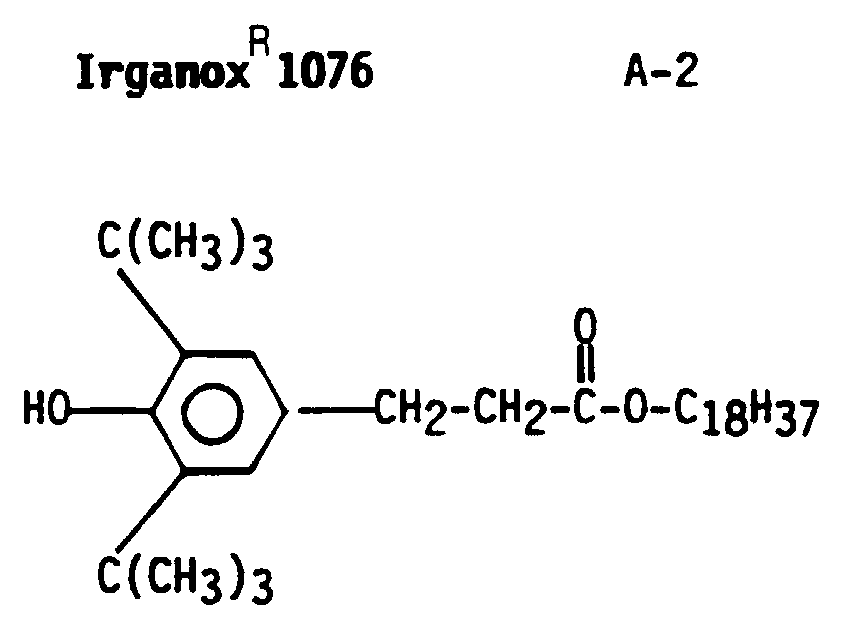
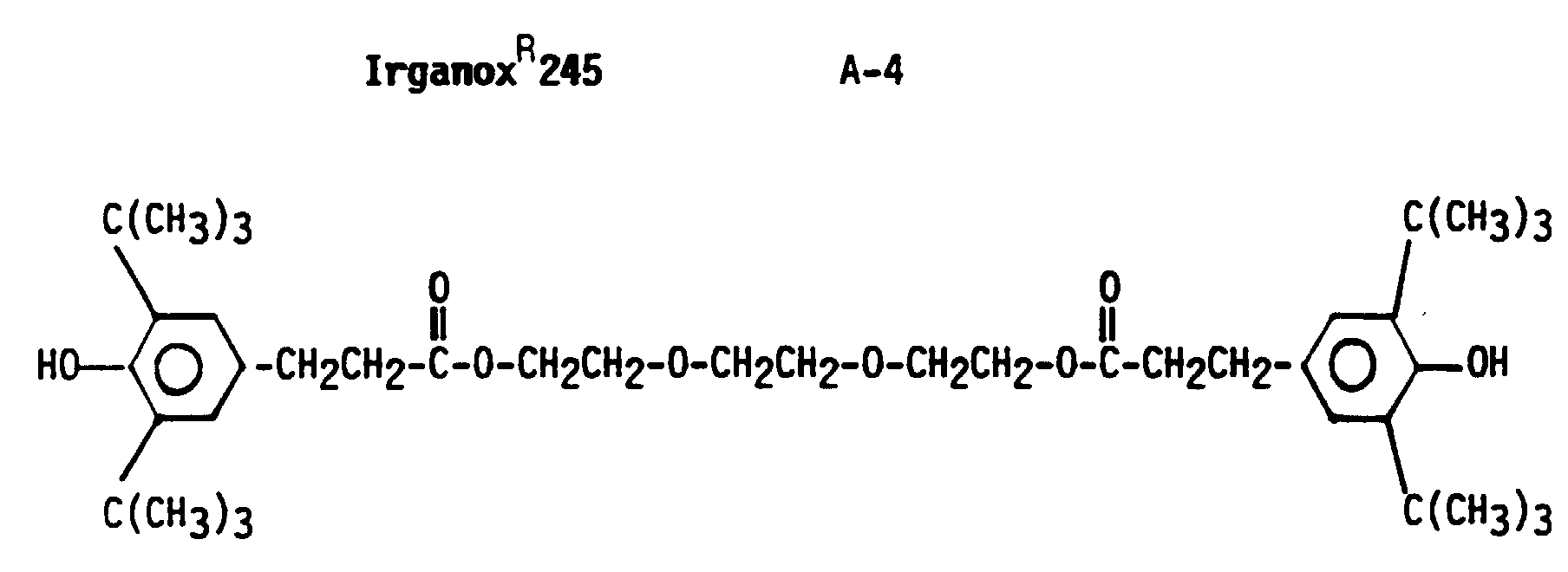
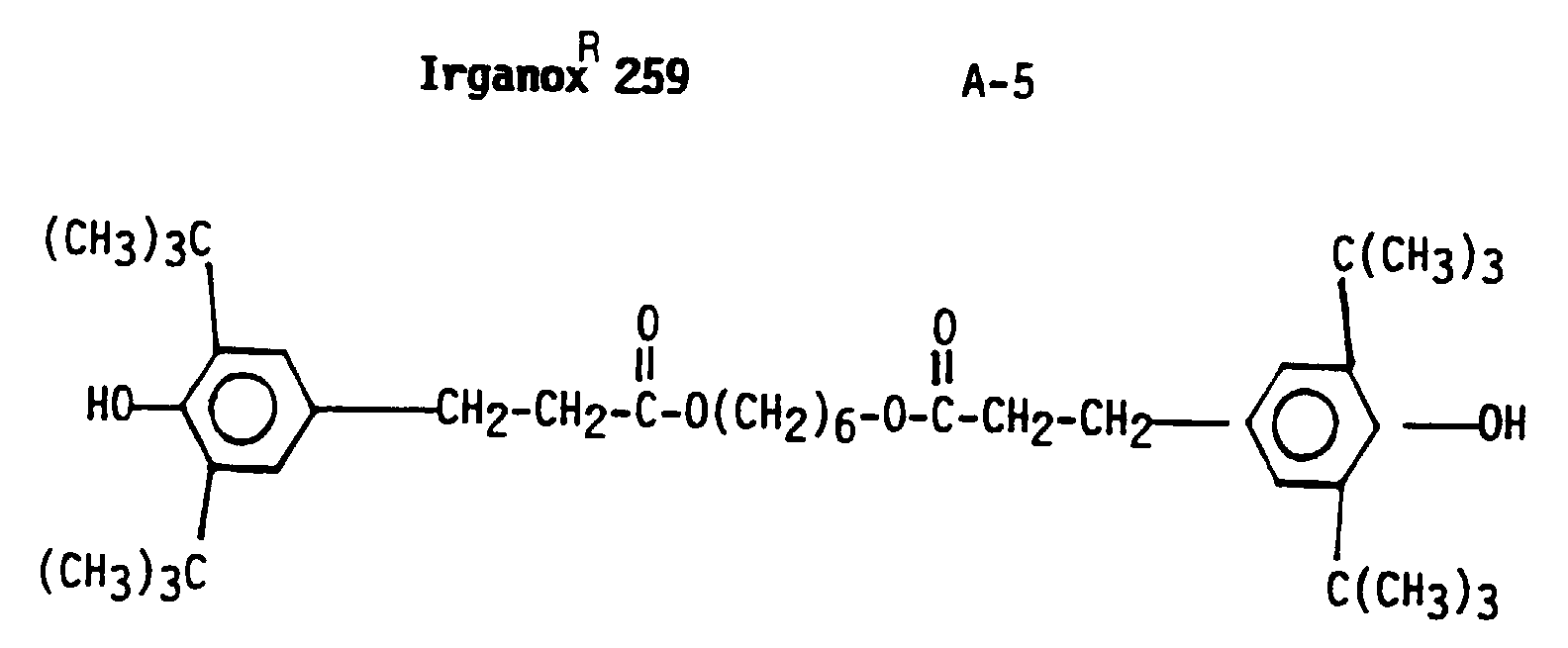
- the sterically hindered are particularly preferred as additional additives Phenols of the structure (A-1 and / or A-6) used.
- the additional additives d) ensure that the inherently good thermal stability of the textile smoothing agents according to the invention is further improved in a synergistic manner. This can be seen, inter alia, from the fact that significantly smaller amounts of the antioxidants d) have to be added than described, for example, in WO 91/13134 (10 to 20% by weight) in order to achieve comparable thermostabilities. For example, even amounts of 1.0% by weight of the sterically hindered Irganox R 1010 phenol - based on components a) to c) - give excellent thermal stability.
- the antioxidants d) in relation to the esters of thiocarboxylic acids in an amount from 1: 1 to 1: 4.
- the sterically hindered phenols particularly good results if the amount of additional Antioxidants d) 10 to 50% by weight, based on the esters of thiocarboxylic acids - Is, the range of 20 to 30 wt .-% is particularly preferred is.
- the textile smoothing agents according to the invention due to their high thermal stability, among other things can be used in spin finishes.
- Another subject of The present invention is therefore spin finishes for synthetic filaments, characterized in that they have the described thermostable contain textile smoothing agents.
- the textile smoothing agent in turn may contain the additional antioxidants d).
- the spin finishes contain at least about 35% by weight of the textile smoothing agents.
- Other components of the spin finishes can be emulsifiers, wetting agents and / or antistatic agents and those known from the prior art Auxiliaries such as thread closing agents, pH regulators, bactericides and / or anti-corrosion agents.
- Suitable emulsifiers, wetting agents and / or antistatic agents are anionic, cationic and / or nonionic surfactants, such as mono- and / or diglycerides, for example glycerol mono- and / or glycerol dioleate, alkoxylated, preferably ethoxylated and / or propoxylated fats or oils, fatty alcohols with 8 to 24 carbon atoms and / or C 8-18 alkylphenols, for example addition products of 25 mol ethylene oxide onto castor oil and / or addition products of 8 mol propylene oxide and 6 mol ethylene oxide onto C 16-18 fatty alcohols, if desired alkoxylated C 8- 24 fatty acid mono- and / or diethanolamides, for example - optionally ethoxylated - oleic acid mono- and / or diethanolamide, tallow fatty acid mono- and / or diethanolamide and / or coconut fatty acid mono- and / or
- alkyl sulfosuccinates for example sodium dioctyl sulfosuccinate and / or amine oxides, for example dimethyldodecylamine oxide.
- an antistatic can act as an emulsifier at about the same time.
- Suitable thread closure agents are the polyacrylates, fatty acid sarcosides and / or copolymers with maleic anhydride known from the prior art.
- Suitable pH regulators are C 1-4 carboxylic acids and / or C 1-4 hydroxycarboxylic acids, e.g. B. acetic acid and / or glycolic acid, alkali hydroxides such as potassium hydroxide and / or amines such as triethanolamide, the presence of bactericides and / or anti-corrosion agents is possible.
- the spin finishes according to the invention can be mixed intensively the textile smoothing agent according to the invention, optionally with the emulsifiers, Wetting agents, antistatic agents and, if necessary, with the usual additives Produce approx. 18-25 ° C.
- the thermal stability was determined by means of a bowl test. For this purpose, 3 g of substance were placed in an aluminum dish and exposed to a temperature of 250 ° C. in an oven for 3 hours. Then it was determined how much of the substance (in%) is still present after the thermal treatment. The higher the value, the better.
- the pure pentaerythritol full ester of pelargonic acid without any addition of antioxidants served as a comparison (comparison). example % Residue comparison 69.8 AA) 76.7 FROM) 96.6 AC) 89.2
- the application examples show that the textile smoothing agents according to the invention have a higher thermal stability than the pure ester (comparison), despite only minor additions to the thiocarboxylic acid esters. Furthermore shows that the addition of the smallest amounts of the sterically hindered Phenols synergistically improve thermal stability (see AB) and AC)). In addition, when using the invention textile smoothing agent the residues lighter colored and more liquid than comparable ones Esters without the addition of the esters of thiocarboxylic acids.
Landscapes
- Engineering & Computer Science (AREA)
- Textile Engineering (AREA)
- Health & Medical Sciences (AREA)
- Emergency Medicine (AREA)
- Treatments For Attaching Organic Compounds To Fibrous Goods (AREA)
- Chemical Or Physical Treatment Of Fibers (AREA)
Description
- c) Estern von Thiocarbonsäuren der allgemeinen Formel (I) und/oder (II)



| Beispiel | % Rückstand |
| Vergleich | 69,8 |
| AA) | 76,7 |
| AB) | 96,6 |
| AC) | 89,2 |
| Beispiel | % Rückstand nach | ||
| 10 | 13 | 16 Stunden | |
| Vergleich | 48,1 | 42,3 | 38,7 |
| AA) | 52,1 | 48,6 | 46,0 |
| AB) | 83,4 | 78,6 | 74,0 |
| AC) | 66,0 | 52,1 | 43,2. |
Claims (11)
- Thermostabile textile Glättemittel erhältlich durch Umsetzung vonin Gegenwart von 0,05 bis 8 Gew.-% - bezogen auf die Summe der Komponenten a) und b) ana) Polyolen mitb) Fettsäuren mit 6 bis 22 C-Atomenworin R1 einen einwertigen Rest und R2, R3, R4 gleiche oder verschiedene zweiwertige Reste von Alkanen, Cycloalkanen, Aromaten oder Alkylaromaten mit 1 bis 22 C-Atomen bedeuten.c) Ester der Thiocarbonsäuren der allgemeinen Formel (I) und/oder (II)
- Glättemittel nach Anspruch 1, dadurch gekennzeichnet, daß die Polyole ausgewählt sind aus der Gruppe Neopentylglykol, Glycerin, Trimethylolpropan und Pentaerythrit.
- Glättemittel nach Anspruch 1 oder 2, dadurch gekennzeichnet, daß die Fettsäuren 8 bis 18 C-Atome aufweisen und vorzugsweise gesättigt sind.
- Glättemittel nach einem der Ansprüche 1 bis 3, dadurch gekennzeichnet, daß die Fettsäuren Capryl-, Pelargon- und/oder Caprinsäure sind.
- Glättemittel nach einem der Ansprüche 1 bis 4, dadurch gekennzeichnet, daß die Thiocarbonsäuren mit aliphatischen monofunktionellen Alkoholen mit 1 bis 22 C-Atomen, Neopentylglykol, Glycerin, Trimethylolpropan oder Pentaerythrit verestert sind.
- Glättemittel nach einem der Ansprüche 1 bis 5, dadurch gekennzeichnet, daß in der Formel (I) R1 eine Alkylgruppe mit 6 bis 18 C-Atomen und R2 eine Alkylengruppe mit 1 oder 2 C-Atomen bedeutet.
- Glättemittel nach einem der Ansprüche 1 bis 6, dadurch gekennzeichnet, daß in der Formel (II) R3 und R4 eine Alkylengruppe mit 2 C-Atomen bedeutet.
- Glättemittel nach einem der Ansprüche 1 bis 7, dadurch gekennzeichnet, daß die Ester der Thiocarbonsäure in einer Menge von 0,5 bis 5 Gew.-%, insbesondere 1 bis 3 Gew.-% - bezogen auf die Summe der Komponenten a) und b) - zugegen sind.
- Glättemittel nach einem der Ansprüche 1 bis 8, dadurch gekennzeichnet, daß zusätzlich Antioxidantien, vorzugsweise sterisch gehinderte Phenole, als Additiv d) enthalten sind.
- Glättemittel nach einem der Ansprüche 1 bis 9, dadurch gekennzeichnet, daß die Antioxidantien im Verhältnis zu den Estern der Thiocarbonsäuren in einer Menge von 1:1 bis 1:4 enthalten sind.
- Spinnpräparationen für synthetische Filamente, dadurch gekennzeichnet, daß sie thermostabile textile Glättemittel nach Anspruch 1 enthalten.
Applications Claiming Priority (3)
| Application Number | Priority Date | Filing Date | Title |
|---|---|---|---|
| US08/260,852 US5464546A (en) | 1994-06-16 | 1994-06-16 | Thermally stable textile lubricants |
| US260852 | 1994-06-16 | ||
| PCT/EP1995/002189 WO1995034708A1 (de) | 1994-06-16 | 1995-06-07 | Thermostabile textile glättemittel |
Publications (2)
| Publication Number | Publication Date |
|---|---|
| EP0765415A1 EP0765415A1 (de) | 1997-04-02 |
| EP0765415B1 true EP0765415B1 (de) | 1998-09-30 |
Family
ID=22990898
Family Applications (1)
| Application Number | Title | Priority Date | Filing Date |
|---|---|---|---|
| EP95923248A Expired - Lifetime EP0765415B1 (de) | 1994-06-16 | 1995-06-07 | Thermostabile textile glättemittel |
Country Status (5)
| Country | Link |
|---|---|
| US (1) | US5464546A (de) |
| EP (1) | EP0765415B1 (de) |
| DE (1) | DE59503796D1 (de) |
| ES (1) | ES2121397T3 (de) |
| WO (1) | WO1995034708A1 (de) |
Families Citing this family (9)
| Publication number | Priority date | Publication date | Assignee | Title |
|---|---|---|---|---|
| US5972497A (en) * | 1996-10-09 | 1999-10-26 | Fiberco, Inc. | Ester lubricants as hydrophobic fiber finishes |
| WO1998024559A1 (en) * | 1996-12-05 | 1998-06-11 | Henkel Corporation | Thioesters as boundary lubricants |
| US6106942A (en) * | 1998-12-02 | 2000-08-22 | Celanese Acetate Llc | Liquid crystalline polymer monofilaments having improved adhesion characteristics |
| TWI225858B (en) * | 2000-08-02 | 2005-01-01 | Mj Res & Dev L P The General P | Lubricant and refrigerant oil system |
| RU2190712C1 (ru) * | 2001-01-16 | 2002-10-10 | Открытое акционерное общество "Арнест" | Средство для антистатической обработки текстильных изделий |
| KR101302940B1 (ko) * | 2003-04-02 | 2013-09-06 | 이데미쓰 고산 가부시키가이샤 | 전도성 윤활유 조성물 |
| JP6445205B1 (ja) * | 2018-06-28 | 2018-12-26 | 竹本油脂株式会社 | 合成繊維用処理剤及び合成繊維 |
| CN111576046A (zh) * | 2020-04-23 | 2020-08-25 | 桐乡市恒隆化工有限公司 | 一种原油上油的纺丝拉伸一步法用油剂及其制备方法 |
| CN113717778B (zh) * | 2021-08-23 | 2022-12-06 | 江苏悦孚油品有限公司 | 一种针织大圆机合成油及其制备方法 |
Family Cites Families (13)
| Publication number | Priority date | Publication date | Assignee | Title |
|---|---|---|---|---|
| GB360982A (en) * | 1935-02-24 | 1931-11-16 | Ig Farbenindustrie Ag | Improvements in or relating to the treatment of textiles |
| GB497574A (en) * | 1937-04-20 | 1938-12-20 | Lister And Company Ltd | Improvements in treating textiles and oils therefor |
| GB738749A (en) * | 1952-04-18 | 1955-10-19 | Exxon Research Engineering Co | Emulsifiable oleaginous composition |
| NL262835A (de) * | 1960-03-29 | |||
| US4066558A (en) * | 1974-02-11 | 1978-01-03 | Ici Americas Inc. | Low viscosity spin finish systems for neat finish application |
| US3963628A (en) * | 1974-06-07 | 1976-06-15 | Union Carbide Corporation | Fiber lubricant composition |
| US4069160A (en) * | 1975-01-20 | 1978-01-17 | Hoechst Fibers Industries, Division Of American Hoechst Corporation | Texturing finish for synthetic filaments |
| US4072617A (en) * | 1976-04-12 | 1978-02-07 | Dow Badische Company | Finish for acrylic fiber |
| US4111819A (en) * | 1977-11-14 | 1978-09-05 | Shell Oil Company | Textile fiber lubricant |
| US4371658A (en) * | 1980-05-05 | 1983-02-01 | Allied Corporation | Polyamide yarn spin finish containing a glyceride and oxidized polyethylene |
| US4400281A (en) * | 1981-08-19 | 1983-08-23 | Atlantic Richfield Co. | Yarn processing lubricants |
| DE3402155A1 (de) * | 1984-01-23 | 1985-07-25 | Henkel KGaA, 4000 Düsseldorf | Spinnpraeparation fuer das schmelzspinnen von synthetischen fasermaterialien |
| US5155244A (en) * | 1990-02-28 | 1992-10-13 | Karlshamns Ab | Preparation of antioxidant glyceride derivatives utilizing esterification |
-
1994
- 1994-06-16 US US08/260,852 patent/US5464546A/en not_active Expired - Lifetime
-
1995
- 1995-06-07 DE DE59503796T patent/DE59503796D1/de not_active Expired - Lifetime
- 1995-06-07 EP EP95923248A patent/EP0765415B1/de not_active Expired - Lifetime
- 1995-06-07 WO PCT/EP1995/002189 patent/WO1995034708A1/de not_active Ceased
- 1995-06-07 ES ES95923248T patent/ES2121397T3/es not_active Expired - Lifetime
Also Published As
| Publication number | Publication date |
|---|---|
| ES2121397T3 (es) | 1998-11-16 |
| EP0765415A1 (de) | 1997-04-02 |
| DE59503796D1 (en) | 1998-11-05 |
| US5464546A (en) | 1995-11-07 |
| WO1995034708A1 (de) | 1995-12-21 |
Similar Documents
| Publication | Publication Date | Title |
|---|---|---|
| EP0082456A2 (de) | Konzentrierte Vormischungen von Wäscheweichspülmitteln | |
| EP0765414B1 (de) | Thermostabile textile glättemittel | |
| DE2525407C3 (de) | Emulgierbares Textilschmiermittel | |
| DE3611027A1 (de) | Kaltwalzoel fuer stahl | |
| EP0729450B1 (de) | Verfahren zur herstellung von festen esterquats | |
| DE934886C (de) | Verfahren zur Herstellung von neuen Salzen von Polyestern aliphatischer Sulfodicarbonsaeuren | |
| WO1995034708A1 (de) | Thermostabile textile glättemittel | |
| EP0452774B1 (de) | Perfluoralkylgruppen enthaltende Pfropfcopolymerisate | |
| DE69900339T2 (de) | Mittel und Verfahren zur Behandlung von Kunstfasern | |
| EP0683763A1 (de) | Verfahren zur herstellung hellfarbiger polyolester | |
| DE4107283A1 (de) | Spinnpraeparationen fuer synthetische filamentfasern | |
| EP0675872B1 (de) | Quaternierte fettsäure-triethanolaminester-salze | |
| EP0029172B1 (de) | Alkanphosphonsäurehalbestersalze, ihre Herstellung und ihre Anwendung als Präparationsmittel für textile Fasern | |
| DE2148590C3 (de) | ||
| EP0118611B1 (de) | Wässrige Emulsionen und Verfahren zum Weichmachen von Fasermaterial, insbesondere von Textilmaterial | |
| DE2658862C3 (de) | Verwendung von Phosphorsäureestern als Faserpräparationsmittel | |
| EP0538714B2 (de) | Biologisch abbaubare Faserpräparationsmittel | |
| EP0361116A1 (de) | Polyurethanhaltige Spinnpräparationen | |
| EP1123300B1 (de) | Phosphorsäureester | |
| DE2225793C3 (de) | Verfahren zur kontinuierlichen Herstellung einer Mischung von primären und sekundären Phosphatestern von organischen Hydroxyverbindungen | |
| EP1144749A1 (de) | Textilbehandlungsmittel, verfahren zu deren herstellung sowie deren verwendung | |
| EP0674701B1 (de) | Wässrige textilweichmacher-dispersionen | |
| EP0303066A2 (de) | Gleitmittel zur Herstellung von synthetischen Fasern und Filamenten | |
| DE3851748T2 (de) | Schmiermittelzusammensetzung für spinnfasern. | |
| EP1347091B1 (de) | Färbereihilfsmittel |
Legal Events
| Date | Code | Title | Description |
|---|---|---|---|
| PUAI | Public reference made under article 153(3) epc to a published international application that has entered the european phase |
Free format text: ORIGINAL CODE: 0009012 |
|
| 17P | Request for examination filed |
Effective date: 19961209 |
|
| AK | Designated contracting states |
Kind code of ref document: A1 Designated state(s): CH DE ES FR GB IT LI NL |
|
| GRAG | Despatch of communication of intention to grant |
Free format text: ORIGINAL CODE: EPIDOS AGRA |
|
| 17Q | First examination report despatched |
Effective date: 19970820 |
|
| GRAG | Despatch of communication of intention to grant |
Free format text: ORIGINAL CODE: EPIDOS AGRA |
|
| GRAH | Despatch of communication of intention to grant a patent |
Free format text: ORIGINAL CODE: EPIDOS IGRA |
|
| GRAH | Despatch of communication of intention to grant a patent |
Free format text: ORIGINAL CODE: EPIDOS IGRA |
|
| GRAA | (expected) grant |
Free format text: ORIGINAL CODE: 0009210 |
|
| AK | Designated contracting states |
Kind code of ref document: B1 Designated state(s): CH DE ES FR GB IT LI NL |
|
| REG | Reference to a national code |
Ref country code: CH Ref legal event code: EP |
|
| REF | Corresponds to: |
Ref document number: 59503796 Country of ref document: DE Date of ref document: 19981105 |
|
| REG | Reference to a national code |
Ref country code: ES Ref legal event code: FG2A Ref document number: 2121397 Country of ref document: ES Kind code of ref document: T3 |
|
| GBT | Gb: translation of ep patent filed (gb section 77(6)(a)/1977) |
Effective date: 19981030 |
|
| ET | Fr: translation filed | ||
| PLBE | No opposition filed within time limit |
Free format text: ORIGINAL CODE: 0009261 |
|
| STAA | Information on the status of an ep patent application or granted ep patent |
Free format text: STATUS: NO OPPOSITION FILED WITHIN TIME LIMIT |
|
| 26N | No opposition filed | ||
| REG | Reference to a national code |
Ref country code: GB Ref legal event code: IF02 |
|
| REG | Reference to a national code |
Ref country code: CH Ref legal event code: PUE Owner name: HENKEL KOMMANDITGESELLSCHAFT AUF AKTIEN TRANSFER- |
|
| REG | Reference to a national code |
Ref country code: GB Ref legal event code: 732E |
|
| NLS | Nl: assignments of ep-patents |
Owner name: COGNIS DEUTSCHLAND GMBH & CO. KG |
|
| REG | Reference to a national code |
Ref country code: FR Ref legal event code: TP |
|
| PGFP | Annual fee paid to national office [announced via postgrant information from national office to epo] |
Ref country code: CH Payment date: 20080611 Year of fee payment: 14 |
|
| PGFP | Annual fee paid to national office [announced via postgrant information from national office to epo] |
Ref country code: IT Payment date: 20080626 Year of fee payment: 14 |
|
| REG | Reference to a national code |
Ref country code: CH Ref legal event code: PUE Owner name: COGNIS IP MANAGEMENT GMBH Free format text: COGNIS DEUTSCHLAND GMBH & CO. KG#HENKELSTRASSE 67#40589 DUESSELDORF (DE) -TRANSFER TO- COGNIS IP MANAGEMENT GMBH#HENKELSTRASSE 67#40589 DUESSELDORF (DE) |
|
| PGFP | Annual fee paid to national office [announced via postgrant information from national office to epo] |
Ref country code: ES Payment date: 20080717 Year of fee payment: 14 |
|
| PGFP | Annual fee paid to national office [announced via postgrant information from national office to epo] |
Ref country code: FR Payment date: 20080617 Year of fee payment: 14 |
|
| PGFP | Annual fee paid to national office [announced via postgrant information from national office to epo] |
Ref country code: GB Payment date: 20080611 Year of fee payment: 14 |
|
| REG | Reference to a national code |
Ref country code: FR Ref legal event code: TP |
|
| REG | Reference to a national code |
Ref country code: GB Ref legal event code: 732E Free format text: REGISTERED BETWEEN 20090514 AND 20090520 |
|
| NLS | Nl: assignments of ep-patents |
Owner name: COGNIS IP MANAGEMENT GMBH Effective date: 20090507 |
|
| REG | Reference to a national code |
Ref country code: CH Ref legal event code: PL |
|
| GBPC | Gb: european patent ceased through non-payment of renewal fee |
Effective date: 20090607 |
|
| REG | Reference to a national code |
Ref country code: FR Ref legal event code: ST Effective date: 20100226 |
|
| PG25 | Lapsed in a contracting state [announced via postgrant information from national office to epo] |
Ref country code: LI Free format text: LAPSE BECAUSE OF NON-PAYMENT OF DUE FEES Effective date: 20090630 Ref country code: FR Free format text: LAPSE BECAUSE OF NON-PAYMENT OF DUE FEES Effective date: 20090630 Ref country code: CH Free format text: LAPSE BECAUSE OF NON-PAYMENT OF DUE FEES Effective date: 20090630 |
|
| PG25 | Lapsed in a contracting state [announced via postgrant information from national office to epo] |
Ref country code: GB Free format text: LAPSE BECAUSE OF NON-PAYMENT OF DUE FEES Effective date: 20090607 |
|
| REG | Reference to a national code |
Ref country code: ES Ref legal event code: FD2A Effective date: 20090608 |
|
| PG25 | Lapsed in a contracting state [announced via postgrant information from national office to epo] |
Ref country code: ES Free format text: LAPSE BECAUSE OF NON-PAYMENT OF DUE FEES Effective date: 20090608 |
|
| PG25 | Lapsed in a contracting state [announced via postgrant information from national office to epo] |
Ref country code: IT Free format text: LAPSE BECAUSE OF NON-PAYMENT OF DUE FEES Effective date: 20090607 |
|
| REG | Reference to a national code |
Ref country code: DE Ref legal event code: R082 Ref document number: 59503796 Country of ref document: DE Representative=s name: HERZOG FIESSER & PARTNER, DE |
|
| REG | Reference to a national code |
Ref country code: DE Ref legal event code: R082 Ref document number: 59503796 Country of ref document: DE Representative=s name: HERZOG FIESSER & PARTNER, DE |
|
| REG | Reference to a national code |
Ref country code: DE Ref legal event code: R082 Ref document number: 59503796 Country of ref document: DE Representative=s name: HERZOG FIESSER & PARTNER, DE Effective date: 20120508 Ref country code: DE Ref legal event code: R082 Ref document number: 59503796 Country of ref document: DE Representative=s name: HERZOG FIESSER & PARTNER, DE Effective date: 20120515 Ref country code: DE Ref legal event code: R081 Ref document number: 59503796 Country of ref document: DE Owner name: FASHION CHEMICALS GMBH & CO. KG, DE Free format text: FORMER OWNER: COGNIS IP MANAGEMENT GMBH, 40589 DUESSELDORF, DE Effective date: 20120515 |
|
| PGFP | Annual fee paid to national office [announced via postgrant information from national office to epo] |
Ref country code: NL Payment date: 20120629 Year of fee payment: 18 |
|
| REG | Reference to a national code |
Ref country code: NL Ref legal event code: SD Effective date: 20120913 |
|
| PGFP | Annual fee paid to national office [announced via postgrant information from national office to epo] |
Ref country code: DE Payment date: 20120711 Year of fee payment: 18 |
|
| REG | Reference to a national code |
Ref country code: NL Ref legal event code: V1 Effective date: 20140101 |
|
| REG | Reference to a national code |
Ref country code: DE Ref legal event code: R119 Ref document number: 59503796 Country of ref document: DE Effective date: 20140101 |
|
| PG25 | Lapsed in a contracting state [announced via postgrant information from national office to epo] |
Ref country code: NL Free format text: LAPSE BECAUSE OF NON-PAYMENT OF DUE FEES Effective date: 20140101 Ref country code: DE Free format text: LAPSE BECAUSE OF NON-PAYMENT OF DUE FEES Effective date: 20140101 |