EP0765415B1 - Thermally stable textile smoothing agents - Google Patents
Thermally stable textile smoothing agents Download PDFInfo
- Publication number
- EP0765415B1 EP0765415B1 EP95923248A EP95923248A EP0765415B1 EP 0765415 B1 EP0765415 B1 EP 0765415B1 EP 95923248 A EP95923248 A EP 95923248A EP 95923248 A EP95923248 A EP 95923248A EP 0765415 B1 EP0765415 B1 EP 0765415B1
- Authority
- EP
- European Patent Office
- Prior art keywords
- lubricants
- esters
- acid
- weight
- thiocarboxylic
- Prior art date
- Legal status (The legal status is an assumption and is not a legal conclusion. Google has not performed a legal analysis and makes no representation as to the accuracy of the status listed.)
- Expired - Lifetime
Links
- 0 *c1cccc(*)c1O Chemical compound *c1cccc(*)c1O 0.000 description 4
Classifications
-
- D—TEXTILES; PAPER
- D06—TREATMENT OF TEXTILES OR THE LIKE; LAUNDERING; FLEXIBLE MATERIALS NOT OTHERWISE PROVIDED FOR
- D06M—TREATMENT, NOT PROVIDED FOR ELSEWHERE IN CLASS D06, OF FIBRES, THREADS, YARNS, FABRICS, FEATHERS OR FIBROUS GOODS MADE FROM SUCH MATERIALS
- D06M13/00—Treating fibres, threads, yarns, fabrics or fibrous goods made from such materials, with non-macromolecular organic compounds; Such treatment combined with mechanical treatment
- D06M13/244—Treating fibres, threads, yarns, fabrics or fibrous goods made from such materials, with non-macromolecular organic compounds; Such treatment combined with mechanical treatment with compounds containing sulfur or phosphorus
- D06M13/248—Treating fibres, threads, yarns, fabrics or fibrous goods made from such materials, with non-macromolecular organic compounds; Such treatment combined with mechanical treatment with compounds containing sulfur or phosphorus with compounds containing sulfur
- D06M13/252—Mercaptans, thiophenols, sulfides or polysulfides, e.g. mercapto acetic acid; Sulfonium compounds
-
- D—TEXTILES; PAPER
- D06—TREATMENT OF TEXTILES OR THE LIKE; LAUNDERING; FLEXIBLE MATERIALS NOT OTHERWISE PROVIDED FOR
- D06M—TREATMENT, NOT PROVIDED FOR ELSEWHERE IN CLASS D06, OF FIBRES, THREADS, YARNS, FABRICS, FEATHERS OR FIBROUS GOODS MADE FROM SUCH MATERIALS
- D06M13/00—Treating fibres, threads, yarns, fabrics or fibrous goods made from such materials, with non-macromolecular organic compounds; Such treatment combined with mechanical treatment
- D06M13/10—Treating fibres, threads, yarns, fabrics or fibrous goods made from such materials, with non-macromolecular organic compounds; Such treatment combined with mechanical treatment with compounds containing oxygen
- D06M13/144—Alcohols; Metal alcoholates
- D06M13/148—Polyalcohols, e.g. glycerol or glucose
-
- D—TEXTILES; PAPER
- D06—TREATMENT OF TEXTILES OR THE LIKE; LAUNDERING; FLEXIBLE MATERIALS NOT OTHERWISE PROVIDED FOR
- D06M—TREATMENT, NOT PROVIDED FOR ELSEWHERE IN CLASS D06, OF FIBRES, THREADS, YARNS, FABRICS, FEATHERS OR FIBROUS GOODS MADE FROM SUCH MATERIALS
- D06M13/00—Treating fibres, threads, yarns, fabrics or fibrous goods made from such materials, with non-macromolecular organic compounds; Such treatment combined with mechanical treatment
- D06M13/10—Treating fibres, threads, yarns, fabrics or fibrous goods made from such materials, with non-macromolecular organic compounds; Such treatment combined with mechanical treatment with compounds containing oxygen
- D06M13/224—Esters of carboxylic acids; Esters of carbonic acid
-
- D—TEXTILES; PAPER
- D06—TREATMENT OF TEXTILES OR THE LIKE; LAUNDERING; FLEXIBLE MATERIALS NOT OTHERWISE PROVIDED FOR
- D06M—TREATMENT, NOT PROVIDED FOR ELSEWHERE IN CLASS D06, OF FIBRES, THREADS, YARNS, FABRICS, FEATHERS OR FIBROUS GOODS MADE FROM SUCH MATERIALS
- D06M7/00—Treating fibres, threads, yarns, fabrics, or fibrous goods made of other substances with subsequent freeing of the treated goods from the treating medium, e.g. swelling, e.g. polyolefins
-
- D—TEXTILES; PAPER
- D06—TREATMENT OF TEXTILES OR THE LIKE; LAUNDERING; FLEXIBLE MATERIALS NOT OTHERWISE PROVIDED FOR
- D06M—TREATMENT, NOT PROVIDED FOR ELSEWHERE IN CLASS D06, OF FIBRES, THREADS, YARNS, FABRICS, FEATHERS OR FIBROUS GOODS MADE FROM SUCH MATERIALS
- D06M2200/00—Functionality of the treatment composition and/or properties imparted to the textile material
- D06M2200/40—Reduced friction resistance, lubricant properties; Sizing compositions
Definitions
- thermostable textile smoothing agents obtainable by reacting polyols with C 6-22 fatty acids in the presence of small amounts of special esters of thiocarboxylic acids and spin finishes which contain these textile smoothing agents.
- spin finishes are used used. These spin finishes all contain so-called textile smoothing agent to avoid friction between filaments or fibers and to minimize between filaments and governing bodies.
- textile Smoothing agents are increasingly being used in esters.
- thermal Stability thermal stability
- antioxidants such as butylated hydroxytoluene (BHT) to use because such connections are already in small up to medium quantities effectively improve the thermal stability.
- BHT butylated hydroxytoluene
- antioxidants e.g. B. the commercially known Irganox R 1010 known to those skilled in the art, the volatility of which is relatively low.
- this procedure has the disadvantage that this group of antioxidants has only a limited solubility in the esters. It follows from this that the required concentration of dissolved antioxidant cannot be achieved to a sufficient extent.
- a method for improving the solubility of antioxidants in smoothing agents is known from WO 91/13134, the antioxidant being incorporated into a carrier medium via covalent bonds.
- the teaching of WO 91/13134 in its preferred embodiment relates to the fact that so-called "superstable lubricants" are obtained when the proportion of the covalently bound antioxidant in the carrier medium is in the range from greater than 0 to 30% by weight.
- the proportion of the covalently bound antioxidant in the carrier medium is in each case 10 or 20% by weight.
- An example of a particularly suitable product is a textile smoothing agent in which 10% by weight of Irganox R 1010 is covalently bonded to pentaerythritol pelargonate as a carrier. From an economic and ecological point of view, however, it is desirable to minimize the antioxidant content.
- GB-A-454 449 describes the use of certain carboxylic acids or thiocarboxylic acids as a replacement for oleic acid as spinning oil.
- GB-A-738 749 describes a mixture of water-soluble alkali salt of an organic acid and water-insoluble fatty acid glycol ester or fatty alcohol ether as an additive in spin finishes to improve the emulsion properties.
- GB-A-930 336 describes esters of polyols and fatty acids in a mixture with other constituents as spinning oils. Thiocarboxylic acid esters are not included.
- GB-A-499 371 describes the addition of certain sulfur-containing compounds as antioxidants to smoothing agents which contain unsaturated compounds.
- the object of the present invention was to provide thermostable textile smoothing agents To provide the disadvantages of the known prior art avoid technology.
- the aim was to create thermostable textiles Developing smoothing agents that contain a minimal amount of antioxidants need.
- the polyols a) and the fatty acids b) can be saturated or olefinic unsaturated and straight or branched with respect to their carbon skeleton be.
- the radicals R 1 to R 4 can be saturated or olefinically unsaturated, straight-chain or branched, insofar as this is an alkyl, alkylene, cycloalkylene or cycloalkyl group or the alkyl part of an alkaryl group.
- Polyols are polyvalent in the context of the present invention Alcohols understood with at least 2 OH groups.
- the chemical constitution the polyols are not subject to any particular restrictions, i.e. they can be straight or branched.
- the polyols selected from that of glycerol, trimethylolpropane, neopentyl glycol and pentaerythritol formed group.
- the fatty acids with 8 to 18 carbon atoms are preferred, which are also preferably saturated.
- the best effects are achieved in the context of the present invention if fatty acids with 8 to 10 carbon atoms are used as component b).
- the latter acids are known to those skilled in the art as caprylic acid, pelargonic acid and capric acid. These acids can be used as component b) either individually or in mixtures. Mixtures of C 8 and C 10 fatty acids are known as so-called pre-fatty acids.
- esters of thiocarboxylic acids are preferred in which the thiocarboxylic acids of the general formula (I) and / or (II) with monofunctional aliphatic alcohols with 1 to 22 C atoms, neopentyl glycol, glycerin, trimethylolpropane or pentaerythritol are esterified.
- monofunctional aliphatic alcohols with 1 to 22 C atoms
- neopentyl glycol, glycerin, trimethylolpropane or pentaerythritol are esterified.
- polyfunctional alcohols neopentyl glycol, glycerin, Trimethylolpropane and pentaerythritol can be pure or else also act as mixed esters.
- esters are called “pure” esters understood in which all hydroxyl groups of the polyfunctional alcohols with one or more thiocarboxylic acids of the general formula (I) and / or (II) are esterified.
- “Mixed” esters are such Understood esters in which at least one hydroxyl group with a Thiocarboxylic acid of the general formula (I) or (II) is esterified. The other hydroxyl groups are then with fatty acids with 6 to 22 carbon atoms, as described in connection with component b), esterified.
- the esters of monofunctional aliphatic are particularly preferred Alcohols of the type described and the "pure” esters of pentaerythritol.
- the monofunctional aliphatic alcohols are particularly suitable n- and i-butanol, 2-ethylhexanol, isotridecanol, lauryl alcohol, isostearyl alcohol and / or oleyl alcohol.
- R 1 denotes an alkyl group with 6 to 18 C atoms
- R 2 denotes an alkylene group with 1 or 2 C atoms.
- Particularly suitable examples are ⁇ -laurylthiopropionic acid (C 12 H 25 SCH 2 CH 2 COOH) and ⁇ -octylthiopropionic acid (C 8 H 17 SCH 2 CH 2 COOH).
- R 3 and R 4 are an alkylene group having 2 carbon atoms, ie thiodipropionic acid (HOOCCH 2 CH 2 SCH 2 CH 2 COOH).
- esters of thiocarboxylic acid are commercially available compounds that but are also easily accessible by known esterification reactions.
- the mixed esters can easily be obtained by transesterification of the pure thioates obtained with the fatty acids described.
- esters of thiocarboxylic acids in an amount of 0.05 to 8 % By weight, based on the sum of components a) and b), is used. It is preferred to use the esters of thiocarboxylic acids in an amount of 0.5 to 5 wt .-%, in particular from 1.0 to 3.0 wt .-%, use. This The quantities used relate to the quantities defined above on pure esters of thiocarboxylic acids. With mixed esters of thiocarboxylic acids are in accordance with the content of thiocarboxylic acids in the ester use higher quantities.
- esters of thiocarboxylic acids can be used in the Implementation between polyols a) and fatty acids b) from the beginning be or be added only during the implementation. Furthermore they can be added in their entirety or in portions will.
- the reaction between polyols a) and the fatty acids b) takes place under the conditions customary for esterification reactions.
- the presence the esters of thiocarboxylic acids of the general formula (I) and / or (II) causes an improvement in thermal stability on the one hand and on the other a color improvement of the textile smoothing agents obtained, since these are lighter in color than when manufactured without the presence of those described Esters of thiocarboxylic acids.
- the invention Agents additionally added antioxidants as additive d).
- This Antioxidants are added after the reaction of the polyols a) with fatty acids b) added in the presence of the esters of thiocarboxylic acids.
- antioxidants butylated hydroxytoluene, dialkyl or diarylphosphonates are suitable, Trialkyl or triaryl phosphites, ascorbic or citric acid and their Derivatives and especially sterically hindered phenols.
- the sterically hindered are particularly preferred as additional additives Phenols of the structure (A-1 and / or A-6) used.
- the additional additives d) ensure that the inherently good thermal stability of the textile smoothing agents according to the invention is further improved in a synergistic manner. This can be seen, inter alia, from the fact that significantly smaller amounts of the antioxidants d) have to be added than described, for example, in WO 91/13134 (10 to 20% by weight) in order to achieve comparable thermostabilities. For example, even amounts of 1.0% by weight of the sterically hindered Irganox R 1010 phenol - based on components a) to c) - give excellent thermal stability.
- the antioxidants d) in relation to the esters of thiocarboxylic acids in an amount from 1: 1 to 1: 4.
- the sterically hindered phenols particularly good results if the amount of additional Antioxidants d) 10 to 50% by weight, based on the esters of thiocarboxylic acids - Is, the range of 20 to 30 wt .-% is particularly preferred is.
- the textile smoothing agents according to the invention due to their high thermal stability, among other things can be used in spin finishes.
- Another subject of The present invention is therefore spin finishes for synthetic filaments, characterized in that they have the described thermostable contain textile smoothing agents.
- the textile smoothing agent in turn may contain the additional antioxidants d).
- the spin finishes contain at least about 35% by weight of the textile smoothing agents.
- Other components of the spin finishes can be emulsifiers, wetting agents and / or antistatic agents and those known from the prior art Auxiliaries such as thread closing agents, pH regulators, bactericides and / or anti-corrosion agents.
- Suitable emulsifiers, wetting agents and / or antistatic agents are anionic, cationic and / or nonionic surfactants, such as mono- and / or diglycerides, for example glycerol mono- and / or glycerol dioleate, alkoxylated, preferably ethoxylated and / or propoxylated fats or oils, fatty alcohols with 8 to 24 carbon atoms and / or C 8-18 alkylphenols, for example addition products of 25 mol ethylene oxide onto castor oil and / or addition products of 8 mol propylene oxide and 6 mol ethylene oxide onto C 16-18 fatty alcohols, if desired alkoxylated C 8- 24 fatty acid mono- and / or diethanolamides, for example - optionally ethoxylated - oleic acid mono- and / or diethanolamide, tallow fatty acid mono- and / or diethanolamide and / or coconut fatty acid mono- and / or
- alkyl sulfosuccinates for example sodium dioctyl sulfosuccinate and / or amine oxides, for example dimethyldodecylamine oxide.
- an antistatic can act as an emulsifier at about the same time.
- Suitable thread closure agents are the polyacrylates, fatty acid sarcosides and / or copolymers with maleic anhydride known from the prior art.
- Suitable pH regulators are C 1-4 carboxylic acids and / or C 1-4 hydroxycarboxylic acids, e.g. B. acetic acid and / or glycolic acid, alkali hydroxides such as potassium hydroxide and / or amines such as triethanolamide, the presence of bactericides and / or anti-corrosion agents is possible.
- the spin finishes according to the invention can be mixed intensively the textile smoothing agent according to the invention, optionally with the emulsifiers, Wetting agents, antistatic agents and, if necessary, with the usual additives Produce approx. 18-25 ° C.
- the thermal stability was determined by means of a bowl test. For this purpose, 3 g of substance were placed in an aluminum dish and exposed to a temperature of 250 ° C. in an oven for 3 hours. Then it was determined how much of the substance (in%) is still present after the thermal treatment. The higher the value, the better.
- the pure pentaerythritol full ester of pelargonic acid without any addition of antioxidants served as a comparison (comparison). example % Residue comparison 69.8 AA) 76.7 FROM) 96.6 AC) 89.2
- the application examples show that the textile smoothing agents according to the invention have a higher thermal stability than the pure ester (comparison), despite only minor additions to the thiocarboxylic acid esters. Furthermore shows that the addition of the smallest amounts of the sterically hindered Phenols synergistically improve thermal stability (see AB) and AC)). In addition, when using the invention textile smoothing agent the residues lighter colored and more liquid than comparable ones Esters without the addition of the esters of thiocarboxylic acids.
Landscapes
- Engineering & Computer Science (AREA)
- Textile Engineering (AREA)
- Health & Medical Sciences (AREA)
- Emergency Medicine (AREA)
- Treatments For Attaching Organic Compounds To Fibrous Goods (AREA)
- Chemical Or Physical Treatment Of Fibers (AREA)
Description
Die Erfindung betrifft thermostabile textile Glättemittel erhältlich durch Umsetzung von Polyolen mit C6-22-Fettsäuren in Gegenwart geringer Mengen an speziellen Estern von Thiocarbonsäuren sowie Spinnpräparationen, die diese textilen Glättemittel enthalten.The invention relates to thermostable textile smoothing agents obtainable by reacting polyols with C 6-22 fatty acids in the presence of small amounts of special esters of thiocarboxylic acids and spin finishes which contain these textile smoothing agents.
Bei der Herstellung und Verarbeitung synthetischer Fasern werden Spinnpräparationen eingesetzt. Diese Spinnpräparationen enthalten alle sogenannte textile Glättemittel, um Reibungen zwischen Filamenten bzw. Fasern und zwischen Filamenten und Führungsorganen herabzusetzen. Als textile Glättemittel werden in zunehmendem Maße Ester eingesetzt. Die zunehmende Automatisierung der Fertigungsprozesse hat dazu geführt, daß an die textilen Glättemittel extrem hohe Anforderungen in Bezug auf ihre thermische Stabilität (Thermostabilität) gestellt werden. Diesen hohen Anforderungen können selbst die als thermisch stabil bekannten Ester ohne weitere Zusätze kaum mehr in ausreichendem Maße entsprechen.In the manufacture and processing of synthetic fibers, spin finishes are used used. These spin finishes all contain so-called textile smoothing agent to avoid friction between filaments or fibers and to minimize between filaments and governing bodies. As a textile Smoothing agents are increasingly being used in esters. The increasing Automation of manufacturing processes has led to the textile Smoothing agents have extremely high requirements with regard to their thermal Stability (thermal stability) are provided. These high demands can even the esters known as thermally stable without further additives hardly correspond to a sufficient extent.
Es ist daher vorgeschlagen worden, Antioxidantien wie butyliertes Hydroxytoluol (BHT) einzusetzen, weil derartige Verbindungen bereits in geringen bis mittleren Mengen die Thermostabilität wirksam verbessern. It has therefore been suggested to use antioxidants such as butylated hydroxytoluene (BHT) to use because such connections are already in small up to medium quantities effectively improve the thermal stability.
Unglücklicherweise haben BHT und verwandte Antioxidantien bei den Temperaturen, die bei der Herstellung und Verarbeitung textiler Fasern auftreten, eine relativ hohe Flüchtigkeit. Dies führt dazu, daß diese Klasse von Antioxidantien sich rasch verflüchtigt und daher seinen Zweck, eine oxidative Schädigung des textilen Glättemittels zu verhindern, nur anfänglich, aber nicht für den gesamten Prozeß erfüllen kann.Unfortunately, BHT and related antioxidants at temperatures, that occur in the manufacture and processing of textile fibers, a relatively high volatility. As a result, this class of Antioxidants evaporate quickly and therefore its purpose is an oxidative To prevent damage to the textile smoothing agent, only initially, but cannot satisfy the entire process.
Es ist weiter vorgeschlagen worden, sterisch gehinderte Phenole als Antioxidantien, z. B. das dem Fachmann bekannte handelsübliche IrganoxR 1010, deren Flüchtigkeit relativ gering ist, einzusetzen. Dieses Vorgehen ist jedoch mit dem Nachteil verbunden, daß diese Gruppe von Antioxidantien nur eine begrenzte Löslichkeit in den Estern aufweist. Daraus ergibt sich, daß die erforderliche Konzentration an gelöstem Antioxidans nicht in ausreichendem Maße erreicht werden kann.It has also been proposed to use sterically hindered phenols as antioxidants, e.g. B. the commercially known Irganox R 1010 known to those skilled in the art, the volatility of which is relatively low. However, this procedure has the disadvantage that this group of antioxidants has only a limited solubility in the esters. It follows from this that the required concentration of dissolved antioxidant cannot be achieved to a sufficient extent.
Aus WO 91/13134 ist ein Verfahren zur Verbesserung der Löslichkeit von Antioxidantien in Glättemitteln bekannt, wobei das Antioxidans über kovalente Bindungen in ein Trägermedium eingebaut wird. Die Lehre der WO 91/13134 bezieht sich dabei in ihrer bevorzugten Ausführungsform darauf, daß sogenannte "superstable lubricants" dann erhalten werden, wenn der Anteil des kovalenten gebundenen Antioxidans in dem Trägermedium im Bereich von größer 0 bis 30 Gew.-% liegt. In den Ausführungsbeispielen beträgt der Anteil des kovalent gebundenen Antioxidans in dem Trägermedium jeweils 10 bzw. 20 Gew.-%. Als Beispiel für ein besonders geeignetes Produkt wird ein textiles Glättemittel genannt, bei dem 10 Gew.-% IrganoxR 1010 mit Pentaerythritpelargonat als Träger kovalent verbunden ist. Aus ökonomischer und ökologischer Sicht ist es jedoch wünschenswert, den Gehalt an Antioxidantien zu minimieren.A method for improving the solubility of antioxidants in smoothing agents is known from WO 91/13134, the antioxidant being incorporated into a carrier medium via covalent bonds. The teaching of WO 91/13134 in its preferred embodiment relates to the fact that so-called "superstable lubricants" are obtained when the proportion of the covalently bound antioxidant in the carrier medium is in the range from greater than 0 to 30% by weight. In the exemplary embodiments, the proportion of the covalently bound antioxidant in the carrier medium is in each case 10 or 20% by weight. An example of a particularly suitable product is a textile smoothing agent in which 10% by weight of Irganox R 1010 is covalently bonded to pentaerythritol pelargonate as a carrier. From an economic and ecological point of view, however, it is desirable to minimize the antioxidant content.
GB-A-454 449 beschreibt die Verwendung bestimmter Carbonsäuren oder Thiocarbonsäuren als Ersatz für Olsäure als Spinnöl.GB-A-454 449 describes the use of certain carboxylic acids or thiocarboxylic acids as a replacement for oleic acid as spinning oil.
GB-A-738 749 beschreibt eine Mischung aus wasserlöslichem Alkalisalz einer organischen Säure und wasserunlöslichem Fettsäureglykolester oder Fettalkoholether als Zusatz in Spinnpräparationen zur Verbesserung der Emulsionseigenschaften.GB-A-738 749 describes a mixture of water-soluble alkali salt of an organic acid and water-insoluble fatty acid glycol ester or fatty alcohol ether as an additive in spin finishes to improve the emulsion properties.
GB-A-930 336 beschreibt Ester von Polyolen und Fettsäuren in Mischung mit weiteren Bestandteilen als Spinnöle. Thiocarbonsäureester sind nicht enthalten. GB-A-930 336 describes esters of polyols and fatty acids in a mixture with other constituents as spinning oils. Thiocarboxylic acid esters are not included.
GB-A-499 371 schließlich beschreibt die Zugabe bestimmter Schwefelhaltiger Verbindungen als Oxidationsverhinderer zu Glättemitteln, die ungesättigte Verbindungen enthalten.Finally, GB-A-499 371 describes the addition of certain sulfur-containing compounds as antioxidants to smoothing agents which contain unsaturated compounds.
Aufgabe der vorliegenden Erfindung war es, thermostabile textile Glättemittel bereitzustellen, die die genannten Nachteile des bekannten Standes der Technik vermeiden. Insbesondere war angestrebt, thermostabile textile Glättemittel zu entwickeln, die einen nur minimalen Anteil an Antioxidantien benötigen.The object of the present invention was to provide thermostable textile smoothing agents To provide the disadvantages of the known prior art avoid technology. In particular, the aim was to create thermostable textiles Developing smoothing agents that contain a minimal amount of antioxidants need.
Diese Aufgabe wurde erfindungsgemäß gelöst durch Glättemittel, die erhältlich
sind durch Umsetzung von
Die Polyole a) sowie die Fettsäuren b) können gesättigt oder olefinisch ungesättigt und in Bezug auf ihr Kohlenstoffgerüst geradkettig oder verzweigt sein. The polyols a) and the fatty acids b) can be saturated or olefinic unsaturated and straight or branched with respect to their carbon skeleton be.
Die Reste R1 bis R4 können gesättigt oder olefinisch ungesättigt, geradkettig oder verzweigt sein, insoweit als es sich dabei um eine Alkyl-, Alkylen-, Cycloalkylen- oder Cycloalkylgruppe bzw. den Alkylteil einer Alkarylgruppe handelt.The radicals R 1 to R 4 can be saturated or olefinically unsaturated, straight-chain or branched, insofar as this is an alkyl, alkylene, cycloalkylene or cycloalkyl group or the alkyl part of an alkaryl group.
Unter Polyolen werden im Rahmen der vorliegenden Erfindung mehrwertige Alkohole mit mindestens 2 OH-Gruppen verstanden. Die chemische Konstitution der Polyole unterliegt dabei an sich keinen besonderen Beschränkungen, d.h. sie können geradkettig oder auch verzweigt sein. Bevorzugt sind die Polyole ausgewählt aus der von Glycerin, Trimethylolpropan, Neopentylglykol und Pentaerythrit gebildeten Gruppe.Polyols are polyvalent in the context of the present invention Alcohols understood with at least 2 OH groups. The chemical constitution the polyols are not subject to any particular restrictions, i.e. they can be straight or branched. Are preferred the polyols selected from that of glycerol, trimethylolpropane, neopentyl glycol and pentaerythritol formed group.
In Bezug auf die Komponente b) sind die Fettsäuren mit 8 bis 18 C-Atomen bevorzugt, die zudem vorzugsweise gesättigt sind. Die besten Effekte werden im Rahmen der vorliegenden Erfindung dann erzielt, wenn als Komponente b) Fettsäuren mit 8 bis 10 C-Atomen eingesetzt werden. Die letztgenannten Säuren sind dem Fachmann als Caprylsäure, Pelargonsäure und Caprinsäure bekannt. Diese Säuren können als Komponente b) entweder einzeln oder in Mischungen eingesetzt werden. Dabei sind Mischungen von C8- und C10-Fettsäure als sogenannte Vorlauf-Fettsäuren bekannt.With regard to component b), the fatty acids with 8 to 18 carbon atoms are preferred, which are also preferably saturated. The best effects are achieved in the context of the present invention if fatty acids with 8 to 10 carbon atoms are used as component b). The latter acids are known to those skilled in the art as caprylic acid, pelargonic acid and capric acid. These acids can be used as component b) either individually or in mixtures. Mixtures of C 8 and C 10 fatty acids are known as so-called pre-fatty acids.
In Bezug auf die Komponente c) sind solche Ester der Thiocarbonsäuren bevorzugt, bei denen die Thiocarbonsäuren der allgemeinen Formel (I) und/oder (II) mit monofunktionellen aliphatischen Alkoholen mit 1 bis 22 C-Atomen, Neopentylglykol, Glycerin, Trimethylolpropan oder Pentaerythrit verestert sind. Bei den mehrfunktionellen Alkoholen Neopentylglykol, Glycerin, Trimethylolpropan und Pentaerythrit kann es sich um reine oder aber auch um gemischte Ester handeln. Unter "reinen" Estern werden solche Ester verstanden, in denen alle Hydroxylgruppen der mehrfunktionellen Alkohole mit einer oder mehreren Thiocarbonsäuren der allgemeinen Formel (I) und/oder (II) verestert sind. Unter "gemischten" Estern werden solche Ester verstanden, in denen wenigstens eine Hydroxylgruppe mit einer Thiocarbonsäure der allgemeinen Formel (I) oder (II) verestert ist. Die anderen Hydroxylgruppen sind dann mit Fettsäuren mit 6 bis 22 C-Atomen, wie sie im Zusammenhang mit der Komponente b) beschrieben sind, verestert. Besonders bevorzugt werden die Ester von monofunktionellen aliphatischen Alkoholen der beschriebenen Art und die "reinen" Ester des Pentaerythrits. Bei den monofunktionellen aliphatischen Alkoholen eignen sich insbesondere n- und i-Butanol, 2-Ethylhexanol, Isotridecanol, Laurylalkohol, Isostearylalkohol und/oder Oleylalkohol.With regard to component c), such esters of thiocarboxylic acids are preferred in which the thiocarboxylic acids of the general formula (I) and / or (II) with monofunctional aliphatic alcohols with 1 to 22 C atoms, neopentyl glycol, glycerin, trimethylolpropane or pentaerythritol are esterified. For the polyfunctional alcohols neopentyl glycol, glycerin, Trimethylolpropane and pentaerythritol can be pure or else also act as mixed esters. Such "esters" are called "pure" esters understood in which all hydroxyl groups of the polyfunctional alcohols with one or more thiocarboxylic acids of the general formula (I) and / or (II) are esterified. "Mixed" esters are such Understood esters in which at least one hydroxyl group with a Thiocarboxylic acid of the general formula (I) or (II) is esterified. The other hydroxyl groups are then with fatty acids with 6 to 22 carbon atoms, as described in connection with component b), esterified. The esters of monofunctional aliphatic are particularly preferred Alcohols of the type described and the "pure" esters of pentaerythritol. The monofunctional aliphatic alcohols are particularly suitable n- and i-butanol, 2-ethylhexanol, isotridecanol, lauryl alcohol, isostearyl alcohol and / or oleyl alcohol.
Unter den Thiocarbonsäuren der allgemeinen Formel (I) werden solche bevorzugt, in der R1 eine Alkylgruppe mit 6 bis 18 C- Atomen und R2 eine Alkylengruppe mit 1 oder 2 C-Atomen bedeutet. Besonders geeignete Beispiele sind β-Laurylthiopropionsäure (C12H25SCH2CH2COOH) und β-Octylthiopropionsäure (C8H17SCH2CH2COOH).Among the thiocarboxylic acids of the general formula (I), preference is given to those in which R 1 denotes an alkyl group with 6 to 18 C atoms and R 2 denotes an alkylene group with 1 or 2 C atoms. Particularly suitable examples are β-laurylthiopropionic acid (C 12 H 25 SCH 2 CH 2 COOH) and β-octylthiopropionic acid (C 8 H 17 SCH 2 CH 2 COOH).
Unter den Thiocarbonsäuren der allgemeinen Formel (II) werden solche bevorzugt, in der R3 und R4 eine Alkylengruppe mit 2 C-Atomen bedeutet, d.h. die Thiodipropionsäure (HOOCCH2CH2SCH2CH2COOH).Among the thiocarboxylic acids of the general formula (II), preference is given to those in which R 3 and R 4 are an alkylene group having 2 carbon atoms, ie thiodipropionic acid (HOOCCH 2 CH 2 SCH 2 CH 2 COOH).
Die Ester der Thiocarbonsäure sind im Handel erhältliche Verbindungen, die aber auch leicht durch bekannte Veresterungsreaktionen zugänglich sind. Die gemischten Ester kann man leicht durch Umesterung der reinen Thiosäureester mit den beschriebenen Fettsäuren erhalten.The esters of thiocarboxylic acid are commercially available compounds that but are also easily accessible by known esterification reactions. The mixed esters can easily be obtained by transesterification of the pure thioates obtained with the fatty acids described.
Bei der Herstellung der erfindungsgemäßen thermostabilen textilen Glättemittel werden die Ester der Thiocarbonsäuren in einer Menge von 0,05 bis 8 Gew.-% - bezogen auf die Summe der Komponenten a) und b) - eingesetzt. Dabei ist es bevorzugt, die Ester der Thiocarbonsäuren in einer Menge von 0,5 bis 5 Gew.-%, insbesondere von 1,0 bis 3,0 Gew.-%, einzusetzen. Diese Angabe der eingesetzten Mengen beziehen sich auf die oben definierten Mengen an reinen Estern der Thiocarbonsäuren. Bei gemischten Estern der Thiocarbonsäuren sind entsprechend dem Gehalt an Thiocarbonsäuren im Ester höhere Mengen einzusetzen. Die Ester der Thiocarbonsäuren können bei der Umsetzung zwischen Polyolen a) und Fettsäuren b) von Anfang an zugegen sein oder aber auch erst während der Umsetzung zugegeben werden. Desweiteren können sie in ihrer gesamten Menge oder auch portionsweise zugegeben werden. Die Umsetzung zwischen Polyolen a) und den Fettsäuren b) erfolgt unter den für Veresterungsreaktionen üblichen Bedingungen. Die Gegenwart der Ester der Thiocarbonsäuren der allgemeinen Formel (I) und/oder (II) bewirkt zum einen eine Verbesserung der Thermostabilität und zum anderen eine Farbverbesserung der dabei erhaltenen textilen Glättemittel, da diese in ihrer Farbe heller sind als bei Herstellung ohne die Gegenwart der beschriebenen Ester der Thiocarbonsäuren.In the manufacture of the thermostable textile smoothing agents according to the invention are the esters of thiocarboxylic acids in an amount of 0.05 to 8 % By weight, based on the sum of components a) and b), is used. It is preferred to use the esters of thiocarboxylic acids in an amount of 0.5 to 5 wt .-%, in particular from 1.0 to 3.0 wt .-%, use. This The quantities used relate to the quantities defined above on pure esters of thiocarboxylic acids. With mixed esters of thiocarboxylic acids are in accordance with the content of thiocarboxylic acids in the ester use higher quantities. The esters of thiocarboxylic acids can be used in the Implementation between polyols a) and fatty acids b) from the beginning be or be added only during the implementation. Furthermore they can be added in their entirety or in portions will. The reaction between polyols a) and the fatty acids b) takes place under the conditions customary for esterification reactions. The presence the esters of thiocarboxylic acids of the general formula (I) and / or (II) causes an improvement in thermal stability on the one hand and on the other a color improvement of the textile smoothing agents obtained, since these are lighter in color than when manufactured without the presence of those described Esters of thiocarboxylic acids.
In einer Ausführungsform der vorliegenden Erfindung werden den erfindungsgemäßen Mitteln zusätzlich Antioxidantien als Additiv d) zugegeben. Diese Antioxidantien werden nach der Umsetzung der Polyolen a) mit Fettsäuren b) in Gegenwart der Ester der Thiocarbonsäuren zugegeben. Als Antioxidantien eignen sich butyliertes Hydroxytoluol, Dialkyl- oder Diarylphosphonate, Trialkyl- oder Triarylphosphite, Ascorbin- oder Zitronensäure und deren Derivate und in besonderem Maße sterisch gehinderte Phenole.In one embodiment of the present invention, the invention Agents additionally added antioxidants as additive d). This Antioxidants are added after the reaction of the polyols a) with fatty acids b) added in the presence of the esters of thiocarboxylic acids. As antioxidants butylated hydroxytoluene, dialkyl or diarylphosphonates are suitable, Trialkyl or triaryl phosphites, ascorbic or citric acid and their Derivatives and especially sterically hindered phenols.
Als spezielle Beispiele für erfindungsgemäß geeignete sterisch gehinderte
Phenole seien die nachstehend aufgeführten Verbindungen A-1 bis A-6 genannt.

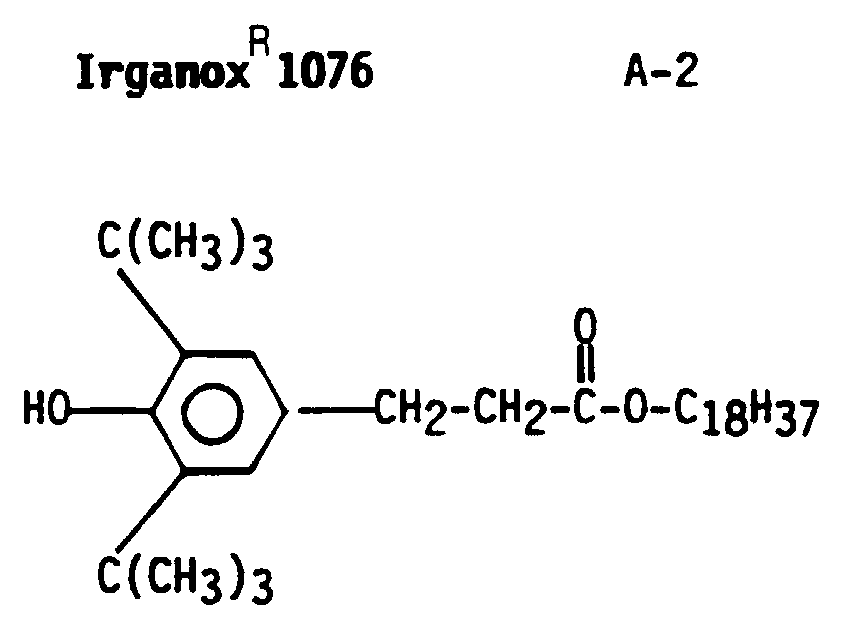

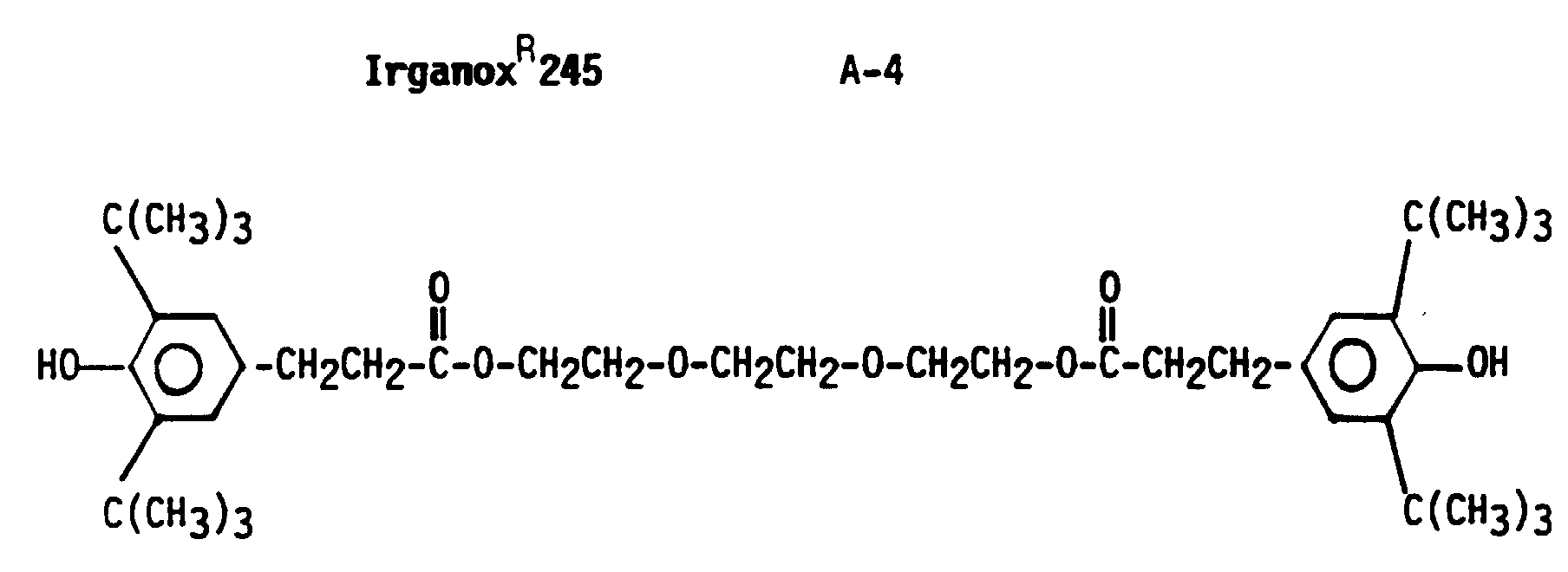
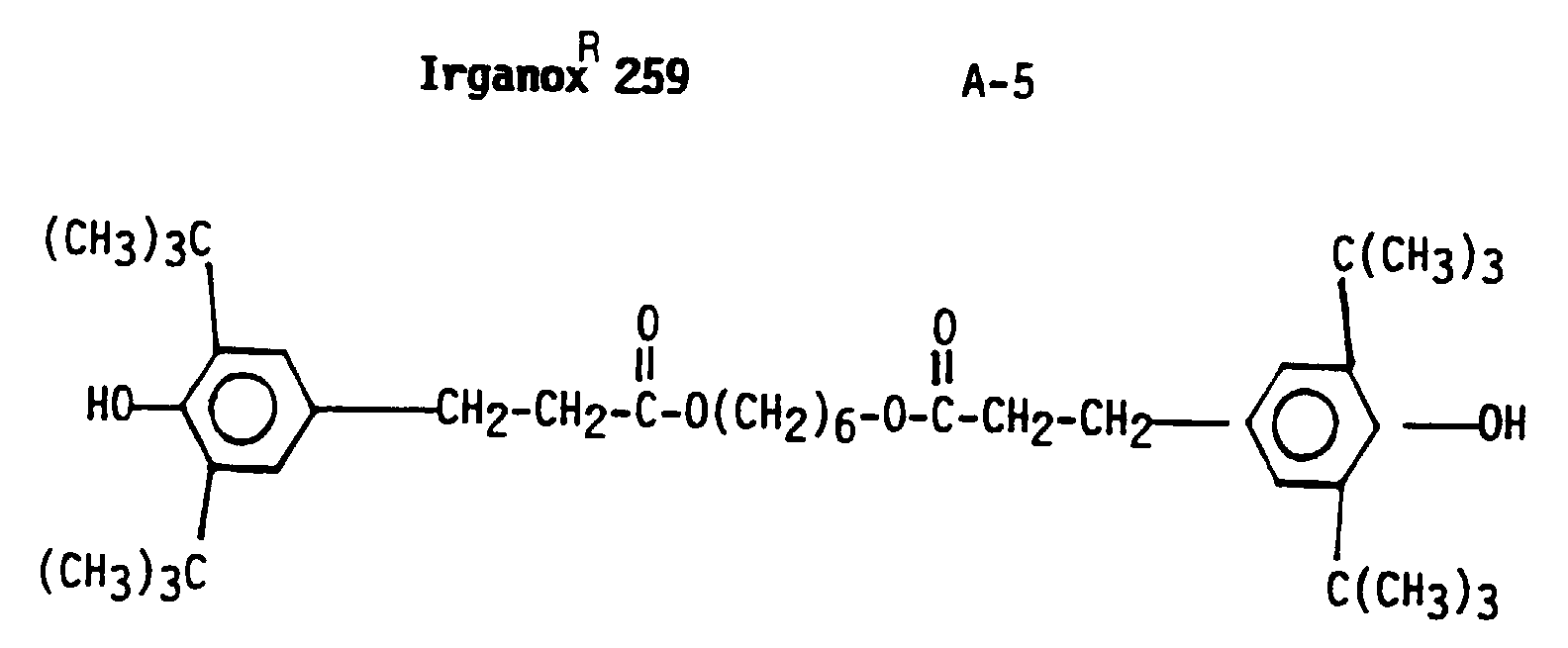

Besonders bevorzugt werden als zusätzliche Additive die sterisch gehinderten Phenole der Struktur (A-1 und/oder A-6) eingesetzt.The sterically hindered are particularly preferred as additional additives Phenols of the structure (A-1 and / or A-6) used.
Durch die zusätzlichen Additive d) wird erreicht, daß die an sich schon gute Thermostabilität der erfindungsgemäßen textilen Glättemittel in synergistischer Weise weiter verbessert wird. Dies ist unter anderem daran zu erkennen, daß wesentlich geringere Mengen an den Antioxidantien d) zugesetzt werden müssen als beispielsweise in der WO 91/13134 (10 bis 20 Gew.%) beschrieben, um vergleichbare Thermostabilitäten zu erreichen. So ergeben beispielsweise schon Mengen von 1,0 Gew.% an dem sterisch gehinderten Phenol IrganoxR 1010 - bezogen auf die Komponenten a) bis c) - hervorragende Thermostabilitäten.The additional additives d) ensure that the inherently good thermal stability of the textile smoothing agents according to the invention is further improved in a synergistic manner. This can be seen, inter alia, from the fact that significantly smaller amounts of the antioxidants d) have to be added than described, for example, in WO 91/13134 (10 to 20% by weight) in order to achieve comparable thermostabilities. For example, even amounts of 1.0% by weight of the sterically hindered Irganox R 1010 phenol - based on components a) to c) - give excellent thermal stability.
Generell gesehen, empfiehlt es sich im Sinne der Erfindung, die Antioxidantien d) im Verhältnis zu den Estern der Thiocarbonsäuren in einer Menge von 1:1 bis 1:4 zuzugeben. Dabei werden bei den sterisch gehinderten Phenolen besonders gute Ergebnisse erzielt, wenn die Menge der zusätzlichen Antioxidantien d) 10 bis 50 Gew.% - bezogen auf die Ester der Thiocarbonsäuren - beträgt, wobei der Bereich von 20 bis 30 Gew.-% besonders bevorzugt ist.Generally speaking, it is recommended in the sense of the invention, the antioxidants d) in relation to the esters of thiocarboxylic acids in an amount from 1: 1 to 1: 4. The sterically hindered phenols particularly good results if the amount of additional Antioxidants d) 10 to 50% by weight, based on the esters of thiocarboxylic acids - Is, the range of 20 to 30 wt .-% is particularly preferred is.
Die erfindungsgemäßen textilen Glättemittel, mit und ohne zusätzliche Antioxidantien d), können aufgrund ihrer hohen Thermostabilität unter anderem in Spinnpräparationen verwendet werden. Ein weiterer Gegenstand der vorliegenden Erfindung sind daher Spinnpräparationen für synthetische Filamente, dadurch gekennzeichnet, daß sie die beschriebenen thermostabilen textilen Glättemittel enthalten. Wobei die textilen Glättemittel wiederum die zusätzlichen Antioxidantien d) enthalten können. Die Spinnpräparationen enthalten dabei mindestens zu etwa 35 Gew.% die textilen Glättemittel. Weitere Bestandteile der Spinnpräparationen können Emulgatoren, Netzmittel und/oder Antistatika sowie die aus dem Stand der Technik bekannten Hilfsmittel wie Fadenschlußmittel, pH-Wert- Regulatoren, Bakterizide und/oder Korrosionsschutzmittel sein.The textile smoothing agents according to the invention, with and without additional antioxidants d), due to their high thermal stability, among other things can be used in spin finishes. Another subject of The present invention is therefore spin finishes for synthetic filaments, characterized in that they have the described thermostable contain textile smoothing agents. The textile smoothing agent in turn may contain the additional antioxidants d). The spin finishes contain at least about 35% by weight of the textile smoothing agents. Other components of the spin finishes can be emulsifiers, wetting agents and / or antistatic agents and those known from the prior art Auxiliaries such as thread closing agents, pH regulators, bactericides and / or anti-corrosion agents.
Als Emulgatoren, Netzmittel und/oder Antistatika kommen anionische, kationische und/oder nichtionische Tenside in Betracht, wie Mono- und/oder Diglyceride, beispielsweise Glycerinmono- und/oder Glycerindioleat, alkoxylierte, vorzugsweise ethoxylierte und/oder propoxylierte Fette bzw. Öle, Fettalkohole mit 8 bis 24 C-Atomen und/oder C8-18-Alkylphenole, beispielsweise Anlagerungsprodukte von 25 mol Ethylenoxid an Rizinusöl und/oder Anlagerungsprodukte von 8 mol Propylenoxid und 6 Mol Ethylenoxid an C16-18-Fettalkohole, gewünschtenfalls alkoxylierte C8-24-Fettsäuremono- und/oder Diethanolamide, beispielsweise - gegebenenfalls ethoxyliertes - Ölsäuremono- und/oder -diethanolamid, Talgfettsäuremono- und/oder -diethanolamid und/oder Kokosfettsäuremono- und/oder -diethanolamid, Alkali- und/oder Ammoniumsalze alkoxylierter, vorzugsweise ethoxylierter und/oder propoxylierter, gegebenenfalls endgruppenverschlossener C8-22-Alkyl- und/oder C8-22-Alkylenalkoholsulfonate, Umsetzungsprodukte aus gegebenenfalls alkoxylierten C8-22-Alkylalkoholen mit Phosphorpentoxid oder Phosphoroxychlorid in Form ihrer Alkali-, Ammonium- und/oder Aminsalze, beispielsweise Phosphorsäureester von ethoxylierten C12-14-Fettalkoholen, neutralisiert mit Alkanolamin, Alkali- und/oder Ammoniumsalze von C8-22-Alkylsulfosuccinaten, beispielsweise Natriumdioctylsulfosuccinat und/oder Aminoxiden, beispielsweise Dimethyldodecylaminoxid. Bei dieser beispielhaften Aufzählung ist zu berücksichtigen, daß eine Vielzahl der genannten Substanzen nicht nur eine Funktion, sondern auch mehrere Funktionen besitzen können; so kann ein Antistatikum etwa gleichzeitig als Emulgator wirken.Suitable emulsifiers, wetting agents and / or antistatic agents are anionic, cationic and / or nonionic surfactants, such as mono- and / or diglycerides, for example glycerol mono- and / or glycerol dioleate, alkoxylated, preferably ethoxylated and / or propoxylated fats or oils, fatty alcohols with 8 to 24 carbon atoms and / or C 8-18 alkylphenols, for example addition products of 25 mol ethylene oxide onto castor oil and / or addition products of 8 mol propylene oxide and 6 mol ethylene oxide onto C 16-18 fatty alcohols, if desired alkoxylated C 8- 24 fatty acid mono- and / or diethanolamides, for example - optionally ethoxylated - oleic acid mono- and / or diethanolamide, tallow fatty acid mono- and / or diethanolamide and / or coconut fatty acid mono- and / or diethanolamide, alkali and / or ammonium salts of alkoxylated, preferably ethoxylated and / or propoxylated, optionally end-capped C 8-22 alkyl and / or C 8-22 alkylene alcohol sulfonates, reaction Products from optionally alkoxylated C 8-22 alkyl alcohols with phosphorus pentoxide or phosphorus oxychloride in the form of their alkali, ammonium and / or amine salts, for example phosphoric acid esters of ethoxylated C 12-14 fatty alcohols, neutralized with alkanolamine, alkali and / or ammonium salts of C. 8-22 alkyl sulfosuccinates, for example sodium dioctyl sulfosuccinate and / or amine oxides, for example dimethyldodecylamine oxide. In this exemplary enumeration it must be taken into account that a large number of the substances mentioned can have not only one function but also several functions; an antistatic can act as an emulsifier at about the same time.
Weitere fakultative Bestandteile können die üblichen Hilfsstoffe sein. Als Fadenschlußmittel sind die aus dem Stand der Technik bekannten Polyacrylate, Fettsäuresarcoside und/oder Mischpolymerisate mit Maleinsäureanhydrid geeignet. Geeignete pH-Wert-Regulatoren sind C1-4-Carbonsäuren und/oder C1-4-Hydroxycarbonsäuren, z. B. Essigsäure und/oder Glykolsäure, Alkalihydroxide wie Kaliumhydroxid und/oder Amine wie Triethanolamid, auch die Anwesenheit von Bakteriziden und/oder Korrosionsschutzmittel ist möglich.Other optional ingredients can be the usual auxiliary substances. Suitable thread closure agents are the polyacrylates, fatty acid sarcosides and / or copolymers with maleic anhydride known from the prior art. Suitable pH regulators are C 1-4 carboxylic acids and / or C 1-4 hydroxycarboxylic acids, e.g. B. acetic acid and / or glycolic acid, alkali hydroxides such as potassium hydroxide and / or amines such as triethanolamide, the presence of bactericides and / or anti-corrosion agents is possible.
Die erfindungsgemäßen Spinnpräparationen lassen sich durch intensives Vermischen der erfindungsgemäßen textilen Glättemittel ggf. mit den Emulgatoren, Netzmittel, Antistatika und ggf. mit den üblichen Hilfsstoffen bei ca. 18-25 °C herstellen.The spin finishes according to the invention can be mixed intensively the textile smoothing agent according to the invention, optionally with the emulsifiers, Wetting agents, antistatic agents and, if necessary, with the usual additives Produce approx. 18-25 ° C.
Wie in der Textilindustrie üblich, werden die Spinnpräparationen in Form
ihrer wäßrigen Dispersionen auf die synthetischen Filamentfasern unmittelbar
nach Austritt aus der Spinndüse appliziert. Die Spinnpräparationen,
die eine Temperatur zwischen 18 und 60 °C haben, werden dabei mit Hilfe
von Auftragswalzen oder Dosierpunkten über geeignete Applikatoren aufgebracht.
Bevorzugt werden Spinnpräparationen in Form ihrer wäßrigen Dispersion,
die einen Gesamtaktivsubstanzgehalt zwischen etwa 3 und 40 Gew.-%,
vorzugsweise zwischen 5 und 30 Gew.-%, aufweisen. Bezogen auf den Gesamtaktivsubstanzgehalt
enthalten dabei die erfindungsgemäßen Spinnpräparationen
In einem 3-Liter Dreihalskolben versehen mit Rührer, Wasserabscheider und Stickstoffeinleitung wurden 1670 g (10,44 Mol) Pelargonsäure, 344 g (2,53 Mol) Pentaerythrit, 1 g 50 gew.-%ige Hypophosphorigesäure und 101 g Pentaerythrittetrakisoctylthiopropionat gegeben und bei 200 °C gerührt. Nachdem die Veresterung praktisch vollständig war, wurde die restliche Säure entfernt, das Produkt abgekühlt und mit 40 g Calciumsilikat behandelt. Nach Filtration erhielt man flüssiges Produkt.In a 3 liter three-necked flask equipped with a stirrer, water separator and Nitrogen bubbling became 1670 g (10.44 mol) of pelargonic acid, 344 g (2.53 Mol) pentaerythritol, 1 g 50% by weight hypophosphorous acid and 101 g pentaerythritol tetrakisoctylthiopropionate given and stirred at 200 ° C. After this the esterification was practically complete, the remaining acid was removed, the product cooled and treated with 40 g calcium silicate. After Filtration gave liquid product.
Analog AA) wurden 1699 g Pelargonsäure, 350 g Pentaerythrit, 1 g 5 gew.-%ige Hypophosphorigesäure, 82 g Pentaerythrittetrakisoctylpropionat und 20,5 g IrganoxR 1010 umgesetzt und aufgearbeitet.Analogously to AA), 1699 g of pelargonic acid, 350 g of pentaerythritol, 1 g of 5% by weight hypophosphorous acid, 82 g of pentaerythritol tetrakisoctyl propionate and 20.5 g of Irganox R 1010 were reacted and worked up.
Analog AA) wurden 1719 g Pelargonsäure, 355 g Pentaerythrit, 1 g 50 gew.-%ige Hypophosphorigesäure, 41,5 g Diisotridecylthiodipropionat und 20,7 g IrganoxR 1010 umgesetzt und aufgearbeitet. Analogously to AA), 1719 g of pelargonic acid, 355 g of pentaerythritol, 1 g of 50% by weight hypophosphorous acid, 41.5 g of diisotridecyl thiodipropionate and 20.7 g of Irganox R 1010 were reacted and worked up.
Die Thermostabilität wurde mittels Schälchentest bestimmt. Dazu wurden 3 g
Substanz in ein Alu-Schälchen gegeben und dies in einem Ofen 3 Stunden
einer Temperatur von 250 °C ausgesetzt. Anschließend wurde ermittelt, wieviel
der Substanz (in %) noch nach der thermischen Behandlung vorhanden
ist. Je höher der Wert ist, desto besser. Als Vergleich diente der reine
Pentaerythritvollester der Pelargonsäure ohne jeden Zusatz an Antioxidantien
(Vergleich).
Die langfristige Thermostabilität wurde ermittelt nach der Thermogravic
Analyses-Methode (TGA-Isotherm- Methode); mit Thermowaage TGA 951, DuPont,
bei 230 °C nach 10, 13 und 16 Stunden. Auch hier wurde der Rückstand der
Substanz in % nach der thermischen Behandlung angegeben. Das Ergebnis ist
umso besser, je höher der Wert ist.
Die Anwendungsbeispiele zeigen, daß die erfindungsgemäßen textilen Glättemittel eine höhere Thermostabilität aufweisen als der reine Ester (Vergleich), trotz nur geringer Zugaben an den Thiocarbonsäureestern. Desweiteren zeigt sich, daß die Zugabe geringster Mengen an den sterisch gehinderten Phenolen die Thermostabilität in synergistischer Weise verbessern (siehe AB) und AC)). Zusätzlich bleiben bei Einsatz der erfindungsgemäßen textilen Glättemittel die Rückstände hellfarbiger und flüssig als vergleichbare Ester ohne Zusatz der Ester der Thiocarbonsäuren.The application examples show that the textile smoothing agents according to the invention have a higher thermal stability than the pure ester (comparison), despite only minor additions to the thiocarboxylic acid esters. Furthermore shows that the addition of the smallest amounts of the sterically hindered Phenols synergistically improve thermal stability (see AB) and AC)). In addition, when using the invention textile smoothing agent the residues lighter colored and more liquid than comparable ones Esters without the addition of the esters of thiocarboxylic acids.
Claims (11)
- Thermally stable textile lubricants obtainable by reaction ofin the presence of 0.05 to 8% by weight, based on the sum of components a) and b), ofa) polyols withb) fatty acids containing 6 to 22 carbon atomsin which R1, R2, R3 and R4 may be the same or different and represent an alkyl, cycloalkyl, aryl or alkaryl group containing 1 to 22 carbon atoms.c) esters of thiocarboxylic acids corresponding to general formula (I) and/or (II):
- Lubricants as claimed in claim 1, characterized in that the polyols are selected from the group consisting of neopentyl glycol, glycerol, trimethylol propane and pentaerythritol.
- Lubricants as claimed in claim 1 or 2, characterized in that the fatty acids contain 8 to 18 carbon atoms and are preferably saturated.
- Lubricants as claimed in any of claims 1 to 3, characterized in that the fatty acids are caprylic acid, pelargonic acid and/or capric acid.
- Lubricants as claimed in any of claims 1 to 4, characterized in that the thiocarboxylic acids are esterified with aliphatic monohydric C1-22 alcohols, neopentyl glycol, glycerol, trimethylol propane or pentaerythritol.
- Lubricants as claimed in any of claims 1 to 5, characterized in that, in formula (I), R1 is a C6-18 alkyl group and R2 is a C1 or C2 alkyl group.
- Lubricants as claimed in any of claims 1 to 6, characterized in that, in formula (II), R3 and R4 represent a C2 alkyl group.
- Lubricants as claimed in any of claims 1 to 7, characterized in that the thiocarboxylic acid esters are present in a quantity of 0.5 to 5% by weight and, more particulary, 1 to 3% by weight, based on the sum of components a) and b).
- Lubricants as claimed in any of claims 1 to 8, characterized in that antioxidants, preferably sterically hindered phenols, are additionally present as an additive d).
- Lubricants as claimed in any of claims 1 to 9, characterized in that the antioxidants are present in a quantity ratio to the thiocarboxylic acid esters of 1:1 to 1:4.
- Spinning finishes for synthetic filaments, characterized in that they contain the thermally stable textile lubricants claimed in claim 1.
Applications Claiming Priority (3)
| Application Number | Priority Date | Filing Date | Title |
|---|---|---|---|
| US08/260,852 US5464546A (en) | 1994-06-16 | 1994-06-16 | Thermally stable textile lubricants |
| US260852 | 1994-06-16 | ||
| PCT/EP1995/002189 WO1995034708A1 (en) | 1994-06-16 | 1995-06-07 | Thermally stable textile smoothing agents |
Publications (2)
| Publication Number | Publication Date |
|---|---|
| EP0765415A1 EP0765415A1 (en) | 1997-04-02 |
| EP0765415B1 true EP0765415B1 (en) | 1998-09-30 |
Family
ID=22990898
Family Applications (1)
| Application Number | Title | Priority Date | Filing Date |
|---|---|---|---|
| EP95923248A Expired - Lifetime EP0765415B1 (en) | 1994-06-16 | 1995-06-07 | Thermally stable textile smoothing agents |
Country Status (5)
| Country | Link |
|---|---|
| US (1) | US5464546A (en) |
| EP (1) | EP0765415B1 (en) |
| DE (1) | DE59503796D1 (en) |
| ES (1) | ES2121397T3 (en) |
| WO (1) | WO1995034708A1 (en) |
Families Citing this family (9)
| Publication number | Priority date | Publication date | Assignee | Title |
|---|---|---|---|---|
| US5972497A (en) * | 1996-10-09 | 1999-10-26 | Fiberco, Inc. | Ester lubricants as hydrophobic fiber finishes |
| WO1998024559A1 (en) * | 1996-12-05 | 1998-06-11 | Henkel Corporation | Thioesters as boundary lubricants |
| US6106942A (en) * | 1998-12-02 | 2000-08-22 | Celanese Acetate Llc | Liquid crystalline polymer monofilaments having improved adhesion characteristics |
| TWI225858B (en) * | 2000-08-02 | 2005-01-01 | Mj Res & Dev L P The General P | Lubricant and refrigerant oil system |
| RU2190712C1 (en) * | 2001-01-16 | 2002-10-10 | Открытое акционерное общество "Арнест" | Agent for antistatic treatment of textile goods |
| KR101302940B1 (en) * | 2003-04-02 | 2013-09-06 | 이데미쓰 고산 가부시키가이샤 | Conductive lubricant composition |
| JP6445205B1 (en) * | 2018-06-28 | 2018-12-26 | 竹本油脂株式会社 | Synthetic fiber treatment agent and synthetic fiber |
| CN111576046A (en) * | 2020-04-23 | 2020-08-25 | 桐乡市恒隆化工有限公司 | Oil agent for spinning and stretching one-step method of crude oil oiling and preparation method thereof |
| CN113717778B (en) * | 2021-08-23 | 2022-12-06 | 江苏悦孚油品有限公司 | Synthetic oil for circular knitting machine and preparation method thereof |
Family Cites Families (13)
| Publication number | Priority date | Publication date | Assignee | Title |
|---|---|---|---|---|
| GB360982A (en) * | 1935-02-24 | 1931-11-16 | Ig Farbenindustrie Ag | Improvements in or relating to the treatment of textiles |
| GB497574A (en) * | 1937-04-20 | 1938-12-20 | Lister And Company Ltd | Improvements in treating textiles and oils therefor |
| GB738749A (en) * | 1952-04-18 | 1955-10-19 | Exxon Research Engineering Co | Emulsifiable oleaginous composition |
| NL262835A (en) * | 1960-03-29 | |||
| US4066558A (en) * | 1974-02-11 | 1978-01-03 | Ici Americas Inc. | Low viscosity spin finish systems for neat finish application |
| US3963628A (en) * | 1974-06-07 | 1976-06-15 | Union Carbide Corporation | Fiber lubricant composition |
| US4069160A (en) * | 1975-01-20 | 1978-01-17 | Hoechst Fibers Industries, Division Of American Hoechst Corporation | Texturing finish for synthetic filaments |
| US4072617A (en) * | 1976-04-12 | 1978-02-07 | Dow Badische Company | Finish for acrylic fiber |
| US4111819A (en) * | 1977-11-14 | 1978-09-05 | Shell Oil Company | Textile fiber lubricant |
| US4371658A (en) * | 1980-05-05 | 1983-02-01 | Allied Corporation | Polyamide yarn spin finish containing a glyceride and oxidized polyethylene |
| US4400281A (en) * | 1981-08-19 | 1983-08-23 | Atlantic Richfield Co. | Yarn processing lubricants |
| DE3402155A1 (en) * | 1984-01-23 | 1985-07-25 | Henkel KGaA, 4000 Düsseldorf | SPIDER PREPARATION FOR THE MELT SPINNING OF SYNTHETIC FIBER MATERIALS |
| US5155244A (en) * | 1990-02-28 | 1992-10-13 | Karlshamns Ab | Preparation of antioxidant glyceride derivatives utilizing esterification |
-
1994
- 1994-06-16 US US08/260,852 patent/US5464546A/en not_active Expired - Lifetime
-
1995
- 1995-06-07 DE DE59503796T patent/DE59503796D1/en not_active Expired - Lifetime
- 1995-06-07 EP EP95923248A patent/EP0765415B1/en not_active Expired - Lifetime
- 1995-06-07 WO PCT/EP1995/002189 patent/WO1995034708A1/en not_active Ceased
- 1995-06-07 ES ES95923248T patent/ES2121397T3/en not_active Expired - Lifetime
Also Published As
| Publication number | Publication date |
|---|---|
| ES2121397T3 (en) | 1998-11-16 |
| EP0765415A1 (en) | 1997-04-02 |
| DE59503796D1 (en) | 1998-11-05 |
| US5464546A (en) | 1995-11-07 |
| WO1995034708A1 (en) | 1995-12-21 |
Similar Documents
| Publication | Publication Date | Title |
|---|---|---|
| EP0082456A2 (en) | Concentrated premixes of fabric-softening agents | |
| EP0765414B1 (en) | Thermally stable textile smoothing agents | |
| DE2525407C3 (en) | Emulsifiable textile lubricant | |
| DE3611027A1 (en) | COLD ROLLING OIL FOR STEEL | |
| EP0729450B1 (en) | Method for preparation of solid quaternary esters | |
| DE934886C (en) | Process for the preparation of new salts of polyesters of aliphatic sulfodicarboxylic acids | |
| WO1995034708A1 (en) | Thermally stable textile smoothing agents | |
| EP0452774B1 (en) | Graft copolymers containing perfluoroalkyl groups | |
| DE69900339T2 (en) | Agents and processes for the treatment of synthetic fibers | |
| EP0683763A1 (en) | Process for producing light-coloured polyolesters | |
| DE4107283A1 (en) | SPINNING PREPARATIONS FOR SYNTHETIC FILAMENT FIBERS | |
| EP0675872B1 (en) | Quaternary fatty-acid triethanolamine ester salts | |
| EP0029172B1 (en) | Alkylphosphonic acid half-ester salts, their preparation and their use as sizing agents in textile fibres | |
| DE2148590C3 (en) | ||
| EP0118611B1 (en) | Aqueous emulsions and process for the softening of fibrous material, in particular textile material | |
| DE2658862C3 (en) | Use of phosphoric acid esters as a fiber preparation agent | |
| EP0538714B2 (en) | Biodegradable fibers treating agent | |
| EP0361116A1 (en) | Polyurethane-containing lubricating textile oil | |
| EP1123300B1 (en) | Phosphoric acid esters | |
| DE2225793C3 (en) | Process for the continuous production of a mixture of primary and secondary phosphate esters of organic hydroxy compounds | |
| EP1144749A1 (en) | Agents for treating textiles, method for producing them and their use | |
| EP0674701B1 (en) | Aqueous textile softener dispersions | |
| EP0303066A2 (en) | Lubricant for the manufacture of synthetic yarns and filaments | |
| DE3851748T2 (en) | LUBRICANT COMPOSITION FOR SPINDLES. | |
| EP1347091B1 (en) | Dyeing assistant |
Legal Events
| Date | Code | Title | Description |
|---|---|---|---|
| PUAI | Public reference made under article 153(3) epc to a published international application that has entered the european phase |
Free format text: ORIGINAL CODE: 0009012 |
|
| 17P | Request for examination filed |
Effective date: 19961209 |
|
| AK | Designated contracting states |
Kind code of ref document: A1 Designated state(s): CH DE ES FR GB IT LI NL |
|
| GRAG | Despatch of communication of intention to grant |
Free format text: ORIGINAL CODE: EPIDOS AGRA |
|
| 17Q | First examination report despatched |
Effective date: 19970820 |
|
| GRAG | Despatch of communication of intention to grant |
Free format text: ORIGINAL CODE: EPIDOS AGRA |
|
| GRAH | Despatch of communication of intention to grant a patent |
Free format text: ORIGINAL CODE: EPIDOS IGRA |
|
| GRAH | Despatch of communication of intention to grant a patent |
Free format text: ORIGINAL CODE: EPIDOS IGRA |
|
| GRAA | (expected) grant |
Free format text: ORIGINAL CODE: 0009210 |
|
| AK | Designated contracting states |
Kind code of ref document: B1 Designated state(s): CH DE ES FR GB IT LI NL |
|
| REG | Reference to a national code |
Ref country code: CH Ref legal event code: EP |
|
| REF | Corresponds to: |
Ref document number: 59503796 Country of ref document: DE Date of ref document: 19981105 |
|
| REG | Reference to a national code |
Ref country code: ES Ref legal event code: FG2A Ref document number: 2121397 Country of ref document: ES Kind code of ref document: T3 |
|
| GBT | Gb: translation of ep patent filed (gb section 77(6)(a)/1977) |
Effective date: 19981030 |
|
| ET | Fr: translation filed | ||
| PLBE | No opposition filed within time limit |
Free format text: ORIGINAL CODE: 0009261 |
|
| STAA | Information on the status of an ep patent application or granted ep patent |
Free format text: STATUS: NO OPPOSITION FILED WITHIN TIME LIMIT |
|
| 26N | No opposition filed | ||
| REG | Reference to a national code |
Ref country code: GB Ref legal event code: IF02 |
|
| REG | Reference to a national code |
Ref country code: CH Ref legal event code: PUE Owner name: HENKEL KOMMANDITGESELLSCHAFT AUF AKTIEN TRANSFER- |
|
| REG | Reference to a national code |
Ref country code: GB Ref legal event code: 732E |
|
| NLS | Nl: assignments of ep-patents |
Owner name: COGNIS DEUTSCHLAND GMBH & CO. KG |
|
| REG | Reference to a national code |
Ref country code: FR Ref legal event code: TP |
|
| PGFP | Annual fee paid to national office [announced via postgrant information from national office to epo] |
Ref country code: CH Payment date: 20080611 Year of fee payment: 14 |
|
| PGFP | Annual fee paid to national office [announced via postgrant information from national office to epo] |
Ref country code: IT Payment date: 20080626 Year of fee payment: 14 |
|
| REG | Reference to a national code |
Ref country code: CH Ref legal event code: PUE Owner name: COGNIS IP MANAGEMENT GMBH Free format text: COGNIS DEUTSCHLAND GMBH & CO. KG#HENKELSTRASSE 67#40589 DUESSELDORF (DE) -TRANSFER TO- COGNIS IP MANAGEMENT GMBH#HENKELSTRASSE 67#40589 DUESSELDORF (DE) |
|
| PGFP | Annual fee paid to national office [announced via postgrant information from national office to epo] |
Ref country code: ES Payment date: 20080717 Year of fee payment: 14 |
|
| PGFP | Annual fee paid to national office [announced via postgrant information from national office to epo] |
Ref country code: FR Payment date: 20080617 Year of fee payment: 14 |
|
| PGFP | Annual fee paid to national office [announced via postgrant information from national office to epo] |
Ref country code: GB Payment date: 20080611 Year of fee payment: 14 |
|
| REG | Reference to a national code |
Ref country code: FR Ref legal event code: TP |
|
| REG | Reference to a national code |
Ref country code: GB Ref legal event code: 732E Free format text: REGISTERED BETWEEN 20090514 AND 20090520 |
|
| NLS | Nl: assignments of ep-patents |
Owner name: COGNIS IP MANAGEMENT GMBH Effective date: 20090507 |
|
| REG | Reference to a national code |
Ref country code: CH Ref legal event code: PL |
|
| GBPC | Gb: european patent ceased through non-payment of renewal fee |
Effective date: 20090607 |
|
| REG | Reference to a national code |
Ref country code: FR Ref legal event code: ST Effective date: 20100226 |
|
| PG25 | Lapsed in a contracting state [announced via postgrant information from national office to epo] |
Ref country code: LI Free format text: LAPSE BECAUSE OF NON-PAYMENT OF DUE FEES Effective date: 20090630 Ref country code: FR Free format text: LAPSE BECAUSE OF NON-PAYMENT OF DUE FEES Effective date: 20090630 Ref country code: CH Free format text: LAPSE BECAUSE OF NON-PAYMENT OF DUE FEES Effective date: 20090630 |
|
| PG25 | Lapsed in a contracting state [announced via postgrant information from national office to epo] |
Ref country code: GB Free format text: LAPSE BECAUSE OF NON-PAYMENT OF DUE FEES Effective date: 20090607 |
|
| REG | Reference to a national code |
Ref country code: ES Ref legal event code: FD2A Effective date: 20090608 |
|
| PG25 | Lapsed in a contracting state [announced via postgrant information from national office to epo] |
Ref country code: ES Free format text: LAPSE BECAUSE OF NON-PAYMENT OF DUE FEES Effective date: 20090608 |
|
| PG25 | Lapsed in a contracting state [announced via postgrant information from national office to epo] |
Ref country code: IT Free format text: LAPSE BECAUSE OF NON-PAYMENT OF DUE FEES Effective date: 20090607 |
|
| REG | Reference to a national code |
Ref country code: DE Ref legal event code: R082 Ref document number: 59503796 Country of ref document: DE Representative=s name: HERZOG FIESSER & PARTNER, DE |
|
| REG | Reference to a national code |
Ref country code: DE Ref legal event code: R082 Ref document number: 59503796 Country of ref document: DE Representative=s name: HERZOG FIESSER & PARTNER, DE |
|
| REG | Reference to a national code |
Ref country code: DE Ref legal event code: R082 Ref document number: 59503796 Country of ref document: DE Representative=s name: HERZOG FIESSER & PARTNER, DE Effective date: 20120508 Ref country code: DE Ref legal event code: R082 Ref document number: 59503796 Country of ref document: DE Representative=s name: HERZOG FIESSER & PARTNER, DE Effective date: 20120515 Ref country code: DE Ref legal event code: R081 Ref document number: 59503796 Country of ref document: DE Owner name: FASHION CHEMICALS GMBH & CO. KG, DE Free format text: FORMER OWNER: COGNIS IP MANAGEMENT GMBH, 40589 DUESSELDORF, DE Effective date: 20120515 |
|
| PGFP | Annual fee paid to national office [announced via postgrant information from national office to epo] |
Ref country code: NL Payment date: 20120629 Year of fee payment: 18 |
|
| REG | Reference to a national code |
Ref country code: NL Ref legal event code: SD Effective date: 20120913 |
|
| PGFP | Annual fee paid to national office [announced via postgrant information from national office to epo] |
Ref country code: DE Payment date: 20120711 Year of fee payment: 18 |
|
| REG | Reference to a national code |
Ref country code: NL Ref legal event code: V1 Effective date: 20140101 |
|
| REG | Reference to a national code |
Ref country code: DE Ref legal event code: R119 Ref document number: 59503796 Country of ref document: DE Effective date: 20140101 |
|
| PG25 | Lapsed in a contracting state [announced via postgrant information from national office to epo] |
Ref country code: NL Free format text: LAPSE BECAUSE OF NON-PAYMENT OF DUE FEES Effective date: 20140101 Ref country code: DE Free format text: LAPSE BECAUSE OF NON-PAYMENT OF DUE FEES Effective date: 20140101 |