EP0751398B1 - Coordinate input device using Mateucci effect - Google Patents
Coordinate input device using Mateucci effect Download PDFInfo
- Publication number
- EP0751398B1 EP0751398B1 EP96113405A EP96113405A EP0751398B1 EP 0751398 B1 EP0751398 B1 EP 0751398B1 EP 96113405 A EP96113405 A EP 96113405A EP 96113405 A EP96113405 A EP 96113405A EP 0751398 B1 EP0751398 B1 EP 0751398B1
- Authority
- EP
- European Patent Office
- Prior art keywords
- magnetic
- coordinate
- wire
- wires
- voltage
- Prior art date
- Legal status (The legal status is an assumption and is not a legal conclusion. Google has not performed a legal analysis and makes no representation as to the accuracy of the status listed.)
- Expired - Lifetime
Links
Images

Classifications
-
- G—PHYSICS
- G01—MEASURING; TESTING
- G01R—MEASURING ELECTRIC VARIABLES; MEASURING MAGNETIC VARIABLES
- G01R33/00—Arrangements or instruments for measuring magnetic variables
- G01R33/20—Arrangements or instruments for measuring magnetic variables involving magnetic resonance
- G01R33/24—Arrangements or instruments for measuring magnetic variables involving magnetic resonance for measuring direction or magnitude of magnetic fields or magnetic flux
-
- G—PHYSICS
- G06—COMPUTING OR CALCULATING; COUNTING
- G06F—ELECTRIC DIGITAL DATA PROCESSING
- G06F3/00—Input arrangements for transferring data to be processed into a form capable of being handled by the computer; Output arrangements for transferring data from processing unit to output unit, e.g. interface arrangements
- G06F3/01—Input arrangements or combined input and output arrangements for interaction between user and computer
- G06F3/03—Arrangements for converting the position or the displacement of a member into a coded form
- G06F3/041—Digitisers, e.g. for touch screens or touch pads, characterised by the transducing means
- G06F3/046—Digitisers, e.g. for touch screens or touch pads, characterised by the transducing means by electromagnetic means
-
- G—PHYSICS
- G01—MEASURING; TESTING
- G01B—MEASURING LENGTH, THICKNESS OR SIMILAR LINEAR DIMENSIONS; MEASURING ANGLES; MEASURING AREAS; MEASURING IRREGULARITIES OF SURFACES OR CONTOURS
- G01B7/00—Measuring arrangements characterised by the use of electric or magnetic techniques
- G01B7/004—Measuring arrangements characterised by the use of electric or magnetic techniques for measuring coordinates of points
-
- G—PHYSICS
- G01—MEASURING; TESTING
- G01D—MEASURING NOT SPECIALLY ADAPTED FOR A SPECIFIC VARIABLE; ARRANGEMENTS FOR MEASURING TWO OR MORE VARIABLES NOT COVERED IN A SINGLE OTHER SUBCLASS; TARIFF METERING APPARATUS; MEASURING OR TESTING NOT OTHERWISE PROVIDED FOR
- G01D5/00—Mechanical means for transferring the output of a sensing member; Means for converting the output of a sensing member to another variable where the form or nature of the sensing member does not constrain the means for converting; Transducers not specially adapted for a specific variable
- G01D5/12—Mechanical means for transferring the output of a sensing member; Means for converting the output of a sensing member to another variable where the form or nature of the sensing member does not constrain the means for converting; Transducers not specially adapted for a specific variable using electric or magnetic means
- G01D5/14—Mechanical means for transferring the output of a sensing member; Means for converting the output of a sensing member to another variable where the form or nature of the sensing member does not constrain the means for converting; Transducers not specially adapted for a specific variable using electric or magnetic means influencing the magnitude of a current or voltage
-
- G—PHYSICS
- G01—MEASURING; TESTING
- G01D—MEASURING NOT SPECIALLY ADAPTED FOR A SPECIFIC VARIABLE; ARRANGEMENTS FOR MEASURING TWO OR MORE VARIABLES NOT COVERED IN A SINGLE OTHER SUBCLASS; TARIFF METERING APPARATUS; MEASURING OR TESTING NOT OTHERWISE PROVIDED FOR
- G01D5/00—Mechanical means for transferring the output of a sensing member; Means for converting the output of a sensing member to another variable where the form or nature of the sensing member does not constrain the means for converting; Transducers not specially adapted for a specific variable
- G01D5/48—Mechanical means for transferring the output of a sensing member; Means for converting the output of a sensing member to another variable where the form or nature of the sensing member does not constrain the means for converting; Transducers not specially adapted for a specific variable using wave or particle radiation means
- G01D5/485—Mechanical means for transferring the output of a sensing member; Means for converting the output of a sensing member to another variable where the form or nature of the sensing member does not constrain the means for converting; Transducers not specially adapted for a specific variable using wave or particle radiation means using magnetostrictive devices
-
- G—PHYSICS
- G01—MEASURING; TESTING
- G01R—MEASURING ELECTRIC VARIABLES; MEASURING MAGNETIC VARIABLES
- G01R33/00—Arrangements or instruments for measuring magnetic variables
- G01R33/02—Measuring direction or magnitude of magnetic fields or magnetic flux
-
- G—PHYSICS
- G01—MEASURING; TESTING
- G01R—MEASURING ELECTRIC VARIABLES; MEASURING MAGNETIC VARIABLES
- G01R33/00—Arrangements or instruments for measuring magnetic variables
- G01R33/02—Measuring direction or magnitude of magnetic fields or magnetic flux
- G01R33/10—Plotting field distribution ; Measuring field distribution
Definitions
- the present invention relates to a coordinate input device using Matteucci effect.
- a prior art magnetic image sensor for detecting magnetic data on a multi-track of a magnetic card or the like or a magnetic field caused by a magnetic material film uses a gap type magnetic head of multi-channel, a magnetic resistive element array, a Hall-effect element array, or the like.
- the prior art magnetic image sensor has been defective in that the magnetic image sensor is expensive and requires the number of detection circuits corresponding to the multi-channel and thus its necessary circuit is increased in size.
- EP-A-0 187 372 disclosed a position detecting device. It includes a tablet with a magnetic sheet and two conductor sheets.
- the magnetic sheet is formed by weaving a group of warp elements composed of a multiplicity of insulating fibres and a plurality of relatively long magnetic elements disposed among the insulating fibres at predetermined regular spacings and a group of weft elements composed of a multiplicity of insulating fibres into a plain weave fabric, and hardening this fabric into a sheet like configuration by means of an insulating resin.
- a plurality of magnetic wires circumferentially magnetized therein are arranged to form a wire array and, when a coordinate designator for generating an A.C. magnetic field is moved close to the wire array, a coordinate position of the designator on the wire array is calculated and found on the basis of a mutual relationship between pulse voltages developed across the respective magnetic wires.
- a plurality of exciting coils for generating a predetermind A.C. magnetic field may further be arranged along a magnetic wire circumferentially magnetized therein and a static magnetic field to be image-detected is positioned along the wire, so that its magnetic image is detected on the basis of the magnitude of a pulse voltage developed across the wire when the exciting coils are sequentially excited one after another.
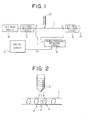
- a signal detecting section of a coordinate input device in accordance with the present invention, wherein a magnetic wire 1 is used as a coordinate detector and an A.C. magnetic field is applied to a coordinate designator through the magnetic wire 1 and an electromagnet 2 for coordinate designation (or coordinate designator 2).
- a D.C. bias circuit 4 is provided to pass a D.C. current through the magnetic wire 1 to provide a circumferential magnetization therein.
- the D.C. bias circuit 4 is connected to the magnetic wire 1 through a wiring line, this causes the impedance of the magnetic wire 1 at its both ends to be reduced, thus reducing a pulse voltage to be developed in the magnetic wire 1.
- the high impedance circuit 3 is provided to at least one end of the magnetic wire 1.
- the pulse voltage thus developed in the magnetic wire 1 appears at both ends P and Q of the magnetic wire 1.
- the pulse voltage is detected by a double-frequency detecting circuit 5 with respect to its 2f component.
- the double-frequency detecting circuit 5 may comprise an ordinary resonance circuit, filter circuit or synchronous detector circuit.
- a control circuit 6 functions to supply an exciting current having a fundamental frequency 1f to the electromagnet 2 for coordination designation and also to supply a control signal having a fundamental frequency 2f to the double-frequency detecting circuit 5 as necessary.
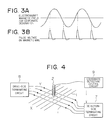
- Fig. 2 shows a pulse-voltage generating principle for explaining how to generate the pulse voltage when the circumferentially-magnetized magnetic wire 1 is subjected to an A.C. magnetic field.
- the circumferential magnetization of the magnetic wire 1 is repetitively subjected to partial inverting and restoring movements under the influence of the alternating magnetic field of the coordiante designating electromagnet 2.
- the magnetic field of the electromagnet and the then pulse voltage developed across the magnetic wire are shown in Figs. 3A and 3B. More specifically, the number of inversions in the magnetization varies depending on the composite value of the magnetic field generated by the electromagnet and the magnetic field based on terrestrial magnetism.
- the frequency components of the voltage developed across the magnetic wire include composite values of the respective frequency components of 1f, 2f, 3f, ... where f denotes a frequency at which the electromagnet is excited.
- the 1f component varies largely with the alternating magnetic field, but the 2f component less varies, since the 2f component is derived from pulses having the same wave-form as will be appreciated from Fig. 3B. For this reason, it is effective to detect the 2f component by the pulse voltage occurring in the magnetic wire and therefore the double-frequency detecting circuit 5 in Fig. 1 is arranged to detect the 2f component.
- the D.C. bias circuit 4 is used.
- the circuit 4 can control of the quantity of the aforementioned D.C. current. Further, by increasing the current supplied to the magnetic wire, the influence of the external magnetic field such as terrestrial magnetism can be made less.
- Fig. 4 Conceptionally shown in Fig. 4 is a coordinate input device wherein the detection section of Fig. 1 is arranged in the form of an X-Y matrix. More in detail, in order to detect a position of the coordinate designating electromagnet 2, a plurality of the magnetic wires 1 are provided in X and Y directions. Though only a Y-direction voltage detector for the magnetic wire 1 has been illustrated in Fig. 4, an X-direction voltage detector having the same function as the Y-direction voltage detector is also provided in actual applications. A detection-side terminating circuit 7, which has the same function as the A.C. high impedance circuit 3 in Fig.
- a drive-side terminating circuit 8 includes such a D.C. current bias circuit 4 and an A.C. high impedance circuit 3 connected to the circuit 4 as necessary as shown in Fig. 4.
- a coordinate detection control circuit 9 acts to excite the electromagnet 2 for coordinate designation and also to generate a timing signal for controlling the function of the double-frequency detecting circuit and the function of the multiplexing circuit. The structures of these circuits will be detailed later.
- the coordinate input device detects voltages developed (when the circumferential magnetization of the magnetic wires is inverted) in ones of the circumferentially-magnetized magnetic wires when the coordinate designator excited with an A.C. current approaches thereto.
- Such a coordiante input device is effective because it is based on a new detection principle that the magnetic wires as coordinate detectors require no windings or the like for voltage generation.
- a voltage is developed between both ends of the magnetic wire, when a multiplicity of magnetic wires for coordinate detection are arranged in the form of an array, the both ends of each magnetic wire is spaced by a relatively long distance. For this reason, a signal return path for connecting the both ends of the magnetic wire is necessary.
- electromagnetic magnetic coupling between the external field and a loop coil comprising the magnetic wire and the return path causes generation of a coupling signal, in addition to the original coordiante detection signal caused by the inversion in the magnetization of the magnetic wire.
- the coupling signal becomes larger than the voltage component caused by the invention in the circumferential magnetization of the magnetic wire, which results in reduction of S/N ratio of the coordiante detection signal.
- the magnetization reversal signal is added to the voltages generated by the magnetic wires of the go and return paths on the detection principle of the circumferentially magnetized magnetic wire, whereby the detection voltage can be obtained which corresponds to twice the detection voltage obtained when the go path is made in the form of a magnetic wire and the return path is made in the form of an ordinary conductor. This case will be detailed in connection with an embodiment shown in Figs. 5 and 6.
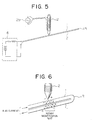
- the magnetic wire 1 as a go path is connected at a fixed turn point 1R to a magnetic wire 1' as a return path.
- the D.C. bias circuit 4 is used to provide circumferential magnetization to the both wires.
- the coordinate designator 2 excited by an A.C. signal source 2S applies an A.C. magnetic field to the both magnetic wires.
- the operational principle of the coordinate detector is shown in Fig. 6, wherein a bias current shown by arrows causes such circumferential magnetization as shown in Fig. 6 to be developed in the interiors of the magnetic wires 1 and 1' of the go and return paths.
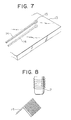
- FIG. 7 Shown in Fig. 7 is another embodiment in which magnetic materials 14 each in the form of a thin magnetic wire pattern is bonded or deposited as fixed onto the front and back surfaces of a substrate 13.
- a through hole 15 made in the substrate 13 is for interconnection between the patterns provided on the front and back sides of the substrate.
- this can be realized by depositing a magnetic film on each of the entire front and back sides of the substrate and then etching the substrate to leave the thin magnetic patterns 14 thereon.
- this can be realized by constructing the substrate in the form of a multiple layer.
- Fig. 8 shows another embodiment wherein the magnetic material 41 is made in the form of a thin magnetic pattern of repetitive magnetic lines to add together detection voltages developed in the magnetic lines to obtain a high total detection voltage and thus a high sensitivity.
- a proximity sensor which detects a vertical distance with respect to the coordinate designator 2 with a high sensitivity. It goes without saying that such a thin magnetic pattern 14 of repetitive magnetic lines as shown in Fig. 8 may be replaced by a single wire as necessary to form the proximity sensor.
- the magnetic wire or magnetic material mentioned above may be made of preferably material having a negative magnetostrictive coefficient such as amorphous material.
- reference numeral 18 denotes a matrix of repetitively turned magnetic wires arranged as equi-spaced in X and Y directions. One ends of all the magnetic wires are connected through a line 19 to the D.C. bias circuit 4 which supplies a constant current; while the other ends of all the magnetic wires are connected to collectors of switching transistors of X- and Y-decoders 20 and 21. The switching transistors are also connected at their emitters to a common circuit part.
- a wire selection circuit 23 supplies a switching signal to the bases of the switching transistors of the X- and Y- decoders 20 and 21 to sequentially turn ON the transistors one after another and to sequentially switch ON the wires one after another to sequentially supply a bias current thereto.
- a coordinate detection control circuit 9 supplies a timing pulse for wire selection to the wire selection circuit 23 and also supplies an A.C. current to the coordinate designator 2 to generate an A.C. magnetic field therein.
- a pulse voltage as shown in Fig. 3B appears on the line 19.
- the pulse voltage is sent through a resistor/capacitor coupling circuit 25 to a detection circuit 26 to be detected thereat.
- the pulse voltage is sample-held at a sample/hold circuit 27, converted into a digital signal at an A/D covnerter 28, subjected to a signal processing at a CPU 29, and then transmitted to a host computer (not shown) as a coordinate data.
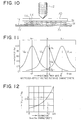
- the wire matrix is constructed so that, as shown in Fig. 10, magnetic wires 1X and 1X' for detection of X-direction coordinate magnetic wires 1Y and 1Y' for detection of Y-direction coordinate are arranged at regular intervals on a panel 30 which acts to stabilize a vertical distance between the coordinate designator 2 and the magnetic wires and also to fixedly mount the magnetic wires thereto.
- the wires 1X, 1X' and 1Y, 1Y' are arranged as bent or turned as shown in Figs. 5 and 6 respectively, and an insulator 31 is disposed between the associated wires to avoid any short-circuiting of the generation voltage caused by the rotary magnetization. Further, another insulator 31 is disposed between the X- and Y-direction wires.
- a multiplicity of magnetic wires are arranged in the X and Y directions to generate detection outputs indicative of a distance between the coordinate designator and ones of the wires close to the designator, so that the detection outputs of the associated magnetic wires made high when subjected to the A.C. magnetic field of the coordinate designator are used to carry out a coordinate estimation computation.
- the coordinate input device can have a resolution of 0.1 mm. This computation is carried out in the CPU 29 in Fig. 9.
- Fig. 11 shows Matteucci effect voltage characteristics V N-1 , V N , and V N+1 detected across three wires N-1, N, and N+1 when the coordinate designator is positioned at points spaced by a distance S from the centers of these wires, respectively.
- the distance between the wires is set to be 5 mm.
- the shape of the characteristic of Fig. 12 is identical or symmetrical with respect to each wire position in the left and right directions.
- the position ⁇ of the coordinate designator from the wire N producing the largest detection voltage can be calculated on the basis of the ratio (V N+1 /V N ) between the detection voltages of the wire N and adjacent wire N+1 respectively having the largest and the next largest values in the detection voltages of the wires, and then a coordinate point indicate of the coordinate designator can be calculated on the basis of the position ⁇ .
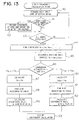
- a detection signal is input from a wire in a step 40 and it is judged in a step 41 whether or not the input signal is larger than a predetermined value. Determination of NO in the step 41 causes control to proceed to a step 43. Determination of YES in the step 41 causes control to go to a step 42 where the coordinate valus of the wire and the size of the detection signal are recorded in the memory and control goes to the step 43. In the step 43, it is judged whether or not detection of all the wires has been completed. Determination of NO in the step 43 causes control to go back to the step 40 to input the detection signal of the next wire.
- Determination of YES causes control to proceed to a step 44 to find detection signals V N-1 , V N , V N+1 , ... which have been judged as having predetermined continuous values.
- a next step 45 one of these detection signals having a maximum value, for example, the signal V N is determined.
- a next step 46 comparison is made in a next step 46 between the detection signals V N-1 and V N+1 of the wires N-1 and N+1 adjacent to the wire N which produced the maximum detection signal.
- control goes to a step 47 to calculate a value V N-1 /V N .
- a value ⁇ is found by referencing a table (stored in the memory) having the characteristic as shown in Fig. 12.
- the value ⁇ is subtracted from the coordinate value of the wire N and then a coordinate point at which the coordinate designator is positioned is calculated.
- the value ⁇ is found by referencing the table according to the calculated value V N+1 /V N .
- the value ⁇ is added to the coordinate value of the wire N to find a coordinate point indicative of the position of the coordinate designator.
- the coordinate calculation is completed.
- Provision of the circumferential magnetization to a magnetic wire having a magnetostrictive coefficient of zero to a negative value can be realized by providing a suitable twist to the magnetic wire to give it a twisting stress.
- the external magnetic field acts as a modulation signal when the exciting magnetic field is considered to be a carrier, and thus separate detection of the external magnetic field can be realized by processing the signal caused by the magnetization inversion. Detection of the external magnetic field can be attained with a high resolution by narrowing the range of the exciting magnetic field and this can be realized with use of a ferrite core wound by a winding.
Landscapes
- Physics & Mathematics (AREA)
- General Physics & Mathematics (AREA)
- Engineering & Computer Science (AREA)
- Condensed Matter Physics & Semiconductors (AREA)
- General Engineering & Computer Science (AREA)
- Theoretical Computer Science (AREA)
- Electromagnetism (AREA)
- Human Computer Interaction (AREA)
- Measurement Of Length, Angles, Or The Like Using Electric Or Magnetic Means (AREA)
- Position Input By Displaying (AREA)
- Measuring Magnetic Variables (AREA)
Applications Claiming Priority (10)
| Application Number | Priority Date | Filing Date | Title |
|---|---|---|---|
| JP32296590 | 1990-11-28 | ||
| JP32296590A JP3009213B2 (ja) | 1990-11-28 | 1990-11-28 | 座標入力装置 |
| JP32296490A JP2510781B2 (ja) | 1990-11-28 | 1990-11-28 | 磁気イメ―ジセンサ |
| JP32296490 | 1990-11-28 | ||
| JP322964/90 | 1990-11-28 | ||
| JP322965/90 | 1990-11-28 | ||
| JP3008921A JPH04252318A (ja) | 1991-01-29 | 1991-01-29 | 座標入力装置 |
| JP892191 | 1991-01-29 | ||
| JP8921/91 | 1991-01-29 | ||
| EP91120183A EP0488167B1 (en) | 1990-11-28 | 1991-11-26 | Magnetic detector based on Mateucci effect |
Related Parent Applications (2)
| Application Number | Title | Priority Date | Filing Date |
|---|---|---|---|
| EP91120183.8 Division | 1991-11-26 | ||
| EP91120183A Division EP0488167B1 (en) | 1990-11-28 | 1991-11-26 | Magnetic detector based on Mateucci effect |
Publications (2)
| Publication Number | Publication Date |
|---|---|
| EP0751398A1 EP0751398A1 (en) | 1997-01-02 |
| EP0751398B1 true EP0751398B1 (en) | 2001-01-31 |
Family
ID=27278252
Family Applications (3)
| Application Number | Title | Priority Date | Filing Date |
|---|---|---|---|
| EP96113405A Expired - Lifetime EP0751398B1 (en) | 1990-11-28 | 1991-11-26 | Coordinate input device using Mateucci effect |
| EP91120183A Expired - Lifetime EP0488167B1 (en) | 1990-11-28 | 1991-11-26 | Magnetic detector based on Mateucci effect |
| EP95118295A Expired - Lifetime EP0706057B1 (en) | 1990-11-28 | 1991-11-26 | Magnetic image sensor using Matteucci effect |
Family Applications After (2)
| Application Number | Title | Priority Date | Filing Date |
|---|---|---|---|
| EP91120183A Expired - Lifetime EP0488167B1 (en) | 1990-11-28 | 1991-11-26 | Magnetic detector based on Mateucci effect |
| EP95118295A Expired - Lifetime EP0706057B1 (en) | 1990-11-28 | 1991-11-26 | Magnetic image sensor using Matteucci effect |
Country Status (4)
| Country | Link |
|---|---|
| US (2) | US5298689A (enExample) |
| EP (3) | EP0751398B1 (enExample) |
| KR (1) | KR960006091B1 (enExample) |
| DE (3) | DE69132528T2 (enExample) |
Families Citing this family (13)
| Publication number | Priority date | Publication date | Assignee | Title |
|---|---|---|---|---|
| JPH05233147A (ja) * | 1992-02-21 | 1993-09-10 | Mitsubishi Electric Corp | ディスプレイ一体型タブレット |
| BE1007126A3 (nl) * | 1992-06-24 | 1995-04-04 | Andre Albert Madelein Heerwegh | Werkwijze en inrichting voor het lezen van driedimensionele informatie. |
| US5920307A (en) * | 1995-02-21 | 1999-07-06 | Lucent Technologies, Inc. | System for directly sensing the orientation of a track ball |
| JP3091398B2 (ja) * | 1995-09-14 | 2000-09-25 | 科学技術振興事業団 | 磁気−インピーダンス素子及びその製造方法 |
| US6396005B2 (en) | 1998-06-15 | 2002-05-28 | Rodgers Technology Center, Inc. | Method and apparatus for diminishing grid complexity in a tablet |
| AU2003232360A1 (en) * | 2002-06-05 | 2003-12-22 | Synaptics (Uk) Limited | Signal transfer method and apparatus |
| JP4527752B2 (ja) * | 2007-06-22 | 2010-08-18 | 日立オムロンターミナルソリューションズ株式会社 | 紙葉類識別装置及びそのセンサ部 |
| EP2690450B1 (en) * | 2012-07-27 | 2014-07-09 | ABB Technology AG | A device for measuring the direct component of alternating current |
| DE102014200461B4 (de) | 2014-01-14 | 2016-01-14 | Schaeffler Technologies AG & Co. KG | Anordnung zum Messen einer Kraft oder eines Drehmomentes an einem Maschinenelement |
| DE102014214249B3 (de) | 2014-07-22 | 2015-09-10 | Schaeffler Technologies AG & Co. KG | Maschinenelement und Anordnung zur Messung einer Kraft oder eines Momentes sowie Verfahren zur Herstellung des Maschinenelementes |
| DE102014219336B3 (de) | 2014-09-24 | 2016-01-21 | Schaeffler Technologies AG & Co. KG | Verfahren und Anordnung zur Messung einer Kraft oder eines Momentes mit mehreren Magnetfeldsensoren |
| DE102015206152B3 (de) | 2015-04-07 | 2016-07-07 | Schaeffler Technologies AG & Co. KG | 1 - 12Anordnung und Verfahren zur berührungslosen Messung eines Momentes an einem Maschinenelement |
| CN107728866A (zh) * | 2017-09-18 | 2018-02-23 | 安徽工程大学 | 一种计算机辅助拼装绘图系统 |
Family Cites Families (9)
| Publication number | Priority date | Publication date | Assignee | Title |
|---|---|---|---|---|
| FR2087205A5 (enExample) * | 1970-05-11 | 1971-12-31 | Dassault Electronique | |
| US4374403A (en) * | 1979-06-27 | 1983-02-15 | Matsushita Electric Industrial Co., Ltd. | Magnetic recording and reproducing system |
| US4418242A (en) * | 1980-03-04 | 1983-11-29 | Fujitsu Limited | Coordinate reading apparatus |
| JPS58117718A (ja) * | 1981-12-30 | 1983-07-13 | Aisin Seiki Co Ltd | 電気パルス発生器 |
| JPS6170628A (ja) | 1984-09-13 | 1986-04-11 | Hitachi Metals Ltd | デ−タ−タブレツト用素子 |
| EP0187372B1 (en) * | 1984-12-28 | 1990-08-08 | Wacom Company, Ltd. | Position detecting device |
| JPS6326720A (ja) * | 1986-07-18 | 1988-02-04 | Nippon Denki Shijiyou Kaihatsu Kk | 周波数結合位置検出装置 |
| US4939459A (en) * | 1987-12-21 | 1990-07-03 | Tdk Corporation | High sensitivity magnetic sensor |
| US4963703A (en) * | 1989-07-18 | 1990-10-16 | Numonics Corporation | Coordinate determining device using spatial filters |
-
1991
- 1991-11-26 EP EP96113405A patent/EP0751398B1/en not_active Expired - Lifetime
- 1991-11-26 EP EP91120183A patent/EP0488167B1/en not_active Expired - Lifetime
- 1991-11-26 DE DE69132528T patent/DE69132528T2/de not_active Expired - Fee Related
- 1991-11-26 EP EP95118295A patent/EP0706057B1/en not_active Expired - Lifetime
- 1991-11-26 US US07/797,923 patent/US5298689A/en not_active Expired - Lifetime
- 1991-11-26 DE DE69127530T patent/DE69127530T2/de not_active Expired - Fee Related
- 1991-11-26 DE DE69132101T patent/DE69132101T2/de not_active Expired - Fee Related
- 1991-11-26 KR KR1019910021190A patent/KR960006091B1/ko not_active Expired - Fee Related
-
1993
- 1993-09-10 US US08/118,764 patent/US5446377A/en not_active Expired - Lifetime
Also Published As
| Publication number | Publication date |
|---|---|
| KR960006091B1 (ko) | 1996-05-08 |
| KR920010310A (ko) | 1992-06-26 |
| EP0706057A3 (enExample) | 1996-05-01 |
| DE69127530T2 (de) | 1998-02-12 |
| EP0488167B1 (en) | 1997-09-03 |
| EP0488167A2 (en) | 1992-06-03 |
| DE69132528T2 (de) | 2001-06-13 |
| DE69127530D1 (de) | 1997-10-09 |
| EP0706057B1 (en) | 2000-04-05 |
| US5298689A (en) | 1994-03-29 |
| EP0751398A1 (en) | 1997-01-02 |
| EP0706057A2 (en) | 1996-04-10 |
| EP0488167A3 (enExample) | 1994-03-02 |
| DE69132101T2 (de) | 2000-09-28 |
| DE69132528D1 (de) | 2001-03-08 |
| DE69132101D1 (de) | 2000-05-11 |
| US5446377A (en) | 1995-08-29 |
Similar Documents
| Publication | Publication Date | Title |
|---|---|---|
| US4603365A (en) | Magnetic detection apparatus | |
| US4582955A (en) | Digitizing tablet system including a tablet having a grid structure made of two orthogonal sets of parallel uniformly sized and spaced U shaped loops of conductive material | |
| EP0607694B1 (en) | Cordless digitizer | |
| US4712064A (en) | Magnetoresistive sensor for detecting position or speed of a ferromagnetic body | |
| US6124708A (en) | Position detection using a spaced apart array of magnetic field generators and plural sensing loop circuits offset from one another in the measurement direction | |
| EP0488167B1 (en) | Magnetic detector based on Mateucci effect | |
| US4054746A (en) | Electronic coordinate position digitizing system | |
| EP0187372A2 (en) | Position detecting device | |
| US4554409A (en) | Method of electromagnetically reading coordinate data | |
| GB2034053A (en) | Magneto resistive displacement sensors | |
| GB2140562A (en) | Current-ratio digitisers | |
| JP3367230B2 (ja) | 位置検出装置 | |
| US4298772A (en) | Coordinate reader using adjustable magnetostrictive oscillations | |
| JP3037380B2 (ja) | 磁気式エンコーダ | |
| JPH07190804A (ja) | 磁気抵抗式センサ装置を備えた磁界測定装置 | |
| US4806708A (en) | Coordinate determining device and method of determining X-Y coordinate position | |
| US4996392A (en) | Superconductor magnetic image detection device | |
| KR960004556B1 (ko) | 마테우치효과를 이용한 좌표입력장치 | |
| JP3379258B2 (ja) | アブソリュートエンコーダ | |
| Green | Search coils | |
| WO1997014014A1 (en) | Inductive device for determining measures and positions of measuring objects of electrically conductive material | |
| WO1990006563A1 (en) | Digitising device | |
| JP3047567B2 (ja) | 方位センサ | |
| JP2611642B2 (ja) | 座標位置検出装置 | |
| CN119043380A (zh) | 一种应用于三相输出电涡流传感器线圈结构 |
Legal Events
| Date | Code | Title | Description |
|---|---|---|---|
| PUAI | Public reference made under article 153(3) epc to a published international application that has entered the european phase |
Free format text: ORIGINAL CODE: 0009012 |
|
| AC | Divisional application: reference to earlier application |
Ref document number: 488167 Country of ref document: EP |
|
| AK | Designated contracting states |
Kind code of ref document: A1 Designated state(s): DE FR GB |
|
| 17P | Request for examination filed |
Effective date: 19961115 |
|
| 17Q | First examination report despatched |
Effective date: 19990114 |
|
| GRAG | Despatch of communication of intention to grant |
Free format text: ORIGINAL CODE: EPIDOS AGRA |
|
| GRAG | Despatch of communication of intention to grant |
Free format text: ORIGINAL CODE: EPIDOS AGRA |
|
| GRAH | Despatch of communication of intention to grant a patent |
Free format text: ORIGINAL CODE: EPIDOS IGRA |
|
| GRAH | Despatch of communication of intention to grant a patent |
Free format text: ORIGINAL CODE: EPIDOS IGRA |
|
| GRAA | (expected) grant |
Free format text: ORIGINAL CODE: 0009210 |
|
| AC | Divisional application: reference to earlier application |
Ref document number: 488167 Country of ref document: EP |
|
| AK | Designated contracting states |
Kind code of ref document: B1 Designated state(s): DE FR GB |
|
| REF | Corresponds to: |
Ref document number: 69132528 Country of ref document: DE Date of ref document: 20010308 |
|
| ET | Fr: translation filed | ||
| PLBE | No opposition filed within time limit |
Free format text: ORIGINAL CODE: 0009261 |
|
| STAA | Information on the status of an ep patent application or granted ep patent |
Free format text: STATUS: NO OPPOSITION FILED WITHIN TIME LIMIT |
|
| REG | Reference to a national code |
Ref country code: GB Ref legal event code: IF02 |
|
| 26N | No opposition filed | ||
| PGFP | Annual fee paid to national office [announced via postgrant information from national office to epo] |
Ref country code: DE Payment date: 20081126 Year of fee payment: 18 |
|
| PGFP | Annual fee paid to national office [announced via postgrant information from national office to epo] |
Ref country code: FR Payment date: 20081017 Year of fee payment: 18 |
|
| PGFP | Annual fee paid to national office [announced via postgrant information from national office to epo] |
Ref country code: GB Payment date: 20081021 Year of fee payment: 18 |
|
| GBPC | Gb: european patent ceased through non-payment of renewal fee |
Effective date: 20091126 |
|
| REG | Reference to a national code |
Ref country code: FR Ref legal event code: ST Effective date: 20100730 |
|
| PG25 | Lapsed in a contracting state [announced via postgrant information from national office to epo] |
Ref country code: FR Free format text: LAPSE BECAUSE OF NON-PAYMENT OF DUE FEES Effective date: 20091130 |
|
| PG25 | Lapsed in a contracting state [announced via postgrant information from national office to epo] |
Ref country code: DE Free format text: LAPSE BECAUSE OF NON-PAYMENT OF DUE FEES Effective date: 20100601 |
|
| PG25 | Lapsed in a contracting state [announced via postgrant information from national office to epo] |
Ref country code: GB Free format text: LAPSE BECAUSE OF NON-PAYMENT OF DUE FEES Effective date: 20091126 |