EP0743361B1 - Procédé de maltage d'orge et malt amélioré ainsi obtenu - Google Patents
Procédé de maltage d'orge et malt amélioré ainsi obtenu Download PDFInfo
- Publication number
- EP0743361B1 EP0743361B1 EP96401017A EP96401017A EP0743361B1 EP 0743361 B1 EP0743361 B1 EP 0743361B1 EP 96401017 A EP96401017 A EP 96401017A EP 96401017 A EP96401017 A EP 96401017A EP 0743361 B1 EP0743361 B1 EP 0743361B1
- Authority
- EP
- European Patent Office
- Prior art keywords
- malt
- steeping
- barley
- acid
- ndma
- Prior art date
- Legal status (The legal status is an assumption and is not a legal conclusion. Google has not performed a legal analysis and makes no representation as to the accuracy of the status listed.)
- Expired - Lifetime
Links
- 235000007340 Hordeum vulgare Nutrition 0.000 title claims abstract description 47
- 238000004890 malting Methods 0.000 title claims abstract description 30
- GXCLVBGFBYZDAG-UHFFFAOYSA-N N-[2-(1H-indol-3-yl)ethyl]-N-methylprop-2-en-1-amine Chemical compound CN(CCC1=CNC2=C1C=CC=C2)CC=C GXCLVBGFBYZDAG-UHFFFAOYSA-N 0.000 title claims description 92
- 238000000034 method Methods 0.000 title claims description 43
- 230000008569 process Effects 0.000 title description 20
- 240000005979 Hordeum vulgare Species 0.000 title 1
- 239000002253 acid Substances 0.000 claims abstract description 52
- 241000209219 Hordeum Species 0.000 claims abstract description 46
- 230000035784 germination Effects 0.000 claims abstract description 44
- XLYOFNOQVPJJNP-UHFFFAOYSA-N water Substances O XLYOFNOQVPJJNP-UHFFFAOYSA-N 0.000 claims abstract description 39
- 235000013339 cereals Nutrition 0.000 claims abstract description 29
- 230000000694 effects Effects 0.000 claims abstract description 17
- 230000006641 stabilisation Effects 0.000 claims abstract description 12
- 238000001035 drying Methods 0.000 claims abstract 2
- UMFJAHHVKNCGLG-UHFFFAOYSA-N n-Nitrosodimethylamine Chemical compound CN(C)N=O UMFJAHHVKNCGLG-UHFFFAOYSA-N 0.000 claims description 159
- NBIIXXVUZAFLBC-UHFFFAOYSA-N Phosphoric acid Chemical compound OP(O)(O)=O NBIIXXVUZAFLBC-UHFFFAOYSA-N 0.000 claims description 26
- VEXZGXHMUGYJMC-UHFFFAOYSA-N Hydrochloric acid Chemical compound Cl VEXZGXHMUGYJMC-UHFFFAOYSA-N 0.000 claims description 24
- 108090000623 proteins and genes Proteins 0.000 claims description 24
- 102000004169 proteins and genes Human genes 0.000 claims description 24
- 230000020477 pH reduction Effects 0.000 claims description 15
- 229920002498 Beta-glucan Polymers 0.000 claims description 10
- 229910000147 aluminium phosphate Inorganic materials 0.000 claims description 10
- 238000011105 stabilization Methods 0.000 claims description 7
- 230000004048 modification Effects 0.000 claims description 3
- 238000012986 modification Methods 0.000 claims description 3
- 230000002378 acidificating effect Effects 0.000 claims 4
- 241001484259 Lacuna Species 0.000 claims 1
- 238000002791 soaking Methods 0.000 abstract description 4
- 238000010791 quenching Methods 0.000 description 76
- 238000012360 testing method Methods 0.000 description 67
- 230000000171 quenching effect Effects 0.000 description 61
- ROSDSFDQCJNGOL-UHFFFAOYSA-N Dimethylamine Chemical compound CNC ROSDSFDQCJNGOL-UHFFFAOYSA-N 0.000 description 43
- KUBCEEMXQZUPDQ-UHFFFAOYSA-N hordenine Chemical compound CN(C)CCC1=CC=C(O)C=C1 KUBCEEMXQZUPDQ-UHFFFAOYSA-N 0.000 description 38
- 229940071490 hordenine Drugs 0.000 description 19
- 239000002243 precursor Substances 0.000 description 19
- 230000007423 decrease Effects 0.000 description 16
- YMWUJEATGCHHMB-UHFFFAOYSA-N Dichloromethane Chemical compound ClCCl YMWUJEATGCHHMB-UHFFFAOYSA-N 0.000 description 15
- NINIDFKCEFEMDL-UHFFFAOYSA-N Sulfur Chemical compound [S] NINIDFKCEFEMDL-UHFFFAOYSA-N 0.000 description 13
- 235000011007 phosphoric acid Nutrition 0.000 description 13
- 229910052717 sulfur Inorganic materials 0.000 description 13
- 239000011593 sulfur Substances 0.000 description 13
- FSYKKLYZXJSNPZ-UHFFFAOYSA-N sarcosine Chemical compound C[NH2+]CC([O-])=O FSYKKLYZXJSNPZ-UHFFFAOYSA-N 0.000 description 10
- 230000015572 biosynthetic process Effects 0.000 description 9
- 238000004519 manufacturing process Methods 0.000 description 9
- OCDGBSUVYYVKQZ-UHFFFAOYSA-N gramine Chemical compound C1=CC=C2C(CN(C)C)=CNC2=C1 OCDGBSUVYYVKQZ-UHFFFAOYSA-N 0.000 description 8
- 210000001161 mammalian embryo Anatomy 0.000 description 8
- GOERTRUXQHDLHC-UHFFFAOYSA-N gramine Natural products COC1=CC=C2NC=C(CN(C)C)C2=C1 GOERTRUXQHDLHC-UHFFFAOYSA-N 0.000 description 7
- 230000012010 growth Effects 0.000 description 7
- 150000004005 nitrosamines Chemical class 0.000 description 7
- 239000005980 Gibberellic acid Substances 0.000 description 6
- 150000001412 amines Chemical class 0.000 description 6
- 238000001914 filtration Methods 0.000 description 6
- IXORZMNAPKEEDV-UHFFFAOYSA-N gibberellic acid GA3 Natural products OC(=O)C1C2(C3)CC(=C)C3(O)CCC2C2(C=CC3O)C1C3(C)C(=O)O2 IXORZMNAPKEEDV-UHFFFAOYSA-N 0.000 description 6
- IXORZMNAPKEEDV-OBDJNFEBSA-N gibberellin A3 Chemical compound C([C@@]1(O)C(=C)C[C@@]2(C1)[C@H]1C(O)=O)C[C@H]2[C@]2(C=C[C@@H]3O)[C@H]1[C@]3(C)C(=O)O2 IXORZMNAPKEEDV-OBDJNFEBSA-N 0.000 description 6
- 238000004128 high performance liquid chromatography Methods 0.000 description 6
- 229920001503 Glucan Polymers 0.000 description 5
- 108010077895 Sarcosine Proteins 0.000 description 5
- 239000003570 air Substances 0.000 description 5
- ROOXNKNUYICQNP-UHFFFAOYSA-N ammonium persulfate Chemical compound [NH4+].[NH4+].[O-]S(=O)(=O)OOS([O-])(=O)=O ROOXNKNUYICQNP-UHFFFAOYSA-N 0.000 description 5
- 235000013405 beer Nutrition 0.000 description 5
- 238000010438 heat treatment Methods 0.000 description 5
- 239000000523 sample Substances 0.000 description 5
- 229940043230 sarcosine Drugs 0.000 description 5
- 230000000638 stimulation Effects 0.000 description 5
- LOTKRQAVGJMPNV-UHFFFAOYSA-N 1-fluoro-2,4-dinitrobenzene Chemical compound [O-][N+](=O)C1=CC=C(F)C([N+]([O-])=O)=C1 LOTKRQAVGJMPNV-UHFFFAOYSA-N 0.000 description 4
- RAHZWNYVWXNFOC-UHFFFAOYSA-N Sulphur dioxide Chemical compound O=S=O RAHZWNYVWXNFOC-UHFFFAOYSA-N 0.000 description 4
- 238000005273 aeration Methods 0.000 description 4
- 238000004458 analytical method Methods 0.000 description 4
- 230000002478 diastatic effect Effects 0.000 description 4
- 230000007246 mechanism Effects 0.000 description 4
- 239000000203 mixture Substances 0.000 description 4
- 230000009935 nitrosation Effects 0.000 description 4
- 238000007034 nitrosation reaction Methods 0.000 description 4
- 230000009467 reduction Effects 0.000 description 4
- 230000004936 stimulating effect Effects 0.000 description 4
- 238000012549 training Methods 0.000 description 4
- 238000009423 ventilation Methods 0.000 description 4
- OKKJLVBELUTLKV-UHFFFAOYSA-N Methanol Chemical compound OC OKKJLVBELUTLKV-UHFFFAOYSA-N 0.000 description 3
- YLKFDHTUAUWZPQ-UHFFFAOYSA-N N-Nitrosodi-n-propylamine Chemical compound CCCN(N=O)CCC YLKFDHTUAUWZPQ-UHFFFAOYSA-N 0.000 description 3
- 230000008901 benefit Effects 0.000 description 3
- 238000000605 extraction Methods 0.000 description 3
- 235000013305 food Nutrition 0.000 description 3
- 150000003335 secondary amines Chemical class 0.000 description 3
- 239000002689 soil Substances 0.000 description 3
- 238000005496 tempering Methods 0.000 description 3
- 235000013522 vodka Nutrition 0.000 description 3
- IJGRMHOSHXDMSA-UHFFFAOYSA-N Atomic nitrogen Chemical compound N#N IJGRMHOSHXDMSA-UHFFFAOYSA-N 0.000 description 2
- 230000009471 action Effects 0.000 description 2
- 238000013019 agitation Methods 0.000 description 2
- -1 aliphatic amines Chemical class 0.000 description 2
- 229910001870 ammonium persulfate Inorganic materials 0.000 description 2
- 230000003139 buffering effect Effects 0.000 description 2
- 238000001816 cooling Methods 0.000 description 2
- 239000012153 distilled water Substances 0.000 description 2
- 239000004744 fabric Substances 0.000 description 2
- XKLJHFLUAHKGGU-UHFFFAOYSA-N nitrous amide Chemical compound ON=N XKLJHFLUAHKGGU-UHFFFAOYSA-N 0.000 description 2
- 235000019645 odor Nutrition 0.000 description 2
- 238000000926 separation method Methods 0.000 description 2
- 239000000126 substance Substances 0.000 description 2
- XTQHKBHJIVJGKJ-UHFFFAOYSA-N sulfur monoxide Chemical compound S=O XTQHKBHJIVJGKJ-UHFFFAOYSA-N 0.000 description 2
- FYGDTMLNYKFZSV-URKRLVJHSA-N (2s,3r,4s,5s,6r)-2-[(2r,4r,5r,6s)-4,5-dihydroxy-2-(hydroxymethyl)-6-[(2r,4r,5r,6s)-4,5,6-trihydroxy-2-(hydroxymethyl)oxan-3-yl]oxyoxan-3-yl]oxy-6-(hydroxymethyl)oxane-3,4,5-triol Chemical compound O[C@@H]1[C@@H](O)[C@H](O)[C@@H](CO)O[C@H]1OC1[C@@H](CO)O[C@@H](OC2[C@H](O[C@H](O)[C@H](O)[C@H]2O)CO)[C@H](O)[C@H]1O FYGDTMLNYKFZSV-URKRLVJHSA-N 0.000 description 1
- 239000004160 Ammonium persulphate Substances 0.000 description 1
- 101710130006 Beta-glucanase Proteins 0.000 description 1
- 244000025254 Cannabis sativa Species 0.000 description 1
- 102000005575 Cellulases Human genes 0.000 description 1
- 108010084185 Cellulases Proteins 0.000 description 1
- 229930091371 Fructose Natural products 0.000 description 1
- 239000005715 Fructose Substances 0.000 description 1
- RFSUNEUAIZKAJO-ARQDHWQXSA-N Fructose Chemical compound OC[C@H]1O[C@](O)(CO)[C@@H](O)[C@@H]1O RFSUNEUAIZKAJO-ARQDHWQXSA-N 0.000 description 1
- WQZGKKKJIJFFOK-GASJEMHNSA-N Glucose Natural products OC[C@H]1OC(O)[C@H](O)[C@@H](O)[C@@H]1O WQZGKKKJIJFFOK-GASJEMHNSA-N 0.000 description 1
- 102000004157 Hydrolases Human genes 0.000 description 1
- 108090000604 Hydrolases Proteins 0.000 description 1
- 241001207999 Notaris Species 0.000 description 1
- 244000046052 Phaseolus vulgaris Species 0.000 description 1
- 235000010627 Phaseolus vulgaris Nutrition 0.000 description 1
- 238000005299 abrasion Methods 0.000 description 1
- 108010050181 aleurone Proteins 0.000 description 1
- 239000012080 ambient air Substances 0.000 description 1
- 235000019395 ammonium persulphate Nutrition 0.000 description 1
- 150000008064 anhydrides Chemical class 0.000 description 1
- 230000000454 anti-cipatory effect Effects 0.000 description 1
- 238000003556 assay Methods 0.000 description 1
- 230000006399 behavior Effects 0.000 description 1
- WQZGKKKJIJFFOK-VFUOTHLCSA-N beta-D-glucose Chemical compound OC[C@H]1O[C@@H](O)[C@H](O)[C@@H](O)[C@@H]1O WQZGKKKJIJFFOK-VFUOTHLCSA-N 0.000 description 1
- SXDBWCPKPHAZSM-UHFFFAOYSA-M bromate Inorganic materials [O-]Br(=O)=O SXDBWCPKPHAZSM-UHFFFAOYSA-M 0.000 description 1
- SXDBWCPKPHAZSM-UHFFFAOYSA-N bromic acid Chemical compound OBr(=O)=O SXDBWCPKPHAZSM-UHFFFAOYSA-N 0.000 description 1
- 230000000711 cancerogenic effect Effects 0.000 description 1
- 231100000315 carcinogenic Toxicity 0.000 description 1
- 230000015556 catabolic process Effects 0.000 description 1
- 230000001413 cellular effect Effects 0.000 description 1
- 230000008859 change Effects 0.000 description 1
- 239000013043 chemical agent Substances 0.000 description 1
- 238000006243 chemical reaction Methods 0.000 description 1
- 239000003795 chemical substances by application Substances 0.000 description 1
- 238000002485 combustion reaction Methods 0.000 description 1
- 230000000052 comparative effect Effects 0.000 description 1
- 150000001875 compounds Chemical class 0.000 description 1
- 238000012790 confirmation Methods 0.000 description 1
- 239000000470 constituent Substances 0.000 description 1
- 239000013068 control sample Substances 0.000 description 1
- 230000001276 controlling effect Effects 0.000 description 1
- 230000001461 cytolytic effect Effects 0.000 description 1
- 230000006378 damage Effects 0.000 description 1
- 230000003247 decreasing effect Effects 0.000 description 1
- 238000006731 degradation reaction Methods 0.000 description 1
- 239000008121 dextrose Substances 0.000 description 1
- 125000002147 dimethylamino group Chemical group [H]C([H])([H])N(*)C([H])([H])[H] 0.000 description 1
- TXKMVPPZCYKFAC-UHFFFAOYSA-N disulfur monoxide Inorganic materials O=S=S TXKMVPPZCYKFAC-UHFFFAOYSA-N 0.000 description 1
- 230000005059 dormancy Effects 0.000 description 1
- 229940083124 ganglion-blocking antiadrenergic secondary and tertiary amines Drugs 0.000 description 1
- IXCSERBJSXMMFS-UHFFFAOYSA-N hcl hcl Chemical compound Cl.Cl IXCSERBJSXMMFS-UHFFFAOYSA-N 0.000 description 1
- 238000000265 homogenisation Methods 0.000 description 1
- 230000006872 improvement Effects 0.000 description 1
- 230000000415 inactivating effect Effects 0.000 description 1
- 238000009434 installation Methods 0.000 description 1
- 235000021577 malt beverage Nutrition 0.000 description 1
- 230000010534 mechanism of action Effects 0.000 description 1
- 231100000219 mutagenic Toxicity 0.000 description 1
- 230000003505 mutagenic effect Effects 0.000 description 1
- ZIUHHBKFKCYYJD-UHFFFAOYSA-N n,n'-methylenebisacrylamide Chemical compound C=CC(=O)NCNC(=O)C=C ZIUHHBKFKCYYJD-UHFFFAOYSA-N 0.000 description 1
- 229910052757 nitrogen Inorganic materials 0.000 description 1
- 230000035479 physiological effects, processes and functions Effects 0.000 description 1
- 230000035790 physiological processes and functions Effects 0.000 description 1
- 238000002360 preparation method Methods 0.000 description 1
- 238000012545 processing Methods 0.000 description 1
- 230000001105 regulatory effect Effects 0.000 description 1
- 230000029058 respiratory gaseous exchange Effects 0.000 description 1
- 230000021749 root development Effects 0.000 description 1
- 230000035939 shock Effects 0.000 description 1
- 238000003860 storage Methods 0.000 description 1
- 229910052815 sulfur oxide Inorganic materials 0.000 description 1
- 239000013589 supplement Substances 0.000 description 1
- 230000001629 suppression Effects 0.000 description 1
- 238000003786 synthesis reaction Methods 0.000 description 1
- 230000008467 tissue growth Effects 0.000 description 1
- 231100000027 toxicology Toxicity 0.000 description 1
- 230000000007 visual effect Effects 0.000 description 1
- 230000002618 waking effect Effects 0.000 description 1
Images

Classifications
-
- C—CHEMISTRY; METALLURGY
- C12—BIOCHEMISTRY; BEER; SPIRITS; WINE; VINEGAR; MICROBIOLOGY; ENZYMOLOGY; MUTATION OR GENETIC ENGINEERING
- C12C—BEER; PREPARATION OF BEER BY FERMENTATION; PREPARATION OF MALT FOR MAKING BEER; PREPARATION OF HOPS FOR MAKING BEER
- C12C1/00—Preparation of malt
- C12C1/02—Pretreatment of grains, e.g. washing, steeping
-
- C—CHEMISTRY; METALLURGY
- C12—BIOCHEMISTRY; BEER; SPIRITS; WINE; VINEGAR; MICROBIOLOGY; ENZYMOLOGY; MUTATION OR GENETIC ENGINEERING
- C12C—BEER; PREPARATION OF BEER BY FERMENTATION; PREPARATION OF MALT FOR MAKING BEER; PREPARATION OF HOPS FOR MAKING BEER
- C12C1/00—Preparation of malt
- C12C1/027—Germinating
- C12C1/047—Influencing the germination by chemical or physical means
-
- C—CHEMISTRY; METALLURGY
- C12—BIOCHEMISTRY; BEER; SPIRITS; WINE; VINEGAR; MICROBIOLOGY; ENZYMOLOGY; MUTATION OR GENETIC ENGINEERING
- C12C—BEER; PREPARATION OF BEER BY FERMENTATION; PREPARATION OF MALT FOR MAKING BEER; PREPARATION OF HOPS FOR MAKING BEER
- C12C1/00—Preparation of malt
- C12C1/18—Preparation of malt extract or of special kinds of malt, e.g. caramel, black malt
Definitions
- the subject of the present invention is a method barley malting, i.e. a process comprising a quenching step, germination step and kilning, to obtain a low content of Nitrosodimethylamine (NDMA).
- NDMA Nitrosodimethylamine
- NDMA NDMA
- NDMA oxides nitrogen
- DMA Dimethylamine
- NDMA Dimethylamine
- S. SAKUMA et al in an article entitled "Formation of N-Nitrosodimethylamine during malt kilning" published in REPORTS RES. LAB.
- KIRIN BREWERY CO of 1981, vol. 24, p.20 indicate that there is a direct relationship between the amount of NDMA produced in malt and the amount of DMA in green malt and NO x in the air.
- LJ YOO in a 1992 article entitled "Precursors of Nitrosodimethylamine in Malted Barley.
- DMA Dimethylamine
- Another known way to decrease the amount of hordenine is to slow germination.
- such a slowing down can be obtained by adding ammonium persulfate or NO 2 after quenching and before germination, or by quenching acidification making it possible to limit the growth of the germ, or else again by the choice of conditions (humidity, temperature, germination time) making it possible to limit the growth of the germ.
- any action in particular appropriate acidification during quenching, which limits the growth of the embryo, reduces the amount of hordenine, mainly a potential precursor of NDMA formed in this fabric, by a factor of about 10, and by therefore the amount of NDMA produced in the finished malt.
- the first article gives as an example the addition to barley of H 2 SO 4 , 0.006N at the first quenching and 0.01N at the second quenching, as well as gibberellic acid (0.5 to 0.1 ppm) at the end of each quench. This has the effect of inactivating the embryo, reducing the size of the rootlets (by more than 70%), increasing the amount of soluble proteins, stimulating the aleurone layer, and increasing the amount of extract in due to the lack of growth of the embryo and rootlets.
- the second article concerns the destruction of barley embryo abraded with acid (not specified) at 0.02%, with addition of gibberellic acid allowing supplement that which would have been produced during a normal germination.
- the French patent FR-1 360 637 (STAUFFER CHEMICAL COMPANY) concerns a malting process providing a more vivid and attractive malt with decreased root development during germination. It implements an acid quenching at reason typically 1 liter of quenching water per 100 grams of barley, the initial pH of the quench varying between 1.7 and 2.4. Such volume ratios between quench water and amount of barley result in the pH of the quenching water remaining long equal to the initial pH. The barley remains very long at a low pH ( ⁇ 2.3), this results in a slowing of the germination, which causes the disadvantages already mentioned.
- the object of the invention is to solve this problem and therefore relates to a process usable on an industrial scale and in particular making it possible to obtain a malt with a low content of NDMA.
- the basic idea of the invention is that it is possible to control acidification during quenching, so that germination is not at all or is not very little modified, while acting on the mechanism which leads, after kilning, to a small amount of NDMA, and this without affecting the properties of the malt or complicating the preparation industrial work, nor decrease the yield.
- the quenching step comprises at least one substep of acid quenching which takes place at a pH which, after stabilization, is between 3.5 and 4.6 at room temperature, the ratio between the volume of the quenching water and the amount of barley being chosen so that the activity of the grain during germination does not be unchanged, all other things being equal. This allows to take into account the buffering effect of barley.
- the malt obtained according to the invention exhibits, after kilning, a low rate NDMA, for example less than 2 ⁇ g / kg and preferably less than 1 ⁇ g / kg.
- said pH stabilized is between 3.8 and 4.6, the value preferred being 4.5.
- the results obtained are practically the same by example for pH equal to 3.5 and 4.5 and so we have interest in working at the highest value, which corresponds to the addition of the lowest quantity acid to the same volume of quench water.
- the acid can be hydrochloric acid and / or phosphoric acid.
- Said ratio between the volume of the water of tempering and the quantity of barley is advantageously understood between 0.8 l and 1.2 l per kg of barley, and preferably equal to 1 l of quenching water per kg of barley.
- At least one quenching sub-step has a duration advantageously between 4 and 6 hours.
- Acid can be added to the quench water during each of the quenching sub-steps.
- the quenching step has three substeps and acid is added to quench water during the first and second of these substeps.
- the invention also relates to a malt obtained with sensitive stimulation of germination and which is characterized in that it has an extract of between 81% and 82% of dry matter (DM), a level of soluble proteins of between 4 and 5 %, a viscosity between 1.4 and 1.5 mPas, a modification homogeneity> 72%, a level of NDMA ⁇ 10 -9 , and optionally a level of soluble ⁇ -glucans ⁇ 200 mg.
- DM dry matter
- Figure 1 shows the two major NDMA training hypotheses in malt published in the literature, in this case the NDMA training from DMA produced during the germination and from DMA formed by nitrosation of hordenine and nitrosohordenine in the course of kilning.
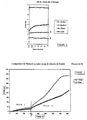
- Figure 2 illustrates comparatively the evolution of the pH during quenching, according to Patent FR-1 360 637 and according to the invention.
- Figure 3 illustrates in a comparative way the filterability of trial and control malts according to TESTS 8 and 9 of TESTS II.
- Tables 1 and 2 show the results TESTS I below.
- Tables 3 and 4 show the results TESTS II below.
- Table 4 illustrates influence on malt quality of stimulation sensitive in germination after acid quenching.
- Table 5 shows the results of the TESTS III below.
- the invention has been implemented in several series of tests conducted in micromalies or well on an industrial scale.
- Barley stored at 13 ° C is subjected to 3 successive quenchings, interspersed with 2 periods of grain aeration. 1st quenching 6 hours 13 ° C 1st ventilation 14 hours 25 ° C 2nd quenching 5 hours 14 ° C 2nd ventilation 13 hours 20 ° C 3rd quenching 2 hours 16 ° C
- the quenching is carried out with a proportion of 1 about liter of quenching water per kilogram of barley.
- This stage which lasts 96 hours can be subdivided into three distinct stages: 1st phase 14 hours 20 ° C 2nd phase 2 hours 18 ° C 3rd phase 80 hours 16 ° C
- the germinated barley is dried in micro-malting by a gradual increase in temperature. 1st phase 3 hours 62 ° C 2nd phase 2 hours 65 ° C 3rd phase 2 hours 68 ° C 4th phase 2 hours 73 ° C 5th phase 1 hour 78 ° C 6th phase 2 hours 80 ° C 7th phase 6 hours 83 ° C
- rootlets After kilning and before storing the malt, rootlets are separated from the grain by impact mechanical.
- the green malt is dried by direct heating of the low NO x type on two circular trays.
- the first step is carried out on the set superior of the kiln for a period of 20 hours.
- the initial temperature of 55 ° C is brought to 68-70 ° C for this period, which has the effect of bringing humidity to the grain from 42% to 10%.
- the second step is carried out on the set inferior. This consists of 3 stages. A gradual rise in temperature over 12 hours up to 75 ° C, heating up to 80 ° C for 4 hours, then a step of cooling the grain by ventilation for 4 hours. During this second stage, the grain moisture drops from 10 to 4%.
- the main malt quality criteria (extract, viscosity, Kolbach index, diastatic power, pH, soluble ⁇ -glucans) were measured by methods described in Analytica-EBC. Dried malts to scale micromalies have been analyzed as such.
- NDMA rates were measured on malts dried in industrial kilns and after separation of rootlets.
- NDMAs are obtained by extracting 15g of malt in 100 ml of distilled water at 50 ° C for one hour with moderate agitation. After extraction with dichloromethane on a "Chemelut" type tube, the extract is concentrated in Dichloromethane (DCM) at 0.5 ml and 10 ⁇ l are injected into the CPG / TEA system ("Thermal Energy Analyze").
- DCM Dichloromethane
- the NDMA content is calculated relative to a calibration performed on a malt sample containing increasing amounts of NDMA.
- NDPA nitrosodipropylamine
- the NDMA levels produced during the kilning of green malts are lower than those of the untreated control: the NDMA values on malt finished are less than a factor of more than 2.
- the acidification of the quench water results in a decrease in the soluble malt ⁇ -glucans. This phenomenon is particularly significant when using H 3 PO 4 which allows a reduction of 15 to 50% of soluble ⁇ -glucans depending on the variety.
- the drop in viscosity is significant in all cases using phosphoric acid.
- Acidification with malting induces low drop in pH (0.2-0.1 pH point) of the must produced at from malts.
- Diastatic power is influenced by the type of acid and acidity without being able to dictate general rules, because this phenomenon varies from one variety to another.
- the pH values of the must and the values of diastatic power are also influenced by acidification of the quenching water.
- TESTS 1 to 5 Four brewing varieties have been tested (TESTS 1 to 5) on an industrial scale (200 tonnes of malt).
- Two are Spring varieties (PRISMA and ALEXIS); two of the winter varieties (CLARINE and PLEASANT).
- Barley stored at 13 ° C is subjected to 3 quenchings successive, interspersed with aeration periods of the grain.
- a second quenching is carried out with the same volume of water for 3 hours, followed by a period 8 hours aeration at 16 ° C. At this point, the humidity of the grain is 35-37%.
- the last quenching corresponds to an underwater 2 hours followed by aeration of 3 to 4 hours at 16 ° C.
- the beans At the final stage of quenching, the beans have reaches a humidity of the order of 40 to 42%.
- the acid hydrochloric acid is pumped from a reservoir of storage and mixed with the water feeding the quench tank.
- This step is carried out for 5 days in circular boxes stacked in an installation vertical type of "Tower of Malting", and the grains are returned every 8 hours so as to homogenize germination.
- the soaked barley is watered so as to reach a grain moisture of 43%.
- the incoming air temperature is controlled at 15 ° C.
- the germinated barley (green malt) is transported from the germination box to the kiln where the green malt is dried by means of direct heating of the low NO x type , on two circular trays.
- the first step is carried out on a tray superior of the kiln for a period of 20 hours.
- the initial temperature of 55 ° C is brought to 68-70 ° C for this period, which has the effect of bringing humidity to the grain from 42% to 10%.
- the second step is carried out on the set inferior. This consists of 3 stages. A gradual rise in temperature over 12 hours up to 75 ° C, heating up to 80 ° C for 4 hours, then a step of cooling the grain by ventilation for 4 hours. During this second stage, the grain moisture drops from 10 to 4%.
- the rootlets After kilning and before storing the malt, the rootlets are separated from the grain by mechanical shock.
- the NDMA assay is carried out after separation of the rootlets.
- NDMA are obtained by extraction of 15 g malt in 100 ml of distilled water at 50 ° C for one hour with moderate agitation. After extraction with dichloromethane on a "Chemelut" type tube, the extract is concentrated with DCM to 0.5 ml and 10 ⁇ l are injected into the CPG / TEA (Thermal Energy Analyzer) system.
- CPG / TEA Thermal Energy Analyzer
- the NDMA content is calculated relative to a calibration performed on a malt sample containing increasing amounts of NDMA.
- NDPA is added as internal standard.
- TESTS I Observations made at the scale of the micromalies (TESTS I) are validated at scale industrial (200 tonnes): applying acid to water quenching makes it possible to obtain malt with a low content of nitrosamines, and of identical quality to the control malt treated with sulfur (see Table 3).
- the pH of the quenching after homogenization and pH balance are between 3.8 and 4.1 on the first quench, and between 3.8 and 4.6 on the second quench.
- a test carried out with a low dose of acid shows the need for a quantity minimum acid at quenching in the absence of sulfur at kilning. With such a dose of acid, the pH at the balance of the first and second quenches are 5.1 and 4.8 respectively.
- the amount of anhydrides sulfur is very low in the malts of the trials by compared to control malt. This of course is related to the absence of sulfur application during kilning in the test cases.
- the level of activities ⁇ -glucanase is always greater than or equal to 400 IRVU in the case of tests, when it is around 300 IRVU in the case of certain witnesses.
- This numbers give the impression that acid "boosts" production hydrolases in the case where conventional conditions of malting would not allow the grain to express fully its potential.
- Option 1 (TESTS 6 and 7) consists of adding acid gibberellic (30 mg / tonne) tested at the start of germination.
- Option 2 (TRIALS 8 and 9) consists of a extension of the last phase by 5 hours of quenching sub-air of the test. In this last case (option 2), we observed the characteristics of the malt at 4 and 5 days of germination. In both options, the amount of acid added corresponds to that used for test 3 (400 and 150 liters). The results are reported in Table 4.
- these malts are characterized also by a lower Kolbach index and a lower viscosity.
- Figure 2 illustrates the variation of the curve pH during the first 6 hours of quenching.
- the "STAUFFER A” and “STAUFFER B” tests correspond to extreme conditions of Patent FR-1 360 637 (p. 2, column left), i.e. quench water containing 0.1% of acid for test A and 1% of acid for test B, and, in both cases, 10 volumes of water for 1 volume of barley (i.e. one liter of quenching water per 100 g of barley).
- the test according to the invention corresponds to quenching water containing 0.2% acid, i.e. 400 1 of acid for 200 tonnes of water, for a test corresponding to 200 tonnes of grain.
- Germinated barley samples were taken at the end of the germination phase and before kilning (green malt) in the case of the test industrial TEST 3 from TABLE 3 (ALEXIS) and in the case VODKA and NOMAD micromaltage from TABLE 2. In each cases, both untreated control green malt and the malt from acid quenching was harvested.
- the NDMA green malt content has been determined in accordance with the method described in the TEST I.
- Figures show that Gramin and Sarcosine are in very low amounts in malt green and that only Hordenine and Dimethylamine are present in measurable quantities. In the case of malt industrial, the concentrations of these two amines are 2 10 times higher for Hordenine and DMA respectively compared to the average of the two micromalts analyzed.
- the values on micromalts and industrial malt are more in line with the other compared to the previous case.
- the concentration of DMA in the test sample acid quenching is lower by a factor of the order of 4 compared to the witness.
- the measured values show that the amount of malt DMA green acid quench test is 10 times less than the quantity measured on the control.
- This mechanism of action of acid is distinguished of the mechanism linked to the decrease in tissue growth (embryo, rootlets) and the amount of hordenine, quoted by WAINWRIGHT et al in "Nitrosamines in malt and beer” in JOURNAL INST. BREW. 1986, vol. 92, p.76; the bill acid quenching carried out according to our conditions has not significant effect on the size of rootlets and plumes developed during malting, nor on the amount of hordenine produced.
Landscapes
- Organic Chemistry (AREA)
- Engineering & Computer Science (AREA)
- Chemical & Material Sciences (AREA)
- Health & Medical Sciences (AREA)
- Food Science & Technology (AREA)
- Life Sciences & Earth Sciences (AREA)
- Biochemistry (AREA)
- Bioinformatics & Cheminformatics (AREA)
- General Engineering & Computer Science (AREA)
- General Health & Medical Sciences (AREA)
- Genetics & Genomics (AREA)
- Wood Science & Technology (AREA)
- Zoology (AREA)
- Physiology (AREA)
- Distillation Of Fermentation Liquor, Processing Of Alcohols, Vinegar And Beer (AREA)
- Soy Sauces And Products Related Thereto (AREA)
- Cereal-Derived Products (AREA)
- General Preparation And Processing Of Foods (AREA)
- Coloring Foods And Improving Nutritive Qualities (AREA)
- Meat, Egg Or Seafood Products (AREA)
- Micro-Organisms Or Cultivation Processes Thereof (AREA)
- Pretreatment Of Seeds And Plants (AREA)
- Polysaccharides And Polysaccharide Derivatives (AREA)
- Thermal Insulation (AREA)
- Electric Stoves And Ranges (AREA)
- Buildings Adapted To Withstand Abnormal External Influences (AREA)
- Medicines Containing Plant Substances (AREA)
- Application Of Or Painting With Fluid Materials (AREA)
Applications Claiming Priority (2)
| Application Number | Priority Date | Filing Date | Title |
|---|---|---|---|
| FR9505765 | 1995-05-16 | ||
| FR9505765A FR2734278B1 (fr) | 1995-05-16 | 1995-05-16 | Procede de maltage d'orge a faible taux de ndma |
Publications (2)
| Publication Number | Publication Date |
|---|---|
| EP0743361A1 EP0743361A1 (fr) | 1996-11-20 |
| EP0743361B1 true EP0743361B1 (fr) | 2001-10-24 |
Family
ID=9479012
Family Applications (1)
| Application Number | Title | Priority Date | Filing Date |
|---|---|---|---|
| EP96401017A Expired - Lifetime EP0743361B1 (fr) | 1995-05-16 | 1996-05-10 | Procédé de maltage d'orge et malt amélioré ainsi obtenu |
Country Status (16)
| Country | Link |
|---|---|
| EP (1) | EP0743361B1 (cs) |
| JP (1) | JPH11505119A (cs) |
| CN (1) | CN1072264C (cs) |
| AT (1) | ATE207530T1 (cs) |
| AU (1) | AU703457B2 (cs) |
| CA (1) | CA2221052A1 (cs) |
| CZ (1) | CZ360397A3 (cs) |
| DE (1) | DE69616144T2 (cs) |
| DK (1) | DK0743361T3 (cs) |
| ES (1) | ES2166870T3 (cs) |
| FR (1) | FR2734278B1 (cs) |
| NO (1) | NO975106L (cs) |
| PL (1) | PL182555B1 (cs) |
| PT (1) | PT743361E (cs) |
| SK (1) | SK282465B6 (cs) |
| WO (1) | WO1996036740A1 (cs) |
Families Citing this family (6)
| Publication number | Priority date | Publication date | Assignee | Title |
|---|---|---|---|---|
| US20090285970A1 (en) * | 2008-04-11 | 2009-11-19 | Thava Vasanthan | Solubility-reduced, beta-glucan containing products and methods of producing and using such products |
| US20150079230A1 (en) * | 2012-04-24 | 2015-03-19 | Cargill, Incorporated | Method for increasing yield in the malting process |
| CN103773642B (zh) * | 2014-02-17 | 2016-03-02 | 青岛啤酒股份有限公司 | 一种具有高麦芽香气的麦芽制备方法及其啤酒 |
| WO2017104065A1 (ja) * | 2015-12-18 | 2017-06-22 | サントリーホールディングス株式会社 | 発根抑制麦芽の製造方法 |
| HUE066457T2 (hu) * | 2017-12-28 | 2024-08-28 | Carlsberg As | Gyors módszerek gabona kivonatok készítéséhez |
| CN110632204B (zh) * | 2019-09-30 | 2022-02-25 | 精晶药业股份有限公司 | 一种大麦芽碱盐酸盐的检测方法 |
Family Cites Families (4)
| Publication number | Priority date | Publication date | Assignee | Title |
|---|---|---|---|---|
| US2698275A (en) * | 1951-01-04 | 1954-12-28 | Pabst Brewing Co | Biochemical control of cereal grain germination |
| FR1360637A (fr) * | 1962-07-03 | 1964-05-08 | Stauffer Chemical Co | Perfectionnements au procédé de maltage |
| BE634380A (cs) * | 1962-07-03 | |||
| JPS5564772A (en) * | 1978-11-08 | 1980-05-15 | Togo Kuroiwa | Grain and seeds permeated with l-amino acid |
-
1995
- 1995-05-16 FR FR9505765A patent/FR2734278B1/fr not_active Expired - Fee Related
-
1996
- 1996-05-10 CN CN96194835A patent/CN1072264C/zh not_active Expired - Fee Related
- 1996-05-10 WO PCT/FR1996/000713 patent/WO1996036740A1/fr not_active Ceased
- 1996-05-10 AU AU59034/96A patent/AU703457B2/en not_active Ceased
- 1996-05-10 DE DE69616144T patent/DE69616144T2/de not_active Expired - Fee Related
- 1996-05-10 SK SK1538-97A patent/SK282465B6/sk unknown
- 1996-05-10 CZ CZ973603A patent/CZ360397A3/cs unknown
- 1996-05-10 PL PL96323463A patent/PL182555B1/pl unknown
- 1996-05-10 JP JP8534598A patent/JPH11505119A/ja active Pending
- 1996-05-10 AT AT96401017T patent/ATE207530T1/de not_active IP Right Cessation
- 1996-05-10 CA CA002221052A patent/CA2221052A1/fr not_active Abandoned
- 1996-05-10 PT PT96401017T patent/PT743361E/pt unknown
- 1996-05-10 DK DK96401017T patent/DK0743361T3/da active
- 1996-05-10 ES ES96401017T patent/ES2166870T3/es not_active Expired - Lifetime
- 1996-05-10 EP EP96401017A patent/EP0743361B1/fr not_active Expired - Lifetime
-
1997
- 1997-11-05 NO NO975106A patent/NO975106L/no not_active Application Discontinuation
Also Published As
| Publication number | Publication date |
|---|---|
| DE69616144D1 (de) | 2001-11-29 |
| NO975106L (no) | 1998-01-08 |
| WO1996036740A1 (fr) | 1996-11-21 |
| CN1072264C (zh) | 2001-10-03 |
| FR2734278A1 (fr) | 1996-11-22 |
| DK0743361T3 (da) | 2002-02-11 |
| SK153897A3 (en) | 1998-07-08 |
| SK282465B6 (sk) | 2002-02-05 |
| EP0743361A1 (fr) | 1996-11-20 |
| CN1187855A (zh) | 1998-07-15 |
| DE69616144T2 (de) | 2002-03-14 |
| CA2221052A1 (fr) | 1996-11-21 |
| FR2734278B1 (fr) | 1997-11-14 |
| PL323463A1 (en) | 1998-03-30 |
| PL182555B1 (pl) | 2002-01-31 |
| AU5903496A (en) | 1996-11-29 |
| ATE207530T1 (de) | 2001-11-15 |
| ES2166870T3 (es) | 2002-05-01 |
| CZ360397A3 (cs) | 1998-08-12 |
| JPH11505119A (ja) | 1999-05-18 |
| NO975106D0 (no) | 1997-11-05 |
| AU703457B2 (en) | 1999-03-25 |
| PT743361E (pt) | 2002-04-29 |
Similar Documents
| Publication | Publication Date | Title |
|---|---|---|
| RU2233869C2 (ru) | Способ приготовления хлебного кваса | |
| EP0743361B1 (fr) | Procédé de maltage d'orge et malt amélioré ainsi obtenu | |
| DE60102358T2 (de) | Verfahren zur herstellung von bier mit verbesserter geschmackstabilität | |
| CN1155901A (zh) | 作为具有泡沫头饮料的泡沫稳定剂的果胶 | |
| US4004034A (en) | Process for the manufacture of worts | |
| JP2017205036A (ja) | ビールテイスト飲料、ビールテイスト飲料の製造方法、及びビールテイスト飲料の香味向上方法 | |
| KR102014930B1 (ko) | 관능 특성이 우수한 과일 맥주의 제조방법 | |
| KR101924066B1 (ko) | 오디 맥주의 제조방법 | |
| JP2017205038A (ja) | ビールテイスト飲料、ビールテイスト飲料の製造方法、及びビールテイスト飲料の香味向上方法 | |
| FR2734279A1 (fr) | Procede de maltage d'orge et malt ameliore ainsi obtenu | |
| JP2017205035A (ja) | ビールテイスト飲料、ビールテイスト飲料の製造方法、及びビールテイスト飲料の香味向上方法 | |
| KR101156071B1 (ko) | 맥주 및 이의 제조방법 | |
| KR102505674B1 (ko) | 머루포도를 이용한 맥주 제조 방법 | |
| KR101156062B1 (ko) | 맥주 및 이의 제조방법 | |
| CN117866717B (zh) | 麦芽制造方法 | |
| FR2908423A1 (fr) | Procede de fabrication de biere. | |
| RU2324729C2 (ru) | Способ производства темного пива "генерал ермолов" | |
| NL2033797B1 (nl) | Versnelde en/of verhoogde productie van gemout graan | |
| JP2010207243A (ja) | 麦芽アルコール飲料 | |
| JPH1057044A (ja) | 発泡酒の製造方法 | |
| US20200362285A1 (en) | Aromatization of beverages | |
| SU1738831A1 (ru) | Способ получени солода | |
| JP2008017760A (ja) | 幼芽を除去した麦芽の製造方法 | |
| RU2147314C1 (ru) | Способ производства светлого пива | |
| CN118109253A (zh) | 一种提高麦芽抗氧化活性的方法 |
Legal Events
| Date | Code | Title | Description |
|---|---|---|---|
| PUAI | Public reference made under article 153(3) epc to a published international application that has entered the european phase |
Free format text: ORIGINAL CODE: 0009012 |
|
| AK | Designated contracting states |
Kind code of ref document: A1 Designated state(s): AT BE CH DE DK ES FI GB GR IE IT LI LU MC NL PT SE |
|
| 17P | Request for examination filed |
Effective date: 19970509 |
|
| 17Q | First examination report despatched |
Effective date: 20000323 |
|
| GRAG | Despatch of communication of intention to grant |
Free format text: ORIGINAL CODE: EPIDOS AGRA |
|
| GRAG | Despatch of communication of intention to grant |
Free format text: ORIGINAL CODE: EPIDOS AGRA |
|
| GRAH | Despatch of communication of intention to grant a patent |
Free format text: ORIGINAL CODE: EPIDOS IGRA |
|
| GRAH | Despatch of communication of intention to grant a patent |
Free format text: ORIGINAL CODE: EPIDOS IGRA |
|
| GRAA | (expected) grant |
Free format text: ORIGINAL CODE: 0009210 |
|
| AK | Designated contracting states |
Kind code of ref document: B1 Designated state(s): AT BE CH DE DK ES FI GB GR IE IT LI LU MC NL PT SE |
|
| REF | Corresponds to: |
Ref document number: 207530 Country of ref document: AT Date of ref document: 20011115 Kind code of ref document: T |
|
| REG | Reference to a national code |
Ref country code: CH Ref legal event code: EP |
|
| REG | Reference to a national code |
Ref country code: IE Ref legal event code: FG4D Free format text: FRENCH |
|
| REF | Corresponds to: |
Ref document number: 69616144 Country of ref document: DE Date of ref document: 20011129 |
|
| REG | Reference to a national code |
Ref country code: GB Ref legal event code: IF02 |
|
| REG | Reference to a national code |
Ref country code: DK Ref legal event code: T3 |
|
| GBT | Gb: translation of ep patent filed (gb section 77(6)(a)/1977) |
Effective date: 20020122 |
|
| REG | Reference to a national code |
Ref country code: CH Ref legal event code: NV Representative=s name: ISLER & PEDRAZZINI AG |
|
| REG | Reference to a national code |
Ref country code: PT Ref legal event code: SC4A Free format text: AVAILABILITY OF NATIONAL TRANSLATION Effective date: 20020117 |
|
| REG | Reference to a national code |
Ref country code: ES Ref legal event code: FG2A Ref document number: 2166870 Country of ref document: ES Kind code of ref document: T3 |
|
| PGFP | Annual fee paid to national office [announced via postgrant information from national office to epo] |
Ref country code: GB Payment date: 20020510 Year of fee payment: 7 |
|
| PGFP | Annual fee paid to national office [announced via postgrant information from national office to epo] |
Ref country code: SE Payment date: 20020513 Year of fee payment: 7 |
|
| PGFP | Annual fee paid to national office [announced via postgrant information from national office to epo] |
Ref country code: IE Payment date: 20020516 Year of fee payment: 7 Ref country code: ES Payment date: 20020516 Year of fee payment: 7 |
|
| PGFP | Annual fee paid to national office [announced via postgrant information from national office to epo] |
Ref country code: CH Payment date: 20020517 Year of fee payment: 7 |
|
| PGFP | Annual fee paid to national office [announced via postgrant information from national office to epo] |
Ref country code: MC Payment date: 20020521 Year of fee payment: 7 Ref country code: FI Payment date: 20020521 Year of fee payment: 7 |
|
| PGFP | Annual fee paid to national office [announced via postgrant information from national office to epo] |
Ref country code: NL Payment date: 20020522 Year of fee payment: 7 |
|
| PGFP | Annual fee paid to national office [announced via postgrant information from national office to epo] |
Ref country code: PT Payment date: 20020523 Year of fee payment: 7 |
|
| REG | Reference to a national code |
Ref country code: GR Ref legal event code: EP Ref document number: 20020400298 Country of ref document: GR |
|
| PGFP | Annual fee paid to national office [announced via postgrant information from national office to epo] |
Ref country code: DK Payment date: 20020527 Year of fee payment: 7 |
|
| PGFP | Annual fee paid to national office [announced via postgrant information from national office to epo] |
Ref country code: GR Payment date: 20020531 Year of fee payment: 7 Ref country code: AT Payment date: 20020531 Year of fee payment: 7 |
|
| PGFP | Annual fee paid to national office [announced via postgrant information from national office to epo] |
Ref country code: LU Payment date: 20020604 Year of fee payment: 7 |
|
| PGFP | Annual fee paid to national office [announced via postgrant information from national office to epo] |
Ref country code: DE Payment date: 20020610 Year of fee payment: 7 |
|
| PGFP | Annual fee paid to national office [announced via postgrant information from national office to epo] |
Ref country code: BE Payment date: 20020613 Year of fee payment: 7 |
|
| PLBE | No opposition filed within time limit |
Free format text: ORIGINAL CODE: 0009261 |
|
| STAA | Information on the status of an ep patent application or granted ep patent |
Free format text: STATUS: NO OPPOSITION FILED WITHIN TIME LIMIT |
|
| 26N | No opposition filed | ||
| PG25 | Lapsed in a contracting state [announced via postgrant information from national office to epo] |
Ref country code: LU Free format text: LAPSE BECAUSE OF NON-PAYMENT OF DUE FEES Effective date: 20030510 Ref country code: GB Free format text: LAPSE BECAUSE OF NON-PAYMENT OF DUE FEES Effective date: 20030510 Ref country code: FI Free format text: LAPSE BECAUSE OF NON-PAYMENT OF DUE FEES Effective date: 20030510 Ref country code: AT Free format text: LAPSE BECAUSE OF NON-PAYMENT OF DUE FEES Effective date: 20030510 |
|
| PG25 | Lapsed in a contracting state [announced via postgrant information from national office to epo] |
Ref country code: SE Free format text: LAPSE BECAUSE OF NON-PAYMENT OF DUE FEES Effective date: 20030511 |
|
| PG25 | Lapsed in a contracting state [announced via postgrant information from national office to epo] |
Ref country code: IE Free format text: LAPSE BECAUSE OF NON-PAYMENT OF DUE FEES Effective date: 20030512 Ref country code: ES Free format text: LAPSE BECAUSE OF NON-PAYMENT OF DUE FEES Effective date: 20030512 |
|
| PG25 | Lapsed in a contracting state [announced via postgrant information from national office to epo] |
Ref country code: MC Free format text: LAPSE BECAUSE OF NON-PAYMENT OF DUE FEES Effective date: 20030531 Ref country code: LI Free format text: LAPSE BECAUSE OF NON-PAYMENT OF DUE FEES Effective date: 20030531 Ref country code: CH Free format text: LAPSE BECAUSE OF NON-PAYMENT OF DUE FEES Effective date: 20030531 Ref country code: BE Free format text: LAPSE BECAUSE OF NON-PAYMENT OF DUE FEES Effective date: 20030531 |
|
| BERE | Be: lapsed |
Owner name: S.A. BRASSERIES *KRONENBOURG Effective date: 20030531 |
|
| PG25 | Lapsed in a contracting state [announced via postgrant information from national office to epo] |
Ref country code: PT Free format text: LAPSE BECAUSE OF NON-PAYMENT OF DUE FEES Effective date: 20031130 |
|
| PG25 | Lapsed in a contracting state [announced via postgrant information from national office to epo] |
Ref country code: NL Free format text: LAPSE BECAUSE OF NON-PAYMENT OF DUE FEES Effective date: 20031201 Ref country code: DK Free format text: LAPSE BECAUSE OF NON-PAYMENT OF DUE FEES Effective date: 20031201 |
|
| PG25 | Lapsed in a contracting state [announced via postgrant information from national office to epo] |
Ref country code: DE Free format text: LAPSE BECAUSE OF NON-PAYMENT OF DUE FEES Effective date: 20031202 |
|
| PG25 | Lapsed in a contracting state [announced via postgrant information from national office to epo] |
Ref country code: GR Free format text: LAPSE BECAUSE OF NON-PAYMENT OF DUE FEES Effective date: 20031203 |
|
| REG | Reference to a national code |
Ref country code: DK Ref legal event code: EBP |
|
| GBPC | Gb: european patent ceased through non-payment of renewal fee |
Effective date: 20030510 |
|
| EUG | Se: european patent has lapsed | ||
| REG | Reference to a national code |
Ref country code: CH Ref legal event code: PL |
|
| NLV4 | Nl: lapsed or anulled due to non-payment of the annual fee |
Effective date: 20031201 |
|
| REG | Reference to a national code |
Ref country code: PT Ref legal event code: MM4A Free format text: LAPSE DUE TO NON-PAYMENT OF FEES Effective date: 20031130 |
|
| REG | Reference to a national code |
Ref country code: IE Ref legal event code: MM4A |
|
| REG | Reference to a national code |
Ref country code: ES Ref legal event code: FD2A Effective date: 20030512 |
|
| PG25 | Lapsed in a contracting state [announced via postgrant information from national office to epo] |
Ref country code: IT Free format text: LAPSE BECAUSE OF NON-PAYMENT OF DUE FEES Effective date: 20050510 |