EP0743155B1 - Aus Kunststoff geformter Gegenstand und Verfahren zu seiner Herstellung - Google Patents
Aus Kunststoff geformter Gegenstand und Verfahren zu seiner Herstellung Download PDFInfo
- Publication number
- EP0743155B1 EP0743155B1 EP96107769A EP96107769A EP0743155B1 EP 0743155 B1 EP0743155 B1 EP 0743155B1 EP 96107769 A EP96107769 A EP 96107769A EP 96107769 A EP96107769 A EP 96107769A EP 0743155 B1 EP0743155 B1 EP 0743155B1
- Authority
- EP
- European Patent Office
- Prior art keywords
- resin
- elastic member
- porous elastic
- disposed
- molded product
- Prior art date
- Legal status (The legal status is an assumption and is not a legal conclusion. Google has not performed a legal analysis and makes no representation as to the accuracy of the status listed.)
- Expired - Lifetime
Links
- 238000004519 manufacturing process Methods 0.000 title claims description 23
- 229920005989 resin Polymers 0.000 claims description 62
- 239000011347 resin Substances 0.000 claims description 62
- 239000000463 material Substances 0.000 claims description 14
- 238000000034 method Methods 0.000 claims description 11
- 238000000465 moulding Methods 0.000 claims description 9
- 238000005520 cutting process Methods 0.000 claims description 8
- 238000012856 packing Methods 0.000 description 65
- 230000001276 controlling effect Effects 0.000 description 5
- 238000005429 filling process Methods 0.000 description 4
- 238000007664 blowing Methods 0.000 description 2
- 230000002950 deficient Effects 0.000 description 2
- 238000012986 modification Methods 0.000 description 2
- 230000004048 modification Effects 0.000 description 2
- 229920003002 synthetic resin Polymers 0.000 description 2
- 239000000057 synthetic resin Substances 0.000 description 2
- 229920001169 thermoplastic Polymers 0.000 description 2
- 239000004416 thermosoftening plastic Substances 0.000 description 2
- 239000004677 Nylon Substances 0.000 description 1
- 239000004743 Polypropylene Substances 0.000 description 1
- 238000005452 bending Methods 0.000 description 1
- 230000003247 decreasing effect Effects 0.000 description 1
- 238000010586 diagram Methods 0.000 description 1
- 239000013013 elastic material Substances 0.000 description 1
- 238000005516 engineering process Methods 0.000 description 1
- 238000007730 finishing process Methods 0.000 description 1
- 239000012530 fluid Substances 0.000 description 1
- 239000011521 glass Substances 0.000 description 1
- 238000007689 inspection Methods 0.000 description 1
- 229920001778 nylon Polymers 0.000 description 1
- -1 polypropylene Polymers 0.000 description 1
- 229920001155 polypropylene Polymers 0.000 description 1
- 230000001105 regulatory effect Effects 0.000 description 1
- 238000011144 upstream manufacturing Methods 0.000 description 1
- 239000002699 waste material Substances 0.000 description 1
- XLYOFNOQVPJJNP-UHFFFAOYSA-N water Substances O XLYOFNOQVPJJNP-UHFFFAOYSA-N 0.000 description 1
Images





Classifications
-
- F—MECHANICAL ENGINEERING; LIGHTING; HEATING; WEAPONS; BLASTING
- F16—ENGINEERING ELEMENTS AND UNITS; GENERAL MEASURES FOR PRODUCING AND MAINTAINING EFFECTIVE FUNCTIONING OF MACHINES OR INSTALLATIONS; THERMAL INSULATION IN GENERAL
- F16K—VALVES; TAPS; COCKS; ACTUATING-FLOATS; DEVICES FOR VENTING OR AERATING
- F16K1/00—Lift valves or globe valves, i.e. cut-off apparatus with closure members having at least a component of their opening and closing motion perpendicular to the closing faces
- F16K1/16—Lift valves or globe valves, i.e. cut-off apparatus with closure members having at least a component of their opening and closing motion perpendicular to the closing faces with pivoted closure-members
- F16K1/18—Lift valves or globe valves, i.e. cut-off apparatus with closure members having at least a component of their opening and closing motion perpendicular to the closing faces with pivoted closure-members with pivoted discs or flaps
-
- B—PERFORMING OPERATIONS; TRANSPORTING
- B29—WORKING OF PLASTICS; WORKING OF SUBSTANCES IN A PLASTIC STATE IN GENERAL
- B29C—SHAPING OR JOINING OF PLASTICS; SHAPING OF MATERIAL IN A PLASTIC STATE, NOT OTHERWISE PROVIDED FOR; AFTER-TREATMENT OF THE SHAPED PRODUCTS, e.g. REPAIRING
- B29C45/00—Injection moulding, i.e. forcing the required volume of moulding material through a nozzle into a closed mould; Apparatus therefor
- B29C45/14—Injection moulding, i.e. forcing the required volume of moulding material through a nozzle into a closed mould; Apparatus therefor incorporating preformed parts or layers, e.g. injection moulding around inserts or for coating articles
- B29C45/14778—Injection moulding, i.e. forcing the required volume of moulding material through a nozzle into a closed mould; Apparatus therefor incorporating preformed parts or layers, e.g. injection moulding around inserts or for coating articles the article consisting of a material with particular properties, e.g. porous, brittle
- B29C45/14795—Porous or permeable material, e.g. foam
-
- B—PERFORMING OPERATIONS; TRANSPORTING
- B60—VEHICLES IN GENERAL
- B60H—ARRANGEMENTS OF HEATING, COOLING, VENTILATING OR OTHER AIR-TREATING DEVICES SPECIALLY ADAPTED FOR PASSENGER OR GOODS SPACES OF VEHICLES
- B60H1/00—Heating, cooling or ventilating [HVAC] devices
- B60H1/00642—Control systems or circuits; Control members or indication devices for heating, cooling or ventilating devices
- B60H1/00664—Construction or arrangement of damper doors
-
- B—PERFORMING OPERATIONS; TRANSPORTING
- B29—WORKING OF PLASTICS; WORKING OF SUBSTANCES IN A PLASTIC STATE IN GENERAL
- B29C—SHAPING OR JOINING OF PLASTICS; SHAPING OF MATERIAL IN A PLASTIC STATE, NOT OTHERWISE PROVIDED FOR; AFTER-TREATMENT OF THE SHAPED PRODUCTS, e.g. REPAIRING
- B29C45/00—Injection moulding, i.e. forcing the required volume of moulding material through a nozzle into a closed mould; Apparatus therefor
- B29C45/14—Injection moulding, i.e. forcing the required volume of moulding material through a nozzle into a closed mould; Apparatus therefor incorporating preformed parts or layers, e.g. injection moulding around inserts or for coating articles
- B29C2045/1486—Details, accessories and auxiliary operations
- B29C2045/14983—Bursting or breakthrough of the insert by the injection pressure
-
- B—PERFORMING OPERATIONS; TRANSPORTING
- B29—WORKING OF PLASTICS; WORKING OF SUBSTANCES IN A PLASTIC STATE IN GENERAL
- B29K—INDEXING SCHEME ASSOCIATED WITH SUBCLASSES B29B, B29C OR B29D, RELATING TO MOULDING MATERIALS OR TO MATERIALS FOR MOULDS, REINFORCEMENTS, FILLERS OR PREFORMED PARTS, e.g. INSERTS
- B29K2715/00—Condition, form or state of preformed parts, e.g. inserts
- B29K2715/003—Cellular or porous
-
- Y—GENERAL TAGGING OF NEW TECHNOLOGICAL DEVELOPMENTS; GENERAL TAGGING OF CROSS-SECTIONAL TECHNOLOGIES SPANNING OVER SEVERAL SECTIONS OF THE IPC; TECHNICAL SUBJECTS COVERED BY FORMER USPC CROSS-REFERENCE ART COLLECTIONS [XRACs] AND DIGESTS
- Y10—TECHNICAL SUBJECTS COVERED BY FORMER USPC
- Y10T—TECHNICAL SUBJECTS COVERED BY FORMER US CLASSIFICATION
- Y10T428/00—Stock material or miscellaneous articles
- Y10T428/24—Structurally defined web or sheet [e.g., overall dimension, etc.]
- Y10T428/24479—Structurally defined web or sheet [e.g., overall dimension, etc.] including variation in thickness
-
- Y—GENERAL TAGGING OF NEW TECHNOLOGICAL DEVELOPMENTS; GENERAL TAGGING OF CROSS-SECTIONAL TECHNOLOGIES SPANNING OVER SEVERAL SECTIONS OF THE IPC; TECHNICAL SUBJECTS COVERED BY FORMER USPC CROSS-REFERENCE ART COLLECTIONS [XRACs] AND DIGESTS
- Y10—TECHNICAL SUBJECTS COVERED BY FORMER USPC
- Y10T—TECHNICAL SUBJECTS COVERED BY FORMER US CLASSIFICATION
- Y10T428/00—Stock material or miscellaneous articles
- Y10T428/24—Structurally defined web or sheet [e.g., overall dimension, etc.]
- Y10T428/24479—Structurally defined web or sheet [e.g., overall dimension, etc.] including variation in thickness
- Y10T428/24496—Foamed or cellular component
Definitions
- the present invention relates to a resin-molded product according to the preamble of claim 1 and a method to manufacture it according to the preamble of claim 10, which preamble starts from the prior art of US-A-4 994 226.
- a resin-molded product manufactured according to the present invention is especially suitable for a resin-molded product controlling flow of air where air-tightness is required.
- it can be used in an automotive air conditioner as a switching damper for vents to the chamber of a vehicle, a switching damper for taking in inside/outside air, or an air mixing damper for regulating the temperature of the air blown into the chamber.
- a resin-molded product manufactured according to the present invention is also applicable to an automotive air conditioner.
- An air inlet switching damper for taking in inside/outside air conventionally has packing 410 and 411 fixed on the entire surface of a damper body 400 as shown in FIG. 14 to provide air-tightness when the damper seats on a frame (not shown).
- US-A-4,994,226 discloses a technology to fix and adhere packing to the entire surface of the damper body 400 with a molded air inlet switching damper.
- an air inlet switching damper rotates on a shaft 203 disposed at an edge thereof and it opens or closes an inside/outside air inlet (not shown) by closing the inside/outside air inlet frame with the damper body 400. That is, only packing disposed on the outer periphery of the damper body 400 is required to provide air-tightness with the inlet, but the other portion (the center) does not need the packing. Accordingly, the amount of wasted packing for this air inlet switching damper is high, and the cost thereof is relatively high.
- the present invention has an object of providing a resin-molded product having a lower material cost by fixing and adhering a porous elastic member only to the portion requiring such a member to provide air-tightness.
- packing in the damper body according to the present invention is disposed only on the portion of the body which is for forming an airtight seal with another member. In this way, packing is not unnecessarily used on other portions of the body, thereby reducing its cost of manufacture.
- the packing member disposed on the damper body may be cut from a sheet of such material in the same shape that it will be disposed on the damper body; however, it is preferably cut in several segments which are selected so that they may be placed closely together on the sheet of packing material.
- the packing members may be cut as interlocking "J" shapes which are placed end-to-end on the damper body to form a frame-like structure around its periphery, or they may be cut as straight segments which are placed end-to-end as sides of the frame.
- the portions of the damper body having the packing affixed thereto are thicker than the remaining portions of the damper body, thereby providing additional structural integrity. These thick portions may also serve as resin guide paths for guiding resin through a mold when the damper body is being molded.
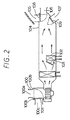
- FIG. 2 is an overall diagram of an automotive air conditioner using a damper according to the first embodiment as an air flow control damper.
- an inside/outside air switching portion 100 has an outside air inlet 100a and an inside air inlet 100c at an upper portion thereof.
- An inside/outside air switching damper 101 for opening and closing the outside air inlet 100a and the inside air inlet 100c is disposed in the inside/outside air switching portion 100.
- a heater core 102 has an air mixing damper 103 upstream therefrom for adjusting the amount of air passing through the heater core 102.
- air temperature inside a vehicle passenger compartment can be adjusted by adjusting the air mixing damper 103.
- a switching portion 104 for vents to the passenger compartment has a defroster outlet 105 at the upper portion thereof for eliminating cloudiness of the front glass.
- a face air outlet 106 is provided for blowing the air toward the upper part of a passenger's body.
- a foot air outlet 107 for blowing out the air toward the lower part of the passenger's body is disposed at the lower portion of the switching portion 104.
- Dampers 108 and 109 switchably control outlets 105 and 106, and 107, respectively.
- FIG. 1 shows the structure of the damper 101 according to the present invention in greater detail.
- a damper body 200 is molded with thermoplastic synthetic resin (for example, polypropylene or nylon).
- a shaft 203 as a rotational axis of the damper 101 is integrally molded with the damper body 200.
- the damper 101 rotates on the shaft 203 to open and close the outside air inlet 100a.
- Packing 210 and 211 of porous elastic material divided into the shape of a square are respectively disposed on the front and back of the damper body 200.
- Each of the packing 210 and 211 is fixed on the outer periphery of the damper body 200 like a frame and adheres to the molded damper 101.
- Marks of injected resin 200d showing the shot marks of molten thermoplastic synthetic resin (hereinafter called "resin" at the time of molding remain on the surface of the packing 210.
- portions 200c having marks of injected resin 200d are the thickest portions on the entire surface of the packing 210.
- the next thickest portions are the frame portions 200b, and the thinnest portions are the portions without the packing 210 and 211.
- the portions 200c can contribute to improving torsional rigidity and bending rigidity of the damper body 200.
- a method of manufacturing the damper 101 is hereinafter described. First, by cutting a rectangular-shaped packing material (drawn in a solid line) as shown in FIG. 5 into the shape shown with a one-dot line, two of the packing members 210a, 210b, 211a and 211b in the shape of a letter "J" are taken out. Of course, by cutting two such sheets, all four members 210a, 210b, 211a, 211b can be made.
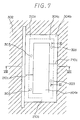
- the J-shaped packing members 210a, 211a, 210b, and 211b are then disposed like a frame on the periphery of the lower mold 302 of resin-molding molds as shown in FIG. 7.
- the upper mold 301 of the resin-molding molds is placed on the lower mold 302 to pressurize and clamp the packing members 210a, 210b, 211a, and 211b as shown in FIG. 8A.
- Out of an in-mold space 304 formed with the upper and the lower molds 301 and 302 in-mold spaces 304b and 304c are occupied with the packing members 210a, 210b, 211a, and 211b.
- the parts of the in-mold space 304 are the in-mold spaces 304c, 304b and 304a.
- the in-mold space 304c is formed in the shape of a square on the entire periphery of the space for disposing the packing 210 as shown in FIG. 7.
- Molten resin is injected into the in-mold space 304 through a resin inlet 303 disposed on the upper mold 301. More specifically, four (shown in FIG. 7) resin inlets 303 are disposed on the upper mold 301 along the in-mold space 304c containing the packing 210. Two adjacent resin inlets 303 are substantially symmetrical with respect to the parting face 210c between the packing members 210a and 210b.
- the in-mold space 304 then is gradually filled with molten resin injected in the third process.
- the in-mold space 304c is hereinafter called a resin guiding space (i.e., a flow leader or flow channel).
- FIG. 8B is a schematic view of the flow of the resin.
- FIG. 9 shows an analytical result of the flow of the resin based on a finite-element method.
- FIG. 8C is a schematic view of the flow of the resin.
- FIG. 10 shows an analytical result of the flow of the resin based on a finite-element method.
- FIG. 8D shows the conditions when the in-mold space 304 is completely filled with the resin.
- the resin-molded product is taken out of the in-mold space 304 for a finishing process to remove flash and for a product inspection process to complete the process of manufacturing the damper 101.
- J-shaped packing members 210a, 210b, 211a, and 211b are taken out by cutting two sheets of the rectangular packing material shown in FIG. 5 (with a solid line) into the shape shown with a one-dot line, which reduces waste of the packing material. If the rectangular packing material (drawn with a solid line) in FIG. 11 is cut as shown with a one-dot line, the center (the shaded portion) of the packing material is wasted. Therefore, the present embodiment can better reduce the material cost.
- the flow of the resin can be controlled so that the resin can flow into the in-mold space 304b where the packing 210 is disposed before it goes into the in-mold space 304a.
- the resin guiding space 304c the resin can be more securely controlled to flow into the in-mold space 304b where the packing 210 is disposed before flowing anywhere else.
- the packing 210 and 211 disposed in the shape of a frame can be firmly fixed to the damper body 200 at a predetermined position with predetermined dimensional accuracy, which contributes to the reduction of defective dampers 101.
- the packing 210 and 211 are strained in the direction to fill a clearance between adjacent ends of the packing members 210a and 210b or 211a and 211b with the flow of the resin. Even if a small clearance (approximately 1.5 - 2.0 mm) between the packing members 210a and 210b as well as 211a and 211b exists when the packing members 210a, 210b, 211a, and 211b are disposed in the mold 302, the clearance can be zero at the completion of the resin filling process. The number of defective products caused by inaccurate cutting of porous elastic members and inaccurate disposition thereof can be consequently reduced.
- An allowance of asymmetry of the resin inlets 303 with respect to the parting face 210c is approximately ⁇ 20 mm according to a research of the inventors.
- Asymmetry in this case means a difference between the distance from one resin inlet 303 out of two adjacent resin inlets 303 to the parting face 210c and the distance from the other resin inlet 303 to the parting face 210c.
- the packing 210 and 211 are cut into a J shape, in the first embodiment, they can be cut into four portions to mold the damper 101 of the present invention as shown in FIG. 12 by using the same manufacturing method as in the first embodiment instead of cutting them into a J shape.
- the in-mold space 304 does not necessarily have a stair-like shape as shown in FIG. 8A, but can be formed to increase its thickness continuously from the center to the edge to manufacture a resin-molded product of the present invention.
- the method of manufacturing a resin-molded product according to the present invention does not have to be limited to manufacture a resin-molded product for controlling the flow of the air; rather, it is also applicable to the manufacture of resin-molded products for controlling other fluids (for example, water or oil).
- the shape of the resin-molded product molded according to the manufacturing method specified in the present invention does not have to be limited to the shape of a damper shown in FIG. 1 but can be a curved surface or a disc shape.
- the present invention can be employed for manufacturing the indicator panel of a vehicle and also for fixing porous members on the back of the indicator panel.
- the fixing position of the packing does not necessarily have to be necessarily at the outer periphery of the body of the resin-molded product as shown in the first and second embodiments. Even if the packing is fixed on other positions (for example, only the center or only on one side of the body of a resin-molded product), the manufacturing method specified in the present invention can be employed.
- the manufacturing method of the present invention can be also applied to manufacture a resin-molded product where the packing is disposed only on one surface of the body of the resin-molded product.
- packing can be cut not only into two "J" shapes as shown in FIG. 1 or into four linear portions as shown in FIG. 12 but also can be cut into six or eight linear portions.
- a resin guiding space can be disposed along the edge of the packing at the portion where packing is not disposed.
Landscapes
- Engineering & Computer Science (AREA)
- Mechanical Engineering (AREA)
- Physics & Mathematics (AREA)
- Thermal Sciences (AREA)
- Manufacturing & Machinery (AREA)
- General Engineering & Computer Science (AREA)
- Injection Moulding Of Plastics Or The Like (AREA)
- Air-Conditioning For Vehicles (AREA)
- Moulds For Moulding Plastics Or The Like (AREA)
Claims (15)
- Aus Kunststoff geformter Gegenstand, umfassend:wobei das poröse elastische Element (210, 211), das an dem ersten Bereich der Fläche des Kunststoffkörpers (200) angeordnet ist, an dem Kunststoffkörper (200) mit geschmolzenem Kunststoff des Kunststoffkörpers (200) befestigt ist, der in eine Berührungsfläche des porösen elastischen Elements (210, 211) eingedrungen ist, und wobei ein Bereich des Kunststoffkörpers (200), an dem das poröse elastische Element (210, 211) angeordnet ist, dicker als der Bereich (200a) des Kunststoffkörpers ist, an dem das poröse elastische Element (210, 211) nicht angeordnet ist,einen Kunststoffkörper (200);ein poröses elastisches Element (210, 211), das an einer vorderen und einer hinteren Fläche eines Bereichs des Kunststoffkörpers (200) zur Schaffung einer luftdichten Dichtung angeordnet ist, wobei das poröse elastische Element (210, 211) an einem ersten Bereich (200b, 200c) der Fläche des Kunststoffkörpers (200) angeordnet ist und nicht an einem zweiten Bereich (200a) der Fläche des Kunststoffkörpers angeordnet ist,
dadurch gekennzeichnet, dass
der Bereich, an dem das poröse elastische Element (210, 211) angeordnet ist, einen ersten Bereich (200c) mit einer ersten Querschnittsdicke und einen zweiten Bereich (200b) mit einer zweiten Querschnittsdicke umfasst, die dünner als die erste Querschnittsfläche des ersten Bereich ist,
die zweiten Bereiche (200a) am Zentrum der vorderen und der hinteren Fläche angeordnet sind und in miteinander zusammenfallen, und
ein Kunststoffeinlass (303) in dem porösen elastischen Element (210, 211) ausgebildet und zu dem ersten Bereich (200c) hin offen ist. - Aus Kunststoff geformter Gegenstand nach Anspruch 1, welcher Gegenstand als ein Dämpfer zur Regelung einer Strömung von Luft vorgesehen ist, wobei der Dämpfer umfasst:einen Kunststoff-Dämpferkörper (200), der zu einer im Wesentlichen rechteckigen Gestalt geformt ist;ein poröses elastisches Element (210, 211), das an dem Außenumfang des Kunststoff-Dämpferkörpers (200) als ein Rahmen zur Bildung bzw. Begrenzung des ersten Bereichs (200b) an dem Kunststoff-Dämpferkörper (200) angeordnet ist.
- Aus Kunststoff geformter Gegenstand nach Anspruch 1 und 2, wobei das poröse elastische Element (210, 211) sowohl an der vorderen als auch an der hinteren Seite des Kunststoff-Dämpferkörpers (200) befestigt ist.
- Aus Kunststoff geformter Gegenstand nach Anspruch 1 und 2, wobei das poröse elastische Element (210, 211) in mehrere Bereiche (210a - 211b) aufgeteilt ist.
- Aus Kunststoff geformter Gegenstand nach Anspruch 4, wobei das poröse elastische Element (210, 211), das an der genannten Fläche (200b) des Kunststoff-Dämpferkörpers (200) als ein Rahmen befestigt ist, in zwei Bereiche (210a - 211b) in der Gestalt eines "J" aufgeteilt und an dem Außenumfang des Kunststoff-Dämpferkörpers (200) angeordnet ist.
- Aus Kunststoff geformter Gegenstand nach Anspruch 4, wobei das poröse elastische Element (210, 211) ), das an der genannten Fläche (200b) des Kunststoff-Dämpferkörpers (200) als ein Rahmen befestigt ist, in vier Bereiche linear aufgeteilt und an dem Außenumfang des Kunststoff-Dämpferkörpers (200) angeordnet ist.
- Aus Kunststoff geformter Gegenstand nach Anspruch 2, wobei der dickste Bereich (200b) des Kunststoff-Dämpferkörpers (200) die Gestalt eines Quadrates an dem gesamten Umfang eines Teils des genannten Bereich (200b) besitzt, wo das poröse elastische Element (210, 211) befestigt ist.
- Aus Kunststoff geformter Gegenstand nach Anspruch 7, wobei die Querschnittsgestalt des ersten Bereichs (200c) im Wesentlichen kreisförmig ist.
- Aus Kunststoff geformter Gegenstand nach Anspruch 8, wobei eine Welle (203) mit einem Durchmesser größer als der Querschnitt des genannten Kunststoff-Führungsbereichs (200c) mit dem Kunststoff-Dämpferkörper (200) einstückig geformt bzw. hergestellt ist.
- Verfahren zur Herstellung eines aus Kunststoff geformten Gegenstands wobei ein poröses elastisches Element (210,211), das nur an einem Bereich eines Kunststoffkörpers (200) zur Bildung einer luftdichten Dichtung angeordnet ist, an dem Kunststoffkörper (200) befestigt ist, wobei das Verfahren die nachfolgend angegebenen Schritte umfasst:wobei der Schritt des Einspritzens einen Schritt des Einspritzens des geschmolzenen Kunststoffs in einem Bereich des Form-Innenraums (304) aufweist, wo das poröse elastische Element (210, 211) in dem Form-Innenraum (304) angeordnet ist,das Ausschneiden des porösen elastischen Elements (210, 211) zu einer vorbestimmten Gestalt aus einem porösen elastischen Elementenmaterial;das Anordnen des porösen elastischen Elements (210, 211) in einer vorbestimmten Position in einem Form-Innenraum (304), der durch Kunststoff-Gießformen (301, 302) gebildet ist;das Einspritzen von geschmolzenem Kunststoff in den Form-Innenraum (304);das Herstellen des Kunststoffkörpers (200) mit eingespritztem Kunststoff derart, dass das poröse elastische Element (210, 211) an dem Kunststoffkörper (200) befestigt wird, wenn der eingespritzte Kunststoff das poröse elastische Element durchdringt,
dadurch gekennzeichnet, dass ein Raum (304c), wo das poröse elastische Element (210, 211) angeordnet ist, an dem gesamten Umfang eines zentralen Bereichs des Form-Innenraums (304) gebildet ist, wo das poröse elastische Element (210, 211) nicht angeordnet ist,
dass der Bereich (210b), an dem das poröse elastische Element (210, 211) angeordnet ist, einen ersten Bereich (200c) einer ersten Querschnittsdicke und einen zweiten Bereich (200b) einer zweiten Querschnittsdicke umfasst, die dünner als die erste Querschnittsdicke des ersten Bereichs ist, und
dass der Kunststoff durch einen Kunststoffeinlass (303) hindurch eingespritzt wird, der in dem porösen elastischen Element (210, 211) gebildet ist, welcher Kunststoffeinlass zu dem ersten Bereich (200c) hin offen ist. - Verfahren zur Herstellung eines aus Kunststoff geformten Gegenstands nach Anspruch 10, wobei der Schritt des Einspritzens einen Schritt des Einspritzens des geschmolzenen Kunststoffs in einen Bereich (304c) des Form-Innenraums (304) aufweist, wo das poröse elastische Element (210, 211) in dem Form-Innenraum (304) angeordnet ist.
- Verfahren zur Herstellung eines aus Kunststoff geformten Gegenstands nach Anspruch 11, wobei der Raum (304c) einen zentralen Bereich des Form-Innenraums (304) umgibt und als ein Raum zur Führung des Kunststoffs gebildet ist, wo das poröse elastische Element (210, 211) angeordnet ist, und der Schritt des Einspritzens einen Schritt des Einspritzens des geschmolzenen Kunststoffs in den Raum (304c) zur Führung des Kunststoffs aufweist.
- Verfahren zur Herstellung eines aus Kunststoff geformten Gegenstands nach Anspruch 12, wobei die Querschnittsgestalt des Raums (304c) zur Führung des Kunststoffs im Wesentlichen kreisförmig ist.
- Verfahren zur Herstellung eines aus Kunststoff geformten Gegenstands nach Anspruch 11, umfassend die nachfolgend angegebenen Schritte:das Ausschneiden eines porösen elastischen Elements (210, 211) zu einer vorbestimmten Gestalt aus einem porösen elastischen Elementenmaterial;das Anordnen des porösen elastischen Elements (210, 211) in einer vorbestimmten Position an dem Außenumfang eines Form-Innenraums (304), der durch Kunststoff-Gießformen (301, 302) gebildet ist, sodass das poröse elastische Element an einem Bereich in dem Form-Innenraum angeordnet ist, der höher als jeder andere Bereich des Form-Innenraum ist;das Einspritzen des geschmolzenen Kunststoffs in den Form-Innenraum (304) von einem Bereich aus, der im Wesentlichen symmetrisch in Hinblick auf die Teilungsfläche (210c, 211c) des porösen elastischen Elements (210, 211) ist; unddas Herstellen eines Kunststoffkörpers (200) mit eingespritztem Kunststoff und das einstückige Anhaftenlassen des porösen elastischen Elements (210, 211) an dem Kunststoffkörper (200).
- Verfahren zur Herstellung eines aus Kunststoff geformten Gegenstands, weiter umfassend die nachfolgend angegebenen Schritte:wobei die Herstellungsschritt einen Schritt des Einspritzens des geschmolzenen Kunststoffs in eine Grenzfläche zwischen die zweischichtigen porösen elastischen Elemente (210, 211) aufweist.das Ausschneiden eines zusätzlichen porösen elastischen Elements (210, 211) aus dem porösen elastischen Elementenmaterial;das Anordnen des zusätzlichen porösen elastischen Elements (210, 211) an der obere Seite des porösen elastischen Elements (210, 211) im Inneren des Form-Innenraums (304);
Applications Claiming Priority (3)
| Application Number | Priority Date | Filing Date | Title |
|---|---|---|---|
| JP11740195 | 1995-05-16 | ||
| JP117401/95 | 1995-05-16 | ||
| JP11740195A JP3289546B2 (ja) | 1995-05-16 | 1995-05-16 | 樹脂成形品とその製造方法 |
Publications (3)
| Publication Number | Publication Date |
|---|---|
| EP0743155A2 EP0743155A2 (de) | 1996-11-20 |
| EP0743155A3 EP0743155A3 (de) | 1997-06-18 |
| EP0743155B1 true EP0743155B1 (de) | 2002-08-28 |
Family
ID=14710744
Family Applications (1)
| Application Number | Title | Priority Date | Filing Date |
|---|---|---|---|
| EP96107769A Expired - Lifetime EP0743155B1 (de) | 1995-05-16 | 1996-05-15 | Aus Kunststoff geformter Gegenstand und Verfahren zu seiner Herstellung |
Country Status (5)
| Country | Link |
|---|---|
| US (1) | US5851633A (de) |
| EP (1) | EP0743155B1 (de) |
| JP (1) | JP3289546B2 (de) |
| KR (1) | KR100198280B1 (de) |
| DE (1) | DE69623172T2 (de) |
Families Citing this family (5)
| Publication number | Priority date | Publication date | Assignee | Title |
|---|---|---|---|---|
| JPH11254457A (ja) | 1998-03-12 | 1999-09-21 | Idemitsu Petrochem Co Ltd | 積層成形品の成形用金型および積層成形品の製造方法 |
| FR2784612B1 (fr) * | 1998-10-14 | 2000-12-15 | Groupe Neyr | Procede pour la fabrication de pieces moulees recouvertes d'une couche de materiau souple et dotees de nervures |
| JP2003127639A (ja) * | 2001-10-19 | 2003-05-08 | Inoac Corp | エアコンダンパー |
| JP2009168311A (ja) * | 2008-01-15 | 2009-07-30 | Sanden Corp | 熱交換器のシール構造 |
| KR101481692B1 (ko) * | 2008-05-01 | 2015-01-13 | 한라비스테온공조 주식회사 | 자동차 공기조화장치용 도어 |
Family Cites Families (9)
| Publication number | Priority date | Publication date | Assignee | Title |
|---|---|---|---|---|
| US3901964A (en) * | 1971-05-24 | 1975-08-26 | Arco Ind Corp | Method of making a plastic butterfly valve vane with peripheral seal |
| JPS5962776A (ja) * | 1982-10-01 | 1984-04-10 | Nissan Motor Co Ltd | 車両用空調装置のドア構造 |
| JPS6368420A (ja) * | 1986-09-08 | 1988-03-28 | Nippon Plast Co Ltd | シヤツタ−バルブの成形方法 |
| JPS63205212A (ja) * | 1986-11-22 | 1988-08-24 | Nippon Denso Co Ltd | 多孔質弾性部材を有する合成樹脂製物品の製造方法 |
| DE3836541C2 (de) * | 1988-10-27 | 1997-05-15 | Illbruck Industrieprodukte Gmb | Verfahren zur Herstellung einer Klappe für Lüftungskanäle |
| FR2642002B1 (fr) * | 1989-01-24 | 1991-05-03 | Hutchinson | Procede de fabrication de joints d'etancheite, notamment de coulisses pour glaces d'automobiles et coulisse obtenue par sa mise en oeuvre |
| JPH0767711B2 (ja) * | 1990-08-29 | 1995-07-26 | 豊田合成株式会社 | 表皮インモールド成形品及びその成形方法 |
| EP0676267B1 (de) * | 1994-04-04 | 2001-07-04 | Toyoda Gosei Co., Ltd. | Verfahren zum Formen von Kunstharz |
| US5690881A (en) * | 1994-05-13 | 1997-11-25 | Nippondenso Co., Ltd. | Manufacturing method of resin damper having foamed resin seal material |
-
1995
- 1995-05-16 JP JP11740195A patent/JP3289546B2/ja not_active Expired - Fee Related
-
1996
- 1996-05-15 EP EP96107769A patent/EP0743155B1/de not_active Expired - Lifetime
- 1996-05-15 DE DE69623172T patent/DE69623172T2/de not_active Expired - Lifetime
- 1996-05-16 US US08/648,706 patent/US5851633A/en not_active Expired - Lifetime
- 1996-05-16 KR KR1019960016487A patent/KR100198280B1/ko not_active Expired - Fee Related
Also Published As
| Publication number | Publication date |
|---|---|
| DE69623172T2 (de) | 2003-04-03 |
| JP3289546B2 (ja) | 2002-06-10 |
| JPH08309786A (ja) | 1996-11-26 |
| EP0743155A3 (de) | 1997-06-18 |
| KR100198280B1 (ko) | 1999-06-15 |
| DE69623172D1 (de) | 2002-10-02 |
| EP0743155A2 (de) | 1996-11-20 |
| KR960040612A (ko) | 1996-12-17 |
| US5851633A (en) | 1998-12-22 |
Similar Documents
| Publication | Publication Date | Title |
|---|---|---|
| CA2274425C (en) | Pressure relief valve and method of manufacturing the same | |
| JP4140522B2 (ja) | ウエザストリップ、その製造方法及びその金型装置 | |
| US20020058124A1 (en) | Weather strip | |
| EP0983885A2 (de) | Luftsteurvorrichtung für Klimaanlage | |
| EP0743155B1 (de) | Aus Kunststoff geformter Gegenstand und Verfahren zu seiner Herstellung | |
| US6126877A (en) | Method of making a part having films coated with plastic | |
| US6641768B2 (en) | Method for manufacturing an air passage switching door | |
| US6523805B2 (en) | Air passage switching door | |
| EP0673742B1 (de) | Verfahren zum Formen eines Elementes aus Kunststoff auf einer Glasplatte | |
| EP1099536B1 (de) | Verfahren zur Herstellung eines mit einem Flansch versehenen Kunststofferzeugnisses und mit einem Flansch versehenen Kunststofferzeugnis | |
| US20010035222A1 (en) | Assembly of extruded or moulded parts | |
| JP7209833B2 (ja) | ルーフライナ及びルーフライナを製造する方法 | |
| JP3582262B2 (ja) | 樹脂ケーシングおよびその製造方法 | |
| US6758738B1 (en) | Damper with integral seal | |
| JP3979773B2 (ja) | 樹脂成形品の成形方法及び装置 | |
| JPS5951418B2 (ja) | 弁体にライニングを形成する方法 | |
| JP5626178B2 (ja) | 空調装置用開閉ドア | |
| GB2355427A (en) | An injection moulded ventilation flap and a method of moulding | |
| JP3719793B2 (ja) | 自動車用ウインドモール及びその製造方法 | |
| JPH1148765A (ja) | 車両用換気装置 | |
| JPH05104575A (ja) | 樹脂一体成形方法 | |
| JPH0412378Y2 (de) | ||
| KR20170083669A (ko) | 차량용 공조장치의 공조케이스 | |
| JPH04269522A (ja) | モールディング | |
| WO2001023199A1 (en) | Damper with integral seal |
Legal Events
| Date | Code | Title | Description |
|---|---|---|---|
| PUAI | Public reference made under article 153(3) epc to a published international application that has entered the european phase |
Free format text: ORIGINAL CODE: 0009012 |
|
| AK | Designated contracting states |
Kind code of ref document: A2 Designated state(s): DE FR GB IT |
|
| RAP1 | Party data changed (applicant data changed or rights of an application transferred) |
Owner name: SHIMIZU INDUSTRY COMPANY LTD. Owner name: DENSO CORPORATION |
|
| PUAL | Search report despatched |
Free format text: ORIGINAL CODE: 0009013 |
|
| AK | Designated contracting states |
Kind code of ref document: A3 Designated state(s): DE FR GB IT |
|
| 17P | Request for examination filed |
Effective date: 19970715 |
|
| 17Q | First examination report despatched |
Effective date: 19980623 |
|
| GRAG | Despatch of communication of intention to grant |
Free format text: ORIGINAL CODE: EPIDOS AGRA |
|
| GRAG | Despatch of communication of intention to grant |
Free format text: ORIGINAL CODE: EPIDOS AGRA |
|
| GRAH | Despatch of communication of intention to grant a patent |
Free format text: ORIGINAL CODE: EPIDOS IGRA |
|
| GRAH | Despatch of communication of intention to grant a patent |
Free format text: ORIGINAL CODE: EPIDOS IGRA |
|
| GRAA | (expected) grant |
Free format text: ORIGINAL CODE: 0009210 |
|
| AK | Designated contracting states |
Kind code of ref document: B1 Designated state(s): DE FR GB IT |
|
| REG | Reference to a national code |
Ref country code: GB Ref legal event code: FG4D |
|
| REF | Corresponds to: |
Ref document number: 69623172 Country of ref document: DE Date of ref document: 20021002 |
|
| ET | Fr: translation filed | ||
| PLBE | No opposition filed within time limit |
Free format text: ORIGINAL CODE: 0009261 |
|
| STAA | Information on the status of an ep patent application or granted ep patent |
Free format text: STATUS: NO OPPOSITION FILED WITHIN TIME LIMIT |
|
| 26N | No opposition filed |
Effective date: 20030530 |
|
| PGFP | Annual fee paid to national office [announced via postgrant information from national office to epo] |
Ref country code: GB Payment date: 20100329 Year of fee payment: 15 |
|
| PGFP | Annual fee paid to national office [announced via postgrant information from national office to epo] |
Ref country code: FR Payment date: 20100525 Year of fee payment: 15 |
|
| PGFP | Annual fee paid to national office [announced via postgrant information from national office to epo] |
Ref country code: IT Payment date: 20100525 Year of fee payment: 15 Ref country code: DE Payment date: 20100512 Year of fee payment: 15 |
|
| REG | Reference to a national code |
Ref country code: DE Ref legal event code: R119 Ref document number: 69623172 Country of ref document: DE |
|
| REG | Reference to a national code |
Ref country code: DE Ref legal event code: R119 Ref document number: 69623172 Country of ref document: DE |
|
| GBPC | Gb: european patent ceased through non-payment of renewal fee |
Effective date: 20110515 |
|
| REG | Reference to a national code |
Ref country code: FR Ref legal event code: ST Effective date: 20120131 |
|
| PG25 | Lapsed in a contracting state [announced via postgrant information from national office to epo] |
Ref country code: IT Free format text: LAPSE BECAUSE OF NON-PAYMENT OF DUE FEES Effective date: 20110515 |
|
| PG25 | Lapsed in a contracting state [announced via postgrant information from national office to epo] |
Ref country code: FR Free format text: LAPSE BECAUSE OF NON-PAYMENT OF DUE FEES Effective date: 20110531 |
|
| PG25 | Lapsed in a contracting state [announced via postgrant information from national office to epo] |
Ref country code: GB Free format text: LAPSE BECAUSE OF NON-PAYMENT OF DUE FEES Effective date: 20110515 |
|
| PG25 | Lapsed in a contracting state [announced via postgrant information from national office to epo] |
Ref country code: DE Free format text: LAPSE BECAUSE OF NON-PAYMENT OF DUE FEES Effective date: 20111130 |