EP0735743A2 - Verfahren zur Erzeugung von fünf bis sieben Farbauszügen für einer Mehrfarbendrucker - Google Patents
Verfahren zur Erzeugung von fünf bis sieben Farbauszügen für einer Mehrfarbendrucker Download PDFInfo
- Publication number
- EP0735743A2 EP0735743A2 EP96104094A EP96104094A EP0735743A2 EP 0735743 A2 EP0735743 A2 EP 0735743A2 EP 96104094 A EP96104094 A EP 96104094A EP 96104094 A EP96104094 A EP 96104094A EP 0735743 A2 EP0735743 A2 EP 0735743A2
- Authority
- EP
- European Patent Office
- Prior art keywords
- color
- separations
- create
- digitized
- signals
- Prior art date
- Legal status (The legal status is an assumption and is not a legal conclusion. Google has not performed a legal analysis and makes no representation as to the accuracy of the status listed.)
- Granted
Links
- 238000000926 separation method Methods 0.000 title claims abstract description 117
- 238000000034 method Methods 0.000 title claims abstract description 79
- 230000008569 process Effects 0.000 title description 42
- 239000003086 colorant Substances 0.000 claims abstract description 95
- 238000012937 correction Methods 0.000 claims abstract description 58
- 238000007639 printing Methods 0.000 claims abstract description 54
- 229920006395 saturated elastomer Polymers 0.000 claims abstract description 8
- 239000000976 ink Substances 0.000 claims description 36
- 239000000654 additive Substances 0.000 description 12
- 230000000996 additive effect Effects 0.000 description 12
- 239000011159 matrix material Substances 0.000 description 11
- 238000012216 screening Methods 0.000 description 9
- 230000009466 transformation Effects 0.000 description 9
- 238000012545 processing Methods 0.000 description 8
- 230000008859 change Effects 0.000 description 6
- 238000013459 approach Methods 0.000 description 4
- 230000008901 benefit Effects 0.000 description 4
- 238000004422 calculation algorithm Methods 0.000 description 4
- 238000004364 calculation method Methods 0.000 description 4
- 230000006870 function Effects 0.000 description 4
- 238000005259 measurement Methods 0.000 description 4
- 230000007935 neutral effect Effects 0.000 description 4
- 230000007704 transition Effects 0.000 description 4
- 201000005569 Gout Diseases 0.000 description 3
- 230000000694 effects Effects 0.000 description 3
- 238000005516 engineering process Methods 0.000 description 3
- 230000007613 environmental effect Effects 0.000 description 3
- 239000012535 impurity Substances 0.000 description 3
- 238000006467 substitution reaction Methods 0.000 description 3
- 238000012986 modification Methods 0.000 description 2
- 230000004048 modification Effects 0.000 description 2
- 238000009877 rendering Methods 0.000 description 2
- 238000012360 testing method Methods 0.000 description 2
- 238000000844 transformation Methods 0.000 description 2
- 230000001131 transforming effect Effects 0.000 description 2
- 230000000007 visual effect Effects 0.000 description 2
- 241000287222 Drupa Species 0.000 description 1
- 102100022419 RPA-interacting protein Human genes 0.000 description 1
- 230000004075 alteration Effects 0.000 description 1
- 238000003491 array Methods 0.000 description 1
- 238000006243 chemical reaction Methods 0.000 description 1
- 238000004590 computer program Methods 0.000 description 1
- 230000001143 conditioned effect Effects 0.000 description 1
- 238000010276 construction Methods 0.000 description 1
- 238000011109 contamination Methods 0.000 description 1
- 230000003247 decreasing effect Effects 0.000 description 1
- 230000007812 deficiency Effects 0.000 description 1
- 230000001419 dependent effect Effects 0.000 description 1
- 238000010586 diagram Methods 0.000 description 1
- -1 dot gain Substances 0.000 description 1
- 238000002474 experimental method Methods 0.000 description 1
- 238000007667 floating Methods 0.000 description 1
- 125000000524 functional group Chemical group 0.000 description 1
- 238000009499 grossing Methods 0.000 description 1
- 238000003384 imaging method Methods 0.000 description 1
- 230000006872 improvement Effects 0.000 description 1
- 238000011835 investigation Methods 0.000 description 1
- 238000012804 iterative process Methods 0.000 description 1
- 238000004519 manufacturing process Methods 0.000 description 1
- 239000002184 metal Substances 0.000 description 1
- 229910052751 metal Inorganic materials 0.000 description 1
- 230000003287 optical effect Effects 0.000 description 1
- 230000000704 physical effect Effects 0.000 description 1
- 229920000728 polyester Polymers 0.000 description 1
- 238000002473 ribonucleic acid immunoprecipitation Methods 0.000 description 1
- 238000010561 standard procedure Methods 0.000 description 1
- 238000012549 training Methods 0.000 description 1
Images


Classifications
-
- H—ELECTRICITY
- H04—ELECTRIC COMMUNICATION TECHNIQUE
- H04N—PICTORIAL COMMUNICATION, e.g. TELEVISION
- H04N1/00—Scanning, transmission or reproduction of documents or the like, e.g. facsimile transmission; Details thereof
- H04N1/46—Colour picture communication systems
- H04N1/54—Conversion of colour picture signals to a plurality of signals some of which represent particular mixed colours, e.g. for textile printing
Definitions
- the invention relates to a method for creating at least five color separations for input to a raster image processor (RIP) for creation of at least five screen separations for use with at least a five color press to create at least a five color printed page.
- RIP raster image processor
- the printing industry depends upon the metameric properties of the human eye to fool the perceiver into believing that a range of a hundred thousand colors are present, when in reality there are only three or four colors on the page. Theoretically, only three colors are necessary to stimulate the eye and create the appearance of a vast range of colors. In reality, four colors are needed because the standard three printing colors (cyan, magenta, and yellow) have pronounced limitations. These limitations stem from significant impurities in the magenta and cyan regions. The presence of equal amounts of cyan, magenta, and yellow should produce a saturated black when applied to white paper under suitable viewing conditions. In actual observation, equal amounts of the three standard inks produce a brownish-green colored black. Since the majority of all printed pages are dominated by black ink - because most pages are textual in nature - the printing industry has added a natural black to the three colored inks to produce 4-color printing.
- DTP Desktop Publishing
- TM Quark Xpress
- EPS Encapsulated PostScript
- CMYK standard 4-color process inks of cyan, magenta, yellow, and black
- spot colors can be added as "spot colors” to enhance specific colors (such as a Pantone (TM) 222, etc.). Spot colors are not considered in this specification.
- RGB red, green, and blue
- Most low-cost scanners can only provide RGB colors to the computer because the scanner has no sophisticated processing power.
- most application programs that manipulate images want RGB as the primary color space.
- Some programs allow for Cyan, Magenta, Yellow, and Black (abbreviated CMYK) color files to be manipulated, but most convert images into RGB so that they can be quickly viewed on color monitors.
- CMYK Cyan, Magenta, Yellow, and Black
- RGB images are typically 24-bits (8-bits each for red, green, and blue), whereas CMYK are typically 32-bits (8-bits each for cyan, magenta, yellow, and black).
- RGB images are typically 24-bits (8-bits each for red, green, and blue)
- CMYK are typically 32-bits (8-bits each for cyan, magenta, yellow, and black).
- any RGB input set can be transformed with matrix multiplications to obtain a CMYK result.
- the advantage of the transformation matrix solution is that only a few numbers are needed to describe the process (typically less than 40 values).
- the disadvantage is the tremendous amount of mathematical calculation needed to transform an image that typically measures 3,000 pixels by 5,000 pixels.
- a pixel is the smallest cell in a digital image.
- Traditional, high-cost pre-press scanners have always transformed the intrinsic RGB signals from their sensor arrays into CMYK by using the "table-and-interpolate” method.
- the earliest machines used analog electronics that depended on a sizeable number of potentiometers to set the "control points" for the color tables.
- PostScript files with color images embedded in them are currently separated into four distinct Postscript jobs with each job containing the information for a specific printer color.
- DTP applications for example, Aldus' PrePrint
- RGB or CMYK images into the four separate PostScript jobs which contain information for only a single color.
- DTP applications for example, Quark's Xpress or Aldus' PageMaker
- the present invention solves the aforementioned problems in the prior art in the following ways.
- Correction Tables are provided which separate out press environment deficiencies into unique tables which can be modified by printing press operators.
- the inventive method employs half-tone screening on 5 to 7 color images without special considerations to remove or minimize moire problems.
- the steps of the present invention allow for a high speed implementation to produce output. There is no requirement for floating-point operations to be performed in the computation steps of the invention. This is quite unique for any color calculations that involve interpolation. With the present invention, a quick transition can be made from 4 color to 5 color to 6 color to 7 color output with a minimum of table adjustment. Prior methods would have to start by re-calibrating their entire system from first principles.
- separation of colors can be performed at the PostScript RIP stage in the printing process.
- the separations in the present invention extend to both the linework (LW) and the contone (CT) part of a page.
- Prior art separation processes will only handle CT parts of a page.
- a method for creating at least 5 color separations for input to a RIP for creation of at least 5 screen separations for use with at least a 5 color press to create at least a 5 color printed page.
- a scanned digitized image is created comprising three primary colors by use of the scanner.
- the digitized image in the form of three digitized input color image signals is input into a digital color separation computer which is separate from the scanner and which creates at least 5 single color unscreened contone image separations in the form of computer files.
- the at least five computer files are input to a raster image processor (RIP) to create at least 5 single screen separations in the form of electrical signals.
- RIP raster image processor
- the electrical signals are fed to a film recorder to create at least 5 single color screen separation films employed in conjunction with at least a 5 color press to create the at least 5 color printed page.
- the digital computer used to create the at least 5 single color unscreened image separations employs a group of correction tables that contain correction files which are initially created with default values. This table group comprises a plurality of tables for various press environmental conditions.
- An intermediate stage of corresponding 4 color signals are computed from the three digitized color imager signals of the scanned image.
- a fifth color is created from the four colors by searching for a maximum saturated color among the three digitized color image signals. Correction factors from the table are applied to the four colors plus the fifth color to obtain at least 5 single color separations.
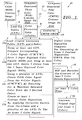
- FIG. 1 generally illustrates at 10 the process according to the invention for creating 5 to 7 color separations used in a multi-color press.
- An image scanner 11 scans a contone (CT) image (which can include line work (LW) such as text) to create three color contone image signals, typically R, G, and B.
- CT contone
- LW line work
- the image scanner 11 may also scan linework (LW), such as test or logos, to also create R, G, B signals.
- a disk 12 may be provided having stored thereon a 3-color contone image.
- a disk 13 having a computer generator 4-color contone image thereon may be provided where the colors are, for example, CMYK. These colors can then be converted in a converter 14 using commercially available conversion techniques to convert the 4-colors (CMYK) to three colors (RGB), for example.
- the scanned digitized image from one of the inputs 11, 12, or 13 is then input in the form of three input digitized color image signals RGB into the digital color separation computer 15.
- digital color separation computer merely indicates any general purpose computer which performs the process of 5 to 7 color separation as described in this patent.
- These three digitized color image signals are often referred to as a digital tristimulus signal.
- the color separation digital computer 15, by programmed steps described hereafter, generates at least 5 single color (contone) unscreened image separations in the form of computer files. These computer files are then forwarded to a commercially available raster image processor (RIP) as is well known in the art, to which is attached a recorder as shown at 16 for creation of color screen separations.
- RIP raster image processor
- the raster image processor converts the contone color files and PostScript drawing instructions into electronic half-tone screens represented by electrical signals which are then fed to the laser recorder for exposing film, the exposed film for each color representing a so-called screen separation, with one screen separation for each of the at least five colors.
- the at least 5 screen separations are transformed into at least 5 printing plates via a photographic exposure of the screened films on to metalized printing plates (paper and polyester plates may also be employed).
- the at least 5 metal printing plates are mounted on the 5 or more printing stations of a commercially available printing press 17.
- the 5 or more color press then prints a customer page 18 in at least 5 colors, as is well know to those skilled in this art.
- 5 color press When the term "5 color press” is used in the present context, it should be understood that this could be a 4 color press in which the fifth color separation is employed after running the four colors. Similarly, for a 6 or 7 color press, it might a 4 color press where the three separations are then run after running the first four colors. Alternatively, of course, 5, 6, or 7 separate press stations could be employed in a true 5, 6, or 7 color press.
- correction tables Prior to creation of the at least 5 color separations by the digital color separation computer 15, correction tables were first generated. These correction tables are of two basic types. As shown in Fig. 3, look up tables (hereinafter known as LUTs) for printing environment parameters are created. These are shown and explained in Fig. 3 hereafter. A second type of correction table known as the color correction table or ⁇ table (hereinafter referred to as the ⁇ table), is created which provides corrections to model real world inks. A color correction table is explained with reference to Fig. 5 hereafter. The use of the LUTs and the ⁇ table by the digital color separation computer processing is shown in greater detail in Fig. 4 as described hereafter.
- the correction tables are loaded (that is the LUTs and the ⁇ table).
- the computer 15 then computes corresponding 4 color signals (CMYK) from the input digitized color signals (RGB), and also derives three colors from the 3 digitized input color signals (RGB).
- the computer 15 creates a fifth color from the 4 color signals (CMYK) by searching for a maximum saturated color from the three derived colors in step 15b above.
- the computer 15 creates the at least five contone color separations by applying correction factors from the correction tables ( ⁇ table and a plurality of the LUTs) to the five colors.
- the color separation computer process employs a simplified mathematical expression for the relationships of primary colors, plus a correction table, to produce the desired separations.
- the process can produce 5, 6 or 7 color separations.
- the steps for implementing 7 color processing are described.
- the steps described are also applicable to creation of 5 or 6 color separations and to produce separations of a lesser number of primary colors than 7, the computer program uses the standard CMYK components to produce whichever of the RGB colors is not present in the traditional way.
- the correction table would have no entries for the RGB color(s) which are not present.
- the color separation computer process starts with equations 1-4 and then compensates for the imperfect inks, dot gain, ink tack, and other print shortcomings by means of a zero-based correction table.
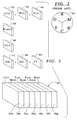
- Figure 2 shows on the colorwheel 19 a schematic representation of how the additive colors (RGB) are related to the subtractive colors (CMY). If equal amounts of yellow and magenta are mixed, the resultant color is red. Similarly, equal amounts of green and blue would yield cyan in a printing environment.
- the basis of the 7-color separation in the color separation computer process is to find the two dominant colors in the CMY color space, and then determine which RGB color will replace the smaller of the two dominant colors.
- the following example illustrates the basic color process:
- Y, Y', and Y'' denotes the changes to the yellow color during the various process steps of color separation computer process of the invention. The same is true for M, C, K, R, G, B and their primed quantities, respectively.
- An additional feature of the color separation computer process is that one of the five non-zero values will be very close to zero percent (typically 4% or less). This means that only four primary colors (of the CMYKRGB set) will be printing at any single pixel location (or in a rosette structure).
- the advantage of this feature is that the moiré problems that have typically been associated with previous experiments in 7-color printing will be non-existent. Neither irrational tangent screening, nor the HPS screening (High Precision Screening) of Linotype-Hell, produce any noticeable moiré with 4-color screening. Since the color separation computer process only produces four colors at any point in an image, the traditional screen angles of 4-color printing will be completely sufficient to solve moiré problems in 7-color screening. It also means that stochastic screening for 7-color images will produce very similar results to stochastic screening for 4-color images, since only 4 inks will be present in any given rosette or pixel.
- Color separation in commercial printing has to account for impurities in the ink (known as additivity failure), dot gain, maximum dot percent, color cast of the printing stock, variable ink trap depending on the order of color on the press, etc.
- maximum dot percent (or “max dot percent”) is a phrase well known in this art and refers to the summation of all colors of ink at a given point in the image.
- press environmental conditions the invented process has a number of LookUp Tables (LUTs) which attempt to separate out these various problems from the simplistic approach to color separation outlined previously. These LookUp Tables (LUTs) are shown in Fig. 3.
- LUTs facilitate a change in the printing process (for example, the use of different colored inks) with only a small number of parameter changes in the entire process. This should be compared to the "table-and-interpolate" or the transformation matrix methods, where a change of printing inks would necessitate a complete re-calibration of the entire system.
- LUTs Fifteen different LUTs have been selected as representative of primary press environmental parameters that need alteration in the commercial printing environment. These are single variable lookup tables (8-bit) with single output values (8-bit). Higher or lower precision tables could be used, but the uniformity of all LUTs to the same resolution greatly simplifies the programming aspects.
- the LUTs shown in Fig. 3 generally are created for the following printing environment parameters used in the creation of the at least 5 color separations according to the invention:
- the LUTs can be easily divided into four functional groups: Gray balance, Black balance, RGB boost, and Output linearization.
- the Gray balance group consist of Clin, Mlin, and Ylin. These tables produce a neutral gray for equal amounts of input RGB (which are translated into CMY).
- the Gray balance is what primarily needs to be changed if a slightly different set of primary color inks is used.
- the Black balance group attempts to correct the printing process from the skeleton black that is put into the algorithm by removing the maximum amount of "blackness" from the 3-component colors of CMY. This is accomplished by taking the least amount of common cyan, magenta, and yellow, and making that quantity the proposed black amount. While skeleton black usually results in the smallest max dot percent, it also produces weak black colors.
- the Ktable determines how much of the maximum black that was permitted to exist will remain in the final image.
- UCA determines how much of the black that was taken from the CMY components will be returned to them in order to produce a rich 3-color black in addition to the K component black.
- the RGB boost group determine how much of the dominant colors in CMY will be replaced by RGB, respectively. Only one color from RGB will be allowed to print in any given pixel or rosette. The RGB boost can either enhance or retard the maximum allowed amount (which is the smaller of the dominant CMY colors).
- the RGB boost group might also need to be changed if drastically different primary inks were introduced into the printing environment.
- the final group is for output linearization.
- the purpose of having output linearization is to take into account minor variances in ink strengths or to compensate for different press dot gains for different colors.
- the output linearization group is typically what needs to be changed when a page goes from one press facility to another. Assuming proper calibration of the other parameters, only the output linearization group would change from press to press.
- the final result of all processes from the input pixel 20 to the output pixel 40 or 41 can contain from 4 to 7 non-zero colors.
- the determination of whether 4, 5, 6, or 7 colors print depends on the input pixel 20, and on all of the associated LUT tables and the ⁇ table.
- a ⁇ table (also known as a color correction table) is schematically illustrated at 53 in Fig. 5.
- This color correction table (also known as a ⁇ table) provides correction factors to model real world inks.
- the ⁇ values introduced in item 8) of the previous section contain all the empirical corrections to the mathematical formulae that have thus far been used to transform an RGB input set into a CMYKRGB collection of seven separations.
- the ⁇ values have a unique feature in that they are zero-based. This means that the initial state of all the entries is zero. This would correspond to perfect printing inks with perfect combinational linearity and printing tack.
- Non-zero ⁇ values represent the corrections needed to compensate for imperfect ink. Because commercial printing inks are not chromatically pure, and have many physical properties which complicate the printing process, the corrections for these properties are encapsulated in the ⁇ table.
- the ⁇ table uses CMY (the original values derived from RGB by equations 1-3) as the input parameters. CMYK or C''''M'''Y'''K'' could have also been used, but they would increase the size of the table with little improvement in output accuracy. Since the ⁇ table is very sparsely populated (a complete table for CMY would require 16.7 million entries), interpolation is required to provide the best accuracy for data points which do not lay directly on specific table values. The choice of interpolation technique (for example, nearest neighbor, bi-linear interpolation, cubic spline, to name just a few) is dependent upon the desired accuracy.
- the table method described herein is just one of many different possible configurations.
- This table configuration is called additive/multiplicative because its correction factors can be either additive or multiplicative on a per element basis. This gives tremendous flexibility in permitting large corrections with moderate errors, or small corrections with no errors at all.
- the table, as described in this example, has 32,767 entry points. An entry point is determined by taking the 5 most significant bits for each of the three components CMY, and then taking that 15-bit value as an address of the delta values. Since there are 7 values of output for each table entry (a delta for C, for M, for Y, for K, for R, for G, and for B), an integer multiplied by 7 of the 15-bit table address will yield a real base address in linear memory.
- CMY Once the input address of CMY yields the specific ⁇ table address, the 7 bytes located at that entry point are associated with CMYKRGB colors. Note that the ⁇ table correction can effect all 7 separation colors even though the mathematical treatment of the 7 color separation only had at most 5 colors present (see 35 in Fig. 4)(and only 4 colors having significant contributions).
- the ability to have all 7 separations receive corrections is a generality of the process. In practical applications of 7 color printing, 5 colors at most would be present in a given output pixel. In a rare case where the creator of the ⁇ table seeks to create special effects, the table could be adjusted to allow all 7 primary colors to be present in dark regions of an image. This would produce extremely high density blacks. It would also require that the press be driven very slowly because of the 500% max dot that would be present.
- delta elements The individual components of a given ⁇ table entry point, called delta elements, are described in this patent specification as comprising a single byte. This is for memory conservation. However, 2-byte and 4-byte delta elements are easily constructed.
- the 8 bits within a byte are considered to be numbered from left to right as bit 7 through bit 0.
- Bit 7 in this example is considered to be a flag bit with 0 representing that the correction is done with addition, whereas a flag bit of 1 would indicate that the correction is accomplished via multiplication.
- Bit 6 is considered to be a sign bit for both the additive and multiplicative operations.
- Bit 5 through bit 0 contain the numerical value of the correction.
- the process of creating the LUTs shown in Fig. 3 and ⁇ table values shown in Fig. 5 are rather straightforward. Initially, all tables are set to unitary transformations, that is, each input value gives the same output value. The ⁇ table is created with all zeros which imply no correction at all.
- Pie shaped step wedges of cyan and magenta, magenta and yellow, and yellow and cyan are also printed going from black to saturated colors. The same procedure is used going from white to saturated color. An optical investigation of the smoothness of the transitions from cyan to blue to magenta will determine the RGB boost needed in the MC() table. Similar printings will provide the basis of the CY() ad YM() boosts.
- the ⁇ table can be constructed in typically ten iterations of output, measurement, and correction to the tables. Once the ⁇ table appears reasonably stable, a least-square mapping program can smooth out the correction data to produce the most uniform printing results.
- the seven output linearization tables need to come from measurement of the dot gain and other forms of press gain for a specific machine. These measurements are typically done once with step wedges done in all seven primary colors.
Landscapes
- Engineering & Computer Science (AREA)
- Textile Engineering (AREA)
- Multimedia (AREA)
- Signal Processing (AREA)
- Facsimile Image Signal Circuits (AREA)
- Color Image Communication Systems (AREA)
- Image Processing (AREA)
- Manufacture Or Reproduction Of Printing Formes (AREA)
Applications Claiming Priority (2)
| Application Number | Priority Date | Filing Date | Title |
|---|---|---|---|
| US08/409,850 US5687300A (en) | 1995-03-27 | 1995-03-27 | Process for creating five to seven color separations used on a multicolor press |
| US409850 | 1995-03-27 |
Publications (3)
| Publication Number | Publication Date |
|---|---|
| EP0735743A2 true EP0735743A2 (de) | 1996-10-02 |
| EP0735743A3 EP0735743A3 (de) | 1997-03-12 |
| EP0735743B1 EP0735743B1 (de) | 2001-10-10 |
Family
ID=23622240
Family Applications (1)
| Application Number | Title | Priority Date | Filing Date |
|---|---|---|---|
| EP96104094A Expired - Lifetime EP0735743B1 (de) | 1995-03-27 | 1996-03-15 | Verfahren zur Erzeugung von mindestens fünf Farbauszügen für einen Mehrfarbendrucker |
Country Status (4)
| Country | Link |
|---|---|
| US (1) | US5687300A (de) |
| EP (1) | EP0735743B1 (de) |
| JP (1) | JP2755935B2 (de) |
| DE (1) | DE69615728T2 (de) |
Cited By (9)
| Publication number | Priority date | Publication date | Assignee | Title |
|---|---|---|---|---|
| EP0810777A3 (de) * | 1996-05-31 | 1999-10-06 | Canon Kabushiki Kaisha | Bildverarbeitungssystem und -verfahren und Aufzeichnungsträger |
| EP0853424A3 (de) * | 1997-01-09 | 2000-06-07 | Hewlett-Packard Company | Getrennte Farbtontabellen |
| EP1237355A2 (de) | 2001-03-02 | 2002-09-04 | Heidelberger Druckmaschinen Aktiengesellschaft | Verfahren zur Bestimmung eines Farbprofils für das Drucken mit mehreren Druckfarben |
| EP1365576A3 (de) * | 2002-05-22 | 2004-08-18 | Creo IL. Ltd. | Verfahren und Apparat zur Kalibrierung der Punktvergrösserung |
| WO2005112432A1 (en) * | 2004-04-30 | 2005-11-24 | Eastman Kodak Company | Pantone matching system color expansion with fifth color |
| WO2007137621A1 (en) * | 2006-05-30 | 2007-12-06 | Hewlett-Packard Development Company, L.P. | Chromatic component replacement |
| EP1758369A3 (de) * | 2005-08-23 | 2008-07-30 | Canon Kabushiki Kaisha | Verfahren und Vorrichtung zur Farbverarbeitung |
| DE102004001937B4 (de) * | 2004-01-14 | 2013-09-26 | Heidelberger Druckmaschinen Ag | Verfahren zur Reproduktion von Sonderfarben mit Primärdruckfarben und Sekundärdruckfarben |
| CN104977802A (zh) * | 2015-06-30 | 2015-10-14 | 太仓丽盛制版有限公司 | 一种改进型凹版印刷装饰版的专色分色方法 |
Families Citing this family (35)
| Publication number | Priority date | Publication date | Assignee | Title |
|---|---|---|---|---|
| JP2809163B2 (ja) * | 1995-12-13 | 1998-10-08 | 日本電気株式会社 | カラー記録方法およびカラープリンタ |
| US6097503A (en) * | 1998-01-23 | 2000-08-01 | Adobe Systems Incorporated | Bi-level to contone data conversion |
| US6594405B1 (en) * | 1998-12-28 | 2003-07-15 | Gateway, Inc. | Method and apparatus for preprinted forms completion |
| US6961066B2 (en) * | 1999-04-13 | 2005-11-01 | Athentech Technologies, Inc. | Automatic color adjustment for digital images |
| US6677959B1 (en) * | 1999-04-13 | 2004-01-13 | Athentech Technologies Inc. | Virtual true color light amplification |
| US6507666B1 (en) * | 1999-05-19 | 2003-01-14 | Jesus Hill De La Torre | Method and apparatus for compensating for dot gain in stochastic printing |
| JP2001111858A (ja) * | 1999-08-03 | 2001-04-20 | Fuji Photo Film Co Ltd | 色修正定義作成方法、色修正定義作成装置、および色修正定義作成プログラム記憶媒体 |
| US6801336B1 (en) | 1999-08-30 | 2004-10-05 | Creo Inc. | System and method for producing halftoned color separations for an output imaging device |
| DE10001211B4 (de) * | 2000-01-14 | 2004-04-15 | Heidelberger Druckmaschinen Ag | Verfahren zum Erzeugen von Rasterdaten und Rastererzeugungssystem |
| EP1156667A3 (de) * | 2000-05-17 | 2004-05-06 | Komori Corporation | Color-Management-Verfahren und -Vorrichtung für eine Druckmaschine |
| JP4757986B2 (ja) * | 2000-09-12 | 2011-08-24 | 東北リコー株式会社 | 印刷装置および印刷システム |
| US7375857B1 (en) | 2000-09-22 | 2008-05-20 | Eastman Kodak Company | Print proofing with color and screen matching |
| US6930810B1 (en) * | 2000-11-28 | 2005-08-16 | Kabushiki Kaisha Toshiba | Correction table forming method and image forming apparatus |
| WO2002070261A1 (en) * | 2001-03-02 | 2002-09-12 | The Ackley Martinez Company Dba Mgi Studio | Printing adjustment system and method |
| CA2452543A1 (en) | 2001-07-30 | 2003-03-13 | The Ackley Martinez Company Dba Mgi Studio | System admixture compensation system and method |
| BR0211123A (pt) * | 2001-07-30 | 2004-10-26 | Ackley Martinez Company Dba Mg | Sistema e método de processamento de gerenciamento de cor |
| US6786565B2 (en) | 2001-09-24 | 2004-09-07 | Creo Americas, Inc. | Inkjet proofing with matched color and screen resolution |
| US7164498B2 (en) * | 2002-06-20 | 2007-01-16 | Esko-Graphics A/S | Color matching for a printing process using more than four colorants using a four-colorant color management system |
| JP4475623B2 (ja) * | 2002-07-31 | 2010-06-09 | キヤノン株式会社 | 色処理方法および色処理装置 |
| JP3925431B2 (ja) * | 2003-02-28 | 2007-06-06 | セイコーエプソン株式会社 | 有彩1次色インクと有彩2次色インクとを含む複数のインク成分への分版処理 |
| DE102004003300B4 (de) * | 2004-01-22 | 2014-03-06 | Heidelberger Druckmaschinen Ag | Verfahren zur Herstellung eines Prüfdrucks für einen Druckprozess mit mehr als vier Druckfarben |
| JP4418270B2 (ja) * | 2004-03-19 | 2010-02-17 | 理想科学工業株式会社 | 画像処理装置及びプリンタドライバ |
| US7580564B2 (en) * | 2004-05-13 | 2009-08-25 | Lexmark International, Inc. | Method of an image processor for transforming a n-bit data packet to a m-bit data packet using a lookup table |
| US7605959B2 (en) * | 2005-01-05 | 2009-10-20 | The Ackley Martinez Company | System and method of color image transformation |
| US8149454B2 (en) * | 2005-06-09 | 2012-04-03 | Xerox Corporation | Color printing |
| US7791776B2 (en) * | 2005-10-28 | 2010-09-07 | Hewlett-Packard Development Company, L.P. | Spot color adjuster |
| US8873102B2 (en) * | 2005-10-28 | 2014-10-28 | Hewlett-Packard Development Company, L.P. | Dynamic color separation at a digital press |
| US7478903B2 (en) * | 2005-10-31 | 2009-01-20 | Hewlett-Packard Development Company, L.P. | Ink set for inkjet printing, inkjet printer including the ink set, and method of inkjet printing using the ink set |
| US8379048B2 (en) * | 2007-05-04 | 2013-02-19 | Esko Software Bvba | User adjustable gamut mapping and conversion of images from a source color space to a destination color space including primary and redundant colors |
| US7978371B2 (en) * | 2008-02-05 | 2011-07-12 | Xerox Corporation | Vector half-toning with minimum luminance variation dot formation |
| US7952764B2 (en) * | 2008-02-05 | 2011-05-31 | Xerox Corporation | Hierarchical color error diffusion in a CMYKRGB domain |
| US7916349B2 (en) * | 2008-10-27 | 2011-03-29 | Xerox Corporation | Color pixel error diffusion in a CMYK input color space |
| JP5317931B2 (ja) * | 2009-08-13 | 2013-10-16 | キヤノン株式会社 | 印刷装置、印刷装置の制御方法、およびプログラム |
| US10542182B2 (en) * | 2013-07-19 | 2020-01-21 | Hewlett-Packard Development Company, L.P. | Color separation |
| US9706085B1 (en) * | 2016-05-20 | 2017-07-11 | Xerox Corporation | Intelligent spot color recipe picker for digital front end |
Family Cites Families (12)
| Publication number | Priority date | Publication date | Assignee | Title |
|---|---|---|---|---|
| US3555262A (en) * | 1968-05-07 | 1971-01-12 | Dainippon Screen Mfg | Apparatus for production of color separation records |
| US4683492A (en) * | 1983-03-08 | 1987-07-28 | Canon Kabushiki Kaisha | Method and apparatus for recording a full-color image with a plurality of colorants on the basis of a set of area factors for the colorants selected from a plurality of sets of area factors calculated from a plurality of sets of equations |
| US4812899A (en) * | 1985-01-29 | 1989-03-14 | Harald Kueppers | Printing process where each incremental area is divided into a chromatic area and an achromatic area and wherein the achromatic areas are printed in black and white and the chromatic areas are printed in color sub-sections |
| DE3537008A1 (de) * | 1985-10-17 | 1987-04-23 | Harald Kueppers | Verfahren zur herstellung von systematischen farbtabellen bzw. farbtafeln fuer den siebenfarbendruck sowie nach diesem verfahren hergestellte tabellen bzw. tafeln |
| US5253082A (en) * | 1988-03-10 | 1993-10-12 | Canon Kabushiki Kaisha | Image forming apparatus |
| US4924301A (en) * | 1988-11-08 | 1990-05-08 | Seecolor Corporation | Apparatus and methods for digital halftoning |
| JPH07102733B2 (ja) * | 1989-03-13 | 1995-11-08 | 大和製罐株式会社 | 円筒形容器外面への非重ね刷り網点印刷方法 |
| JPH02238990A (ja) * | 1989-03-13 | 1990-09-21 | Fujitsu Ltd | フルカラー画像印刷方法 |
| ATE156642T1 (de) * | 1990-02-05 | 1997-08-15 | Scitex Corp Ltd | Farbeichungsgerät und -verfahren |
| US5327257A (en) * | 1992-02-26 | 1994-07-05 | Cymbolic Sciences International Ltd. | Method and apparatus for adaptively interpolating a digital image |
| IL102994A (en) * | 1992-08-30 | 1998-12-27 | Scitex Corp Ltd | Method and device for printing in seven colors |
| JPH06233126A (ja) * | 1993-02-01 | 1994-08-19 | Canon Inc | カラー画像処理装置 |
-
1995
- 1995-03-27 US US08/409,850 patent/US5687300A/en not_active Expired - Fee Related
-
1996
- 1996-03-15 DE DE69615728T patent/DE69615728T2/de not_active Expired - Fee Related
- 1996-03-15 EP EP96104094A patent/EP0735743B1/de not_active Expired - Lifetime
- 1996-03-27 JP JP8072493A patent/JP2755935B2/ja not_active Expired - Lifetime
Cited By (15)
| Publication number | Priority date | Publication date | Assignee | Title |
|---|---|---|---|---|
| EP0810777A3 (de) * | 1996-05-31 | 1999-10-06 | Canon Kabushiki Kaisha | Bildverarbeitungssystem und -verfahren und Aufzeichnungsträger |
| US6038373A (en) * | 1996-05-31 | 2000-03-14 | Canon Kabushiki Kaisha | Image processing system and method and recording media |
| EP0853424A3 (de) * | 1997-01-09 | 2000-06-07 | Hewlett-Packard Company | Getrennte Farbtontabellen |
| US7233412B2 (en) | 2001-03-02 | 2007-06-19 | Heidelberger Druckmaschinen Ag | Method of determining a color profile for printing with N printing inks |
| DE10110125A1 (de) * | 2001-03-02 | 2002-09-19 | Heidelberger Druckmasch Ag | Verfahren zur Bestimmung eines Farbprofils für das drucken mit N Druckfarben |
| EP1237355A2 (de) | 2001-03-02 | 2002-09-04 | Heidelberger Druckmaschinen Aktiengesellschaft | Verfahren zur Bestimmung eines Farbprofils für das Drucken mit mehreren Druckfarben |
| EP1365576A3 (de) * | 2002-05-22 | 2004-08-18 | Creo IL. Ltd. | Verfahren und Apparat zur Kalibrierung der Punktvergrösserung |
| US6917448B2 (en) | 2002-05-22 | 2005-07-12 | Creo Il. Ltd. | Dot gain calibration method and apparatus |
| US7123384B2 (en) | 2002-05-22 | 2006-10-17 | Creo Il. Ltd. | Dot gain calibration method and apparatus |
| DE102004001937B4 (de) * | 2004-01-14 | 2013-09-26 | Heidelberger Druckmaschinen Ag | Verfahren zur Reproduktion von Sonderfarben mit Primärdruckfarben und Sekundärdruckfarben |
| WO2005112432A1 (en) * | 2004-04-30 | 2005-11-24 | Eastman Kodak Company | Pantone matching system color expansion with fifth color |
| EP1758369A3 (de) * | 2005-08-23 | 2008-07-30 | Canon Kabushiki Kaisha | Verfahren und Vorrichtung zur Farbverarbeitung |
| US7583407B2 (en) | 2005-08-23 | 2009-09-01 | Canon Kabushiki Kaisha | Color processing method and apparatus |
| WO2007137621A1 (en) * | 2006-05-30 | 2007-12-06 | Hewlett-Packard Development Company, L.P. | Chromatic component replacement |
| CN104977802A (zh) * | 2015-06-30 | 2015-10-14 | 太仓丽盛制版有限公司 | 一种改进型凹版印刷装饰版的专色分色方法 |
Also Published As
| Publication number | Publication date |
|---|---|
| EP0735743B1 (de) | 2001-10-10 |
| DE69615728T2 (de) | 2002-08-01 |
| EP0735743A3 (de) | 1997-03-12 |
| JP2755935B2 (ja) | 1998-05-25 |
| JPH08272081A (ja) | 1996-10-18 |
| DE69615728D1 (de) | 2001-11-15 |
| US5687300A (en) | 1997-11-11 |
Similar Documents
| Publication | Publication Date | Title |
|---|---|---|
| US5687300A (en) | Process for creating five to seven color separations used on a multicolor press | |
| US5748858A (en) | Method of and system for predicting reproduced color image | |
| US5528377A (en) | Extended density color printing | |
| US5787193A (en) | System for converting color image signals from RGB to CMY color spaces through look-up tables | |
| EP0648042B1 (de) | Farbreproduktionssystem | |
| EP0854638B1 (de) | Verfahren zur kontinuierlichen inkrementalen Farbkalibrierung an der Ausgabeseite von Farbkopierern | |
| US5305119A (en) | Color printer calibration architecture | |
| US6897988B1 (en) | Image processing apparatus, image processing method, and storage medium for color matching | |
| KR19990009458A (ko) | 화상 시스템의 색보정 장치 및 방법 | |
| JPH07231393A (ja) | 画像再現装置 | |
| JP2003136683A (ja) | 印刷カラーマネージメントシステムおよび印刷カラーマネージメント方法 | |
| JPH0983824A (ja) | 色修正方法 | |
| US5612795A (en) | HSL corrections in CMY color space | |
| US6567186B1 (en) | Method for determining gray values in a printer | |
| JP2000062253A (ja) | 特色印刷用プロファイル作成方法、及び特色印刷原稿の校正刷り作成装置 | |
| JPH04335771A (ja) | 色修正装置 | |
| JP2001186368A (ja) | 色空間座標変換方法及び装置、色信号変換テーブルの生成方法及び装置、並びにメモリ媒体 | |
| JP3776326B2 (ja) | 色変換テーブル作成方法 | |
| JP2535521B2 (ja) | 画像デ―タ処理方法 | |
| JP2713932B2 (ja) | 画像処理方法 | |
| JP2001119591A (ja) | カラー画像処理装置 | |
| JP3314245B2 (ja) | 画像処理装置 | |
| JPH06334850A (ja) | 色変換処理装置 | |
| JP3218904B2 (ja) | カラー画像処理装置 | |
| JP3097757B2 (ja) | 元のcmyk印刷色によって再現される原画像内に各補正量を導入する方法 |
Legal Events
| Date | Code | Title | Description |
|---|---|---|---|
| PUAI | Public reference made under article 153(3) epc to a published international application that has entered the european phase |
Free format text: ORIGINAL CODE: 0009012 |
|
| AK | Designated contracting states |
Kind code of ref document: A2 Designated state(s): DE FR GB IT |
|
| PUAL | Search report despatched |
Free format text: ORIGINAL CODE: 0009013 |
|
| AK | Designated contracting states |
Kind code of ref document: A3 Designated state(s): DE FR GB IT |
|
| 17P | Request for examination filed |
Effective date: 19970912 |
|
| RAP1 | Party data changed (applicant data changed or rights of an application transferred) |
Owner name: HEIDELBERGER DRUCKMASCHINEN AKTIENGESELLSCHAFT |
|
| 17Q | First examination report despatched |
Effective date: 19990614 |
|
| GRAG | Despatch of communication of intention to grant |
Free format text: ORIGINAL CODE: EPIDOS AGRA |
|
| GRAG | Despatch of communication of intention to grant |
Free format text: ORIGINAL CODE: EPIDOS AGRA |
|
| GRAH | Despatch of communication of intention to grant a patent |
Free format text: ORIGINAL CODE: EPIDOS IGRA |
|
| RTI1 | Title (correction) |
Free format text: METHOD FOR CREATING AT LEAST FIVE COLOR SEPARATIONS USED ON A MULTICOLOR PRESS |
|
| GRAH | Despatch of communication of intention to grant a patent |
Free format text: ORIGINAL CODE: EPIDOS IGRA |
|
| GRAA | (expected) grant |
Free format text: ORIGINAL CODE: 0009210 |
|
| AK | Designated contracting states |
Kind code of ref document: B1 Designated state(s): DE FR GB IT |
|
| PG25 | Lapsed in a contracting state [announced via postgrant information from national office to epo] |
Ref country code: FR Free format text: LAPSE BECAUSE OF FAILURE TO SUBMIT A TRANSLATION OF THE DESCRIPTION OR TO PAY THE FEE WITHIN THE PRESCRIBED TIME-LIMIT Effective date: 20011010 |
|
| REF | Corresponds to: |
Ref document number: 69615728 Country of ref document: DE Date of ref document: 20011115 |
|
| REG | Reference to a national code |
Ref country code: GB Ref legal event code: IF02 |
|
| PG25 | Lapsed in a contracting state [announced via postgrant information from national office to epo] |
Ref country code: GB Free format text: LAPSE BECAUSE OF NON-PAYMENT OF DUE FEES Effective date: 20020315 |
|
| EN | Fr: translation not filed | ||
| PLBE | No opposition filed within time limit |
Free format text: ORIGINAL CODE: 0009261 |
|
| STAA | Information on the status of an ep patent application or granted ep patent |
Free format text: STATUS: NO OPPOSITION FILED WITHIN TIME LIMIT |
|
| PG25 | Lapsed in a contracting state [announced via postgrant information from national office to epo] |
Ref country code: DE Free format text: LAPSE BECAUSE OF NON-PAYMENT OF DUE FEES Effective date: 20021001 |
|
| 26N | No opposition filed | ||
| GBPC | Gb: european patent ceased through non-payment of renewal fee |
Effective date: 20020315 |
|
| PG25 | Lapsed in a contracting state [announced via postgrant information from national office to epo] |
Ref country code: IT Free format text: LAPSE BECAUSE OF NON-PAYMENT OF DUE FEES;WARNING: LAPSES OF ITALIAN PATENTS WITH EFFECTIVE DATE BEFORE 2007 MAY HAVE OCCURRED AT ANY TIME BEFORE 2007. THE CORRECT EFFECTIVE DATE MAY BE DIFFERENT FROM THE ONE RECORDED. Effective date: 20050315 |