EP0731894B1 - Rohrisolation mit klebeverschluss und ein verfahren zu deren herstellung - Google Patents
Rohrisolation mit klebeverschluss und ein verfahren zu deren herstellung Download PDFInfo
- Publication number
- EP0731894B1 EP0731894B1 EP95902011A EP95902011A EP0731894B1 EP 0731894 B1 EP0731894 B1 EP 0731894B1 EP 95902011 A EP95902011 A EP 95902011A EP 95902011 A EP95902011 A EP 95902011A EP 0731894 B1 EP0731894 B1 EP 0731894B1
- Authority
- EP
- European Patent Office
- Prior art keywords
- pipe insulation
- adhesive
- slit
- pressure sensitive
- insulation
- Prior art date
- Legal status (The legal status is an assumption and is not a legal conclusion. Google has not performed a legal analysis and makes no representation as to the accuracy of the status listed.)
- Expired - Lifetime
Links
- 238000009413 insulation Methods 0.000 title claims abstract description 103
- 239000000853 adhesive Substances 0.000 title claims abstract description 65
- 230000001070 adhesive effect Effects 0.000 title claims abstract description 65
- 238000000034 method Methods 0.000 title claims abstract description 23
- 238000004519 manufacturing process Methods 0.000 title description 8
- 239000004820 Pressure-sensitive adhesive Substances 0.000 claims abstract description 12
- 239000000463 material Substances 0.000 claims abstract description 6
- 239000004831 Hot glue Substances 0.000 claims description 19
- 239000007921 spray Substances 0.000 claims description 12
- 238000001125 extrusion Methods 0.000 claims description 10
- 239000000155 melt Substances 0.000 claims description 6
- 230000002093 peripheral effect Effects 0.000 claims description 6
- 238000001816 cooling Methods 0.000 claims description 4
- 229920001684 low density polyethylene Polymers 0.000 claims description 4
- 239000004702 low-density polyethylene Substances 0.000 claims description 4
- 238000005520 cutting process Methods 0.000 claims description 3
- 238000002844 melting Methods 0.000 claims description 3
- 230000008018 melting Effects 0.000 claims description 3
- 239000012790 adhesive layer Substances 0.000 claims description 2
- 239000012467 final product Substances 0.000 claims description 2
- 239000012943 hotmelt Substances 0.000 claims description 2
- 238000003892 spreading Methods 0.000 claims description 2
- 230000015572 biosynthetic process Effects 0.000 claims 2
- 238000005755 formation reaction Methods 0.000 claims 2
- -1 polyethylene Polymers 0.000 abstract description 10
- 239000004698 Polyethylene Substances 0.000 abstract description 8
- 239000006260 foam Substances 0.000 abstract description 8
- 229920000573 polyethylene Polymers 0.000 abstract description 8
- 239000010408 film Substances 0.000 description 38
- 239000000047 product Substances 0.000 description 31
- 210000004027 cell Anatomy 0.000 description 11
- 239000000758 substrate Substances 0.000 description 7
- 235000012438 extruded product Nutrition 0.000 description 6
- XLYOFNOQVPJJNP-UHFFFAOYSA-N water Substances O XLYOFNOQVPJJNP-UHFFFAOYSA-N 0.000 description 5
- 238000005507 spraying Methods 0.000 description 3
- 239000004743 Polypropylene Substances 0.000 description 2
- 239000002390 adhesive tape Substances 0.000 description 2
- 238000013459 approach Methods 0.000 description 2
- QVGXLLKOCUKJST-UHFFFAOYSA-N atomic oxygen Chemical compound [O] QVGXLLKOCUKJST-UHFFFAOYSA-N 0.000 description 2
- 230000015556 catabolic process Effects 0.000 description 2
- 210000002421 cell wall Anatomy 0.000 description 2
- 238000006731 degradation reaction Methods 0.000 description 2
- 230000000694 effects Effects 0.000 description 2
- 239000010410 layer Substances 0.000 description 2
- 229910052760 oxygen Inorganic materials 0.000 description 2
- 239000001301 oxygen Substances 0.000 description 2
- 229920001155 polypropylene Polymers 0.000 description 2
- 239000003381 stabilizer Substances 0.000 description 2
- 230000003685 thermal hair damage Effects 0.000 description 2
- XUIMIQQOPSSXEZ-UHFFFAOYSA-N Silicon Chemical compound [Si] XUIMIQQOPSSXEZ-UHFFFAOYSA-N 0.000 description 1
- 229920002472 Starch Polymers 0.000 description 1
- 230000001413 cellular effect Effects 0.000 description 1
- 210000003850 cellular structure Anatomy 0.000 description 1
- 239000011248 coating agent Substances 0.000 description 1
- 238000000576 coating method Methods 0.000 description 1
- 150000001875 compounds Chemical class 0.000 description 1
- 238000011109 contamination Methods 0.000 description 1
- 230000006866 deterioration Effects 0.000 description 1
- 239000006261 foam material Substances 0.000 description 1
- 239000011521 glass Substances 0.000 description 1
- 230000005484 gravity Effects 0.000 description 1
- 239000000976 ink Substances 0.000 description 1
- 238000009434 installation Methods 0.000 description 1
- 229920000092 linear low density polyethylene Polymers 0.000 description 1
- 239000004707 linear low-density polyethylene Substances 0.000 description 1
- 239000002184 metal Substances 0.000 description 1
- 229910052751 metal Inorganic materials 0.000 description 1
- 150000002739 metals Chemical class 0.000 description 1
- 239000000203 mixture Substances 0.000 description 1
- 238000004806 packaging method and process Methods 0.000 description 1
- 230000035515 penetration Effects 0.000 description 1
- 229920003023 plastic Polymers 0.000 description 1
- 239000004033 plastic Substances 0.000 description 1
- 229920000728 polyester Polymers 0.000 description 1
- 238000003825 pressing Methods 0.000 description 1
- 229910052710 silicon Inorganic materials 0.000 description 1
- 239000010703 silicon Substances 0.000 description 1
- 239000007787 solid Substances 0.000 description 1
- 239000002904 solvent Substances 0.000 description 1
- 239000008107 starch Substances 0.000 description 1
- 235000019698 starch Nutrition 0.000 description 1
- 239000000126 substance Substances 0.000 description 1
- 229920001169 thermoplastic Polymers 0.000 description 1
- 239000004416 thermosoftening plastic Substances 0.000 description 1
- 239000010409 thin film Substances 0.000 description 1
Images


Classifications
-
- F—MECHANICAL ENGINEERING; LIGHTING; HEATING; WEAPONS; BLASTING
- F16—ENGINEERING ELEMENTS AND UNITS; GENERAL MEASURES FOR PRODUCING AND MAINTAINING EFFECTIVE FUNCTIONING OF MACHINES OR INSTALLATIONS; THERMAL INSULATION IN GENERAL
- F16L—PIPES; JOINTS OR FITTINGS FOR PIPES; SUPPORTS FOR PIPES, CABLES OR PROTECTIVE TUBING; MEANS FOR THERMAL INSULATION IN GENERAL
- F16L59/00—Thermal insulation in general
- F16L59/02—Shape or form of insulating materials, with or without coverings integral with the insulating materials
- F16L59/021—Shape or form of insulating materials, with or without coverings integral with the insulating materials comprising a single piece or sleeve, e.g. split sleeves; consisting of two half sleeves; comprising more than two segments
- F16L59/022—Shape or form of insulating materials, with or without coverings integral with the insulating materials comprising a single piece or sleeve, e.g. split sleeves; consisting of two half sleeves; comprising more than two segments with a single slit
-
- B—PERFORMING OPERATIONS; TRANSPORTING
- B29—WORKING OF PLASTICS; WORKING OF SUBSTANCES IN A PLASTIC STATE IN GENERAL
- B29C—SHAPING OR JOINING OF PLASTICS; SHAPING OF MATERIAL IN A PLASTIC STATE, NOT OTHERWISE PROVIDED FOR; AFTER-TREATMENT OF THE SHAPED PRODUCTS, e.g. REPAIRING
- B29C44/00—Shaping by internal pressure generated in the material, e.g. swelling or foaming ; Producing porous or cellular expanded plastics articles
- B29C44/34—Auxiliary operations
- B29C44/56—After-treatment of articles, e.g. for altering the shape
-
- B—PERFORMING OPERATIONS; TRANSPORTING
- B29—WORKING OF PLASTICS; WORKING OF SUBSTANCES IN A PLASTIC STATE IN GENERAL
- B29C—SHAPING OR JOINING OF PLASTICS; SHAPING OF MATERIAL IN A PLASTIC STATE, NOT OTHERWISE PROVIDED FOR; AFTER-TREATMENT OF THE SHAPED PRODUCTS, e.g. REPAIRING
- B29C48/00—Extrusion moulding, i.e. expressing the moulding material through a die or nozzle which imparts the desired form; Apparatus therefor
- B29C48/001—Combinations of extrusion moulding with other shaping operations
- B29C48/0022—Combinations of extrusion moulding with other shaping operations combined with cutting
-
- B—PERFORMING OPERATIONS; TRANSPORTING
- B29—WORKING OF PLASTICS; WORKING OF SUBSTANCES IN A PLASTIC STATE IN GENERAL
- B29C—SHAPING OR JOINING OF PLASTICS; SHAPING OF MATERIAL IN A PLASTIC STATE, NOT OTHERWISE PROVIDED FOR; AFTER-TREATMENT OF THE SHAPED PRODUCTS, e.g. REPAIRING
- B29C48/00—Extrusion moulding, i.e. expressing the moulding material through a die or nozzle which imparts the desired form; Apparatus therefor
- B29C48/03—Extrusion moulding, i.e. expressing the moulding material through a die or nozzle which imparts the desired form; Apparatus therefor characterised by the shape of the extruded material at extrusion
- B29C48/12—Articles with an irregular circumference when viewed in cross-section, e.g. window profiles
-
- B—PERFORMING OPERATIONS; TRANSPORTING
- B29—WORKING OF PLASTICS; WORKING OF SUBSTANCES IN A PLASTIC STATE IN GENERAL
- B29C—SHAPING OR JOINING OF PLASTICS; SHAPING OF MATERIAL IN A PLASTIC STATE, NOT OTHERWISE PROVIDED FOR; AFTER-TREATMENT OF THE SHAPED PRODUCTS, e.g. REPAIRING
- B29C63/00—Lining or sheathing, i.e. applying preformed layers or sheathings of plastics; Apparatus therefor
- B29C63/0026—Lining or sheathing, i.e. applying preformed layers or sheathings of plastics; Apparatus therefor an edge face with strip material, e.g. a panel edge
- B29C63/003—Lining or sheathing, i.e. applying preformed layers or sheathings of plastics; Apparatus therefor an edge face with strip material, e.g. a panel edge continuously
-
- B—PERFORMING OPERATIONS; TRANSPORTING
- B29—WORKING OF PLASTICS; WORKING OF SUBSTANCES IN A PLASTIC STATE IN GENERAL
- B29C—SHAPING OR JOINING OF PLASTICS; SHAPING OF MATERIAL IN A PLASTIC STATE, NOT OTHERWISE PROVIDED FOR; AFTER-TREATMENT OF THE SHAPED PRODUCTS, e.g. REPAIRING
- B29C65/00—Joining or sealing of preformed parts, e.g. welding of plastics materials; Apparatus therefor
- B29C65/48—Joining or sealing of preformed parts, e.g. welding of plastics materials; Apparatus therefor using adhesives, i.e. using supplementary joining material; solvent bonding
- B29C65/4805—Joining or sealing of preformed parts, e.g. welding of plastics materials; Apparatus therefor using adhesives, i.e. using supplementary joining material; solvent bonding characterised by the type of adhesives
- B29C65/481—Non-reactive adhesives, e.g. physically hardening adhesives
- B29C65/4815—Hot melt adhesives, e.g. thermoplastic adhesives
-
- B—PERFORMING OPERATIONS; TRANSPORTING
- B29—WORKING OF PLASTICS; WORKING OF SUBSTANCES IN A PLASTIC STATE IN GENERAL
- B29C—SHAPING OR JOINING OF PLASTICS; SHAPING OF MATERIAL IN A PLASTIC STATE, NOT OTHERWISE PROVIDED FOR; AFTER-TREATMENT OF THE SHAPED PRODUCTS, e.g. REPAIRING
- B29C65/00—Joining or sealing of preformed parts, e.g. welding of plastics materials; Apparatus therefor
- B29C65/48—Joining or sealing of preformed parts, e.g. welding of plastics materials; Apparatus therefor using adhesives, i.e. using supplementary joining material; solvent bonding
- B29C65/4805—Joining or sealing of preformed parts, e.g. welding of plastics materials; Apparatus therefor using adhesives, i.e. using supplementary joining material; solvent bonding characterised by the type of adhesives
- B29C65/481—Non-reactive adhesives, e.g. physically hardening adhesives
- B29C65/4825—Pressure sensitive adhesives
-
- B—PERFORMING OPERATIONS; TRANSPORTING
- B29—WORKING OF PLASTICS; WORKING OF SUBSTANCES IN A PLASTIC STATE IN GENERAL
- B29C—SHAPING OR JOINING OF PLASTICS; SHAPING OF MATERIAL IN A PLASTIC STATE, NOT OTHERWISE PROVIDED FOR; AFTER-TREATMENT OF THE SHAPED PRODUCTS, e.g. REPAIRING
- B29C65/00—Joining or sealing of preformed parts, e.g. welding of plastics materials; Apparatus therefor
- B29C65/48—Joining or sealing of preformed parts, e.g. welding of plastics materials; Apparatus therefor using adhesives, i.e. using supplementary joining material; solvent bonding
- B29C65/50—Joining or sealing of preformed parts, e.g. welding of plastics materials; Apparatus therefor using adhesives, i.e. using supplementary joining material; solvent bonding using adhesive tape, e.g. thermoplastic tape; using threads or the like
- B29C65/5042—Joining or sealing of preformed parts, e.g. welding of plastics materials; Apparatus therefor using adhesives, i.e. using supplementary joining material; solvent bonding using adhesive tape, e.g. thermoplastic tape; using threads or the like covering both elements to be joined
-
- B—PERFORMING OPERATIONS; TRANSPORTING
- B29—WORKING OF PLASTICS; WORKING OF SUBSTANCES IN A PLASTIC STATE IN GENERAL
- B29C—SHAPING OR JOINING OF PLASTICS; SHAPING OF MATERIAL IN A PLASTIC STATE, NOT OTHERWISE PROVIDED FOR; AFTER-TREATMENT OF THE SHAPED PRODUCTS, e.g. REPAIRING
- B29C66/00—General aspects of processes or apparatus for joining preformed parts
- B29C66/01—General aspects dealing with the joint area or with the area to be joined
- B29C66/05—Particular design of joint configurations
- B29C66/10—Particular design of joint configurations particular design of the joint cross-sections
- B29C66/11—Joint cross-sections comprising a single joint-segment, i.e. one of the parts to be joined comprising a single joint-segment in the joint cross-section
- B29C66/114—Single butt joints
- B29C66/1142—Single butt to butt joints
-
- B—PERFORMING OPERATIONS; TRANSPORTING
- B29—WORKING OF PLASTICS; WORKING OF SUBSTANCES IN A PLASTIC STATE IN GENERAL
- B29C—SHAPING OR JOINING OF PLASTICS; SHAPING OF MATERIAL IN A PLASTIC STATE, NOT OTHERWISE PROVIDED FOR; AFTER-TREATMENT OF THE SHAPED PRODUCTS, e.g. REPAIRING
- B29C66/00—General aspects of processes or apparatus for joining preformed parts
- B29C66/40—General aspects of joining substantially flat articles, e.g. plates, sheets or web-like materials; Making flat seams in tubular or hollow articles; Joining single elements to substantially flat surfaces
- B29C66/41—Joining substantially flat articles ; Making flat seams in tubular or hollow articles
- B29C66/43—Joining a relatively small portion of the surface of said articles
- B29C66/432—Joining a relatively small portion of the surface of said articles for making tubular articles or closed loops, e.g. by joining several sheets ; for making hollow articles or hollow preforms
- B29C66/4322—Joining a relatively small portion of the surface of said articles for making tubular articles or closed loops, e.g. by joining several sheets ; for making hollow articles or hollow preforms by joining a single sheet to itself
-
- B—PERFORMING OPERATIONS; TRANSPORTING
- B29—WORKING OF PLASTICS; WORKING OF SUBSTANCES IN A PLASTIC STATE IN GENERAL
- B29C—SHAPING OR JOINING OF PLASTICS; SHAPING OF MATERIAL IN A PLASTIC STATE, NOT OTHERWISE PROVIDED FOR; AFTER-TREATMENT OF THE SHAPED PRODUCTS, e.g. REPAIRING
- B29C66/00—General aspects of processes or apparatus for joining preformed parts
- B29C66/50—General aspects of joining tubular articles; General aspects of joining long products, i.e. bars or profiled elements; General aspects of joining single elements to tubular articles, hollow articles or bars; General aspects of joining several hollow-preforms to form hollow or tubular articles
- B29C66/51—Joining tubular articles, profiled elements or bars; Joining single elements to tubular articles, hollow articles or bars; Joining several hollow-preforms to form hollow or tubular articles
- B29C66/53—Joining single elements to tubular articles, hollow articles or bars
- B29C66/532—Joining single elements to the wall of tubular articles, hollow articles or bars
- B29C66/5326—Joining single elements to the wall of tubular articles, hollow articles or bars said single elements being substantially flat
-
- B—PERFORMING OPERATIONS; TRANSPORTING
- B29—WORKING OF PLASTICS; WORKING OF SUBSTANCES IN A PLASTIC STATE IN GENERAL
- B29C—SHAPING OR JOINING OF PLASTICS; SHAPING OF MATERIAL IN A PLASTIC STATE, NOT OTHERWISE PROVIDED FOR; AFTER-TREATMENT OF THE SHAPED PRODUCTS, e.g. REPAIRING
- B29C66/00—General aspects of processes or apparatus for joining preformed parts
- B29C66/70—General aspects of processes or apparatus for joining preformed parts characterised by the composition, physical properties or the structure of the material of the parts to be joined; Joining with non-plastics material
- B29C66/72—General aspects of processes or apparatus for joining preformed parts characterised by the composition, physical properties or the structure of the material of the parts to be joined; Joining with non-plastics material characterised by the structure of the material of the parts to be joined
- B29C66/727—General aspects of processes or apparatus for joining preformed parts characterised by the composition, physical properties or the structure of the material of the parts to be joined; Joining with non-plastics material characterised by the structure of the material of the parts to be joined being porous, e.g. foam
-
- B—PERFORMING OPERATIONS; TRANSPORTING
- B29—WORKING OF PLASTICS; WORKING OF SUBSTANCES IN A PLASTIC STATE IN GENERAL
- B29C—SHAPING OR JOINING OF PLASTICS; SHAPING OF MATERIAL IN A PLASTIC STATE, NOT OTHERWISE PROVIDED FOR; AFTER-TREATMENT OF THE SHAPED PRODUCTS, e.g. REPAIRING
- B29C66/00—General aspects of processes or apparatus for joining preformed parts
- B29C66/80—General aspects of machine operations or constructions and parts thereof
- B29C66/83—General aspects of machine operations or constructions and parts thereof characterised by the movement of the joining or pressing tools
- B29C66/834—General aspects of machine operations or constructions and parts thereof characterised by the movement of the joining or pressing tools moving with the parts to be joined
- B29C66/8341—Roller, cylinder or drum types; Band or belt types; Ball types
- B29C66/83411—Roller, cylinder or drum types
- B29C66/83413—Roller, cylinder or drum types cooperating rollers, cylinders or drums
-
- B—PERFORMING OPERATIONS; TRANSPORTING
- B29—WORKING OF PLASTICS; WORKING OF SUBSTANCES IN A PLASTIC STATE IN GENERAL
- B29D—PRODUCING PARTICULAR ARTICLES FROM PLASTICS OR FROM SUBSTANCES IN A PLASTIC STATE
- B29D23/00—Producing tubular articles
-
- F—MECHANICAL ENGINEERING; LIGHTING; HEATING; WEAPONS; BLASTING
- F16—ENGINEERING ELEMENTS AND UNITS; GENERAL MEASURES FOR PRODUCING AND MAINTAINING EFFECTIVE FUNCTIONING OF MACHINES OR INSTALLATIONS; THERMAL INSULATION IN GENERAL
- F16L—PIPES; JOINTS OR FITTINGS FOR PIPES; SUPPORTS FOR PIPES, CABLES OR PROTECTIVE TUBING; MEANS FOR THERMAL INSULATION IN GENERAL
- F16L59/00—Thermal insulation in general
- F16L59/10—Bandages or covers for the protection of the insulation, e.g. against the influence of the environment or against mechanical damage
-
- B—PERFORMING OPERATIONS; TRANSPORTING
- B29—WORKING OF PLASTICS; WORKING OF SUBSTANCES IN A PLASTIC STATE IN GENERAL
- B29C—SHAPING OR JOINING OF PLASTICS; SHAPING OF MATERIAL IN A PLASTIC STATE, NOT OTHERWISE PROVIDED FOR; AFTER-TREATMENT OF THE SHAPED PRODUCTS, e.g. REPAIRING
- B29C2793/00—Shaping techniques involving a cutting or machining operation
-
- B—PERFORMING OPERATIONS; TRANSPORTING
- B29—WORKING OF PLASTICS; WORKING OF SUBSTANCES IN A PLASTIC STATE IN GENERAL
- B29C—SHAPING OR JOINING OF PLASTICS; SHAPING OF MATERIAL IN A PLASTIC STATE, NOT OTHERWISE PROVIDED FOR; AFTER-TREATMENT OF THE SHAPED PRODUCTS, e.g. REPAIRING
- B29C2793/00—Shaping techniques involving a cutting or machining operation
- B29C2793/0063—Cutting longitudinally
-
- B—PERFORMING OPERATIONS; TRANSPORTING
- B29—WORKING OF PLASTICS; WORKING OF SUBSTANCES IN A PLASTIC STATE IN GENERAL
- B29C—SHAPING OR JOINING OF PLASTICS; SHAPING OF MATERIAL IN A PLASTIC STATE, NOT OTHERWISE PROVIDED FOR; AFTER-TREATMENT OF THE SHAPED PRODUCTS, e.g. REPAIRING
- B29C48/00—Extrusion moulding, i.e. expressing the moulding material through a die or nozzle which imparts the desired form; Apparatus therefor
- B29C48/001—Combinations of extrusion moulding with other shaping operations
- B29C48/0012—Combinations of extrusion moulding with other shaping operations combined with shaping by internal pressure generated in the material, e.g. foaming
-
- B—PERFORMING OPERATIONS; TRANSPORTING
- B29—WORKING OF PLASTICS; WORKING OF SUBSTANCES IN A PLASTIC STATE IN GENERAL
- B29C—SHAPING OR JOINING OF PLASTICS; SHAPING OF MATERIAL IN A PLASTIC STATE, NOT OTHERWISE PROVIDED FOR; AFTER-TREATMENT OF THE SHAPED PRODUCTS, e.g. REPAIRING
- B29C48/00—Extrusion moulding, i.e. expressing the moulding material through a die or nozzle which imparts the desired form; Apparatus therefor
- B29C48/001—Combinations of extrusion moulding with other shaping operations
- B29C48/0018—Combinations of extrusion moulding with other shaping operations combined with shaping by orienting, stretching or shrinking, e.g. film blowing
-
- B—PERFORMING OPERATIONS; TRANSPORTING
- B29—WORKING OF PLASTICS; WORKING OF SUBSTANCES IN A PLASTIC STATE IN GENERAL
- B29C—SHAPING OR JOINING OF PLASTICS; SHAPING OF MATERIAL IN A PLASTIC STATE, NOT OTHERWISE PROVIDED FOR; AFTER-TREATMENT OF THE SHAPED PRODUCTS, e.g. REPAIRING
- B29C48/00—Extrusion moulding, i.e. expressing the moulding material through a die or nozzle which imparts the desired form; Apparatus therefor
- B29C48/03—Extrusion moulding, i.e. expressing the moulding material through a die or nozzle which imparts the desired form; Apparatus therefor characterised by the shape of the extruded material at extrusion
- B29C48/09—Articles with cross-sections having partially or fully enclosed cavities, e.g. pipes or channels
-
- B—PERFORMING OPERATIONS; TRANSPORTING
- B29—WORKING OF PLASTICS; WORKING OF SUBSTANCES IN A PLASTIC STATE IN GENERAL
- B29C—SHAPING OR JOINING OF PLASTICS; SHAPING OF MATERIAL IN A PLASTIC STATE, NOT OTHERWISE PROVIDED FOR; AFTER-TREATMENT OF THE SHAPED PRODUCTS, e.g. REPAIRING
- B29C48/00—Extrusion moulding, i.e. expressing the moulding material through a die or nozzle which imparts the desired form; Apparatus therefor
- B29C48/03—Extrusion moulding, i.e. expressing the moulding material through a die or nozzle which imparts the desired form; Apparatus therefor characterised by the shape of the extruded material at extrusion
- B29C48/09—Articles with cross-sections having partially or fully enclosed cavities, e.g. pipes or channels
- B29C48/10—Articles with cross-sections having partially or fully enclosed cavities, e.g. pipes or channels flexible, e.g. blown foils
-
- B—PERFORMING OPERATIONS; TRANSPORTING
- B29—WORKING OF PLASTICS; WORKING OF SUBSTANCES IN A PLASTIC STATE IN GENERAL
- B29C—SHAPING OR JOINING OF PLASTICS; SHAPING OF MATERIAL IN A PLASTIC STATE, NOT OTHERWISE PROVIDED FOR; AFTER-TREATMENT OF THE SHAPED PRODUCTS, e.g. REPAIRING
- B29C66/00—General aspects of processes or apparatus for joining preformed parts
- B29C66/40—General aspects of joining substantially flat articles, e.g. plates, sheets or web-like materials; Making flat seams in tubular or hollow articles; Joining single elements to substantially flat surfaces
- B29C66/47—Joining single elements to sheets, plates or other substantially flat surfaces
- B29C66/472—Joining single elements to sheets, plates or other substantially flat surfaces said single elements being substantially flat
- B29C66/4722—Fixing strips to surfaces other than edge faces
-
- B—PERFORMING OPERATIONS; TRANSPORTING
- B29—WORKING OF PLASTICS; WORKING OF SUBSTANCES IN A PLASTIC STATE IN GENERAL
- B29C—SHAPING OR JOINING OF PLASTICS; SHAPING OF MATERIAL IN A PLASTIC STATE, NOT OTHERWISE PROVIDED FOR; AFTER-TREATMENT OF THE SHAPED PRODUCTS, e.g. REPAIRING
- B29C66/00—General aspects of processes or apparatus for joining preformed parts
- B29C66/70—General aspects of processes or apparatus for joining preformed parts characterised by the composition, physical properties or the structure of the material of the parts to be joined; Joining with non-plastics material
- B29C66/71—General aspects of processes or apparatus for joining preformed parts characterised by the composition, physical properties or the structure of the material of the parts to be joined; Joining with non-plastics material characterised by the composition of the plastics material of the parts to be joined
-
- B—PERFORMING OPERATIONS; TRANSPORTING
- B29—WORKING OF PLASTICS; WORKING OF SUBSTANCES IN A PLASTIC STATE IN GENERAL
- B29C—SHAPING OR JOINING OF PLASTICS; SHAPING OF MATERIAL IN A PLASTIC STATE, NOT OTHERWISE PROVIDED FOR; AFTER-TREATMENT OF THE SHAPED PRODUCTS, e.g. REPAIRING
- B29C66/00—General aspects of processes or apparatus for joining preformed parts
- B29C66/90—Measuring or controlling the joining process
- B29C66/91—Measuring or controlling the joining process by measuring or controlling the temperature, the heat or the thermal flux
- B29C66/914—Measuring or controlling the joining process by measuring or controlling the temperature, the heat or the thermal flux by controlling or regulating the temperature, the heat or the thermal flux
- B29C66/9141—Measuring or controlling the joining process by measuring or controlling the temperature, the heat or the thermal flux by controlling or regulating the temperature, the heat or the thermal flux by controlling or regulating the temperature
- B29C66/91411—Measuring or controlling the joining process by measuring or controlling the temperature, the heat or the thermal flux by controlling or regulating the temperature, the heat or the thermal flux by controlling or regulating the temperature of the parts to be joined, e.g. the joining process taking the temperature of the parts to be joined into account
-
- B—PERFORMING OPERATIONS; TRANSPORTING
- B29—WORKING OF PLASTICS; WORKING OF SUBSTANCES IN A PLASTIC STATE IN GENERAL
- B29C—SHAPING OR JOINING OF PLASTICS; SHAPING OF MATERIAL IN A PLASTIC STATE, NOT OTHERWISE PROVIDED FOR; AFTER-TREATMENT OF THE SHAPED PRODUCTS, e.g. REPAIRING
- B29C66/00—General aspects of processes or apparatus for joining preformed parts
- B29C66/90—Measuring or controlling the joining process
- B29C66/91—Measuring or controlling the joining process by measuring or controlling the temperature, the heat or the thermal flux
- B29C66/919—Measuring or controlling the joining process by measuring or controlling the temperature, the heat or the thermal flux characterised by specific temperature, heat or thermal flux values or ranges
- B29C66/9192—Measuring or controlling the joining process by measuring or controlling the temperature, the heat or the thermal flux characterised by specific temperature, heat or thermal flux values or ranges in explicit relation to another variable, e.g. temperature diagrams
- B29C66/91921—Measuring or controlling the joining process by measuring or controlling the temperature, the heat or the thermal flux characterised by specific temperature, heat or thermal flux values or ranges in explicit relation to another variable, e.g. temperature diagrams in explicit relation to another temperature, e.g. to the softening temperature or softening point, to the thermal degradation temperature or to the ambient temperature
-
- B—PERFORMING OPERATIONS; TRANSPORTING
- B29—WORKING OF PLASTICS; WORKING OF SUBSTANCES IN A PLASTIC STATE IN GENERAL
- B29C—SHAPING OR JOINING OF PLASTICS; SHAPING OF MATERIAL IN A PLASTIC STATE, NOT OTHERWISE PROVIDED FOR; AFTER-TREATMENT OF THE SHAPED PRODUCTS, e.g. REPAIRING
- B29C66/00—General aspects of processes or apparatus for joining preformed parts
- B29C66/90—Measuring or controlling the joining process
- B29C66/91—Measuring or controlling the joining process by measuring or controlling the temperature, the heat or the thermal flux
- B29C66/919—Measuring or controlling the joining process by measuring or controlling the temperature, the heat or the thermal flux characterised by specific temperature, heat or thermal flux values or ranges
- B29C66/9192—Measuring or controlling the joining process by measuring or controlling the temperature, the heat or the thermal flux characterised by specific temperature, heat or thermal flux values or ranges in explicit relation to another variable, e.g. temperature diagrams
- B29C66/91921—Measuring or controlling the joining process by measuring or controlling the temperature, the heat or the thermal flux characterised by specific temperature, heat or thermal flux values or ranges in explicit relation to another variable, e.g. temperature diagrams in explicit relation to another temperature, e.g. to the softening temperature or softening point, to the thermal degradation temperature or to the ambient temperature
- B29C66/91931—Measuring or controlling the joining process by measuring or controlling the temperature, the heat or the thermal flux characterised by specific temperature, heat or thermal flux values or ranges in explicit relation to another variable, e.g. temperature diagrams in explicit relation to another temperature, e.g. to the softening temperature or softening point, to the thermal degradation temperature or to the ambient temperature in explicit relation to the fusion temperature or melting point of the material of one of the parts to be joined
-
- B—PERFORMING OPERATIONS; TRANSPORTING
- B29—WORKING OF PLASTICS; WORKING OF SUBSTANCES IN A PLASTIC STATE IN GENERAL
- B29K—INDEXING SCHEME ASSOCIATED WITH SUBCLASSES B29B, B29C OR B29D, RELATING TO MOULDING MATERIALS OR TO MATERIALS FOR MOULDS, REINFORCEMENTS, FILLERS OR PREFORMED PARTS, e.g. INSERTS
- B29K2105/00—Condition, form or state of moulded material or of the material to be shaped
- B29K2105/04—Condition, form or state of moulded material or of the material to be shaped cellular or porous
-
- B—PERFORMING OPERATIONS; TRANSPORTING
- B29—WORKING OF PLASTICS; WORKING OF SUBSTANCES IN A PLASTIC STATE IN GENERAL
- B29L—INDEXING SCHEME ASSOCIATED WITH SUBCLASS B29C, RELATING TO PARTICULAR ARTICLES
- B29L2023/00—Tubular articles
- B29L2023/22—Tubes or pipes, i.e. rigid
- B29L2023/225—Insulated
-
- Y—GENERAL TAGGING OF NEW TECHNOLOGICAL DEVELOPMENTS; GENERAL TAGGING OF CROSS-SECTIONAL TECHNOLOGIES SPANNING OVER SEVERAL SECTIONS OF THE IPC; TECHNICAL SUBJECTS COVERED BY FORMER USPC CROSS-REFERENCE ART COLLECTIONS [XRACs] AND DIGESTS
- Y10—TECHNICAL SUBJECTS COVERED BY FORMER USPC
- Y10T—TECHNICAL SUBJECTS COVERED BY FORMER US CLASSIFICATION
- Y10T156/00—Adhesive bonding and miscellaneous chemical manufacture
- Y10T156/10—Methods of surface bonding and/or assembly therefor
- Y10T156/1002—Methods of surface bonding and/or assembly therefor with permanent bending or reshaping or surface deformation of self sustaining lamina
- Y10T156/1036—Bending of one piece blank and joining edges to form article
- Y10T156/1038—Hollow cylinder article
Definitions
- the present invention relates to pipe insulation and in particular to pipe insulation having a longitudinal cut therein for application over a pipe and means for closing of the cut once the insulation has been applied to a pipe.
- EP-A-0 152 393 discloses a different method for applying an adhesive to an opposed wall at a longitudinal slit in pipe insulation.
- the pipe insulation is slit and manipulated to expose the opposed wall and the adhesive is then applied and covered with a removable film.
- DE-A-35 36 086 discloses a similar method, but in this case, the pipe insulation is not slit through and adhesive and removable tape are applied to one of the faces in the groove.
- Another problem is with respect to the ability to apply the tape to the pipe insulation in an effective manner at the time of extrusion.
- the product when initially extruded, is of a certain diameter and length, and for a period of at least about 24 hours after extrusion, the product will continue to shrink. Shrinkage is typically in the order of 2%. It has therefore been the practice to produce the pipe insulation by extrusion, cut or partially cut the material to form a longitudinal slit, cut the extruded product to length and thereafter store the cut product for sufficient time to accommodate shrinkage. After shrinkage has occurred, an adhesive closing tape is applied to the article adjacent the longitudinal slit.
- an in-line method of producing pipe insulation is defined by the features of claim 1.
- a pipe insulation produced by such a method is defined by the features of claim 11.
- the removable release film strip is a low density polyethylene applied in a low tensioned state, and preferably the pressure sensitive adhesive is a hot melt adhesive spray-applied or pumped to the foamed articles on the opposed walls.
- the pressure sensitive adhesive is spray-applied to the pipe insulation.
- the adhesive is a pressure sensitive hot melt adhesive which is initially at a temperature about or above the melt temperature of the foamed article and is sprayed on the product through an air gap and contacts the walls of the pipe insulation at a temperature about or slightly below the melt temperature of the pipe insulation. Spraying through the air gap partially cools the hot melt adhesive, which is sprayed in a narrow jet having a circular spray pattern. Spraying the adhesive at a temperature about the melt temperature of the foam insulation provides a strong bond or securement of the adhesive to the opposed walls without any appreciable thermal damage of the pipe insulation due to the much higher mass thereof.
- the pressure sensitive hot melt adhesive is applied to opposed slit walls adjacent the slit.
- the release substrate is centrally located in a V shape and the opposed walls are forced together against the V section to cover and protect the applied adhesive.
- the V section is subsequently cut into two parts, one for each of the opposed walls.
- the slit is a nonradial slit to increase the width of the opposed walls and improve adhesion properties of the final product.
- the wall thickness of the pipe insulation can vary considerably, but is typically at least 0.64 cm (1 ⁇ 4 of an inch).
- the slit exposes cells of the foamed product and these exposed cells have a greatly varying surface.
- the sprayed adhesive allows coating of this surface and forms a strong bond therewith.
- the adhesive also has good adhesion with itself to maintain the slit closed.
- a pressure sensitive adhesive can be matched to the material of the pipe insulation whereby effective application of the adhesive occurs when the product is in its initial larger shape and the applied adhesive can maintain a stressed, stretched condition of the film. With shrinkage, this stress is relieved and good coverage of the adhesive is obtained. Furthermore, product shrinkage may actually improve the bond of the adhesive with the product.
- a suitable polypropylene based film or a suitable linear low density polyethylene based film which is easily stretched under relatively low loads allows the adhesive to maintain the stretched, condition of the film at application until it is subsequently relieved or partially relieved during shrinkage of the insulation.
- the film, the adhesive and the pipe insulation cooperate to maintain the initial stretched or stressed state of the film which is progressively, relieved as the product shrinks.
- the thin film is very flexible and generally maintains coverage over the adhesive, even if some buckling of the film during shrinkage occurs.
- the adhesive and film are applied in-line as the product is being extruded and at production speeds typical of conventional extruded foam pipe insulation without adhesive closure. This greatly simplifies manufacturing and packaging of the product, as it is completed at the time of manufacture and shrinkage can occur afterwards, as would be the case if the pipe insulation was manufactured without the adhesive closing arrangement. There is no requirement to reprocess the produced pipe insulation once shrinkage has been completed. The cost of the adhesive and applying thereof is low and the improvement to the product is high.
- the method allows the application of the adhesive and release film at production speeds to the extruded product, which can be cut to length afterwards where the product and film are cut in a single step.
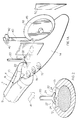
- Foamed pipe insulation 2 preferably low density polyethylene pipe insulation, is extruded as illustrated in Figure 1A and 1B, and is shown exiting the die 40 with the product being extruded in the direction of the arrow 41.
- the pipe insulation as it exits the die 40 is quite hot and it is often water cooled (water bath 19) to remove heat from the extruded product (see Figure 1B). This water cooling would occur prior to slitting of the product to improve the stability of the cell structure. If water cooling is used, the pipe insulation 2 can be stripped of water, preferably with an air jet arrangement 3, prior to further processing of the product including the foam cutting station 5.
- the polyethylene pipe insulation 2 has an outer peripheral wall 4 and an inner peripheral wall 6, which collectively define a hollow center 8.
- the pipe insulation typically has an outer and inner skin and is cellular between the inner and outer walls. Typically the cells are closed or predominantly closed cells, however, it is possible to make pipe insulation with open cells or a large percentage of open cells, if so desired.
- the outer peripheral wall 4 is the skin of the extruded product and this outer skin is difficult to adhere to for many adhesives.
- a longitudinal slit 9 is formed, exposing the cellular structure of the opposed walls 10 and 12. In many climates, it is desirable to positively close the slit after the pipe insulation has been installed about a pipe. This is particularly desirable where the insulation is outdoors and is exposed to the elements.
- One suitable adhesive is manufactured by National Starch and Chemical Company and is sold under the DURO-TAK 4144 trademark. It is a hot melt pressure sensitive adhesive and has the following performance in addition to good initial bond for fast set-up requirements; Polyester (2 mil) (0.05 mm) 180° Peel (oz./in.) 20 minutes 105 24 hours 115 Shear (hours) 4 psi @ 72°F 24 Tack (oz./sq.in.) 100 A U.V. stabilizer may be added when required.
- thermoplastic pressure sensitive hot melt adhesive is a solid and tan in colour with a viscosity of 25,000 mPa.s @ 150°C 15,000 mPa.s @ 163°C 8,000 mPa.s @ 177°C and a specific gravity of 0.94.
- This adhesive is suitable with a large variety of surfaces, including paper, polyethylene and other plastics, glass, metals and inks.
- the adhesive has high tack for automatic label applications.
- This adhesive bonds well with polyethylene and polypropylene and is suitable for the present application.
- a U.V. stabilizer may be added when required.
- the pipe insulation 2 as shown in Figure 1A, is being fed in the direction 41 over the mandrel 14.
- the pipe insulation 2 is of a polyethylene foam material which has just been extruded and cooled sufficiently to allow handling thereof (see Figure 1B). It has an outer peripheral wall or skin 4 and inner peripheral wall or skin 6 about a hollow interior 8.
- the pipe insulation has been cut to form the longitudinal slit 9 running the length of the insulation.
- the slitting operation forms the opposed walls 10 and 12.
- the pipe insulation is guided over the mandrel 14 and the movement over the mandrel is assisted, in this case by rotatable wheels or bearings generally shown as 16. Other arrangements are possible for allowing the pipe insulation to move over the mandrel to spread the opposed wall sections 10 and 12, as indicated in Figure 2.
- the pipe insulation 2 is typically spread about 2.5 cm to 3.75 cm (1 to 11 ⁇ 2 inches) and the wall thickness is at least about 0.64 cm (1 ⁇ 4 of an inch) and is often 1.28 cm (1 ⁇ 2 inch) or more.
- the pipe insulation is spread to opposed wall sections 10 and 12 to the spray head 21, which is connected to the pressure sensitive hot melt adhesive supply 20, and feeds the pressure sensitive hot melt adhesive to the spray nozzles, indicated as 22.
- a spray of pressure sensitive hot melt adhesive is applied to the opposed walls 10 and 12 and the pressure sensitive hot melt adhesive is preferably at a temperature of about 163°C (325°F) when it exits the spray nozzles 22.
- the pressure sensitive hot melt adhesive cools as it passes through the air gap (approximately 1.27 cm (1 ⁇ 2 inch)), indicated as 24 in Figure 2, and strikes the opposed walls 10 and 12 at a temperature about the melting temperature of the pipe insulation.
- the pressure sensitive hot melt adhesive preferably has a melting temperature at least 11°C (20°F) above the melt temperature of the foamed polyethylene.
- the hot application of the adhesive to the walls 10 and 12 produces better adhesion than if an adhesive is applied cold to these surfaces. It can be appreciated that the insulation will act as a heat sink to the spray and strong adhesion is provided.
- the sprayed adhesive is able to coat the exposed cell walls, and thus, provide a good coverage to this area.
- the pipe insulation will cool the adhesive on contact and the temperatures and spray should be such that no appreciable thermal damage to the pipe insulation occurs. High temperatures described above provide strong securement of the adhesive to the pipe insulation.
- the pipe insulation is still warm from the extrusion process and strong securement between the wall section and the adhesive is achieved.
- the strength of the securement is also improved due to the pocketed surface of the various cut cells of the pipe insulation. Therefore, the adhesive strongly adheres to the slit walls 10 and 12.
- the product is still subject to post-extrusion shrinkage in the order of about 2% in the product length, and therefore, coverage improves with shrinkage.
- the extruded product continues to move across the mandrel 14 towards the removable release film indicated as 40.
- This removable release film is preferably of a silicon coated, low strength polyethylene which can be easily elongated approximately 2% of its length by means of the drag of the film and the tensioning rollers 42. Other suitable release materials can also be used.
- the removable releasable film is brought into contact with the opposed walls 10 and 12 on the V wheel 46 and is heated by the adhesive and the pipe insulation. The film is generally centered on the V edge 48 of the V wheel and, at this point, the pipe insulation 2 is no longer being spread (see Figure 3) and opposed walls 10 and 12 are being urged into contact with the V edge 48, with the removable tape substrate 40 trained thereabout.
- the extruded product continues to advance in the direction 41 immediately downstream of the V wheel 46, the product will be in the condition generally shown in Figure 4.
- the adhesive is preferably only applied on approximately 3 ⁇ 4 of the surface area of the opposed walls 10 and 12 and preferably is not applied to the edge of these walls immediately adjacent the mandrel. This provides a small safety margin and it has not been found necessary to fully coat these surfaces to provide effective securement thereof.
- the removable release tape penetrates sufficiently to fully cover the inside edge of the adhesive while also forming two releasable tabs, generally indicated as 47 and 49 projecting above the pipe insulation. It can been seen that the film substrate is still joined centrally between the opposed walls 10 and 12.
- a knife, generally indicated as 50 serves to cut the removable release film 40, as indicated in Figure 5, to thereby form two removable release films, one for each of the opposed walls 10 and 12.
- the film preferably extends above the pipe insulation and slightly into the hollow cavity to fully cover the opposed walls.
- the user of the product merely forces the pipe insulation through slit 9, whereafter the removable release film 40 is removed from each of the opposed walls 10 and 12 and these walls are brought into contact to effect adhesive securement therebetween. It has.been found that this provides an excellent bond and it is also believed that the closed cell nature of the product assists in reducing degradation of the adhesive by oxygen.
- the adhesive preferably includes the appropriate compositions to reduce oxygen degradation. Both films can be removed together by gripping the releasable tabs and pulling on both.
- the extruded foam product will undergo shrinkage in its length, typically in the range of about 2%. It is for this reason that the removable tape substrate is tensioned approximately 2% and the removable release film is selected to require only minimal force to effect a 2% elongation. Furthermore, the release film can readily buckle, if necessary. In this way, the adhesive and the product does not need to oppose a large force and can easily maintain the film tensioned until such time as the product has undergone shrinkage, at which point the tensile force will be dissipated. By using this particular arrangement, the film effectively covers the respective opposed walls 10 and 12 and protects the adhesive.
- Pretensioning of the film reduces the extent of buckling, although some buckling may occur while still providing good protection of the underlying adhesive.
- the removable release film with the extending tabs 47 and 49 make it extremely convenient to remove these portions when the pipe insulation has been properly placed about a pipe.
- the spray of the pressure sensitive hot melt adhesive against the walls of the pipe insulation forms a particularly strong bond due to the penetration of the adhesive into the exposed cells of the product as well as the high temperature application of the adhesive to the walls, which walls are also at an elevated temperature.
- the temperature of the film, adhesive and foam adjacent the opposed walls generally cool at the same rate, allowing the film and foam to shrink at the same rate and end up the same length when cooled or to at least provide effective coverage of the pressure sensitive adhesive to avoid contamination and to reduce deterioration due to contact with the air and/or dirt.
- This coverage is improved by having the film also being of low density polyethylene.
- the film serves to protect the adhesive from dirt and to maintain the adhesive in a state to effectively close the slit at the time of installation. Some buckling of the film can occur as long as a strong adhesive bond of the slit is finally achieved. Allowing additional cooling of the adhesive prior to coverage with the film can reduce buckling further, however, minor buckling due to temperature conditions have not caused problems, as any buckling is very localized.
- Pressure sensitive hot melt adhesives when spray-applied to the product walls in the manner shown herein, have proven very effective, however, it is possible to use two different adhesive combinations which, when brought together, react and form a strong closure.
- two separate spray heads would be used, one for spraying each of the components.
Landscapes
- Engineering & Computer Science (AREA)
- Mechanical Engineering (AREA)
- General Engineering & Computer Science (AREA)
- Manufacturing & Machinery (AREA)
- Adhesives Or Adhesive Processes (AREA)
- Adhesive Tapes (AREA)
- Laminated Bodies (AREA)
- Lining Or Joining Of Plastics Or The Like (AREA)
Claims (11)
- In einer Reihe ablaufendes Verfahren zum Herstellen einer Rohrisolation, die einen Längsschlitz aufweist, auf dem ein druckempfindlicher Klebstoff an einer Stelle aufgebracht ist, daß gegenüberliegende Wände der Rohrisolation, die zu beiden Seiten des Schlitzes liegen, durch Verklebung miteinander verbunden werden können, und die einen lösbaren Trennfilm für den vorübergehenden Schutz der aufgebrachten Klebstoffschicht aufweist, wobei das Verfahren umfaßt: Extrudieren geschäumter Rohrisolation, die einer erheblichen Schrumpfung nach der Extrusion unterworfen ist, Teilabkühlen der Rohrisolation, um deren Handhabung zu ermöglichen, und anschließendes Ausbilden eines Längsschlitzes, vermittels dem die Rohrisolation bei ihrer endgültigen Anbringung über ein Rohr gedrückt werden kann, um das Rohr zu umschließen; Aufspreizen der geschlitzten Rohrisolation, um die einander gegenüberliegenden Wände der Rohrisolation zu beiden Seiten des Schlitzes freizulegen, Aufbringen eines druckempfindlichen Klebstoffs auf wenigstens eine der freigelegten Wände und Aufbringen eines lösbaren Trennfilms auf die geschäumte Rohrisolation, um den druckempfindlichen Klebstoff abzudecken, während die Rohrisolation noch der Schrumpfung nach Extrusion unterworfen ist.
- In einer Reihe ablaufendes Verfahren zum Herstellen einer Rohrisolation nach Anspruch 1, enthaltend den Schritt des Spannens des lösbaren Trennfilms mit einer niedrigen Spannkraft, um eine Längung desselben zu bewirken, um der Schrumpfung nach Extrusion der Rohrisolation vor dem Aufbringen des Trennfilms Rechnung zu tragen.
- In einer Reihe ablaufendes Verfahren zum Herstellen einer Rohrisolation nach Anspruch 1, bei dem der druckempfindliche Klebstoff durch Aufsprühen auf die Rohrisolation aufgebracht wird.
- In einer Reihe ablaufendes Verfahren zum Herstellen einer Rohrisolation nach Anspruch 3, bei dem die Rohrisolation geschlitzt wird, um Zellenformationen auf den gegenüberliegenden Wänden freizulegen, und der drckempfindliche Klebstoff ein Heißschmelzkleber ist und bei einer Temperatur um den Schmelzpunkt des geschäumten Artikels auf die freiliegenden Zellenformationen der geschäumten Rohrisolation aufgebracht wird.
- In einer Reihe ablaufendes Verfahren zum Herstellen einer Rohrisolation nach Anspruch 4, bei dem der druckempfindliche Heißschmelzkleber anfänglich auf einer Temperatur oberhalb des Schmelzpunktes der geschäumten Rohrisolation ist und auf die gegenüberliegenden Wände über einen Luftspalt hinweg aufgesprüht wird, der den Kleber ausreichend abkühlt, daß er die Rohrisolation in einem gleichmäßig verteilten Sprühstrahl bei einer Temperatur berührt, die um den Schmelzpunkt der Rohrisolation liegt.
- In einer Reihe ablaufendes Verfahren zum Herstellen einer Rohrisolation nach Anspruch 5, bei dem der druckempfindliche Heißschmelzkleber auf beide einander gegenüberliegenden Wände aufgebracht wird.
- In einer Reihe ablaufendes Verfahren zum Herstellen einer Rohrisolation nach Anspruch 6, bei dem der Trennfilm vor der Aufbringung in einer V-Form vorliegt und zwischen die gegenüberliegenden Wände gebracht wird, die gegen den V-Abschnitt gedrückt werden, wobei der V-Abschnitt anschließend in zwei Abschnitte aufgespalten wird.
- In einer Reihe ablaufendes Verfahren zum Herstellen einer Rohrisolation nach Anspruch 7, bei dem der Längsschnitt durch Schneiden der Rohrisolation in einer nicht-radialen Weisen ausgeführt wird, um die Breite der freigelegten Wandabschnitte zu vergrößern und die Klebeigenschaften des Endproduktes zu verbessern.
- In einer Reihe ablaufendes Verfahren zum Herstellen einer Rohrisolation nach Anspruch 7, bei dem der Schlitz in einer tangentialen Weise bezüglich der Innenwand der Rohrisolation ausgebildet wird.
- In einer Reihe ablaufendes Verfahren zum Herstellen einer Rohrisolation nach Anspruch 5, bei dem der druckempfindliche Heißschmelzkleber so aufgebracht wird, daß er einen Abschnitt der gegenüberliegenden Wände benachbart einer inneren Umfangsfläche frei von Klebstoff bleibt.
- Rohrisolation aus einem extrudierten Polyethylenschaummaterial niedriger Dichte, bestehend aus einem tubusförmigem Körper mit einem hohlen Innenraum in der Mitte, der in Längsrichtung verläuft, einem Schlitz längs des Gegenstandes, um zu ermöglichen, ein Rohr durch den Schlitz in der Rohrisolation und in den hohlen Innenraum zu drücken, wobei dieser Schlitz zwischen gegenüberliegenden Wänden der Rohrisolation liegt und einen druckempfindlichen Heißschmelzkleber enthält, der wenigstens eine der gegenüberliegenden Wände bedeckt, wobei ein lösbarer Film den Kleber bedeckt und die Rohrisolation nach dem in einer Reihe ablaufendes Verfahren zum Herstellen einer Rohrisolation nach einem der Ansprüche 1 bis 10 erzeugt ist und der lösbare Film bei der Schrumpfung nach Extrusion eine begrenzte Welligkeit aufweist.
Applications Claiming Priority (3)
| Application Number | Priority Date | Filing Date | Title |
|---|---|---|---|
| US160097 | 1993-12-01 | ||
| US08/160,097 US5419859A (en) | 1992-12-24 | 1993-12-01 | Method of forming pipe insulation with an adhesive closure |
| PCT/CA1994/000663 WO1995015461A1 (en) | 1993-12-01 | 1994-12-01 | Pipe insulation with adhesive closure |
Publications (2)
| Publication Number | Publication Date |
|---|---|
| EP0731894A1 EP0731894A1 (de) | 1996-09-18 |
| EP0731894B1 true EP0731894B1 (de) | 1998-08-19 |
Family
ID=22575497
Family Applications (1)
| Application Number | Title | Priority Date | Filing Date |
|---|---|---|---|
| EP95902011A Expired - Lifetime EP0731894B1 (de) | 1993-12-01 | 1994-12-01 | Rohrisolation mit klebeverschluss und ein verfahren zu deren herstellung |
Country Status (5)
| Country | Link |
|---|---|
| US (1) | US5419859A (de) |
| EP (1) | EP0731894B1 (de) |
| CA (1) | CA2177353C (de) |
| DE (1) | DE69412637T2 (de) |
| WO (1) | WO1995015461A1 (de) |
Families Citing this family (16)
| Publication number | Priority date | Publication date | Assignee | Title |
|---|---|---|---|---|
| US5558739A (en) * | 1994-10-19 | 1996-09-24 | Insulation Materials Corporation Of America | Apparatus and process for applying glue to edges of insulation tube slit |
| US6016846A (en) * | 1996-02-07 | 2000-01-25 | Morgan Adhesives Company | Pipe insulation sleeve |
| JP3138656B2 (ja) * | 1997-03-28 | 2001-02-26 | 日本碍子株式会社 | セラミック成形体の焼成方法 |
| ATE213820T1 (de) * | 1997-10-17 | 2002-03-15 | Rockwool Int | Rohrabschnitt mit einer ringförmigen isolationsschicht |
| NL1011603C2 (nl) * | 1999-03-19 | 2000-09-27 | Rockwool Lapinus Bv | Zelfklevende isolatiedeken. |
| DE29920682U1 (de) * | 1999-11-25 | 2000-02-17 | Klöckner Pentaplast GmbH, 56410 Montabaur | Tiefgezogenes Formteil |
| CN100489335C (zh) * | 2003-12-25 | 2009-05-20 | 东洋品质第一股份有限公司 | 覆盖部件及其制造方法 |
| ATE496759T1 (de) * | 2006-04-06 | 2011-02-15 | Aisapack Holding Sa | Schlauchförmiger verpackungskörper aus thermoplastmaterial mit eingebettetem streifen |
| US20070292647A1 (en) * | 2006-06-16 | 2007-12-20 | Princell Charles M | Lap and seam seal closure system for foam pipe insulation |
| DE102008036389A1 (de) * | 2008-08-05 | 2010-02-11 | Rehau Ag + Co | Verfahren zur Herstellung eines rohrförmigen Hohlkörpers, insbesondere eines Rohrs aus Polymermaterial |
| FR2937398B1 (fr) | 2008-10-20 | 2010-12-17 | Majus Ltd | Installation et procede de fabrication en continu d'un tube ou d'un cable isole thermiquement ou electriquement, tube ou cable ainsi obtenu et application a la realisation de tuyaux double enveloppe |
| US20100124625A1 (en) * | 2008-11-14 | 2010-05-20 | Industrial Thermo Polymers Limited | Pipe insulation with foamed adhesive closure |
| US8261558B2 (en) | 2009-06-25 | 2012-09-11 | Nomaco Inc. | Self-adjusting insulation, including insulation particularly suited for pipe or duct |
| BR122014017821A2 (pt) | 2010-01-28 | 2019-07-09 | Avery Dennison Corporation | Sistema para aplicação de rótulos em artigos |
| US9157566B2 (en) | 2012-05-11 | 2015-10-13 | Nomaco Inc. | Insulation systems employing expansion features to insulate elongated containers subject to extreme temperature fluctuations, and related components and methods |
| CN114770962A (zh) * | 2022-03-18 | 2022-07-22 | 天津太合节能科技有限公司 | 管中管式保温管封堵机端盖水平微调及压紧机构 |
Family Cites Families (19)
| Publication number | Priority date | Publication date | Assignee | Title |
|---|---|---|---|---|
| CA655441A (en) * | 1956-11-09 | 1963-01-08 | General Electric Company | Process for making void-free insulated conductors |
| US3691990A (en) * | 1971-05-13 | 1972-09-19 | Armstrong Cork Co | Apparatus for applying adhesive to the edges of a slit tube |
| GB1411943A (en) * | 1971-10-12 | 1975-10-29 | Raychem Ltd | Covering methods |
| US4023589A (en) * | 1974-10-15 | 1977-05-17 | The Wiremold Company | Tubular joint and the product formed thereby |
| DE7509227U (de) * | 1975-03-22 | 1975-11-20 | Freudenberg C | Isolierschale |
| DE2640544A1 (de) * | 1976-09-09 | 1978-03-16 | Peter Trieb | Verfahren zur thermischen isolierung von rohrleitungen |
| US4584217A (en) * | 1977-09-29 | 1986-04-22 | Morgan Adhesives Company | Composite pressure sensitive adhesive construction |
| DE2807036C2 (de) * | 1978-02-18 | 1982-10-07 | Fa. Carl Freudenberg, 6940 Weinheim | Isolierschale für ein Rohr |
| US4586971A (en) * | 1979-07-19 | 1986-05-06 | Raychem Corporation | Method of joining heat shrinkable closure members |
| US4713271A (en) * | 1982-06-30 | 1987-12-15 | Cosden Technology, Inc. | Foamed polymer tubing |
| JPS5938033A (ja) * | 1982-08-27 | 1984-03-01 | Sekisui Chem Co Ltd | 保温用配管カバ−の製造方法 |
| EP0152393A3 (de) * | 1984-01-27 | 1985-09-18 | Pla-Ma Belgium N.V. | Vorrichtung für das Behandeln einer Isolierhülle für Röhren |
| US4605457A (en) * | 1984-05-08 | 1986-08-12 | Lof Plastics Inc. | Tape tension control system |
| DE3536086A1 (de) * | 1985-10-09 | 1987-04-09 | Eduard Steinbacher | Schlauch |
| US4748060A (en) * | 1986-12-29 | 1988-05-31 | Armstrong World Industries, Inc. | Flexible pipe covering seam sealing |
| DE3702585A1 (de) * | 1987-01-29 | 1988-08-11 | Marquet & Cie Noel | Verfahren und vorrichtung zur kontinuierlichen umhuellung von voll- oder hohlprofilen, insbesondere von rohren, mit einem extrudierten schaumstoffmantel aus thermoplastischem kunststoff, sowie auf diese weise hergestellte produkte |
| US5234520A (en) * | 1987-03-20 | 1993-08-10 | Morgan Adhesives Co. | Method of making an adhesive construction |
| US4874648A (en) * | 1988-03-17 | 1989-10-17 | Sorrento Engineer, Inc. | Method of making flame resistant polyimide foam insulation and the resulting insulation |
| DE9205551U1 (de) * | 1992-04-25 | 1992-07-30 | Fischer, Kurt, 7615 Zell | Schlitzversiegelung eines Isolierschlauches mit selbstklebendem Band |
-
1993
- 1993-12-01 US US08/160,097 patent/US5419859A/en not_active Expired - Lifetime
-
1994
- 1994-12-01 CA CA002177353A patent/CA2177353C/en not_active Expired - Lifetime
- 1994-12-01 EP EP95902011A patent/EP0731894B1/de not_active Expired - Lifetime
- 1994-12-01 WO PCT/CA1994/000663 patent/WO1995015461A1/en not_active Ceased
- 1994-12-01 DE DE69412637T patent/DE69412637T2/de not_active Expired - Fee Related
Also Published As
| Publication number | Publication date |
|---|---|
| CA2177353C (en) | 1999-02-16 |
| WO1995015461A1 (en) | 1995-06-08 |
| US5419859A (en) | 1995-05-30 |
| EP0731894A1 (de) | 1996-09-18 |
| CA2177353A1 (en) | 1995-06-08 |
| DE69412637D1 (de) | 1998-09-24 |
| DE69412637T2 (de) | 1999-02-11 |
Similar Documents
| Publication | Publication Date | Title |
|---|---|---|
| EP0731894A1 (de) | Rohrisolation mit klebeverschluss und ein verfahren zu deren herstellung | |
| US4097634A (en) | Thermoplastic resin molding of complex decorative relief | |
| US4857371A (en) | Method of making an adhesive construction for articles and said articles | |
| CA1155744A (en) | Method of making a three-dimensional laminate | |
| EP0458484A2 (de) | Gummibasierte Klebebänder | |
| FR2605640A1 (fr) | Nouvelles bandes adhesives comportant un support alveolaire et leur fabrication | |
| US20120043018A1 (en) | Pipe insulation with foamed adhesive closure | |
| US3843438A (en) | Article labeling method | |
| US8327585B2 (en) | Weatherseal with removable protective coating | |
| US4130453A (en) | Pipe coating method and apparatus | |
| US5234520A (en) | Method of making an adhesive construction | |
| US5417901A (en) | Method of forming pipe insulation with prestressed tape closure | |
| US6312630B1 (en) | Method of forming a two-part coated foam structure | |
| US3741844A (en) | Hot melt process for forming resin layer on polyurethane foam | |
| US4167431A (en) | Method of heat lamination and laminated product | |
| CA2181056A1 (en) | Pressure sensitive adhesive tape | |
| JPH10329169A (ja) | 薄膜アクリルインサート成形品とその製造方法 | |
| CA2643898A1 (en) | Pipe insulation with foamed adhesive closure | |
| JPH02169228A (ja) | プラスチックモールの製造方法 | |
| US5009831A (en) | Extrusion coated substrates with separable and removable layers | |
| EP3733803A1 (de) | Separator und klebeband oder -folie mit separator | |
| EP0724002A2 (de) | Klebefilm | |
| JPH0241403B2 (de) | ||
| JP3019757B2 (ja) | 加飾フィルム層を備えたゴム押出物の製造方法 | |
| EP0163571A1 (de) | Verfahren zur Herstellung von leichten, starren Rohren aus thermoplastischen Stoffen durch Multiextrusion |
Legal Events
| Date | Code | Title | Description |
|---|---|---|---|
| PUAI | Public reference made under article 153(3) epc to a published international application that has entered the european phase |
Free format text: ORIGINAL CODE: 0009012 |
|
| 17P | Request for examination filed |
Effective date: 19960619 |
|
| AK | Designated contracting states |
Kind code of ref document: A1 Designated state(s): BE DE FR GB |
|
| 17Q | First examination report despatched |
Effective date: 19970117 |
|
| GRAG | Despatch of communication of intention to grant |
Free format text: ORIGINAL CODE: EPIDOS AGRA |
|
| GRAG | Despatch of communication of intention to grant |
Free format text: ORIGINAL CODE: EPIDOS AGRA |
|
| GRAH | Despatch of communication of intention to grant a patent |
Free format text: ORIGINAL CODE: EPIDOS IGRA |
|
| GRAH | Despatch of communication of intention to grant a patent |
Free format text: ORIGINAL CODE: EPIDOS IGRA |
|
| GRAA | (expected) grant |
Free format text: ORIGINAL CODE: 0009210 |
|
| AK | Designated contracting states |
Kind code of ref document: B1 Designated state(s): BE DE FR GB |
|
| REF | Corresponds to: |
Ref document number: 69412637 Country of ref document: DE Date of ref document: 19980924 |
|
| ET | Fr: translation filed | ||
| PLBE | No opposition filed within time limit |
Free format text: ORIGINAL CODE: 0009261 |
|
| STAA | Information on the status of an ep patent application or granted ep patent |
Free format text: STATUS: NO OPPOSITION FILED WITHIN TIME LIMIT |
|
| 26N | No opposition filed | ||
| REG | Reference to a national code |
Ref country code: GB Ref legal event code: IF02 |
|
| PGFP | Annual fee paid to national office [announced via postgrant information from national office to epo] |
Ref country code: GB Payment date: 20041112 Year of fee payment: 11 |
|
| PGFP | Annual fee paid to national office [announced via postgrant information from national office to epo] |
Ref country code: FR Payment date: 20041116 Year of fee payment: 11 |
|
| PGFP | Annual fee paid to national office [announced via postgrant information from national office to epo] |
Ref country code: DE Payment date: 20041230 Year of fee payment: 11 |
|
| PGFP | Annual fee paid to national office [announced via postgrant information from national office to epo] |
Ref country code: BE Payment date: 20050104 Year of fee payment: 11 |
|
| PG25 | Lapsed in a contracting state [announced via postgrant information from national office to epo] |
Ref country code: GB Free format text: LAPSE BECAUSE OF NON-PAYMENT OF DUE FEES Effective date: 20051201 |
|
| PG25 | Lapsed in a contracting state [announced via postgrant information from national office to epo] |
Ref country code: BE Free format text: LAPSE BECAUSE OF NON-PAYMENT OF DUE FEES Effective date: 20051231 |
|
| PG25 | Lapsed in a contracting state [announced via postgrant information from national office to epo] |
Ref country code: DE Free format text: LAPSE BECAUSE OF NON-PAYMENT OF DUE FEES Effective date: 20060701 |
|
| GBPC | Gb: european patent ceased through non-payment of renewal fee |
Effective date: 20051201 |
|
| PG25 | Lapsed in a contracting state [announced via postgrant information from national office to epo] |
Ref country code: FR Free format text: LAPSE BECAUSE OF NON-PAYMENT OF DUE FEES Effective date: 20060831 |
|
| REG | Reference to a national code |
Ref country code: FR Ref legal event code: ST Effective date: 20060831 |
|
| BERE | Be: lapsed |
Owner name: *INDUSTRIAL THERMO POLYMERS LTD Effective date: 20051231 |