EP0731332B1 - Stahlpanzerplatte und Herstellungsverfahren dafür - Google Patents
Stahlpanzerplatte und Herstellungsverfahren dafür Download PDFInfo
- Publication number
- EP0731332B1 EP0731332B1 EP96301536A EP96301536A EP0731332B1 EP 0731332 B1 EP0731332 B1 EP 0731332B1 EP 96301536 A EP96301536 A EP 96301536A EP 96301536 A EP96301536 A EP 96301536A EP 0731332 B1 EP0731332 B1 EP 0731332B1
- Authority
- EP
- European Patent Office
- Prior art keywords
- plate
- armor plate
- steel
- armor
- inclusions
- Prior art date
- Legal status (The legal status is an assumption and is not a legal conclusion. Google has not performed a legal analysis and makes no representation as to the accuracy of the status listed.)
- Expired - Lifetime
Links
Images
Classifications
-
- C—CHEMISTRY; METALLURGY
- C21—METALLURGY OF IRON
- C21D—MODIFYING THE PHYSICAL STRUCTURE OF FERROUS METALS; GENERAL DEVICES FOR HEAT TREATMENT OF FERROUS OR NON-FERROUS METALS OR ALLOYS; MAKING METAL MALLEABLE, e.g. BY DECARBURISATION OR TEMPERING
- C21D9/00—Heat treatment, e.g. annealing, hardening, quenching or tempering, adapted for particular articles; Furnaces therefor
- C21D9/42—Heat treatment, e.g. annealing, hardening, quenching or tempering, adapted for particular articles; Furnaces therefor for armour plate
-
- F—MECHANICAL ENGINEERING; LIGHTING; HEATING; WEAPONS; BLASTING
- F41—WEAPONS
- F41H—ARMOUR; ARMOURED TURRETS; ARMOURED OR ARMED VEHICLES; MEANS OF ATTACK OR DEFENCE, e.g. CAMOUFLAGE, IN GENERAL
- F41H5/00—Armour; Armour plates
- F41H5/02—Plate construction
- F41H5/04—Plate construction composed of more than one layer
- F41H5/0442—Layered armour containing metal
- F41H5/045—Layered armour containing metal all the layers being metal layers
-
- C—CHEMISTRY; METALLURGY
- C21—METALLURGY OF IRON
- C21D—MODIFYING THE PHYSICAL STRUCTURE OF FERROUS METALS; GENERAL DEVICES FOR HEAT TREATMENT OF FERROUS OR NON-FERROUS METALS OR ALLOYS; MAKING METAL MALLEABLE, e.g. BY DECARBURISATION OR TEMPERING
- C21D6/00—Heat treatment of ferrous alloys
- C21D6/004—Heat treatment of ferrous alloys containing Cr and Ni
-
- C—CHEMISTRY; METALLURGY
- C22—METALLURGY; FERROUS OR NON-FERROUS ALLOYS; TREATMENT OF ALLOYS OR NON-FERROUS METALS
- C22C—ALLOYS
- C22C38/00—Ferrous alloys, e.g. steel alloys
- C22C38/18—Ferrous alloys, e.g. steel alloys containing chromium
- C22C38/40—Ferrous alloys, e.g. steel alloys containing chromium with nickel
-
- C—CHEMISTRY; METALLURGY
- C22—METALLURGY; FERROUS OR NON-FERROUS ALLOYS; TREATMENT OF ALLOYS OR NON-FERROUS METALS
- C22C—ALLOYS
- C22C38/00—Ferrous alloys, e.g. steel alloys
- C22C38/60—Ferrous alloys, e.g. steel alloys containing lead, selenium, tellurium, or antimony, or more than 0.04% by weight of sulfur
-
- Y—GENERAL TAGGING OF NEW TECHNOLOGICAL DEVELOPMENTS; GENERAL TAGGING OF CROSS-SECTIONAL TECHNOLOGIES SPANNING OVER SEVERAL SECTIONS OF THE IPC; TECHNICAL SUBJECTS COVERED BY FORMER USPC CROSS-REFERENCE ART COLLECTIONS [XRACs] AND DIGESTS
- Y10—TECHNICAL SUBJECTS COVERED BY FORMER USPC
- Y10T—TECHNICAL SUBJECTS COVERED BY FORMER US CLASSIFICATION
- Y10T29/00—Metal working
- Y10T29/49—Method of mechanical manufacture
- Y10T29/4998—Combined manufacture including applying or shaping of fluent material
-
- Y—GENERAL TAGGING OF NEW TECHNOLOGICAL DEVELOPMENTS; GENERAL TAGGING OF CROSS-SECTIONAL TECHNOLOGIES SPANNING OVER SEVERAL SECTIONS OF THE IPC; TECHNICAL SUBJECTS COVERED BY FORMER USPC CROSS-REFERENCE ART COLLECTIONS [XRACs] AND DIGESTS
- Y10—TECHNICAL SUBJECTS COVERED BY FORMER USPC
- Y10T—TECHNICAL SUBJECTS COVERED BY FORMER US CLASSIFICATION
- Y10T428/00—Stock material or miscellaneous articles
- Y10T428/12—All metal or with adjacent metals
- Y10T428/12493—Composite; i.e., plural, adjacent, spatially distinct metal components [e.g., layers, joint, etc.]
- Y10T428/12771—Transition metal-base component
- Y10T428/12861—Group VIII or IB metal-base component
- Y10T428/12951—Fe-base component
- Y10T428/12958—Next to Fe-base component
- Y10T428/12965—Both containing 0.01-1.7% carbon [i.e., steel]
Definitions
- This invention relates to metal armor plate having improved ballistic defeat capability. More particularly, the invention relates to a method or producing steel armor plate and steel armor plate so-produced having a hard face with intended inclusions in the metal matrix.
- Armor plate has found utility in both civilian and military uses. Historically, armor plate has been produced from various materials, including ceramics, metals, such as steel and aluminum, as well as composites of metals and other materials. Improvements in armor plate have resulted from the desire to provide greater ballistic protection while providing a more light-weight armor plate.
- clad or composite steels were produced and found new uses as a lighter-weight dual hardness composite steel armor.
- the composites of two steels are used where one is chosen for its hardness and the other for its toughness.
- the concept of dual hardness composite armor involves the use of a hard front side that breaks up the projectile such as the penetrator of an armor-piercing projectile.
- the front side is not intended to shatter or spall even though it may be cracked by the ballistic impact because the front side is metallurgically bonded to a tougher crack-arresting rear side.
- such armor plate is produced by selecting two steel compositions, producing each of them in a plate product form, and then roll bonding to form the composite dual hardness armor steel plate. See “Steels Double Up for Composites", The Iron Age , November 16, 1967, pages 70-72.
- such composite armor plate may range in thickness from 0.040-inch (1 mm) sheet to 3-inch (76 mm) plate.
- various steel compositions may be used for the composite materials.
- Such steels may be referred to by their nominal composition, such as 3 Ni-Mo steel, 5 Ni-Cr-Mo steel, 12 Ni-5 Cr-3 Mo steel, 10 Ni-Cr-Mo-Co steel, as well as an alloy known as HY-130T steel produced by U.S. Steel in the 1960s. See “Review of Recent Armor Plate Developments" by Rathbone, Blast Furnace and Steel Plant, July 1968, pages 575-583. This document is considered to be the closest prior art for claims 1, 6 and 10.
- AISI 4340 melted by routine melt methods is frequently used for armor plate applications.
- AISI 4340 steel is also sometimes used for armor applications when produced through vacuum arc remelting (VAR) or electroslag remelting (ESR).
- VAR vacuum arc remelting
- ESR electroslag remelting
- SEM scanning electron microscopy
- Mil-A-46173 also recites an oxygen requirement of 25 parts per million (ppm) max.
- US-A-1563420 discloses a method of producing armor plate which consists in carburizing one surface of the plate in successive stages alternated with mechanical working of the plate.
- US-A-4645720 relates to armor-plate comprising a two bonded subsequently heat-treated clad steel comprising an upper layer and a base layer.
- a projectile When a projectile strikes armor plate, preferably the projectile will begin to break apart or deform so that its force is diminished. At sufficiently high velocity, a projectile may penetrate the armor plate by pushing a plug out of the back side of the plate. Depending upon the toughness and ductility of the material comprising the armor plate, there may or may not be deformation of the armor plate in the vicinity of the hole. Furthermore, armor plate is expected to meet certain ballistics defeat requirements as defined in a specification at certain material thickness. Frequently, armor plate, when tested by firing projectiles at the plate, may exhibit ballistic results which are marginally passing or marginally failing.
- the present invention provides a method of producing steel armor plate with improved resistance to penetration by projectiles.
- the method includes providing an alloy steel armor plate having intended inclusion content with the inclusions oriented substantially parallel to the plate surface.
- the inclusions result from at least one element of the steel composition selected from the group of sulfur and oxygen, so that the armor plate is characterized by a higher V 50 protection for a given plate thickness.
- the invention provides steel armor plate as set out in claims 1 and 10.
- the invention also provides a method of producing steel armor plate as set out in claim 6.
- a composite armor plate is provided by the method of bonding the armor plate to a second armor plate to form a composite clad dual hardness armor plate.
- the second plate layer has a lower hardness and increased ductility when compared to the first armor plate.
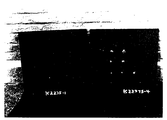
- the Figure illustrates a photographic representation of one embodiment of the back side of the composite armor plate of the present invention compared with a prior art composite armor plate after ballistics testing.
- an armor plate and a method are provided for producing a steel armor plate having improved ballistics defeat capability at higher velocities when compared to conventional plates at the same thickness, and having improved ballistics defeat capability at the same velocities but at plate thicknesses less than that of conventional plate materials.
- non-metallic inclusions or particles can be beneficial to improve the ballistics defeat capability of armor plate.
- the inclusions are oriented parallel to the surface of the armor plate, and preferably, the inclusion shape is generally elliptical rather than rod-like, as a result of the rolling process. This is contrary to the conventional wisdom of the industry which requires that the metal armor plate have a low inclusion content in order to improve the toughness and ductility of the plate material.
- a steel with higher inclusion content may promote better ballistic defeat capability by dissipating the energy of the projectile through distribution of the force of the impact over wider area.
- a steel with higher inclusion content sometimes referred to as a "dirtier" steel
- the shock wave or cracks in the armor plate will follow the direction of the inclusions parallel to the plate surface, thereby spreading the energy of the impact over a wider area.
- the inclusions provide a path for the shock wave or cracks to follow which causes the force of the impact to be distributed over a wider area which allows the material to absorb the energy more effectively without penetration of the armor plate by the projectile.
- the teachings of the present invention are believed to be useful both in a dual hardness composite steel armor plate, as well as a homogenous steel armor plate.
- homogenous plate it is meant that the armor plate is not a composite of two or more plates, but is a single plate made from one melt composition. It is anticipated that in homogeneous armor plate, the same dual hardness benefits would be realized if the inclusion level were to be increased in approximately one-quarter to three-quarters of the thickness, or more preferably one-half, measured from the front or striking side of the plate.
- the armor plate of the present invention may be produced by conventional melting practices such as electroslag remelting (ESR), vacuum arc remelting (VAR), and argon-oxygen decarburization (AOD). What is important, however, is that the steel have sufficient amounts of potential inclusion-forming elements, particularly sulfur and/or oxygen. Higher concentrations of sulfide and oxide inclusions in the solidified steel are required to achieve the desired results.
- Sulfur content may range from as low as 0.015% up to 0.15%, by weight, and preferably may range from 0.020-0.080%.
- Oxygen may range from 0.0025 to 0.1000%, by weight, and preferably from 0.0050 to 0.0500%.
- a suitable plate composition may include 0.1-1% carbon, 0-6% nickel, 0-2% molybdenum, 0-3% chromium, 0-2% manganese, 0.1-1% silicon, and the balance iron and residual impurities in addition to the specified amounts of sulfur and/or oxygen in accordance with the present invention.
- One typical plate composition may include 0.2-0.8% carbon, 2-4% nickel, 0.1-0.6% molybdenum, 0.3-1.2% chromium, less than 1% manganese and less than 0.5% silicon, and the balance iron and residual impurities in addition to the specified amounts of sulfur and/or oxygen in accordance with the present invention.
- the steel composition of the armor plate may be conventional alloy steel typically used for armor plate.
- Such steels may contain specified amounts of nickel, chromium, molybdenum, cobalt, or other elements as is conventional It is believed that the teachings of the present invention for providing higher inclusion content to benefit ballistic resistance is not necessarily dependent upon the overall composition of the steel and, therefore, is useful in many steel armor plate alloys.
- the method would include melting the appropriate steel composition, casting into ingot or slabs, and hot rolling to an intermediate slab thickness.
- each steel composition would be melted and hot rolled to an intermediate slab thickness.
- the composite would be produced by grinding and cleaning the mating surfaces of the two slabs, peripheral welding to form packs on the front and rear slabs, possibly but not necessarily, evacuating and hermetically sealing the slabs, thereafter roll-bonding to the desired plate thickness and subsequently heat treating by austenitizing, quenching, and tempering as necessary.
- the steel compositicn provides sufficient quantities of sulfur and/or oxygen to provide a necessary inclusion content so that when rolled to plate thickness, the inclusions will be substantially parallel to the plate surface and generally elliptical rather than rod-like in shape.
- All four Heats were produced in a conventional manner by melting using an electric arc furnace followed by argon-oxygen decarburization, casting into ingots, hot working, and forming a composite.
- Several test panels of a dual hardness steel armor plate bearing composite Plate No. K2237S were produced using Heat 1C217 as the front side and Heat 1C218 as the back side.
- Several test panels of a dual hardness plate bearing Composite Plate No. K2235 were produced using Heat No. 3B736 as the front size and Heat. No. 2B603 as the back side.
- the dual hardness armor plate of the present invention is clearly shown to have an improved ballistics defeat capability.
- the dual hardness armor plate of the present invention surpasses an applicable ballistics specification by either a larger margin or passes the specification by a comfortable margin as compared with standard material which may either pass by a smaller margin or fail the specification requirement.
- the steel armor plate of the present invention demonstrated superior results in th V-50 test by exceeding the conventional plate by 150 feet per second (46 m/s).
- the plate of the present invention also exhibited superior results in the High Partial and Low Complete measurements by 120 fps (37 m/s) and 172 fps (53 m/s) respectively.
- the Figure is a photographic representation of the rear face of Test Panels K2237S and K2235-1 shown in Table II.
- the concept of providing an impact surface which would spread out the force of a projectile over a wider area using inclusions and facilitating crack propagation was demonstrated.
- the Test Panels tested exhibited outstanding ballistics for the composite steel armor plate of the present invention (K2237S-4) and showed pronounced bulges on the softer back side as compared to the bulges of the conventional dual hardness armor plate. The more pronounced bulges clearly show that the projectile force was more widely distributed across the impact face.
- the present invention As was an objective of the present invention, a method of producing a steel armor plate with improved resistance to penetration by projectiles and an improved steel armor plate were made. The novel idea of using inclusions based on increasing the amount of sulfur and/or oxygen in the steel was confirmed. Although demonstrated on composite steel armor plate, the present invention is applicable to homogeneous armor plate wherein the inclusion level is increased on one surface (the striking surface) of the plate, preferably within about three-quarters to one-quarter of the plate thickness nearest that one surface.
Landscapes
- Chemical & Material Sciences (AREA)
- Engineering & Computer Science (AREA)
- Metallurgy (AREA)
- Organic Chemistry (AREA)
- Materials Engineering (AREA)
- Mechanical Engineering (AREA)
- Physics & Mathematics (AREA)
- General Engineering & Computer Science (AREA)
- Ceramic Engineering (AREA)
- Thermal Sciences (AREA)
- Crystallography & Structural Chemistry (AREA)
- Aiming, Guidance, Guns With A Light Source, Armor, Camouflage, And Targets (AREA)
- Heat Treatment Of Steel (AREA)
- Laminated Bodies (AREA)
- Heat Treatment Of Sheet Steel (AREA)
- Rod-Shaped Construction Members (AREA)
- Table Devices Or Equipment (AREA)
Claims (10)
- Stahlpanzerplatte mit verbesserter Eindringfestigkeit gegenüber Projektilen mit:einer Vielzahl von Einschlüssen, die im wesentlichen parallel zur Plattenoberfläche orientiert und in einem Viertel bis zu drei Viertel der Plattendicke konzentriert sind, wodurch sich ein Mechanismus zur Verteilung der Kraft des Stoßes über eine weite Fläche ergibt,wobei die Einschlüsse von mindestens einem Element der Stahlzusammensetzung in Gewichtsprozentanteilen, ausgewählt aus der Gruppe Schwefel und Sauerstoff mit Schwefel im Bereich von 0,015 Gew.-% bis 0,150 Gew.-% und Sauerstoff im Bereich von 0,0025 Gew.-% bis 0,1000 Gew.-%, herrühren, undein höherer V50-Schutz bei einer gegebenen Plattendicke geliefert wird.
- Panzerplatte nach Anspruch 1, wobei die Plattenzusammensetzung des weiteren 0,1-1% Kohlenstoff, 0-6% Nickel, 0-2% Molybdän, 0-3% Chrom, 0-2% Mangan, 0,1-1% Silicium und zum Rest Eisen und restliche Verunreinigungen umfaßt.
- Panzerplatte mit einer ersten Panzerplattenschicht nach einem der vorhergehenden Ansprüche und einer zweiten Panzerplattenschicht, die zusammen eine Panzerplatte mit Zweifachhärte bilden, wobei die zweite Schicht eine geringere Härte als die erste Schicht aufweist.
- Verbundpanzerplatte mit Zweifachhärte nach Anspruch 3, wobei die erste Schicht beim Einsatz die Vorderseite und die zweite Schicht die Rückseite bildet.
- Panzerplatte nach einem vorhergehenden Anspruch, wobei der Schwefelgehalt im Bereich von 0,02% bis 0,8% und der Sauerstoffgehalt in einem Bereich von 0,005% bis 0,05% liegen kann.
- Verfahren zur Herstellung einer Stahlpanzerplatte mit verbesserter Eindringfestigkeit gegenüber Projektilen durch:Schmelzen einer Stahllegierung, die in Gew.-% 0,2-0,8 Kohlenstoff, 2-4 Nickel, 0,1-0,6 Molybdän, 0,3-1,2 Chrom, weniger als 1 Mangan, weniger als 0,5 Silicium, zum Rest Eisen und restliche Verunreinigungen umfaßt,Herstellen einer Panzerplatte aus dem Stahl mit im wesentlichen parallel zur Plattenoberfläche orientierten Einschlüssen, wobei die Einschlüsse von mindestens einem Element der Stahlzusammensetzung (in Gew.-%), ausgewählt aus der Gruppe Schwefel und Sauerstoff mit Schwefel im Bereich von 0,015 Gew.-% bis 0,150 Gew.-% und Sauerstoff im Bereich von 0,0025 Gew.-% bis 0,1000 Gew.-%, herrühren und die Stahlplatte einen höheren V50-Schutz bei einer gegebenen Plattendicke aufweist.
- Verfahren nach Anspruch 6, wobei dieses Verfahren die Stufe Verbinden der Panzerplatte mit einer zweiten Panzerplatte zur Ausbildung einer Panzerplatte in Form einer Verbundplatte mit Zweifachhärte, bei der die zweite Plattenschicht eine geringere Härte aufweist, einschließt.
- Verfahren nach Anspruch 6, das die Konzentration der Einschlüsse in etwa der Hälfte der Plattendicke umfaßt, wodurch ein Mechanismus zur Verteilung der Kraft des Stoßes über eine breitere Fläche geliefert wird.
- Verfahren nach einem der Ansprüche 6 bis 8, wobei der Schwefelgehalt im Bereich von 0,02% bis 0,8% und der Sauerstoffgehalt im Bereich von 0,005% bis 0,05% liegen können.
- Panzerplatte, die nach einem Verfahren gemäß einem der Ansprüche 6 bis 9 hergestellt wurde.
Applications Claiming Priority (2)
| Application Number | Priority Date | Filing Date | Title |
|---|---|---|---|
| US08/398,934 US5749140A (en) | 1995-03-06 | 1995-03-06 | Ballistic resistant metal armor plate |
| US398934 | 1995-03-06 |
Publications (3)
| Publication Number | Publication Date |
|---|---|
| EP0731332A2 EP0731332A2 (de) | 1996-09-11 |
| EP0731332A3 EP0731332A3 (de) | 1997-01-02 |
| EP0731332B1 true EP0731332B1 (de) | 1998-12-16 |
Family
ID=23577405
Family Applications (1)
| Application Number | Title | Priority Date | Filing Date |
|---|---|---|---|
| EP96301536A Expired - Lifetime EP0731332B1 (de) | 1995-03-06 | 1996-03-06 | Stahlpanzerplatte und Herstellungsverfahren dafür |
Country Status (9)
| Country | Link |
|---|---|
| US (1) | US5749140A (de) |
| EP (1) | EP0731332B1 (de) |
| JP (1) | JP3676480B2 (de) |
| KR (1) | KR100472389B1 (de) |
| AT (1) | ATE174685T1 (de) |
| BR (1) | BR9600928A (de) |
| CA (1) | CA2171079C (de) |
| DE (1) | DE69601138T2 (de) |
| ES (1) | ES2128142T3 (de) |
Families Citing this family (30)
| Publication number | Priority date | Publication date | Assignee | Title |
|---|---|---|---|---|
| JP3576017B2 (ja) * | 1998-11-30 | 2004-10-13 | 石川島播磨重工業株式会社 | 耐衝撃貫通特性に優れた鋼の製造方法 |
| US6873920B2 (en) * | 2001-10-15 | 2005-03-29 | Air Liquide Process And Construction, Inc. | Oxygen fire and blast fragment barriers |
| ES2238556T3 (es) * | 2001-12-19 | 2005-09-01 | Bohler Bleche Gmbh | Material con alta proteccion anti-balas. |
| US6723182B1 (en) * | 2002-11-14 | 2004-04-20 | Arthur J. Bahmiller | Martensitic alloy steels having intermetallic compounds and precipitates as a substitute for cobalt |
| EP1766321A2 (de) * | 2004-06-11 | 2007-03-28 | Stewart & Stevenson Tactical Vehicle Systems, L.P. | Gepanzertes fahrerhaus für fahrzeuge |
| US8056463B2 (en) * | 2005-01-14 | 2011-11-15 | Defense Consulting Services, Inc. | Vehicle window cover |
| US8141472B1 (en) | 2005-01-14 | 2012-03-27 | Defense Consulting Services, Inc. | Vehicle window cover |
| US7225718B1 (en) | 2005-01-14 | 2007-06-05 | Defense Consulting Services, Inc. | Military vehicle window cover |
| IL170119A (en) * | 2005-08-04 | 2010-12-30 | Moshe Ravid | Multi-functional armor system |
| AU2006284895B2 (en) | 2005-08-30 | 2011-09-08 | Ati Properties, Inc. | Steel compositions, methods of forming the same, and articles formed therefrom |
| US7523693B1 (en) * | 2005-09-27 | 2009-04-28 | Molding Technologies | Composite laminated armor structure |
| US7357062B2 (en) * | 2006-04-11 | 2008-04-15 | Force Protection Industries, Inc. | Mine resistant armored vehicle |
| IL179125A (en) | 2006-11-08 | 2012-10-31 | Moshe Ravid | Dual hardness armor |
| JP5296336B2 (ja) * | 2007-06-19 | 2013-09-25 | 京セラケミカル株式会社 | セラミック複合装甲板の製造方法及び取付方法 |
| US8444776B1 (en) | 2007-08-01 | 2013-05-21 | Ati Properties, Inc. | High hardness, high toughness iron-base alloys and methods for making same |
| PL2183401T3 (pl) * | 2007-08-01 | 2018-08-31 | Ati Properties Llc | Stopy o dużej twardości, o dużej wiązkości na bazie żelaza i sposób ich wytwarzania |
| US8529708B2 (en) * | 2007-10-22 | 2013-09-10 | Jay Carl Locke | Carburized ballistic alloy |
| ES2709433T3 (es) * | 2008-05-07 | 2019-04-16 | Thyssenkrupp Steel Europe Ag | Material compuesto con efecto de protección balística |
| US8176831B2 (en) * | 2009-04-10 | 2012-05-15 | Nova Research, Inc. | Armor plate |
| US8146478B2 (en) * | 2009-04-10 | 2012-04-03 | Force Protection Technologies, Inc. | Mine resistant armored vehicle |
| BRPI1012740A2 (pt) * | 2009-06-15 | 2016-03-22 | Damascus Armour Dev Pty Ltd | liga de aço de blindagem martensítica com alta resistência balística |
| US8146477B2 (en) | 2010-05-14 | 2012-04-03 | Force Protection Technologies, Inc. | System for protecting a vehicle from a mine |
| JP5122623B2 (ja) * | 2010-09-27 | 2013-01-16 | 株式会社日本製鋼所 | 防弾板 |
| US9182196B2 (en) * | 2011-01-07 | 2015-11-10 | Ati Properties, Inc. | Dual hardness steel article |
| US8695476B2 (en) | 2011-03-14 | 2014-04-15 | The United States Of America, As Represented By The Secretary Of The Navy | Armor plate with shock wave absorbing properties |
| US9657363B2 (en) * | 2011-06-15 | 2017-05-23 | Ati Properties Llc | Air hardenable shock-resistant steel alloys, methods of making the alloys, and articles including the alloys |
| US9194665B2 (en) * | 2013-03-08 | 2015-11-24 | Bae Systems Land & Armaments, L.P. | Optimized bent bar grille |
| DE102015116619B4 (de) | 2015-09-30 | 2018-11-29 | Thyssenkrupp Ag | Herstellung von Halbzeugen und Strukturbauteilen mit bereichsweise unterschiedlichen Materialdicken |
| DE102019116363A1 (de) | 2019-06-17 | 2020-12-17 | Benteler Automobiltechnik Gmbh | Verfahren zur Herstellung eines Panzerungsbauteils für Kraftfahrzeuge |
| US20210396494A1 (en) * | 2020-06-18 | 2021-12-23 | Crs Holdings, Inc. | Gradient armor plate |
Family Cites Families (10)
| Publication number | Priority date | Publication date | Assignee | Title |
|---|---|---|---|---|
| US1016560A (en) * | 1906-09-06 | 1912-02-06 | Anonima Italiano Gio Ansaldo Armstrong & Co Soc | Armor-plate and other steel article. |
| US1563420A (en) * | 1921-08-08 | 1925-12-01 | John B Johnson | Process of manufacture of armor plate |
| US2562467A (en) * | 1946-05-14 | 1951-07-31 | United States Steel Corp | Armor plate and method for making same |
| GB763442A (en) * | 1952-04-03 | 1956-12-12 | Wilbur Thomas Bolkcom | Improvements in or relating to low alloy steels and a method of manufacturing them |
| US3888637A (en) * | 1972-12-29 | 1975-06-10 | Komatsu Mfg Co Ltd | Ripper point part |
| DE7920376U1 (de) * | 1979-07-17 | 1980-01-31 | Industrie-Werke Karlsruhe Augsburg Ag, 7500 Karlsruhe | Ballistischer und/oder splitterschutz |
| FR2509640A1 (fr) * | 1981-07-17 | 1983-01-21 | Creusot Loire | Procede de fabrication d'une piece metallique composite et produits obtenus |
| DE3340031C2 (de) * | 1983-11-05 | 1985-11-21 | Thyssen Stahl AG, 4100 Duisburg | Panzerblech und Verfahren zu seiner Herstellung |
| JPS60230693A (ja) * | 1984-04-27 | 1985-11-16 | インタ−ナショナル ビジネス マシ−ンズ コ−ポレ−ション | カラ−画像表示システム |
| DD295195A5 (de) * | 1990-06-11 | 1991-10-24 | Gisag Ag,Giesserei Und Maschinenbau Leipzig,De | Verschleissfeste stahllegierung |
-
1995
- 1995-03-06 US US08/398,934 patent/US5749140A/en not_active Expired - Lifetime
-
1996
- 1996-03-05 CA CA002171079A patent/CA2171079C/en not_active Expired - Lifetime
- 1996-03-06 ES ES96301536T patent/ES2128142T3/es not_active Expired - Lifetime
- 1996-03-06 EP EP96301536A patent/EP0731332B1/de not_active Expired - Lifetime
- 1996-03-06 JP JP04910996A patent/JP3676480B2/ja not_active Expired - Lifetime
- 1996-03-06 AT AT96301536T patent/ATE174685T1/de active
- 1996-03-06 BR BR9600928A patent/BR9600928A/pt not_active IP Right Cessation
- 1996-03-06 DE DE69601138T patent/DE69601138T2/de not_active Expired - Lifetime
- 1996-03-06 KR KR1019960005743A patent/KR100472389B1/ko not_active Expired - Lifetime
Also Published As
| Publication number | Publication date |
|---|---|
| EP0731332A3 (de) | 1997-01-02 |
| EP0731332A2 (de) | 1996-09-11 |
| US5749140A (en) | 1998-05-12 |
| CA2171079A1 (en) | 1996-09-07 |
| ES2128142T3 (es) | 1999-05-01 |
| ATE174685T1 (de) | 1999-01-15 |
| BR9600928A (pt) | 1997-12-30 |
| CA2171079C (en) | 2004-08-24 |
| DE69601138T2 (de) | 1999-06-02 |
| JP3676480B2 (ja) | 2005-07-27 |
| JPH08320198A (ja) | 1996-12-03 |
| KR100472389B1 (ko) | 2005-05-19 |
| DE69601138D1 (de) | 1999-01-28 |
| KR960034438A (ko) | 1996-10-22 |
Similar Documents
| Publication | Publication Date | Title |
|---|---|---|
| EP0731332B1 (de) | Stahlpanzerplatte und Herstellungsverfahren dafür | |
| EP3392600B1 (de) | Plattierte stahlplatte mit zwei härten und herstellungsverfahren dafür | |
| US4645720A (en) | Armour-plate and process for its manufacture | |
| RU2578278C2 (ru) | Изделие из стали с двумя слоями разной твердости и способ его изготовления | |
| KR101314360B1 (ko) | 강 조성물, 이의 제조 방법 및 이로부터 제조된 물품 | |
| JP5432900B2 (ja) | 高い硬度、高い靭性の鉄ベース合金及びその作成方法 | |
| JP5746194B2 (ja) | 高硬度で高靭性の鉄ベース合金及びその製造方法 | |
| RU2549030C2 (ru) | Дешевый альфа-бета-сплав титана с хорошими баллистическими и механическими свойствами | |
| EP2465954A1 (de) | Explosionsbeständige, nichtmagnetische Edelstahlpanzerung | |
| TWI527909B (zh) | A hot rolled steel sheet having excellent drawability and surface hardness after processing | |
| US20190134948A1 (en) | Protective composite steel plate and method for manufacturing same | |
| US10894388B2 (en) | Protective steel plate with excellent cold-bend processing performance and method for manufacturing same | |
| US20080181807A1 (en) | Material with high ballistic protective effect | |
| JP2857724B2 (ja) | 高速度鋼系焼結合金 | |
| CN113802065B (zh) | 热冲压成形构件、热冲压成形用钢板以及热冲压工艺 | |
| AU2022315631B2 (en) | Armour component produced from a 7xxx-series aluminium alloy | |
| JP3886881B2 (ja) | 防弾性に優れた高Mnオーステナイト鋼板 | |
| RU2731398C1 (ru) | Многослойный металлокерамический композиционный материал и способ его изготовления | |
| Gooch et al. | Ballistic analysis of bulgarian electroslag remelted dual hard steel armor plate | |
| AU2014203070B2 (en) | High hardness, high toughness iron-base alloys and methods for making same | |
| JP2002317241A (ja) | 溶接施工性および溶接継手靭性に優れた600MPa級鋼 |
Legal Events
| Date | Code | Title | Description |
|---|---|---|---|
| PUAI | Public reference made under article 153(3) epc to a published international application that has entered the european phase |
Free format text: ORIGINAL CODE: 0009012 |
|
| AK | Designated contracting states |
Kind code of ref document: A2 Designated state(s): AT BE DE ES FR GB IT SE |
|
| PUAL | Search report despatched |
Free format text: ORIGINAL CODE: 0009013 |
|
| AK | Designated contracting states |
Kind code of ref document: A3 Designated state(s): AT BE DE ES FR GB IT SE |
|
| 17P | Request for examination filed |
Effective date: 19970314 |
|
| 17Q | First examination report despatched |
Effective date: 19970422 |
|
| GRAG | Despatch of communication of intention to grant |
Free format text: ORIGINAL CODE: EPIDOS AGRA |
|
| GRAG | Despatch of communication of intention to grant |
Free format text: ORIGINAL CODE: EPIDOS AGRA |
|
| GRAH | Despatch of communication of intention to grant a patent |
Free format text: ORIGINAL CODE: EPIDOS IGRA |
|
| GRAH | Despatch of communication of intention to grant a patent |
Free format text: ORIGINAL CODE: EPIDOS IGRA |
|
| GRAA | (expected) grant |
Free format text: ORIGINAL CODE: 0009210 |
|
| AK | Designated contracting states |
Kind code of ref document: B1 Designated state(s): AT BE DE ES FR GB IT SE |
|
| REF | Corresponds to: |
Ref document number: 174685 Country of ref document: AT Date of ref document: 19990115 Kind code of ref document: T |
|
| REF | Corresponds to: |
Ref document number: 69601138 Country of ref document: DE Date of ref document: 19990128 |
|
| ITF | It: translation for a ep patent filed | ||
| ET | Fr: translation filed | ||
| REG | Reference to a national code |
Ref country code: ES Ref legal event code: FG2A Ref document number: 2128142 Country of ref document: ES Kind code of ref document: T3 |
|
| PLBE | No opposition filed within time limit |
Free format text: ORIGINAL CODE: 0009261 |
|
| STAA | Information on the status of an ep patent application or granted ep patent |
Free format text: STATUS: NO OPPOSITION FILED WITHIN TIME LIMIT |
|
| 26N | No opposition filed | ||
| REG | Reference to a national code |
Ref country code: GB Ref legal event code: IF02 |
|
| REG | Reference to a national code |
Ref country code: FR Ref legal event code: PLFP Year of fee payment: 20 |
|
| PGFP | Annual fee paid to national office [announced via postgrant information from national office to epo] |
Ref country code: ES Payment date: 20150326 Year of fee payment: 20 Ref country code: IT Payment date: 20150325 Year of fee payment: 20 Ref country code: DE Payment date: 20150327 Year of fee payment: 20 |
|
| PGFP | Annual fee paid to national office [announced via postgrant information from national office to epo] |
Ref country code: AT Payment date: 20150219 Year of fee payment: 20 Ref country code: GB Payment date: 20150327 Year of fee payment: 20 Ref country code: FR Payment date: 20150317 Year of fee payment: 20 Ref country code: SE Payment date: 20150327 Year of fee payment: 20 |
|
| PGFP | Annual fee paid to national office [announced via postgrant information from national office to epo] |
Ref country code: BE Payment date: 20150327 Year of fee payment: 20 |
|
| REG | Reference to a national code |
Ref country code: DE Ref legal event code: R071 Ref document number: 69601138 Country of ref document: DE |
|
| REG | Reference to a national code |
Ref country code: GB Ref legal event code: PE20 Expiry date: 20160305 |
|
| REG | Reference to a national code |
Ref country code: AT Ref legal event code: MK07 Ref document number: 174685 Country of ref document: AT Kind code of ref document: T Effective date: 20160306 |
|
| PG25 | Lapsed in a contracting state [announced via postgrant information from national office to epo] |
Ref country code: GB Free format text: LAPSE BECAUSE OF EXPIRATION OF PROTECTION Effective date: 20160305 |
|
| REG | Reference to a national code |
Ref country code: SE Ref legal event code: EUG |
|
| REG | Reference to a national code |
Ref country code: ES Ref legal event code: FD2A Effective date: 20160624 |
|
| PG25 | Lapsed in a contracting state [announced via postgrant information from national office to epo] |
Ref country code: ES Free format text: LAPSE BECAUSE OF EXPIRATION OF PROTECTION Effective date: 20160307 |