EP0725170B1 - Fishing line - Google Patents
Fishing line Download PDFInfo
- Publication number
- EP0725170B1 EP0725170B1 EP96101224A EP96101224A EP0725170B1 EP 0725170 B1 EP0725170 B1 EP 0725170B1 EP 96101224 A EP96101224 A EP 96101224A EP 96101224 A EP96101224 A EP 96101224A EP 0725170 B1 EP0725170 B1 EP 0725170B1
- Authority
- EP
- European Patent Office
- Prior art keywords
- fishing line
- percentage
- extension
- breaking
- tensile force
- Prior art date
- Legal status (The legal status is an assumption and is not a legal conclusion. Google has not performed a legal analysis and makes no representation as to the accuracy of the status listed.)
- Expired - Lifetime
Links
- 239000000463 material Substances 0.000 claims description 26
- 238000009987 spinning Methods 0.000 claims description 13
- 229920003232 aliphatic polyester Polymers 0.000 claims description 8
- 238000000034 method Methods 0.000 claims description 6
- 238000001816 cooling Methods 0.000 claims description 5
- 238000004519 manufacturing process Methods 0.000 claims 1
- 241000251468 Actinopterygii Species 0.000 description 22
- 229920000704 biodegradable plastic Polymers 0.000 description 6
- 230000000052 comparative effect Effects 0.000 description 5
- 229920000728 polyester Polymers 0.000 description 4
- 239000004677 Nylon Substances 0.000 description 3
- 229920002472 Starch Polymers 0.000 description 3
- 229920001778 nylon Polymers 0.000 description 3
- 229920003023 plastic Polymers 0.000 description 3
- 239000004033 plastic Substances 0.000 description 3
- 239000008107 starch Substances 0.000 description 3
- 235000019698 starch Nutrition 0.000 description 3
- 239000000126 substance Substances 0.000 description 3
- LYCAIKOWRPUZTN-UHFFFAOYSA-N Ethylene glycol Chemical compound OCCO LYCAIKOWRPUZTN-UHFFFAOYSA-N 0.000 description 2
- 239000004952 Polyamide Substances 0.000 description 2
- 239000004372 Polyvinyl alcohol Substances 0.000 description 2
- 238000004898 kneading Methods 0.000 description 2
- 229920002647 polyamide Polymers 0.000 description 2
- 229920002451 polyvinyl alcohol Polymers 0.000 description 2
- 230000035939 shock Effects 0.000 description 2
- 229920001661 Chitosan Polymers 0.000 description 1
- OFOBLEOULBTSOW-UHFFFAOYSA-N Malonic acid Chemical compound OC(=O)CC(O)=O OFOBLEOULBTSOW-UHFFFAOYSA-N 0.000 description 1
- 239000004698 Polyethylene Substances 0.000 description 1
- 229920000331 Polyhydroxybutyrate Polymers 0.000 description 1
- 125000001931 aliphatic group Chemical group 0.000 description 1
- 229920002678 cellulose Polymers 0.000 description 1
- 239000001913 cellulose Substances 0.000 description 1
- 239000007795 chemical reaction product Substances 0.000 description 1
- 230000000694 effects Effects 0.000 description 1
- 230000001747 exhibiting effect Effects 0.000 description 1
- WGCNASOHLSPBMP-UHFFFAOYSA-N hydroxyacetaldehyde Natural products OCC=O WGCNASOHLSPBMP-UHFFFAOYSA-N 0.000 description 1
- 238000002844 melting Methods 0.000 description 1
- 230000008018 melting Effects 0.000 description 1
- 239000002184 metal Substances 0.000 description 1
- 239000005015 poly(hydroxybutyrate) Substances 0.000 description 1
- 229920000747 poly(lactic acid) Polymers 0.000 description 1
- 229920001610 polycaprolactone Polymers 0.000 description 1
- 239000004632 polycaprolactone Substances 0.000 description 1
- 238000012643 polycondensation polymerization Methods 0.000 description 1
- -1 polyethylene Polymers 0.000 description 1
- 229920000573 polyethylene Polymers 0.000 description 1
- 239000004626 polylactic acid Substances 0.000 description 1
- 238000005979 thermal decomposition reaction Methods 0.000 description 1
- 210000004916 vomit Anatomy 0.000 description 1
- 230000008673 vomiting Effects 0.000 description 1
Images
Classifications
-
- A—HUMAN NECESSITIES
- A01—AGRICULTURE; FORESTRY; ANIMAL HUSBANDRY; HUNTING; TRAPPING; FISHING
- A01K—ANIMAL HUSBANDRY; AVICULTURE; APICULTURE; PISCICULTURE; FISHING; REARING OR BREEDING ANIMALS, NOT OTHERWISE PROVIDED FOR; NEW BREEDS OF ANIMALS
- A01K91/00—Lines
-
- D—TEXTILES; PAPER
- D01—NATURAL OR MAN-MADE THREADS OR FIBRES; SPINNING
- D01F—CHEMICAL FEATURES IN THE MANUFACTURE OF ARTIFICIAL FILAMENTS, THREADS, FIBRES, BRISTLES OR RIBBONS; APPARATUS SPECIALLY ADAPTED FOR THE MANUFACTURE OF CARBON FILAMENTS
- D01F6/00—Monocomponent artificial filaments or the like of synthetic polymers; Manufacture thereof
- D01F6/58—Monocomponent artificial filaments or the like of synthetic polymers; Manufacture thereof from homopolycondensation products
- D01F6/62—Monocomponent artificial filaments or the like of synthetic polymers; Manufacture thereof from homopolycondensation products from polyesters
- D01F6/625—Monocomponent artificial filaments or the like of synthetic polymers; Manufacture thereof from homopolycondensation products from polyesters derived from hydroxy-carboxylic acids, e.g. lactones
-
- Y—GENERAL TAGGING OF NEW TECHNOLOGICAL DEVELOPMENTS; GENERAL TAGGING OF CROSS-SECTIONAL TECHNOLOGIES SPANNING OVER SEVERAL SECTIONS OF THE IPC; TECHNICAL SUBJECTS COVERED BY FORMER USPC CROSS-REFERENCE ART COLLECTIONS [XRACs] AND DIGESTS
- Y10—TECHNICAL SUBJECTS COVERED BY FORMER USPC
- Y10T—TECHNICAL SUBJECTS COVERED BY FORMER US CLASSIFICATION
- Y10T428/00—Stock material or miscellaneous articles
- Y10T428/29—Coated or structually defined flake, particle, cell, strand, strand portion, rod, filament, macroscopic fiber or mass thereof
- Y10T428/2913—Rod, strand, filament or fiber
- Y10T428/2933—Coated or with bond, impregnation or core
- Y10T428/2964—Artificial fiber or filament
- Y10T428/2967—Synthetic resin or polymer
- Y10T428/2969—Polyamide, polyimide or polyester
Definitions
- the present invention relates to a fishing line.
- conventional fishing lines there are known a polyamide fishing line and a metal fishing line. Because these fishing lines is large in the strength while it is low in extension percentage against a small tensile force, there is a risk that, if a fish is stricken so intensively or a fishing rod is moved so widely when the fish is hooked, the mouth of the fish or the fishing line cannot withstand the shock and may be broken so that catching the hooked fish is missed.
- a fishing line using a biodegradable material is disclosed in Japanese Patent Unexamined Publication No. Hei-5-43637.
- This fishing line is poor in balance between strength and extension, so that this fishing line is suitable for a fishing net knit like mesh but it is unsuitable for a fishing line for so-called game fishing (taste fishing) to perform line-fishing with a single fishing line.
- the present invention is designed upon such circumstances and an object thereof is to provide a fishing line which is good in balance between strength and extension so that not only the line is prevented from breaking in the middle of fishing but also fishing is easy to handle.
- the present invention provides a fishing line characterized in that: a body of the fishing line has a first region in which the percentage of initial extension in a tensile force smaller than 2.0 g/d is not lower than 10 %, and a second region in which the percentage of extension in a tensile force range of from 2.0 to 4.5 g/d is lower than the initial extension percentage, the percentage of extension at the time of breaking is not higher than 40 %, and the breaking strength at the time of breaking is not smaller than 4.5 g/d.
- aliphatic polyester biodegradable plastics Nylon, polyester, etc. may be used as a material for the body of the fishing line.
- the first region which is a high extension region is designed so that the initial extension percentage against a tensile force smaller than 2.0 g/d is selected to be not lower than 10 %. This is because the mouth of a fish or the fishing line is broken easily by an impact force of a strike if the initial extension percentage against a tensile force smaller than 2.0 g/d is lower than 10 %.
- the second region which is a high strength region is designed so that not only the extension percentage in a tensile force range of from 2.0 to 4.5 g/d is lower than the initial extension percentage of the first region but also the extension at the time of breaking is not higher than 40 % and strength at the time of breaking is not smaller than 4.5 g/d.
- This is for the following reason. That is, if the extension percentage in a tensile force range of from 2.0 to 4.5 g/d is higher than the initial extension percentage of the first region, it is difficult to quickly response to a tug in the fishing line. If the extension percentage at the time of breaking is higher than 40 %, the degree of freedom in movement of the fish increases so that the time required for taking in the fish becomes long.
- the extension percentage at the time of breaking is preferably in a range of from 15 to 40 %, most preferably in a range of from 15 to 35 % in order to balance first extension (extension corresponding to a relatively small tensile force acting on the fishing line when a strike is fitted) with second extension (extension for a relatively large tensile force acting on the fishing line when the fish is taken in).
- the proportion of the first region which is a high extension region to the second region which is a high strength region, the positions of the regions in the body of the fishing line, and so on, are not limited specifically.
- the body of the fishing line is made by spinning biodegradable material.
- fishing lines can be returned to nature when they are thrown away after used.
- biodegradable material examples include aliphatic polyesters chemically synthesized by condensation polymerization from glycol and aliphatic dicarboxylic acid as represented by the following chemical formula 1.
- the aliphatic polyesters of molecular weight set at 60 to 100 thousand (MN value) and flow ability set at 0.1 to 3.0 g/10min (MFR value) are preferable.
- biodegradable material examples include: biodegradable chemosynthetic plastics such as polyvinyl alcohol, polycaprolactone, biodegradable fermented plastics such as polylactic acid, polyhydroxy butyrate, biodegradable natural plastics such as reaction products of cellulose and chitosan, starch, biodegradable plastics such as kneading of starch and polyvinyl alcohol.
- biodegradable plastics of the partially degradable type produced by kneading starch and polyethylene may be used.
- the aforementioned biodegradable material When the aforementioned biodegradable material is to be spun, spinning is performed at such a melting temperature that the aforementioned material set to be a molecular weight (generally, a large molecular weight) exhibiting a maximum strength is not thermally decomposed.
- the spinning temperature is obtained experimentally.
- the spinning temperature is preferably set to be not higher than 230°C.
- the thus spun material After being subjected to the spinning, the thus spun material is generally subjected to drawing or elongation so as to obtain a fishing line.
- the drawing of five-to-ten times drawing ratio is carried out under thermal environment condition at 80 to 120 °C, and more preferably the drawing is divided into two steps so that the first one is larger in the drawing ratio than the second one.
- the thus drawn material or thus obtained fishing line is dipped into a cooling vessel at 10 to 25 °C.
- the fishing line according to the present invention is characterized in that a body of the fishing line has a first region in which the percentage of initial extension in a tensile force smaller than 2.0 g/d is not lower than 10 %, and a second region in which the percentage of extension in a tensile force range of from 2.0 to 4.5 g/d is lower than the initial extension percentage, the percentage of extension at the time of breaking is not higher than 40 %, and the breaking strength at the time of breaking is not smaller than 4.5 g/d.
- the initial extension percentage of the fishing line is selected to be large so that not only the shock caused by a strong strike or an excessive tug of the fishing rod when a fish is hooked can be relaxed but also the mouth of the fish or the fishing line can be securely prevented from breaking.
- the extension percentage is low so that the fish can be pulled or taken in easily to thereby control the fish easily even in the case where a strong tensile force due to the fish acts on the fishing line.
- the fishing line according to the present invention has the aforementioned characteristic and the body of the fishing line is produced by spinning a biodegradable material.
- the fishing line is biodegraded to return to nature under the natural environment after the fishing line is thrown away after used, so that the fishing line can be prevented from doing harm to living beings and from exerting bad influence on the environment.
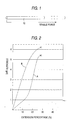
- Fig. 1 is an explanatory view showing an embodiment of the fishing line according to the present invention.
- Fig. 2 is a graph showing the relation between strength and extension percentage concerning the fishing line.
- Fig. 1 is a view showing an example of the fishing line according to the present invention.
- This fishing line 10 was made of aliphatic polyester biodegradable plastics in which the relation between strength and expansion exhibited the curve A in Fig. 2 when a tensile force acted on the fishing line 10 in the direction of the arrow in Fig. 1. That is, in this fishing line 10, the initial extension percentage for a tensile force smaller than 2.0 g/d was 18 %, the extension percentage in a tensile force range of from 2.0 to 4.5 g/d was 5 %, the extension percentage at the time of breaking was 27 % and the strength at the time of breaking was 5.4 g/d.
- the temperature for spinning the aliphatic polyester biodegradable plastics was selected to be 210°C.
- First and second drawing processes were set at three and four times, respectively, so that the total seven times drawing was carried out under thermal environment condition at 100 °C.
- Temperature of each cooling vessel was set at 12 °C.
- a Nylon fishing line was prepared so that the initial extension percentage against a tensile force smaller than 2.0 g/d was 5 %, the extension percentage in a tensile force range of from 2.0 to 4.5 g/d was 4 %, the extension percentage at the time of breaking was 13 % and the strength at the time of breaking was 6.5 g/d.
- a Nylon fishing line was prepared so that the initial extension percentage against a tensile force smaller than 2.0 g/d was 13 %, the extension percentage in a tensile force range of from 2.0 to 4.5 g/d was 20 %, the extension percentage at the time of breaking was 38 % and the strength at the time of breaking was 6.5 g/d.
- a polyester fishing line was prepared so that the initial extension percentage for a tensile force smaller than 2.0 g/d was 18 %, the extension percentage in a tensile force range of from 2.0 to 4.5 g/d was 5 %, the extension percentage at the time of breaking was 55 % and the strength at the time of breaking was 6.5 g/d.
- a polyester fishing line was prepared so that the initial extension percentage for a tensile force smaller than 2.0 g/d was 16 %, the extension percentage in a tensile force range of from 2.0 to 4.5 g/d was 7 %, the extension percentage at the time of breaking was 30 % and the strength at the time of breaking is 3.0 g/d.
- a fishing line of a polyamide material was prepared so that the initial extension percentage for a tensile force smaller than 2.0 g/d was 7 %, the extension percentage in a tensile force range of from 2.0 to 4.5 g/d was 8 %, the extension percentage at the time of breaking was 27 % and the strength at the time of breaking was 6.5 g/d.
- the relation between strength and extension percentage exhibited the curve B in Fig. 2 when a tensile force acted on the fishing line in the direction of the arrow in Fig. 1.
- Polyester type biodegradable plastics represented by the chemical formula 1 was used as a biodegradable material and a fishing line was prepared by spinning this material at 250°C.
- the spinning temperature is so high that the strength of this fishing line at the time of breaking was lowered to 3.8 g/d because of thermal decomposition of the material.
- the fishing line according to the present invention is designed so that a body of the fishing line has a first region in which the percentage of initial extension in a tensile force smaller than 2.0 g/d is not lower than 10 %, and a second region in which the percentage of extension in a tensile force range of from 2.0 to 4.5 g/d is lower than the initial extension percentage; the percentage of extension at the time of breaking is not higher than 40 %; and the breaking strength at the time of breaking is not smaller than 4.5 g/d. Accordingly, not only the fishing line is prevented from breaking in the middle of fishing but also it is easy to perform fishing operation.
- the fishing line according to the present invention is designed so that the body of the fishing line has the aforementioned characteristic and is produced by spinning a biodegradable material, the fishing line does not exert bad influence on the environment, that is, the fishing line is gentle to the environment.
Landscapes
- Life Sciences & Earth Sciences (AREA)
- Environmental Sciences (AREA)
- Chemical & Material Sciences (AREA)
- Chemical Kinetics & Catalysis (AREA)
- General Chemical & Material Sciences (AREA)
- Engineering & Computer Science (AREA)
- Textile Engineering (AREA)
- Animal Husbandry (AREA)
- Biodiversity & Conservation Biology (AREA)
- Biological Depolymerization Polymers (AREA)
- Artificial Filaments (AREA)
- Compositions Of Macromolecular Compounds (AREA)
Applications Claiming Priority (2)
| Application Number | Priority Date | Filing Date | Title |
|---|---|---|---|
| JP7012670A JPH08196175A (ja) | 1995-01-30 | 1995-01-30 | 釣り糸 |
| JP12670/95 | 1995-01-30 |
Publications (2)
| Publication Number | Publication Date |
|---|---|
| EP0725170A1 EP0725170A1 (en) | 1996-08-07 |
| EP0725170B1 true EP0725170B1 (en) | 1999-05-06 |
Family
ID=11811818
Family Applications (1)
| Application Number | Title | Priority Date | Filing Date |
|---|---|---|---|
| EP96101224A Expired - Lifetime EP0725170B1 (en) | 1995-01-30 | 1996-01-29 | Fishing line |
Country Status (4)
| Country | Link |
|---|---|
| US (1) | US5753366A (enExample) |
| EP (1) | EP0725170B1 (enExample) |
| JP (1) | JPH08196175A (enExample) |
| DE (1) | DE69602289T2 (enExample) |
Families Citing this family (4)
| Publication number | Priority date | Publication date | Assignee | Title |
|---|---|---|---|---|
| JP2002211876A (ja) * | 2001-01-10 | 2002-07-31 | Toray Ind Inc | スリングベルト |
| US6725596B2 (en) * | 2001-02-08 | 2004-04-27 | Ferrari Importing Co. | Fishing line with enhanced properties |
| KR100415812B1 (ko) * | 2002-09-19 | 2004-01-24 | 대한민국 | 생분해성 지방족 폴리에스테르계 수지조성물, 이를 이용한어로작업용 어구 및 그의 제조방법 |
| US7374496B2 (en) * | 2003-10-09 | 2008-05-20 | Grant Marlin D | Golf club, ball, reel and line apparatus |
Family Cites Families (5)
| Publication number | Priority date | Publication date | Assignee | Title |
|---|---|---|---|---|
| JP2585820B2 (ja) * | 1990-01-08 | 1997-02-26 | 帝人株式会社 | 漁網用ポリエステル繊維 |
| JPH0543637A (ja) * | 1991-08-21 | 1993-02-23 | Asahi Chem Ind Co Ltd | 分解性線状体 |
| KR0120326B1 (ko) * | 1992-12-24 | 1997-10-22 | 김준웅 | 열가소성 생분해성 지방족 폴리에스테르 및 그 제조방법 |
| JP3156811B2 (ja) * | 1993-03-11 | 2001-04-16 | 東洋紡績株式会社 | 生分解性漁業用繊維集合体 |
| DE69430291T2 (de) * | 1993-11-18 | 2002-10-24 | Mitsui Chemicals, Inc. | Geformte Gegenstände aus abbaubarem aliphatischem Polyester |
-
1995
- 1995-01-30 JP JP7012670A patent/JPH08196175A/ja active Pending
-
1996
- 1996-01-29 US US08/593,278 patent/US5753366A/en not_active Expired - Fee Related
- 1996-01-29 EP EP96101224A patent/EP0725170B1/en not_active Expired - Lifetime
- 1996-01-29 DE DE69602289T patent/DE69602289T2/de not_active Expired - Fee Related
Also Published As
| Publication number | Publication date |
|---|---|
| EP0725170A1 (en) | 1996-08-07 |
| US5753366A (en) | 1998-05-19 |
| DE69602289D1 (de) | 1999-06-10 |
| DE69602289T2 (de) | 1999-09-09 |
| JPH08196175A (ja) | 1996-08-06 |
Similar Documents
| Publication | Publication Date | Title |
|---|---|---|
| DE69430291T2 (de) | Geformte Gegenstände aus abbaubarem aliphatischem Polyester | |
| US5100433A (en) | Suture coated with a copolymer coating composition | |
| US5753366A (en) | Fishing line | |
| JPH04108331A (ja) | 釣り糸 | |
| JPH06264306A (ja) | 微生物分解性マルチフイラメントとその製造法 | |
| JP3499053B2 (ja) | 生分解性ポリエステル繊維 | |
| KR100415812B1 (ko) | 생분해성 지방족 폴리에스테르계 수지조성물, 이를 이용한어로작업용 어구 및 그의 제조방법 | |
| US6132869A (en) | Vinylidene fluoride resin monofilament and fishing line prepared therefrom | |
| JPH06264305A (ja) | 微生物分解性繊維とその製造法 | |
| JPH07305234A (ja) | 改良された生分解性ポリエステル繊維 | |
| JP3599310B2 (ja) | ポリ乳酸モノフィラメントとその製造方法 | |
| JP3906349B2 (ja) | 生分解性複合モノフィラメントおよびその用途 | |
| JPH07278965A (ja) | 生分解性複合モノフィラメントとその製造法 | |
| JPH10110332A (ja) | 生分解性モノフィラメントおよびその用途 | |
| JP3615841B2 (ja) | 生分解性釣糸およびその製造方法 | |
| JPH03183428A (ja) | 釣糸及びその製造法 | |
| JP2002176863A (ja) | 農業用ネット | |
| JPH03262430A (ja) | 漁網 | |
| JPH1060733A (ja) | 生分解性モノフィラメントの製造方法 | |
| JPH0559611A (ja) | 高強度ポリカプロラクトンモノフイラメントとその製造法 | |
| JP2598316B2 (ja) | 釣り糸 | |
| JP3156811B2 (ja) | 生分解性漁業用繊維集合体 | |
| JPH07163237A (ja) | 接ぎ木支持具 | |
| US6725596B2 (en) | Fishing line with enhanced properties | |
| JP2000192370A (ja) | 乳酸系樹脂モノフィラメント |
Legal Events
| Date | Code | Title | Description |
|---|---|---|---|
| PUAI | Public reference made under article 153(3) epc to a published international application that has entered the european phase |
Free format text: ORIGINAL CODE: 0009012 |
|
| AK | Designated contracting states |
Kind code of ref document: A1 Designated state(s): DE FR GB IT |
|
| 17P | Request for examination filed |
Effective date: 19961125 |
|
| 17Q | First examination report despatched |
Effective date: 19970617 |
|
| GRAG | Despatch of communication of intention to grant |
Free format text: ORIGINAL CODE: EPIDOS AGRA |
|
| GRAG | Despatch of communication of intention to grant |
Free format text: ORIGINAL CODE: EPIDOS AGRA |
|
| GRAH | Despatch of communication of intention to grant a patent |
Free format text: ORIGINAL CODE: EPIDOS IGRA |
|
| GRAH | Despatch of communication of intention to grant a patent |
Free format text: ORIGINAL CODE: EPIDOS IGRA |
|
| GRAA | (expected) grant |
Free format text: ORIGINAL CODE: 0009210 |
|
| AK | Designated contracting states |
Kind code of ref document: B1 Designated state(s): DE FR GB IT |
|
| REF | Corresponds to: |
Ref document number: 69602289 Country of ref document: DE Date of ref document: 19990610 |
|
| ET | Fr: translation filed | ||
| PLBE | No opposition filed within time limit |
Free format text: ORIGINAL CODE: 0009261 |
|
| STAA | Information on the status of an ep patent application or granted ep patent |
Free format text: STATUS: NO OPPOSITION FILED WITHIN TIME LIMIT |
|
| 26N | No opposition filed | ||
| REG | Reference to a national code |
Ref country code: GB Ref legal event code: IF02 |
|
| PGFP | Annual fee paid to national office [announced via postgrant information from national office to epo] |
Ref country code: FR Payment date: 20040108 Year of fee payment: 9 |
|
| PGFP | Annual fee paid to national office [announced via postgrant information from national office to epo] |
Ref country code: GB Payment date: 20040128 Year of fee payment: 9 |
|
| PGFP | Annual fee paid to national office [announced via postgrant information from national office to epo] |
Ref country code: DE Payment date: 20040205 Year of fee payment: 9 |
|
| PG25 | Lapsed in a contracting state [announced via postgrant information from national office to epo] |
Ref country code: IT Free format text: LAPSE BECAUSE OF NON-PAYMENT OF DUE FEES;WARNING: LAPSES OF ITALIAN PATENTS WITH EFFECTIVE DATE BEFORE 2007 MAY HAVE OCCURRED AT ANY TIME BEFORE 2007. THE CORRECT EFFECTIVE DATE MAY BE DIFFERENT FROM THE ONE RECORDED. Effective date: 20050129 Ref country code: GB Free format text: LAPSE BECAUSE OF NON-PAYMENT OF DUE FEES Effective date: 20050129 |
|
| PG25 | Lapsed in a contracting state [announced via postgrant information from national office to epo] |
Ref country code: DE Free format text: LAPSE BECAUSE OF NON-PAYMENT OF DUE FEES Effective date: 20050802 |
|
| GBPC | Gb: european patent ceased through non-payment of renewal fee |
Effective date: 20050129 |
|
| PG25 | Lapsed in a contracting state [announced via postgrant information from national office to epo] |
Ref country code: FR Free format text: LAPSE BECAUSE OF NON-PAYMENT OF DUE FEES Effective date: 20050930 |
|
| REG | Reference to a national code |
Ref country code: FR Ref legal event code: ST |