EP0724643B1 - Endosomolytisch wirksame partikel - Google Patents
Endosomolytisch wirksame partikel Download PDFInfo
- Publication number
- EP0724643B1 EP0724643B1 EP94928873A EP94928873A EP0724643B1 EP 0724643 B1 EP0724643 B1 EP 0724643B1 EP 94928873 A EP94928873 A EP 94928873A EP 94928873 A EP94928873 A EP 94928873A EP 0724643 B1 EP0724643 B1 EP 0724643B1
- Authority
- EP
- European Patent Office
- Prior art keywords
- particles
- modified
- capsid
- particle
- membrane
- Prior art date
- Legal status (The legal status is an assumption and is not a legal conclusion. Google has not performed a legal analysis and makes no representation as to the accuracy of the status listed.)
- Expired - Lifetime
Links
Images

Classifications
-
- C—CHEMISTRY; METALLURGY
- C12—BIOCHEMISTRY; BEER; SPIRITS; WINE; VINEGAR; MICROBIOLOGY; ENZYMOLOGY; MUTATION OR GENETIC ENGINEERING
- C12N—MICROORGANISMS OR ENZYMES; COMPOSITIONS THEREOF; PROPAGATING, PRESERVING, OR MAINTAINING MICROORGANISMS; MUTATION OR GENETIC ENGINEERING; CULTURE MEDIA
- C12N15/00—Mutation or genetic engineering; DNA or RNA concerning genetic engineering, vectors, e.g. plasmids, or their isolation, preparation or purification; Use of hosts therefor
- C12N15/09—Recombinant DNA-technology
- C12N15/87—Introduction of foreign genetic material using processes not otherwise provided for, e.g. co-transformation
-
- A—HUMAN NECESSITIES
- A61—MEDICAL OR VETERINARY SCIENCE; HYGIENE
- A61K—PREPARATIONS FOR MEDICAL, DENTAL OR TOILETRY PURPOSES
- A61K47/00—Medicinal preparations characterised by the non-active ingredients used, e.g. carriers or inert additives; Targeting or modifying agents chemically bound to the active ingredient
- A61K47/50—Medicinal preparations characterised by the non-active ingredients used, e.g. carriers or inert additives; Targeting or modifying agents chemically bound to the active ingredient the non-active ingredient being chemically bound to the active ingredient, e.g. polymer-drug conjugates
- A61K47/69—Medicinal preparations characterised by the non-active ingredients used, e.g. carriers or inert additives; Targeting or modifying agents chemically bound to the active ingredient the non-active ingredient being chemically bound to the active ingredient, e.g. polymer-drug conjugates the conjugate being characterised by physical or galenical forms, e.g. emulsion, particle, inclusion complex, stent or kit
- A61K47/6901—Conjugates being cells, cell fragments, viruses, ghosts, red blood cells or viral vectors
Definitions
- the invention relates to the introduction of Nucleic acids in higher eukaryotic cells.
- Gene therapy also provides one promising approach to the treatment of Cancer, whereby so-called "cancer vaccine” administered become.
- cancer vaccine administered become.
- To improve the immunogenicity of tumor cells increase these are changed to either to make it more antigenic, or to make them too cause certain immunomodulating substances to generate, e.g. Cytokines, which then have an immune response trigger.
- the cells are using DNA transfected for a cytokine, e.g. IL-2, IL-4, IFN-gamma, TNF- ⁇ , encoded.
- cytokine e.g. IL-2, IL-4, IFN-gamma, TNF- ⁇ , encoded.
- the farthest advanced techniques for gene transfer in autologous tumor cells use viral vectors.
- Nucleic acids as therapeutically active substances also apply to certain Inhibit cell functions, e.g. have antisense RNAs and DNAs or ribozymes as effective agents for the selective inhibition of certain gene sequences proved.
- gene transfer systems have been developed that circumvent the limitations of the retroviral and adenoviral vectors and eliminate the security risks that arise from the co-transfer of viable viral gene elements from the original virus.
- These gene transfer systems are based on mechanisms which the cell uses for the transport of macromolecules, for example on the extremely powerful route of receptor-mediated endocytosis (Wu and Wu, 1987; EP-Al 0 388 758; WO 91/17773, WO 92/17210 and WO 92/19281).
- This method which uses bifunctional molecular conjugates, which have a DNA binding domain and a domain with specificity for a cell surface receptor, high gene transfer rates could be achieved.
- the randomly arranged synthetic conjugates Peptides and polylysine used for complexation and Condensation of the DNA molecules used was missing an orderly three-dimensional structuring of the endosomolytic function as it regards its endosomolytic activity extremely efficient Adenovirus particle. From the endosomolytic Activity of the adenovirus particle is thought to be it is located in the penton base (Seth et al., 1984), which in a defined number of copies specific locations on the surface of the Virus particle is present (Stewart et al., 1993). This organized arrangement could be a function with regard on the requirements for assembling one Virus particles, but they could also play a role in controlling the interactions of the membrane-active motif on the penton proteins with the Play endosome membrane.
- the present invention was based on the object provide endosomolytic agents that a Improvement of gene transfer systems via receptor-mediated Allow endocytosis by high Expression rates with the most extensive. Elimination of Ensure security risks.
- membrane-active peptides achieve that they are in an orderly form assembles or arranges by placing them on one Attaches protein that has the ability to self Assemble particles with ordered structures.
- the present invention relates to an endosomolytic effective virus-like particle made up of units of capsid proteins derived from capsid proteins of Viruses or virus-like particles is, the capsid prot units with a membrane-active peptide sequence are modified.
- the skeleton of the particles according to the invention is a empty virus capsid or a capsid-like particle Proteins from viruses or virus-like particles, such as Bacteriophages or yeast transposons.
- the proteins that forming the capsid framework are part of the present invention referred to as "capsid proteins”.
- the membrane active peptide sequence is on the Capsid protein units arranged to ensure is that it is in the place of its effectiveness, ie in the Cell that is functionally available: the membrane-active peptide sequences are either on the Surface of the particles are free or in a way arranged in the surface structure that their Exposure to events in the cell, such as Proteolysis, pH change or change in Redox potential, is exposed.
- the membrane active Function of the peptides which include through her Accessibility is determined, is expressed in their endosomolytic activity. This is reflected in the Increase in gene transfer capacity and can be tested using gene transfer experiments.
- Capsids of simple enveloped viruses are from a number of viruses are available.
- the natural ones Capsids generally consist of one to three Proteins.
- Extra capsids, inherently endosomolytic Have activity that includes recording and Expression of DNA transported into the cell can be improved as such without further modification of the particle can be used, as in WO 93/07283 was proposed.
- the empty ones are an example of this Capsids of parvovirus B19, e.g. by Baculovirus expression can be obtained.
- the particles according to the invention are from Capsid structures derived, which inherently to the Required to increase the efficiency of gene transfer endosomolytic activity not or not in have sufficient or desired extent.
- the initial particles forming the framework can of natural origin, in which case they will especially received from viral infections.
- the particles are preferably recombinant produced by the, optionally modified, Capsid proteins are expressed and purified and, if they are not already in an associated form, then be associated.
- unmodified capsid proteins When expressing unmodified capsid proteins can be obtained after their association Particles that form the scaffold subsequently on their Surface modified with the membrane-active peptides e.g. chemically by coupling with synthetic membrane active peptides.
- the coupling of the membrane-active peptide on the capsid framework can be used for the coupling of peptides in a manner known per se take place, e.g. by chemical means, whereby if required the individual components before the Coupling reaction with linkers.
- the coupling can e.g. take place via disulfide bridges, which split again under reducing conditions can be used (e.g. when connecting using succinimidyl; Jung et al., 1981).
- the capsid has suitable carbohydrate chains, it can with the peptide over these carbohydrate chains get connected. This can be done according to the Preparation of glycoprotein-polycation conjugates in the method described in WO 92/15281 become.
- Another method of making the particles according to the invention is the enzymatic Coupling of the membrane-active peptide to the scaffold capsid by a transglutaminase.
- a transglutaminase According to the in the WO 93/07283 for the coupling of polylysine Adenovirus described method can be followed. The prerequisite for this is that on proteins corresponding glutamines or lysines are present, which can be implemented by the enzyme.
- the particles according to the invention are preferred obtained by using the modified capsid proteins Can be produced using recombinant methods.
- the invention thus relates in a further aspect a method of making endosomolytic effective virus-like particles, one for a capsid protein from viruses or virus-like Particle encoding DNA, which with a for a modified membrane-active peptide coding sequence is expressed and the capsid protein obtained, if required to associate with capsid structures.
- the chimeric DNA one for the capsid protein and a sequence coding for the membrane-active peptide contains, e.g. transformed with baculoviruses Insect cells, expressed in yeast or in bacteria.
- the obtained by a membrane active peptide domain modified capsid protein can e.g. associate be left after the overexpressed Capsid protein monomers denatured, purified and that Denaturants were removed.
- Denaturants come in particular urea or Guanidine hydrochloride, optionally in the presence mild detergents and / or reducing agents, in Consideration.
- a denaturation is not then required if the modified Capsid proteins already in the host organism Arrange capsid structures, as is evident with the Yeast Ty Particle is the case. In this case the host cells are broken up mechanically and the finished capsid particles are harvested.
- bacterial expression system a large one of which Selection available for routine use there are no restrictions. Is preferred used a system that expresses the modified capsid proteins in large quantities permits; because of their efficiency in general bacterial expression systems preferred.
- An example for a suitable in the context of the present invention bacterial expression system is that of Studier et al., 1990.
- An example of a a suitable yeast expression system is that from Emr, 1990, described; also baculovirus systems that are used for the production of capsid proteins already were used differently are suitable (e.g. O'Reilly et al., 1992). It can be constitutive or inducible expression systems can be used.
- modifying existing expression systems can be controlled in what form the capsids are obtained, e.g. can a decrease in the rate of expression denaturation and then resolubilization of the capsid proteins make redundant.
- the recombinant manufacture in which the modification of the capsid proteins in the course of the expression of the appropriately modified DNA has compared the subsequent modification of capsids
- Advantage that the location of the membrane-active domains the protein and the ratio of capsid proteins membrane-active peptides can be precisely defined.
- the Presence of the membrane active peptide be it due to its sequence or arrangement, the ability of expressed capsid proteins to order themselves Put structures together, not affected. This The requirement also applies to the position in the Capsid protein in which the peptide is inserted.
- the proteins can be co-expressed become; e.g. in the case of two capsid proteins by co-transformation the host organism with two plasmids, each carrying a capsid protein sequence, or by Transformation of the host with a double recombinant vector that carries the two sequences, such as. for the expression of the capsid of the parvovirus B19 was shown in insect cells using baculoviruses (Brown et al., 1991).
- the proteins of which in Baculovirus system are expressed and that too Being able to put particles together counts the adeno-associated Virus, a dependovirus (Ruffing et al., 1992); "Aleutian Mink Disease Virus", an autonomous Parvovirus (Christensen et al., 1993); Flock House Virus, a nodovirus (Schneeman et al., 1993), Papilloma virus; Poliovirus (Urakawa et al., 1989); Norwalk Virus (Jiang et al., 1992) and Polyomavirus.
- capsid proteins which by Introduction of foreign domains can be modified are those of the L-A particle made of yeast (Icho and Wickner, 1989; Wickner, 1993), the bacteriophage Q ⁇ , GA, SP and other phages of the Leviviridae family, and des Bacteriophage phi x 174 (Ackerman and DuBow, 1987).
- the yeast Ty particle is particularly good and the MS2 phage with: Kingsman et al., 1991, have shown that ordered yeast Ty particles for the immunogenic, multivalent presentation of peptides and small proteins like HIV gp120 epitopes, hepatitis B antigens, etc. are suitable. This is possible because the main protein of the Ty particle, the product of the TyA gene, has the ability to self at 40 nm large isometric particles (Burns et al., 1992). Kingsman et al. have a fragment of the Proteins identified that for this Self-assembly activity is sufficient; Peptide sequences which are attached to the carboxy terminus of this protein are lying on the surface of the composite Particles free.
- the MS2 virus has a 24 nm quasiicosohedral Capsid consisting of 180 copies of the Major coat protein (13 kd), a copy of the Maturing protein (45 kd), and a 3569 nt RNA genome.
- MS2 was the first organism to have its entire genome was sequenced (Fiers et al., 1976).
- the Crystal structure of this virus has been elucidated and showed an exposed ⁇ -hairpin loop on the Surface of each of the 180 capsomeres (Valegard et al., 1990).
- the unfixed structure of this loop and their surface exposure was exploited to To form particles for the antigen presentation by Sections of 11 to 26 amino acids in this loop were inserted (Mastico et al., 1993).
- the MS2 capsid protein tolerates these insertions under Maintaining his ability to get organized Assemble capsid structures yourself; the Capsid protein can be denatured in urea and builds up to native after its removal virus-like structures together (Mastico et al., 1993). This way the composition of capsids, the numerous peptide epitopes on its surface wear, enables.
- the requirements for the particle in general that it is less than 100 nm in size, preferably have a diameter of less than 50 nm is said to increase uptake by endocytosis allow it to be free of unnecessary, especially infectious nucleic acid that does not Has function for gene transfer, and that it is the Prerequisite is that he has an endosomolytic Activity (in the form of membrane active peptides or small proteins) can be conferred on either chemical way or by means of genetic manipulation.
- the capsules to be produced recombinantly have the following requirements:
- the capsid should have the simplest possible structure, preferably consisting of a maximum of three subunits.
- the subunits are said to either already associate themselves in the host organism in which they are expressed or, if they are in insoluble form after overexpression, to be resolubilizable and to self-assemble into capsid structures.
- capsid proteins are assumed whose genes are available in cloned form, otherwise the cloning must first be carried out.
- capsid structures are preferably used, the 3D structure (crystal structure) of which has been elucidated by means of X-ray structure analysis.
- the sequence region in the capsid protein in which the membrane-active peptide sequence is attached is generally subject to the requirement that it has no function for the formation of the capsid structure or the assembly or that its function is not hindered by the insertion of a peptide structure.
- the crystal structure is available, this will be used when determining the location for the insertion of the peptide domain: If the crystal structure shows that the virus or virus-like particles has loops on its surface, such as the MS2 phage, these loops are preferred are not required for the formation of the capsid structure, used for the modification. If the crystal structure is not known, the insertion site can be determined empirically: the amino acid sequence can be used to determine whether certain areas may form the basis for the formation of structural elements such as ⁇ -helical or ⁇ -sheet structures.
- non-conserved regions that are not required for the structure, such as the loops of the MS2 phage, can be used for the modification ,
- capsid frameworks and membrane-active Peptides When choosing capsid frameworks and membrane-active Peptides and the determination of the insertion site of the Peptide sequence for the construction of the particles according to the invention are e.g. as follows proceeded: The for the capsid protein (s) coding DNA sequence (s) under which Control of suitable expression control sequences, in introduced a vector and in a suitable host expressed.
- vectors for Expression brought in each of which Capsid protein sequence with one for a membrane active Peptide coding sequence is modified. Doing so if necessary, first the insertion point for the Foreign sequence varies to find the optimal location determine. In the course of working up the Expression products can meet the conditions for Purification of the capsid monomers and for their association be optimized.
- membrane active peptides are for the production of the particles according to the invention suitable, provided they meet the condition that Assembly of the capsid structures not too affect and the particle in the cell to confer endosomolytic function which the Brings an increase in gene transfer efficiency.
- suitable membrane active peptides either subsequently linked to the original particles or their coding DNA sequence for the production of chimeric Capsid protein DNA can be used, e.g. that of Subbarao et al., 1987; Parente et al., 1990 and peptides described by Wagner et al., 1992, and the natural and synthetic membrane active endosomolytically active peptides that are in the WO 93/07283 are described.
- the invention thus relates to a preferred Aspect of a yeast Ty particle, composed of TyA protein units, those with a membrane active Peptide sequence are modified.
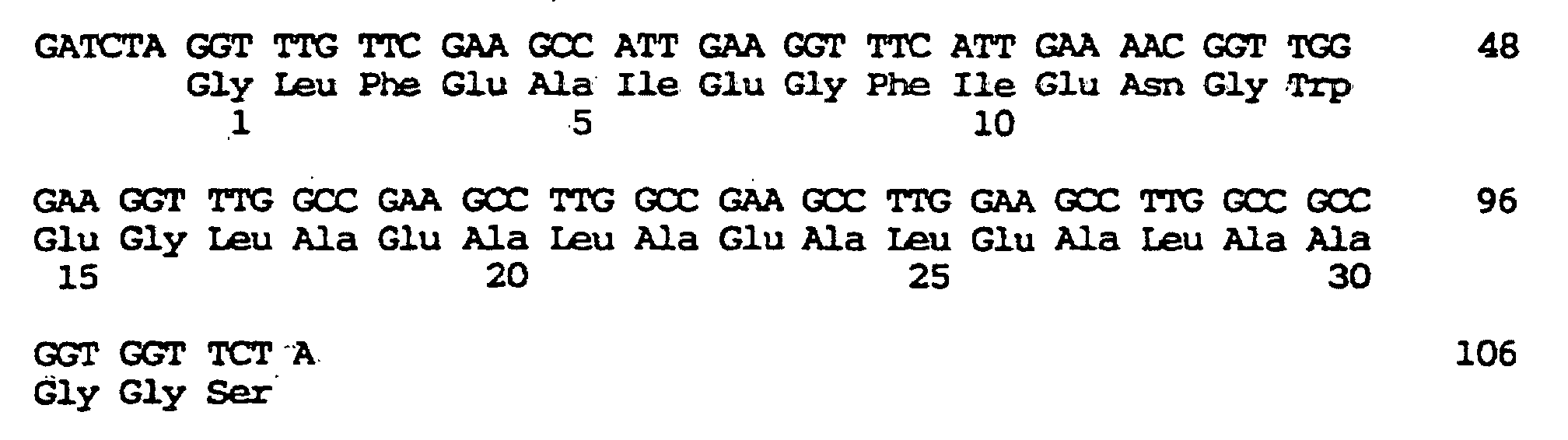
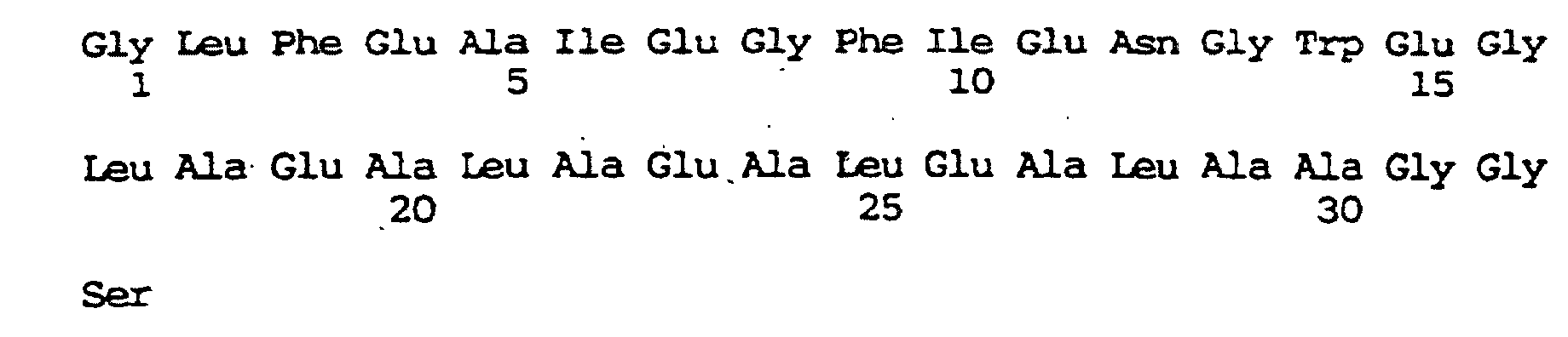
- the Ty particle with the peptide sequence Gly Leu Phe Glu Ala Ile Glu Gly Phe Ile Glu Asn Gly Trp Glu Gly Leu Ala Glu Ala Leu Ala Glu Ala Leu Glu Ala Leu Ala Ala Gly Gly Ser modified at the carboxy terminus of the TyA protein located.
- the yeast Ty particles according to the invention are obtained by making a DNA encoding the TyA protein that a membrane-active peptide sequence at the carboxy terminus , expresses, unlocks the host cells and the capsid is harvesting.
- the expression of the modified TyA sequence e.g. in yeast or bacteria modified Ty particles because of their size and Density can be cleaned.
- the cleaned endosomolytic Ty particles were in the Within the scope of the present invention biotinylated and with Streptavidin polylysine and transferrin polylysine as well of the DNA to be transported into the cell Transfection complexes united.
- endosomolytic Ty particles coupled directly to polylysine using transglutaminase and with transferrin-polylysine conjugates and the DNA ternary transfection complexes.
- Another preferred embodiment of the present invention is thus an MS2 particle, composed. from MS2 capsid protein units, the modified with a membrane-active peptide sequence are.
- the membrane active peptide is in the ⁇ -hairpin loop region between amino acid 11 (Asp) and amino acid 17 (Asp), especially between Amino acid 14 (Gly) and 15 (Thr) of the MS2 capsid protein inserted.
- Another possible insertion point for the membrane-active peptide lies in the C-terminal region of the MS2 capsid protein.
- the endosomolytic MS2 particle with the peptide sequence GALA, which lies between amino acid 14 and amino acid 15 of the MS2 capsid protein is inserted, modified.
- the MS2 particles according to the invention are preferred obtained by inserting the for that modified membrane-active peptide coding sequence Capsid protein DNA expressed, and the obtained modified capsid protein denatured and under Associate denaturant removal is left.
- the cleaned endosomolytic MS2 particles were biotinylated in the context of the present invention and with streptavidin polylysine and transferrin polylysine and the DNA to be transported into the cell Complexes united.
- the particles according to the invention in addition to the / the membrane active peptide (s) a peptide sequence with the Function of a ligand for the target cell.
- a Internalization function conferred this Peptide sequence is hereinafter referred to as "ligand peptide" designated.
- the best characterized ligand peptide is the arginine-glycine-aspartic acid sequence (RGD), which was found in various integrin-binding cell adhesion proteins, such as fibronectin, fibrinogen, from Willebrand factor and vitronectin (Pierschbacher and Ruoslahti, 1984; 1987).
- RGD arginine-glycine-aspartic acid sequence
- An RGD motif present in the penton base of type 2 and type 5 adenovirus has been shown to play a role in the internalization of the virus (Wickham et al., 1993).
- Such a short one containing the RGD motif Ligand peptide sequence can be inserted into capsid proteins in order to obtain particles according to the invention which have a cell-binding motif on their surface.
- the ability e.g. of the MS2 capsid protein Urea-denatured monomers themselves assembling can also be used to To produce MS2 particles that have more than one Show foreign domain. The prerequisite for this is also in this case that these insertions have the ability of Do not interfere with self-assembly particles.
- a membrane-active domain e.g. the GALA motif
- a cell binding domain e.g.
- the RGD motif is preferably so proceeded that on the one hand capsid monomers with a membrane-active modification and on the other hand with a ligand modification are produced, and the two differently modified, denatured Monomers in a defined ratio mixed and the denaturant is removed to the association of the modified proteins enable virus-like particles.
- Ligand peptides introduced into the capsid monomers become; Examples are small ones Peptide growth factors and hormones like that EGF (epidermal growth factor) peptide, insulin, the costimulatory Molecule HSA "Heat Stable Antigen” (Kay et al., 1990), also peptides from so-called superantigens, encoded by mouse mammary tumor virus (Torres et al., 1993).
- EGF epidermal growth factor
- HSA Heat Stable Antigen
- the particles according to the invention with a nucleic acid binding Domain especially an organic one polycationic compound such as polylysine.
- a nucleic acid binding Domain especially an organic one polycationic compound such as polylysine.
- virus-like particles to the membrane - active endosomolytic peptides and optionally the cell-binding ligand motifs Domains that have the ability to attach to nucleic acids tie.
- These particles that contain a DNA binding domain can be made by the capsid subsequently with a DNA binding substance such as Polylysine is conjugated.
- the conjugation of the capsid e.g. with polylysine can after for coupling peptides with Polyamine compounds are carried out in a manner known per se, e.g. by chemical means, through coupling via a Biotin-streptavidin bridge or by direct binding of the polylysine to the capsid by means of transglutaminase.
- the same procedure can be used as in the WO 93/07283 for the coupling of polylysine to viruses or virus components.
- capsids As an alternative to the subsequent conjugation of capsids with a DNA binding peptide, the modification of the capsid proteins with a DNA binding domain too directly, i.e. by expression of a chimeric DNA sequence consisting of one for the capsid protein coding DNA sequence, and one for the DNA binding Peptide coding sequence.
- This method of production binds to the DNA binding peptides that also for the other foreign domains current requirement that their presence on the capsid protein's ability to order Assembling structures, not affected.
- DNA binding motifs after expression the chimeric capsid DNA on the invention Particles are cationic polypeptides, e.g. the homologues polylysine, polyarginine, or peptides, the of naturally occurring DNA-binding proteins, such as Histones, core proteins of adenovirus (e.g. protein V, protein VII and the 13 kd protein L211K) or Protamines are derived.
- cationic polypeptides e.g. the homologues polylysine, polyarginine, or peptides
- the of naturally occurring DNA-binding proteins such as Histones, core proteins of adenovirus (e.g. protein V, protein VII and the 13 kd protein L211K) or Protamines are derived.
- the production of particles according to the invention the have more than one foreign domain, e.g. several membrane active domains or a membrane active domain in Connection with a ligand and / or a DNA binding Domain, can be separated into two or more, same or different expression systems getting produced.
- a foreign domain e.g. several membrane active domains or a membrane active domain in Connection with a ligand and / or a DNA binding Domain
- a capsid protein monomer with a membrane active domain e.g. the peptide GALA
- a capsid monomer with a ligand domain e.g. the RGD motif
- the Monomers are mixed in the desired ratio, so that these become orderly structures assemble.
- the optimal mixing ratio will be determined empirically.
- the particles of the invention are as endosomolytic agents in compositions for the Gene transfer used, as described in WO 93/07283 are described.
- the invention thus relates in a further aspect a composition for the transport of nucleic acid into the higher eukaryotic cell, in which the Nucleic acid is complexed with endosomolytic effective virus-like particles consisting of modified units of capsid proteins of viruses or virus-like particles, the Capsid protein units membrane active peptidic Sequences and polycationic sequences for binding of the nucleic acid.
- the Gene transfer complexes in addition to those of the invention endosomolytic particles that have a nucleic acid binding domain have a conjugate in which a Nucleic acid binding domain, generally the same like that of the particle, with one Internalization factor for the transfected Target cell is coupled.
- These ternary complexes or Combination complexes are mainly used if the endosomolytic particle is not by itself can penetrate into the target cell, i.e. if it's not in native form can penetrate into the cell and also not with a ligand domain for the target cell was modified.
- this embodiment can also be used when the ligand function of a particle according to the invention by a additional ligand function should be added.
- Transfection complexes consisting of DNA, the particle according to the invention conjugated with polylysine, and a trarisferrin-polylysine conjugate.
- an additional Nucleic acid binding substance especially polylysine, be contained in non-conjugated form to the Condense nucleic acid.
- Internalizing factor conjugate included Nucleic acid binding domain the function of attachment to the nucleic acid without losing all of the to saturate negative charges.
Landscapes
- Health & Medical Sciences (AREA)
- Life Sciences & Earth Sciences (AREA)
- Engineering & Computer Science (AREA)
- Genetics & Genomics (AREA)
- Chemical & Material Sciences (AREA)
- Bioinformatics & Cheminformatics (AREA)
- Organic Chemistry (AREA)
- Wood Science & Technology (AREA)
- Biomedical Technology (AREA)
- General Health & Medical Sciences (AREA)
- Biotechnology (AREA)
- General Engineering & Computer Science (AREA)
- Zoology (AREA)
- Biochemistry (AREA)
- Epidemiology (AREA)
- Plant Pathology (AREA)
- Molecular Biology (AREA)
- Biophysics (AREA)
- Physics & Mathematics (AREA)
- Cell Biology (AREA)
- Hematology (AREA)
- Virology (AREA)
- Medicinal Chemistry (AREA)
- Pharmacology & Pharmacy (AREA)
- Microbiology (AREA)
- Animal Behavior & Ethology (AREA)
- Public Health (AREA)
- Veterinary Medicine (AREA)
- Peptides Or Proteins (AREA)
- Micro-Organisms Or Cultivation Processes Thereof (AREA)
- Physical Or Chemical Processes And Apparatus (AREA)
- Manufacturing Of Micro-Capsules (AREA)
- Processes Of Treating Macromolecular Substances (AREA)
- Preparation Of Compounds By Using Micro-Organisms (AREA)
Description
WO 91/17773, WO 92/17210 und WO 92/19281). Mit Hilfe dieser Methode, die sich bifunktioneller molekularer Konjugate bedient, die eine DNA-Bindungsdomäne und eine Domäne mit Spezifität für einen Zelloberflächenrezeptor aufweisen, konnten hohe Gentransferraten erzielt werden.
Im Hinblick auf die Insertionsstelle für die Einfügung der membranaktiven Peptidsequenz wird bevorzugt von Kapsidstrukturen ausgegangen, deren 3D-Struktur (Kristallstruktur) mittels Röntgenstrukturanalyse aufgeklärt wurde. An den Sequenzbereich im Kapsidprotein, in dem die Anbringung der membranaktiven Peptidsequenz vorgenommen wird, wird generell die Anforderung gestellt, daß er für die Ausbildung der Kapsidstruktur bzw. den Zusammenbau keine Funktion hat bzw. daß ihre Funktion durch die Einfügung einer Peptidstruktur nicht behindert wird. Wenn die Kristallstruktur verfügbar ist, wird diese bei der Festlegung der Stelle für die Einfügung der Peptiddomäne herangezogen: Zeigt die Kristallstruktur, daß das Virus oder virusähnliche Partikel an seiner Oberfläche Schleifen hat, wie z.B. der MS2-Phage, so werden bevorzugt diese Schleifen, die für die Ausbildung der Kapsidstruktur nicht erforderlich sind, für die Modifikation herangezogen.
Ist die Kristallstruktur nicht bekannt, kann bei der Bestimmung der Insertionsstelle empirisch vorgegangen werden: Aus der Aminosäuresequenz kann abgeleitet werden, ob bestimmte Bereiche gegebenenfalls die Grundlage für die Ausbildung von Strukturelementen, wie α-helikalen oder von β-Faltblattstrukturen, darstellen. Sofern Informationen über Deletionen oder künstliche oder natürliche Mutationen von Virusproteinen einen Rückschluß auf die Existenz nicht-konservierter Regionen zulassen, können die nicht konservierten Regionen, die für die Struktur nicht erforderlich sind, wie z.B. die Schleifen des MS2-Phagen, für die Modifikation benützt werden.
Eine für dieses Motiv kodierende Sequenz wurde auch in das M13-Gen III eingeführt, um es an der Oberfläche des filamentösen Phagen zu präsentieren.
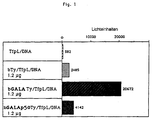
- Fig. 1:
- Transfer von DNA in K562-Zellen mittels Transfektionskomplexen, enthaltend endosomolytische Ty-Partikel, die über Biotin-Streptavidin an Polylysin gekoppelt sind
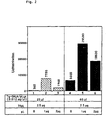
- Fig. 2:
- Transfer von DNA in K562-Zellen mittels Transfektionskomplexen, enthaltend endosomolytische Ty-Partikel, die direkt an Polylysin gekoppelt sind
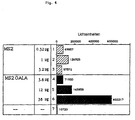
- Fig. 3 und 4:
- Transfer von DNA in K562-Zellen mittels Transfektionskomplexen, enthaltend endosomolytische MS2-Partikel, die über Biotin-Streptavidin an Polylysin gekoppelt sind
Dadurch wurde das Einführen von DNA-Sequenzen,
kodierend für membranaktive Peptide, die auf der Oberfläche des resultierenden TyA-Fusionsproteins exprimiert werden sollten, in die nun nur einmal vorkommende BamHI-Stelle ermöglicht. In diese Stelle wurden zwei verschiedene, für membranaktive Peptide kodierende Sequenzen eingeführt: die komplementären Oligonukleotide der Bezeichnung GALA.1 (SEQ ID NO:7) und GALA.2 (SEQ ID NO:9), kodierend für die Original-GALA-Sequenz minus Trp am N-Terminus (Subbarao et al., 1987; Parente et al., 1990) (SEQ ID NO:8); die komplementären Oligonukleotide GALAP50.1 (SEQ ID NO:10) und GALAP50.2 (SEQ ID NO:12), die für das chimäre Peptid der Bezeichnung GALAP50 (SEQ ID NO.11) kodieren. Die erhaltenen Plasmide wurden pJefGALA und pJefGALAP50 bezeichnet; die Plasmide wurden über die eingefügte Region sequenziert, um die Korrektheit der Modifikation zu bestätigen.














Claims (17)
- Endosomolytisch wirksames virusähnliches Partikel, dadurch gekennzeichnet, daß es aus Einheiten von Kapsidproteinen, abgeleitet von Viren oder virusähnlichen Teilchen, zusammengesetzt ist, die mit einer membranaktiven peptidischen Sequenz modifiziert sind.
- Partikel nach Anspruch 1, dadurch gekennzeichnet, daß es ein modifiziertes Hefe-Ty-Partikel ist, das aus Einheiten von TyA-Protein zusammengesetzt ist, die mit einer membranaktiven Peptidsequenz modifiziert sind.
- Partikel nach Anspruch 2, dadurch gekennzeichnet, daß das Ty-Partikel mit der Peptidsequenz Glu Ala Ala Leu Ala Glu Ala Leu Ala Glu Ala Leu Ala Glu His Leu Ala Glu Ala Leu Ala Glu Ala Leu Glu Ala Leu Ala Ala modifiziert ist, die sich am Carboxy-Terminus des TyA-Proteins befindet.
- Partikel nach Anspruch 2, dadurch gekennzeichnet, daß das Ty-Partikel mit der Peptidsequenz Gly Leu Phe Glu Ala Ile Glu Gly Phe Ile Glu Asn Gly Trp Glu Gly Leu Ala Glu Ala Leu Ala Glu Ala Leu Glu Ala Leu Ala Ala Gly Gly Ser modifiziert ist, die sich am Carboxy-Terminus des TyA-Proteins befindet.
- Partikel nach Anspruch 1, dadurch gekennzeichnet, daß es ein modifiziertes MS2-Partikel ist, das aus Einheiten des MS2-Kapsidproteins zusammengesetzt ist, die mit einer membranaktiven Peptidsequenz modifiziert sind.
- Partikel nach Anspruch 5, dadurch gekennzeichnet, daß das membranaktive Peptid in der β-Haarnadelschleifenregion zwischen Aminosäure 11 (Asp) und Aminosäure 17 (Asp), insbesondere zwischen Aminosäure 14 (Gly) und 15 (Thr), des MS2-Kapsidproteins eingefügt ist.
- Partikel nach Anspruch 5 oder 6, dadurch gekennzeichnet, daß es mit der Peptidsequenz Glu Ala Ala Leu Ala Glu Ala Leu Ala Glu Ala Leu Ala Glu His Leu Ala Glu Ala Leu Ala Glu Ala Leu Glu Ala Leu Ala Ala modifiziert ist.
- Partikel nach einem der Ansprüche 1 bis 7, dadurch gekennzeichnet, daß es außerdem eine Nukleinsäure-bindende Domäne aufweist.
- Partikel nach Anspruch 8, dadurch gekennzeichnet, daß die Nukleinsäure-bindende Domäne Polylysin ist.
- Partikel nach Anspruch 9, dadurch gekennzeichnet, daß es direkt an Polylysin gebunden ist.
- Partikel nach einem der Ansprüche 1 bis 8, dadurch gekennzeichnet, daß es außerdem eine Peptidsequenz aufweist, die die Funktion eines Liganden für eine höhere eukaryotische Zelle hat.
- Verfahren zur Herstellung von Partikeln nach Anspruch 1, dadurch gekennzeichnet, daß man eine für ein Kapsidprotein von Viren oder virusähnlichen Teilchen kodierende DNA, die mit einer für ein membranaktives Peptid kodierenden Sequenz modifiziert ist, exprimiert und das erhaltene Kapsid erntet oder erforderlichenfalls die Kapsidproteinmonomeren zu Kapsidstrukturen assoziieren läßt.
- Verfahren zur Herstellung von Hefe-Ty-Partikeln nach Anspruch 2, dadurch gekennzeichnet, daß man eine DNA, kodierend für das TyA-Protein, das am Carboxy-Terminus ein membranaktives Peptid enthält, in Hefezellen exprimiert, die Zellen aufschließt und die Partikel erntet.
- Verfahren zur Herstellung von MS2-Partikeln nach Anspruch 5, dadurch gekennzeichnet, daß man eine DNA, kodierend für das MS2-Kapsidprotein, die eine für ein membranaktives Peptid kodierene Sequenz eingefügt enthält, exprimiert, das erhaltene modifizierte Kapsidprotein denaturiert und nach Entfernung des Denaturierungsmittels assoziieren läßt.
- Zusammensetzung für den Transport von Nukleinsäure in die höhere eukaryotische Zelle, enthaltend ein endosomolytisches Mittel, dadurch gekennzeichnet, daß das endosomolytische Mittel ein endosomolytisch wirksames virusähnliches Partikel nach einem der Ansprüche 7 bis 11 ist.
- Zusammensetzung nach Anspruch 15, daß sie außerdem ein Konjugat aus einer Nukleinsäure-bindenden Substanz und einem Internalisierungsfaktor für die Zelle enthält.
- Zusammensetzung nach Anspruch 16, dadurch gekennzeichnet, sie ein Transferrin-Polylysin-Konjugat enthält.
Applications Claiming Priority (3)
| Application Number | Priority Date | Filing Date | Title |
|---|---|---|---|
| DE4335025A DE4335025A1 (de) | 1993-10-14 | 1993-10-14 | Endosomolytisch wirksame Partikel |
| DE4335025 | 1993-10-14 | ||
| PCT/EP1994/003313 WO1995010624A1 (de) | 1993-10-14 | 1994-10-07 | Endosomolytisch wirksame partikel |
Publications (2)
| Publication Number | Publication Date |
|---|---|
| EP0724643A1 EP0724643A1 (de) | 1996-08-07 |
| EP0724643B1 true EP0724643B1 (de) | 2004-06-30 |
Family
ID=6500137
Family Applications (1)
| Application Number | Title | Priority Date | Filing Date |
|---|---|---|---|
| EP94928873A Expired - Lifetime EP0724643B1 (de) | 1993-10-14 | 1994-10-07 | Endosomolytisch wirksame partikel |
Country Status (8)
| Country | Link |
|---|---|
| US (1) | US5789230A (de) |
| EP (1) | EP0724643B1 (de) |
| JP (1) | JPH09503665A (de) |
| AT (1) | ATE270342T1 (de) |
| AU (1) | AU681705B2 (de) |
| CA (1) | CA2172139A1 (de) |
| DE (2) | DE4335025A1 (de) |
| WO (1) | WO1995010624A1 (de) |
Families Citing this family (39)
| Publication number | Priority date | Publication date | Assignee | Title |
|---|---|---|---|---|
| NZ244306A (en) | 1991-09-30 | 1995-07-26 | Boehringer Ingelheim Int | Composition for introducing nucleic acid complexes into eucaryotic cells, complex containing nucleic acid and endosomolytic agent, peptide with endosomolytic domain and nucleic acid binding domain and preparation |
| DE4426429A1 (de) * | 1994-07-26 | 1996-02-01 | Boehringer Ingelheim Int | Verfahren zum Einführen von DNA in höhere eukaryotische Zellen |
| EP0785276A4 (de) * | 1994-09-29 | 2002-01-09 | Ajinomoto Kk | Modifizierung eines peptids und eines proteins |
| AU702802B2 (en) | 1994-10-18 | 1999-03-04 | Scottish Crop Research Institute | Method of producing a chimeric protein |
| GB9607899D0 (en) * | 1996-04-17 | 1996-06-19 | Scottish Crop Research Inst | Virus-like particle |
| DE19618797C2 (de) * | 1996-05-10 | 2000-03-23 | Bertling Wolf | Vehikel zum Transport molekularer Substanz |
| FR2749323B1 (fr) * | 1996-06-04 | 1998-07-10 | Pasteur Merieux Serums Vacc | Pseudo-particules virales utiles en tant que vecteur de delivrance d'acide nucleique |
| US6797276B1 (en) | 1996-11-14 | 2004-09-28 | The United States Of America As Represented By The Secretary Of The Army | Use of penetration enhancers and barrier disruption agents to enhance the transcutaneous immune response |
| US5980898A (en) | 1996-11-14 | 1999-11-09 | The United States Of America As Represented By The U.S. Army Medical Research & Material Command | Adjuvant for transcutaneous immunization |
| US20060002949A1 (en) | 1996-11-14 | 2006-01-05 | Army Govt. Of The Usa, As Rep. By Secretary Of The Office Of The Command Judge Advocate, Hq Usamrmc. | Transcutaneous immunization without heterologous adjuvant |
| US6958148B1 (en) | 1998-01-20 | 2005-10-25 | Pericor Science, Inc. | Linkage of agents to body tissue using microparticles and transglutaminase |
| US6919076B1 (en) | 1998-01-20 | 2005-07-19 | Pericor Science, Inc. | Conjugates of agents and transglutaminase substrate linking molecules |
| DE19829005C2 (de) * | 1998-06-29 | 2000-08-31 | November Ag Molekulare Medizin | Verfahren zum Transport molekularer Substanz in vorgegebene Bereiche eukaryontischer Zellen |
| EP1144707B1 (de) | 1998-12-15 | 2006-03-01 | Lynntech, Inc. | Polymetallat und heteropolymetallat zur passivierungsbeschichtung metallischer oberflächen |
| DE19956568A1 (de) * | 1999-01-30 | 2000-08-17 | Roland Kreutzer | Verfahren und Medikament zur Hemmung der Expression eines vorgegebenen Gens |
| GB9908195D0 (en) | 1999-04-09 | 1999-06-02 | Microbiological Res Authority | Treatment of intracellular infection |
| DE19916224C1 (de) | 1999-04-10 | 2000-06-21 | November Ag Molekulare Medizin | Synthetisches biologisch aktives Molekül |
| DE19952957B4 (de) * | 1999-11-03 | 2006-08-31 | Acgt Progenomics Ag | Modulare Transportsysteme für molekulare Substanzen und deren Herstellung und Verwendung |
| ES2310201T3 (es) | 2001-02-13 | 2009-01-01 | Government Of The United States Of America, As Represented By The Secretary Of The Army | Vacuna para inmunizacion transcutanea contra la diarrea de los viajeros. |
| DE10131145B4 (de) * | 2001-06-28 | 2005-07-14 | Innovent E.V. | Zusammensetzung zum zellspezifischen Transfer von Wirkstoffen |
| AU2003220161A1 (en) * | 2002-03-12 | 2003-09-29 | Nitto Denko Corporation | Vector for transfection of eukaryotic cells |
| US7977098B2 (en) | 2002-05-31 | 2011-07-12 | Children's Hospital Medical Center | Antigenic binding patterns of norovirus to human histo-blood group antigens |
| DE60336063D1 (de) * | 2002-05-31 | 2011-03-31 | Childrens Hosp Medical Center | Verfahren, zusammensetzung und kit für die antigenbindung von norwalk-ähnlichen viren |
| US8507277B2 (en) | 2003-10-24 | 2013-08-13 | Gencia Corporation | Nonviral vectors for delivering polynucleotides |
| US20090123468A1 (en) | 2003-10-24 | 2009-05-14 | Gencia Corporation | Transducible polypeptides for modifying metabolism |
| EP1687017B1 (de) | 2003-10-24 | 2013-03-06 | Gencia Corporation | Verfahren und Zusammensetzungen zur Abgabe von Polynukleotiden |
| US8062891B2 (en) | 2003-10-24 | 2011-11-22 | Gencia Corporation | Nonviral vectors for delivering polynucleotides to plants |
| US8133733B2 (en) | 2003-10-24 | 2012-03-13 | Gencia Corporation | Nonviral vectors for delivering polynucleotides to target tissues |
| CA2556027C (en) * | 2004-02-12 | 2015-11-24 | Morphotek, Inc. | Monoclonal antibodies that specifically block biological activity of a tumor antigen |
| JP2008538700A (ja) * | 2005-04-22 | 2008-11-06 | モルフォテック、インク. | 免疫エフェクター活性を有するエンドシアリン細胞に内部移行する抗体 |
| US20110152263A1 (en) * | 2006-11-16 | 2011-06-23 | Xi Jiang | Composition and method for inhibiting norovirus infection |
| WO2008128251A1 (en) * | 2007-04-17 | 2008-10-23 | The Children's Hospital Of Philadelphia | Humanized viral vectors and methods of use thereof |
| EP2440582B1 (de) | 2009-06-09 | 2018-11-07 | Children's Hospital Medical Center | Monomere und dimere der antigen-norovirus-p-domäne, moleküle aus antigen-norovirus-partikeln sowie verfahren zu ihrer herstellung und verwendung |
| US9321803B2 (en) | 2013-07-12 | 2016-04-26 | Children's Hospital Medical Center | Compositions and methods for inhibiting norovirus infection |
| US11672866B2 (en) | 2016-01-08 | 2023-06-13 | Paul N. DURFEE | Osteotropic nanoparticles for prevention or treatment of bone metastases |
| WO2018160865A1 (en) | 2017-03-01 | 2018-09-07 | Charles Jeffrey Brinker | Active targeting of cells by monosized protocells |
| EP3600397A4 (de) | 2017-03-28 | 2021-01-27 | Children's Hospital Medical Center | Impfstoffe auf basis von norovirus-s-partikeln sowie verfahren zur herstellung und verwendung davon |
| WO2020068798A1 (en) | 2018-09-24 | 2020-04-02 | Guo Jimin | Living mammalian cells modified with functional modular nanoparticles |
| US12208164B2 (en) | 2019-02-28 | 2025-01-28 | Unm Rainforest Innovations | Modular metal-organic polyhedra superassembly compositions |
Family Cites Families (6)
| Publication number | Priority date | Publication date | Assignee | Title |
|---|---|---|---|---|
| WO1988003562A1 (en) * | 1986-11-01 | 1988-05-19 | Oxford Gene Systems Limited | Particulate hybrid hiv antigens |
| US5166320A (en) * | 1987-04-22 | 1992-11-24 | University Of Connecticut | Carrier system and method for the introduction of genes into mammalian cells |
| NZ244306A (en) * | 1991-09-30 | 1995-07-26 | Boehringer Ingelheim Int | Composition for introducing nucleic acid complexes into eucaryotic cells, complex containing nucleic acid and endosomolytic agent, peptide with endosomolytic domain and nucleic acid binding domain and preparation |
| IL103059A0 (en) * | 1991-09-30 | 1993-02-21 | Boehringer Ingelheim Int | Conjugates for introducing nucleic acid into higher eucaryotic cells |
| GB9213601D0 (en) * | 1992-06-26 | 1992-08-12 | Mastico Robert A | Protein based delivery system |
| WO1994006923A1 (en) * | 1992-09-24 | 1994-03-31 | The University Of Connecticut | Modification of a virus to redirect infectivity and enhance targeted delivery of polynucleotides to cells |
-
1993
- 1993-10-14 DE DE4335025A patent/DE4335025A1/de not_active Withdrawn
-
1994
- 1994-10-07 DE DE59410380T patent/DE59410380D1/de not_active Expired - Fee Related
- 1994-10-07 CA CA002172139A patent/CA2172139A1/en not_active Abandoned
- 1994-10-07 JP JP7511255A patent/JPH09503665A/ja active Pending
- 1994-10-07 US US08/628,665 patent/US5789230A/en not_active Expired - Lifetime
- 1994-10-07 AU AU78120/94A patent/AU681705B2/en not_active Ceased
- 1994-10-07 AT AT94928873T patent/ATE270342T1/de not_active IP Right Cessation
- 1994-10-07 WO PCT/EP1994/003313 patent/WO1995010624A1/de not_active Ceased
- 1994-10-07 EP EP94928873A patent/EP0724643B1/de not_active Expired - Lifetime
Also Published As
| Publication number | Publication date |
|---|---|
| EP0724643A1 (de) | 1996-08-07 |
| WO1995010624A1 (de) | 1995-04-20 |
| AU681705B2 (en) | 1997-09-04 |
| ATE270342T1 (de) | 2004-07-15 |
| AU7812094A (en) | 1995-05-04 |
| JPH09503665A (ja) | 1997-04-15 |
| DE4335025A1 (de) | 1995-04-20 |
| CA2172139A1 (en) | 1995-04-20 |
| DE59410380D1 (de) | 2004-08-05 |
| US5789230A (en) | 1998-08-04 |
Similar Documents
| Publication | Publication Date | Title |
|---|---|---|
| EP0724643B1 (de) | Endosomolytisch wirksame partikel | |
| DE69831741T2 (de) | Modifizierte adenovirale fiber und sie enthaltende adenoviren | |
| DE69010206T2 (de) | Stabilisierte protein- oder peptidkonjugate. | |
| DE69521331T2 (de) | Nukleinsäure-einbringungssystem | |
| JP4697982B2 (ja) | モジュラートランスフェクション系 | |
| EP0571414B1 (de) | Neue, über endozytose in höhere eukaryotische zellen aufnehmbare, nukleinsäure enthaltende komplexe | |
| CN113811611A (zh) | 无毒cas9酶及其应用 | |
| DD294969A5 (de) | Thermisch stabile cytosin-deaminase | |
| CA2186118A1 (en) | Compacted nucleic acids and their delivery to cells | |
| EP0689604A1 (de) | Verfahren zur herstellung von krebsvakzinen | |
| DE19618797C2 (de) | Vehikel zum Transport molekularer Substanz | |
| WO1999066061A1 (en) | Nucleic acid transfer phage | |
| CA2392202A1 (en) | Constructs for delivery of therapeutic agents to neuronal cells | |
| EP1228235B1 (de) | Verfahren zum transfer von molekularen substanzen mit prokaryontischen nukleinsaure-bindenden proteinen | |
| DE4339922C1 (de) | Vektor für Leber-Gentherapie | |
| JP2834111B2 (ja) | 微生物によるヒト副甲状腺ホルモンの生産 | |
| EP1270586B1 (de) | Zusammensetzung zum zellspezifischen Transfer von Wirkstoffen | |
| DE4421079C1 (de) | Chimäres Peptid-Nukleinsäure-Fragment, Verfahren zu seiner Herstellung und die Verwendung des Fragments zur zielgerichteten Nukleinsäureeinbringung in Zellorganellen und Zellen | |
| DE69933875T2 (de) | Protein-verabreichungssystem, das dem menschlichen papillomavirus ähnliche partikel benützt. | |
| JP2003521934A (ja) | ウイルスベクターライブラリーの製造および使用方法 | |
| DE60033679T2 (de) | Herstellung von rekombinanten adenoviren und von adenovirus-genbanken | |
| EP1685253A2 (de) | Adapter zum ankoppeln einer an einer zelloberfläche anzukoppelnden substanz | |
| DE102004032888B4 (de) | Rekombinante ScV-Partikel, ihre kodierenden Nukleinsäuren und ihre Verwendungen | |
| EP1228199A2 (de) | Verfahren zur gerichteten verpackung von molekularen substanzen in proteinhüllen | |
| CN121969759A (zh) | 一种蛋白复合物的制备纯化及应用 |
Legal Events
| Date | Code | Title | Description |
|---|---|---|---|
| PUAI | Public reference made under article 153(3) epc to a published international application that has entered the european phase |
Free format text: ORIGINAL CODE: 0009012 |
|
| 17P | Request for examination filed |
Effective date: 19960514 |
|
| AK | Designated contracting states |
Kind code of ref document: A1 Designated state(s): AT BE CH DE DK ES FR GB GR IE IT LI LU MC NL PT SE |
|
| RAP1 | Party data changed (applicant data changed or rights of an application transferred) |
Owner name: BOEHRINGER INGELHEIM INTERNATIONAL GMBH |
|
| GRAP | Despatch of communication of intention to grant a patent |
Free format text: ORIGINAL CODE: EPIDOSNIGR1 |
|
| GRAS | Grant fee paid |
Free format text: ORIGINAL CODE: EPIDOSNIGR3 |
|
| GRAA | (expected) grant |
Free format text: ORIGINAL CODE: 0009210 |
|
| AK | Designated contracting states |
Kind code of ref document: B1 Designated state(s): AT BE CH DE DK ES FR GB GR IE IT LI LU MC NL PT SE |
|
| PG25 | Lapsed in a contracting state [announced via postgrant information from national office to epo] |
Ref country code: NL Free format text: LAPSE BECAUSE OF FAILURE TO SUBMIT A TRANSLATION OF THE DESCRIPTION OR TO PAY THE FEE WITHIN THE PRESCRIBED TIME-LIMIT Effective date: 20040630 Ref country code: IT Free format text: LAPSE BECAUSE OF FAILURE TO SUBMIT A TRANSLATION OF THE DESCRIPTION OR TO PAY THE FEE WITHIN THE PRE;WARNING: LAPSES OF ITALIAN PATENTS WITH EFFECTIVE DATE BEFORE 2007 MAY HAVE OCCURRED AT ANY TIME BEFORE 2007. THE CORRECT EFFECTIVE DATE MAY BE DIFFERENT FROM THE ONE RECORDED.SCRIBED TIME-LIMIT Effective date: 20040630 Ref country code: IE Free format text: LAPSE BECAUSE OF FAILURE TO SUBMIT A TRANSLATION OF THE DESCRIPTION OR TO PAY THE FEE WITHIN THE PRESCRIBED TIME-LIMIT Effective date: 20040630 Ref country code: GB Free format text: LAPSE BECAUSE OF FAILURE TO SUBMIT A TRANSLATION OF THE DESCRIPTION OR TO PAY THE FEE WITHIN THE PRESCRIBED TIME-LIMIT Effective date: 20040630 Ref country code: FR Free format text: LAPSE BECAUSE OF FAILURE TO SUBMIT A TRANSLATION OF THE DESCRIPTION OR TO PAY THE FEE WITHIN THE PRESCRIBED TIME-LIMIT Effective date: 20040630 |
|
| REG | Reference to a national code |
Ref country code: GB Ref legal event code: FG4D Free format text: NOT ENGLISH Ref country code: CH Ref legal event code: EP |
|
| REG | Reference to a national code |
Ref country code: IE Ref legal event code: FG4D Free format text: GERMAN |
|
| REF | Corresponds to: |
Ref document number: 59410380 Country of ref document: DE Date of ref document: 20040805 Kind code of ref document: P |
|
| PG25 | Lapsed in a contracting state [announced via postgrant information from national office to epo] |
Ref country code: SE Free format text: LAPSE BECAUSE OF FAILURE TO SUBMIT A TRANSLATION OF THE DESCRIPTION OR TO PAY THE FEE WITHIN THE PRESCRIBED TIME-LIMIT Effective date: 20040930 Ref country code: GR Free format text: LAPSE BECAUSE OF FAILURE TO SUBMIT A TRANSLATION OF THE DESCRIPTION OR TO PAY THE FEE WITHIN THE PRESCRIBED TIME-LIMIT Effective date: 20040930 Ref country code: DK Free format text: LAPSE BECAUSE OF FAILURE TO SUBMIT A TRANSLATION OF THE DESCRIPTION OR TO PAY THE FEE WITHIN THE PRESCRIBED TIME-LIMIT Effective date: 20040930 |
|
| PG25 | Lapsed in a contracting state [announced via postgrant information from national office to epo] |
Ref country code: LU Free format text: LAPSE BECAUSE OF NON-PAYMENT OF DUE FEES Effective date: 20041007 Ref country code: AT Free format text: LAPSE BECAUSE OF NON-PAYMENT OF DUE FEES Effective date: 20041007 |
|
| PG25 | Lapsed in a contracting state [announced via postgrant information from national office to epo] |
Ref country code: ES Free format text: LAPSE BECAUSE OF FAILURE TO SUBMIT A TRANSLATION OF THE DESCRIPTION OR TO PAY THE FEE WITHIN THE PRESCRIBED TIME-LIMIT Effective date: 20041011 |
|
| PG25 | Lapsed in a contracting state [announced via postgrant information from national office to epo] |
Ref country code: MC Free format text: LAPSE BECAUSE OF NON-PAYMENT OF DUE FEES Effective date: 20041031 Ref country code: LI Free format text: LAPSE BECAUSE OF NON-PAYMENT OF DUE FEES Effective date: 20041031 Ref country code: CH Free format text: LAPSE BECAUSE OF NON-PAYMENT OF DUE FEES Effective date: 20041031 Ref country code: BE Free format text: LAPSE BECAUSE OF NON-PAYMENT OF DUE FEES Effective date: 20041031 |
|
| GBV | Gb: ep patent (uk) treated as always having been void in accordance with gb section 77(7)/1977 [no translation filed] |
Effective date: 20040630 |
|
| NLV1 | Nl: lapsed or annulled due to failure to fulfill the requirements of art. 29p and 29m of the patents act | ||
| BERE | Be: lapsed |
Owner name: BOEHRINGER INGELHEIM INTERNATIONAL G.M.B.H. Effective date: 20041031 |
|
| PG25 | Lapsed in a contracting state [announced via postgrant information from national office to epo] |
Ref country code: DE Free format text: LAPSE BECAUSE OF NON-PAYMENT OF DUE FEES Effective date: 20050503 |
|
| PLBE | No opposition filed within time limit |
Free format text: ORIGINAL CODE: 0009261 |
|
| STAA | Information on the status of an ep patent application or granted ep patent |
Free format text: STATUS: NO OPPOSITION FILED WITHIN TIME LIMIT |
|
| REG | Reference to a national code |
Ref country code: CH Ref legal event code: PL |
|
| 26N | No opposition filed |
Effective date: 20050331 |
|
| EN | Fr: translation not filed | ||
| BERE | Be: lapsed |
Owner name: *BOEHRINGER INGELHEIM INTERNATIONAL G.M.B.H. Effective date: 20041031 |
|
| PG25 | Lapsed in a contracting state [announced via postgrant information from national office to epo] |
Ref country code: PT Free format text: LAPSE BECAUSE OF NON-PAYMENT OF DUE FEES Effective date: 20041130 |