EP0723540B1 - Tricyclische amide und harnstoffderivate zur inhibierung der g-protein funktion und für die behandlung von proliferatinen erkrankungen - Google Patents
Tricyclische amide und harnstoffderivate zur inhibierung der g-protein funktion und für die behandlung von proliferatinen erkrankungen Download PDFInfo
- Publication number
- EP0723540B1 EP0723540B1 EP94930650A EP94930650A EP0723540B1 EP 0723540 B1 EP0723540 B1 EP 0723540B1 EP 94930650 A EP94930650 A EP 94930650A EP 94930650 A EP94930650 A EP 94930650A EP 0723540 B1 EP0723540 B1 EP 0723540B1
- Authority
- EP
- European Patent Office
- Prior art keywords
- compound
- formula
- benzo
- cyclohepta
- dihydro
- Prior art date
- Legal status (The legal status is an assumption and is not a legal conclusion. Google has not performed a legal analysis and makes no representation as to the accuracy of the status listed.)
- Expired - Lifetime
Links
- 0 C[C@](C*CC1)N1C1OC1* Chemical compound C[C@](C*CC1)N1C1OC1* 0.000 description 34
- YFNOTMRKVGZZNF-UHFFFAOYSA-N OC(CC1CCNCC1)=O Chemical compound OC(CC1CCNCC1)=O YFNOTMRKVGZZNF-UHFFFAOYSA-N 0.000 description 2
- QJLAJGAZACGDHX-STAPVYDPSA-N CC(/C=C\C1=C(C)CCc2cccnc2C1=C(CC1)CCN1C(CC(C1)[C@@H]([C@@H](C)CCC2)C12C1CC1)=O)Cl Chemical compound CC(/C=C\C1=C(C)CCc2cccnc2C1=C(CC1)CCN1C(CC(C1)[C@@H]([C@@H](C)CCC2)C12C1CC1)=O)Cl QJLAJGAZACGDHX-STAPVYDPSA-N 0.000 description 1
- QWRDUYSJCXZJDB-UHFFFAOYSA-N CC(C)(C(N(CC1)CCC1C(c(c(CC1)c2)ccc2Cl)C2=C1C=CCN2C)=O)c1ccccc1 Chemical compound CC(C)(C(N(CC1)CCC1C(c(c(CC1)c2)ccc2Cl)C2=C1C=CCN2C)=O)c1ccccc1 QWRDUYSJCXZJDB-UHFFFAOYSA-N 0.000 description 1
- JTQUWCBNLDGQQU-UHFFFAOYSA-N CC(C)Cc1cccnc1C(C(CC1)CCN1C(Cc1ccncc1)=O)C(C=C1)=CCC1Cl Chemical compound CC(C)Cc1cccnc1C(C(CC1)CCN1C(Cc1ccncc1)=O)C(C=C1)=CCC1Cl JTQUWCBNLDGQQU-UHFFFAOYSA-N 0.000 description 1
- WUXUXYQXYIFTRV-UHFFFAOYSA-N CC(C1)(C=CC2=C1CCc1cccnc1C2=C(CC1)CCN1C(Cc(cc1)ccc1N(C)C)=O)Cl Chemical compound CC(C1)(C=CC2=C1CCc1cccnc1C2=C(CC1)CCN1C(Cc(cc1)ccc1N(C)C)=O)Cl WUXUXYQXYIFTRV-UHFFFAOYSA-N 0.000 description 1
- AJJTXFDWORPVHO-UHFFFAOYSA-N CC(C1)C(C)NC2=C1CCc1cc(Cl)ccc1C2N(CC1)CCN1C(CC1CN(C)CCC1)=O Chemical compound CC(C1)C(C)NC2=C1CCc1cc(Cl)ccc1C2N(CC1)CCN1C(CC1CN(C)CCC1)=O AJJTXFDWORPVHO-UHFFFAOYSA-N 0.000 description 1
- TYANUSLHFYNMIV-UHFFFAOYSA-N CC(C1)C=NC2=C1CCC(CC(C)(C=C1)Cl)=C1C2=C(CC1)CCN1C(C(c1ccccc1)OC(c1ccncc1)=O)=O Chemical compound CC(C1)C=NC2=C1CCC(CC(C)(C=C1)Cl)=C1C2=C(CC1)CCN1C(C(c1ccccc1)OC(c1ccncc1)=O)=O TYANUSLHFYNMIV-UHFFFAOYSA-N 0.000 description 1
- NACLMRMBLJHXKV-UHFFFAOYSA-N CC(N1CC(CC(N(CC2)CCN2C2c3ncccc3CCc3cc(Cl)ccc23)=O)CCC1)=O Chemical compound CC(N1CC(CC(N(CC2)CCN2C2c3ncccc3CCc3cc(Cl)ccc23)=O)CCC1)=O NACLMRMBLJHXKV-UHFFFAOYSA-N 0.000 description 1
- UHQRCEZHYXCOPY-UHFFFAOYSA-N CC(N1CC(CC(O)=O)CCC1)=O Chemical compound CC(N1CC(CC(O)=O)CCC1)=O UHQRCEZHYXCOPY-UHFFFAOYSA-N 0.000 description 1
- JXNIGCDETYLKAE-UHFFFAOYSA-N CC(N1CCC(CC(N(CC2)CCN2C2c3ncccc3CCc3cc(Cl)ccc23)=O)CC1)=O Chemical compound CC(N1CCC(CC(N(CC2)CCN2C2c3ncccc3CCc3cc(Cl)ccc23)=O)CC1)=O JXNIGCDETYLKAE-UHFFFAOYSA-N 0.000 description 1
- JXNIGCDETYLKAE-HHHXNRCGSA-N CC(N1CCC(CC(N(CC2)CCN2[C@H]2c3ncccc3CCc3cc(Cl)ccc23)=O)CC1)=O Chemical compound CC(N1CCC(CC(N(CC2)CCN2[C@H]2c3ncccc3CCc3cc(Cl)ccc23)=O)CC1)=O JXNIGCDETYLKAE-HHHXNRCGSA-N 0.000 description 1
- SPNAWRHVQZEFHH-UHFFFAOYSA-N CC(N1CCC(CC(O)=O)CC1)=O Chemical compound CC(N1CCC(CC(O)=O)CC1)=O SPNAWRHVQZEFHH-UHFFFAOYSA-N 0.000 description 1
- ZOHOOKXAYSDIEL-UHFFFAOYSA-N CC1(C=CC(CC2OC2N(CC2)CCC2=C(C2N=CC=CC2CCc2c3)c2ccc3Cl)=CC1)Br Chemical compound CC1(C=CC(CC2OC2N(CC2)CCC2=C(C2N=CC=CC2CCc2c3)c2ccc3Cl)=CC1)Br ZOHOOKXAYSDIEL-UHFFFAOYSA-N 0.000 description 1
- DKIPQIXJHIZDDN-UHFFFAOYSA-N CC1C(C(C(N(CC2)CCC2=C2c3ncccc3CCc3cc(Cl)ccc23)=O)OC(c2ccncc2)=O)=CC=CC1 Chemical compound CC1C(C(C(N(CC2)CCC2=C2c3ncccc3CCc3cc(Cl)ccc23)=O)OC(c2ccncc2)=O)=CC=CC1 DKIPQIXJHIZDDN-UHFFFAOYSA-N 0.000 description 1
- GJUMGFALOGKITK-UHFFFAOYSA-N CCC(C(N(CC1)CCC1=C(C1C=C2)c3ncccc3CCC1(C)C=C2Cl)=O)c1ccccc1 Chemical compound CCC(C(N(CC1)CCC1=C(C1C=C2)c3ncccc3CCC1(C)C=C2Cl)=O)c1ccccc1 GJUMGFALOGKITK-UHFFFAOYSA-N 0.000 description 1
- SMYHNTXTDVXYMY-UHFFFAOYSA-N CCC(C(N(CC1)CCC1=C1c2ncccc2CCc2cc(Cl)ccc12)O)C1=CC=CCC1C Chemical compound CCC(C(N(CC1)CCC1=C1c2ncccc2CCc2cc(Cl)ccc12)O)C1=CC=CCC1C SMYHNTXTDVXYMY-UHFFFAOYSA-N 0.000 description 1
- VPOORTOQZRUGCB-UHFFFAOYSA-N CCOC(N(CC1)CCC1=C1c2nc(Cl)ccc2CCc2cc(Cl)ccc12)=O Chemical compound CCOC(N(CC1)CCC1=C1c2nc(Cl)ccc2CCc2cc(Cl)ccc12)=O VPOORTOQZRUGCB-UHFFFAOYSA-N 0.000 description 1
- LOTMYBFPXGPIDD-UHFFFAOYSA-N CCOC(N(CC1)CCC1=C1c2nccc(Cl)c2CCc2cc(Cl)ccc12)=O Chemical compound CCOC(N(CC1)CCC1=C1c2nccc(Cl)c2CCc2cc(Cl)ccc12)=O LOTMYBFPXGPIDD-UHFFFAOYSA-N 0.000 description 1
- KZKDANFJLJUQLG-UHFFFAOYSA-N CCOC(N(CC1)CCC1C1c2ncccc2CCc2cc(Cl)ccc12)=O Chemical compound CCOC(N(CC1)CCC1C1c2ncccc2CCc2cc(Cl)ccc12)=O KZKDANFJLJUQLG-UHFFFAOYSA-N 0.000 description 1
- UBZUMTJNAPTEPF-UHFFFAOYSA-N CN(C)c1ccc(CC(N(CC2)CCC2=C2c3ncccc3CCc3cc(Cl)ccc23)=O)cc1 Chemical compound CN(C)c1ccc(CC(N(CC2)CCC2=C2c3ncccc3CCc3cc(Cl)ccc23)=O)cc1 UBZUMTJNAPTEPF-UHFFFAOYSA-N 0.000 description 1
- FOIATOGDCIIDMZ-UHFFFAOYSA-N CN1CCC(CC(N(CC2)CCN2C2c3ncccc3CCc3cc(Cl)ccc23)=O)CC1 Chemical compound CN1CCC(CC(N(CC2)CCN2C2c3ncccc3CCc3cc(Cl)ccc23)=O)CC1 FOIATOGDCIIDMZ-UHFFFAOYSA-N 0.000 description 1
- KPQGGKCBIODRRY-UHFFFAOYSA-N CN1CCC(CC(O)=O)CC1 Chemical compound CN1CCC(CC(O)=O)CC1 KPQGGKCBIODRRY-UHFFFAOYSA-N 0.000 description 1
- XITWKRQUYADKHA-UHFFFAOYSA-N CNN(CC1)CCC1C1c2ncccc2CCc2cc(Cl)ccc12 Chemical compound CNN(CC1)CCC1C1c2ncccc2CCc2cc(Cl)ccc12 XITWKRQUYADKHA-UHFFFAOYSA-N 0.000 description 1
- XYUKNTSYXOTSID-UHFFFAOYSA-N CNN(CC1)CCC1C1c2ncccc2CCc2ccccc12 Chemical compound CNN(CC1)CCC1C1c2ncccc2CCc2ccccc12 XYUKNTSYXOTSID-UHFFFAOYSA-N 0.000 description 1
- VXWJBJXBRMQTMW-UHFFFAOYSA-N Clc(cc1CCc(cc2)c3nc2Cl)ccc1C3=C1CCNCC1 Chemical compound Clc(cc1CCc(cc2)c3nc2Cl)ccc1C3=C1CCNCC1 VXWJBJXBRMQTMW-UHFFFAOYSA-N 0.000 description 1
- KXXGGGAASDARNJ-UHFFFAOYSA-N Clc(cc1CCc2cccnc22)ccc1C2=C(CC1)CCN1Cl Chemical compound Clc(cc1CCc2cccnc22)ccc1C2=C(CC1)CCN1Cl KXXGGGAASDARNJ-UHFFFAOYSA-N 0.000 description 1
- NYXGBXBGXUSGSJ-UHFFFAOYSA-N Clc1ccc(C(C2CCNCC2)c2ncccc2CC2)c2c1 Chemical compound Clc1ccc(C(C2CCNCC2)c2ncccc2CC2)c2c1 NYXGBXBGXUSGSJ-UHFFFAOYSA-N 0.000 description 1
- CGJTYEWHOUWBSM-UHFFFAOYSA-N N#Cc(nc1)c(CCc2cccc(Cl)c2)cc1Br Chemical compound N#Cc(nc1)c(CCc2cccc(Cl)c2)cc1Br CGJTYEWHOUWBSM-UHFFFAOYSA-N 0.000 description 1
- LJFUGVICCAUJGJ-UHFFFAOYSA-N Nc(cc1)cc(CCc2cccnc22)c1C2=C(CC1)CCN1C(C(c1ccccc1)c1ccccc1)=O Chemical compound Nc(cc1)cc(CCc2cccnc22)c1C2=C(CC1)CCN1C(C(c1ccccc1)c1ccccc1)=O LJFUGVICCAUJGJ-UHFFFAOYSA-N 0.000 description 1
- OABVTAYRZZTXCG-UHFFFAOYSA-N O=C(Cc1cccnc1)N(CCCC1)CCC1C1c2ncccc2C=Cc2cc(Cl)ccc12 Chemical compound O=C(Cc1cccnc1)N(CCCC1)CCC1C1c2ncccc2C=Cc2cc(Cl)ccc12 OABVTAYRZZTXCG-UHFFFAOYSA-N 0.000 description 1
- PWRCWWNSCWTXMH-UHFFFAOYSA-N O=C(Cc1ccncc1)N(CC1)CCC1=C1c2ncccc2CCc2cc(Br)ccc12 Chemical compound O=C(Cc1ccncc1)N(CC1)CCC1=C1c2ncccc2CCc2cc(Br)ccc12 PWRCWWNSCWTXMH-UHFFFAOYSA-N 0.000 description 1
- JDVAFNYVHBODGV-UHFFFAOYSA-N O=C(Cc1ccncc1)N(CC1)CCC1C1c2ncccc2CCc2cc(Cl)ccc12 Chemical compound O=C(Cc1ccncc1)N(CC1)CCC1C1c2ncccc2CCc2cc(Cl)ccc12 JDVAFNYVHBODGV-UHFFFAOYSA-N 0.000 description 1
- PBBXJGGLQJQTRW-UHFFFAOYSA-N O=C(Cc1cnccc1)N(CC1)CCC1C1c2ncccc2CCc2cc(Cl)ccc12 Chemical compound O=C(Cc1cnccc1)N(CC1)CCC1C1c2ncccc2CCc2cc(Cl)ccc12 PBBXJGGLQJQTRW-UHFFFAOYSA-N 0.000 description 1
- CSUZZEVXBPNANR-UHFFFAOYSA-N O=C(c(c(CCc1c2)c3)ccc3Cl)c1ncc2Br Chemical compound O=C(c(c(CCc1c2)c3)ccc3Cl)c1ncc2Br CSUZZEVXBPNANR-UHFFFAOYSA-N 0.000 description 1
- HGCFDJOSJCJZAR-UHFFFAOYSA-N O=C1c2nc(Cl)ccc2CCc2cc(Cl)ccc12 Chemical compound O=C1c2nc(Cl)ccc2CCc2cc(Cl)ccc12 HGCFDJOSJCJZAR-UHFFFAOYSA-N 0.000 description 1
- WMQNOYVVLMIZDV-UHFFFAOYSA-N O=C1c2ncccc2CCc2cc(Cl)ccc12 Chemical compound O=C1c2ncccc2CCc2cc(Cl)ccc12 WMQNOYVVLMIZDV-UHFFFAOYSA-N 0.000 description 1
- SRJOCJYGOFTFLH-UHFFFAOYSA-N OC(C1CCNCC1)=O Chemical compound OC(C1CCNCC1)=O SRJOCJYGOFTFLH-UHFFFAOYSA-N 0.000 description 1
- WKXRHAACRPUBIC-UHFFFAOYSA-N OC(CC1CNCCC1)=O Chemical compound OC(CC1CNCCC1)=O WKXRHAACRPUBIC-UHFFFAOYSA-N 0.000 description 1
- BCSASULZFIFFIN-UHFFFAOYSA-N OC1c2ncccc2CCc2c1ccc(Cl)c2 Chemical compound OC1c2ncccc2CCc2c1ccc(Cl)c2 BCSASULZFIFFIN-UHFFFAOYSA-N 0.000 description 1
- HVDJKPDIPGJZIQ-MCOPDZHSSA-N [O-][N+](c1cc(CC(C(CCC2)CC/C2=C2\c3ncccc3CCC(C3)C2C=CC3[U])=O)ccc1)=O Chemical compound [O-][N+](c1cc(CC(C(CCC2)CC/C2=C2\c3ncccc3CCC(C3)C2C=CC3[U])=O)ccc1)=O HVDJKPDIPGJZIQ-MCOPDZHSSA-N 0.000 description 1
Classifications
-
- C—CHEMISTRY; METALLURGY
- C07—ORGANIC CHEMISTRY
- C07D—HETEROCYCLIC COMPOUNDS
- C07D231/00—Heterocyclic compounds containing 1,2-diazole or hydrogenated 1,2-diazole rings
- C07D231/02—Heterocyclic compounds containing 1,2-diazole or hydrogenated 1,2-diazole rings not condensed with other rings
- C07D231/10—Heterocyclic compounds containing 1,2-diazole or hydrogenated 1,2-diazole rings not condensed with other rings having two or three double bonds between ring members or between ring members and non-ring members
- C07D231/12—Heterocyclic compounds containing 1,2-diazole or hydrogenated 1,2-diazole rings not condensed with other rings having two or three double bonds between ring members or between ring members and non-ring members with only hydrogen atoms, hydrocarbon or substituted hydrocarbon radicals, directly attached to ring carbon atoms
-
- A—HUMAN NECESSITIES
- A61—MEDICAL OR VETERINARY SCIENCE; HYGIENE
- A61K—PREPARATIONS FOR MEDICAL, DENTAL OR TOILETRY PURPOSES
- A61K31/00—Medicinal preparations containing organic active ingredients
- A61K31/33—Heterocyclic compounds
- A61K31/395—Heterocyclic compounds having nitrogen as a ring hetero atom, e.g. guanethidine or rifamycins
- A61K31/435—Heterocyclic compounds having nitrogen as a ring hetero atom, e.g. guanethidine or rifamycins having six-membered rings with one nitrogen as the only ring hetero atom
- A61K31/44—Non condensed pyridines; Hydrogenated derivatives thereof
- A61K31/4427—Non condensed pyridines; Hydrogenated derivatives thereof containing further heterocyclic ring systems
- A61K31/444—Non condensed pyridines; Hydrogenated derivatives thereof containing further heterocyclic ring systems containing a six-membered ring with nitrogen as a ring heteroatom, e.g. amrinone
-
- A—HUMAN NECESSITIES
- A61—MEDICAL OR VETERINARY SCIENCE; HYGIENE
- A61K—PREPARATIONS FOR MEDICAL, DENTAL OR TOILETRY PURPOSES
- A61K31/00—Medicinal preparations containing organic active ingredients
- A61K31/33—Heterocyclic compounds
- A61K31/395—Heterocyclic compounds having nitrogen as a ring hetero atom, e.g. guanethidine or rifamycins
- A61K31/435—Heterocyclic compounds having nitrogen as a ring hetero atom, e.g. guanethidine or rifamycins having six-membered rings with one nitrogen as the only ring hetero atom
- A61K31/44—Non condensed pyridines; Hydrogenated derivatives thereof
- A61K31/445—Non condensed piperidines, e.g. piperocaine
-
- A—HUMAN NECESSITIES
- A61—MEDICAL OR VETERINARY SCIENCE; HYGIENE
- A61K—PREPARATIONS FOR MEDICAL, DENTAL OR TOILETRY PURPOSES
- A61K31/00—Medicinal preparations containing organic active ingredients
- A61K31/33—Heterocyclic compounds
- A61K31/395—Heterocyclic compounds having nitrogen as a ring hetero atom, e.g. guanethidine or rifamycins
- A61K31/435—Heterocyclic compounds having nitrogen as a ring hetero atom, e.g. guanethidine or rifamycins having six-membered rings with one nitrogen as the only ring hetero atom
- A61K31/47—Quinolines; Isoquinolines
-
- A—HUMAN NECESSITIES
- A61—MEDICAL OR VETERINARY SCIENCE; HYGIENE
- A61K—PREPARATIONS FOR MEDICAL, DENTAL OR TOILETRY PURPOSES
- A61K31/00—Medicinal preparations containing organic active ingredients
- A61K31/33—Heterocyclic compounds
- A61K31/395—Heterocyclic compounds having nitrogen as a ring hetero atom, e.g. guanethidine or rifamycins
- A61K31/495—Heterocyclic compounds having nitrogen as a ring hetero atom, e.g. guanethidine or rifamycins having six-membered rings with two or more nitrogen atoms as the only ring heteroatoms, e.g. piperazine or tetrazines
-
- A—HUMAN NECESSITIES
- A61—MEDICAL OR VETERINARY SCIENCE; HYGIENE
- A61K—PREPARATIONS FOR MEDICAL, DENTAL OR TOILETRY PURPOSES
- A61K31/00—Medicinal preparations containing organic active ingredients
- A61K31/33—Heterocyclic compounds
- A61K31/395—Heterocyclic compounds having nitrogen as a ring hetero atom, e.g. guanethidine or rifamycins
- A61K31/495—Heterocyclic compounds having nitrogen as a ring hetero atom, e.g. guanethidine or rifamycins having six-membered rings with two or more nitrogen atoms as the only ring heteroatoms, e.g. piperazine or tetrazines
- A61K31/496—Non-condensed piperazines containing further heterocyclic rings, e.g. rifampin, thiothixene or sparfloxacin
-
- A—HUMAN NECESSITIES
- A61—MEDICAL OR VETERINARY SCIENCE; HYGIENE
- A61K—PREPARATIONS FOR MEDICAL, DENTAL OR TOILETRY PURPOSES
- A61K31/00—Medicinal preparations containing organic active ingredients
- A61K31/33—Heterocyclic compounds
- A61K31/395—Heterocyclic compounds having nitrogen as a ring hetero atom, e.g. guanethidine or rifamycins
- A61K31/495—Heterocyclic compounds having nitrogen as a ring hetero atom, e.g. guanethidine or rifamycins having six-membered rings with two or more nitrogen atoms as the only ring heteroatoms, e.g. piperazine or tetrazines
- A61K31/50—Pyridazines; Hydrogenated pyridazines
-
- A—HUMAN NECESSITIES
- A61—MEDICAL OR VETERINARY SCIENCE; HYGIENE
- A61K—PREPARATIONS FOR MEDICAL, DENTAL OR TOILETRY PURPOSES
- A61K31/00—Medicinal preparations containing organic active ingredients
- A61K31/33—Heterocyclic compounds
- A61K31/395—Heterocyclic compounds having nitrogen as a ring hetero atom, e.g. guanethidine or rifamycins
- A61K31/495—Heterocyclic compounds having nitrogen as a ring hetero atom, e.g. guanethidine or rifamycins having six-membered rings with two or more nitrogen atoms as the only ring heteroatoms, e.g. piperazine or tetrazines
- A61K31/505—Pyrimidines; Hydrogenated pyrimidines, e.g. trimethoprim
-
- A—HUMAN NECESSITIES
- A61—MEDICAL OR VETERINARY SCIENCE; HYGIENE
- A61P—SPECIFIC THERAPEUTIC ACTIVITY OF CHEMICAL COMPOUNDS OR MEDICINAL PREPARATIONS
- A61P35/00—Antineoplastic agents
-
- C—CHEMISTRY; METALLURGY
- C07—ORGANIC CHEMISTRY
- C07D—HETEROCYCLIC COMPOUNDS
- C07D221/00—Heterocyclic compounds containing six-membered rings having one nitrogen atom as the only ring hetero atom, not provided for by groups C07D211/00 - C07D219/00
- C07D221/02—Heterocyclic compounds containing six-membered rings having one nitrogen atom as the only ring hetero atom, not provided for by groups C07D211/00 - C07D219/00 condensed with carbocyclic rings or ring systems
- C07D221/04—Ortho- or peri-condensed ring systems
- C07D221/06—Ring systems of three rings
- C07D221/16—Ring systems of three rings containing carbocyclic rings other than six-membered
-
- C—CHEMISTRY; METALLURGY
- C07—ORGANIC CHEMISTRY
- C07D—HETEROCYCLIC COMPOUNDS
- C07D233/00—Heterocyclic compounds containing 1,3-diazole or hydrogenated 1,3-diazole rings, not condensed with other rings
- C07D233/54—Heterocyclic compounds containing 1,3-diazole or hydrogenated 1,3-diazole rings, not condensed with other rings having two double bonds between ring members or between ring members and non-ring members
- C07D233/56—Heterocyclic compounds containing 1,3-diazole or hydrogenated 1,3-diazole rings, not condensed with other rings having two double bonds between ring members or between ring members and non-ring members with only hydrogen atoms or radicals containing only hydrogen and carbon atoms, attached to ring carbon atoms
-
- C—CHEMISTRY; METALLURGY
- C07—ORGANIC CHEMISTRY
- C07D—HETEROCYCLIC COMPOUNDS
- C07D249/00—Heterocyclic compounds containing five-membered rings having three nitrogen atoms as the only ring hetero atoms
- C07D249/02—Heterocyclic compounds containing five-membered rings having three nitrogen atoms as the only ring hetero atoms not condensed with other rings
- C07D249/08—1,2,4-Triazoles; Hydrogenated 1,2,4-triazoles
-
- C—CHEMISTRY; METALLURGY
- C07—ORGANIC CHEMISTRY
- C07D—HETEROCYCLIC COMPOUNDS
- C07D401/00—Heterocyclic compounds containing two or more hetero rings, having nitrogen atoms as the only ring hetero atoms, at least one ring being a six-membered ring with only one nitrogen atom
- C07D401/02—Heterocyclic compounds containing two or more hetero rings, having nitrogen atoms as the only ring hetero atoms, at least one ring being a six-membered ring with only one nitrogen atom containing two hetero rings
- C07D401/04—Heterocyclic compounds containing two or more hetero rings, having nitrogen atoms as the only ring hetero atoms, at least one ring being a six-membered ring with only one nitrogen atom containing two hetero rings directly linked by a ring-member-to-ring-member bond
-
- C—CHEMISTRY; METALLURGY
- C07—ORGANIC CHEMISTRY
- C07D—HETEROCYCLIC COMPOUNDS
- C07D401/00—Heterocyclic compounds containing two or more hetero rings, having nitrogen atoms as the only ring hetero atoms, at least one ring being a six-membered ring with only one nitrogen atom
- C07D401/02—Heterocyclic compounds containing two or more hetero rings, having nitrogen atoms as the only ring hetero atoms, at least one ring being a six-membered ring with only one nitrogen atom containing two hetero rings
- C07D401/12—Heterocyclic compounds containing two or more hetero rings, having nitrogen atoms as the only ring hetero atoms, at least one ring being a six-membered ring with only one nitrogen atom containing two hetero rings linked by a chain containing hetero atoms as chain links
-
- C—CHEMISTRY; METALLURGY
- C07—ORGANIC CHEMISTRY
- C07D—HETEROCYCLIC COMPOUNDS
- C07D401/00—Heterocyclic compounds containing two or more hetero rings, having nitrogen atoms as the only ring hetero atoms, at least one ring being a six-membered ring with only one nitrogen atom
- C07D401/14—Heterocyclic compounds containing two or more hetero rings, having nitrogen atoms as the only ring hetero atoms, at least one ring being a six-membered ring with only one nitrogen atom containing three or more hetero rings
-
- C—CHEMISTRY; METALLURGY
- C07—ORGANIC CHEMISTRY
- C07D—HETEROCYCLIC COMPOUNDS
- C07D405/00—Heterocyclic compounds containing both one or more hetero rings having oxygen atoms as the only ring hetero atoms, and one or more rings having nitrogen as the only ring hetero atom
- C07D405/14—Heterocyclic compounds containing both one or more hetero rings having oxygen atoms as the only ring hetero atoms, and one or more rings having nitrogen as the only ring hetero atom containing three or more hetero rings
-
- C—CHEMISTRY; METALLURGY
- C07—ORGANIC CHEMISTRY
- C07D—HETEROCYCLIC COMPOUNDS
- C07D409/00—Heterocyclic compounds containing two or more hetero rings, at least one ring having sulfur atoms as the only ring hetero atoms
- C07D409/14—Heterocyclic compounds containing two or more hetero rings, at least one ring having sulfur atoms as the only ring hetero atoms containing three or more hetero rings
-
- C—CHEMISTRY; METALLURGY
- C07—ORGANIC CHEMISTRY
- C07D—HETEROCYCLIC COMPOUNDS
- C07D417/00—Heterocyclic compounds containing two or more hetero rings, at least one ring having nitrogen and sulfur atoms as the only ring hetero atoms, not provided for by group C07D415/00
- C07D417/14—Heterocyclic compounds containing two or more hetero rings, at least one ring having nitrogen and sulfur atoms as the only ring hetero atoms, not provided for by group C07D415/00 containing three or more hetero rings
Definitions
- Y' can be, amongst others, -COOR' wherein R' is C1 to C6 alkyl or substituted alkyl, phenyl, substituted phenyl, C7 to C12 aralkyl or substituted aralkyl or -2, -3, or -4 piperidyl or N-substituted piperidyl.
- Y' can also be, amongst others, SO 2 R' wherein R' is C1 to C6 alkyl, phenyl, substituted phenyl, C7 to C12 aralkyl or substituted aralkyl.
- potentiating agents include 11-(4-piperidylidene)-5H-benzo[5,6]cyclohepta[1,2-b]pyridines such as Loratadine.
- Oncogenes frequently encode protein components of signal transduction pathways which lead to stimulation of cell growth and mitogenesis.
- Oncogene expression in cultured cells leads to cellular transformation, characterized by the ability of cells to grow in soft agar and the growth of cells as dense foci lacking the contact inhibition exhibited by non-transformed cells. Mutation and/or overexpression of certain oncogenes is frequently associated with human cancer.
- Ras oncoprotein To acquire transforming potential, the precursor of the Ras oncoprotein must undergo farnesylation of the cysteine residue located in a carboxyl-terminal tetrapeptide. Inhibitors of the enzyme that catalyzes this modification, farnesyl protein transferase, have therefore been suggested as anticancer agents for tumors in which Ras contributes to transformation. Mutated, oncogenic forms of ras are frequently found in many human cancers, most notably in more than 50% of colon and pancreatic carcinomas (Kohl et al., Science, Vol. 260, 1834 to 1837, 1993).
- this invention provides a method for inhibiting farnesyl protein transferase using tricyclic compounds of this invention which: (i) potently inhibit farnesyl protein transferase, but not geranylgeranyl protein transferase I , in vitro ; (ii) block the phenotypic change induced by a form of transforming Ras which is a famesyl acceptor but not by a form of transforming Ras engineered to be a geranylgeranyl acceptor; (iii) block intracellular processing of Ras which is a farnesyl acceptor but not of Ras engineered to be a geranylgeranyl acceptor; and (iv) block abnormal cell growth in culture induced by transforming Ras.
- tricyclic compounds of this invention which: (i) potently inhibit farnesyl protein transferase, but not geranylgeranyl protein transferase I , in vitro ; (ii) block the phenotypic change induced by a form of
- This invention provides a method for inhibiting the abnormal growth of cells, including transformed cells, by administering an effective amount of a compound of this invention.
- Abnormal growth of cells refers to cell growth independent of normal regulatory mechanisms (e.g., loss of contact inhibition). This includes the abnormal growth of: (1) tumor cells (tumors) expressing an activated Ras oncogene; (2) tumor cells in which the Ras protein is activated as a result of oncogenic mutation in another gene; and (3) benign and malignant cells of other proliferative diseases in which aberrant Ras activation occurs.
- Ring V examples include:
- R 20 , R 21 and R 46 for the above formulae include:
- Tricyclic compounds useful in the methods of this invention are described in (1) U.S. 5,151,423; (2) U.S. 4,826,853, (3) U.S. 5,089,496; (4) WO 88/03138 published on May 5, 1988 (PCT/US87/02777); and (5) U.S. 5,104,876; the disclosures of each being incorporated herein by reference thereto. Those compounds within the scope of this invention which are not described in these documents are described herein.
- This invention also provides novel compounds of Formula (1.0) having the formulae 5.0, 5.1 and 5.2: or a pharmaceutically acceptable salt or solvate thereof wherein all the substituents are as defined for Formula (1.0), with the proviso that, for compounds wherein R 1 , R 2 , R 3 and R 4 represent H, halo, -CF 3 or C 1 -C 6 alkyl, and where R 46 represents phenyl, pyridyl, substituted pyridyl, pyridyl N-oxide, substituted pyridyl N-oxide or piperidyl Ring V wherein the R 50 is H, then R 20 and R 21 cannot both be H.
- This invention also provides a method for inhibiting tumor growth by administering an effective amount of the tricyclic compounds, described herein, to a mammal (e.g., a human) in need of such treatment.
- this invention provides a method for inhibiting the growth of tumors expressing an activated Ras oncogene by the administration of an effective amount of the above described compounds.
- tumors which may be inhibited include, but are not limited to, lung cancer (e.g., lung adenocarcinoma), pancreatic cancers (e.g., pancreatic carcinoma such as, for example, exocrine pancreatic carcinoma), colon cancers (e.g., colorectal carcinomas, such as, for example, colon adenocarcinoma and colon adenoma), myeloid leukemias (for example, acute myelogenous leukemia (AML)), thyroid follicular cancer, myelodysplastic syndrome (MDS), bladder carcinoma and epidermal carcinoma.
- lung cancer e.g., lung adenocarcinoma
- pancreatic cancers e.g., pancreatic carcinoma such as, for example, exocrine pancreatic carcinoma
- colon cancers e.g., colorectal carcinomas, such as, for example, colon adenocarcinoma and colon adenoma
- myeloid leukemias for
- this invention also provides a method for inhibiting proliferative diseases, both benign and malignant, wherein Ras proteins are aberrantly activated as a result of oncogenic mutation in other genes--i.e., the Ras gene itself is not activated by mutation to an oncogenic form--with said inhibition being accomplished by the administration of an effective amount of the tricyclic compounds described herein, to a mammal (e.g., a human) in need of such treatment.
- a mammal e.g., a human
- the benign proliferative disorder neurofibromatosis, or tumors in which Ras is activated due to mutation or overexpression of tyrosine kinase oncogenes may be inhibited by the tricyclic compounds described herein.
- the compounds of this invention inhibit farnesyl protein transferase and the famesylation of the oncogene protein Ras.
- This invention further provides a method of inhibiting ras farnesyl protein transferase, in mammals, especially humans, by the administration of an effective amount of the tricyclic compounds described above.
- the administration of the compounds of this invention to patients, to inhibit farnesyl protein transferase, is useful in the treatment of the cancers described above.
- the tricyclic compounds useful in the methods of this invention inhibit the abnormal growth of cells. Without wishing to be bound by theory, it is believed that these compounds may function through the inhibition of G-protein function, such as ras p21, by blocking G-protein isoprenylation, thus making them useful in the treatment of proliferative diseases such as tumor growth and cancer. Without wishing to be bound by theory, it is believed that these compounds inhibit ras farnesyl protein transferase, and thus show antiproliferative activity against ras transformed cells.
- a process for producing 3-nitro substituted compounds which may be useful intermediates for producing compounds of Formul 1.0 comprises reacting one molar equivalent of a compound: wherein R 1 , R 2 , R 3 , R 4 , A, B, and the dotted lines are as defined for Formula 1.0; and R 65 represents H or -OR 66 wherein R 66 represents alkyl (e.g., C 1 to C 4 alkyl, preferably ethyl); with one molar equivalent of a nitrating reagent, said nitrating reagent being preformed (i.e., prepared first) by mixing, at cold temperature (e.g., at 0°C) equimolar amounts of tetrabutyl ammonium nitrate with trifluoroacetic anhydride; the reaction of the nitrating reagent with the compound of Formula 1.0g taking place in a suitable aprotic solvent (e.g., methylene chloride, chloroform
- the reaction usually proceeds overnight to completion, i.e., the reaction usually proceeds for about 16 hours.
- the reaction can be conducted within a temperature of 0°C to about 25°C during a time period of about 10 to about 24 hours.
- Preferably the reaction is initially conducted at 0°C and the temperature is allowed to warm up to 25°C.
- the reaction produces the 3-nitro compound:
- the compound of Formula 1.0h can then be converted to other 3-substituted products by methods well known to those skilled in the art.
- the 3-nitro compounds can be converted to 3-amino, 3-halo, 3-cyano, 3-alkyl, 3-aryl, 3-thio, 3-arylalkyl, 3-hydroxyl, and 3-OR 67 wherein R 67 is alkyl or aryl.
- the 3-substituted compounds can then be converted to final products (wherein R 65 is R 42 or R 44 ) by the procedures described herein.
- 3-nitro compounds of the formula: which may be useful intermediates for producing compounds of formula 1.0 may be synthetised by producing a compound of Formula 1.0h from 1.0g as described above; and then hydrolyzing the compound of Formula 1.0h by dissolving the compound of Formula 1.0h in a sufficient amount of concentrated acid (e.g., concentrated HCl or aqueous sulfuric acid), and heating the resulting mixture to a temperature sufficient to remove (hydrolyze) the -C(O)R 65 substituent, for example, heating to reflux or to a temperature of about 100°C.
- concentrated acid e.g., concentrated HCl or aqueous sulfuric acid
- the compound of Formula 1.0i can then be converted to other 3-substituted compounds as discussed above for the compounds of Formula 1.0h.
- the compounds of Formula 1.0i can then be converted to compounds of this invention by the methods described herein.
- This invention also provides a process for producing compounds of the formula: by reacting one molar equivalent a compound of formula: with one molar equivalent of a nitrating reagent, said nitrating reagent being preformed (i.e., prepared first) by mixing, at cold temperature (e.g., at 0°C) equimolar amounts of tetrabutyl ammonium nitrate with trifluoroacetic anhydride; the reaction of the nitrating reagent with the compound of Formula 1.0k taking place in a suitable aprotic solvent (e.g., methylene chloride, chloroform, toluene or tetrahydrofuran); said reaction with said nitrating reagent being conducted at a temperature and for a period of time sufficient to allow the reaction to proceed at a reasonable rate to produce the desired final 3-nitro compound of Formula 1.0j--i.e., the reaction of the compound of Formula 1.0k with said nitrating
- the reaction usually proceeds overnight to completion, i.e., the reaction usually proceeds for about 16 hours.
- the reaction can be conducted within a temperature of 0°C to about 25°C during a time period of about 10 to about 24 hours. Preferably the reaction is initially conducted at 0°C and the temperature is allowed to warm up to 25°C.
- R 1 , R 2 , R 3 , R 4 , A, B, and the dotted lines are as defined for Formula 1.0
- the compounds of Formula 1.0j can be converted to compounds of Formula 1.0h by methods described below. Also, as discussed above for the compounds of Formula 1.0h, the compounds of Formula 1.0j can be converted to other 3-substituted compounds wherein the substituents are those discussed above for Formula 1.0h.
- Compounds of Formula 1.0m can be converted to compounds of this invention by the methods disclosed herein. Also, as discussed above for the compounds of Formula 1.0h, the compounds of Formula 1.0m can be converted to other 3-substituted compounds wherein the substituents are those discussed above for Formula 1.0h. Intermediates useful for the synthesis of compounds of this invention include those having the formulas: and wherein all substituents are as defined herein.
- R 1 and R 2 are H; R 3 is halo, most preferably Cl, in the C-8 position; R 4 is H; and A and B are H when the double between C-5 and C-6 is present, and A and B are H 2 when the bond between C-5 and C-6 is a single bond (most preferably the bond between C-5 and C-6 is a single bond).
- Rings I, II, and/or III can be further substituted, as described herein, to produce the desired compounds of the invention.
- R 1 can be at the C-4 position and R 2 can be at the C-2 or C-3 position.
- R 3 can be at the C-8 position and R 4 can be at the C-9 position.
- Formula 1.0 include but are not limited to : wherein all substituents are as defined for Formula 1.0.
- Compounds of Formula 5.0 include:
- Compounds of Formula 5.1 include:
- Compounds of Formula 5.2 additionally include:
- R 46 is selected from piperidine Ring V, heteroaryl, phenyl, substituted phenyl, substituted pyridyl or substituted pyridyl N-oxide, and R 20 and R 21 are independently selected from H or alkyl, with the proviso that, for compounds wherein R 1 , R 2 , R 3 and R 4 is H, halo, -CF 3 or C 1 -C 6 alkyl, and wherein R 46 is piperidine Ring V where the R 50 is H, then R 20 and R 21 cannot both be H.
- R 46 is pyridyl, pyridyl N-oxide or piperidine Ring V. More preferably for compounds wherein R 1 , R 2 , R 3 and R 4 are not H, halo, -CF 3 or C 1 -C 6 alkyl and wherein R 46 is not piperidine Ring V (where the R 50 is H), R 20 and R 21 are preferably both hydrogen or both R 20 and R 21 are alkyl (still more preferably methyl).
- R 46 is selected from 3-pyridyl, 4-pyridyl, 3-pyridyl N-oxide, 4-pyridyl N-oxide, 4-N-methylpiperidinyl, 3-N-methyl-piperidinyl, 4-N-acetylpiperidinyl or 3-N-acetylpiperidinyl, and both R 20 and R 21 are hydrogen or both R 20 and R 21 are alkyl (even more preferably methyl).
- R 46 is selected from 3-pyridyl, 3-pyridyl N-oxide, 4-pyridyl, and 4-pyridyl N-oxide, and both R 20 and R 21 are hydrogen or both R 20 and R 21 are methyl.
- R 42 groups examples include:
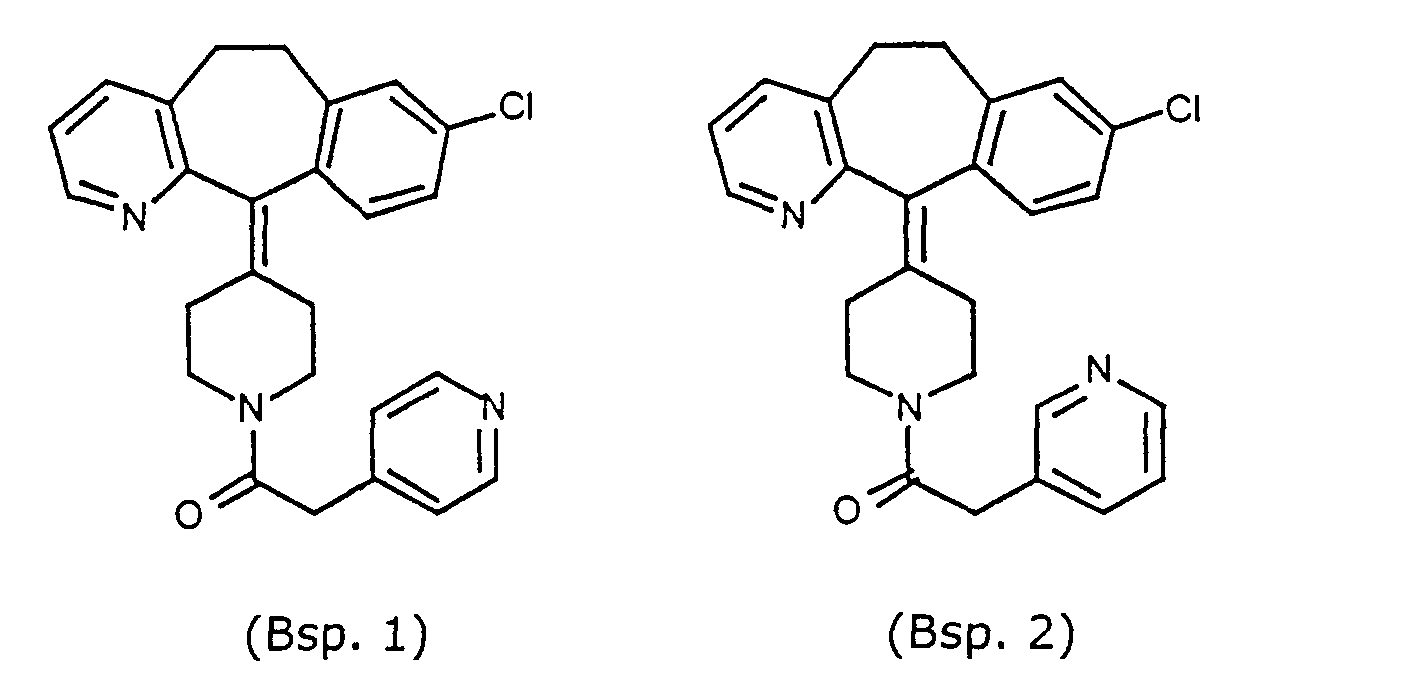
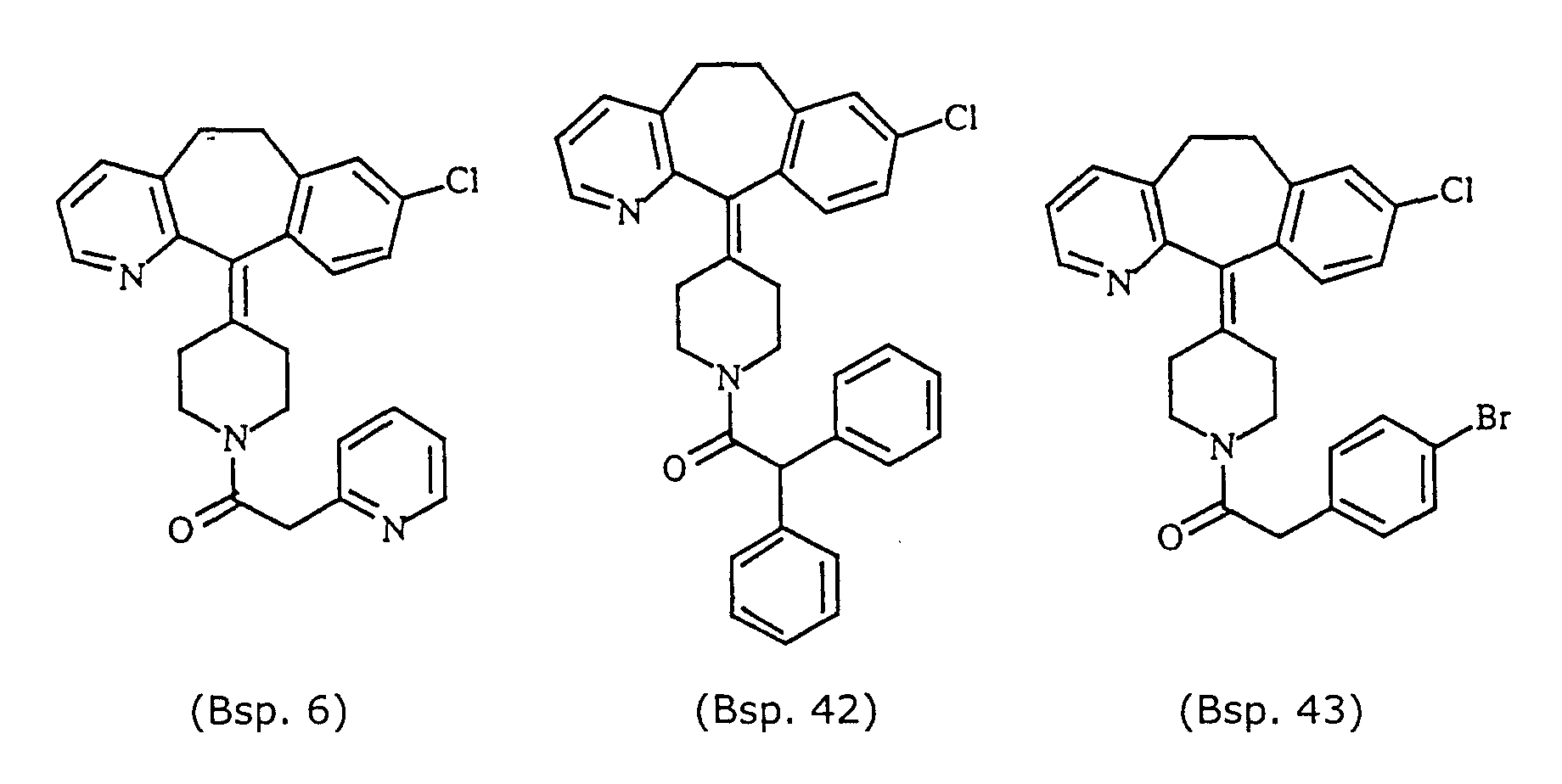
- Representative compounds for use in accordance with the present invention include the following : and
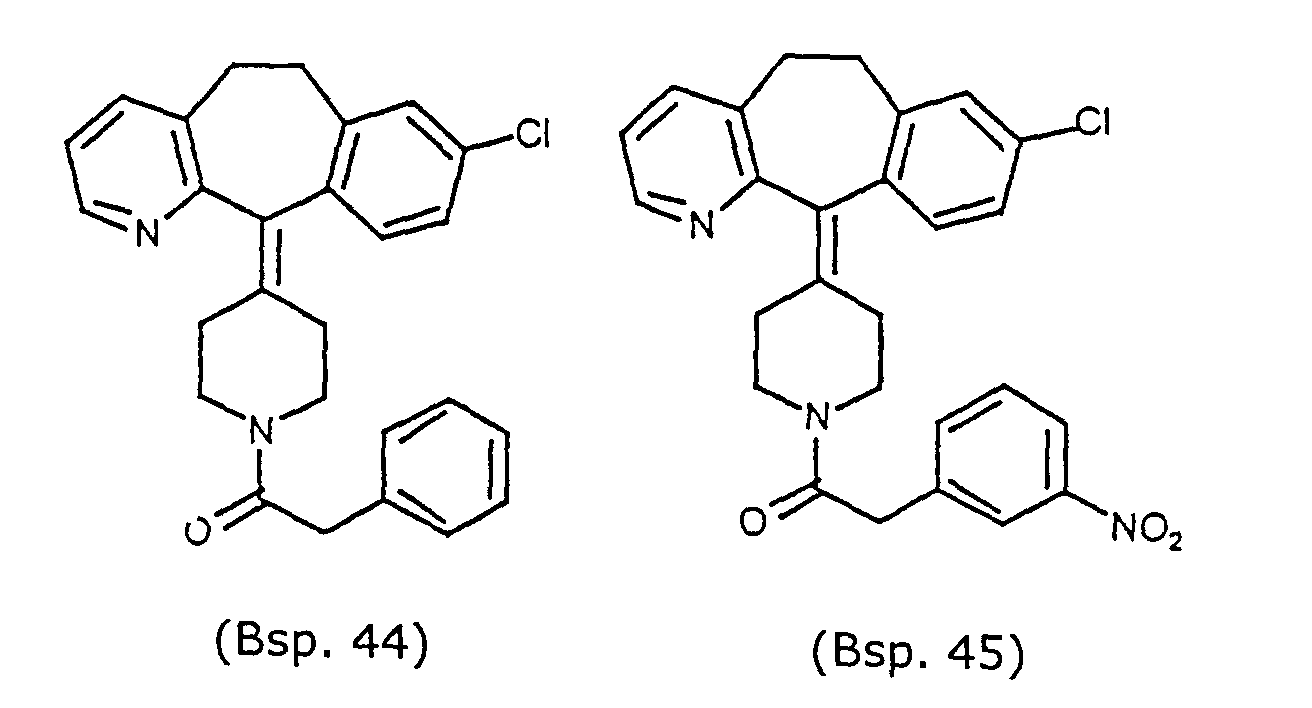
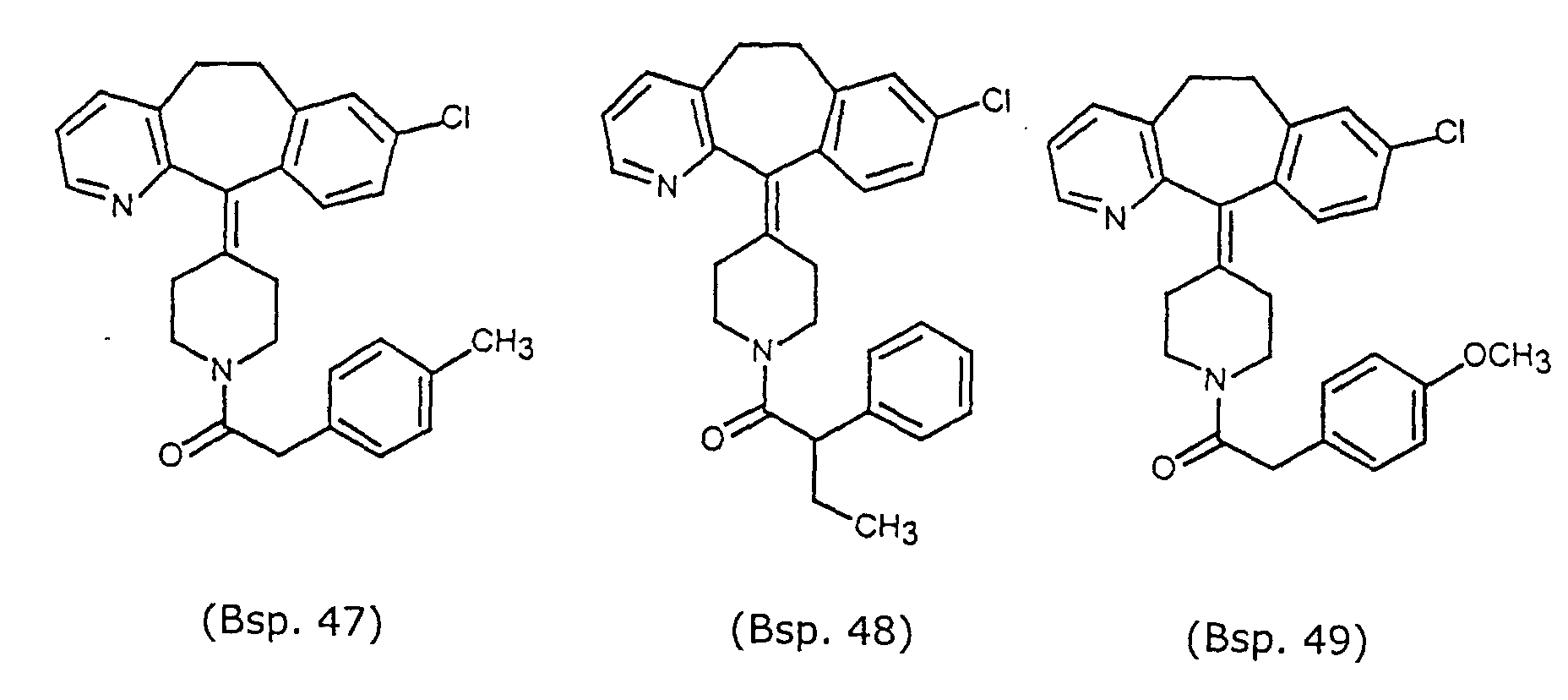
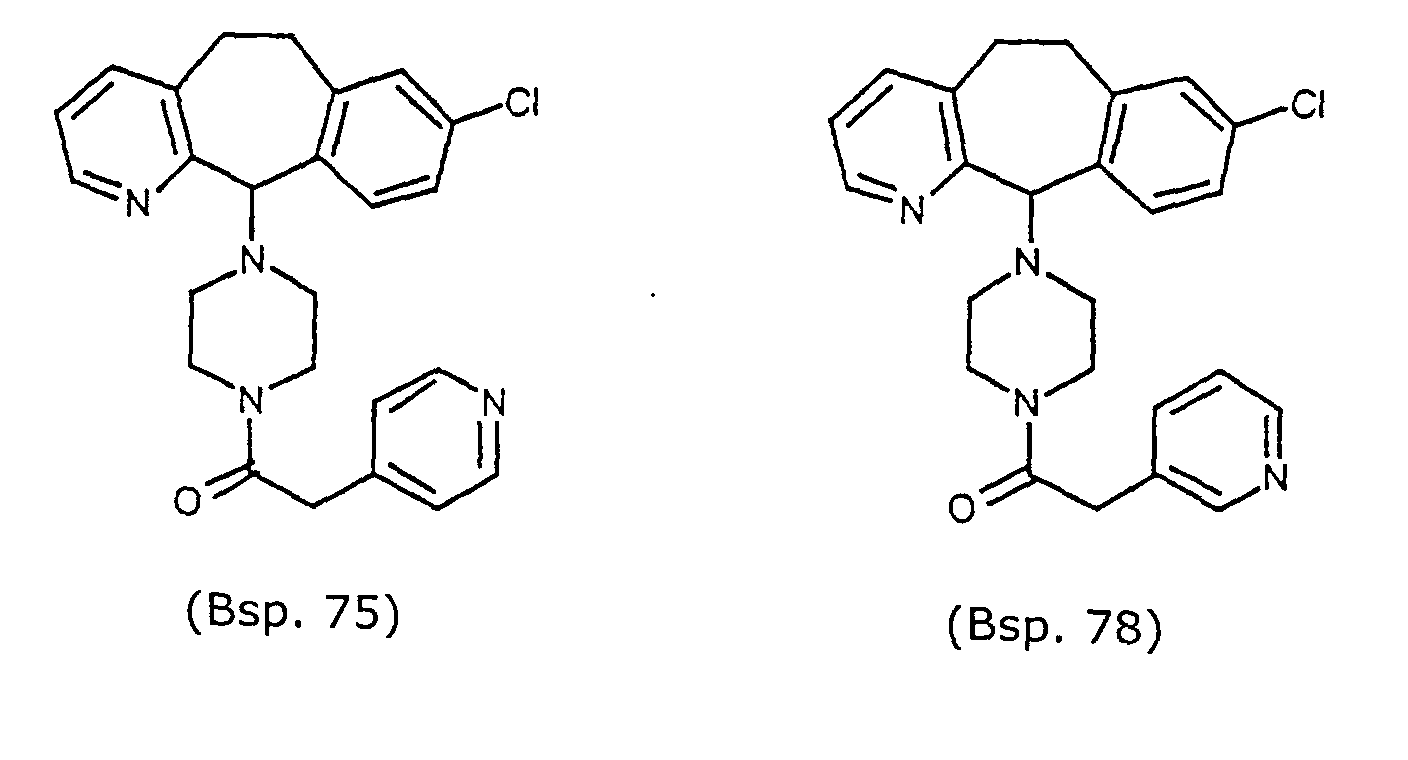
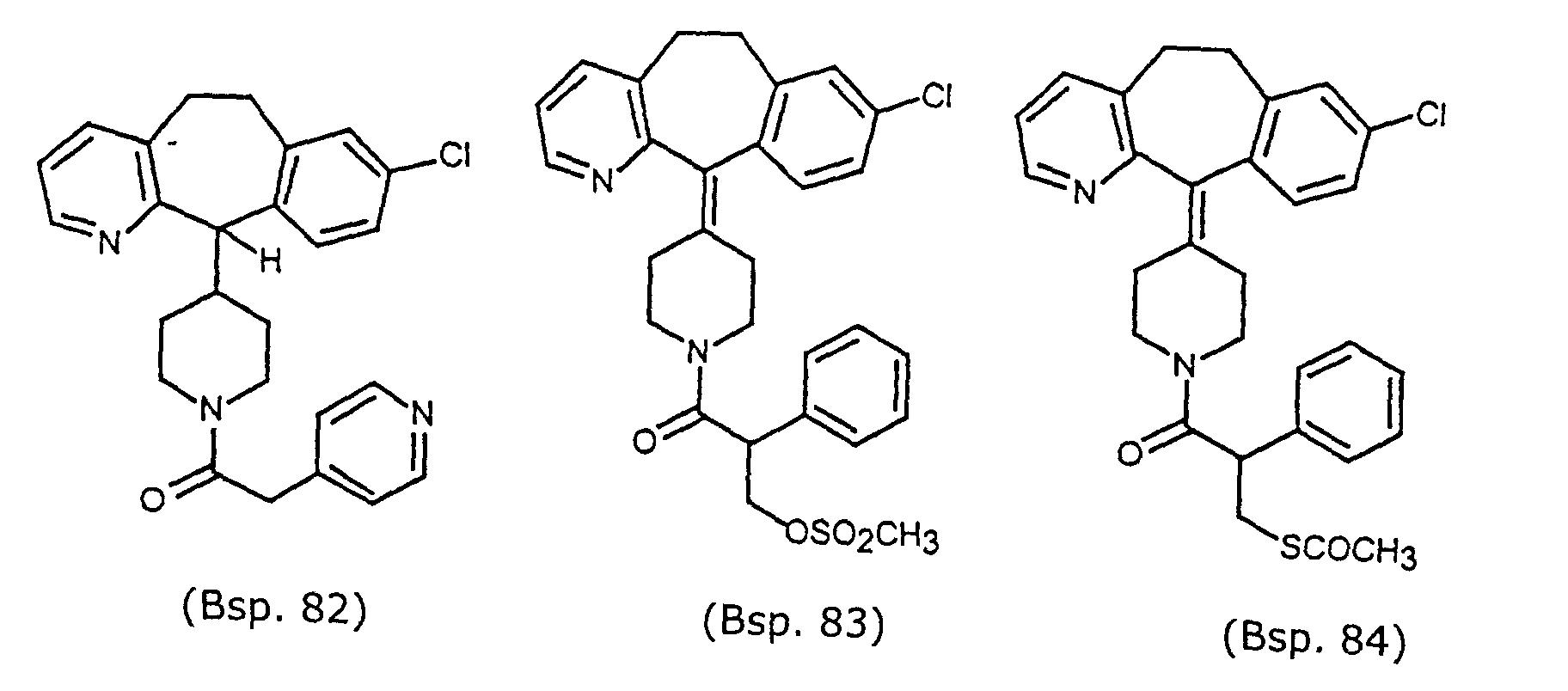
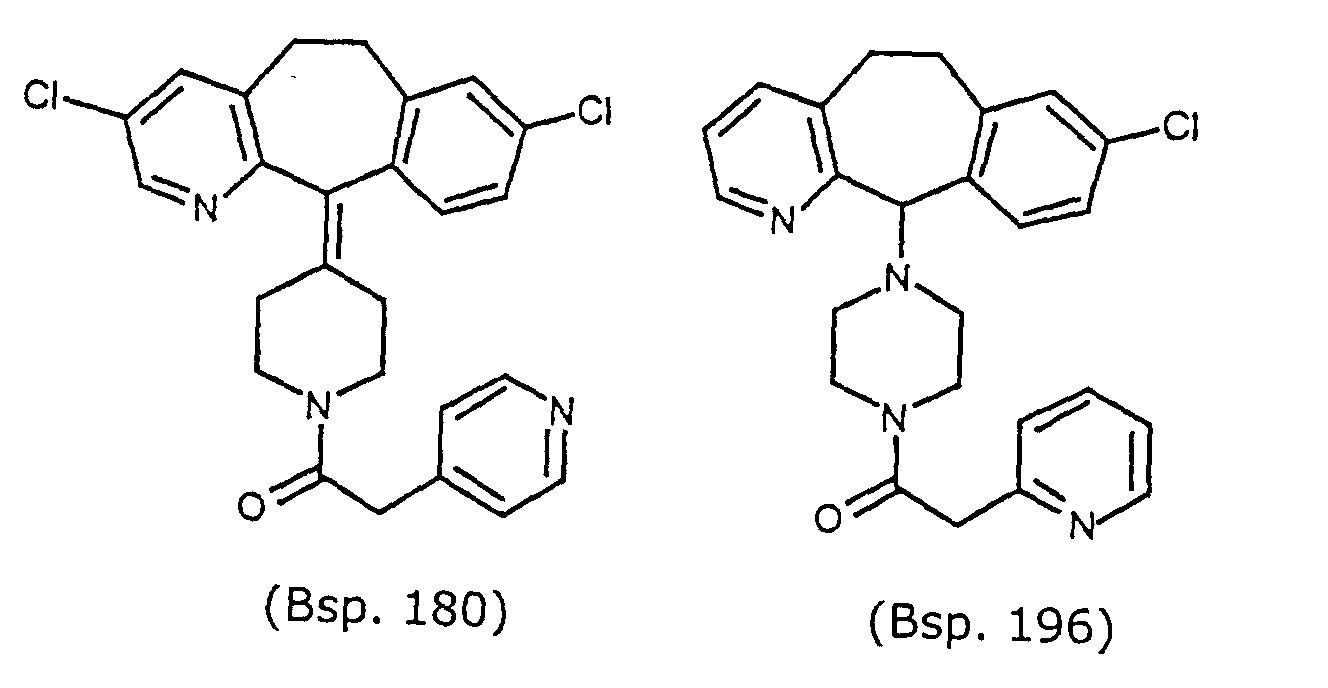
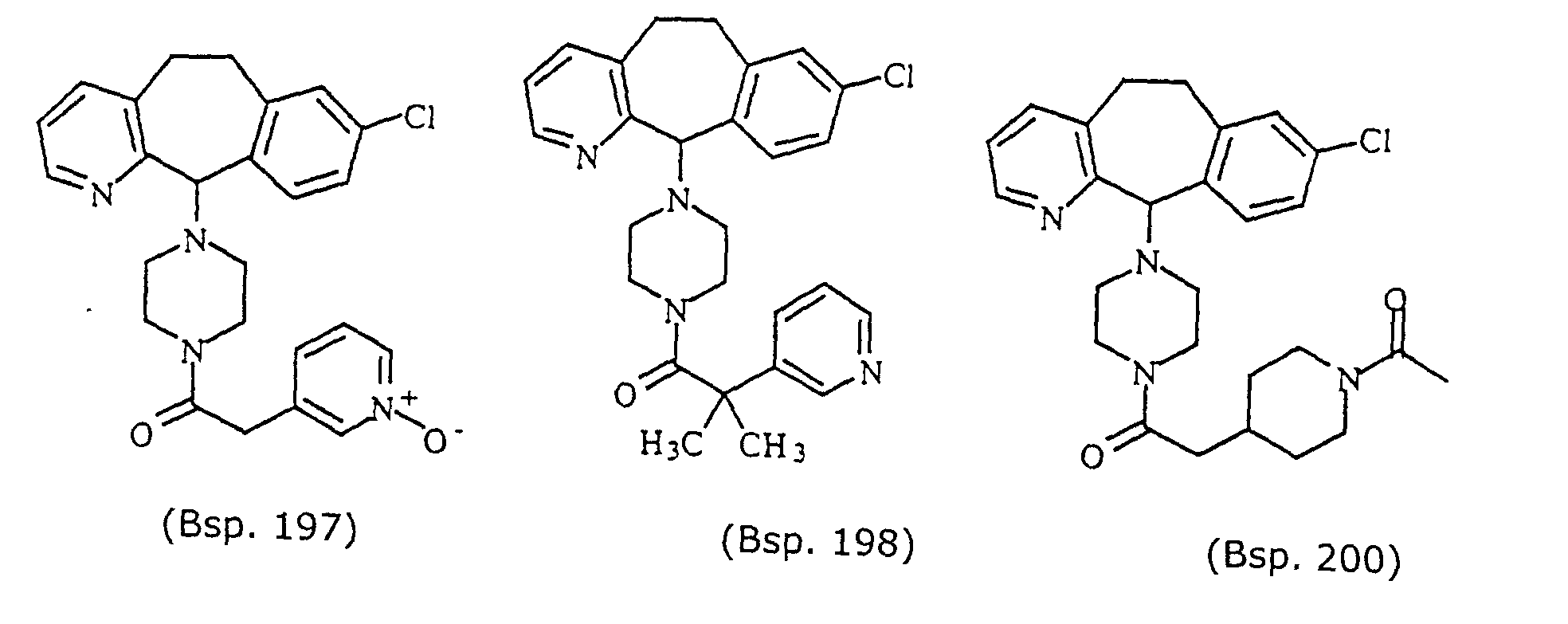
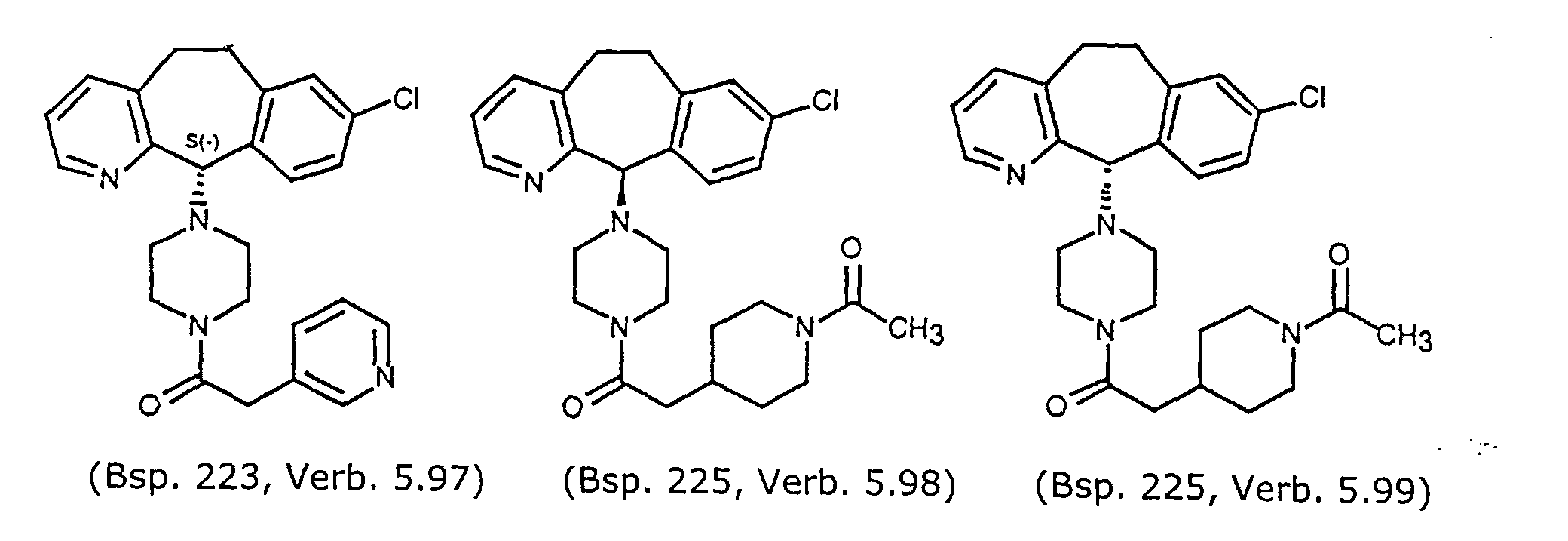
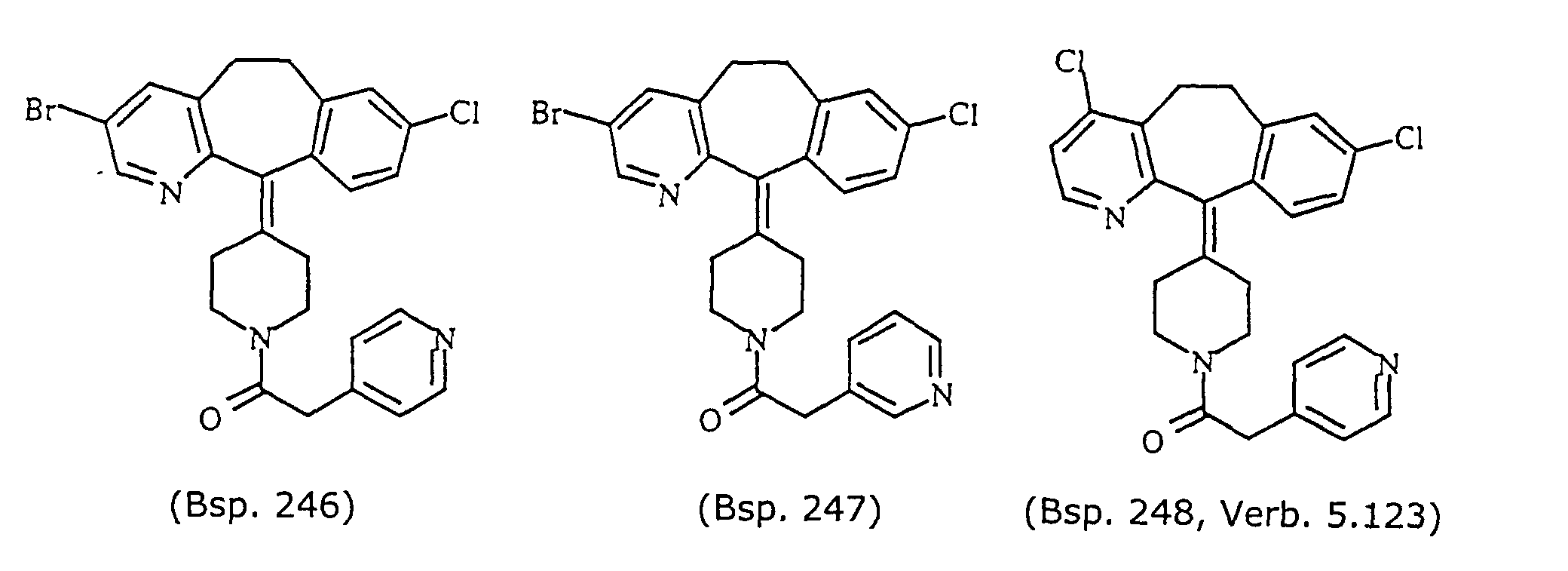
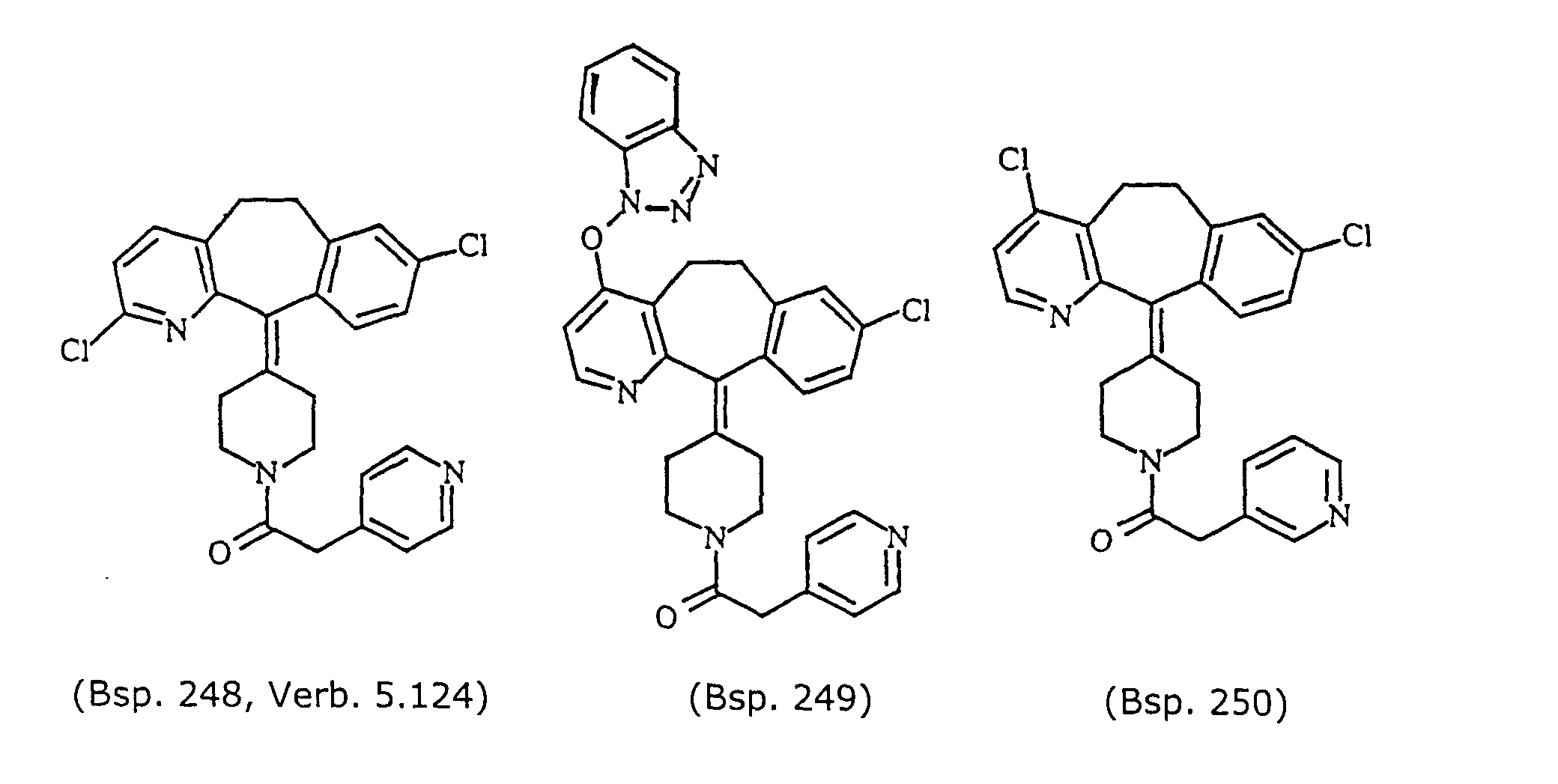
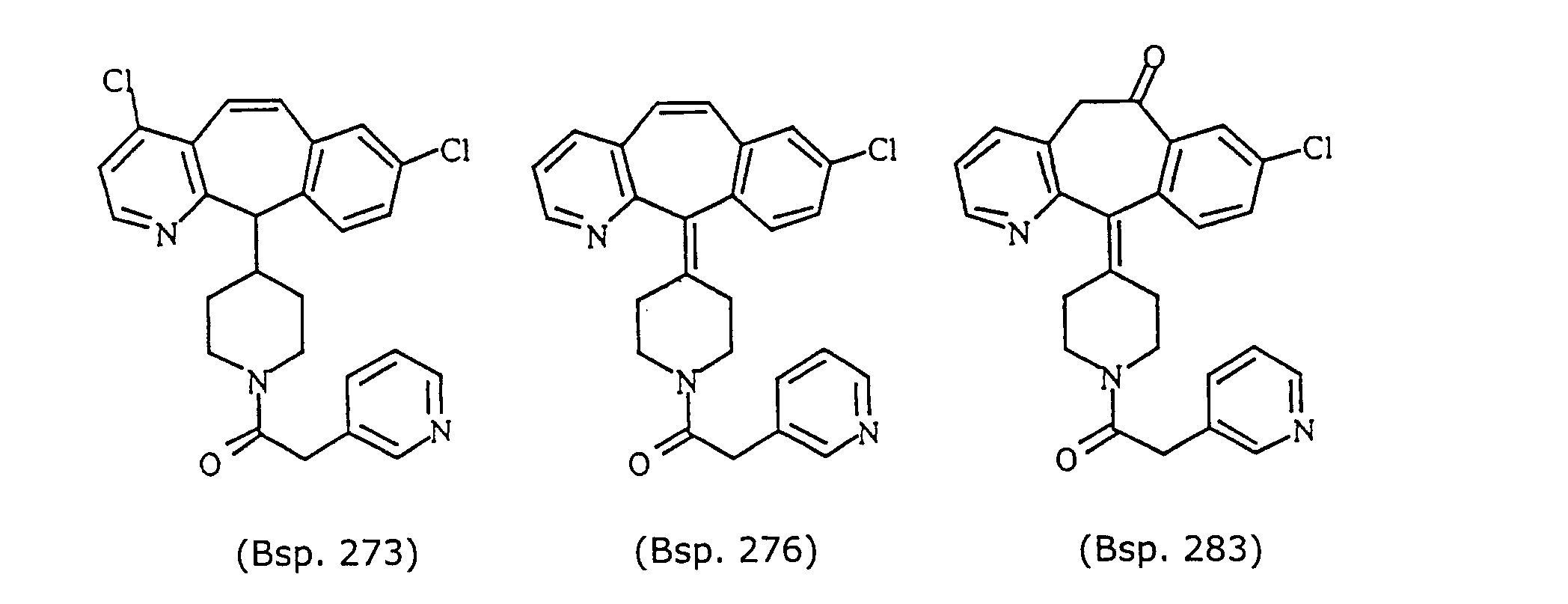
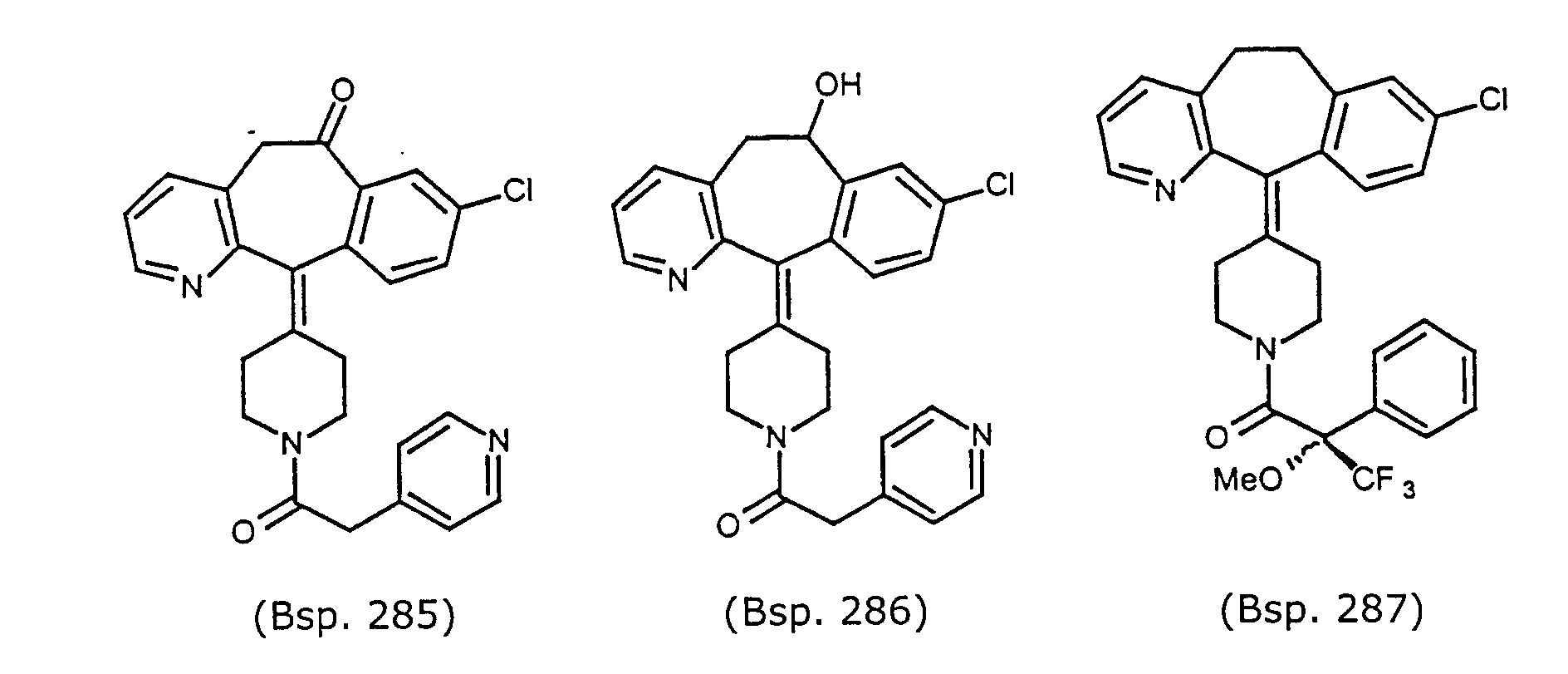
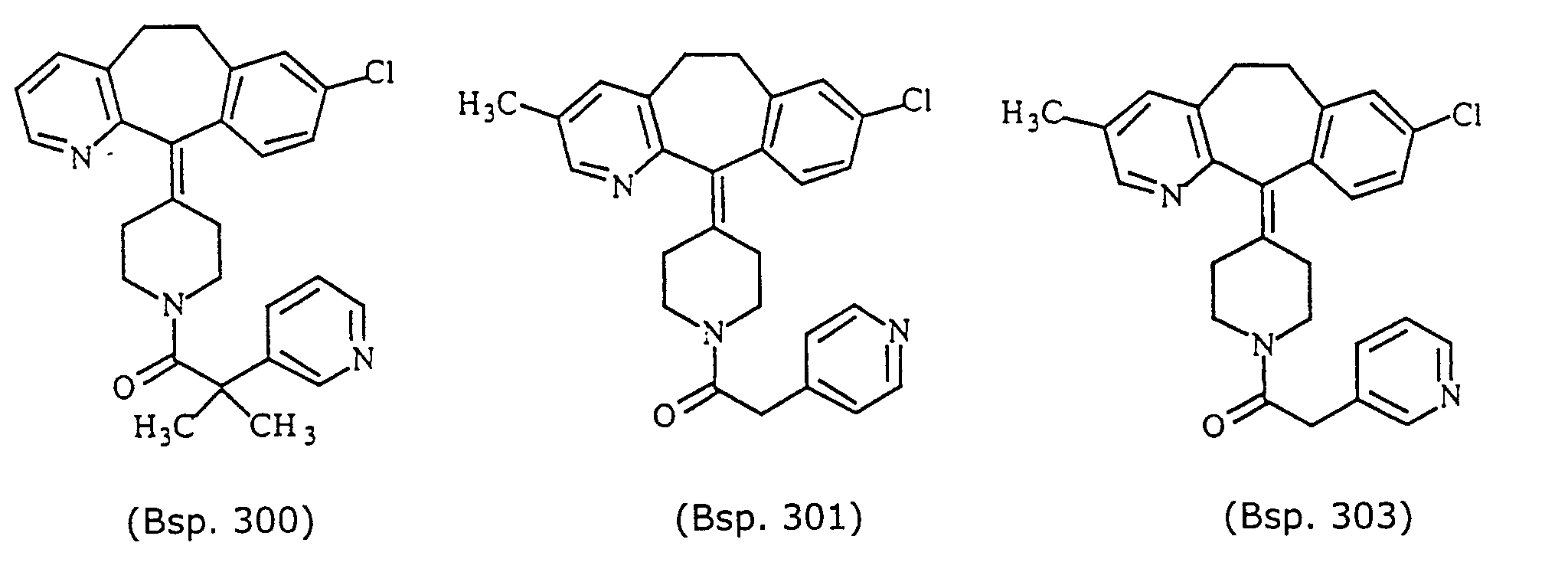
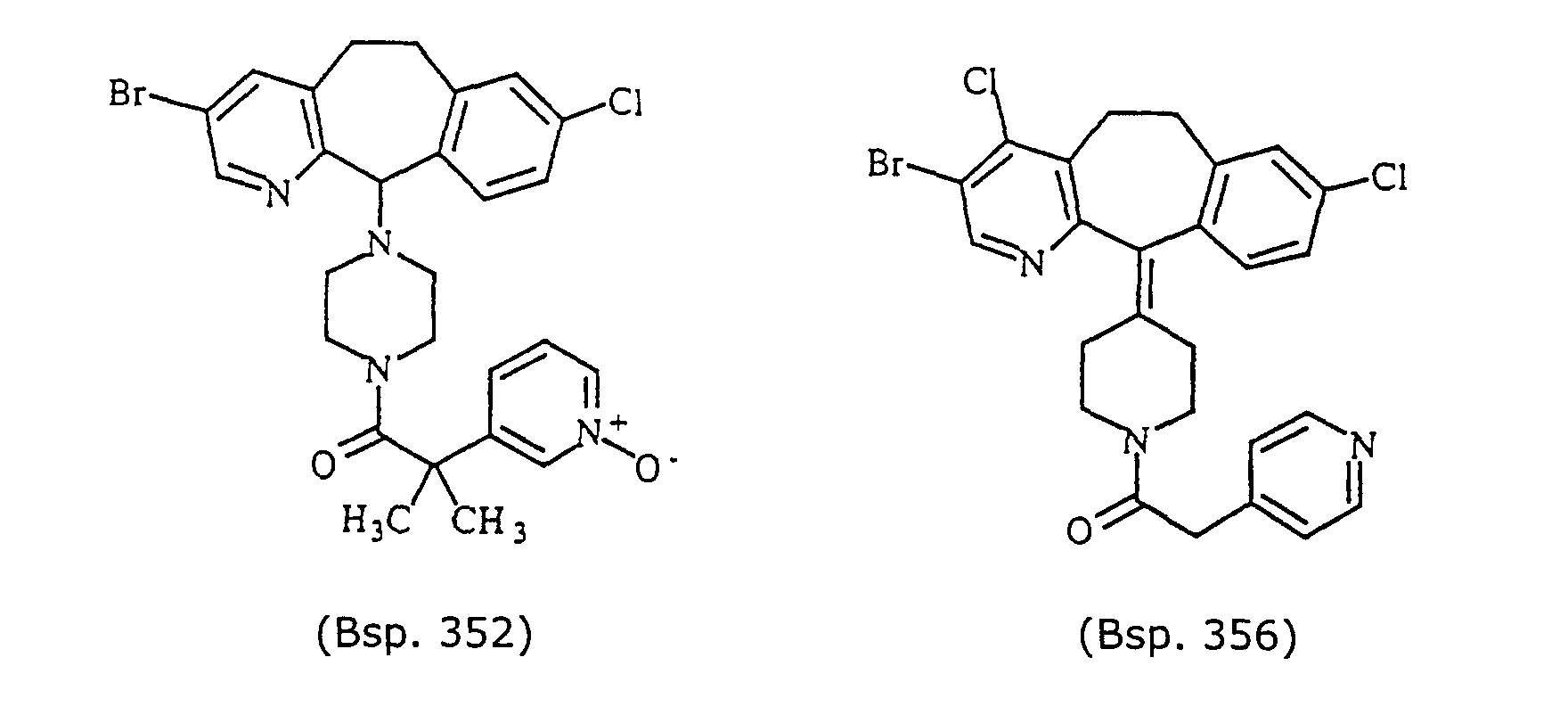
- Preferred compounds for use in the present invention are selected from the group consisting of compounds of Examples 1, 2, 6, 42, 43, 45, 47, 48, 49, 75, 78, 82, 83, 84, 180, 196, 197, 198, 200, 201, 206, 223, 225, 227, 233, 234, 246, 247, 248, 249, 250, 251, 266, 269, 273, 276, 283, 285, 286, 287, 288, 289, 299, 300, 301, 303, 307, 309, 311, 316, 350, 351, 352 and 356.
- More preferred compounds for use in the present invention are selected from the group consisting of compounds of Examples 1, 2, 42, 43, 75, 78, 82, 180, 196, 197, 198, 200, 223, 227, 233, 234, 246, 247, 248, 249, 250, 251, 266, 269, 273, 283, 285, 286, 300, 301, 303, 307, 311, 350, 351, 352 and 356.
- Even more preferred compounds of this invention are selected from the group consisting of compounds of Examples 82, 197, 233, 246, 266, 351, 352 and 356.
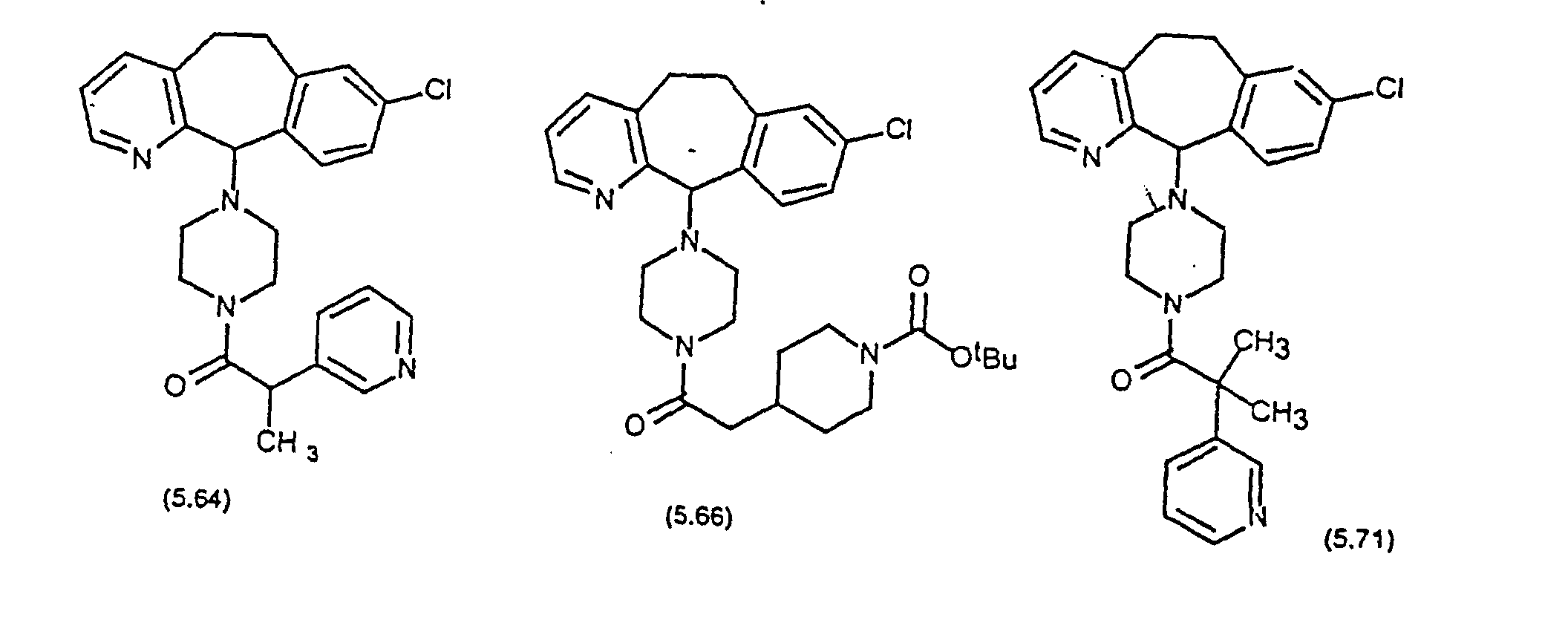
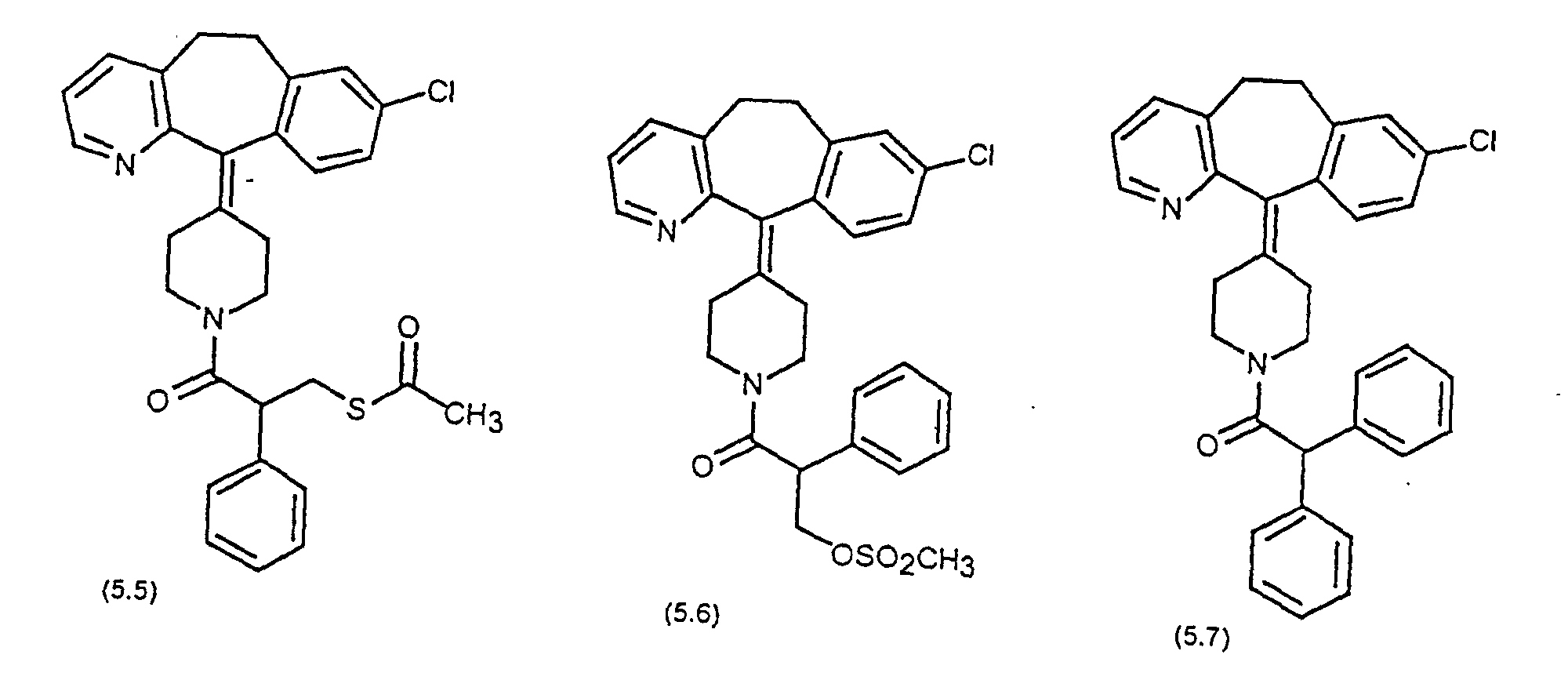
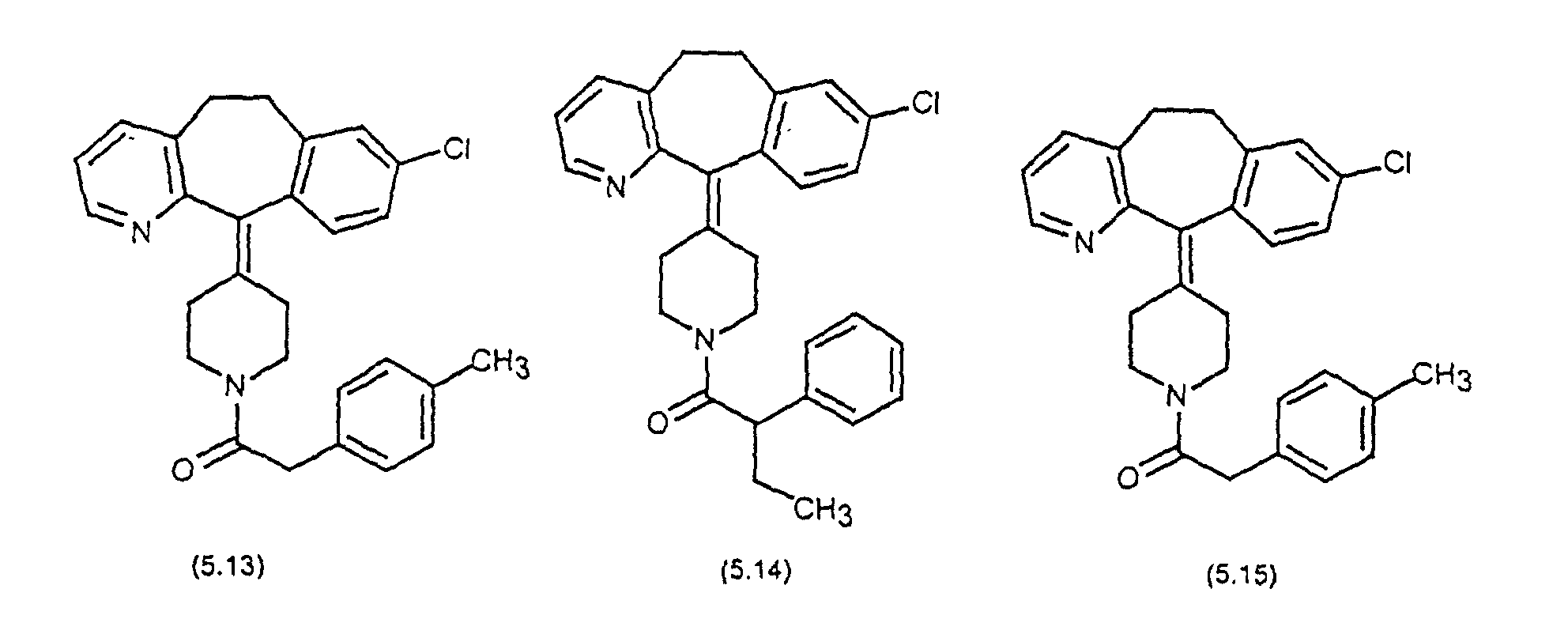
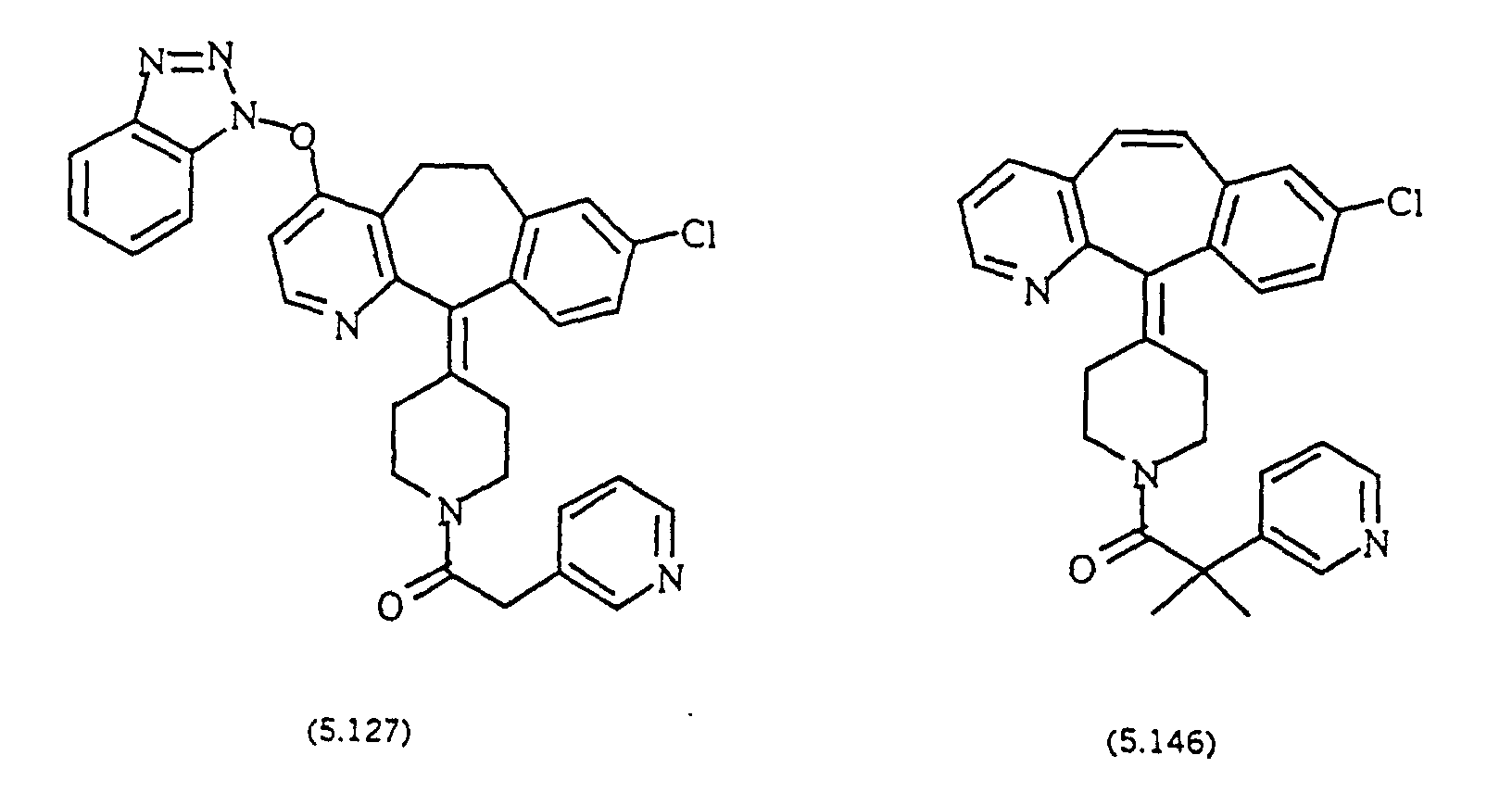
- Preferred novel compounds of the present invention are selected from the group consisting of the following structures:
- Lines drawn into the ring systems indicate that the indicated bond may be attached to any of the substitutable ring carbon atoms.
- Certain compounds of the invention may exist in different isomeric (e.g. enantiomers and diastereoisomers) forms.
- the invention contemplates all such isomers both in pure form and in admixture, including racemic mixtures. Enol forms are also included.
- Certain tricyclic compounds will be acidic in nature, e.g. those compounds which possess a carboxyl or phenolic hydroxyl group. These compounds may form pharmaceutically acceptable salts. Examples of such salts may include sodium. potassium, calcium, aluminum, gold and silver salts. Also contemplated are salts formed with pharmaceutically acceptable amines such as ammonia, alkyl amines, hydroxyalkylamines, N-methylglucamine and the like.
- Certain basic tricyclic compounds also form pharmaceutically acceptable salts, e.g. acid addition salts.
- the pyrido-nitrogen atoms may form salts with strong acid, while compounds having basic substituents such as amino groups also form salts with weaker acids.
- suitable acids for salt formation are hydrochloric, sulfuric, phosphoric, acetic, citric, oxalic, malonic, salicyclic, malic, fumaric, succinic, ascorbic, maleic, methanesulfonic and other mineral and carboxylic acids well known to those in the art.
- the salts are prepared by contacting the free base form with a sufficient amount of the desired acid to produce a salt in the conventional manner.
- the free base forms may be regenerated by treating the salt with a suitable dilute aqueous base solution such as dilute aqueous sodium hydroxide, potassium carbonate, ammonia, and sodium bicarbonate.
- a suitable dilute aqueous base solution such as dilute aqueous sodium hydroxide, potassium carbonate, ammonia, and sodium bicarbonate.
- the free base forms differ from their respective salt forms somewhat in certain physical properties, such as solubility in polar solvents, but the acid and base salts are otherwise equivalent to their respective free base forms for purposes of the invention.
- L designates a suitable leaving group.
- a compound of compound 410.00 may be an acyl halide (e.g., L represents halo) or an acyl anhydride, (e.g., L is -O-C(O)-R).
- the leaving group may also be alkoxy, in which case the compounds of Formula 400.00 may be produced by refluxing a compound of Formula 405.00 with an excess of a compound of Formula 410.00.
- Compounds of Formula 405.00 may be prepared by cleaving the group COOR a from the corresponding carbamates 415.00, for example, via acid hydrolysis (e.g., HCl) or base hydrolysis (e.g., KOH): wherein R a is a group which does not prevent the cleavage reaction, e.g., R a is an optionally substituted alkyl such as ethyl.
- acid hydrolysis e.g., HCl
- base hydrolysis e.g., KOH
- Compound 415.00 may be treated with an organometallic reagent (e.g., CH 3 Li), a reductive reagent (e.g., Zn in acid), etc., to form compounds of Formula 405.00.
- organometallic reagent e.g., CH 3 Li
- a reductive reagent e.g., Zn in acid
- Compound 415.00 may be prepared from the N-alkyl compound shown as Formula 420.00 below, in the manner disclosed in U.S. Patents 4,282,233 and 4,335,036.
- the compounds of Formula 400.00 wherein Z is O may be made by an alternative process using direct conversion of the N-alkyl compound 420.00 with an appropriate compound of Formula 410.00 such as an acyl halide or acyl anhydride.
- an appropriate nucleophile e.g. LiI, etc.
- solvent e.g., toluene, dioxane or xylenes.
- An appropriate base may be added, and heating may be required.
- a temperature ranging from 50-150°C (preferably 100-120°C) is utilized.
- Compound 420.00 is prepared as described in part B above.
- Compounds of Formula 400.00 wherein X is carbon and the bond to carbon 11 (C-11) is a single bond, can be prepared by reducing compounds of Formula 405.00, wherein X is carbon and the bond to C-11 is a double bond, with lithium aluminum hydride in tetrahydrofuran. Conversion to final products can be done following the process described above for conversion of compounds of Formula 405.00 to compounds of Formula 400.00.
- Compounds of Formula 400.00 wherein X is a carbon atom having an exocyclic double bond to carbon 11, may be prepared from compound 420.00 as described above.
- Compounds of Formula 420.00 may be produced by the methods disclosed generally in U.S. Patent 3,326,924 or alternatively may be prepared by a ring closure reaction, wherein the desired cycloheptene ring is formed by treating compound 425.00 with a super acid.
- Suitable super acids for this purpose include, for example, HF/BF 3 , CF 3 SO 3 H (triflic acid), CH 3 SO 3 H/BF 3 , etc.
- the reaction can be performed in the absence of, or with, an inert co-solvent such as CH 2 Cl 2 .
- the temperature and time of the reaction vary with the acid employed.
- the temperature may be controlled so as to minimize side reactions, such as HF addition to the exocyclic double bond.
- the temperature is generally in the range of from about +5°C to -50°C.
- the reaction may be run at elevated temperatures, e.g., from about 25°C to about 150°C and at lower temperatures but the reaction then takes longer to complete.
- the super acid is employed in excess, preferably in amounts of from about 1.5 to about 30 equivalents.
- a ketone compound of Formula 425.00 may be formed by hydrolysis of 430.00, e.g., such as by reacting a Grignard intermediate of Formula 430.00 with an aqueous acid (e.g., aqueous HCl).
- I a in Formula 430.00 represents chloro, bromo or iodo.
- the Grignard intermediate 430.00 is formed by the reaction of the cyano compound 435.00 with an appropriate Grignard reagent 440.00 prepared from 1-alkyl-4halopiperidine.
- the reaction is generally performed in an inert solvent, such as ether, toluene, or tetrahydrofuran, under general Grignard conditions e.g., temperature of from about 0°C to about 75°C.
- inert solvent such as ether, toluene, or tetrahydrofuran
- other organometallic derivatives of the 1 alkyl-4-halo piperidine can be employed.
- the cyano compound of Formula 435.00 is produced by converting the tertiary butyl amide of Formula 445.00 with a suitable dehydrating agent, such as POCl 3 , SOCl 2 , P 2 O 5 , toluene sulfonyl chloride in pyridine, oxalyl chloride in pyridine, etc. This reaction can be performed in the absence of or with a co-solvent, such as xylene.
- a suitable dehydrating agent such as POCl 3 , SOCl 2 , P 2 O 5
- This reaction can be performed in the absence of or with a co-solvent, such as xylene.
- the dehydrating agent such as POCl 3 is employed in equivalent amounts or greater and preferably in amounts of from about 2 to about 15 equivalents. Any suitable temperature and time can be employed for performing the reaction, but generally heat is added to accelerate the reaction. Preferably the reaction is performed at or near reflux.
- the tert-butylamide of Formula 445.00 may be produced by reaction of a compound of Formula 450.00a and 450.00b, in the presence of base, wherein G is chloro, bromo or iodo.
- the compound of Formula 450.00a may be formed by hydrolysis of the corresponding nitrile wherein the appropriate cyanomethyl pyridine, such as 2-cyano-3-pyridine, is reacted with a tertiary butyl compound in acid, such as concentrated sulfuric acid or concentrated sulfuric acid in glacial acetic acid.
- a tertiary butyl compound in acid such as concentrated sulfuric acid or concentrated sulfuric acid in glacial acetic acid.
- Suitable tertiary butyl compounds include, but are not limited to, t-butyl alcohol, t-butyl chloride, t-butyl bromide, t-butyl iodide, isobutylene or any other compound which under hydrolytic conditions forms t-butyl carboxamides with cyano compounds.
- the temperature of the reaction will vary depending upon the reactants, but generally the reaction is conducted in the range of from about 50°C to about 100°C with t-butyl alcohol.
- the reaction
- An alternative process for the formation of compounds of Formula 400.00a may involve direct cyclization of Compound 455.00 as shown below.
- Cyclization to form the cycloheptene ring may be accomplished with a strong acid (e.g., triflic, polyphosphoric, HF/BF 3 ), and may be performed in an inert solvent, such as ether, toluene or THF.
- a strong acid e.g., triflic, polyphosphoric, HF/BF 3
- an inert solvent such as ether, toluene or THF.
- the temperature and time may vary with the acid employed, as described in process A above.
- a good nucleophile such as LiI
- a second method of preparing compounds of Formula 455.00 involves reacting an unsubstituted piperidylidene compound of Formula 460.00 with the appropriate acyl halide or acyl anhydride of Formula 410.00 in the presence of base, such as pyridine or triethylamine.
- base such as pyridine or triethylamine.
- Compounds of Formula 460.00 may be produced from the corresponding carbamates of Formula 465.00, via acid hydrolysis, using for example, aqueous hydrochloric acid, or base hydrolysis using for example, potassium hydroxide.
- some compounds can be prepared by treating the carbamate, Formula 465.00, with an organometallic reagent, such as methyl lithium or a reductive reagent, such as zinc in acid, etc., depending upon the nature of the R a group.
- organometallic reagent such as methyl lithium or a reductive reagent, such as zinc in acid, etc.
- the carbamate compounds of Formula 465.00 may be prepared from the appropriate alkyl compound of Formula 425.00 by treatment with a chloroformate, preferably in an inert solvent, such as toluene, with warming to approximately 80°C.
- a chloroformate preferably in an inert solvent, such as toluene
- Other alternative methods are available for the conversion of 425.00 to 455.00 as previously described (e.g. Von Braun reaction conditions).
- Compounds of Formula 425.00 may be prepared as described above.
- WO 88/03138 Various methods can be used as described in WO 88/03138 to provide compounds which are substituted on the pyridine ring, i.e., in positions 2-, 3- and or 4- positions of the tricyclic ring system.
- the cyclization methods described on pages 20-30 of WO 88/03138 can already have the appropriate substituents on the pyridine ring in place.
- a variety of substituted pyridines are known in the literature and can be employed in these syntheses.
- the azaketone of Formula XIX (from page 27 of WO 88/03138) wherein R 1 and R 2 are both H can be converted to the appropriately substituted azaketone wherein R 1 and R 2 are non-H substitutents. If both R 1 and R 2 are desired to be non-H substitutents the procedure would be repeated.
- the azaketone is thus reacted with an oxidizing agent such as meta-chloroperoxybenzoic acid (MCPBA) or hydrogen peroxide to produce the corresponding compound in which the nitrogen of the pyridine ring is as an N-oxide:
- MCPBA meta-chloroperoxybenzoic acid
- hydrogen peroxide hydrogen peroxide
- This reaction is normally run at temperatures from -15°C to reflux, more typically at about 0°C.
- the reaction is preferably conducted in an inert solvent such as methylene chloride for MCPBA or acetic acid for hydrogen peroxide.
- the azaketone N-oxide of Formula 470.00a can then be reacted with a chlorinating agent such as SO 2 Cl 2 or SOCl 2 to form a compound of Formula 470.00b.
- a chlorinating agent such as SO 2 Cl 2 or SOCl 2
- this reaction results in monosubstitution of Cl in the ortho or para-position relative to the N atom of the ring.
- steps 1 and 2 above are repeated.
- the resulting disubstituted compounds have Cl ortho and para relative to the N atom of the pyridine ring.
- the mono or disubstituted compounds of Formulas 470.00b and 470.00c above can be reacted with various nucleophiles such as alkoxides, amines, thiols, etc. This will result in compounds where one or both of the Cl substituents are replaced by the nucleophile to provide a compound of Formula 470.00d or a compound easily converted to Formula 470.00d.
- nucleophiles such as alkoxides, amines, thiols, etc.
- the substituted ketone of Formula 470.00 can then be converted to the desired compound by the methods described above and in WO 88/03138 and in U.S. Patent No. 3,326,924.
- Formula 405.00 wherein R 1 or R 2 are chlorine, can be made by the following alternate process.
- N-oxide of Formula 415.00 can be treated with POCl 3 to form a compound of Formula 415.01. Typically, this reaction results in monosubstitution of Cl in the ortho or para position relative to the N atom of the ring.
- the Cl substituted azaketones of Formula 470.00b or 470.00c above can be converted to the corresponding derivatives of Formula 405.00 above wherein R 1 and/or R 2 is Cl by methods analogous to those described above.
- the Cl substituent(s) can be displaced by an appropriate nucleophile to provide the desired substituent.
- Suitable nucleophiles include alkoxide, amines, thiols, etc. This reaction usually requires higher tempertures (e.g., from about 100° to about 200°C) than the displacement reaction to produce ketone 470.00d above. It is also usually conducted in a sealed vessel in an inert solvent.
- the compound of Formula 405.00 is then converted to a compound of Formula 400.00 as described above.
- Various electrophilic species can also be added to the pyridine ring from the corresponding halo-substituted pyridine (Formula 405.00 wherein R 1 is halo, preferably bromo or iodo).
- R 1 is halo, preferably bromo or iodo.
- Transmetallation of the halo derivative using an alkyl lithium e.g. n-BuLi
- the appropriate electrophile e.g. R 1 L, etc.
- An alternative process for introducing substituents at the C-3 position of pyridine Ring I of Formula 1.0 involves nitrating a compound of Formula 415.00 (except wherein X is nitrogen) or a compound of Formula 470.00d with tetrbutylammonium nitrate - trifluoroacetic anhydride in methylene chloride at a temperature of 0°C to room temperature (about 25°C).
- the nitro group may then be reduced to the corresponding amine using iron filings in ethanol, or powdered zinc-acetic acid in aqueous THF.
- the amine group can be converted to a variety of substituents, such as, halo.
- Compounds of formula 400.00 with a double bond between C-5 and C-6 can be prepared by heating a compound of Formula 470.00h in acetic acid with SeO 2 to produce a compound of Formula 470.00i.
- Compounds of Formula 470.00i can be converted to final products according to methods already described.
- Compounds having a piperazine ring bound to the C-11 of the tricyclic nucleus are best prepared via alkylation of the appropriately substituted piperazine compound of Formula 700.00 with a compound of Formula 705.00.
- Compounds of Formula 705.00 contain the appropriately substituted halide (such as Cl, Br, or I) or other similar leaving group (e.g., tosyloxy or mesyloxy).
- the reaction is usually conducted in an inert solvent, such as THF or toluene, optionally with a base such as triethylamine or potassium carbonate, and typically at a temperature range of ambient to reflux to produce a compound of Formula 710.00.
- R g is H, CO 2 R a (wherein R a is a C 1 to C 4 alkyl group) or C(Z)R.
- R a is a C 1 to C 4 alkyl group
- C(Z)R is a C 1 to C 4 alkyl group
- the reaction is typically carried out in a polar solvent, such as methanol or ethanol, optionally in the presence of a dehydrating agent, such as 3 ⁇ molecular sieves.
- a dehydrating agent such as 3 ⁇ molecular sieves.
- the intermediate Schiff base can be reduced to the compound of Formula 710.00 by employing a variety of reducing agents, such as NaCNBH 3 , or catalytic hydrogenation, for example, hydrogen over Pd/C.
- R g is C(Z)R
- R g is H or CO 2 R a
- these are converted to compounds of the invention as described herein.
- R 1 , R 2 , R 3 and R 4 etc. groups during the reactions.
- Conventional protecting groups are operable as described in Greene, T.W., "Protective Groups In Organic Synthesis," John Wiley & Sons, New York, 1981.
- the groups listed in column 1 of Table 1 may be protected as indicated in column 2 of the table:
- Other protecting groups well known in the art also may be used. After the reaction or reactions, the protecting groups may be removed by standard procedures.
- dichloro compound (I) is recrystallized from toluene and has a melting point of 150-152°C. Reaction times are determined by TLC or HPLC. In some instances purification of the product by chromatography is necessary.
- the product is prepared (m.p. 138-140°C, triturated with pentane) by employing basically the same process as described in steps 2A-2G. Workup time is determined by either TLC or HPLC. In some instances purification of the product by chromatography is necessary.
- step 1B By substituting in step 1B above N-(1,1-dimethylethyl)-3,5-dimethyl-2-pyridine carboxamide for N-(1,1-dimethylethyl)-3-methyl-2-pyridine carboxamide and employing basically the same methods as steps B through G of Preparative Example 1, one obtains 8-chloro-3-methyl-11-(4-piperidylidene)-6,11-dihydro-5 H -benzo[5,6]cyclohepta[1,2-b]pyridine. Reaction times are determined by TLC or HPLC.
- Steps A-E the compounds or respectively, can be prepared. Note that the addition of the nitrile group to the pyridine in Step C of Preparative Example 3 can result in the formation of other undesirable isomers which can be removed via flash chromatography.
- Nipecotic acid (3.87 grams) (30.0 mmoles) was reacted with acetic anhydride (9.17 grams) (90 mmoles) as described in Preparative Example 13A to give the title compound (Yield: 5.0 grams, 97%, MH + 172).
- Arecaidine hydrochloride (4 grams) (22.6 mmotes) was hydrogenated in water (100 ml) using 10% Pd-C at 40 psi at 25°C for 24 hours. The catalyst was filtered off and washed with water. The aqueous solution was shaken with BioRad AG1X8 resin (OH- form) (23 ml bed) and after 5 minutes the resin was filtered off and washed with water. The aqueous solution was evaporated to give the title compound (Yield: 2.95 grams, 92%).
- Tetrabutyl ammonium nitrate(4.98g, 16.3 mmol) was dissolved in dichloromethane(20 mL) and trifluoroacetic anhydride(3.12g, 14.9 mmol, 2.1 mL) was then added. The solution was cooled to 0°C and then added (by cannulation) to a solution of 4-(8-chloro-5,6-dihydro-1H-benzo[5,6]-cyclohepta[1,2-b]pyridin-11-ylidene)-1-piperidine-1-carboxylic aid ethyl ester (5.69g, 14.9 mmol) in methylene chloride (35 mL) also cooled to 0°C.
- reaction mixture was stirred at 0°C for 3h and then allowed to go to room temperature (25°C) overnight.
- the reaction mixture was then extracted with saturated sodium bicarbonate (60 mL) dried over magnesium sulfate and concentrated to give a semi-solid material that was chromatographed on silica gel eluting first with 10% and then 20% ethyl acetate -hexane. Removal of the organic solvents gave the title compound in 44% yield as a light yellow solid.
- MP 90.4-91.0°C, MH + 428.
- Example 266 The title compound from Preparative Example 34C above was treated as descibed in Example 266, using 4-pyridylacetic acid in place of 3-pyridylacetic acid, to give the title compound (M + 430).
- Example 266 The title compound from Preparative Example 36C was treated as descibed in Example 266 to give the title compound (mp 100.1 - 103.4°C). dichloromethane/3% methanol saturated with ammonia to 93% dichloromethane/7% methanol saturated with ammonia. The title compound was obtained as a yellow solid (0.13g, 13%, M+ 465)
- Example 279 The procedure of Example 279 was followed with the exception that 4-pyridylacetic acid was used in place of 3-pyridylacetic acid to give the title compound (MH + 444).
- Example 280 The procedure of Example 280 was followed with the exception that 4-pyridylacetic acid was used in place of 3-pyridylacetic acid to give the title compound (MH + 446).
- Example 283 The procedure of Example 283 was followed with the exception that 4-pyridylacetic acid was used in place of 3-pyridylacetic acid to give the title compound (M + 444).
- Example 284 The procedure of Example 284 was followed with the exception that 4-pyridylacetic acid was used in place of 3-pyridylacetic acid to give the title compound (MH + 446).
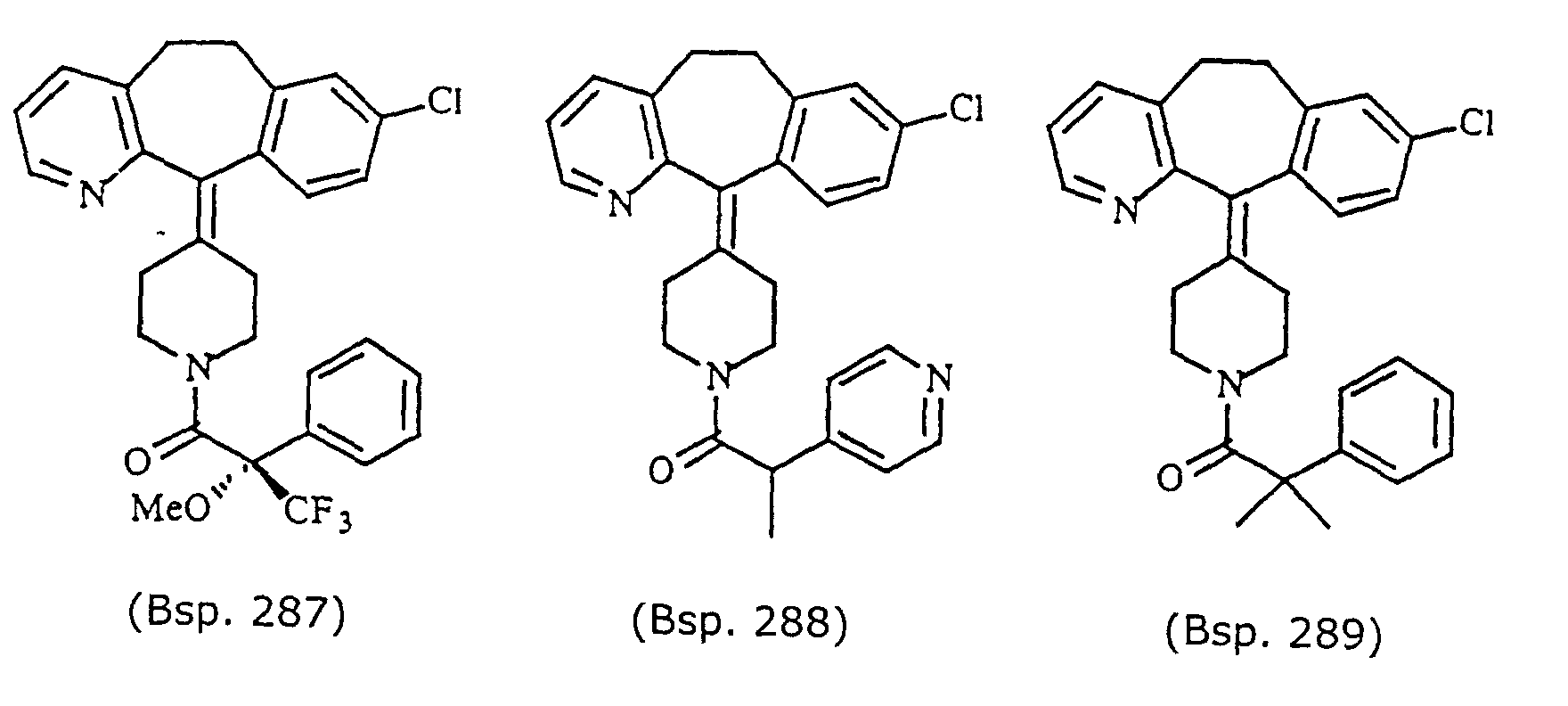
- Example 290 By essentially the same procedure as in Example 1, but using either (R)-(+)- ⁇ -methoxy- ⁇ -(trifluromethyl)-phenylacetic acid (Example 290), (S)-(-)- ⁇ -methoxy- ⁇ -(trifluromethyl)-phenylacetic acid (Example 287), or ⁇ , ⁇ -dimethylphenylacetic acid (Example 289), the compounds of Example 290, 287 and 289 were obtained.
- the structures for these compounds are in Table 7. Data for these compounds are: compound of Example 290, white solid MH+ 527; compound of Example 287, white solid MH+ 527; and compound of Example 289, white solid M+ 457.
- Example 180 By essentially the same procedure as set forth in Example 180, but using 4-(8-chloro-3-methyl-5,6-dihydro-11-(4-piperidylidene)-11H-benzo[5,6]cyclohepta[1,2-b]pyridine (from Preparative Example 3E) instead of 4-(3,8-dichloro-5,6-dihydro-11-(4-piperidylidene)-11H-benzo[5,6]cyclohepta[1,2-b]pyridine, and 3-pyridylacetic acid instead of 4-pyridylacetic acid, the title compound was obtained as white solid MH+ 444.
- Example 307 By essentially the same procedure as in Example 1, using the title compound from Preparative Example 37B, and 4-pyridylacetic acid the compound of Example 307, identified in Table 8, was obtained, MH + 428.
- Example 180 By essentially the same procedure as set forth in Example 180, but using 4-(8-chloro-2-methyl-5,6-dihydro-11-(4-piperidylidene)-11H-benzo[5,6]cyclohepta[1,2-b]pyridine (from Preparative Example 3E) instead of 4-(3,8-dichloro-5,6-dihydro-11-(4-piperidylidene)-11H-benzo[5,6]cyclohepta[1,2-b]pyridine, and 3-pyridylacetic acid instead of 4-pyridylacetic acid, the title compound was obtained as white solid MH+ 444.
- Example 180 By essentially the same procedure as set forth in Example 180, but using 4-(8,9-dichloro-5,6-dihydro-11-(4-piperidylidene)-11H-benzo[5,6]-cyclohepta[1,2-b]pyridine (from Preparative Example 1H) instead of 4-(3,8-dichloro-5,6-dihydro-11-(4-piperidylidene)-11H-benzo[5,6]cyclohepta[1,2-b]pyridine, and 3-pyridylacetic acid instead of 4-pyridylacetic acid, the title compound was obtained as white solid MH+ 464.
- Example 75 By substituting in Example 75, 0.4g (1.28mmoles) of 8-chloro-11-(1-piperazinyl)-11H-benzo[5,6]cyclohepta[1,2-b]pyridine (Preparative Example 38) for 8-chloro-11-(1-piperazinyl)-6,11-dihydro-5H-benzo[5,6]-cyclohepta[1,2-b]pyridine and 0,1765g (1.28mmoles) of 3-pyridylacetic acid for 4-pyridylacetic acid and using the same method as described in Example 75, one obtains the title compound (0.513g, 93%, MH + 431).
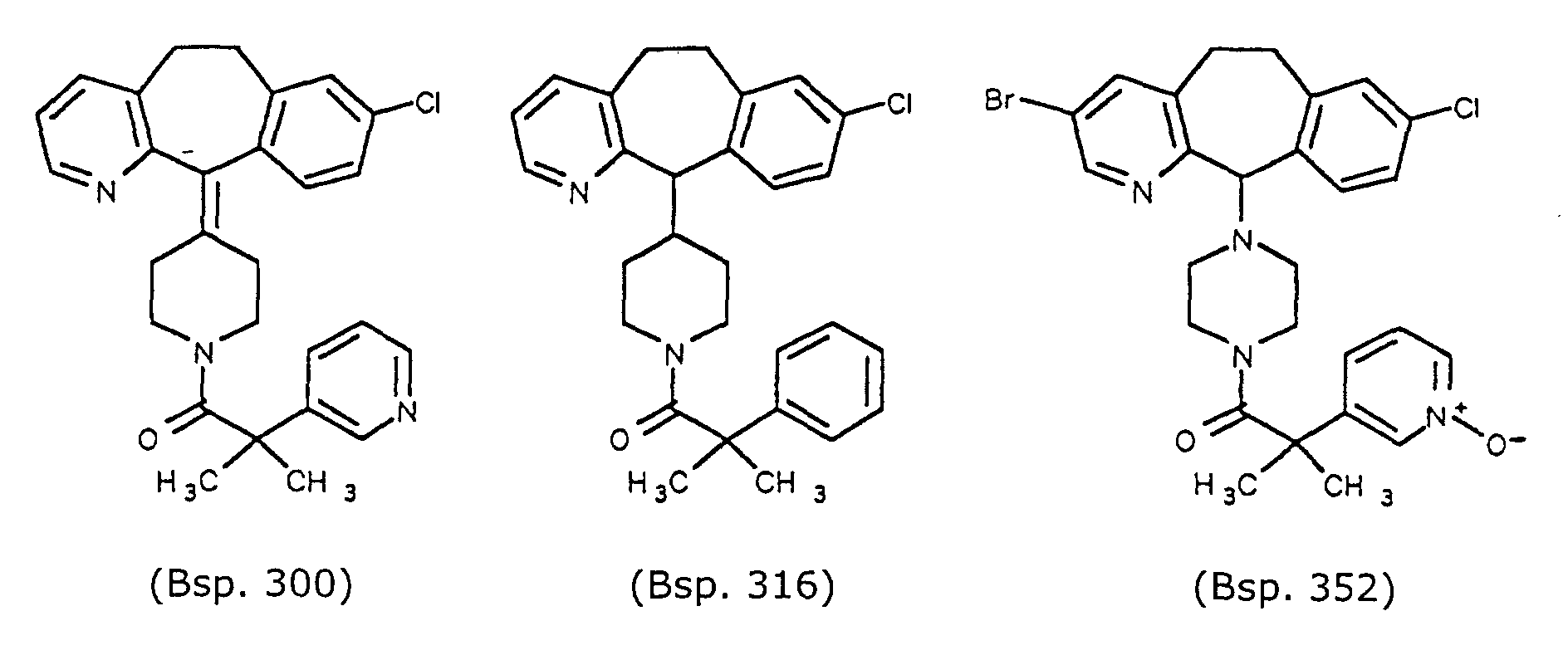
- Example 352 is a white amorphous solid, yield 65%, Mass Spec MH + 555.
- the compound of Example 353 is a white amorphous solid, yield 59%, Mass Spec MH + 539.
- Example 75 4,8-chloro-11-(1-piperazinyl)-6,11-dihydro-5H-benzo[5,6]cyclohepta[1,2-b]pyridine (0.3g, 0.86mmoles) (Preparative Example 41) for 8-chloro-11-(1-piperazinyl)-6,11-dihydro-5H-benzo[5,6]cyclohepta[1,2-b]pyridine and 3-pyridylacetic acid (0.1181g, 0.86mmoles) for 4-pyridylacetic acid and using the method described in Example 50 ,one obtains the title compound (0.357g, 88%, MH + 467).
- Ras-CVLS cysteine-valine-leucine-serine
- Ras-CVLL cystein-valine-leucine-leucine
- the cDNAs encoding these proteins were constructed so that the proteins contain an amino-terminal extension of 6 histidine residues. Both proteins were expressed in Escherichia coli and purified using metal chelate affinity chromatography.
- the radiolabelled isoprenyl pyrophosphate substrates, [ 3 H]farnesyl pyrophosphate and [ 3 H]geranylgeranyl pyrophosphate, were purchased from DuPont/New England Nuclear.
- the reaction mixture contained 40 mM Hepes, pH 7.5; 20 mM magnesium chloride; 5 mM dithiothreitol; 0.25 ⁇ M [ 3 H]farnesyl pyrophosphate; 10 ⁇ l Q-Sepharose-purified farnesyl protein transferase; the indicated concentration of tricyclic compound or dimethylsulfoxide (DMSO) vehicle control (5% DMSO final); and 5 ⁇ M Ras-CVLS in a total volume of 100 ⁇ l.
- DMSO dimethylsulfoxide
- the reaction was allowed to proceed for 30 minutes at room temperature and then stopped with 0.5 ml of 4% sodium dodecyl sulfate (SDS) followed by 0.5 ml of cold 30% trichloracetic acid (TCA).
- SDS sodium dodecyl sulfate
- TCA cold 30% trichloracetic acid
- Samples were allowed to sit on ice for 45 minutes and precipitated Ras protein was then collected on GF/C filter paper mats using a Brandel cell harvester. Filter mats were washed once with 6% TCA, 2% SDS and radioactivity was measured in a Wallac 1204 Betaplate BS liquid scintillation counter. Percent inhibition was calculated relative to the DMSO vehicle control.
- the geranylgeranyl protein transferase I assay was essentially identical to the farnesyl protein transferase assay described above, with two exceptions: [ 3 H]geranylgeranylpyrophosphate replaced farnesyl pyrophosphate as the isoprenoid donor and Ras-CVLL was the protein acceptor. This is similar to the assay reported by Casey et al (Casey, P.J., et al., (1991), Enzymatic modification of proteins with a geranylgeranyl isoprenoid, Proc. Natl. Acad. Sci, USA 88 : 8631-8635 , the disclosure of which is incorporated herein by reference thereto).
- COS monkey kidney cells were transfected by electroporation with the plasmid pSV-SPORT (Gibco/BRL) containing a cDNA insert encoding either Ras-CVLS or Ras-CVLL, leading to transient overexpression of a Ras substrate for either farnesyl protein transferase or geranylgeranyl protein transferase I, respectively (see above).
- cells were plated into 6-well tissue culture dishes containing 1.5 ml of Dulbecco's-modified Eagle's media (GIBCO, Inc.) supplemented with 10% fetal calf serum and the appropriate farnesyl protein transferase inhibitors. After 24 hours, media was removed and fresh media containing the appropriate drugs was re-added.
- Dulbecco's-modified Eagle's media GEBCO, Inc.
- Cellular protein was precipitated by addition of ice-cold trichloroacetic acid and redissolved in 100 ⁇ l of SDS-electrophoresis sample buffer. Samples (5-10 ⁇ l) were loaded onto 14% polyacrylamide minigels (Novex, Inc.) and electrophoresed until the tracking dye neared the bottom of the gel. Proteins resolved on the gels were electroblotted onto nitrocellulose membranes for immunodetection.
- Membranes were blocked by incubation overnight at 4°C in PBS containing 2.5% dried milk and 0.5% Tween-20 and then incubated with a Ras-specific monoclonal antibody, Y13-259 (Furth, M.E., et al., (1982), Monoclonal antibodies to the p21 products of the transforming gene of Harvey murine sarcome virus and of the cellular ras gene family, J. Virol. 43 : 294-304 ), in PBS containing 1% fetal calf serum for one hour at room temperature.
- a Ras-specific monoclonal antibody Y13-259
- Normal human HEPM fibroblasts were planted in 3.5 cm dishes at a density of 5 x 10 4 cells/dish in 2 ml growth medium, and incubated for 3-5d to achieve confluence.
- Medium was aspirated from each dish and the indicator tumor cells, T24-BAG4 human bladder carcinoma cells expressing an activated H-ras gene, were planted on top of the fibroblast monolayer at a density of 2 x 10 3 cells/dish in 2 ml growth medium, and allowed to attach overnight.
- Compound-induced colony inhibition was assayed by addition of serial dilutions of compound directly to the growth medium 24 h after tumor cell planting, and incubating cells for an additional 14 d to allow colony formation.
- Both IC 50 values were obtained by determining the density of tumor cells and mat cells by visual inspection and enumeration of cells per colony and the number of colonies under the microscope.
- the therapeutic index of the compound was quantitatively expressed as the ratio of mIC 50 /tIC 50 , with values greater than one indicative of tumor target specificity.
- EXAMPLE FPT IC 50 ( ⁇ M) EXAMPLE FPT IC 50 ( ⁇ M) EXAMPLE FPT IC 50 ( ⁇ M) EXAMPLE FPT IC 50 ( ⁇ M) 246 (5.121) 0.01-10 247 (5.122) 0.01-10 248 (5.124) 0.01-10 248 (5.123) 0.01-10 249 (5.125) 0.01-10 250 (5.126) 0.01-10 266 (5.138) 0.01-10 269 (5.140) 0.01-10 276 (5.145) 0.01-10 279 (5.147) 0.01-10 280 (5.148) 10-100 281 (5.149) 0.01-10 282 (5.150) 0.01-10 283 (5.151) 0.01-10 284 (5.152) 0.01-10 285 (5.153) 0.01-10 286 (5.154) 0.01-10
- Table 11 lists FPT IC 50 results for additional compounds.
- EXAMPLE FPT IC 50 ( ⁇ M) EXAMPLE FPT IC 50 ( ⁇ M) EXAMPLE FPT IC 50 ( ⁇ M) 180 (5.47) 0.01-10 181 (5.48) 0.01-10 182 (6.4) 0.01-10 183 (6.5) 0.01-10
- Example Inhibition of Ras Processing IC 50 ( ⁇ M) Example Inhibition of Ras Processing IC 50 ( ⁇ M) Example Inhibition of Ras Processing IC 50 ( ⁇ M) 1 0.01-10 82 0.01-10 75 0.01-10 2 0.01-10 45 0.01-10 157 0.01-10 78 0.01-10 42 0.01-10 83 0.01-10 77 0.01-10 43 0.01-10 6 0.01-10
- Example 157 In Table 15, the numbers in parenthesis in the Example column refer to the formula number for the compound used in the indicated example. Also, the compound of Example 157 is: INHIBITION OF TUMOR CELL GROWTH MAT ASSAY Example Tumor IC 50 ( ⁇ M) Normal IC 50 ( ⁇ M) Example Tumor IC 50 ( ⁇ M) Normal IC 50 ( ⁇ M) 75 2.5 >50.0 1 3.1 25.0 82 3.1 40.0 127 6.3 >50.0 45 6.3 >50.0 6 12.5 50.0 49 12.5 >50.0 47 12.5 >50.0 48 12.5 25.0 79 12.5 >50.0 2 25 >50.0 128 25.0 >50.0 44 25.0 25.0 43 25.0 50.0 165 (5.34) 25.0 50.0 166 (5.26) 37.0 >50.0 159 (5.31) 37.0 >50.0 160 (5.39) 37.0 50.0 162 (5.29) 37.0 >50.0 94 40.0 80.0 126 50.0 >50.0 163 (5.27) 50.0 >50.0 42 50.0 >50.0 80 >50.0
- the data demonstrate that compounds of the invention are poorer inhibitors of geranylgeranyl protein transferase (GGPT) assayed using Ras-CVLL as isoprenoid acceptor.
- the compounds of the invention are inactive or weakly active as geranylgeranyl transferase inhibitors at 20 ⁇ g/mL.
- the compound of Example 1 inhibits GGPT 24% at 46 ⁇ M and is at least 184-fold selective for FPT inhibition.
- the compound of Example 2 for example, inhibits GGPT 25% at 46 ⁇ M and is at least 98-fold selective for FPT inhibition.
- the compound of Example 3 inhibits GPPT 3% at 39 ⁇ M and is at least 59-fold selective for FPT. This selectivity is important for the therapeutic potential of the compounds used in the methods of this invention, and increases the potential that the compounds will have selective growth inhibitory properties against Ras-transformed cells.
- Example 1 inhibited the morphological changes induced by Ras-CVLS in a dose-dependent manner over the concentration range of 2 to 20 ⁇ g/mL.
- the compound of Example 1 had little effect at 0.2 or 0.5 ⁇ g/mL.
- 20 ⁇ g/mL of the compound of Example 1 did not prevent the morphological changes induced by Ras-CVLL.
- Tricyclic farnesyl protein transferase inhibitors of this invention also inhibited the growth of Ras-transformed tumor cells in the Mat assay without displaying cytotoxic activity against the normal monolayer.
- Tumor cells (5 x 10 5 to 8 x 10 6 of M27 (mouse Lewis lung carcinoma), A431 (human epidermal carcinoma) or SW620 (human colon adenocarcinoma [lymph node metastasis]) are innoculated subcutaneously into the flank of 5-6 week old athymic nu/nu female mice.
- C-f-1 mouse fibroblast transformed with c-fos oncogene
- 2 mm 3 tumor fragments are transplanted subcutaneously into the flank of 5-6 week old athymic nu/nu female mice.
- Tumor bearing animals are selected and randomized when the tumors are established. Animals are treated with vehicle (beta cyclodextran for i.p.
- LOX is a human memanoma cell line, and the schedule "10/wk, x4", for example, means 10 times per week (twice a day Monday to Friday) for 4 weeks.
- In-Vivo Anti-Tumor Results Example or Structure Tumor Dose (MPK) Route & Schedule Average % Tumor Inhibition Ex. 2 SW620 100 ip, 10/wk, x2 0 SW620 100 po, 10/wk, x2 0 SW620 100 po, 10/wk, x4 1 M27 100 po, 14/wk, x4 45 Ex.
- SW620 100 po, 10/wk, x4 0 SW620 100 po, 10/wk, x4 27 M27 100 po, 10/wk, x3 30 Ex.
- inert, pharmaceutically acceptable carriers can be either solid or liquid.
- Solid form preparations include powders, tablets, dispersible granules, capsules, cachets and suppositories.
- the powders and tablets may be comprised of from about 5 to about 70 percent active ingredient.
- Suitable solid carriers are known in the art, e.g. magnesium carbonate, magnesium stearate, talc, sugar, lactose. Tablets, powders, cachets and capsules can be used as solid dosage forms suitable for oral administration.
- a low melting wax such as a mixture of fatty acid glycerides or cocoa butter is first melted, and the active ingredient is dispersed homogeneously therein as by stirring. The molten homogeneous mixture is then poured into convenient sized molds, allowed to cool and thereby solidify.
- Liquid form preparations include solutions, suspensions and emulsions. As an example may be mentioned water or water-propylene glycol solutions for parenteral injection.
- Liquid form preparations may also include solutions for intranasal administration.
- Aerosol preparations suitable for inhalation may include solutions and solids in powder form, which may be in combination with a pharmaceutically acceptable carrier, such as an inert compressed gas.
- a pharmaceutically acceptable carrier such as an inert compressed gas.
- solid form preparations which are intended to be converted, shortly before use, to liquid form preparations for either oral or parenteral administration.
- liquid forms include solutions, suspensions and emulsions.
- the compounds of the invention may also be deliverable transdermally.
- the transdermal compositions can take the form of creams, lotions, aerosols and/or emulsions and can be included in a transdermal patch of the matrix or reservoir type as are conventional in the art for this purpose.
- the compound is administered orally.
- the pharmaceutical preparation is in unit dosage form.
- the preparation is subdivided into unit doses containing appropriate quantities of the active component, e.g., an effective amount to achieve the desired purpose.
- the quantity of active compound in a unit dose of preparation may be varied or adjusted from about 0.1 mg to 1000 mg, more preferably from about 1 mg. to 300 mg, according to the particular application.
- the actual dosage employed may be varied depending upon the requirements of the patient and the severity of the condition being treated. Determination of the proper dosage for a particular situation is within the skill of the art. Generally, treatment is initiated with smaller dosages which are less than the optimum dose of the compound. Thereafter, the dosage is increased by small increments until the optimum effect under the circumstances is reached. For convenience, the total daily dosage may be divided and administered in portions during the day if desired.
- a typical recommended dosage regimen is oral administration of from 10 mg to 2000 mg/day preferably 10 to 1000 mg/day, in two to four divided doses to block tumor growth.
- the compounds are non-toxic when administered within this dosage range.
Landscapes
- Chemical & Material Sciences (AREA)
- Organic Chemistry (AREA)
- Health & Medical Sciences (AREA)
- Medicinal Chemistry (AREA)
- Pharmacology & Pharmacy (AREA)
- Life Sciences & Earth Sciences (AREA)
- Animal Behavior & Ethology (AREA)
- General Health & Medical Sciences (AREA)
- Public Health (AREA)
- Veterinary Medicine (AREA)
- Epidemiology (AREA)
- General Chemical & Material Sciences (AREA)
- Chemical Kinetics & Catalysis (AREA)
- Nuclear Medicine, Radiotherapy & Molecular Imaging (AREA)
- Pharmaceuticals Containing Other Organic And Inorganic Compounds (AREA)
- Acyclic And Carbocyclic Compounds In Medicinal Compositions (AREA)
- Organic Low-Molecular-Weight Compounds And Preparation Thereof (AREA)
- Plural Heterocyclic Compounds (AREA)
- Other In-Based Heterocyclic Compounds (AREA)
- Medicines That Contain Protein Lipid Enzymes And Other Medicines (AREA)
- Peptides Or Proteins (AREA)
- Heterocyclic Carbon Compounds Containing A Hetero Ring Having Nitrogen And Oxygen As The Only Ring Hetero Atoms (AREA)
- Nitrogen- Or Sulfur-Containing Heterocyclic Ring Compounds With Rings Of Six Or More Members (AREA)
- Nitrogen And Oxygen Or Sulfur-Condensed Heterocyclic Ring Systems (AREA)
Claims (14)
- Verwendung einer Verbindung der Formel 1.0oder eines pharmazeutisch annehmbaren Salzes oder Solvats davon bei der Herstellung einer pharmazeutischen Zusammensetzung zur Hemmung des abnormen Wachstums von Zellen, wobei:
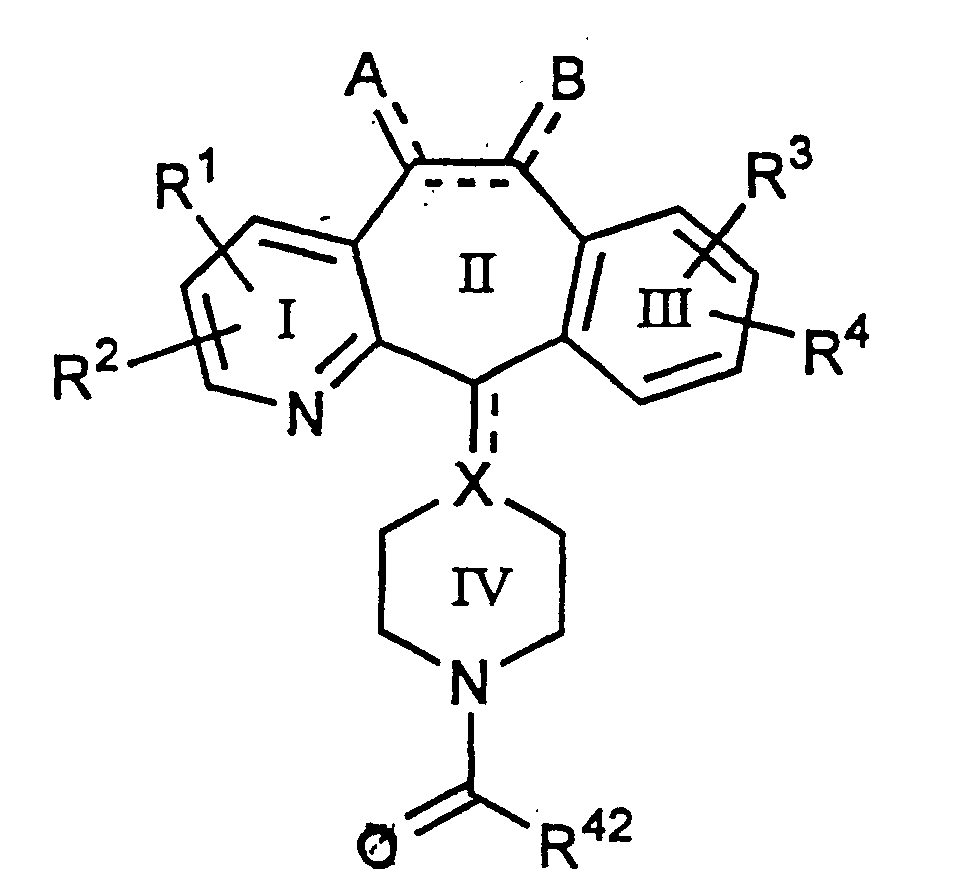 R1 und R2 jeweils unabhängig aus H, Halogen, -CF3, C1-C6-Alkyl oder Benzotriazol-1-yloxy ausgewählt sind;R3 und R4 unabhängig voneinander H oder Halogen darstellen;X N, CH oder C darstellen, wobei C eine wahlfreie Doppelbindung enthalten kann, die durch die gestrichelte Linie zum Kohlenstoffatom 11 dargestellt ist;die gestrichelte Linie zwischen den Kohlenstoffatomen 5 und 6 eine wahlfreie Doppelbindung darstellt, so dass dann, wenn eine Doppelbindung vorhanden ist, A und B unabhängig voneinander H, C1-C6-Alkyl oder C1-C6-Alkyloxy darstellen, und wenn die Doppelbindung zwischen den Kohlenstoffatomen 5 und 6 fehlt, A und B unabhängig voneinander H2, (-H und -OH) oder =O darstellen;R42darstellt, wobei R20 und R21 jeweils unabhängig aus der Gruppe ausgewählt sind, die aus folgendem besteht:
 (1) H;(2) -(CH2)qSC(O)CH3, wobei q 1 bis 3 beträgt;(3) -(CH2)qOSO2CH3, wobei q 1 bis 3 beträgt;(4) -OH;(5) -CS(CH2)w(substituiertes Phenyl), wobei w 1 bis 3 beträgt und die Substituenten an der substituierten Phenylgruppe dieselben Substituenten sind, wie sie unten für das substituierte Phenyl beschrieben sind;(6) -NH2;(7) -NHCBZ;(8) -NHC(O)OR22, wobei R22 eine Alkylgruppe mit 1 bis 5 Kohlenstoffatomen ist oder R22 Phenyl darstellt, das mit 1 bis 3 Alkylgruppen substituiert ist;(9) C1- bis C6-Alkyl;(10) -(CH2)kphenyl, wobei k 1 bis 6 beträgt;(11) Phenyl;(12) substituiertem Phenyl, wobei die Substituenten aus der Gruppe ausgewählt sind, die aus Halogen, NO2, -OH, -OCH3, -NH2, -NHR22, -N(R22)2 (wobei R22 wie oben definiert ist), C1-C6-Alkyl, -O(CH2)t-phenyl (wobei t 1 bis 3 beträgt) und -O(CH2)t-substituiertes Phenyl (wobei t 1 bis 3 beträgt) besteht;(13) Naphthyl;(14) substituiertem Naphthyl, wobei die Substituenten wie oben für das substituierte Phenyl definiert sind;(15) verbrückten polycyclischen Kohlenwasserstoffen mit 5 bis 10 Kohlenstoffatomen;(16) Cycloalkyl mit 5 bis 7 Kohlenstoffatomen;(17) Heteroaryl (das gegebenenfalls mit R3 und R4 substituiert sein kann, wie sie oben definiert sind), das 2 bis 12 Kohlenstoffatome und wenigstens ein Heteroatom, das aus O, S oder N ausgewählt ist, wobei das Heteroatom eine carbocyclische Ringstruktur unterbricht, aufweist und eine ausreichende Zahl von delokalisierten pi-Elektronen aufweist, so dass es aromatischen Charakter erhält (z.B. 2-, 3- oder 4-Pyridyl oder Pyridyl-N-oxid);(18) C1-C6-Hydroxyalkyl;(19) substituiertem Pyridyl oder substituiertem Pyridyl-N-oxid, wobei die Substituenten aus den Substituenten ausgewählt sind, die oben für das substituierte Phenyl angegeben sind, und die Substituenten an ein Ringkohlenstoffatom gebunden sind, indem sie den an das Kohlenstoffatom gebundenen Wasserstoff ersetzen;
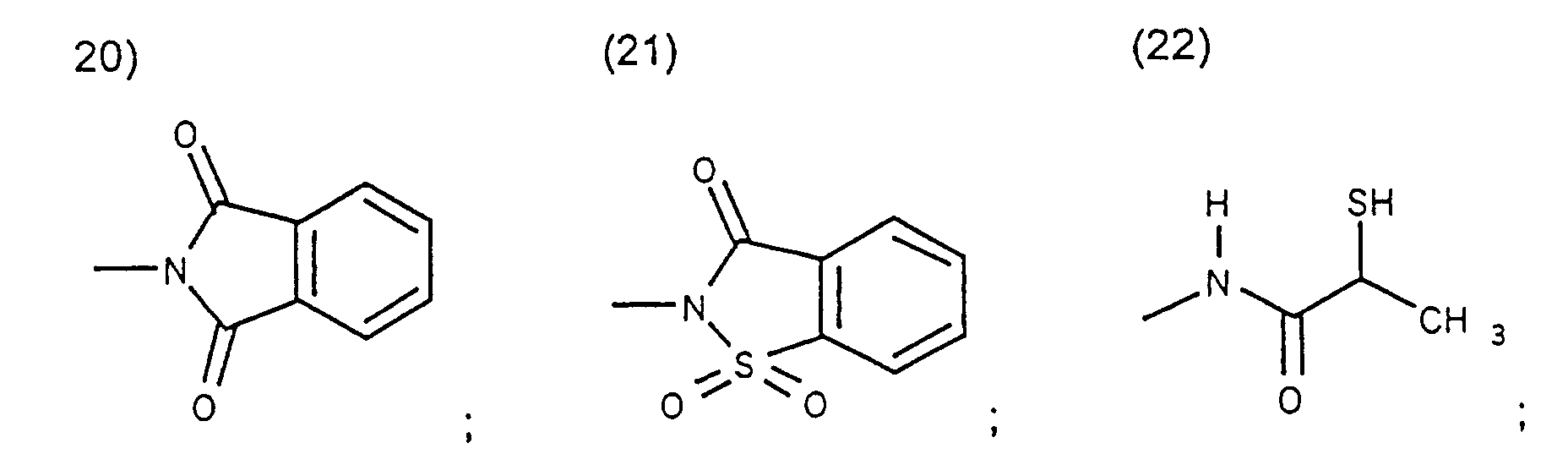 (23) -NHC(O)-(CH2)k-phenyl oder -NH(O)-(CH2)k-substituiertes Phenyl, wobei k wie oben definiert ist;(24) einem Piperidinring V:wobei R50 H, C1-C6-Alkyl, C1-C6-Alkylcarbonyl, C1-C6-Alkyloxycarbonyl, C1-C6-Halogenalkyl oder -C(O)NH(R10) darstellt, wobei R10 H oder C1-C6-Alkyl ist;
 (25) -NHC(O)CH2C6H5 oder -NHC(O)CH2-substituiertes-C6H5;(26) -NHC(O)OC6H5;
 (30) -OC(O)-Heteroaryl (wobei Heteroaryl wie oben definiert ist), zum Beispiel:
 (31) -O-(C1-C6-Alkyl) (z.B. -OCH3);(32) -CF3;(33) R20 und R21 bilden zusammen eine Gruppe =O;(34) R20 und R21 bilden zusammen einen Piperidinring V, wie er oben definiert ist; undR46 aus Phenyl, substituiertem Phenyl, Heteroaryl oder einem Piperidinring V, wie er oben definiert ist, ausgewählt ist;mit der Maßgabe, dass R46, R20 und R21 so ausgewählt sind, dass das Kohlenstoffatom, an das sie gebunden sind, nicht mehr als ein Heteroatom enthält.
 - Verwendung gemäß Anspruch 1, wobei R20 und R21 jeweils unabhängig aus H und C1-C6-Alkyl ausgewählt sind; R3 Cl ist; R4 H ist; R1 und R2 einzeln aus H, Benzotriazol-1-yloxy, C1-C6-Alkyl oder Halogen ausgewählt sind; und R46 3-Pyridyl, 3-Pyridyl-N-oxid, 4-Pyridyl, 4-Pyridyl-N-oxid, 3-N-Methylpiperidinyl, 4-N-Methylpiperidinyl, 3-N-Acetylpiperidinyl oder 4-N-Acetylpiperidinyl darstellt.
- Verwendung gemäß Anspruch 2, wobei sowohl R20 als auch R21 H sind oder sowohl R20 als auch R21 Methyl sind; R1 und R2 einzeln aus H, Br, Cl, Methyl oder Benzotriazol-1-yloxy ausgewählt sind; und R46 3-Pyridyl, 3-Pyridyl-N-oxid, 4-Pyridyl, 4-Pyridyl-N-oxid, 3-N-Methylpiperidinyl oder 4-N-Methylpiperidinyl darstellt.
- Verwendung gemäß Anspruch 1, wobei die gehemmten Zellen Tumorzellen sind, die ein aktiviertes ras-Onkogen exprimieren.
- Verwendung gemäß Anspruch 4, wobei die gehemmten Zellen pankreatische Tumorzellen, Lungenkrebszellen, Tumorzellen der myeloiden Leukämie, Schilddrüsenfollikeltumorzellen, Myelodysplasie-Tumorzellen, Epidermiskarzinom-Tumorzellen, Blasenkrebs-Tumorzellen oder Colon-Tumorzellen sind.
- Verwendung gemäß Anspruch 1, wobei die Hemmung des abnormen Wachstums der Zellen durch die Hemmung der ras-Farnesyl-Protein-Transferase erfolgt.
- Verwendung gemäß Anspruch 1, wobei die Hemmung Tumorzellen betrifft, bei denen das Ras-Protein als Ergebnis einer onkogenischen Mutation in anderen Genen als dem ras-Gen aktiviert ist.
- Verwendung gemäß Anspruch 1, wobei die Verbindung aus den folgenden Strukturen ausgewählt ist:




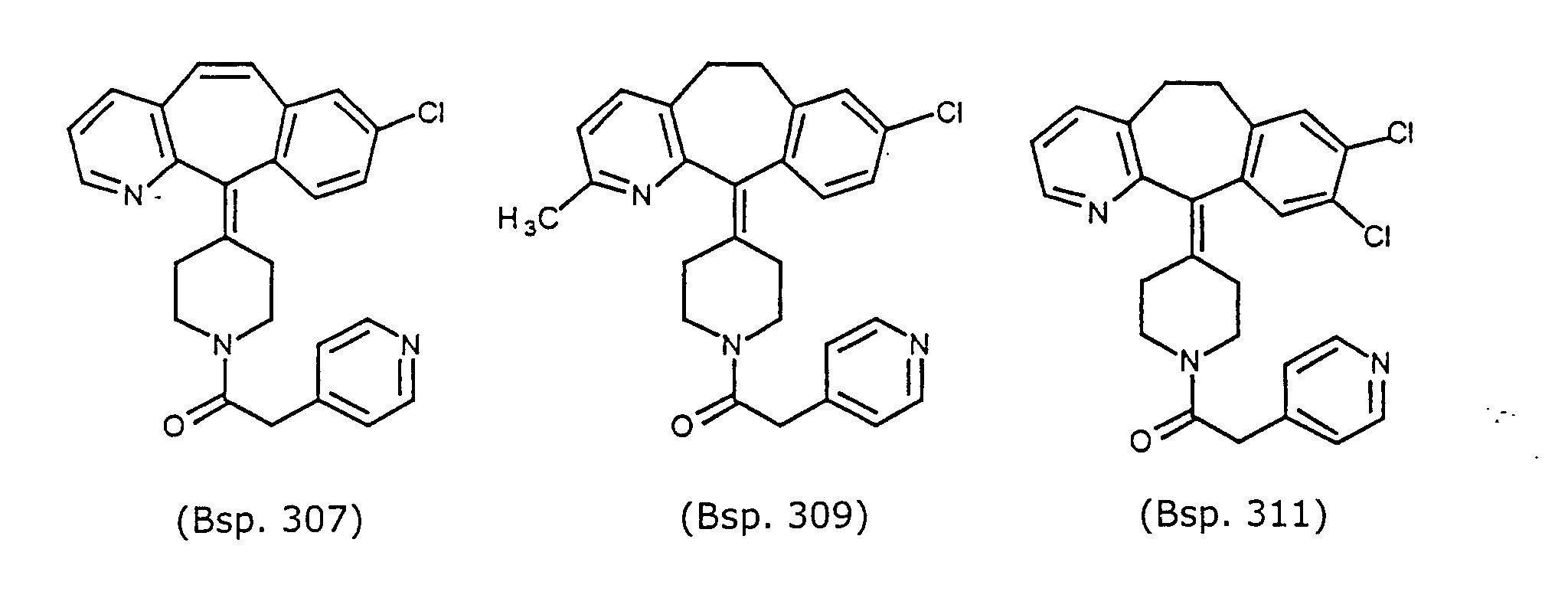

- Verbindung, die aus einer Verbindung der Formeln 5.0, 5.1 und 5.2 ausgewählt istoder ein pharmazeutisch annehmbares Salz oder Solvat davon, wobei alle Substituenten wie in Anspruch 1 definiert sind, mit der Maßgabe, dass bei Verbindungen, bei denen R1, R2, R3 und R4 H, Halogen, -CF3 oder C1-C6-Alkyl sind, wobei R46 Phenyl, Pyridyl, substituiertes Pyridyl, Pyridyl-N-oxid, substituiertes Pyridyl-N-oxid oder den Piperidylring V, wobei R50 H ist, darstellt, R20 und R21 nicht beide H sein können.
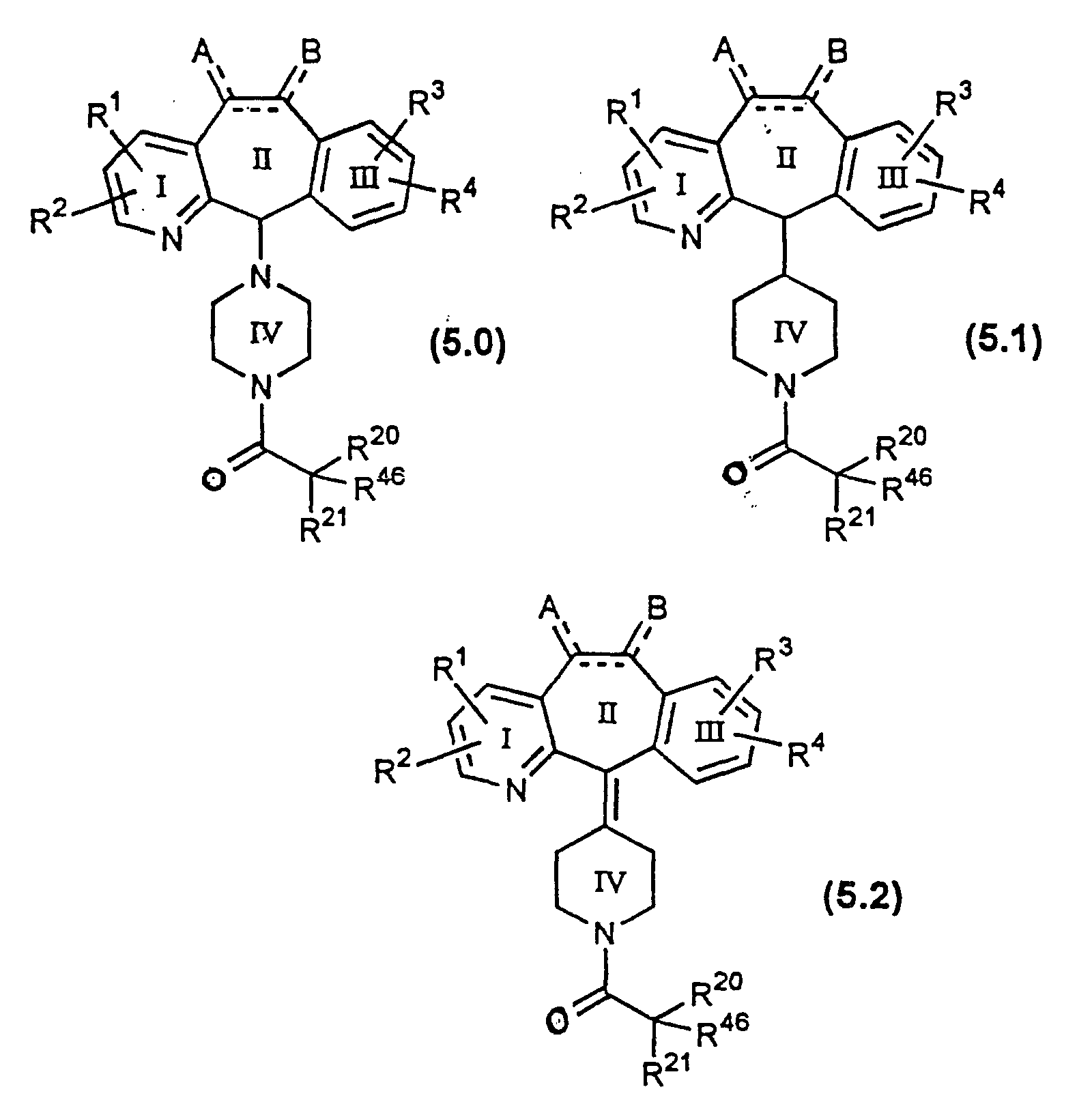
- Verbindung gemäß Anspruch 9, wobei sich R1 in der C-4-Position befindet und sich R2 in der C-3-Position befindet und sich R3 in der C-8-Position befindet und sich R4 in der C-9-Position befindet.
- Verbindung gemäß Anspruch 13, die aus einer Verbindung mit den folgenden Strukturen ausgewählt ist:
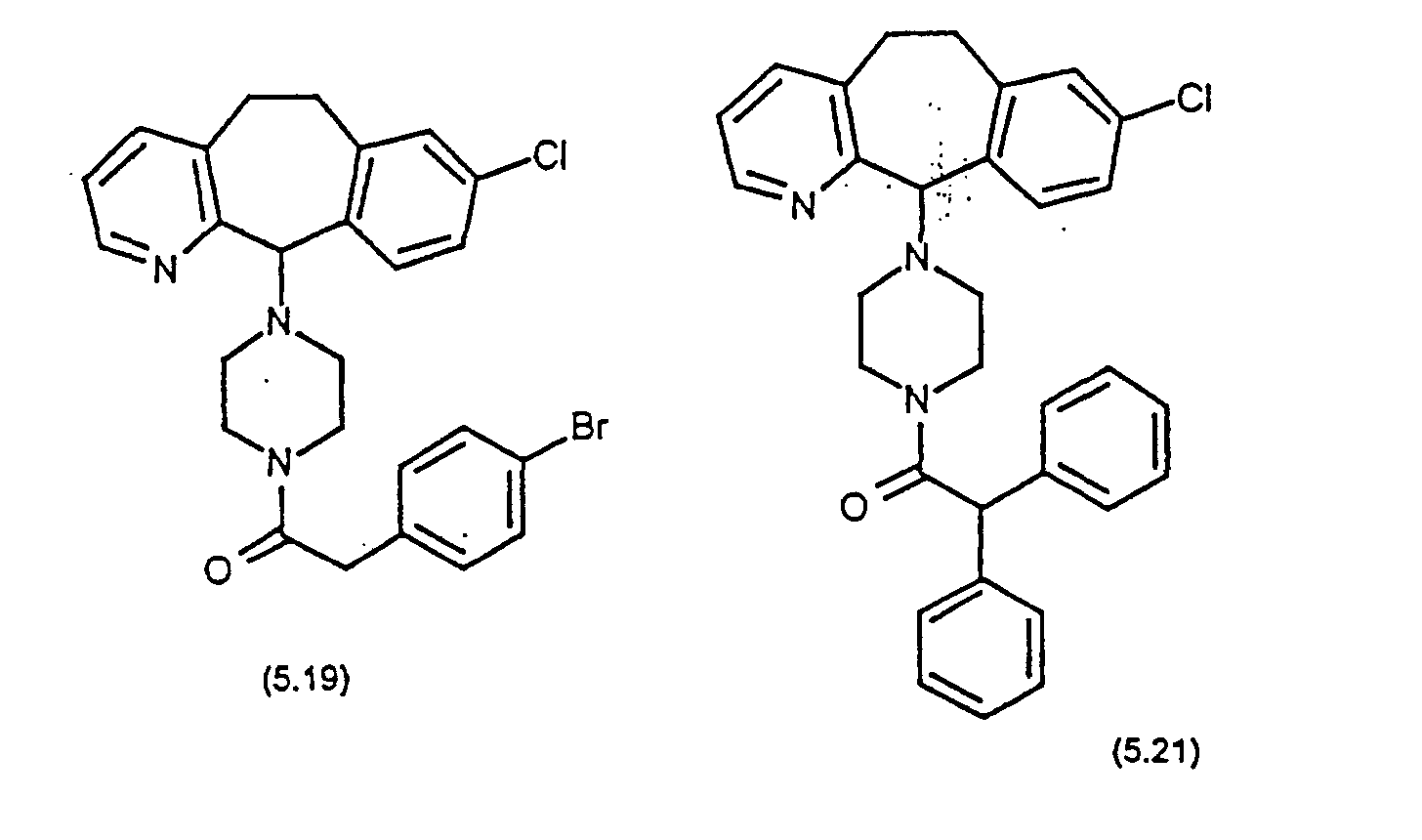








- Pharmazeutische Zusammensetzung zur Hemmung des abnormen Wachstums von Zellen, welche eine wirksame Menge der Verbindung von Anspruch 9 in Kombination mit einem pharmazeutisch annehmbaren Träger umfasst.
- Verwendung einer Verbindung gemäß Anspruch 9 bei der Hersteliung einer pharmazeutischen Zusammensetzung zur Hemmung des abnormen Wachstums von Zellen.
- Verfahren zur Herstellung einer Verbindung gemäß Anspruch 9, umfassend:wobei L eine Abgangsgruppe ist, unter Bildung einer Verbindung der Formel 1.0, bei der X N ist; oder(a) Umsetzen einer Verbindung der Formel 405.00mit RCOOH bei einer Temperatur zwischen 0°C und Rückfluss in einem inerten Lösungsmittel;
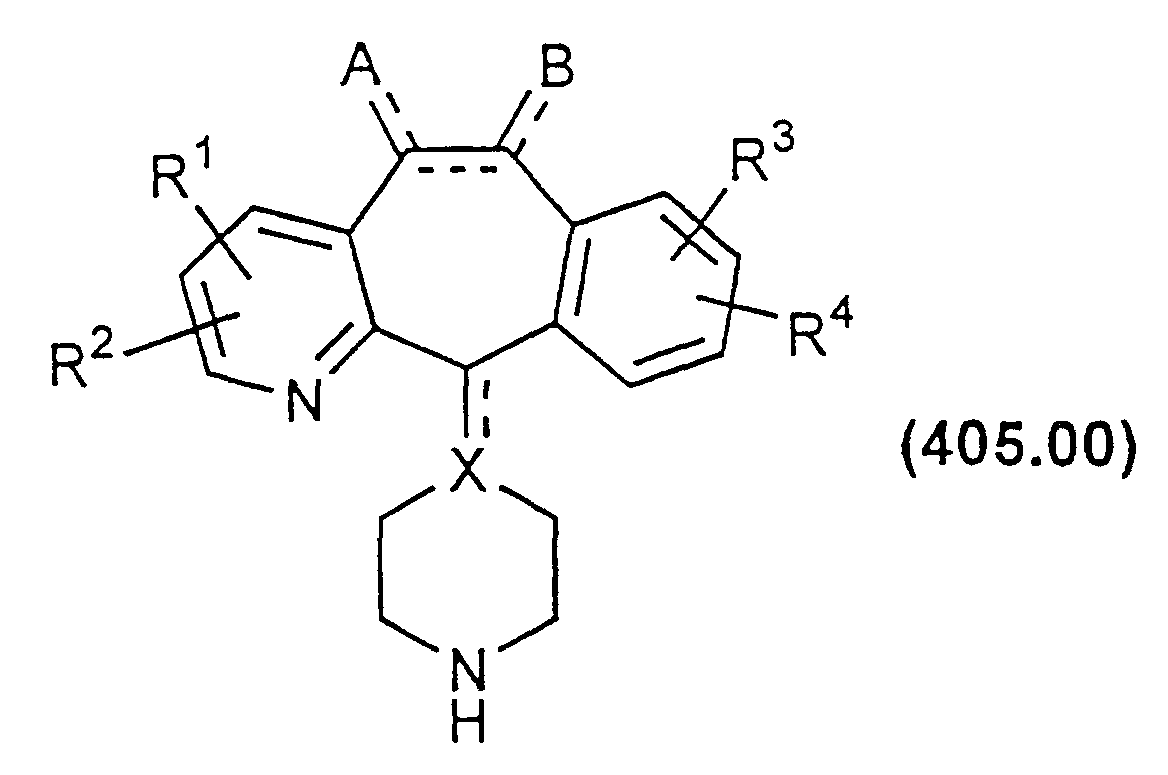 (b) Umsetzen der Verbindung der Formel 405.00 mit RC(O)L, wobei L eine geeignete Abgangsgruppe darstellt, in Gegenwart einer Base;(c) Umsetzen einer Verbindung der Formel 420.00mit einem geeigneten Acylhalogenid oder einem Acylanhydrid;
 (d) Reduzieren der Verbindung der Formel 405.00, wobei X Kohlenstoff ist und die Bindung zu C-11 eine Doppelbindung ist, mit Lithiumaluminiumhydrid in Tetrahydrofuran und dann Umsetzen der reduzierten Formel 405.00 mit RCOOH oder RC(O)L unter Bildung von Verbindungen der Formel 1.0 in Anspruch 1, bei denen X Kohlenstoff ist und die Bindung zu C-11 eine Einfachbindung ist;(e) Reduzieren von Verbindungen der Formel 470.00dmit Natriumborhydrid in Methanol oder Ethanol, Umwandeln des resultierenden Alkohols in ein Chlorid mit Thionylchlorid, Verdrängen mit Piperazin und Umsetzen der resultierenden Verbindung mit RCOOH oder RC(O)L, wie es oben für die Umwandlung von Formel 405.00 in Formel 1.0 beschrieben ist, wobei die Bindung zu C-11 eine Einfachbindung ist;
 (f) Cyclisieren einer Verbindung der Formel 455.00unter Bildung einer Verbindung der Formel 1.0, bei der die Bindung zu C-11 eine Einfachbindung ist;
 (g) Umsetzen des Azaketons der Formel 470.00mit einem Oxidationsmittel unter Bildung der entsprechenden Verbindung, bei der das Stickstoffatom des Pyridinrings ein N-Oxid ist, Umsetzen des resultierenden Produkts mit einem Chlorierungsmittel unter Bildung einer Verbindung der Formel 470.00b
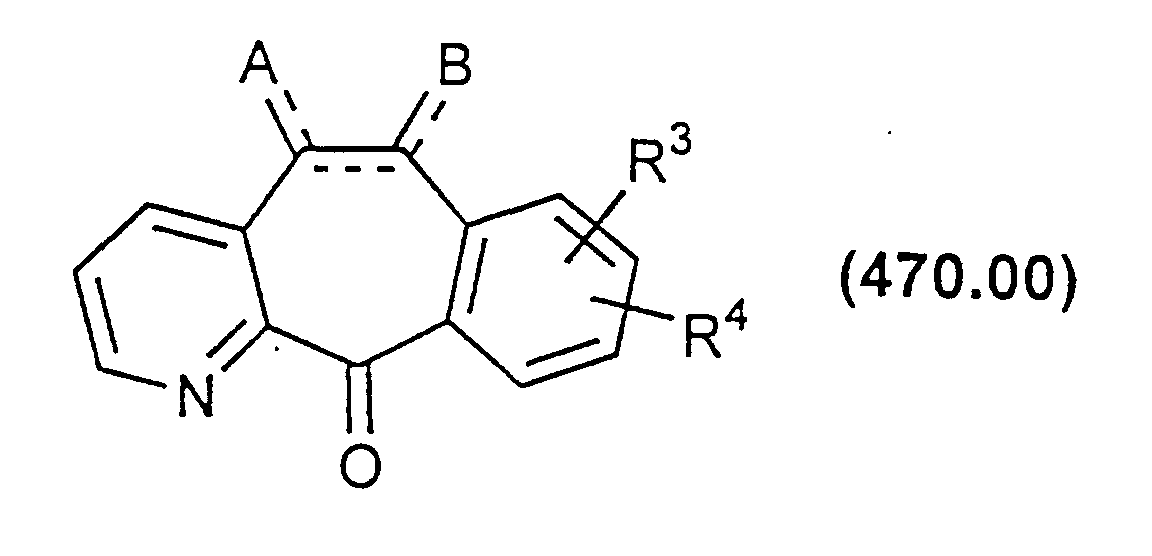 gegebenenfalls Wiederholen der Chlorierung unter Bildung der disubstituierten Verbindung der Formel 470.00c
 gegebenenfalls Umsetzen der Verbindung der Formel 470.00b oder 470.00c mit Nucleophilen, so dass man die substituierte Verbindung der obigen Formel 470.00d erhält, Umsetzen der Verbindung der Formel 470.00d, wie sie oben in (f) beschrieben ist, unter Bildung von Verbindungen der Formel 1.0;
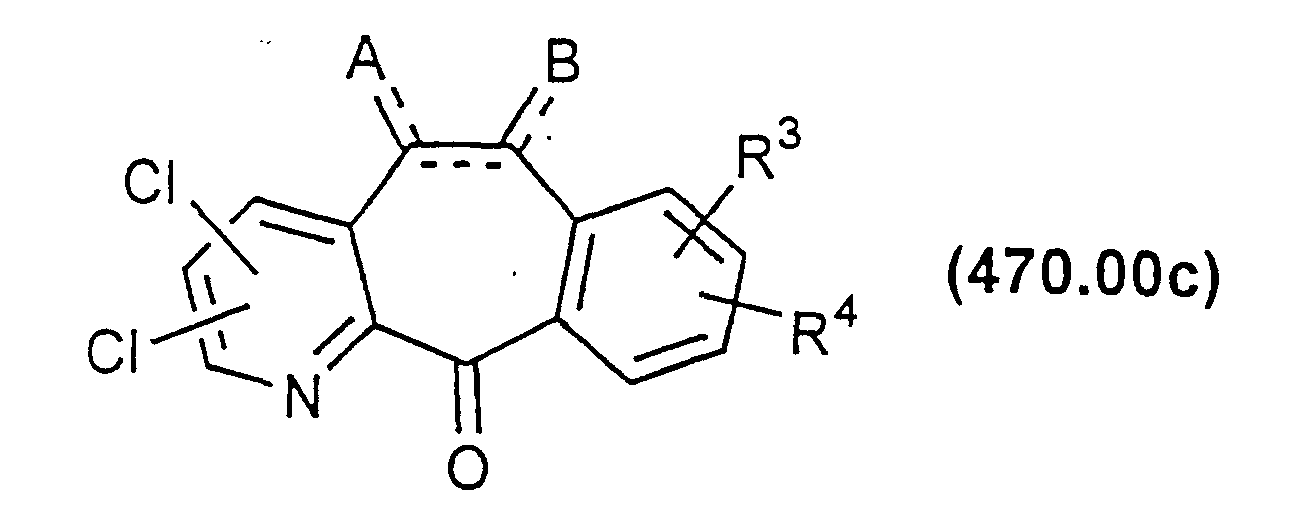 (h) Umsetzen der N-Oxid-Verbindung der obigen Formel 405.00 mit POCl3 unter Bildung einer Verbindung der Formel 415.01
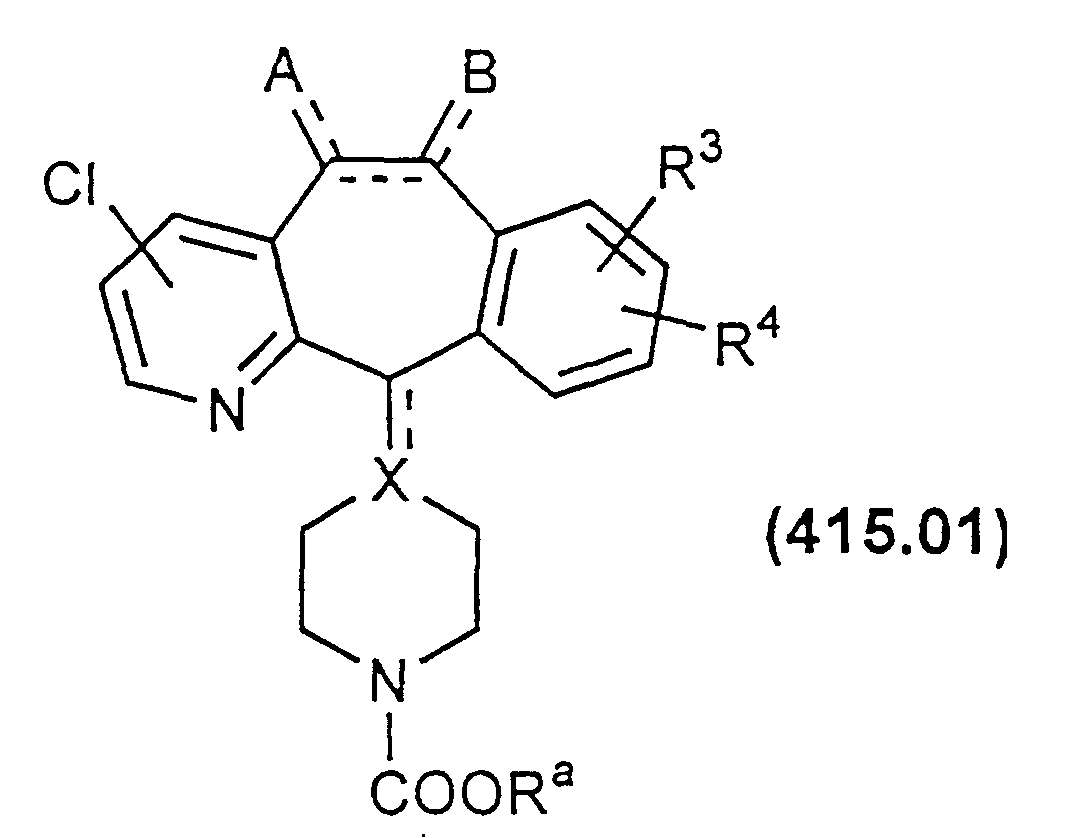 (i) Umsetzen einer halogensubstituierten Verbindung der obigen Formel 405.00, wobei R1 Halogen ist, mit einem Lithiumalkyl unter Bildung des Lithioderivats und dann Ablöschen des Lithioderivats mit dem geeigneten Elektrophil;(j) Umsetzen einer Verbindung der Formel 470.00h :in Essigsäure mit SeO2 unter Bildung einer Verbindung der Formel 470.00i
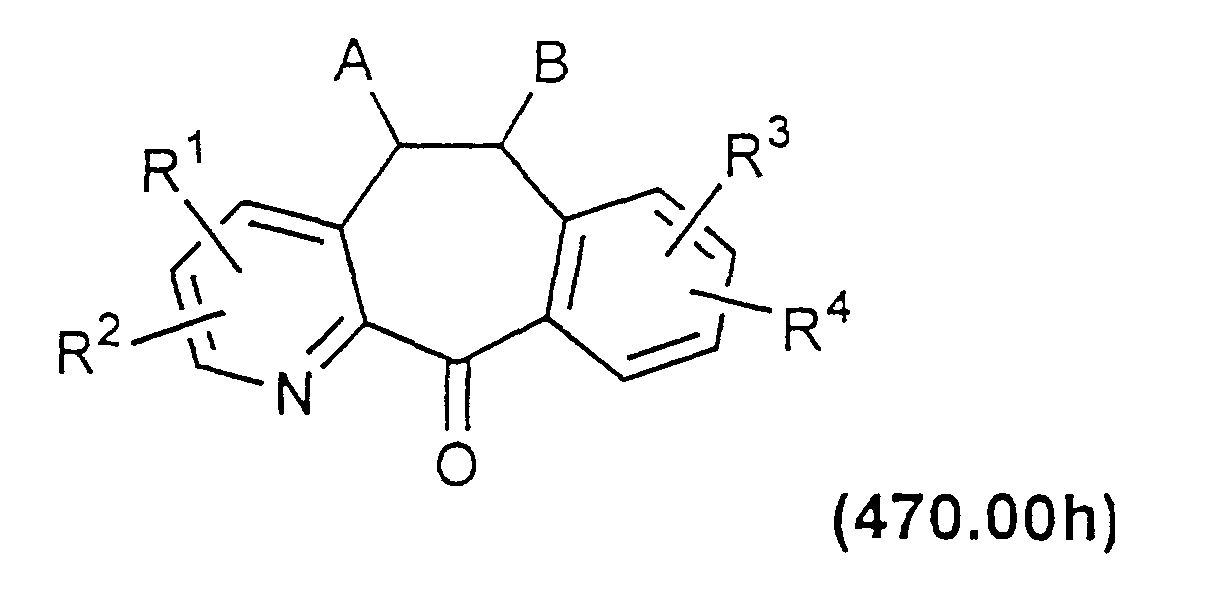 und dann Umwandeln der Verbindung 470.00i in eine Verbindung der Formel 1.0;
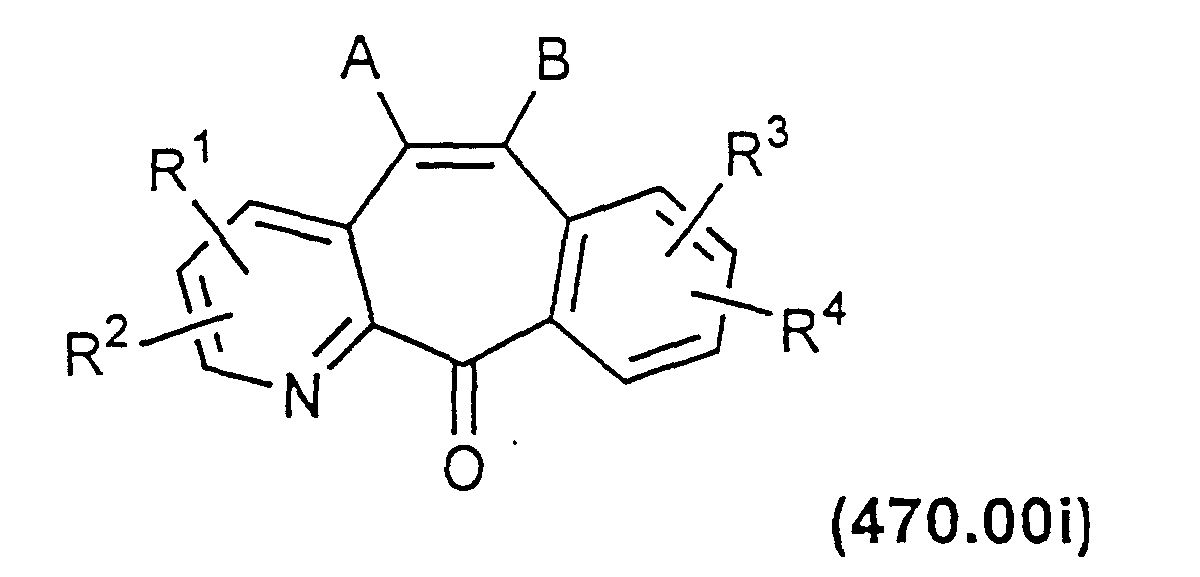 (k) Alkylieren der in geeigneter Weise substituierten Piperazinverbindung der Formel 700.00mit einer Verbindung der Formel 705.00
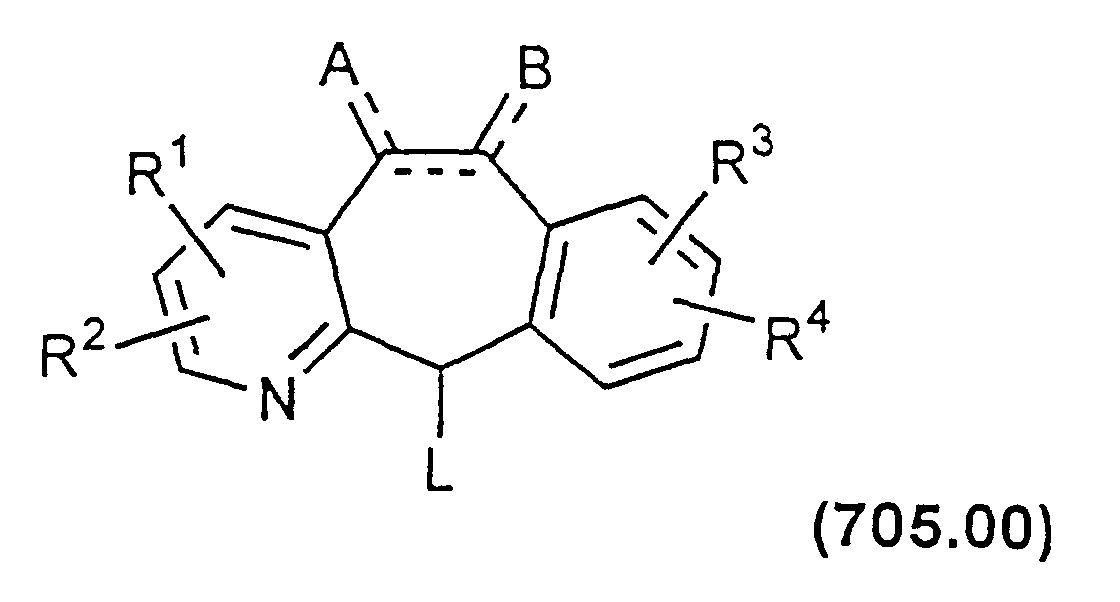 (I) reduktive Aminierung des Azaketons der Formel 715.00mit dem Piperazin der obigen Formel 700.00.
Priority Applications (1)
| Application Number | Priority Date | Filing Date | Title |
|---|---|---|---|
| EP01109408A EP1123931B1 (de) | 1993-10-15 | 1994-10-12 | Tricyclische Amide und Harnstoffderivate zur Inhibierung der G-Protein Funktion und für die Behandlung von proliferativen Behandlungen |
Applications Claiming Priority (3)
| Application Number | Priority Date | Filing Date | Title |
|---|---|---|---|
| US13786293A | 1993-10-15 | 1993-10-15 | |
| US137862 | 1993-10-15 | ||
| PCT/US1994/011392 WO1995010516A1 (en) | 1993-10-15 | 1994-10-12 | Tricyclic amide and urea compounds useful for inhibition of g-protein function and for treatment of proliferative diseases |
Related Child Applications (1)
| Application Number | Title | Priority Date | Filing Date |
|---|---|---|---|
| EP01109408A Division EP1123931B1 (de) | 1993-10-15 | 1994-10-12 | Tricyclische Amide und Harnstoffderivate zur Inhibierung der G-Protein Funktion und für die Behandlung von proliferativen Behandlungen |
Publications (2)
| Publication Number | Publication Date |
|---|---|
| EP0723540A1 EP0723540A1 (de) | 1996-07-31 |
| EP0723540B1 true EP0723540B1 (de) | 2001-12-12 |
Family
ID=22479374
Family Applications (2)
| Application Number | Title | Priority Date | Filing Date |
|---|---|---|---|
| EP94930650A Expired - Lifetime EP0723540B1 (de) | 1993-10-15 | 1994-10-12 | Tricyclische amide und harnstoffderivate zur inhibierung der g-protein funktion und für die behandlung von proliferatinen erkrankungen |
| EP01109408A Expired - Lifetime EP1123931B1 (de) | 1993-10-15 | 1994-10-12 | Tricyclische Amide und Harnstoffderivate zur Inhibierung der G-Protein Funktion und für die Behandlung von proliferativen Behandlungen |
Family Applications After (1)
| Application Number | Title | Priority Date | Filing Date |
|---|---|---|---|
| EP01109408A Expired - Lifetime EP1123931B1 (de) | 1993-10-15 | 1994-10-12 | Tricyclische Amide und Harnstoffderivate zur Inhibierung der G-Protein Funktion und für die Behandlung von proliferativen Behandlungen |
Country Status (20)
| Country | Link |
|---|---|
| EP (2) | EP0723540B1 (de) |
| JP (1) | JP2880576B2 (de) |
| AT (2) | ATE296819T1 (de) |
| AU (2) | AU700246B2 (de) |
| CA (1) | CA2174104C (de) |
| DE (2) | DE69434397T2 (de) |
| DK (1) | DK0723540T3 (de) |
| ES (2) | ES2164718T3 (de) |
| HK (1) | HK1039488B (de) |
| HU (1) | HUT76056A (de) |
| IL (1) | IL111235A (de) |
| MA (1) | MA23354A1 (de) |
| MY (1) | MY114132A (de) |
| NZ (2) | NZ275647A (de) |
| PT (1) | PT723540E (de) |
| SG (1) | SG75084A1 (de) |
| TN (1) | TNSN94106A1 (de) |
| TW (1) | TW334432B (de) |
| WO (1) | WO1995010516A1 (de) |
| ZA (1) | ZA947971B (de) |
Families Citing this family (161)
| Publication number | Priority date | Publication date | Assignee | Title |
|---|---|---|---|---|
| WO1995000497A1 (en) * | 1993-06-18 | 1995-01-05 | Merck & Co., Inc. | Inhibitors of farnesyl-protein transferase |
| US5719148A (en) * | 1993-10-15 | 1998-02-17 | Schering Corporation | Tricyclic amide and urea compounds useful for inhibition of g-protein function and for treatment of proliferative diseases |
| US5721236A (en) * | 1993-10-15 | 1998-02-24 | Schering Corporation | Tricyclic carbamate compounds useful for inhibition of G-protein function and for treatment of proliferative diseases |
| US6524832B1 (en) | 1994-02-04 | 2003-02-25 | Arch Development Corporation | DNA damaging agents in combination with tyrosine kinase inhibitors |
| US5700806A (en) * | 1995-03-24 | 1997-12-23 | Schering Corporation | Tricyclic amide and urea compounds useful for inhibition of G-protein function and for treatment of proliferative diseases |
| US5856326A (en) * | 1995-03-29 | 1999-01-05 | Merck & Co., Inc. | Inhibitors of farnesyl-protein transferase |
| IL117798A (en) | 1995-04-07 | 2001-11-25 | Schering Plough Corp | Tricyclic compounds useful for inhibiting the function of protein - G and for the treatment of malignant diseases, and pharmaceutical preparations containing them |
| US5801175A (en) | 1995-04-07 | 1998-09-01 | Schering Corporation | Tricyclic compounds useful for inhibition of G-protein function and for treatment of proliferative diseases |
| US5712280A (en) * | 1995-04-07 | 1998-01-27 | Schering Corporation | Tricyclic compounds useful for inhibition of G-protein function and for treatment of proliferative diseases |
| IL117797A0 (en) * | 1995-04-07 | 1996-08-04 | Pharmacopeia Inc | Tricyclic compounds useful for inhibition of G-protein function and for treatment of proliferative diseases |
| US5919780A (en) * | 1995-06-16 | 1999-07-06 | Warner Lambert Company | Tricyclic inhibitors of protein farnesyltransferase |
| JPH11509204A (ja) * | 1995-07-13 | 1999-08-17 | ユニバーシテイ・オブ・シンシナテイ | 神経線維腫症の治療に有用な化合物 |
| SK86198A3 (en) * | 1995-12-22 | 1999-02-11 | Schering Corp | Tricyclic amides useful for inhibition of g-protein function and for treatment of proliferative diseases |
| AU769687B2 (en) * | 1995-12-22 | 2004-01-29 | Merck Sharp & Dohme Corp. | Tricyclic amides useful for inhibition of G-protein function and for treatment of proliferative diseases |
| US5874442A (en) | 1995-12-22 | 1999-02-23 | Schering-Plough Corporation | Tricyclic amides useful for inhibition of G-protein function and for treatment of proliferative disease |
| AU712504B2 (en) * | 1996-01-30 | 1999-11-11 | Merck & Co., Inc. | Inhibitors of farnesyl-protein transferase |
| US6117641A (en) | 1996-04-11 | 2000-09-12 | Mitotix, Inc. | Assays and reagents for identifying anti-fungal agents and uses related thereto |
| AU717165B2 (en) | 1996-04-11 | 2000-03-16 | Gpc Biotech Inc. | Assays and reagents for identifying anti-fungal agents, and uses related thereto |
| US6727082B1 (en) | 1996-04-11 | 2004-04-27 | Gpc Biotech Inc. | Assays and reagents for identifying anti-fungal agents, and uses related thereto |
| DE19624659A1 (de) | 1996-06-20 | 1998-01-08 | Klinge Co Chem Pharm Fab | Neue Pyridylalken- und Pyridylalkinsäureamide |
| US6451816B1 (en) | 1997-06-20 | 2002-09-17 | Klinge Pharma Gmbh | Use of pyridyl alkane, pyridyl alkene and/or pyridyl alkine acid amides in the treatment of tumors or for immunosuppression |
| DE19624704A1 (de) | 1996-06-20 | 1998-01-08 | Klinge Co Chem Pharm Fab | Neue Pyridylalkansäureamide |
| US5925757A (en) * | 1996-07-26 | 1999-07-20 | Schering Corporation | Method for preparing carboxamides |
| PE92098A1 (es) | 1996-07-31 | 1998-12-31 | Schering Corp | N-cianoiminas triciclicas utiles como inhibidores de transferasa de proteina farnesilo |
| CN1237176A (zh) * | 1996-09-13 | 1999-12-01 | 先灵公司 | 用作fpt抑制剂的三环化合物 |
| US5861395A (en) * | 1996-09-13 | 1999-01-19 | Schering Corporation | Compounds useful for inhibition of farnesyl proteins transferase |
| NZ334437A (en) * | 1996-09-13 | 2000-09-29 | Schering Corp | Substituted benzocycloheptapyridine derivatives useful for inhibition of farnesyl protein transferase |
| US6030982A (en) | 1996-09-13 | 2000-02-29 | Schering Corporationm | Compounds useful for inhibition of farnesyl protein transferase |
| US6040305A (en) * | 1996-09-13 | 2000-03-21 | Schering Corporation | Compounds useful for inhibition of farnesyl protein transferase |
| US5945429A (en) * | 1996-09-13 | 1999-08-31 | Schering Corporation | Compounds useful for inhibition of farnesyl protein transferase |
| US6071907A (en) * | 1996-09-13 | 2000-06-06 | Schering Corporation | Tricyclic compounds useful as FPT inhibitors |
| CA2264666A1 (en) * | 1996-09-13 | 1998-03-19 | Schering Corporation | Substituted benzocycloheptapyridine useful as inhibitors of farnesyl-protein transferase |
| HUP0000126A2 (hu) * | 1996-09-13 | 2001-04-28 | Schering Corp. | Farnezil-protein-transzferáz inhibitorként alkalmazható szubsztituált benzo-ciklohepta-piridin-származékok |
| SK33699A3 (en) * | 1996-09-13 | 2000-03-13 | Schering Corp | Tricyclic compounds useful for inhibition of farnesyl protein transferase |
| CN1104427C (zh) * | 1996-09-13 | 2003-04-02 | 先灵公司 | 法呢基蛋白转移酶的三环抑制剂 |
| US5985879A (en) * | 1996-09-13 | 1999-11-16 | Schering Corporation | Compounds useful for inhibition of farnesyl protein transferase |
| AU4801197A (en) * | 1996-09-13 | 1998-04-02 | Schering Corporation | Tricyclic antitumor compounds being farnesyl protein transferase inhibit ors |
| US5965570A (en) * | 1996-09-13 | 1999-10-12 | Schering Corporation | Tricyclic piperidinyl compounds useful as inhibitors of farnesyl-protein transferase |
| US5994364A (en) | 1996-09-13 | 1999-11-30 | Schering Corporation | Tricyclic antitumor farnesyl protein transferase inhibitors |
| CZ84199A3 (cs) * | 1996-09-13 | 1999-11-17 | Schering Corporation | Nové, tricyklické piperidinylové sloučeniny použitelné jako inhibitory farnesylprotein transferasy |
| US5958890A (en) * | 1996-09-13 | 1999-09-28 | Schering Corporation | Tricyclic compounds useful for inhibition of G-protein function and for treatment of proliferative diseases |
| CN1248253A (zh) * | 1996-09-13 | 2000-03-22 | 先灵公司 | 用于抑制法呢基蛋白转移酶的化合物 |
| IL128949A0 (en) * | 1996-09-13 | 2000-02-17 | Schering Corp | Tricyclic compounds useful for inhibition of g-protein function and for treatment of proliferative diseases |
| US6130229A (en) * | 1996-10-09 | 2000-10-10 | Schering Corporation | Tricyclic compounds having activity as RAS-FPT inhibitors |
| US5972966A (en) * | 1996-12-05 | 1999-10-26 | Merck & Co., Inc. | Inhibitors of farnesyl-protein transferase |
| US5898810A (en) * | 1997-04-04 | 1999-04-27 | Minnesota Mining And Manufacturing Company | Illumination waveguide and method for producing same |
| US5760232A (en) * | 1997-06-16 | 1998-06-02 | Schering Corporation | Synthesis of intermediates useful in preparing bromo-substituted tricyclic compounds |
| JP2002504142A (ja) * | 1997-06-17 | 2002-02-05 | シェーリング コーポレイション | ファルネシルタンパク質トランスフェラーゼの阻害に有用なベンゾ(5,6)シクロヘプタ(1,2−b)ピリジン誘導体 |
| HUP0003138A3 (en) * | 1997-06-17 | 2002-11-28 | Schering Corp | Benzpyrido cycloheptane compounds useful for inhibition of farnesyl protein transferase |
| HUP0002186A3 (en) * | 1997-06-17 | 2002-04-29 | Schering Corp | Compounds useful for inhibition of farnesyl protein transferase |
| IL133446A0 (en) * | 1997-06-17 | 2001-04-30 | Schering Corp | Novel phenyl-substituted tricyclic inhibitors of farnesyl-protein transferase |
| ES2196566T3 (es) * | 1997-06-17 | 2003-12-16 | Schering Corp | Nuevos compuestos triciclicos de aminooxiamida inhibidores de la farnesil-proteina-transferasa. |
| US6159984A (en) * | 1997-06-17 | 2000-12-12 | Schering Corporation | Farnesyl protein transferase inhibitors |
| KR20010013825A (ko) * | 1997-06-17 | 2001-02-26 | 둘락 노먼 씨. | 파네실 단백질 전이효소를 억제하기에 유용한비스피리도-사이클로헵탄 화합물 |
| AU8253498A (en) * | 1997-06-17 | 1999-01-04 | Schering Corporation | Tricyclic compounds useful for inhibition of g-protein function and for treatment of proliferative diseases |
| IL133389A0 (en) * | 1997-06-17 | 2001-04-30 | Schering Corp | Novel n-substituted urea inhibitors of farnesyl-protein transferase |
| CN1172932C (zh) * | 1997-06-17 | 2004-10-27 | 先灵公司 | 抑制法尼基蛋白转移酶的苯并(5,6)芳庚并(1,2b)吡啶衍生物 |
| JP2002510308A (ja) * | 1997-06-17 | 2002-04-02 | シェーリング コーポレイション | ファルネシルタンパク質トランスフェラーゼインヒビターとしてのベンゾ(5,6)シクロヘプタ(1,2−b)ピリジン誘導体 |
| US5945430A (en) * | 1997-06-17 | 1999-08-31 | Schering Corporation | Aminooxyamide tricyclic inhibitors of farnesyl-protein transferase |
| US6218401B1 (en) | 1997-06-17 | 2001-04-17 | Schering Corporation | Phenyl-substituted tricyclic inhibitors of farnesyl-protein transferase |
| US5877177A (en) * | 1997-06-17 | 1999-03-02 | Schering Corporation | Carboxy piperidylacetamide tricyclic compounds useful for inhibition of G-protein function and for treatment of proliferative diseases |
| US5925639A (en) * | 1997-06-17 | 1999-07-20 | Schering Corporation | Keto amide derivatives useful as farnesyl protein transferase inhibitors |
| US6225322B1 (en) | 1997-06-17 | 2001-05-01 | Schering Corporation | Compounds useful for inhibition of farnesyl protein transferase |
| US5852034A (en) * | 1997-06-17 | 1998-12-22 | Schering Corporation | Benzo(5,6)cycloheptapyridine cyclic ureas and lactams useful as farnesyl protein transferase inhibitors |
| US6211193B1 (en) | 1997-06-17 | 2001-04-03 | Schering Corporation | Compounds useful for inhibition of farnesyl protein transferase |
| US5939416A (en) * | 1997-06-17 | 1999-08-17 | Schering Corporation | Benzo (5,6) cycloheptapyridine compounds useful as farnesyl protein transferase inhibitors |
| US6689789B2 (en) | 1997-06-17 | 2004-02-10 | Schering Corporation | Compounds useful for inhibition of farnesyl protein transferase |
| US6576639B1 (en) | 1997-06-17 | 2003-06-10 | Schering Corporation | Compounds for the inhibition of farnesyl protein transferase |
| US6228865B1 (en) | 1997-06-17 | 2001-05-08 | Schering Corporation | Compounds useful for inhibition of farnesyl protein transferase |
| US6037166A (en) * | 1997-06-17 | 2000-03-14 | Schering Corporation | Enzymatic kinetic resolution of an intermediate useful for preparing substituted tricyclics |
| US6051582A (en) * | 1997-06-17 | 2000-04-18 | Schering Corporation | Compounds useful for inhibition of farnesyl protein transferase |
| CA2294347C (en) * | 1997-06-17 | 2008-01-29 | Schering Corporation | Benzo(5,6)cyclohepta(1,2-b)pyridine derivatives for the inhibition of farnesyl protein transferase |
| US6239140B1 (en) | 1997-06-17 | 2001-05-29 | Schering Corporation | Compounds useful for inhibition of farnesyl protein transferase |
| US6358968B1 (en) | 1997-06-17 | 2002-03-19 | Schering Corporation | N-substituted urea inhibitors of farnesyl-protein transferase |
| US5925648A (en) * | 1997-07-29 | 1999-07-20 | Schering Corporation | Tricyclic N-cyanoimines useful as inhibitors of a farnesyl-protein transferase |
| US5958940A (en) * | 1997-09-11 | 1999-09-28 | Schering Corporation | Tricyclic compounds useful as inhibitors of farnesyl-protein transferase |
| DE19756235A1 (de) | 1997-12-17 | 1999-07-01 | Klinge Co Chem Pharm Fab | Neue piperidinylsubstituierte Pyridylalkan- alken- und -alkincarbonsäureamide |
| DE19756212A1 (de) * | 1997-12-17 | 1999-07-01 | Klinge Co Chem Pharm Fab | Neue, mit einem cyclischen Imid substituierte Pyridylalkan-, alken- und -alkincarbonsäureamide |
| US6903118B1 (en) | 1997-12-17 | 2005-06-07 | Klinge Pharma Gmbh | Piperazinyl-substituted pyridylalkane, alkene and alkine carboxamides |
| US6632455B2 (en) | 1997-12-22 | 2003-10-14 | Schering Corporation | Molecular dispersion composition with enhanced bioavailability |
| US6096757A (en) | 1998-12-21 | 2000-08-01 | Schering Corporation | Method for treating proliferative diseases |
| US6307048B1 (en) | 1998-11-20 | 2001-10-23 | Schering Corporation | Enantioselective alkylation of tricyclic compounds |
| PL348293A1 (en) | 1998-12-18 | 2002-05-20 | Schering Corp | Tricyclic farnesyl protein transferase inhibitors |
| US6800636B2 (en) | 1998-12-18 | 2004-10-05 | Schering Corporation | Farnesyl protein transferase inhibitors |
| TR200101754T2 (tr) * | 1998-12-18 | 2002-05-21 | Schering Corporation | Farnezil protein transferaz inhibitörleri |
| US6372747B1 (en) | 1998-12-18 | 2002-04-16 | Schering Corporation | Farnesyl protein transferase inhibitors |
| US6362188B1 (en) | 1998-12-18 | 2002-03-26 | Schering Corporation | Farnesyl protein transferase inhibitors |
| EP1031564A1 (de) | 1999-02-26 | 2000-08-30 | Klinge Pharma GmbH | Hemmer der Nicotinamidmonononukleotide-Bildung und deren Verwendung zur Krebstherapie |
| US6316462B1 (en) * | 1999-04-09 | 2001-11-13 | Schering Corporation | Methods of inducing cancer cell death and tumor regression |
| US7342016B2 (en) | 2000-08-30 | 2008-03-11 | Schering Corporation | Farnesyl protein transferase inhibitors as antitumor agents |
| JP4189472B2 (ja) * | 2000-11-22 | 2008-12-03 | 勤 竹内 | ジベンゾスベラニルピペラジン誘導体および該誘導体を含む薬剤耐性克服剤 |
| ES2291368T3 (es) * | 2000-11-29 | 2008-03-01 | Schering Corporation | Inhibidores de la farnesil protein transferasa. |
| AU2002236813A1 (en) * | 2001-01-22 | 2002-07-30 | Schering Corporation | Treatment of malaria with farnesyl protein transferase inhibitors |
| US6703400B2 (en) | 2001-02-23 | 2004-03-09 | Schering Corporation | Methods for treating multidrug resistance |
| WO2003041658A2 (en) | 2001-11-13 | 2003-05-22 | Bristol-Myers Squibb Company | Process for the preparation of 3,7-disubstituted-2,3,4,5- tetrahydro-1h-1,4-benzodiazepine compounds |
| RU2006101825A (ru) | 2003-06-25 | 2006-07-27 | Шеринг Корпорейшн (US) | Метаболиты трициклических амидов, пригодные для ингибирования функции-белка, и способы лечения пролиферативных заболеваний |
| ES2317047T3 (es) | 2003-08-07 | 2009-04-16 | Schering Corporation | Nuevos inhibidores de la farnesil proteina transferasa como agentes antitumorales. |
| WO2005017160A2 (en) | 2003-08-13 | 2005-02-24 | Children's Hospital Medical Center | Mobilization of hematopoietic cells |
| MX2007007074A (es) | 2004-12-13 | 2007-09-04 | Schering Corp | Inhibidores novedosos de proteina transferasa de farnesilo y su uso para tratar cancer. |
| MX2007007611A (es) * | 2004-12-21 | 2007-09-04 | Schering Corp | Nuevos inhibidores de la farnesil protein-transferasa como agentes antitumorales. |
| WO2006123182A2 (en) | 2005-05-17 | 2006-11-23 | Merck Sharp & Dohme Limited | Cyclohexyl sulphones for treatment of cancer |
| PE20070335A1 (es) | 2005-08-30 | 2007-04-21 | Novartis Ag | Benzimidazoles sustituidos y metodos para su preparacion |
| GB0603041D0 (en) | 2006-02-15 | 2006-03-29 | Angeletti P Ist Richerche Bio | Therapeutic compounds |
| PE20080359A1 (es) | 2006-04-19 | 2008-06-06 | Novartis Ag | Compuestos de benzoxazol y benzotiazol 6-0-sustituidos y metodos de inhibicion de la senalizacion de csf-1r |
| JP5489333B2 (ja) | 2006-09-22 | 2014-05-14 | メルク・シャープ・アンド・ドーム・コーポレーション | 脂肪酸合成阻害剤を用いた治療の方法 |
| US20110218176A1 (en) | 2006-11-01 | 2011-09-08 | Barbara Brooke Jennings-Spring | Compounds, methods, and treatments for abnormal signaling pathways for prenatal and postnatal development |
| AR064777A1 (es) | 2007-01-10 | 2009-04-22 | Inst Di Reserche D Biolog Mole | Indazoles sustituidos con amida como inhibidores de poli (adp- ribosa) polimerasa (parp) |
| MX2009009304A (es) | 2007-03-01 | 2009-11-18 | Novartis Ag | Inhibidores de cinasa pim y metodos para su uso. |
| ES2452349T3 (es) | 2007-05-21 | 2014-04-01 | Novartis Ag | Inhibidores de CSF-1R, composiciones, y métodos de uso |
| EP3103791B1 (de) | 2007-06-27 | 2018-01-31 | Merck Sharp & Dohme Corp. | 4-carboxybenzylamino-derivate als histondeacetylase-hemmer |
| WO2010114780A1 (en) | 2009-04-01 | 2010-10-07 | Merck Sharp & Dohme Corp. | Inhibitors of akt activity |
| EP2440058A4 (de) | 2009-06-12 | 2012-11-21 | Dana Farber Cancer Inst Inc | Verschmolzene heterozyklische verbindungen und anwendungen davon |
| US8859776B2 (en) | 2009-10-14 | 2014-10-14 | Merck Sharp & Dohme Corp. | Substituted piperidines that increase p53 activity and the uses thereof |
| US9180127B2 (en) | 2009-12-29 | 2015-11-10 | Dana-Farber Cancer Institute, Inc. | Type II Raf kinase inhibitors |
| BR112012023021A2 (pt) | 2010-03-16 | 2016-05-31 | Dana Farber Cancer Inst Inc | compostos de indazol e seus usos |
| US8999957B2 (en) | 2010-06-24 | 2015-04-07 | Merck Sharp & Dohme Corp. | Heterocyclic compounds as ERK inhibitors |
| CA2805265A1 (en) | 2010-08-02 | 2012-02-09 | Merck Sharp & Dohme Corp. | Rna interference mediated inhibition of catenin (cadherin-associated protein), beta 1 (ctnnb1) gene expression using short interfering nucleic acid (sina) |
| WO2012024170A2 (en) | 2010-08-17 | 2012-02-23 | Merck Sharp & Dohme Corp. | RNA INTERFERENCE MEDIATED INHIBITION OF HEPATITIS B VIRUS (HBV) GENE EXPRESSION USING SHORT INTERFERING NUCLEIC ACID (siNA) |
| US8883801B2 (en) | 2010-08-23 | 2014-11-11 | Merck Sharp & Dohme Corp. | Substituted pyrazolo[1,5-a]pyrimidines as mTOR inhibitors |
| WO2012030685A2 (en) | 2010-09-01 | 2012-03-08 | Schering Corporation | Indazole derivatives useful as erk inhibitors |
| US9242981B2 (en) | 2010-09-16 | 2016-01-26 | Merck Sharp & Dohme Corp. | Fused pyrazole derivatives as novel ERK inhibitors |
| WO2012058210A1 (en) | 2010-10-29 | 2012-05-03 | Merck Sharp & Dohme Corp. | RNA INTERFERENCE MEDIATED INHIBITION OF GENE EXPRESSION USING SHORT INTERFERING NUCLEIC ACIDS (siNA) |
| EP2654748B1 (de) | 2010-12-21 | 2016-07-27 | Merck Sharp & Dohme Corp. | Indazolderivate als erk-hemmer |
| WO2012143879A1 (en) | 2011-04-21 | 2012-10-26 | Piramal Healthcare Limited | A crystalline form of a salt of a morpholino sulfonyl indole derivative and a process for its preparation |
| EP2770987B1 (de) | 2011-10-27 | 2018-04-04 | Merck Sharp & Dohme Corp. | Neue verbindungen als erk-hemmer |
| CA2856291C (en) | 2011-11-17 | 2020-08-11 | Dana-Farber Cancer Institute, Inc. | Inhibitors of c-jun-n-terminal kinase (jnk) |
| WO2013165816A2 (en) | 2012-05-02 | 2013-11-07 | Merck Sharp & Dohme Corp. | SHORT INTERFERING NUCLEIC ACID (siNA) COMPOSITIONS |
| EP2895472B1 (de) * | 2012-08-09 | 2016-11-23 | VIIV Healthcare UK (No.5) Limited | Trizyklische Alken-Derivate als HIV-Bindungsinhibitoren |
| WO2014052563A2 (en) | 2012-09-28 | 2014-04-03 | Merck Sharp & Dohme Corp. | Novel compounds that are erk inhibitors |
| EP2909194A1 (de) | 2012-10-18 | 2015-08-26 | Dana-Farber Cancer Institute, Inc. | Hemmer der cyclinabhängigen kinase 7 (cdk7) |
| US10000483B2 (en) | 2012-10-19 | 2018-06-19 | Dana-Farber Cancer Institute, Inc. | Bone marrow on X chromosome kinase (BMX) inhibitors and uses thereof |
| US9758522B2 (en) | 2012-10-19 | 2017-09-12 | Dana-Farber Cancer Institute, Inc. | Hydrophobically tagged small molecules as inducers of protein degradation |
| ME02925B (de) | 2012-11-28 | 2018-04-20 | Merck Sharp & Dohme | Zusammensetzungen und verfahren zur behandlung von krebs |
| TW201429969A (zh) | 2012-12-20 | 2014-08-01 | Merck Sharp & Dohme | 作爲hdm2抑制劑之經取代咪唑吡啶 |
| WO2014120748A1 (en) | 2013-01-30 | 2014-08-07 | Merck Sharp & Dohme Corp. | 2,6,7,8 substituted purines as hdm2 inhibitors |
| US20160194368A1 (en) | 2013-09-03 | 2016-07-07 | Moderna Therapeutics, Inc. | Circular polynucleotides |
| CN104418836A (zh) * | 2013-09-09 | 2015-03-18 | 天津药物研究院 | 双酰胺类化合物及其制备方法和用途 |
| EP3057955B1 (de) | 2013-10-18 | 2018-04-11 | Syros Pharmaceuticals, Inc. | Zur behandlung von proliferativen erkrankungen geeignete heteroaromatische verbindungen |
| US10047070B2 (en) | 2013-10-18 | 2018-08-14 | Dana-Farber Cancer Institute, Inc. | Polycyclic inhibitors of cyclin-dependent kinase 7 (CDK7) |
| US10017477B2 (en) | 2014-04-23 | 2018-07-10 | Dana-Farber Cancer Institute, Inc. | Janus kinase inhibitors and uses thereof |
| US9862688B2 (en) | 2014-04-23 | 2018-01-09 | Dana-Farber Cancer Institute, Inc. | Hydrophobically tagged janus kinase inhibitors and uses thereof |
| JO3589B1 (ar) | 2014-08-06 | 2020-07-05 | Novartis Ag | مثبطات كيناز البروتين c وطرق استخداماتها |
| AU2015371251B2 (en) | 2014-12-23 | 2020-06-11 | Dana-Farber Cancer Institute, Inc. | Inhibitors of cyclin-dependent kinase 7 (CDK7) |
| HK1246645A1 (zh) | 2015-03-27 | 2018-09-14 | 达纳-法伯癌症研究所股份有限公司 | 细胞周期蛋白依赖性激酶的抑制剂 |
| US10702527B2 (en) | 2015-06-12 | 2020-07-07 | Dana-Farber Cancer Institute, Inc. | Combination therapy of transcription inhibitors and kinase inhibitors |
| EP3347018B1 (de) | 2015-09-09 | 2021-09-01 | Dana-Farber Cancer Institute, Inc. | Hemmer von cyclinabhängigen kinasen |
| JOP20190055A1 (ar) | 2016-09-26 | 2019-03-24 | Merck Sharp & Dohme | أجسام مضادة ضد cd27 |
| US10975084B2 (en) | 2016-10-12 | 2021-04-13 | Merck Sharp & Dohme Corp. | KDM5 inhibitors |
| CN118267470A (zh) | 2017-04-13 | 2024-07-02 | 赛罗帕私人有限公司 | 抗SIRPα抗体 |
| US10947234B2 (en) | 2017-11-08 | 2021-03-16 | Merck Sharp & Dohme Corp. | PRMT5 inhibitors |
| EP3706747B1 (de) | 2017-11-08 | 2025-09-03 | Merck Sharp & Dohme LLC | Prmt5-inhibitoren |
| WO2019148412A1 (en) | 2018-02-01 | 2019-08-08 | Merck Sharp & Dohme Corp. | Anti-pd-1/lag3 bispecific antibodies |
| US12187701B2 (en) | 2018-06-25 | 2025-01-07 | Dana-Farber Cancer Institute, Inc. | Taire family kinase inhibitors and uses thereof |
| EP3833669A4 (de) | 2018-08-07 | 2022-05-11 | Merck Sharp & Dohme Corp. | Prmt5-inhibitoren |
| WO2020033288A1 (en) | 2018-08-07 | 2020-02-13 | Merck Sharp & Dohme Corp. | Prmt5 inhibitors |
| WO2020033282A1 (en) | 2018-08-07 | 2020-02-13 | Merck Sharp & Dohme Corp. | Prmt5 inhibitors |
| US11981701B2 (en) | 2018-08-07 | 2024-05-14 | Merck Sharp & Dohme Llc | PRMT5 inhibitors |
| JP7660063B2 (ja) | 2018-12-28 | 2025-04-10 | ダナ-ファーバー キャンサー インスティテュート, インコーポレイテッド | サイクリン依存性キナーゼ7のインヒビターおよびそれらの使用 |
| AU2020372682A1 (en) * | 2019-10-31 | 2022-06-09 | Jd Bioscience Inc. | Tricyclic compound and pharmaceutical use thereof |
| EP4673747A1 (de) | 2023-03-02 | 2026-01-07 | CARCIMUN BIOTECH GmbH | Mittel und verfahren zur diagnose von krebs und/oder einer akuten entzündungskrankheit |
| WO2026027944A1 (en) | 2024-07-30 | 2026-02-05 | Sairopa B.V. | Anti-sirp alpha antibody formulations and uses thereof |
Family Cites Families (4)
| Publication number | Priority date | Publication date | Assignee | Title |
|---|---|---|---|---|
| US5089496A (en) * | 1986-10-31 | 1992-02-18 | Schering Corporation | Benzo[5,6]cycloheptapyridine compounds, compositions and method of treating allergies |
| US4826853A (en) * | 1986-10-31 | 1989-05-02 | Schering Corporation | 6,11-Dihydro-11-(N-substituted-4-piperidylidene)-5H-benzo(5,6)cyclohepta(1,2-B)pyridines and compositions and methods of use |
| DE69120430D1 (de) * | 1990-12-18 | 1996-07-25 | Wellcome Found | Mittel zur verstaerkung der wirkung von antitumoralen mittel und zur widerstandsbekaempfung von vielfachdrogen |
| KR920014799A (ko) * | 1991-01-18 | 1992-08-25 | 나오가따 다이도 | 신규벤조[5,6]시클로헵타[1,2-b]피리딘 유도체 및 이를 함유하는 항알레르기제 |
-
1994
- 1994-10-11 IL IL11123594A patent/IL111235A/en not_active IP Right Cessation
- 1994-10-12 EP EP94930650A patent/EP0723540B1/de not_active Expired - Lifetime
- 1994-10-12 TW TW083109425A patent/TW334432B/zh not_active IP Right Cessation
- 1994-10-12 ES ES94930650T patent/ES2164718T3/es not_active Expired - Lifetime
- 1994-10-12 NZ NZ275647A patent/NZ275647A/xx not_active IP Right Cessation
- 1994-10-12 ZA ZA947971A patent/ZA947971B/xx unknown
- 1994-10-12 ES ES01109408T patent/ES2240270T3/es not_active Expired - Lifetime
- 1994-10-12 AT AT01109408T patent/ATE296819T1/de not_active IP Right Cessation
- 1994-10-12 EP EP01109408A patent/EP1123931B1/de not_active Expired - Lifetime
- 1994-10-12 MY MYPI94002710A patent/MY114132A/en unknown
- 1994-10-12 PT PT94930650T patent/PT723540E/pt unknown
- 1994-10-12 WO PCT/US1994/011392 patent/WO1995010516A1/en not_active Ceased
- 1994-10-12 CA CA002174104A patent/CA2174104C/en not_active Expired - Fee Related
- 1994-10-12 HU HU9600962A patent/HUT76056A/hu unknown
- 1994-10-12 DE DE69434397T patent/DE69434397T2/de not_active Expired - Lifetime
- 1994-10-12 DK DK94930650T patent/DK0723540T3/da active
- 1994-10-12 AU AU79703/94A patent/AU700246B2/en not_active Ceased
- 1994-10-12 NZ NZ329374A patent/NZ329374A/xx not_active IP Right Cessation
- 1994-10-12 SG SG1996001120A patent/SG75084A1/en unknown
- 1994-10-12 DE DE69429441T patent/DE69429441T2/de not_active Expired - Lifetime
- 1994-10-12 JP JP7511924A patent/JP2880576B2/ja not_active Expired - Fee Related
- 1994-10-12 AT AT94930650T patent/ATE210654T1/de active
- 1994-10-14 MA MA23676A patent/MA23354A1/fr unknown
- 1994-10-14 TN TNTNSN94106A patent/TNSN94106A1/fr unknown
-
1998
- 1998-11-16 AU AU92399/98A patent/AU735262B2/en not_active Ceased
-
2002
- 2002-02-05 HK HK02100866.9A patent/HK1039488B/en not_active IP Right Cessation
Also Published As
Similar Documents
| Publication | Publication Date | Title |
|---|---|---|
| EP0723540B1 (de) | Tricyclische amide und harnstoffderivate zur inhibierung der g-protein funktion und für die behandlung von proliferatinen erkrankungen | |
| EP0723538B1 (de) | Tricyclische carbamat-derivate zur inhibierung der g-protein funktion und für die behandlung von proliferativen erkrankungen | |
| US6300338B1 (en) | Tricyclic carbamate compounds useful for inhibition of g-protein function and for treatment of proliferative diseases | |
| EP0723539B1 (de) | Tricyclische sulfonamide-derivate zur inhibierung der g-protein funktion und fur die bekandlung von proliferativen erkrantungen | |
| US6492381B1 (en) | Tricyclic carbamate compounds useful for inhibition of G-protein function and for treatment of proliferative diseases | |
| US5661152A (en) | Tricyclic sulfonamide compounds useful for inhibition of G-protein function and for treatment of proliferative diseases | |
| US6242458B1 (en) | Tricyclic amide and urea compounds useful for inhibition of G-protein function and for treatment of proliferative diseases | |
| US5712280A (en) | Tricyclic compounds useful for inhibition of G-protein function and for treatment of proliferative diseases | |
| EP0819128B1 (de) | Trizyklische verbindungen zur behandlung von zellproliferativen störungen |
Legal Events
| Date | Code | Title | Description |
|---|---|---|---|
| PUAI | Public reference made under article 153(3) epc to a published international application that has entered the european phase |
Free format text: ORIGINAL CODE: 0009012 |
|
| 17P | Request for examination filed |
Effective date: 19960503 |
|
| AK | Designated contracting states |
Kind code of ref document: A1 Designated state(s): AT BE CH DE DK ES FR GB GR IE IT LI LU NL PT SE |
|
| 17Q | First examination report despatched |
Effective date: 19970609 |
|
| GRAG | Despatch of communication of intention to grant |
Free format text: ORIGINAL CODE: EPIDOS AGRA |
|
| GRAG | Despatch of communication of intention to grant |
Free format text: ORIGINAL CODE: EPIDOS AGRA |
|
| GRAG | Despatch of communication of intention to grant |
Free format text: ORIGINAL CODE: EPIDOS AGRA |
|
| GRAH | Despatch of communication of intention to grant a patent |
Free format text: ORIGINAL CODE: EPIDOS IGRA |
|
| GRAH | Despatch of communication of intention to grant a patent |
Free format text: ORIGINAL CODE: EPIDOS IGRA |
|
| GRAA | (expected) grant |
Free format text: ORIGINAL CODE: 0009210 |
|
| AK | Designated contracting states |
Kind code of ref document: B1 Designated state(s): AT BE CH DE DK ES FR GB GR IE IT LI LU NL PT SE |
|
| REF | Corresponds to: |
Ref document number: 210654 Country of ref document: AT Date of ref document: 20011215 Kind code of ref document: T |
|
| REG | Reference to a national code |
Ref country code: CH Ref legal event code: EP |
|
| REG | Reference to a national code |
Ref country code: GB Ref legal event code: IF02 |
|
| REG | Reference to a national code |
Ref country code: IE Ref legal event code: FG4D |
|
| REF | Corresponds to: |
Ref document number: 69429441 Country of ref document: DE Date of ref document: 20020124 |
|
| REG | Reference to a national code |
Ref country code: ES Ref legal event code: FG2A Ref document number: 2164718 Country of ref document: ES Kind code of ref document: T3 |
|
| REG | Reference to a national code |
Ref country code: DK Ref legal event code: T3 |
|
| REG | Reference to a national code |
Ref country code: CH Ref legal event code: NV Representative=s name: E. BLUM & CO. PATENTANWAELTE |
|
| ET | Fr: translation filed | ||
| REG | Reference to a national code |
Ref country code: PT Ref legal event code: SC4A Free format text: AVAILABILITY OF NATIONAL TRANSLATION Effective date: 20020222 |
|
| REG | Reference to a national code |
Ref country code: GR Ref legal event code: EP Ref document number: 20020400654 Country of ref document: GR |
|
| PLBE | No opposition filed within time limit |
Free format text: ORIGINAL CODE: 0009261 |
|
| STAA | Information on the status of an ep patent application or granted ep patent |
Free format text: STATUS: NO OPPOSITION FILED WITHIN TIME LIMIT |
|
| 26N | No opposition filed | ||
| REG | Reference to a national code |
Ref country code: CH Ref legal event code: PFA Owner name: SCHERING CORPORATION Free format text: SCHERING CORPORATION#2000 GALLOPING HILL ROAD#KENILWORTH NEW JERSEY 07033-0530 (US) -TRANSFER TO- SCHERING CORPORATION#2000 GALLOPING HILL ROAD#KENILWORTH NEW JERSEY 07033-0530 (US) |
|
| PGFP | Annual fee paid to national office [announced via postgrant information from national office to epo] |
Ref country code: IE Payment date: 20100928 Year of fee payment: 17 |
|
| PGFP | Annual fee paid to national office [announced via postgrant information from national office to epo] |
Ref country code: SE Payment date: 20100923 Year of fee payment: 17 Ref country code: FR Payment date: 20101004 Year of fee payment: 17 |
|
| PGFP | Annual fee paid to national office [announced via postgrant information from national office to epo] |
Ref country code: GR Payment date: 20100928 Year of fee payment: 17 Ref country code: GB Payment date: 20100923 Year of fee payment: 17 |
|
| PGFP | Annual fee paid to national office [announced via postgrant information from national office to epo] |
Ref country code: PT Payment date: 20100924 Year of fee payment: 17 Ref country code: NL Payment date: 20100912 Year of fee payment: 17 Ref country code: DK Payment date: 20100923 Year of fee payment: 17 Ref country code: AT Payment date: 20100923 Year of fee payment: 17 |
|
| PGFP | Annual fee paid to national office [announced via postgrant information from national office to epo] |
Ref country code: LU Payment date: 20101012 Year of fee payment: 17 Ref country code: DE Payment date: 20101029 Year of fee payment: 17 Ref country code: CH Payment date: 20101026 Year of fee payment: 17 |
|
| PGFP | Annual fee paid to national office [announced via postgrant information from national office to epo] |
Ref country code: IT Payment date: 20101016 Year of fee payment: 17 Ref country code: BE Payment date: 20101013 Year of fee payment: 17 |
|
| PGFP | Annual fee paid to national office [announced via postgrant information from national office to epo] |
Ref country code: ES Payment date: 20101014 Year of fee payment: 17 |
|
| REG | Reference to a national code |
Ref country code: PT Ref legal event code: MM4A Free format text: LAPSE DUE TO NON-PAYMENT OF FEES Effective date: 20120412 |
|
| BERE | Be: lapsed |
Owner name: *SCHERING CORP. Effective date: 20111031 |
|
| REG | Reference to a national code |
Ref country code: NL Ref legal event code: V1 Effective date: 20120501 |
|
| REG | Reference to a national code |
Ref country code: CH Ref legal event code: PL |
|
| REG | Reference to a national code |
Ref country code: GR Ref legal event code: ML Ref document number: 20020400654 Country of ref document: GR Effective date: 20120503 |
|
| GBPC | Gb: european patent ceased through non-payment of renewal fee |
Effective date: 20111012 |
|
| REG | Reference to a national code |
Ref country code: DK Ref legal event code: EBP |
|
| REG | Reference to a national code |
Ref country code: SE Ref legal event code: EUG |
|
| REG | Reference to a national code |
Ref country code: FR Ref legal event code: ST Effective date: 20120629 |
|
| PG25 | Lapsed in a contracting state [announced via postgrant information from national office to epo] |
Ref country code: DE Free format text: LAPSE BECAUSE OF NON-PAYMENT OF DUE FEES Effective date: 20120501 Ref country code: NL Free format text: LAPSE BECAUSE OF NON-PAYMENT OF DUE FEES Effective date: 20120501 Ref country code: LI Free format text: LAPSE BECAUSE OF NON-PAYMENT OF DUE FEES Effective date: 20111031 Ref country code: BE Free format text: LAPSE BECAUSE OF NON-PAYMENT OF DUE FEES Effective date: 20111031 Ref country code: CH Free format text: LAPSE BECAUSE OF NON-PAYMENT OF DUE FEES Effective date: 20111031 |
|
| REG | Reference to a national code |
Ref country code: IE Ref legal event code: MM4A |
|
| REG | Reference to a national code |
Ref country code: DE Ref legal event code: R119 Ref document number: 69429441 Country of ref document: DE Effective date: 20120501 |
|
| PG25 | Lapsed in a contracting state [announced via postgrant information from national office to epo] |
Ref country code: FR Free format text: LAPSE BECAUSE OF NON-PAYMENT OF DUE FEES Effective date: 20111102 Ref country code: GB Free format text: LAPSE BECAUSE OF NON-PAYMENT OF DUE FEES Effective date: 20111012 Ref country code: GR Free format text: LAPSE BECAUSE OF NON-PAYMENT OF DUE FEES Effective date: 20120503 Ref country code: IT Free format text: LAPSE BECAUSE OF NON-PAYMENT OF DUE FEES Effective date: 20111012 Ref country code: PT Free format text: LAPSE BECAUSE OF NON-PAYMENT OF DUE FEES Effective date: 20120412 |
|
| PG25 | Lapsed in a contracting state [announced via postgrant information from national office to epo] |
Ref country code: SE Free format text: LAPSE BECAUSE OF NON-PAYMENT OF DUE FEES Effective date: 20111013 Ref country code: DK Free format text: LAPSE BECAUSE OF NON-PAYMENT OF DUE FEES Effective date: 20111031 Ref country code: IE Free format text: LAPSE BECAUSE OF NON-PAYMENT OF DUE FEES Effective date: 20111012 |
|
| REG | Reference to a national code |
Ref country code: AT Ref legal event code: MM01 Ref document number: 210654 Country of ref document: AT Kind code of ref document: T Effective date: 20111012 |
|
| PG25 | Lapsed in a contracting state [announced via postgrant information from national office to epo] |
Ref country code: AT Free format text: LAPSE BECAUSE OF NON-PAYMENT OF DUE FEES Effective date: 20111012 |
|
| REG | Reference to a national code |
Ref country code: ES Ref legal event code: FD2A Effective date: 20130417 |
|
| PG25 | Lapsed in a contracting state [announced via postgrant information from national office to epo] |
Ref country code: ES Free format text: LAPSE BECAUSE OF NON-PAYMENT OF DUE FEES Effective date: 20111013 |
|
| PG25 | Lapsed in a contracting state [announced via postgrant information from national office to epo] |
Ref country code: LU Free format text: LAPSE BECAUSE OF NON-PAYMENT OF DUE FEES Effective date: 20111012 |