EP0717036A1 - Verwendung von 5-Acyl-1,4-dihydropyridin zur Bekämpfung von Erkrankung des ZNS - Google Patents
Verwendung von 5-Acyl-1,4-dihydropyridin zur Bekämpfung von Erkrankung des ZNS Download PDFInfo
- Publication number
- EP0717036A1 EP0717036A1 EP95119053A EP95119053A EP0717036A1 EP 0717036 A1 EP0717036 A1 EP 0717036A1 EP 95119053 A EP95119053 A EP 95119053A EP 95119053 A EP95119053 A EP 95119053A EP 0717036 A1 EP0717036 A1 EP 0717036A1
- Authority
- EP
- European Patent Office
- Prior art keywords
- acetyl
- trimethyl
- carbon atoms
- general formula
- dihydropyridine
- Prior art date
- Legal status (The legal status is an assumption and is not a legal conclusion. Google has not performed a legal analysis and makes no representation as to the accuracy of the status listed.)
- Granted
Links
- 0 CC1=C(**)C(*)C(**)=C(C)N1* Chemical compound CC1=C(**)C(*)C(**)=C(C)N1* 0.000 description 1
Classifications
-
- C—CHEMISTRY; METALLURGY
- C07—ORGANIC CHEMISTRY
- C07D—HETEROCYCLIC COMPOUNDS
- C07D211/00—Heterocyclic compounds containing hydrogenated pyridine rings, not condensed with other rings
- C07D211/04—Heterocyclic compounds containing hydrogenated pyridine rings, not condensed with other rings with only hydrogen or carbon atoms directly attached to the ring nitrogen atom
- C07D211/80—Heterocyclic compounds containing hydrogenated pyridine rings, not condensed with other rings with only hydrogen or carbon atoms directly attached to the ring nitrogen atom having two double bonds between ring members or between ring members and non-ring members
- C07D211/84—Heterocyclic compounds containing hydrogenated pyridine rings, not condensed with other rings with only hydrogen or carbon atoms directly attached to the ring nitrogen atom having two double bonds between ring members or between ring members and non-ring members with hetero atoms or with carbon atoms having three bonds to hetero atoms, with at the most one bond to halogen directly attached to ring carbon atoms
- C07D211/90—Carbon atoms having three bonds to hetero atoms with at the most one bond to halogen
-
- C—CHEMISTRY; METALLURGY
- C07—ORGANIC CHEMISTRY
- C07D—HETEROCYCLIC COMPOUNDS
- C07D211/00—Heterocyclic compounds containing hydrogenated pyridine rings, not condensed with other rings
- C07D211/92—Heterocyclic compounds containing hydrogenated pyridine rings, not condensed with other rings with a hetero atom directly attached to the ring nitrogen atom
- C07D211/96—Sulfur atom
-
- A—HUMAN NECESSITIES
- A61—MEDICAL OR VETERINARY SCIENCE; HYGIENE
- A61K—PREPARATIONS FOR MEDICAL, DENTAL OR TOILETRY PURPOSES
- A61K31/00—Medicinal preparations containing organic active ingredients
- A61K31/33—Heterocyclic compounds
- A61K31/395—Heterocyclic compounds having nitrogen as a ring hetero atom, e.g. guanethidine or rifamycins
- A61K31/435—Heterocyclic compounds having nitrogen as a ring hetero atom, e.g. guanethidine or rifamycins having six-membered rings with one nitrogen as the only ring hetero atom
- A61K31/44—Non condensed pyridines; Hydrogenated derivatives thereof
-
- A—HUMAN NECESSITIES
- A61—MEDICAL OR VETERINARY SCIENCE; HYGIENE
- A61K—PREPARATIONS FOR MEDICAL, DENTAL OR TOILETRY PURPOSES
- A61K31/00—Medicinal preparations containing organic active ingredients
- A61K31/33—Heterocyclic compounds
- A61K31/395—Heterocyclic compounds having nitrogen as a ring hetero atom, e.g. guanethidine or rifamycins
- A61K31/435—Heterocyclic compounds having nitrogen as a ring hetero atom, e.g. guanethidine or rifamycins having six-membered rings with one nitrogen as the only ring hetero atom
- A61K31/44—Non condensed pyridines; Hydrogenated derivatives thereof
- A61K31/4422—1,4-Dihydropyridines, e.g. nifedipine, nicardipine
-
- A—HUMAN NECESSITIES
- A61—MEDICAL OR VETERINARY SCIENCE; HYGIENE
- A61P—SPECIFIC THERAPEUTIC ACTIVITY OF CHEMICAL COMPOUNDS OR MEDICINAL PREPARATIONS
- A61P25/00—Drugs for disorders of the nervous system
-
- A—HUMAN NECESSITIES
- A61—MEDICAL OR VETERINARY SCIENCE; HYGIENE
- A61P—SPECIFIC THERAPEUTIC ACTIVITY OF CHEMICAL COMPOUNDS OR MEDICINAL PREPARATIONS
- A61P25/00—Drugs for disorders of the nervous system
- A61P25/28—Drugs for disorders of the nervous system for treating neurodegenerative disorders of the central nervous system, e.g. nootropic agents, cognition enhancers, drugs for treating Alzheimer's disease or other forms of dementia
Definitions
- the present invention relates to the new use of partially known 1-alkyl-3,5-diacyl-1,4-dihydropyridines, processes for their preparation and their use as medicaments, as selective potassium channel modulators, in particular for the treatment of the central nervous system.
- the compounds according to the invention can exist in stereoisomeric forms which either behave like image and mirror image (enantiomers) or do not behave like image and mirror image (diastereomers).
- the invention relates to both the antipodes and the racemic forms as well as the diastereomer mixtures. Like the diastereomers, the racemic forms can be separated into the stereoisomerically uniform constituents in a known manner.
- BK (Ca) channels calcium-dependent potassium channels of high conductivity
- MID multi-infarct dementia
- PDD primary degenerative dementia
- pre- and senile Alzheimer's disease Disease HIV dementia and other forms of dementia
- Parkinson's disease amyotrophic lateral sclerosis and multiple sclerosis.
- the active substances are also suitable for the treatment of brain performance disorders in old age, organic brain syndrome (HOPS, Organic Brain Syndrome, OBS) and age-related memory disorders (AAMI).
- HOPS organic brain syndrome
- OBS Organic Brain Syndrome
- AAMI age-related memory disorders
- cerebral circulatory disorders such as cerebral ischemia, strokes, traumatic brain injuries and subarachnoid hemorrhages.
- the active compounds are also suitable for treating disorders of the immune system, in particular T lymphocyte proliferation and for influencing smooth muscles, in particular the uterus, urinary bladder and bronchial tract, and for treating related diseases such as e.g. Asthma and urinary incontinence and for the treatment of arrhythmia, angina and diabetes.
- the invention also relates to new selected compounds of the general formula (I) with the substituent meanings given in the following table:
- All inert organic solvents which do not change under the reaction conditions are suitable as solvents. These preferably include alcohols such as methanol, ethanol, propanol or isopropanol, or ethers such as diethyl ether, dioxane, tetrahydrofuran, glycol dimethyl ether, or diethylene glycol dimethyl ether, acetonitrile, acetone or amides such as hexamethylphosphoric acid triamide or dimethylformamide, or halogenated hydrocarbons such as methylene chloride or tetrachloromethane such as benzene or pyridine. It is also possible to use mixtures of the solvents mentioned. Pyridine is preferred for process (A) and isopropanol for process (B).
- reaction temperatures can be varied over a wide range. In general, one works between + 10 ° C and + 150 ° C, preferably between + 20 ° C and + 100 ° C, especially at the boiling point of the respective solvent.
- the reactions can be carried out at normal pressure, but also at elevated or reduced pressure (e.g. 0.5 to 3 bar). Generally one works at normal pressure.
- organic solvents which do not change under the reaction conditions are generally suitable for the alkylation.
- These preferably include ethers such as diethyl ether, dioxane, tetrahydrofuran, glycol dimethyl ether, or Hydrocarbons such as benzene, toluene, xylene, hexane, cyclohexane or petroleum fractions, or halogenated hydrocarbons such as dichloromethane, trichloromethane, tetrachloromethane, dichlorethylene, or chlorobenzene, or ethyl acetate, or triethylamine, pyridine, dimethylsulfoxide, dimethylphosphonitrile, hexamethanoic acid, nitramethane. It is also possible to use mixtures of the solvents mentioned. Dimethylformamide is preferred.
- Alkali alcoholates such as sodium or potassium methoxide, sodium or potassium ethanolate or potassium tert-butoxide are generally suitable as bases for the alkylation. It is also possible to use alkali metals such as sodium or their hydrides such as sodium hydride as bases. Sodium hydride is preferred.
- the alkylation is generally carried out using alkylating agents such as (C1-C4) alkyl halides, sulfonic acid esters or substituted or unsubstituted (C1-C4) dialkyl sulfates, preferably methyl iodide or dimethyl sulfate.
- alkylating agents such as (C1-C4) alkyl halides, sulfonic acid esters or substituted or unsubstituted (C1-C4) dialkyl sulfates, preferably methyl iodide or dimethyl sulfate.
- the alkylation is generally carried out in one of the solvents listed above, preferably in dimethylformamide in a temperature range from 0 ° C. to + 70 ° C., preferably from 0 ° C. to + 30 ° C. and normal pressure.
- the ratio of the substances involved in the reaction is arbitrary. In general, however, one works with molar amounts of the reactants.
- Enantiomerically pure forms are obtained, for example, by separating diastereomer mixtures of the compounds of the general formula (I), in which R2 is an optically active ester residue, by a conventional method, then either directly transesterified or first the chiral carboxylic acids and then the enantiomerically pure dihydropyridines by esterification manufactures.
- the diastereomers are generally separated either by fractional crystallization, by column chromatography or by Craig distribution.
- the best method must be decided on a case-by-case basis sometimes it is also advisable to use combinations of the individual methods. Separation by crystallization or Craig distribution or a combination of both processes is particularly suitable.
- the enantiomerically pure compounds include accessible by chromatography of the racemic esters on chiral phases.
- the compounds of the general formula (I) according to the invention have an unforeseeable spectrum of action, in particular because of their selectivity for calcium-dependent potassium channels of high conductivity.
- the present invention also includes pharmaceutical preparations which, in addition to inert, non-toxic, pharmaceutically suitable auxiliaries and excipients, contain one or more compounds of the general formula (I) or which consist of one or more active compounds of the formula (I), and processes for the preparation of these preparations.
- the active compounds of the formula (I) should be present in these preparations in a concentration of 0.1 to 99.5% by weight, preferably 0.5 to 95% by weight, of the total mixture.
- the pharmaceutical preparations can also contain other pharmaceutical active ingredients.
- the pharmaceutical preparations listed above can be prepared in a customary manner by known methods, for example using the excipient or excipients.
- the active ingredient (s) of the formula (I) in total amounts of about 0.01 to about 100 mg / kg, preferably in total amounts of about 1 mg / kg to 50 mg / kg body weight per 24 hours , if necessary in the form of several single doses, to achieve the desired result.
Landscapes
- Health & Medical Sciences (AREA)
- Chemical & Material Sciences (AREA)
- Organic Chemistry (AREA)
- Veterinary Medicine (AREA)
- Medicinal Chemistry (AREA)
- Pharmacology & Pharmacy (AREA)
- Life Sciences & Earth Sciences (AREA)
- Animal Behavior & Ethology (AREA)
- General Health & Medical Sciences (AREA)
- Public Health (AREA)
- Epidemiology (AREA)
- Engineering & Computer Science (AREA)
- Bioinformatics & Cheminformatics (AREA)
- Biomedical Technology (AREA)
- Neurology (AREA)
- Neurosurgery (AREA)
- Chemical Kinetics & Catalysis (AREA)
- General Chemical & Material Sciences (AREA)
- Nuclear Medicine, Radiotherapy & Molecular Imaging (AREA)
- Hospice & Palliative Care (AREA)
- Psychiatry (AREA)
- Hydrogenated Pyridines (AREA)
- Pharmaceuticals Containing Other Organic And Inorganic Compounds (AREA)
Abstract
Description
- Die vorliegende Erfindung betrifft die neue Verwendung von teilweise bekannten 1-Alkyl-3,5-diacyl-1,4-dihydropyridinen, Verfahren zu ihrer Herstellung und ihre Verwendung als Arzneimittel, als selektive Kaliumkanalmodulatoren, insbesondere zur Behandlung des zentralen Nervensystems.
- Aus den Publikationen DOS 20 18 738 und 20 18 739 und US 39 66 948 sind Acyl-1,4-dihydropyridine mit Kreislaufwirkung bekannt.
- Außerdem sind einige 4-Aryl-2,6-dimethyl-3,5-diacetyl-1,4-dihydropyridine als Synthesebausteine in der Publikation Chem. Het. Compounds (Engl. Transl.), Bd. 19, 1983, Heft 4, S. 415-419 = Khim. Geterosikl. Soedin Bd. 4, 1983, S. 508-513 beschrieben.
- Es wurde nun gefunden, daß die teilweise bekannten 1-Alkyl-5-acyl-1,4-dihydropyridine der allgemeinen Formel (I)

in welcher
R¹ für Aryl mit 6 bis 10 Kohlenstoffatomen steht, das gegebenenfalls bis zu 5-fach gleich oder verschieden durch Nitro, Cyano, Halogen, Trifluormethyl oder durch geradkettiges oder verzweigtes Alkylthio mit bis zu 6 Kohlenstoffatomen substituiert ist,
R² und R³ gleich oder verschieden sind und jeweils
für geradkettiges oder verzweigtes Alkyl mit bis zu 8 Kohlenstoffatomen oder Phenyl stehen, oder - R²
- für geradkettiges oder verzweigtes Alkoxy mit bis zu 8 Kohlenstoffatomen oder für Phenoxy steht, und
- R⁴
- für geradkettiges oder verzweigtes Alkyl mit bis zu 4 Kohlenstoffatomen stehen,
- Die erfindungsgemäßen Verbindungen können in stereoisomeren Formen existieren, die sich entweder wie Bild und Spiegelbild (Enantiomere), oder die sich nicht wie Bild und Spiegelbild (Diastereomere) verhalten. Die Erfindung betrifft sowohl die Antipoden als auch die Racemformen sowie die Diastereomerengemische. Die Racemformen lassen sich ebenso wie die Diastereomeren in bekannter Weise in die stereoisomer einheitlichen Bestandteile trennen.
- Bevorzugt verwendet werden Verbindungen der allgemeinen Formel (I),
in welcher - R¹
- für Phenyl oder Naphthyl steht, die gegebenenfalls bis zu 3-fach gleich oder verschieden durch Nitro, Cyano, Fluor, Chlor, Brom, Iod, Trifluormethyl oder durch geradkettiges oder verzweigtes Alkylthio mit bis zu 4 Kohlenstoffatomen substituiert sind,
- R² und R³
- gleich oder verschieden sind und jeweils
für geradkettiges oder verzweigtes Alkyl mit bis zu 6 Kohlenstoffatomen oder Phenyl stehen, oder - R²
- für geradkettiges oder verzweigtes Alkoxy mit bis zu 6 Kohlenstoffatomen oder für Phenoxy steht, und
- R⁴
- für geradkettiges oder verzweigtes Alkyl mit bis zu 4 Kohlenstoffatomen steht,
- Besonders bevorzugt verwendet werden Verbindungen der allgemeinen Formel (I),
in welcher - R¹
- für Phenyl steht, das gegebenenfalls bis zu 3-fach gleich oder verschieden durch Nitro, Cyano, Fluor, Chlor, Brom, Iod, Trifluormethyl oder durch Methylthio substituiert ist,
- R² und R³
- gleich oder verschieden sind und jeweils für Alkyl mit bis zu 4 Kohlenstoffatomen oder für Phenyl stehen, oder
- R²
- für Alkoxy mit bis zu 4 Kohlenstoffatomen oder für Phenoxy steht, und
- R⁴
- für Methyl oder Ethyl steht,
- Die erfindungsgemäßen Verbindungen der allgemeinen Formel (I) zeigen ein nicht vorhersehbares, wertvolles pharmakologisches Wirkspektrum.
- Sie sind Kanalmodulatoren mit einer überraschenden Selektivität für calciumabhängige Kalium-Kanäle großer Leitfähigkeit (BK(Ca)-Kanäle), insbesondere die Kalium-Kanäle des zentralen Nervensystems.
- Aufgrund ihrer pharmakologischen Eigenschaften können sie für die Herstellung von Arzneimitteln zur Behandlung von zentral degenerativen Erkrankungen eingesetzt werden, wie z.B. bei Auftreten von Demenzen (Multiinfarktdemenz (MID), primär degenerativer Demenz (PDD), prä- und seniler Alzheimerscher Krankheit, HIV-Demenz und andere Demenzformen), Parkinsonscher Krankheit oder amyotrophischer Lateralsklerose sowie multipler Sklerose.
- Weiterhin eignen sich die Wirkstoffe zur Behandlung von Hirnleistungsstörungen im Alter, des hirnorganischen Psychosyndroms (HOPS, Organic Brain Syndrom, OBS) und von altersbedingten Gedächtnisstörungen (age associated memory impairment, AAMI).
- Sie sind geeignet zur Prophylaxe, Behandlung und zur Bekämpfung der Folgen cerebraler Durchblutungsstörungen wie cerebraler Ischämien, Schlaganfällen, Schädel-Hirn-Traumata und von Subarachnoidalblutungen.
- Sie sind wertvoll zur Behandlung von Depressionen und Psychosen, z.B. Schizophrenie. Außerdem eignen sie sich zur Behandlung von Störungen der neuroendokrinen Sekretion sowie der Neurotransmittersekretion und damit zusammenhängenden gesundheitlichen Störungen wie Manie, Alkoholismus, Drogenmißbrauch, Sucht oder krankhaftem Eßverhalten. Weitere Anwendungsgebiete sind die Behandlung von Migräne, Schlafstörungen und von Neuropathien. Darüber hinaus sind sie als Schmerzmittel geeignet.
- Die Wirkstoffe sind ferner geeignet zur Behandlung von Störungen des Immunsystems, insbesondere der T-Lymphocyten-Proliferation und zur Beeinflussung der glatten Muskulatur, insbesondere von Uterus, Harnblase und Bronchialtrakt und zur Behandlung damit zusammenhängender Krankheiten wie z.B. Asthma und urinärer Inkontinenz und zur Behandlung von Arrhythmie, Angina und Diabetes.
- Außerdem betrifft die Erfindung neue ausgewählte Verbindungen der allgemeinen Formel (I), mit den in der folgenden Tabelle angegebenen Substituentenbedeutungen:
R¹ R² R³ R⁴ 2,4,5-Cl-C₆H₂ CH₃ CH₃ CH₃ 2,3,5-Cl-C₆H₂ CH₃ CH₃ CH₃ 3,4,5-F₃-C₆H₂ CH₃ CH₃ CH₃ 2,3-Cl-C₆H₃ CH₃ CH₃ CH₃ 4-Cl-C₆H₄ CH₃ CH₃ CH₃ 3,4-Cl-C₆H₃ CH₃ CH₃ CH₃ 4-F-C₆H₄ CH₃ CH₃ CH₃ 4-Cl-C₆H₄ OCH₃ -CH₃ -CH₃ 2,3-Cl-C₆H₃ OCH₃ -CH₃ -CH₃ 3-NO₂-C₆H₄ OCH₃ -CH₃ -CH₃ 3,4,5-F-C₆H₂ OCH₃ -CH₃ -CH₃ 4-F-C₆H₄ OCH₃ -CH₃ -CH₃ 3,4-Cl-C₆H₃ OCH₃ -CH₃ -CH₃ 4-NO₂-C₆H₄ OCH₃ -CH₃ -CH₃ 3-CF₃, 4-Cl-C₆H₂ OCH₃ -CH₃ -CH₃ - Die erfindungsgemäßen Verbindungen der Formel (I) können hergestellt werden, indem man
- A) Aldehyde der allgemeinen Formel (II)
R¹-CHO (II)
in welcher- R¹
- die oben angegebene Bedeutung hat,

R² und R³ die oben angegebene Bedeutung haben,
und mit Alkylaminhydrochloriden in inerten Lösemitteln, gegebenenfalls in Anwesenheit einer Base, umsetzt, oder - B) Aldehyde der Formel (II) mit β-Ketoverbindungen der Formel (IIIa) und Enaminen der Formel (IV)

- R³
- die oben angegebene Bedeutung hat,

R¹, R² und R³ die oben angegebene Bedeutung haben,
in inerten Lösemitteln umsetzt,
und anschließend mit Alkylierungsmitteln der allgemeinen Formel (VI)
R⁴-L (VI)
in welcher- R⁴
- die oben angegebene Bedeutung hat und
- L
- für Halogen, vorzugsweise für Brom oder Iod steht,
- Die erfindungsgemäßen Verfahren können durch folgendes Formelschema beispielhaft erläutert werden:


Als Lösemittel eignen sich alle inerten organischen Lösemittel, die sich unter den Reaktionsbedingungen nicht verändern. Hierzu gehören bevorzugt Alkohole wie Methanol, Ethanol, Propanol oder Isopropanol, oder Ether wie Diethylether, Dioxan, Tetrahydrofuran, Glykoldimethylether, oder Diethylenglykoldimethylether, Acetonitril, Aceton oder Amide wie Hexamethylphosphorsäuretriamid oder Dimethylformamid, oder halogenierte Kohlenwasserstoffe wie Methylenchlorid, Tetrachlorkohlenstoff oder Kohlenwasserstoffe wie Benzol oder Toluol oder Pyridin. Ebenso ist es möglich, Gemische der genannten Lösemittel zu verwenden. Bevorzugt ist für das Verfahren (A) Pyridin, für das Verfahren (B) Isopropanol. - Die Reaktionstemperaturen können in einem größeren Bereich variiert werden. Im allgemeinen arbeitet man zwischen +10°C und +150°C, vorzugsweise zwischen +20°C und +100°C, insbesondere bei der Siedetemperatur des jeweiligen Lösemittels.
- Die Umsetzungen können bei Normaldruck, aber auch bei erhöhtem oder erniedrigtem Druck (z.B. 0,5 bis 3 bar) durchgeführt werden. Im allgemeinen arbeitet man bei Normaldruck.
- Für die Alkylierung eignen sich im allgemeinen übliche organische Lösemittel, die sich unter den Reaktionsbedingungen nicht verändern. Hierzu gehören bevorzugt Ether wie Diethylether, Dioxan, Tetrahydrofuran, Glykoldimethylether, oder Kohlenwasserstoffe wie Benzol, Toluol, Xylol, Hexan, Cyclohexan oder Erdölfraktionen, oder Halogenkohlenwasserstoffe wie Dichlormethan, Trichlormethan, Tetrachlormethan, Dichlorethylen, Trichlorethylen oder Chlorbenzol, oder Essigester, oder Triethylamin, Pyridin, Dimethylsulfoxid, Dimethylformamid, Hexamethylphosphorsäuretriamid, Acetonitril, Aceton oder Nitromethan. Ebenso ist es möglich, Gemische der genannten Lösemittel zu verwenden. Bevorzugt ist Dimethylformamid.
- Als Basen für die Alkylierung eignen sich im allgemeinen Alkalialkoholate wie Natrium- oder Kaliummethanolat, Natrium- oder Kaliumethanolat oder Kalium-tert.-butylat. Es ist auch möglich, als Basen Alkalimetalle wie Natrium oder deren Hydride wie Natriumhydrid einzusetzen. Bevorzugt ist Natriumhydrid.
- Die Alkylierung erfolgt im allgemeinen mit Alkylierungsmitteln wie beispielsweise (C₁-C₄)-Alkylhalogeniden, Sulfonsäureestern oder substituierten oder unsubstituierten (C₁-C₄)-Dialkyl-sulfate, vorzugsweise Methyliodid oder Dimethylsulfat.
- Die Alkylierung erfolgt im allgemeinen in einem der oben aufgeführten Lösemitteln, vorzugsweise in Dimethylformamid in einem Temperaturbereich von 0°C bis +70°C, vorzugsweise von 0°C bis +30°C und Normaldruck.
- Bei der Durchführung der erfindungsgemäßen Verfahren ist das Verhältnis der an der Reaktion beteiligten Stoffe beliebig. Im allgemeinen arbeitet man jedoch bei molaren Mengen der Reaktanden.
- Die Verbindungen der allgemeinen Formeln (II), (III), (IV) und (V) sind bekannt oder können nach bekannten Methoden hergestellt werden.
- Enantiomerenreine Formen erhält man z.B., indem man Diastereomerengemische der Verbindungen der allgemeinen Formel (I), in welcher R² für einen optisch aktiven Esterrest steht, nach üblicher Methode trennt, anschließend entweder direkt umestert oder zuerst die chiralen Carbonsäuren herstellt und dann durch Veresterung die enantiomerenreinen Dihydropyridine herstellt.
- Die Trennung der Diastereomeren erfolgt im allgemeinen entweder durch fraktionierte Kristallisation, durch Säulenchromatographie oder durch Craig-Verteilung. Welches das optimale Verfahren ist, muß von Fall zu Fall entschieden werden, manchmal ist es auch zweckmäßig, Kombinationen der einzelnen Verfahren zu benutzen. Besonders geeignet ist die Trennung durch Kristallisation oder Craig-Verteilung bzw. eine Kombination beider Verfahren.
- Die enantiomerenreinen Verbindungen sind u.a. zugänglich durch Chromatographie der racemischen Ester auf chiralen Phasen.
- Die erfindungsgemäßen Verbindungen der allgemeinen Formel (I) zeigen ein nicht vorhersehbares Wirkspektrum, insbesondere auf Grund ihrer Selektivität auf calciumabhängige Kalium-Kanäle großer Leitfähigkeit.
- Die Versuche wurden mit geringfügigen Veränderungen entsprechend der von Tas et al. (Neurosci. Lett. 94, 279-284, (1988)) beschriebenen Methode durchgeführt. Dazu werden C6-BU1-Glioma-Zellen aus Ratten verwendet. Aus den durch Flüssigkeitszintillation erhaltenen Daten wird die durch Ionomycin hervorgerufene Erhöhung des Effluxes über den Basalefflux berechnet und als 100 % gesetzt. Die Stimulationen in Gegenwart von Prüfsubstanzen werden dann auf diesen Wert bezogen.
- Zur vorliegenden Erfindung gehören auch pharmazeutische Zubereitungen, die neben inerten, nicht-toxischen, pharmazeutisch geeigneten Hilfs- und Trägerstoffen eine oder mehrere Verbindungen der allgemeinen Formel (I) enthalten, oder die aus einem oder mehreren Wirkstoffen der Formel (I) bestehen, sowie Verfahren zur Herstellung dieser Zubereitungen.
- Die Wirkstoffe der Formel (I) sollen in diesen Zubereitungen in einer Konzentration von 0,1 bis 99,5 Gew.-%, bevorzugt von 0,5 bis 95 Gew.-% der Gesamtmischung vorhanden sein.
- Neben den Wirkstoffen der Formel (I) können die pharmazeutischen Zubereitungen auch andere pharmazeutische Wirkstoffe enthalten.
- Die oben aufgeführten pharmazeutischen Zubereitungen können in üblicher Weise nach bekannten Methoden hergestellt werden, beispielsweise mit dem oder den Hilfs- oder Trägerstoffen.
- Im allgemeinen hat es sich als vorteilhaft erwiesen, den oder die Wirkstoffe der Formel (I) in Gesamtmengen von etwa 0,01 bis etwa 100 mg/kg, bevorzugt in Gesamtmengen von etwa 1 mg/kg bis 50 mg/kg Körpergewicht je 24 Stunden, gegebenenfalls in Form mehrerer Einzelgaben, zur Erzielung des gewünschten Ergebnisses zu verabreichen.
- Es kann aber gegebenenfalls vorteilhaft sein, von den genannten Mengen abzuweichen, und zwar in Abhängigkeit von der Art und vom Körpergewicht des behandelten Objekts, vom individuellen Verhalten gegenüber dem Medikament, der Art und Schwere der Erkrankung, der Art der Zubereitung und Applikation, sowie dem Zeitpunkt bzw. Intervall, zu welchem die Verabreichung erfolgt.
-

5,64 g (40 mmol) 4-Chlorbenzaldehyd, 4,0 g (40 mmol) 4-Aminopent-3-en-2-on sowie 4,6 g (40 mmol) Methylacetoacetat werden in 100 ml Isopropanol 12 h zum Rückfluß erhitzt. Man läßt abkühlen und engt die Reaktionsmischung ein. Aus Et₂O kristallisieren 1,85 g der Titelverbindung. -

5,0 g (23,9 mmol) 2,4,5-Trichlorbenzaldehyd, 4,8 g (47,8 mmol) Acetylaceton und 1,78 g (26,3 mmol) Methylamin-hydrochlorid werden in 4 ml Pyridin 5 h am Rückfluß gekocht. Anschließend wird das Pyridin abgezogen und der Rückstand zweimal mit Toluol kodestilliert. Man nimmt in AcOEt auf und extrahiert mit 1 N wäßriger HCl. Trocknen und Einengen der wäßrigen Phase liefert ein braunes Öl, das durch Flashchromatographie gereinigt wird (Petrolether / AcOEt = 5:1). Abschließend wird aus Ether umkristallisiert. Man erhält 4,2 g der Titelverbindung (45% d.Th.).
MS: 385
Rf = 0,65 (Petrolether : AcOEt = 1:1)
In Analogie zur Vorschrift des Beispiels 1 werden die in Tabelle 1 aufgeführten Verbindungen hergestellt:
-
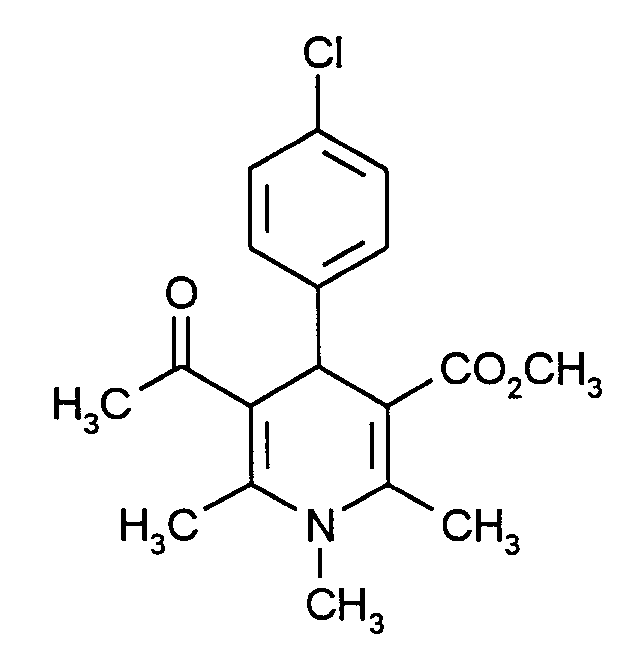
1,0 g (3,2 mmol) der Verbindung aus Beispiel I werden in 15 ml DMF gelöst und unter Argon mit 180 mg NaH versetzt. Man läßt 15 Minuten bei 0°C rühren. Dann tropft man 0,51 ml (6,2 mmol) MeI hinzu und rührt erneut 30 min. Man versetzt nacheinander mit H₂O und Essigsäureethylester und wäscht die organische Phase mit gesättigter wäßriger NaCl-Lösung. Dann wird eingeengt und über Kieselgel aufgetrennt (Petrolether/AcOEt = 1+1). Die entsprechenden Fraktionen kristallisieren aus Et₂O/Petrolether. Man erhält 230 mg der Titelverbindung.
MS: 333,8
Rf = 0,57 (Petrolether/AeOEt = 1+1)
In Analogie zur Vorschrift des Beispiels 8 werden die in Tabelle 2 aufgeführten Verbindungen hergestellt:
Claims (7)
- Verwendung von 1-Alkyl-5-acyl-1,4-dihydropyridinen der allgemeinen Formel (I)
 R¹ für Aryl mit 6 bis 10 Kohlenstoffatomen steht, das gegebenenfalls bis zu 5-fach gleich oder verschieden durch Nitro, Cyano, Halogen, Trifluormethyl oder durch geradkettiges oder verzweigtes Alkylthio mit bis zu 6 Kohlenstoffatomen substituiert ist,R² und R³ gleich oder verschieden sind und jeweils für geradkettiges oder verzweigtes Alkyl mit bis zu 8 Kohlenstoffatomen oder Phenyl stehen, oderR² für geradkettiges oder verzweigtes Alkoxy mit bis zu 8 Kohlenstoffatomen oder für Phenoxy steht, undR⁴ für geradkettiges oder verzweigtes Alkyl mit bis zu 4 Kohlenstoffatomen stehen,zur Herstellung von Arzneimitteln zur Bekämpfung von Erkrankungen des zentralen Nervensystems, die eine selektiv modulierende Wirkung auf Kaliumkanäle besitzen.
 - Verwendung von Verbindungen der allgemeinen Formel (I) gemäß Anspruch 1, in welcherR¹ für Phenyl oder Naphthyl steht, die gegebenenfalls bis zu 3-fach gleich oder verschieden durch Nitro, Cyano, Fluor, Chlor, Brom, Iod, Trifluormethyl oder durch geradkettiges oder verzweigtes Alkylthio mit bis zu 4 Kohlenstoffatomen substituiert sind,R² und R³ gleich oder verschieden sind und jeweils
für geradkettiges oder verzweigtes Alkyl mit bis zu 6 Kohlenstoffatomen oder Phenyl stehen, oderR² für geradkettiges oder verzweigtes Alkoxy mit bis zu 6 Kohlenstoffatomen oder für Phenoxy steht, undR⁴ für geradkettiges oder verzweigtes Alkyl mit bis zu 4 Kohlenstoffatomen steht,zur Herstellung von Arzneimitteln gemäß Anspruch 1. - Verwendung von Verbindungen der allgemeinen Formel (I) gemäß Anspruch 1, in welcherR¹ für Phenyl steht, das gegebenenfalls bis zu 3-fach gleich oder verschieden durch Nitro, Cyano, Fluor, Chlor, Brom, Iod, Trifluormethyl oder durch Methylthio substituiert ist,R² und R³ gleich oder verschieden sind und jeweils für Alkyl mit bis zu 4 Kohlenstoffatomen oder für Phenyl stehen, oderR² für Alkoxy mit bis zu 4 Kohlenstoffatomen oder für Phenoxy steht, undR⁴ für Methyl oder Ethyl steht,zur Herstellung von Arzneimitteln gemäß Anspruch 1.
- Verbindungen der allgemeinen Formel (I) gemäß Anspruch 1, ausgewählt aus der folgenden Gruppe
1-[5-Acetyl-4-(2,4,5-trichlorphenyl)-1,2,6-trimethyl-1,4-dihydropyridin-3 yl]ethanon
1-[5-Acetyl-4-(2,3,5-trichlorphenyl)-1,2,6-trimethyl-1,4-dihydropyridin-3-yl]ethanon
1-[5-Acetyl-4-(3,4,5-trichlorphenyl)-1,2,6-trimethyl-1,4-dihydropyridin-3-yl]ethanon
1-[5-Acetyl-4-(2,3-dichlorphenyl)-1,2,6-trimethyl-1,4-dihydropyridin-3-yl]ethanon
1-[5-Acetyl-4-(4-chlorphenyl)-1,2,6-trimethyl-1,4-dihydropyridin-3-yl]ethanon
1-[5-Acetyl-4-(3,4-dichlorphenyl)-1,2,6-trimethyl-1,4-dihydropyridin-3-yl]ethanon
1-[5-Acetyl-4-(4-fluorphenyl)-1,2,6-trimethyl-1,4-dihydropyridin-3-yl]ethanon
5-Acetyl-4-(4-chlorphenyl)-1,2,6-trimethyl-1,4-dihydropyridin-3-carbonsäure-methylester
5-Acetyl-4-(2,3-dichlorphenyl)-1,2,6-trimethyl-1,4-dihydropyridin-3-carbonsäure-methylester
5-Acetyl-4-(3-nitrophenyl)-1,2,6-trimethyl-1,4-dihydropyridin-3-carbonsäure-methylester
5-Acetyl-4-(3,4,5-trifluorphenyl)-1,2,6-trimethyl-1,4-dihydropyridin-3-carbonsäure-methylester
5-Acetyl-4-(4-fluorphenyl)-1,2,6-trimethyl-1,4-dihydropyridin-3-carbonsäure-methylester
5-Acetyl-4-(3,4-dichlorphenyl)-1,2,6-trimethyl-1,4-dihydropyridin-3-carbonsäure-methylester
5-Acetyl-4-(4-nitrophenyl)-1,2,6-trimethyl-1,4-dihydropyridin-3-carbonsäure-methylester
5-Acetyl-4-(4-chlor-3-trifluormethylphenyl)-1,2,6-trimethyl-1,4-dihydropyridin-3-carbonsäure-methylester - Verfahren zur Herstellung von Verbindungen der allgemeinen Formel (I) gemäß Anspruch 1 und von Verbindungen gemäß Anspruch 4, dadurch gekennzeichnet, daß manA) Aldehyde der allgemeinen Formel (II)
R¹-CHO (II)
in welcherR¹ die oben angegebene Bedeutung hat,mit β-Ketoverbindungen der allgemeinen Formel (III)
R² und R³ die oben angegebene Bedeutung haben,
und mit Alkylaminhydrochloriden in inerten Lösemitteln, gegebenenfalls in Anwesenheit einer Base, umsetzt, oderB) Aldehyde der Formel (II) mit β-Ketoverbindungen der Formel (IIIa) und Enaminen der Formel (IV) R³ die oben angegebene Bedeutung hat,zunächst zu 1,4-Dihydropyridinen der allgemeinen Formel (V)
R¹, R² und R³ die oben angegebene Bedeutung haben,
in inerten Lösemitteln umsetzt,
und anschließend mit Alkylierungsmitteln der allgemeinen Formel (VI)
R⁴-L (VI)
in welcherR⁴ die oben angegebene Bedeutung hat undL für Halogen, vorzugsweise für Brom oder Iod steht,gegebenenfalls unter Schutzgasatmosphäre in inerten Lösemitteln und in Gegenwart einer Base umsetzt. - Arzneimittel zur Behandlung des zentralen Nervensystems enthaltend mindestens eine Verbindung der allgemeinen Formel (I) gemäß Anspruch 1 als selektiven Kaliumkanalmodulator.
- Verfahren zur Herstellung von Arzneimitteln, dadurch gekennzeichnet, daß man mindestens eine Verbindung der allgemeinen Formel (I) gemäß Anspruch 1 gegebenenfalls unter Verwendung von üblichen Hilfs- und Trägerstoffen in eine geeignete Applikationsform überführt.
Priority Applications (1)
| Application Number | Priority Date | Filing Date | Title |
|---|---|---|---|
| SI9530214T SI0717036T1 (en) | 1994-12-16 | 1995-12-04 | Use of 5-acyl-1,4-dihydropyridines for the treatment of diseases of the CNS |
Applications Claiming Priority (2)
| Application Number | Priority Date | Filing Date | Title |
|---|---|---|---|
| DE4444864 | 1994-12-16 | ||
| DE4444864A DE4444864A1 (de) | 1994-12-16 | 1994-12-16 | Verwendung von 5-Acyl-1,4-dihydropyridinen |
Publications (2)
| Publication Number | Publication Date |
|---|---|
| EP0717036A1 true EP0717036A1 (de) | 1996-06-19 |
| EP0717036B1 EP0717036B1 (de) | 1999-03-17 |
Family
ID=6535989
Family Applications (1)
| Application Number | Title | Priority Date | Filing Date |
|---|---|---|---|
| EP95119053A Expired - Lifetime EP0717036B1 (de) | 1994-12-16 | 1995-12-04 | Verwendung von 5-Acyl-1,4-dihydropyridin zur Bekämpfung der Erkrankungen des ZNS |
Country Status (25)
| Country | Link |
|---|---|
| US (2) | US5646166A (de) |
| EP (1) | EP0717036B1 (de) |
| JP (1) | JPH08239364A (de) |
| KR (1) | KR960022464A (de) |
| CN (1) | CN1130505A (de) |
| AT (1) | ATE177735T1 (de) |
| AU (1) | AU704466B2 (de) |
| CA (1) | CA2165130A1 (de) |
| CZ (1) | CZ332995A3 (de) |
| DE (2) | DE4444864A1 (de) |
| DK (1) | DK0717036T3 (de) |
| EE (1) | EE9500075A (de) |
| ES (1) | ES2130506T3 (de) |
| FI (1) | FI956015A7 (de) |
| GR (1) | GR3030319T3 (de) |
| HU (1) | HUT74185A (de) |
| IL (1) | IL116387A (de) |
| NO (1) | NO309125B1 (de) |
| NZ (1) | NZ280662A (de) |
| PL (1) | PL311845A1 (de) |
| RU (1) | RU2158259C2 (de) |
| SI (1) | SI0717036T1 (de) |
| SK (1) | SK158195A3 (de) |
| TW (1) | TW381023B (de) |
| ZA (1) | ZA9510693B (de) |
Cited By (2)
| Publication number | Priority date | Publication date | Assignee | Title |
|---|---|---|---|---|
| EP1284141A3 (de) * | 2001-08-15 | 2003-07-30 | Pfizer Products Inc. | Pharmazeutische Kombinationspräparate zur Behandlung neurodegenerativer Erkrankungen, enthaltend Inhibitoren der neuronalen Stickoxid-Synthase |
| WO2013076516A1 (en) * | 2011-11-24 | 2013-05-30 | Lipidart Kutató Fejlesztő És Tanácsadó Kft. | 1,4- dihydropyridine derivatives with hsp modulating activity |
Families Citing this family (8)
| Publication number | Priority date | Publication date | Assignee | Title |
|---|---|---|---|---|
| AU1459500A (en) * | 1998-10-28 | 2000-05-15 | Abbott Laboratories | Dihydropyridine compounds and methods of use |
| MXPA03006605A (es) * | 2001-01-30 | 2003-09-22 | Lilly Co Eli | Esteres de indol-5-ilo del acido bencensulfonico como antagonistas del receptor 5-ht6. |
| US20050075359A1 (en) * | 2003-03-14 | 2005-04-07 | Rikako Kono | Large conductance calcium-activated K channel opener |
| US20060188938A1 (en) * | 2005-01-07 | 2006-08-24 | Mullan Michael J | Compounds for inhibiting beta-amyloid production and methods of identifying the compounds |
| CN103420901B (zh) * | 2012-05-22 | 2015-06-17 | 中国科学院大连化学物理研究所 | 一种制备1,2-二氢吡啶衍生物的方法 |
| CN103420900B (zh) * | 2012-05-22 | 2015-06-03 | 中国科学院大连化学物理研究所 | 一种制备卤代-1,2-二氢吡啶的方法 |
| CN103804286B (zh) * | 2012-11-06 | 2016-07-06 | 中国科学院大连化学物理研究所 | 一种由3-氮杂-1,5-烯炔制备吡啶衍生物的方法 |
| CN103804283B (zh) * | 2012-11-06 | 2016-04-20 | 中国科学院大连化学物理研究所 | 一种制备1,2-二氢吡啶衍生物的方法 |
Citations (6)
| Publication number | Priority date | Publication date | Assignee | Title |
|---|---|---|---|---|
| DE2018738A1 (en) | 1970-04-18 | 1971-10-28 | Farbenfabriken Bayer Ag, 5090 Leverkusen | Hydrogenated pyridines, quinolines andacridi |
| DE2018739A1 (en) | 1970-04-18 | 1971-10-28 | Farbenfabriken Bayer Ag, 5090 Leverkusen | 1,4-dihydro-3,5-diacyl-4-arylpyridines,coronary active |
| DE2302866A1 (de) * | 1972-01-22 | 1973-08-02 | Yamanouchi Pharma Co Ltd | Neue 1-substituierte-1,4-dihydropyridinderivate |
| US3966948A (en) | 1970-01-24 | 1976-06-29 | Bayer Aktiengesellschaft | Spasmolytic, vaso-dilating and anti-hypertensive compositions and methods |
| EP0406502A1 (de) * | 1989-07-04 | 1991-01-09 | Adir Et Compagnie | Verfahren zur Herstellung von (-)2-(2-(2-Aminoethoxy)ethoxy)methyl)-4-(2,3-dichlorphenyl)-3-ethoxycarbonyl-5-methoxycarbonyl-6-methyl-1,4-dihydropyridin, und Zwischenprodukt zu dessen Herstellung. |
| EP0675409A1 (de) * | 1994-03-29 | 1995-10-04 | Nitto Denko Corporation | Hitzebeständige, negativ-arbeitende Photoresistzusammensetzung, lichtempfindliches Substrat und Verfahren zur Herstellung eines negativen Musters |
Family Cites Families (2)
| Publication number | Priority date | Publication date | Assignee | Title |
|---|---|---|---|---|
| DE3244178A1 (de) * | 1982-11-30 | 1984-05-30 | Bayer Ag, 5090 Leverkusen | 1,4-dihydropyridinderivate, verfahren zu ihrer herstellung sowie ihre verwendung in arzneimitteln |
| US5446057A (en) * | 1993-09-24 | 1995-08-29 | Warner-Lambert Company | Substituted tetrahydropyridine and piperidine carboxylic acids as muscarinic antagonists |
-
1994
- 1994-12-16 DE DE4444864A patent/DE4444864A1/de not_active Withdrawn
-
1995
- 1995-11-24 TW TW084112525A patent/TW381023B/zh not_active IP Right Cessation
- 1995-12-04 ES ES95119053T patent/ES2130506T3/es not_active Expired - Lifetime
- 1995-12-04 DK DK95119053T patent/DK0717036T3/da active
- 1995-12-04 DE DE59505373T patent/DE59505373D1/de not_active Expired - Fee Related
- 1995-12-04 SI SI9530214T patent/SI0717036T1/xx unknown
- 1995-12-04 AT AT95119053T patent/ATE177735T1/de not_active IP Right Cessation
- 1995-12-04 EP EP95119053A patent/EP0717036B1/de not_active Expired - Lifetime
- 1995-12-07 AU AU40293/95A patent/AU704466B2/en not_active Ceased
- 1995-12-08 US US08/569,438 patent/US5646166A/en not_active Expired - Fee Related
- 1995-12-13 CA CA002165130A patent/CA2165130A1/en not_active Abandoned
- 1995-12-13 JP JP7346237A patent/JPH08239364A/ja active Pending
- 1995-12-13 NZ NZ280662A patent/NZ280662A/en unknown
- 1995-12-14 PL PL95311845A patent/PL311845A1/xx unknown
- 1995-12-14 FI FI956015A patent/FI956015A7/fi unknown
- 1995-12-14 IL IL11638795A patent/IL116387A/xx not_active IP Right Cessation
- 1995-12-15 EE EE9500075A patent/EE9500075A/xx unknown
- 1995-12-15 CZ CZ953329A patent/CZ332995A3/cs unknown
- 1995-12-15 RU RU95121070/04A patent/RU2158259C2/ru active
- 1995-12-15 SK SK1581-95A patent/SK158195A3/sk unknown
- 1995-12-15 NO NO955104A patent/NO309125B1/no not_active IP Right Cessation
- 1995-12-15 HU HU9503592A patent/HUT74185A/hu unknown
- 1995-12-15 ZA ZA9510693A patent/ZA9510693B/xx unknown
- 1995-12-15 CN CN95121330A patent/CN1130505A/zh active Pending
- 1995-12-15 KR KR1019950050397A patent/KR960022464A/ko not_active Ceased
-
1997
- 1997-02-11 US US08/798,255 patent/US5942526A/en not_active Expired - Fee Related
-
1999
- 1999-05-27 GR GR990401406T patent/GR3030319T3/el unknown
Patent Citations (6)
| Publication number | Priority date | Publication date | Assignee | Title |
|---|---|---|---|---|
| US3966948A (en) | 1970-01-24 | 1976-06-29 | Bayer Aktiengesellschaft | Spasmolytic, vaso-dilating and anti-hypertensive compositions and methods |
| DE2018738A1 (en) | 1970-04-18 | 1971-10-28 | Farbenfabriken Bayer Ag, 5090 Leverkusen | Hydrogenated pyridines, quinolines andacridi |
| DE2018739A1 (en) | 1970-04-18 | 1971-10-28 | Farbenfabriken Bayer Ag, 5090 Leverkusen | 1,4-dihydro-3,5-diacyl-4-arylpyridines,coronary active |
| DE2302866A1 (de) * | 1972-01-22 | 1973-08-02 | Yamanouchi Pharma Co Ltd | Neue 1-substituierte-1,4-dihydropyridinderivate |
| EP0406502A1 (de) * | 1989-07-04 | 1991-01-09 | Adir Et Compagnie | Verfahren zur Herstellung von (-)2-(2-(2-Aminoethoxy)ethoxy)methyl)-4-(2,3-dichlorphenyl)-3-ethoxycarbonyl-5-methoxycarbonyl-6-methyl-1,4-dihydropyridin, und Zwischenprodukt zu dessen Herstellung. |
| EP0675409A1 (de) * | 1994-03-29 | 1995-10-04 | Nitto Denko Corporation | Hitzebeständige, negativ-arbeitende Photoresistzusammensetzung, lichtempfindliches Substrat und Verfahren zur Herstellung eines negativen Musters |
Non-Patent Citations (2)
| Title |
|---|
| KHIM. GETEROSIKL. SOEDIN, vol. 4, 1983, pages 508 - 513 |
| PUBLIKATION CHEM. HET. COMPOUNDS (ENGL. TRANSL.), vol. 19, no. 4, 1983, pages 415 - 419 |
Cited By (5)
| Publication number | Priority date | Publication date | Assignee | Title |
|---|---|---|---|---|
| EP1284141A3 (de) * | 2001-08-15 | 2003-07-30 | Pfizer Products Inc. | Pharmazeutische Kombinationspräparate zur Behandlung neurodegenerativer Erkrankungen, enthaltend Inhibitoren der neuronalen Stickoxid-Synthase |
| WO2013076516A1 (en) * | 2011-11-24 | 2013-05-30 | Lipidart Kutató Fejlesztő És Tanácsadó Kft. | 1,4- dihydropyridine derivatives with hsp modulating activity |
| AU2012342226B2 (en) * | 2011-11-24 | 2017-09-28 | Richter Gedeon Nyrt. | 1,4- dihydropyridine derivatives with Hsp modulating activity |
| US10258498B2 (en) | 2011-11-24 | 2019-04-16 | Richter Gedeon Nyrt. | 1,4-dihydropyridine derivatives with Hsp modulating activity |
| US10660789B2 (en) | 2011-11-24 | 2020-05-26 | Richter Gedeon Nyrt. | 1,4-dihydropyridine derivatives with HSP modulating activity |
Also Published As
| Publication number | Publication date |
|---|---|
| FI956015L (fi) | 1996-06-17 |
| FI956015A0 (fi) | 1995-12-14 |
| RU2158259C2 (ru) | 2000-10-27 |
| DE59505373D1 (de) | 1999-04-22 |
| IL116387A (en) | 2000-11-21 |
| SK158195A3 (en) | 1996-09-04 |
| US5942526A (en) | 1999-08-24 |
| AU4029395A (en) | 1996-06-27 |
| US5646166A (en) | 1997-07-08 |
| CA2165130A1 (en) | 1996-06-17 |
| NO309125B1 (no) | 2000-12-18 |
| EE9500075A (et) | 1996-06-17 |
| GR3030319T3 (en) | 1999-09-30 |
| NZ280662A (en) | 1997-02-24 |
| HUT74185A (en) | 1996-11-28 |
| TW381023B (en) | 2000-02-01 |
| KR960022464A (ko) | 1996-07-18 |
| NO955104D0 (no) | 1995-12-15 |
| ATE177735T1 (de) | 1999-04-15 |
| IL116387A0 (en) | 1996-03-31 |
| FI956015A7 (fi) | 1996-06-17 |
| NO955104L (no) | 1996-06-17 |
| ES2130506T3 (es) | 1999-07-01 |
| ZA9510693B (en) | 1996-07-03 |
| CZ332995A3 (en) | 1996-07-17 |
| DE4444864A1 (de) | 1996-06-20 |
| PL311845A1 (en) | 1996-06-24 |
| CN1130505A (zh) | 1996-09-11 |
| AU704466B2 (en) | 1999-04-22 |
| SI0717036T1 (en) | 1999-06-30 |
| JPH08239364A (ja) | 1996-09-17 |
| HU9503592D0 (en) | 1996-02-28 |
| EP0717036B1 (de) | 1999-03-17 |
| DK0717036T3 (da) | 1999-10-11 |
Similar Documents
| Publication | Publication Date | Title |
|---|---|---|
| DE69110254T2 (de) | Hydroxychinolonderivate. | |
| EP0705820A1 (de) | 6-Amino-Nicotinsäurederivaten und ihre Verwendung als selektive Kaliumkanalmodulatoren | |
| DE4430639A1 (de) | Verwendung von 5-substituierten Pyridin- und Hexahydrochinolin-3-carbonsäurederivaten | |
| EP0717036B1 (de) | Verwendung von 5-Acyl-1,4-dihydropyridin zur Bekämpfung der Erkrankungen des ZNS | |
| WO1996005837A1 (de) | Verwendung von n-substituierten phenothiazinen | |
| EP0705830A1 (de) | 2,3-Cyclisch kondensierte 1,4-Dihydropyridine, Verfahren zu ihrer Herstellung und ihre Verwendung als selektive Kaliumkanalmodulatoren | |
| EP0770082B1 (de) | Dioxo-thiopyrano-pyridin-carbonsäure-derivate und ihre verwendung als arzneimittel | |
| EP0525568B1 (de) | N-alkylierte 1,4-Dihydropyridincarbonsäureester | |
| EP0539803A1 (de) | Triazaspirodecanon-Methyl-Chromane zur Bekämpfung von Erkrankungen des Zentralnervensystems | |
| EP0717043B1 (de) | Verwendung von 1,2-überbrückten 1,4-Dihydropyridinen als selektive Kaliumkanalmodulatoren | |
| EP0777663B1 (de) | Verwendung von substituierten 6-amino-4h-pyranen | |
| EP0705819A1 (de) | 1,4-Dihydropyridin-3,5-dicarbonsäureestern und ihre Verwendung als selektive Kaliumkanalmodulatoren | |
| EP0595166B1 (de) | 4-Heterocyclyl substituierte Dihydropyridine | |
| EP0538690A1 (de) | Aryl-Chinolyl-substituierte 1,4-Dihydropyridin-dicarbonsäurederivate, Verfahren zu ihrer Herstellung und ihre Verwendung in Arzneimitteln | |
| EP0698597B1 (de) | Cyclohexadienderivate | |
| DE19529858A1 (de) | Substituierte 4H-Pyrane | |
| EP0758647B1 (de) | Acyl-substituierte Aminopyrane mit einer modulierende Wirkung auf Kaliumkanäle | |
| EP0657431B1 (de) | 4-Phenyl-3-substituierte 1,4-Dihydropyridinester mit cerebraler Aktivität | |
| EP0657430B1 (de) | Isopropyl-(2-methoxyethyl)-4-(2-chlor-3-cyano-phenyl)-1,4-dihydro-2,6-dimethyl-pyridin-3,5-dicarboxylat | |
| EP0657432A1 (de) | Phenyl-substituierte 1,4-Dihydropyridine mit cerebraler Aktivität | |
| EP0704434A1 (de) | 6-Amino-1,4-Dihydropyridinen und ihre Verwendung als selektive Kaliumkanalmodulatoren | |
| EP0657434A1 (de) | Arylsubstituierte Alkoxycarbonyl-1,4-dihydropyridin-5-carbonsäureester mit cerebraler Wirksamkeit | |
| DE4236705A1 (de) | 4-Pyrrolylphenyl substituierte Dihydropyridine | |
| DE3431700A1 (de) | Neue 1,4-dihydro-pyridazin-derivate, verfahren zu ihrer herstellung und ihre verwendung in arzneimitteln | |
| DE4342194A1 (de) | Halogen-phenyl-substituierte 1,4-Dihydropyridine |
Legal Events
| Date | Code | Title | Description |
|---|---|---|---|
| PUAI | Public reference made under article 153(3) epc to a published international application that has entered the european phase |
Free format text: ORIGINAL CODE: 0009012 |
|
| AK | Designated contracting states |
Kind code of ref document: A1 Designated state(s): AT BE CH DE DK ES FR GB GR IE IT LI LU MC NL PT SE |
|
| AX | Request for extension of the european patent |
Free format text: LT PAYMENT 951204;LV PAYMENT 951204;SI PAYMENT 951204 |
|
| RAX | Requested extension states of the european patent have changed |
Free format text: LT PAYMENT 951204;LV PAYMENT 951204;SI PAYMENT 951204 |
|
| 17P | Request for examination filed |
Effective date: 19961115 |
|
| 17Q | First examination report despatched |
Effective date: 19970603 |
|
| GRAG | Despatch of communication of intention to grant |
Free format text: ORIGINAL CODE: EPIDOS AGRA |
|
| GRAG | Despatch of communication of intention to grant |
Free format text: ORIGINAL CODE: EPIDOS AGRA |
|
| GRAH | Despatch of communication of intention to grant a patent |
Free format text: ORIGINAL CODE: EPIDOS IGRA |
|
| GRAH | Despatch of communication of intention to grant a patent |
Free format text: ORIGINAL CODE: EPIDOS IGRA |
|
| GRAA | (expected) grant |
Free format text: ORIGINAL CODE: 0009210 |
|
| AK | Designated contracting states |
Kind code of ref document: B1 Designated state(s): AT BE CH DE DK ES FR GB GR IE IT LI LU MC NL PT SE |
|
| AX | Request for extension of the european patent |
Free format text: LT PAYMENT 951204;LV PAYMENT 951204;SI PAYMENT 951204 |
|
| REF | Corresponds to: |
Ref document number: 177735 Country of ref document: AT Date of ref document: 19990415 Kind code of ref document: T |
|
| REG | Reference to a national code |
Ref country code: CH Ref legal event code: NV Representative=s name: E. BLUM & CO. PATENTANWAELTE Ref country code: CH Ref legal event code: EP |
|
| GBT | Gb: translation of ep patent filed (gb section 77(6)(a)/1977) |
Effective date: 19990319 |
|
| REG | Reference to a national code |
Ref country code: IE Ref legal event code: FG4D Free format text: GERMAN |
|
| REF | Corresponds to: |
Ref document number: 59505373 Country of ref document: DE Date of ref document: 19990422 |
|
| ET | Fr: translation filed | ||
| ITF | It: translation for a ep patent filed | ||
| REG | Reference to a national code |
Ref country code: ES Ref legal event code: FG2A Ref document number: 2130506 Country of ref document: ES Kind code of ref document: T3 |
|
| REG | Reference to a national code |
Ref country code: DK Ref legal event code: T3 |
|
| PLBE | No opposition filed within time limit |
Free format text: ORIGINAL CODE: 0009261 |
|
| STAA | Information on the status of an ep patent application or granted ep patent |
Free format text: STATUS: NO OPPOSITION FILED WITHIN TIME LIMIT |
|
| 26N | No opposition filed | ||
| PGFP | Annual fee paid to national office [announced via postgrant information from national office to epo] |
Ref country code: DE Payment date: 20001115 Year of fee payment: 6 |
|
| PGFP | Annual fee paid to national office [announced via postgrant information from national office to epo] |
Ref country code: SE Payment date: 20001120 Year of fee payment: 6 |
|
| PGFP | Annual fee paid to national office [announced via postgrant information from national office to epo] |
Ref country code: IE Payment date: 20001121 Year of fee payment: 6 |
|
| PGFP | Annual fee paid to national office [announced via postgrant information from national office to epo] |
Ref country code: FR Payment date: 20001122 Year of fee payment: 6 |
|
| PGFP | Annual fee paid to national office [announced via postgrant information from national office to epo] |
Ref country code: MC Payment date: 20001129 Year of fee payment: 6 Ref country code: GB Payment date: 20001129 Year of fee payment: 6 Ref country code: AT Payment date: 20001129 Year of fee payment: 6 |
|
| PGFP | Annual fee paid to national office [announced via postgrant information from national office to epo] |
Ref country code: PT Payment date: 20001130 Year of fee payment: 6 Ref country code: CH Payment date: 20001130 Year of fee payment: 6 |
|
| PGFP | Annual fee paid to national office [announced via postgrant information from national office to epo] |
Ref country code: GR Payment date: 20001213 Year of fee payment: 6 Ref country code: ES Payment date: 20001213 Year of fee payment: 6 |
|
| PGFP | Annual fee paid to national office [announced via postgrant information from national office to epo] |
Ref country code: LU Payment date: 20001218 Year of fee payment: 6 |
|
| PGFP | Annual fee paid to national office [announced via postgrant information from national office to epo] |
Ref country code: BE Payment date: 20001220 Year of fee payment: 6 |
|
| PGFP | Annual fee paid to national office [announced via postgrant information from national office to epo] |
Ref country code: DK Payment date: 20001229 Year of fee payment: 6 |
|
| PGFP | Annual fee paid to national office [announced via postgrant information from national office to epo] |
Ref country code: NL Payment date: 20001231 Year of fee payment: 6 |
|
| LTLA | Lt: lapse of european patent or patent extension | ||
| PG25 | Lapsed in a contracting state [announced via postgrant information from national office to epo] |
Ref country code: MC Free format text: LAPSE BECAUSE OF NON-PAYMENT OF DUE FEES Effective date: 20011204 Ref country code: LU Free format text: LAPSE BECAUSE OF NON-PAYMENT OF DUE FEES Effective date: 20011204 Ref country code: IE Free format text: LAPSE BECAUSE OF FAILURE TO SUBMIT A TRANSLATION OF THE DESCRIPTION OR TO PAY THE FEE WITHIN THE PRESCRIBED TIME-LIMIT Effective date: 20011204 Ref country code: GB Free format text: LAPSE BECAUSE OF NON-PAYMENT OF DUE FEES Effective date: 20011204 Ref country code: DK Free format text: LAPSE BECAUSE OF NON-PAYMENT OF DUE FEES Effective date: 20011204 Ref country code: AT Free format text: LAPSE BECAUSE OF NON-PAYMENT OF DUE FEES Effective date: 20011204 |
|
| PG25 | Lapsed in a contracting state [announced via postgrant information from national office to epo] |
Ref country code: SE Free format text: LAPSE BECAUSE OF NON-PAYMENT OF DUE FEES Effective date: 20011205 |
|
| PG25 | Lapsed in a contracting state [announced via postgrant information from national office to epo] |
Ref country code: LI Free format text: LAPSE BECAUSE OF NON-PAYMENT OF DUE FEES Effective date: 20011231 Ref country code: GR Free format text: LAPSE BECAUSE OF NON-PAYMENT OF DUE FEES Effective date: 20011231 Ref country code: CH Free format text: LAPSE BECAUSE OF NON-PAYMENT OF DUE FEES Effective date: 20011231 Ref country code: BE Free format text: LAPSE BECAUSE OF NON-PAYMENT OF DUE FEES Effective date: 20011231 |
|
| REG | Reference to a national code |
Ref country code: GB Ref legal event code: IF02 |
|
| BERE | Be: lapsed |
Owner name: BAYER A.G. Effective date: 20011231 |
|
| PG25 | Lapsed in a contracting state [announced via postgrant information from national office to epo] |
Ref country code: PT Free format text: LAPSE BECAUSE OF NON-PAYMENT OF DUE FEES Effective date: 20020630 |
|
| PG25 | Lapsed in a contracting state [announced via postgrant information from national office to epo] |
Ref country code: NL Free format text: LAPSE BECAUSE OF NON-PAYMENT OF DUE FEES Effective date: 20020701 |
|
| PG25 | Lapsed in a contracting state [announced via postgrant information from national office to epo] |
Ref country code: DE Free format text: LAPSE BECAUSE OF NON-PAYMENT OF DUE FEES Effective date: 20020702 |
|
| GBPC | Gb: european patent ceased through non-payment of renewal fee |
Effective date: 20011204 |
|
| EUG | Se: european patent has lapsed |
Ref document number: 95119053.7 |
|
| REG | Reference to a national code |
Ref country code: CH Ref legal event code: PL |
|
| PG25 | Lapsed in a contracting state [announced via postgrant information from national office to epo] |
Ref country code: FR Free format text: LAPSE BECAUSE OF NON-PAYMENT OF DUE FEES Effective date: 20020830 |
|
| NLV4 | Nl: lapsed or anulled due to non-payment of the annual fee |
Effective date: 20020701 |
|
| REG | Reference to a national code |
Ref country code: DK Ref legal event code: EBP |
|
| REG | Reference to a national code |
Ref country code: FR Ref legal event code: ST |
|
| REG | Reference to a national code |
Ref country code: PT Ref legal event code: MM4A Free format text: LAPSE DUE TO NON-PAYMENT OF FEES Effective date: 20020630 |
|
| REG | Reference to a national code |
Ref country code: IE Ref legal event code: MM4A |
|
| PG25 | Lapsed in a contracting state [announced via postgrant information from national office to epo] |
Ref country code: ES Free format text: LAPSE BECAUSE OF NON-PAYMENT OF DUE FEES Effective date: 20021205 |
|
| REG | Reference to a national code |
Ref country code: ES Ref legal event code: FD2A Effective date: 20030113 |
|
| PG25 | Lapsed in a contracting state [announced via postgrant information from national office to epo] |
Ref country code: IT Free format text: LAPSE BECAUSE OF NON-PAYMENT OF DUE FEES Effective date: 20051204 |