EP0714656B1 - Capsule shell compositions and their use - Google Patents
Capsule shell compositions and their use Download PDFInfo
- Publication number
- EP0714656B1 EP0714656B1 EP19950307898 EP95307898A EP0714656B1 EP 0714656 B1 EP0714656 B1 EP 0714656B1 EP 19950307898 EP19950307898 EP 19950307898 EP 95307898 A EP95307898 A EP 95307898A EP 0714656 B1 EP0714656 B1 EP 0714656B1
- Authority
- EP
- European Patent Office
- Prior art keywords
- gelling agent
- carrageenan
- capsule
- hpmc
- weight
- Prior art date
- Legal status (The legal status is an assumption and is not a legal conclusion. Google has not performed a legal analysis and makes no representation as to the accuracy of the status listed.)
- Expired - Lifetime
Links
Images
Classifications
-
- A—HUMAN NECESSITIES
- A61—MEDICAL OR VETERINARY SCIENCE; HYGIENE
- A61K—PREPARATIONS FOR MEDICAL, DENTAL OR TOILETRY PURPOSES
- A61K9/00—Medicinal preparations characterised by special physical form
- A61K9/48—Preparations in capsules, e.g. of gelatin, of chocolate
- A61K9/4816—Wall or shell material
Definitions
- This invention relates to a composition for forming medical hard capsules. More particularly, it relates to such a capsule shell composition using hydroxypropylmethyl cellulose as a base.
- Medical hard capsules are conventionally formed from compositions comprising gelatin as a base with a plasticizer such as glycerin and sorbitol, opaque agent, dye, pigment and other additives blended therein. After molding pins are immersed in a gelatin aqueous solution with such components blended and withdrawn therefrom, the gelatin solution adhering to the pins is dried, obtaining capsule shells.
- the shell-forming compositions based on gelatin have the problem that the plasticity and other properties of shells largely depend on a water content. With a too low water content, shells are less resistant against shocks as encountered on drug filling. Also, as the water content lowers due to drying during shelf storage, shells can contract to loosen the cap-body engagement of capsules.
- JP-B Japanese Patent Publication
- JP-A Japanese Patent Application Kokai Nos. 100519/1986 and 266060/1987 disclose to prepare capsules from an aqueous solution of water-soluble cellulose ether and polyvinyl alcohol (PVA) blended therewith.
- JP-B-4310/1972's shell forming method involves the steps of immersing molding pins in an aqueous solution of water-soluble cellulose derivative and heating the pins and hence, the coating adhered thereto for gelation.
- the coating is not gelled or solidified and can fall down from the pins if heating is insufficient.
- the coating can be wrinkled during gelation if the heating temperature is too high.
- the water-soluble cellulose derivative adhered to the molding pins is gelled by immersing it in hot water. Some of the gelled coating can be dissolved in the hot water at this point, hindering formation of uniform shells.
- due to low jelly strength the dried shells can often be cracked upon removal from the molding pins. In either of these methods, it is difficult to produce capsule shells having a low water content.
- this capsule is inferior to conventional gelatin capsules in solubility or disintegrating ability under certain conditions. More particularly, one preferred formulation of this capsule shell composition uses hydroxypropylmethyl cellulose as a water-soluble cellulose derivative base, carrageenan as a gelling agent and a potassium ion as a co-gelling agent. Shells of this preferred formulation take a long time to disintegrate under special conditions where calcium ions are present. Then, if a capsule of this composition filled with drugs is administered after having a food or beverage containing much calcium ions, for example, milk, then the capsule is retarded from disintegration. Then the drugs are not fully released or absorbed within a proper time, failing to fully exert their pharmaceutical effect. Therefore, it is desired to further improve the properties of the capsule based on a water-soluble cellulose derivative.
- the general aim herein is to provide new and useful capsule shell compositions, their use, and the resulting shells; also the shells when loaded with pharmaceutical.
- One preferred aim herein is to provide a capsule shell composition based on a water-soluble cellulose derivative which does not degrade its disintegration ability under special conditions where much calcium ion is present, that is, exerts its performance under any condition.
- the capsule shell composition comprising hydroxypropylmethyl cellulose (to be abbreviated as HPMC, hereinafter) as a water-soluble cellulose derivative base, carrageenan as a gelling agent, and a potassium ion as a co-gelling agent wherein the shapability of HPMC is improved by blending carrageenan as a gelling agent and gelling this carrageenan with the co-gelling agent, we found that the disintegration ability of this composition is degraded in the presence of calcium ions because the calcium ions inhibit dissolution of the carrageenan blended in the composition as the gelling agent.
- HPMC hydroxypropylmethyl cellulose
- the present invention provides a capsule shell composition
- a capsule shell composition comprising
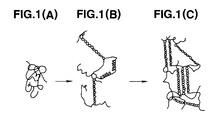
- FIG. 1 schematically illustrates the gelation mechanism of carrageenan.
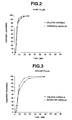
- FIG. 2 is a graph showing the percent leaching of the contents from a capsule of Example 1 and a conventional gelatin capsule when they were immersed in a first solution prescribed in the Pharmacopoeia of Japan.
- FIG. 3 is a graph showing the percent leaching of the contents from a capsule of Example 1 and a conventional gelatin capsule when they were immersed in a second solution prescribed in the Pharmacopoeia of Japan.
- a capsule shell composition comprising HPMC as a base, carrageenan as a gelling agent and a co-gelling agent for assisting in gelation of carrageenan
- the present invention optimizes the viscosity of HPMC and the blending proportion of the respective components such that the composition may maintain satisfactory disintegration ability even under special conditions where many calcium ions are present.
- the HPMC used as the base may be a commercially available powder product.
- the HPMC should be a low viscosity one such that a 2% aqueous solution of HPMC has a viscosity of 2.4 to 5.4*10 -6 m 2 / s (2.4 to 5.4 centistokes) at 20°C, preferably 3.0 to 4.6*10 -6 m 2 / s (3.0 to 4.6 centistokes) at 20°C.
- the viscosity of HPMC is not the viscosity of HPMC itself, but the viscosity of a 2% aqueous solution of HPMC throughout the specification.
- an immersion solution of HPMC from which a capsule shell composition is to be obtained by a dipping technique has a viscosity too low to shape the capsule shell composition.
- an immersion solution has too high a viscosity, which requires to reduce the amount of HPMC blended which in turn, requires to increase the proportion of the gelling agent blended, failing to achieve the desired aim.
- Such low viscosity HPMC is commercially available e.g. as TC-5M type HPMC (2% aqueous solution viscosity 4.5*10 -6 m 2 / s(4.5 centistokes) at 20°C) and TC-5E type HPMC (2% aqueous solution viscosity 3.0*10 -6 m 2 / s(3.0 centistokes) at 20°C) from Shin-Etsu Chemical Co., Ltd.
- HPMC products may be used alone or suitably blended to form a mixture having a viscosity of 3.0 to 4.6*10 -6 m 2 / s (3.0 to 4.6 centistokes).
- such a HPMC product may be blended with another HPMC product having higher or lower viscosity (by itself outside the range prescribed here) to form a mixture having an optimum viscosity as defined- above.
- the proportion of HPMC blended is 18 to 28 parts by weight, preferably 19 to 25 parts by weight relative to the remaining components to be defined later.
- Capsule shells may be formed from the capsule shell composition according to the invention by dissolving the composition in water to form an aqueous immersion solution, immersing molding pins in the immersion solution, withdrawing the pins from the solution with the solution adhering to the periphery of the pins, and drying the adhering solution. If the proportion of HPMC blended is less than 18 parts by weight, the proportion of the gelling agent blended becomes relatively high, failing to achieve the desired aim herein. If the proportion of HPMC blended is more than 28 parts by weight, the proportion of the gelling agent blended becomes relatively low, but the immersion solution has a viscosity too high to shape capsule shells by the dipping technique.
- Carrageenan is blended as the gelling agent.
- Carrageenan generally includes three types, iota ( ), kappa ( ⁇ ) and lambda ( ⁇ ). Among these, -carrageenan and ⁇ -carrageenan having a gelling ability are suitable, with the K-carrageenan being preferred.
- the proportion of carrageenan blended is 0.01 to 0.1 part by weight, preferably 0.01 to 0.09 part by weight, more preferably 0.07 to 0.09 part by weight relative to the above-mentioned amount of HPMC. If the proportion of carrageenan blended is less than 0.01 part by weight, no satisfactory degree of gelation is achieved and shells of sufficient gage cannot be formed by the dipping technique. If the proportion of carrageenan blended exceeds 0.1 part by weight, the composition loses disintegration ability in the presence of calcium ions.
- the co-gelling agent for assisting in gelation of carrageenan comprising potassium ion, calcium ion or both.
- potassium ion is used for -carrageenan and potassium ion is used for ⁇ -carrageenan. It is most preferred to use ⁇ -carrageenan as the gelling agent and a potassium ion as the co-gelling agent.
- the potassium ion may be blended in the form of a water-soluble compound such as potassium chloride, potassium phosphate and potassium citrate.
- the calcium ion may also be blended in the form of a water-soluble compound such as calcium chloride.
- the proportion of co-gelling agent blended is 0.05 to 0.6 part by weight, preferably 0.06 to 0.1 part by weight in ionic amount relative to the above-mentioned amount of HPMC and gelling agent. If the proportion of the agent blended is less than 0.05 part by weight, no satisfactory gelation of carrageenan is achieved and shells of sufficient gage cannot be formed by the dipping technique. If the proportion of co-gelling agent blended exceeds 0.6 part by weight, a gelled film forms in an aqueous immersion solution, shell formation by the dipping technique is difficult, and shells, even formed, are low in disintegration ability.
- the shapability of HPMC is improved by gelling carrageenan as the gelling agent with the co-gelling agent.
- the gelation of carrageenan follows the mechanism schematically shown in FIG.1, i.e carrageenan molecules form double helix structures with the aid of the co-gelling agent (FIG. 1B) to form a three-dimensional network. If the thus gelled carrageenan comes in contact with calcium ions, the double helix structures increase to strengthen the three-dimensional network (FIG. 1C). Also crosslinking occurs between adjacent sulfate groups in adjacent double helix structures to stabilize the three-dimensional network. Then the gel increases its hardness to detract from solubility or disintegration ability.
- the amount of carrageenan relative to HPMC is set at a very low level. Then even when double helix structures of carrageenan increase upon contact with calcium ions and crosslinking occurs between sulfate groups in double helix structures, the interstice structure resulting from tangling of carrageenan molecules is maintained in a relatively coarse state so that strong gelation does not occur. In this way, satisfactory disintegration ability is maintained.
- the composition forms a capsule shell of 0.1 mm thick which will have an opening time within 4 minutes, more preferably within 2-1/2 minutes when immersed in an aqueous solution of 0.1M potassium chloride at 37°C.
- the potassium ion inhibits dissolution of carrageenan through a similar mechanism to the inhibitory mechanism of the calcium ion and rather to a greater extent than the calcium ion.
- the dissolution of a shell in the presence of potassium ions can represent the dissolution of a shell in the presence of calcium ions.
- a shell having satisfactory dissolution characteristics in an aqueous solution of potassium chloride will exhibit satisfactory disintegration ability comparable to that of conventional gelatin shells even in an environment where much calcium ion is present. It is thus understood that a shell composition as described having a dissolution time as defined above of more than 4 minutes will still have practically acceptable dissolution property in the presence of calcium ions.
- the capsule shell composition of the invention containing the above-defined HPMC base, carrageenan gelling agent and co-gelling agent in the above-defined proportion, there may be further blended various additives such as coloring agents (e.g., dyes and pigments), opaque agents, and flavors in conventional amounts.
- coloring agents e.g., dyes and pigments
- the capsule shell composition may be prepared in the form of a capsule shell by a well-known dipping technique as used in the manufacture of conventional gelatin capsule shells. More particularly, medical hard capsules are prepared by blending the HPMC, gelling agent, co-gelling agent and optional additives in water to form an aqueous solution or immersion solution, once immersing molding pins in the immersion solution, withdrawing the pins from the solution with the solution adhering to the periphery of the pins, drying the adhering solution to form capsule shells (body or cap), and removing the shells from the pins. The shells are cut to a suitable size if necessary. A pair of body and cap shells are mated to form a capsule. In this way, the capsule shell composition of the invention is available in the form of a capsule shell.
- the immersion solution in which shaping pins are immersed is preferably set at a temperature of 48 to 55°C, especially 51 to 53°C. Outside this temperature range, the immersion solution would have a finely varying jelly viscosity and thickly or thinly adhere to the pins, failing to form shells of uniform gage. Thereafter the immersion solution adhering to the pins is preferably dried at a temperature of 25 to 35°C for 40 to 60 minutes. Through the drying step, the immersion solution adhering to the pins is concentrated to form hard shells around the pins. Other conditions may be the same as used in the manufacture of conventional gelatin shells.
- Hard capsules formed of the present compositions are well suited for medical application. They may be also used in other applications such as food.
- HPMC capsules of the inventive composition will effectively disintegrate in the stomach even when they are administered after drinking milk containing much calcium ions, achieving equivalent performance to conventional gelatin capsules. Then the invention enables to take full advantage of HPMC-base hard capsules.
- Potassium chloride was dissolved in pure water at about 75°C. With stirring, ⁇ -carrageenan and a coloring agent (titanium oxide) were added to the solution and dissolved therein. With stirring, hydroxypropylmethyl cellulose (HPMC) was added to the solution and dispersed therein. The solution was cooled to a temperature of 50°C and further agitated for dissolving the HPMC therein. The solution was then allowed to stand for deaeration. In this way, two immersion solutions were obtained as shown in Table 1.
- ⁇ -carrageenan and a coloring agent titanium oxide
- HPMC hydroxypropylmethyl cellulose
- a conventional capsule shell forming apparatus was charged with the immersion solution which was maintained at 52°C.
- the apparatus was operated in accordance with a conventional dipping technique to prepare No. 2 capsule shells of the shell composition shown in Table 1 having a thickness of 0.1 mm. In this way, two types of capsule shells were obtained.
- TC-5R, TC-5MW and TC-5EW are trade names of HPMC manufactured by Shin-Etsu Chemical Co., Ltd.
- TC-5R has a viscosity of 6.0 centistokes
- TC-5MW has a viscosity of 4.5 ⁇ 10 -6 m 2 / s (4.5 centistokes)
- TC-5EW has a viscosity of 3.0 10 -6 m 2 / s (3.0 centistokes), as measured in 2% aqueous solution at 20°C.
- the viscosity of Example 1 is that of a 1/1 mixture of TC-5MW and TC-5EW.
- the capsules were filled with 0.3 g of corn starch and immersed in an aqueous solution of 0.1M potassium chloride at 37°C.
- the opening time was measured by means of a disintegration tester as prescribed in the Pharmacopoeia of Japan. Three measurements were taken and an average was calculated. The results are shown in Table 2.
- a conventional gelatin capsule was similarly measured for opening time, with the results shown in Table 2.
- the capsules were filled with 0.7 g of copper wire as a weight and immersed in milk at 37°C.
- the opening time was measured by means of a disintegration tester as prescribed in the Pharmacopoeia of Japan. Three measurements were taken and an average was calculated. The results are shown in Table 3.
- a conventional gelatin capsule was similarly measured for opening time, with the results shown in Table 3.
- the capsule shell composition of the invention exhibits disintegration ability comparable to the conventional gelatin capsule even in milk, containing much calcium ion.
- Example 1 the capsule of Example 1 and a conventional gelatin capsule were evaluated for disintegration ability in the first and second fluids prescribed in the Pharmacopoeia of Japan, Section 12.
- the capsules were each filled with 300 mg of a mixture of 20 parts by weight of acetaminophen and 280 parts by weight of corn starch.
- the capsules were immersed in the first and second fluids. While stirring the test solution by rotating a paddle at 100 rpm, the percent leaching of the contents was measured. The results are plotted in the graphs of FIGS. 2 and 3.
- Example 1 has an equivalent disintegration ability to that of the conventional gelatin capsule in both the first and second fluids prescribed in the Pharmacopoeia of Japan. This suggests that the hard capsules of the shell composition according to the invention are useful as medical capsules.
- Capsule shells were prepared from an immersion solution by the same procedure as in Example 1. The compositions of immersion solutions and capsule shells are shown in Table 4.
- Example 2 Example 3 Immersion solution HPMC: TC-5MW 18% - T-C-5EW - 28% Viscosity 4.5 cst 3.0 cst ⁇ -carrageenan 0.1% 0.01% Potassium chloride 0.11% 1.0% (potassium ion) (0.06%) (0.5%) Titanium oxide 0.69% 1.11%
Landscapes
- Health & Medical Sciences (AREA)
- Chemical & Material Sciences (AREA)
- Medicinal Chemistry (AREA)
- Pharmacology & Pharmacy (AREA)
- Epidemiology (AREA)
- Life Sciences & Earth Sciences (AREA)
- Animal Behavior & Ethology (AREA)
- General Health & Medical Sciences (AREA)
- Public Health (AREA)
- Veterinary Medicine (AREA)
- Medicinal Preparation (AREA)
Applications Claiming Priority (6)
| Application Number | Priority Date | Filing Date | Title |
|---|---|---|---|
| JP32358194 | 1994-12-01 | ||
| JP323581/94 | 1994-12-01 | ||
| JP32358194 | 1994-12-01 | ||
| JP333965/94 | 1994-12-16 | ||
| JP33396594 | 1994-12-16 | ||
| JP6333965A JP2959423B2 (ja) | 1994-12-01 | 1994-12-16 | カプセル用皮膜組成物 |
Publications (2)
| Publication Number | Publication Date |
|---|---|
| EP0714656A1 EP0714656A1 (en) | 1996-06-05 |
| EP0714656B1 true EP0714656B1 (en) | 2001-02-28 |
Family
ID=26571237
Family Applications (1)
| Application Number | Title | Priority Date | Filing Date |
|---|---|---|---|
| EP19950307898 Expired - Lifetime EP0714656B1 (en) | 1994-12-01 | 1995-11-06 | Capsule shell compositions and their use |
Country Status (4)
| Country | Link |
|---|---|
| EP (1) | EP0714656B1 (enExample) |
| JP (1) | JP2959423B2 (enExample) |
| DE (1) | DE69520194T2 (enExample) |
| ES (1) | ES2156198T3 (enExample) |
Cited By (12)
| Publication number | Priority date | Publication date | Assignee | Title |
|---|---|---|---|---|
| US6331205B1 (en) | 1997-08-08 | 2001-12-18 | Laurence Paris | Aqueous viscous compositions, whether clear or not, for making soft or hard capsules, and method for making films for such capsules |
| US6340473B1 (en) | 1999-07-07 | 2002-01-22 | R.P. Scherer Technologies, Inc. | Film forming compositions comprising modified starches and iota-carrageenan and methods for manufacturing soft capsules using same |
| US6432448B1 (en) | 1999-02-08 | 2002-08-13 | Fmc Corporation | Edible coating composition |
| WO2003009832A1 (en) * | 2001-07-24 | 2003-02-06 | Cardinal Health Australia 401 Pty Ltd | Non-gelatin based capsules |
| US6649180B1 (en) | 1999-04-14 | 2003-11-18 | Shionogi Qualicaps Co., Ltd. | Hard capsule formed of cellulose ether film with a specific content of methoxyl and hydroxypropoxyl groups |
| US6699315B2 (en) | 2000-11-28 | 2004-03-02 | Fmc Corporation | Edible PGA coating composition |
| US6723342B1 (en) | 1999-02-08 | 2004-04-20 | Fmc Corporation | Edible coating composition |
| US6932861B2 (en) | 2000-11-28 | 2005-08-23 | Fmc Corporation | Edible PGA coating composition |
| US7785650B2 (en) | 2001-05-15 | 2010-08-31 | Mcneil-Ppc, Inc. | Method for dip coating dosage forms |
| US10130587B2 (en) | 2011-01-11 | 2018-11-20 | Capsugel Belgium Nv | Hard capsules |
| US10765194B2 (en) * | 2015-11-06 | 2020-09-08 | Lotte Fine Chemical Co., Ltd. | Method of preparing dry hydrogel sheet and dry hydrogel sheet prepared by the same |
| US11878079B2 (en) | 2017-04-14 | 2024-01-23 | Capsugel Belgium Nv | Pullulan capsules |
Families Citing this family (38)
| Publication number | Priority date | Publication date | Assignee | Title |
|---|---|---|---|---|
| FR2757173A1 (fr) * | 1996-12-17 | 1998-06-19 | Warner Lambert Co | Compositions polymeres d'origine non-animale pour la formation de films |
| ES2234306T3 (es) * | 1998-09-28 | 2005-06-16 | Warner-Lambert Company Llc | Administracion enterica y via colon usando capsulas de hpmc. |
| JP3449253B2 (ja) | 1998-10-29 | 2003-09-22 | シオノギクオリカプス株式会社 | 硬質カプセルの製造方法 |
| KR20000052283A (ko) * | 1999-01-25 | 2000-08-16 | 양주환 | 식물성 하드 공캅셀 및 그의 제조방법 |
| JP2000212070A (ja) * | 1999-01-25 | 2000-08-02 | Su Heung Capsule Co Ltd | 植物性ハ―ド空カプセル及びその製造方法 |
| WO2003011257A1 (en) * | 2001-08-01 | 2003-02-13 | Jasjit Singh | Composition and process the manufacture of soluble containers with improved gel-strength |
| KR100686300B1 (ko) * | 2002-11-22 | 2007-02-26 | 에자이 가부시키가이샤 | 테프레논을 충전한 히드록시프로필메틸셀룰로오스 캡슐제제 |
| US7485322B2 (en) * | 2002-12-24 | 2009-02-03 | Lek Pharmaceuticals D.D. | Modified release pharmaceutical composition |
| EP1437129B2 (de) * | 2003-01-08 | 2012-05-09 | Swiss Caps Rechte und Lizenzen AG | Formkörper bestehend aus gelatinfreiem Material und gefüllt mit einer flüssigen Füllmasse |
| CA2516327C (en) * | 2003-02-21 | 2012-04-17 | Lek Pharmaceuticals D.D | Therapeutic system comprising amoxicillin and clavulanic acid |
| US7816341B2 (en) | 2003-04-14 | 2010-10-19 | Fmc Corporation | Homogeneous, thermoreversible gel containing reduced viscosity carrageenan and products made therefrom |
| WO2004091528A2 (en) | 2003-04-14 | 2004-10-28 | Fmc Corporation | Delivery systems of homogeneous thermoreversible alginate films |
| US20060093560A1 (en) * | 2004-10-29 | 2006-05-04 | Jen-Chi Chen | Immediate release film coating |
| JP5253162B2 (ja) * | 2006-01-24 | 2013-07-31 | クオリカプス株式会社 | 低水分硬質カプセル、及びその製造方法 |
| EP1849461A1 (en) * | 2006-04-21 | 2007-10-31 | Pfizer Products Inc. | Process for manufacturing films |
| MX2009004434A (es) | 2006-10-27 | 2009-05-08 | Pfizer Prod Inc | Capsulas duras de hidroxipropilmetilcelulosa y procedimiento de fabricacion. |
| EP2397160A1 (en) * | 2009-02-13 | 2011-12-21 | Nisshin Kasei Co., Ltd. | Hard capsule |
| JP5730205B2 (ja) * | 2009-08-31 | 2015-06-03 | 日新化成株式会社 | コーティング用組成物 |
| US9394376B2 (en) | 2010-10-12 | 2016-07-19 | Dow Global Technologies Llc | Cellulose ethers and their use |
| KR101902751B1 (ko) | 2011-04-06 | 2018-10-02 | 다우 글로벌 테크놀로지스 엘엘씨 | 높은 벌크 밀도, 양호한 유동성 및 개선된 냉수 분산성의 셀룰로스 유도체를 제조하는 방법 |
| JP6181044B2 (ja) | 2012-04-20 | 2017-08-16 | エーザイ・アール・アンド・ディー・マネジメント株式会社 | カプセル剤 |
| WO2013174884A1 (en) | 2012-05-23 | 2013-11-28 | Capsugel France SAS | Capsules having an incorporated taste modifying component |
| EP2900753B1 (en) | 2012-09-25 | 2018-07-04 | Dow Global Technologies LLC | Process for producing cellulose derivatives of high bulk density, good flowability and/or dispersibility in cold water as well as low solution color |
| KR20160094987A (ko) | 2013-12-04 | 2016-08-10 | 다우 글로벌 테크놀로지스 엘엘씨 | 셀룰로오스 유도체와 액체 희석제의 혼합물의 제조 방법 |
| KR101550322B1 (ko) * | 2015-02-27 | 2015-09-04 | 김재훈 | 연질 캡슐 조성물 |
| WO2017052301A1 (ko) * | 2015-09-25 | 2017-03-30 | 롯데정밀화학 주식회사 | 하이드로겔 시트용 조성물, 이로부터 제조되는 하이드로겔 시트 및 이의 제조 방법 |
| JP6412853B2 (ja) * | 2015-12-16 | 2018-10-24 | 信越化学工業株式会社 | フィルム成型用組成物 |
| ES3015728T3 (en) * | 2016-12-07 | 2025-05-07 | Qualicaps Co Ltd | Hard capsule showing improved deposition of gelling adjuvant and method for preparation thereof |
| CN110678555B (zh) | 2017-04-14 | 2023-10-13 | 比利时胶囊公司 | 制作普鲁兰的方法 |
| BR112020000011A2 (pt) | 2017-07-11 | 2020-07-21 | Qualicaps Co., Ltd. | cápsula dura entérica |
| JP7368383B2 (ja) | 2018-05-14 | 2023-10-24 | キャプシュゲル・ベルジウム・エヌ・ヴィ | 不透明化剤を含むカプセル |
| ES2976714T3 (es) | 2018-06-22 | 2024-08-07 | Qualicaps Co Ltd | Cápsula dura entérica |
| CN113677331A (zh) * | 2019-03-14 | 2021-11-19 | 赢创运营有限公司 | 包含核壳聚合物和纤维素的胶囊壳 |
| JP7377782B2 (ja) | 2019-09-04 | 2023-11-10 | 信越化学工業株式会社 | フィルム成形用組成物及びフィルム |
| JP7311448B2 (ja) | 2020-03-13 | 2023-07-19 | 信越化学工業株式会社 | フィルム成形用組成物及びフィルム |
| CN112641121B (zh) * | 2020-10-10 | 2022-04-19 | 广州玖洲胶囊生物科技有限公司 | 一种羟丙甲基纤维素和卡拉胶的填充空心胶囊制备方法 |
| CN114159402A (zh) * | 2021-12-21 | 2022-03-11 | 湖州展望天明药业有限公司 | 一种不透明植物胶囊及其制备方法 |
| CN117797117A (zh) * | 2022-12-30 | 2024-04-02 | 华侨大学 | 一种快速崩解药用植物空心胶囊及其制备方法 |
Family Cites Families (5)
| Publication number | Priority date | Publication date | Assignee | Title |
|---|---|---|---|---|
| JPS61100519A (ja) | 1984-10-23 | 1986-05-19 | Shin Etsu Chem Co Ltd | 医薬用硬質カプセル |
| JPS62266060A (ja) | 1986-05-12 | 1987-11-18 | 信越化学工業株式会社 | 医薬用硬質カプセルの製造方法 |
| US5264223A (en) | 1990-03-29 | 1993-11-23 | Japan Elanco Company, Ltd. | Hard capsule for pharmaceutical drugs and method for producing the same |
| JP3116602B2 (ja) * | 1992-10-06 | 2000-12-11 | シオノギクオリカプス株式会社 | 硬質カプセル |
| JPH06333965A (ja) | 1993-05-20 | 1994-12-02 | Three Bond Co Ltd | 異方導電性接着剤シート |
-
1994
- 1994-12-16 JP JP6333965A patent/JP2959423B2/ja not_active Expired - Lifetime
-
1995
- 1995-11-06 ES ES95307898T patent/ES2156198T3/es not_active Expired - Lifetime
- 1995-11-06 DE DE1995620194 patent/DE69520194T2/de not_active Expired - Lifetime
- 1995-11-06 EP EP19950307898 patent/EP0714656B1/en not_active Expired - Lifetime
Cited By (14)
| Publication number | Priority date | Publication date | Assignee | Title |
|---|---|---|---|---|
| US6331205B1 (en) | 1997-08-08 | 2001-12-18 | Laurence Paris | Aqueous viscous compositions, whether clear or not, for making soft or hard capsules, and method for making films for such capsules |
| AU744704B2 (en) * | 1997-08-08 | 2002-02-28 | R.P. Scherer Technologies, Llc | Aqueous viscous compositions, whether clear or not, for making soft or hard capsules, and method for making films for such capsules |
| US6723342B1 (en) | 1999-02-08 | 2004-04-20 | Fmc Corporation | Edible coating composition |
| US6432448B1 (en) | 1999-02-08 | 2002-08-13 | Fmc Corporation | Edible coating composition |
| US6649180B1 (en) | 1999-04-14 | 2003-11-18 | Shionogi Qualicaps Co., Ltd. | Hard capsule formed of cellulose ether film with a specific content of methoxyl and hydroxypropoxyl groups |
| US6582727B2 (en) | 1999-07-07 | 2003-06-24 | R. P. Scherer Technologies, Inc. | Film forming compositions comprising modified starches and iota-carrageenan and methods for manufacturing soft capsules using same |
| US6340473B1 (en) | 1999-07-07 | 2002-01-22 | R.P. Scherer Technologies, Inc. | Film forming compositions comprising modified starches and iota-carrageenan and methods for manufacturing soft capsules using same |
| US6699315B2 (en) | 2000-11-28 | 2004-03-02 | Fmc Corporation | Edible PGA coating composition |
| US6932861B2 (en) | 2000-11-28 | 2005-08-23 | Fmc Corporation | Edible PGA coating composition |
| US7785650B2 (en) | 2001-05-15 | 2010-08-31 | Mcneil-Ppc, Inc. | Method for dip coating dosage forms |
| WO2003009832A1 (en) * | 2001-07-24 | 2003-02-06 | Cardinal Health Australia 401 Pty Ltd | Non-gelatin based capsules |
| US10130587B2 (en) | 2011-01-11 | 2018-11-20 | Capsugel Belgium Nv | Hard capsules |
| US10765194B2 (en) * | 2015-11-06 | 2020-09-08 | Lotte Fine Chemical Co., Ltd. | Method of preparing dry hydrogel sheet and dry hydrogel sheet prepared by the same |
| US11878079B2 (en) | 2017-04-14 | 2024-01-23 | Capsugel Belgium Nv | Pullulan capsules |
Also Published As
| Publication number | Publication date |
|---|---|
| JPH08208458A (ja) | 1996-08-13 |
| JP2959423B2 (ja) | 1999-10-06 |
| DE69520194D1 (de) | 2001-04-05 |
| EP0714656A1 (en) | 1996-06-05 |
| DE69520194T2 (de) | 2001-08-02 |
| ES2156198T3 (es) | 2001-06-16 |
Similar Documents
| Publication | Publication Date | Title |
|---|---|---|
| US5756123A (en) | Capsule shell | |
| EP0714656A1 (en) | Capsule shell compositions and their use | |
| EP1045000B1 (en) | Cellulose ether films | |
| JP5248739B2 (ja) | 腸溶性調製物 | |
| EP2480218B1 (en) | Acid resistant capsules | |
| AU762692C (en) | Modified starch film compositions | |
| US20070254024A1 (en) | Process for manufacturing films | |
| EP1072633A1 (en) | Pullulan film compositions | |
| US9254270B2 (en) | Enteric soft capsules | |
| EP3556358B1 (en) | Acid resistant capsule shell composition | |
| WO2022189045A1 (en) | Pullulan capsules | |
| HK40095658A (en) | Pullulan capsules |
Legal Events
| Date | Code | Title | Description |
|---|---|---|---|
| PUAI | Public reference made under article 153(3) epc to a published international application that has entered the european phase |
Free format text: ORIGINAL CODE: 0009012 |
|
| AK | Designated contracting states |
Kind code of ref document: A1 Designated state(s): DE ES FR GB IT |
|
| 17P | Request for examination filed |
Effective date: 19961203 |
|
| RAP1 | Party data changed (applicant data changed or rights of an application transferred) |
Owner name: SHIONOGI QUALICAPS CO., LTD. |
|
| GRAG | Despatch of communication of intention to grant |
Free format text: ORIGINAL CODE: EPIDOS AGRA |
|
| 17Q | First examination report despatched |
Effective date: 20000406 |
|
| GRAG | Despatch of communication of intention to grant |
Free format text: ORIGINAL CODE: EPIDOS AGRA |
|
| GRAG | Despatch of communication of intention to grant |
Free format text: ORIGINAL CODE: EPIDOS AGRA |
|
| GRAH | Despatch of communication of intention to grant a patent |
Free format text: ORIGINAL CODE: EPIDOS IGRA |
|
| GRAH | Despatch of communication of intention to grant a patent |
Free format text: ORIGINAL CODE: EPIDOS IGRA |
|
| GRAA | (expected) grant |
Free format text: ORIGINAL CODE: 0009210 |
|
| AK | Designated contracting states |
Kind code of ref document: B1 Designated state(s): DE ES FR GB IT |
|
| REF | Corresponds to: |
Ref document number: 69520194 Country of ref document: DE Date of ref document: 20010405 |
|
| ITF | It: translation for a ep patent filed | ||
| REG | Reference to a national code |
Ref country code: ES Ref legal event code: FG2A Ref document number: 2156198 Country of ref document: ES Kind code of ref document: T3 |
|
| ET | Fr: translation filed | ||
| REG | Reference to a national code |
Ref country code: GB Ref legal event code: IF02 |
|
| PLBE | No opposition filed within time limit |
Free format text: ORIGINAL CODE: 0009261 |
|
| STAA | Information on the status of an ep patent application or granted ep patent |
Free format text: STATUS: NO OPPOSITION FILED WITHIN TIME LIMIT |
|
| 26N | No opposition filed | ||
| PGFP | Annual fee paid to national office [announced via postgrant information from national office to epo] |
Ref country code: GB Payment date: 20140919 Year of fee payment: 20 Ref country code: ES Payment date: 20140925 Year of fee payment: 20 |
|
| PGFP | Annual fee paid to national office [announced via postgrant information from national office to epo] |
Ref country code: DE Payment date: 20140925 Year of fee payment: 20 Ref country code: FR Payment date: 20140925 Year of fee payment: 20 |
|
| PGFP | Annual fee paid to national office [announced via postgrant information from national office to epo] |
Ref country code: IT Payment date: 20140929 Year of fee payment: 20 |
|
| REG | Reference to a national code |
Ref country code: DE Ref legal event code: R071 Ref document number: 69520194 Country of ref document: DE |
|
| REG | Reference to a national code |
Ref country code: GB Ref legal event code: PE20 Expiry date: 20151105 |
|
| PG25 | Lapsed in a contracting state [announced via postgrant information from national office to epo] |
Ref country code: GB Free format text: LAPSE BECAUSE OF EXPIRATION OF PROTECTION Effective date: 20151105 |
|
| REG | Reference to a national code |
Ref country code: ES Ref legal event code: FD2A Effective date: 20160226 |
|
| PG25 | Lapsed in a contracting state [announced via postgrant information from national office to epo] |
Ref country code: ES Free format text: LAPSE BECAUSE OF EXPIRATION OF PROTECTION Effective date: 20151107 |