EP0703199A2 - Hochzäher, hochfester Siliciumnitriol-Sinterkörper und Verfahren zu seiner Herstellung - Google Patents
Hochzäher, hochfester Siliciumnitriol-Sinterkörper und Verfahren zu seiner Herstellung Download PDFInfo
- Publication number
- EP0703199A2 EP0703199A2 EP95306511A EP95306511A EP0703199A2 EP 0703199 A2 EP0703199 A2 EP 0703199A2 EP 95306511 A EP95306511 A EP 95306511A EP 95306511 A EP95306511 A EP 95306511A EP 0703199 A2 EP0703199 A2 EP 0703199A2
- Authority
- EP
- European Patent Office
- Prior art keywords
- silicon nitride
- sinter
- single crystal
- particles
- toughness
- Prior art date
- Legal status (The legal status is an assumption and is not a legal conclusion. Google has not performed a legal analysis and makes no representation as to the accuracy of the status listed.)
- Withdrawn
Links
- 229910052581 Si3N4 Inorganic materials 0.000 title claims abstract description 105
- HQVNEWCFYHHQES-UHFFFAOYSA-N silicon nitride Chemical compound N12[Si]34N5[Si]62N3[Si]51N64 HQVNEWCFYHHQES-UHFFFAOYSA-N 0.000 title claims abstract description 65
- 238000004519 manufacturing process Methods 0.000 title claims abstract description 15
- 239000013078 crystal Substances 0.000 claims abstract description 63
- 239000002245 particle Substances 0.000 claims abstract description 45
- 238000000034 method Methods 0.000 claims abstract description 38
- 238000005245 sintering Methods 0.000 claims abstract description 33
- 239000000843 powder Substances 0.000 claims abstract description 24
- 239000000654 additive Substances 0.000 claims abstract description 21
- 239000000203 mixture Substances 0.000 claims abstract description 19
- 230000000996 additive effect Effects 0.000 claims abstract description 18
- 238000002156 mixing Methods 0.000 claims abstract description 17
- 239000011369 resultant mixture Substances 0.000 claims abstract description 13
- 238000010438 heat treatment Methods 0.000 claims abstract 3
- VYPSYNLAJGMNEJ-UHFFFAOYSA-N Silicium dioxide Chemical compound O=[Si]=O VYPSYNLAJGMNEJ-UHFFFAOYSA-N 0.000 claims description 12
- RUDFQVOCFDJEEF-UHFFFAOYSA-N yttrium(III) oxide Inorganic materials [O-2].[O-2].[O-2].[Y+3].[Y+3] RUDFQVOCFDJEEF-UHFFFAOYSA-N 0.000 claims description 12
- PNEYBMLMFCGWSK-UHFFFAOYSA-N aluminium oxide Inorganic materials [O-2].[O-2].[O-2].[Al+3].[Al+3] PNEYBMLMFCGWSK-UHFFFAOYSA-N 0.000 claims description 8
- 229910052593 corundum Inorganic materials 0.000 claims description 8
- 229910001845 yogo sapphire Inorganic materials 0.000 claims description 8
- MCMNRKCIXSYSNV-UHFFFAOYSA-N Zirconium dioxide Chemical compound O=[Zr]=O MCMNRKCIXSYSNV-UHFFFAOYSA-N 0.000 claims description 6
- 229910052681 coesite Inorganic materials 0.000 claims description 6
- 229910052906 cristobalite Inorganic materials 0.000 claims description 6
- QDOXWKRWXJOMAK-UHFFFAOYSA-N dichromium trioxide Chemical compound O=[Cr]O[Cr]=O QDOXWKRWXJOMAK-UHFFFAOYSA-N 0.000 claims description 6
- 239000000377 silicon dioxide Substances 0.000 claims description 6
- 235000012239 silicon dioxide Nutrition 0.000 claims description 6
- 229910052682 stishovite Inorganic materials 0.000 claims description 6
- 229910052905 tridymite Inorganic materials 0.000 claims description 6
- FIXNOXLJNSSSLJ-UHFFFAOYSA-N ytterbium(III) oxide Inorganic materials O=[Yb]O[Yb]=O FIXNOXLJNSSSLJ-UHFFFAOYSA-N 0.000 claims description 4
- 229910017083 AlN Inorganic materials 0.000 claims description 3
- PIGFYZPCRLYGLF-UHFFFAOYSA-N Aluminum nitride Chemical compound [Al]#N PIGFYZPCRLYGLF-UHFFFAOYSA-N 0.000 claims description 3
- ODINCKMPIJJUCX-UHFFFAOYSA-N calcium oxide Inorganic materials [Ca]=O ODINCKMPIJJUCX-UHFFFAOYSA-N 0.000 claims description 3
- CETPSERCERDGAM-UHFFFAOYSA-N ceric oxide Chemical compound O=[Ce]=O CETPSERCERDGAM-UHFFFAOYSA-N 0.000 claims description 3
- 229910000422 cerium(IV) oxide Inorganic materials 0.000 claims description 3
- CJNBYAVZURUTKZ-UHFFFAOYSA-N hafnium(IV) oxide Inorganic materials O=[Hf]=O CJNBYAVZURUTKZ-UHFFFAOYSA-N 0.000 claims description 3
- CPLXHLVBOLITMK-UHFFFAOYSA-N magnesium oxide Inorganic materials [Mg]=O CPLXHLVBOLITMK-UHFFFAOYSA-N 0.000 claims description 3
- 238000000465 moulding Methods 0.000 claims description 3
- HYXGAEYDKFCVMU-UHFFFAOYSA-N scandium(III) oxide Inorganic materials O=[Sc]O[Sc]=O HYXGAEYDKFCVMU-UHFFFAOYSA-N 0.000 claims description 3
- 229910052761 rare earth metal Inorganic materials 0.000 claims 2
- 239000002994 raw material Substances 0.000 description 22
- OKKJLVBELUTLKV-UHFFFAOYSA-N Methanol Chemical compound OC OKKJLVBELUTLKV-UHFFFAOYSA-N 0.000 description 21
- 238000012360 testing method Methods 0.000 description 19
- IJGRMHOSHXDMSA-UHFFFAOYSA-N Atomic nitrogen Chemical compound N#N IJGRMHOSHXDMSA-UHFFFAOYSA-N 0.000 description 14
- 239000000919 ceramic Substances 0.000 description 10
- 238000010304 firing Methods 0.000 description 10
- 239000007789 gas Substances 0.000 description 9
- 239000002002 slurry Substances 0.000 description 8
- 229910052757 nitrogen Inorganic materials 0.000 description 7
- 229920005989 resin Polymers 0.000 description 7
- 239000011347 resin Substances 0.000 description 7
- YXFVVABEGXRONW-UHFFFAOYSA-N Toluene Chemical compound CC1=CC=CC=C1 YXFVVABEGXRONW-UHFFFAOYSA-N 0.000 description 6
- 239000011230 binding agent Substances 0.000 description 6
- 239000011159 matrix material Substances 0.000 description 6
- 230000000052 comparative effect Effects 0.000 description 5
- 239000007787 solid Substances 0.000 description 5
- KRHYYFGTRYWZRS-UHFFFAOYSA-N Fluorane Chemical compound F KRHYYFGTRYWZRS-UHFFFAOYSA-N 0.000 description 4
- 239000002270 dispersing agent Substances 0.000 description 4
- 238000000635 electron micrograph Methods 0.000 description 4
- 238000001513 hot isostatic pressing Methods 0.000 description 4
- LFQSCWFLJHTTHZ-UHFFFAOYSA-N Ethanol Chemical compound CCO LFQSCWFLJHTTHZ-UHFFFAOYSA-N 0.000 description 3
- HEMHJVSKTPXQMS-UHFFFAOYSA-M Sodium hydroxide Chemical compound [OH-].[Na+] HEMHJVSKTPXQMS-UHFFFAOYSA-M 0.000 description 3
- 230000015572 biosynthetic process Effects 0.000 description 3
- 230000007423 decrease Effects 0.000 description 3
- 238000009826 distribution Methods 0.000 description 3
- 238000007606 doctor blade method Methods 0.000 description 3
- 230000000694 effects Effects 0.000 description 3
- 230000001747 exhibiting effect Effects 0.000 description 3
- 238000013001 point bending Methods 0.000 description 3
- 239000002904 solvent Substances 0.000 description 3
- LRHPLDYGYMQRHN-UHFFFAOYSA-N N-Butanol Chemical compound CCCCO LRHPLDYGYMQRHN-UHFFFAOYSA-N 0.000 description 2
- 241000282320 Panthera leo Species 0.000 description 2
- 101100371219 Pseudomonas putida (strain DOT-T1E) ttgE gene Proteins 0.000 description 2
- QAOWNCQODCNURD-UHFFFAOYSA-N Sulfuric acid Chemical compound OS(O)(=O)=O QAOWNCQODCNURD-UHFFFAOYSA-N 0.000 description 2
- 238000005452 bending Methods 0.000 description 2
- 244000309464 bull Species 0.000 description 2
- 238000004581 coalescence Methods 0.000 description 2
- 238000009694 cold isostatic pressing Methods 0.000 description 2
- 239000002131 composite material Substances 0.000 description 2
- 238000010586 diagram Methods 0.000 description 2
- 230000002708 enhancing effect Effects 0.000 description 2
- 238000010348 incorporation Methods 0.000 description 2
- 239000007788 liquid Substances 0.000 description 2
- 239000000463 material Substances 0.000 description 2
- 239000003960 organic solvent Substances 0.000 description 2
- 238000011160 research Methods 0.000 description 2
- 239000000126 substance Substances 0.000 description 2
- XLYOFNOQVPJJNP-UHFFFAOYSA-N water Substances O XLYOFNOQVPJJNP-UHFFFAOYSA-N 0.000 description 2
- ZORQXIQZAOLNGE-UHFFFAOYSA-N 1,1-difluorocyclohexane Chemical compound FC1(F)CCCCC1 ZORQXIQZAOLNGE-UHFFFAOYSA-N 0.000 description 1
- DWZBSOVYCROKJR-UHFFFAOYSA-N 4-(2-methylphenyl)butan-1-ol Chemical compound CC1=CC=CC=C1CCCCO DWZBSOVYCROKJR-UHFFFAOYSA-N 0.000 description 1
- VHUUQVKOLVNVRT-UHFFFAOYSA-N Ammonium hydroxide Chemical compound [NH4+].[OH-] VHUUQVKOLVNVRT-UHFFFAOYSA-N 0.000 description 1
- OKTJSMMVPCPJKN-UHFFFAOYSA-N Carbon Chemical compound [C] OKTJSMMVPCPJKN-UHFFFAOYSA-N 0.000 description 1
- XWROUVVQGRRRMF-UHFFFAOYSA-N F.O[N+]([O-])=O Chemical compound F.O[N+]([O-])=O XWROUVVQGRRRMF-UHFFFAOYSA-N 0.000 description 1
- GRYLNZFGIOXLOG-UHFFFAOYSA-N Nitric acid Chemical compound O[N+]([O-])=O GRYLNZFGIOXLOG-UHFFFAOYSA-N 0.000 description 1
- 238000013019 agitation Methods 0.000 description 1
- 235000011114 ammonium hydroxide Nutrition 0.000 description 1
- 239000007864 aqueous solution Substances 0.000 description 1
- QVGXLLKOCUKJST-UHFFFAOYSA-N atomic oxygen Chemical compound [O] QVGXLLKOCUKJST-UHFFFAOYSA-N 0.000 description 1
- ZFMQKOWCDKKBIF-UHFFFAOYSA-N bis(3,5-difluorophenyl)phosphane Chemical compound FC1=CC(F)=CC(PC=2C=C(F)C=C(F)C=2)=C1 ZFMQKOWCDKKBIF-UHFFFAOYSA-N 0.000 description 1
- 229910052799 carbon Inorganic materials 0.000 description 1
- 238000005056 compaction Methods 0.000 description 1
- 150000001875 compounds Chemical class 0.000 description 1
- 230000007547 defect Effects 0.000 description 1
- 238000000280 densification Methods 0.000 description 1
- 150000004985 diamines Chemical class 0.000 description 1
- 239000006185 dispersion Substances 0.000 description 1
- 238000001125 extrusion Methods 0.000 description 1
- 239000011521 glass Substances 0.000 description 1
- 230000005484 gravity Effects 0.000 description 1
- 238000007731 hot pressing Methods 0.000 description 1
- 238000007654 immersion Methods 0.000 description 1
- 239000012535 impurity Substances 0.000 description 1
- 238000003475 lamination Methods 0.000 description 1
- 238000011068 loading method Methods 0.000 description 1
- 238000005259 measurement Methods 0.000 description 1
- 229910052751 metal Inorganic materials 0.000 description 1
- 239000002184 metal Substances 0.000 description 1
- 239000007769 metal material Substances 0.000 description 1
- 239000011812 mixed powder Substances 0.000 description 1
- 239000011268 mixed slurry Substances 0.000 description 1
- 239000011259 mixed solution Substances 0.000 description 1
- 230000000877 morphologic effect Effects 0.000 description 1
- PLDDOISOJJCEMH-UHFFFAOYSA-N neodymium oxide Inorganic materials [O-2].[O-2].[O-2].[Nd+3].[Nd+3] PLDDOISOJJCEMH-UHFFFAOYSA-N 0.000 description 1
- 229910017604 nitric acid Inorganic materials 0.000 description 1
- 230000003647 oxidation Effects 0.000 description 1
- 238000007254 oxidation reaction Methods 0.000 description 1
- 229910052574 oxide ceramic Inorganic materials 0.000 description 1
- 239000011224 oxide ceramic Substances 0.000 description 1
- 239000001301 oxygen Substances 0.000 description 1
- 229910052760 oxygen Inorganic materials 0.000 description 1
- 239000004014 plasticizer Substances 0.000 description 1
- 238000005498 polishing Methods 0.000 description 1
- 229920002037 poly(vinyl butyral) polymer Polymers 0.000 description 1
- 238000002360 preparation method Methods 0.000 description 1
- 229910001404 rare earth metal oxide Inorganic materials 0.000 description 1
- 229910000753 refractory alloy Inorganic materials 0.000 description 1
- 230000001105 regulatory effect Effects 0.000 description 1
- 239000012779 reinforcing material Substances 0.000 description 1
- 230000000717 retained effect Effects 0.000 description 1
- 239000000243 solution Substances 0.000 description 1
- 229940035049 sorbitan monooleate Drugs 0.000 description 1
- 235000011069 sorbitan monooleate Nutrition 0.000 description 1
- 239000001593 sorbitan monooleate Substances 0.000 description 1
- 230000001052 transient effect Effects 0.000 description 1
- 238000001132 ultrasonic dispersion Methods 0.000 description 1
- 229910052727 yttrium Inorganic materials 0.000 description 1
- VWQVUPCCIRVNHF-UHFFFAOYSA-N yttrium atom Chemical compound [Y] VWQVUPCCIRVNHF-UHFFFAOYSA-N 0.000 description 1
Images

Classifications
-
- C—CHEMISTRY; METALLURGY
- C04—CEMENTS; CONCRETE; ARTIFICIAL STONE; CERAMICS; REFRACTORIES
- C04B—LIME, MAGNESIA; SLAG; CEMENTS; COMPOSITIONS THEREOF, e.g. MORTARS, CONCRETE OR LIKE BUILDING MATERIALS; ARTIFICIAL STONE; CERAMICS; REFRACTORIES; TREATMENT OF NATURAL STONE
- C04B35/00—Shaped ceramic products characterised by their composition; Ceramics compositions; Processing powders of inorganic compounds preparatory to the manufacturing of ceramic products
- C04B35/515—Shaped ceramic products characterised by their composition; Ceramics compositions; Processing powders of inorganic compounds preparatory to the manufacturing of ceramic products based on non-oxide ceramics
- C04B35/58—Shaped ceramic products characterised by their composition; Ceramics compositions; Processing powders of inorganic compounds preparatory to the manufacturing of ceramic products based on non-oxide ceramics based on borides, nitrides, i.e. nitrides, oxynitrides, carbonitrides or oxycarbonitrides or silicides
- C04B35/584—Shaped ceramic products characterised by their composition; Ceramics compositions; Processing powders of inorganic compounds preparatory to the manufacturing of ceramic products based on non-oxide ceramics based on borides, nitrides, i.e. nitrides, oxynitrides, carbonitrides or oxycarbonitrides or silicides based on silicon nitride
- C04B35/593—Shaped ceramic products characterised by their composition; Ceramics compositions; Processing powders of inorganic compounds preparatory to the manufacturing of ceramic products based on non-oxide ceramics based on borides, nitrides, i.e. nitrides, oxynitrides, carbonitrides or oxycarbonitrides or silicides based on silicon nitride obtained by pressure sintering
- C04B35/5935—Shaped ceramic products characterised by their composition; Ceramics compositions; Processing powders of inorganic compounds preparatory to the manufacturing of ceramic products based on non-oxide ceramics based on borides, nitrides, i.e. nitrides, oxynitrides, carbonitrides or oxycarbonitrides or silicides based on silicon nitride obtained by pressure sintering obtained by gas pressure sintering
Definitions
- This invention relates to a silicon nitride sinter exhibiting extremely high strength and toughness in a specific direction and a method for the production thereof.
- Silicon nitride exhibits higher covalent bond strength and much better stability at high temperatures than oxide ceramics. This has stimulated research into high-temperature structural materials using silicon nitride. While some practical applications have recently been found for silicon nitride such as in engine parts, including automobile grade turbo chargers, use has been limited because, despite being the toughest among ceramics, silicon nitride has a fracture toughness that is one or more decimal places lower than that of metallic materials.
- the former method produces a highly toughened silicon nitride sinter having fracture toughness in the range of from 10 to 14 MPa ⁇ m 1/2 .
- Am. Ceram. Soc. Bull., 65[2] 351-356 (1986) reports formation of a sinter having fracture toughness in the range of from 10 to 12 MPa ⁇ m 1/2 by dispersing 10 to 40% in volume of SiC whiskers in a silicon nitride and subjecting the resultant green body to hot press sintering, and Ceramic Transactions, Vol. 19, pp.
- 765-771 reports production of a sinter having fracture toughness of 14 MPa ⁇ m 1/2 by dispersing 30% in volume of SiC platelike particles in a silicon nitride and subjecting the resultant green body to a treatment with a hot press.
- the sinters obtained by these procedures have high levels of fracture toughness, they exhibit conspicuously low strength (in the range of from 400 to 600 MPa) because the incorporated reinforcing materials act as flaws.
- the dispersion of 10 to 40% in volume of a second phase is expensive because it requires firing by a special method such as hot pressing or hot isostatic pressing (HIP).
- the latter method consists in firing in an ambience of nitrogen compressed to about 100 atmospheres at a temperature in the range of from 1800 to 2000°C thereby developing large elongated ⁇ -silicon nitride grains in the sinter that produce the same effect as whiskers.
- This method eliminates the need for hot press or HIP and forms a silicon nitride sinter having high fracture toughness in the range of from 8 to 11 MPa ⁇ m 1/2 . This is comparable to the toughness obtained by incorporation of whiskers.
- Soc., 76[7] 1892-1894 (1993) reports production of a silicon nitride sinter having fracture toughness in the range of from 8.5 to 10.3 MPa.m 1/2 by adding Y2O3-Nd2O3 as a sintering additives to raw material of ⁇ -Si3N4 and firing the resultant mixture in an ambience of nitrogen compressed to 100 atmospheres at 2000°C for 2 to 8 hours.
- the high-toughness silicon nitride sinters obtained by these gas pressure sintering methods have low strength (in the range of from 400 to 700 MPa) because large elongated ⁇ -silicon nitride grains developing in the sinter act as flaws.
- this invention relates to a method for the production of a high-strength, high-toughness silicon nitride sinter comprising the steps of mixing a silicon nitride powder with a sintering additive, adding to the resultant mixture as seed particles 0.1 to 10% by volume, based on the amount of the mixture, of rod-like single crystal ⁇ -silicon nitride particles having a larger diameter than the average particle diameter of the silicon nitride powder and having an aspect ratio of at least 2, forming the resultant mixture so as to orient the rod-like single crystal ⁇ -silicon nitride particles, added as seed particles in a specific direction, and the green body in heated to density it and induce epitaxial growth from single crystal ⁇ -silicon nitride particles; resulting in the high-strength, high-toughness silicon nitride sinter obtained by this method.
- Figure 1 is a model diagram showing the microstructure of a silicon nitride sinter obtained by this invention.
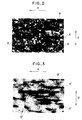
- Figure 2 is an electron micrograph at 2000 magnifications of a fracture surface of the sinter of this invention.
- Figure 3 is an electron micrograph at 2000 magnifications of a ground and etched surface of the sinter of this invention.
- the inventors Prior to achieving this invention, the inventors extensively studied the conventional high-toughness silicon nitride sinter obtained by gas pressure sintering for determining the relation between the microstructure, strength, and fracture toughness of the sinter. They found that the conventional gas pressure sintering causes random growth of elongate grains from ⁇ -silicon nitride particles present in the raw material silicon nitride as nuclei and consequently induces occurrence of large elongate grains in the produced sinter. Since the large elongate grains are origin for fracture, the sinter presents low strength, although it has improved fracture toughness.
- the inventors prepared seed crystals and produced a sinter by repeating the method disclosed in J. Am. Ceram. Soc., 77[7] 1857-1862 (1994). To be specific, they added rod-like single crystal ⁇ -silicon nitride particles morphological regulated as seed crystals to silicon nitride raw material and tried to control the shape and size of anisotropically grown elongate ⁇ -silicon nitride grains. They consequently succeeded in producing a silicon nitride sinter having relatively high strength in the range of from 900 to 1000 MPa and relatively high toughness in the range of from 8.2 to 8.6 MPa ⁇ m 1/2 .
- the inventors next investigated the microstructure of the sinter with respect to the relation between the strength and toughness thereof and confirmed the following fact.
- the inventors continued their study on control of the microstructure by the incorporation of seed crystals. They consequently learned that when the group of large elongated grains present in random three-dimensional orientation are aligned in a specific direction, the toughness of the system is effectively improved in that direction without decrease in strength. Ultimately, they obtained the high-strength, high-toughness silicon nitride sinter of this invention.
- this invention requires the raw material powder of silicon nitride to be added with a prescribed amount of a sintering additive.
- the silicon nitride raw material may be in any of such crystal systems as ⁇ type, ⁇ type, or amorphous type. It is advantageously used in the form of a fine powder having an average particle diameter of not more than 0.5 ⁇ m.
- the sintering additive may be any of the known compounds available for the purpose of accelerating the sintering. Concrete examples are MgO, CaO, Al2O3, Y2O3, Yb2O3, HfO2, Sc2O3, CeO2, ZrO2, SiO2, Cr2O3, and AlN.
- sintering additives vary with the method of firing, which may, for example, be normal pressure sintering, gas pressure sintering, hot press, or hot isostatic pressing (HIP). They are so selected that the sample, on being fired by a given method, is compacted to a relative density of not less than 97%.
- the sintering additive should appropriately contain a rare earth oxide such as Y2O3 or Yb2O3.
- the mixing of the raw materials can be conducted using any of the commercially available equipments available for mixing or blending powders.
- the raw materials are advantageously mixed wet by the use of a suitable solvent such as water, methanol, ethanol, or toluene.
- a suitable solvent such as water, methanol, ethanol, or toluene.
- an organic solvent for preventing the otherwise possible oxidation of silicon nitride.
- the mixing can be effectively accelerated by using a dispersant such as sorbitan monooleate.
- rod-like single crystal ⁇ -silicon nitride particles are added as seed crystals in an amount in the range of from 0.1 to 10% by volume, preferably from 1 to 5% by volume. If the amount of the seed crystals so added is less than 0.1% by volume, the group of elongated grains will not be incorporated in a fully satisfactory amount into the sinter.
- the amount of the seed crystals added should be limited to the range of from 0.1 to 10% by volume.
- the shape of the seed crystals is preferably such that the diameter is larger than the average particle diameter of the raw material powder of silicon nitride and the aspect ratio is not less than 2.
- the seed crystals will be dissolved in the transient liquid during sintering and will not accomplish their role of seed crystals. If the aspect ratio is not more than 2, the seed crystals will not be thoroughly oriented as in the case of sheet molding and will induce coalescence between the randomly grown elongated grains and consequently cause the produced sinter to suffer a decrease in strength.
- the upper limit of the aspect ratio is about 50. If the aspect ratio exceeds 50, the seed crystals will not be thoroughly dispersed.
- the elongated single crystal ⁇ -silicon nitride particles used as seed crystals may be commercially available ⁇ -silicon nitride whiskers. However, since these whiskers lack uniformity of size and contain lattice defects and impurities, it is better to use rod-like single crystal ⁇ -silicon nitride particles of high purity and uniform size manufactured by a method such as that reported in Journal of Ceramic Society of Japan, 101[9] 1071-1073 (1993).
- the addition of the seed crystals to the raw material powder be implemented by mixing the silicon nitride raw material thoroughly with the sintering additive in accordance with the wet mixing technique mentioned above and causing the seed crystals to be dispersed in the resultant slurry by means of ultrasonic dispersion or by the pot mixing technique using a resin pot and coated resin balls in such a manner as to avoid breaking the seed crystals.
- the mixed slurry obtained as described above and a proper amount of an organic binder added thereto are mixed.
- the produced mixture is sheet molded by the use of a doctor blade or formed by the use of an extrusion device to effect orientation of the seed crystals in the mixture. Particularly when the mixture is sheet molded, the produced sheet are stacked using a hot plate press to acquire a prescribed thickness.
- the formed mixture is calcined by the ordinary firing schedule, i.e. at a temperature in the approximate range of from 600 to 1000°C to remove the binder and then fired in the ambience of nitrogen kept at a temperature in the range of from 1700 to 2000°C under a pressure of 1 to 200 atmospheres.
- the ordinary firing schedule i.e. at a temperature in the approximate range of from 600 to 1000°C to remove the binder and then fired in the ambience of nitrogen kept at a temperature in the range of from 1700 to 2000°C under a pressure of 1 to 200 atmospheres.
- the silicon nitride sinter obtained from the raw material which incorporates the seed crystals possesses a microstructure in which large elongated ⁇ -silicon nitride grains epitaxially grown from the seed crystals are two-dimensionally dispersed in a matrix of small silicon nitride grains. It is important that the group of these large elongated grains account for a volume ratio of not less than 10%. If the volume ratio of the group of elongated grains after the firing is less than 10%, the level of improvement of toughness will be unduly low and the desired sinter will not be obtained.
- the specific temperature, nitrogen pressure, and keeping time during the firing are closely related to the sintering additive.
- This high-toughness silicon nitride sinter is characterized by being compacted by pressureless firing or gas pressure firing.
- the densification may be effected by hot press or HIP.
- the silicon nitride sinter produced by the method of this invention as described above possesses such a microstructure that elongated ⁇ -silicon nitride grains grown epitaxially from ⁇ -silicon nitride particles as seeds are highly dispersed in a planar distribution.
- this sinter acquires enhanced strength in a direction perpendicular to the direction of the orientation (1) because the whole group of elongated grains function toward enhancing the toughness and consequently the level of improvement of toughness is high as compared with the conventional high-toughness silicon nitride in which the group of elongated grains are present in random three-dimensional orientation and (2) because the large elongated grains, though present in the texture of the sinter, are dispersed in a planar distribution and therefore the extent to which they act as flaw is small.
- This invention allows production of a silicon nitride sinter which acquires compaction to a relative density of not less than 99% and exhibiting a strength of not less than 1100 MPa and a fracture toughness of not less than 11 MPa ⁇ m 1/2 in a direction perpendicular to the direction of orientation of the elongated grains.
- microstructure of the silicon nitride sinter obtained by this invention is shown by a model diagram in Figure 1.
- the symbol “a” represents a small silicon nitride grains
- the symbol “b” an rod-like single crystal ⁇ -Ni3N4 particles as a seed crystal
- the symbol “c” elongated grains grown epitaxially from a seed crystal.
- the method disclosed by this invention enables production of a silicon nitride sinter exhibiting strength of not less than 1100 MPa and fracture toughness of not less than 11 MPa ⁇ m 1/2 in a direction perpendicular to the direction of orientation of the elongated grains and consequently permits provision of a silicon nitride ceramic simultaneously presenting strength and toughness of a high level unattainable by conventional silicon nitride ceramics.
- the silicon nitride sinter of this invention therefore possesses outstanding reliability as compared with conventional silicon nitride sinters and can be expected to find extensive utility as a structural material for heat exchangers, engines, and gas turbine parts in the place of refractory alloys.
- compositions A and B were each treated with a vacuum evaporator to vaporize methanol, further vacuum dried at 120°C, and passed through a 60-mesh sieve to obtain a composite for the preparation of seed crystals.
- the composite was placed in a crucible made of silicon nitride and heated therein in an ambience of nitrogen under 5 atmospheres at 1850°C for two hours. The aggregate consequently obtained was crushed into a powder of 60 mesh.
- hydrofluoric acid : nitric acid : water 45 : 5 : 50 in volume percentage
- sulfuric acid dilute hydrofluoric acid
- aqua ammonia in the order mentioned to remove Y2O3 and SiO2, glass phase components
- a raw material powder of ⁇ -Si3N4 (having a specific surface area of 10 m/g and an average particle diameter of 0.1 ⁇ m) and a sintering additive composed of Y2O3 and Al2O3 and 3% by weight of a dispersant [produced by Kao Co., Ltd. and marketed as "Diamine RRT"] based on the total of the other three components added thereto were mixed for three hours in a toluene-butanol liquid mixture (80% by volume of toluene and 20% by volume of butanol) as a mixing medium.
- the amount of the mixing medium per 100 g of solids was 110 cc.
- the amounts (% by weight) of the seed crystals Y2O3 and Al2O3 based on the total amount of solids ( ⁇ -Si3N4, seed crystals Y2O3 and Al2O3) in the working examples were as shown in Table 1.
- the slurry obtained in each example and the relevant seed crystals added in an amount of 2 or 5% by weight based on the total amount of solids were mixed for 24 hours by the use of a resin pot and resin-coated balls. Further, the resultant mixture and 9% by weight of a binder (polyvinyl butyral resin) and 2.25% by weight of a plasticizer (dioctyl adipate) based on the total amount of solids which were added thereto were mixed for 48 hours.
- the slurry consequently obtained was formed by the doctor blade method into a green sheet having a thickness of 150 ⁇ m.
- the seed crystals SA and SB were both found to be oriented in a planar form in the plane of the sheet.
- the green sheet was cut into rectangles of 45 x 50 mm and 50 such rectangles were superposed in one direction and laminated at 130°C under a pressure of 70 kg/cm.
- the resultant laminate was calcined in a stream of a mixed gas of 95% N2 and 5% H2 at 600°C for two hours to remove the organic binder.
- the calcined sheet was placed in a carbon crucible, covered with a Si3N4 powder, and retained in an ambience of nitrogen compressed to 9 atmospheres at 1850°C for six hours, to obtain a sinter of this invention.
- the sinter thus obtained was cut into two types test pieces measuring 3 x 4 x 40 mm. One type was cut so that the sheet forming direction coincided with the longitudinal direction of the test pieces (A direction) and the other type was cut so that the direction perpendicular to the sheet forming direction coincided with the longitudinal direction of test pieces (B direction). After polishing, the test pieces were tested for specific gravity, for room temperature four-point bending strength as specified by JIS (Japanese Industrial Standards) R-1601, and for fracture toughness by the SEPB method specified by JIS R-1607. A sample was mirror ground and then etched by immersion in an equimolar mixed solution of NaOH and KOH at 280°C for 15 minutes.
- the symbol “A” represents a large elongated grain (grown from a seed crystal) and the symbol “B” a matrix of small silicon nitride grains.
- the symbol “A'” represents an elongated grain and the symbol “B'” a matrix of small silicon nitride grains. The photographs show that the elongated grains had a prefered orientation.
- a slurry is prepared by dissolving an organic binder in a solvent and dispersing a given ceramic raw material in the resultant solution.
- the slurry is spread thin on a carrier film by the use of a blade.
- the spread layer of the slurry is dried to remove the solvent and obtain a molded sheet having the ceramic raw material powder fixed by the organic binder.
- JIS R-1601 Full-point bending strength measurement: A test piece is placed on two supporting points (lower supporting points) separated by a prescribed distance and a load is applied as split between two points (upper load points) of the test piece separated by equal distances in opposite directions from the center thereof between the supporting points to find the maximum bending stress at the time the test piece fractures.
- the distance between the lower supporting points (outer span) is 30 mm
- the distance between the upper loading point (inner span) is 10 mm
- the total length, width, and thickness of the test pieces are respectively not less than 36 mm, 4.0 ⁇ 0.1 mm, and 3.0 ⁇ 0.1 mm.
- JIS R-1607 SEPB method, single-edge-precracked-beam method: The fracture load of a test piece is determined by precracking the test piece and subjecting this test piece to a three-point bending fracture test. The magnitude of fracture toughness of the test piece is determined based on the precrack length, the size of the test piece, and the distance between the bending supporting points. According to JIS R-1607, the distance between the supporting points is 16 or 30 mm, the width of the test piece is 4.0 ⁇ 0.1 mm, the thickness of the test piece is 3.0 ⁇ 0.1 mm, and the precrack length is 1.2 to 2.4 mm in the three-point fracture test.
- a raw material powder of ⁇ -Si3N4 and a sintering additive composed of Y2O3 and Al2O3 and 0.5% by weight of a dispersant (produced by Lion Chemicals Ltd., Japan and marketed as "Reogard GP") based on the total of the other three components added thereto were mixed in methanol as a mixing medium for three hours.
- the raw material used was the same as in Example.
- the composition of the components used was as shown in Table 1.
- the resultant mixture was dried with a vacuum evaporator to vaporize methanol.
- the dry residue was calcined in a stream of a mixed gas of 95% N2 and 5% H2 at 600°C for two hours to remove the organic components.
- the resultant mixed powder was preformed in the shape of a rectangular cube 42 x 47 x 5 mm by the use of a metal mold and further subjected to CIP forming (cold isostatic pressing) under a pressure of 500 MPa.
- CIP forming cold isostatic pressing
- Table 1 shows that the sinters obtained in working examples of this invention exhibited outstanding properties as compared with the sinters obtained in Comparative Examples as is evident from the fact that their strengths were not less than 1100 MPa and their fracture toughnesses were not less than 11 MPa ⁇ m 1/2 .
Landscapes
- Engineering & Computer Science (AREA)
- Chemical & Material Sciences (AREA)
- Ceramic Engineering (AREA)
- Manufacturing & Machinery (AREA)
- Materials Engineering (AREA)
- Structural Engineering (AREA)
- Organic Chemistry (AREA)
- Ceramic Products (AREA)
- Crystals, And After-Treatments Of Crystals (AREA)
Applications Claiming Priority (4)
| Application Number | Priority Date | Filing Date | Title |
|---|---|---|---|
| JP253095/94 | 1994-09-20 | ||
| JP25309594 | 1994-09-20 | ||
| JP6336177A JP2615437B2 (ja) | 1994-09-20 | 1994-12-21 | 高強度・高靱性窒化ケイ素焼結体及びその製造方法 |
| JP336177/94 | 1994-12-21 |
Publications (2)
| Publication Number | Publication Date |
|---|---|
| EP0703199A2 true EP0703199A2 (de) | 1996-03-27 |
| EP0703199A3 EP0703199A3 (de) | 1998-05-20 |
Family
ID=26541036
Family Applications (1)
| Application Number | Title | Priority Date | Filing Date |
|---|---|---|---|
| EP95306511A Withdrawn EP0703199A3 (de) | 1994-09-20 | 1995-09-15 | Hochzäher, hochfester Siliciumnitriol-Sinterkörper und Verfahren zu seiner Herstellung |
Country Status (3)
| Country | Link |
|---|---|
| US (2) | US5674793A (de) |
| EP (1) | EP0703199A3 (de) |
| JP (1) | JP2615437B2 (de) |
Cited By (1)
| Publication number | Priority date | Publication date | Assignee | Title |
|---|---|---|---|---|
| CN112573936A (zh) * | 2020-12-14 | 2021-03-30 | 哈尔滨工业大学 | 一种氮化硅陶瓷基片的制备方法 |
Families Citing this family (15)
| Publication number | Priority date | Publication date | Assignee | Title |
|---|---|---|---|---|
| JP2744938B2 (ja) * | 1996-01-30 | 1998-04-28 | 工業技術院長 | 多孔質高強度低熱伝導窒化ケイ素質セラミックス及びその製造方法 |
| JP2753577B2 (ja) * | 1996-04-30 | 1998-05-20 | 工業技術院長 | 配向した柱状粒子からなる窒化ケイ素多孔体とその製造方法 |
| EP0963464B1 (de) * | 1997-02-06 | 2001-07-18 | Deutsche Solar GmbH | Mit siliciumschutzschichten versehene schmelztiegel, ein verfahren zum aufbringen der siliciumschutzschicht und deren verwendung |
| JPH1160338A (ja) * | 1997-08-20 | 1999-03-02 | Fine Ceramics Gijutsu Kenkyu Kumiai | 高熱伝導・高強度窒化ケイ素焼結体およびその製造方法 |
| US6610113B1 (en) * | 1999-09-09 | 2003-08-26 | Kennametal Pc Inc. | Process for heat treating ceramics and articles of manufacture made thereby |
| US7335908B2 (en) | 2002-07-08 | 2008-02-26 | Qunano Ab | Nanostructures and methods for manufacturing the same |
| JP2010514651A (ja) * | 2006-12-22 | 2010-05-06 | サン−ゴバン セラミックス アンド プラスティクス,インコーポレイティド | 窒化ケイ素体及びその製造方法 |
| US7968484B2 (en) * | 2007-09-07 | 2011-06-28 | Ut-Battelle, Llc | Use of additives to improve microstructures and fracture resistance of silicon nitride ceramics |
| CN102272074B (zh) * | 2008-08-29 | 2014-05-28 | Skf股份公司 | 大型陶瓷部件及其制造方法 |
| JP5773330B2 (ja) * | 2011-05-12 | 2015-09-02 | 三菱マテリアル株式会社 | 一軸配向した針状Si3N4粒子を含有するセラミックス焼結板 |
| KR101751531B1 (ko) * | 2014-03-31 | 2017-06-27 | 니혼 파인 세라믹스 가부시키가이샤 | 질화 규소 기판 제조방법 |
| CN105152655B (zh) * | 2015-07-15 | 2018-01-16 | 东莞华南设计创新院 | 一种陶瓷的织构化方法 |
| CN112142476B (zh) * | 2020-09-28 | 2021-10-01 | 中国科学院上海硅酸盐研究所 | 一种提高氮化硅陶瓷基板材料热导率和力学性能的硅热还原方法 |
| CN116217235B (zh) * | 2023-02-10 | 2024-03-01 | 湖南星鑫航天新材料股份有限公司 | 一种氮化硅质大尺寸高温结构件及其制备方法 |
| JP7610660B1 (ja) * | 2023-08-22 | 2025-01-08 | 株式会社Maruwa | 窒化ケイ素焼結体、絶縁回路基板、および半導体装置 |
Family Cites Families (12)
| Publication number | Priority date | Publication date | Assignee | Title |
|---|---|---|---|---|
| JPS5692180A (en) * | 1979-12-27 | 1981-07-25 | Sumitomo Electric Industries | Manufacture of silicon nitride whisker reinforced silicon nitride sintered body |
| JP2563392B2 (ja) * | 1986-11-21 | 1996-12-11 | 株式会社東芝 | 窒化ケイ素系セラミックスおよびその製造方法 |
| US4994219A (en) * | 1988-03-08 | 1991-02-19 | Allied-Signal Inc. | Method for forming a high strength silicon nitride |
| US5214007A (en) * | 1988-03-31 | 1993-05-25 | Aisin Seiki Kabushiki Kaisha | Production process for silicon nitride sintered body |
| JPH04223808A (ja) * | 1990-04-19 | 1992-08-13 | Sumitomo Electric Ind Ltd | 窒化珪素系焼結体工具 |
| US5091347A (en) * | 1990-08-15 | 1992-02-25 | The Dow Chemical Company | Self-reinforced silicon nitride ceramic body and a method of preparing the same |
| DE69206434T2 (de) * | 1991-01-30 | 1996-05-02 | Ngk Spark Plug Co | Verfahren zur Herstellung von Keramik auf Siliciumnitridbasis. |
| US5401450A (en) * | 1991-12-20 | 1995-03-28 | Nissan Motor Co., Ltd | β-silicon nitride sintered body and method of producing same |
| JP3198662B2 (ja) * | 1992-09-21 | 2001-08-13 | 住友電気工業株式会社 | 窒化ケイ素系焼結体及びその製造方法 |
| US5518673A (en) * | 1993-10-14 | 1996-05-21 | Saint-Gobain/Norton Industrial Ceramics Corp. | Silicon nitride ceramic having high fatigue life and high toughness |
| JP3173251B2 (ja) * | 1993-10-26 | 2001-06-04 | トヨタ自動車株式会社 | 窒化珪素焼結体の製造方法及びターボロータ |
| JPH0834670A (ja) * | 1994-07-26 | 1996-02-06 | Natl Inst For Res In Inorg Mater | 窒化ケイ素質焼結体およびその製造方法 |
-
1994
- 1994-12-21 JP JP6336177A patent/JP2615437B2/ja not_active Expired - Lifetime
-
1995
- 1995-09-15 EP EP95306511A patent/EP0703199A3/de not_active Withdrawn
- 1995-09-18 US US08/529,854 patent/US5674793A/en not_active Expired - Fee Related
-
1996
- 1996-12-06 US US08/761,206 patent/US5705449A/en not_active Expired - Fee Related
Non-Patent Citations (4)
| Title |
|---|
| AM. CERAM. SOC. BULL., vol. 65, no. 2, 1986, pages 351 - 356 |
| AM. CERAM. SOC. BULL., vol. 65, no. 9, 1986, pages 1311 - 1315 |
| CERAMIC TRANSACTIONS, vol. 19, pages 765 - 771 |
| J. AM. CERAM. SOC., vol. 77, no. 7, 1994, pages 1857 - 1862 |
Cited By (2)
| Publication number | Priority date | Publication date | Assignee | Title |
|---|---|---|---|---|
| CN112573936A (zh) * | 2020-12-14 | 2021-03-30 | 哈尔滨工业大学 | 一种氮化硅陶瓷基片的制备方法 |
| CN112573936B (zh) * | 2020-12-14 | 2022-12-09 | 哈尔滨工业大学 | 一种氮化硅陶瓷基片的制备方法 |
Also Published As
| Publication number | Publication date |
|---|---|
| JP2615437B2 (ja) | 1997-05-28 |
| US5705449A (en) | 1998-01-06 |
| JPH08143400A (ja) | 1996-06-04 |
| EP0703199A3 (de) | 1998-05-20 |
| US5674793A (en) | 1997-10-07 |
Similar Documents
| Publication | Publication Date | Title |
|---|---|---|
| US5674793A (en) | Method for producing a high-strength, high-toughness silicon nitride sinter | |
| Kim et al. | Effect of initial α‐phase content on microstructure and mechanical properties of sintered silicon carbide | |
| US5656218A (en) | Method for making high performance self-reinforced silicon carbide using a pressureless sintering process | |
| JP2882575B2 (ja) | 高熱伝導窒化ケイ素セラミックスならびにその製造方法 | |
| US5908798A (en) | In-situ toughened alpha prime-sialon-based ceramics | |
| WO1992014685A2 (en) | A dense, self-reinforced silicon nitride ceramic prepared by pressureless or low pressure gas sintering | |
| EP2189432B1 (de) | Aluminiumnitridgesinterter Körper mit hoher thermischer Leitfähigkeit | |
| US5518673A (en) | Silicon nitride ceramic having high fatigue life and high toughness | |
| JP3472585B2 (ja) | 窒化アルミニウム焼結体 | |
| US5449649A (en) | Monolithic silicon nitride having high fracture toughness | |
| EP0676380A1 (de) | Kompositpulver aus Siliciumnitrid und Siliciumcarbid | |
| US5968426A (en) | Method of producing porous silicon nitride ceramics having high strength and low thermal conductivity | |
| JP2773976B2 (ja) | 超靭性モノリシック窒化ケイ素 | |
| JP3148559B2 (ja) | セラミックス繊維強化タービン翼及びその製造方法 | |
| JP4070254B2 (ja) | 窒化珪素と炭化珪素の複合焼結体及びその製造方法 | |
| JP3932349B2 (ja) | 非酸化物系窒化ホウ素複合材料の反応合成 | |
| JP3124865B2 (ja) | 窒化珪素質焼結体及びその製造方法 | |
| JPH0559074B2 (de) | ||
| JP3241215B2 (ja) | 窒化珪素質焼結体の製造方法 | |
| JPH01197357A (ja) | アルミナ−サイアロン複合焼結体 | |
| JPH042664A (ja) | 高強度サイアロン基焼結体 | |
| JPH06116038A (ja) | 窒化ケイ素−炭化ケイ素複合焼結体の製造法 | |
| JP2736427B2 (ja) | 窒化珪素質焼結体およびその製造方法 | |
| JPH0559077B2 (de) | ||
| JPH0559073B2 (de) |
Legal Events
| Date | Code | Title | Description |
|---|---|---|---|
| PUAI | Public reference made under article 153(3) epc to a published international application that has entered the european phase |
Free format text: ORIGINAL CODE: 0009012 |
|
| AK | Designated contracting states |
Kind code of ref document: A2 Designated state(s): DE GB |
|
| PUAL | Search report despatched |
Free format text: ORIGINAL CODE: 0009013 |
|
| AK | Designated contracting states |
Kind code of ref document: A3 Designated state(s): DE GB |
|
| STAA | Information on the status of an ep patent application or granted ep patent |
Free format text: STATUS: THE APPLICATION IS DEEMED TO BE WITHDRAWN |
|
| 18D | Application deemed to be withdrawn |
Effective date: 19981121 |