EP0700904B1 - Mit Heterocyclen-N-Oxid-substituierte Benzoylguanidine, Verfahren zu ihrer Herstellung, ihre Verwendung als Medikament oder Diagnostikum sowie sie enthaltendes Medikament - Google Patents
Mit Heterocyclen-N-Oxid-substituierte Benzoylguanidine, Verfahren zu ihrer Herstellung, ihre Verwendung als Medikament oder Diagnostikum sowie sie enthaltendes Medikament Download PDFInfo
- Publication number
- EP0700904B1 EP0700904B1 EP95113845A EP95113845A EP0700904B1 EP 0700904 B1 EP0700904 B1 EP 0700904B1 EP 95113845 A EP95113845 A EP 95113845A EP 95113845 A EP95113845 A EP 95113845A EP 0700904 B1 EP0700904 B1 EP 0700904B1
- Authority
- EP
- European Patent Office
- Prior art keywords
- oxide
- hydrogen
- methyl
- alkyl
- compound
- Prior art date
- Legal status (The legal status is an assumption and is not a legal conclusion. Google has not performed a legal analysis and makes no representation as to the accuracy of the status listed.)
- Expired - Lifetime
Links
- HECQGFJMONDOIM-UHFFFAOYSA-N NC(N)=NC(c(cc1)cc(C(F)(F)F)c1Oc1cnccc1)=O Chemical compound NC(N)=NC(c(cc1)cc(C(F)(F)F)c1Oc1cnccc1)=O HECQGFJMONDOIM-UHFFFAOYSA-N 0.000 description 1
Classifications
-
- C—CHEMISTRY; METALLURGY
- C07—ORGANIC CHEMISTRY
- C07C—ACYCLIC OR CARBOCYCLIC COMPOUNDS
- C07C317/00—Sulfones; Sulfoxides
-
- C—CHEMISTRY; METALLURGY
- C07—ORGANIC CHEMISTRY
- C07D—HETEROCYCLIC COMPOUNDS
- C07D213/00—Heterocyclic compounds containing six-membered rings, not condensed with other rings, with one nitrogen atom as the only ring hetero atom and three or more double bonds between ring members or between ring members and non-ring members
- C07D213/02—Heterocyclic compounds containing six-membered rings, not condensed with other rings, with one nitrogen atom as the only ring hetero atom and three or more double bonds between ring members or between ring members and non-ring members having three double bonds between ring members or between ring members and non-ring members
- C07D213/89—Heterocyclic compounds containing six-membered rings, not condensed with other rings, with one nitrogen atom as the only ring hetero atom and three or more double bonds between ring members or between ring members and non-ring members having three double bonds between ring members or between ring members and non-ring members with hetero atoms directly attached to the ring nitrogen atom
-
- A—HUMAN NECESSITIES
- A61—MEDICAL OR VETERINARY SCIENCE; HYGIENE
- A61P—SPECIFIC THERAPEUTIC ACTIVITY OF CHEMICAL COMPOUNDS OR MEDICINAL PREPARATIONS
- A61P1/00—Drugs for disorders of the alimentary tract or the digestive system
- A61P1/16—Drugs for disorders of the alimentary tract or the digestive system for liver or gallbladder disorders, e.g. hepatoprotective agents, cholagogues, litholytics
-
- A—HUMAN NECESSITIES
- A61—MEDICAL OR VETERINARY SCIENCE; HYGIENE
- A61P—SPECIFIC THERAPEUTIC ACTIVITY OF CHEMICAL COMPOUNDS OR MEDICINAL PREPARATIONS
- A61P11/00—Drugs for disorders of the respiratory system
-
- A—HUMAN NECESSITIES
- A61—MEDICAL OR VETERINARY SCIENCE; HYGIENE
- A61P—SPECIFIC THERAPEUTIC ACTIVITY OF CHEMICAL COMPOUNDS OR MEDICINAL PREPARATIONS
- A61P13/00—Drugs for disorders of the urinary system
- A61P13/02—Drugs for disorders of the urinary system of urine or of the urinary tract, e.g. urine acidifiers
-
- A—HUMAN NECESSITIES
- A61—MEDICAL OR VETERINARY SCIENCE; HYGIENE
- A61P—SPECIFIC THERAPEUTIC ACTIVITY OF CHEMICAL COMPOUNDS OR MEDICINAL PREPARATIONS
- A61P15/00—Drugs for genital or sexual disorders; Contraceptives
-
- A—HUMAN NECESSITIES
- A61—MEDICAL OR VETERINARY SCIENCE; HYGIENE
- A61P—SPECIFIC THERAPEUTIC ACTIVITY OF CHEMICAL COMPOUNDS OR MEDICINAL PREPARATIONS
- A61P3/00—Drugs for disorders of the metabolism
- A61P3/08—Drugs for disorders of the metabolism for glucose homeostasis
- A61P3/10—Drugs for disorders of the metabolism for glucose homeostasis for hyperglycaemia, e.g. antidiabetics
-
- A—HUMAN NECESSITIES
- A61—MEDICAL OR VETERINARY SCIENCE; HYGIENE
- A61P—SPECIFIC THERAPEUTIC ACTIVITY OF CHEMICAL COMPOUNDS OR MEDICINAL PREPARATIONS
- A61P35/00—Antineoplastic agents
-
- A—HUMAN NECESSITIES
- A61—MEDICAL OR VETERINARY SCIENCE; HYGIENE
- A61P—SPECIFIC THERAPEUTIC ACTIVITY OF CHEMICAL COMPOUNDS OR MEDICINAL PREPARATIONS
- A61P41/00—Drugs used in surgical methods, e.g. surgery adjuvants for preventing adhesion or for vitreum substitution
-
- A—HUMAN NECESSITIES
- A61—MEDICAL OR VETERINARY SCIENCE; HYGIENE
- A61P—SPECIFIC THERAPEUTIC ACTIVITY OF CHEMICAL COMPOUNDS OR MEDICINAL PREPARATIONS
- A61P43/00—Drugs for specific purposes, not provided for in groups A61P1/00-A61P41/00
-
- A—HUMAN NECESSITIES
- A61—MEDICAL OR VETERINARY SCIENCE; HYGIENE
- A61P—SPECIFIC THERAPEUTIC ACTIVITY OF CHEMICAL COMPOUNDS OR MEDICINAL PREPARATIONS
- A61P9/00—Drugs for disorders of the cardiovascular system
-
- A—HUMAN NECESSITIES
- A61—MEDICAL OR VETERINARY SCIENCE; HYGIENE
- A61P—SPECIFIC THERAPEUTIC ACTIVITY OF CHEMICAL COMPOUNDS OR MEDICINAL PREPARATIONS
- A61P9/00—Drugs for disorders of the cardiovascular system
- A61P9/06—Antiarrhythmics
-
- A—HUMAN NECESSITIES
- A61—MEDICAL OR VETERINARY SCIENCE; HYGIENE
- A61P—SPECIFIC THERAPEUTIC ACTIVITY OF CHEMICAL COMPOUNDS OR MEDICINAL PREPARATIONS
- A61P9/00—Drugs for disorders of the cardiovascular system
- A61P9/08—Vasodilators for multiple indications
-
- A—HUMAN NECESSITIES
- A61—MEDICAL OR VETERINARY SCIENCE; HYGIENE
- A61P—SPECIFIC THERAPEUTIC ACTIVITY OF CHEMICAL COMPOUNDS OR MEDICINAL PREPARATIONS
- A61P9/00—Drugs for disorders of the cardiovascular system
- A61P9/10—Drugs for disorders of the cardiovascular system for treating ischaemic or atherosclerotic diseases, e.g. antianginal drugs, coronary vasodilators, drugs for myocardial infarction, retinopathy, cerebrovascula insufficiency, renal arteriosclerosis
-
- A—HUMAN NECESSITIES
- A61—MEDICAL OR VETERINARY SCIENCE; HYGIENE
- A61P—SPECIFIC THERAPEUTIC ACTIVITY OF CHEMICAL COMPOUNDS OR MEDICINAL PREPARATIONS
- A61P9/00—Drugs for disorders of the cardiovascular system
- A61P9/12—Antihypertensives
-
- C—CHEMISTRY; METALLURGY
- C07—ORGANIC CHEMISTRY
- C07D—HETEROCYCLIC COMPOUNDS
- C07D215/00—Heterocyclic compounds containing quinoline or hydrogenated quinoline ring systems
- C07D215/58—Heterocyclic compounds containing quinoline or hydrogenated quinoline ring systems with hetero atoms directly attached to the ring nitrogen atom
- C07D215/60—N-oxides
Definitions
- Heteroaryl-N-oxide are imidazolyl-N-oxide, pyrazolyl-N-oxide, triazolyl-N-oxide, Tetrazolyl-N-oxide, oxazolyl-N-oxide, isoxazolyl-N-oxide, thiazolyl-N-oxide, Isothiazolyl-N-oxide, pyridyl-N-oxide, pyrazinyl-N-oxide, pyrimidinyl-N-oxide, Pyridazinyl-N-oxide, indazolyl-N-oxide, quinolyl-N-oxide, isoquinolyl-N-oxide, Phthalazinyl-N-oxide, quinoxalinyl-N-oxide, quinazolinyl-N-oxide, cinnolinyl-N-oxide.
- R (1) to R (5) one or more Asymmetry centers, these can be configured both S and R.
- the Compounds can be used as optical isomers, as diastereomers, as racemates or as mixtures thereof.
- alkyl and perfluoroalkyl radicals can be both straight-chain and to be branched.
- the invention further relates to a process for the preparation of the compounds of formula I, characterized in that a compound of formula II reacted with guanidine, in which L stands for an easily nucleophilically substitutable leaving group.
- the unknown compounds of the formula II can be found in literature Methods are prepared by, for example, 4-halo-3-chlorosulfonylbenzoic acids with ammonia or amines in 3-aminosulfonyl-4-halogeno-benzoic acids or with a weak reducing agent like Sodium bisulfite and subsequent alkylation in 3-alkylsulfonyl-4-halogeno-benzoic acids transferred and according to one of the above Process variants to compounds I according to the invention are implemented.
- Substituted sulfur, oxygen or nitrogen nucleophiles can be introduced using methods known from the literature for nucleophilic substitution on aromatics. Halides and trifluoromethanesulfonates have proven themselves as leaving groups in this substitution.
- the process is advantageously carried out in a dipolar aprotic solvent, such as DMF or TMU, at a temperature between 0 ° C. and the boiling point of the solvent, preferably between 80 ° C. and the boiling point of the solvent.
- An alkali or alkaline earth salt with an anion of high basicity and low nucleophilicity such as, for example, K 2 CO 3 or CsCO 3 , advantageously serves as the acid scavenger.
- alkyl or aryl substituents are introduced by means known from the literature Methods of palladium-mediated cross-coupling of aryl halides with for example organozinc compounds, organostannans, organoboronic acids or organoboranes.
- the nitrogen in the heteroaryl substituent can be oxidized on suitable ones Intermediate compounds such as the benzoic acid ester with known in principle Methods.
- Intermediate compounds such as the benzoic acid ester with known in principle Methods.
- m-chloroperbenzoic acid has proven itself in one inert solvents such as methylene chloride at a temperature between -30 ° C and the boiling point of the solvent.
- Benzoylguanidines I are generally weak bases and can take acid Bind formation of salts. Salts of all come as acid addition salts pharmacologically acceptable acids, for example halides, in particular hydrochlorides, lactates, sulfates, citrates, tartrates, acetates, Phosphates, methyl sulfonates, p-toluenesulfonates.
- halides in particular hydrochlorides, lactates, sulfates, citrates, tartrates, acetates, Phosphates, methyl sulfonates, p-toluenesulfonates.
- the compounds I are substituted acylguanidines.
- the most prominent representative of the acylguanidines is the pyrazine derivative amiloride, which is used as a potassium-saving diuretic in therapy.
- EP-A 602 523 describes related compounds, but is not one of them Compounds with an N-oxide structure described or suggested.
- the compounds according to the invention have no undesirable and disadvantageous salidiuretic, but very good antiarrhythmic properties which are important in the treatment of diseases such as those which occur, for example, in the case of oxygen deficiency symptoms.
- the compounds are outstandingly suitable as antiarrhythmic medicaments with cardioprotective components for the prevention of infarction and the treatment of infarction, and for the treatment of angina pectoris, and they also prevent or inhibit the pathophysiological processes in the occurrence of ischemically induced damage, particularly when triggering ischemically induced cardiac arrhythmias greatly decrease.
- the compounds of the formula I according to the invention can be used as a medicament for the treatment of all acute or chronic damage caused by ischemia or diseases which are primarily or secondarily induced thereby.
- This relates to their use as medicines for surgical interventions, for example in organ transplants, the compounds being used both for protecting the organs in the donor before and during removal, for protecting removed organs, for example during treatment with or their storage in physiological bath fluids, and also in the case of Transfer into the recipient organism can be used.
- the compounds are also valuable, protective drugs when performing angioplasty surgery, for example on the heart as well as on peripheral vessels.
- the compounds are also suitable as medicaments for treating ischemia of the nervous system, in particular the central nervous system, where they are suitable, for example, for the treatment of stroke or cerebral edema.
- the compounds of the formula I according to the invention are also suitable for treating forms of shock, such as, for example, allergic, cardiogenic, hypovolemic and bacterial shock.
- the compounds of formula I according to the invention are distinguished due to strong inhibitory effect on cell proliferation, for example fibroblast cell proliferation and smooth proliferation Vascular muscle cells, from. Therefore, the compounds of formula I come as Valuable therapeutic agents for diseases in which cell proliferation is a primary or secondary cause, and can therefore be considered Antiatherosclerotics, remedies for late diabetic complications, Cancer, fibrotic diseases such as pulmonary fibrosis, liver fibrosis or kidney fibrosis, organ hypertrophy and hyperplasia, especially in Prostate hyperplasia or prostate hypertrophy can be used.
- the compounds according to the invention are effective inhibitors of the cellular sodium proton antiporter (Na + / H + exchanger), which is increased in numerous diseases (essential hypertension, atherosclerosis, diabetes, etc.) even in cells which are easily accessible, such as in erythrocytes, thrombocytes or leukocytes.
- the compounds of the invention are therefore suitable as excellent and simple scientific tools, for example in their use as diagnostics for determining and differentiating certain forms of hypertension, but also of atherosclerosis, diabetes, proliferative diseases, etc.
- the compounds of the formula I are for preventive therapy is suitable for preventing the genesis of high blood pressure, for example essential hypertension.
- the compounds according to the Invention has significantly improved water solubility. Therefore they are much more suitable for i.V.applications.
- Drugs containing a compound I can be administered orally, parenterally, administered intravenously, rectally or by inhalation, the preferred one Application depends on the particular appearance of the disease.
- the compounds I can be used alone or together with galenic Excipients are used, both in the veterinary and also in human medicine.
- excipients are suitable for the desired pharmaceutical formulation is familiar to the expert on the basis of his specialist knowledge.
- Active substance carriers can, for example, antioxidants, dispersants, Emulsifiers, defoamers, flavoring agents, preservatives, Solubilizers or dyes are used.
- the active compounds with the for it suitable additives such as carriers, stabilizers or inert Diluent mixed and by the usual methods in the appropriate Dosage forms brought, such as tablets, coated tablets, capsules, aqueous, alcoholic or oily solutions.
- inert carriers such as B. rubber arabicum, magnesia, magnesium carbonate, potassium phosphate, milk sugar, Glucose or starch, especially corn starch, can be used. It can the preparation takes place both as dry and as wet granules.
- oily carriers or as solvents come, for example, vegetable or animal oils, such as sunflower oil or cod liver oil.
- the active compounds For subcutaneous or intravenous administration, the active compounds, if desired with the usual substances such as solubilizers, Emulsifiers or other auxiliaries in solution, suspension or emulsion brought.
- solvents such.
- a pharmaceutical formulation for administration in the form of aerosols or sprays are suitable e.g. B. solutions, suspensions or emulsions of Active ingredient of formula I in a pharmaceutically acceptable Solvent, such as especially ethanol or water, or a mixture such solvents.
- a pharmaceutically acceptable Solvent such as especially ethanol or water, or a mixture such solvents.
- the formulation can also be other pharmaceuticals as needed Excipients such as surfactants, emulsifiers and stabilizers as well as a propellant contain.
- Excipients such as surfactants, emulsifiers and stabilizers as well as a propellant contain.
- Such a preparation usually contains the active ingredient in one Concentration from about 0.1 to 10, in particular from about 0.3 to 3 wt .-%.
- the dosage of the active ingredient of formula I to be administered and the frequency of administration depend on the potency and duration of action of the compounds used; also on the type and severity of the disease to be treated and on the sex, age, weight and individual responsiveness of the mammal to be treated.
- the daily dose of a compound of the formula I in a patient weighing approximately 75 kg is at least 0.001 mg / kg, preferably 0.01 mg / kg, to at most 10 mg / kg, preferably 1 mg / kg body weight.
- more frequent doses may be necessary, for example up to 4 individual doses per day.
- up to 200 mg per day may be necessary.
- Example 3 The compound of Example 3 was synthesized analogously to Example 2:
- White New Zealand rabbits (Ivanovas) were given a standard 2% cholesterol diet for six weeks to activate the Na + / H + exchange and thus the Na + influx into the erythrocytes via the Na + / H + exchange
- the blood was taken from the ear arteries and made non-coagulable by 25 IU potassium heparin. A portion of each sample was used to duplicate the hematocrit by centrifugation. Aliquots of 100 ⁇ l of the erythrocytes were used to measure the initial Na +.
- the Na + net influx was calculated from the difference between the initial sodium values and the sodium content of the erythrocytes after incubation.
- the amiloride-inhibitable sodium influx resulted from the difference in the sodium content of the erythrocytes after incubation with and without amiloride 3 x 10 -4 mol / l.
- the same procedure was followed for the compounds according to the invention.
Landscapes
- Health & Medical Sciences (AREA)
- Organic Chemistry (AREA)
- Chemical & Material Sciences (AREA)
- Life Sciences & Earth Sciences (AREA)
- General Health & Medical Sciences (AREA)
- Nuclear Medicine, Radiotherapy & Molecular Imaging (AREA)
- General Chemical & Material Sciences (AREA)
- Pharmacology & Pharmacy (AREA)
- Chemical Kinetics & Catalysis (AREA)
- Animal Behavior & Ethology (AREA)
- Medicinal Chemistry (AREA)
- Public Health (AREA)
- Veterinary Medicine (AREA)
- Engineering & Computer Science (AREA)
- Bioinformatics & Cheminformatics (AREA)
- Cardiology (AREA)
- Heart & Thoracic Surgery (AREA)
- Diabetes (AREA)
- Urology & Nephrology (AREA)
- Endocrinology (AREA)
- Pulmonology (AREA)
- Vascular Medicine (AREA)
- Surgery (AREA)
- Hematology (AREA)
- Obesity (AREA)
- Gastroenterology & Hepatology (AREA)
- Emergency Medicine (AREA)
- Reproductive Health (AREA)
- Pharmaceuticals Containing Other Organic And Inorganic Compounds (AREA)
- Acyclic And Carbocyclic Compounds In Medicinal Compositions (AREA)
- Organic Low-Molecular-Weight Compounds And Preparation Thereof (AREA)
- Medicines Containing Antibodies Or Antigens For Use As Internal Diagnostic Agents (AREA)
- Agricultural Chemicals And Associated Chemicals (AREA)
- Quinoline Compounds (AREA)
- Pyridine Compounds (AREA)
- Plural Heterocyclic Compounds (AREA)
Description

- R(1)
- (C1-C4)-Alkyl, (C2-C4)-Alkenyl oder -CmH2mR(14),
m Null, 1 oder 2;
R(14) (C5-C6)-Cycloalkyl oder Phenyl,
welches nicht substituiert oder substituiert ist mit 1 - 2 Substituenten ausgewählt aus der Gruppe bestehend aus F, Cl, CF3, Methyl, Methoxy und NR(15)R(16);
R(15) und R(16)
Wasserstoff oder CH3;
- R(1)
- Wasserstoff, F, Cl, Br, I, -C≡N, R(22)-SO2, R(23)R(24)N-CO, R(25)-CO-oder
R(26)R(27)N-SO2-;
R(22), R(23), R(25) und R(26)
unabhängig voneinander (C1-C4)-Alkyl, (C2-C4)-Alkenyl,
-CnH2n-R(29) oder CF3;
n Null, 1 oder 2;
R(29) (C5-C6)-Cycloalkyl oder Phenyl,
welches nicht substituiert ist oder substituiert mit 1 - 2 Substituenten ausgewählt aus der Gruppe bestehend aus F, Cl, CF3, Methyl, Methoxy und NR(30)R(31);
R(30) und R(31)
Wasserstoff oder Methyl;
R(23), R(25) und R(26)
Wasserstoff;
R(24) und R(27)
unabhängig voneinander Wasserstoff oder Methyl;
oder R(23) und R(24) sowie R(26) und R(27)
gemeinsam 4 oder 5 Methylengruppen, von denen eine CH2-Gruppe durch Sauerstoff, S, NH, N-CH3 oder N-Benzyl ersetzt sein kann;
oder
- R(1)
- OR(35) oder NR(35)R(36);
R(35) und R(36)
unabhängig voneinander Wasserstoff, (C1-C4)-Alkyl;
oder R(35) und R(36)
gemeinsam 4 - 5 Methylengruppen, von denen eine CH2-Gruppe durch Sauerstoff, S, NH, N-CH3 oder N-Benzyl ersetzt sein kann;
Imidazolyl-N-Oxid, Pyrazolyl-N-Oxid, Triazolyl-N-Oxid, Tetrazolyl-N-Oxid, Oxazolyl-N-Oxid, Isoxazolyl-N-Oxid, Thiazolyl-N-Oxid, Isothiazolyl-N-Oxid, Pyridyl-N-Oxid, Pyrazinyl-N-Oxid, Pyrimidinyl-N-Oxid, Pyridazinyl-N-Oxid, Indazolyl-N-Oxid, Chinolyl-N-Oxid, Isochinolyl-N-Oxid, Phthalazinyl-N-Oxid, Chinoxalinyl-N-Oxid, Chinazolinyl-N-Oxid, Cinnolinyl-N-Oxid,
das über C oder N verknüpft ist und das unsubstituiert oder substituiert ist mit 1 - 2 Substituenten ausgewählt aus der Gruppe bestehend aus F, Cl, CF3, CH3, Methoxy, Hydroxy, Amino, Methylamino und Dimethylamino;
oder einer der Substituenten R(2) und R(3)
-SR(10), -OR(10), -NR(10)R(11) oder -CR(10)R(11)R(12);
R(10) -CaH2a-[Imidazolyl-N-Oxid, Pyrazolyl-N-Oxid, Triazolyl-N-Oxid,
Tetrazolyl-N-Oxid, Oxazolyl-N-Oxid, Isoxazolyl-N-Oxid, Thiazolyl-N-Oxid, Isothiazolyl-N-Oxid, Pyridyl-N-Oxid, Pyrazinyl-N-Oxid, Pyrimidinyl-N-Oxid, Pyridazinyl-N-Oxid, Indazolyl-N-Oxid, Chinolyl-N-Oxid, Isochinolyl-N-Oxid, Phthalazinyl-N-Oxid, Chinoxalinyl-N-Oxid, Chinazolinyl-N-Oxid, Cinnolinyl-N-Oxid],
das über C oder N verknüpft ist und das unsubstituiert oder substituiert ist mit 1 - 2 Substituenten ausgewählt aus der Gruppe bestehend aus F, Cl, CF3, CH3, Methoxy, Hydroxy, Amino, Methylamino und Dimethylamino;
a Null oder 1;
R(11), R(12)
Wasserstoff oder Methyl;
und der jeweils andere Substituent R(2) und R(3)
unabhängig voneinander (C1-C4)-Alkyl, Wasserstoff, F, Cl, Br oder I;
R(4) und R(5)
unabhängig voneinander Wasserstoff, Methyl, F, Cl, -OR(32),
-NR(33)R(34) oder CF3;
R(32), R(33) und R(34)
unabhängig voneinander Wasserstoff oder Methyl;
sowie deren pharmazeutisch verträgliche Salze.
- R(1)
- (C1-C4)-Alkyl, (C2-C4)-Alkenyl oder -CmH2mR(14);
m Null, 1 oder 2;
R(14) (C5-C6)-Cycloalkyl oder Phenyl,
welches nicht substituiert oder substituiert ist mit 1 - 2 Substituenten ausgewählt aus der Gruppe bestehend aus F, Cl, CF3, Methyl, Methoxy und NR(15)R(16);
R(15) und R(16)
Wasserstoff oder CH3;
- R(1)
- Wasserstoff, F, Cl, Br, I, -C≡N, R(22)-SO2, R(23)R(24)N-CO, R(25)-CO-oder
R(26)R(27)N-SO2-;
R(22), R(23), R(25) und R(26)
unabhängig Methyl oder CF3;
oder
R(23), R(25) und R(26)
Wasserstoff;
R(24) und R(27)
unabhängig voneinander Wasserstoff oder Methyl;
- R(1)
- OR(35) oder NR(35)R(36);
R(35) und R(361
unabhängig voneinander Wasserstoff, (C1-C4)-Alkyl;
oder
R(35) und R(36)
gemeinsam 4 - 5 Methylengruppen, von denen eine CH2-Gruppe durch Sauerstoff, S, NH, N-CH3 oder N-Benzyl ersetzt sein kann,
Imidazolyl-N-Oxid, Pyrazolyl-N-Oxid, Triazolyl-N-Oxid, Tetrazolyl-N-Oxid, Oxazolyl-N-Oxid, Isoxazolyl-N-Oxid, Thiazolyl-N-Oxid, Isothiazolyl-N-Oxid, Pyridyl-N-Oxid, Pyrazinyl-N-Oxid, Pyrimidinyl-N-Oxid, Pyridazinyl-N-Oxid, Indazolyl-N-Oxid, Chinolyl-N-Oxid, Isochinolyl-N-Oxid, Phthalazinyl-N-Oxid, Chinoxalinyl-N-Oxid, Chinazolinyl-N-Oxid, Cinnolinyl-N-Oxid,
das über C oder N verknüpft ist und das unsubstituiert oder substituiert ist mit 1 - 2 Substituenten ausgewählt aus der Gruppe bestehend aus F, Cl, CF3, CH3, Methoxy, Hydroxy, Amino, Methylamino und Dimethylamino;
oder
einer der Substituenten R(2) und R(3)
-SR(10), -OR(10), -NR(10)R(11) oder -CR(10)R(11)R(12);
R(10) Imidazolyl-N-Oxid, Pyrazolyl-N-Oxid, Triazolyl-N-Oxid, Tetrazolyl-N-Oxid, Oxazolyl-N-Oxid, Isoxazolyl-N-Oxid, Thiazolyl-N-Oxid, Isothiazolyl-N-Oxid, Pyridyl-N-Oxid, Pyrazinyl-N-Oxid, Pyrimidinyl-N-Oxid, Pyridazinyl-N-Oxid, Indazolyl-N-Oxid, Chinolyl-N-Oxid, Isochinolyl-N-Oxid, Phthalazinyl-N-Oxid, Chinoxalinyl-N-Oxid, Chinazolinyl-N-Oxid, Cinnolinyl-N-Oxid,
das über C oder N verknüpft ist und das unsubstituiert oder substituiert ist mit 1 - 2 Substituenten ausgewählt aus der Gruppe bestehend aus F, Cl, CF3, CH3, Methoxy, Hydroxy, Amino, Methylamino und Dimethylamino;
R(11) und R(12)
Wasserstoff oder Methyl;
und der jeweils andere Substituent R(2) oder R(3)
unabhängig voneinander (C1-C4)-Alkyl, Wasserstoff, F, Cl, Br oder I;
R(4) und R(5)
unabhängig voneinander Wasserstoff, Methyl, F, Cl, -OR(32),-NR(33)R(34) oder CF3;
R(32), R(33) und R(34)
unabhängig voneinander Wasserstoff oder Methyl;
sowie deren pharmazeutisch verträgliche Salze.
eine Verbindung der Formel II

Neben den Carbonsäurechloriden der Formel II (L = Cl) lassen sich auch weitere aktivierte Säurederivate der Formel II in an sich bekannter Weise direkt aus den zugrundeliegenden Benzoesäurederivaten (Formel II, L = OH) herstellen, wie beispielsweise die Methylester der Formel II mit L = OCH3 durch Behandeln mit gasförmigem HCI in Methanol, die Imidazolide der Formel II durch Behandeln mit Carbonyldiimidazol (L = 1-Imidazolyl, Staab, Angew. Chem. Int. Ed. Engl. 1,351-367 (1962)), die gemischten Anhydride II mit Cl-COOC2H5 oder Tosylchlorid in Gegenwart von Triethylamin in einem inerten Lösungsmittel, wie auch die Aktivierungen von Benzoesäuresäuren mit Dicyclohexylcarbodiimid (DCC) oder mit O-[(Cyano(ethoxycarbonyl)-methylen)amino]-1,1,3,3-tetramethyluronium-tetrafluoroborat ("TOTU")[Proceedings of the 21. European Peptide Symposium, Peptides 1990, Editors E. Giralt and D. Andreu, Escom, Leiden, 1991]. Eine Reihe geeigneter Methoden zur Herstellung von aktivierten Carbonsäurederivaten der allgemeinen Formel II sind unter Angabe von Quellenliteratur in J. March, Advanced Organic Chemistry, Third Edition (John Wiley & Sons, 1985), S. 350 angegeben.

- Z
- Cl,
OR(45), OMet oder OH;
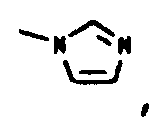
R(45) (C1-C8)-Alkyl oder (C1-C4)-Alkylen-Phenyl;
Met Ion eines Alkali- oder Erdalkali-Metalls.
Prominentester Vertreter der Acylguanidine ist das Pyrazinderivat Amilorid, das als kaliumsparendes Diuretikum in der Therapie Verwendung findet. Zahlreiche weitere Verbindungen vom Amilorid-Typ werden in der Literatur beschrieben, wie beispielsweise Dimethylamilorid oder Ethylisopropylamilorid.

Dimethylamilorid: R',R" = CH3
Ethylisopropylamilorid: R' = C2H5, R" = CH(CH3)2
Im Durchschnitt beträgt die tägliche Dosis einer Verbindung der Formel I bei einem etwa 75 kg schweren Patienten mindestens 0,001 mg/kg, vorzugsweise 0,01 mg/kg, bis höchstens 10 mg/kg, vorzugsweise 1 mg/kg Körpergewicht. Bei akuten Ausbrüchen der Krankheit, etwa unmittelbar nach Erleiden eines Herzinfarkts, können auch noch höhere und vor allem häufigere Dosierungen notwendig sein, z.B. bis zu 4 Einzeldosen pro Tag. Insbesondere bei i.v. Anwendung, etwa bei einem Infarktpatienten auf der Intensivstation können bis zu 200 mg pro Tag notwendig werden.
- MeOH
- Methanol
- DMF
- N,N-Dimethylformamid
- TMU
- N,N,N',N'-Tetramethylharnstoff
- El
- electron impact
- DCI
- Desorption-Chemical Ionisation
- RT
- Raumtemperatur
- EE
- Ethylacetat (EtOAc)
- DIP
- Diisopropylether
- MTB
- Methyltertiärbutylether
- mp
- Schmelzpunkt
- HEP
- n-Heptan
- DME
- Dimethoxyethan
- FAB
- Fast Atom Bombardment
- CH2Cl2
- Dichlormethan
- THF
- Tetrahydrofuran
- eq
- Äquivalent
- ES
- Elektrospray-lonisation
- Me
- Methyl
- Et
- Ethyl
- Bn
- Benzyl
- ZNS
- Zentralnervensystem
- Brine
- gesättigte wäßrige NaCl-Lösung
- Met
- Metall
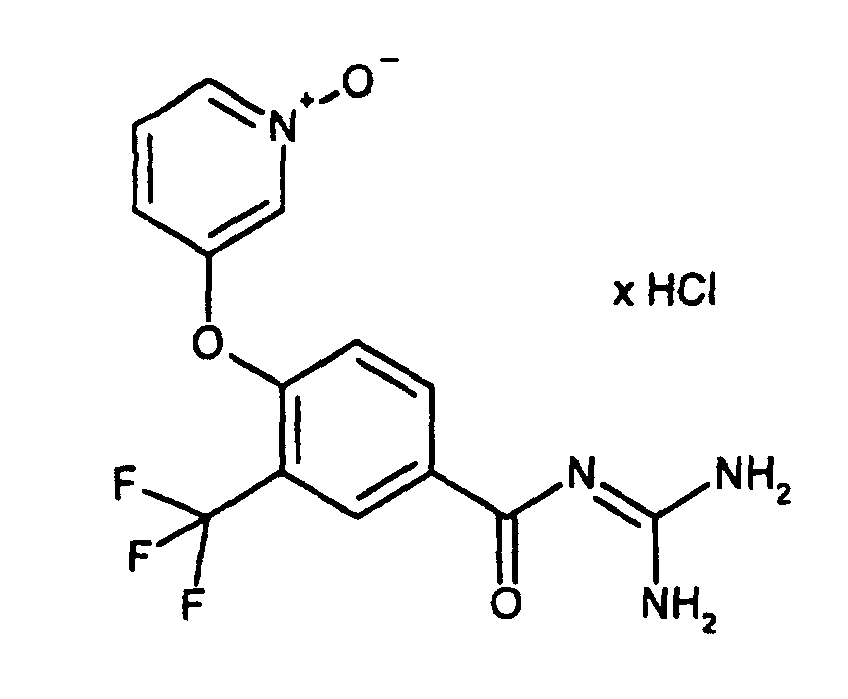
Rf (EE/MeOH 1:1) = 0.27 MS (ES) : 341 (M+H)+
Rf (EE/MeOH 10 : 1) = 0.19 MS (ES) : 314 (M + H)+
Rf(MTB) = 0.33 MS (ES) : 298 (M + 1)

Man erhält 140 mg eines glasigen Feststoffs.
mp (Hydrochlorid) = 247°C.
Rf (EE/MeOH 5:1) = 0.06 MS (ES) : 417 (M + H)+
Rf (MTB) = 0.31 MS (ES) : 372 (M+H)+
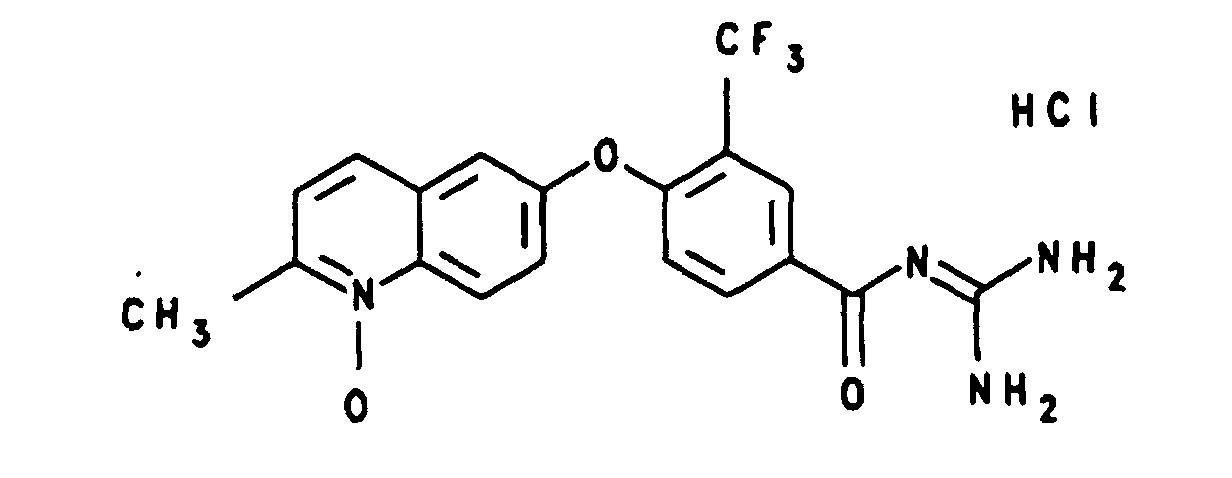
| Inhibition des Na+/H+-Exchangers: | |
| Beispiel | IC50 µmol/l |
| 1 | 0.08 |
| 2 | 0.3 |
| 3 | 0.019 |
Claims (14)
- Benzoylguanidine der Formel Iworin bedeuten:

- R(1)
- (C1-C4)-Alkyl, (C2-C4)-Alkenyl oder -CmH2mR(14),
m Null, 1 oder 2;
R(14) (C5-C6)-Cycloalkyl oder Phenyl,
welches nicht substituiert oder substituiert ist mit 1 - 2 Substituenten ausgewählt aus der Gruppe bestehend aus F, Cl, CF3, Methyl, Methoxy und NR(15)R(16);
R(15) und R(16)
Wasserstoff oder CH3;
- R(1)
- Wasserstoff, F, Cl, Br, I, -C≡N, R(22)-SO2, R(23)R(24)N-CO, R(25)-CO-oder
R(26)R(27)N-SO2-;
R(22), R(23), R(25) und R(26)
unabhängig (C1-C4)-Alkyl, (C2-C4)-Alkenyl, -CnH2n-R(29) oder CF3;
n Null, 1 oder 2;
R(29) (C5-C6)-Cycloalkyl oder Phenyl,
welches nicht substituiert ist oder substituiert mit 1 - 2 Substituenten ausgewählt aus der Gruppe bestehend aus F, Cl, CF3, Methyl, Methoxy und NR(30)R(31);
R(30) und R(31)
Wasserstoff oder Methyl;
oder
R(23), R(25) und R(26)
Wasserstoff;
R(24) und R(27)
unabhängig voneinander Wasserstoff oder Methyl;
oder R(23) und R(24) sowie R(26) und R(27)
gemeinsam 4 oder 5 Methylengruppen, von denen eine CH2-Gruppe durch Sauerstoff, S, NH, N-CH3 oder N-Benzyl ersetzt sein kann;
- R(1)
- OR(35) oder NR(35)R(36);
R(35) und R(36)
unabhängig voneinander Wasserstoff, (C1-C4)-Alkyl;
oder R(35) und R(36)
gemeinsam 4 - 5 Methylengruppen, von denen eine CH2-Gruppe
durch Sauerstoff, S, NH, N-CH3 oder N-Benzyl ersetzt sein kann;
Imidazolyl-N-Oxid, Pyrazolyl-N-Oxid, Triazolyl-N-Oxid, Tetrazolyl-N-Oxid, Oxazolyl-N-Oxid, Isoxazolyl-N-Oxid, Thiazolyl-N-Oxid, Isothiazolyl-N-Oxid, Pyridyl-N-Oxid, Pyrazinyl-N-Oxid, Pyrimidinyl-N-Oxid, Pyridazinyl-N-Oxid, Indazolyl-N-Oxid, Chinolyl-N-Oxid, Isochinolyl-N-Oxid, Phthalazinyl-N-Oxid, Chinoxalinyl-N-Oxid, Chinazolinyl-N-Oxid, Cinnolinyl-N-Oxid,
das über C oder N verknüpft ist und das unsubstituiert oder substituiert ist mit 1 - 2 Substituenten ausgewählt aus der Gruppe bestehend aus F, Cl, CF3, CH3, Methoxy, Hydroxy, Amino, Methylamino und Dimethylamino;
oder einer der Substituenten R(2) und R(3)
-SR(10), -OR(10), -NR(10)R(11) oder -CR(10)R(11)R(12);
R(10) -CaH2a-[Imidazolyl-N-Oxid, Pyrazolyl-N-Oxid, Triazolyl-N-Oxid,
Tetrazolyl-N-Oxid, Oxazolyl-N-Oxid, Isoxazolyl-N-Oxid, Thiazolyl-N-Oxid, Isothiazolyl-N-Oxid, Pyridyl-N-Oxid, Pyrazinyl-N-Oxid, Pyrimidinyl-N-Oxid, Pyridazinyl-N-Oxid, Indazolyl-N-Oxid, Chinolyl-N-Oxid, Isochinolyl-N-Oxid, Phthalazinyl-N-Oxid, Chinoxalinyl-N-Oxid, Chinazolinyl-N-Oxid, Cinnolinyl-N-Oxid],
das unsubstituiert oder substituiert ist mit 1 - 2 Substituenten ausgewählt aus der Gruppe bestehend aus F, Cl, CF3, CH3, Methoxy, Hydroxy, Amino, Methylamino und Dimethylamino;
a Null oder 1;
R(11), R(12)
Wasserstoff oder Methyl;
und der jeweils andere Substituent R(2) und R(3)
unabhängig voneinander (C1-C4)-Alkyl, Wasserstoff, F, Cl, Br oder 1; R(4) und R(5)
unabhängig voneinander Wasserstoff, Methyl, F, Cl, -OR(32),
-NR(33)R(34) oder CF3;
R(32), R(33) und R(34)
unabhängig voneinander Wasserstoff oder Methyl;
sowie deren pharmazeutisch verträgliche Salze. - Verbindungen der Formel I nach Anspruch 1, in der bedeuten:
- R(1)
- (C1-C4)-Alkyl, (C2-C4)-Alkenyl oder -CmH2mR(14);
m Null, 1 oder 2;
R(14) (C5-C6)-Cycloalkyl oder Phenyl,
welches nicht substituiert oder substituiert ist mit 1 - 2 Substituenten ausgewählt aus der Gruppe bestehend aus F, Cl, CF3, Methyl, Methoxy und NR(15)R(16);
R(15) und R(16)
Wasserstoff oder CH3;
- R(1)
- Wasserstoff, F, Cl, Br, I, -C≡N, R(22)-SO2, R(23)R(24)N-CO, R(25)-CO-oder
R(26)R(27)N-SO2-;
R(22), R(23), R(25) und R(26)
unabhängig voneinander Methyl oder CF3;
oder
R(23), R(25) und R(26)
Wasserstoff;
R(24) und R(27)
unabhängig voneinander Wasserstoff oder Methyl;
- R(1)
- OR(35) oder NR(35)R(36);
R(35) und R(36)
unabhängig voneinander Wasserstoff, (C1-C4)-Alkyl;
oder
R(35) und R(36)
gemeinsam 4 - 5 Methylengruppen, von denen eine CH2-Gruppe durch Sauerstoff, S, NH, N-CH3 oder N-Benzyl ersetzt sein kann,
Imidazolyl-N-Oxid, Pyrazolyl-N-Oxid, Triazolyl-N-Oxid, Tetrazolyl-N-Oxid, Oxazolyl-N-Oxid, Isoxazolyl-N-Oxid, Thiazolyl-N-Oxid, Isothiazolyl-N-Oxid, Pyridyl-N-Oxid, Pyrazinyl-N-Oxid, Pyrimidinyl-N-Oxid, Pyridazinyl-N-Oxid, Indazolyl-N-Oxid, Chinolyl-N-Oxid, Isochinolyl-N-Oxid, Phthalazinyl-N-Oxid, Chinoxalinyl-N-Oxid, Chinazolinyl-N-Oxid, Cinnolinyl-N-Oxid,
das über C oder N verknüpft ist und das unsubstituiert oder substituiert ist mit 1 - 2 Substituenten ausgewählt aus der Gruppe bestehend aus F, Cl, CF3, CH3, Methoxy, Hydroxy und Dimethylamino;
oder
einer der Substituenten R(2) und R(3)
-SR(10), -OR(10), -NR(10)R(11) oder -CR(10)R(11)R(12);
R(10) Imidazolyl-N-Oxid, Pyrazolyl-N-Oxid, Triazolyl-N-Oxid, Tetrazolyl-N-Oxid, Oxazolyl-N-Oxid, Isoxazolyl-N-Oxid, Thiazolyl-N-Oxid, Isothiazolyl-N-Oxid, Pyridyl-N-Oxid, Pyrazinyl-N-Oxid, Pyrimidinyl-N-Oxid, Pyridazinyl-N-Oxid, Indazolyl-N-Oxid, Chinolyl-N-Oxid, Isochinolyl-N-Oxid, Phthalazinyl-N-Oxid, Chinoxalinyl-N-Oxid, Chinazolinyl-N-Oxid, Cinnolinyl-N-Oxid,
das unsubstituiert oder substituiert ist mit 1 - 2 Substituenten ausgewählt aus der Gruppe bestehend aus F, Cl, CF3, CH3, Methoxy, Hydroxy und Dimethylamino;
R(11) und R(12)
unabhängig voneinander Wasserstoff oder Methyl;
und der jeweils andere Substituent R(2) und R(3)
unabhängig voneinander (C1-C4)-Alkyl, Wasserstoff, F, Cl, Br oder I;
R(4) und R(5)
unabhängig voneinander Wasserstoff, Methyl, F, Cl, -OR(32), - NR(33)R(34) oder CF3;
R(32), R(33) und R(34)
unabhängig voneinander Wasserstoff oder Methyl. - Verfahren zur Herstellung einer Verbindung der Formel I nach Anspruch 1, dadurch gekennzeichnet, daß man
eine Verbindung der Formel IIin welcher R(1) bis R(5) die in Anspruch 1 angegebenen Bedeutungen haben, mit Guanidin umsetzt, worin L für eine leicht nucleophil substituierbare Fluchtgruppe steht.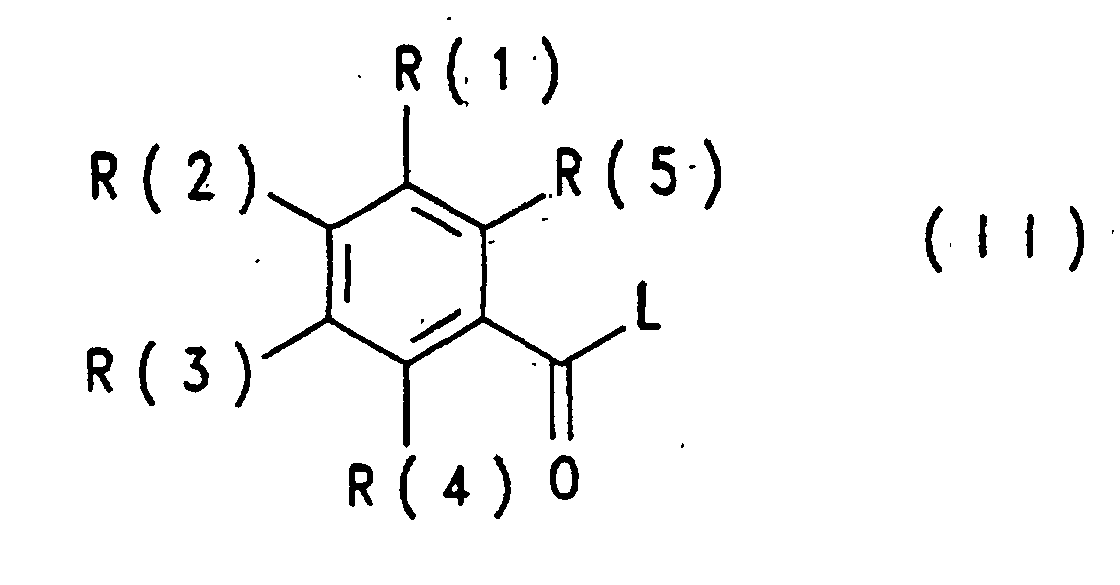
- Verwendung einer Verbindung I nach Anspruch 1 zur Herstellung eines Medikaments zur Behandlung von Arrhythmien.
- Verwendung einer Verbindung I nach Anspruch 1 zur Herstellung eines Medikaments zur Behandlung oder Prophylaxe des Herzinfarkts.
- Verwendung einer Verbindung I nach Anspruch 1 zur Herstellung eines Medikaments zur Behandlung oder Prophylaxe der Angina Pectoris.
- Verwendung einer Verbindung I nach Anspruch 1 zur Herstellung eines Medikaments zur Behandlung oder Prophylaxe von ischämischen Zuständen des Herzens.
- Verwendung einer Verbindung I nach Anspruch 1 zur Herstellung eines Medikaments zur Behandlung oder Prophylaxe von ischämischen Zuständen des peripheren und zentralen Nervensystems und des Schlaganfalls.
- Verwendung einer Verbindung I nach Anspruch 1 zur Herstellung eines Medikaments zur Behandlung oder Prophylaxe von ischämischen Zuständen peripherer Organe und Gliedmaßen.
- Verwendung einer Verbindung 1 nach Anspruch 1 zur Herstellung eines Medikaments zur Behandlung von Schockzuständen.
- Verwendung einer Verbindung I nach Anspruch 1 zur Herstellung eines Medikaments zum Einsatz bei chirurgischen Operationen und Organtransplantationen.
- Verwendung einer Verbindung I nach Anspruch 1 zur Herstellung eines Medikaments zur Konservierung und Lagerung von Transplantaten für chirurgische Maßnahmen.
- Verwendung einer Verbindung I nach Anspruch 1 zur Herstellung eines Medikaments zur Behandlung von Krankheiten, bei denen die Zellproliferation eine primäre oder sekundäre Ursache darstellt.
- Heilmittel, enthaltend eine wirksame Menge einer Verbindung I nach Anspruch 1.
Applications Claiming Priority (2)
| Application Number | Priority Date | Filing Date | Title |
|---|---|---|---|
| DE4432106 | 1994-09-09 | ||
| DE4432106A DE4432106A1 (de) | 1994-09-09 | 1994-09-09 | Mit Heterocyclen-N-Oxid-substituierte Benzoylguanidine, Verfahren zu ihrer Herstellung, ihre Verwendung als Medikament oder Diagnostikum, sie enthaltendes Medikament sowie Zwischenprodukte zu ihrer Herstellung |
Publications (2)
| Publication Number | Publication Date |
|---|---|
| EP0700904A1 EP0700904A1 (de) | 1996-03-13 |
| EP0700904B1 true EP0700904B1 (de) | 2001-12-05 |
Family
ID=6527788
Family Applications (1)
| Application Number | Title | Priority Date | Filing Date |
|---|---|---|---|
| EP95113845A Expired - Lifetime EP0700904B1 (de) | 1994-09-09 | 1995-09-04 | Mit Heterocyclen-N-Oxid-substituierte Benzoylguanidine, Verfahren zu ihrer Herstellung, ihre Verwendung als Medikament oder Diagnostikum sowie sie enthaltendes Medikament |
Country Status (22)
| Country | Link |
|---|---|
| US (1) | US5641792A (de) |
| EP (1) | EP0700904B1 (de) |
| JP (1) | JP4113262B2 (de) |
| KR (1) | KR960010619A (de) |
| CN (1) | CN1119643A (de) |
| AT (1) | ATE210121T1 (de) |
| AU (1) | AU695342B2 (de) |
| CA (1) | CA2157855C (de) |
| CZ (1) | CZ291188B6 (de) |
| DE (2) | DE4432106A1 (de) |
| DK (1) | DK0700904T3 (de) |
| ES (1) | ES2168324T3 (de) |
| FI (1) | FI954190A7 (de) |
| HU (1) | HU219976B (de) |
| IL (1) | IL115196A (de) |
| NO (1) | NO305202B1 (de) |
| NZ (1) | NZ272946A (de) |
| PL (1) | PL310346A1 (de) |
| PT (1) | PT700904E (de) |
| RU (1) | RU2160727C2 (de) |
| SI (1) | SI9500280B (de) |
| ZA (1) | ZA957548B (de) |
Families Citing this family (11)
| Publication number | Priority date | Publication date | Assignee | Title |
|---|---|---|---|---|
| EP0765867A1 (de) * | 1995-09-27 | 1997-04-02 | Hoechst Aktiengesellschaft | Substituierte Benzoylguanidine, Verfahren zu ihrer Herstellung, ihre Verwendung als Antiarrhytmika oder Diagnostikum sowie sie enthaltendes Medikament |
| DE19540995A1 (de) * | 1995-11-03 | 1997-05-07 | Hoechst Ag | Substituierte Sulfonimidamide, Verfahren zu ihrer Herstellung, ihre Verwendung als Medikament oder Diagnostikum sowie sie enthaltendes Medikament |
| DE19542306A1 (de) * | 1995-11-14 | 1997-05-15 | Hoechst Ag | Sulfonylamino-substituierte Benzoylguanidine, Verfahren zu ihrer Herstellung, ihre Verwendung als Medikament oder Diagnostikum sowie sie enthaltendes Medikament |
| PL316439A1 (en) * | 1995-11-20 | 1997-05-26 | Hoechst Ag | Novel substituted derivatives of benzoyloguanidine, method of obtaining them, their application in production of pharmaceutic and diagnostic agents and pharmaceutic agent as such |
| DE19546736A1 (de) * | 1995-12-14 | 1997-06-19 | Hoechst Ag | Substituierte Chromanylsulfonyl(thio)harnstoffe, Verfahren zu ihrer Herstellung und ihre Verwendung zur Herstellung pharmazeutischer Präparate |
| DE19621319A1 (de) * | 1996-05-28 | 1997-12-04 | Hoechst Ag | Bis-ortho-substituierte Benzoylguanidine, Verfahren zu ihrer Herstellung, ihre Verwendung als Medikament oder Diagnostikum sowie sie enthaltendes Medikament |
| DE19737224A1 (de) | 1997-08-27 | 1999-03-18 | Hoechst Marion Roussel De Gmbh | Pharmazeutisches Kombinationspräparat aus einem Inhibitor des Natrium-Wasserstoff-Austauschers und einem Arzneimittel zur Behandlung von Herz-Kreislauferkrankungen |
| US6852739B1 (en) * | 1999-02-26 | 2005-02-08 | Nitromed Inc. | Methods using proton pump inhibitors and nitric oxide donors |
| US6455554B1 (en) | 1999-06-07 | 2002-09-24 | Targacept, Inc. | Oxopyridinyl pharmaceutical compositions and methods for use |
| JP4634144B2 (ja) * | 2002-08-01 | 2011-02-16 | ニコックス エスエー | ニトロソ化プロトンポンプ阻害剤、組成物および使用方法 |
| WO2006055381A2 (en) * | 2004-11-16 | 2006-05-26 | Merck & Co., Inc. | Prodrugs of (2r)-2-propyloctanoic acid for treatment of stroke |
Family Cites Families (17)
| Publication number | Priority date | Publication date | Assignee | Title |
|---|---|---|---|---|
| DE271903C (de) * | ||||
| US3780027A (en) | 1970-04-29 | 1973-12-18 | Merck & Co Inc | Anthranilic acid derivatives |
| DE2258276C3 (de) * | 1972-11-28 | 1981-08-13 | Bayer Ag, 5090 Leverkusen | Triazolyl-stilbene, sowie deren Herstellung und Verwendung als optische Aufheller |
| US3931181A (en) * | 1973-07-27 | 1976-01-06 | Hoffmann-La Roche Inc. | 2,4-Diamino-5-benzylpyrimidines |
| JPS59510B2 (ja) * | 1973-11-22 | 1984-01-07 | 塩野義製薬株式会社 | ピリジンユウドウタイ ノ セイゾウホウ |
| US4373024A (en) | 1980-12-02 | 1983-02-08 | Phillips Petroleum Company | Apparatus useful for foam breaking |
| US4617307A (en) * | 1984-06-20 | 1986-10-14 | Ciba-Geigy Corporation | Substituted imidazo[1,5-A]pyridine derivatives as aromatase inhibitors |
| DD271903A1 (de) * | 1988-05-17 | 1989-09-20 | Univ Halle Wittenberg | Verfahren zur herstellung stabiler, 2-unsubstituierter imidazol-3-oxide |
| US4959377A (en) * | 1989-06-29 | 1990-09-25 | Hoechst-Roussel Pharmaceuticals Inc. | Phenoxypyridinamine compounds which are use as a dermatological composition |
| DE3929582A1 (de) * | 1989-09-06 | 1991-03-07 | Hoechst Ag | Benzoylguanidine, verfahren zu ihrer herstellung, ihre verwendung als medikament sowie sie enthaltendes medikament |
| US5212182A (en) * | 1990-10-03 | 1993-05-18 | American Home Products Corpooration | Substituted quinolinyl- and naphthalenylbenzamides or benzylamines and related compounds useful as analgesics |
| ES2089600T3 (es) * | 1992-02-15 | 1996-10-01 | Hoechst Ag | Benzoilguanidina sustituida en 3,5, con efecto antiarritmico y efecto inhibidor de la proliferacion de celulas. |
| CZ284456B6 (cs) * | 1992-02-15 | 1998-12-16 | Hoechst Aktiengesellschaft | Aminosubstituované benzoylguanidiny, způsob jejich přípravy, jejich použití jako léčiv a léčivo, které je obsahuje |
| TW250477B (de) * | 1992-12-15 | 1995-07-01 | Hoechst Ag | |
| TW250479B (de) * | 1992-12-15 | 1995-07-01 | Hoechst Ag | |
| ES2100435T3 (es) * | 1992-12-16 | 1997-06-16 | Hoechst Ag | Aminobenzoilguanidinas 3,5-sustituidas, procedimiento para su preparacion, su empleo como medicamento o agente de diagnostico, asi como medicamento que las contiene. |
| DK0612723T3 (da) * | 1993-02-20 | 1998-03-30 | Hoechst Ag | Substituerede benzoylguanidiner, fremgangsmåde til fremstilling, deres anvendelse som lægemiddel, som inhibitor af den cellulære Na+/H+-udbytning eller som diagnostikum samt lægemiddel med indhold deraf |
-
1994
- 1994-09-09 DE DE4432106A patent/DE4432106A1/de not_active Withdrawn
-
1995
- 1995-09-04 ES ES95113845T patent/ES2168324T3/es not_active Expired - Lifetime
- 1995-09-04 AT AT95113845T patent/ATE210121T1/de not_active IP Right Cessation
- 1995-09-04 DK DK95113845T patent/DK0700904T3/da active
- 1995-09-04 PT PT95113845T patent/PT700904E/pt unknown
- 1995-09-04 EP EP95113845A patent/EP0700904B1/de not_active Expired - Lifetime
- 1995-09-04 DE DE59509899T patent/DE59509899D1/de not_active Expired - Lifetime
- 1995-09-06 CN CN95116297A patent/CN1119643A/zh active Pending
- 1995-09-06 IL IL11519695A patent/IL115196A/xx active IP Right Grant
- 1995-09-07 RU RU95115511/04A patent/RU2160727C2/ru not_active IP Right Cessation
- 1995-09-07 AU AU30504/95A patent/AU695342B2/en not_active Ceased
- 1995-09-07 NZ NZ272946A patent/NZ272946A/en unknown
- 1995-09-07 KR KR1019950029358A patent/KR960010619A/ko not_active Ceased
- 1995-09-07 FI FI954190A patent/FI954190A7/fi unknown
- 1995-09-08 PL PL95310346A patent/PL310346A1/xx unknown
- 1995-09-08 ZA ZA957548A patent/ZA957548B/xx unknown
- 1995-09-08 JP JP23096695A patent/JP4113262B2/ja not_active Expired - Fee Related
- 1995-09-08 SI SI9500280A patent/SI9500280B/sl unknown
- 1995-09-08 CA CA002157855A patent/CA2157855C/en not_active Expired - Fee Related
- 1995-09-08 CZ CZ19952315A patent/CZ291188B6/cs not_active IP Right Cessation
- 1995-09-08 HU HU9502634A patent/HU219976B/hu not_active IP Right Cessation
- 1995-09-08 NO NO953555A patent/NO305202B1/no unknown
- 1995-09-08 US US08/525,156 patent/US5641792A/en not_active Expired - Lifetime
Also Published As
| Publication number | Publication date |
|---|---|
| FI954190L (fi) | 1996-03-10 |
| RU2160727C2 (ru) | 2000-12-20 |
| CN1119643A (zh) | 1996-04-03 |
| SI9500280B (en) | 2001-12-31 |
| US5641792A (en) | 1997-06-24 |
| IL115196A (en) | 2003-01-12 |
| NO953555L (no) | 1996-03-11 |
| CZ231595A3 (en) | 1996-04-17 |
| ES2168324T3 (es) | 2002-06-16 |
| KR960010619A (ko) | 1996-04-20 |
| CA2157855C (en) | 2009-04-21 |
| FI954190A7 (fi) | 1996-03-10 |
| SI9500280A (en) | 1996-04-30 |
| AU3050495A (en) | 1996-03-21 |
| DK0700904T3 (da) | 2002-03-18 |
| HU9502634D0 (en) | 1995-11-28 |
| EP0700904A1 (de) | 1996-03-13 |
| PL310346A1 (en) | 1996-03-18 |
| IL115196A0 (en) | 1995-12-31 |
| CA2157855A1 (en) | 1996-03-10 |
| JP4113262B2 (ja) | 2008-07-09 |
| PT700904E (pt) | 2002-05-31 |
| ATE210121T1 (de) | 2001-12-15 |
| NZ272946A (en) | 1996-12-20 |
| NO953555D0 (no) | 1995-09-08 |
| NO305202B1 (no) | 1999-04-19 |
| ZA957548B (en) | 1996-04-17 |
| DE4432106A1 (de) | 1996-03-14 |
| AU695342B2 (en) | 1998-08-13 |
| HU219976B (hu) | 2001-10-28 |
| DE59509899D1 (de) | 2002-01-17 |
| JPH0892215A (ja) | 1996-04-09 |
| HUT72630A (en) | 1996-05-28 |
| FI954190A0 (fi) | 1995-09-07 |
| CZ291188B6 (cs) | 2003-01-15 |
Similar Documents
| Publication | Publication Date | Title |
|---|---|---|
| EP0628543B1 (de) | Substituierte Benzoylguanidine, Verfahren zu ihrer Herstellung, ihre Verwendung als Medikament oder Diagnostikum sowie sie enthaltendes Medikament | |
| EP0676395B1 (de) | Substituierte N-Heteroaroylguanidine, als Inhibitoren des zellulären Natrium-Protonen-Antiporters, als Antiarrhythmika und als Inhibitoren der Proliferation von Zellen | |
| EP0640588B1 (de) | Ortho-substituierte Benzoylguanidine, Verfahren zu ihrer Herstellung, ihre Verwendung als Medikament oder Diagnostikum sowie sie enthaltendes Medikament | |
| EP0686627B1 (de) | Perfluoralkyl-substituierte Benzoylguanidine, Verfahren zu ihrer Herstellung, ihre Verwendung als Medikament oder Diagnostikum sowie sie enthaltendes Medikament | |
| EP0659748B1 (de) | Substituierte 1,1-dioxo-2H-1,2-benzothiazinoylguanidine mit Na+/H+-Austausch inhibierender Wirkung | |
| EP0640593B1 (de) | Substituierte Benzoylguanidine, Verfahren zu ihrer Herstellung, ihre Verwendung als Medikament oder Diagnostikum sowie sie enthaltendes Medikament | |
| EP0602523B1 (de) | Substituierte Benzoylguanidine, Verfahren zu ihrer Herstellung, ihre Verwendung als Medikament oder Diagnostikum sowie sie enthaltendes Medikament | |
| EP0688766B1 (de) | Perfluoralkylgruppen tragende phenylsubstituierte Alkenylcarbonsäure-guanidide, Verfahren zu ihrer Herstellung, ihre Verwendung als Medikament oder Diagnostikum sowie sie enthaltendes Medikament | |
| EP0627413B1 (de) | Substituierte Benzonylguanidine, Verfahren zu ihrer Herstellung, ihre Verwendung als Medikament oder Diagnostikum sowie sie enthaltendes Medikament | |
| EP0744397B1 (de) | Fluorphenylsubstituierte Alkenylcarbonsäureguanidine als Natriumprotonen-Antiporter-Inhibitoren, Verfahren zu ihrer Herstellung, ihre Verwendung als Medikament oder Diagnostikum sowie sie enthaltendes Medikament | |
| EP0638548B1 (de) | Harnstoffsubstituierte Benzoylguanidine, Verfahren zu ihrer Herstellung, ihre Verwendung als Medikament oder Diagnostikum sowie sie enthaltendes Medikament | |
| EP0700899B1 (de) | Substituierte Benzoylguanidine, Verfahren zu ihrer Herstellung, ihre Verwendung als Medikament oder Diagnostikum sowie sie enthaltendes Medikament | |
| EP0682017B1 (de) | Substituierte bizyklische Heteroaroylguanidine, Verfahren zu ihrer Herstellung, ihre Verwendung als Medikament oder Diagnostikum sowie sie enthaltendes Medikament | |
| EP0700904B1 (de) | Mit Heterocyclen-N-Oxid-substituierte Benzoylguanidine, Verfahren zu ihrer Herstellung, ihre Verwendung als Medikament oder Diagnostikum sowie sie enthaltendes Medikament | |
| EP0666252B1 (de) | Perfluoralkylgruppen tragende phenyl-substituierte Alkylcarbonsäure-guanidide, Vefahren zu ihrer Herstellung, ihre Verwendung als Medikament oder Diagnostikum sowie sie enthaltendes Medikament | |
| EP0690048A1 (de) | Ortho-amino-substituierte Benzoylguanidine, Verfahren zu ihrer Herstellung, ihre Verwendung als Medikament oder Diagnostikum sowie sie enthaltendes Medikament | |
| EP0765867A1 (de) | Substituierte Benzoylguanidine, Verfahren zu ihrer Herstellung, ihre Verwendung als Antiarrhytmika oder Diagnostikum sowie sie enthaltendes Medikament | |
| EP0754680A1 (de) | 4-Fluoralkyl-substituierte Benzoylguandine, Verfahren zu ihrer Herstellung, ihre Verwendung als Medikament oder Diagnostikum sowie sie enthaltendes Medikament | |
| EP0713864A1 (de) | Substituierte Benzoylguanidine, Verfahren zu ihrer Herstellung, ihre Verwendung als Medikament oder Diagnostikum sowie sie enthaltendes Medikament | |
| EP0702001A1 (de) | Fluoro-alkyl/alkenyl-substituierte Benzoylguanidine und ihre Verwendung als Medikament oder Diagnostikum | |
| EP0774459A1 (de) | Sulfonylamino-substituierte Benzoylguanidine, Verfahren zu ihrer Herstellung, ihre Verwendung als Medikament oder Diagnostikum sowie sie enthaltendes Medikament | |
| EP0791577B1 (de) | Ortho-substituierte Benzoylguanidine, Verfahren zu ihrer Herstellung, ihre Verwendung als Medikament oder Diagnostikum sowie sie enthaltendes Medikament | |
| EP0787717A1 (de) | Substituierte Diaryldicarbonsäure-diguanidine, Verfahren zu ihrer Herstellung, ihre Verwendung als Inhibitoren des Na+/H+-Antiporters sowie sie enthaltendes Medikament oder Diagnostikum | |
| DE19502795A1 (de) | Benzolsulfonamid-substituierte Benzoylguanidine, Verfahren zu ihrer Herstellung, ihre Verwendung als Medikament oder Diagnostikum sowie sie enthaltendes Medikament | |
| EP0765868A1 (de) | Substituierte Benzoylguanidine, Verfahren zu ihrer Herstellung, ihre Verwendung als Antiarhythmika oder als Diagnostikum sowie sie enthaltendes Medikament |
Legal Events
| Date | Code | Title | Description |
|---|---|---|---|
| PUAI | Public reference made under article 153(3) epc to a published international application that has entered the european phase |
Free format text: ORIGINAL CODE: 0009012 |
|
| AK | Designated contracting states |
Kind code of ref document: A1 Designated state(s): AT BE CH DE DK ES FR GB GR IE IT LI LU NL PT SE |
|
| 17P | Request for examination filed |
Effective date: 19960913 |
|
| 17Q | First examination report despatched |
Effective date: 19981218 |
|
| GRAG | Despatch of communication of intention to grant |
Free format text: ORIGINAL CODE: EPIDOS AGRA |
|
| RTI1 | Title (correction) |
Free format text: HETEROCYCLIC-N-OXIDE SUBSTITUTED BENZOYLGUANIDINES, PROCESS FOR THEIR PREPARATION, THEIR USE AS MEDICAMENT OR DIAGNOSTIC AS WELL AS MEDICAMENTS CONTAINING THEM |
|
| GRAG | Despatch of communication of intention to grant |
Free format text: ORIGINAL CODE: EPIDOS AGRA |
|
| GRAH | Despatch of communication of intention to grant a patent |
Free format text: ORIGINAL CODE: EPIDOS IGRA |
|
| RIN1 | Information on inventor provided before grant (corrected) |
Inventor name: ALBUS, UDO, DR. Inventor name: SCHOLZ, WOLFGANG, DR. Inventor name: WEICHERT, ANDREAS, DR. Inventor name: SCHWARK, JAN-ROBERT, DR. Inventor name: LANG, HANS-JOCHEN, DR. Inventor name: KLEEMANN, HEINZ-WERNER, DR. |
|
| GRAH | Despatch of communication of intention to grant a patent |
Free format text: ORIGINAL CODE: EPIDOS IGRA |
|
| GRAA | (expected) grant |
Free format text: ORIGINAL CODE: 0009210 |
|
| AK | Designated contracting states |
Kind code of ref document: B1 Designated state(s): AT BE CH DE DK ES FR GB GR IE IT LI LU NL PT SE |
|
| REF | Corresponds to: |
Ref document number: 210121 Country of ref document: AT Date of ref document: 20011215 Kind code of ref document: T |
|
| REG | Reference to a national code |
Ref country code: CH Ref legal event code: EP |
|
| REG | Reference to a national code |
Ref country code: GB Ref legal event code: IF02 |
|
| REG | Reference to a national code |
Ref country code: IE Ref legal event code: FG4D Free format text: GERMAN |
|
| REF | Corresponds to: |
Ref document number: 59509899 Country of ref document: DE Date of ref document: 20020117 |
|
| GBT | Gb: translation of ep patent filed (gb section 77(6)(a)/1977) |
Effective date: 20020208 |
|
| REG | Reference to a national code |
Ref country code: DK Ref legal event code: T3 |
|
| ET | Fr: translation filed | ||
| REG | Reference to a national code |
Ref country code: PT Ref legal event code: SC4A Free format text: AVAILABILITY OF NATIONAL TRANSLATION Effective date: 20020214 |
|
| REG | Reference to a national code |
Ref country code: ES Ref legal event code: FG2A Ref document number: 2168324 Country of ref document: ES Kind code of ref document: T3 |
|
| REG | Reference to a national code |
Ref country code: GR Ref legal event code: EP Ref document number: 20020400796 Country of ref document: GR |
|
| PGFP | Annual fee paid to national office [announced via postgrant information from national office to epo] |
Ref country code: AT Payment date: 20020813 Year of fee payment: 8 |
|
| PGFP | Annual fee paid to national office [announced via postgrant information from national office to epo] |
Ref country code: NL Payment date: 20020814 Year of fee payment: 8 |
|
| PGFP | Annual fee paid to national office [announced via postgrant information from national office to epo] |
Ref country code: SE Payment date: 20020815 Year of fee payment: 8 Ref country code: DK Payment date: 20020815 Year of fee payment: 8 Ref country code: CH Payment date: 20020815 Year of fee payment: 8 |
|
| PGFP | Annual fee paid to national office [announced via postgrant information from national office to epo] |
Ref country code: PT Payment date: 20020903 Year of fee payment: 8 |
|
| PGFP | Annual fee paid to national office [announced via postgrant information from national office to epo] |
Ref country code: GR Payment date: 20020911 Year of fee payment: 8 |
|
| PGFP | Annual fee paid to national office [announced via postgrant information from national office to epo] |
Ref country code: IE Payment date: 20020913 Year of fee payment: 8 |
|
| PGFP | Annual fee paid to national office [announced via postgrant information from national office to epo] |
Ref country code: BE Payment date: 20020917 Year of fee payment: 8 |
|
| PGFP | Annual fee paid to national office [announced via postgrant information from national office to epo] |
Ref country code: LU Payment date: 20021007 Year of fee payment: 8 |
|
| PLBE | No opposition filed within time limit |
Free format text: ORIGINAL CODE: 0009261 |
|
| STAA | Information on the status of an ep patent application or granted ep patent |
Free format text: STATUS: NO OPPOSITION FILED WITHIN TIME LIMIT |
|
| 26N | No opposition filed | ||
| PG25 | Lapsed in a contracting state [announced via postgrant information from national office to epo] |
Ref country code: LU Free format text: LAPSE BECAUSE OF NON-PAYMENT OF DUE FEES Effective date: 20030904 Ref country code: IE Free format text: LAPSE BECAUSE OF NON-PAYMENT OF DUE FEES Effective date: 20030904 Ref country code: AT Free format text: LAPSE BECAUSE OF NON-PAYMENT OF DUE FEES Effective date: 20030904 |
|
| PG25 | Lapsed in a contracting state [announced via postgrant information from national office to epo] |
Ref country code: SE Free format text: LAPSE BECAUSE OF NON-PAYMENT OF DUE FEES Effective date: 20030905 |
|
| PG25 | Lapsed in a contracting state [announced via postgrant information from national office to epo] |
Ref country code: LI Free format text: LAPSE BECAUSE OF NON-PAYMENT OF DUE FEES Effective date: 20030930 Ref country code: DK Free format text: LAPSE BECAUSE OF NON-PAYMENT OF DUE FEES Effective date: 20030930 Ref country code: CH Free format text: LAPSE BECAUSE OF NON-PAYMENT OF DUE FEES Effective date: 20030930 Ref country code: BE Free format text: LAPSE BECAUSE OF NON-PAYMENT OF DUE FEES Effective date: 20030930 |
|
| BERE | Be: lapsed |
Owner name: *HOECHST A.G. Effective date: 20030930 |
|
| PG25 | Lapsed in a contracting state [announced via postgrant information from national office to epo] |
Ref country code: PT Free format text: LAPSE BECAUSE OF NON-PAYMENT OF DUE FEES Effective date: 20040331 |
|
| PG25 | Lapsed in a contracting state [announced via postgrant information from national office to epo] |
Ref country code: NL Free format text: LAPSE BECAUSE OF NON-PAYMENT OF DUE FEES Effective date: 20040401 |
|
| PG25 | Lapsed in a contracting state [announced via postgrant information from national office to epo] |
Ref country code: GR Free format text: LAPSE BECAUSE OF NON-PAYMENT OF DUE FEES Effective date: 20040402 |
|
| EUG | Se: european patent has lapsed | ||
| REG | Reference to a national code |
Ref country code: DK Ref legal event code: EBP |
|
| REG | Reference to a national code |
Ref country code: CH Ref legal event code: PL |
|
| NLV4 | Nl: lapsed or anulled due to non-payment of the annual fee |
Effective date: 20040401 |
|
| REG | Reference to a national code |
Ref country code: PT Ref legal event code: MM4A Free format text: LAPSE DUE TO NON-PAYMENT OF FEES Effective date: 20040331 Ref country code: IE Ref legal event code: MM4A |
|
| PGFP | Annual fee paid to national office [announced via postgrant information from national office to epo] |
Ref country code: GB Payment date: 20110831 Year of fee payment: 17 Ref country code: DE Payment date: 20110831 Year of fee payment: 17 Ref country code: FR Payment date: 20110922 Year of fee payment: 17 |
|
| PGFP | Annual fee paid to national office [announced via postgrant information from national office to epo] |
Ref country code: IT Payment date: 20110914 Year of fee payment: 17 |
|
| PGFP | Annual fee paid to national office [announced via postgrant information from national office to epo] |
Ref country code: ES Payment date: 20111017 Year of fee payment: 17 |
|
| GBPC | Gb: european patent ceased through non-payment of renewal fee |
Effective date: 20120904 |
|
| REG | Reference to a national code |
Ref country code: FR Ref legal event code: ST Effective date: 20130531 |
|
| PG25 | Lapsed in a contracting state [announced via postgrant information from national office to epo] |
Ref country code: DE Free format text: LAPSE BECAUSE OF NON-PAYMENT OF DUE FEES Effective date: 20130403 Ref country code: GB Free format text: LAPSE BECAUSE OF NON-PAYMENT OF DUE FEES Effective date: 20120904 |
|
| PG25 | Lapsed in a contracting state [announced via postgrant information from national office to epo] |
Ref country code: FR Free format text: LAPSE BECAUSE OF NON-PAYMENT OF DUE FEES Effective date: 20121001 Ref country code: IT Free format text: LAPSE BECAUSE OF NON-PAYMENT OF DUE FEES Effective date: 20120904 |
|
| REG | Reference to a national code |
Ref country code: DE Ref legal event code: R119 Ref document number: 59509899 Country of ref document: DE Effective date: 20130403 |
|
| REG | Reference to a national code |
Ref country code: ES Ref legal event code: FD2A Effective date: 20131018 |
|
| PG25 | Lapsed in a contracting state [announced via postgrant information from national office to epo] |
Ref country code: ES Free format text: LAPSE BECAUSE OF NON-PAYMENT OF DUE FEES Effective date: 20120905 |