EP0699718A2 - Azothiophenfarbstoffe mit einer 2,4,6-Triamino-3-cyanpyridin Kupplungskomponente - Google Patents
Azothiophenfarbstoffe mit einer 2,4,6-Triamino-3-cyanpyridin Kupplungskomponente Download PDFInfo
- Publication number
- EP0699718A2 EP0699718A2 EP95810520A EP95810520A EP0699718A2 EP 0699718 A2 EP0699718 A2 EP 0699718A2 EP 95810520 A EP95810520 A EP 95810520A EP 95810520 A EP95810520 A EP 95810520A EP 0699718 A2 EP0699718 A2 EP 0699718A2
- Authority
- EP
- European Patent Office
- Prior art keywords
- alkyl
- alkoxy
- unsubstituted
- phenyl
- substituted
- Prior art date
- Legal status (The legal status is an assumption and is not a legal conclusion. Google has not performed a legal analysis and makes no representation as to the accuracy of the status listed.)
- Withdrawn
Links
- 239000000975 dye Substances 0.000 title claims abstract description 54
- 230000008878 coupling Effects 0.000 title claims description 9
- 238000010168 coupling process Methods 0.000 title claims description 9
- 238000005859 coupling reaction Methods 0.000 title claims description 9
- DVXMQZHDVBYYEQ-UHFFFAOYSA-N 2,4,6-triaminopyridine-3-carbonitrile Chemical compound NC1=CC(N)=C(C#N)C(N)=N1 DVXMQZHDVBYYEQ-UHFFFAOYSA-N 0.000 title 1
- AQYFGWINIJJWBQ-UHFFFAOYSA-N dithiophen-2-yldiazene Chemical compound C1=CSC(N=NC=2SC=CC=2)=C1 AQYFGWINIJJWBQ-UHFFFAOYSA-N 0.000 title 1
- 239000000463 material Substances 0.000 claims abstract description 25
- 125000001997 phenyl group Chemical group [H]C1=C([H])C([H])=C(*)C([H])=C1[H] 0.000 claims abstract description 21
- 229910052736 halogen Inorganic materials 0.000 claims abstract description 19
- 150000002367 halogens Chemical class 0.000 claims abstract description 19
- 229920000728 polyester Polymers 0.000 claims abstract description 19
- 238000000034 method Methods 0.000 claims abstract description 18
- 239000004753 textile Substances 0.000 claims abstract description 16
- 238000004043 dyeing Methods 0.000 claims abstract description 13
- 230000002209 hydrophobic effect Effects 0.000 claims abstract description 10
- 125000004453 alkoxycarbonyl group Chemical group 0.000 claims abstract description 9
- 239000000835 fiber Substances 0.000 claims abstract description 9
- 125000000951 phenoxy group Chemical group [H]C1=C([H])C([H])=C(O*)C([H])=C1[H] 0.000 claims abstract description 8
- 229910052801 chlorine Inorganic materials 0.000 claims abstract description 7
- 125000003386 piperidinyl group Chemical group 0.000 claims abstract description 7
- 229910052794 bromium Inorganic materials 0.000 claims abstract description 6
- 229910052731 fluorine Inorganic materials 0.000 claims abstract description 6
- 125000000719 pyrrolidinyl group Chemical group 0.000 claims abstract description 6
- 125000003236 benzoyl group Chemical group [H]C1=C([H])C([H])=C(C([H])=C1[H])C(*)=O 0.000 claims abstract description 5
- 125000003917 carbamoyl group Chemical group [H]N([H])C(*)=O 0.000 claims abstract description 5
- 125000002777 acetyl group Chemical group [H]C([H])([H])C(*)=O 0.000 claims abstract description 3
- 125000002485 formyl group Chemical group [H]C(*)=O 0.000 claims abstract description 3
- -1 nitro, cyano, acetyl Chemical group 0.000 claims description 22
- 125000000229 (C1-C4)alkoxy group Chemical group 0.000 claims description 19
- 239000000203 mixture Substances 0.000 claims description 18
- 229910052739 hydrogen Inorganic materials 0.000 claims description 14
- 239000001257 hydrogen Substances 0.000 claims description 14
- 125000002887 hydroxy group Chemical group [H]O* 0.000 claims description 14
- 150000001875 compounds Chemical class 0.000 claims description 12
- 150000002431 hydrogen Chemical group 0.000 claims description 12
- 150000003254 radicals Chemical class 0.000 claims description 10
- 125000004209 (C1-C8) alkyl group Chemical group 0.000 claims description 8
- 239000002657 fibrous material Substances 0.000 claims description 8
- 125000002496 methyl group Chemical group [H]C([H])([H])* 0.000 claims description 8
- 125000000449 nitro group Chemical group [O-][N+](*)=O 0.000 claims description 8
- WKBOTKDWSSQWDR-UHFFFAOYSA-N Bromine atom Chemical group [Br] WKBOTKDWSSQWDR-UHFFFAOYSA-N 0.000 claims description 6
- ZAMOUSCENKQFHK-UHFFFAOYSA-N Chlorine atom Chemical group [Cl] ZAMOUSCENKQFHK-UHFFFAOYSA-N 0.000 claims description 6
- 239000000460 chlorine Chemical group 0.000 claims description 6
- 229910052757 nitrogen Inorganic materials 0.000 claims description 6
- 125000004433 nitrogen atom Chemical group N* 0.000 claims description 6
- GDTBXPJZTBHREO-UHFFFAOYSA-N bromine Chemical group BrBr GDTBXPJZTBHREO-UHFFFAOYSA-N 0.000 claims description 5
- 239000011737 fluorine Substances 0.000 claims description 5
- 238000002360 preparation method Methods 0.000 claims description 5
- 125000006702 (C1-C18) alkyl group Chemical class 0.000 claims description 4
- 125000004093 cyano group Chemical group *C#N 0.000 claims description 4
- 125000001153 fluoro group Chemical group F* 0.000 claims description 4
- 125000000956 methoxy group Chemical group [H]C([H])([H])O* 0.000 claims description 4
- 125000004430 oxygen atom Chemical group O* 0.000 claims description 4
- KHUXNRRPPZOJPT-UHFFFAOYSA-N phenoxy radical Chemical compound O=C1C=C[CH]C=C1 KHUXNRRPPZOJPT-UHFFFAOYSA-N 0.000 claims description 4
- 150000001412 amines Chemical class 0.000 claims description 3
- 125000004108 n-butyl group Chemical group [H]C([H])([H])C([H])([H])C([H])([H])C([H])([H])* 0.000 claims description 3
- 239000000986 disperse dye Substances 0.000 claims description 2
- 125000004435 hydrogen atom Chemical group [H]* 0.000 claims description 2
- 125000001280 n-hexyl group Chemical group C(CCCCC)* 0.000 claims description 2
- 125000000740 n-pentyl group Chemical group [H]C([H])([H])C([H])([H])C([H])([H])C([H])([H])C([H])([H])* 0.000 claims description 2
- 125000004423 acyloxy group Chemical group 0.000 abstract description 2
- 125000000753 cycloalkyl group Chemical group 0.000 abstract description 2
- 125000000217 alkyl group Chemical group 0.000 abstract 9
- 125000003545 alkoxy group Chemical group 0.000 abstract 4
- SDNIHFOKVFTGMV-UHFFFAOYSA-N 2,4,6-triamino-2-(pyridin-2-yldiazenyl)-5-thiophen-2-yl-1h-pyridine-3-carbonitrile Chemical compound NC1=C(C#N)C(N)(N=NC=2N=CC=CC=2)NC(N)=C1C1=CC=CS1 SDNIHFOKVFTGMV-UHFFFAOYSA-N 0.000 abstract 1
- 125000005037 alkyl phenyl group Chemical group 0.000 abstract 1
- RTZKZFJDLAIYFH-UHFFFAOYSA-N ether Substances CCOCC RTZKZFJDLAIYFH-UHFFFAOYSA-N 0.000 abstract 1
- 125000002757 morpholinyl group Chemical group 0.000 abstract 1
- XLYOFNOQVPJJNP-UHFFFAOYSA-N water Substances O XLYOFNOQVPJJNP-UHFFFAOYSA-N 0.000 description 10
- HEMHJVSKTPXQMS-UHFFFAOYSA-M Sodium hydroxide Chemical compound [OH-].[Na+] HEMHJVSKTPXQMS-UHFFFAOYSA-M 0.000 description 9
- QTBSBXVTEAMEQO-UHFFFAOYSA-N Acetic acid Chemical compound CC(O)=O QTBSBXVTEAMEQO-UHFFFAOYSA-N 0.000 description 8
- 239000000243 solution Substances 0.000 description 8
- QAOWNCQODCNURD-UHFFFAOYSA-N Sulfuric acid Chemical compound OS(O)(=O)=O QAOWNCQODCNURD-UHFFFAOYSA-N 0.000 description 4
- KKEYFWRCBNTPAC-UHFFFAOYSA-N Terephthalic acid Chemical compound OC(=O)C1=CC=C(C(O)=O)C=C1 KKEYFWRCBNTPAC-UHFFFAOYSA-N 0.000 description 4
- 229960000583 acetic acid Drugs 0.000 description 4
- 238000006193 diazotization reaction Methods 0.000 description 4
- XBDQKXXYIPTUBI-UHFFFAOYSA-N dimethylselenoniopropionate Natural products CCC(O)=O XBDQKXXYIPTUBI-UHFFFAOYSA-N 0.000 description 4
- 239000002270 dispersing agent Substances 0.000 description 4
- 239000004744 fabric Substances 0.000 description 4
- 239000012362 glacial acetic acid Substances 0.000 description 4
- BWHMMNNQKKPAPP-UHFFFAOYSA-L potassium carbonate Chemical compound [K+].[K+].[O-]C([O-])=O BWHMMNNQKKPAPP-UHFFFAOYSA-L 0.000 description 4
- GCSCENSWKWQJQG-UHFFFAOYSA-N 5-amino-3-methylthiophene-2,4-dicarbonitrile Chemical compound CC1=C(C#N)SC(N)=C1C#N GCSCENSWKWQJQG-UHFFFAOYSA-N 0.000 description 3
- LYCAIKOWRPUZTN-UHFFFAOYSA-N Ethylene glycol Chemical compound OCCO LYCAIKOWRPUZTN-UHFFFAOYSA-N 0.000 description 3
- 238000006243 chemical reaction Methods 0.000 description 3
- 238000001816 cooling Methods 0.000 description 3
- 238000003756 stirring Methods 0.000 description 3
- AOCFAXMQSDOMDG-UHFFFAOYSA-N 4,6-diamino-2-(butylamino)pyridine-3-carbonitrile Chemical compound CCCCNC1=NC(N)=CC(N)=C1C#N AOCFAXMQSDOMDG-UHFFFAOYSA-N 0.000 description 2
- CNQOFPOPWDYQPS-UHFFFAOYSA-N 4,6-diamino-2-[3-(2-phenoxyethoxy)propylamino]pyridine-3-carbonitrile Chemical compound NC1=CC(N)=C(C#N)C(NCCCOCCOC=2C=CC=CC=2)=N1 CNQOFPOPWDYQPS-UHFFFAOYSA-N 0.000 description 2
- RXQNKKRGJJRMKD-UHFFFAOYSA-N 5-bromo-2-methylaniline Chemical compound CC1=CC=C(Br)C=C1N RXQNKKRGJJRMKD-UHFFFAOYSA-N 0.000 description 2
- 229920002284 Cellulose triacetate Polymers 0.000 description 2
- VEXZGXHMUGYJMC-UHFFFAOYSA-N Hydrochloric acid Chemical compound Cl VEXZGXHMUGYJMC-UHFFFAOYSA-N 0.000 description 2
- CPELXLSAUQHCOX-UHFFFAOYSA-N Hydrogen bromide Chemical compound Br CPELXLSAUQHCOX-UHFFFAOYSA-N 0.000 description 2
- KFZMGEQAYNKOFK-UHFFFAOYSA-N Isopropanol Chemical compound CC(C)O KFZMGEQAYNKOFK-UHFFFAOYSA-N 0.000 description 2
- XSQUKJJJFZCRTK-UHFFFAOYSA-N Urea Chemical compound NC(N)=O XSQUKJJJFZCRTK-UHFFFAOYSA-N 0.000 description 2
- NNLVGZFZQQXQNW-ADJNRHBOSA-N [(2r,3r,4s,5r,6s)-4,5-diacetyloxy-3-[(2s,3r,4s,5r,6r)-3,4,5-triacetyloxy-6-(acetyloxymethyl)oxan-2-yl]oxy-6-[(2r,3r,4s,5r,6s)-4,5,6-triacetyloxy-2-(acetyloxymethyl)oxan-3-yl]oxyoxan-2-yl]methyl acetate Chemical compound O([C@@H]1O[C@@H]([C@H]([C@H](OC(C)=O)[C@H]1OC(C)=O)O[C@H]1[C@@H]([C@@H](OC(C)=O)[C@H](OC(C)=O)[C@@H](COC(C)=O)O1)OC(C)=O)COC(=O)C)[C@@H]1[C@@H](COC(C)=O)O[C@@H](OC(C)=O)[C@H](OC(C)=O)[C@H]1OC(C)=O NNLVGZFZQQXQNW-ADJNRHBOSA-N 0.000 description 2
- VJMAITQRABEEKP-UHFFFAOYSA-N [6-(phenylmethoxymethyl)-1,4-dioxan-2-yl]methyl acetate Chemical compound O1C(COC(=O)C)COCC1COCC1=CC=CC=C1 VJMAITQRABEEKP-UHFFFAOYSA-N 0.000 description 2
- 150000004982 aromatic amines Chemical class 0.000 description 2
- POJOORKDYOPQLS-UHFFFAOYSA-L barium(2+) 5-chloro-2-[(2-hydroxynaphthalen-1-yl)diazenyl]-4-methylbenzenesulfonate Chemical compound [Ba+2].C1=C(Cl)C(C)=CC(N=NC=2C3=CC=CC=C3C=CC=2O)=C1S([O-])(=O)=O.C1=C(Cl)C(C)=CC(N=NC=2C3=CC=CC=C3C=CC=2O)=C1S([O-])(=O)=O POJOORKDYOPQLS-UHFFFAOYSA-L 0.000 description 2
- 239000004202 carbamide Substances 0.000 description 2
- 238000010790 dilution Methods 0.000 description 2
- 239000012895 dilution Substances 0.000 description 2
- 239000006185 dispersion Substances 0.000 description 2
- 125000001495 ethyl group Chemical group [H]C([H])([H])C([H])([H])* 0.000 description 2
- 229920000591 gum Polymers 0.000 description 2
- 229910000027 potassium carbonate Inorganic materials 0.000 description 2
- 239000000047 product Substances 0.000 description 2
- BDERNNFJNOPAEC-UHFFFAOYSA-N propan-1-ol Chemical compound CCCO BDERNNFJNOPAEC-UHFFFAOYSA-N 0.000 description 2
- 235000019260 propionic acid Nutrition 0.000 description 2
- IUVKMZGDUIUOCP-BTNSXGMBSA-N quinbolone Chemical compound O([C@H]1CC[C@H]2[C@H]3[C@@H]([C@]4(C=CC(=O)C=C4CC3)C)CC[C@@]21C)C1=CCCC1 IUVKMZGDUIUOCP-BTNSXGMBSA-N 0.000 description 2
- 239000000758 substrate Substances 0.000 description 2
- 210000002268 wool Anatomy 0.000 description 2
- 125000004178 (C1-C4) alkyl group Chemical group 0.000 description 1
- 125000004169 (C1-C6) alkyl group Chemical group 0.000 description 1
- ZMESHQOXZMOOQQ-UHFFFAOYSA-N 1-(naphthalen-1-ylmethyl)naphthalene Chemical compound C1=CC=C2C(CC=3C4=CC=CC=C4C=CC=3)=CC=CC2=C1 ZMESHQOXZMOOQQ-UHFFFAOYSA-N 0.000 description 1
- XIZSUYSWKGAOCN-UHFFFAOYSA-N 2-amino-4-chloro-5-formylthiophene-3-carbonitrile Chemical compound NC=1SC(C=O)=C(Cl)C=1C#N XIZSUYSWKGAOCN-UHFFFAOYSA-N 0.000 description 1
- IMRWILPUOVGIMU-UHFFFAOYSA-N 2-bromopyridine Chemical compound BrC1=CC=CC=N1 IMRWILPUOVGIMU-UHFFFAOYSA-N 0.000 description 1
- WQFCFMPMUNOOTQ-UHFFFAOYSA-N 3-(2-phenoxyethoxy)propan-1-amine Chemical compound NCCCOCCOC1=CC=CC=C1 WQFCFMPMUNOOTQ-UHFFFAOYSA-N 0.000 description 1
- MINUGMKLCVKBJT-UHFFFAOYSA-N 4,6-diamino-2-(hexylamino)pyridine-3-carbonitrile Chemical compound CCCCCCNC1=NC(N)=CC(N)=C1C#N MINUGMKLCVKBJT-UHFFFAOYSA-N 0.000 description 1
- KNZJZBMDJRLUFP-UHFFFAOYSA-N 4,6-diamino-2-(pentylamino)pyridine-3-carbonitrile Chemical compound CCCCCNC1=NC(N)=CC(N)=C1C#N KNZJZBMDJRLUFP-UHFFFAOYSA-N 0.000 description 1
- NKXPRYBNUGINBZ-UHFFFAOYSA-N 4,6-diamino-2-bromopyridine-3-carbonitrile Chemical compound NC1=CC(N)=C(C#N)C(Br)=N1 NKXPRYBNUGINBZ-UHFFFAOYSA-N 0.000 description 1
- YZLGTUOBDLJINN-UHFFFAOYSA-N 5-amino-3-chlorothiophene-2,4-dicarbonitrile Chemical compound NC=1SC(C#N)=C(Cl)C=1C#N YZLGTUOBDLJINN-UHFFFAOYSA-N 0.000 description 1
- ZCYVEMRRCGMTRW-UHFFFAOYSA-N 7553-56-2 Chemical compound [I] ZCYVEMRRCGMTRW-UHFFFAOYSA-N 0.000 description 1
- 244000215068 Acacia senegal Species 0.000 description 1
- 241000416162 Astragalus gummifer Species 0.000 description 1
- 229920002134 Carboxymethyl cellulose Polymers 0.000 description 1
- 0 Cc1c(C#N)[s]c(N=N[C@](C(N)N=C2N(*)*)C(N)=C2C#N)c1C#N Chemical compound Cc1c(C#N)[s]c(N=N[C@](C(N)N=C2N(*)*)C(N)=C2C#N)c1C#N 0.000 description 1
- 229920003043 Cellulose fiber Polymers 0.000 description 1
- 229920000742 Cotton Polymers 0.000 description 1
- PXGOKWXKJXAPGV-UHFFFAOYSA-N Fluorine Chemical compound FF PXGOKWXKJXAPGV-UHFFFAOYSA-N 0.000 description 1
- 229920000084 Gum arabic Polymers 0.000 description 1
- 229920000663 Hydroxyethyl cellulose Polymers 0.000 description 1
- 239000004354 Hydroxyethyl cellulose Substances 0.000 description 1
- 229920001612 Hydroxyethyl starch Polymers 0.000 description 1
- 229920000161 Locust bean gum Polymers 0.000 description 1
- IOVCWXUNBOPUCH-UHFFFAOYSA-M Nitrite anion Chemical compound [O-]N=O IOVCWXUNBOPUCH-UHFFFAOYSA-M 0.000 description 1
- IOVCWXUNBOPUCH-UHFFFAOYSA-N Nitrous acid Chemical compound ON=O IOVCWXUNBOPUCH-UHFFFAOYSA-N 0.000 description 1
- YGYAWVDWMABLBF-UHFFFAOYSA-N Phosgene Chemical compound ClC(Cl)=O YGYAWVDWMABLBF-UHFFFAOYSA-N 0.000 description 1
- 239000004952 Polyamide Substances 0.000 description 1
- VMHLLURERBWHNL-UHFFFAOYSA-M Sodium acetate Chemical compound [Na+].CC([O-])=O VMHLLURERBWHNL-UHFFFAOYSA-M 0.000 description 1
- 229920002125 Sokalan® Polymers 0.000 description 1
- 229920001615 Tragacanth Polymers 0.000 description 1
- YIMQCDZDWXUDCA-UHFFFAOYSA-N [4-(hydroxymethyl)cyclohexyl]methanol Chemical compound OCC1CCC(CO)CC1 YIMQCDZDWXUDCA-UHFFFAOYSA-N 0.000 description 1
- 235000010489 acacia gum Nutrition 0.000 description 1
- 239000000205 acacia gum Substances 0.000 description 1
- 235000010443 alginic acid Nutrition 0.000 description 1
- 229920000615 alginic acid Polymers 0.000 description 1
- 125000000129 anionic group Chemical group 0.000 description 1
- 125000003118 aryl group Chemical group 0.000 description 1
- 238000000889 atomisation Methods 0.000 description 1
- 239000000987 azo dye Substances 0.000 description 1
- 239000001045 blue dye Substances 0.000 description 1
- 125000004744 butyloxycarbonyl group Chemical group 0.000 description 1
- 239000001768 carboxy methyl cellulose Substances 0.000 description 1
- 235000010948 carboxy methyl cellulose Nutrition 0.000 description 1
- 150000001732 carboxylic acid derivatives Chemical class 0.000 description 1
- 239000008112 carboxymethyl-cellulose Substances 0.000 description 1
- 229940105329 carboxymethylcellulose Drugs 0.000 description 1
- 239000000969 carrier Substances 0.000 description 1
- 239000001913 cellulose Substances 0.000 description 1
- 229920002678 cellulose Polymers 0.000 description 1
- 239000003795 chemical substances by application Substances 0.000 description 1
- 239000003086 colorant Substances 0.000 description 1
- 238000012505 colouration Methods 0.000 description 1
- 239000007859 condensation product Substances 0.000 description 1
- 229920001577 copolymer Polymers 0.000 description 1
- 239000013078 crystal Substances 0.000 description 1
- 125000000582 cycloheptyl group Chemical group [H]C1([H])C([H])([H])C([H])([H])C([H])([H])C([H])(*)C([H])([H])C1([H])[H] 0.000 description 1
- 125000000113 cyclohexyl group Chemical group [H]C1([H])C([H])([H])C([H])([H])C([H])(*)C([H])([H])C1([H])[H] 0.000 description 1
- 125000001511 cyclopentyl group Chemical group [H]C1([H])C([H])([H])C([H])([H])C([H])(*)C1([H])[H] 0.000 description 1
- 125000002704 decyl group Chemical group [H]C([H])([H])C([H])([H])C([H])([H])C([H])([H])C([H])([H])C([H])([H])C([H])([H])C([H])([H])C([H])([H])C([H])([H])* 0.000 description 1
- 125000000664 diazo group Chemical group [N-]=[N+]=[*] 0.000 description 1
- 238000006471 dimerization reaction Methods 0.000 description 1
- 125000003754 ethoxycarbonyl group Chemical group C(=O)(OCC)* 0.000 description 1
- 125000005448 ethoxyethyl group Chemical group [H]C([H])([H])C([H])([H])OC([H])([H])C([H])([H])* 0.000 description 1
- 238000009472 formulation Methods 0.000 description 1
- 150000002334 glycols Chemical class 0.000 description 1
- 238000000227 grinding Methods 0.000 description 1
- 125000004051 hexyl group Chemical group [H]C([H])([H])C([H])([H])C([H])([H])C([H])([H])C([H])([H])C([H])([H])* 0.000 description 1
- 150000007857 hydrazones Chemical class 0.000 description 1
- 229910000042 hydrogen bromide Inorganic materials 0.000 description 1
- 235000019447 hydroxyethyl cellulose Nutrition 0.000 description 1
- 229940071826 hydroxyethyl cellulose Drugs 0.000 description 1
- 229940050526 hydroxyethylstarch Drugs 0.000 description 1
- 229910052740 iodine Inorganic materials 0.000 description 1
- 239000011630 iodine Substances 0.000 description 1
- 125000000959 isobutyl group Chemical group [H]C([H])([H])C([H])(C([H])([H])[H])C([H])([H])* 0.000 description 1
- 125000001449 isopropyl group Chemical group [H]C([H])([H])C([H])(*)C([H])([H])[H] 0.000 description 1
- 235000010420 locust bean gum Nutrition 0.000 description 1
- 239000000711 locust bean gum Substances 0.000 description 1
- CUONGYYJJVDODC-UHFFFAOYSA-N malononitrile Chemical compound N#CCC#N CUONGYYJJVDODC-UHFFFAOYSA-N 0.000 description 1
- 125000001160 methoxycarbonyl group Chemical group [H]C([H])([H])OC(*)=O 0.000 description 1
- SYSQUGFVNFXIIT-UHFFFAOYSA-N n-[4-(1,3-benzoxazol-2-yl)phenyl]-4-nitrobenzenesulfonamide Chemical class C1=CC([N+](=O)[O-])=CC=C1S(=O)(=O)NC1=CC=C(C=2OC3=CC=CC=C3N=2)C=C1 SYSQUGFVNFXIIT-UHFFFAOYSA-N 0.000 description 1
- 125000006606 n-butoxy group Chemical group 0.000 description 1
- 125000004123 n-propyl group Chemical group [H]C([H])([H])C([H])([H])C([H])([H])* 0.000 description 1
- 229930014626 natural product Natural products 0.000 description 1
- 125000002347 octyl group Chemical group [H]C([*])([H])C([H])([H])C([H])([H])C([H])([H])C([H])([H])C([H])([H])C([H])([H])C([H])([H])[H] 0.000 description 1
- 239000002245 particle Substances 0.000 description 1
- 125000001147 pentyl group Chemical group C(CCCC)* 0.000 description 1
- 239000000049 pigment Substances 0.000 description 1
- 229920002401 polyacrylamide Polymers 0.000 description 1
- 239000004584 polyacrylic acid Substances 0.000 description 1
- 229920002647 polyamide Polymers 0.000 description 1
- 229920000515 polycarbonate Polymers 0.000 description 1
- 239000004417 polycarbonate Substances 0.000 description 1
- 229920002451 polyvinyl alcohol Polymers 0.000 description 1
- 235000019422 polyvinyl alcohol Nutrition 0.000 description 1
- 229920000915 polyvinyl chloride Polymers 0.000 description 1
- 239000004800 polyvinyl chloride Substances 0.000 description 1
- 239000002244 precipitate Substances 0.000 description 1
- 150000003141 primary amines Chemical class 0.000 description 1
- 125000001436 propyl group Chemical group [H]C([*])([H])C([H])([H])C([H])([H])[H] 0.000 description 1
- 125000004742 propyloxycarbonyl group Chemical group 0.000 description 1
- 150000003222 pyridines Chemical class 0.000 description 1
- 239000011541 reaction mixture Substances 0.000 description 1
- 239000010979 ruby Substances 0.000 description 1
- 229910001750 ruby Inorganic materials 0.000 description 1
- 239000004576 sand Substances 0.000 description 1
- 125000002914 sec-butyl group Chemical group [H]C([H])([H])C([H])([H])C([H])(*)C([H])([H])[H] 0.000 description 1
- 150000003335 secondary amines Chemical class 0.000 description 1
- 239000001632 sodium acetate Substances 0.000 description 1
- 235000017281 sodium acetate Nutrition 0.000 description 1
- 239000002904 solvent Substances 0.000 description 1
- 239000008107 starch Substances 0.000 description 1
- 235000019698 starch Nutrition 0.000 description 1
- 238000000859 sublimation Methods 0.000 description 1
- 230000008022 sublimation Effects 0.000 description 1
- 210000004243 sweat Anatomy 0.000 description 1
- 230000008961 swelling Effects 0.000 description 1
- 229920002994 synthetic fiber Polymers 0.000 description 1
- 239000004758 synthetic textile Substances 0.000 description 1
- 125000000999 tert-butyl group Chemical group [H]C([H])([H])C(*)(C([H])([H])[H])C([H])([H])[H] 0.000 description 1
- 229920001187 thermosetting polymer Polymers 0.000 description 1
- 239000002562 thickening agent Substances 0.000 description 1
- 125000003944 tolyl group Chemical group 0.000 description 1
- 235000010487 tragacanth Nutrition 0.000 description 1
- 239000000196 tragacanth Substances 0.000 description 1
- 229940116362 tragacanth Drugs 0.000 description 1
- 125000002948 undecyl group Chemical group [H]C([*])([H])C([H])([H])C([H])([H])C([H])([H])C([H])([H])C([H])([H])C([H])([H])C([H])([H])C([H])([H])C([H])([H])C([H])([H])[H] 0.000 description 1
- 125000005023 xylyl group Chemical group 0.000 description 1
Classifications
-
- C—CHEMISTRY; METALLURGY
- C09—DYES; PAINTS; POLISHES; NATURAL RESINS; ADHESIVES; COMPOSITIONS NOT OTHERWISE PROVIDED FOR; APPLICATIONS OF MATERIALS NOT OTHERWISE PROVIDED FOR
- C09B—ORGANIC DYES OR CLOSELY-RELATED COMPOUNDS FOR PRODUCING DYES, e.g. PIGMENTS; MORDANTS; LAKES
- C09B29/00—Monoazo dyes prepared by diazotising and coupling
- C09B29/34—Monoazo dyes prepared by diazotising and coupling from other coupling components
- C09B29/36—Monoazo dyes prepared by diazotising and coupling from other coupling components from heterocyclic compounds
- C09B29/3604—Monoazo dyes prepared by diazotising and coupling from other coupling components from heterocyclic compounds containing only a nitrogen as heteroatom
- C09B29/3617—Monoazo dyes prepared by diazotising and coupling from other coupling components from heterocyclic compounds containing only a nitrogen as heteroatom containing a six-membered heterocyclic with only one nitrogen as heteroatom
- C09B29/3621—Monoazo dyes prepared by diazotising and coupling from other coupling components from heterocyclic compounds containing only a nitrogen as heteroatom containing a six-membered heterocyclic with only one nitrogen as heteroatom from a pyridine ring
- C09B29/3639—Monoazo dyes prepared by diazotising and coupling from other coupling components from heterocyclic compounds containing only a nitrogen as heteroatom containing a six-membered heterocyclic with only one nitrogen as heteroatom from a pyridine ring from a pyridine ring containing one or more amino groups
-
- C—CHEMISTRY; METALLURGY
- C09—DYES; PAINTS; POLISHES; NATURAL RESINS; ADHESIVES; COMPOSITIONS NOT OTHERWISE PROVIDED FOR; APPLICATIONS OF MATERIALS NOT OTHERWISE PROVIDED FOR
- C09B—ORGANIC DYES OR CLOSELY-RELATED COMPOUNDS FOR PRODUCING DYES, e.g. PIGMENTS; MORDANTS; LAKES
- C09B29/00—Monoazo dyes prepared by diazotising and coupling
- C09B29/0025—Monoazo dyes prepared by diazotising and coupling from diazotized amino heterocyclic compounds
- C09B29/0059—Monoazo dyes prepared by diazotising and coupling from diazotized amino heterocyclic compounds the heterocyclic ring containing only sulfur as heteroatom
-
- C—CHEMISTRY; METALLURGY
- C09—DYES; PAINTS; POLISHES; NATURAL RESINS; ADHESIVES; COMPOSITIONS NOT OTHERWISE PROVIDED FOR; APPLICATIONS OF MATERIALS NOT OTHERWISE PROVIDED FOR
- C09B—ORGANIC DYES OR CLOSELY-RELATED COMPOUNDS FOR PRODUCING DYES, e.g. PIGMENTS; MORDANTS; LAKES
- C09B67/00—Influencing the physical, e.g. the dyeing or printing properties of dyestuffs without chemical reactions, e.g. by treating with solvents grinding or grinding assistants, coating of pigments or dyes; Process features in the making of dyestuff preparations; Dyestuff preparations of a special physical nature, e.g. tablets, films
- C09B67/0033—Blends of pigments; Mixtured crystals; Solid solutions
- C09B67/0046—Mixtures of two or more azo dyes
- C09B67/0051—Mixtures of two or more azo dyes mixture of two or more monoazo dyes
-
- D—TEXTILES; PAPER
- D06—TREATMENT OF TEXTILES OR THE LIKE; LAUNDERING; FLEXIBLE MATERIALS NOT OTHERWISE PROVIDED FOR
- D06P—DYEING OR PRINTING TEXTILES; DYEING LEATHER, FURS OR SOLID MACROMOLECULAR SUBSTANCES IN ANY FORM
- D06P3/00—Special processes of dyeing or printing textiles, or dyeing leather, furs, or solid macromolecular substances in any form, classified according to the material treated
- D06P3/34—Material containing ester groups
- D06P3/52—Polyesters
- D06P3/54—Polyesters using dispersed dyestuffs
-
- Y—GENERAL TAGGING OF NEW TECHNOLOGICAL DEVELOPMENTS; GENERAL TAGGING OF CROSS-SECTIONAL TECHNOLOGIES SPANNING OVER SEVERAL SECTIONS OF THE IPC; TECHNICAL SUBJECTS COVERED BY FORMER USPC CROSS-REFERENCE ART COLLECTIONS [XRACs] AND DIGESTS
- Y10—TECHNICAL SUBJECTS COVERED BY FORMER USPC
- Y10S—TECHNICAL SUBJECTS COVERED BY FORMER USPC CROSS-REFERENCE ART COLLECTIONS [XRACs] AND DIGESTS
- Y10S8/00—Bleaching and dyeing; fluid treatment and chemical modification of textiles and fibers
- Y10S8/92—Synthetic fiber dyeing
- Y10S8/922—Polyester fiber
Definitions
- the present invention relates to disperse dyes, processes for their preparation and their use for dyeing textile materials.
- C1-C4 alkyl in formula (1) comes e.g. Considerable: methyl, ethyl, isopropyl, n-propyl, isobutyl, n-butyl, sec-butyl, tert-butyl.
- the C1-C8-alkyl radical and the C1-C18-alkyl radical can, in addition to the radicals given above for C1-C4-alkyl, straight-chain or branched alkyl radicals, such as e.g. Pentyl, hexyl, octyl, decyl or undecyl.
- the invention relates to the dyes of the formula (1) and the mixture of isomers, for example in which A is -NH2, B is the rest of the formula -N (R1) R2 and C NH2, or in which B is -NH2, A is the rest of the formula -N (R1) R2 and C is NH2, or wherein C is the rest of the Formula -N (R1) R2 and A or B is the rest of the formula -N (R1) R2 and B or A is -NH2, or these isomer mixtures in admixture with the compound in which A and B are -NH2 and C -N (R1 ) R2, or A, B and C is -NH2 or -N (R1) R2.
- C1-C4 alkoxycarbonyl for Y and Z e.g. considered: methoxycarbonyl, ethoxycarbonyl, propoxycarbonyl, butoxycarbonyl.
- C1-C4 alkoxy in formula (1) means e.g. Methoxy, ethoxy, isopropoxy, n-propoxy and n-butoxy.
- C1-C4-alkoxy-C1-C4-alkyl in formula (1) means e.g. Methoxyethyl, ethoxyethyl.
- C4-C7 cycloalkyl comes e.g. Cyclopentyl, cyclohexyl or cycloheptyl.
- Halogen in formula (1) is generally to be understood as fluorine, bromine, iodine or especially chlorine.
- C2-C4 alkanoyloxy comes e.g. -O-CO-CH3, -O-CO-C2H5 or -O-CO-C3H7 into consideration.
- Dyes of the formula (1) are preferred in which X is hydrogen, C1-C8-alkyl or unsubstituted or substituted by fluorine, chlorine, bromine, methyl, methoxy or nitro; Y is cyan, C1-C4 alkoxycarbonyl or nitro; Z cyan, acetyl, benzoyl or unsubstituted or by C1-C4-alkyl, C1-C4-alkoxy, C1-C4-alkoxy-C1-C4-alkyl, phenyl or (C1-C4-alkyl) 1 ⁇ 2phenyl-substituted carbamoyl, or X and Z or Y and Z are each simultaneously C1-C4 alkoxycarbonyl, the radical C is -NH2, and one of the radicals A or B is -NH2 and the other is -N (R1) R2, and R1 and R2 independently of one another are hydrogen , phenyl unsubstitute
- Dyes of the formula (1) in particular those of the formula (1), in which C is -NH2, and in which R2 is unsubstituted C1-C8-alkyl or a radical of the formula are particularly preferred -R3-O-R4-L (2), wherein R3 is C2-C4-alkylene, R4 C2-C8-alkylene and L is hydrogen, hydroxy, -O-phenyl, -O-C1-C8-alkyl or -OCO-C1-C8-alkyl.
- X denotes unsubstituted C1-C8-alkyl, in particular methyl, preferably in dyes of the formula (1) in which C is -NH2.
- Dyes of the formula are important wherein R1 is hydrogen, and R2 has the meaning given under formula (1).
- the dyes of the formula (3) or (4) are particularly important, in which R1 is hydrogen and R2 is C1-C6-alkyl, in particular n-butyl, n-pentyl or n-hexyl, C1-C3-alkoxy-C2-C3-alkyl , Phenyl, methoxyphenyl or a radical of the formula -R5-O-R6-Q (5) is in which R5 is C2-C3-alkylene, R6 C2-C4-alkylene and Q is phenoxy, C1-C4-alkoxy or propionyloxy, or wherein R1 and R2 together with the nitrogen atom connecting them form a pyrrolidinyl, piperidinyl or morpholinyl radical.
- the invention also relates to a process for the preparation of the dyes of the formula (1).
- the dyes according to the invention are prepared in a manner known per se, for example by using an amine of the formula wherein X, Y and Z have the meanings given under formula (1), diazotized and onto a coupling component of the formula couples, wherein A, B and C have the meanings given under formula (1).
- the compounds of the formulas (6) and (7) are known or can be prepared in a manner known per se and the diazotization and coupling are carried out in the customary manner.
- Examples of compounds of the formula (6) are: 2-amino-3,5-dicyan-4-methylthiophene.
- the mixtures of the dyes of the formula (1) can be prepared analogously to known processes by coupling diazotized aromatic amines to the corresponding pyridine derivatives.
- the coupling components are e.g. obtained by reacting malodinitrile with hydrogen bromide to give bromopyridine and then replacing the bromine atom with an amine residue.
- Another way of producing mixtures of the compounds of the formula (1) is by dimerization of malodinitrile according to known methods and subsequent coupling with a diazotized aromatic amine to the corresponding hydrazone.
- the subsequent reaction with primary or secondary amines in the presence of a carboxylic acid provides 2,4,6-triaminopyridine-azo dye mixtures in which one, two or all three positions are occupied by an -NH2 group or -N (R1) R2.
- the compounds of formula (1) according to the invention can be used as dyes for dyeing and printing semi-synthetic and in particular synthetic hydrophobic fiber materials, especially textile materials. Textile materials from blended fabrics which contain such semi-synthetic or synthetic hydrophobic textile materials can also be dyed or printed with the aid of the compounds according to the invention.
- Cellulose 21 ⁇ 2-acetate and cellulose triacetate are particularly suitable as semi-synthetic textile materials.
- Synthetic hydrophobic textile materials consist primarily of linear, aromatic polyesters, for example those made of terephthalic acid and glycols, especially ethylene glycol or condensation products made of terephthalic acid and 1,4-bis (hydroxymethyl) cyclohexane; from polycarbonates, e.g. those from ⁇ , ⁇ -dimethyl-4,4'-dihydroxy-diphenylmethane and phosgene, from fibers based on polyvinyl chloride and polyamide.
- polyester fiber materials are dyed in the exhaust process from aqueous dispersion in the presence of customary anionic or nonionic dispersants and, if appropriate, customary swelling agents (carriers) at temperatures between 80 and 140 ° C.
- Cellulose-21 ⁇ 2-acetate is preferably dyed between about 65 to 85 ° C and cellulose triacetate at temperatures up to 115 ° C.
- the new dyes do not or only slightly stain the wool and cotton present in the dyebath (very good reserve), so that they can also be used well for dyeing polyester / wool and polyester / cellulose fiber blended fabrics.
- the dyes according to the invention are suitable for dyeing by the thermosol process, in the exhaust process and for printing processes.
- the textile material mentioned can be in the various processing forms, such as as fiber, thread or fleece, as woven or knitted fabric.
- the dyes according to the invention are converted into a dye preparation before they are used.
- the dye is ground so that its particle size is on average between 0.1 and 10 microns.
- the grinding can take place in the presence of dispersants.
- the dried dye is ground with a dispersant or kneaded in paste form with a dispersant and then dried in vacuo or by atomization. With the preparations obtained in this way, printing pastes and dyebaths can be prepared after the addition of water.
- the usual thickeners will be used for printing, e.g. modified or unmodified natural products, for example alginates, British gum, gum arabic, crystal gum, locust bean gum, tragacanth, carboxymethyl cellulose, hydroxyethyl cellulose, starch or synthetic products, for example polyacrylamides, polyacrylic acid or their copolymers or polyvinyl alcohols.
- modified or unmodified natural products for example alginates, British gum, gum arabic, crystal gum, locust bean gum, tragacanth, carboxymethyl cellulose, hydroxyethyl cellulose, starch or synthetic products, for example polyacrylamides, polyacrylic acid or their copolymers or polyvinyl alcohols.
- the dyes according to the invention give the above-mentioned materials, especially the polyester material, level red-orange or red shades of very good fastness to use, such as, above all, good lightfastness, thermosetting, pleating, chlorine and wet fastness such as water, sweat and washfastness; the colorations are also characterized by very good fastness to rubbing. Particularly noteworthy is the very good lightfastness of the dyeings obtained with high brilliance.
- the dyes according to the invention are furthermore distinguished by a good structure, excellent fastness to sublimation and very good fastness to thermomigration.
- the dyes according to the invention can also be used well to produce mixed shades together with other dyes or together with a suitable yellow and blue dye for trichromatic dyeing. Mixtures of the dyes according to the invention can of course also be used with one another.
- the dyes according to the invention are outstandingly suitable for dyeing polyester textile material for car upholstery covers.
- the abovementioned uses of the azo compounds of the formula (1) according to the invention also form part of the subject of the present invention, as is a process for dyeing or printing semi-synthetic or synthetic hydrophobic fiber material, in particular textile material, which consists in one or more compounds of the formula ( 1) apply to the material mentioned or incorporate it into it.
- the hydrophobic fiber material mentioned is preferably textile polyester material.
- Another object of the invention is the hydrophobic fiber material, preferably polyester textile material, dyed or printed by the method mentioned.
- the pH is carefully adjusted to about 2.8 with 10 parts of sodium hydroxide solution (30%) and 10 parts of water are added for dilution.
- the dye of the formula formed is filtered off, washed with water and dried. It dyes polyester fibers in brilliant red tones with excellent fastness properties, especially very good light fastness.
- the diazotization mixture obtained according to Example 1 is added to a solution consisting of 0.57 parts of n-butylamino-3-cyano-4,6-diaminopyridine in 4 parts of glacial acetic acid / propionic acid (ratio 5: 1) and 2 parts of water. For dilution, 5 parts of water are added dropwise and the pH is adjusted to 2.8 with 5 parts of sodium hydroxide solution (30%). The dye formed is filtered off, washed with water and dried. It corresponds to the formula
- polyester in brilliant red tones of excellent fastness properties.
- the dyes listed in the following table are obtained in a manner analogous to that described in Examples 1 and 2. They dye polyester fibers in red shades.
- the dyes listed in the following table are obtained in a manner analogous to that described in Examples 1 and 2. They dye polyester fibers in red shades.
- the diazotization mixture prepared in this way is allowed to flow into a solution of 3.6 parts of 2-phenoxyethoxypropylamino-3-cyano-4,6-diaminopyridine in 15 parts of glacial acetic acid, 30 parts of water and 5 parts of 1N hydrochloric acid within 30 minutes and the mixture is stirred for a further approx 45 minutes after.
- the pH is adjusted to about 3 by adding 28 parts of sodium hydroxide solution (30%).
- the unusual dye of the formula is filtered off, washed salt-free and dried. It dyes polyester with a ruby shade.
- the dyes listed in the following table are obtained in a manner analogous to that described in Example 56. They dye polyester fibers in red shades.
- Example 1 1 g of the dye described in Example 1 is ground together with 17 g of water and 2 g of a commercially available disperser of the dinaphthyl methane disulfonate type in a sand mill and converted into a 5% aqueous dispersion.
Landscapes
- Chemical & Material Sciences (AREA)
- Organic Chemistry (AREA)
- Dispersion Chemistry (AREA)
- Engineering & Computer Science (AREA)
- Textile Engineering (AREA)
- Chemical Kinetics & Catalysis (AREA)
- Coloring (AREA)
- Plural Heterocyclic Compounds (AREA)
- Paper (AREA)
Abstract
Description
- Gegenstand der vorliegenden Erfindung sind Dispersionsfarbstoffe, Verfahren zu deren Herstellung sowie ihre Verwendung zum Färben von Textilmaterialien.
- Die erfindungsgemässen Farbstoffe entsprechen der Formel

worin X Wasserstoff, Halogen, C₁-C₈-Alkyl oder unsubstituiertes oder durch Fluor, Chlor, Brom, Methyl, Methoxy oder Nitro substituiertes Phenyl; Y Cyan, C₁-C₄-Alkoxycarbonyl oder Nitro; Z Nitro, Cyan, Acetyl, Benzoyl, Formyl, -CH=C(CN)₂, -CH=C(CN)CO₂R oder unsubstituiertes oder durch C₁-C₄-Alkyl, C₁-C₄-Alkoxy, C₁-C₄-Alkoxy-C₁-C₄-alkyl, Phenyl oder (C₁-C₄-Alkyl)₁₋₂phenyl substituiertes Carbamoyl, wobei R C₁-C₄-Alkyl ist, oder X und Z oder Y und Z jeweils gleichzeitig C₁-C₄-Alkoxycarbonyl ist, und A, B und C unabhängig voneinander -NH₂ oder -N(R₁)R₂ bedeuten, und R₁ und R₂ unabhängig voneinander Wasserstoff, unsubstituiertes oder durch Hydroxy, C₁-C₄-Alkyl, Halogen oder C₁-C₄-Alkoxy substituiertes Phenyl, unsubstituiertes oder durch C₁-C₄-Alkyl substituiertes C₄-C₇-Cycloalkyl, oder unsubstituiertes oder durch Halogen, Cyan, C₂-C₄-Alkanoyloxy, Hydroxy, C₁-C₄-Alkoxy, Phenoxy oder Phenyl substituiertes C₁-C₁₈-Alkyl bedeuten, wobei der Phenyl- oder Phenoxyrest unsubstituiert oder durch Hydroxy, C₁-C₄-Alkyl, Halogen oder C₁-C₄-Alkoxy substituiert ist und der C₁-C₁₈-Alkylrest durch Sauerstoffatome unterbrochen sein kann, oder worin R₁ und R₂ zusammen mit dem sie verbindenden Stickstoffatom einen Piperidinyl-, Pyrrolidinyl- oder Morpholinylrest bilden. - Als C₁-C₄-Alkyl in Formel (1) kommt z.B. in Betracht: Methyl, Aethyl, Isopropyl, n-Propyl, Isobutyl, n-Butyl, sek.-Butyl, tert.-Butyl. Der C₁-C₈-Alkykest und der C₁-C₁₈-Alkylrest kann ausser den oben für C₁-C₄-Alkyl angegebenen Resten geradkettige oder verzweigte Alkylreste, wie z.B. Pentyl, Hexyl, Octyl, Decyl oder Undecyl, bedeuten.
- Gegenstand der Erfindung sind die Farbstoffe der Formel (1) sowie die Mischung der Isomeren, z.B. worin A -NH₂, B der Rest der Formel -N(R₁)R₂ und C NH₂ ist, oder worin B -NH₂, A der Rest der Formel -N(R₁)R₂ und C NH₂ ist, oder worin C der Rest der Formel -N(R₁)R₂ und A oder B der Rest der Formel -N(R₁)R₂ und B oder A -NH₂ ist, oder diese Isomerenmischungen in Mischung mit der Verbindung, worin A und B -NH₂ und C -N(R₁)R₂, oder A, B und C -NH₂ oder -N(R₁)R₂ ist.
- Als C₁-C₄-Alkoxycarbonyl kommt für Y und Z z.B. in Betracht: Methoxycarbonyl, Aethoxycarbonyl, Propoxycarbonyl, Butoxycarbonyl.
- C₁-C₄-Alkoxy bedeutet in Formel (1) z.B. Methoxy, Aethoxy, Isopropoxy, n-Propoxy und n-Butoxy.
- C₁-C₄-Alkoxy-C₁-C₄-alkyl bedeutet in Formel (1) z.B. Methoxyaethyl, Aethoxyäthyl.
- Als (C₁-C₄-Alkyl)₁₋₂phenyl kommt z.B. Tolyl und Xylyl in Betracht.
- Als C₄-C₇-Cycloalkyl kommt z.B. Cyclopentyl, Cyclohexyl oder Cycloheptyl in Betracht.
- Unter Halogen ist in Formel (1) generell Fluor, Brom, Jod oder vor allem Chlor zu verstehen.
- Als C₂-C₄-Alkanoyloxy kommt z.B. -O-CO-CH₃, -O-CO-C₂H₅ oder -O-CO-C₃H₇ in Betracht.
- Bevorzugt sind Farbstoffe der Formel (1), worin X Wasserstoff, C₁-C₈-Alkyl oder unsubstituiertes oder durch Fluor, Chlor, Brom, Methyl, Methoxy oder Nitro substituiertes Phenyl; Y Cyan, C₁-C₄-Alkoxycarbonyl oder Nitro; Z Cyan, Acetyl, Benzoyl oder unsubstituiertes oder durch C₁-C₄-Alkyl, C₁-C₄-Alkoxy, C₁-C₄-Alkoxy-C₁-C₄-alkyl, Phenyl oder (C₁-C₄-Alkyl)₁₋₂phenyl substituiertes Carbamoyl, oder X und Z oder Y und Z jeweils gleichzeitig C₁-C₄-Alkoxycarbonyl ist, der Rest C -NH₂ bedeutet, und einer der Reste A oder B -NH₂ und der andere -N(R₁)R₂ bedeuten, und R₁ und R₂ unabhängig voneinander Wasserstoff, unsubstituiertes oder durch Hydroxy, C₁-C₄-Alkyl, Halogen oder C₁-C₄-Alkoxy substituiertes Phenyl, unsubstituiertes oder durch C₁-C₄-Alkyl substituiertes C₄-C₇-Cycloalkyl, oder unsubstituiertes oder durch Halogen, Cyan, C₂-C₄-Alkanoyloxy, Hydroxy, C₁-C₄-Alkoxy, Phenoxy oder Phenyl substituiertes C₁-C₁₈-Alkyl bedeuten, wobei der Phenyl- oder Phenoxyrest unsubstituiert oder durch Hydroxy, C₁-C₄-Alkyl, Halogen oder C₁-C₄-Alkoxy substituiert ist und der C₁-C₁₈-Alkylrest durch Sauerstoffatome unterbrochen sein kann, oder worin R₁ und R₂ zusammen mit dem sie verbindenden Stickstoffatom einen Piperidinyl-, Pyrrolidinyl- oder Morpholinylrest bilden.
- Besonders bevorzugt sind Farbstoffe der Formel (1), insbesondere solche der Formel (1), worin C -NH₂ ist, und worin R₂ unsubstituiertes C₁-C₈-Alkyl oder einen Rest der Formel
-R₃-O-R₄-L (2),
worin R₃ C₂-C₄-Alkylen, R₄ C₂-C₈-Alkylen und L Wasserstoff, Hydroxy, -O-Phenyl, -O-C₁-C₈-Alkyl oder -OCO-C₁-C₈-Alkyl bedeuten. - In ganz besonders bevorzugten erfindungsgemässen Farbstoffen der Formel (1) bedeutet X unsubstituiertes C₁-C₈-Alkyl, insbesondere Methyl, vorzugsweise in Farbstoffen der Formel (1), worin C -NH₂ ist.
- Wichtig sind Farbstoffe der Formel

worin R₁ Wasserstoff ist, und R₂ die unter Formel (1) angegebene Bedeutung hat. - Besonders wichtig sind die Farbstoffe der Formel (3) oder (4), worin R₁ Wasserstoff und R₂ C₁-C₆-Alkyl, insbesondere n-Butyl, n-Pentyl oder n-Hexyl, C₁-C₃-Alkoxy-C₂-C₃-alkyl, Phenyl, Methoxyphenyl oder ein Rest der Formel
-R₅-O-R₆-Q (5)
ist, worin R₅ C₂-C₃-Alkylen, R₆ C₂-C₄-Alkylen und Q Phenoxy, C₁-C₄-Alkoxy oder Propionyloxy bedeutet, oder worin R₁ und R₂ zusammen mit dem sie verbindenden Stickstoffatom einen Pyrrolidinyl-, Piperidinyl- oder Morpholinylrest bilden. - Für die Isomerenmischungen gelten die identischen Bevorzugungen wie oben für die Reste X, Y, Z, A, B und C angegeben. Interessant sind Mischungen aus mindestens zwei Farbstoffen der Formel (1) worin X, Y, Z, A, B und C die als bevorzugt, besonders bevorzugt und ganz besonders bevorzugt angegebenen Bedeutungen haben. Besonders interessant sind ferner Mischungen enthaltend mindestens zwei Farbstoffe der Formeln (3) und (4).
- Gegenstand der Erfindung ist auch ein Verfahren zur Herstellung der Farbstoffe der Formel (1). Die erfindungsgemässen Farbstoffe werden auf an sich bekannte Art und Weise hergestellt, beispielsweise indem man ein Amin der Formel

worin X, Y und Z die unter Formel (1) angegebenen Bedeutungen haben, diazotiert und auf eine Kupplungskomponente der Formel
kuppelt, wobei A, B und C die unter der Formel (1) angegebenen Bedeutungen aufweisen. - Die Verbindungen der Formel (6) und (7) sind bekannt oder können auf an sich bekannte Art hergestellt werden und die Diazotierung und Kupplung erfolgen auf übliche Weise.
- Als Beispiele für Verbindungen der Formel (7) seien genannt:
2,4-Diamino-5-cyan-6-n-butylaminopyridin, 2,4-Diamino-5-cyan-6-n-pentylaminopyridin, 2,4-Diamino-5-cyan-6-n-hexylaminopyridin. - Die Mischungen der Farbstoffe der Formel (1) lassen sich in Analogie zu bekannten Verfahren herstellen durch Kupplung diazotierter aromatischer Amine auf die entsprechenden Pyridinderivate. Die Kupplungskomponenten werden z.B. durch Umsetzung von Malodinitril mit Bromwasserstoff zu Brompyridin und anschliessendem Austausch des Bromatoms gegen einen Aminrest erhalten.
- Eine weiterer Weg zur Herstellung von Mischungen der Verbindungen der Formel (1) erfolgt durch Dimerisierung von Malodinitril nach bekannten Methoden und anschliessender Kupplung mit einem diazotierten aromatischen Amin zu den entsprechenden Hydrazonen. Die anschliessende Umsetzung mit primären oder sekundären Aminen in Anwesenheit einer Carbonsäure liefert 2,4,6-Triaminopyridin-azofarbstoffgemische, in denen eine, zwei oder alle drei Positionen durch eine -NH₂-Gruppe oder -N(R₁)R₂ besetzt sind.
- Die erfindungsgemässen Verbindungen der Formel (1) können als Farbstoffe zum Färben und Bedrucken von halbsynthetischen und insbesondere synthetischen hydrophoben Fasermaterialien, vor allem Textilmaterialien, verwendet werden. Textilmaterialien aus Mischgeweben, die derartige halbsynthetische bzw. synthetische hydrophobe Textilmaterialien enthalten, können ebenfalls mit Hilfe der erfindungsgemässen Verbindungen gefärbt oder bedruckt werden.
- Als halbsynthetische Textilmaterialien kommen vor allem Cellulose 2½-Acetat und Cellulosetriacetat in Frage.
- Synthetische hydrophobe Textilmaterialien bestehen vor allem aus linearen, aromatischen Polyestern, beispielsweise solchen aus Terephthalsäure und Glykolen, besonders Ethylenglykol oder Kondensationsprodukten aus Terephthalsäure und 1,4-Bis-(hydroxymethyl)cyclohexan; aus Polycarbonaten, z.B. solchen aus α,α-Dimethyl-4,4'-dihydroxy-diphenylmethan und Phosgen, aus Fasern auf Polyvinylchlorid- sowie Polyamid-Basis.
- Die Applikation der erfindungsgemässen Verbindungen auf die Textilmaterialien erfolgt nach bekannten Färbeverfahren. Beispielsweise färbt man Polyesterfasermaterialien im Ausziehverfahren aus wässriger Dispersion in Gegenwart von üblichen anionischen oder nicht-ionischen Dispergiermitteln und gegebenenfalls üblichen Quellmitteln (Carrier) bei Temperaturen zwischen 80 und 140°C. Cellulose-2½-acetat färbt man vorzugsweise zwischen ungefähr 65 bis 85°C und Cellulosetriacetat bei Temperaturen bis zu 115°C.
- Die neuen Farbstoffe färben im Färbebad gleichzeitig anwesende Wolle und Baumwolle nicht oder nur wenig an (sehr gute Reserve), so dass sie auch gut zum Färben von Polyester/Wolle- und Polyester/Cellulosefaser-Mischgeweben verwendet werden können.
- Die erfindungsgemässen Farbstoffe eignen sich zum Färben nach dem Thermosol-Verfahren, im Ausziehverfahren und für Druckverfahren.
- Das genannte Textilmaterial kann dabei in den verschiedenen Verarbeitungsformen vorliegen, wie z.B. als Faser, Faden oder Vlies, als Gewebe oder Gewirke.
- Es ist vorteilhaft, die erfindungsgemässen Farbstoffe vor ihrer Verwendung in ein Farbstoffpräparat zu überführen. Hierzu wird der Farbstoff vermahlen, so dass seine Teilchengrösse im Mittel zwischen 0,1 und 10 Mikron beträgt. Das Vermahlen kann in Gegenwart von Dispergiermitteln erfolgen. Beispielsweise wird der getrocknete Farbstoff mit einem Dispergiermittel gemahlen oder in Pastenform mit einem Dispergiermittel geknetet und hierauf im Vakuum oder durch Zerstäuben getrocknet. Mit den so erhaltenen Präparaten kann man nach Zugabe von Wasser Druckpasten und Färbebäder herstellen.
- Beim Bedrucken wird man die üblichen Verdickungsmittel verwenden, z.B. modifizierte oder nichtmodifizierte natürliche Produkte, beispielsweise Alginate, British-Gummi, Gummi arabicum, Kristallgummi, Johannisbrotkernmehl, Tragant, Carboxymethylcellulose, Hydroxyethylcellulose, Stärke oder synthetische Produkte, beispielsweise Polyacrylamide, Polyacrylsäure oder deren Copolymere oder Polyvinylalkohole.
- Die erfindungsgemässen Farbstoffe verleihen den genannten Materialien, vor allem dem Polyestermaterial, egale rotorange oder rote Farbtöne von sehr guten Gebrauchs-Echtheiten, wie vor allem guter Lichtechtheit, Thermofixier-, Plissier-, Chlor- und Nassechtheit wie Wasser-, Schweiss- und Waschechtheit; die Ausfärbungen sind ferner gekennzeichnet durch sehr gute Reibechtheit. Besonders hervorzuheben ist die sehr gute Lichtechtheit der erhaltenen Färbungen bei hoher Brillanz. Die erfindungsgemässen Farbstoffe zeichnen sich ferner durch einen guten Aufbau, ausgezeichnete Sublimierechtheit und sehr gute Thermomigrationsechtheit aus.
- Die erfindungsgemässen Farbstoffe können auch gut verwendet werden zur Herstellung von Mischnuancen zusammen mit anderen Farbstoffen oder zusammen mit einem geeigneten gelben und blauen Farbstoff für das Trichromie-Färben. Selbstverständlich können auch Mischungen der erfindungsgemässen Farbstoffe untereinander verwendet werden.
- Wegen der sehr guten Lichtechtheit auch bei erhöhten Temperaturen sind die erfindungsgemässen Farbstoffe hervorragend geeignet für das Färben von PolyesterTextilmaterial für Autopolsterbezüge.
- Die vorstehend genannten Verwendungen der erfindungsgemässen Azoverbindungen der Formel (1) stellt ebenso einen Gegenstand der vorliegenden Erfindung dar wie ein Verfahren zum Färben oder Bedrucken von halb-synthetischem oder synthetischem hydrophobem Fasermaterial, insbesondere Textilmaterial, das darin besteht, eine oder mehrere Verbindungen der Formel (1) auf das genannte Material aufzubringen oder es in dieses einzuarbeiten. Das genannte hydrophobe Fasermaterial ist vorzugsweise textiles Polyestermaterial. Weitere Substrate, die durch das erfindungsgemässe Verfahren behandelt werden können sowie bevorzugte Verfahrensbedingungen sind vorstehend bei der näheren Erläuterung der Verwendung der erfindungsgemässen Verbindungen zu finden.
- Ein weiterer Gegenstand der Erfindung ist das durch das genannte Verfahren gefärbte bzw. bedruckte hydrophobe Fasermaterial, vorzugsweise Polyester-Textilmaterial.
- In den folgenden Beispielen bedeuten Teile Gewichtsteile und Prozente beziehen sich, sofern nicht anders angegeben, auf das Gewicht. Die Temperaturen sind in Celsiusgraden angegeben.
- 30,5 Teile 2-Brom-3-cyan-4,6-diaminopyridin, 250 Teile Isopropanol, 51 Teile 2-Phenoxyethoxypropylamin und 32 Teile Kaliumcarbonat werden während 36 Stunden in einem Autoklaven bei einem Druck von 7-8 bar auf 120° erhitzt. Nach beendeter Reaktion wird überschüssiges Kaliumcarbonat abfiltriert und das Lösungsmittel am Rotationsverdampfer abdestilliert. Als Rückstand verbleibt ein dunkles Öl, welches die Verbindung der Formel

enthält. Das Rohprodukt kann für die nachfolgend beschriebene Kupplung weiter verwendet werden. - 0,41 Teile 2-Amino-3,5-dicyan-4-methylthiophen werden in 6,4 Teilen 65%-iger Schwefelsäure unter Kühlung aufgelöst. In die Lösung gibt man tropfenweise unter weiterer Kühlung bei 0 bis 5° 0,88 Teile Nitrosylschwefelsäure (40%-ig) und rührt 90 Minuten bei dieser Temperatur nach. Überschüssige salpetrige Säure wird mit gemahlenem Harnstoff beseitigt. Die so erhaltene Diazolösung lässt man in eine Lösung von 0,82 Teilen 2-Phenoxyethoxypropylamino-3-cyan-4,6-diaminopyridin in 16 Teilen Eisessig/Propionsäure (Verhältnis 5:1) und 4 Teilen Wasser langsam zufliessen und rührt ca. 60 Minuten nach. Nach beendeter Kupplung wird der pH-Wert mit 10 Teilen Natronlauge (30%-ig) vorsichtig auf ca. 2,8 gestellt und zur Verdünnung mit 10 Teilen Wasser versetzt. Der gebildete Farbstoff der Formel

wird abfiltriert, mit Wasser gewaschen und getrocknet. Er färbt Polyesterfasern in brillanten roten Tönen von hervorragenden Echtheiten, insbesondere sehr guter Lichtechtheit. - Das gemäss Beispiel 1 erhaltene Diazotierungsgemisch wird in eine Lösung bestehend aus 0,57 Teilen n-Butylamino-3-cyan-4,6-diaminopyridin in 4 Teilen Eisessig/Propionsäure (Verhältnis 5:1) und 2 Teilen Wasser gegeben. Zur Verdünnung versetzt man tropfenweise mit 5 Teilen Wasser und stellt den pH-Wert mit 5 Teilen Natronlauge (30%-ig) auf 2,8 ein. Der gebildete Farbstoff wird abfiltriert, mit Wasser gewaschen und getrocknet. Er entspricht der Formel

- Er färbt Polyester in brillanten roten Tönen von vorzüglichen Echtheiten.
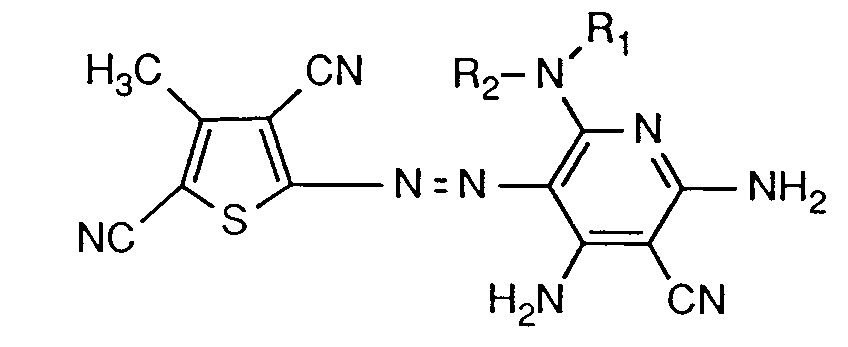
- Auf analoge Weise wie in den Beispielen 1 und 2 beschrieben, erhält man die in der folgenden Tabelle aufgeführten Farbstoffe. Sie färben Polyesterfasern in roten Farbtönen.


- Auf analoge Weise wie in den Beispielen 1 und 2 beschrieben, erhält man die in der folgenden Tabelle aufgeführten Farbstoffe. Sie färben Polyesterfasern in roten Farbtönen.


- 2,5 Teile des Farbstoffes, der analog Beispiel 1 erhalten wird, wobei man anstelle von 2-Amino-3,5-dicyan-4-methylthiophen von 2-Amino-3,5-dicyan-4-chlorthiophen ausgeht, werden zusammen mit 0,44 Teilen Malodinitril und o,33 Teilen Natriumacetat in 30 ml Propanol bei 20°C 2 Stunden gerührt. Danach werden nochmals 0,22 Teile Malodinitril zugefügt und das Ganze auf 50°C erwärmt. Nach weiteren 2 Stunden ist die Reaktion beendet. Das Reaktionsgemisch wird auf 20°C abgekühlt, der dunkle Niederschlag abfiltriert und mit 160 Teilen Propanol nachgewaschen und getrocknet. Man erhält 2,2 Teile des Farbstoffes der Formel

der Polyestermaterial in rotstichig blauen Tönen färbt. - 1,7 Teile Eis werden mit 9,3 Teilen Schwefelsäure (100%-ig) versetzt, das Gemisch auf 20°C abgekühlt und mit 1,5 Teilen Eisessig verdünnt. Die Mischung kühlt man auf 0°C ab und gibt tropfenweise 3,5 Teile Nitrosylschwefelsäure (40%-ig) hinzu. In dieses Gemisch werden innert 15 Minuten unter Kühlung bei 0-5°C 1,84 Teile 2-Amino-3-cyano-4-chlor-5-formylthiophen eingetragen. Bis zur vollständigen Diazotierung lässt man ca. 2,5 Stunden bei 0-5°C nachrühren. Überschüssiges Nitrit wird mit Harnstoff entfernt.
- Das auf diese Weise hergestellte Diazotierungsgemisch lässt man innert 30 Minuten in eine Lösung von 3,6 Teilen 2-Phenoxyethoxypropylamino-3-cyano-4,6-diaminopyridin in 15 Teilen Eisessig, 30 Teilen Wasser und 5 Teilen 1N Salzsäure zufliessen und rührt noch ca. 45 Minuten nach. Der pH-Wert wird durch Versetzen mit 28 Teilen Natonlauge (30%-ig) auf ca. 3 eingestellt. Der ausgefallene Farbstoff der Formel

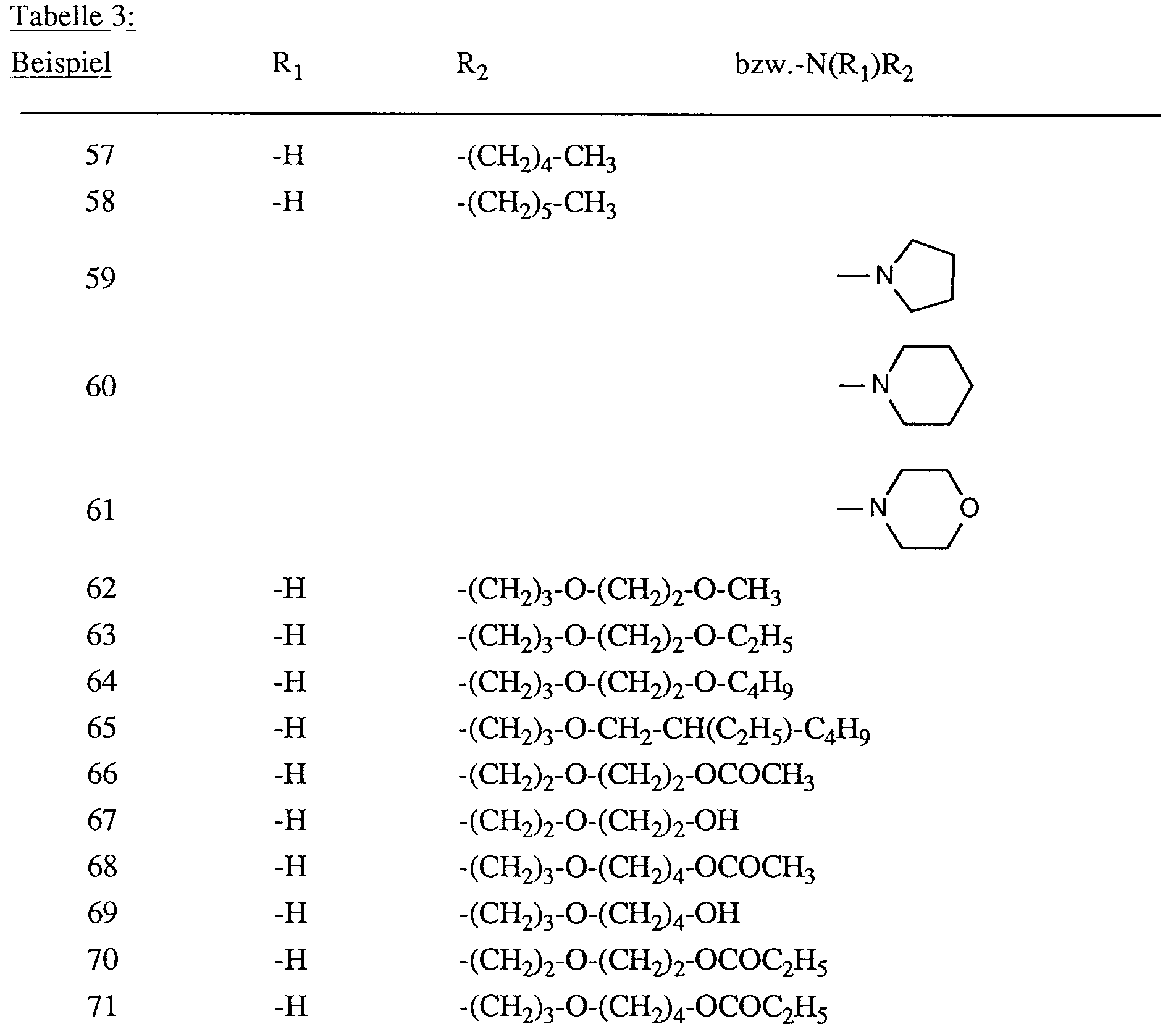
wird abfiltriert, salzfrei gewaschen und getrocknet. Er färbt Polyester mit rubinroter Nuance. - Auf analoge Weise wie in Beispiel 56 beschrieben, erhält man die in der folgenden Tabelle aufgeführten Farbstoffe. Sie färben Polyesterfasern in roten Farbtönen.


- 1 g des im Beispiel 1 beschriebenen Farbstoffs wird zusammen mit 17 g Wasser und 2 g eines handelsüblichen Dispergators vom Typ Dinaphthylmethandisulfonat in einer Sandmühle gemahlen und in eine 5%ige wässrige Dispersion überführt.
- Mit dieser Formulierung wird im HT-Ausziehverfahren bei 130°C eine 1%ige Färbung (bezogen auf Pigment und Substrat) auf Polyestergewebe erstellt und reduktiv gereinigt. Die so erzielte rote Färbung weist sehr gute Gebrauchsechtheiten und insbesondere eine ausgezeichnete Lichtechtheit auf.
Claims (13)
- Farbstoffe der Formel

- Farbstoffe gemäss Anspruch 1, worin X Wasserstoff, C₁-C₈-Alkyl oder unsubstituiertes oder durch Fluor, Chlor, Brom, Methyl, Methoxy oder Nitro substituiertes Phenyl; Y Cyan, C₁-C₄-Alkoxycarbonyl oder Nitro; Z Cyan, Acetyl, Benzoyl oder unsubstituiertes oder durch C₁-C₄-Alkyl, C₁-C₄-Alkoxy, C₁-C₄-Alkoxy-C₁-C₄-alkyl, Phenyl oder (C₁-C₄-Alkyl)₁₋₂phenyl substituiertes Carbamoyl, oder X und Z oder Y und Z jeweils gleichzeitig C₁-C₄-Alkoxycarbonyl ist, der Rest C -NH₂ bedeutet, und einer der Reste A oder B-NH₂ und der andere -N(R₁)R₂ bedeuten, und R₁ und R₂ unabhängig voneinander Wasserstoff, unsubstituiertes oder durch Hydroxy, C₁-C₄-Alkyl, Halogen oder C₁-C₄-Alkoxy substituiertes Phenyl, unsubstituiertes oder durch C₁-C₄-Alkyl substituiertes C₄-C₇-Cycloalkyl, oder unsubstituiertes oder durch Halogen, Cyan, C₂-C₄-Alkanoyloxy, Hydroxy, C₁-C₄-Alkoxy, Phenoxy oder Phenyl substituiertes C₁-C₁₈-Alkyl bedeuten, wobei der Phenyl- oder Phenoxyrest unsubstituiert oder durch Hydroxy, C₁-C₄-Alkyl, Halogen oder C₁-C₄-Alkoxy substituiert ist und der C₁-C₁₈-Alkylrest durch Sauerstoffatome unterbrochen sein kann, oder worin R₁ und R₂ zusammen mit dem sie verbindenden Stickstoffatom einen Piperidinyl-, Pyrrolidinyl- oder Morpholinylrest bilden.
- Farbstoffe gemäss einem der Ansprüche 1 und 2, worin R₂ unsubstituiertes C₁-C₈-Alkyl oder einen Rest der Formel
-R₃-O-R₄-L (2),
worin R₃ C₂-C₄-Alkylen, R₄ C₂-C₈-Alkylen und L Wasserstoff, Hydroxy, -O-Phenyl, -O-C₁-C₈-Alkyl oder -OCO-C₁-C₈-Alkyl bedeutet. - Farbstoffe gemäss einem der Ansprüche 1, 2 oder 3, worin X unsubstituiertes C₁-C₈-Alkyl, insbesondere Methyl ist.
- Farbstoffe gemäss einem der Ansprüche 1 und 2 der Formel

- Farbstoffe gemäss Anspruch 5, worin R₁ Wasserstoff und R₂ C₁-C₆-Alkyl, insbesondere n-Butyl, n-Pentyl oder n-Hexyl, C₁-C₃-Alkoxy-C₂-C₃-alkyl, Phenyl, Methoxyphenyl oder ein Rest der Formel
-R₅-O-R₆-Q (5)
ist, worin R₅ C₂-C₃-Alkylen, R₆ C₂-C₄-Alkylen und Q Phenoxy, C₁-C₄-Alkoxy oder Propionyloxy bedeutet, oder worin R₁ und R₂ zusammen mit dem sie verbindenden Stickstoffatom einen Pyrrolidiyl-, Piperidinyl- oder Morpholinylrest bilden. - Farbstoffmischungen, enthaltend mindestens zwei Farbstoffe der Formel (1) gemäss Anspruch 1.
- Verfahren zur Herstellung von Farbstoffen der Formel (1) gemäss Anspruch 1, dadurch gekennzeichnet, dass man ein Amin der Formel


- Verwendung der Dispersionsfarbstoffe gemäss Anspruch 1 zum Färben oder Bedrucken von halbsynthetischem oder synthetischem hydrophobem Fasermaterial, insbesondere Textilmaterial.
- Verwendung nach Anspruch 9 zum Färben oder Bedrucken von Textilmaterial aus Polyesterfasern.
- Verfahren zum Färben oder Bedrucken von halbsynthetischem oder synthetischem hydrophobem Fasermaterial, insbesondere Textilmaterial, dadurch gekennzeichnet, dass man eine oder mehrere der im Anspruch 1 definierten Verbindungen auf das genannte Material aufbringt oder diesem einverleibt.
- Verfahren nach Anspruch 11, worin das hydrophobe Fasermaterial, vorzugsweise Textilmaterial, aus Polyesterfasern besteht.
- Das gemäss Anspruch 11 oder 12 gefärbte oder bedruckte Material.
Applications Claiming Priority (2)
| Application Number | Priority Date | Filing Date | Title |
|---|---|---|---|
| CH2639/94 | 1994-08-29 | ||
| CH263994 | 1994-08-29 |
Publications (2)
| Publication Number | Publication Date |
|---|---|
| EP0699718A2 true EP0699718A2 (de) | 1996-03-06 |
| EP0699718A3 EP0699718A3 (de) | 1996-06-19 |
Family
ID=4238285
Family Applications (1)
| Application Number | Title | Priority Date | Filing Date |
|---|---|---|---|
| EP95810520A Withdrawn EP0699718A3 (de) | 1994-08-29 | 1995-08-21 | Azothiophenfarbstoffe mit einer 2,4,6-Triamino-3-cyanpyridin Kupplungskomponente |
Country Status (6)
| Country | Link |
|---|---|
| US (1) | US5602238A (de) |
| EP (1) | EP0699718A3 (de) |
| JP (1) | JPH0873761A (de) |
| KR (1) | KR960007696A (de) |
| CN (1) | CN1128278A (de) |
| TW (1) | TW293835B (de) |
Cited By (1)
| Publication number | Priority date | Publication date | Assignee | Title |
|---|---|---|---|---|
| WO2002059216A1 (en) * | 2001-01-26 | 2002-08-01 | Ciba Specialty Chemicals Holding Inc. | Azo dyes, a process for their preparation and their use in the dyeing or printing of hydrophobic fibre materials |
Families Citing this family (10)
| Publication number | Priority date | Publication date | Assignee | Title |
|---|---|---|---|---|
| EP1227871A1 (de) * | 1999-07-14 | 2002-08-07 | Tommy G. Taylor | Innovatives verbrennungssystem für aus abfällen stammenden brennstoffen, kohlen- und petroleumkoks oder chlorierten kohlenwasserstoffen |
| JP4530570B2 (ja) * | 2001-04-09 | 2010-08-25 | 富士フイルム株式会社 | 着色画像のオゾンガス堅牢性改良方法 |
| JP4538226B2 (ja) * | 2002-01-25 | 2010-09-08 | 富士フイルム株式会社 | インクジェット記録用インク、インクジェット記録用インクセット及びインクジェット記録方法 |
| US7311391B2 (en) * | 2002-02-04 | 2007-12-25 | Fujifilm Corporation | Ink composition and ink jet recording method |
| EP1473336B1 (de) * | 2002-02-08 | 2007-09-19 | FUJIFILM Corporation | Tinte und tintensätze zum tintenstrahldrucken und tintenstrahldruckverfahren |
| DE60334283D1 (de) * | 2002-02-08 | 2010-11-04 | Fujifilm Corp | Tintenzusammensetzung und tintenstrahlaufzeichnungsverfahren |
| CN1290943C (zh) * | 2002-02-08 | 2006-12-20 | 富士胶片株式会社 | 喷墨记录用墨水和喷墨记录方法 |
| JP5144873B2 (ja) * | 2002-02-13 | 2013-02-13 | 富士フイルム株式会社 | インクジェット記録用インク及びインクジェット記録方法 |
| EP1837377A1 (de) * | 2004-12-13 | 2007-09-26 | Nippon Kayaku Kabushiki Kaisha | Neue azo-verbindungen oder azo-salz, tintenzusammensetzung mit einer solchen azo-verbindung und gefärbtes material |
| GB0521546D0 (en) * | 2005-10-22 | 2005-11-30 | Avecia Inkjet Ltd | Yellow azo dyes for ink jet printing |
Family Cites Families (19)
| Publication number | Priority date | Publication date | Assignee | Title |
|---|---|---|---|---|
| US4016152A (en) * | 1970-12-19 | 1977-04-05 | Basf Aktiengesellschaft | Azo dye with a 2,6-diamino-5-cyano-or-5-carbamoyl-pyridine coupling component |
| US4208324A (en) * | 1971-12-28 | 1980-06-17 | Ciba-Geigy Corporation | Disperse diaminopyridine-3-azo dyestuffs |
| CH606297A5 (en) * | 1972-10-24 | 1978-10-31 | Ciba Geigy Ag | Mono:azo dispersion dyes of pyridine series |
| US4156086A (en) * | 1973-02-14 | 1979-05-22 | Bayer Aktiengesellschaft | Trisaminopyridines and method of preparation by reaction of diamino-2-chloro pyridinium salt and organic amine |
| US4038268A (en) * | 1973-02-14 | 1977-07-26 | Bayer Aktiengesellschaft | Process for preparing azo dyestuffs containing 2,4,6-tri-amino-3-(cyano ester or carbonamide)pyridine |
| DE2349373A1 (de) * | 1973-10-02 | 1975-04-24 | Basf Ag | Azofarbstoffe |
| CH606298A5 (de) * | 1974-02-26 | 1978-10-31 | Ciba Geigy Ag | |
| US4066637A (en) * | 1974-06-18 | 1978-01-03 | Ciba-Geigy Corporation | Basic diaminopyridine-(3)-azo dyestuffs |
| DE2437543A1 (de) * | 1974-08-03 | 1976-02-19 | Bayer Ag | Azofarbstoffe |
| CH617714A5 (de) * | 1974-12-06 | 1980-06-13 | Ciba Geigy Ag | |
| DE2701610A1 (de) * | 1977-01-17 | 1978-07-20 | Basf Ag | Farbstoffzubereitungen fuer cellulose und cellulosehaltiges textilmaterial und neue farbstoffe |
| CH637153A5 (de) * | 1978-06-02 | 1983-07-15 | Ciba Geigy Ag | Azofarbstoffe und verfahren zur herstellung von azofarbstoffen. |
| DE3528759A1 (de) * | 1985-08-10 | 1987-02-19 | Basf Ag | Heterocyclische azofarbstoffe |
| DE3615093A1 (de) * | 1986-05-03 | 1987-11-05 | Basf Ag | Diaminopyridin-azofarbstoffe mit acyloxy-resten |
| DE4010512A1 (de) * | 1990-04-02 | 1991-10-10 | Basf Ag | Marineblaue farbstoffmischungen |
| DE59107419D1 (de) * | 1990-06-27 | 1996-03-28 | Ciba Geigy Ag | Azofarbstoffe mit 2-Alkylamino-3-cyan-4,6-diaminopyridinen als Kupplungskomponenten |
| US5199956A (en) * | 1990-09-03 | 1993-04-06 | Ciba-Geigy Corporation | Process for dyeing hydrophobic textile material with disperse dyes from super-critical carbon dioxide |
| DE4138550A1 (de) * | 1991-11-23 | 1993-05-27 | Basf Ag | Thiophenazofarbstoffe mit einer kupplungskomponente aus der diaminopyridinreihe |
| JP3165745B2 (ja) * | 1992-07-13 | 2001-05-14 | ダイスタージャパン株式会社 | モノアゾ分散染料およびその混合物 |
-
1995
- 1995-08-07 TW TW084108189A patent/TW293835B/zh active
- 1995-08-21 EP EP95810520A patent/EP0699718A3/de not_active Withdrawn
- 1995-08-22 JP JP7213147A patent/JPH0873761A/ja active Pending
- 1995-08-25 US US08/519,226 patent/US5602238A/en not_active Expired - Fee Related
- 1995-08-28 CN CN95116967A patent/CN1128278A/zh active Pending
- 1995-08-29 KR KR1019950027047A patent/KR960007696A/ko not_active Withdrawn
Non-Patent Citations (1)
| Title |
|---|
| None |
Cited By (1)
| Publication number | Priority date | Publication date | Assignee | Title |
|---|---|---|---|---|
| WO2002059216A1 (en) * | 2001-01-26 | 2002-08-01 | Ciba Specialty Chemicals Holding Inc. | Azo dyes, a process for their preparation and their use in the dyeing or printing of hydrophobic fibre materials |
Also Published As
| Publication number | Publication date |
|---|---|
| TW293835B (de) | 1996-12-21 |
| US5602238A (en) | 1997-02-11 |
| EP0699718A3 (de) | 1996-06-19 |
| JPH0873761A (ja) | 1996-03-19 |
| KR960007696A (ko) | 1996-03-22 |
| CN1128278A (zh) | 1996-08-07 |
Similar Documents
| Publication | Publication Date | Title |
|---|---|---|
| EP0555179B1 (de) | Azofarbstoffe | |
| EP0623654B1 (de) | Azofarbstoffe | |
| EP1141138B1 (de) | Phthalimidyl-azofarbstoffe, verfahren zu deren herstellung und deren verwendung | |
| EP0864615B1 (de) | Azofarbstoffmischungen | |
| EP0667376A1 (de) | Phthalimidyl-Azofarbstoffe, Verfahren zu deren Herstellung und deren Verwendung | |
| EP0894830B1 (de) | Dispersionsfarbstoffe | |
| EP0443984B1 (de) | Phthalimidyl-Azofarbstoffe | |
| EP0463995B1 (de) | Azofarbstoffe mit 2-Alkylamino-3-cyan-4,6-diaminopyridinen als Kupplungskomponenten | |
| EP0378510B1 (de) | Dispersionsfarbstoffe | |
| EP0284560B1 (de) | Dispersionsfarbstoffe, enthaltend eine Tricyanovinylgruppierung | |
| DE19646429A1 (de) | Mischungen von Monoazopyridonfarbstoffen | |
| EP0776948B1 (de) | Mischungen von Monoazopyridonfarbstoffen | |
| DE2732384A1 (de) | Neue kationische farbstoffe, deren herstellung und verwendung | |
| EP0083313B1 (de) | Farbstoffmischung, Verfahren zu ihrer Herstellung und Verwendung zum Färben und Bedrucken von hydrophobem Fasermaterial | |
| EP1085055B1 (de) | Azofarbstoff, Verfahren zu dessen Herstellung und dessen Verwendung zum Färben oder Bedrucken von hydrophoben Fasermaterialien | |
| EP0726297A1 (de) | Farbstoffmischungen und ihre Verwendung | |
| EP0271444B1 (de) | Dispersionsfarbstoffe | |
| CH661518A5 (de) | Monoazoverbindungen. | |
| EP0041042A1 (de) | Azoverbindungen | |
| DE19646430A1 (de) | Mischungen von Monoazopyridonfarbstoffen | |
| DE1644252C (de) | In Wasser schwerlösliche Farbstoffe der Anthrachinon Azoreihe, Verfahren zu ihrer Herstellung und ihre Verwendung | |
| CH505880A (de) | Verfahren zur Herstellung von in Wasser schwerlöslichen Azofarbstoffen | |
| DE2101912C3 (de) | In Wasser schwerlösliche Monoazofarbstoffe und deren Verwendung | |
| DE2011051C (de) | In Wasser schwerlösliche Monoazofarbstoffe | |
| EP0109527A1 (de) | Wasserunlösliche Monoazofarbstoffe, Verfahren zu deren Herstellung und Verwendung |
Legal Events
| Date | Code | Title | Description |
|---|---|---|---|
| PUAI | Public reference made under article 153(3) epc to a published international application that has entered the european phase |
Free format text: ORIGINAL CODE: 0009012 |
|
| AK | Designated contracting states |
Kind code of ref document: A2 Designated state(s): BE CH DE ES FR GB IT LI |
|
| PUAL | Search report despatched |
Free format text: ORIGINAL CODE: 0009013 |
|
| AK | Designated contracting states |
Kind code of ref document: A3 Designated state(s): BE CH DE ES FR GB IT LI |
|
| 17P | Request for examination filed |
Effective date: 19961114 |
|
| RAP1 | Party data changed (applicant data changed or rights of an application transferred) |
Owner name: CIBA SC HOLDING AG |
|
| RAP3 | Party data changed (applicant data changed or rights of an application transferred) |
Owner name: CIBA SPECIALTY CHEMICALS HOLDING INC. |
|
| 17Q | First examination report despatched |
Effective date: 19990706 |
|
| STAA | Information on the status of an ep patent application or granted ep patent |
Free format text: STATUS: THE APPLICATION IS DEEMED TO BE WITHDRAWN |
|
| 18D | Application deemed to be withdrawn |
Effective date: 19991117 |
|
| REG | Reference to a national code |
Ref country code: HK Ref legal event code: WD Ref document number: 1005695 Country of ref document: HK |