EP0693132B1 - Rapamycin assay - Google Patents
Rapamycin assay Download PDFInfo
- Publication number
- EP0693132B1 EP0693132B1 EP94913093A EP94913093A EP0693132B1 EP 0693132 B1 EP0693132 B1 EP 0693132B1 EP 94913093 A EP94913093 A EP 94913093A EP 94913093 A EP94913093 A EP 94913093A EP 0693132 B1 EP0693132 B1 EP 0693132B1
- Authority
- EP
- European Patent Office
- Prior art keywords
- rapamycin
- monoclonal antibody
- succinimidooxysuccinyl
- conjugate
- immunogenic
- Prior art date
- Legal status (The legal status is an assumption and is not a legal conclusion. Google has not performed a legal analysis and makes no representation as to the accuracy of the status listed.)
- Expired - Lifetime
Links
Images



Classifications
-
- C—CHEMISTRY; METALLURGY
- C07—ORGANIC CHEMISTRY
- C07K—PEPTIDES
- C07K16/00—Immunoglobulins [IG], e.g. monoclonal or polyclonal antibodies
- C07K16/12—Immunoglobulins [IG], e.g. monoclonal or polyclonal antibodies against material from bacteria
- C07K16/1267—Gram-positive bacteria
- C07K16/1292—Gram-positive bacteria from Actinomyces; from Streptomyces (G)
-
- C—CHEMISTRY; METALLURGY
- C12—BIOCHEMISTRY; BEER; SPIRITS; WINE; VINEGAR; MICROBIOLOGY; ENZYMOLOGY; MUTATION OR GENETIC ENGINEERING
- C12P—FERMENTATION OR ENZYME-USING PROCESSES TO SYNTHESISE A DESIRED CHEMICAL COMPOUND OR COMPOSITION OR TO SEPARATE OPTICAL ISOMERS FROM A RACEMIC MIXTURE
- C12P21/00—Preparation of peptides or proteins
-
- A—HUMAN NECESSITIES
- A61—MEDICAL OR VETERINARY SCIENCE; HYGIENE
- A61K—PREPARATIONS FOR MEDICAL, DENTAL OR TOILETRY PURPOSES
- A61K47/00—Medicinal preparations characterised by the non-active ingredients used, e.g. carriers or inert additives; Targeting or modifying agents chemically bound to the active ingredient
- A61K47/50—Medicinal preparations characterised by the non-active ingredients used, e.g. carriers or inert additives; Targeting or modifying agents chemically bound to the active ingredient the non-active ingredient being chemically bound to the active ingredient, e.g. polymer-drug conjugates
-
- G—PHYSICS
- G01—MEASURING; TESTING
- G01N—INVESTIGATING OR ANALYSING MATERIALS BY DETERMINING THEIR CHEMICAL OR PHYSICAL PROPERTIES
- G01N33/00—Investigating or analysing materials by specific methods not covered by groups G01N1/00 - G01N31/00
- G01N33/48—Biological material, e.g. blood, urine; Haemocytometers
- G01N33/50—Chemical analysis of biological material, e.g. blood, urine; Testing involving biospecific ligand binding methods; Immunological testing
- G01N33/53—Immunoassay; Biospecific binding assay; Materials therefor
- G01N33/577—Immunoassay; Biospecific binding assay; Materials therefor involving monoclonal antibodies binding reaction mechanisms characterised by the use of monoclonal antibodies
Definitions
- This invention relates to monoclonal antibodies to rapamycin and rapamycin derivatives, which are useful, e.g., in assay kits for monitoring blood levels of drug.
- Rapamycin is a macrolide antibiotic produced by Streptomyces hygroscopicus, which has been found to be pharmaceutically useful in a variety of applications, particularly as an immunosuppressant, e.g., for use in the treatment and prevention of organ transplant rejection and autoimmune diseases. Rapamycin, however, does exhibit side effects at higher dosages, and it has a somewhat variable bioavailability. Monitoring blood levels of rapamycin in patients being treated with rapamycin is thus very desirable in order to be able to regulate the dosage so as to maintain the minimum level sufficient for pharmacologic activity and to avoid any undue risk of side effects. The lack of a sensitive and reliable assay which can be performed quickly and easily in a clinical setting has been a major obstacle to the development of rapamycin as a pharmaceutical.
- EP 041795 describes a microbiological assay in which rapamycin concentration is measured as a function of antifungal activity.
- WO 92/02946 provides an assay system which measures rapamycin levels indirectly by measuring competition for binding to macrophilin. Both of these assays are cumbersome and not particularly sensitive. Even more importantly, both of these assays may have considerable variation under slightly different test conditions, making comparisons of test results from different hospitals difficult.
- EP 0 450 936 refers to antiparasitic compounds in the form of an avermectin complex, which complex is produced by fermentation of of Streptomyces avermitilis MA-4680, and further discloses production of monoclonal antibodies specific for such an avermectin complex.
- EP 0 524 832 refers to macrolide antibiotics produceable, inter alia, by different strains of Streptomyces.
- AN 90-053405 and JP-A-2 000 495 refer to streptomyces subtilisin inhibitor and monoclonal antibodies thereto.
- the present invention provides monoclonal antibodies which are highly sensitive to rapamycin.
- the antibodies of the invention are produced in response to inoculation with a novel immunogenic conjugate comprising a novel derivative of rapamycin linked to an immunogenic protein.
- Assay kits using these antibodies are well suited for use in a clinical setting and provide far more accurate and reproducible results than was previously possible.
- the antibodies are also useful in the purification and isolation of rapamycin.
- rapamycins which are O-substituted at the hydroxy on the cyclohexyl ring (position 40), e.g., as described in US 5 258 389 and PCT/EP 93/02604 (O-aryl and O-alkyl rapamycins) (both incorporated herein by reference); especially 40-O-alkylated rapamycins where the 40-O-substituent is alkyl or substituted alkyl; e.g., hydroxyalkyl, hydroxyalkoxyalkyl, acylaminoalkyl, or aminoalkyl, wherein "alk-" or "alkyl” refers to C 1-6 alkyl, branched or linear, preferably C 1-3 alkyl, in which the carbon chain may be optionally interrupted by an ether (
- novel activated derivatives of rapamycin used to make the novel immunogenic conjugates of the invention are rapamycins which are linked through one of the hydroxy groups on the rapamycin, preferably the hydroxy group located on the cyclohexyl portion of the rapamycin (position 40) or the hydroxy at position 28, to an activated coupling group, i.e., a group capable of direct reaction with a protein to form a covalent linkage without the requirement for the use of a coupling agent (e.g., carbodiimide reagents) to enable, effect, or promote the reaction with the protein.
- a coupling agent e.g., carbodiimide reagents
- the activated coupling group has an activated ester or carboxy group, i.e., of formula -CO-O-X where X is a carboxy activating group such as o- or p-nitrophenyl, 1-benztriazole, pentafluorophenyl, or (especially) N-succinimido.
- X is a carboxy activating group such as o- or p-nitrophenyl, 1-benztriazole, pentafluorophenyl, or (especially) N-succinimido.
- Other suitable activated coupling groups are, for example, i) activated dithio groups, e.g., of formula -S-S-Z wherein Z is a dithio activating group such as 2-pyridyl, which may be linked to the rapamycin; or ii) epoxy groups, e.g., epoxy methyl.
- the activated coupling group may be linked to the rapamycin by means of an ester, ether, amide, thio or other suitable linkage, but ester linkage is preferred.
- the activated coupling group contains a bis-ester moiety, e.g., succinyl, having an ester linkage to the rapamycin at one end and the activated ester or activated carboxy group at the other.
- the preferred rapamycin derivatives of the invention are those of formula III below which are produced according to Reaction I: wherein formula I is rapamycin, which is a) reacted with an acylating agent, e.g., a cyclic anhydride or a dicarboxylic acid (optionally in hemi-O-protected form), under suitable conditions and deprotection if necessary to yield the rapamycin of formula II, wherein Y is a spacer moiety, preferably a lower alkylene, e.g., C 2-6 alkylene, most preferably ethylene.
- This rapamycin of formula II is then b) activated by reaction with a carboxy activating group, e.g. of formula HO-X where X is as defined above, to yield the activated rapamycin of formula III.
- a preferred activated derivative of rapamycin is the succinimido derivative of formula III below, prepared, e.g., according to Reaction II: wherein formula I is rapamycin, which is a) 0-acylated using succinic anhydride in the presence of DMAP and pyridine to form the rapamycin hemisuccinate of formula II' ( 40-O-(3-Carboxy)propanoyl-rapamycin); which is then b) activated with N-hydroxy succinimide in the presence of EDC, Et 3 N, and CH 2 Cl 2 to form the 40-O-succinimidooxysuccinyl rapamycin of formula III', e.g., as described more fully in example 1 below.
- Monoclonal antibodies produced using a hapten such as this which is linked through the 40-position will ordinarily be cross reactive between rapamycin and a 40-O-derivative of rapamycin, such as described above.
- Such monoclonal antibodies can be selected as described below for compounds which recognize a particular region of the rapamycin or 40-O-derivative of the rapamycin, e.g., in the binder domain or effector domain, as described below.
- the hapten is preferably linked through the 28-O position rather than the 40-O position.
- the rapamycin derivative of formula A: wherein R is an O-protecting group, or a substituent as described above, e.g., hydroxyalkyl, hydroxyalkoxyalkyl, acylaminoalkyl, or aminoalkyl, optionally in protected form is reacted according to Reaction I, deprotecting if necessary, to give the analogous 28-O activated hapten, for example a compound of formula B: wherein R1 is H, or an O-substituent as described above, e.g., hydroxyalkyl, hydroxyalkoxyalkyl, acylaminoalkyl, or aminoalkyl, Y is a linker moiety as defined above, and X is a carboxy activating group as defined above.
- the acylating agent may optionally be, e.g., a dicarboxylic acid in hemi-O-protected form, so that following acylation, both O-protecting groups may be removed in one step prior to adding the carboxy activating group.
- haptens for generating monoclonal antibodies capable of recognizing 40-O-(2-hydroxyethyl)-rapamycin can be produced by protecting the primary hydroxy, acylating the hydroxy at position 28 with a dicarboxylic acid in hemi-O-protected form, deprotecting, and activating the carboxy group, e.g., according to Reaction III:
- rapamycin itself may be activated at the 28-O rather than the 40-O, by O-protecting the C40 hydroxy, acylating the hydroxy group in position 28 with a hemi-O-protected dicarboxylic acid, deprotecting, and activating the carboxy group, e.g., according reaction IV:
- the activated rapamycin or rapamycin derivative is then linked to a suitable immunogenic protein, e.g., bovine serum albumin (BSA), ovalbumin (OVA), or keyhole limpet hemocyanine (KLH) to form an immunogenic conjugate.
- a suitable immunogenic protein e.g., bovine serum albumin (BSA), ovalbumin (OVA), or keyhole limpet hemocyanine (KLH)
- BSA bovine serum albumin
- OVA ovalbumin
- KLH keyhole limpet hemocyanine
- Monoclonal antibodies are prepared using conventional methods, e.g., administering the novel immunogenic conjugate to a suitable animal species to effect immunogenic challenge and recovering antibody-producing cells sensitized to said conjugate; immortalizing said antibody producing cells by fusion with a suitable myeloma; and recovering the monoclonal antibody from a selected immortalized cell line thus established.
- the antibodies of the invention may then be used in a suitable assay.
- a suitable assay Several possibilities would be clear to one skilled in the art.
- One approach is a competitive assay using antibody and a rapamycin tracer, for example wherein microtiter plates are coated with antibody and exposed to a competitor which is a labeled (e.g., fluoro- or radio-labeled, especially biotinylated) rapamycin, in the presence and absence of test fluid believed to possibly contain a rapamycin, e.g., plasma or whole blood from the patient.
- the plates are rinsed, and the amount of labeled competitor which has bound to the antibody is measured, which amount varies inversely with the amount of rapamycin in the test fluid.
- Another approach is an ELISA using antibody, a rapamycin protein conjugate, and a labeled (e.g., enzyme-labeled) tracer antibody recognizing murine IgG, for example wherein microtiter plates are coated with a rapamycin-protein conjugate (e.g., the immunogenic conjugate described above comprising a protein linked to rapamycin or a 40-O-alkylated rapamycin), exposed to antibody in the presence and absence of test fluid, rinsed, and antibody binding to the rapamycin conjugate detected by binding of the tracer antibody to the antibody bound to the rapamycin conjugate.
- the amount of bound antibody will vary inversely with the amount of rapamycin in the test sample.
- the assay is standardized with test solutions containing known concentrations of rapamycin.
- An assay kit comprising (i) the monoclonal antibody of the invention, preferably in lyophilized form or coated onto a microtiter plate, and (ii) optionally also comprising either a rapamycin protein conjugate, optionally coated onto a plate, and/or a labeled rapamycin derivative, and (iii) further optionally comprising a rapamycin solution for standardization and instructions for use, is therefore provided.
- Such a kit is capable of detecting rapamycin at concentrations of below 10 ng/ml, e.g., below 1 ng/ml, e.g., as low as 0.25-0.5 ng/ml.
- the antibodies of the invention may be further characterized by their relative binding affinity to an immunosuppressive ascomycin, e.g., FK-506.
- FK-506 is an immunosuppressive macrolide having some structural similarity to rapamycin in the binding domain. Rapamycins (e.g., rapamycin and its immunosuppressant derivatives) and FK-506 both bind to macrophilins (FKBPs), and for both it is believed that macrophilin binding is a necessary but not a sufficient criteria for immunosuppressive activity.
- FKBPs macrophilins
- the effector region of rapamycin is quite different from FK-506, and indeed, the two compounds have quite different mechanisms of activity.
- Rapamycins can thus be characterized as having an FKBP binding domain and an effector domain, and a distinction can be made between rapamycin metabolites which are modified in the FKBP binding domain from those modified in the effector domain.
- monoclonal antibodies of the invention by measuring the relative cross-reactivity of the monoclonal antibodies of the invention with FK-506 (cross-reactivity being measured, e.g., in a competitive ELISA): monoclonal antibodies having a high degree of cross reactivity (e.g., greater than 50%) recognize epitopes in the FKBP binding domain of rapamycin which is similar to FK-506; monoclonal antibodies with a low degree of cross reactivity (e.g., less than 20%, optimally less than 10%) recognize epitopes in the effector region, which is unique to rapamycins.
- FK-506 cross-reactivity being measured, e.g., in a competitive ELISA
- Antibodies of the invention can also be screened and characterized according to their ability to distinguish between rapamycin and a 40-O-derivative of rapamycin, e.g., as defined above. Where it is desired that the antibodies do not distinguish between rapamycin and a 40-O-derivative of rapamycin, antibodies are selected which show at least 70%, preferably greater than 90%, cross-reactivity between rapamycin and a 40-O-derivative thereof.
- the hapten used to make the monoclonal antibody is preferably a 40-O-activated rapamycin, e.g., of formula III in Reaction I.
- antibodies are selected having less than 30%, preferably less than 10%, cross-reactivity thereto.
- the hapten used to make the antibody is preferably a 28-O-activated rapamycin or rapamycin derivative, e.g., of formula B.
- the resulting mixture is extracted three times with ethyl acetate.
- the organic solution is washed successively with 1N aqueous hydrochloric acid, 1N aqueous sodium bicarbonate and saturated brine, then dried over anhydrous sodium sulfate, filtered and concentrated under reduced pressure.
- the residue is purified by column chromatography on silica gel (50:50 hexane-ethyl acetate) to afford the allyloxycarbonyl protected compound (formula 2 in reaction III above) as a white foam.
- a solution of 53 mg (0.050 mmol) of the hemisuccinate of step a) in 2.5 mL of methylene chloride is treated with 2 mg of DMAP, 24 mg (0.125 mmol) of EDC and 14 mg (0.125 mmol) of N-hydroxysuccinimide. After stirring for 2 hours at ambient temperature, the reaction is quenched with 1N aqueous sodium bicarbonate. The mixture is extracted with three portions of ethyl acetate.
- a solution of 51 mg (0.050 mmol) of the product of step a) in 2 mL of methylene chloride is treated with 2 mg of DMAP, 24 mg (0.125 mmol) of EDC and 14 mg (0.125 mmol) of N-hydroxysuccinimide. After stirring for 4 hours at ambient temperature, the reaction is quenched with 1N aqueous sodium bicarbonate. The mixture is extracted with three portions of methyl-t-butylether.
- Monoclonal antibody is produced by using conventional techniques, essentially as described by Köhler and Milstein in Nature 256 : 49.
- Female Balb/C mice (20-25 g) each receive 10 or 50 ⁇ g of the 40-O-linked rapamycin-KLH immunogenic conjugate of example 4a) in 0.2 ml complete Freund adjuvant, administered by subcutaneous injection at four sites. After 2 weeks a second booster injection comprising the same amount of the immunogenic conjugate emulsified in 0.2 ml of incomplete Freund adjuvant is administered, again by s.c. injection.
- the presence of antibodies reactive to the antigen in the animals' blood serum is confirmed by direct ELISA as described in example 6 below.
- mice may optionally be further selected for antibody to the effector region (low cross reactivity with FK-506) and to the FKBP binding region (high cross reactivity to FK-506).
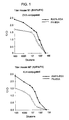
- Figure 1 shows titer curves for a mouse (M1) having a high level of antibody to the binding domain of rapamycin, and another mouse (M7) having relatively high levels of antibody to the effector domain.
- Mice displaying maximal blood serum levels of antibody of appropriate specificity receive booster injections comprising 10 ⁇ g of antigen half i.p. half i.v. on day -3, and i.p. on day -2 and -1. On day 0.
- mice are sacrificed and their spleen cells are isolated and fused with PAI-0 cells or other suitable myeloma line.
- the resulting hybridomae are cultured and selected using ELISA for expression of antibody having a high affinity to rapamycin.
- mice receive 10 or 50 ⁇ g of the 40-(hydroxyethyl)-rapamycin KLH immunogenic conjugate of example 4b) in 0.2ml complete Freund's adjuvant by s.c. injections on 4 points. After 2 weeks, a second injection (booster) comprising the same quantity of immunogenic conjugate emulsified in 0.2ml incomplete Freund's adjuvant is administered, again by s.c. injection. The presence of antibodies reactive to the antigen in the animal's blood serum is tested by direct ELISA as described below.
- mice are further selected for antibody to the region of the rapamycin molecule modified in the 40-O region by binding to a conjugate of BSA-rapamycin compared to a conjugate of BSA-40-O(2-hydroxyethyl)-rapamycin.
- Both antibodies which bind to the 40-O(2-hydroxyethyl)-rapamycin conjugate but do not bind to conjugated rapamycin, and antibodies which bind both to 40-O(2-hydroxyethyl)-rapamycin and rapamycin conjugates are obtained.
- Mice displaying maximal blood serum levels of antibody of appropriate specificity receive booster injections comprising 10 ⁇ g of antigen half i.p. half i.v. on day -3, and i.p.
- mice On day -2 and -1. On day 0. the mice are sacrificed and their spleen cells are isolated and fused with PAI-0 cells. The resulting hybridoma are cultured and selected using ELISA for expression of antibody having a high affinity to 40-O-(2-hydroxyethyl)-rapamycin.
- Microtiter plates are coated with 1-2 ⁇ g/ml rapamycin-BSA conjugate in PBS for 2 hours at 37°C, then saturated with 2% BSA in PBS for 1 hour at 37°C, and washed 3x with 0.05% Tween-PBS.
- the hybridoma supernatants to be screened are diluted in a 1% solution of BSA in PBS, and incubated overnight at room temperature (or 18 hours at 4°C or 2 hours at 37°C). Level of bound antibody is measured by anti-mouse IgG goat globulin coupled to alkaline phosphatase with para-nitrophenylphosphate as the substrate. After incubation for two hours at 37°C, the enzymatic substrate is hydrolysed (i hour at room temperature) and absorbance at 405 nm is measured. Hybridomae are selected for production of high affinity monoclonal antibody.
- Standard curves to determine relative affinity of a selected antibody to rapamycin are prepared using solutions containing known concentrations of rapamycin (e.g., 1 to 140 ng/ml in blood serum).
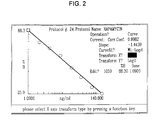
- Figure 2 shows a standard curve for our monoclonal antibody M7-91, demonstrating that that monoclonal antibody, which was selected as being highly specific for rapamycin, is capable of detecting rapamycin at levels as low as 0.25 ng/ml.
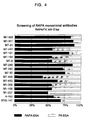
- Antibodies may be further characterized as binding to the effector or FKBP binding domains of rapamycin by measuring cross reactivity with FK-506 in an analogous direct ELISA using microtiter plates coated with FK506-BSA conjugate, which can be prepared analogously to rapamycin-BSA conjugate. For example, a comparison of binding levels of 17 selected monoclonal antibodies in the rapamycin-BSA and FK-506 assays is shown in figure 3; cross reactivity as a percentage is shown in figure 4. In this comparison of binding to rapamycin-BSA vs. FK506-BSA, monoclonal antibodies of very low affinity are detected.
- the above direct ELISA may be converted to a competitive ELISA wherein a competitor is added to the monoclonal antibody solution, and binding of the monoclonal antibody to the conjugate in the presence and absence of the competitor is measured.
- the competitor is FK506 or a rapamycin
- the competitor in ethanolic solution e.g., 1 mg/ml is directly added to the monoclonal antibody solution (e.g., 2 ⁇ l/200 ⁇ l/well) and further diluted in the microtiter plate.
- Figure 5 shows an inhibition curve for binding of the M7-91 antibody (M7.91.13) to BSA-rapamycin in the presence of different concentrations of free rapamycin.
- This ELISA is performed analogously to the procedure described in a). Microtiter plates are coated with 40-O-(2-hydroxyethyl)-rapamycin-BSA, saturated with BSA and washed. The hybridoma supernatants to be screened are incubated 18 hours at 4°C or 2 hours at 37°C. Level of bound antibody is measured by anti-mouse IgG goat globulin coupled to alkaline phosphatase with para-nitrophenylphosphate as the substrate. A parallel ELISA is performed using bound rapamycin-BSA to select for monoclonal antibodies capable of distinguishing 40-O-(2-hydroxyethyl)-rapamycin from rapamycin.
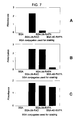
- Figure 7 shows, for example, supernatants of hybridoma B3-203 binding selectively to 40-O-(2-hydroxyethyl)-rapamycin-BSA (referred to in the figure as BSA-28-RAD) (figure 7A), of hybridoma B3-113 recognizing both 40-O-(2-hydroxyethyl)-rapamycin-BSA and rapamycin-BSA conjugated through position 28 (figure 7B), and of hybridoma B3-164 that recognize in addition rapamycin coupled to BSA through position 40 (figure 7C).
- the relative affinity of the antibodies to 40-O-(2-hydroxyethyl)-rapamycin versus rapamycin is further measured by competing the binding of the antibodies to the coated 40-O-(2-hydroxyethyl)-rapamycin-BSA conjugate with 40-O-(2-hydroxyethyl)-rapamycin or rapamycin free in solution.
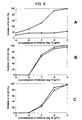
- Figure 8 shows that antibodies produced by hybridoma B3-203 react strongly with 40-O-(2-hydroxyethyl)-rapamycin with low crossreactivity for rapamycin (figure 8A) and that antibodies produced by hybridoma B3-113 and B3-164 bind equally well to 40-O-(2-hydroxyethyl)-rapamycin and rapamycin (figures 8B and 8C).
- Other hybridomae producing antibodies binding at least 10-100-fold better to 40-O-(2-hydroxyethyl)-rapamycin than to rapamycin include B3-22, B3-127 and B3-156.
- Other hybridomae such as B3-29, B3-265 and B3-539 produce antibodies that bind rapamycin as well as 40-O-(2-hydroxyethyl)-rapamycin.
- an assay kit would provide one or more selected antibodies in lyophilized form, a microtiter plate coated with a rapamycin conjugate (e.g., rapamycin-BSA conjugate or 40-O-(2-hydroxyethyl)-rapamycin-BSA conjugate), a rapamycin standard, and instructions for use.
- the kit may further comprise a labelled rapamycin derivative for use in a competitive assay.
- Anti-mouse IgG-enzyme conjugate and substrate as described above may additionally be provided.
- the customer may use the monoclonal antibody of the invention in his own established ELISA or other assay system.
Landscapes
- Health & Medical Sciences (AREA)
- Chemical & Material Sciences (AREA)
- Life Sciences & Earth Sciences (AREA)
- Organic Chemistry (AREA)
- Immunology (AREA)
- Engineering & Computer Science (AREA)
- General Health & Medical Sciences (AREA)
- Molecular Biology (AREA)
- Medicinal Chemistry (AREA)
- Biochemistry (AREA)
- Genetics & Genomics (AREA)
- Zoology (AREA)
- Wood Science & Technology (AREA)
- Proteomics, Peptides & Aminoacids (AREA)
- Biomedical Technology (AREA)
- Biotechnology (AREA)
- Biophysics (AREA)
- Hematology (AREA)
- Microbiology (AREA)
- Chemical Kinetics & Catalysis (AREA)
- Urology & Nephrology (AREA)
- Bioinformatics & Cheminformatics (AREA)
- Public Health (AREA)
- Cell Biology (AREA)
- Animal Behavior & Ethology (AREA)
- General Physics & Mathematics (AREA)
- Pathology (AREA)
- General Chemical & Material Sciences (AREA)
- Epidemiology (AREA)
- Physics & Mathematics (AREA)
- Pharmacology & Pharmacy (AREA)
- General Engineering & Computer Science (AREA)
- Food Science & Technology (AREA)
- Analytical Chemistry (AREA)
- Veterinary Medicine (AREA)
- Preparation Of Compounds By Using Micro-Organisms (AREA)
- Peptides Or Proteins (AREA)
- Nitrogen And Oxygen Or Sulfur-Condensed Heterocyclic Ring Systems (AREA)
- Micro-Organisms Or Cultivation Processes Thereof (AREA)
- Steroid Compounds (AREA)
Applications Claiming Priority (3)
| Application Number | Priority Date | Filing Date | Title |
|---|---|---|---|
| GB939307491A GB9307491D0 (en) | 1993-04-08 | 1993-04-08 | Organic compounds |
| GB9307491 | 1993-04-08 | ||
| PCT/EP1994/001006 WO1994024304A1 (en) | 1993-04-08 | 1994-03-30 | Rapamycin assay |
Publications (2)
| Publication Number | Publication Date |
|---|---|
| EP0693132A1 EP0693132A1 (en) | 1996-01-24 |
| EP0693132B1 true EP0693132B1 (en) | 1997-12-17 |
Family
ID=10733650
Family Applications (1)
| Application Number | Title | Priority Date | Filing Date |
|---|---|---|---|
| EP94913093A Expired - Lifetime EP0693132B1 (en) | 1993-04-08 | 1994-03-30 | Rapamycin assay |
Country Status (22)
| Country | Link |
|---|---|
| US (3) | US8039599B1 (enExample) |
| EP (1) | EP0693132B1 (enExample) |
| JP (4) | JP3397325B2 (enExample) |
| KR (2) | KR100347166B1 (enExample) |
| CN (1) | CN1080312C (enExample) |
| AT (1) | ATE161289T1 (enExample) |
| AU (1) | AU677321B2 (enExample) |
| BR (1) | BR9406210A (enExample) |
| CZ (1) | CZ284431B6 (enExample) |
| DE (1) | DE69407402T2 (enExample) |
| DK (1) | DK0693132T3 (enExample) |
| ES (1) | ES2110230T3 (enExample) |
| FI (1) | FI110670B (enExample) |
| GB (1) | GB9307491D0 (enExample) |
| GR (1) | GR3025753T3 (enExample) |
| HU (1) | HU221606B (enExample) |
| NO (1) | NO320470B1 (enExample) |
| NZ (1) | NZ265051A (enExample) |
| PL (1) | PL185855B1 (enExample) |
| RU (1) | RU2175672C2 (enExample) |
| SK (1) | SK280048B6 (enExample) |
| WO (1) | WO1994024304A1 (enExample) |
Cited By (7)
| Publication number | Priority date | Publication date | Assignee | Title |
|---|---|---|---|---|
| US6328970B1 (en) | 1993-04-23 | 2001-12-11 | American Home Products Corporation | Rapamycin position 27 conjugates |
| US7279561B1 (en) | 1993-04-23 | 2007-10-09 | Wyeth | Anti-rapamycin monoclonal antibodies |
| USRE40596E1 (en) * | 1993-04-08 | 2008-12-02 | Novartis Ag | Rapamycin assay |
| US7914999B2 (en) | 2006-12-29 | 2011-03-29 | Abbott Laboratories | Non-denaturing lysis reagent |
| US8039599B1 (en) | 1993-04-08 | 2011-10-18 | Novartis Ag | Rapamycin assay |
| US8221986B2 (en) | 2006-12-29 | 2012-07-17 | Abbott Laboratories | Diagnostic test for the detection of a molecule or drug in whole blood |
| US8404452B2 (en) | 2006-12-29 | 2013-03-26 | Abbott Laboratories | Assay for immunosuppressant drugs |
Families Citing this family (32)
| Publication number | Priority date | Publication date | Assignee | Title |
|---|---|---|---|---|
| GB9318612D0 (en) * | 1993-09-08 | 1993-10-27 | Sandoz Ltd | An assay |
| US5635406A (en) * | 1995-06-07 | 1997-06-03 | Abbott Laboratories | Stabilized standards and calibrators containing rapamycin and tacrolimus bound to anti-rapamycin and anti-tacrolimus antibodies |
| AU4176897A (en) * | 1996-09-09 | 1998-03-26 | American Home Products Corporation | Alkylated rapamycin derivatives |
| EP0973805A1 (en) * | 1997-04-09 | 2000-01-26 | Isotechnika, Inc. | Method for production of antibodies to specific sites of rapamycin |
| US6709873B1 (en) | 1997-04-09 | 2004-03-23 | Isodiagnostika Inc. | Method for production of antibodies to specific sites of rapamycin |
| DE19951684A1 (de) * | 1999-10-27 | 2001-05-03 | Aventis Pharma Gmbh | Neuer immunologischer Assay zur Bestimmung von C-peptidhaltigen Kontaminanten in Proben von Humanisulin und dessen Derivaten |
| US7157561B2 (en) * | 2001-07-13 | 2007-01-02 | Roche Diagnostics Operations, Inc. | Methods of inhibiting transmission of a costimulatory signal of lymphocytes |
| US7193065B2 (en) * | 2001-07-13 | 2007-03-20 | Roche Diagnostics Operations, Inc. | Protease inhibitor conjugates and antibodies useful in immunoassay |
| US20040243224A1 (en) * | 2003-04-03 | 2004-12-02 | Medtronic Vascular, Inc. | Methods and compositions for inhibiting narrowing in mammalian vascular pathways |
| US20050176080A1 (en) * | 2004-02-10 | 2005-08-11 | Vani Bodepudi | Hapten, immunogens and derivatives of ascomycin useful for preparation of antibodies and immunoassays |
| WO2005085290A1 (en) * | 2004-03-05 | 2005-09-15 | Astellas Pharma Inc. | Anti fk778antibodies and high sensitive immunoassay methods |
| JP4540704B2 (ja) * | 2004-03-10 | 2010-09-08 | セラディン インコーポレイテッド | エベロリムスの測定方法および測定キット |
| DK1735321T3 (da) | 2004-04-14 | 2009-01-12 | Wyeth Corp | Fremgangsmåde til fremstilling af rapamycin 42-estere og FK-506 32-estere med dicarboxylsyre, precursors for rapamycinkonjugater og antistoffer |
| CA2571710A1 (en) | 2004-06-24 | 2006-11-02 | Nicholas Valiante | Small molecule immunopotentiators and assays for their detection |
| JP2008517874A (ja) * | 2004-08-10 | 2008-05-29 | ワイス | Cci−779誘導体及びそれらの作製法 |
| US8021849B2 (en) | 2004-11-05 | 2011-09-20 | Siemens Healthcare Diagnostics Inc. | Methods and kits for the determination of sirolimus in a sample |
| US8563612B2 (en) * | 2005-03-21 | 2013-10-22 | Cytacoat Ab | Antimicrobial agent comprising a cysteine component covalently bound to a substrate in particular by binding through an S-S bridge via a spacer molecule |
| US7189582B2 (en) | 2005-04-27 | 2007-03-13 | Dade Behring Inc. | Compositions and methods for detection of sirolimus |
| US20080081379A1 (en) * | 2006-07-13 | 2008-04-03 | Sigler Gerald F | Homogeneous double receptor agglutination assay for immunosuppressant drugs |
| US7883855B2 (en) | 2006-07-21 | 2011-02-08 | Abbott Laboratories | Immunosuppressant drug extraction reagent for immunoassays |
| FR2908658B1 (fr) * | 2006-11-20 | 2011-11-11 | Centre Nat Rech Scient | Composition pour la prevention et/ou le traitement des maladies associees a la surexpression du tnf et/ou de l'il-12 |
| JP5319549B2 (ja) | 2006-12-29 | 2013-10-16 | アボット・ラボラトリーズ | 溶液内捕捉イムノアッセイで使用する非変性細胞溶解試薬 |
| US20080287675A1 (en) * | 2007-05-18 | 2008-11-20 | Abbott Laboratories | Cascade system |
| US9901567B2 (en) | 2007-08-01 | 2018-02-27 | Syntarga B.V. | Substituted CC-1065 analogs and their conjugates |
| US20110097733A1 (en) | 2009-10-27 | 2011-04-28 | Michel Anciaux | Process for the production of a hybridoma and antibody obtained therefrom, able to recognize more than one vitamin d metabolite |
| RU2730502C2 (ru) | 2010-04-21 | 2020-08-24 | Синтарга Б.В. | Новые конъюгаты аналогов сс-1065 и бифункциональные линкеры |
| BR112014032916A2 (pt) * | 2012-06-28 | 2017-08-01 | Pfizer | anticorpos anti-fármacos e usos destes para o monitoramento de fármaco |
| EP2948183B1 (en) | 2014-01-10 | 2016-04-06 | Synthon Biopharmaceuticals B.V. | Duocarmycin adcs for use in treatment of endometrial cancer |
| RU2769700C2 (ru) | 2014-01-10 | 2022-04-05 | Байондис Б.В. | Дуокармициновые adc, демонстрирующие улучшенную противоопухолевую активность in vivo |
| WO2016046173A1 (en) * | 2014-09-22 | 2016-03-31 | Synthon Biopharmaceuticals B.V. | Pan-reactive antibodies to duocarmycins |
| EP4406614A3 (en) | 2018-11-02 | 2024-11-13 | Siemens Healthcare Diagnostics Inc. | Binding competitors for use in macrophilin-binding pharmaceuticals assays and methods of use thereof |
| CN120971716A (zh) | 2019-06-28 | 2025-11-18 | 美国西门子医学诊断股份有限公司 | 使用颗粒增强凝集检测的夹心免疫测定试剂及其生产和使用方法 |
Family Cites Families (26)
| Publication number | Priority date | Publication date | Assignee | Title |
|---|---|---|---|---|
| US5169773A (en) * | 1984-10-04 | 1992-12-08 | Sandoz Ltd. | Monoclonal antibodies to cyclosporins |
| WO1986002080A1 (en) | 1984-10-04 | 1986-04-10 | Sandoz Ag | Monoclonal antibodies to cyclosporings |
| US4650803A (en) | 1985-12-06 | 1987-03-17 | University Of Kansas | Prodrugs of rapamycin |
| EP0293892B1 (en) | 1987-06-05 | 1993-12-15 | Fujisawa Pharmaceutical Co., Ltd. | Anti-FR-900506 substance antibodies and highly-sensitive enzyme immunoassay method |
| JPH02495A (ja) * | 1987-12-25 | 1990-01-05 | Tosoh Corp | モノクローナル抗体、その製法及びそれを用いた測定法 |
| CA2039541A1 (en) * | 1990-04-05 | 1991-10-06 | Ethel B. Jacobson | Monoclonal antibodies to avermectins |
| ATE132504T1 (de) * | 1990-08-15 | 1996-01-15 | Abbott Lab | Immunotestreagenzien und verfahren zur bestimmung von cyclosporin |
| US5130307A (en) | 1990-09-28 | 1992-07-14 | American Home Products Corporation | Aminoesters of rapamycin |
| PT98990A (pt) * | 1990-09-19 | 1992-08-31 | American Home Prod | Processo para a preparacao de esteres de acidos carboxilicos de rapamicina |
| US5120842A (en) * | 1991-04-01 | 1992-06-09 | American Home Products Corporation | Silyl ethers of rapamycin |
| US5100883A (en) | 1991-04-08 | 1992-03-31 | American Home Products Corporation | Fluorinated esters of rapamycin |
| US5322772A (en) | 1991-04-09 | 1994-06-21 | Children's Research Institute | Rapamycin assay |
| NO921449L (no) * | 1991-04-17 | 1992-10-19 | American Home Prod | Karbamater av rapamycin |
| US5194447A (en) | 1992-02-18 | 1993-03-16 | American Home Products Corporation | Sulfonylcarbamates of rapamycin |
| US5118678A (en) | 1991-04-17 | 1992-06-02 | American Home Products Corporation | Carbamates of rapamycin |
| US5118677A (en) | 1991-05-20 | 1992-06-02 | American Home Products Corporation | Amide esters of rapamycin |
| US5514544A (en) * | 1991-07-26 | 1996-05-07 | Eli Lilly And Company | Activator gene for macrolide biosynthesis |
| US5151413A (en) | 1991-11-06 | 1992-09-29 | American Home Products Corporation | Rapamycin acetals as immunosuppressant and antifungal agents |
| US5177203A (en) | 1992-03-05 | 1993-01-05 | American Home Products Corporation | Rapamycin 42-sulfonates and 42-(N-carboalkoxy) sulfamates useful as immunosuppressive agents |
| GB9221220D0 (en) | 1992-10-09 | 1992-11-25 | Sandoz Ag | Organic componds |
| US5258389A (en) | 1992-11-09 | 1993-11-02 | Merck & Co., Inc. | O-aryl, O-alkyl, O-alkenyl and O-alkynylrapamycin derivatives |
| GB9307491D0 (en) | 1993-04-08 | 1993-06-02 | Sandoz Ltd | Organic compounds |
| US5504091A (en) | 1993-04-23 | 1996-04-02 | American Home Products Corporation | Biotin esters of rapamycin |
| JPH08509499A (ja) | 1993-04-23 | 1996-10-08 | アボツト・ラボラトリーズ | ラパマイシン結合体及び抗体 |
| AU6711994A (en) | 1993-04-23 | 1994-11-21 | American Home Products Corporation | Rapamycin conjugates and antibodies |
| US6187547B1 (en) * | 1993-09-08 | 2001-02-13 | Novartis Ag | Assay kit |
-
1993
- 1993-04-08 GB GB939307491A patent/GB9307491D0/en not_active Ceased
-
1994
- 1994-03-30 DK DK94913093.4T patent/DK0693132T3/da active
- 1994-03-30 WO PCT/EP1994/001006 patent/WO1994024304A1/en not_active Ceased
- 1994-03-30 SK SK1257-95A patent/SK280048B6/sk not_active IP Right Cessation
- 1994-03-30 BR BR9406210A patent/BR9406210A/pt not_active Application Discontinuation
- 1994-03-30 JP JP52268294A patent/JP3397325B2/ja not_active Expired - Lifetime
- 1994-03-30 KR KR1019950704410A patent/KR100347166B1/ko not_active Expired - Lifetime
- 1994-03-30 AT AT94913093T patent/ATE161289T1/de active
- 1994-03-30 EP EP94913093A patent/EP0693132B1/en not_active Expired - Lifetime
- 1994-03-30 HU HU9501975A patent/HU221606B/hu unknown
- 1994-03-30 NZ NZ265051A patent/NZ265051A/en not_active IP Right Cessation
- 1994-03-30 PL PL94310967A patent/PL185855B1/pl unknown
- 1994-03-30 KR KR10-2002-7004572A patent/KR100404162B1/ko not_active Expired - Lifetime
- 1994-03-30 ES ES94913093T patent/ES2110230T3/es not_active Expired - Lifetime
- 1994-03-30 DE DE69407402T patent/DE69407402T2/de not_active Expired - Lifetime
- 1994-03-30 AU AU65377/94A patent/AU677321B2/en not_active Expired
- 1994-03-30 RU RU95119595/13A patent/RU2175672C2/ru active
- 1994-03-30 CZ CZ952583A patent/CZ284431B6/cs not_active IP Right Cessation
- 1994-03-30 CN CN94191718A patent/CN1080312C/zh not_active Expired - Lifetime
-
1995
- 1995-09-14 FI FI954319A patent/FI110670B/fi not_active IP Right Cessation
- 1995-10-06 NO NO19953975A patent/NO320470B1/no not_active IP Right Cessation
-
1997
- 1997-12-23 GR GR970403403T patent/GR3025753T3/el unknown
-
2000
- 2000-06-02 US US09/585,743 patent/US8039599B1/en not_active Expired - Fee Related
-
2001
- 2001-01-09 US US09/757,212 patent/US6635745B2/en not_active Ceased
- 2001-03-19 JP JP2001078335A patent/JP2001302698A/ja active Pending
- 2001-08-20 US US09/933,104 patent/US8039600B2/en not_active Expired - Fee Related
-
2002
- 2002-05-02 JP JP2002130451A patent/JP4287619B2/ja not_active Expired - Lifetime
-
2006
- 2006-03-22 JP JP2006079344A patent/JP2006249090A/ja active Pending
Cited By (12)
| Publication number | Priority date | Publication date | Assignee | Title |
|---|---|---|---|---|
| USRE40596E1 (en) * | 1993-04-08 | 2008-12-02 | Novartis Ag | Rapamycin assay |
| US8039599B1 (en) | 1993-04-08 | 2011-10-18 | Novartis Ag | Rapamycin assay |
| US8039600B2 (en) | 1993-04-08 | 2011-10-18 | Novartis Ag | Rapamycin assay |
| US6328970B1 (en) | 1993-04-23 | 2001-12-11 | American Home Products Corporation | Rapamycin position 27 conjugates |
| US6541612B2 (en) | 1993-04-23 | 2003-04-01 | Wyeth | Monoclonal antibodies obtained using rapamycin position 27 conjugates as an immunogen |
| US7279561B1 (en) | 1993-04-23 | 2007-10-09 | Wyeth | Anti-rapamycin monoclonal antibodies |
| US7897733B2 (en) | 1993-04-23 | 2011-03-01 | Pfizer, Inc. | Rapamycin conjugates and antibodies |
| US7914999B2 (en) | 2006-12-29 | 2011-03-29 | Abbott Laboratories | Non-denaturing lysis reagent |
| US8221986B2 (en) | 2006-12-29 | 2012-07-17 | Abbott Laboratories | Diagnostic test for the detection of a molecule or drug in whole blood |
| US8404452B2 (en) | 2006-12-29 | 2013-03-26 | Abbott Laboratories | Assay for immunosuppressant drugs |
| US8440416B2 (en) | 2006-12-29 | 2013-05-14 | Abbott Laboratories | Diagnostic test for the detection of a molecule or drug in whole blood |
| US8697365B2 (en) | 2006-12-29 | 2014-04-15 | Abbott Laboratories | Non-denaturing lysis reagent |
Also Published As
Similar Documents
| Publication | Publication Date | Title |
|---|---|---|
| US6635745B2 (en) | Rapamycin assay | |
| US6541612B2 (en) | Monoclonal antibodies obtained using rapamycin position 27 conjugates as an immunogen | |
| US8030458B2 (en) | Monoclonal antibodies to tacrolimus and immunoassays methods for tacrolimus | |
| US5504091A (en) | Biotin esters of rapamycin | |
| USRE40596E1 (en) | Rapamycin assay | |
| CA2156397C (en) | Rapamycin assay | |
| US6797479B2 (en) | Reagents and methods for the detection and quantification of vancomycin in biological fluids | |
| US7399470B2 (en) | Sandwich immunoassay kits for detecting ciguatoxin CTX3C | |
| CA2559998C (en) | Rapamycin conjugates and antibodies |
Legal Events
| Date | Code | Title | Description |
|---|---|---|---|
| PUAI | Public reference made under article 153(3) epc to a published international application that has entered the european phase |
Free format text: ORIGINAL CODE: 0009012 |
|
| 17P | Request for examination filed |
Effective date: 19950811 |
|
| AK | Designated contracting states |
Kind code of ref document: A1 Designated state(s): AT BE CH DE DK ES FR GB GR IE IT LI LU NL PT SE |
|
| AX | Request for extension of the european patent |
Free format text: SI PAYMENT 950811 |
|
| RAX | Requested extension states of the european patent have changed |
Free format text: SI PAYMENT 950811 |
|
| 17Q | First examination report despatched |
Effective date: 19960503 |
|
| GRAG | Despatch of communication of intention to grant |
Free format text: ORIGINAL CODE: EPIDOS AGRA |
|
| GRAH | Despatch of communication of intention to grant a patent |
Free format text: ORIGINAL CODE: EPIDOS IGRA |
|
| RAP1 | Party data changed (applicant data changed or rights of an application transferred) |
Owner name: SANDOZ-ERFINDUNGEN VERWALTUNGSGESELLSCHAFT M.B.H. Owner name: SANDOZ-PATENT-GMBH Owner name: NOVARTIS AG |
|
| GRAA | (expected) grant |
Free format text: ORIGINAL CODE: 0009210 |
|
| ITF | It: translation for a ep patent filed | ||
| AK | Designated contracting states |
Kind code of ref document: B1 Designated state(s): AT BE CH DE DK ES FR GB GR IE IT LI LU NL PT SE |
|
| AX | Request for extension of the european patent |
Free format text: SI PAYMENT 950811 |
|
| REF | Corresponds to: |
Ref document number: 161289 Country of ref document: AT Date of ref document: 19980115 Kind code of ref document: T |
|
| REG | Reference to a national code |
Ref country code: CH Ref legal event code: EP |
|
| REF | Corresponds to: |
Ref document number: 69407402 Country of ref document: DE Date of ref document: 19980129 |
|
| REG | Reference to a national code |
Ref country code: ES Ref legal event code: FG2A Ref document number: 2110230 Country of ref document: ES Kind code of ref document: T3 |
|
| REG | Reference to a national code |
Ref country code: DK Ref legal event code: T3 |
|
| RAP2 | Party data changed (patent owner data changed or rights of a patent transferred) |
Owner name: SANDOZ-ERFINDUNGEN VERWALTUNGSGESELLSCHAFT M.B.H. Owner name: NOVARTIS AG |
|
| ET | Fr: translation filed | ||
| RAP2 | Party data changed (patent owner data changed or rights of a patent transferred) |
Owner name: NOVARTIS-ERFINDUNGEN VERWALTUNGSGESELLSCHAFT M.B. Owner name: NOVARTIS AG |
|
| NLT2 | Nl: modifications (of names), taken from the european patent patent bulletin |
Owner name: NOVARTIS AG |
|
| REG | Reference to a national code |
Ref country code: IE Ref legal event code: FG4D Free format text: 77966 |
|
| REG | Reference to a national code |
Ref country code: PT Ref legal event code: SC4A Free format text: AVAILABILITY OF NATIONAL TRANSLATION Effective date: 19980213 |
|
| NLT2 | Nl: modifications (of names), taken from the european patent patent bulletin |
Owner name: NOVARTIS AG |
|
| PLBE | No opposition filed within time limit |
Free format text: ORIGINAL CODE: 0009261 |
|
| STAA | Information on the status of an ep patent application or granted ep patent |
Free format text: STATUS: NO OPPOSITION FILED WITHIN TIME LIMIT |
|
| 26N | No opposition filed | ||
| REG | Reference to a national code |
Ref country code: GB Ref legal event code: IF02 |
|
| PGFP | Annual fee paid to national office [announced via postgrant information from national office to epo] |
Ref country code: IT Payment date: 20120320 Year of fee payment: 19 |
|
| PGFP | Annual fee paid to national office [announced via postgrant information from national office to epo] |
Ref country code: ES Payment date: 20130313 Year of fee payment: 20 Ref country code: DK Payment date: 20130312 Year of fee payment: 20 Ref country code: CH Payment date: 20130312 Year of fee payment: 20 Ref country code: DE Payment date: 20130327 Year of fee payment: 20 Ref country code: SE Payment date: 20130312 Year of fee payment: 20 Ref country code: IE Payment date: 20130312 Year of fee payment: 20 Ref country code: GB Payment date: 20130327 Year of fee payment: 20 Ref country code: LU Payment date: 20130328 Year of fee payment: 20 Ref country code: FR Payment date: 20130325 Year of fee payment: 20 |
|
| PGFP | Annual fee paid to national office [announced via postgrant information from national office to epo] |
Ref country code: NL Payment date: 20130309 Year of fee payment: 20 Ref country code: GR Payment date: 20130215 Year of fee payment: 20 |
|
| PGFP | Annual fee paid to national office [announced via postgrant information from national office to epo] |
Ref country code: AT Payment date: 20130226 Year of fee payment: 20 Ref country code: PT Payment date: 20130328 Year of fee payment: 20 |
|
| PGFP | Annual fee paid to national office [announced via postgrant information from national office to epo] |
Ref country code: BE Payment date: 20130312 Year of fee payment: 20 |
|
| REG | Reference to a national code |
Ref country code: DE Ref legal event code: R082 Ref document number: 69407402 Country of ref document: DE |
|
| REG | Reference to a national code |
Ref country code: DE Ref legal event code: R071 Ref document number: 69407402 Country of ref document: DE |
|
| BE20 | Be: patent expired |
Owner name: *NOVARTIS A.G. Effective date: 20140330 |
|
| REG | Reference to a national code |
Ref country code: CH Ref legal event code: PL Ref country code: DK Ref legal event code: EUP Effective date: 20140330 |
|
| REG | Reference to a national code |
Ref country code: NL Ref legal event code: V4 Effective date: 20140330 Ref country code: DE Ref legal event code: R071 Ref document number: 69407402 Country of ref document: DE |
|
| REG | Reference to a national code |
Ref country code: PT Ref legal event code: MM4A Free format text: MAXIMUM VALIDITY LIMIT REACHED Effective date: 20140330 |
|
| REG | Reference to a national code |
Ref country code: GB Ref legal event code: PE20 Expiry date: 20140329 Ref country code: IE Ref legal event code: MK9A |
|
| REG | Reference to a national code |
Ref country code: SE Ref legal event code: EUG |
|
| PG25 | Lapsed in a contracting state [announced via postgrant information from national office to epo] |
Ref country code: GB Free format text: LAPSE BECAUSE OF EXPIRATION OF PROTECTION Effective date: 20140329 |
|
| REG | Reference to a national code |
Ref country code: AT Ref legal event code: MK07 Ref document number: 161289 Country of ref document: AT Kind code of ref document: T Effective date: 20140330 |
|
| REG | Reference to a national code |
Ref country code: GR Ref legal event code: MA Ref document number: 970403403 Country of ref document: GR Effective date: 20140331 |
|
| PG25 | Lapsed in a contracting state [announced via postgrant information from national office to epo] |
Ref country code: IE Free format text: LAPSE BECAUSE OF EXPIRATION OF PROTECTION Effective date: 20140330 |
|
| PG25 | Lapsed in a contracting state [announced via postgrant information from national office to epo] |
Ref country code: DE Free format text: LAPSE BECAUSE OF EXPIRATION OF PROTECTION Effective date: 20140401 Ref country code: PT Free format text: LAPSE BECAUSE OF EXPIRATION OF PROTECTION Effective date: 20140408 |
|
| REG | Reference to a national code |
Ref country code: ES Ref legal event code: FD2A Effective date: 20140926 |
|
| PG25 | Lapsed in a contracting state [announced via postgrant information from national office to epo] |
Ref country code: ES Free format text: LAPSE BECAUSE OF EXPIRATION OF PROTECTION Effective date: 20140331 |