EP0683797B1 - Verfahren zur herstellung von cycloolefincopolymeren mit niedriger schmelzeviskosität und niedriger optischer dämpfung - Google Patents
Verfahren zur herstellung von cycloolefincopolymeren mit niedriger schmelzeviskosität und niedriger optischer dämpfung Download PDFInfo
- Publication number
- EP0683797B1 EP0683797B1 EP94905734A EP94905734A EP0683797B1 EP 0683797 B1 EP0683797 B1 EP 0683797B1 EP 94905734 A EP94905734 A EP 94905734A EP 94905734 A EP94905734 A EP 94905734A EP 0683797 B1 EP0683797 B1 EP 0683797B1
- Authority
- EP
- European Patent Office
- Prior art keywords
- group
- formula
- coc
- different
- metallocene
- Prior art date
- Legal status (The legal status is an assumption and is not a legal conclusion. Google has not performed a legal analysis and makes no representation as to the accuracy of the status listed.)
- Expired - Lifetime
Links
- 0 CC(C(*)C1*)C(*)(*)C1C(C1)C(C2)C(*)(*)C1CC1C=CC2C1(*)* Chemical compound CC(C(*)C1*)C(*)(*)C1C(C1)C(C2)C(*)(*)C1CC1C=CC2C1(*)* 0.000 description 2
Classifications
-
- C—CHEMISTRY; METALLURGY
- C08—ORGANIC MACROMOLECULAR COMPOUNDS; THEIR PREPARATION OR CHEMICAL WORKING-UP; COMPOSITIONS BASED THEREON
- C08F—MACROMOLECULAR COMPOUNDS OBTAINED BY REACTIONS ONLY INVOLVING CARBON-TO-CARBON UNSATURATED BONDS
- C08F232/00—Copolymers of cyclic compounds containing no unsaturated aliphatic radicals in a side chain, and having one or more carbon-to-carbon double bonds in a carbocyclic ring system
- C08F232/08—Copolymers of cyclic compounds containing no unsaturated aliphatic radicals in a side chain, and having one or more carbon-to-carbon double bonds in a carbocyclic ring system having condensed rings
-
- C—CHEMISTRY; METALLURGY
- C08—ORGANIC MACROMOLECULAR COMPOUNDS; THEIR PREPARATION OR CHEMICAL WORKING-UP; COMPOSITIONS BASED THEREON
- C08F—MACROMOLECULAR COMPOUNDS OBTAINED BY REACTIONS ONLY INVOLVING CARBON-TO-CARBON UNSATURATED BONDS
- C08F210/00—Copolymers of unsaturated aliphatic hydrocarbons having only one carbon-to-carbon double bond
-
- C—CHEMISTRY; METALLURGY
- C08—ORGANIC MACROMOLECULAR COMPOUNDS; THEIR PREPARATION OR CHEMICAL WORKING-UP; COMPOSITIONS BASED THEREON
- C08F—MACROMOLECULAR COMPOUNDS OBTAINED BY REACTIONS ONLY INVOLVING CARBON-TO-CARBON UNSATURATED BONDS
- C08F4/00—Polymerisation catalysts
- C08F4/42—Metals; Metal hydrides; Metallo-organic compounds; Use thereof as catalyst precursors
- C08F4/44—Metals; Metal hydrides; Metallo-organic compounds; Use thereof as catalyst precursors selected from light metals, zinc, cadmium, mercury, copper, silver, gold, boron, gallium, indium, thallium, rare earths or actinides
- C08F4/60—Metals; Metal hydrides; Metallo-organic compounds; Use thereof as catalyst precursors selected from light metals, zinc, cadmium, mercury, copper, silver, gold, boron, gallium, indium, thallium, rare earths or actinides together with refractory metals, iron group metals, platinum group metals, manganese, rhenium technetium or compounds thereof
- C08F4/62—Refractory metals or compounds thereof
- C08F4/64—Titanium, zirconium, hafnium or compounds thereof
- C08F4/659—Component covered by group C08F4/64 containing a transition metal-carbon bond
- C08F4/65912—Component covered by group C08F4/64 containing a transition metal-carbon bond in combination with an organoaluminium compound
-
- C—CHEMISTRY; METALLURGY
- C08—ORGANIC MACROMOLECULAR COMPOUNDS; THEIR PREPARATION OR CHEMICAL WORKING-UP; COMPOSITIONS BASED THEREON
- C08F—MACROMOLECULAR COMPOUNDS OBTAINED BY REACTIONS ONLY INVOLVING CARBON-TO-CARBON UNSATURATED BONDS
- C08F4/00—Polymerisation catalysts
- C08F4/42—Metals; Metal hydrides; Metallo-organic compounds; Use thereof as catalyst precursors
- C08F4/44—Metals; Metal hydrides; Metallo-organic compounds; Use thereof as catalyst precursors selected from light metals, zinc, cadmium, mercury, copper, silver, gold, boron, gallium, indium, thallium, rare earths or actinides
- C08F4/60—Metals; Metal hydrides; Metallo-organic compounds; Use thereof as catalyst precursors selected from light metals, zinc, cadmium, mercury, copper, silver, gold, boron, gallium, indium, thallium, rare earths or actinides together with refractory metals, iron group metals, platinum group metals, manganese, rhenium technetium or compounds thereof
- C08F4/62—Refractory metals or compounds thereof
- C08F4/64—Titanium, zirconium, hafnium or compounds thereof
- C08F4/659—Component covered by group C08F4/64 containing a transition metal-carbon bond
- C08F4/6592—Component covered by group C08F4/64 containing a transition metal-carbon bond containing at least one cyclopentadienyl ring, condensed or not, e.g. an indenyl or a fluorenyl ring
- C08F4/65922—Component covered by group C08F4/64 containing a transition metal-carbon bond containing at least one cyclopentadienyl ring, condensed or not, e.g. an indenyl or a fluorenyl ring containing at least two cyclopentadienyl rings, fused or not
- C08F4/65927—Component covered by group C08F4/64 containing a transition metal-carbon bond containing at least one cyclopentadienyl ring, condensed or not, e.g. an indenyl or a fluorenyl ring containing at least two cyclopentadienyl rings, fused or not two cyclopentadienyl rings being mutually bridged
-
- D—TEXTILES; PAPER
- D01—NATURAL OR MAN-MADE THREADS OR FIBRES; SPINNING
- D01F—CHEMICAL FEATURES IN THE MANUFACTURE OF ARTIFICIAL FILAMENTS, THREADS, FIBRES, BRISTLES OR RIBBONS; APPARATUS SPECIALLY ADAPTED FOR THE MANUFACTURE OF CARBON FILAMENTS
- D01F8/00—Conjugated, i.e. bi- or multicomponent, artificial filaments or the like; Manufacture thereof
- D01F8/04—Conjugated, i.e. bi- or multicomponent, artificial filaments or the like; Manufacture thereof from synthetic polymers
- D01F8/06—Conjugated, i.e. bi- or multicomponent, artificial filaments or the like; Manufacture thereof from synthetic polymers with at least one polyolefin as constituent
-
- G—PHYSICS
- G02—OPTICS
- G02B—OPTICAL ELEMENTS, SYSTEMS OR APPARATUS
- G02B1/00—Optical elements characterised by the material of which they are made; Optical coatings for optical elements
- G02B1/04—Optical elements characterised by the material of which they are made; Optical coatings for optical elements made of organic materials, e.g. plastics
- G02B1/045—Light guides
- G02B1/046—Light guides characterised by the core material
-
- Y—GENERAL TAGGING OF NEW TECHNOLOGICAL DEVELOPMENTS; GENERAL TAGGING OF CROSS-SECTIONAL TECHNOLOGIES SPANNING OVER SEVERAL SECTIONS OF THE IPC; TECHNICAL SUBJECTS COVERED BY FORMER USPC CROSS-REFERENCE ART COLLECTIONS [XRACs] AND DIGESTS
- Y10—TECHNICAL SUBJECTS COVERED BY FORMER USPC
- Y10S—TECHNICAL SUBJECTS COVERED BY FORMER USPC CROSS-REFERENCE ART COLLECTIONS [XRACs] AND DIGESTS
- Y10S526/00—Synthetic resins or natural rubbers -- part of the class 520 series
- Y10S526/943—Polymerization with metallocene catalysts
-
- Y—GENERAL TAGGING OF NEW TECHNOLOGICAL DEVELOPMENTS; GENERAL TAGGING OF CROSS-SECTIONAL TECHNOLOGIES SPANNING OVER SEVERAL SECTIONS OF THE IPC; TECHNICAL SUBJECTS COVERED BY FORMER USPC CROSS-REFERENCE ART COLLECTIONS [XRACs] AND DIGESTS
- Y10—TECHNICAL SUBJECTS COVERED BY FORMER USPC
- Y10T—TECHNICAL SUBJECTS COVERED BY FORMER US CLASSIFICATION
- Y10T428/00—Stock material or miscellaneous articles
- Y10T428/29—Coated or structually defined flake, particle, cell, strand, strand portion, rod, filament, macroscopic fiber or mass thereof
- Y10T428/2913—Rod, strand, filament or fiber
- Y10T428/2929—Bicomponent, conjugate, composite or collateral fibers or filaments [i.e., coextruded sheath-core or side-by-side type]
-
- Y—GENERAL TAGGING OF NEW TECHNOLOGICAL DEVELOPMENTS; GENERAL TAGGING OF CROSS-SECTIONAL TECHNOLOGIES SPANNING OVER SEVERAL SECTIONS OF THE IPC; TECHNICAL SUBJECTS COVERED BY FORMER USPC CROSS-REFERENCE ART COLLECTIONS [XRACs] AND DIGESTS
- Y10—TECHNICAL SUBJECTS COVERED BY FORMER USPC
- Y10T—TECHNICAL SUBJECTS COVERED BY FORMER US CLASSIFICATION
- Y10T428/00—Stock material or miscellaneous articles
- Y10T428/29—Coated or structually defined flake, particle, cell, strand, strand portion, rod, filament, macroscopic fiber or mass thereof
- Y10T428/2913—Rod, strand, filament or fiber
- Y10T428/2933—Coated or with bond, impregnation or core
- Y10T428/2964—Artificial fiber or filament
- Y10T428/2967—Synthetic resin or polymer
-
- Y—GENERAL TAGGING OF NEW TECHNOLOGICAL DEVELOPMENTS; GENERAL TAGGING OF CROSS-SECTIONAL TECHNOLOGIES SPANNING OVER SEVERAL SECTIONS OF THE IPC; TECHNICAL SUBJECTS COVERED BY FORMER USPC CROSS-REFERENCE ART COLLECTIONS [XRACs] AND DIGESTS
- Y10—TECHNICAL SUBJECTS COVERED BY FORMER USPC
- Y10T—TECHNICAL SUBJECTS COVERED BY FORMER US CLASSIFICATION
- Y10T428/00—Stock material or miscellaneous articles
- Y10T428/31504—Composite [nonstructural laminate]
- Y10T428/3154—Of fluorinated addition polymer from unsaturated monomers
-
- Y—GENERAL TAGGING OF NEW TECHNOLOGICAL DEVELOPMENTS; GENERAL TAGGING OF CROSS-SECTIONAL TECHNOLOGIES SPANNING OVER SEVERAL SECTIONS OF THE IPC; TECHNICAL SUBJECTS COVERED BY FORMER USPC CROSS-REFERENCE ART COLLECTIONS [XRACs] AND DIGESTS
- Y10—TECHNICAL SUBJECTS COVERED BY FORMER USPC
- Y10T—TECHNICAL SUBJECTS COVERED BY FORMER US CLASSIFICATION
- Y10T428/00—Stock material or miscellaneous articles
- Y10T428/31504—Composite [nonstructural laminate]
- Y10T428/31855—Of addition polymer from unsaturated monomers
- Y10T428/31909—Next to second addition polymer from unsaturated monomers
- Y10T428/31913—Monoolefin polymer
Definitions
- the invention relates to a method for producing thermoplastic cycloolefin copolymers (COC), the one low melt viscosity and low optical Have damping.
- COC thermoplastic cycloolefin copolymers
- Optical fibers are used to transport light, e.g. B. for the purpose of lighting or signal transmission. They generally consist of one cylindrical, light-guiding core, which also consists of a cladding layer transparent material is surrounded with a lower refractive index. Flat Optical fibers exist z. B. from three transparent layers, the two outer layers have a lower refractive index than the middle layer. The The light is guided by total reflection at the interface.
- transparent Materials can be glasses or (organic or inorganic) polymers deploy.
- the most common polymer for use as an optical fiber Polymethyl methacrylate (PMMA), due to its low glass transition temperature approx. 106 ° C can only be used up to approx. 85 ° C.
- the use of such Polymer for optical fibers is described by way of example in A. Tanaka et al., SPIE Vol. 840 (1987).
- the heat resistance can be determined by reactions on polymethacrylates improve.
- the polymer-analogous implementation of Polymethyl methacrylate called polymethacrylimide.
- the copolymerization of poly (meth) acrylate with comonomers such as methacrylic anhydride or Methacrylonitrile leads to polymers with higher heat resistance to the unmodified PMMA.
- Another path to transparent polymers with increased Glass temperature is the use of (meth) acrylic acid esters (per) halogenated or polycyclic aliphatic alcohols or substituted phenols.
- the latter also have an increased level due to the aromatic building blocks Light absorption in the short-wave spectral range.
- the former connections result in transparent polymers with high glass transition temperatures, but the Processability e.g. B. to optical fibers due to their inherent brittleness difficult or impossible.
- thermoplastic COC shows a lower water absorption, which also has an increased heat resistance.
- chromophores such as double bonds of any kind, makes these polymers particularly suitable for optical applications.
- These plastics should also be usable in the area of light conduction (EP-A0-355 682, EP-A0-485 893).
- COC can be produced using special Ziegler catalysts (EP-A0-355 682), usually aluminum alkyls or aluminum alkyl chlorides being used as cocatalysts. However, these compounds hydrolyze during the work-up process described to extremely fine, gel-like compounds that are difficult to filter.
- EP-AO-156 4664 are complex multi-stage filtration is freed from partially crystalline ethylene polymerization, and the metallocene catalysts described in EP 404 870, with the exception of isopropylene (9-fluorenyl) cyclopentadienylzirconium dichloride and diphenylcarbyl) -9-fluorenyl) cyclopentadienylzirconium dichloride, also produce as a by-product of cycloolefin copolymer Ethylene polymers, as our own extensive studies have shown. However, the higher the content of partially crystalline ethyl polymer, the higher the optical attenuation of the material.
- the object of the invention was to provide a method for producing COC to develop, which is characterized by an improved melt viscosity, a lower optical attenuation, an increased glass temperature and a low one Characterize water absorption compared to the state of the art.
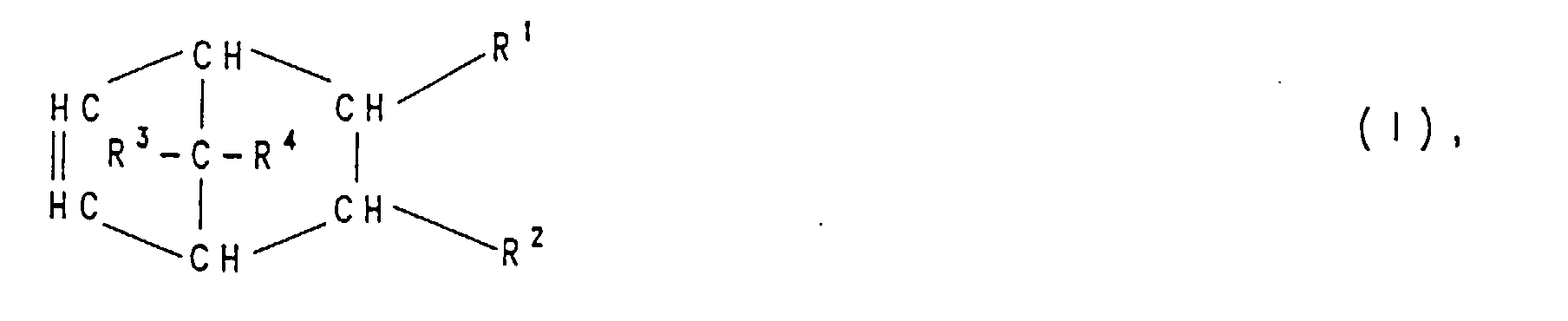
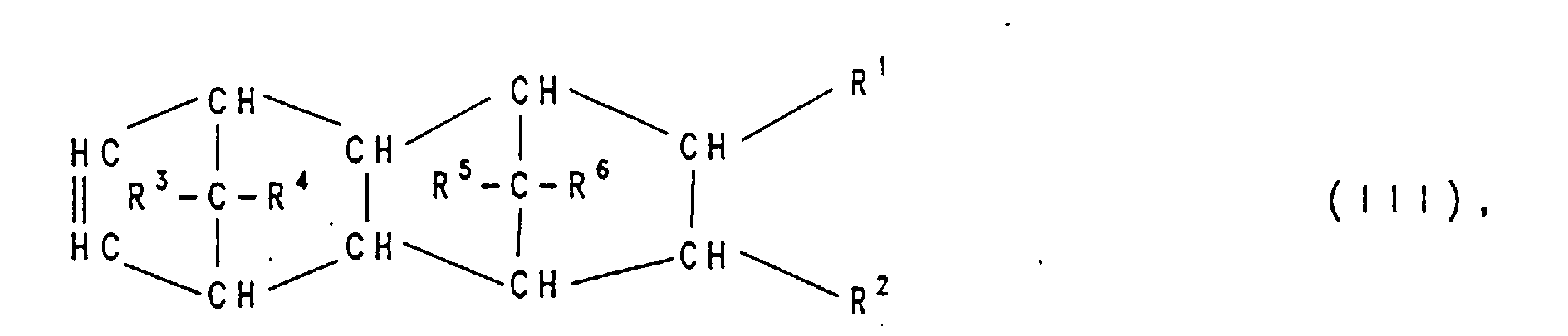
- At least one polycyclic olefin of the formula I, II, III or IV preferably a cycloolefin of the formula I or III, wherein R 1 , R 2 , R 3 , R 4 , R 5 , R 6 , R 7 and R 8 are the same or different and represent a hydrogen atom or a C 1 -C 8 alkyl radical or a C 1 -C 16 aryl radical , where the same radicals in the different formulas can have different meanings.
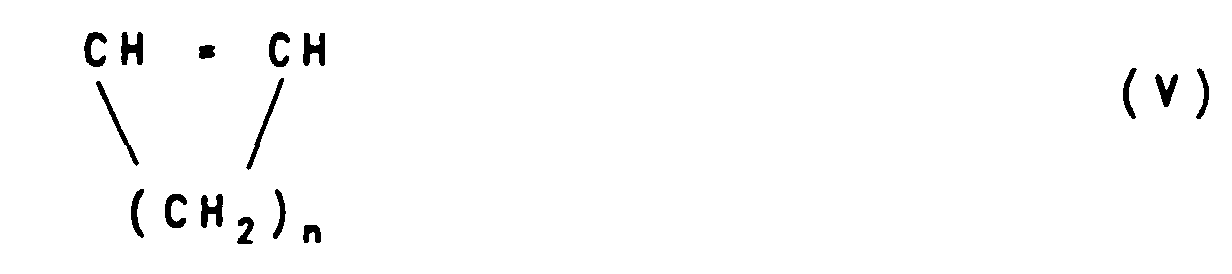
- a monocyclic olefin of the formula V where n is a number from 2 to 10 is used.
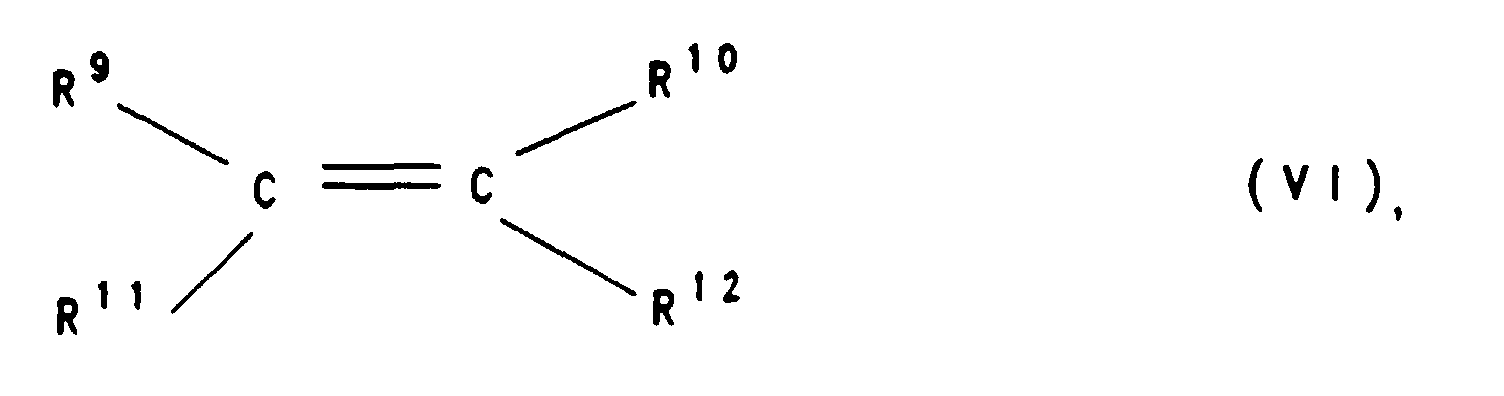
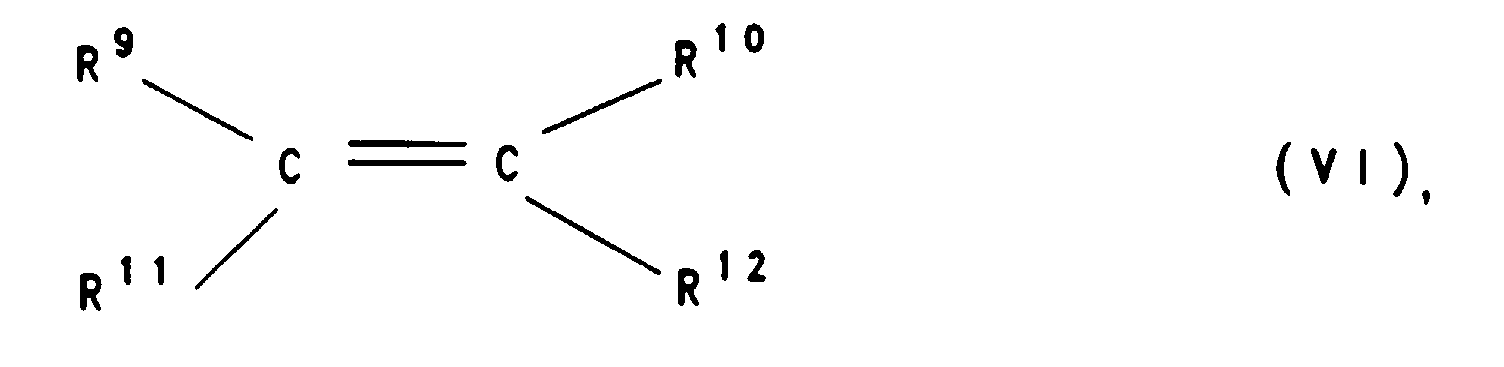
- Another comonomer is an acyclic 1-olefin of the formula VI, wherein R 9 , R 10 , R 11 and R 12 are the same or different and represent a hydrogen atom or a C 1 -C 8 alkyl radical, which may also contain a double bond, or a C 6 -C 16 aryl radical.
- Ethylene, propylene, butene, hexene, octene or styrene are preferred.
- Ethene is particularly preferred. Dienes can also be used.
- copolymers of polycyclic olefins of the formula I and II manufactured.
- the polycyclic olefin (I to IV) is used in an amount of 0.1 to 99.9% by weight, the monocyclic olefin (V) in an amount of 0.1 to 99.9% by weight and that acyclic 1-olefin (VI) in an amount of 0.1 to 99.9% by weight, based in each case on the total amount of monomers used.
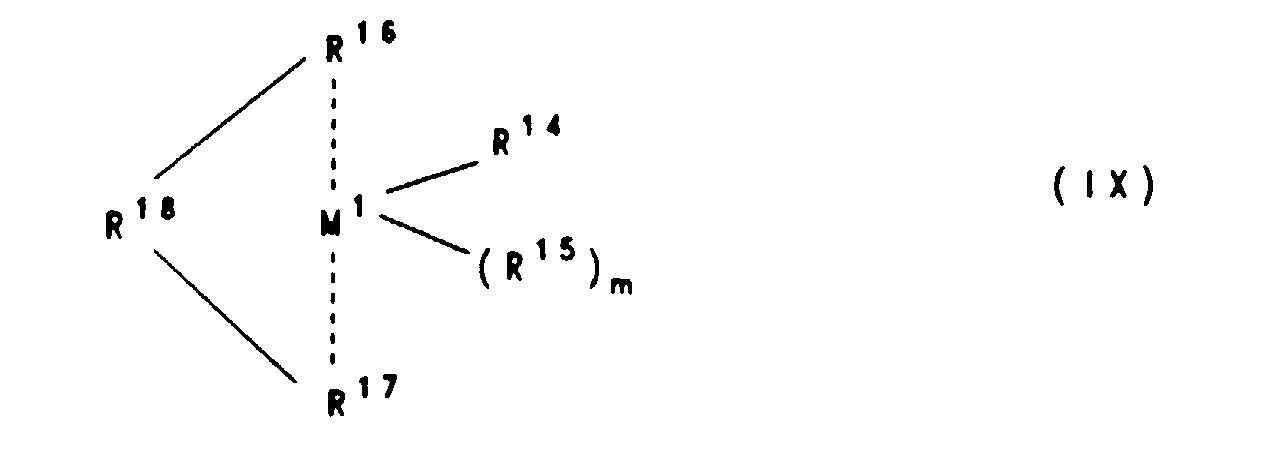
- the catalyst used in the polymerization consists of an aluminoxane and at least one metallocene of the formula IX
- M 1 is a metal from the group titanium, zirconium, hafnium, vanadium, niobium and tantalum, preferably zirconium and hafnium.
- R 16 and R 17 are different and represent a mono- or polynuclear hydrocarbon radical which can form a sandwich structure with the central atom M 1 .
- the metallocene of formula IX has a C s symmetry with respect to the ligands R 16 and R 17 and to the central atom M 1 connecting them .
- R 16 is preferably fluorenyl and R 17 is cyclopentadienyl.
- M 2 is silicon, germanium or tin, preferably silicon or germanium.
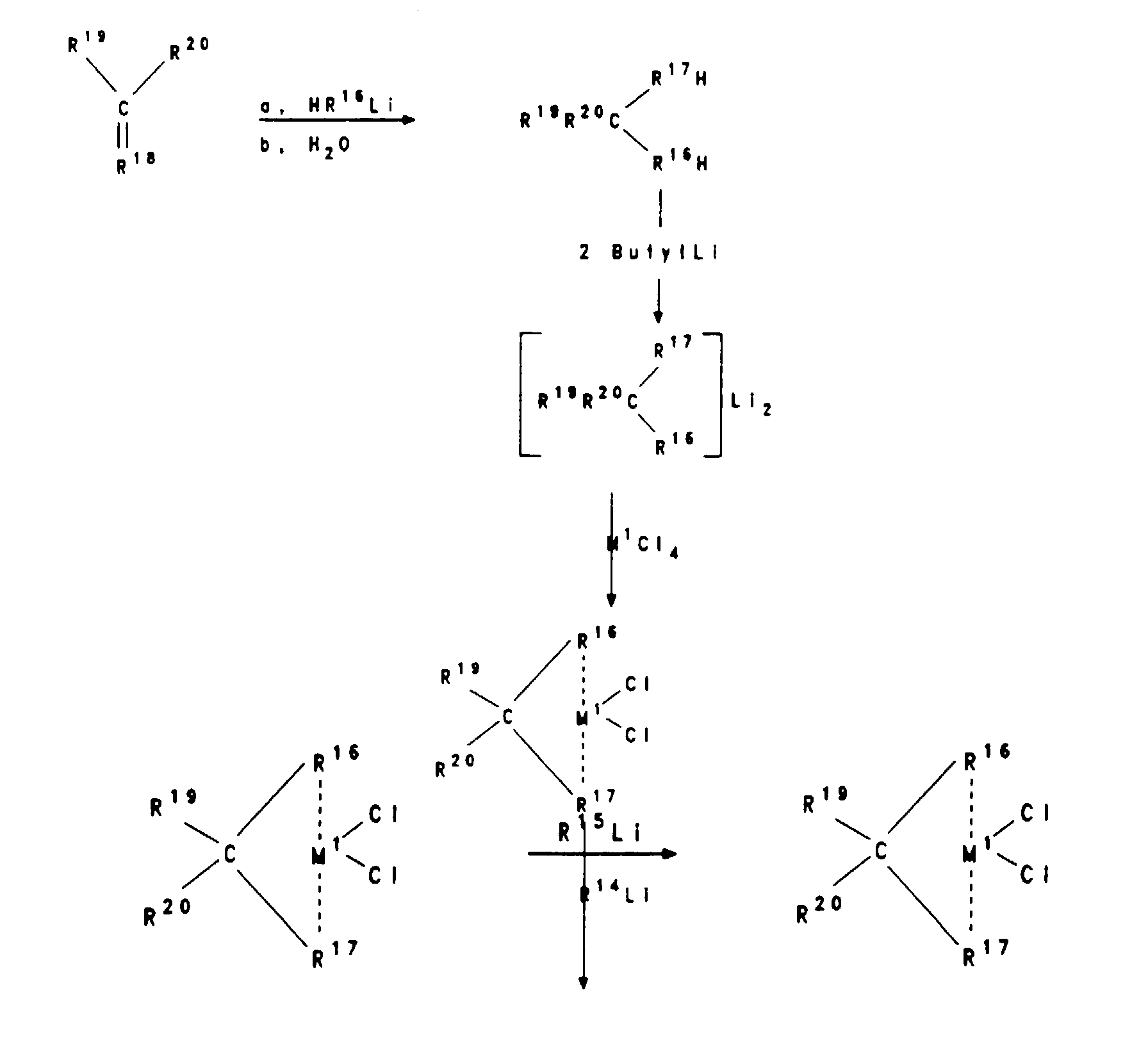
- the metallocenes can be prepared according to the following reaction scheme: or H 2 R 16 + ButylLi ⁇ HR 16 Li
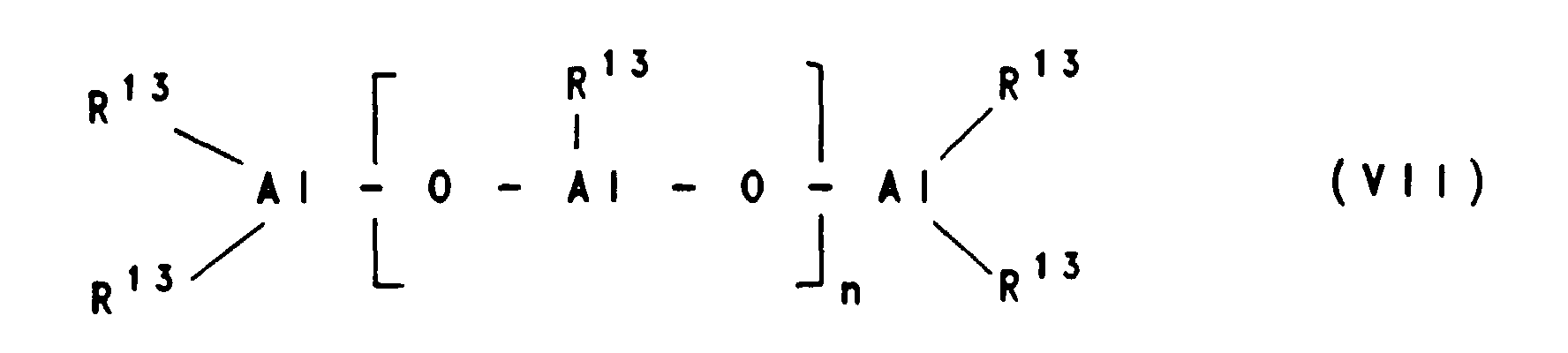
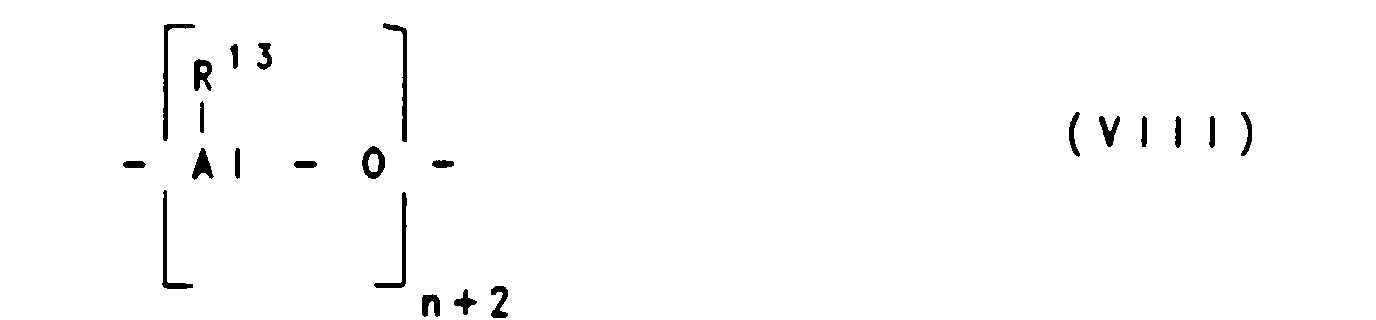
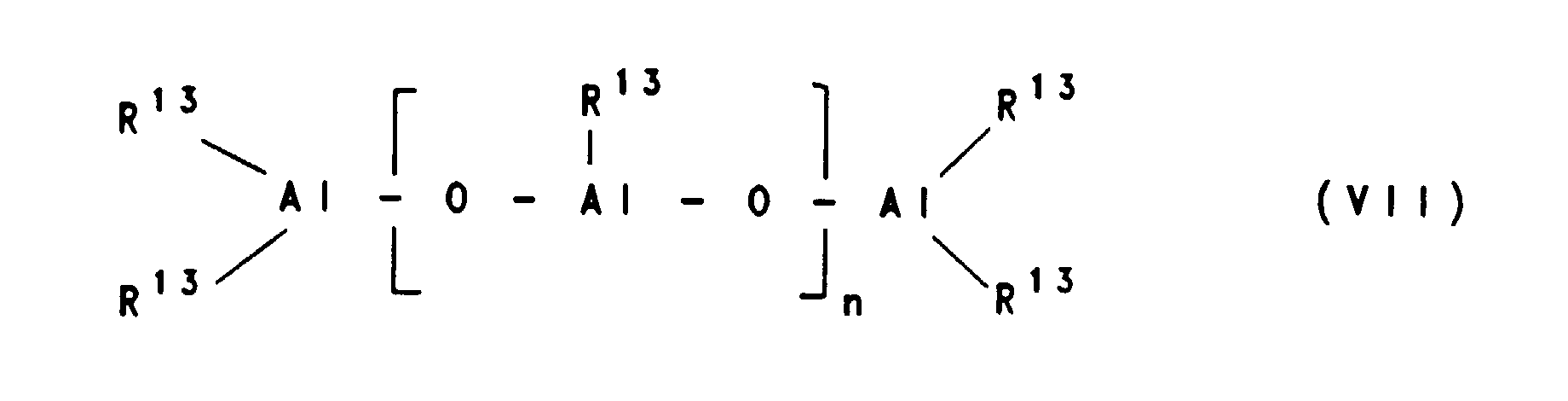
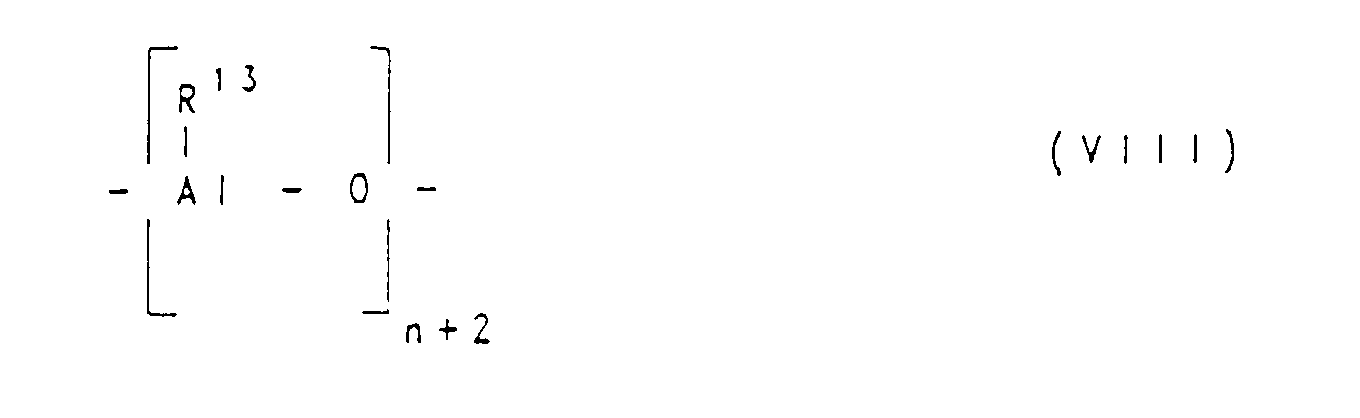
- the cocatalyst is an aluminoxane of formula VII for the linear type and / or formula VIII for the cyclic type.
- R 13 represents a C 1 -C 6 alkyl group, preferably methyl, ethyl or isobutyl, butyl or neopentyl, or phenyl or benzyl. Methyl is particularly preferred.
- n is an integer from 2 to 50, preferably 5 to 40.
- the exact structure of the aluminoxane is not known.
- the aluminoxane can be made in a number of ways.
- finely powdered copper sulfate pentahydrate is slurried in toluene and aluminum trialkyl is added in a glass flask under inert gas at about -20 ° C. so that about 1 mol of CuSO 4 .5H 2 O is available for every 4 Al atoms.
- the reaction mixture is left at room temperature for 24 to 48 hours, cooling if necessary so that the temperature does not rise above 30 ° C.
- the aluminoxane dissolved in toluene is then filtered off from the copper sulfate and the solution is concentrated in vacuo. It is believed that in these manufacturing processes the low molecular weight aluminoxanes condense to form higher oligomers with the elimination of aluminum trialkyl.
- aluminoxanes are obtained if one at a temperature of -20 to 100 ° C in an inert aliphatic or aromatic solvent, preferably Heptane or toluene, dissolved aluminum trialkyl, preferably aluminum trimethyl, with aluminum salts containing water of crystallization, preferably aluminum sulfate, for Brings reaction.
- Aluminum salts containing water of crystallization those which have a high content of water of crystallization are used in particular.
- Aluminum sulfate hydrate is particularly preferred, especially the compounds Al 2 (SO 4 ) 3 .16H 2 O and Al 2 (SO 4 ) 3 .18H 2 O with the particularly high crystal water content of 16 or 18 mol H 2 O / mol Al 2 (SO 4 ) 3 .
- aluminoxanes consists in Aluminum trialkyl, preferably aluminum trimethyl, in which Polymerization vessel submitted suspension medium, preferably in the liquid Monomers, in heptane or toluene, and then the aluminum compound to implement with water.
- the transition metal compound is preactivated in solution.
- the metallocene is preferably in a solution of the aluminoxane in one inert hydrocarbon dissolved.
- a suitable hydrocarbon is inert aliphatic or aromatic hydrocarbon. Toluene is preferred used.
- the concentration of the aluminoxane in the solution is in the range from about 1% by weight to the saturation limit, preferably from 5 to 30% by weight, based in each case on the total solution.
- the metallocene can be used in the same concentration, but preferably it is used in an amount of 10 -4 - 1 mol per mol of aluminoxane.
- the preactivation time is 5 minutes to 60 hours, preferably 5 to 60 minutes. One works at a temperature of -78 ° C to 150 ° C, preferably 20 to 100 ° C.
- the polymerization is carried out in one for the Ziegler low pressure process commonly used inert solvents, for example in one aliphatic or cycloaliphatic hydrocarbon; as such for example butane, pentane, hexane, heptane, isooctane, cyclohexane, Called methylcyclohexane.
- a gasoline or hydrogenated Diesel oil fraction carefully selected from oxygen, sulfur compounds and Moisture Free has been used.
- Toluene and decalin can also be used and xylene.
- the monomer to be polymerized can also be used as a solvent or Suspension agents are used.
- Suspension agents are used.
- norbornene such Bulk polymerizations carried out at a temperature above 45 ° C.
- the Molar mass of the polymer can be regulated in a known manner; hydrogen is preferably used for this purpose.
- the polymerization is carried out in a known manner in solution, in suspension, in the liquid cycloolefin monomer or cycloolefin monomer mixture or in the Gas phase, continuous or discontinuous, one or more stages in one Temperature from -78 to 150 ° C, preferably 20 to 100 ° C, performed.
- Of the Pressure is 0.5 to 64 bar and is either by the gaseous olefins or obtained with the help of inert gas.
- Continuous and multi-stage processes are particularly advantageous because they a rational use of the polycyclic process, the polycyclic olefin, which as a residual monomer feed together with the reaction mixture.
- the metallocene compound is used in a concentration, based on the transition metal, of 10 -3 to 10 -7 , preferably 10 -5 to 10 -6 mol, transition metal per dm 3 reactor volume.
- the aluminoxane is used in a concentration of 10 -4 to 10 -1 , preferably 10 -4 to 2 ⁇ 10 -2 mol per dm 3 reactor volume, based on the aluminum content. In principle, however, higher concentrations are also possible in order to use the polymerization properties of various metallocenes.
- the variation of the molar ratios can of the polycyclic olefin to the 1-olefin used in a wide range respectively.
- the concentration the catalyst components and the molar ratio used can be the Control the installation rate on the Comomomer almost as desired. With norbornen one Installation rate of more than 40 mol% reached.
- the average molecular weight of the copolymer formed can be varied by Catalyst concentration or temperature vary in a known manner.
- the polydispersity M w / M n of the copolymers is quite narrow with values between 1.9-3.5. This results in a property profile of the polymers, which makes them particularly suitable for extrusion.
- the glass transition temperature is above 100 ° C.
- the reaction mixture is subjected to a purification process.
- a purification process is cleaned by a process which is characterized in that in a first step the reaction mixture with a filter aid and with a Substance that precipitates the organometallic compounds in the reaction mixture, is suspended, in a second step the heterogeneous fraction is filtered and in a third step, the purified COC from the COC filtrate using a Precipitant is precipitated or the solvent of the COC filtrate is evaporated becomes.
- evaporation processes can be used, such as evaporation with the aid of a flash chamber, a thin-film evaporator, ®List kneader (List, England), degassing extruder or a ®Diskpack (Farrel, USA).
- Substances that precipitate the organometallic compound in the reaction mixture are preferably polar compounds, such as water, ethylene glycol, glycerol and acetic acid.
- the suspending agent is a hydrocarbon.
- Particularly suitable filter aids are kieselguhr, e.g. ®Celite 545, (LuV, Hamburg), Perlite, e.g.
- ®Celite Perlite J-100 (LuV)
- modified cellulose e.g. ®Diacel (LuV)
- porous carbon and absorbent asbestos fibers are also suitable.
- Good depth filtration is achieved through the use of filter aids.
- Continuous and discontinuous filtering techniques can be used.
- the filtration can be carried out as pressure filtration or centrifugation. Filtering is preferably carried out by suction filtering, pressure filtering, for example by filtering through a fleece or by peeling centrifugation. Other conventional filtration techniques can also be used.
- the filtered COC solution can be passed continuously or discontinuously several times over the same filter so that the filtering effect is further intensified.
- a suitable precipitant is acetone, isopropanol or methanol.
- the polymers obtained have been subjected to the cleaning step described above and have been dried, melted using a piston or screw extruder and pushed through a nozzle.
- a covering layer is placed on the thread applied from a second polymer, by coextrusion or by Coating from a solution, the refractive index of the second polymer is lower than that of the core material.
- Possible jacket materials Polymers and copolymers from 4-methylpentene, among others Olefins, copolymers of Ethylene and vinylidene fluoride, optionally with the addition of other comonomers such as.
- the above are Processed polymers described melted in an extruder and pushed through a slot die.
- the reflective layer on the surface can be by coextrusion or by coating from solution with a apply second polymer, whose refractive index is lower than that of Is core material.
- a clean and dry 75 dm 3 polymerization reactor with stirrer was purged with nitrogen and then with ethylene and filled with 22,000 g of norbornene melt (Nb) and 6 liters of toluene.
- the reactor was then brought to a temperature of 70 ° C. with stirring and 3.4 bar of ethylene were injected. Thereafter, 500 cm 3 of toluene methylalumoxane solution (10.1% by weight of methylaluminoxane with a molecular weight of 1,300 g / mol after cryoscopic determination) were metered into the reactor and the mixture was stirred at 70 ° C. for 15 minutes, the ethylene pressure at 3.4 was held in cash.
- the reaction solution was drained in a 150 liter stirred kettle in which 500 g of diatomaceous earth (®Celite 545, LuV, Hamburg) or optionally cellulose filter aids (®Diacel, LuV, Hamburg), 200 ml of water, 0.5 g of peroxide decomposer (®Hostanox 3, Hoechst) and 0.5 g antioxidant (®Hostanox 03, Hoechst) in 50 liters of a hydrogenated diesel oil fraction (®Exsol, boiling range 100-120 ° C, Exxon). The mixture was stirred at 60 ° C. for 30 minutes.
- diatomaceous earth ®Celite 545, LuV, Hamburg
- optionally cellulose filter aids ®Diacel, LuV, Hamburg
- antioxidant ®Hostanox 03, Hoechst
- the polymer solution was filtered through the pressure filter. The procedure was such that the filtrate is first returned to the suction filter for 15 minutes. A pressure of up to 2.8 bar nitrogen was built up over the solution. It was then filtered through 7 filter cartridges (Fluid Dynamics, Dynalloy XS64, 5 ⁇ m, 0.1 m 2 / cartridge), which were mounted in a steel housing.
- the polymer solution was stirred into 500 liters of acetone using a dispersant (®Ultraturax) and precipitated.
- the acetone suspension was circulated through a 680-liter stirring pressure filter with the bottom valve open. After closing the bottom valve, it was washed three times with 200 l of acetone. 50 g of stabilizer (®Irganox 1010, Ciba) were added to the last wash. Following the last filtration, the product was predried at 100 ° C. in a stream of nitrogen and dried in the drying cabinet at 0.2 bar for 24 hours. A product amount of 4160 g was obtained. A viscosity number (VZ) of 62 cm 3 (DIN 53728) and a glass transition temperature (T g ) of 181 ° C. were measured on the product. Its melt viscosity is 400 PaS.
- VZ viscosity number
- T g glass transition temperature
- Example 2 (comparative example to example 1, EP 407 870)
- a clean and dry 75 dm 3 polymerization reactor with stirrer was purged with nitrogen and then with ethylene and filled with 22,000 g of norbornene melt (Nb) and 6 liters of toluene.
- the reactor was then brought to a temperature of 70 ° C. with stirring and 3.4 bar of ethylene were injected. Thereafter, 500 cm 3 of toluene methylalumoxane solution (10.1% by weight of methylaluminoxane with a molecular weight of 1,300 g / mol after cryoscopic determination) were metered into the reactor and the mixture was stirred at 70 ° C. for 15 minutes, the ethylene pressure at 3.4 was held in cash.
- Example 2 The procedure was analogous to Example 1. However, 1200 mg of rac-dimethylsilyl-bis- (1-indenyl) zirconium dichloride was used as the catalyst. After a reaction time of 150 min and an ethylene pressure of 3.2 bar and the application of the work-up procedure described in Example 1, 5070 g of polymer were obtained, on which a VZ of 61 cm 3 (DIN 53728) and a T g of 179 ° C. were measured were.
- COC (example 1)
- COC (example 3)
- Melt viscosity (Pa * S) 400 2000 (Measured as zero shear viscosity, ie as an approximate viscosity at a shear rate of 0.1 s -1 , measurement by capillary viscometry. Measurement at T T g + 120 ° C)
- a polymerization solution was prepared analogously to Example 3.
- the solution was but worked up analogously to Example 2, d. H. there was no filtration of the Polymer solution.
- a Melting endotherm at 127 ° C with a melting enthalpy of 1 J / g can be detected, due to a partially crystalline ethylene-rich polymer is to be fed.
- This value corresponds to a polyethylene content in the dried and purified product from 0.5 to 1 wt .-%.
- a press plate was 1 mm thick milky cloudy (pressing conditions: 240 ° C, 10 minutes, 50 bar pressure).
Landscapes
- Chemical & Material Sciences (AREA)
- Chemical Kinetics & Catalysis (AREA)
- Organic Chemistry (AREA)
- Health & Medical Sciences (AREA)
- Medicinal Chemistry (AREA)
- Polymers & Plastics (AREA)
- Physics & Mathematics (AREA)
- Engineering & Computer Science (AREA)
- Textile Engineering (AREA)
- General Chemical & Material Sciences (AREA)
- General Physics & Mathematics (AREA)
- Optics & Photonics (AREA)
- Crystallography & Structural Chemistry (AREA)
- Materials Engineering (AREA)
- Addition Polymer Or Copolymer, Post-Treatments, Or Chemical Modifications (AREA)
- Transition And Organic Metals Composition Catalysts For Addition Polymerization (AREA)
- Polymerization Catalysts (AREA)
Description
COC können unter Verwendung spezieller Ziegler-Katalysatoren (EP-A0-355 682) hergstellt werden, wobei üblicherweise Aluminiumalkyle bzw. Aluminiumalkylchloride als Cokatalysatoren eingesetzt werden. Diese Verbindungen hydrolysieren jedoch während der beschriebenen Aufarbeitungsverfahrens zu extrem feinen, gelartigen Verbindungen, die schwer filtrierbar sind. Werden Aluminiumalkylchloride eingesetzt, entstehen bei der Aufarbeitung chlorhaltige Verbindungen, wie Salzsäure oder Salze, die ebenfalls schwer abtrennbar sind. Wird Salzsäure zur Aufarbeitung eingesetzt ((EP-A0-355 682, EP-A0-485 893), entstehen ähnliche Probleme. Insbesondere bei der Verarbeitung der so hergestellten COC tritt eine Braunfärbung auf. Darüber hinaus ist ein bekanntes Problem bei der Herstellung von ethylenhaltigen Cycloolefin-Copolymeren die Bildung von teilkristallinen Ethylenpolymerisaten als Nebenprodukt. In der EP-AU-447 072 z. B. wird beschrieben, wie Cycloolefin-Copolymere, hergestellt durch Vanadium-Katalyse (vergl. EP-AO-156 464), durch eine aufwendige mehrstufige Filtration von teilkristallinen Ethylenpolymerisation befreit werden. Auch die in der EP 404 870 beschriebenen Metallocen-Katalysatoren, mit der Ausnahme von Isopropylen-(9-fluorenyl)cyclopentadienylzirkondichlorid und Diphenylcarbyl)-9-fluorenyl)cyclopentadienylzirkondichlorid, produzieren als Nebenprodukt zum Cycloolefin-Copolymer teilkristalline Ethylenpolymerisate, wie eigene, ausführliche Untersuchungen gezeigt haben. Je höher allerdings der Gehalt an teilkristallinem Ethylpolymerisat ist, desto höher jedoch ist die optische Dämpfung des Materials.
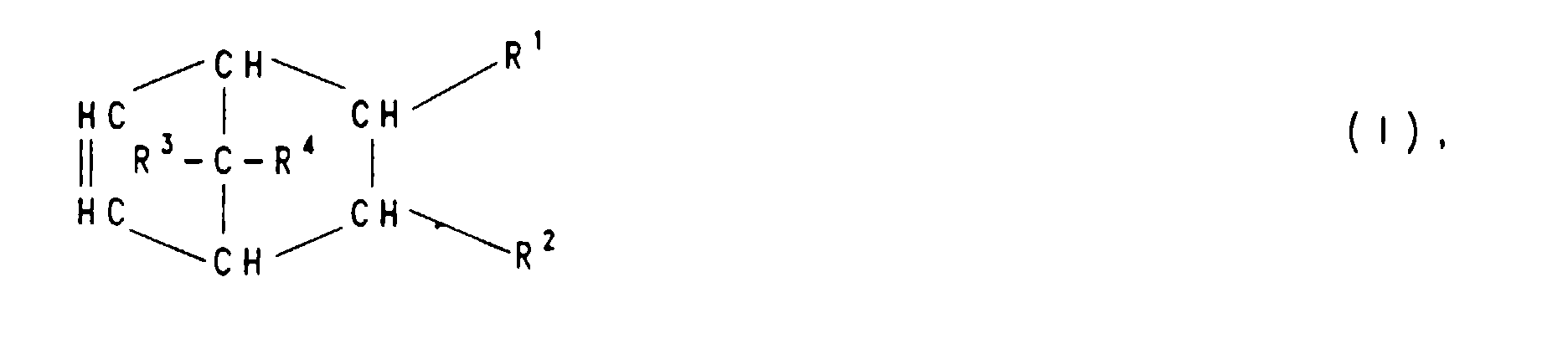
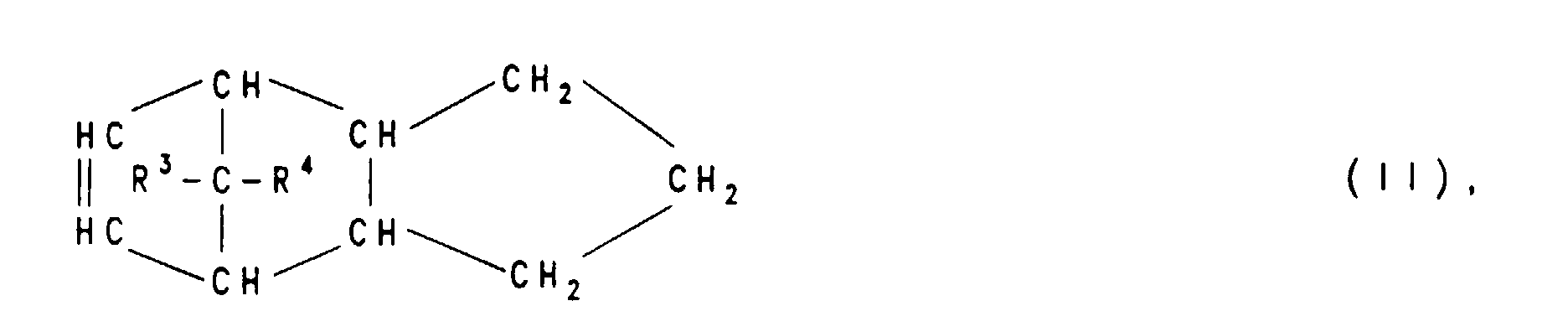
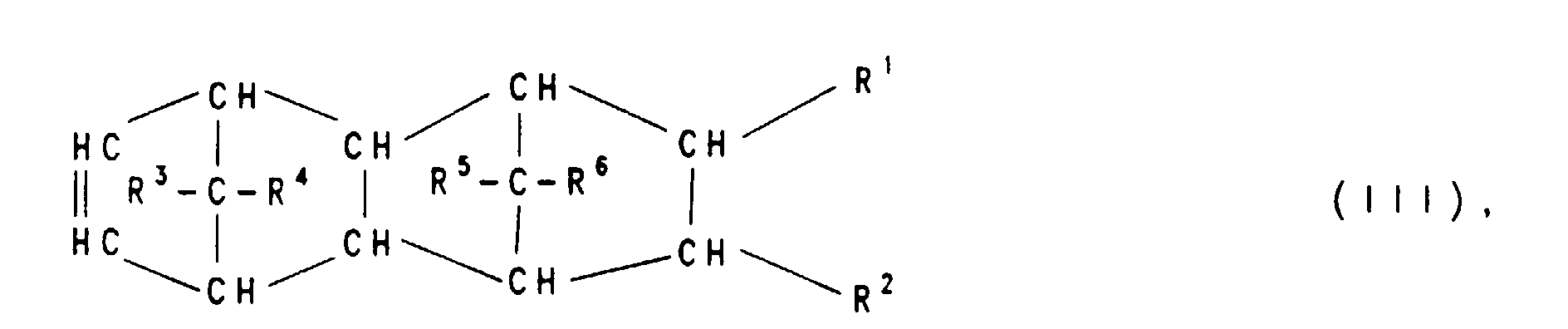

0,1 bis 99,9 Gew.-%, bezogen auf die Gesamtmenge der Monomeren, mindestens eines acvclischen 1-Olefins der Formel VI
- M1
- Titan, Zirkon, Hafnium, Vanadium, Niob oder Tantal ist,
- R14 und R15
- gleich oder verschieden sind und ein Wasserstoffatom, ein Halogenatom, eine C1-C10-Alkylgruppe, eine C1-C10-Alkoxygruppe, eine C6-C10-Arylgruppe, eine C6-C10-Aryloxygruppe, eine C2-C10-Alkenylgruppe, eine C7-C40-Arylalkylgruppe, eine C7-C40-Alkylarylgruppe oder eine C8-C40-Arylalkenylgruppe bedeuten,
- m
- eins oder zwei, je nach der Wertigkeit des Zenralatoms M1, sein kann,
- R18
- = BR19, = AlR19, -Ge-, -Sn-, -O-, -S-, = SO, =SO2, = NR19, = CO, = PR19 oder = P(O)R19 ist, wobei R19, R20 und R21 gleich oder verschieden sind und ein Wasserstoffatom, ein Halogenatom, eine C1-C10-Alkylgruppe, eine C1-C10-Fluoralkylgruppe, eine C6-C10-Fluorarylgruppe, eine C6-C10-Arylgruppe, eine C1-C10-Alkoxygruppe, eine C2-C10-Alkenylgruppe, eine C7-C40-Arylalkylgruppe, eine C8-C40-Arylalkenylgruppe oder eine C7-C40-Alkylarylgruppe bedeuten oder R19 und R20 o2der R19 und R21 jeweils mit den sie verbindenden Atomen einen Ring bilden,

- M2
- Silizium, Germanium oder Zinn ist,
- R16 und R17
- verschieden sind und einen ein- oder mehrkernigen
Kohlenwasserstoffrest, welcher mit dem Zentralatom M1 eine
Sandwichstruktur bilden kann, bedeuten, dadurch gekennzeichnet, daß das
Metallocen der Formel IX eine Cs-Symmetrie in Bezug auf die Liganden R16
und R17 und das sie verbindende Zentralatom M1 besitzt,
wobei man das Copolymerisat nach Ablauf der Copolymerisation einem Reinigungsverfahren unterwirft, wobei in einem ersten Schritt des Reinigungsverfahrens das Reaktionsgemisch mit einem Filterhilfsmittel und mit einer Substanz, die die metallorganische Verbindungen im Reaktionsgemisch ausfällt, suspendiert wird, in einem zweiten Schritt der heterogene Anteil fiitriert wird und in einem dritten Schritt das gereinigte COC aus dem COC-Filtrat mit Hilfe eines Fällmittels ausgefällt wird oder das Lösungsmittel des COC-Filtrats abgedampft wird und das erhaltene Material eine optische Dämpfung von 0,1 - 5 dB/m aufweist.


Gegebenenfalls wird auch ein monocyclisches Olefin der Formel V

Ein anderes Comonomer ist ein acyclischen 1-Olefins der Formel VI,

Das Metallocen der Formel IX hat eine Cs-Symmetrie in Bezug auf die Liganden R16 und R17 und auf das sie verbindende Zentralatom M1.
Bevorzugt ist R16 Fluorenyl und R17 Cyclopentadienyl.
R18 ist eine ein- oder mehrgliedrige Brücke, welche die Reste R16 und R17 verknüpft und bedeutet


Isopropylen-(9-fluorenyl)-cyclopentadienyl-zirkondichlorid oder deren Gemische.

Ein geeignetes Fällmittel ist Aceton, Isopropanol oder Methanol.
Danach wurden 500 cm3 toluolische Methylalumoxanlösung (10,1 Gew-% Methylaluminoxan mit Molmasse 1 300 g/mol nach kryoskopischer Bestimmung) in den Reaktor dosiert und die Mischung 15 min bei 70°C gerührt, wobei durch Nachdosieren der Ethylendruck bei 3,4 bar gehalten wurde. Parallel dazu wurden 350 mg Diphenylcarbyl-cyclopentadienyl)-(9-fluorenyl)-Zirkoniumdichlorid in 500 cm3 toluolischer Methylaluminoxanlösung (Konzentration und Qualität siehe oben) gelöst und durch 15 minütiges Stehenlassen voraktiviert. Dann wurde die Lösung des Komplexes (Kat.Lösung) in den Reaktor dosiert. Zur Molekulargewichtsregelung wurden 0,7 Liter Wasserstoff vorgelegt. Während der Polymerisation wurde 780 ml Wasserstoff/Stunde kontinuierlich zudosiert. Unter Rühren (750 Umdrehungen pro Minute) wurde dann 1,5 Stunden bei 70°C polymerisiert, wobei der Ethylendruck durch Nachdosieren bei 3,4 bar gehalten wurde.
Die Reaktionslösung wurde in einem 150-Liter-Rührkessel abgelassen, in dem 500g Kieselgur (®Celite 545, LuV, Hamburg) oder wahlweise auch Cellulosefilterhilfsmittel (®Diacel, LuV, Hamburg), 200 ml Wasser, 0,5 g Peroxidzersetzer (®Hostanox 3, Hoechst) und 0,5 g Antioxidans (®Hostanox 03, Hoechst) in 50 Liter einer hydrierten Dieselälfraktion (®Exsol, Siedebereich 100 - 120°C, Exxon) vorgelegt wurden. Bei 60°C wurde 30 min gerührt.
Auf dem Filtergewebe einer 120-Liter-Drucknutsche wurde ein Filterkuchen aus 500g ®Celite (oder auch 500 g Cellulose), suspendiert in 10 Liter ®Exsol, aufgebaut. Die Polymerlösung wurde über die Drucknutsche filtriert. Dabei wurde so verfahren, daß das Filtrat zunächst 15 min in die Nutsche zurückgefördert wird. Über der Lösung wurde ein Druck bis zu 2,8 bar Stickstoff aufgebaut. Anschließend wurde über 7 Filterkerzen (Fluid Dynamics, Dynalloy XS64, 5µm, 0,1 m2/Kerze), die in einem Stahlgehäuse montiert wurden, filtriert.
Die Polymerlösung wurde mittels eines Dispergators (®Ultraturax) in 500 Liter Aceton eingerührt und gefällt. Die Acetonsuspension wurde dabei über eine 680-Liter-Rührdrucknutsche bei geöffnetem Bodenventil im Kreis gefördert. Nach Schließen des Bodenventils wurde dreimal mit 200 l Aceton gewaschen. Der letzten Wäsche wurden 50 g Stabilisator (®Irganox 1010, Ciba) zugesetzt.
Im Anschluß an die letzte Filtration wurde das Produkt bei 100°C im Stickstoffstrom vorgetrocknet und im Trockenschrank bei 0,2 bar 24 Stunden nachgetrocknet. Es wurde eine Produktmenge von 4160 g erhalten. An dem Produkt wurde eine Viskositätszahl (VZ) von 62 cm3 (DIN 53728) und eine Glastemperatur (Tg) von 181°C gemessen. Seine Schmelzeviskosität beträgt 400 PaS.
Danach wurden 500 cm3 toluolische Methylalumoxanlösung (10,1 Gew-% Methylaluminoxan mit Molmasse 1 300 g/mol nach kryoskopischer Bestimmung) in den Reaktor dosiert und die Mischung 15 min bei 70°C gerührt, wobei durch Nachdosieren der Ethylendruck bei 3,4 bar gehalten wurde. Parallel dazu wurden 350 mg Diphenylcarbyl-(cyclopentadienyl)-(9-fluorenyl)-zirkoniumdichlorid in 500 cm3 toluolischer Methylaluminoxanlösung (Konzentration und Qualität siehe oben) gelöst und durch 15 minütiges Stehenlassen voraktiviert. Dann wurde die Lösung des Komplexes (Kat.Lösung) in den Reaktor dosiert. Zur Molekulargewichtsregelung wurden 0,7 Liter Wasserstoff vorgelegt. Während der Polymerisation wurden 780 ml Wasserstoff/Stunde kontinuierlich zudosiert. Unter Rühren (750 Umdrehungen pro Minute) wurde dann 1,5 Stunden bei 70°C polymerisiert, wobei der Ethylendruck durch Nachdosieren bei 3,4 bar gehalten wurde.
Dann wurde der Reaktorinhalt schnell in einen 150 l Rührkessel abgelassen, in dem 200 cm3 Isopropanol in 10 l Exsol vorgelegt waren. Diese Mischung wurde in 500 l Aceton ausgefällt, 10 min gerührt und dann der suspendierte polymere Feststoff abfiltriert. Das abfiltrierte Polymer wurde dann in 200 l einer Mischung aus zwei Teilen 3-normaler Salzsäure und einem Teil Ethanol gegeben und diese Suspension 2 Stunden gerührt. Das Polymer wurde dann erneut abfiltriert, mit Wasser neutral gewaschen und bei 80°C und 0,2 bar 15 h getrocknet. Es wurde eine Produktmenge von 4320 g erhalten. An dem Produkt wurde eine Viskositätszahl VZ = 60 cm3 (DIN 53728) und eine Glastemperatur (Tg) von 182°C gemessen. Es wurde keine Schmelzendotherme in der DSC gefunden.
| COC (Beispiel 1) | COC (Beispiel 3) | |
| Schmelzviskosität (Pa*S) | 400 | 2000 |
Claims (5)
- Verfahren zur Herstellung von Cycloolefincopolymeren (COC) mit einer niedrigen Schmelzeviskosität durch Copolymerisation von 0,1 bis 99,9 Gew.-%, bezogen auf die Gesamtmenge der Monomeren, mindestens eines Monomers der Formeln I, II, III oder IV

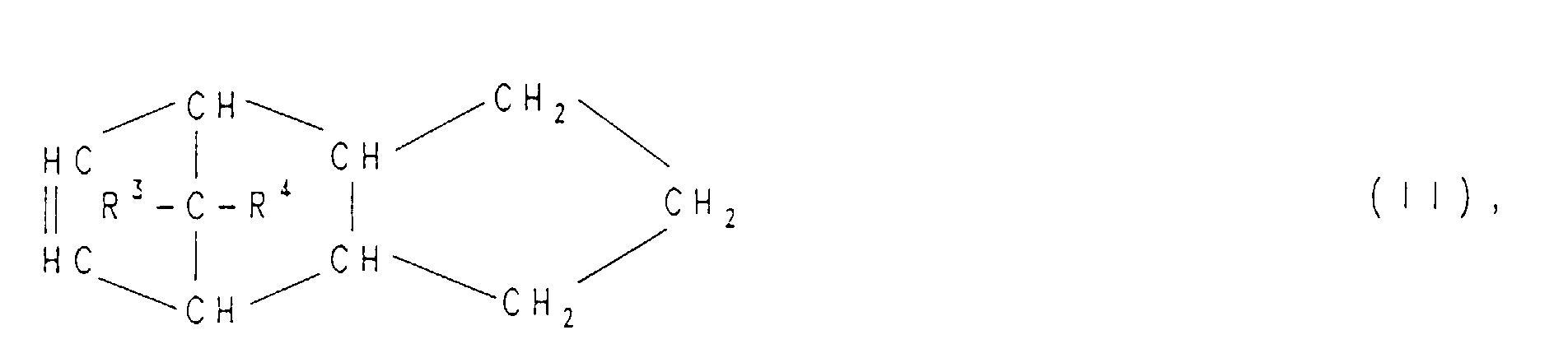
 worin R1, R2, R3, R4, R5, R6, R7 und R8 gleich oder verschieden sind und ein Wasserstoffatom oder einen C1-C8-Alkylrest cder Arylrest bedeuten, wobei gleiche Reste in den verschiedenen Forme!n eine unterschiedliche Bedeutung haben können 0 bis 99,9 Gew.-%, bezogen auf die Gesamtmenge der Monomeren, eines Cyclcolefins der Formel V
 worin n eine Zahl von 2 bis 10 ist, und
0,1 bis 99,9 Gew.-%, bezogen auf die Gesamtmenge der Monomeren, mindestens eines acyclischen 1-Olefins der Formel VIworin R9, R10, R11 und R12 gleich oder verschieden sind und ein Wasserstoffatom oder einen C1-C8-Alkylrest bedeuten, in Lösung, in Suspension, in dem flüssigen Cycloolefinmonomer oder Cycloolefinmonomergemisch oder in der Gasphase, bei einer Temperatur von -78 bis 150° C, bei einem Druck von 0,5 bis 64 bar, in Gegenwart eines Katalysators, welcher aus einem Metallocen als Übergangsmetallkomponente und einem Aluminoxan der Formel VII für den linearen Typ und/oder der Formel VIII
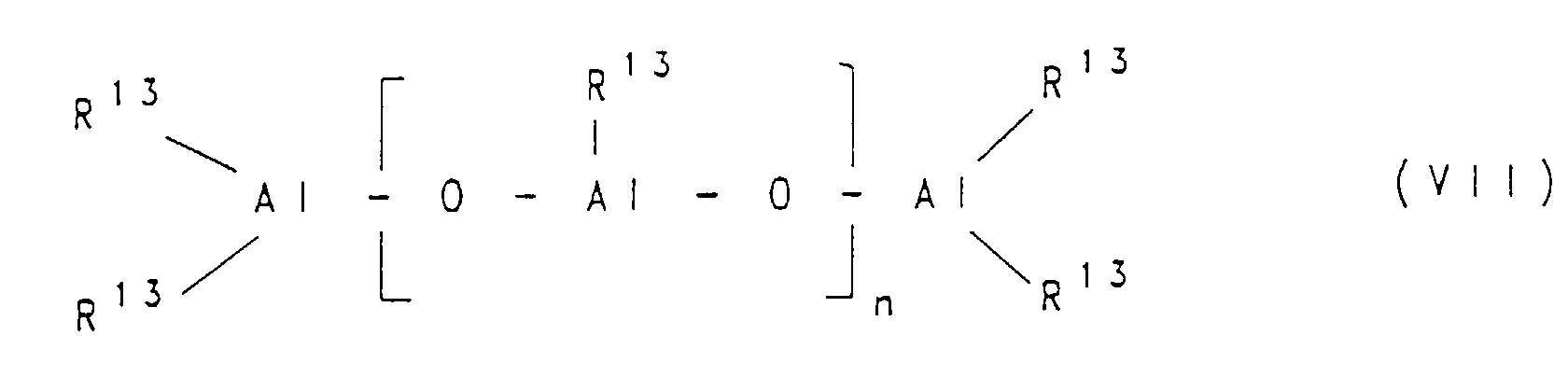 für den cyclischen Typ besteht, wobei in den Formeln VII und VIII R13 eine C1-C6-Alkylgruppe oder Phenyl oder Benzyl bedeutet und n eine ganze Zahl von 2 bis 50 ist, wobei die Polymerisation in Gegenwart eines Katalysators durchgeführt wird, dessen Übergangsmetallkomponente mindestens eine Verbindung der Formel IX
 ist, worin
- M1
- Titan, Zirkon, Hafnium, Vanadium, Niob oder Tantal ist,
- R14 und R15
- gleich oder verschieden sind und ein Wasserstoffatom, ein Halogenatom, eine C1-C10-Alkylgruppe, eine C1-C10-Alkoxygruppe, eine C6-C10-Arylgruppe, eine C6-C10-Aryloxygruppe, eine C2-C10-Alkenylgruppe, eine C7-C40-Arylalkylgruppe, eine C7-C40-Alkylarylgruppe oder eine C8-C40-Arylalkenylgruppe bedeuten, und
- m
- eins oder zwei, je nach der Wertigkeit des Zentralatoms M1, sein kann,
- R18
- = BR19, = AlR19, -Ge-, -Sn-, -O-, -S-, = SO, =SO2, = NR19, = CO, = PR19 oder = P(O)R19 ist, wobei R19, R20 und R21 gleich oder verschieden sind und ein Wasserstoffatom, ein Halogenatom, eine C1-C10-Alkylgruppe, eine C1-C10-Fluoralkylgruppe, eine C6-C10-Fluorarylgruppe, eine C6-C10-Arylgruppe, eine C1-C10-Alkoxygruppe, eine C2-C10-Alkenylgruppe, eine C7-C40-Arylälkylgruppe, eine C8-C40-Arylalkenylgruppe oder eine C7-C40-Alkylarylgruppe bedeuten oder R19 und R20 oder R19 und R21 jeweils mit den sie verbindenden Atomen einen Ring bilden,

- M2
- Silizium, Germanium oder Zinn ist,
- R16 und R17
- verschieden sind und einen ein- oder mehrkernigen Kohlenwasserstoffrest, welcher mit dem Zentralatom M1 eine Sandwichstruktur bilden kann, bedeuten, dadurch gekennzeichnet, daß das Metallocen der Formel IX Cs-Symmetrie in Bezug auf die Liganden R16 und R17 und auf das sie verbindende Zentralatom M1 besitzt, wobei man das Copolymerisat nach Ablauf der Copolymerisation einem Reinigungsverfahren unterwirft, wobei in einem ersten Schritt des Reinigungsverfahrens das Reaktionsgemisch mit einem Filterhilfsmittel und mit einer Substanz, die die metallorganische Verbindungen im Reaktionsgemisch ausfällt, suspendiert wird, in einem zweiten Schritt der heterogene Anteil filtriert wird und in einem dritten Schritt das gereinigte COC aus dem COC-Filtrat mit Hilfe eines Fällmittels ausgefällt wird oder das Lösungsmittel des COC-Filtrats abgedampft wird und das erhaltene Material eine optische Dämpfung von 0,1 - 5 dB/m aufweist.
- Verfahren nach Anspruch 1, dadurch gekennzeichnet, daß als Katalysator ein Metallocen der Formel XI verwendet wird, worin R16 = Fluorenyl und R17 = Cyclopentadienyl sind.
- Verfahren nach Anspruch 1 oder 2, dadurch gekennzeichnet, daß als Metallocen Diphenylmethylen-(9-fluorenyl)-cyclopentadienyl-zirkoniumdichlorid und bevorzugt Isopropylen-(9-fluorenyl)-cyclopentadienyl-zirkoniumdichlorid verwendet wird.
- Verfahren nach einem oder mehreren der Ansprüche 1 bis 3, dadurch gekennzeichnet, daß als 1-Olefin Ethylen eingesetzt wird.
- Verfahren nach einem oder mehreren der Ansprüche 1 bis 4, daß als 1-Olefin Ethylen und als polycyclisches Olefin Norbornen eingesetzt werden.
Applications Claiming Priority (3)
| Application Number | Priority Date | Filing Date | Title |
|---|---|---|---|
| DE4304291 | 1993-02-12 | ||
| DE4304291A DE4304291A1 (de) | 1993-02-12 | 1993-02-12 | Cycloolefincopolymere mit niedriger Schmelzeviskosität und niedriger optischer Dämpfung |
| PCT/EP1994/000263 WO1994018251A1 (de) | 1993-02-12 | 1994-01-31 | Cycloolefincopolymere mit niedriger schmelzeviskosität und niedriger optischer dämpfung |
Publications (2)
| Publication Number | Publication Date |
|---|---|
| EP0683797A1 EP0683797A1 (de) | 1995-11-29 |
| EP0683797B1 true EP0683797B1 (de) | 1999-04-14 |
Family
ID=6480340
Family Applications (1)
| Application Number | Title | Priority Date | Filing Date |
|---|---|---|---|
| EP94905734A Expired - Lifetime EP0683797B1 (de) | 1993-02-12 | 1994-01-31 | Verfahren zur herstellung von cycloolefincopolymeren mit niedriger schmelzeviskosität und niedriger optischer dämpfung |
Country Status (11)
| Country | Link |
|---|---|
| US (1) | US5637400A (de) |
| EP (1) | EP0683797B1 (de) |
| JP (1) | JP3361808B2 (de) |
| KR (1) | KR100306351B1 (de) |
| CN (1) | CN1117737A (de) |
| AU (1) | AU693083B2 (de) |
| BR (1) | BR9405831A (de) |
| CA (1) | CA2155936C (de) |
| DE (2) | DE4304291A1 (de) |
| ES (1) | ES2132378T3 (de) |
| WO (1) | WO1994018251A1 (de) |
Cited By (1)
| Publication number | Priority date | Publication date | Assignee | Title |
|---|---|---|---|---|
| US6713582B2 (en) | 2001-12-14 | 2004-03-30 | Uniroyal Chemical Company, Inc. | Process for the oligomerization of α-olefins having low unsaturation, the resulting polymers, and lubricants containing same |
Families Citing this family (50)
| Publication number | Priority date | Publication date | Assignee | Title |
|---|---|---|---|---|
| US6964798B2 (en) | 1993-11-16 | 2005-11-15 | Baxter International Inc. | Multi-layered polymer based thin film structure for medical grade products |
| FI105196B (fi) * | 1995-05-08 | 2000-06-30 | Optatech Oy | Amorfiset olefiini-ko/terpolymeerit |
| DE19522106A1 (de) * | 1995-06-19 | 1997-01-02 | Hoechst Ag | Verfahren zur Herstellung von Cycloolefincopolymeren |
| DE19546500A1 (de) * | 1995-12-13 | 1997-06-19 | Hoechst Ag | Verfahren zur Herstellung eines Cycloolefincopolymeren |
| JP3299477B2 (ja) * | 1997-02-07 | 2002-07-08 | 光信 宮城 | 中空導波路の製造方法 |
| US6497939B1 (en) * | 1998-02-03 | 2002-12-24 | Nippon Zeon Co., Ltd. | Flat plate and light guide plate |
| JP2001031744A (ja) | 1999-07-21 | 2001-02-06 | Jsr Corp | 光学用成形材料および光ディスク |
| US6297322B1 (en) | 1999-09-09 | 2001-10-02 | Baxter International Inc. | Cycloolefin blends and method for solvent bonding polyolefins |
| US6613187B1 (en) | 1999-09-09 | 2003-09-02 | Baxter International Inc | Solvent bonding method for polyolefin materials |
| US6590033B2 (en) | 1999-09-09 | 2003-07-08 | Baxter International Inc. | Cycloolefin blends and method for solvent bonding polyolefins |
| US6632318B1 (en) | 1999-09-09 | 2003-10-14 | Baxter International Inc. | Method for solvent bonding polyolefins |
| US6255396B1 (en) | 1999-09-09 | 2001-07-03 | Baxter International Inc. | Cycloolefin blends and method for solvent bonding polyolefins |
| DE10003934A1 (de) * | 2000-01-29 | 2001-08-09 | Daimler Chrysler Ag | Lichtwellenleiter mit einem Kern aus einem Polymer |
| US6497676B1 (en) | 2000-02-10 | 2002-12-24 | Baxter International | Method and apparatus for monitoring and controlling peritoneal dialysis therapy |
| US6875719B2 (en) * | 2000-04-27 | 2005-04-05 | Industrial Technology Research Institute | Catalyst composition for preparing olefin polymers |
| AU2001279056A1 (en) | 2000-07-28 | 2002-02-13 | Goodrich Corporation | Optical waveguides and methods for making the same |
| KR20020073476A (ko) | 2000-09-15 | 2002-09-26 | 퍼스트 퀄러티 파이버스 인코퍼레이티드 | 반결정성 중합체로 제조된 광학섬유의 제조장치 |
| US6372848B1 (en) | 2000-10-10 | 2002-04-16 | Baxter International Inc. | Blend of ethylene and α-olefin copolymers obtained using a metallocene catalyst for fabricating medical films and tubings |
| US20020172615A1 (en) * | 2001-03-08 | 2002-11-21 | Archie Woodworth | Apparatus for and method of manufacturing a prefilled sterile container |
| US20030125662A1 (en) | 2002-01-03 | 2003-07-03 | Tuan Bui | Method and apparatus for providing medical treatment therapy based on calculated demand |
| DE10228439A1 (de) * | 2002-06-26 | 2004-01-22 | Degussa Ag | Kunststoff-Lichtwellenleiter |
| US7238164B2 (en) | 2002-07-19 | 2007-07-03 | Baxter International Inc. | Systems, methods and apparatuses for pumping cassette-based therapies |
| JP2004144987A (ja) | 2002-10-24 | 2004-05-20 | Fuji Xerox Co Ltd | 高分子光導波路の製造方法 |
| JP4175183B2 (ja) | 2003-06-04 | 2008-11-05 | 富士ゼロックス株式会社 | 高分子光導波路の製造方法 |
| JP2005181662A (ja) | 2003-12-19 | 2005-07-07 | Fuji Xerox Co Ltd | 高分子光導波路の製造方法 |
| US7101654B2 (en) * | 2004-01-14 | 2006-09-05 | Promerus Llc | Norbornene-type monomers and polymers containing pendent lactone or sultone groups |
| JP4225207B2 (ja) | 2004-01-23 | 2009-02-18 | 富士ゼロックス株式会社 | 高分子光導波路の製造方法 |
| JP2004195246A (ja) * | 2004-02-13 | 2004-07-15 | Mitsunobu Miyagi | レーザプローブ |
| EP1763575A4 (de) | 2004-04-27 | 2009-09-23 | Baxter Int | Rührkesselreaktorsystem |
| JP2006083266A (ja) * | 2004-09-15 | 2006-03-30 | Teijin Ltd | 光学用フィルム |
| WO2007011462A1 (en) * | 2005-07-19 | 2007-01-25 | Exxonmobil Chemical Patents Inc. | Lubricants from mixed alpha-olefin feeds |
| JP5635234B2 (ja) * | 2005-07-19 | 2014-12-03 | エクソンモービル・ケミカル・パテンツ・インク | ポリαオレフィン組成物およびこれを生成するためのプロセス |
| US7989670B2 (en) * | 2005-07-19 | 2011-08-02 | Exxonmobil Chemical Patents Inc. | Process to produce high viscosity fluids |
| US8071835B2 (en) * | 2006-07-19 | 2011-12-06 | Exxonmobil Chemical Patents Inc. | Process to produce polyolefins using metallocene catalysts |
| US8558964B2 (en) | 2007-02-15 | 2013-10-15 | Baxter International Inc. | Dialysis system having display with electromagnetic compliance (“EMC”) seal |
| US7998115B2 (en) | 2007-02-15 | 2011-08-16 | Baxter International Inc. | Dialysis system having optical flowrate detection |
| US8361023B2 (en) | 2007-02-15 | 2013-01-29 | Baxter International Inc. | Dialysis system with efficient battery back-up |
| US7731689B2 (en) | 2007-02-15 | 2010-06-08 | Baxter International Inc. | Dialysis system having inductive heating |
| US8870812B2 (en) | 2007-02-15 | 2014-10-28 | Baxter International Inc. | Dialysis system having video display with ambient light adjustment |
| US8513478B2 (en) * | 2007-08-01 | 2013-08-20 | Exxonmobil Chemical Patents Inc. | Process to produce polyalphaolefins |
| JP5266335B2 (ja) * | 2008-01-31 | 2013-08-21 | エクソンモービル・ケミカル・パテンツ・インク | メタロセン触媒によるポリ−アルファオレフィン類の生産におけるリニアアルファオレフィン類の改良された利用 |
| US8865959B2 (en) * | 2008-03-18 | 2014-10-21 | Exxonmobil Chemical Patents Inc. | Process for synthetic lubricant production |
| CA2718894C (en) | 2008-03-31 | 2013-01-15 | Exxonmobil Chemical Patents Inc. | Production of shear-stable high viscosity pao |
| WO2010026931A1 (ja) * | 2008-09-05 | 2010-03-11 | 住友ベークライト株式会社 | 光導波路、光配線、光電気混載基板および電子機器 |
| CN102666806B (zh) | 2009-12-24 | 2015-09-16 | 埃克森美孚化学专利公司 | 用于生产新型合成基础油料的方法 |
| US9815915B2 (en) | 2010-09-03 | 2017-11-14 | Exxonmobil Chemical Patents Inc. | Production of liquid polyolefins |
| CA2849093C (en) | 2011-10-10 | 2016-12-06 | Exxonmobil Chemical Patents Inc. | Poly alpha olefin compositions and process to produce poly alpha olefin compositions |
| CN105705973B (zh) * | 2013-11-01 | 2020-06-23 | 东丽株式会社 | 投光塑料光纤及其制造方法 |
| US11179516B2 (en) | 2017-06-22 | 2021-11-23 | Baxter International Inc. | Systems and methods for incorporating patient pressure into medical fluid delivery |
| WO2019004298A1 (ja) * | 2017-06-27 | 2019-01-03 | ダイキン工業株式会社 | 含フッ素ポリマー製造工程から生じる水性流体を処理する方法およびシステム |
Citations (2)
| Publication number | Priority date | Publication date | Assignee | Title |
|---|---|---|---|---|
| EP0501370A1 (de) * | 1991-02-27 | 1992-09-02 | Hoechst Aktiengesellschaft | Cycloolefin(co)polymere mit enger Molekulargewichtsverteilung und Verfahren zu ihrer Herstellung |
| EP0683798A1 (de) * | 1993-02-12 | 1995-11-29 | Hoechst Aktiengesellschaft | Cycloolefincopolymere mit hoher reissfestigkeit und niedriger optischer dämpfung |
Family Cites Families (6)
| Publication number | Priority date | Publication date | Assignee | Title |
|---|---|---|---|---|
| JPS5342260B2 (de) * | 1973-11-22 | 1978-11-10 | ||
| DE3922546A1 (de) * | 1989-07-08 | 1991-01-17 | Hoechst Ag | Verfahren zur herstellung von cycloolefinpolymeren |
| US5371158A (en) * | 1990-07-05 | 1994-12-06 | Hoechst Aktiengesellschaft | Bulk polymerization using specific metallocene catalysts for the preparation of cycloolefin polymers |
| TW227005B (de) * | 1990-11-14 | 1994-07-21 | Hoechst Ag | |
| DE4104392A1 (de) * | 1991-02-14 | 1992-08-20 | Hoechst Ag | Polymere optische fasern auf der basis von fluor- und fluoralkylsubstituierten poly(norbornen)- und poly(norbornadien)-derivaten und verfahren zu deren herstellung |
| ATE223440T1 (de) * | 1991-03-09 | 2002-09-15 | Basell Polyolefine Gmbh | Metallocen und katalysator |
-
1993
- 1993-02-12 DE DE4304291A patent/DE4304291A1/de not_active Withdrawn
-
1994
- 1994-01-31 EP EP94905734A patent/EP0683797B1/de not_active Expired - Lifetime
- 1994-01-31 JP JP51760794A patent/JP3361808B2/ja not_active Expired - Fee Related
- 1994-01-31 KR KR1019950703346A patent/KR100306351B1/ko not_active Expired - Fee Related
- 1994-01-31 BR BR9405831A patent/BR9405831A/pt not_active Application Discontinuation
- 1994-01-31 CA CA002155936A patent/CA2155936C/en not_active Expired - Fee Related
- 1994-01-31 WO PCT/EP1994/000263 patent/WO1994018251A1/de not_active Ceased
- 1994-01-31 CN CN94191172A patent/CN1117737A/zh active Pending
- 1994-01-31 DE DE59408117T patent/DE59408117D1/de not_active Expired - Lifetime
- 1994-01-31 US US08/492,106 patent/US5637400A/en not_active Expired - Lifetime
- 1994-01-31 AU AU59724/94A patent/AU693083B2/en not_active Ceased
- 1994-01-31 ES ES94905734T patent/ES2132378T3/es not_active Expired - Lifetime
Patent Citations (2)
| Publication number | Priority date | Publication date | Assignee | Title |
|---|---|---|---|---|
| EP0501370A1 (de) * | 1991-02-27 | 1992-09-02 | Hoechst Aktiengesellschaft | Cycloolefin(co)polymere mit enger Molekulargewichtsverteilung und Verfahren zu ihrer Herstellung |
| EP0683798A1 (de) * | 1993-02-12 | 1995-11-29 | Hoechst Aktiengesellschaft | Cycloolefincopolymere mit hoher reissfestigkeit und niedriger optischer dämpfung |
Cited By (2)
| Publication number | Priority date | Publication date | Assignee | Title |
|---|---|---|---|---|
| US6713582B2 (en) | 2001-12-14 | 2004-03-30 | Uniroyal Chemical Company, Inc. | Process for the oligomerization of α-olefins having low unsaturation, the resulting polymers, and lubricants containing same |
| US7037974B2 (en) | 2001-12-14 | 2006-05-02 | Uniroyal Chemical Company, Inc. | Process for the oligomerization of α-olefins having low unsaturation, the resulting polymers, and lubricants containing same |
Also Published As
| Publication number | Publication date |
|---|---|
| DE4304291A1 (de) | 1994-08-18 |
| BR9405831A (pt) | 1995-12-26 |
| KR960701111A (ko) | 1996-02-24 |
| AU693083B2 (en) | 1998-06-25 |
| US5637400A (en) | 1997-06-10 |
| WO1994018251A1 (de) | 1994-08-18 |
| CA2155936A1 (en) | 1994-08-18 |
| AU5972494A (en) | 1994-08-29 |
| CN1117737A (zh) | 1996-02-28 |
| KR100306351B1 (ko) | 2001-11-30 |
| DE59408117D1 (de) | 1999-05-20 |
| EP0683797A1 (de) | 1995-11-29 |
| CA2155936C (en) | 2006-05-30 |
| JPH08507800A (ja) | 1996-08-20 |
| ES2132378T3 (es) | 1999-08-16 |
| JP3361808B2 (ja) | 2003-01-07 |
Similar Documents
| Publication | Publication Date | Title |
|---|---|---|
| DE4304291A1 (de) | Cycloolefincopolymere mit niedriger Schmelzeviskosität und niedriger optischer Dämpfung | |
| EP0610851B1 (de) | Verfahren zur Herstellung von Cycloolefincopolymeren | |
| EP0501370B1 (de) | Verfahren zur Herstellung von Cycloolefin(co)polymeren mit enger Molekulargewichtsverteilung | |
| EP0690078B1 (de) | Cycloolefinpolymere | |
| EP0610814B1 (de) | Teilkristalline Cycloolefin-Copolymer-Folie | |
| EP0485893B1 (de) | Massepolymerisation mit speziellen Metallocenkatalysatoren zur Herstellung von Cycloolefinpolymeren | |
| EP0503422B1 (de) | Verfahren zur Herstellung chemisch einheitlicher Cycloolefincopolymere | |
| EP0688801B1 (de) | Verfahren zur Herstellung von Cycloolefincopolymeren | |
| DE69422410T2 (de) | Polymerisationskataylsatoren, ihre herstellung und verwendung | |
| DE69525042T3 (de) | Polymerisationskatalysatorsysteme, ihre herstellung und ihre verwendung | |
| DE60003936T2 (de) | Katalysatorsystem unf verfahren zur polymerisierung von olefine | |
| EP0608760B1 (de) | Faserverstärktes Cycloolefincopolymer-Material, Verfahren zu seiner Herstellung und Formkörper aus dem Material | |
| DE19652340A1 (de) | Verfahren zur Herstellung von Cycloolefincopolymers | |
| EP0480390B1 (de) | Verfahren zur Herstellung eines Polyolefins | |
| EP0946616B1 (de) | Verfahren zur herstellung eines cycloolefincopolymers | |
| EP0560090A1 (de) | Cycloolefinblockcopolymere und Verfahren zu ihrer Herstellung | |
| DE69814991T2 (de) | Copolymere aus alpha-olefin und cycloolefin und verfahren zu ihrer herstellung | |
| EP0610847B1 (de) | Fasern aus Cycloolefincopolymeren | |
| EP0683798B1 (de) | Verfahren zur herstellung von cycloolefincopolymeren mit hoher reissfestigkeit und niedriger optischer dämpfung | |
| DE4240784A1 (de) | Glasfaserverstärktes Cycloolefinpolymer-Material und Verfahren zu seiner Herstellung | |
| US6214951B1 (en) | Cycloolefin copolymers having high tear strength and low optical attenuation | |
| DE4213219A1 (de) | Polymerlegierungen aus Cycloolefinpolymeren und Polyolefinen | |
| EP0749988A2 (de) | Verfahren zur Herstellung von Cycloolefincopolymeren | |
| DE4344631A1 (de) | Verfahren zur Herstellung von Cycloolefincopolymeren |
Legal Events
| Date | Code | Title | Description |
|---|---|---|---|
| PUAI | Public reference made under article 153(3) epc to a published international application that has entered the european phase |
Free format text: ORIGINAL CODE: 0009012 |
|
| 17P | Request for examination filed |
Effective date: 19950912 |
|
| AK | Designated contracting states |
Kind code of ref document: A1 Designated state(s): DE ES FR GB IT NL |
|
| 17Q | First examination report despatched |
Effective date: 19960528 |
|
| RBV | Designated contracting states (corrected) |
Designated state(s): DE ES FR GB IT NL |
|
| RAP1 | Party data changed (applicant data changed or rights of an application transferred) |
Owner name: TICONA GMBH |
|
| GRAG | Despatch of communication of intention to grant |
Free format text: ORIGINAL CODE: EPIDOS AGRA |
|
| GRAG | Despatch of communication of intention to grant |
Free format text: ORIGINAL CODE: EPIDOS AGRA |
|
| GRAG | Despatch of communication of intention to grant |
Free format text: ORIGINAL CODE: EPIDOS AGRA |
|
| GRAH | Despatch of communication of intention to grant a patent |
Free format text: ORIGINAL CODE: EPIDOS IGRA |
|
| RAP1 | Party data changed (applicant data changed or rights of an application transferred) |
Owner name: TICONA GMBH |
|
| GRAH | Despatch of communication of intention to grant a patent |
Free format text: ORIGINAL CODE: EPIDOS IGRA |
|
| GRAA | (expected) grant |
Free format text: ORIGINAL CODE: 0009210 |
|
| AK | Designated contracting states |
Kind code of ref document: B1 Designated state(s): DE ES FR GB IT NL |
|
| REF | Corresponds to: |
Ref document number: 59408117 Country of ref document: DE Date of ref document: 19990520 |
|
| GBT | Gb: translation of ep patent filed (gb section 77(6)(a)/1977) |
Effective date: 19990520 |
|
| ET | Fr: translation filed | ||
| REG | Reference to a national code |
Ref country code: ES Ref legal event code: FG2A Ref document number: 2132378 Country of ref document: ES Kind code of ref document: T3 |
|
| PLBE | No opposition filed within time limit |
Free format text: ORIGINAL CODE: 0009261 |
|
| STAA | Information on the status of an ep patent application or granted ep patent |
Free format text: STATUS: NO OPPOSITION FILED WITHIN TIME LIMIT |
|
| 26N | No opposition filed | ||
| REG | Reference to a national code |
Ref country code: GB Ref legal event code: IF02 |
|
| PGFP | Annual fee paid to national office [announced via postgrant information from national office to epo] |
Ref country code: FR Payment date: 20120206 Year of fee payment: 19 |
|
| PGFP | Annual fee paid to national office [announced via postgrant information from national office to epo] |
Ref country code: DE Payment date: 20120123 Year of fee payment: 19 |
|
| PGFP | Annual fee paid to national office [announced via postgrant information from national office to epo] |
Ref country code: IT Payment date: 20120126 Year of fee payment: 19 Ref country code: GB Payment date: 20120120 Year of fee payment: 19 |
|
| PGFP | Annual fee paid to national office [announced via postgrant information from national office to epo] |
Ref country code: NL Payment date: 20120125 Year of fee payment: 19 |
|
| PGFP | Annual fee paid to national office [announced via postgrant information from national office to epo] |
Ref country code: ES Payment date: 20120126 Year of fee payment: 19 |
|
| REG | Reference to a national code |
Ref country code: NL Ref legal event code: V1 Effective date: 20130801 |
|
| GBPC | Gb: european patent ceased through non-payment of renewal fee |
Effective date: 20130131 |
|
| REG | Reference to a national code |
Ref country code: FR Ref legal event code: ST Effective date: 20130930 |
|
| PG25 | Lapsed in a contracting state [announced via postgrant information from national office to epo] |
Ref country code: DE Free format text: LAPSE BECAUSE OF NON-PAYMENT OF DUE FEES Effective date: 20130801 Ref country code: NL Free format text: LAPSE BECAUSE OF NON-PAYMENT OF DUE FEES Effective date: 20130801 |
|
| REG | Reference to a national code |
Ref country code: DE Ref legal event code: R119 Ref document number: 59408117 Country of ref document: DE Effective date: 20130801 |
|
| PG25 | Lapsed in a contracting state [announced via postgrant information from national office to epo] |
Ref country code: GB Free format text: LAPSE BECAUSE OF NON-PAYMENT OF DUE FEES Effective date: 20130131 Ref country code: FR Free format text: LAPSE BECAUSE OF NON-PAYMENT OF DUE FEES Effective date: 20130131 |
|
| PG25 | Lapsed in a contracting state [announced via postgrant information from national office to epo] |
Ref country code: IT Free format text: LAPSE BECAUSE OF NON-PAYMENT OF DUE FEES Effective date: 20130131 |
|
| REG | Reference to a national code |
Ref country code: ES Ref legal event code: FD2A Effective date: 20140321 |
|
| PG25 | Lapsed in a contracting state [announced via postgrant information from national office to epo] |
Ref country code: ES Free format text: LAPSE BECAUSE OF NON-PAYMENT OF DUE FEES Effective date: 20130201 |