EP0671069B1 - Procede de charge rapide de batteries secondaires et appareil prevu a cet effet - Google Patents
Procede de charge rapide de batteries secondaires et appareil prevu a cet effet Download PDFInfo
- Publication number
- EP0671069B1 EP0671069B1 EP94913785A EP94913785A EP0671069B1 EP 0671069 B1 EP0671069 B1 EP 0671069B1 EP 94913785 A EP94913785 A EP 94913785A EP 94913785 A EP94913785 A EP 94913785A EP 0671069 B1 EP0671069 B1 EP 0671069B1
- Authority
- EP
- European Patent Office
- Prior art keywords
- charging
- data
- sampling time
- value
- amount
- Prior art date
- Legal status (The legal status is an assumption and is not a legal conclusion. Google has not performed a legal analysis and makes no representation as to the accuracy of the status listed.)
- Expired - Lifetime
Links
Images




Classifications
-
- H—ELECTRICITY
- H01—ELECTRIC ELEMENTS
- H01M—PROCESSES OR MEANS, e.g. BATTERIES, FOR THE DIRECT CONVERSION OF CHEMICAL ENERGY INTO ELECTRICAL ENERGY
- H01M10/00—Secondary cells; Manufacture thereof
- H01M10/42—Methods or arrangements for servicing or maintenance of secondary cells or secondary half-cells
- H01M10/44—Methods for charging or discharging
-
- H—ELECTRICITY
- H02—GENERATION; CONVERSION OR DISTRIBUTION OF ELECTRIC POWER
- H02J—ELECTRIC POWER NETWORKS; CIRCUIT ARRANGEMENTS OR SYSTEMS FOR SUPPLYING OR DISTRIBUTING ELECTRIC POWER; SYSTEMS FOR STORING ELECTRIC ENERGY
- H02J7/00—Circuit arrangements for charging or discharging batteries or for supplying loads from batteries
- H02J7/40—Circuit arrangements for charging or discharging batteries or for supplying loads from batteries characterised by the exchange of charge or discharge related data
- H02J7/443—Circuit arrangements for charging or discharging batteries or for supplying loads from batteries characterised by the exchange of charge or discharge related data using passive battery identification means, e.g. resistors or capacitors
- H02J7/445—Circuit arrangements for charging or discharging batteries or for supplying loads from batteries characterised by the exchange of charge or discharge related data using passive battery identification means, e.g. resistors or capacitors in response to measured battery parameters, e.g. voltage, current or temperature profile
-
- H—ELECTRICITY
- H02—GENERATION; CONVERSION OR DISTRIBUTION OF ELECTRIC POWER
- H02J—ELECTRIC POWER NETWORKS; CIRCUIT ARRANGEMENTS OR SYSTEMS FOR SUPPLYING OR DISTRIBUTING ELECTRIC POWER; SYSTEMS FOR STORING ELECTRIC ENERGY
- H02J7/00—Circuit arrangements for charging or discharging batteries or for supplying loads from batteries
- H02J7/485—Circuit arrangements for charging or discharging batteries or for supplying loads from batteries with provisions for charging different types of batteries
-
- H—ELECTRICITY
- H02—GENERATION; CONVERSION OR DISTRIBUTION OF ELECTRIC POWER
- H02J—ELECTRIC POWER NETWORKS; CIRCUIT ARRANGEMENTS OR SYSTEMS FOR SUPPLYING OR DISTRIBUTING ELECTRIC POWER; SYSTEMS FOR STORING ELECTRIC ENERGY
- H02J7/00—Circuit arrangements for charging or discharging batteries or for supplying loads from batteries
- H02J7/90—Regulation of charging or discharging current or voltage
- H02J7/933—Regulation of charging or discharging current or voltage the cycle being controlled or terminated in response to electric parameters
-
- H—ELECTRICITY
- H02—GENERATION; CONVERSION OR DISTRIBUTION OF ELECTRIC POWER
- H02J—ELECTRIC POWER NETWORKS; CIRCUIT ARRANGEMENTS OR SYSTEMS FOR SUPPLYING OR DISTRIBUTING ELECTRIC POWER; SYSTEMS FOR STORING ELECTRIC ENERGY
- H02J7/00—Circuit arrangements for charging or discharging batteries or for supplying loads from batteries
- H02J7/90—Regulation of charging or discharging current or voltage
- H02J7/96—Regulation of charging or discharging current or voltage in response to battery voltage
- H02J7/963—Regulation of charging or discharging current or voltage in response to battery voltage in response to battery voltage gradient
-
- H—ELECTRICITY
- H02—GENERATION; CONVERSION OR DISTRIBUTION OF ELECTRIC POWER
- H02J—ELECTRIC POWER NETWORKS; CIRCUIT ARRANGEMENTS OR SYSTEMS FOR SUPPLYING OR DISTRIBUTING ELECTRIC POWER; SYSTEMS FOR STORING ELECTRIC ENERGY
- H02J7/00—Circuit arrangements for charging or discharging batteries or for supplying loads from batteries
- H02J7/90—Regulation of charging or discharging current or voltage
- H02J7/971—Regulation of charging or discharging current or voltage the charge cycle being controlled or terminated in response to non-electric parameters
- H02J7/975—Regulation of charging or discharging current or voltage the charge cycle being controlled or terminated in response to non-electric parameters in response to temperature
- H02J7/977—Regulation of charging or discharging current or voltage the charge cycle being controlled or terminated in response to non-electric parameters in response to temperature of the battery
-
- Y—GENERAL TAGGING OF NEW TECHNOLOGICAL DEVELOPMENTS; GENERAL TAGGING OF CROSS-SECTIONAL TECHNOLOGIES SPANNING OVER SEVERAL SECTIONS OF THE IPC; TECHNICAL SUBJECTS COVERED BY FORMER USPC CROSS-REFERENCE ART COLLECTIONS [XRACs] AND DIGESTS
- Y02—TECHNOLOGIES OR APPLICATIONS FOR MITIGATION OR ADAPTATION AGAINST CLIMATE CHANGE
- Y02E—REDUCTION OF GREENHOUSE GAS [GHG] EMISSIONS, RELATED TO ENERGY GENERATION, TRANSMISSION OR DISTRIBUTION
- Y02E60/00—Enabling technologies; Technologies with a potential or indirect contribution to GHG emissions mitigation
- Y02E60/10—Energy storage using batteries
Definitions
- the present invention is related to the high-speed charging of secondary batteries and, more specifically, to a high-speed charging apparatus and high-speed charging method for such secondary batteries as nickel-cadmium batteries, nickel-hydrogen batteries, and lithium ion batteries.
- the present invention is configured so as to enable, with regard to nickel-cadmium, nickel-hydrogen (Ni/H2) and lithium ion secondary batteries, the monitoring of the temperature and voltage of the battery during the recharging process, and so as to stop said charging process when these monitored parameters of either temperature or temperature and voltage reach a particular condition.
- Secondary batteries such as Nickel-cadmium storage batteries, nickel-hydrogen batteries, or lithium ion batteries can be recharged any number of times during their useful lifetimes. It is widely known by persons skilled in the art that this recharging process must be performed under careful control to minimize the damaging affects to the storage battery. (For example refer to “Charging Storage Batteries: Extending Useful Life", Bob Williams, “Cellular Business” April, 1989, pp 44 to 49.)
- Japanese patent publications Sho 62-23528 and Sho 62-23529 disclose a method for use in recharging of secondary batteries such as nickel-cadmium batteries, wherein the voltage waveform of the battery is observed during charging, a number of deflection points appearing in the voltage waveform being stored beforehand, and if the stored deflection points occurred in a given sequence, the charging process is interrupted.
- EP-A-0 593 770 which was published 27/04/94 (Article 54(3)EPC), discloses a nickel-cadmium battery charger in which battery voltage and/or temperature are sampled during predetermined periods of time, the values being stored in a first memory. An average is calculated for each period and stored in a second memory. The amount of change between consecutive periods is then calculated. Charging is stopped if the rate of temperature change between two adjacent periods is more than twice that between the two previous periods, or if the change of voltage drops to or below zero.
- nickel-hydrogen and lithium ion batteries exist as secondary batteries.
- the voltage and temperature characteristics of a nickel-cadmium storage battery are as shown in FIG. 2
- the voltage and temperature characteristics of a nickel-hydrogen battery are as shown in FIG. 3
- the voltage and temperature characteristics of a lithium ion battery are as shown in FIG. 4.
- the purpose of the present invention is to improve the above-described shortcomings of the prior art, and to facilitate the recharging of secondary batteries, and in particular nickel-cadmium, nickel-hydrogen, and lithium ion secondary batteries, within an extremely short period of time of from several minutes to 20 minutes. Recharging at this extremely fast speed increases the significance of a number of parameters which were not so significant in the relatively slow-speed prior art recharging systems. However, it was discovered that these parameters could be processed so as to produce a recharging system which performs safe, high-speed charging without damaging side-effects to the storage battery being charged.
- the charger was something to be used only for the charging of a particular type of secondary battery, it being necessary to make available individual chargers for individual secondary batteries, making the charging operation not only inconvenient, but troublesome and complex as well.
- the object of the present invention is to improve on the defects described above, and provide a single charger which is universally usable to charge any type of secondary battery in a short period of time under any arbitrary charging rate C.
- step 11 which judges, in the sequence of occurrence of said difference values ⁇ Hv1 to ⁇ Hvm, whether or not said difference value ⁇ Hv is zero or negative for S times continuously, and if said difference value ⁇ Hv is zero or negative S times continuously, stops said charging.
- the high-speed charging method for secondary batteries of the present invention makes use of the above-described basic technical configuration, even for secondary batteries of differing types, in consideration of the mutually differing charging characteristics exhibited by the secondary batteries, such as terminal voltage or temperature, it is possible to determine the common characteristics of secondary batteries having differing constitutent elements, to accurately determine the point at which the charge level reaches nearly 100%, enabling not only one and the same apparatus to be used to reliably charge secondary batteries of differing construction, but also enabling the accurate determination of the charge level during the charging process, the quick determination of the point at which the charge level reaches a level of nearly 100%, and the stopping of the charging process at that point, the result being not only a reliable avoidance of the problem encountered when the charging is continued even after the charge level has exceeded 100%, thereby causing the temperature of the secondary battery to rise above its rated maximum temperature, leading to damage to said secondary battery, but also a determination of the characteristics of said secondary battery with respect to the speed of charge, or charge rate, thereby enabling charging of secondary batteries which are of the same constituent
- FIG. 1 is a block diagram which shows the configuration of a specific example of the high-speed charging apparatus for secondary batteries of the present invention.
- FIG. 2 is a graph which shows the charging characteristics of a nickel-cadmium battery.
- FIG. 3 is a graph which shows the charging characteristics of a nickel-hydrogen battery.
- FIG. 4 is a graph which shows the charging characteristics of a lithium ion battery.
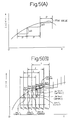
- FIG. 5 (A) is a drawing which shows a curve of measurement data and the relationship of the sampling interval p to the amount of change
- FIG. 5 (B) is a drawing which shows the relationship of the measurement data sampling period t and the measurement data amount of change reading sampling time (ts) for the present invention.
- FIG. 6 (A) is a drawing which describes one example of analysis of the voltage measurement data and condition of change thereof in the present invention
- FIG. 6 (B) is a drawing which describes one example of analysis of the temperature measurement data and condition of change thereof in the present invention
- FIG. 7 is a flowchart which shows one example of the procedure in the case of executing the secondary battery charging method of the present invention.
- FIG. 8 is a flowchart which shows one example of the procedure in the case of executing the secondary battery charging method of the present invention.
- FIG. 9 is a flowchart which shows one example of the procedure in the case of executing the secondary battery charging method of the present invention.
- FIG. 10 is a flowchart which shows another example of the procedure in the case of executing the secondary battery charging method of the present invention.
- FIG. 11 is a flowchart which shows one example of the procedure in the case of executing the secondary battery charging method of the present invention.
- FIG. 12 is a graph showing one example of the voltage characteristics of a nickel-cadmium battery when charged at 0.25C.
- FIG. 13 is a graph showing the a graph of the changes in the overall voltage amount of change ⁇ TDvn and the counter value N when the charging of FIG. 12 is done.
- FIG. 14 is a graph showing one example of the temperature characteristics of a nickel-cadmium battery when charged at 3C.
- FIG. 15 is a graph showing one example of the voltage characteristics of a nickel-cadmium battery when charged at 3C.
- FIG. 16 is a graph showing the a graph of the changes in the overall voltage amount of change ⁇ TDvn and the counter value N when the charging of FIG. 15 is done.
- FIG. 17 is a graph showing one example of the voltage characteristics of a nickel-hydrogen battery when charged at 0.25C.
- FIG. 18 is a graph showing the a graph of the changes in the overall voltage amount of change ⁇ TDvn and the counter value N when the charging of FIG. 17 is done.
- FIG. 19 is a graph showing one example of the voltage characteristics of a nickel-hydrogen battery when charged at 1C.
- FIG. 20 is a graph showing the a graph of the changes in the overall voltage amount of change ⁇ TDvn and the counter value N when the charging of FIG. 19 is done.
- the inventors then, analyzed, the nickel-cadmium batteries, nickel-hydrogen batteries, and lithium ion batteries, which were thought to be the important types of those types commercially available in the past, the result of this analysis being that in general for nickel-cadmium batteries, as shown in FIG. 2, the terminal voltage during charging continues a gradual increase up to the point at which 100% charge level is reached, at which point a peak voltage is reached, with further charging causing a decrease in voltage.
- the battery terminal voltage continues its gradual increase from the start of the charge until the 100% charge level, and when the charge level reaches 100% the voltage value exhibits the peak value, after which subsequent charging results in no further change the battery voltage, which maintains the peak value.
- the temperature of a nickel-hydrogen battery gradually increase from the start of charging to just before the 100% charge level, and although the overall characteristics is virtually flat with no extremely temperature increase, except when the 100% charge level region is approached, when there is a sudden increase in temperature.
- lithium ion batteries As shown in FIG. 4, the battery terminal voltage increasing approximately in direct proportion to elapsed time, from the start of charging to the 100% charge level, and when the 100% charge level is reached, the voltage value exhibits the peak value, after which subsequent charging results in no further change in the battery voltage, which maintains the peak value.
- the battery temperature in the case of a lithium ion secondary battery exhibits a gradual increase from the start of charging, which, during the charging process, changes to a gradual increase, until the 100% charge level is reached, at which point the battery temperature increases sharply as the same configuration as that of the nickel-cadmium battery.
- the energy of the current caused to flow in the battery until the 100% charge level is reached is spent in the chemical reaction required for charging, and is not converted to thermal energy.
- a method and an apparatus for high-speed charging of secondary batteries which makes possible the reliable stopping of charging of any type of secondary battery at a point in the charge level of 95% to 100%, charging at current levels ranging from small to large (for example, equal to or greater than the capacity of the battery), and in particular, high-speed charging, for example at a charge rate of 2C in an extremely short period of time, for example 15 minutes or less.
- FIG. 1 shows a block diagram of one concrete example of the configuration of the high-speed charging apparatus for secondary batteries of the present invention, which basically shows an apparatus for high-speed charging of secondary batteries 1, comprising, a current-supplying means 3 which supplies electrical current to the cells of a secondary battery 2 requiring charging, a switch means 5 provided between said current-supplying means 3 and terminal 4 of said secondary battery being charged, a temperature measurement means 6 which measures the temperature of said cells of said secondary battery 2, a voltage measurement means 7 which measures the terminal voltage of said secondary battery, a sampling means 8 which operates said temperature-measurement means 6 and/or said voltage measurement means 7 to measure the temperature and/or the voltage of said cells of said secondary battery 2 with the desired sampling interval, a storage device 30 which stores each of the data sampled by said sampling means 8, and which executes the required calculations on said stored data, storing the results in a separate memory means, a charging-control means 9 which is connected to said sampling means and controls said switch means 5, a charging rate setting means 10 which sets the charging rate C, a basic data reading timing
- one and the same high-speed secondary battery charging apparatus is capable of performing high-speed charging of, as described above, nickel-cadmium batteries, a nickel-hydrogen batteries, or a lithium ion batteries.
- One of the characteristics of the present invention is that, for the purpose of performing precise, high-speed charging of any secondary battery, a comprehensive study of the characteristics of said secondary batteries was made, and the configuration was made so as to enable accurate and quick detection of changes in characteristics values of said secondary batteries, enabling not only reliable detection of the point at which said secondary batteries reach a condition in which they are as close as can be to the 100% charge level, but also stopping of the charging process at that point, and to enable this performance, the present invention is configured to perform measurement of voltage data and/or temperature data of said secondary batteries at an extremely short interval, the results of these measurements being used to effectively determine the charging condition of said secondary batteries.
- the overall said amount of change reading sampling time t and said data amount of change reading sampling time ts are each shifted by one at a time, as the amount of temperature data and/or voltage data change ⁇ TD1 to ⁇ TDm for respective overall amount of change reading sampling times tl to tm is determined.
- the present invention by properly selecting the values of the above-stated constants M and L, it is possible, with a low-cost reading apparatus, not only to read measurement data with high accuracy, but also, because the range obtained by shifting said overall amount of change reading sampling time (ts) is shifted one at a time is set, so that said voltage data and/or temperature data amount of change ⁇ TD is obtained at an interval which is said amount of change reading sampling time (ts), it is possible to obtain the large amount of change data ⁇ TD which is sampled at the relatively long interval of the overall amount of change reading sampling time t, within the relative short time which is the amount of data change sampling time (ts), it is possible to determine at a short sampling interval whether or not to stop charging, resulting in a detailed and precise charging operation.
- the configuration is made such that, according to the the speed of charging, or what is normally called the charging rate, so that high or low charging speeds can be employed to obtain the optimum charging operation.
- the apparatus for high-speed charging of secondary batteries 1 of the present invention is provided with a switch means 5 which is connected between the terminal 4 of the secondary battery being charged and the current-supplying means 3 for the purpose of supplying charging current to a secondary battery 2 requiring charging, said switch means 5 being controlled by said charging-control means 9, so that the current from said current-supplying means 3 is on and off controlled.
- said switch means 5 In performing charging of said secondary battery 2, said switch means 5 is turned on, so that current flows from said current-supplying means 3 to said secondary battery 2 of said secondary battery, and when the charge level of said secondary battery reaches 100% or when, as described later, a condition is detected which indicates that said secondary battery is approaching the 100% charge level, said switch means 5 is switched off, and the current from said current-supplying means 3 to said secondary battery 2 is cut off.
- the reason for this is that, in the present invention, in measuring the above-stated voltage and/or temperature, if a measurement is made with the charging current flowing from said current-supplying means 3 to said secondary battery 2, because there will not be a uniform reaction occurring within the battery, the voltage value will include an error, making the acquisition of accurate measurement data impossible.
- a microcomputer is used to measure a large amount of terminal voltage and battery surface temperature voltage for the secondary battery in an extremely short period of time, and to analyze the results of these measurements, making judgments as to whether or not the secondary battery has reached a charge level of 100% or the region near 100% as it tracks the minute variations of secondary battery characteristic values.
- the configuration is such that even if the charging rate C, which is a charging condition, is varied, it is possible to complete precise charging in a short period of time.
- a charging rate setting means 10 for the purpose of adjusting the speed of charging, that is the charging rate C, to the characteristics charging rate of the secondary battery to be charged.
- a basic data reading timing generator means 11 which sets the basic data reading time tb, the basic data reading time tb generated by said basic data reading timing generator means 11 being adjusted by corrected data reading time setting means 12, based on the charging rate C set by said charging rate setting means 10, so that the adjusted data reading time ta is characteristic to the charge rate C of said secondary battery.
- the above constant A can be set as appropriate, for example, as a positive integer such as 16.
- the difference between the amount of change D1 at the 1st sampling time (ts1), which was stored in the 2nd memory means 16 and the amount of change D2 at the next, 2nd, sampling time (ts2), which was stored in said 2nd memory means 16 is determined by calculation, the results being the differences in amount of change ⁇ D, which are stored in 3rd memory means 17.
- the difference between the voltage amount of change ⁇ TDv1 measured from over the said overall amount of change reading sampling time established as running from said 1st sampling time (ts1) to the sampling time (tsM) for the M-th sampling, and the voltage amount of change ⁇ TDv2 measured from over the overall amount of change reading sampling time established as running from said 2nd sampling time (ts2) to the sampling time (tsM+1) for the M+1-th sampling is determined by calculation, said calculated difference ⁇ Hv being stored in a 5th memory means.
- said 1st judgment means 22 if said change ratio ⁇ Ht between amounts of temperature change differences exceeds a preestablished reference value K, the judgment will be made that said secondary battery has reached 100% charge level or the 100% charge level region, and a signal will be output for the purpose of stopping said charging operation, the result being that said charging-control means 9 is operated to turn said switch means 5 off, thereby stopping the charging operation of said secondary battery.
- the present invention although the method of measuring the terminal voltage of said secondary battery during charging and stopping the charging operation if the judgment is made that the charge level has reached 100% or the 100% region, and the method of measuring the temperature of said secondary battery during charging and stopping the charging operation if the judgment is made that the charge level has reached 100% or the 100% region were described separately, in the present invention it is possible to combine these two methods, thereby enabling a more accurate determination of the charge level.
- the basic method is when measuring voltage data, to measure the voltage data measured at each amount of change reading sampling time (ts), repeating this M times, thereby accumulating the overall data value during the overall sampling period t (ts ⁇ M), using the results to observe the change of said voltage data, in the charging of a secondary battery, when the charge level of said secondary battery is 100% or is in the 100% region, the change in temperature becomes very gradual, so that if the sampling period is made long, it is possible to, for example, detect the peak value on the temperature variation graph, or to accurately and quickly detect such conditions as a dropoff from the peak value, or in addition, the condition in which there is no change from the peak value over a given period of time.
- FIG. 7 through FIG. 9 are flowcharts that explain the operation of one specific example of the high-speed charging method for secondary batteries of the present invention.
- step (1) the basic data reading time tb required to read data is set, operation proceeding to step (2), at which the charging rate C which is a rated value suitable for executing charging with respect to said secondary battery.
- step (3) at which the adjusted data reading time ta, which is characteristic to the set charging rate C is set in accordance with the set charging rate C and said basic data reading time tb.
- step (4) since in the case in which the measured voltage value amount of change is either zero or negative a preestablished number of times, for example P, in a row, the judgment is made that said secondary battery being charged has reached the 100% charge level or the region of 100% charge level, and said charging operation is stopped, if this occurs, at this step the preestablished value of P is set into the counter I, which counts down.
- step (5) in order to repeat the sampling operation every adjusted data reading time ta, which value is characteristics to the charging rate C, for example L times, said preestablished number of times L is set into counter II, which controls said number of repetitions.
- step (6) at which the time data corresponding to the adjusted data reading time ta, which is characteristics to the charging rate and which is set at step (3), is set into counter II.
- step (7) when measuring the voltage and temperature data of the secondary battery being charged, for the reason described previously, the supply of current to charging said secondary battery is cut off at the instant of the data measurement.
- the charging current at the time of these data measurements is cut off by turning the switch means 5 which comprises the transistor in FIG. 1 to off.
- step (8) the terminal voltage (dv) of said secondary battery being charged is measured, and at step (9), the results are stored into 1st memory means 15, that is, in memory I.
- step (10) the surface temperature (dt) of said secondary battery being charged is measured, and at step (13), the results are stored into the same 1st memory means 15, that is, into memory I.
- step (12) at which the supply of charging current is starting once again to restart the charging operation, after which at step (13) a judgment is made as to whether or not either the voltage value or the temperature value just measured exceeds the preestablished data limit value, and if said measured data does exceed said limit value, the judgment is made that an abnormal condition has occurred in the secondary battery being charged, and said charging operation is stopped.
- step (14) at which the set value of counter III is decremented by 1, and operation proceeds to step (15), at which a judgment is made as to whether or not the value of said counter III is zero, and if it is not zero, a wait is made until the value of counter III is zero, that is, until the corrected data reading time tc has elapsed, and after a verification is made that the value of said counter III is zero, operation proceeds to step (16), at which the values of voltage data dv and temperature data dt obtained from the measurement just made are added to the respective values of voltage data dv and temperature data dt obtained at the immediately previous measurement, the results being cumulatively stored separately into said 1st memory means 15.
- step (17) operation proceeds to step (17), at which 1 is subtracted from the setting value L of counter II, and operation proceeds to step (18), where a judgment is made as to whether or not the setting value L of said counter II is zero.
- step (18) if the setting value L of said counter II is not zero, it means that the required number of measurements has not yet been reached, so that return is made to step (6), at which the above-mentioned steps are repeated.
- step (18) If, however, at step (18), the setting value L of said counter II is zero, this means that the required number of measurements has been reached, so that operation proceeds to step (19), at which a calculation is performed to determine the sums, Dvn and Dtn, of the voltage and temperature data values that had been stored into 1st memory means 15 L times each corrected data reading time tc, these results being stored separately into 2nd memory means 16 (memory II).
- step (20) using the data that had been stored into said 2nd memory means 16, the differences between the values Dv(n-1) and Dt(n-1) stored into memory II the immediately previous measurement and the values Dvn and Dtn of the current measurement, that is, the amounts of change between the data measured at the current measurement data amount of change reading sampling time (ts) and the data measured at the immediately previous measurement data amount of change reading sampling time (ts-1) are calculated, at the step (21) the resulting ⁇ Dv and ⁇ Dt are stored separately into said 3rd memory means 17 (memory III).
- step (22) using the data ⁇ Dv and ⁇ Dt which had been individually cumulatively stored into 3rd memory means 17, said amount of change data ⁇ Dv and ⁇ Dt obtained at the current measurement data amount of change reading time (ts1) are added respectively to the amounts of change data obtained at the immediately previous measurement data amount of change reading time (ts0), the results of ⁇ TDv and ⁇ TDt being stored separately into 4th memory means 18 (memory IV).
- said measurement data amount of change reading sampling time (ts) is set a number of times, for example M times, and the accumulated sum of the amount of change data values obtained at each of the sampling times (tsn) is calculated.
- step (23) a judgment is made as to whether or not the total number of data stored in said 4th memory means 18 (memory IV) is a preestablished number, for example M, and if the result of this judgment is NO, the judgment is made that the measurement data amount of change reading sampling time (ts) has not been repeated the preestablished number of times M, and return is made to step (5), after which step the above steps are repeated.
- step (26) a judgment is made as to whether or not measurement data is voltage data, and if the result is NO, operation proceeds to step (27), at which, as shown in FIG. 6B, a judgment is made as to whether or not said overall amount of change, ⁇ Ht, of said measurement data is larger than a preestablished value, for example the value K, and if the result is YES, operation proceeds to step (28).
- the overall sum of said temperature data amounts of change ⁇ TDtn over the M times of measurement data amount of change reading sampling time (ts1) to (tsM) is shift one said measurement data amount of change reading sampling time (ts) at a time, and if the change ratio with respect to the overall sum said temperature data amounts of change ⁇ TDt(n+1) over the M times of measurement data amount of change reading sampling time (ts2) to (tsM+1) is large, indicating that the rate of rise of said temperature measurement data has increased over a short period of time, the judgment is made that said secondary battery being charged has reached the 100% charge level or the region of the 100% charge level, and the charging operation is stopped at this point.
- the preestablished value K can be set as desired, and in the present invention, it is set as a value of, for example, 2 or greater.
- step (27) If at step (27) the judgments result is NO, operation proceeds to step (29), at which, for the purpose of determining the overall amount temperature measurement data amount of change, ⁇ TDt(n+2) for the M temperature data over the measurement data amount of change reading sampling time (ts3) to (tsM+2) by shifting said measurement data amount of change reading sampling time (ts) one at a time, after first deleting the first of the M temperature measurement data currently stored in memory V, return is made to step (23), after which the above operations are repeated.
- step (28) if the result was YES, the operation proceeds to step (30), at which a judgment is made as to whether the change in said overall voltage data amount of change, that is ⁇ Hv, is zero or negative less than zero, and if the result was YES, operation proceeds to step (31), at which the setting value P of counter I is decremented by 1, and then to step (32), at which a judgment is made as to whether the setting value P of said counter is P, and if the result is YES, operation proceeds to step (28), at which the charging operation is stopped.
- step (32) return is made to step (7), after which the above operations are repeated.
- any secondary battery to detect the condition in which the charge level has reached 100% or the 100% region, a judgment is made as to whether the overall change in the amount of change, that is, the difference amount ⁇ Hv is zero or negative, and further a determination of whether the difference value ⁇ Hv has been zero or negative for P times in a row, and if so, the judgment is made that said secondary battery has reached the charge level of 100% or the region of charge level 100%, and the charging operation is then stopped.
- the setting value P of said counter I can be established arbitrarily as desired, for example it can be set to a P value of 3.
- step (30) if the result was NO, in step (33) the setting value of counter I is reset to P, and operation returns to step (4), and thereafter each of the above-stated steps is repeated.
- said count I is set to an initial value of P, and counts down sequentially, in accordance with the result of measurements, so that when the setting value P is 0 the judgment is made that the charge level of the secondary battery is 100%, it is also possible to reverse this, by setting said counter I to an initial value of 0 and having said counter count up sequentially according to the results of measurements, and when the setting value of said counter I reached a preestablished value of P, to make the judgment that the charge level of the secondary battery is 100%.
- the high-speed charging method for secondary batteries of the present invention it is sufficient to at least measure the terminal voltage data of said secondary battery, so that the amount of change in the terminal voltage data are detected, and it is also possible to measure the surface temperature data of said secondary battery, so that the change ratio in the surface temperature is detected.
- the basic data reading time tb required for reading data is set to 0.75 second
- counter II value L is set to 4
- the charge rate C at which said secondary battery is to be charged is set to 4
- constant A is set to 16.
- step (23) if the number of repetitions M is set to 8, said measurement data amount of change reading sampling time (ts) will be 12 seconds, and the time required for 8 repetitions of the measurement data amount of change reading sampling time (ts) will be 96 seconds.
- the measurement of either voltage or temperature will require a considerable amount time, and in such cases it is also possible, instead of repeating the above-stated measurement data amount of change reading sampling time (ts) M times, to use individual values of the amount of change ⁇ Dv and ⁇ Dt to judge the charge level.
- FIG. 10 and FIG. 11 are basically the same as the flowcharts of FIG. 7 through FIG. 9 which show a high-speed charging method for secondary batteries of the present invention, there are slight differences in the method of calculation and judging performed at individual steps.
- said voltage data is totaled within the measurement data amount of change reading sampling time (ts), so that in the case of the charge level of said secondary battery approaching 100%, because the voltage exhibits particularly small changes in a short period of time, it is desirable to constantly track the changes to detect such a condition, and in the present invention the configuration is made such that, for each measurement data amount of change reading sampling time (ts), detection is performed of how said voltage data is varying, so that if said voltage data variation exhibits a particular condition, as shown in steps (24) through (32) in said FIGs. 8 and 9 after repeating the voltage measurement data at least 8 times at the measurement data amount of change reading sampling time (ts), the charging operation can be stopped before judging the charging condition.
- FIG. 10 and FIG. 11 show the flowcharts of the operations performed in practicing the other specific example of the present invention, wherein because step (7) through step (20) are the same as in the flowchart of FIGs. 7 and 8, these steps are omitted from FIG. 10, with the flowchart beginning with the step corresponding to step (20) of FIG. 8.
- step (124) it is desirable to detect the width of variation occurring over a short period of time, and for that reason, at step (124), said difference ⁇ Dv is judged as being either a non-zero positive value or not, and if the result is YES, operation proceeds to step (126) at which AS is reset to zero.
- step (124) a NO result occurs at step (124), that is, if the voltage data is either decreasing or constant, operation proceeds instead to step (125), at which the current said difference value ⁇ Dv is added to immediately previous value of constant ⁇ S and the value preestablished constant value X is subtracted from this, the result being taken as the new value of constant ⁇ S.
- step (127) a judgment is made as to whether said constant ⁇ S is equal to or less than a preestablished value of w, and if the result is YES, since it is possible to assume that the charge level of the secondary battery is at 100% or in the region of 100%, operation proceeds to step (135), at which the charging operation is stopped.
- said value w is set to, for example, 6, and if said constant Z is 2 and said difference value ⁇ Dv is zero 3 times consecutively, that is, if there is no change, the following sequence will occur.
- the value L of counter II is set as 4
- the charging rate C at which the secondary battery is to be charged is set to 4
- said constant A is set to 16.
- the charging operation with respect to the secondary battery would be stopped at the measurement at the third measurement data amount of change reading sampling time (ts), the time required for this to occur being merely 48 milliseconds.
- step (130) If, however, said difference value ⁇ Hv is zero, the value of said counter is not changed, and if said difference value ⁇ Hv is negative, operation proceeds to step (130), at which the value N of said counter is incremented by 1, after which operation proceeds to step (132).
- step (124) through step (127) if ⁇ Dv is zero, it is assumed that the negative condition exists, even at said step (129), even if said voltage measurement data is maintaining a peak value, the condition in which the difference value ⁇ Hv is zero will not occur, so that this will be counted as a negative value.
- step (134) in the case in which both the above-noted amounts of total temperature change are equal to or greater than the preestablished value ⁇ , operation proceeds to step (134), at which a judgment is made as to whether the rate of change ⁇ Ht between the current amount of measurement data change, that is, the overall amount of change ⁇ TDn, which is based on the M measurement data at said measurement data amount of change reading sampling time (ts1) to (tsM), and the immediately previous amount of measurement data change, that is, the overall amount of change ⁇ TDtn-1, which is based on the M measurement data at said measurement data amount of change reading sampling time (ts0) to (tsM-1), is or is not greater than a preestablished value, for example K, and if the result of this judgment is YES, the charging operation is stopped.
- a preestablished value for example K
- Table I shows the case of using the secondary battery charging method of the present invention suitable for nickel-cadmium batteries having a charging rate of 0.25C, and wherein the settings:
- Table I shows the voltage measurement data at each measurement data amount of change reading sampling time (ts), the total amount of voltage change ⁇ TDv at step (122) of FIG. 10, and the counter value N at step (130) and step (131) of FIG. 10.
- the battery voltage data is the raw data obtained at each said measurement data amount of change reading sampling time (ts), and the overall total amount of change ⁇ TDv indicates the difference value between the total of the shift values summed over 8 times at each of the measurement data amount of change reading sampling times (ts1) to (ts8) and total of the shift values summed over 8 times at each of the measurement data amount of change reading sampling times (ts2) to (ts9).
- the count value N in accordance with above-stated step (129) through step (131) in FIG. 10, is added to or subtracted from, depending upon whether said difference value ⁇ Hv is positive, negative, or zero.
- said count value is set to 3, so that the charging operation is stopped when said count value exceeds 3, so that although in this specific example the charging operation is stopped at ts11, since the battery voltage of said secondary battery which has reached 100% charge level is known beforehand, it is possible to perform processing so that, as long as that voltage is not exceeded, the data value of said counter is not valid.
- FIG. 12 shows a graph of the measurement data of Table I, with ts plotted along the horizontal axis, and in FIG. 13, plotted from the raw data of FIG. 12, the solid line shows the plot of said total amount of change ⁇ TDv for each ts, and the dotted line shows said counter value N plotted for each ts.
- Table II shows the case of using the secondary battery charging method of the present invention suitable for nickel-cadmium batteries having a charging rate of 3C, and wherein the settings:
- Table II shows the battery temperature measurement data at each measurement data amount of change reading sampling time (ts), the total amount of temperature change ⁇ TDt at step (123) of FIG. 10, and the change ratio ⁇ Ht of the amount of temperature change at step (134) of FIG. 10.
- the temperature data is the raw data obtained at each said measurement data amount of change reading sampling time (ts)
- the overall total amount of temperature change ⁇ TDt indicates the difference value between the total of the shift values summed over 8 times at each of the measurement data amount of change reading sampling times (ts1) to (ts8) and total of the shift values summed over 8 times at each of the measurement data amount of change reading sampling times (ts2) to (ts9)
- Fig. 14 is a graph of with regard to battery temperature measurement data shown in Table II, with ts plotted along the horizontal axis.
- Table III shows the case of using the secondary battery charging method of the present invention suitable for nickel-cadmium batteries having a charging rate of 3C, and wherein the settings:
- Table III shows the battery voltage data at each measurement data amount of change reading sampling time (ts), the total amount of voltage change ⁇ TDv at step (122) of FIG. 10, and the counter value N at step (130) and step (131) of FIG. 10.
- the battery voltage data and other data of Table III are the same type of data as in above Table I, and therefore no particular separate explanation will be provided, although it can be said that this indicates that the same type of operations as in the case of Table I enable charging in a short period of time with a large current, and in particular that, at 3C, at the point of ts61, because charging is completed, the charge is seen to have been completed at a time approximately 16 minutes from the start of charging operation.
- FIG. 15 and FIG. 16 are graphs that correspond to above-discussed FIG. 12 and FIG. 13.
- Table IV shows the case of using the secondary battery charging method of the present invention suitable for nickel-hydrogen batteries having a charging rate of 0.25C, and wherein the settings:
- Table IV shows the battery voltage data at each measurement data amount of change reading sampling time (ts), the total amount of voltage change ⁇ TDv at step (122) of FIG. 10, and the counter value N at step (130) and step (131) of FIG. 10.
- the battery voltage data and other data of Table IV are the same type of data as in above Table I, and therefore no particular separate explanation will be provided, although it can be said that this indicates that the same type of operations as in the case of Table I enable complete charging of a new type of secondary battery, the nickel-hydrogen battery, at ts79, which is in a period of time of 252 minutes.
- FIG. 17 and FIG. 18 are the graphs that correspond to above-discussed FIG. 12 and FIG. 13.
- Table V shows the case of using the secondary battery charging method of the present invention suitable for nickel-hydrogen batteries having a charging rate of 1C, and wherein the settings:
- Table V shows the battery voltage data at each measurement data amount of change reading sampling time (ts), the total amount of voltage change ⁇ TDv at step (122) of FIG. 10, and the counter value N at step (130) and step (131) of FIG. 10.
- the battery voltage data and other data of Table V are the same type of data as in above Table I, and therefore no particular separate explanation will be provided, although it can be said that this indicates that the same type of operations as in the case of Table I enable complete charging of a new type of secondary battery, the nickel-hydrogen battery, at ts78, which is in a period of time of 62 minutes, 24 seconds.
- FIG. 19 and FIG. 20 are the graphs that correspond to above-discussed FIG. 12 and FIG. 13.
- the high-speed charging method for secondary batteries of the present invention makes use of the above-described technical configuration, even for secondary batteries of differing types, in consideration of the mutually differing charging characteristics exhibited by the secondary batteries, such as terminal voltage or temperature, it is possible to determine the common characteristics of secondary batteries having differing constituent elements, to accurate determine point at which the charge level reaches nearly 100%, enabling not only one and the same apparatus to be used to reliably charge secondary batteries of differing construction, but also enabling the accurate determination of the charge level during the charging process, the quick determination of the point at which the charge level reaches a level of nearly 100%, and the stopping of the charging process at that point, the result being not only a reliable avoidance of the problem encountered when the charging is continued even after the charge level has exceeded 100%, thereby causing the temperature of the secondary battery to rise above its rated maximum temperature, leading to damage to said secondary battery, but also a determination of the characteristics of said secondary battery with respect to the speed of charge, or charge rate, thereby enabling charging of secondary batteries which are of the same constituent elements at different
Landscapes
- Engineering & Computer Science (AREA)
- Power Engineering (AREA)
- Manufacturing & Machinery (AREA)
- Chemical & Material Sciences (AREA)
- Chemical Kinetics & Catalysis (AREA)
- Electrochemistry (AREA)
- General Chemical & Material Sciences (AREA)
- Charge And Discharge Circuits For Batteries Or The Like (AREA)
- Secondary Cells (AREA)
Claims (10)
- Procédé de charge d'une batterie secondaire comprenant :une étape 1 qui définit un moment de lecture de base des données tb nécessaire pour lire les données ;une étape 2 qui définit le taux de charge C ;une étape 3 qui définit un moment de lecture ajusté des données ta en fonction du taux de charge C défini et dudit moment de lecture de base des données tb, ledit moment de lecture ajusté des données ta étant caractéristique dudit taux de charge C ;une étape 4 qui, pendant l'opération de charge, utilise un moyen d'échantillonnage approprié pour mesurer la tension aux bornes de ladite batterie secondaire au moins une fois pendant chaque dit moment de lecture ajusté des données ta, et qui stocke la valeur des données de tension mesurée à ce moment dans un 1er moyen de mémorisation approprié ;une étape 5 qui répète l'opération de ladite étape 4 un nombre prédéterminé de fois L, effectue la somme desdites valeurs des données de tension stockées obtenues pendant chaque dit moment de lecture ajusté des données ta pendant une période d'échantillonnage ts, où ts = L x ta, et stocke la valeur Dvn de la somme dans un 2ème moyen de mémorisation approprié ;une étape 6 qui calcule la différence ΔDv entre la valeur Dv1 de la somme pendant la 1ère période d'échantillonnage (ts1) et la valeur Dv2 de la somme pendant la suivante, 2ème, période d'échantillonnage (ts2) obtenue dans l'étape 5, et qui stocke ladite différence ΔDv dans un 3ème moyen de mémorisation ;une étape 7 qui répète continuellement ladite étape 6 un nombre de fois prédéterminé M, et réalise une somme supplémentaire des valeurs comprises entre ΔDv1 et ΔDvM (M valeurs) obtenues pendant lesdites périodes d'échantillonnage respectives (ts1 à tsM) afin de déterminer le niveau de variation des données de tension ΔTDv pendant une dite période d'échantillonnage globale t, où t = ts x M, les résultats étant stockés dans un 4ème moyen de mémorisation ;une étape 8 qui effectue un calcul, basé sur le niveau de variation des données de tension ΔTDv stocké dans ledit 4ème moyen de mémorisation, afin de déterminer la différence ΔHv entre le niveau de variation des données de tension ΔTDv1 déterminé pendant une dite première période d'échantillonnage globale (t1) qui s'étend de ladite 1ère période d'échantillonnage (ts1) à la Mième période d'échantillonnage (tsM) pendant le Mième échantillonnage prédéterminé, et le niveau de variation des données de tension ΔTDv2 déterminé pendant unedite deuxième période d'échantillonnage globale qui s'étend de ladite 2ème période d'échantillonnage (ts2) à la (M+1)ième période d'échantillonnage (tsM+1) pendant le M+1-ième échantillonnage prédéterminé, ladite différence calculée ΔHv, où ΔHv = ΔTDv2 - ΔTDv1, étant stockée dans un 5ème moyen de mémorisation ;une étape 9 qui répète ladite étape 8 tout en calculant la valeur de la différence ΔHvn, où ΔHvn = ΔTDv(n+1) - ΔTDvn, entre le niveau des variations de tension ΔTDvn et ΔTDv(n+1) déterminé pour chaque paire de dites périodes d'échantillonnage globales voisines tn et tn+1, et stocke les résultats calculés dans un 5ème moyen de mémorisation ;une étape 10 qui évalue si chacune desdites valeurs différentielles ΔHv1 à ΔHVm sont positives, c'est-à-dire égales ou supérieures à zéro, ou négatives, c'est-à-dire inférieures à zéro ; etune étape 11 qui évalue, dans l'ordre d'apparition desdites valeurs différentielles ΔHv1 à ΔHvm, si ladite valeur différentielle ΔHv est ou non égale à zéro ou négative pendant S fois consécutives, et si ladite valeur différentielle ΔHv est égale à zéro ou négative S fois consécutives, stoppe ladite charge.
- Procédé de charge d'une batterie secondaire comprenant :une étape 1 qui définit un moment de lecture de base des données tb nécessaire pour lire les données ;une étape 2 qui définit le taux de charge C ;une étape 3 qui définit un moment de lecture ajusté des données ta en fonction du taux de charge C défini et dudit moment de lecture de base des données tb, ledit moment de lecture ajusté des données ta étant caractéristique dudit taux de charge C ;une étape 4 qui, pendant l'opération de charge, utilise un moyen d'échantillonnage approprié pour mesurer la température de ladite batterie secondaire au moins une fois pendant chaque dit moment de lecture ajusté des données ta, et qui stocke la valeur des données de température mesurée à ce moment dans un 1er moyen de mémorisation approprié ;une étape 5 qui répète l'opération de ladite étape 4 un nombre prédéterminé de fois L, effectue la somme desdites valeurs des données de température stockées obtenues pendant chaque dit moment de lecture ajusté des données ta pendant une période d'échantillonnage ts, où ts = L x ta, et stocke la valeur Dtn de la somme dans un 2ème moyen de mémorisation approprié ;une étape 6 qui calcule la différence ΔDt entre la valeur Dt1 de la somme pendant la 1ère période d'échantillonnage (ts1) et la valeur Dt2 de la somme pendant la suivante, 2ème, période d'échantillonnage (ts2) obtenue dans l'étape 5, et qui stocke ladite différence ΔDt dans un 3ème moyen de mémorisation ;une étape 7 qui répète continuellement ladite étape 6 un nombre de fois prédéterminé M, et réalise une somme supplémentaire des valeurs comprises entre ΔDt1 et ΔDtM (M valeurs) obtenues pendant lesdites périodes d'échantillonnage respectives (ts1 à tsM) afin de déterminer le niveau de variation des données de température ΔTDt pendant une dite période d'échantillonnage globale t, où t = ts x M, les résultats étant stockés dans un 4ème moyen de mémorisation ;une étape 8 qui effectue un calcul, basé sur les valeurs du niveau de variation des données de température ΔTDt stocké dans ledit 4ème moyen de mémorisation, afin de déterminer le rapport ΔHt entre le niveau de variation des données de température ΔTDt1 déterminé pendant une dite première période d'échantillonnage globale t1 qui s'étend de ladite 1ère période d'échantillonnage (ts1) à la Mième période d'échantillonnage (tsM) pendant le M-ième échantillonnage prédéterminé, et le niveau de variation des données de température ΔTDt2 déterminé pendant unedite deuxième période d'échantillonnage globale t2 qui s'étend de ladite 2ème période d'échantillonnage (ts2) à la (M+1)ième période d'échantillonnage (tsM+1) pendant le M+1-ième échantillonnage prédéterminé, ledit rapport calculé ΔHt, où ΔHt = ΔTDt2/ΔTDt1, étant stocké dans un 5ème moyen de mémorisation ;une étape 9 qui répète les opérations de ladite étape 8 tout en calculant la valeur du rapport ΔHtn, où ΔHtn = ΔTDt(n+1)/ΔTDtn, entre le niveau des variations de température ΔTDtn et ΔTDt(n+1) déterminé pour chaque paire de dites périodes d'échantillonnage globales voisines tn et tn+1, et stocke les résultats calculés dans un 5ème moyen de mémorisation ;une étape 10 qui évalue à partir des informations stockées dans ledit 5ème moyen de mémorisation si le rapport ΔHt entre deux dites variations de température voisines est égal ou supérieur ou inférieur à une valeur donnée K ; etune étape 11 qui, si le rapport ΔHm est égal ou supérieur à la valeur donnée K, stoppe ladite charge.
- Procédé de charge d'une batterie secondaire comprenant :une étape 1 qui définit un moment de lecture de base des données tb nécessaire pour lire les données ;une étape 2 qui définit le taux de charge C ;une étape 3 qui définit un moment de lecture ajusté des données ta en fonction du taux de charge C défini et dudit moment de lecture de base des données tb, ledit moment de lecture ajusté des données ta étant caractéristique dudit taux de charge C ;une étape 4 qui, pendant l'opération de charge, utilise des moyens d'échantillonnage appropriés pour mesurer respectivement la température et la tension aux bornes de ladite batterie secondaire au moins une fois pendant chaque dit moment de lecture ajusté des données ta, et qui stocke respectivement la valeur des données de température mesurée et la valeur des données de tension mesurée aux bornes à ce moment dans un 1er moyen de mémorisation approprié ;une étape 5 qui répète l'opération de ladite étape 4 un nombre prédéterminé de fois L, effectue les sommes respectives desdites valeurs des données de température de la batterie stockées et desdites valeurs des données de tension stockées obtenues pendant chaque dit moment de lecture ajusté des données ta pendant une période d'échantillonnage ts, où ts = L x ta, et stocke les valeurs respectives Dtn et Dvn des sommes dans un 2ème moyen de mémorisation approprié ;une étape 6 qui calcule les différences ΔDv, ΔDt entre les valeurs Dv1, Dt1 des sommes respectives pendant la 1ère, période d'échantillonnage (ts1) et les valeurs Dv2, Dt2 des sommes respectives pendant la suivante, 2ème, période d'échantillonnage (ts2) obtenue dans l'étape 5, et qui stocke les différences obtenues ΔDv, ΔDt des données de température et des données de tension aux bornes dans un 3ème moyen de mémorisation ;une étape 7 qui répète continuellement l'étape 6 un nombre de fois prédéterminé M, et réalise des sommes respectives supplémentaires des valeurs comprises entre ΔDv1 et ΔDvM, M valeurs, et entre ΔDt1 et ΔDtM, M valeurs, obtenues pendant lesdites périodes d'échantillonnage respectives (ts1 à tsM) afin de déterminer le niveau de variation des données de température et le niveau de variation des données de tension aux bornes, respectivement ΔTDt et ΔTDv, pendant une période d'échantillonnage globale t, où t = ts x M, les résultats étant stockés dans un 4ème moyen de mémorisation ;une étape 8 qui effectue un calcul, basé sur le niveau de variation des données de tension ΔTDv stocké dans ledit 4ème moyen de mémorisation, afin de déterminer la différence ΔHv entre le niveau de variation des données de tension ΔTDv1 déterminé pendant une dite première période d'échantillonnage globale tl qui s'étend de ladite 1ère période d'échantillonnage (ts1) à ladite Mième période d'échantillonnage (tsM) pendant le M-thième échantillonnage prédéterminé, et le niveau de variation des données de tension ΔTDv2 déterminé pendant unedite deuxième période d'échantillonnage globale t2 qui s'étend de ladite 2ème période d'échantillonnage (ts2) à la période d'échantillonnage (tsM+1) pendant le M+1-ième échantillonnage prédéterminé, ladite différence calculée ΔHv, où ΔHv = ΔTDv2 - ΔTDv1, étant stockée dans un 6ème moyen de mémorisation ;une étape 9 qui répète l'étape 8 tout en calculant la valeur de la différence ΔHvn, où ΔHvn = ΔTDv(n+1) - ΔTDvn, entre le niveau des variations de tension ΔTDvn et ΔTDv(n+1) déterminé pour chaque paire de dites périodes d'échantillonnage globales voisines tn et tn+1, et stocke les résultats calculés dans un 6ème moyen de mémorisation ;une étape 10 qui évalue si lesdites m valeurs différentielles ΔHv1 à ΔHvm sont positives, c'est-à-dire égales ou supérieures à zéro, ou négatives, c'est-à-dire inférieures à zéro ;une étape 11 qui effectue un calcul, basé sur les valeurs du niveau de variation des données de température ΔTDt stocké dans ledit 4ème moyen de mémorisation, afin de déterminer le rapport ΔHt entre le niveau de variation des données de température ΔTDt1 déterminé pendant une première période d'échantillonnage globale (t1) qui s'étend de ladite 1ère période d'échantillonnage (ts1) à la Mième période d'échantillonnage (tsM) pendant le M-ième échantillonnage prédéterminé, et le niveau de variation des données de température ΔTDt2 déterminé pendant unedite deuxième période d'échantillonnage globale t2 qui s'étend de ladite 2ème période d'échantillonnage (ts2) à la (M+1)ième période d'échantillonnage (tsM+1) pendant le M+1-ième échantillonnage prédéterminé, ledit rapport calculé ΔHt, où ΔHt = ΔTDt2/ΔTDt1, étant stocké dans un 5ème moyen de mémorisation ;une étape 12 qui répète les opérations de l'étape 11 tout en calculant la valeur du rapport ΔHtn, où ΔHtn = ΔTDt(n+1)/ΔTDtn, entre le niveau des variations de température ΔTDtn et ΔTDt(n+1) déterminé pour chaque paire de dites périodes d'échantillonnage globales voisines respectives tn et tn+1, et stocke les résultats calculés dans un 5ème moyen de mémorisation ;une étape 13 qui évalue à partir des informations stockées dans ledit 5ème moyen de mémorisation si le rapport ΔHt entre deux dits niveaux de variation de température voisins est égal ou supérieur ou inférieur à une valeur donnée K ; etune étape 14 qui évalue, pour lesdits rapports de variation de température ΔHtm égaux ou supérieurs à la valeur prédéterminée de K et dans l'ordre d'apparition desdites valeurs différentielles ΔHv1 à ΔHvm, si ladite valeur différentielle ΔHv est ou non égale à zéro ou négative pendant S fois consécutives, et si ladite valeur différentielle ΔHv est égale à zéro ou négative S fois consécutives, stoppe ladite charge.
- Procédé de charge d'une batterie secondaire selon la revendication 1, 2 ou 3, dans lequel lorsque ledit moyen d'échantillonnage est utilisé pendant la charge pour mesurer la tension aux bornes ou pour mesurer la température de ladite batterie secondaire à chaque moment de lecture ajusté des données ta, l'alimentation en courant de charge de ladite batterie secondaire est coupée lors de la mesure.
- Procédé de charge d'une batterie secondaire selon la revendication 1, 2, 3 ou 4, dans lequel lorsque ledit moyen d'échantillonnage est utilisé pendant la charge pour mesurer la tension aux bornes ou pour mesurer la température de ladite batterie secondaire à chaque moment de lecture ajusté des données ta, si la mesure de même une seule de ces valeurs indique un niveau excédant un niveau de valeur anormale prédéterminé, ladite opération de charge est interrompue.
- Procédé de charge d'une batterie secondaire selon la revendication 1, 2, 3, 4 ou 5, dans lequel ledit moment de lecture ajusté des données ta est calculé à partir dudit taux de charge C et dudit moment de lecture de base des données tb par l'équation ta = tb x A/C, dans laquelle A est une constante.
- Procédé de charge d'une batterie secondaire selon la revendication 1, 2, 3, 4, 5 ou 6, dans lequel dans une étape qui répète continuellement M fois la mesure des données de tension aux bornes à chaque dite période d'échantillonnage ts de lecture de variation des données, à chaque moment lesdites données de tension sont mesurées à chaque dite période d'échantillonnage ts, le niveau de variation des données de tension ΔTDv est calculé, une évaluation est faite pour savoir si ledit niveau de variation des données de tension ΔTDv est positif, négatif ou égal à zéro, et s'il est positif, une valeur de compteur appropriée ΔS, qui évalue une situation de variation du niveau de variation des données de tension ΔTDv, est remise à zéro, mais si ledit niveau de variation des données de tension ΔTDv est négatif ou égal à zéro, ladite valeur de compteur ΔS étant remise à jour avec ladite valeur additionnée, après quoi ladite valeur de compteur ΔS est comparée avec une valeur de référence prédéfinie W, et si ladite valeur de compteur ΔS est inférieure à ladite valeur de référence W, ladite opération de charge est stoppée.
- Procédé de charge d'une batterie secondaire selon la revendication 7, dans lequel, lorsque le niveau de ladite variation des données de tension ΔTDv est égal à zéro, une valeur prédéfinie Z est soustraite de ladite valeur de compteur ΔS.
- Appareil de charge d'une batterie secondaire comprenant :un moyen de fourniture de courant (3) pour fournir un courant électrique aux cellules d'une batterie secondaire (2) nécessitant une charge ;un moyen de commutation (5) fourni entre ledit moyen de fourniture de courant et ladite batterie secondaire en cours de charge ;un moyen de mesure de la température (6) pour mesurer la température desdites cellules ;un moyen d'échantillonnage (8) pour faire fonctionner ledit moyen de mesure de la température afin de mesurer la température desdites cellules avec l'intervalle d'échantillonnage souhaité ;un moyen de commande de charge (9) qui est raccordé audit moyen d'échantillonnage et commande ledit moyen de commutation (5);un moyen de réglage du taux de charge (10) qui définit le taux de charge C ;un moyen de réglage du moment de lecture ajusté des données (12) qui, en se basant sur le taux de charge C défini au niveau dudit moyen de réglage du taux de charge (10), calcule à partir d'un moment de lecture de base des données tb prédéterminé le moment de lecture ajusté des données ta, dont la valeur est caractéristique dudit taux de charge C ;un moyen de réglage de la période d'échantillonnage (13) qui multiplie le moment de lecture ajusté des données ta par une valeur prédéfinie L afin de définir la période d'échantillonnage ts ;un moyen de réglage de la période d'échantillonnage globale (14) qui multiplie ladite période d'échantillonnage ts par une valeur prédéfinie M afin de définir la période d'échantillonnage globale t ;un 1er moyen de mémorisation (15) qui stocke les valeurs des données de température dtn mesurées à chacun desdits moments de lecture ajustés des données ta ;un 2ème moyen de mémorisation (16) qui stocke les données Dtn représentant la somme d'un nombre prédéfini L de valeurs de données de température dtn stockées dans ledit 1er moyen de mémorisation ;un 3ème moyen de mémorisation (17) qui, à partir des données Dtn stockées dans ledit 2ème moyen de mémorisation, stocke la différence entre les données Dt(n-1) mesurées pendant la période d'échantillonnage précédente ts et les données Dtn mesurées pendant la période d'échantillonnage courante ts+1, cette valeur différentielle étant ΔDt, où ΔDt = Dtn - Dt(n-1) ;un 4ème moyen de mémorisation (18) qui stocke le niveau de variation des données de température ΔTDt obtenu en formant une somme supplémentaire de chacun des M niveaux de données de différence de température ΔDt1 .. ΔDtM obtenus pendant lesdites périodes d'échantillonnage respectives (ts1 .. tsM) pendant une période d'échantillonnage globale t, où t = ts x M, cette valeur ΔTDt étant obtenue en répétant ladite période d'échantillonnage (ts) le nombre M de fois nécessaires ;un 5ème moyen de mémorisation (19A) qui, en considération des données de différence de température ΔTDt stockées dans ledit 4ème moyen de mémorisation, stocke le rapport ΔHt calculé entre le niveau de variation des données de température ΔTDtn déterminé pendant une 1ère période d'échantillonnage globale tn et le niveau de variation des données de température ΔTDt(n+1) déterminé pendant une 2ème période d'échantillonnage globale tn+1, laquelle est formée en décalant la période d'une période d'échantillonnage (ts) unique, ledit rapport étant ΔHt où ΔHt = ΔTDt(n+1)/ΔTDtn ;un 1er moyen d'évaluation (22) qui compare ledit rapport ΔHtm entre lesdits niveaux de variation de température avec une valeur de référence prédéfinie K, et si ledit rapport ΔHtm entre lesdits niveaux de variation de température dépasse ladite valeur de référence K, émet un signal qui stoppe ladite charge ;un moyen de traitement (20) qui traite chacune des données individuelles stockées par chacun desdits moyens ; etun moyen de traitement central (25) qui commande le fonctionnement de chacun desdits moyens.
- Appareil de charge d'une batterie secondaire comprenant :un moyen de fourniture de courant (3) pour fournir un courant électrique aux cellules d'une batterie secondaire (2) nécessitant une charge ;un moyen de commutation (5) fourni entre ledit moyen de fourniture de courant et ladite batterie secondaire en cours de charge ;un moyen de mesure de la tension aux bornes (7) pour mesurer la tension aux bornes desdites cellules ;un moyen d'échantillonnage (8) pour faire fonctionner ledit moyen de mesure de la tension aux bornes afin de mesurer la tension aux bornes desdites cellules avec l'intervalle d'échantillonnage souhaité ;un moyen de commande de charge (9) qui est raccordé audit moyen d'échantillonnage (8) et commande ledit moyen de commutation (5) ;un moyen de réglage du taux de charge (10) qui définit le taux de charge C ;un moyen de réglage du moment de lecture ajusté des données (12) qui, en se basant sur le taux de charge C défini au niveau dudit moyen de réglage du taux de charge (10), calcule à partir d'un moment de lecture de base des données tb prédéterminé le moment de lecture ajusté des données ta, dont la valeur est caractéristique dudit taux de charge C ;un moyen de réglage de la période d'échantillonnage (13) qui multiplie le moment de lecture ajusté des données ta par une valeur prédéfinie L afin de définir la période d'échantillonnage ts ;un moyen de réglage de la période d'échantillonnage globale (14) qui multiplie ladite période d'échantillonnage ts par une valeur prédéfinie M afin de définir la période d'échantillonnage globale t ;un 1er moyen de mémorisation (15) qui stocke les valeurs des données de tension aux bornes dvn mesurées pendant chacun desdits moments de lecture ajustés des données ta ;un 2ème moyen de mémorisation (16) qui stocke les données Dvn représentant la somme des L valeurs de données de température dvn stockées dans ledit 1er moyen de mémorisation ;un 3ème moyen de mémorisation (17) qui, à partir des données Dvn stockées dans ledit 2ème moyen de mémorisation, stocke la différence entre les données Dv(n-1) mesurées pendant la période d'échantillonnage précédente ts et les données Dvn mesurées pendant la période d'échantillonnage courante ts+1, cette valeur différentielle étant ΔDv, où ΔDv = Dvn - Dv(n-1) ;un 4ème moyen de mémorisation (18) qui stocke le niveau de variation des données de tension aux bornes ΔTDv obtenu en formant une somme supplémentaire des M niveaux des données de variation de tension (ΔDv1 ... ΔDvM) obtenus pendant les périodes d'échantillonnage respectives, ts1 ... tsM pendant une période d'échantillonnage globale t, où t = ts x M, cette valeur ΔTDv étant obtenue en répétant ladite période d'échantillonnage (ts) le nombre M de fois nécessaires ;un 6ème moyen de mémorisation (19B) qui, en considération de la variation des données de tension aux bornes ΔTDv stockée dans ledit 4ème moyen de mémorisation, stocke la valeur différentielle ΔHvm calculée entre le niveau de variation des données de tension ΔTDvn mesuré pendant une 1ère période d'échantillonnage globale tn et la variation des données de tension ΔTDv(n+1) mesurée pendant une 2ème période d'échantillonnage globale tn+1, laquelle est formée en décalant la période d'une période d'échantillonnage (ts) unique, ladite différence étant ΔHvm où ΔHvm = Hv(m+1) - Hvm ;un moyen d'évaluation (23) qui, en considération des m valeurs différentielles ΔHv1 à ΔHvm stockées séquentiellement dans ledit 6ème moyen de mémorisation, effectue une évaluation afin de déterminer laquelle desdites valeurs différentielles ΔHv1 à ΔHvm est positive, c'est-à-dire égale ou supérieure à zéro, ou négative, c'est-à-dire inférieure à zéro, et qui effectue ledit traitement d'évaluation dans l'ordre d'apparition desdites valeurs différentielles ΔHv1 à ΔHvm, et si chacune des valeurs différentielles ΔHv mesurées successivement révèle une valeur négative, au moins un nombre de fois prédéfini S, de façon continue stoppe ladite opération de charge ;un moyen de traitement (20) qui traite chacune des données individuelles stockées par chacun desdits moyens ; etun moyen de traitement central (25) qui commande le fonctionnement de chacun desdits moyens.
Applications Claiming Priority (3)
| Application Number | Priority Date | Filing Date | Title |
|---|---|---|---|
| JP243223/93 | 1993-09-29 | ||
| JP5243223A JP2732204B2 (ja) | 1993-09-29 | 1993-09-29 | 二次電池の高速充電方法及びその装置 |
| PCT/JP1994/000651 WO1995009471A1 (fr) | 1993-09-29 | 1994-04-20 | Procede de charge rapide de batteries secondaires et appareil prevu a cet effet |
Publications (2)
| Publication Number | Publication Date |
|---|---|
| EP0671069A1 EP0671069A1 (fr) | 1995-09-13 |
| EP0671069B1 true EP0671069B1 (fr) | 1997-11-05 |
Family
ID=17100670
Family Applications (1)
| Application Number | Title | Priority Date | Filing Date |
|---|---|---|---|
| EP94913785A Expired - Lifetime EP0671069B1 (fr) | 1993-09-29 | 1994-04-20 | Procede de charge rapide de batteries secondaires et appareil prevu a cet effet |
Country Status (18)
| Country | Link |
|---|---|
| US (1) | US5583871A (fr) |
| EP (1) | EP0671069B1 (fr) |
| JP (1) | JP2732204B2 (fr) |
| KR (1) | KR0185193B1 (fr) |
| CN (1) | CN1037218C (fr) |
| AT (1) | ATE160057T1 (fr) |
| AU (1) | AU677323B2 (fr) |
| CA (1) | CA2150347C (fr) |
| DE (1) | DE69406642T2 (fr) |
| DK (1) | DK0671069T3 (fr) |
| FI (1) | FI952580A7 (fr) |
| HK (1) | HK1005073A1 (fr) |
| NO (1) | NO308278B1 (fr) |
| NZ (1) | NZ265379A (fr) |
| RU (1) | RU2138896C1 (fr) |
| SG (1) | SG49778A1 (fr) |
| TW (1) | TW233387B (fr) |
| WO (1) | WO1995009471A1 (fr) |
Families Citing this family (44)
| Publication number | Priority date | Publication date | Assignee | Title |
|---|---|---|---|---|
| US6226093B1 (en) * | 1993-01-06 | 2001-05-01 | Allen K. Wah Lo | 3D photographic printer using a video monitor for exposure |
| JPH0935756A (ja) * | 1995-07-20 | 1997-02-07 | Nippon Soken Inc | 充電装置 |
| TW348325B (en) * | 1996-01-26 | 1998-12-21 | Yamaha Motor Co Ltd | Method and apparatus for monitoring deterioration of a storage battery |
| US5900718A (en) * | 1996-08-16 | 1999-05-04 | Total Battery Management, | Battery charger and method of charging batteries |
| US6008628A (en) * | 1997-08-20 | 1999-12-28 | Black & Decker Inc. | Method for charging batteries |
| JP3378189B2 (ja) | 1998-02-28 | 2003-02-17 | 株式会社マキタ | 充電装置及び充電方法 |
| DE69942848D1 (de) * | 1998-06-09 | 2010-11-25 | Makita Corp | Batterieladegerät |
| JP3506916B2 (ja) * | 1998-07-03 | 2004-03-15 | 株式会社マキタ | 充電装置 |
| CA2276821C (fr) * | 1998-07-09 | 2007-11-27 | Daniele C. Brotto | Methode de chargement de piles |
| US6194867B1 (en) | 1999-01-22 | 2001-02-27 | Dell Usa, L.P. | Adaptive multiple battery charging apparatus |
| GB2346745A (en) | 1999-02-11 | 2000-08-16 | Nec Technologies | Battery charger start up timer for fully charged battery |
| US6476584B2 (en) | 1999-03-25 | 2002-11-05 | Makita Corporation | Battery charger and battery charging method |
| JP3495636B2 (ja) | 1999-03-25 | 2004-02-09 | 株式会社マキタ | 充電装置 |
| JP3495637B2 (ja) | 1999-03-26 | 2004-02-09 | 株式会社マキタ | 充電装置及び充電方式 |
| US6160383A (en) * | 1999-07-02 | 2000-12-12 | Research In Motion Limited | Indirect contact battery temperature detection for rechargeable battery system |
| US6891354B2 (en) | 1999-07-15 | 2005-05-10 | Fazakas Andras | Method for detecting slow and small changes of electrical signals |
| HUP9902385A2 (hu) * | 1999-07-15 | 2001-02-28 | András Fazakas | Központi vezérlőegység akkumulátor töltésére |
| JP3652191B2 (ja) | 1999-11-10 | 2005-05-25 | 株式会社マキタ | 充電装置 |
| JP3581064B2 (ja) | 1999-11-10 | 2004-10-27 | 株式会社マキタ | 充電装置 |
| JP3778262B2 (ja) * | 2000-12-21 | 2006-05-24 | 株式会社マキタ | 充電方式及び電池パック |
| JP4744673B2 (ja) * | 2000-06-30 | 2011-08-10 | パナソニック株式会社 | 充電装置、電池パック及びそれらを用いた充電システム |
| US6249107B1 (en) * | 2000-09-28 | 2001-06-19 | Motorola, Inc. | Method of charging a battery in a mobile charger |
| JP2002165380A (ja) * | 2000-11-24 | 2002-06-07 | Tokyo R & D Co Ltd | 組電池の充電システム |
| RU2215353C2 (ru) * | 2001-03-30 | 2003-10-27 | Открытое акционерное общество "Всероссийский научно-исследовательский и проектно-конструкторский институт электровозостроения" | Способ автоматического ускоренного заряда аккумуляторной батареи асимметричным током и устройство для его осуществления |
| RU2210841C2 (ru) * | 2001-04-02 | 2003-08-20 | Открытое акционерное общество "Всероссийский научно-исследовательский и проектно-конструкторский институт электровозостроения" | Способ заряда никель-кадмиевого аккумулятора |
| JP4194399B2 (ja) | 2003-03-25 | 2008-12-10 | キヤノン株式会社 | 組電池、並びに、その充電装置およびその方法 |
| JP2005293950A (ja) * | 2004-03-31 | 2005-10-20 | Tdk Corp | リチウムイオン二次電池、及び、リチウムイオン二次電池の充電方法 |
| JP5029862B2 (ja) * | 2006-03-31 | 2012-09-19 | 日立工機株式会社 | 充電装置 |
| US7751994B2 (en) * | 2007-09-29 | 2010-07-06 | Intel Corporation | Intelligent battery safety management system configured to compare collected operational data with reference operational data |
| DE102007051052A1 (de) * | 2007-10-16 | 2009-04-23 | C. & E. Fein Gmbh | Verfahren zum Laden von wiederaufladbaren Lithium-Akkumulatoren, Ladegerät und Lithium-Akkumulator |
| US7795843B2 (en) | 2007-12-28 | 2010-09-14 | Intel Corporation | Short circuit detection for batteries |
| US20090243549A1 (en) * | 2008-03-31 | 2009-10-01 | Naoki Matsumura | Intelligent battery charging rate management |
| US9252622B2 (en) * | 2010-12-13 | 2016-02-02 | Panasonic Intellectual Property Management Co., Ltd. | Charging apparatus, power storage apparatus, and power source apparatus |
| MX2013007333A (es) * | 2010-12-21 | 2014-01-23 | Nissan Motor | Sistema de carga rapida, aparato de control, metodo para controlar la cantidad de energia almacenada, y programada. |
| DE102011007840A1 (de) * | 2011-04-21 | 2012-10-25 | Bayerische Motoren Werke Aktiengesellschaft | Verfahren und Vorrichtung zur Ermittlung der Innentemperatur eines Energiespeichers |
| US9413189B2 (en) * | 2013-12-04 | 2016-08-09 | Google Technology Holdings LLC | Method and system for rapid charging of rechargeable cells |
| US20180198296A1 (en) * | 2017-01-10 | 2018-07-12 | Htc Corporation | Hand-held electronic apparatus, charging system, connector and charging management method thereof |
| JP2019175755A (ja) * | 2018-03-29 | 2019-10-10 | セイコーエプソン株式会社 | 回路装置、制御装置、受電装置及び電子機器 |
| CN110824365A (zh) * | 2019-10-23 | 2020-02-21 | 上海施能电器设备有限公司 | 一种基于Wsa充电曲线电压变化率实现的铅酸蓄电池充足判断方法 |
| US11936228B2 (en) | 2020-06-16 | 2024-03-19 | Black & Decker Inc. | Battery charger |
| US12556021B2 (en) * | 2020-06-16 | 2026-02-17 | Black & Decker Inc. | System and method for charging a battery pack |
| JP7785483B2 (ja) * | 2021-08-23 | 2025-12-15 | 株式会社東芝 | 蓄電池の放電及び充電に関連する処理方法、処理装置、及び、処理プログラム |
| CN115360809A (zh) * | 2022-08-25 | 2022-11-18 | 武汉迪昌科技有限公司 | 故障应急工况下的辅助备用电源控制方法、装置、设备及存储介质 |
| CN116520169B (zh) * | 2023-04-20 | 2026-02-13 | 成都市菱奇半导体有限公司 | 充电过程中电池状态检测方法、电池充电电路和充电器 |
Family Cites Families (10)
| Publication number | Priority date | Publication date | Assignee | Title |
|---|---|---|---|---|
| US4709202A (en) * | 1982-06-07 | 1987-11-24 | Norand Corporation | Battery powered system |
| US4843299A (en) * | 1987-06-01 | 1989-06-27 | Power-Tech Systems Corporation | Universal battery charging system and a method |
| DE69121432T2 (de) * | 1990-02-28 | 1997-03-20 | Hitachi Maxell | Verfahren zum Laden einer Sekundärbatterie |
| SU1741225A1 (ru) * | 1990-05-15 | 1992-06-15 | С.А. Ивашков | Устройство дл зар да аккумул торных батарей |
| US5349282A (en) * | 1990-12-11 | 1994-09-20 | Span, Inc. | Battery charging and monitoring system |
| US5396163A (en) * | 1991-03-13 | 1995-03-07 | Inco Limited | Battery charger |
| CA2038160C (fr) * | 1991-03-13 | 1996-10-22 | Jiri K. Nor | Circuits de chargement pour piles et batteries rechargeables |
| US5200689A (en) * | 1992-01-24 | 1993-04-06 | Compaq Computer Corporation | Battery charge monitor to determine fast charge termination |
| US5315228A (en) * | 1992-01-24 | 1994-05-24 | Compaq Computer Corp. | Battery charge monitor and fuel gauge |
| US5541496A (en) * | 1992-03-16 | 1996-07-30 | 4C Technologies Inc. | Apparatus and method of rapidly charging nickel-cadmium batteries |
-
1993
- 1993-09-29 JP JP5243223A patent/JP2732204B2/ja not_active Expired - Fee Related
-
1994
- 1994-04-20 US US08/436,419 patent/US5583871A/en not_active Expired - Fee Related
- 1994-04-20 AU AU65807/94A patent/AU677323B2/en not_active Ceased
- 1994-04-20 EP EP94913785A patent/EP0671069B1/fr not_active Expired - Lifetime
- 1994-04-20 CN CN94190849A patent/CN1037218C/zh not_active Expired - Fee Related
- 1994-04-20 SG SG1996005603A patent/SG49778A1/en unknown
- 1994-04-20 DE DE69406642T patent/DE69406642T2/de not_active Expired - Fee Related
- 1994-04-20 WO PCT/JP1994/000651 patent/WO1995009471A1/fr not_active Ceased
- 1994-04-20 DK DK94913785.5T patent/DK0671069T3/da active
- 1994-04-20 NZ NZ265379A patent/NZ265379A/en unknown
- 1994-04-20 AT AT94913785T patent/ATE160057T1/de not_active IP Right Cessation
- 1994-04-20 RU RU95112476A patent/RU2138896C1/ru active
- 1994-04-20 CA CA002150347A patent/CA2150347C/fr not_active Expired - Fee Related
- 1994-04-20 HK HK98103806A patent/HK1005073A1/en not_active IP Right Cessation
- 1994-04-20 KR KR1019950702163A patent/KR0185193B1/ko not_active Expired - Fee Related
- 1994-04-28 TW TW083103841A patent/TW233387B/zh active
-
1995
- 1995-05-26 NO NO952091A patent/NO308278B1/no not_active IP Right Cessation
- 1995-05-26 FI FI952580A patent/FI952580A7/fi not_active Application Discontinuation
Also Published As
| Publication number | Publication date |
|---|---|
| EP0671069A1 (fr) | 1995-09-13 |
| RU2138896C1 (ru) | 1999-09-27 |
| CN1116016A (zh) | 1996-01-31 |
| NO952091L (no) | 1995-07-26 |
| DE69406642D1 (de) | 1997-12-11 |
| CN1037218C (zh) | 1998-01-28 |
| ATE160057T1 (de) | 1997-11-15 |
| TW233387B (en) | 1994-11-01 |
| FI952580A0 (fi) | 1995-05-26 |
| NZ265379A (en) | 1996-05-28 |
| FI952580A7 (fi) | 1995-07-13 |
| JPH07107675A (ja) | 1995-04-21 |
| CA2150347A1 (fr) | 1995-04-06 |
| US5583871A (en) | 1996-12-10 |
| DK0671069T3 (da) | 1997-12-22 |
| DE69406642T2 (de) | 1998-06-04 |
| HK1005073A1 (en) | 1998-12-18 |
| AU677323B2 (en) | 1997-04-17 |
| CA2150347C (fr) | 1998-09-15 |
| SG49778A1 (en) | 1998-06-15 |
| KR0185193B1 (ko) | 1999-05-15 |
| NO952091D0 (no) | 1995-05-26 |
| AU6580794A (en) | 1995-04-18 |
| JP2732204B2 (ja) | 1998-03-25 |
| NO308278B1 (no) | 2000-08-21 |
| RU95112476A (ru) | 1997-02-20 |
| WO1995009471A1 (fr) | 1995-04-06 |
Similar Documents
| Publication | Publication Date | Title |
|---|---|---|
| EP0671069B1 (fr) | Procede de charge rapide de batteries secondaires et appareil prevu a cet effet | |
| HK1005073B (en) | Method for high-speed charging of secondary batteries and apparatus therefor | |
| KR100230586B1 (ko) | 니켈-카드뮴 배터리의 고속 충전 장치 및 고속 충전 방법 | |
| US6104165A (en) | Multi-stage battery charging system | |
| KR101786900B1 (ko) | 전지 감시 장치 및 전지 감시 방법 | |
| CN101800340B (zh) | 二次电池的异常检测器件及二次电池器件 | |
| US7459912B2 (en) | Nickel-hydride battery life determining method and life determining apparatus | |
| JP3043808B2 (ja) | 再充電可能な電池を特に急速に充電するための方法 | |
| US7482784B2 (en) | Degradation judgment circuit for secondary battery | |
| CA2197462C (fr) | Chargeur et systeme de charge | |
| EP0555012A2 (fr) | Procédé de surveillance de la décharge d'une batterie | |
| EP0583906A1 (fr) | Unité d'accumulateur et procédé pour charger les frais d'énergie | |
| US20010000212A1 (en) | Battery system providing indicia of a charging parameter | |
| JP3641367B2 (ja) | アルカリ蓄電池容量残量推定法および容量推定装置 | |
| CN106324508A (zh) | 电池健康状态的检测装置及方法 | |
| JPH1197074A (ja) | 充電方法及び充電装置 | |
| WO2007125906A1 (fr) | Dispositif et procédé destinés à décider le remplacement d'un accumulateur | |
| EP1132989B1 (fr) | Dispositif et procédé pour le chargement d'une batterie d'accumulateur | |
| EP1064690A1 (fr) | Procede et dispositif pour ameliorer les performances d'une batterie intelligente | |
| US6060865A (en) | Rapid charging of a battery by applying alternating pulsed large current without a high temperature | |
| JPH08149709A (ja) | 二次電池の充電装置 | |
| JPH04274776A (ja) | Ni−Cd蓄電池の寿命検出装置 | |
| JP3306233B2 (ja) | 二次電池の充電方法 | |
| KR100620871B1 (ko) | 소형 충전밧데리용 충전기의 충전방법 | |
| JP3340504B2 (ja) | 鉛蓄電池の劣化判定方法 |
Legal Events
| Date | Code | Title | Description |
|---|---|---|---|
| PUAI | Public reference made under article 153(3) epc to a published international application that has entered the european phase |
Free format text: ORIGINAL CODE: 0009012 |
|
| 17P | Request for examination filed |
Effective date: 19950530 |
|
| AK | Designated contracting states |
Kind code of ref document: A1 Designated state(s): AT CH DE DK GB LI LU NL SE |
|
| GRAG | Despatch of communication of intention to grant |
Free format text: ORIGINAL CODE: EPIDOS AGRA |
|
| 17Q | First examination report despatched |
Effective date: 19961216 |
|
| GRAH | Despatch of communication of intention to grant a patent |
Free format text: ORIGINAL CODE: EPIDOS IGRA |
|
| GRAH | Despatch of communication of intention to grant a patent |
Free format text: ORIGINAL CODE: EPIDOS IGRA |
|
| RAP1 | Party data changed (applicant data changed or rights of an application transferred) |
Owner name: ZIP CHARGE CO., LTD. |
|
| GRAA | (expected) grant |
Free format text: ORIGINAL CODE: 0009210 |
|
| AK | Designated contracting states |
Kind code of ref document: B1 Designated state(s): AT CH DE DK GB LI LU NL SE |
|
| PG25 | Lapsed in a contracting state [announced via postgrant information from national office to epo] |
Ref country code: NL Free format text: LAPSE BECAUSE OF FAILURE TO SUBMIT A TRANSLATION OF THE DESCRIPTION OR TO PAY THE FEE WITHIN THE PRESCRIBED TIME-LIMIT Effective date: 19971105 Ref country code: LI Free format text: LAPSE BECAUSE OF FAILURE TO SUBMIT A TRANSLATION OF THE DESCRIPTION OR TO PAY THE FEE WITHIN THE PRESCRIBED TIME-LIMIT Effective date: 19971105 Ref country code: CH Free format text: LAPSE BECAUSE OF FAILURE TO SUBMIT A TRANSLATION OF THE DESCRIPTION OR TO PAY THE FEE WITHIN THE PRESCRIBED TIME-LIMIT Effective date: 19971105 |
|
| REF | Corresponds to: |
Ref document number: 160057 Country of ref document: AT Date of ref document: 19971115 Kind code of ref document: T |
|
| REG | Reference to a national code |
Ref country code: CH Ref legal event code: EP |
|
| REF | Corresponds to: |
Ref document number: 69406642 Country of ref document: DE Date of ref document: 19971211 |
|
| REG | Reference to a national code |
Ref country code: DK Ref legal event code: T3 |
|
| NLV1 | Nl: lapsed or annulled due to failure to fulfill the requirements of art. 29p and 29m of the patents act | ||
| PG25 | Lapsed in a contracting state [announced via postgrant information from national office to epo] |
Ref country code: LU Free format text: LAPSE BECAUSE OF NON-PAYMENT OF DUE FEES Effective date: 19980420 |
|
| REG | Reference to a national code |
Ref country code: CH Ref legal event code: PL |
|
| PLBE | No opposition filed within time limit |
Free format text: ORIGINAL CODE: 0009261 |
|
| STAA | Information on the status of an ep patent application or granted ep patent |
Free format text: STATUS: NO OPPOSITION FILED WITHIN TIME LIMIT |
|
| 26N | No opposition filed | ||
| PGFP | Annual fee paid to national office [announced via postgrant information from national office to epo] |
Ref country code: DK Payment date: 20000412 Year of fee payment: 7 Ref country code: AT Payment date: 20000412 Year of fee payment: 7 |
|
| PG25 | Lapsed in a contracting state [announced via postgrant information from national office to epo] |
Ref country code: DK Free format text: LAPSE BECAUSE OF NON-PAYMENT OF DUE FEES Effective date: 20010420 Ref country code: AT Free format text: LAPSE BECAUSE OF NON-PAYMENT OF DUE FEES Effective date: 20010420 |
|
| REG | Reference to a national code |
Ref country code: DK Ref legal event code: EBP |
|
| REG | Reference to a national code |
Ref country code: GB Ref legal event code: IF02 |
|
| PGFP | Annual fee paid to national office [announced via postgrant information from national office to epo] |
Ref country code: SE Payment date: 20020405 Year of fee payment: 9 |
|
| PGFP | Annual fee paid to national office [announced via postgrant information from national office to epo] |
Ref country code: DE Payment date: 20020424 Year of fee payment: 9 |
|
| PG25 | Lapsed in a contracting state [announced via postgrant information from national office to epo] |
Ref country code: SE Free format text: LAPSE BECAUSE OF NON-PAYMENT OF DUE FEES Effective date: 20030421 |
|
| PG25 | Lapsed in a contracting state [announced via postgrant information from national office to epo] |
Ref country code: DE Free format text: LAPSE BECAUSE OF NON-PAYMENT OF DUE FEES Effective date: 20031101 |
|
| EUG | Se: european patent has lapsed | ||
| PGFP | Annual fee paid to national office [announced via postgrant information from national office to epo] |
Ref country code: GB Payment date: 20070418 Year of fee payment: 14 |
|
| GBPC | Gb: european patent ceased through non-payment of renewal fee |
Effective date: 20080420 |
|
| PG25 | Lapsed in a contracting state [announced via postgrant information from national office to epo] |
Ref country code: GB Free format text: LAPSE BECAUSE OF NON-PAYMENT OF DUE FEES Effective date: 20080420 |