EP0656187B1 - Pulse rate calculating apparatus - Google Patents
Pulse rate calculating apparatus Download PDFInfo
- Publication number
- EP0656187B1 EP0656187B1 EP94118896A EP94118896A EP0656187B1 EP 0656187 B1 EP0656187 B1 EP 0656187B1 EP 94118896 A EP94118896 A EP 94118896A EP 94118896 A EP94118896 A EP 94118896A EP 0656187 B1 EP0656187 B1 EP 0656187B1
- Authority
- EP
- European Patent Office
- Prior art keywords
- pulse
- time
- data
- time measuring
- mode
- Prior art date
- Legal status (The legal status is an assumption and is not a legal conclusion. Google has not performed a legal analysis and makes no representation as to the accuracy of the status listed.)
- Expired - Lifetime
Links
- 238000005259 measurement Methods 0.000 description 17
- 238000000034 method Methods 0.000 description 16
- 238000010586 diagram Methods 0.000 description 9
- 230000006870 function Effects 0.000 description 4
- 238000002559 palpation Methods 0.000 description 2
- 230000001419 dependent effect Effects 0.000 description 1
- 239000004973 liquid crystal related substance Substances 0.000 description 1
- 230000003287 optical effect Effects 0.000 description 1
- 230000010355 oscillation Effects 0.000 description 1
- 230000004044 response Effects 0.000 description 1
- 210000000707 wrist Anatomy 0.000 description 1
Images



Classifications
-
- A—HUMAN NECESSITIES
- A61—MEDICAL OR VETERINARY SCIENCE; HYGIENE
- A61B—DIAGNOSIS; SURGERY; IDENTIFICATION
- A61B5/00—Measuring for diagnostic purposes; Identification of persons
- A61B5/02—Detecting, measuring or recording for evaluating the cardiovascular system, e.g. pulse, heart rate, blood pressure or blood flow
- A61B5/024—Measuring pulse rate or heart rate
-
- A—HUMAN NECESSITIES
- A61—MEDICAL OR VETERINARY SCIENCE; HYGIENE
- A61B—DIAGNOSIS; SURGERY; IDENTIFICATION
- A61B5/00—Measuring for diagnostic purposes; Identification of persons
- A61B5/68—Arrangements of detecting, measuring or recording means, e.g. sensors, in relation to patient
- A61B5/6801—Arrangements of detecting, measuring or recording means, e.g. sensors, in relation to patient specially adapted to be attached to or worn on the body surface
- A61B5/6802—Sensor mounted on worn items
- A61B5/681—Wristwatch-type devices
-
- G—PHYSICS
- G04—HOROLOGY
- G04G—ELECTRONIC TIME-PIECES
- G04G21/00—Input or output devices integrated in time-pieces
- G04G21/02—Detectors of external physical values, e.g. temperature
- G04G21/025—Detectors of external physical values, e.g. temperature for measuring physiological data
Definitions
- the present invention relates to a pulse rate calculating apparatus according to the subject matter of claim 1.
- the aforementioned pulse counting apparatus in the mentioned US-patents has the following drawback. That is, noise is liable to generate in a sensor of the apparatus for detecting an electrocardiographic signal or an optical sensor for detecting pulse. Since noise can result in an inaccurate count, the pulse must be counted repeatedly.
- the object of, the present invention is to provide a pulse rate calculating apparatus, which has a simple structure and makes few count errors.
- a pulse rate can be calculated with a very simple structure, without using a pulse sensor.
- the pulse rate calculating apparatus of the present invention is applied to an electronic watch having a pulse counting function.
- FIG. 1 is a diagram showing the structure of the electronic watch having the pulse rate calculating function.
- an oscillation clock signal of a predetermined frequency generated in an oscillator 1 is divided by a frequency divider 2.
- a frequency-divided signal is input to a control unit 3.
- a key input section 4 has a SW1 key for switching modes such as a time display mode and a pulse mode, a SW2 key for starting and stopping measurement of a pulse counting time, a SW3 key for inputting the age of the user and a SW4 key for switching the pulse mode to an age setting mode (to be described later) in which an input of the age by means of the S3 key is permitted.
- the control unit (central processing unit) 3 executes a key process, a time-counting process, a pulse calculation process (to be described later), and the like, in accordance with a control program stored in a ROM (read only memory) 5, and stores a measured time and a calculation result in a RAM (random access memory) 6.
- the control unit 3 reads time data or pulse data (to be described later) from the RAM 6, outputs them to a driver 7 and displays them in a display unit 8 such as a liquid crystal display.
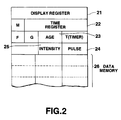
- a display register 21 stores display data to be displayed in the display unit 8.
- a time register 22 stores current time data.
- a mode register M stores numerals corresponding to operation modes: "0" in the time display mode, "1” in the pulse mode and "2" in a recall mode in which pulse data is read from a data memory 26 (to be described later).
- a flag F is to distinguish between a pulse count mode and the age setting mode. More specifically, "0" is set to the flag F in the pulse count mode and “1" is set in the age setting mode. As regards a flag G, “1” is set when a pulse counting time is measured and “0” is set in the other situations.
- a timer (a time measuring means) T measures a time period in which the user counts a predetermined number (e.g., 10) of pulses by means of palpation.
- An age register 23 stores age data input by the user.
- a pulse register 24 stores the number of pulses per minute calculated from an equation based on the period of time measured by the timer T and a predetermined number of pulses.
- An intensity register 25 stores exercise intensity data calculated by an exercise intensity calculation process (to be described later) based on a maximum number of pulses, depending on the age, and the number of pulses obtained by the calculation (pulse data stored in the pulse register 24).
- the exercise intensity data indicates a percentage with respect to the intensity of exercise corresponding to the maximum pulse of the set age.
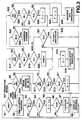
- control unit 3 When the control unit 3 is in a halt state in a step S1 as shown in FIG. 3, if it detects a timing signal output from the frequency-divider 2, it executes a time counting process of a step S2. If it detects a key operation signal, the flow proceeds to a step S9.
- a timing signal is detected in the step S1
- a time counting process of the step S2 is executed.
- current time data stored in the time register 22 is updated.
- step S3 the flow proceeds to a step S8 in which a display process in the corresponding mode is performed.
- the time data stored in the time register 22 is transferred to the display register 21, so that the current date and time are displayed on the display unit 8.
- step S4 if the flag G is "1", that is, if the pulse counting time is being measured, the flow proceeds to a step S5 in which the value of the timer T for measuring the pulse counting time is incremented by 1. In the next step S6, it is determined whether the value of the timer T amounts to "20", i.e., whether the counting time period amounts to 20 seconds.
- step S6 if the counting time period amounts to 20 seconds, the values of the timer T and the flag G are cleared in a step S7, so that the operation mode is switched to the initial mode. Thereafter, the display process is executed in a step S8, so as to display the counting time period "0" of the timer T.
- the pulse counting time is a period of time which elapses until the pulses amount to X (10)
- the pulse counting time of 20 seconds elapses until the pulses amount to 10
- the pulse per minute will be 30. Actually, however, the pulse per minute cannot be so low. Therefore, when the value of the timer T becomes 20, the control unit determines that the pulse is miscounted and clears the values of the timer T and the flag G, so that the pulse cannot be calculated from the value of the timer T.
- step S6 if the value of the timer T is less than 20 seconds, the flow proceeds to the step S8 in which the counting time of the timer T is displayed on the display unit 8.
- step S9 determines whether the SW1 key is operated. If the SW1 key is operated, the flow proceeds to a step S10, in which the value of the mode register M is incremented by 1, thereby changing the operation mode. Subsequently, the display process of step S8 is executed, so that a display process in the corresponding mode is performed.
- step S9 if a key other than the SW1 key is operated, the flow proceeds to a step S11, in which it is determined whether the SW2 key is operated. If the SW2 key is operated, the flow proceeds to a step S12, in which it is determined whether the value of the mode register M is "1" and the value of the flag F is "0".
- step S13 if the flag G is "0", i.e., if the SW2 key is operated in the initial mode of the pulse mode, the flow proceeds to a step S14, in which the flag G is set to "1" and the mode is switched to a pulse count time measurement mode, so as to start the measurement of the pulse counting time in the timer T. Thereafter, the display process of the step S8 is executed to display the pulse counting time in the timer T.
- step S13 If the flag G is "1" in the step S13, i.e., if the SW2 key is operated while the pulse counting time is being measured, the flow proceeds to a step S15, in which the flag G is set to "0" and the current operation mode is switched to a pulse display mode and the measurement of the pulse counting time of the timer T is stopped. At the same time, the calculation in a step S16 is executed.
- step S41 it is determined whether the value of the timer T, when the measurement is stopped, is 3 second or less. If the period of time in which the pulses amount to 10 is 3 seconds or less, the pulse per minute will be 200 or greater. Since, in general, the pulse per minute cannot be so much, the control unit determines that the pulse is miscounted by the user and clears the value of the timer T in a step S42. Further, in step S43 is set to the flag G, so that the operation mode is switched to the measurement mode.
- the pulse is calculated in a step S44, i.e., the calculation "600/Pulse Counting Time" (the period of time measured by the timer T until the pulses amount to 10) is executed so as to obtain the pulse per minute. Further, in a step S45, intensity of exercise is calculated from the age data stored in the age register 23 and the pulse data calculated in the step S44.
- the maximum pulse of a person of an age is represented by "220-Age".
- the intensity of the exercise, corresponding to the calculated pulse is obtained from the ratio of the calculated pulse to the maximum pulse.
- the calculated pulse data is stored in the data memory 26 in a step S46.
- the value of the mode register M is changed to "2", i.e., the apparatus is switched to the recall mode.
- the pulse data stored in the data memory 26 can be successively displayed by operating the SW3 key.
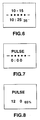
- FIGS. 6 to 8 show states of the display in the time display mode, the initial mode and the pulse display mode.
- FIG. 6 shows a state of the display in the time display mode, indicating the current date and time, October 15, 10:25 35".
- FIG. 7 shows a state of the display in the initial mode, indicating the letters "PULSE” and the initial value "0:00" of the timer.
- FIG. 8 shows a state of the display in the pulse display mode, indicating the pulse per minute "120" and the exercise intensity "65%” calculated from the pulse and the age.
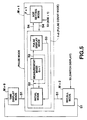
- the function of the SW3 key will be described with reference to FIG. 5.
- the value of the age register 23 is incremented by 1.
- the age of the user can be set by operating the SW3 key in the age setting mode.
- the timer T and the pulse register 24 are cleared and the apparatus is switched to the initial mode.
- step S27 i.e., if the SW4 key is operated in the pulse mode
- "1" is set in the flag F in a step S28, thereby switching the apparatus to the age setting mode.
- the flow proceeds to a step S29 in which "0" is set to the flag F thereby switching the apparatus to the pulse mode. If the SW4 key is not operated in the step S25, the flow proceeds to a step S30, so that another key operation can be executed.
- a mode switching process by means of operating the SW4 key will be described with reference to FIG. 5.
- the age setting mode a desired age can be set by operating the SW3 key as described above.
- the pulse counting time period can be measured by operating the SW2 key as described above.
- the measured period of time is too short (shorter than a first reference period of time, e.g., 3 seconds in the embodiment) in a logical sense or too long (longer than a second reference period of time, e.g., 20 seconds in the embodiment), the measured period of time is invalidated. In this way, even if the user miscounts pulse, the miscounted pulse is not displayed.
- pulse per minute is calculated in every second based on the period of time measured by the timer T and the predetermined number of pulses (e.g., 10 pulses in the embodiment) and the calculated pulse is displayed.
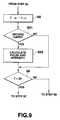
- FIG. 9 is a flowchart showing processes of the second embodiment inserted between the steps S5 and S6 of the flowchart of FIG. 3.
- step S5 After the timer is incremented by 1 in the step S5, it is determined whether a second carry is generated in a step S51. If a second carry is generated, a calculation of pulse and intensity is executed in a step S52. The calculation is the same as the calculation of pulse in the step S44 and the calculation of intensity in the step S45 shown in FIG. 4. That is, pulse per minute is calculated from the value of the timer T and the number (10) of pulses and the exercise intensity is calculated from the pulse per minute and the age. Thereafter, in the step S6, it is determined whether the timer T accounts to 20 seconds. The subsequent steps are the same as those shown in FIG. 3.
- FIG. 10A shows a display when 5 seconds have elapsed from the start of the measurement of the pulse counting time.
- the pulse amounts to 10 in 5 seconds
- the pulse per minute "120" is displayed.
- FIG. 10B shows a display when 6 seconds have elapsed from the start of the measurement of the pulse counting time.
- the pulse per minute "100" is displayed. Further the exercise intensity "50" % is obtained and displayed.
- the pulse per minute is calculated and displayed every second after the start of the measurement of the pulse counting time. Therefore, the number displayed when the user amounts 10 pulses is the pulse per minute of the user. It is thus unnecessary to stop the measurement of the period of time.
- the pulse per minute is obtained by the calculation "600/Pulse Counting Time".
- the number of pulses to be counted is not limited to 10 but can be 5, 20 or any other number and the calculation can be modified accordingly.
- the present invention is not limited to the watch as used in the above embodiments but can be applied to any other device having a time measuring function.
- the present invention has the following advantages.
- pulse per unit time can be immediately obtained simply by counting the number of pulses at a wrist or the neck of the user by means of palpation and measuring the period of time in which the pulses amount to a predetermined number. Further, if the measured period of time is too short or long, the period is invalidated, so that an incorrect pulse cannot be displayed. Furthermore, since the intensity of exercise is displayed along with the pulse, the user can see the degree of the exercise.
Landscapes
- Health & Medical Sciences (AREA)
- Life Sciences & Earth Sciences (AREA)
- General Health & Medical Sciences (AREA)
- Biophysics (AREA)
- Physics & Mathematics (AREA)
- Cardiology (AREA)
- Physiology (AREA)
- Engineering & Computer Science (AREA)
- Medical Informatics (AREA)
- Molecular Biology (AREA)
- Surgery (AREA)
- Animal Behavior & Ethology (AREA)
- Heart & Thoracic Surgery (AREA)
- Public Health (AREA)
- Veterinary Medicine (AREA)
- Biomedical Technology (AREA)
- Pathology (AREA)
- General Physics & Mathematics (AREA)
- Measuring Pulse, Heart Rate, Blood Pressure Or Blood Flow (AREA)
- Electric Clocks (AREA)
Applications Claiming Priority (3)
| Application Number | Priority Date | Filing Date | Title |
|---|---|---|---|
| JP5303020A JPH07148128A (ja) | 1993-12-02 | 1993-12-02 | 脈拍時間測定装置 |
| JP30302093 | 1993-12-02 | ||
| JP303020/93 | 1993-12-02 |
Publications (3)
| Publication Number | Publication Date |
|---|---|
| EP0656187A2 EP0656187A2 (en) | 1995-06-07 |
| EP0656187A3 EP0656187A3 (en) | 1996-03-13 |
| EP0656187B1 true EP0656187B1 (en) | 2000-02-02 |
Family
ID=17915975
Family Applications (1)
| Application Number | Title | Priority Date | Filing Date |
|---|---|---|---|
| EP94118896A Expired - Lifetime EP0656187B1 (en) | 1993-12-02 | 1994-11-30 | Pulse rate calculating apparatus |
Country Status (6)
| Country | Link |
|---|---|
| US (1) | US5603330A (enExample) |
| EP (1) | EP0656187B1 (enExample) |
| JP (1) | JPH07148128A (enExample) |
| KR (1) | KR0138058B1 (enExample) |
| CN (1) | CN1108081A (enExample) |
| DE (1) | DE69422895T2 (enExample) |
Families Citing this family (17)
| Publication number | Priority date | Publication date | Assignee | Title |
|---|---|---|---|---|
| DE69731347T2 (de) * | 1996-03-22 | 2005-12-01 | Seiko Epson Corp. | Vorrichtung zum messen der bewegungsmenge |
| GB2348715B (en) * | 1999-04-07 | 2002-10-30 | Healthcare Technology Ltd | Rate calculating apparatus |
| US8105207B1 (en) | 2004-05-10 | 2012-01-31 | Michael G. Lannon | Exercising apparatus |
| US7771319B1 (en) | 2004-05-10 | 2010-08-10 | Michael G. Lannon | Exercising apparatus |
| US20180008865A9 (en) | 2004-05-10 | 2018-01-11 | Koko Fitness, Inc. | Exercising apparatus |
| JP2006187469A (ja) * | 2005-01-06 | 2006-07-20 | Seiko Instruments Inc | 運動強度評価装置 |
| USD590898S1 (en) | 2006-09-29 | 2009-04-21 | Michael G. Lannon | Exercising apparatus |
| JP5470681B2 (ja) * | 2007-03-09 | 2014-04-16 | 富士通株式会社 | 運動モニタリング装置、運動モニタリングプログラム、および運動モニタリング方法 |
| CA2765946A1 (en) * | 2009-04-27 | 2010-11-04 | Spacelabs Healthcare, Llc | Multiple mode, portable patient monitoring system |
| CN102652669B (zh) * | 2011-03-04 | 2016-04-20 | 富泰华工业(深圳)有限公司 | 具有脉搏测量功能的触摸显示装置及脉搏测量方法 |
| US9629566B2 (en) | 2011-03-11 | 2017-04-25 | Spacelabs Healthcare Llc | Methods and systems to determine multi-parameter managed alarm hierarchy during patient monitoring |
| JP6108706B2 (ja) * | 2012-07-27 | 2017-04-05 | セイコーインスツル株式会社 | 電子時計および計測データ処理方法 |
| JP5998780B2 (ja) * | 2012-09-14 | 2016-09-28 | カシオ計算機株式会社 | 生体情報通知装置、生体情報通知方法及び生体情報通知プログラム |
| US10987026B2 (en) | 2013-05-30 | 2021-04-27 | Spacelabs Healthcare Llc | Capnography module with automatic switching between mainstream and sidestream monitoring |
| CN104523279A (zh) * | 2014-12-20 | 2015-04-22 | 万步健康科技(江门)有限公司 | 一种通过脉搏血氧仪监测运动强度的方法 |
| US12102416B2 (en) | 2019-06-26 | 2024-10-01 | Spacelabs Healthcare L.L.C. | Using data from a body worn sensor to modify monitored physiological data |
| CN111904396A (zh) * | 2020-08-05 | 2020-11-10 | 深圳桔子智能科技发展有限公司 | 脉搏检测方法、装置、系统、电子设备及存储介质 |
Family Cites Families (9)
| Publication number | Priority date | Publication date | Assignee | Title |
|---|---|---|---|---|
| DE2621574C3 (de) * | 1975-05-16 | 1979-05-17 | Matsushita Electric Industrial Co., Ltd., Kadoma, Osaka (Japan) | Blutdruckmeßgerät |
| NL7609211A (nl) * | 1975-10-01 | 1977-04-05 | Keiper Trainingsysteme Gmbh | Werkwijze voor het meten van de hartslagfre- kwentie en hartslagfrekwentiemeetinrichting voor het uitvoeren van de werkwijze volgens de uitvinding. |
| US4807639A (en) * | 1985-08-31 | 1989-02-28 | Casio Computer Co., Ltd. | Pulse detection apparatus |
| FR2657004A1 (fr) * | 1990-01-15 | 1991-07-19 | Trameta Ets Travert | Compteur manuel et portatif de pulsations cardiaques. |
| US5316008A (en) * | 1990-04-06 | 1994-05-31 | Casio Computer Co., Ltd. | Measurement of electrocardiographic wave and sphygmus |
| JPH05220120A (ja) * | 1992-02-18 | 1993-08-31 | Casio Comput Co Ltd | 運動強度表示装置 |
| US5335286A (en) * | 1992-02-18 | 1994-08-02 | Knowles Electronics, Inc. | Electret assembly |
| US5323784A (en) * | 1992-04-02 | 1994-06-28 | Unisen, Inc. | Heart rate calculation for users of exercise machines |
| US5301154A (en) * | 1992-07-16 | 1994-04-05 | Casio Computer Co., Ltd. | Time calculating device |
-
1993
- 1993-12-02 JP JP5303020A patent/JPH07148128A/ja active Pending
-
1994
- 1994-11-28 US US08/345,132 patent/US5603330A/en not_active Expired - Lifetime
- 1994-11-30 DE DE69422895T patent/DE69422895T2/de not_active Expired - Fee Related
- 1994-11-30 EP EP94118896A patent/EP0656187B1/en not_active Expired - Lifetime
- 1994-12-01 KR KR1019940032458A patent/KR0138058B1/ko not_active Expired - Fee Related
- 1994-12-02 CN CN94120182A patent/CN1108081A/zh not_active Ceased
Also Published As
| Publication number | Publication date |
|---|---|
| KR950016662A (ko) | 1995-07-20 |
| DE69422895D1 (de) | 2000-03-09 |
| JPH07148128A (ja) | 1995-06-13 |
| DE69422895T2 (de) | 2000-06-15 |
| US5603330A (en) | 1997-02-18 |
| EP0656187A3 (en) | 1996-03-13 |
| KR0138058B1 (ko) | 1998-04-28 |
| EP0656187A2 (en) | 1995-06-07 |
| HK1013399A1 (en) | 1999-08-27 |
| CN1108081A (zh) | 1995-09-13 |
Similar Documents
| Publication | Publication Date | Title |
|---|---|---|
| US5603330A (en) | Pulse counting apparatus | |
| US5097429A (en) | Programmable event reminder apparatus | |
| JP3334279B2 (ja) | ピッチ表示装置 | |
| US5301154A (en) | Time calculating device | |
| EP0556702B1 (en) | Exercise-hardness data output apparatus | |
| EP0559203B1 (en) | Pulsimeter | |
| US4424967A (en) | Timepiece apparatus having game function | |
| HK1013399B (en) | Pulse rate calculating apparatus | |
| US5130957A (en) | Electronic timepiece with timer | |
| JP3161065B2 (ja) | アルコール濃度記憶装置及びこれを用いたアルコール濃度予測時間表示装置 | |
| JP3033849B2 (ja) | 血圧記憶装置 | |
| EP0745913B1 (en) | Information display apparatus, in particular electronic watch | |
| US4236375A (en) | Electronic watch | |
| JP3424132B2 (ja) | ピッチ表示装置及びピッチ算出方法 | |
| JP3301208B2 (ja) | センサ情報記憶装置 | |
| EP0689110B1 (en) | Apparatus and method for setting a value to be displayed | |
| JP3498379B2 (ja) | 心拍計 | |
| JP2759159B2 (ja) | 電子温度測定装置 | |
| JP2566089Y2 (ja) | 時間計測装置 | |
| HK1010668B (en) | Pulsimeter | |
| JP3173090B2 (ja) | ストップウォッチ装置 | |
| JPH05337092A (ja) | 脈拍測定装置 | |
| JPH0614723Y2 (ja) | 脈拍測定装置 | |
| JP3278895B2 (ja) | 時間計測装置 | |
| HK1014590B (en) | Apparatus and method for setting a value to be displayed |
Legal Events
| Date | Code | Title | Description |
|---|---|---|---|
| PUAI | Public reference made under article 153(3) epc to a published international application that has entered the european phase |
Free format text: ORIGINAL CODE: 0009012 |
|
| 17P | Request for examination filed |
Effective date: 19941130 |
|
| AK | Designated contracting states |
Kind code of ref document: A2 Designated state(s): DE FR GB |
|
| PUAL | Search report despatched |
Free format text: ORIGINAL CODE: 0009013 |
|
| AK | Designated contracting states |
Kind code of ref document: A3 Designated state(s): DE FR GB |
|
| RAP1 | Party data changed (applicant data changed or rights of an application transferred) |
Owner name: CASIO COMPUTER CO., LTD. |
|
| 17Q | First examination report despatched |
Effective date: 19981027 |
|
| GRAG | Despatch of communication of intention to grant |
Free format text: ORIGINAL CODE: EPIDOS AGRA |
|
| GRAG | Despatch of communication of intention to grant |
Free format text: ORIGINAL CODE: EPIDOS AGRA |
|
| GRAH | Despatch of communication of intention to grant a patent |
Free format text: ORIGINAL CODE: EPIDOS IGRA |
|
| GRAH | Despatch of communication of intention to grant a patent |
Free format text: ORIGINAL CODE: EPIDOS IGRA |
|
| GRAA | (expected) grant |
Free format text: ORIGINAL CODE: 0009210 |
|
| AK | Designated contracting states |
Kind code of ref document: B1 Designated state(s): DE FR GB |
|
| REF | Corresponds to: |
Ref document number: 69422895 Country of ref document: DE Date of ref document: 20000309 |
|
| ET | Fr: translation filed | ||
| PLBE | No opposition filed within time limit |
Free format text: ORIGINAL CODE: 0009261 |
|
| STAA | Information on the status of an ep patent application or granted ep patent |
Free format text: STATUS: NO OPPOSITION FILED WITHIN TIME LIMIT |
|
| 26N | No opposition filed | ||
| PGFP | Annual fee paid to national office [announced via postgrant information from national office to epo] |
Ref country code: FR Payment date: 20011113 Year of fee payment: 8 |
|
| PGFP | Annual fee paid to national office [announced via postgrant information from national office to epo] |
Ref country code: GB Payment date: 20011128 Year of fee payment: 8 |
|
| PGFP | Annual fee paid to national office [announced via postgrant information from national office to epo] |
Ref country code: DE Payment date: 20011217 Year of fee payment: 8 |
|
| REG | Reference to a national code |
Ref country code: GB Ref legal event code: IF02 |
|
| PG25 | Lapsed in a contracting state [announced via postgrant information from national office to epo] |
Ref country code: GB Free format text: LAPSE BECAUSE OF NON-PAYMENT OF DUE FEES Effective date: 20021130 |
|
| PG25 | Lapsed in a contracting state [announced via postgrant information from national office to epo] |
Ref country code: DE Free format text: LAPSE BECAUSE OF NON-PAYMENT OF DUE FEES Effective date: 20030603 |
|
| GBPC | Gb: european patent ceased through non-payment of renewal fee | ||
| PG25 | Lapsed in a contracting state [announced via postgrant information from national office to epo] |
Ref country code: FR Free format text: LAPSE BECAUSE OF NON-PAYMENT OF DUE FEES Effective date: 20030731 |
|
| REG | Reference to a national code |
Ref country code: FR Ref legal event code: ST |