EP0641129B1 - Vorrichtung und Verfahren zur Organisation des Termins einer Kommunikationskonferenz - Google Patents
Vorrichtung und Verfahren zur Organisation des Termins einer Kommunikationskonferenz Download PDFInfo
- Publication number
- EP0641129B1 EP0641129B1 EP94306329A EP94306329A EP0641129B1 EP 0641129 B1 EP0641129 B1 EP 0641129B1 EP 94306329 A EP94306329 A EP 94306329A EP 94306329 A EP94306329 A EP 94306329A EP 0641129 B1 EP0641129 B1 EP 0641129B1
- Authority
- EP
- European Patent Office
- Prior art keywords
- schedule information
- area
- schedule
- information
- conference
- Prior art date
- Legal status (The legal status is an assumption and is not a legal conclusion. Google has not performed a legal analysis and makes no representation as to the accuracy of the status listed.)
- Expired - Lifetime
Links
Images



Classifications
-
- H—ELECTRICITY
- H04—ELECTRIC COMMUNICATION TECHNIQUE
- H04N—PICTORIAL COMMUNICATION, e.g. TELEVISION
- H04N7/00—Television systems
- H04N7/14—Systems for two-way working
- H04N7/15—Conference systems
Definitions
- the present invention relates to a communication terminal apparatus and a communication conference system, which allow easy schedule adjustment between communication terminal apparatuses.
- Digital communication lines have been popular recently, and a great deal of attention has been given to a TV telephone/conference system using a digital line network. Standardization is a prerequisite for the popularization of a communication system.
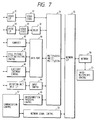
- Fig. 6 is a block diagram showing the schematic arrangement of a conventional TV conference terminal apparatus.
- this apparatus includes a video camera 10 for photographing, e.g., participants in a conference at one station, a monitor 12 for displaying images photographed at this station and/or other stations participating in a conference, a speaker 14, a microphone 16, an operation unit 18 for performing control, e.g., panning, tilting, and zooming, of the camera 10 at the station and cameras in other stations, switching control of the cameras, and the like, input/output equipment terminals 20 including a keyboard of a computer, a still picture input device, a pointing device for inputting plotting pictures, such as a mouse or digitizer, a sub-monitor for displaying images from other auxiliary equipment, and a main body 22 of the TV conference system.
- a video camera 10 for photographing, e.g., participants in a conference at one station
- a monitor 12 for displaying images photographed at this station and/or other stations participating in a conference
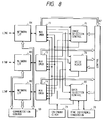
- Fig. 7 shows the detailed arrangement of the main body 22.
- a video I/F 30 serves to connect the camera 10 and the monitor 12 to the main body 22.
- the video I/F 30 has image processing functions of performing screen division, image synthesis, character synthesis, and the like.
- a video coder/decoder (CODEC) 32 codes a video signal from the video I/F 30 and decodes received coded video information.
- a voice I/F 34 serves to connect the speaker 14 and the microphone 16 to the main body 22, and has voice processing functions such as an echo cancel function.
- a voice coder/decoder (CODEC) 36 codes a voice signal from the voice I/F 30 and decodes the received coded voice information.
- a delay circuit 38 delays coded voice information obtained by the voice CODEC 36 and received coded voice information by a predetermined period. The delay circuit 38 serves to synchronize voice information to video information.
- a computer 40 provides a TV conference function and a computer conference function.
- a still picture/plotting picture control circuit 42 controls the still picture input/output operation and plotting picture input/output operation of the auxiliary input/output equipment terminal 20.
- a data port 46 performs data transfer between the main body 22 and the auxiliary input/output equipment terminal 20 via the computer 40, the still picture/plotting picture control circuit 42, and an auxiliary equipment control circuit 44.
- An interconnection procedure control circuit 48 controls interconnection with other TV conference terminals via a network.
- a network signal control circuit 50 performs end/end control to establish a common mode for communications between terminals.
- a communication control circuit 52 performs overall communication control by using the interconnection procedure control circuit 48 and the network signal control circuit 50.
- a multiplexing and demultiplexing circuit 54 performs multiplex transmission of data.
- a network I/F 56 serves to connect a communication network 58 to the main body 22.
- An inter-multipoints control circuit 60 interconnects TV conference terminals at multiple points to allow a TV conference between the multiple points.
- An operation unit input I/F 62 receives various commands from the operation unit.
- An input control unit 64 outputs a command to each component of the self station in accordance with a designation of the operation unit input I/F 62.
- the communication terminals negotiate with each other about the date of the conference and the time which can be spared for the conference, thereby performing schedule adjustment. If, however, an international conference is to be held, the working days and hours in each country participating in the conference, time differences, and the like must be considered. In this case, mistakes tend to occur. Especially when terminals belonging to a plurality of countries participate in a conference, communications for schedule adjustment alone cost a great deal.
- EP-A-0349709 discloses a video conference installation which has transmission and reception devices for handling audio and video signals from a plurality of subscriber points. A subscriber can initiate control and carry out switching actions by using position sensitive screen input.
- the present invention aims to provide a communication terminal apparatus and a communication conference system which can easily perform schedule adjustment.
- a schedule managing apparatus as set out in claim 1.
- Another aspect of the present invention aims to provide a communication terminal apparatus and a communication conference system in which mistakes are not easily caused in performing communication schedule adjustment.
- Still another aspect of the invention aims to provide a communication terminal apparatus and a communication conference system which can reduce the communication cost required for communication schedule adjustment.
- Fig. 1 is a block diagram showing the schematic arrangement of a TV conference terminal according to an embodiment of the present invention.
- the same reference numerals in Fig. 1 denote the same parts as in Fig. 6, and a description thereof will be omitted.
- this terminal includes a calendar clock 24 and a time difference conversion circuit 26.
- the calendar clock 24 stores calendar information of the station with which the terminal is associated (hereinafter referred to as "terminal station") and year/month/day/time information in a ROM (not shown).
- the calendar clock 24 has a RAM (not shown) capable of writing and reading the. determined schedule information of a TV conference therein and therefrom, and outputting information, as needed.
- the time difference conversion circuit 26 stores the time differences between the home country and other countries, and has a time difference conversion table 27 for converting date information of a partner's country sent from a partner's station into date information of the home country by using the ID information and date information of the partner's country as an address of the table.
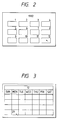
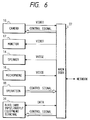
- Figs. 2, 3, 4, and 5 show examples of how date information is displayed in this embodiment. Characteristic operations of the embodiment will be described below with reference to Figs. 2 to 5.
- calendar data of the terminalstation is sent to a partner's station to be displayed on its submonitor.
- calendar data of the partner's station may be read out from a calendar clock 24 of the partner's station, received, and displayed on the submonitor of the terminalstation or the partner's station.
- Fig. 2 shows an example of display.
- an yearly calendar (1992 calendar in Fig. 2) including the current day is displayed in accordance with a designation from the operation unit 28. If December is selected by using a pointing device of the auxiliary input/output equipment terminal 20, a monthly calendar of December is displayed. In this case, a monthly calendar of December is also displayed in the partner's station.
- the displayed contents reflect holidays and public holidays in each country in accordance with the time difference conversion circuit 26.
- the timetable of the 29th day is displayed. If, for example, "9:00 - 11:00 A.M.” in Japan is selected, as shown in Fig. 4, ID information indicating the transmission side, i.e., Japan, and year/month/day/time information are sent to the partner's station in accordance with the selection, and the time data is converted into time data corresponding to the country of the partner's station by a time difference conversion circuit 26 of the partner's station and displayed, as shown in Fig. 5. If, for example, the partner's station is in the eastern part of the U.S.A, "7:00 - 9:00 P.M.” on December 28 is displayed.
- date information set before time difference conversion by the time difference conversion circuit 26 is preferably displayed on the submonitor at the same time.
- the date information of the communication partner in the partner's country can be known on the screen. Therefore, schedule adjustment can be performed by comparing the year/month/day/time information of the communication partner with the year/month/day/time of the self station.
- a TV conference terminal is shared by a plurality of persons. If, for example, determined schedule information, e.g., the expected date of a conference, is written in the RAM in the calendar clock 24 in addition to the calendar display, an operator at each station can run through the operation schedule of the TV conference system by displaying the calendar on the submonitor.
- the operator can see the conference schedule of each station to prevent overlapping of expected operation times.
- the schedule of the partner's station can also be checked, thereby facilitating determination of the date of the next conference.
- the detailed contents of the schedule can be masked with respect to the partner's station.
- individual schedule information in the electronic notebook of each user can be written in the RAM in the calendar clock 24 via an interface (not shown) of the auxiliary input/output equipment terminal 20, and can be displayed on the monitors in the self station and the partner's station.
- the schedule information can be transmitted while the detailed contents of the schedule of the terminal station are masked in accordance with the operation of the operation unit 28.
- schedule adjustment can be performed while the user in the terminal station sees the contents of the schedule on the monitor in the self station, and the communication partner checks the presence/absence of free time in the schedule information received from the self station. Therefore, schedule adjustment can be performed while a change in the schedule is considered in accordance with the contents of the schedule.
- the desired date of a conference may be temporarily stored in the RAM of the calendar clock 24.
- desired conference dates may be designated at predetermined portions of a calendar transmitted to the partner's terminal.
- the time difference conversion circuits 26 in the respective stations are designed to collate the desired conference dates with each other so that overlapping desired dates can be automatically and identifiably displayed on the calendars on the submonitors in the respective stations.
- the time difference conversion circuit 26 may have a function of identifiably displaying a day time zone in each country, e.g., from 8:30 A.M. to 6:00 P.M., on the calendar of a partner's station.
- date information and country ID information are transmitted to a partner's terminal. It is, however, apparent that the country ID information of a communication partner may be identified at the beginning of communication, and date information of the terminal station may be transmitted to the partner's terminal upon conversion of the date information.
- a star connection scheme is employed, as shown in Fig. 9.
- an inter-multipoints connection control unit 60 is required.
- Fig. 8 shows the detailed arrangement of the inter-multipoints connection control unit 60.
- multiplexing/demultiplexing circuits 70, 72, and 74 multiplex and demultiplex information (image information, voice information, and the like) to be transmitted.
- An image selection control circuit 76 selects data to be distributed from individual stations.
- a voice mixer 78 synthesizes voice data from the individual stations.
- a data selection control circuit 80 selects and distributes data such as still picture data and computer data.
- a control circuit 82 controls the image selection control circuit 76, the voice mixer 78, and the data selection control circuit 80.
- Network I/Fs 84, 86, and 88 serve to connect the apparatus shown in Fig. 8 to communication networks.
- a communication control unit 90 controls network access to each station. Similar to Fig. 1, this system includes a calendar clock 24 and a time difference conversion circuit 26.
- the terminal of each station need not have the calendar clock 24 and the time difference conversion circuit 26 and may transmit only ID information indicating the country or area of the self station or a partner's station to the inter-multipoints connection control unit 60.
- the calendar clock 24 of the inter-multipoints connection control unit 60 counts only one kind of standard time, e.g., Greenwich mean time. Calendar data is converted by the time difference conversion circuit 26 on the basis of ID information transmitted from each station, and the calendar data is transmitted thereto.
- Pieces of such ID information may be communicated between the respective terminals at the beginning of a conference so that each terminal can recognize the ID information of the partner's terminal.
- ID information indicating the country or area may be transmitted to the inter-multipoints connection control unit 60.
- a terminal in each station can extract the calendar data of any country or area from the inter-multipoints connection control unit 60 in accordance with ID information, regardless of where the corresponding station participates in a conference, and can display the calendar data on a monitor in a station which requests it.
- each station includes the calendar clock 24 and the time difference conversion circuit 26, each station can cause the inter-multipoints connection control unit 60 to perform a similar operation, in addition to the above operation.
- the above calendar data is calculated by a computer program for producing a calendar in consideration of an arbitrary year, e.g., a leap year.
- the above time difference data is calculated from Greenwich mean time in each country. Therefore, pieces of information unique to each country or area, e.g., public holidays, holidays, and summer time, may be set in the calendar clock and the time difference conversion circuit in advance for each country.
- calendar data is displayed on the monitor in the terminal station in accordance with the operation of the operation unit, while the calendar data is converted in the partner's station in consideration of the time difference, thereby facilitating schedule adjustment and saving a communication time.
- calendar data received from the partner's station can be displayed without performing time difference conversion so that each station can perform schedule adjustment while checking local times in the partner's station. Since a given user can perform schedule adjustment upon checking expected conference terminal operation information, the operation schedule of the user does not overlap the operation schedules of other users.
- a schedule written in the electronic notebook of each user can be input to the system through the interface, schedule adjustment can be performed in accordance with the priorities of schedules.
Landscapes
- Engineering & Computer Science (AREA)
- Multimedia (AREA)
- Signal Processing (AREA)
- Two-Way Televisions, Distribution Of Moving Picture Or The Like (AREA)
- Telephonic Communication Services (AREA)
- Electric Clocks (AREA)
Claims (15)
- Gerät (Fig. 1, 60) zur Organisation eines Kommunikationskonferenzzeitplans miteiner Empfangseinrichtung (22) zum Empfangen von ersten Zeitplaninformationen (Fig. 4) von einer in einem ersten Bereich gelegenen Konferenzstation, die in der Ortszeit des ersten Bereichs dargestellt werden, und
gekennzeichnet durchdie Empfangseinrichtung, die eine Zeitunterschiedumwandlungseinrichtung (26) zur Umwandlung der ersten Zeitplaninformationen in zweite Zeitplaninformationen (Fig. 5) aufweist, die auf der Grundlage des Ortszeitunterschieds zwischen dem ersten Bereich und einem zweiten Bereich in der Ortszeit des zweiten Bereichs darstellt werden,eine Ausgabeeinrichtung (20) zum Ausgeben der zweiten Zeitplaninformationen,
wobei jede der ersten und zweiten Zeitplaninformationen zur Bestimmung der Zeitspanne von einem Startzeitpunkt bis zu einem Endzeitpunkt eines vorbestimmten Zeitplans verwendet wird. - Gerät nach Anspruch 1, wobei das Gerät zur Organisation eines Zeitplans einem in dem zweiten Bereich angeordneten Endgerät entspricht, und wobei die Empfangseinrichtung die ersten Zeitplaninformationen von einem in dem ersten Bereich angeordneten ersten Endgerät empfängt.
- Gerät nach Anspruch 1, wobei das Gerät zur Organisation eines Zeitplans einem in dem ersten Bereich angeordneten Endgerät entspricht, und wobei die Ausgabeeinrichtung die zweiten Zeitplaninformationen an ein in dem ersten Bereich angeordnetes erstes Endgerät ausgibt.
- Gerät nach Anspruch 1, wobei es zur Übertragung einer Kommunikation zwischen einem in dem ersten Bereich angeordneten ersten Endgerät und einem in dem zweiten Bereich angeordneten zweiten Endgerät geeignet ist.
- Gerät nach einem der vorstehenden Ansprüche, wobei die Ausgabeeinrichtung (20) zum Anzeigen der zweiten Zeitplaninformationen geeignet ist.
- Gerät nach Anspruch 1, wobei die ersten Zeitplaninformationen Zeitplaninformationen eines Benutzers eines in dem ersten Bereich angeordneten Endgeräts entsprechen.
- Gerät nach einem der vorstehenden Ansprüche, ferner mit einer Videokamera zum Aufnehmen eines Bildes.
- Gerät nach einem der vorstehenden Ansprüche, ferner mit einem Lautsprecher zum Ausgeben von empfangenen Audiosignalen.
- Gerät nach einem der vorstehenden Ansprüche, ferner mit einem Mikrofon zum Eingeben von Audiosignalen zur Übertragung.
- Gerät nach einem der vorstehenden Ansprüche, wobei die Empfangseinrichtung ID-Informationen empfängt, die den ersten Bereich anzeigen, und wobei die Zeitunterschiedumwandlungseinrichtung die ersten Zeitplaninformationen auf der Grundlage der ID-Informationen in die zweiten Zeitplaninformationen umwandelt.
- Gerät nach Anspruch 10, wobei die Zeitunterschiedumwandlungseinrichtung eine Tabelle aufweist, damit die zweiten Zeitplaninformationen als eine Adresse für die ID-Informationen und die ersten Zeitplaninformationen ausgegeben werden.
- System mit einer Konferenzstation, die in einem Gerät nach Anspruch 4 zur Organisation eines Zeitplans angeordnet ist, und einem Endgerät mit einer Ausgabeeinrichtung zum Ausgeben von Zeitplaninformationen, die zu dem Endgerät durch die in einem Gerät zur Organisation eines Zeitplans angeordnete Konferenzstation übertragen werden.
- Verfahren zum Organisieren von Zeitplänen von Kommunikationskonferenzen mit den Schritten:Empfangen von ersten Zeitplaninformationen von einer in einem ersten Bereich gelegenen Konferenzstation, wobei die Zeitplaninformationen einen Zeitplan mit der Ortszeit in dem ersten Bereich darstellen, wobei bei dem Empfangsschritt ein Zeitunterschiedumwandlungsschritt zum Umwandeln der ersten Zeitplaninformationen in zweite Zeitplaninformationen verwendet wird, die auf der Grundlage des Ortszeitunterschieds zwischen dem ersten Bereich und einem zweiten Bereich in der Ortszeit des zweiten Bereichs dargestellt werden,Ausgeben der zweiten Zeitplaninformationen, undVerwenden der ersten und zweiten Zeitplaninformationen zur Bestimmung der Zeitspanne von einem Startzeitpunkt bis zu einem Endzeitpunkt eines vorbestimmten Zeitplans.
- Verfahren nach Anspruch 13, wobei die ersten und zweiten Zeitplaninformationen bei einem Gerät zur Organisation eines Zeitplans empfangen werden und zu mindestens einem weiteren Endgerät ausgegeben werden.
- Verfahren nach Anspruch 14, wobei die ersten und zweiten Zeitplaninformationen von verschiedenen videokonferierenden Endgeräten empfangen werden und zu einem dritten videokonferierenden Endgerät gesendet werden.
Applications Claiming Priority (6)
| Application Number | Priority Date | Filing Date | Title |
|---|---|---|---|
| JP21437493 | 1993-08-30 | ||
| JP21437493 | 1993-08-30 | ||
| JP214374/93 | 1993-08-30 | ||
| JP6198344A JPH07123167A (ja) | 1993-08-30 | 1994-08-23 | 通信端末装置及び通信会議システム |
| JP198344/94 | 1994-08-23 | ||
| JP19834494 | 1994-08-23 |
Publications (2)
| Publication Number | Publication Date |
|---|---|
| EP0641129A1 EP0641129A1 (de) | 1995-03-01 |
| EP0641129B1 true EP0641129B1 (de) | 2000-06-28 |
Family
ID=26510927
Family Applications (1)
| Application Number | Title | Priority Date | Filing Date |
|---|---|---|---|
| EP94306329A Expired - Lifetime EP0641129B1 (de) | 1993-08-30 | 1994-08-26 | Vorrichtung und Verfahren zur Organisation des Termins einer Kommunikationskonferenz |
Country Status (4)
| Country | Link |
|---|---|
| US (1) | US6205089B1 (de) |
| EP (1) | EP0641129B1 (de) |
| JP (1) | JPH07123167A (de) |
| DE (1) | DE69425027T2 (de) |
Families Citing this family (14)
| Publication number | Priority date | Publication date | Assignee | Title |
|---|---|---|---|---|
| US6525761B2 (en) | 1996-07-23 | 2003-02-25 | Canon Kabushiki Kaisha | Apparatus and method for controlling a camera connected to a network |
| US7249061B1 (en) * | 1997-03-14 | 2007-07-24 | Kabushiki Kaisha Toshiba | Method of electronic commerce including receiving an acceptance signal indicating a change in a transaction available period based on a time adjustment day |
| US6064975A (en) * | 1997-10-22 | 2000-05-16 | Ericsson Inc. | Apparatus and method for highlighting holidays of a specified location in a calendar software application |
| JP4575591B2 (ja) * | 1997-10-24 | 2010-11-04 | マイクロソフト コーポレーション | モバイルデバイスからのミーティング要求およびグループスケジューリング生成 |
| JP3986687B2 (ja) * | 1998-09-18 | 2007-10-03 | 株式会社リコー | ファクシミリ装置 |
| JPWO2002027583A1 (ja) * | 2000-09-27 | 2004-02-05 | 株式会社東芝 | 電子商取引用サーバ、電子商取引方法、及び電子商取引プログラムを記録した記録媒体 |
| KR100452819B1 (ko) | 2002-03-18 | 2004-10-15 | 삼성전기주식회사 | 칩 패키지 및 그 제조방법 |
| JP2005352933A (ja) * | 2004-06-14 | 2005-12-22 | Fuji Xerox Co Ltd | 表示装置、システムおよび表示方法 |
| US7856483B2 (en) | 2004-12-10 | 2010-12-21 | Microsoft Corporation | Information management systems with time zone information, including event scheduling processes |
| US8626556B2 (en) * | 2005-04-25 | 2014-01-07 | International Business Machines Corporation | Visualizing multiple time zones in a calendaring and scheduling application |
| JP4564410B2 (ja) * | 2005-06-16 | 2010-10-20 | オリンパスイメージング株式会社 | 画像再生装置 |
| US7813325B2 (en) * | 2006-03-03 | 2010-10-12 | Sony Ericsson Mobile Communications Ab | Location information communication |
| US20090077819A1 (en) * | 2007-09-21 | 2009-03-26 | Black & Decker Inc. | Cutting Angle Indicator in Jigsaw Housing with Positive Lock in Separately Assembled Shoe Sub-Assembly |
| JP2009086850A (ja) * | 2007-09-28 | 2009-04-23 | Hitachi Ltd | スケジュール管理システム |
Family Cites Families (14)
| Publication number | Priority date | Publication date | Assignee | Title |
|---|---|---|---|---|
| US4977529A (en) * | 1973-02-23 | 1990-12-11 | Westinghouse Electric Corp. | Training simulator for a nuclear power plant |
| US4725886A (en) * | 1983-04-21 | 1988-02-16 | The Weather Channel, Inc. | Communications system having an addressable receiver |
| US4831552A (en) * | 1987-01-29 | 1989-05-16 | International Business Machines Corporation | Method for concurrently displaying entries from a plurality of different electronic calendars based on interactively entered non-temporal criteria |
| US4774658A (en) * | 1987-02-12 | 1988-09-27 | Thomas Lewin | Standardized alarm notification transmission alternative system |
| US4987492A (en) * | 1987-09-28 | 1991-01-22 | Stults Robert A | User interface control for communication system |
| DE3823219C1 (de) | 1988-07-08 | 1989-05-18 | Telenorma Telefonbau Und Normalzeit Gmbh, 6000 Frankfurt, De | |
| US4882743A (en) * | 1988-08-01 | 1989-11-21 | American Telephone And Telegraph | Multi-location video conference system |
| US5375018A (en) * | 1990-07-18 | 1994-12-20 | Klausner Patent Technologies | Location acquisition and time adjusting system |
| US5062136A (en) * | 1990-09-12 | 1991-10-29 | The United States Of America As Represented By The Secretary Of The Navy | Telecommunications system and method |
| US5396269A (en) * | 1991-02-20 | 1995-03-07 | Hitachi, Ltd. | Television telephone |
| DE4140017C2 (de) * | 1991-12-04 | 1995-01-05 | Nec Electronics Germany | Verfahren zum Betreiben von über einen Datenbus durch seriellen Datenaustausch miteinander kommunizierenden Rechnereinheiten |
| DE69329628T2 (de) * | 1992-03-26 | 2001-03-01 | Nec Corp., Tokio/Tokyo | Automatische Zeitzonenanpassung in einem Mobilfunktelefon |
| JPH06225301A (ja) * | 1993-01-25 | 1994-08-12 | Matsushita Electric Ind Co Ltd | 通信端末装置 |
| US5455807A (en) * | 1993-08-18 | 1995-10-03 | Seiko Corp. | Time maintenance and display in a time keeping system including a time zone boundary |
-
1994
- 1994-08-23 JP JP6198344A patent/JPH07123167A/ja not_active Withdrawn
- 1994-08-26 EP EP94306329A patent/EP0641129B1/de not_active Expired - Lifetime
- 1994-08-26 DE DE69425027T patent/DE69425027T2/de not_active Expired - Lifetime
- 1994-08-29 US US08/297,180 patent/US6205089B1/en not_active Expired - Lifetime
Also Published As
| Publication number | Publication date |
|---|---|
| DE69425027D1 (de) | 2000-08-03 |
| DE69425027T2 (de) | 2001-02-22 |
| US6205089B1 (en) | 2001-03-20 |
| EP0641129A1 (de) | 1995-03-01 |
| JPH07123167A (ja) | 1995-05-12 |
Similar Documents
| Publication | Publication Date | Title |
|---|---|---|
| EP0641129B1 (de) | Vorrichtung und Verfahren zur Organisation des Termins einer Kommunikationskonferenz | |
| JP3319618B2 (ja) | テレビ会議システム | |
| EP0571119B1 (de) | Videodienste | |
| JP3305037B2 (ja) | 多地点制御装置、テレビ会議端末装置及び多地点テレビ会議システム | |
| KR0163723B1 (ko) | 종합정보통신망을 이용한 화상회의시스템의 화상회의 제어장치 | |
| US5444477A (en) | Video telephone system | |
| KR100210546B1 (ko) | 텔레비젼 회의 시스템 | |
| US20040210635A1 (en) | Intelligent switching system for voice and data | |
| AU2001215578B2 (en) | Teleconferencing system | |
| US6621514B1 (en) | Video conferencing system | |
| KR100203279B1 (ko) | 단말정보를 갖는 화상회의 다지점제어장치 | |
| JP3258409B2 (ja) | 通信会議装置 | |
| JPH07131771A (ja) | テレビ会議システム | |
| JP2707948B2 (ja) | 多地点テレビ講義システム | |
| JP2004282785A (ja) | 表示制御装置及び表示制御方法 | |
| JP3123685B2 (ja) | グループ映像通信システム | |
| JP3107465B2 (ja) | テレビ会議システム | |
| JP3124646B2 (ja) | マルチメディア伝送システム及びその方法 | |
| JP3308905B2 (ja) | テレビ会議端末 | |
| JP3491932B2 (ja) | テレビ会議システム | |
| JPH07162823A (ja) | 多地点間テレビ会議映像表示方式 | |
| JPH0435591A (ja) | テレビ会議装置 | |
| KR0175608B1 (ko) | 영상회의 시스템의 공동작업 방법 | |
| US20030101221A1 (en) | Network conference system and method for using the same | |
| JPH0265426A (ja) | 衛星テレビジョン会議システム |
Legal Events
| Date | Code | Title | Description |
|---|---|---|---|
| PUAI | Public reference made under article 153(3) epc to a published international application that has entered the european phase |
Free format text: ORIGINAL CODE: 0009012 |
|
| AK | Designated contracting states |
Kind code of ref document: A1 Designated state(s): DE FR GB |
|
| 17P | Request for examination filed |
Effective date: 19950713 |
|
| 17Q | First examination report despatched |
Effective date: 19980309 |
|
| GRAG | Despatch of communication of intention to grant |
Free format text: ORIGINAL CODE: EPIDOS AGRA |
|
| RTI1 | Title (correction) |
Free format text: COMMUNICATION CONFERENCE SCHEDULES MANAGING APPARATUS AND METHOD |
|
| GRAG | Despatch of communication of intention to grant |
Free format text: ORIGINAL CODE: EPIDOS AGRA |
|
| GRAH | Despatch of communication of intention to grant a patent |
Free format text: ORIGINAL CODE: EPIDOS IGRA |
|
| GRAH | Despatch of communication of intention to grant a patent |
Free format text: ORIGINAL CODE: EPIDOS IGRA |
|
| GRAA | (expected) grant |
Free format text: ORIGINAL CODE: 0009210 |
|
| AK | Designated contracting states |
Kind code of ref document: B1 Designated state(s): DE FR GB |
|
| REF | Corresponds to: |
Ref document number: 69425027 Country of ref document: DE Date of ref document: 20000803 |
|
| ET | Fr: translation filed | ||
| PLBE | No opposition filed within time limit |
Free format text: ORIGINAL CODE: 0009261 |
|
| STAA | Information on the status of an ep patent application or granted ep patent |
Free format text: STATUS: NO OPPOSITION FILED WITHIN TIME LIMIT |
|
| 26N | No opposition filed | ||
| REG | Reference to a national code |
Ref country code: GB Ref legal event code: IF02 |
|
| PGFP | Annual fee paid to national office [announced via postgrant information from national office to epo] |
Ref country code: DE Payment date: 20130831 Year of fee payment: 20 |
|
| PGFP | Annual fee paid to national office [announced via postgrant information from national office to epo] |
Ref country code: FR Payment date: 20130823 Year of fee payment: 20 Ref country code: GB Payment date: 20130822 Year of fee payment: 20 |
|
| REG | Reference to a national code |
Ref country code: DE Ref legal event code: R071 Ref document number: 69425027 Country of ref document: DE |
|
| REG | Reference to a national code |
Ref country code: GB Ref legal event code: PE20 Expiry date: 20140825 |
|
| PG25 | Lapsed in a contracting state [announced via postgrant information from national office to epo] |
Ref country code: DE Free format text: LAPSE BECAUSE OF EXPIRATION OF PROTECTION Effective date: 20140827 |
|
| PG25 | Lapsed in a contracting state [announced via postgrant information from national office to epo] |
Ref country code: GB Free format text: LAPSE BECAUSE OF EXPIRATION OF PROTECTION Effective date: 20140825 |