EP0625811B1 - Vorrichtung mit kurzwellenlängiger Lichtquelle - Google Patents
Vorrichtung mit kurzwellenlängiger Lichtquelle Download PDFInfo
- Publication number
- EP0625811B1 EP0625811B1 EP94107841A EP94107841A EP0625811B1 EP 0625811 B1 EP0625811 B1 EP 0625811B1 EP 94107841 A EP94107841 A EP 94107841A EP 94107841 A EP94107841 A EP 94107841A EP 0625811 B1 EP0625811 B1 EP 0625811B1
- Authority
- EP
- European Patent Office
- Prior art keywords
- wavelength
- optical
- light source
- source apparatus
- short wavelength
- Prior art date
- Legal status (The legal status is an assumption and is not a legal conclusion. Google has not performed a legal analysis and makes no representation as to the accuracy of the status listed.)
- Expired - Lifetime
Links
Images


Classifications
-
- H—ELECTRICITY
- H01—ELECTRIC ELEMENTS
- H01S—DEVICES USING THE PROCESS OF LIGHT AMPLIFICATION BY STIMULATED EMISSION OF RADIATION [LASER] TO AMPLIFY OR GENERATE LIGHT; DEVICES USING STIMULATED EMISSION OF ELECTROMAGNETIC RADIATION IN WAVE RANGES OTHER THAN OPTICAL
- H01S3/00—Lasers, i.e. devices using stimulated emission of electromagnetic radiation in the infrared, visible or ultraviolet wave range
- H01S3/09—Processes or apparatus for excitation, e.g. pumping
- H01S3/091—Processes or apparatus for excitation, e.g. pumping using optical pumping
- H01S3/094—Processes or apparatus for excitation, e.g. pumping using optical pumping by coherent light
- H01S3/0941—Processes or apparatus for excitation, e.g. pumping using optical pumping by coherent light of a laser diode
- H01S3/09415—Processes or apparatus for excitation, e.g. pumping using optical pumping by coherent light of a laser diode the pumping beam being parallel to the lasing mode of the pumped medium, e.g. end-pumping
-
- H—ELECTRICITY
- H01—ELECTRIC ELEMENTS
- H01S—DEVICES USING THE PROCESS OF LIGHT AMPLIFICATION BY STIMULATED EMISSION OF RADIATION [LASER] TO AMPLIFY OR GENERATE LIGHT; DEVICES USING STIMULATED EMISSION OF ELECTROMAGNETIC RADIATION IN WAVE RANGES OTHER THAN OPTICAL
- H01S3/00—Lasers, i.e. devices using stimulated emission of electromagnetic radiation in the infrared, visible or ultraviolet wave range
- H01S3/10—Controlling the intensity, frequency, phase, polarisation or direction of the emitted radiation, e.g. switching, gating, modulating or demodulating
- H01S3/106—Controlling the intensity, frequency, phase, polarisation or direction of the emitted radiation, e.g. switching, gating, modulating or demodulating by controlling devices placed within the cavity
- H01S3/108—Controlling the intensity, frequency, phase, polarisation or direction of the emitted radiation, e.g. switching, gating, modulating or demodulating by controlling devices placed within the cavity using non-linear optical devices, e.g. exhibiting Brillouin or Raman scattering
- H01S3/109—Frequency multiplication, e.g. harmonic generation
-
- G—PHYSICS
- G02—OPTICS
- G02F—OPTICAL DEVICES OR ARRANGEMENTS FOR THE CONTROL OF LIGHT BY MODIFICATION OF THE OPTICAL PROPERTIES OF THE MEDIA OF THE ELEMENTS INVOLVED THEREIN; NON-LINEAR OPTICS; FREQUENCY-CHANGING OF LIGHT; OPTICAL LOGIC ELEMENTS; OPTICAL ANALOGUE/DIGITAL CONVERTERS
- G02F1/00—Devices or arrangements for the control of the intensity, colour, phase, polarisation or direction of light arriving from an independent light source, e.g. switching, gating or modulating; Non-linear optics
- G02F1/35—Non-linear optics
- G02F1/353—Frequency conversion, i.e. wherein a light beam is generated with frequency components different from those of the incident light beams
- G02F1/3544—Particular phase matching techniques
- G02F1/3548—Quasi phase matching [QPM], e.g. using a periodic domain inverted structure
-
- G—PHYSICS
- G02—OPTICS
- G02F—OPTICAL DEVICES OR ARRANGEMENTS FOR THE CONTROL OF LIGHT BY MODIFICATION OF THE OPTICAL PROPERTIES OF THE MEDIA OF THE ELEMENTS INVOLVED THEREIN; NON-LINEAR OPTICS; FREQUENCY-CHANGING OF LIGHT; OPTICAL LOGIC ELEMENTS; OPTICAL ANALOGUE/DIGITAL CONVERTERS
- G02F1/00—Devices or arrangements for the control of the intensity, colour, phase, polarisation or direction of light arriving from an independent light source, e.g. switching, gating or modulating; Non-linear optics
- G02F1/35—Non-linear optics
- G02F1/37—Non-linear optics for second-harmonic generation
- G02F1/377—Non-linear optics for second-harmonic generation in an optical waveguide structure
-
- H—ELECTRICITY
- H01—ELECTRIC ELEMENTS
- H01S—DEVICES USING THE PROCESS OF LIGHT AMPLIFICATION BY STIMULATED EMISSION OF RADIATION [LASER] TO AMPLIFY OR GENERATE LIGHT; DEVICES USING STIMULATED EMISSION OF ELECTROMAGNETIC RADIATION IN WAVE RANGES OTHER THAN OPTICAL
- H01S3/00—Lasers, i.e. devices using stimulated emission of electromagnetic radiation in the infrared, visible or ultraviolet wave range
- H01S3/005—Optical devices external to the laser cavity, specially adapted for lasers, e.g. for homogenisation of the beam or for manipulating laser pulses, e.g. pulse shaping
-
- H—ELECTRICITY
- H01—ELECTRIC ELEMENTS
- H01S—DEVICES USING THE PROCESS OF LIGHT AMPLIFICATION BY STIMULATED EMISSION OF RADIATION [LASER] TO AMPLIFY OR GENERATE LIGHT; DEVICES USING STIMULATED EMISSION OF ELECTROMAGNETIC RADIATION IN WAVE RANGES OTHER THAN OPTICAL
- H01S3/00—Lasers, i.e. devices using stimulated emission of electromagnetic radiation in the infrared, visible or ultraviolet wave range
- H01S3/05—Construction or shape of optical resonators; Accommodation of active medium therein; Shape of active medium
- H01S3/08—Construction or shape of optical resonators or components thereof
- H01S3/08018—Mode suppression
- H01S3/08022—Longitudinal modes
- H01S3/08031—Single-mode emission
-
- H—ELECTRICITY
- H01—ELECTRIC ELEMENTS
- H01S—DEVICES USING THE PROCESS OF LIGHT AMPLIFICATION BY STIMULATED EMISSION OF RADIATION [LASER] TO AMPLIFY OR GENERATE LIGHT; DEVICES USING STIMULATED EMISSION OF ELECTROMAGNETIC RADIATION IN WAVE RANGES OTHER THAN OPTICAL
- H01S3/00—Lasers, i.e. devices using stimulated emission of electromagnetic radiation in the infrared, visible or ultraviolet wave range
- H01S3/09—Processes or apparatus for excitation, e.g. pumping
- H01S3/091—Processes or apparatus for excitation, e.g. pumping using optical pumping
- H01S3/094—Processes or apparatus for excitation, e.g. pumping using optical pumping by coherent light
- H01S3/094065—Single-mode pumping
-
- H—ELECTRICITY
- H01—ELECTRIC ELEMENTS
- H01S—DEVICES USING THE PROCESS OF LIGHT AMPLIFICATION BY STIMULATED EMISSION OF RADIATION [LASER] TO AMPLIFY OR GENERATE LIGHT; DEVICES USING STIMULATED EMISSION OF ELECTROMAGNETIC RADIATION IN WAVE RANGES OTHER THAN OPTICAL
- H01S3/00—Lasers, i.e. devices using stimulated emission of electromagnetic radiation in the infrared, visible or ultraviolet wave range
- H01S3/14—Lasers, i.e. devices using stimulated emission of electromagnetic radiation in the infrared, visible or ultraviolet wave range characterised by the material used as the active medium
- H01S3/16—Solid materials
- H01S3/1601—Solid materials characterised by an active (lasing) ion
- H01S3/1603—Solid materials characterised by an active (lasing) ion rare earth
- H01S3/1611—Solid materials characterised by an active (lasing) ion rare earth neodymium
-
- H—ELECTRICITY
- H01—ELECTRIC ELEMENTS
- H01S—DEVICES USING THE PROCESS OF LIGHT AMPLIFICATION BY STIMULATED EMISSION OF RADIATION [LASER] TO AMPLIFY OR GENERATE LIGHT; DEVICES USING STIMULATED EMISSION OF ELECTROMAGNETIC RADIATION IN WAVE RANGES OTHER THAN OPTICAL
- H01S3/00—Lasers, i.e. devices using stimulated emission of electromagnetic radiation in the infrared, visible or ultraviolet wave range
- H01S3/14—Lasers, i.e. devices using stimulated emission of electromagnetic radiation in the infrared, visible or ultraviolet wave range characterised by the material used as the active medium
- H01S3/16—Solid materials
- H01S3/163—Solid materials characterised by a crystal matrix
- H01S3/1671—Solid materials characterised by a crystal matrix vanadate, niobate, tantalate
- H01S3/1673—YVO4 [YVO]
-
- H—ELECTRICITY
- H01—ELECTRIC ELEMENTS
- H01S—DEVICES USING THE PROCESS OF LIGHT AMPLIFICATION BY STIMULATED EMISSION OF RADIATION [LASER] TO AMPLIFY OR GENERATE LIGHT; DEVICES USING STIMULATED EMISSION OF ELECTROMAGNETIC RADIATION IN WAVE RANGES OTHER THAN OPTICAL
- H01S5/00—Semiconductor lasers
- H01S5/005—Optical components external to the laser cavity, specially adapted therefor, e.g. for homogenisation or merging of the beams or for manipulating laser pulses, e.g. pulse shaping
- H01S5/0092—Optical components external to the laser cavity, specially adapted therefor, e.g. for homogenisation or merging of the beams or for manipulating laser pulses, e.g. pulse shaping for nonlinear frequency conversion, e.g. second harmonic generation [SHG] or sum- or difference-frequency generation outside the laser cavity
-
- H—ELECTRICITY
- H01—ELECTRIC ELEMENTS
- H01S—DEVICES USING THE PROCESS OF LIGHT AMPLIFICATION BY STIMULATED EMISSION OF RADIATION [LASER] TO AMPLIFY OR GENERATE LIGHT; DEVICES USING STIMULATED EMISSION OF ELECTROMAGNETIC RADIATION IN WAVE RANGES OTHER THAN OPTICAL
- H01S5/00—Semiconductor lasers
- H01S5/06—Arrangements for controlling the laser output parameters, e.g. by operating on the active medium
- H01S5/065—Mode locking; Mode suppression; Mode selection ; Self pulsating
-
- H—ELECTRICITY
- H01—ELECTRIC ELEMENTS
- H01S—DEVICES USING THE PROCESS OF LIGHT AMPLIFICATION BY STIMULATED EMISSION OF RADIATION [LASER] TO AMPLIFY OR GENERATE LIGHT; DEVICES USING STIMULATED EMISSION OF ELECTROMAGNETIC RADIATION IN WAVE RANGES OTHER THAN OPTICAL
- H01S5/00—Semiconductor lasers
- H01S5/10—Construction or shape of the optical resonator, e.g. extended or external cavity, coupled cavities, bent-guide, varying width, thickness or composition of the active region
- H01S5/14—External cavity lasers
-
- H—ELECTRICITY
- H01—ELECTRIC ELEMENTS
- H01S—DEVICES USING THE PROCESS OF LIGHT AMPLIFICATION BY STIMULATED EMISSION OF RADIATION [LASER] TO AMPLIFY OR GENERATE LIGHT; DEVICES USING STIMULATED EMISSION OF ELECTROMAGNETIC RADIATION IN WAVE RANGES OTHER THAN OPTICAL
- H01S5/00—Semiconductor lasers
- H01S5/10—Construction or shape of the optical resonator, e.g. extended or external cavity, coupled cavities, bent-guide, varying width, thickness or composition of the active region
- H01S5/14—External cavity lasers
- H01S5/141—External cavity lasers using a wavelength selective device, e.g. a grating or etalon
Definitions
- a laser medium receives laser light generated by a semiconductor laser (pump light source) so as to effect laser oscillation, and generates laser light having a longer wavelength than that of the laser light from the semiconductor laser.
- the generated laser light is converted into short-wavelength light (harmonics) by an optical wavelength converting element inserted in the interior of a resonator.
- the output of the QPM polarization inversion type waveguide element can be stable for a time period of only several seconds.
- Phase matching type non-linear optical crystals and QPM polarization inversion type bulk elements similarly have a relatively narrow range of allowable wavelength variation with respect to phase matching. This increases the importance of stabilization of the oscillation wavelength of a semiconductor laser used as a pump light source.
- reference numeral D01 denotes a 50 mW-class AlGaAs semiconductor laser for the 0.83 ⁇ m band
- D02 denotes a collimating lens
- D03 denotes a ⁇ /2 plate
- D04 denotes a focusing lens having a numerical aperture (hereinafter referred to as "N.A.") of 0.6
- D05 denotes a grating disposed at an angle of ⁇ with the optical axis of the semiconductor laser D01 .
- the grating D05 has a linear shape.
- a high reflectance coating is formed on an end face D06 of the semiconductor laser D01 .
- the grating D05 has a wavelength dispersing effect, and therefore is capable of locking the oscillation wavelength of the semiconductor laser D01 by feeding back light of a certain wavelength to the semiconductor laser D01 as a first-order diffracted light.
- Laser light (wavelength: 830 nm) reflected from the grating D05 is incident to the ⁇ /2 plate D03 , which rotates the polarizing direction of the laser light, and is lead through a focusing lens D04 so as to be focused on an end face D07 of the polarization inversion type waveguide element D08 .
- the polarization inversion type waveguide element D08 having polarization-inverted layers (period: 3.7 ⁇ m) is converted into light with a wavelength of 415 nm so as to go out through an end face D09 .
- An antireflection (AR) coating which does not reflect the fundamental wave is provided on each of the end faces D07 and D09 .
- the polarization inversion type waveguide element D08 is formed on an LiTaO 3 substrate.
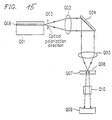
- reference numeral Q01 denotes a 60 mW-class AlGaAs semiconductor laser for the 809 nm band
- Q02 denotes a collimating lens
- Q03 denotes a focusing lens (f:14.5 mm)
- Q04 denotes a grating disposed at an angle of ⁇ with the optical axis of the semiconductor laser Q01 .
- the grating Q04 has a linear shape. A diffraction efficiency of about 10% was obtained under the following conditions: the incident angle was 30°; the depth was 0.29 ⁇ m; and the pitch was 0.83 ⁇ m.
- the grating Q04 has a wavelength dispersing effect, and therefore is capable of locking the oscillation wavelength of the semiconductor laser Q01 by feeding back light of a certain wavelength to the semiconductor laser Q01 as a first-order diffracted light.
- Laser light (zero-order diffracted light) reflected from the grating Q04 is lead through the focusing lens Q03 so as to be focused on an end face Q08 of a laser medium of Nd:YVO 4 Q07 .
- the fundamental wave, resonated between an output mirror Q09 and the end face Q08 of the Nd:YVO 4 laser medium Q07 is subjected to wavelength conversion by a non-linear device optical crystal of KTP(KTiOPO 4 ) Q10 so as to be output through the output mirror Q09 .
- the stability when attempting to stabilize the longitudinal mode oscillation of a semiconductor laser with the use of a grating, the stability may be drastically lowered due to temporal change of the grating and/or the posture in which it is maintained and change in the surrounding temperature.
- the grating angle dependence of the wavelength stability is 28 nm/deg.
- the whole module (apparatus) cannot be configurated in a linear shape because the optical axis of the semiconductor laser is bent with respect to the optical axis of the emitted light. Therefore, miniaturization of such a short wavelength light source apparatus becomes difficult.
- US-A-5185752 defines a short wavelength light source apparatus according to the preamble of claims 1, 9, 27 and 45.
- a short wavelength light source apparatus is defined by the features of independent claims 1, 9, 27 and 45. Preferred embodiments are defined by the subclaims.
- FIG. 1 schematically shows a configuration for a short wavelength light source apparatus according to a first example of the present invention.
- the short wavelength light source apparatus includes a semiconductor laser 101 including an active layer (not shown) for emitting laser light, an optical wavelength converting element 106 for receiving at least a portion of the generated laser light so as to generate short wavelength light (harmonics) having a shorter wavelength than that of the laser light.
- the semiconductor laser 101 is a 150 mW-class single longitudinal mode laser with an oscillation wavelength of the 870 nm band.
- the optical wavelength converting element 106 is a polarization inversion type waveguide element.
- This short wavelength light source apparatus includes a thin film optical element 103 in addition to an ordinary optical system including lenses, etc.
- the thin film optical element 103 selectively reflects a portion of laser light generated by the semiconductor laser 101 that belongs to a predetermined wavelength band so as to feed back the reflected light to the active layer of the semiconductor laser 101 .
- the thin film optical element 103 may be, for example, a band-stop type (reflective type) filter formed of a dielectric multilayer film, and can be obtained by forming a layer of dielectric material such as SiO 2 and TiO 2 on a glass substrate having a thickness of 0.5 mm.
- Figure 2 shows reflection characteristics of the thin film optical element 103 .
- the reflectance of the thin film optical element 103 has a peak of about 10%.
- Light in the vicinity of the 870 nm band is optically fed back to the active layer of the semiconductor laser 101 by the thin film optical element 103 .
- the thin film optical element 103 feeds back a relatively wide spectrum width of about 5 nm of reflected light to the active layer of the semiconductor laser 101 .
- the short wavelength light source apparatus of the present example As is shown in Figure 1 , light generated by the semiconductor laser 101 is collimated by a lens 102 (N.A.: 0.55), and then is incident to the thin film optical element 103 .
- the thin film optical element 103 is disposed perpendicularly to the optical axis of the semiconductor laser 101 .
- a portion (about 10% or less) of light incident to the thin film optical element 103 that is in the vicinity of the 870 nm band is optically fed back to the active layer of the semiconductor laser 101 .
- the rest of the laser light i.e. a portion of the laser light which is not reflected by the thin film optical element 103 , is transmitted through the thin film optical element 103 .
- the thin film optical element 103 feeds back a relatively wide spectrum width of about 5 nm of reflected light to the active layer of the semiconductor laser 101 .
- the semiconductor laser 101 of the present example achieved a stable oscillation in a single longitudinal mode by feeding back the reflected light having the above-mentioned spectrum, and the oscillation wavelength was stabilized at 870 nm.
- the polarization direction of the laser light transmitted through the thin film optical element 103 is rotated by 90° around the optical axis by means of a ⁇ /2 plate 104 .
- the laser light after being transmitted through the ⁇ /2 plate 104 , is focused on an incident end face of the polarization inversion type waveguide element (optical wavelength converting element) 106 by a focusing lens 105 .
- the laser light having a wavelength of 870 nm is converted into blue light having a wavelength of 435 nm while being propagated through a waveguide 108 .
- blue light is stably emitted from an end face of the polarization inversion type waveguide element 106 (hereinafter, this end face of a given waveguide will be referred to as an 'outgoing end face').
- the polarization inversion type waveguide element 106 includes a LiTaO 3 substrate 109 , an optical waveguide 108 (width: 4 ⁇ m) formed on the LiTaO 3 substrate 109 , and polarization-inverted layers 107 (period: 4 ⁇ m).
- the polarization inversion type waveguide element 106 is formed in the following manner.
- a Ta film is deposited on the LiTaO 3 , and thereafter is patterned into a periodic pattern by using a usual photoprocess and a dry etching method, whereby a plurality of slits are formed in the Ta film.
- the LiTaO 3 substrate is subjected to a proton exchanging process for 30 minutes at 260°C, so as to form a proton exchanged layer (thickness: 0.8 ⁇ m) under the slits in the Ta layer.
- the LiTaO 3 substrate 109 is subjected to a heat treatment for 10 minutes at 590°C.
- the temperature during the heat treatment is increased at a rate (elevation rate) of 10°C/min., and is decreased at a rate (cooling rate) of 50°C/min.
- the Li concentration in regions directly below the proton exchanged layer of the LiTaO 3 109 decreases, so that the Curie temperature in such regions decreases.
- the regions under the proton exchanged layer have the capability of locally conducting polarization inversion.
- the polarization-inverted layers 107 are formed in the LiTaO 3 substrate 109 .
- the LiTaO 3 substrate 109 which is covered with the above-mentioned Ta mask, is subjected to a proton exchange process for 16 minutes at 260°C so as to form high refractive index layer having a thickness of 0.5 ⁇ m, and is subjected to a heat treatment for 10 minutes at 380 °C after removing the Ta mask.
- the refractive index of the LiTaO 3 substrate 109 is about 2.2, Fresnel reflection of about 14% is inevitably generated unless a coating is provided on end faces thereof. If Fresnel reflection is present, there emerges light returning to the semiconductor laser 101 , thereby hindering stabilization of the oscillation wavelength by the thin film optical element 103 . Therefore, it is preferable to form an AR coating which does not reflect light having a wavelength of 870 nm on the incident end face and the outgoing end face of the polarization inversion type waveguide element 106 .
- the ⁇ /2 plate 104 inserted in the optical system composed essentially of the collimating lens 102 and the focusing lens 105 may alternatively be formed on the thin film optical element 103 . In that case, the number of the component elements of the short wavelength light source apparatus would be reduced, thereby facilitating further miniaturization of the short wavelength light source apparatus.
- the polarization inversion type waveguide element 106 including a substrate composed of LiTaO 3 (LT) is used as an optical wavelength converting element in the short wavelength light source apparatus shown in Figure 1
- similarly stable short wavelength light can be obtained by using: a polarization inversion type waveguide element including a substrate composed of LiNbO 3 (LN) or KTiOPO 4 (KTP); a non-linear optical crystal having a large non-linear optical constant, e.g. KNbO 3 (KN); or a polarization inversion type bulk element including a substrate composed of LT, LN, or KTP.
- An AR coating which does not reflect light having a wavelength of 870 nm is provided on an incident end face and an outgoing end face of the optical wavelength converting element according to the present example.
- Deep polarization-inverted layers can be fabricated by a drawing method using an electron beam (EB), a focusing ion beam (FIB) method, etc., and by a proton exchange method.
- EB electron beam
- FIB focusing ion beam
- a polarization inversion type bulk element can be fabricated by any of the following four methods.
- a metal film is vapor deposited on a +C plane of a substrate composed of a dielectric material of LiNbO 3 or LiTaO 3 (C plates), and is grounded.
- An electron beam accelerated at an acceleration voltage of 25 keV is focused so as to be radiated on each substrate from a -C plane thereof so that the polarization at the irradiated portion is inverted.
- the polarization-inverted layers thus obtained reach the bottom face of the substrate (thickness: 0.5 mm). Thus, deep polarization-inverted layers can be obtained.
- Si 2+ ions are focused and radiated on a substrate, the Si 2+ ions having been separated and selected by means of an electric field filter.
- the focused area extends about 1 ⁇ m ⁇ .
- the substrate is a C plate composed of LiTaO 3 , which is grounded to a sample holder with metal paste.
- the Si 2+ ions are focused on the +C plane of the substrate. A periodic scanning is conducted with the focused ions while utilizing computer control.
- the above-mentioned irradiation is conducted under the conditions that: the acceleration energy is 200 keV; the amount of current is 120 pA; and the scanning velocity is 84 ⁇ m/sec.
- the polarization-inverted layers thus obtained reach the bottom face of the substrate, and has a width of 1.8 ⁇ m.
- the width of each polarization-inverted layer is uniform along the depth direction of the polarization-inverted layer.
- periodic polarization-inverted layers (period:4 ⁇ m) under the same conditions as above, a uniform periodic structure having a period of 4 ⁇ m was formed, with the width and the depth of each polarization-inverted layer being 1.8 ⁇ m and 0.5 mm, respectively.
- Ta is vapor deposited on a -C plane of a LiTaO 3 substrate and is subjected to a photolithography and a dry etching so as to form stripes having a period of 4 ⁇ m.
- Several drops of pyrophoric acid are placed on the stripes, and a heat treatment is conducted for 30 minutes on a hot plate heated at 230°C.
- a heat treatment is conducted for 30 minutes on a hot plate heated at 230°C.
- the short wavelength light source apparatus of the present example As is shown in Figure 3 , light generated by the semiconductor laser 301 is collimated by a lens 302 , and then is incident to the thin film optical element 303 .
- the thin film optical element 303 is disposed obliquely with respect to the optical axis of the semiconductor laser 301 .
- only light having a wavelength in the vicinity of 870 nm is selectively transmitted through the thin film optical element 303 when the thin film optical element 303 is disposed at an angle of 20° with the optical axis of the semiconductor laser 301 .
- the rest of the laser light i.e.
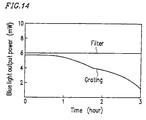
- Figure 14 shows temporal change in the output power of the short wavelength light source apparatus of the present example in comparison with a case where a grating is employed.
- the polarization inversion type waveguide element 306 is stable as a function of time as well, since the wavelength shifts by a smaller amount depending on the angle when using a filter than when using a grating.
- the wavelength does not shift depending on the angle by such a large amount as 28 nm/deg as in the case where a grating is used. Therefore, the adjustment using the thin film optical element 303 is facilitated, and the short wavelength light source apparatus is made stable against temporal deterioration even if configurated as a module.
- the short wavelength light source apparatus of the present example is stable against temperature changes as well (wavelength shift against temperature changes: 0.005 nm/°C).
- the short wavelength light source apparatus is also stable against changes in moisture.
- the ⁇ /2 plate 304 disposed in the optical system may alternatively be formed on the thin film optical element 303 . In that case, the number of the component elements of the short wavelength light source apparatus would be reduced, thereby facilitating further miniaturization of the short wavelength light source apparatus.
- the semiconductor laser 601 is a 150 mW-class single longitudinal mode laser with an oscillation wavelength of the 870 nm band.
- Reference numeral 602 denotes a collimating lens (N.A.: 0.55);
- 604 denotes a ⁇ /2 plate;
- 605 denotes a focusing lens for coupling light to the waveguide.
- a wavelength selection mirror 607 is an optical element for separating a harmonic wave obtained by wavelength conversion from the fundamental light.
- Laser light emitted from the semiconductor laser 601 is transmitted through the thin film optical element 603 , and then focused on the incident end face 608 of the polarization inversion type waveguide element 606 by the focusing lens 605 so as to be coupled to the waveguide.
- the fundamental wave (870 nm) coupled to the polarization inversion type waveguide element 606 is converted into a harmonic wave having a wavelength of 435 nm.
- blue light goes out through the incident end face 608 of the polarization inversion type waveguide element 606 .
- the blue light is separated from the fundamental wave by the wavelength selection mirror 607 .
- the polarization inversion type waveguide element 606 has a length of 10 mm and a conversion efficiency of 800%/W. As a result, a harmonic wave of about 30 mW is obtained, the fundamental wave power of about 70 mW being coupled to the waveguide.
- the polarization inversion type waveguide element 606 including a substrate composed of LiTaO 3 (LT) is used as an optical wavelength converting element in the short wavelength light source apparatus shown in Figure 6
- similarly stable short wavelength light can be obtained by using a polarization inversion type waveguide element including a substrate composed of LiNbO 3 (LN) or KTiOPO 4 (KTP), a phase matching type waveguide device composed of KN, etc., or the like.
- the polarization inversion type waveguide element 705 includes deep polarization-inverted layers (period: 4 ⁇ m) formed in a LiTaO 3 substrate by a similar manner to that used in Example 2.
- the reflectance of an incident end face 706 of the polarization inversion type bulk element 705 is reduced, preferably by providing an AR coating on the incident end face 706 , so as to utilize light reflected by an outgoing end face 707 as light returning to the semiconductor laser 701 .
- Light emitted from the semiconductor laser 701 is focused on the outgoing end face 707 of the polarization inversion type bulk element 705 .
- An outgoing end face of the semiconductor laser 701 and the incident end face 706 of the polarization inversion type bulk element 705 are confocally disposed. As a result, light reflected by the outgoing end face 707 is all optically fed back to an active layer of the semiconductor laser 701 . If the thin film optical element 703 is not provided, the above-mentioned reflected light (returned light) may cause the semiconductor laser 701 to have mode hopping or to have a multitude of modes.
- the thin film optical element 703 By disposing the thin film optical element 703 between the semiconductor laser 701 and the polarization inversion type bulk element 705 at an angle of 20° with the optical axis, it is ensured that only light having a wavelength in the vicinity of 870 nm is incident to the polarization inversion type bulk element 705 , so that only light having a wavelength in the vicinity of 870 nm which is reflected by the outgoing end face 707 is transmitted back through the thin film element 703 so as to be optically fed back to the semiconductor laser 701 . As a result, the longitudinal mode of the semiconductor laser 701 is stabilized as a single mode in the vicinity of 870 nm.
- the amount of light returning to the semiconductor laser 701 can be increased, so as to further stabilize the operation of the short wavelength light source apparatus.
- the thin film optical element 703 is disposed obliquely with respect to the optical axis of the semiconductor laser 701 .
- the thin film optical element 703 reflects light having wavelengths other than those in the vicinity of 870 nm. In other words, light having wavelengths other than those in the vicinity of 870 nm is not optically fed back to the active layer of the semiconductor laser 701 .
- the fundamental wave (870 nm) coupled to the polarization inversion type bulk element 705 is converted into a harmonic wave having a wavelength of 435 nm.
- An even higher harmonic output power can be obtained by using a 1 W-class single longitudinal mode laser including a light amplifying portion as the pump laser source.
- the harmonic output power can be stabilized by providing a rotation mechanism and a feedback circuit for the thin film optical element 703 , as in Example 3.
- the polarization inversion type waveguide element 705 including a substrate composed of LiTaO 3 (LT) is used as an optical wavelength converting element in the short wavelength light source apparatus shown in Figure 7
- similarly stable short wavelength light can be obtained by using: a polarization inversion type bulk element including a substrate composed of LiNbO 3 (LN) or KTiOPO 4 (KTP); or an organic or inorganic non-linear optical crystal (a ring resonator structure, phase matching type waveguide device, etc.) having a large non-linear optical constant, e.g. KNbO 3 (KN).
- an AR coating which does not reflect light having a wavelength of 870 nm on an incident end face of the optical wavelength converting element, and to provide an HR coating for reflecting light having a wavelength of 870 nm and an AR coating which does not reflect light having a wavelength of 435 nm on an outgoing end face of the optical wavelength converting element.
- the short wavelength light source apparatus of the present example incorporates a thin film optical element 803 (band-pass type filter) having a transmission spectrum shown in Figure 4 .
- a polarization inversion type bulk element 805 is used as an optical wavelength converting element.
- Light emitted from the semiconductor laser 801 is led through the thin film optical element 803 so as to be focused by the focusing lens 804 on the end face 808 of the polarization inversion type bulk element 805 .
- An outgoing end face of the semiconductor laser 801 and the end face 808 of the polarization inversion type bulk element 805 are confocally disposed.
- light reflected by the end face 808 is optically fed back to an active layer of the semiconductor laser 801 .
- the thin film optical element 803 is not provided, the above-mentioned reflected light (returned light) may cause the semiconductor laser 801 to have mode hopping or to have a multitude of modes.
- the fundamental wave (870 nm) coupled to the polarization inversion type bulk element 805 is converted into a harmonic wave having a wavelength of 435 nm.
- blue light goes out through the incident end face 807 of the polarization inversion type bulk element 805 .
- the blue light is separated from the fundamental wave by the wavelength selection mirror 806 .
- the polarization inversion type bulk element 805 has a length of 2 mm and a conversion efficiency of 32%/W. As a result, a harmonic wave of about 1.6 mW is obtained.
- the wavelength selection mirror 806 inserted in the optical system composed essentially of the collimating lens 802 and the focusing lens 804 may alternatively be formed on the thin film optical element 803 . In that case, the number of the component elements of the short wavelength light source apparatus would be reduced, thereby facilitating further miniaturization of the short wavelength light source apparatus.
- An even higher harmonic output power can be obtained by using a 1 W-class single longitudinal mode laser including a light amplifying portion as the pump laser source.
- the harmonic output power can be stabilized by providing a rotation mechanism and a feedback circuit for the thin film optical element 803 , as in Example 3.
- a transmission type filter composed essentially of a dielectric multilayer film 903 on an outgoing end of the semiconductor laser 901 , as is shown in Figure 9A . It is also applicable to provide a transmission type filter or reflective type filter composed essentially of a dielectric multilayer film 904 on an incident end face of a polarization inversion type waveguide element 902 . In this case, too, the oscillation wavelength of the semiconductor laser 901 can be stabilized. Thus, stable wavelength conversion and harmonic light can be provided.
- the polarization inversion type waveguide element A02 shown in Figure 10A is formed of an x-plate LiTaO 3 , since such a polarization inversion type waveguide element is more preferable because of the large coupling coefficient thereof with the semiconductor laser A01 .
- FIG. 10B As is shown in Figure 10B , light emitted from a semiconductor laser A05 is incident to an incident end face of the polarization inversion type bulk element A06 formed in a LiTaO 3 substrate.
- a transmission type filter A07 provided on the incident end face of the polarization inversion type bulk element A06 transmits only light having a wavelength in the vicinity of 870 nm, which light is led to an outgoing end face of the polarization inversion type bulk element A06 .
- the outgoing end face of the polarization inversion type bulk element A06 is processed to a spherical shape, and has a curvature of 10 mm.
- An HR coating for reflecting light having a wavelength of 870 nm and an AR coating which does not reflect light having a wavelength of 435 nm are provided on the outgoing end face of the polarization inversion type bulk element A06 .
- Light reflected by the outgoing end face of the polarization inversion type waveguide element A06 is transmitted back through the transmission type filter A07 , and is focused on an outgoing end face of the semiconductor laser A05 so as to be optically fed back to an active layer thereof.
- the oscillation wavelength of the semiconductor laser short wavelength light source apparatus is stabilized in the vicinity of 870 nm.
- the oscillation wavelength of a semiconductor laser can be varied by varying an angle ⁇ at which a thin film optical element is disposed.
- a polarization inversion type bulk element or waveguide element of the short wavelength light source apparatus as to have a polarization inversion period of a chirp structure or a split structure, light having short wavelengths corresponding to the varying oscillation wavelengths of the semiconductor laser can be obtained.
- the wavelength of the short wavelength light can be tuned by varying the incident angle of laser light at which the laser light enters the thin film optical element.
- the polarization-inverted layers in region I have a period of 3.6 ⁇ m; the polarization-inverted layers in region II have a period of 3.8 ⁇ m; and the polarization-inverted layers in region III have a period of 4.0 ⁇ m.
- Quasi-phase matching is achieved for light having wavelengths of 850 nm, 860 nm, and 870 nm in regions I , II , and III , respectively.
- Regions I , II , and III output harmonics having wavelengths of, respectively, 425 nm, 430 nm, and 435 nm.
- Figure 12 shows a short wavelength light source apparatus incorporating a polarization inversion type waveguide element C06 which is identical with the polarization inversion type waveguide element shown in Figure 11B .
- Reference numeral C01 denotes a 150 mW-class single longitudinal mode semiconductor laser
- C02 denotes a collimating lens (N.A.: 0.55)
- C03 denotes a thin film optical element
- C04 denotes a ⁇ /2 plate
- C05 denotes a focusing lens for coupling light to a waveguide formed in the polarization inversion type waveguide element.
- the thin film optical element C03 is a band-pass filter composed essentially of a dielectric multilayer film having a transmittance of about 85%, and has a transmission spectrum with peak wavelengths of 870 nm, 860 nm, and 850 nm at incident angles of 1°, 15°, and 20°, respectively.
- the wavelength of the output harmonic wave can be varied by adjusting the angle ⁇ at which the thin film optical element C03 shown in Figure 12 is disposed.
- the polarization inversion type waveguide element C06 includes an optical waveguide (width: 4 ⁇ m) and the polarization-inverted layers shown in Figure 11B formed in a LiTaO 3 substrate.
- An HR coating for reflecting light having a wavelength in the range of 850 nm to 870 nm is provided on an outgoing end face C08 of the polarization inversion type waveguide element C06 .
- An AR coating which does not reflect light having a wavelength in the range of 850 nm to 870 nm is provided on an incident end face C07 of the polarization inversion type waveguide element C06 .
- Light emitted from the semiconductor laser C01 is focused by the focusing lens C05 on the incident end face C07 of the polarization inversion type waveguide element C06 so as to be coupled to the waveguide.
- An outgoing end face of the semiconductor laser C01 and the incident end face C07 of the polarization inversion type element C06 are confocally disposed.
- the outgoing end face of the semiconductor laser C01 also constitutes a confocal system with the outgoing end face C08 of the polarization inversion type waveguide element C06 .
- light reflected by the outgoing end face C08 is all optically fed back to an active layer of the semiconductor laser C01 . If the thin film optical element C03 is not provided, the above-mentioned reflected light (returned light) may cause the semiconductor laser C01 to have mode hopping or to have a multitude of modes.
- the semiconductor laser C01 By disposing the thin film optical element C03 between the semiconductor laser C01 and the polarization inversion type waveguide element C06 at a certain angle with the optical axis, it is ensured that only light having a corresponding wavelength in a narrow range of band from 850 nm to 870 nm, emitted from the semiconductor laser C01 , is incident to the incident end face C07 of the polarization inversion type waveguide element C06 , so that only light having that wavelength which is reflected by the outgoing end face C08 is optically fed back to the semiconductor laser C01 .
- the semiconductor laser C01 stably oscillates in a single longitudinal mode, the oscillation wavelength being stabilized.
- a rotation monitor and/or a piezo element may be used as a rotation mechanism for rotating the thin film optical element C03 .
- the output power of the short wavelength light source apparatus can be stabilized by monitoring the harmonic output power and feeding back the monitored harmonic output power to the rotation mechanism.
- Figure 11C shows a polarization inversion type waveguide element having a chirp structure.
- the polarization inversion type waveguide element is 15 mm long.
- the polarization-inverted layers have a period of 3.6 ⁇ m at an end face 01 , and a period of 4.0 ⁇ m at an end face B02 , thus providing a linear chirp structure.
- This polarization inversion type waveguide element can be substituted for the polarization inversion type waveguide element C06 in the polarization inversion type waveguide element C06 shown in Figure 12 .
- the wavelength of the output harmonic wave can be continually varied by varying the angle ⁇ at which the thin film optical element C03 is disposed from 0° to 20°.
- a wavelength-variable short wavelength light source apparatus can also be realized by optically feeding back light reflected by the incident end face C07 , as is shown in Figure 3 .
- a short wavelength light source apparatus having four times as large an harmonic output power as that of the short wavelength light source apparatus shown in Figure 12 can be realized by providing an HR coating for reflecting the fundamental wave and the harmonic wave and by extracting the harmonic wave by means of a wavelength selection mirror.
- the polarization inversion type waveguide element C06 is used as an optical wavelength converting element in the short wavelength light source apparatus shown in Figure 12
- a similar wavelength-variable short wavelength light source apparatus can be realized by using a polarization inversion type bulk element having a split structure or a chirp structure. It is also applicable to use a LiNbO 3 or KTP substrate instead of a LiTaO 3 substrate.
- a transmission type filter is used as a thin film optical element in the short wavelength light source apparatus shown in Figure 12
- a similar wavelength-variable short wavelength light source apparatus can be realized by using a reflective type filter.
- An HR coating for reflecting light having a wavelength in the range of 850 nm to 870 nm, and an AR coating which does not reflect harmonic waves are provided on an outgoing end face of the polarization inversion type waveguide element.
- An AR coating which does not reflect light having a wavelength in the range of 850 nm to 870 nm is provided on an incident end face of the polarization inversion type waveguide element.
- phase matching wavelength By adjusting the phase matching wavelength to be a desired value in the range of 850 nm to 870 nm and by tuning the oscillation wavelength of the semiconductor laser to be the phase matching wavelength, a harmonic light having a desired wavelength in the range of 425 nm to 435 nm is obtained through the outgoing end face of the polarization inversion type waveguide element. As a result, a harmonic wave of about 10 mW is obtained, laser light of about 70 mW being coupled to the waveguide.
- the phase matching wavelength of the polarization inversion type waveguide element can be varied by varying the applied voltage.
- the wavelength-variable short wavelength light source apparatus capable of generating light in the blue wavelength band, has much use in the fields of measurement and communication as well as a wide range of applicability.
- the oscillation wavelength of a semiconductor laser of a short wavelength light source apparatus can also be adjusted to be the phase matching wavelength of the polarization inversion type waveguide element by using a Bragg's reflective type thin film optical element composed essentially of a plurality of periodically formed layers.
- a method for producing a Bragg's reflective type thin film optical element will be described.
- SiO 2 (refractive index: 1.46), SiO 2 having a different composition (refractive index: 1.48) are alternately formed with a period of 0.27 ⁇ m on a quartz substrate by means of an EB vapor deposition apparatus.
- About 100 such layers are laminated to form the Bragg's reflective type thin film optical element.
- a Bragg's reflective type thin film optical element is very practical because the spectrum width thereof can be easily adjusted by varying the number of the layers laminated.
- the oscillation wavelength of a semiconductor laser of a short wavelength light source apparatus incorporating this Bragg's reflective type thin film optical element instead of the band-stop filter shown in Figure 1 is stabilized at the phase matching wavelength.
- a stable harmonic output power can be obtained without any mode hopping.
- the Bragg's reflective type thin film optical element is formed on a quartz substrate so as to form a separate optical element.
- similar effects can be attained by forming a Bragg's reflective type thin film optical element directly on an incident end face or an outgoing end face of the polarization inversion type waveguide element, as shown in Figure 10 , or on an outgoing end face of the semiconductor laser, thus providing a stable blue/green light source apparatus.
- a Bragg's reflective type filter can also be realized by a holographical method where laser light of a predetermined wavelength is incident to a photorefractive material such as LT and LN doped with Fe in two directions so that the two laser light beams interfere with each other.
- Each of the transmission type or reflective type filters shown in Figures 1 , 3 , 5 , 6 , 7 , 8 , 12 , and 13 is a thin film optical element obtained by forming a dielectric multilayer film on a glass substrate having a thickness of 0.5 mm. It was found out that the oscillation wavelength becomes especially stable when the glass substrate has a thickness in the range of 0.2 mm to 2.0 mm. The oscillation wavelength becomes unstable when the thickness of the substrate is 0.2 mm or less because of the warping of the substrate after polishing. The oscillation wavelength has an aberration when the thickness of the substrate is 2.0 mm or more owing to the thickness of the substrate.
- a thin film optical element including a dielectric multilayer film formed on a glass substrate is used as an optical element for transmitting or reflecting light in a predetermined wavelength band.
- the longitudinal mode of the semiconductor laser can also be locked and stabilized by using the following as an optical element: an etalon element including a highly planar element polished so as to be highly planar and so as to have a high degree of parallelism and a reflective film formed on each side of the highly planar element; or a birefringence filter that utilizes interference between normal light and extraordinary light in a birefringence crystal plate.
- Etalon composed of synthetic quartz having a thickness of 50 ⁇ m, a reflectance of 85%, and a parallelism of ⁇ /10 is used in the present example.
- Etalon has peak transmittances at certain intervals when transmittance is regarded as a function of the wavelength of incident light.
- finesse F of the etalon is derived.
- the finesse F is expressed as a ratio between ⁇ v and the half width ⁇ v 1/2 of a certain mode.
- the finesse F of the etalon of the present example is 5.
- the value 1 nm of the half width of the etalon of the present example is substantially the same as that of a transmission type filter (thin film optical element).
- An interference pattern can be obtained by radiating light on a crystal panel interposed between two polarizing plates, corresponding to the change in the wavelength of the incident light.
- the interference patterns overlap with one another so that a sharp peak is left.
- a band-pass filter having a transmission spectrum width of about 0.1 nm is realized.
- the oscillation wavelength of the semiconductor laser can be stabilized also by using such a birefringence filter in the place of a thin film optical element.
- a short wavelength light source apparatus incorporating a semiconductor laser is likely to have the problem of unstable oscillation by the semiconductor laser due to light returning from an end face of an optical wavelength converting element or an end face of a laser medium.
- the optical component elements can be linearly disposed, thereby facilitating miniaturization of the short wavelength light source apparatus.
- a peak wavelength of the transmission spectrum of a transmission type filter generally has angle dependence.
- the peak wavelength of the transmission spectrum shifts by 1.5 nm/deg.
- the shift amount is 0.9 nm/deg.
- the peak wavelength makes substantially no shift depending on the angle.
- the oscillation wavelength of the semiconductor laser can be tuned to be the phase matching wavelength of the optical wavelength converting element.
- the shift amount of the transmission spectrum of a transmission filter is not so large as compared with that of a grating, e.g. 28 nm/deg.
- a transmission type filter to stabilize the oscillation wavelength of the semiconductor laser makes the necessary optical adjustment easier than using grating feedback technique. It will be appreciated that use of a transmission type filter (thin film optical element) for stabilization of the oscillation wavelength of the semiconductor laser has great practical effects.
- a short wavelength light source apparatus is stable against temperature changes, having a wavelength shift of 0.005 nm/°C, and is also stable against changes in moisture. Since it is not composed of resin unlike a grating, the entire short wavelength light source apparatus is made reliable.
- oscillation wavelength locking Even more stable oscillation wavelength (oscillation wavelength locking) can be achieved by incorporating an etalon or a birefringence filter, since the half width of the transmission spectrum of such elements can be reduced to about 0.1 nm.
Landscapes
- Physics & Mathematics (AREA)
- Electromagnetism (AREA)
- Engineering & Computer Science (AREA)
- Plasma & Fusion (AREA)
- Optics & Photonics (AREA)
- Nonlinear Science (AREA)
- Semiconductor Lasers (AREA)
- Optical Modulation, Optical Deflection, Nonlinear Optics, Optical Demodulation, Optical Logic Elements (AREA)
- Lasers (AREA)
Claims (63)
- Vorrichtung mit kurzwellenlängiger bzw. Kurzwellen-Lichtquelle mit:einem Halbleiterlaser (101), welcher eine aktive Schicht zum Emittieren bzw. Aussenden von Laser-Licht aufweist;einem optischen Element (106) zum Umwandeln (converting) der Wellenlänge, zum Empfangen bzw. Aufnehmen von mindestens einem Teil des Laser-Lichtes, welches von dem Halbleiter-Laser (101) emittiert bzw. ausgesandt wird, und zum Erzeugen eines Lichts mit kurzer Wellenlänge, welches eine Wellenlänge aufweist, welche kürzer ist als die Wellenlänge des Laser-Lichtes; undeinem optischen Element (103), welches zwischen dem Halbleiter-Laser (101) und dem optischen Element (106) zum Umwandeln der Wellenlänge angeordnet ist, zum selektiven bzw. ausgewählten Reflektieren eines Teils des Laser-Lichtes, welches zu einem vorgegebenen bzw. bestimmten Wellenlängenband gehört, und zum Rückkoppeln bzw. Rückführen (feed back) des reflektierten Lichts zur der aktiven Schicht des Halbleiterlasers (101), um so eine stabile Oszillation bzw. Schwingung in einem einzelnen longitudinalen Modus zu erhalten,
dadurch gekennzeichnet, dassdas optische Element (103) ein optisches Dünnfilmelement (103) ist, welches dielelektrische Schichten aufweist,das optische Element (106) zum Umwandeln der Wellenlänge ein Polarisations-Umkehrungs- bzw. -Inversions-Element eines Quasi-Phasenanpassungs-Typs (QPM; quasi-phase-matching) mit einem Wellenleiter ist, unddie Polarisationsrichtung des von dem Halbleiterlaser (101) emittierten bzw. ausgesandten Laserlichtes so festgelegt bzw. eingestellt ist, dass sie mit der Polarisationsrichtung des Wellenleiters des optischen Elements (106) zum Umwandeln der Wellenlänge zusammenfällt bzw. übereinstimmt. - Vorrichtung mit Kurzwellen-Lichtquelle nach Anspruch 1, wobei das optische Element (106) zum Umwandeln der Wellenlänge in einem LiNbxTa1-xO3 (0 ≤ x ≤ 1) Substrat oder einem K1-xRbxTiOMO4 (0 ≤ x ≤ 1;
- Vorrichtung mit Kurzwellen-Lichtquelle nach einem der Ansprüche 1 oder 2, wobei das optische Element (103) ein optisches Dünnfilmelement eines reflektierenden Bragg-Typs ist und dielektrische Schichten aufweist, welche verschiedene Brechungsindizes haben, wobei die dielektrischen Schichten mit einer vorgegebenen Periode bzw. in einem bestimmten Abstand ausgebildet sind.
- Vorrichtung mit Kurzwellen-Lichtquelle nach einem der Ansprüche 1 oder 2, wobei das optische Element ein optisches Dünnfilmelement (103) ist, welches ein Substrat und einen dielektrischen Mehr- bzw. Vielschicht- (multilayer) Film aufweist, welcher auf dem Substrat ausgebildet ist.
- Vorrichtung mit Kurzwellen-Lichtquelle nach einem der Ansprüche 1 oder 2, wobei das optische Element (103) einen dielektrischen Mehrschichtfilm (303) aufweist, welcher auf einer Eintritts- bzw. Einfalls-Endoberfläche oder einer Auslass- bzw. Austritts-Endoberfläche von mindestens dem Halbleiterlaser (101) oder dem optischen Element zum Umwandeln der Wellenlänge (106) ausgebildet ist.
- Vorrichtung mit Kurzwellen-Lichtquelle nach einem der Ansprüche 1 bis 5, weiter aufweisend mehr als ein optisches Element neben dem optischen Dünnfilmelement (103).
- Vorrichtung mit Kurzwellen-Lichtquelle nach einem der vorhergehenden Ansprüche, wobei das optische Element (103) einen Dünnfilm (304) aufweist, welcher als eine λ/2-Platte bzw. -Schicht für die Wellenlänge des Laserlichtes wirkt.
- Vorrichtung mit Kurzwellen-Lichtquelle nach einem der vorhergehenden Ansprüche, wobei eine λ/2-Platte (104) zwischen dem Halbleiterlaser (101) und dem Polarisations-Umkehrungs- bzw. -Inversions-Element (106) vom QPM-Typ angeordnet ist.
- Vorrichtung mit Kurzwellen-Lichtquelle mit:einem Halbleiterlaser (301), welcher eine aktive Schicht zum Emittieren bzw. Aussenden von Laser-Licht aufweist;einem optischen Element (306) zum Umwandeln (converting) der Wellenlänge, zum Empfangen von mindestens einem Teil des Laser-Lichtes, welches von dem Halbleiter-Laser (301) emittiert bzw. ausgesandt wird, und zum Erzeugen eines Lichts mit kurzer Wellenlänge, welches eine Wellenlänge aufweist, welche kürzer ist als die Wellenlänge des Laser-Lichtes;wobei das optische Element (306) zum Umwandeln der Wellenlänge eine Einfallsendoberfläche (307) zum Empfangen bzw. Aufnehmen von mindestens einem Teil des Laserlichtes aufweist, und eine Austrittsendoberfläche, durch welche das Licht mit kurzer Wellenlänge austritt; undeinem optischen Element (303), welches zwischen dem Halbleiterlaser (301) und dem optischen Element (306) zum Umwandeln der Wellenlänge angeordnet ist;
dadurch gekennzeichnet, dassdas optische Element (303) ein optisches Dünnfilmelement (303) ist, welches dielektrische Schichten aufweist, zum selektiven bzw. ausgewählten Übertragen bzw. Übermitteln eines Teils des Laserlichtes, welches zu einem vorgegebenen Wellenlängenband gehört, dassdas optische Element zum Umwandeln der Wellenlänge ein Polarisations-Umkehrungs- bzw. -Inversions-Element eines Quasi-Phasenanpassungs-Typs (QPM; quasi-phase-matching) mit einem Wellenleiter ist,der Halbleiterlaser (301) und das optische Element (306) zum Umwandeln der Wellenlänge in einer solchen Art angeordnet sind, dass der Teil des Laserlichtes, welcher durch bzw. über das optische Element (303) übertragen wird, durch die bzw. an der Einfallsendoberfläche (307) des optischen Elements (306) zum Umwandeln der Wellenlänge reflektiert wird, um so zurück durch bzw. über das optische Dünnfilmelement (303) übertragen zu werden und zu der aktiven Schicht des Halbleiterlasers (301) rückgekoppelt bzw. zurückgeführt zu werden, um so eine stabile Schwingung bzw. Oszillation in einem einzelnen longitudinalen Modus zu erhalten bzw. erzielen, und dassdie Polarisationsrichtung des Laserlichtes, welches von dem Halbleiterlaser (301) emittiert bzw. ausgesandt wird, so eingestellt bzw. festgelegt ist, dass sie mit der Polarisationsrichtung des Wellenleiters des optischen Elements (306) zum Umwandeln der Wellenlänge zusammenfällt bzw. übereinstimmt. - Vorrichtung mit Kurzwellen-Lichtquelle nach Anspruch 9, wobei das optische Element (106) zum Umwandeln der Wellenlänge in einem LiNbxTa1-xO3 (0 ≤ x ≤ 1) Substrat oder einem K1-xRbxTiOMO4 (0 ≤ x ≤ 1;
- Vorrichtung mit Kurzwellen-Lichtquelle nach Anspruch 9, wobei das optische Element zum Umwandeln der Wellenlänge in eine Mehrzahl von Bereichen aufgeteilt bzw. unterteilt ist, welche voneinander verschiedene Polarisations-Umkehr- bzw. -Inversions-Perioden bzw. -Abstände aufweisen.
- Vorrichtung mit Kurzwellen-Lichtquelle nach Anspruch 11, wobei die Wellenlänge des Lichts, welches auf das optische Element zum Umwandeln der Wellenlänge einfällt, durch Verändern bzw. Einstellen des Winkels des optischen Elements so eingestellt bzw. angepasst ist, dass sie eine phasenangepasste bzw. in der Phase passende (phase matching) Wellenlänge des optischen Elements zum Umwandeln der Wellenlänge ist, wodurch die Wellenlänge des kurzwellenlängigen bzw. Kurzwellenlichtes verändert bzw. eingestellt wird.
- Vorrichtung mit Kurzwellen-Lichtquelle nach Anspruch 9, wobei das optische Element zum Umwandeln der Wellenlänge eine Chirp-Struktur aufweist mit einer schwankenden bzw. unterschiedlichen Polarisations-Inversions- bzw. - Umkehr-Periode bzw. -Abstand.
- Vorrichtung mit Kurzwellen-Lichtquelle nach Anspruch 13, wobei die Wellenlänge des Lichtes, welches auf das optische Element zum Umwandeln der Wellenlänge einfällt, so eingestellt bzw. abgeglichen wird, dass es eine phasenangepasste bzw. phasenabgeglichene Wellenlänge des optischen Elements zum Umwandeln der Wellenlänge ist, durch Verändern bzw. Einstellen des Winkels des optischen Elements, wodurch die Wellenlänge des Kurzwellenlichts verändert bzw. eingestellt wird.
- Vorrichtung mit Kurzwellen-Lichtquelle nach einem der Ansprüche 9 bis 14, wobei das optische Element (503) ein optisches Dünnfilmelement ist und ein Substrat und einen dielektrischen Mehrschichtfilm aufweist, welcher auf dem Substrat ausgebildet ist.
- Vorrichtung mit Kurzwellen-Lichtquelle nach einem der Ansprüche 9 bis 14, wobei das optische Element einen dielektrischen Mehrschichtfilm aufweist, welcher auf einer Einfallsendoberfläche oder einer Austrittsendoberfläche von dem Halbleiterlaser und/oder dem optischen Element zum Umwandeln der Wellenlänge ausgebildet ist.
- Vorrichtung mit Kurzwellen-Lichtquelle nach einem der Ansprüche 9 bis 14, wobei das optische Element mit einem Winkel in Bezug auf die optische Achse des Halbleiterlasers angeordnet ist.
- Vorrichtung mit Kurzwellen-Lichtquelle nach einem der Ansprüche 9 bis 15, weiter aufweisend einen Dreh- bzw. Rotations-Mechanismus zum Drehen des optischen Elements (503).
- Vorrichtung mit Kurzwellen-Lichtquelle nach Anspruch 18 weiter aufweisend eine Vorrichtung zum Verändern der phasenangepassten bzw. phasenabgeglichenen Wellenlänge des optischen Elements (506) zum Umwandeln der Wellenlänge, wobei eine Wellenlänge des Lichts, welches auf das optische Element (506) zum Umwandeln der Wellenlänge einfällt, so eingestellt bzw. abgeglichen ist, dass sie die phasenangepasste Wellenlänge ist, indem der Winkel des optischen Elements verändert wird, wodurch die Wellenlänge des Kurzwellenlichtes verändert wird.
- Vorrichtung mit Kurzwellen-Lichtquelle nach Anspruch 18, wobei die Wellenlänge des Lichtes, welches auf das optische Element (506) zum Umwandeln der Wellenlänge einfällt, so eingestellt bzw. abgeglichen ist, dass sie eine phasenangepasste Wellenlänge des optischen Elements (506) zum Umwandeln der Wellenlänge ist, indem der Winkel des optischen Elements (503) verändert wird, wodurch die Wellenlänge des Kurzwellenlichtes verändert wird.
- Vorrichtung mit Kurzwellen-Lichtquelle nach Anspruch 18, wobei der Drehmechanismus einen Rückkopplungs- bzw. Rückführungsschaltkreis aufweist zum Regeln bzw. Steuern der Ausgangsleistung des Kurzwellenlichtes, so dass diese konstant ist.
- Vorrichtung mit Kurzwellen-Lichtquelle nach Anspruch 18, wobei der Drehmechanismus ein Piezo-Element aufweist.
- Vorrichtung mit Kurzwellen-Lichtquelle nach Anspruch 18, wobei der Drehmechanismus einen Aktor bzw. Aktuator bzw. ein Einstellglied aufweist.
- Vorrichtung mit Kurzwellen-Lichtquelle nach einem der Ansprüche 9 bis 23 weiter aufweisend mehr als ein optisches Element außer bzw. neben dem optischen Element.
- Vorrichtung mit Kurzwellen-Lichtquelle nach Anspruch 18, wobei der Drehmechanismus einen Dünnfilm aufweist, welcher als eine λ/2-Platte bezüglich der Wellenlänge des Laserlichtes wirkt.
- Vorrichtung mit Kurzwellen-Lichtquelle nach einem der Ansprüche 9 bis 24, wobei eine λ/2-Platte (304) zwischen dem Halbleiterlaser (301) und dem Element (306) angeordnet ist.
- Vorrichtung mit Kurzwellen-Lichtquelle mit:einem Halbleiterlaser (501), welcher eine aktive Schicht zum Emittieren bzw. Aussenden von Laser-Licht aufweist;einem optischen Element (506) zum Umwandeln (converting) der Wellenlänge zum Empfangen von mindestens einem Teil des Laser-Lichtes, welches von dem Halbleiter-Laser (501) emittiert bzw. ausgesandt wird, und zum Erzeugen eines Lichts mit kurzer Wellenlänge, welches eine Wellenlänge aufweist, welche kürzer ist als die Wellenlänge des Laser-Lichtes;wobei das optische Element (506) zum Umwandeln der Wellenlänge eine Einfallsendoberfläche (507) aufweist zum Aufnehmen bzw. Empfangen von mindestens einem Teil des Laserlichtes, und eine Austrittsendoberfläche (508), durch welche das Kurzwellenlicht austritt; undeinem optischen Element (503), welches zwischen dem Halbleiterlaser (501) und dem optischen Element (506) zum Umwandeln der Wellenlänge angeordnet ist,
dadurch gekennzeichnet, dassdas optische Element (506) zum Umwandeln der Wellenlänge (506) ein Polarisations-Umkehrungs- bzw. -Inversions-Element eines Quasi-Phasenanpassungs-Typs (QPM; quasi-phase-matching) mit einem Wellenleiter ist, unddas optische Element (503) ein optisches Dünnfilmelement ist, welches dielektrische Schichten aufweist zum selektiven bzw. ausgewählten Übertragen eines Teils des Laserlichtes, welches zu einem vorgegebenen Wellenlängenband gehört, wobei der Halbleiterlaser (501) und das optische Element (506) zum Umwandeln der Wellenlänge auf eine solche Art angeordnet sind, dass der Teil des Laserlichts, welcher durch bzw. über das optische Dünnfilmelement (503) übertragen wird, in das optische Element (506) zum Umwandeln der Wellenlänge bei seiner Einfallsendoberfläche (507) eintritt und danach an bzw. von der Austrittsendoberfläche (508) des optischen Elements zum Umwandeln der Wellenlänge (506) so reflektiert wird, dass es zurück durch bzw. über das optische Dünnfilmelement (503) übertragen bzw. übermittelt wird und zu der aktiven Schicht des Halbleiterlasers (501) rückgekoppelt bzw. rückgeführt wird, um eine stabile Oszillation bzw. Schwingung in einem einzelnen longitudinalen Modus zu erhalten, unddie Polarisationsrichtung des Laserlichts, welches von dem Halbleiterlaser (501) emittiert bzw. ausgesandt wird, ist so eingestellt bzw. festgelegt, dass diese mit der Polarisationsrichtung des Wellenleiters des optischen Elements (506) zum Umwandeln der Wellenlänge zusammenfällt. - Vorrichtung mit Kurzwellen-Lichtquelle nach Anspruch 27, wobei das optische Element (506) zum Umwandeln der Wellenlänge in einem LiNbxTa1-xO3 (0 ≤ x ≤ 1) Substrat oder einem K1-xRbxTiOMO4 (0 ≤ x ≤ 1;
- Vorrichtung mit Kurzwellen-Lichtquelle nach Anspruch 27, wobei das optische Element (506) zum Umwandeln der Wellenlänge in eine Mehrzahl von Bereichen unterteilt ist, welche voneinander verschiedene Polarisations-Inversions- bzw. -Umkehr-Perioden bzw. -Abstände aufweisen.
- Vorrichtung mit Kurzwellen-Lichtquelle nach Anspruch 29, wobei die Wellenlänge des Lichtes, welches auf das optische Element (506) zum Umwandeln der Wellenlänge einfällt bzw. auftrifft, so eingestellt bzw. angepasst ist, dass sie eine phasenangepasste Wellenlänge ist, durch Verändern des Winkels des optischen Elements, wodurch die Wellenlänge des Kurzwellenlichtes verändert wird.
- Vorrichtung mit Kurzwellen-Lichtquelle nach Anspruch 27, wobei das optische Element (506) zum Umwandeln der Wellenlänge eine Chirp-Struktur aufweist mit einer schwankenden bzw. unterschiedlichen Polarisations-Inversions- bzw. -Umkehr-Periode bzw. -Abstand.
- Vorrichtung mit Kurzwellen-Lichtquelle nach Anspruch 31, wobei die Wellenlänge des Lichtes, welches auf das optische Element zum Umwandeln der Wellenlänge einfällt, so eingestellt bzw. abgeglichen ist, dass sie eine phasenangepasste bzw. phasenabgeglichene Wellenlänge des optischen Elements zum Umwandeln der Wellenlänge ist, durch Verändern bzw. Einstellen des Winkels des optischen Elements, wodurch die Wellenlänge des Kurzwellenlichts verändert bzw. eingestellt wird.
- Vorrichtung mit Kurzwellen-Lichtquelle nach einem der Ansprüche 27 bis 32, wobei das optische Element ein optisches Dünnfilmelement (503) ist und ein Substrat und einen dielektrischen Mehrschichtfilm aufweist, welcher auf dem Substrat ausgebildet ist.
- Vorrichtung mit Kurzwellen-Lichtquelle nach einem der Ansprüche 27 bis 32, wobei das optische Element (503) einen dielektrischen Mehrschichtfilm aufweist, welcher auf einer Einfallsendoberfläche oder einer Austrittsendoberfläche von dem Halbleiterlaser (501) und/oder dem optischen Element zum Umwandeln der Wellenlänge (506) ausgebildet ist.
- Vorrichtung mit Kurzwellen-Lichtquelle nach einem der Ansprüche 27 bis 32, wobei das optische Element (503) mit einem Winkel in Bezug auf die optische Achse des Halbleiterlasers (501) angeordnet ist.
- Vorrichtung mit Kurzwellen-Lichtquelle nach einem der Ansprüche 27 bis 35, weiter aufweisend einen Dreh- bzw. Rotations-Mechanismus zum Drehen des optischen Elements (503).
- Vorrichtung mit Kurzwellen-Lichtquelle nach Anspruch 36 weiter aufweisend eine Vorrichtung zum Verändern der phasenangepassten Wellenlänge des optischen Elements zum Umwandeln der Wellenlänge, wobei eine Wellenlänge des Lichts, welches auf das optische Element zum Umwandeln der Wellenlänge einfallt, so eingestellt bzw. abgeglichen wird, dass sie die phasenangepasste Wellenlänge ist, indem der Winkel des optischen Elements verändert wird, wodurch die Wellenlänge des Kurzwellenlichtes verändert wird.
- Vorrichtung mit Kurzwellen-Lichtquelle nach Anspruch 36, wobei die Wellenlänge des Lichtes, welches auf das optische Element zum Umwandeln der Wellenlänge einfällt, so eingestellt bzw. abgeglichen ist, dass sie eine phasenangepasste Wellenlänge des optischen Elements zum Umwandeln der Wellenlänge ist, indem der Winkel des optischen Elements verändert wird, wodurch die Wellenlänge des Kurzwellenlichtes verändert wird.
- Vorrichtung mit Kurzwellen-Lichtquelle nach Anspruch 36, wobei der Drehmechanismus einen Rückkopplungs- bzw. Rückführungsschaltkreis aufweist zum Regeln bzw. Steuern der Ausgangsleistung des Kurzwellenlichtes, so dass diese konstant ist.
- Vorrichtung mit Kurzwellen-Lichtquelle nach Anspruch 36, wobei der Drehmechanismus ein Piezo-Element aufweist.
- Vorrichtung mit Kurzwellen-Lichtquelle nach Anspruch 36, wobei der Drehmechanismus einen Aktor bzw. Aktuator bzw. ein Einstellglied aufweist.
- Vorrichtung mit Kurzwellen-Lichtquelle nach einem der Ansprüche 27 bis 41 weiter aufweisend mehr als ein optisches Element außer bzw. neben dem optischen Dünnfilmelement.
- Vorrichtung mit Kurzwellen-Lichtquelle nach einem der Ansprüche 27 bis 42, wobei das optische Dünnfilmelement (603) einen Dünnfilm (604) aufweist, welcher als eine λ/2-Platte für die bzw. bezüglich der Wellenlänge des Laserlichtes wirkt.
- Vorrichtung mit Kurzwellen-Lichtquelle nach einem der Ansprüche 27 bis 42, wobei eine λ/2-Platte (504) zwischen dem Halbleiterlaser (501) und dem Element angeordnet ist.
- Vorrichtung mit Kurzwellen-Lichtquelle mit:einem Halbleiterlaser (601), welcher eine aktive Schicht zum Emittieren bzw. Aussenden von Laser-Licht aufweist;einem optischen Element (606) zum Umwandeln (converting) der Wellenlänge zum Empfangen von mindestens einem Teil des Laser-Lichtes, welches von dem Halbleiter-Laser (601) emittiert bzw. ausgesandt wird, und zum Erzeugen eines Lichts mit kurzer Wellenlänge, welches eine Wellenlänge aufweist, welche kürzer ist als die Wellenlänge des Laser-Lichtes;wobei das optische Element (606) zum Umwandeln der Wellenlänge einen Wellenleiter aufweist und eine Einfallsendoberfläche (680) aufweist zum Empfangen bzw. Aufnehmen von mindestens einem Teil des Laserlichts, und eine Ausgangs- bzw. Austrittsendoberfläche (608), undeinem optischen Element (603), welches zwischen dem Halbleiterlaser (601) und dem optischen Element (605) zum Umwandeln der Wellenlänge angeordnet ist,
dadurch gekennzeichnet, dassdas optische Element zum Umwandeln der Wellenlänge ein Polarisations-Umkehrungs- bzw. -Inversions-Element eines Quasi-Phasenanpassungs-Typs (QPM; quasi-phase-matching) ist,das optische Element ein optisches Dünnfilmelement (603) ist und dielektrische Schichten aufweist zum selektiven bzw. ausgewählten Übertragen eines Teils des Laserlichtes, welches zu dem vorgegebenen bzw. bestimmten Wellenlängenband gehört,ein Wellenlängenauswahlspiegel (607) vorgesehen ist zum selektiven Übertragen eines Teils des Laserlichts, welches zu einem vorgegebenen Wellenlängenband gehört, und zum Reflektieren des Kurzwellenlängenlichts, wobei der Wellenlängenauswahlspiegel (607) zwischen dem Halbleiterlaser (601) und dem optischen Element (606) zum Umwandeln der Wellenlänge angeordnet ist, undein Teil des Laserlichts, welcher zu dem vorgegebenen Wellenlängenband gehört, wird durch bzw. über das optische Dünnfilmelement (603) und den Wellenlängenauswahlspiegel (607) übertragen bzw. übermittelt, von der Einfallsendoberfläche (680) des optischen Elements (606) zum Umwandeln der Wellenlänge reflektiert, und danach zurück übertragen durch bzw. über das optische Dünnfilmelement (603) und den Wellenlängenauswahlspiegel (607), um so zu der aktiven Schicht des Halbleiterlasers (601) zurückgeführt bzw. rückgekoppelt zu werden, um eine stabile Oszillation bzw. Schwingung in einem einzelnen longitudinalen Modus zu erhalten,das Kurzwellenlängenlicht, welches von dem optischen Element (606) zum Umwandeln der Wellenlänge erzeugt wird, wird von bzw. an der Austrittsendoberfläche (680) des optischen Elements (606) zum Umwandeln der Wellenlänge reflektiert, zurück durch den Wellenleiter übertragen bzw. breitet sich durch diesen aus, und wird danach in einer vorgegebenen Richtung durch den Wellenlängenauswahlspiegel (607) reflektiert, unddie Polarisationsrichtung des Laserlichtes, welches von dem Halbleiterlaser (601) emittiert bzw. ausgesandt ist, wird so eingestellt bzw. festgelegt, dass sie mit der Polarisationsrichtung eines Wellenleiters des optischen Elements (605) zum Umwandeln der Wellenlänge übereinstimmt bzw. zusammenfällt. - Vorrichtung mit Kurzwellen-Lichtquelle nach Anspruch 45, wobei das optische Element (605) zum Umwandeln der Wellenlänge in einem LiNbxTa1-xO3 (0 ≤ x ≤ 1) Substrat oder einem K1-xRbxTiOMO4 (0 ≤ x ≤ 1;
- Vorrichtung mit Kurzwellen-Lichtquelle nach einem der Ansprüche 45 oder 46, wobei das optische Element (605) zum Umwandeln der Wellenlänge in eine Mehrzahl von Bereichen unterteilt ist, welche voneinander verschiedene Polarisations-Inversions- bzw. -Umkehr-Perioden bzw. -Abstände aufweisen
- Vorrichtung mit Kurzwellen-Lichtquelle nach Anspruch 47, wobei die Wellenlänge des Lichtes, welches auf das optische Element (605) zum Umwandeln der Wellenlänge einfällt, so eingestellt bzw. abgeglichen ist, dass sie eine phasenangepasste Wellenlänge des optischen Elements zum Umwandeln der Wellenlänge ist, durch Verändern bzw. Einstellen des Winkels des optischen Elements, wodurch die Wellenlänge des Kurzwellenlängenlichts verändert wird.
- Vorrichtung mit Kurzwellen-Lichtquelle nach Anspruch 46, wobei das optische Element zum Umwandeln der Wellenlänge eine Chirp-Struktur aufweist mit einer schwankenden bzw. unterschiedlichen Polarisations-Inversions- bzw. - Umkehr-Periode bzw. -Abstand.
- Vorrichtung mit Kurzwellen-Lichtquelle nach Anspruch 49, wobei die Wellenlänge des Lichtes, welches auf das optische Element zum Umwandeln der Wellenlänge einfällt, so eingestellt bzw. abgeglichen ist, dass sie eine phasenangepasste bzw. phasenabgeglichene Wellenlänge des optischen Elements zum Umwandeln der Wellenlänge ist, durch Verändern bzw. Einstellen des Winkels des optischen Elements, wodurch die Wellenlänge des Kurzwellenlichts verändert bzw. eingestellt wird.
- Vorrichtung mit Kurzwellen-Lichtquelle nach einem der Ansprüche 45 bis 50, wobei das optische Element (603) ein optisches Dünnfilmelement ist und ein Substrat und einen dielektrischen Mehrschichtfilm aufweist, welcher auf dem Substrat ausgebildet ist.
- Vorrichtung mit Kurzwellen-Lichtquelle nach einem der Ansprüche 45 bis 50, wobei das optische Element einen dielektrischen Mehrschichtfilm aufweist, welcher auf einer Einfallsendoberfläche oder einer Austrittsendoberfläche von dem Halbleiterlaser (601) und/oder dem optischen Element zum Umwandeln der Wellenlänge (605) ausgebildet ist.
- Vorrichtung mit Kurzwellen-Lichtquelle nach einem der Ansprüche 45 bis 50, wobei das optische Element (603) mit bzw. unter einem Winkel in Bezug auf die optische Achse des Halbleiterlasers (601) angeordnet ist.
- Vorrichtung mit Kurzwellen-Lichtquelle nach einem der Ansprüche 45 bis 53, weiter aufweisend einen Dreh- bzw. Rotations-Mechanismus zum Drehen des optischen Elements (603).
- Vorrichtung mit Kurzwellen-Lichtquelle nach Anspruch 54, weiter aufweisend eine Vorrichtung zum Verändern der phasenangepassten Wellenlänge des optischen Elements (605) zum Umwandeln der Wellenlänge, wobei die Wellenlänge des Lichts, welches auf das optische Element zum Umwandeln der Wellenlänge einfällt, so eingestellt bzw. abgeglichen ist, dass es die phasenangepasste Wellenlänge ist, indem der Winkel des optischen Elements (603) verändert wird, wodurch die Wellenlänge des Kurzwellenlichtes verändert wird.
- Vorrichtung mit Kurzwellen-Lichtquelle nach Anspruch 54, wobei die Wellenlänge des Lichtes, welches auf das optische Element zum Umwandeln der Wellenlänge einfallt, so eingestellt bzw. abgeglichen ist, dass es eine phasenangepasste Wellenlänge des optischen Elements zum Umwandeln der Wellenlänge ist, indem der Winkel des optischen Elements verändert wird, wodurch die Wellenlänge des Kurzwellenlichtes verändert wird.
- Vorrichtung mit Kurzwellen-Lichtquelle nach Anspruch 54, wobei der Drehmechanismus einen Rückkopplungs- bzw. Rückführungsschaltkreis aufweist zum Regeln bzw. Steuern der Ausgangsleistung des Kurzwellenlichtes, so dass diese konstant ist.
- Vorrichtung mit Kurzwellen-Lichtquelle nach Anspruch 54, wobei der Drehmechanismus ein Piezo-Element aufweist.
- Vorrichtung mit Kurzwellen-Lichtquelle nach Anspruch 54, wobei der Drehmechanismus einen Aktor bzw. Aktuator bzw. ein Einstellglied aufweist.
- Vorrichtung mit Kurzwellen-Lichtquelle nach einem der Ansprüche 45 bis 59, weiter aufweisend mehr als ein optisches Element außer bzw. neben dem optischen Element (603).
- Vorrichtung mit Kurzwellen-Lichtquelle nach einem der Ansprüche 45 bis 60, wobei das optische Element einen Dünnfilm aufweist, welcher als eine λ/2-Platte für die Wellenlänge des Laserlichtes wirkt.
- Vorrichtung mit Kurzwellen-Lichtquelle nach einem der Ansprüche 45 bis 61, wobei der Spiegel zum Auswählen bzw. zur Selektion der Wellenlänge, welcher als ein Film des Durchgangs- bzw . Transmissions-Typs bezüglich des Laserlichts wirkt und als ein Film eines reflektierenden Typs bezüglich des Kurzwellenlängenlichts wirkt, auf dem optischen Element vorgesehen ist.
- Vorrichtung mit Kurzwellen-Lichtquelle nach einem der Ansprüche 45 bis 62, wobei eine λ/2-Platte zwischen dem Halbleiterlaser (601) und dem Umwandlungselement (605) angeordnet ist.
Priority Applications (1)
| Application Number | Priority Date | Filing Date | Title |
|---|---|---|---|
| EP96110043A EP0738031B1 (de) | 1993-05-21 | 1994-05-20 | Vorrichtung mit kurzwelliger Lichtquelle |
Applications Claiming Priority (9)
| Application Number | Priority Date | Filing Date | Title |
|---|---|---|---|
| JP11974293 | 1993-05-21 | ||
| JP11974293 | 1993-05-21 | ||
| JP119742/93 | 1993-05-21 | ||
| JP246529/93 | 1993-10-01 | ||
| JP24652993 | 1993-10-01 | ||
| JP24652993 | 1993-10-01 | ||
| JP24788393 | 1993-10-04 | ||
| JP24788393 | 1993-10-04 | ||
| JP247883/93 | 1993-10-04 |
Related Child Applications (1)
| Application Number | Title | Priority Date | Filing Date |
|---|---|---|---|
| EP96110043A Division EP0738031B1 (de) | 1993-05-21 | 1994-05-20 | Vorrichtung mit kurzwelliger Lichtquelle |
Publications (2)
| Publication Number | Publication Date |
|---|---|
| EP0625811A1 EP0625811A1 (de) | 1994-11-23 |
| EP0625811B1 true EP0625811B1 (de) | 2000-02-16 |
Family
ID=27313896
Family Applications (2)
| Application Number | Title | Priority Date | Filing Date |
|---|---|---|---|
| EP96110043A Expired - Lifetime EP0738031B1 (de) | 1993-05-21 | 1994-05-20 | Vorrichtung mit kurzwelliger Lichtquelle |
| EP94107841A Expired - Lifetime EP0625811B1 (de) | 1993-05-21 | 1994-05-20 | Vorrichtung mit kurzwellenlängiger Lichtquelle |
Family Applications Before (1)
| Application Number | Title | Priority Date | Filing Date |
|---|---|---|---|
| EP96110043A Expired - Lifetime EP0738031B1 (de) | 1993-05-21 | 1994-05-20 | Vorrichtung mit kurzwelliger Lichtquelle |
Country Status (2)
| Country | Link |
|---|---|
| EP (2) | EP0738031B1 (de) |
| DE (2) | DE69427771T2 (de) |
Families Citing this family (14)
| Publication number | Priority date | Publication date | Assignee | Title |
|---|---|---|---|---|
| US5640405A (en) * | 1996-02-01 | 1997-06-17 | Lighthouse Electronics Corporation | Multi quasi phase matched interactions in a non-linear crystal |
| JP2008538163A (ja) * | 2005-03-30 | 2008-10-09 | ノバラックス,インコーポレイティド | 周波数安定化した垂直拡大キャビティ面発光レーザ |
| WO2006112412A1 (ja) | 2005-04-15 | 2006-10-26 | Sumitomo Osaka Cement Co., Ltd. | レーザ光発生装置および発生方法 |
| WO2007013608A1 (ja) | 2005-07-28 | 2007-02-01 | Matsushita Electric Industrial Co., Ltd. | レーザ光源およびディスプレイ装置 |
| JP4449976B2 (ja) | 2006-12-26 | 2010-04-14 | セイコーエプソン株式会社 | 外部共振型レーザ光源装置 |
| JP5432894B2 (ja) * | 2007-07-05 | 2014-03-05 | コーニンクレッカ フィリップス エヌ ヴェ | 表面発光外部キャビティレーザーデバイス |
| US7782913B2 (en) * | 2007-07-20 | 2010-08-24 | Corning Incorporated | Intensity modulation in wavelength converting optical package |
| US8111452B2 (en) * | 2010-02-22 | 2012-02-07 | Corning Incorporated | Wavelength conversion device with microlens and optical package incorporating the same |
| US8942267B2 (en) | 2011-05-17 | 2015-01-27 | Redshift Systems Corporation | Thermo-optically tunable laser system |
| EP3079009B1 (de) | 2013-12-05 | 2021-09-29 | Mitsubishi Electric Corporation | Laservorrichtung mit mehreren wellenlängen |
| WO2017205842A1 (en) * | 2016-05-26 | 2017-11-30 | Compound Photonics Ltd | Solid-state laser system |
| US20190245320A1 (en) * | 2016-05-26 | 2019-08-08 | Compound Photonics Limited | Solid-state laser system |
| JP7454754B2 (ja) * | 2020-06-19 | 2024-03-25 | 国立大学法人東海国立大学機構 | 吸収分光システムおよび吸収分光方法 |
| US12498319B2 (en) | 2023-05-12 | 2025-12-16 | Redshift Bioanalytics, Inc. | Matched optical filter |
Family Cites Families (5)
| Publication number | Priority date | Publication date | Assignee | Title |
|---|---|---|---|---|
| JPH01257922A (ja) * | 1988-04-08 | 1989-10-16 | Nec Corp | 導波路型波長変換素子 |
| JP2718259B2 (ja) * | 1990-11-06 | 1998-02-25 | 松下電器産業株式会社 | 短波長レーザ光源 |
| JPH0566440A (ja) * | 1991-02-13 | 1993-03-19 | Matsushita Electric Ind Co Ltd | レーザ光源 |
| US5185752A (en) * | 1992-02-18 | 1993-02-09 | Spectra Diode Laboratories, Inc. | Coupling arrangements for frequency-doubled diode lasers |
| US5301059A (en) * | 1992-03-03 | 1994-04-05 | Matsushita Electric Industrial Co., Ltd. | Short-wavelength light generating apparatus |
-
1994
- 1994-05-20 DE DE69427771T patent/DE69427771T2/de not_active Expired - Lifetime
- 1994-05-20 EP EP96110043A patent/EP0738031B1/de not_active Expired - Lifetime
- 1994-05-20 DE DE69423022T patent/DE69423022T2/de not_active Expired - Lifetime
- 1994-05-20 EP EP94107841A patent/EP0625811B1/de not_active Expired - Lifetime
Also Published As
| Publication number | Publication date |
|---|---|
| DE69423022T2 (de) | 2000-08-03 |
| DE69423022D1 (de) | 2000-03-23 |
| EP0738031A3 (de) | 1997-06-04 |
| EP0738031B1 (de) | 2001-07-18 |
| EP0625811A1 (de) | 1994-11-23 |
| DE69427771T2 (de) | 2004-10-14 |
| EP0738031A2 (de) | 1996-10-16 |
| DE69427771D1 (de) | 2001-08-23 |
Similar Documents
| Publication | Publication Date | Title |
|---|---|---|
| EP0712183B1 (de) | Wellenlängenstabilisierter Lichtquelle | |
| EP0625811B1 (de) | Vorrichtung mit kurzwellenlängiger Lichtquelle | |
| US5644584A (en) | Tunable blue laser diode | |
| US5047668A (en) | Optical walkoff compensation in critically phase-matched three-wave frequency conversion systems | |
| US7101723B2 (en) | Optical device, laser beam source, laser apparatus and method of producing optical device | |
| JP3052651B2 (ja) | 短波長光源 | |
| JPWO1996038757A1 (ja) | 光素子、レーザ光源及びレーザ装置並びに光素子の製造方法 | |
| US7173950B2 (en) | Low-noise high-power SHG laser system | |
| Beier et al. | Second harmonic generation of the output of an AlGaAs diode oscillator amplifier system in critically phase matched LiB 3 O 5 and β-BaB 2 O 4 | |
| JPH07152055A (ja) | 短波長光源および波長可変レーザ光源 | |
| JP3786878B2 (ja) | レーザ光源 | |
| KR0174775B1 (ko) | 파장변환 도파로형 레이저 장치 | |
| JPH06338650A (ja) | 短波長レーザ光源 | |
| Kean et al. | Generation of 20 mW of blue laser radiation from a diode‐pumped sum‐frequency laser | |
| JPH08213686A (ja) | 波長安定化光源 | |
| JP3366160B2 (ja) | 高調波出力安定化方法及びそれを利用する短波長レーザ光源 | |
| JPH06342954A (ja) | 短波長レーザ光源およびその製造方法 | |
| JPH07270632A (ja) | 光素子および光波長変換素子および短波長光発生装置 | |
| JP3223648B2 (ja) | 光波長変換素子ならびにレーザ光源 | |
| JP3454810B2 (ja) | 短波長レーザ光源 | |
| JP3526282B2 (ja) | 高調波出力安定化方法及びそれを利用する短波長レーザ光源 | |
| Kitaoka et al. | Frequency doubling of wavelength locked laser diode with a transmission-type filter in a confocal optical configuration | |
| JP3492337B2 (ja) | 短波長レーザ光源 | |
| JP3731977B2 (ja) | 光波長変換装置 | |
| JP2906615B2 (ja) | 導波路型波長変換素子 |
Legal Events
| Date | Code | Title | Description |
|---|---|---|---|
| PUAI | Public reference made under article 153(3) epc to a published international application that has entered the european phase |
Free format text: ORIGINAL CODE: 0009012 |
|
| AK | Designated contracting states |
Kind code of ref document: A1 Designated state(s): DE FR |
|
| 17P | Request for examination filed |
Effective date: 19941021 |
|
| 17Q | First examination report despatched |
Effective date: 19950227 |
|
| GRAG | Despatch of communication of intention to grant |
Free format text: ORIGINAL CODE: EPIDOS AGRA |
|
| GRAG | Despatch of communication of intention to grant |
Free format text: ORIGINAL CODE: EPIDOS AGRA |
|
| GRAH | Despatch of communication of intention to grant a patent |
Free format text: ORIGINAL CODE: EPIDOS IGRA |
|
| GRAH | Despatch of communication of intention to grant a patent |
Free format text: ORIGINAL CODE: EPIDOS IGRA |
|
| GRAA | (expected) grant |
Free format text: ORIGINAL CODE: 0009210 |
|
| DX | Miscellaneous (deleted) | ||
| AK | Designated contracting states |
Kind code of ref document: B1 Designated state(s): DE FR |
|
| REF | Corresponds to: |
Ref document number: 69423022 Country of ref document: DE Date of ref document: 20000323 |
|
| ET | Fr: translation filed | ||
| PLBE | No opposition filed within time limit |
Free format text: ORIGINAL CODE: 0009261 |
|
| STAA | Information on the status of an ep patent application or granted ep patent |
Free format text: STATUS: NO OPPOSITION FILED WITHIN TIME LIMIT |
|
| 26N | No opposition filed | ||
| REG | Reference to a national code |
Ref country code: DE Ref legal event code: R084 Ref document number: 69423022 Country of ref document: DE Effective date: 20111010 |
|
| PGFP | Annual fee paid to national office [announced via postgrant information from national office to epo] |
Ref country code: DE Payment date: 20120516 Year of fee payment: 19 |
|
| PGFP | Annual fee paid to national office [announced via postgrant information from national office to epo] |
Ref country code: FR Payment date: 20120608 Year of fee payment: 19 |
|
| PG25 | Lapsed in a contracting state [announced via postgrant information from national office to epo] |
Ref country code: DE Free format text: LAPSE BECAUSE OF NON-PAYMENT OF DUE FEES Effective date: 20131203 |
|
| REG | Reference to a national code |
Ref country code: DE Ref legal event code: R119 Ref document number: 69423022 Country of ref document: DE Effective date: 20131203 |
|
| REG | Reference to a national code |
Ref country code: FR Ref legal event code: ST Effective date: 20140131 |
|
| PG25 | Lapsed in a contracting state [announced via postgrant information from national office to epo] |
Ref country code: FR Free format text: LAPSE BECAUSE OF NON-PAYMENT OF DUE FEES Effective date: 20130531 |