EP0622834A2 - Verfahren zur Latch-up Vermeidung und Durchbruchspannung Verbesserung in SOI MOSFET - Google Patents
Verfahren zur Latch-up Vermeidung und Durchbruchspannung Verbesserung in SOI MOSFET Download PDFInfo
- Publication number
- EP0622834A2 EP0622834A2 EP94102414A EP94102414A EP0622834A2 EP 0622834 A2 EP0622834 A2 EP 0622834A2 EP 94102414 A EP94102414 A EP 94102414A EP 94102414 A EP94102414 A EP 94102414A EP 0622834 A2 EP0622834 A2 EP 0622834A2
- Authority
- EP
- European Patent Office
- Prior art keywords
- substrate
- soi
- silicon
- germanium
- devices
- Prior art date
- Legal status (The legal status is an assumption and is not a legal conclusion. Google has not performed a legal analysis and makes no representation as to the accuracy of the status listed.)
- Ceased
Links
Images


Classifications
-
- H—ELECTRICITY
- H10—SEMICONDUCTOR DEVICES; ELECTRIC SOLID-STATE DEVICES NOT OTHERWISE PROVIDED FOR
- H10P—GENERIC PROCESSES OR APPARATUS FOR THE MANUFACTURE OR TREATMENT OF DEVICES COVERED BY CLASS H10
- H10P30/00—Ion implantation into wafers, substrates or parts of devices
- H10P30/20—Ion implantation into wafers, substrates or parts of devices into semiconductor materials, e.g. for doping
- H10P30/202—Ion implantation into wafers, substrates or parts of devices into semiconductor materials, e.g. for doping characterised by the semiconductor materials
- H10P30/204—Ion implantation into wafers, substrates or parts of devices into semiconductor materials, e.g. for doping characterised by the semiconductor materials into Group IV semiconductors
-
- H—ELECTRICITY
- H10—SEMICONDUCTOR DEVICES; ELECTRIC SOLID-STATE DEVICES NOT OTHERWISE PROVIDED FOR
- H10D—INORGANIC ELECTRIC SEMICONDUCTOR DEVICES
- H10D30/00—Field-effect transistors [FET]
- H10D30/01—Manufacture or treatment
- H10D30/021—Manufacture or treatment of FETs having insulated gates [IGFET]
- H10D30/031—Manufacture or treatment of FETs having insulated gates [IGFET] of thin-film transistors [TFT]
- H10D30/0321—Manufacture or treatment of FETs having insulated gates [IGFET] of thin-film transistors [TFT] comprising silicon, e.g. amorphous silicon or polysilicon
- H10D30/0323—Manufacture or treatment of FETs having insulated gates [IGFET] of thin-film transistors [TFT] comprising silicon, e.g. amorphous silicon or polysilicon comprising monocrystalline silicon
-
- H—ELECTRICITY
- H10—SEMICONDUCTOR DEVICES; ELECTRIC SOLID-STATE DEVICES NOT OTHERWISE PROVIDED FOR
- H10D—INORGANIC ELECTRIC SEMICONDUCTOR DEVICES
- H10D30/00—Field-effect transistors [FET]
- H10D30/60—Insulated-gate field-effect transistors [IGFET]
- H10D30/67—Thin-film transistors [TFT]
- H10D30/6704—Thin-film transistors [TFT] having supplementary regions or layers in the thin films or in the insulated bulk substrates for controlling properties of the device
- H10D30/6708—Thin-film transistors [TFT] having supplementary regions or layers in the thin films or in the insulated bulk substrates for controlling properties of the device for preventing the kink effect or the snapback effect, e.g. discharging the minority carriers of the channel region for preventing bipolar effect
-
- H—ELECTRICITY
- H10—SEMICONDUCTOR DEVICES; ELECTRIC SOLID-STATE DEVICES NOT OTHERWISE PROVIDED FOR
- H10P—GENERIC PROCESSES OR APPARATUS FOR THE MANUFACTURE OR TREATMENT OF DEVICES COVERED BY CLASS H10
- H10P30/00—Ion implantation into wafers, substrates or parts of devices
- H10P30/20—Ion implantation into wafers, substrates or parts of devices into semiconductor materials, e.g. for doping
- H10P30/208—Ion implantation into wafers, substrates or parts of devices into semiconductor materials, e.g. for doping of electrically inactive species
-
- Y—GENERAL TAGGING OF NEW TECHNOLOGICAL DEVELOPMENTS; GENERAL TAGGING OF CROSS-SECTIONAL TECHNOLOGIES SPANNING OVER SEVERAL SECTIONS OF THE IPC; TECHNICAL SUBJECTS COVERED BY FORMER USPC CROSS-REFERENCE ART COLLECTIONS [XRACs] AND DIGESTS
- Y10—TECHNICAL SUBJECTS COVERED BY FORMER USPC
- Y10S—TECHNICAL SUBJECTS COVERED BY FORMER USPC CROSS-REFERENCE ART COLLECTIONS [XRACs] AND DIGESTS
- Y10S148/00—Metal treatment
- Y10S148/04—Dopants, special
Definitions
- This invention relates to semiconductor device processing, and more particularly, to latch-up prevention and increased breakdown voltage in SOI devices.
- SOI silicon-on-insulator
- SOI silicon-on-insulator
- one of the disadvantages of SOI devices is the parasitic bipolar induced latch-up/breakdown voltage, which severely limits the maximum power supply voltage at which SOI circuits and devices can operate.
- the parasitic device turns on, the SOI device cannot be switched off by changing its gate bias. This single transistor latch-up also manifests itself as a very low breakdown voltage.
- the SOI device self latch-up effect is caused by a positive feedback mechanism generated by the steady-state balancing between the minority and majority carriers in the body of the transistor.
- the electric field at the body/drain junction becomes high enough so that electron/hole pairs are generated by impact ionization.
- the majority carriers carriers of the same dopant type as the source and drain
- the body of the transistor is separated from the substrate by a buried oxide.
- the minority carriers thus collect in the body of the transistor.
- the concentration of minority carriers in the body disturbs the normal steady state potential of the body.
- majority carriers are injected from the source. These carriers then diffuse to the high field region of the drain/body junction, creating even more electron/hole pairs by impact ionization, and cause a run-away current in the device.
- body tie In the body tie approach, either an extra contact is attached to the body of the transistor to keep the voltage potential from floating, or highly doped straps are used to short the body to the source.
- body ties are useful only for thick-film SOI devices. As the film becomes thinner, the sheet resistance of the body increases, and the body tie collects a lower percentage of the excess current. As a result, extra ties/straps are needed, greatly increasing the required device area.
- implementing body ties requires significant design changes from bulk silicon transistor technology. Thus, circuits implementing body ties must be designed for SOI from the start, thereby increasing cost.
- the LDD approach aims to decrease the electric field at the body/drain junction by reducing the dopant gradient (from the very highly doped drain to the low doped body) in this region. This is accomplished by the use of a spacer to explicitly separate the drain from the body. An additional implant is used to decrease the resistance of the spacer region. This approach can be used to easily increase the operating voltage.
- the generation lifetime refers to the generation of carriers by thermal effects. Thermally generated carriers contribute to the off-state device leakage. As devices are made with shorter gates, shorter recombination lifetimes are required to increase the maximum drain voltage. However, the generation lifetime decreases proportionally, so that the submicron devices would be excessively leaky. In addition, the minimum acceptable leakage decreases as devices are shrunk.
- the present invention is a method to improve the device operating voltage via implantation of neutral impurity ions into the silicon transistor devices.
- the implants are used to generate scattering centers in the high field region of the drain/body junction. These scattering centers reduce the mean free path of electrons, thus reducing the energy they acquire. Since the carriers have less energy, less impact ionization occurs.
- the neutral impurities include group VIII atoms such as Krypton and Xenon. Germanium may also be used, since it is electrically neutral in silicon. It is key that the size of the impurity atom be much larger then the size of the silicon atom. The size difference generates the scattering.
- the present invention employs neutral impurities to generate scattering centers in the high field region of a transistor.
- Neutral impurities include group VIII atoms such as krypton and xenon and also germanium. Because of the increased size of these atoms and with the disturbance in the band structure, high energy carriers within the transistor see more scattering centers. The amount of energy that an electron or hole accumulates in a high field region depends upon how far it travels before it encounters a scattering center. Thus, for a given drain field having neutral impurity centers the impact ionization current is reduced, this reducing the parasitic bipolar effects.
- a typical SOI device is shown in Figure 1 wherein the device 10 has a substrate 12, an insulating buried oxide 14, a drain and source region 16 and 18 respectively, a gate oxide 20, and a gate electrode 22.
- the body region 24 is the channel region under the gate between the source and drain regions of the device.
- the process prescribes the implantation of a neutral species followed by an anneal to eliminate implant induced damage.
- the implant can be done at several different points in the process. For example, the implant can be done after the formation of the lateral isolation (through a dummy gate oxide), or after the definition of the gate.
- This invention was demonstrated by the implantation of germanium.
- the optimum energy for the implantation depends in part whether the transistor is a surface channel or buried channel device. However, an implant energy window exists, below which one excessively damages the surface and above which one amorphizes the film. In the sent process an energy of 60 KeV was used.
- the implant dose should be in the order of 1E14 to 1E16 cm-2 range.
- the anneal should be at a temperature of approximately 900 °C for at least 30 minutes to remove the implant damage and to avoid leaky transistor characteristics.
- the present invention avoids the problems of the approaches described in the background art.
- the neutral impurity implant approach is compatible with bulk designs.
- the neutral impurity implant process is very simple and does not degrade device performance.
- the present method does not increase the device leakage currents.
- the inventive process was implemented using a germanium implantation.
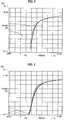
- the drain current versus gate voltage I-V characteristics for an SOI device without the neutrality impurity implant is shown in Figure 2. It is seen that at a drain bias of around 3 volts the gate begins to lose control of the device current (self latch-up begins). For a device of the same dimensions processed identically except for the neutral impurity implant, self latch-up occurs at about 4 volts as seen in Figure 3. Additional results are shown in Figure 4 in which the latch-up voltage was measured for both n and p-channel devices on two device wafers, with and without the neutral impurity implant.
- the germanium implant was applied to a single lot of wafers with one half of the wafers being implanted and the other half being without neutral impurity implantation. Measurements were taken on 147 devices. The use of the implant was seen to improve latch-up on an average of 1.04 volts.
Landscapes
- Thin Film Transistor (AREA)
- Metal-Oxide And Bipolar Metal-Oxide Semiconductor Integrated Circuits (AREA)
Applications Claiming Priority (2)
| Application Number | Priority Date | Filing Date | Title |
|---|---|---|---|
| US5604293A | 1993-04-30 | 1993-04-30 | |
| US56042 | 1998-04-03 |
Publications (2)
| Publication Number | Publication Date |
|---|---|
| EP0622834A2 true EP0622834A2 (de) | 1994-11-02 |
| EP0622834A3 EP0622834A3 (de) | 1998-02-11 |
Family
ID=22001790
Family Applications (1)
| Application Number | Title | Priority Date | Filing Date |
|---|---|---|---|
| EP94102414A Ceased EP0622834A3 (de) | 1993-04-30 | 1994-02-17 | Verfahren zur Latch-up Vermeidung und Durchbruchspannung Verbesserung in SOI MOSFET |
Country Status (3)
| Country | Link |
|---|---|
| US (1) | US5527724A (de) |
| EP (1) | EP0622834A3 (de) |
| JP (1) | JP2891321B2 (de) |
Cited By (4)
| Publication number | Priority date | Publication date | Assignee | Title |
|---|---|---|---|---|
| US5585286A (en) * | 1995-08-31 | 1996-12-17 | Lsi Logic Corporation | Implantation of a semiconductor substrate with controlled amount of noble gas ions to reduce channeling and/or diffusion of a boron dopant subsequently implanted into the substrate to form P- LDD region of a PMOS device |
| EP0735592A3 (de) * | 1995-03-31 | 1997-11-05 | Nippon Telegraph And Telephone Corporation | MOS-Dünnfilmtransistor und Herstellungsverfahren |
| US6657241B1 (en) | 1998-04-10 | 2003-12-02 | Cypress Semiconductor Corp. | ESD structure having an improved noise immunity in CMOS and BICMOS semiconductor devices |
| EP1320897B1 (de) * | 2000-09-29 | 2012-12-05 | Infineon Technologies AG | Verfahren zum herstellen eines halbleiterbauelements aus halbleitermaterial mit reduzierter mittlerer freier weglänge und mit dem verfahren hergestelltes halbleiterbauelement |
Families Citing this family (24)
| Publication number | Priority date | Publication date | Assignee | Title |
|---|---|---|---|---|
| US5514902A (en) * | 1993-09-16 | 1996-05-07 | Mitsubishi Denki Kabushiki Kaisha | Semiconductor device having MOS transistor |
| JP3361922B2 (ja) * | 1994-09-13 | 2003-01-07 | 株式会社東芝 | 半導体装置 |
| US5985703A (en) * | 1994-10-24 | 1999-11-16 | Banerjee; Sanjay | Method of making thin film transistors |
| US5773328A (en) * | 1995-02-28 | 1998-06-30 | Sgs-Thomson Microelectronics, Inc. | Method of making a fully-dielectric-isolated fet |
| US5985728A (en) * | 1995-09-01 | 1999-11-16 | Elantec Semiconductor, Inc. | Silicon on insulator process with recovery of a device layer from an etch stop layer |
| US5789310A (en) * | 1996-12-10 | 1998-08-04 | Advanced Micro Devices, Inc. | Method of forming shallow junctions by entrapment of interstitial atoms |
| US6337500B1 (en) | 1997-06-19 | 2002-01-08 | Matsushita Electric Industrial Co., Ltd. | Semiconductor device and method for fabricating the same |
| US5915199A (en) * | 1998-06-04 | 1999-06-22 | Sharp Microelectronics Technology, Inc. | Method for manufacturing a CMOS self-aligned strapped interconnection |
| US6482725B1 (en) | 1999-08-18 | 2002-11-19 | Advanced Micro Devices, Inc. | Gate formation method for reduced poly-depletion and boron penetration |
| US6633066B1 (en) * | 2000-01-07 | 2003-10-14 | Samsung Electronics Co., Ltd. | CMOS integrated circuit devices and substrates having unstrained silicon active layers |
| JP3504212B2 (ja) * | 2000-04-04 | 2004-03-08 | シャープ株式会社 | Soi構造の半導体装置 |
| US6495887B1 (en) | 2000-06-09 | 2002-12-17 | Advanced Micro Devices, Inc. | Argon implantation after silicidation for improved floating-body effects |
| DE10030381B4 (de) * | 2000-06-21 | 2005-04-14 | eupec Europäische Gesellschaft für Leistungshalbleiter mbH & Co. KG | Leistungshalbleiterbauelement aufweisend einen Körper aus Halbleitermaterial mit Übergang zwischen zueinander entgegengesetzten Leiterfähigkeitstypen |
| DE10048345A1 (de) | 2000-09-29 | 2002-05-16 | Eupec Gmbh & Co Kg | Körper aus Halbleitermaterial mit reduzierter mittlerer freier Weglänge |
| US6638832B2 (en) | 2000-12-21 | 2003-10-28 | Bae Systems Information And Electronic Systems Integration, Inc. | Elimination of narrow device width effects in complementary metal oxide semiconductor (CMOS) devices |
| US6509613B1 (en) * | 2001-05-04 | 2003-01-21 | Advanced Micro Devices, Inc. | Self-aligned floating body control for SOI device through leakage enhanced buried oxide |
| US7122863B1 (en) | 2001-05-07 | 2006-10-17 | Advanced Micro Devices, Inc. | SOI device with structure for enhancing carrier recombination and method of fabricating same |
| US6624037B2 (en) * | 2001-08-01 | 2003-09-23 | Advanced Micro Devices, Inc. | XE preamorphizing implantation |
| US6506654B1 (en) * | 2002-03-26 | 2003-01-14 | Advanced Micro Devices, Inc. | Source-side stacking fault body-tie for partially-depleted SOI MOSFET hysteresis control |
| JP3873012B2 (ja) * | 2002-07-29 | 2007-01-24 | 株式会社東芝 | 半導体装置の製造方法 |
| US6803270B2 (en) * | 2003-02-21 | 2004-10-12 | International Business Machines Corporation | CMOS performance enhancement using localized voids and extended defects |
| CN100416839C (zh) * | 2003-10-13 | 2008-09-03 | 联华电子股份有限公司 | 局部耗尽soi金属氧化物半导体元件 |
| US20050090067A1 (en) * | 2003-10-27 | 2005-04-28 | Dharmesh Jawarani | Silicide formation for a semiconductor device |
| US8748285B2 (en) | 2011-11-28 | 2014-06-10 | International Business Machines Corporation | Noble gas implantation region in top silicon layer of semiconductor-on-insulator substrate |
Family Cites Families (15)
| Publication number | Priority date | Publication date | Assignee | Title |
|---|---|---|---|---|
| US4160984A (en) * | 1977-11-14 | 1979-07-10 | Hughes Aircraft Company | Schottky-gate field-effect transistor and fabrication process therefor |
| JPS5891682A (ja) * | 1981-11-27 | 1983-05-31 | Hitachi Ltd | 半導体装置 |
| JPS60246195A (ja) * | 1984-05-22 | 1985-12-05 | Fuji Photo Film Co Ltd | 線順次による映像信号の記録・再生方式 |
| US4603471A (en) * | 1984-09-06 | 1986-08-05 | Fairchild Semiconductor Corporation | Method for making a CMOS circuit having a reduced tendency to latch by controlling the band-gap of source and drain regions |
| US4634473A (en) * | 1985-09-09 | 1987-01-06 | Rca Corporation | Method for fabricating a radiation hardened oxide having structural damage |
| US4946735A (en) * | 1986-02-10 | 1990-08-07 | Cornell Research Foundation, Inc. | Ultra-thin semiconductor membranes |
| US4766482A (en) * | 1986-12-09 | 1988-08-23 | General Electric Company | Semiconductor device and method of making the same |
| JPH01235276A (ja) * | 1988-03-15 | 1989-09-20 | Sony Corp | 薄膜半導体装置 |
| US5053353A (en) * | 1988-11-21 | 1991-10-01 | Harris Corporation | Fabricating dielectric isolation of SOI island side wall for reducing leakage current |
| US5134447A (en) * | 1989-09-22 | 1992-07-28 | At&T Bell Laboratories | Neutral impurities to increase lifetime of operation of semiconductor devices |
| US5102810A (en) * | 1990-03-13 | 1992-04-07 | General Instrument Corp. | Method for controlling the switching speed of bipolar power devices |
| US5156994A (en) * | 1990-12-21 | 1992-10-20 | Texas Instruments Incorporated | Local interconnect method and structure |
| JPH04313242A (ja) * | 1991-04-10 | 1992-11-05 | Sony Corp | 薄膜半導体装置の製造方法 |
| JPH04337625A (ja) * | 1991-05-15 | 1992-11-25 | Kawasaki Steel Corp | 半導体装置の製造方法 |
| JP2875412B2 (ja) * | 1991-06-14 | 1999-03-31 | キヤノン株式会社 | 半導体素子の製造法 |
-
1994
- 1994-02-17 EP EP94102414A patent/EP0622834A3/de not_active Ceased
- 1994-04-18 JP JP6078654A patent/JP2891321B2/ja not_active Expired - Lifetime
- 1994-09-12 US US08/304,639 patent/US5527724A/en not_active Expired - Lifetime
Cited By (5)
| Publication number | Priority date | Publication date | Assignee | Title |
|---|---|---|---|---|
| EP0735592A3 (de) * | 1995-03-31 | 1997-11-05 | Nippon Telegraph And Telephone Corporation | MOS-Dünnfilmtransistor und Herstellungsverfahren |
| US5585286A (en) * | 1995-08-31 | 1996-12-17 | Lsi Logic Corporation | Implantation of a semiconductor substrate with controlled amount of noble gas ions to reduce channeling and/or diffusion of a boron dopant subsequently implanted into the substrate to form P- LDD region of a PMOS device |
| US6657241B1 (en) | 1998-04-10 | 2003-12-02 | Cypress Semiconductor Corp. | ESD structure having an improved noise immunity in CMOS and BICMOS semiconductor devices |
| EP1320897B1 (de) * | 2000-09-29 | 2012-12-05 | Infineon Technologies AG | Verfahren zum herstellen eines halbleiterbauelements aus halbleitermaterial mit reduzierter mittlerer freier weglänge und mit dem verfahren hergestelltes halbleiterbauelement |
| US9608128B2 (en) | 2000-09-29 | 2017-03-28 | Infineon Technologies Ag | Body of doped semiconductor material having scattering centers of non-doping atoms of foreign matter disposed between two layers of opposing conductivities |
Also Published As
| Publication number | Publication date |
|---|---|
| US5527724A (en) | 1996-06-18 |
| JPH0715015A (ja) | 1995-01-17 |
| JP2891321B2 (ja) | 1999-05-17 |
| EP0622834A3 (de) | 1998-02-11 |
Similar Documents
| Publication | Publication Date | Title |
|---|---|---|
| US5527724A (en) | Method to prevent latch-up and improve breakdown volatge in SOI mosfets | |
| US5420055A (en) | Reduction of parasitic effects in floating body MOSFETs | |
| KR100863921B1 (ko) | 반도체 장치 및 그 제조 방법 | |
| US5358879A (en) | Method of making gate overlapped lightly doped drain for buried channel devices | |
| EP1225622B1 (de) | Halbleiteranordnung | |
| EP0419128B1 (de) | MOSFET aus Silizium mit einer durch eine Germanium-Dotierung verlängerten Lebensdauer | |
| JP2835216B2 (ja) | 半導体装置の製造方法 | |
| US5726459A (en) | GE-SI SOI MOS transistor and method of fabricating same | |
| WO1996029733A1 (en) | Self-aligned edge control in silicon on insulator | |
| US5963813A (en) | Integrated circuitry and method of forming a field effect transistor | |
| US5352914A (en) | Field-effect transistor with structure for suppressing hot-electron effects, and method of fabricating the transistor | |
| US7019378B2 (en) | Field-shielded SOI-MOS structure free from floating body effects, and method of fabrication therefor | |
| US6528846B1 (en) | Asymmetric high voltage silicon on insulator device design for input output circuits | |
| Ohno et al. | Suppression of parasitic bipolar action in ultra-thin-film fully-depleted CMOS/SIMOX devices by Ar-ion implantation into source/drain regions | |
| US8835997B2 (en) | Low extension dose implants in SRAM fabrication | |
| Kamins et al. | MOSFET's in electron-beam recrystallized polysilicon | |
| US6420767B1 (en) | Capacitively coupled DTMOS on SOI | |
| US5422510A (en) | MOS transistor with non-uniform channel dopant profile | |
| US6455903B1 (en) | Dual threshold voltage MOSFET by local confinement of channel depletion layer using inert ion implantation | |
| JP3454752B2 (ja) | Soi半導体装置の安定化方法及びsoi半導体装置 | |
| JPH0571190B2 (de) | ||
| US5925915A (en) | Semiconductor on insulator devices | |
| KR980006490A (ko) | 반도체 소자 및 그의 제조방법 | |
| US20020155686A1 (en) | Fabrication method for suppressing a hot carrier effect and leakage currents of I/O devices | |
| JPH0552069B2 (de) |
Legal Events
| Date | Code | Title | Description |
|---|---|---|---|
| PUAI | Public reference made under article 153(3) epc to a published international application that has entered the european phase |
Free format text: ORIGINAL CODE: 0009012 |
|
| AK | Designated contracting states |
Kind code of ref document: A2 Designated state(s): DE FR GB |
|
| 17P | Request for examination filed |
Effective date: 19950227 |
|
| PUAL | Search report despatched |
Free format text: ORIGINAL CODE: 0009013 |
|
| AK | Designated contracting states |
Kind code of ref document: A3 Designated state(s): DE FR GB |
|
| RIC1 | Information provided on ipc code assigned before grant |
Free format text: 7H 01L 29/772 A, 7H 01L 21/336 B, 7H 01L 21/265 B |
|
| 17Q | First examination report despatched |
Effective date: 19991229 |
|
| RAP1 | Party data changed (applicant data changed or rights of an application transferred) |
Owner name: LOCKHEED MARTIN FEDERAL SYSTEMS, INC |
|
| RAP1 | Party data changed (applicant data changed or rights of an application transferred) |
Owner name: BAE SYSTEMS INFORMATION AND ELECTRONIC SYSTEM INTE |
|
| STAA | Information on the status of an ep patent application or granted ep patent |
Free format text: STATUS: THE APPLICATION HAS BEEN REFUSED |
|
| 18R | Application refused |
Effective date: 20021015 |