EP0620573B1 - Magnetische Dünnfilmvorrichtungen für Flussausbreitung - Google Patents
Magnetische Dünnfilmvorrichtungen für Flussausbreitung Download PDFInfo
- Publication number
- EP0620573B1 EP0620573B1 EP94202004A EP94202004A EP0620573B1 EP 0620573 B1 EP0620573 B1 EP 0620573B1 EP 94202004 A EP94202004 A EP 94202004A EP 94202004 A EP94202004 A EP 94202004A EP 0620573 B1 EP0620573 B1 EP 0620573B1
- Authority
- EP
- European Patent Office
- Prior art keywords
- layers
- magnetic
- flux
- magnetic domains
- layer
- Prior art date
- Legal status (The legal status is an assumption and is not a legal conclusion. Google has not performed a legal analysis and makes no representation as to the accuracy of the status listed.)
- Expired - Lifetime
Links
- 230000004907 flux Effects 0.000 title claims abstract description 145
- 239000010409 thin film Substances 0.000 title claims abstract description 20
- 230000007480 spreading Effects 0.000 title abstract description 12
- 238000003892 spreading Methods 0.000 title abstract description 12
- 238000000034 method Methods 0.000 claims abstract description 35
- 230000005381 magnetic domain Effects 0.000 claims description 41
- 230000008878 coupling Effects 0.000 claims description 8
- 238000010168 coupling process Methods 0.000 claims description 8
- 238000005859 coupling reaction Methods 0.000 claims description 8
- 238000000151 deposition Methods 0.000 claims description 5
- 239000013078 crystal Substances 0.000 claims description 4
- 238000000469 dry deposition Methods 0.000 claims description 4
- 239000000463 material Substances 0.000 claims description 4
- 238000007747 plating Methods 0.000 claims description 2
- 239000000758 substrate Substances 0.000 claims description 2
- 238000001771 vacuum deposition Methods 0.000 claims description 2
- 238000000137 annealing Methods 0.000 claims 2
- 229910010293 ceramic material Inorganic materials 0.000 claims 1
- 238000004519 manufacturing process Methods 0.000 abstract description 3
- 230000005415 magnetization Effects 0.000 description 9
- 230000007246 mechanism Effects 0.000 description 9
- 230000008569 process Effects 0.000 description 8
- 238000006073 displacement reaction Methods 0.000 description 5
- 239000010408 film Substances 0.000 description 4
- 230000000295 complement effect Effects 0.000 description 3
- 230000008021 deposition Effects 0.000 description 3
- 230000003068 static effect Effects 0.000 description 3
- 230000005330 Barkhausen effect Effects 0.000 description 2
- XEEYBQQBJWHFJM-UHFFFAOYSA-N Iron Chemical compound [Fe] XEEYBQQBJWHFJM-UHFFFAOYSA-N 0.000 description 2
- 238000013459 approach Methods 0.000 description 2
- 230000015572 biosynthetic process Effects 0.000 description 2
- 239000000919 ceramic Substances 0.000 description 2
- 230000007547 defect Effects 0.000 description 2
- 238000013461 design Methods 0.000 description 2
- 230000000694 effects Effects 0.000 description 2
- 230000006698 induction Effects 0.000 description 2
- 239000002184 metal Substances 0.000 description 2
- 229910052751 metal Inorganic materials 0.000 description 2
- 238000012545 processing Methods 0.000 description 2
- 230000000644 propagated effect Effects 0.000 description 2
- 229910000531 Co alloy Inorganic materials 0.000 description 1
- 229910000640 Fe alloy Inorganic materials 0.000 description 1
- 229910001030 Iron–nickel alloy Inorganic materials 0.000 description 1
- 229910000990 Ni alloy Inorganic materials 0.000 description 1
- 229910018104 Ni-P Inorganic materials 0.000 description 1
- 229910018536 Ni—P Inorganic materials 0.000 description 1
- 230000009286 beneficial effect Effects 0.000 description 1
- 230000008901 benefit Effects 0.000 description 1
- 230000005540 biological transmission Effects 0.000 description 1
- 230000008859 change Effects 0.000 description 1
- 238000006243 chemical reaction Methods 0.000 description 1
- 239000010941 cobalt Substances 0.000 description 1
- GUTLYIVDDKVIGB-UHFFFAOYSA-N cobalt atom Chemical compound [Co] GUTLYIVDDKVIGB-UHFFFAOYSA-N 0.000 description 1
- 229910052802 copper Inorganic materials 0.000 description 1
- 230000003292 diminished effect Effects 0.000 description 1
- 238000005516 engineering process Methods 0.000 description 1
- 230000007717 exclusion Effects 0.000 description 1
- 239000002223 garnet Substances 0.000 description 1
- 229910052737 gold Inorganic materials 0.000 description 1
- 238000010438 heat treatment Methods 0.000 description 1
- 230000001939 inductive effect Effects 0.000 description 1
- 230000003993 interaction Effects 0.000 description 1
- 238000010030 laminating Methods 0.000 description 1
- 238000003475 lamination Methods 0.000 description 1
- 230000035699 permeability Effects 0.000 description 1
- 230000001902 propagating effect Effects 0.000 description 1
- 230000009467 reduction Effects 0.000 description 1
- 230000004044 response Effects 0.000 description 1
- 230000035945 sensitivity Effects 0.000 description 1
- 238000004544 sputter deposition Methods 0.000 description 1
- 238000000992 sputter etching Methods 0.000 description 1
- 238000012546 transfer Methods 0.000 description 1
- 229910000859 α-Fe Inorganic materials 0.000 description 1
Images


Classifications
-
- G—PHYSICS
- G01—MEASURING; TESTING
- G01R—MEASURING ELECTRIC VARIABLES; MEASURING MAGNETIC VARIABLES
- G01R33/00—Arrangements or instruments for measuring magnetic variables
- G01R33/02—Measuring direction or magnitude of magnetic fields or magnetic flux
-
- B—PERFORMING OPERATIONS; TRANSPORTING
- B82—NANOTECHNOLOGY
- B82Y—SPECIFIC USES OR APPLICATIONS OF NANOSTRUCTURES; MEASUREMENT OR ANALYSIS OF NANOSTRUCTURES; MANUFACTURE OR TREATMENT OF NANOSTRUCTURES
- B82Y25/00—Nanomagnetism, e.g. magnetoimpedance, anisotropic magnetoresistance, giant magnetoresistance or tunneling magnetoresistance
-
- B—PERFORMING OPERATIONS; TRANSPORTING
- B82—NANOTECHNOLOGY
- B82Y—SPECIFIC USES OR APPLICATIONS OF NANOSTRUCTURES; MEASUREMENT OR ANALYSIS OF NANOSTRUCTURES; MANUFACTURE OR TREATMENT OF NANOSTRUCTURES
- B82Y40/00—Manufacture or treatment of nanostructures
-
- G—PHYSICS
- G11—INFORMATION STORAGE
- G11B—INFORMATION STORAGE BASED ON RELATIVE MOVEMENT BETWEEN RECORD CARRIER AND TRANSDUCER
- G11B5/00—Recording by magnetisation or demagnetisation of a record carrier; Reproducing by magnetic means; Record carriers therefor
- G11B5/127—Structure or manufacture of heads, e.g. inductive
- G11B5/31—Structure or manufacture of heads, e.g. inductive using thin films
- G11B5/3109—Details
- G11B5/3113—Details for improving the magnetic domain structure or avoiding the formation or displacement of undesirable magnetic domains
-
- G—PHYSICS
- G11—INFORMATION STORAGE
- G11B—INFORMATION STORAGE BASED ON RELATIVE MOVEMENT BETWEEN RECORD CARRIER AND TRANSDUCER
- G11B5/00—Recording by magnetisation or demagnetisation of a record carrier; Reproducing by magnetic means; Record carriers therefor
- G11B5/127—Structure or manufacture of heads, e.g. inductive
- G11B5/31—Structure or manufacture of heads, e.g. inductive using thin films
- G11B5/3109—Details
- G11B5/313—Disposition of layers
- G11B5/3143—Disposition of layers including additional layers for improving the electromagnetic transducing properties of the basic structure, e.g. for flux coupling, guiding or shielding
-
- G—PHYSICS
- G11—INFORMATION STORAGE
- G11B—INFORMATION STORAGE BASED ON RELATIVE MOVEMENT BETWEEN RECORD CARRIER AND TRANSDUCER
- G11B5/00—Recording by magnetisation or demagnetisation of a record carrier; Reproducing by magnetic means; Record carriers therefor
- G11B5/127—Structure or manufacture of heads, e.g. inductive
- G11B5/31—Structure or manufacture of heads, e.g. inductive using thin films
- G11B5/3109—Details
- G11B5/313—Disposition of layers
- G11B5/3143—Disposition of layers including additional layers for improving the electromagnetic transducing properties of the basic structure, e.g. for flux coupling, guiding or shielding
- G11B5/3146—Disposition of layers including additional layers for improving the electromagnetic transducing properties of the basic structure, e.g. for flux coupling, guiding or shielding magnetic layers
- G11B5/3153—Disposition of layers including additional layers for improving the electromagnetic transducing properties of the basic structure, e.g. for flux coupling, guiding or shielding magnetic layers including at least one magnetic thin film coupled by interfacing to the basic magnetic thin film structure
-
- G—PHYSICS
- G11—INFORMATION STORAGE
- G11B—INFORMATION STORAGE BASED ON RELATIVE MOVEMENT BETWEEN RECORD CARRIER AND TRANSDUCER
- G11B5/00—Recording by magnetisation or demagnetisation of a record carrier; Reproducing by magnetic means; Record carriers therefor
- G11B5/127—Structure or manufacture of heads, e.g. inductive
- G11B5/31—Structure or manufacture of heads, e.g. inductive using thin films
- G11B5/3109—Details
- G11B5/313—Disposition of layers
- G11B5/3143—Disposition of layers including additional layers for improving the electromagnetic transducing properties of the basic structure, e.g. for flux coupling, guiding or shielding
- G11B5/3146—Disposition of layers including additional layers for improving the electromagnetic transducing properties of the basic structure, e.g. for flux coupling, guiding or shielding magnetic layers
- G11B5/3153—Disposition of layers including additional layers for improving the electromagnetic transducing properties of the basic structure, e.g. for flux coupling, guiding or shielding magnetic layers including at least one magnetic thin film coupled by interfacing to the basic magnetic thin film structure
- G11B5/3156—Disposition of layers including additional layers for improving the electromagnetic transducing properties of the basic structure, e.g. for flux coupling, guiding or shielding magnetic layers including at least one magnetic thin film coupled by interfacing to the basic magnetic thin film structure providing interaction by induced or exchange coupling
-
- G—PHYSICS
- G11—INFORMATION STORAGE
- G11B—INFORMATION STORAGE BASED ON RELATIVE MOVEMENT BETWEEN RECORD CARRIER AND TRANSDUCER
- G11B5/00—Recording by magnetisation or demagnetisation of a record carrier; Reproducing by magnetic means; Record carriers therefor
- G11B5/127—Structure or manufacture of heads, e.g. inductive
- G11B5/31—Structure or manufacture of heads, e.g. inductive using thin films
- G11B5/3176—Structure of heads comprising at least in the transducing gap regions two magnetic thin films disposed respectively at both sides of the gaps
- G11B5/3179—Structure of heads comprising at least in the transducing gap regions two magnetic thin films disposed respectively at both sides of the gaps the films being mainly disposed in parallel planes
-
- G—PHYSICS
- G11—INFORMATION STORAGE
- G11B—INFORMATION STORAGE BASED ON RELATIVE MOVEMENT BETWEEN RECORD CARRIER AND TRANSDUCER
- G11B5/00—Recording by magnetisation or demagnetisation of a record carrier; Reproducing by magnetic means; Record carriers therefor
- G11B5/127—Structure or manufacture of heads, e.g. inductive
- G11B5/33—Structure or manufacture of flux-sensitive heads, i.e. for reproduction only; Combination of such heads with means for recording or erasing only
- G11B5/332—Structure or manufacture of flux-sensitive heads, i.e. for reproduction only; Combination of such heads with means for recording or erasing only using thin films
-
- G—PHYSICS
- G11—INFORMATION STORAGE
- G11B—INFORMATION STORAGE BASED ON RELATIVE MOVEMENT BETWEEN RECORD CARRIER AND TRANSDUCER
- G11B5/00—Recording by magnetisation or demagnetisation of a record carrier; Reproducing by magnetic means; Record carriers therefor
- G11B5/62—Record carriers characterised by the selection of the material
- G11B5/64—Record carriers characterised by the selection of the material comprising only the magnetic material without bonding agent
- G11B5/66—Record carriers characterised by the selection of the material comprising only the magnetic material without bonding agent the record carriers consisting of several layers
- G11B5/674—Record carriers characterised by the selection of the material comprising only the magnetic material without bonding agent the record carriers consisting of several layers having differing macroscopic or microscopic structures, e.g. differing crystalline lattices, varying atomic structures or differing roughnesses
-
- G—PHYSICS
- G11—INFORMATION STORAGE
- G11C—STATIC STORES
- G11C11/00—Digital stores characterised by the use of particular electric or magnetic storage elements; Storage elements therefor
- G11C11/02—Digital stores characterised by the use of particular electric or magnetic storage elements; Storage elements therefor using magnetic elements
- G11C11/14—Digital stores characterised by the use of particular electric or magnetic storage elements; Storage elements therefor using magnetic elements using thin-film elements
-
- G—PHYSICS
- G11—INFORMATION STORAGE
- G11C—STATIC STORES
- G11C11/00—Digital stores characterised by the use of particular electric or magnetic storage elements; Storage elements therefor
- G11C11/02—Digital stores characterised by the use of particular electric or magnetic storage elements; Storage elements therefor using magnetic elements
- G11C11/14—Digital stores characterised by the use of particular electric or magnetic storage elements; Storage elements therefor using magnetic elements using thin-film elements
- G11C11/15—Digital stores characterised by the use of particular electric or magnetic storage elements; Storage elements therefor using magnetic elements using thin-film elements using multiple magnetic layers
-
- H—ELECTRICITY
- H01—ELECTRIC ELEMENTS
- H01F—MAGNETS; INDUCTANCES; TRANSFORMERS; SELECTION OF MATERIALS FOR THEIR MAGNETIC PROPERTIES
- H01F10/00—Thin magnetic films, e.g. of one-domain structure
- H01F10/26—Thin magnetic films, e.g. of one-domain structure characterised by the substrate or intermediate layers
- H01F10/30—Thin magnetic films, e.g. of one-domain structure characterised by the substrate or intermediate layers characterised by the composition of the intermediate layers, e.g. seed, buffer, template, diffusion preventing, cap layers
-
- H—ELECTRICITY
- H01—ELECTRIC ELEMENTS
- H01F—MAGNETS; INDUCTANCES; TRANSFORMERS; SELECTION OF MATERIALS FOR THEIR MAGNETIC PROPERTIES
- H01F10/00—Thin magnetic films, e.g. of one-domain structure
- H01F10/32—Spin-exchange-coupled multilayers, e.g. nanostructured superlattices
-
- H—ELECTRICITY
- H01—ELECTRIC ELEMENTS
- H01F—MAGNETS; INDUCTANCES; TRANSFORMERS; SELECTION OF MATERIALS FOR THEIR MAGNETIC PROPERTIES
- H01F27/00—Details of transformers or inductances, in general
- H01F27/24—Magnetic cores
-
- H—ELECTRICITY
- H01—ELECTRIC ELEMENTS
- H01F—MAGNETS; INDUCTANCES; TRANSFORMERS; SELECTION OF MATERIALS FOR THEIR MAGNETIC PROPERTIES
- H01F27/00—Details of transformers or inductances, in general
- H01F27/34—Special means for preventing or reducing unwanted electric or magnetic effects, e.g. no-load losses, reactive currents, harmonics, oscillations, leakage fields
- H01F27/36—Electric or magnetic shields or screens
-
- H—ELECTRICITY
- H01—ELECTRIC ELEMENTS
- H01F—MAGNETS; INDUCTANCES; TRANSFORMERS; SELECTION OF MATERIALS FOR THEIR MAGNETIC PROPERTIES
- H01F27/00—Details of transformers or inductances, in general
- H01F27/34—Special means for preventing or reducing unwanted electric or magnetic effects, e.g. no-load losses, reactive currents, harmonics, oscillations, leakage fields
- H01F27/36—Electric or magnetic shields or screens
- H01F27/366—Electric or magnetic shields or screens made of ferromagnetic material
-
- H—ELECTRICITY
- H01—ELECTRIC ELEMENTS
- H01F—MAGNETS; INDUCTANCES; TRANSFORMERS; SELECTION OF MATERIALS FOR THEIR MAGNETIC PROPERTIES
- H01F41/00—Apparatus or processes specially adapted for manufacturing or assembling magnets, inductances or transformers; Apparatus or processes specially adapted for manufacturing materials characterised by their magnetic properties
- H01F41/14—Apparatus or processes specially adapted for manufacturing or assembling magnets, inductances or transformers; Apparatus or processes specially adapted for manufacturing materials characterised by their magnetic properties for applying magnetic films to substrates
- H01F41/30—Apparatus or processes specially adapted for manufacturing or assembling magnets, inductances or transformers; Apparatus or processes specially adapted for manufacturing materials characterised by their magnetic properties for applying magnetic films to substrates for applying nanostructures, e.g. by molecular beam epitaxy [MBE]
- H01F41/302—Apparatus or processes specially adapted for manufacturing or assembling magnets, inductances or transformers; Apparatus or processes specially adapted for manufacturing materials characterised by their magnetic properties for applying magnetic films to substrates for applying nanostructures, e.g. by molecular beam epitaxy [MBE] for applying spin-exchange-coupled multilayers, e.g. nanostructured superlattices
-
- Y—GENERAL TAGGING OF NEW TECHNOLOGICAL DEVELOPMENTS; GENERAL TAGGING OF CROSS-SECTIONAL TECHNOLOGIES SPANNING OVER SEVERAL SECTIONS OF THE IPC; TECHNICAL SUBJECTS COVERED BY FORMER USPC CROSS-REFERENCE ART COLLECTIONS [XRACs] AND DIGESTS
- Y10—TECHNICAL SUBJECTS COVERED BY FORMER USPC
- Y10S—TECHNICAL SUBJECTS COVERED BY FORMER USPC CROSS-REFERENCE ART COLLECTIONS [XRACs] AND DIGESTS
- Y10S428/00—Stock material or miscellaneous articles
- Y10S428/90—Magnetic feature
-
- Y—GENERAL TAGGING OF NEW TECHNOLOGICAL DEVELOPMENTS; GENERAL TAGGING OF CROSS-SECTIONAL TECHNOLOGIES SPANNING OVER SEVERAL SECTIONS OF THE IPC; TECHNICAL SUBJECTS COVERED BY FORMER USPC CROSS-REFERENCE ART COLLECTIONS [XRACs] AND DIGESTS
- Y10—TECHNICAL SUBJECTS COVERED BY FORMER USPC
- Y10S—TECHNICAL SUBJECTS COVERED BY FORMER USPC CROSS-REFERENCE ART COLLECTIONS [XRACs] AND DIGESTS
- Y10S428/00—Stock material or miscellaneous articles
- Y10S428/922—Static electricity metal bleed-off metallic stock
- Y10S428/9265—Special properties
- Y10S428/928—Magnetic property
-
- Y—GENERAL TAGGING OF NEW TECHNOLOGICAL DEVELOPMENTS; GENERAL TAGGING OF CROSS-SECTIONAL TECHNOLOGIES SPANNING OVER SEVERAL SECTIONS OF THE IPC; TECHNICAL SUBJECTS COVERED BY FORMER USPC CROSS-REFERENCE ART COLLECTIONS [XRACs] AND DIGESTS
- Y10—TECHNICAL SUBJECTS COVERED BY FORMER USPC
- Y10T—TECHNICAL SUBJECTS COVERED BY FORMER US CLASSIFICATION
- Y10T428/00—Stock material or miscellaneous articles
- Y10T428/11—Magnetic recording head
- Y10T428/1171—Magnetic recording head with defined laminate structural detail
- Y10T428/1186—Magnetic recording head with defined laminate structural detail with head pole component
-
- Y—GENERAL TAGGING OF NEW TECHNOLOGICAL DEVELOPMENTS; GENERAL TAGGING OF CROSS-SECTIONAL TECHNOLOGIES SPANNING OVER SEVERAL SECTIONS OF THE IPC; TECHNICAL SUBJECTS COVERED BY FORMER USPC CROSS-REFERENCE ART COLLECTIONS [XRACs] AND DIGESTS
- Y10—TECHNICAL SUBJECTS COVERED BY FORMER USPC
- Y10T—TECHNICAL SUBJECTS COVERED BY FORMER US CLASSIFICATION
- Y10T428/00—Stock material or miscellaneous articles
- Y10T428/26—Web or sheet containing structurally defined element or component, the element or component having a specified physical dimension
- Y10T428/263—Coating layer not in excess of 5 mils thick or equivalent
- Y10T428/264—Up to 3 mils
- Y10T428/265—1 mil or less
-
- Y—GENERAL TAGGING OF NEW TECHNOLOGICAL DEVELOPMENTS; GENERAL TAGGING OF CROSS-SECTIONAL TECHNOLOGIES SPANNING OVER SEVERAL SECTIONS OF THE IPC; TECHNICAL SUBJECTS COVERED BY FORMER USPC CROSS-REFERENCE ART COLLECTIONS [XRACs] AND DIGESTS
- Y10—TECHNICAL SUBJECTS COVERED BY FORMER USPC
- Y10T—TECHNICAL SUBJECTS COVERED BY FORMER US CLASSIFICATION
- Y10T428/00—Stock material or miscellaneous articles
- Y10T428/31504—Composite [nonstructural laminate]
- Y10T428/31678—Of metal
Definitions
- the present invention relates to rotational flux conduction in thin film magnetic devices.
- Magnetic devices such as thin film recording heads, whether read, read/write, or write, are designed to have particular magnetic orientations, or domains, within the active regions of the device material.
- the static state of each of these domains can be oriented along a given axis, known as the easy axis (or axis of anisotropy), as desired, by control of the manufacturing process.
- Performance is critically linked to domain formation, and, therefore, control can be exerted over device performance by controlling domain formation.
- Domain wall motion results in flux being transmitted through a thin film head along the walls of a domain, or domains, the flux spreading out along the domain walls as the flux seeks to return to equilibrium.
- domain wall motion facilitates conduction of flux at low frequencies, it is a poor vehicle for conduction of flux at high frequencies.
- defects in the material in a magnetic head can be the source of Barkhausen noise during conduction of flux by wall motion as the flux is perturbed by these defects. Such noise can result in erroneous readings of recorded data.
- FIG. 1(a) A conventional prior art pole of a magnetic recording head is shown in Fig. 1(a), where medium M will be seen as inserting signal flux into a first transversely oriented domain d1 of a series of transversely oriented domains d1-dn.
- the rest state flux of the domains is in the X-axis (transverse direction), which leaves a rotational option of flowing into the Y axis (longitudinal direction) or Z axis (vertical direction) in reaction to the signal flux from the medium.
- the Z-axis is out of plane and is a high reluctance path. Hence the flux will rotate into the Y-axis, as indicated by the rotated arrows of each of domains d1-dn.
- conduction of flux by domain rotation may be achieved by configuring a series of neighboring transverse domains axially aligned along parallel axes, where signal flux impinged upon the first domain at a given angle will cause the magnetization of that domain to rotate from its static orientation by that angle radially into and impinging upon the neighboring domain.
- Such rotation can be transmitted in a like manner along an axis of flux transmission by each neighboring domain of the series.
- flux can be conducted in the pole and through the yoke of a thin film head in a series of domain rotations.
- the yoke enables conduction of flux through a transducer which produces electrical signals proportional to flux levels or the rate of flux change.
- the transducer might be an induction coil or other flux sensing device.
- An induction coil is shown schematically in Fig. 1(a) as it might overlie the bottom pole of a two pole structure.
- the present invention provides a magnetic device for conducting signal flux therethrough, comprising a plurality of magnetic layers each of which includes magnetic domains oriented in a transverse direction to a longitudinal axis of said layers so that said layers support conduction of said signal flux by rotation along a longitudinal axis of said layer, the magnetic device including an external bias source for biasing said magnetic domains of a first one of said layers and said magnetic domains of a second one of said layers in opposite directions with respect to said transverse direction so that said first one of said layers conducts said signal flux by rotation in a first direction arranged obliquely to said longitudinal axis, and said second one of said layers conducts said signal flux by rotation in a second, different oblique direction with respect to said longitudinal axis.
- the layers are coupled to each other to allow said signal flux to pass between said layers so that said signal flux conducts by rotation through said device by following said first and second directions.
- the bias source includes a bias coil disposed adjacent to at least one of the layers, for conducting electrical current, said current causing said biasing of said magnetic domains.
- the layers respectively comprise a pair of poles of a thin film head that includes a write coil for causing said head to write information on a magnetic medium, the write coil serving as the bias coil.
- the present invention provides a method for making a magnetic device for conducting signal flux therethrough, comprising the step of: providing a plurality of magnetic layers each of which includes magnetic domains oriented in a transverse direction to a longitudinal axis of said layers so that said layers support conduction of said signal flux by rotation along a longitudinal axis of said layer; biasing, by an external bias source, the magnetic domains of a first one of said layers and said magnetic domains of a second one of said layers in opposite directions with respect to said transverse direction so that said first one of said layers conducts said signal flux by rotation in a first direction arranged obliquely to said longitudinal axis, and said second one of said layers conducts said signal flux by rotation in a second, different oblique direction with respect to said longitudinal axis; andcoupling said layers to each other to allow said signal flux to pass between said layers so that said signal flux conducts by rotation through said layers by following said first and second directions.
- the biasing step includes applying electrical current through a bias coil disposed adjacent to at least one of said layers.
- the layers respectively comprise a pair of poles to a thin film head that includes a write coil for causing said head to write information on a magnetic medium, said write coil serving as said bias coil.
- Fig. 1(a) is a schematic view of the top layer of a prior art pole
- Fig. 1(b) is a cross-sectional view of a two layer configuration of the prior art pole of Fig. 1(a).
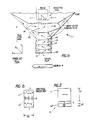
- Fig. 2 is a schematic of a two layer pole.
- Fig. 3 is a schematic of the top layer of the pole of Fig. 2.
- Fig. 4 is a schematic of the bottom layer of the pole of Fig. 2.
- Fig. 5 is a schematic in two views of a unidirectional anisotropy prior art head.
- Fig. 6 is a schematic in four views of a pole showing a flux beam comprised of angular and rotational components.
- Fig. 7 is a schematic of a pole arrangement having two layers, each layer having a parallel sublayer.
- Fig. 8 is a conventional laminated two pole geometry.
- Fig. 9 is a schematic of an arrangement where poles P1 and P2 are in the same horizontal plane.
- Fig. 10 is a schematic of an arrangement where poles P1 and P2 are stacked.
- Fig. 11 is a schematic in five views relating to further pole configurations.
- the present invention enables low reluctance flux conduction by magnetization rotation at high frequencies. This is achieved by provision of a structure allowing both longitudinal and lateral rotational conductivity. Such multidimensional conductivity obviates the need for domain wall propagation, thus avoiding low response at high frequencies and Barkhausen noise.
- the invention is applicable to a wide variety of devices relying upon magnetic conduction, including transformers, magnetic field sensors, bubble memory magnetic structures, thin film magnetic memory elements, magnetic shields, and recording heads, and may be embodied in both single and multi-layered devices.
- Fig. 1(b) shows in cross-section a two-layer configuration of a prior art pole.
- layers L1 and L2 are separated by a very narrow gap g to enable coupling between layers L1, L2 of rest state domain flux (i.e., D.C. flux of the domains at rest).
- the anisotropy directions of layers L1, L2 are parallel to each other and transverse to the pole, as indicated by the horizontal arrows a, b in layers L1, L2, respectively.
- the thicknesses of L1 and L2 are by design equal.
- a pole configuration is shown from a magnetic recording medium looking into the tip of the pole 10 of a magnetic recording head having two active layers, L1, L2, one with in-plane anisotropy (i.e., rest state domain orientation) transversely oriented, and the other layer longitudinally oriented. These layers are separated by a gap layer g.
- the gap layer is thick enough such that the domain state of each layer will remain independent from each other, but yet is thin enough such that signal flux can transmit readily between the two layers of the pole.
- a range of 30-200 nanometres (three hundred to two thousand angstroms) would be a reasonable target for gap size.
- each pole could have a like configuration.
- Layers L1 and L2 are preferably configured where L1 thickness t1 does not equal L2 thickness t2. These layers are preferably configured with t1 greater than t2.
- FIG. 3 A top view of pole 10 of Fig. 2 is shown in Fig. 3, where the first layer L1 of pole 10 has a preferred easy axis transverse to the longitudinal axis of the pole.
- the domain structure is configured to have relatively large and uniform central domains 12 with adjacent relatively small edge domains 16 in the region of pole tip 20, and with extended edge domains 22 in the yoke region 24.
- flux from the medium will be read at the first domain d1 at pole tip 20.
- This conducting mechanism may be referred to as a flux pipe or flux beam, and is schematically indicated by the parallel vertical dotted lines running up the pole from the tip and through the yoke.
- FIG. 4 A top view of layer L2 of Fig. 2 is shown in Fig. 4.
- Layer L2 has a longitudinal easy axis, parallel to the longitudinal axis of the pole and transverse to the easy axis of layer L1.
- the domain structure is substantially longitudinal in orientation. As a result it will conduct flux transversely by rotation.
- the yoke section 24 is shown to increase in width as it extends away from pole tip 20. If the yoke section were not spread, the boundaries of the flux beam would be defined as shown in dotted lines and high reluctance would degrade operation. However, by having this region spread out, the flux beam will somewhat spread out, thus adding to the area within the dotted lines by including at least a portion of the regions indicated by the hash marks 23. This effectively results in a lower reluctance path of conduction through the yoke.
- Flux will be introduced from the magnetic medium into the first transverse domain d1 domain at pole tip 20 perpendicular to the easy axis of the transversely magnetized layer L1.
- the flux will be propagated longitudinally by rotation down that layer, domain 12 to domain 12, for as long as a low path of reluctance is experienced by the flux.
- path length and thus reluctance accumulates, a portion of the flux crosses the gap g and propagates into the longitudinally oriented domain L2, thus lowering the reluctance of the system.
- the flux will propagate transversely in layer L2 until it accumulates reluctance as will cause it to seek a path of lower reluctance and to jump the gap to re-enter into the transverse layer L1.
- the flux propagates longitudinally until accumulated reluctance again causes the flux to seek a lower path of reluctance in the longitudinal active layer on the other side of the gap. This process will continue until the flux has propagated longitudinally through the yoke, but by the virtue of the process of adding a transverse rotational component to flux flow, the flux will have spread out within the widened yoke region, thus reducing total system reluctance.
- Thin film heads are being used at higher bit densities.
- One way to achieve this higher bit density is by reduction of track width.
- a narrow track should have a high anisotropy field.
- This high anisotropy field will act to keep the flux path open by keeping edge domains relatively small.
- the rotational mechanism may be kept alive even where the structural magnetic reluctance is lowered in the yoke section according to the present invention, although the high anisotropy field will reduce permeability of the structure.
- Figs. 2, 3 and 4 While the embodiment shown in conjunction with Figs. 2, 3 and 4 includes layer L1 having an axis of anisotropy perpendicular to that of layer L2, it may be considered more convenient to have the same axis of anisotropy for both layers L1 and L2 in the pole. Nevertheless, the same advantageous effect of the invention described with respect to Figs. 2, 3 and 4 can be obtained.
- layer L2 might be wider than layer L1, as shown in Fig. 11(a), with layer L2 having a center domain width Wc and layer L1 having a total width the same as the L2 center domain width Wc.
- Layer L1 might have a domain configuration as shown in Fig.
- layer L2 might have a domain configuration as shown in Fig. 11(c).
- edge domains of layer L1 oriented longitudinally
- Fig. 11(c) the edge domains of layer L1 (oriented longitudinally) can be adjacent to the transversely oriented center domains of layer L2.
- alternative conduction paths are provided between layers L1 and L2 as will facilitate the flux conduction and spreading mechanism of the invention.
- layers L1 and L2 have similar width, but one layer is offset from the other such that edge domains of the one can interact with the center domains of the other. This offset may require a planarized surface to form a gap layer g over which L1 can be formed.
- the width of layer L1 might be so reduced as to totally eliminate its transversely oriented center domain region, as shown in Fig. 11(d), thus providing increased opportunity for the present flux spreading mechanism of the present invention when such layer L1 is combined with a layer L2 configured such as in Fig. 11(c).
- a plurality of narrow magnetic strips such as shown in Fig. 11(f), replaces layer L1.
- many longitudinal edge domains can be provided so to interact with the transversely oriented center domain region of the underlying layer L2.
- such narrow strips can be provided with a low anisotropy as would eliminate their central domain regions, thus providing a maximum amount of transversely oriented edge domain per thin strip.
- the criss-cross orientation shown in the strips of Fig. 11f would become primarily longitudinally oriented.
- laminated films In the design of a narrow track head, laminated films often are used to eliminate edge domains and 180° walls. Therefore, these laminated films will not spread flux well in conventional configurations, and can negate the benefits described above.
- Fig. 5 (A and B), which includes schematic complementary views of a unidirectional anisotropy prior art head not having the cooperating layers of the present invention
- the flux imposed at an angle phi or 180° minus phi
- phi or 180° minus phi
- a uniform beam will be conducted back through the pole into and through the yoke, except that it will be canted by one half of phi.
- a high magnetic impedance will be experienced at the yoke because the flux beam does not widen significantly.
- the present invention achieves flux spreading by orienting the easy axes of the top and bottom layers of laminated poles at plus and minus angles, theta, relative to the transverse magnetic direction. As a result, the flux will then spread out in a wedge angle of twice the value of theta, plus the additional angular component phi caused by the flux rotation.
- the wedge-creating arrangement is shown conceptually in Figs. 6(a), 6(b) and 6(c), where in 6(a) the first active layer L1 has been imparted a static angular displacement of its magnetic orientation at an angle theta measured from the transverse axis.
- the second active layer L2 is shown in Fig.
- the flux beam will be the summation of the two angularly and rotationally displaced flux beams of each layer, amounting to two theta plus phi, as shown in Fig. 6(c). It is preferred in this configuration that the gap between the two laminated layers is small enough to pass rest state domain flux.
- flux from the magnetic medium will enter the pole tip and be conducted back to the yoke juncture by rotation in both layers.
- the top layer directs a flux beam off at an angle theta relative to the axis of symmetry of the pole, and the bottom layer directs the flux beam off at an angle 180° minus theta. Conduction of flux between the layers allows the top layer to insert flux into the bottom one in positive theta regions and vice versa.
- the flux beam will cant at an angle ⁇ plus one-half ⁇ for layer L1 and will oppositely cant at ⁇ plus one-half ⁇ for layer L2. This canting will again combine into a flux spreading profile of twice ⁇ plus ⁇ .
- Fig. 6(d) the distinction between the embodiment of Fig. 6(d) and that of Fig. 6(c) resides in that the angular displacement of the rest state magnetization is nil in Fig. 6(d) and is ⁇ in Fig. 6(c), with theta displacement of the at rest magnetization being supplied in Fig. 6(d) by an external bias source.
- a small current is applied to the read/write coil in a typical thin film head having a laminated pole structure to supply the required external bias.
- an additional bias source may be included in such head, including an additional coil, a permanent magnet or an external bias field, for example.
- the bias field cants the rest state magnetization away from the transverse direction to provide the beneficial effect described above.
- two or more active magnetic layers can be employed.
- one pole of which is illustrated in Fig. 7, four active magnetic layers (A, B, C and D) comprise two pairs (AB and CD) of layers.
- the layers A and B are oriented in the same direction and the gap between A and B is small enough to couple rest state domain flux between them.
- the layers C and D are similarly configured but their orientation is at a different angle.
- the gap from B to C is large enough to not conduct rest state domain flux but small enough to conduct signal flux.
- a and B could be longitudinally oriented while C and D are transversely oriented.
- a and B could be oriented at plus theta to the transverse direction while C and D are at 180° minus theta.
- FIG. 7 An alternative configuration of the embodiment of Fig. 7 is provided having three active layers (A, B and C), A and B are paired as described above and are transversely oriented.
- the gap from B to C is large enough to block rest state domain flux but small enough to conduct signal flux.
- Layer C is oriented longitudinally.
- the pair A and B conducts flux longitudinally even for narrow track widths.
- the layer C spreads the flux laterally thus to avoid the high impedance flux beam effect.
- a and B could be oriented longitudinally and C could be oriented transversely.
- Fig. 8 shows a conventional two pole yoke geometry where the top and bottom halves of the yoke are symmetrical, and the tips are centered about gap g.
- the foregoing configurations of the invention can be applied to this geometry. By doing so, flux spreading by rotation will be achieved while preserving flux conduction by rotation in the longitudinal direction.
- Each pole is shown to have been laminated into two active magnetic layers E,F and E1,F1.
- poles P1 and P2 are horizontal. Their first layer L1 is longitudinally oriented. Layer L2 is transversely oriented. Flux entering the right hand pole tip near the gap in region RP is initially conducted to the right in the top longitudinally oriented layer. When the flux reaches the juncture with the right hand leg in region RJ, it will transfer to the bottom layer and be conducted toward the back of that pole in that transversely oriented layer. When the flux reaches the back section of the yoke, it must jump back into the top layer in order to travel leftward by rotation. The flux travels in a complementary manner to complete the flux path back to the left hand pole tip.
- poles P1 and P2 are stacked.
- the first layer L1 extends over each pole and is longitudinally oriented.
- Layer L2 is transversely oriented and extends over each pole. Vias are provided in the yoke to assure coupling between respective portions of each layer. In this embodiment, the same process occurs as in the embodiment of Fig. 9, but the turns on the path are not abrupt. Also, the pole tips are stacked.
- transducer must be associated with the yoke in order to generate electrical signals from the signal flux in the device.
- Various transducer configurations would be operable with practice of the present invention.
- the transversely oriented layer can be deposited on a wafer substrate by placing the wafer in a transversely oriented magnetic field during deposition. (Alternately, this can be accomplished by growing the film with a crystal orientation that places a crystallographically oriented axis in the transverse direction.)
- the transversely oriented magnetic field can be supplied by coils or by the magnetron target magnets of a sputtering machine, for example.
- the deposition can be made at angles normal or other than normal to the surface, where the incident direction establishes the preferred axis.
- one layer might have a field direction at plus theta to the transverse direction, and the other layer might be oriented at minus theta.
- exclusion of all fields would allow the two layers to self bias.
- the easy axis in both layers could be established at some angle greater than theta, such that after anneal they would relax to angle theta.
- a buffer layer non-magnetic
- a ceramic which can be made thinner than a metal and will stop exchange coupling between the first and the next layer.
- the second magnetic layer will be deposited either with the wafer rotated 90° to the first deposition position, or the magnetic field rotated 90°.
- the yoke may be formed by means of a masked ion milling process.
- orientation direction of magnetization in the sublayers paired together preferably would be in the same direction. It may be found that dry deposition is more suited to this type of heavily laminated structure.
- each layer is deposited through a plating mask in a bias field to establish appropriate magnetic domain orientation.
- the non-magnetic layer can be plated if it is a metal, for example Ni-P, Au, Cu, etc. If a ceramic is used for the buffer layer, then this must be sputtered after the mask has been removed.
- the structure is now ready to receive the next magnetic layer, whereupon a seed layer and mask will be laid down, and the layer will be plated thereon.
- a problem with the technology described above resides in that any exposure to very high temperatures (for example, greater than 200°C for greater than half an hour for NiFe poles) will degrade the induced anisotropy obtained by depositing in a field.
- This sensitivity can be overcome by using the angle of incidence approach to inducing anisotropy as discussed above in regard to dry deposition.
- the top layer of the bottom of the yoke and the bottom layer of the top of the yoke may be deposited in a transverse field, which field is maintained during high temperature processing. Thereafter the top layer of the top yoke may be deposited in a longitudinal field and which is not annealed. Only the bottom layer then has experienced an anisotropy-lowering anneal, and it will retain only some of its orientation. Nevertheless, orientation of this lowest layer, while important for yoke conductivity, is not critical for pole tip conductivity, and therefore such conductivity can be diminished.
- Pole materials which may be used in the above processes include alloys of nickel, iron and cobalt, and magnetic garnet and ferrite crystals, to name a few alternatives.
Landscapes
- Engineering & Computer Science (AREA)
- Power Engineering (AREA)
- Manufacturing & Machinery (AREA)
- Chemical & Material Sciences (AREA)
- Physics & Mathematics (AREA)
- Crystallography & Structural Chemistry (AREA)
- Nanotechnology (AREA)
- Electromagnetism (AREA)
- Computer Hardware Design (AREA)
- General Physics & Mathematics (AREA)
- Condensed Matter Physics & Semiconductors (AREA)
- Spectroscopy & Molecular Physics (AREA)
- Magnetic Heads (AREA)
- Thin Magnetic Films (AREA)
- Physical Vapour Deposition (AREA)
- Electric Connection Of Electric Components To Printed Circuits (AREA)
- Printers Or Recording Devices Using Electromagnetic And Radiation Means (AREA)
Claims (42)
- Eine magnetische Vorrichtung zum Leiten eines Signalflusses durch dieselbe, mit folgenden Merkmalen:
einer Mehrzahl von magnetischen Schichten (L1,L2), wobei jede derselben magnetische Domänen aufweist, die in einer Querrichtung zu einer Längsachse der Schichten orientiert ist, so daß die Schichten eine Leitung des Signalflusses durch Rotation entlang einer Längsachse der Schicht unterstützen, dadurch gekennzeichnet, daß:die magnetische Vorrichtung eine externe Vormagnetisierungsquelle zum Vormagnetisieren der magnetischen Domänen einer ersten (L1) Schicht und der magnetischen Domänen einer zweiten (L2) Schicht in entgegengesetzten Richtungen (±Θ) bezüglich der Querrichtung aufweist, so daß die erste Schicht den Signalfluß durch Rotation in einer ersten Richtung, die schräg zu der Längsachse angeordnet ist, und die zweite Schicht den Signalfluß durch Rotation in einer zweiten, unterschiedlichen schrägen Richtung bezüglich der Längsachse leitet, unddie Schichten (L1,L2) miteinander gekoppelt sind, um es dem Signalfluß zu ermöglichen, zwischen den Schichten hindurchzufließen, so daß der Signalfluß mittels Rotation durch die Vorrichtung leitet, indem er der ersten und zweiten Richtung folgt. - Die Vorrichtung gemäß Anspruch 1, wobei die Vormagnetisierungsquelle eine Vormagnetisierungsspule aufweist, die angrenzend an mindestens einer der Schichten (L1,L2) zum Leiten von elektrischem Strom angeordnet ist, wobei der Strom die Vormagnetisierung der magnetischen Domänen bewirkt.
- Die Vorrichtung gemäß Anspruch 2, wobei die Schichten jeweils ein Paar von Polen eines Dünnfilm-Kopfes umfassen, der eine Schreibspule aufweist, um den Kopf zu veranlassen, Information auf ein magnetisches Medium (M) zu schreiben, wobei die Schreibspule als die Vormagnetisierungsspule dient.
- Die Vorrichtung gemäß Anspruch 2, wobei die Schichten jeweils ein Paar von Polen eines Dünnfilm-Kopfes umfassen, der eine Lesespule aufweist, um den Kopf zu veranlassen, Information aus einem magnetischen Medium (M) zu lesen, wobei die Lesespule als die Vormagnetisierungsspule dient.
- Die Vorrichtung gemäß Anspruch 1, wobei die Vormagnetisierungsquelle die magnetischen Domänen in der ersten Schicht und der zweiten Schicht in einer Ebene der Vorrichtung vormagnetisiert.
- Die Vorrichtung gemäß Anspruch 1, wobei die Vormagnetisierungsquelle einen Permanentmagneten umfaßt.
- Die Vorrichtung gemäß Anspruch 1, wobei die Schichten zusammengekoppelt sind, um eine Flußleitung dazwischen zu ermöglichen, wenn der Signalfluß nicht vorhanden ist.
- Die Vorrichtung gemäß Anspruch 1, wobei die erste Schicht und die zweite Schicht jeweils eine Mehrzahl von magnetischen Schichten umfaßt.
- Die Vorrichtung gemäß Anspruch 1, die in einem Transformator aufgebaut ist, wobei die erste Schicht und die zweite Schicht angeordnet sind, um ein laminiertes Joch des Transformators bereitzustellen.
- Die Vorrichtung gemäß Anspruch 1, die als ein Magnetfeldsensor aufgebaut ist, wobei die erste Schicht und die zweite Schicht angeordnet sind, um eine laminierte Magnetstruktur zum Erfassen und Leiten von Fluß bereitzustellen, der an dem Sensor angelegt ist.
- Die Vorrichtung gemäß Anspruch 1, die als Blasenspeicher-Magnetfeldstruktur aufgebaut ist, wobei die erste Schicht und die zweite Schicht angeordnet sind, um mindestens ein laminiertes Speicherelement davon bereitzustellen.
- Die Vorrichtung gemäß Anspruch 1, wobei die erste Schicht und die zweite Schicht angeordnet sind, um ein laminiertes Magnetspeicherelement bereitzustellen.
- Die Vorrichtung gemäß Anspruch 1, wobei die erste Schicht und die zweite Schicht angeordnet sind, um eine laminierte magnetische Abschirmung bereitzustellen.
- Die Vorrichtung gemäß Anspruch 1, ferner umfassend: mindestens eine zusätzliche magnetische Schicht (B), die magnetische Domänen aufweist, die parallel zu den magnetischen Domänen der ersten Schicht (A) orientiert sind, wobei die erste Schicht (A) und die zusätzliche Schicht (B) zusammen gekoppelt sind, um eine Flußleitung zwischen den magnetischen Domänen der Schichten zu ermöglichen, wenn der Signalfluß nicht vorhanden ist.
- Die Vorrichtung gemäß Anspruch 1, ferner umfassend: mindestens zwei zusätzliche magnetische Schichten, wobei eine der zusätzlichen Schichten (B) magnetische Domänen aufweist, die parallel zu den magnetischen Domänen der ersten Schicht (A) orientiert sind und mit der ersten Schicht gekoppelt sind, um eine Flußleitung zwischen den magnetischen Domänen zu ermöglichen, wenn der Signalfluß nicht vorhanden ist, undeine zweite der zusätzlichen Schichten (D) magnetische Domänen aufweist, die parallel zu den magnetischen Domänen der zweiten Schicht (C) orientiert sind und mit der zweiten Schicht gekoppelt sind, um eine Flußleitung zwischen den magnetischen Domänen zu ermöglichen, wenn der Signalfluß nicht vorhanden ist, und wobei die erste Schicht (A) und die zweite Schicht (C) voneinander getrennt sind, um eine Flußleitung zwischen den magnetischen Domänen der ersten Schicht und der zweiten Schicht zu vermeiden, wenn der Signalfluß nicht vorhanden ist.
- Die Vorrichtung gemäß Anspruch 1, wobei die erste Richtung und die zweite Richtung in entgegengesetzten schrägen Winkeln bezüglich einer Längsachse orientiert sind, wodurch die erste Schicht und die zweite Schicht den Fluß im allgemeinen entlang der Längsachse leiten, während es dem Fluß ermöglicht wird, sich quer zur Längsachse um einen Betrag auszubreiten, der durch die schrägen Winkel definiert wird.
- Die Vorrichtung gemäß Anspruch 1, wobei die erste Schicht und die zweite Schicht einen Pol bilden.
- Die Vorrichtung gemäß Anspruch 17, ferner einen zweiten Pol umfassend, der mit dem zuerst erwähnten Pol gekoppelt ist.
- Ein Verfahren zum Herstellen einer magnetischen Vorrichtung zum Leiten eines Signalflusses durch dieselbe, mit folgendem Schritt:
Schaffen einer Mehrzahl von magnetischen Schichten (L1,L2), wobei jede derselben magnetische Domänen aufweist, die in einer Querrichtung zu einer Längsachse der Schichten orientiert ist, so daß die Schichten eine Leitung des Signalflusses durch Rotation entlang einer Längsachse der Schicht unterstützen; dadurch gekennzeichnet, daß das Verfahren ferner folgende Schritte umfaßt:Vormagnetisieren durch eine externe Vormagnetisierungsquelle der magnetischen Domänen einer ersten Schicht (L1) und der magnetischen Domänen einer zweiten Schicht (L2) in entgegengesetzten Richtungen (±Θ) bezüglich der Querrichtung, so daß die erste Schicht den Signalfluß durch Rotation in einer ersten Richtung leitet, die schräg zu der Längsachse angeordnet ist, und die zweite Schicht den Signalfluß durch Rotation in einer zweiten, unterschiedlichen schrägen Richtung bezüglich der Längsachse leitet; undKoppeln der Schichten miteinander, um es dem Signalfluß zu ermöglichen, zwischen den Schichten hindurchzufließen, so daß der Signalfluß mittels Rotation durch die Schichten leitet, indem er der ersten und zweiten Richtungen folgt. - Das Verfahren gemäß Anspruch 19, wobei der Vormagnetisierungsschritt ein Anlegen eines elektrischen Stroms durch eine Vormagnetisierungsspule aufweist, die angrenzend an mindestens eine der Schichten angeordnet ist.
- Das Verfahren gemäß Anspruch 20, wobei die Schichten jeweils ein Paar von Polen eines Dünnfilm-Kopfes umfassen, der eine Schreibspule aufweist, um den Kopf zu veranlassen, Information auf ein magnetisches Medium (M) zu schreiben, wobei die Schreibspule als die Vormagnetisierungsspule dient.
- Das Verfahren gemäß Anspruch 20, wobei die Schichten jeweils ein Paar von Polen eines Dünnfilm-Kopfes umfassen, der eine Lesespule aufweist, um den Kopf zu veranlassen, Information von einem magnetischen Medium (M) zu lesen, wobei die Lesespule als die Vormagnetisierungsspule dient.
- Das Verfahren gemäß Anspruch 19, ferner umfassend: ein Zusammenkoppeln der Schichten, um eine Flußleitung dazwischen zu ermöglichen, wenn der Signalfluß nicht vorhanden ist.
- Das Verfahren gemäß Anspruch 19, wobei der Vormagnetisierungsschritt ein Anlegen eines Magnetfeldes von einem Permanentmagneten aufweist, der angrenzend an mindestens eine der Schichten angeordnet ist.
- Das Verfahren gemäß Anspruch 19, ferner umfassend:Bereitstellen mindestens einer zusätzlichen magnetischen Schicht und Konfigurieren mindestens einer zusätzlichen Schicht mit magnetischen Domänen, die parallel zu den magnetischen Domänen der ersten Schicht orientiert sind, undZusammenkoppeln der ersten Schicht und der zusätzlichen Schicht, um eine Flußleitung zwischen den magnetischen Domänen der Schichten zu ermöglichen, wenn der Signalfluß nicht vorhanden ist.
- Das Verfahren gemäß Anspruch 19, ferner umfassend:
mindestens zwei zusätzliche magnetische Schichten, Konfigurieren einer ersten der zusätzlichen Schichten mit magnetischen Domänen, die parallel zu den magnetischen Domänen der ersten Schicht orientiert sind, und Koppeln der ersten zusätzlichen Schicht zu der ersten Schicht, um eine Flußleitung zwischen den magnetischen Domänen zu ermöglichen, wenn der Signalfluß nicht vorhanden ist, undKonfigurieren einer zweiten der zusätzlichen Schichten mit magnetischen Domänen, die parallel zu den magnetischen Domänen der zweiten Schicht orientiert sind, und Koppeln der zweiten zusätzlichen Schicht mit der zweiten Schicht, um eine Flußleitung zwischen den magnetischen Domänen zu ermöglichen, wenn der Signalfluß nicht vorhanden ist,Trennen der ersten Schicht und der zweiten Schicht voneinander, um eine Flußleitung zwischen den magnetischen Domänen der ersten Schicht und der zweiten Schicht zu vermeiden, wenn ein Signalfluß nicht vorhanden ist. - Das Verfahren gemäß Anspruch 19, wobei die erste Schicht und die zweite Schicht jeweils eine Mehrzahl von magnetischen Schichten umfaßt.
- Das Verfahren gemäß Anspruch 19, ferner ein Aufbringen der ersten Schicht auf einem Substrat durch Vakuumbeschichtung umfassend.
- Das Verfahren gemäß Anspruch 28, ferner eine Zwischenschicht auf der ersten Schicht umfassend.
- Das Verfahren gemäß Anspruch 29, ferner ein Vorsehen der Zwischenschicht mit einer Dicke zwischen 30 und 200 nm umfassend.
- Das Verfahren gemäß Anspruch 30, ferner ein Bilden der zweiten Schicht über der Zwischenschicht umfassend.
- Das Verfahren gemäß Anspruch 31, ferner ein Bilden der zweiten Schicht durch Trockenbeschichtung umfassend.
- Das Verfahren gemäß Anspruch 31, ferner ein Bilden der zweiten Schicht durch Plattierung umfassend.
- Das Verfahren gemäß Anspruch 29, wobei die Zwischenschicht ein keramisches Material aufweist.
- Das Verfahren gemäß Anspruch 19, ferner ein Ausglühen der ersten Schicht umfassend.
- Das Verfahren gemäß Anspruch 35, ferner umfassend: ein Anlegen eines Magnetfeldes während des Ausglühens, um die magnetischen Domänen zu orientieren, um den Signalfluß durch Rotation in der ersten Richtung zu leiten.
- Das Verfahren gemäß Anspruch 19, ferner umfassend: ein Anordnen der Schichten aus einem Material mit einer Kristallachse, wobei die magnetischen Domänen der ersten Schicht entlang der Kristallachse orientiert sind.
- Das Verfahren gemäß Anspruch 19, ferner ein Orientieren der magnetischen Domänen durch Magnetostriktion umfassend.
- Das Verfahren gemäß Anspruch 19, ferner ein Orientieren der magnetischen Domänen durch Anlegen eines Magnetfeldes an die erste Schicht umfassend.
- Das Verfahren gemäß Anspruch 19, ferner umfassend: ein Bilden der ersten Schicht aus einer Mehrzahl von laminierten Schichten, die magnetische Domänen aufweisen, die parallel orientiert sind.
- Das Verfahren gemäß Anspruch 19, ferner ein Konfigurieren der magnetischen Schichten als einen Pol umfassend.
- Das Verfahren gemäß Anspruch 41, ferner ein Bereitstellen eines zweiten Pols, der mit dem erstgenannten Pol gekoppelt ist, umfassend.
Applications Claiming Priority (3)
| Application Number | Priority Date | Filing Date | Title |
|---|---|---|---|
| US360421 | 1989-06-02 | ||
| US07/360,421 US5085935A (en) | 1988-08-03 | 1989-06-02 | Flux spreading thin film magnetic devices |
| EP90305150A EP0401983B1 (de) | 1989-06-02 | 1990-05-14 | Dünnfilm-Vorrichtung zur Rotationsleitung von magnetischem Fluss |
Related Parent Applications (2)
| Application Number | Title | Priority Date | Filing Date |
|---|---|---|---|
| EP90305150A Division EP0401983B1 (de) | 1989-06-02 | 1990-05-14 | Dünnfilm-Vorrichtung zur Rotationsleitung von magnetischem Fluss |
| EP90305150.6 Division | 1990-05-14 |
Publications (3)
| Publication Number | Publication Date |
|---|---|
| EP0620573A2 EP0620573A2 (de) | 1994-10-19 |
| EP0620573A3 EP0620573A3 (de) | 1995-04-05 |
| EP0620573B1 true EP0620573B1 (de) | 1999-09-29 |
Family
ID=23417889
Family Applications (2)
| Application Number | Title | Priority Date | Filing Date |
|---|---|---|---|
| EP90305150A Expired - Lifetime EP0401983B1 (de) | 1989-06-02 | 1990-05-14 | Dünnfilm-Vorrichtung zur Rotationsleitung von magnetischem Fluss |
| EP94202004A Expired - Lifetime EP0620573B1 (de) | 1989-06-02 | 1990-05-14 | Magnetische Dünnfilmvorrichtungen für Flussausbreitung |
Family Applications Before (1)
| Application Number | Title | Priority Date | Filing Date |
|---|---|---|---|
| EP90305150A Expired - Lifetime EP0401983B1 (de) | 1989-06-02 | 1990-05-14 | Dünnfilm-Vorrichtung zur Rotationsleitung von magnetischem Fluss |
Country Status (6)
| Country | Link |
|---|---|
| US (1) | US5085935A (de) |
| EP (2) | EP0401983B1 (de) |
| JP (1) | JPH07105005B2 (de) |
| AT (1) | ATE130453T1 (de) |
| CA (1) | CA2015156C (de) |
| DE (2) | DE69023548T2 (de) |
Families Citing this family (22)
| Publication number | Priority date | Publication date | Assignee | Title |
|---|---|---|---|---|
| US5428893A (en) * | 1989-06-02 | 1995-07-04 | Quantum Corporation | Method of making a transducer with improved inductive coupling |
| US5195005A (en) * | 1989-06-02 | 1993-03-16 | Digital Equipment Corporation | Tranducer with improved inductive coupling |
| US5184267A (en) * | 1989-06-02 | 1993-02-02 | Digital Equipment Corporation | Transducer with improved inductive coupling |
| US5311386A (en) * | 1989-06-02 | 1994-05-10 | Digital Equipment Corporation | Transducer with improved inductive coupling |
| US5208715A (en) * | 1990-08-31 | 1993-05-04 | Seagate Technology, Inc. | Shield geometry for stabilizing magnetic domain structure in a magnetoresistive head |
| US5187628A (en) * | 1990-10-12 | 1993-02-16 | Fujitsu Limited | Thin film magnetic head having magnetic anisotropy with in-plane and perpendicular components |
| JPH04362505A (ja) * | 1991-02-27 | 1992-12-15 | Internatl Business Mach Corp <Ibm> | 薄膜磁気読み出し/書き込みヘッド及び磁気記録システム |
| DE4442682C2 (de) * | 1994-11-30 | 1997-12-18 | Bogen Electronic Gmbh | Kodierkopf zum Magnetisieren von Schichten |
| US6510031B1 (en) * | 1995-03-31 | 2003-01-21 | International Business Machines Corporation | Magnetoresistive sensor with magnetostatic coupling to obtain opposite alignment of magnetic regions |
| US5703740A (en) * | 1995-08-24 | 1997-12-30 | Velocidata, Inc. | Toroidal thin film head |
| JPH10149513A (ja) * | 1996-11-15 | 1998-06-02 | Nec Corp | 磁気抵抗効果型複合ヘッド |
| US5982177A (en) * | 1997-08-08 | 1999-11-09 | Florida State University | Magnetoresistive sensor magnetically biased in a region spaced from a sensing region |
| US6222702B1 (en) | 1997-08-15 | 2001-04-24 | Seagate Technology, Inc. | Magnetic read element shield having dimensions that minimize domain wall movement |
| JP2000020916A (ja) | 1998-07-01 | 2000-01-21 | Hitachi Ltd | 誘導型薄膜磁気ヘッド |
| US6191917B1 (en) * | 1998-09-10 | 2001-02-20 | Storage Technology Corporation | Thin film tape write head for dual frequency operation |
| US6169646B1 (en) | 1998-11-18 | 2001-01-02 | Seagate Technology, Inc. | Magnetoresistive shield incorporating seedlayer for anisotropy enhancement |
| US6097578A (en) * | 1998-12-02 | 2000-08-01 | Seagate Technology, Inc. | Bottom shield design for magnetic read heads |
| JP2000339635A (ja) * | 1999-05-31 | 2000-12-08 | Toshiba Corp | 磁気ヘッド及び磁気記録再生装置 |
| FR2905792A1 (fr) * | 2006-09-11 | 2008-03-14 | Commissariat Energie Atomique | Circuit magnetique ferme pour applications dynamiques a haute frequence et procede de realisation d'un tel circuit magnetique. |
| US8259411B2 (en) * | 2008-05-07 | 2012-09-04 | Seagate Technology Llc | Fabrication of trapezoidal pole for magnetic recording |
| US9958511B2 (en) | 2014-12-08 | 2018-05-01 | Infineon Technologies Ag | Soft switching of magnetization in a magnetoresistive sensor |
| KR102699954B1 (ko) * | 2016-04-11 | 2024-08-30 | 퍼시몬 테크놀로지스 코포레이션 | 재료, 고정자 코어, 고정자 권선 코어 |
Family Cites Families (49)
| Publication number | Priority date | Publication date | Assignee | Title |
|---|---|---|---|---|
| US3880602A (en) * | 1967-07-28 | 1975-04-29 | Centre Nat Rech Scient | Thin layer magnetic structures for binary information stores |
| US3549825A (en) * | 1967-09-18 | 1970-12-22 | Ncr Co | Magnetic transducer with planar spiral coil extending into the gap |
| US3961299A (en) * | 1969-10-28 | 1976-06-01 | Commissariat A L'energie Atomique | Magnetic circuit having low reluctance |
| US3665431A (en) * | 1970-06-25 | 1972-05-23 | Ibm | Magneto-optic transducer |
| US3967368A (en) * | 1972-10-11 | 1976-07-06 | International Business Machines Corporation | Method for manufacturing and using an internally biased magnetoresistive magnetic transducer |
| GB1440343A (en) * | 1973-04-13 | 1976-06-23 | Data Recording Instr Co | Magnetic core and coil assemblies |
| FR2248566B1 (de) * | 1973-10-23 | 1976-11-19 | Cii | |
| JPS52131711A (en) * | 1976-04-28 | 1977-11-04 | Kokusai Denshin Denwa Co Ltd | Thin film magnetic head |
| US4103315A (en) * | 1977-06-24 | 1978-07-25 | International Business Machines Corporation | Antiferromagnetic-ferromagnetic exchange bias films |
| JPS5459915A (en) * | 1977-10-20 | 1979-05-15 | Sony Corp | Method and apparatus for reading of magnetic recording signal |
| US4165525A (en) * | 1978-02-15 | 1979-08-21 | U.S. Philips Corporation | Magnetic head having a core provided on a substrate by means of thin-film technology |
| JPS5584016A (en) * | 1978-12-19 | 1980-06-24 | Sony Corp | Magnetic head and its manufacture |
| US4335410A (en) * | 1979-01-15 | 1982-06-15 | Magnex Corporation | Thin film magnetic transducer |
| US4242710A (en) * | 1979-01-29 | 1980-12-30 | International Business Machines Corporation | Thin film head having negative magnetostriction |
| US4374403A (en) * | 1979-06-27 | 1983-02-15 | Matsushita Electric Industrial Co., Ltd. | Magnetic recording and reproducing system |
| US4413296A (en) * | 1979-07-16 | 1983-11-01 | Eastman Kodak Company | Thin film magnetoresistive head |
| JPS56163517A (en) * | 1980-05-19 | 1981-12-16 | Fujitsu Ltd | Vertical magnetization recording head |
| US4356523A (en) * | 1980-06-09 | 1982-10-26 | Ampex Corporation | Narrow track magnetoresistive transducer assembly |
| JPS57141013A (en) * | 1981-02-25 | 1982-09-01 | Canon Electronics Inc | Thin film magnetic sensor |
| JPS57164416A (en) * | 1981-03-31 | 1982-10-09 | Fujitsu Ltd | Magnetic head |
| NL8200481A (nl) * | 1982-02-09 | 1983-09-01 | Philips Nv | Magneetkop. |
| US4613918A (en) * | 1982-04-14 | 1986-09-23 | Matsushita Electric Industrial Co., Ltd. | Perpendicular magnetic playback head and a perpendicular magnetic recording and reproducing device |
| NL192546C (nl) * | 1982-07-19 | 1997-09-02 | Nippon Telegraph & Telephone | Leeskop voor een met hoge dichtheid uitgevoerde magnetische registratie. |
| US4566050A (en) * | 1982-12-30 | 1986-01-21 | International Business Machines Corp. (Ibm) | Skew insensitive magnetic read head |
| US4535375A (en) * | 1983-01-14 | 1985-08-13 | Magnetic Peripherals, Inc. | Magnetoresistive head |
| JPH061729B2 (ja) * | 1983-01-17 | 1994-01-05 | 株式会社日立製作所 | 磁性体膜およびそれを用いた磁気ヘッド |
| JPH0622170B2 (ja) * | 1983-12-16 | 1994-03-23 | 株式会社日立製作所 | 磁気ヘッド |
| DE3346876A1 (de) * | 1983-12-23 | 1985-07-11 | Siemens AG, 1000 Berlin und 8000 München | Kombinierter schreib- und lese-magnetkopf zur senkrechten magnetisierung eines entsprechenden aufzeichnungsmediums |
| US4626946A (en) * | 1984-02-28 | 1986-12-02 | International Business Machines Corporation | Twin track vertical read-write head structure |
| JPS60223043A (ja) * | 1984-04-20 | 1985-11-07 | Nippon Telegr & Teleph Corp <Ntt> | マイクロ磁気ヘツド |
| ATE43450T1 (de) * | 1984-12-21 | 1989-06-15 | Siemens Ag | Duennfilm-magnetkopf fuer ein senkrecht zu magnetisierendes aufzeichnungsmedium. |
| US4656546A (en) * | 1985-01-22 | 1987-04-07 | Digital Equipment Corporation | Vertical magnetic recording arrangement |
| JPS61192011A (ja) * | 1985-02-20 | 1986-08-26 | Hitachi Ltd | 薄膜磁気ヘツド |
| US4668913A (en) * | 1985-03-14 | 1987-05-26 | International Business Machines Corporation | Constant flux magneto resistive magnetic reluctance sensing apparatus |
| JPH069083B2 (ja) * | 1985-04-04 | 1994-02-02 | 日本電気株式会社 | 垂直磁気ヘッド |
| US4649447A (en) * | 1985-08-15 | 1987-03-10 | International Business Machines | Combed MR sensor |
| US4663685A (en) * | 1985-08-15 | 1987-05-05 | International Business Machines | Magnetoresistive read transducer having patterned longitudinal bias |
| JPS6246418A (ja) * | 1985-08-23 | 1987-02-28 | Nippon Telegr & Teleph Corp <Ntt> | バイアス印加型磁気ヘツド |
| US4698711A (en) * | 1985-10-02 | 1987-10-06 | International Business Machines Corporation | Simplified, shielded twin-track read/write head structure |
| US4695351A (en) * | 1986-07-10 | 1987-09-22 | Digital Equipment Corporation | Method for producing magnetic heads |
| US4803580A (en) * | 1987-02-17 | 1989-02-07 | Magnetic Peripherals Inc. | Double-gap magnetoresistive head having an elongated central write/shield pole completely shielding the magnetoresistive sensor strip in the read gap |
| US4891725A (en) * | 1987-02-17 | 1990-01-02 | Magnetic Peripherals Inc. | Magnetoresistive sensor having antiferromagnetic exchange-biased ends |
| US4825318A (en) * | 1987-06-05 | 1989-04-25 | Carnegie-Mellon University | Compound read/write element for rigid magnetic disk files |
| US4816947A (en) * | 1987-11-12 | 1989-03-28 | International Business Machines | Single track vertical and horizontal recording read/write head design |
| DE3888680T2 (de) * | 1987-12-04 | 1994-09-08 | Digital Equipment Corp | Lamellierte pole für magnetköpfe. |
| US4912584A (en) * | 1988-03-09 | 1990-03-27 | Digital Equipment Corporation | Method for fabricating magnetic recording poles |
| US4878140A (en) * | 1988-06-21 | 1989-10-31 | Hewlett-Packard Company | Magneto-resistive sensor with opposing currents for reading perpendicularly recorded media |
| CA1334447C (en) * | 1988-08-03 | 1995-02-14 | Digital Equipment Corporation | Perpendicular anisotropy in thin film devices |
| US5089334A (en) * | 1988-08-03 | 1992-02-18 | Digital Equipment Corporation | Flux spreading thin film magnetic devices |
-
1989
- 1989-06-02 US US07/360,421 patent/US5085935A/en not_active Expired - Fee Related
-
1990
- 1990-04-23 CA CA002015156A patent/CA2015156C/en not_active Expired - Fee Related
- 1990-05-14 DE DE69023548T patent/DE69023548T2/de not_active Expired - Fee Related
- 1990-05-14 EP EP90305150A patent/EP0401983B1/de not_active Expired - Lifetime
- 1990-05-14 AT AT90305150T patent/ATE130453T1/de not_active IP Right Cessation
- 1990-05-14 DE DE69033307T patent/DE69033307T2/de not_active Expired - Fee Related
- 1990-05-14 EP EP94202004A patent/EP0620573B1/de not_active Expired - Lifetime
- 1990-05-24 JP JP2135135A patent/JPH07105005B2/ja not_active Expired - Lifetime
Also Published As
| Publication number | Publication date |
|---|---|
| EP0401983B1 (de) | 1995-11-15 |
| JPH0349010A (ja) | 1991-03-01 |
| EP0620573A2 (de) | 1994-10-19 |
| DE69023548D1 (de) | 1995-12-21 |
| DE69033307D1 (de) | 1999-11-04 |
| US5085935A (en) | 1992-02-04 |
| EP0401983A1 (de) | 1990-12-12 |
| CA2015156A1 (en) | 1990-12-02 |
| DE69023548T2 (de) | 1996-04-18 |
| DE69033307T2 (de) | 2000-04-06 |
| CA2015156C (en) | 1994-08-02 |
| ATE130453T1 (de) | 1995-12-15 |
| EP0620573A3 (de) | 1995-04-05 |
| JPH07105005B2 (ja) | 1995-11-13 |
Similar Documents
| Publication | Publication Date | Title |
|---|---|---|
| US5085935A (en) | Flux spreading thin film magnetic devices | |
| EP0353911B1 (de) | Magnetische Dünnfilmvorrichtungen für Flussausbreitung | |
| US4896235A (en) | Magnetic transducer head utilizing magnetoresistance effect | |
| US5729410A (en) | Magnetic tunnel junction device with longitudinal biasing | |
| US5032945A (en) | Magnetic thin film structures fabricated with edge closure layers | |
| EP0463753B1 (de) | Dünnfilmaufzeichnungskopf mit Magnetpolkonfiguration zur Aufzeichnung mit hoher Dichte | |
| US6223420B1 (en) | Method of making a read head with high resistance soft magnetic flux guide layer for enhancing read sensor efficiency | |
| US5792547A (en) | Low noise magnetic head for high frequency recording | |
| JP3908554B2 (ja) | 磁気検出素子の製造方法 | |
| US5926348A (en) | Magnetoresistive head having a magnetoresistive element with bent portions located at points of high longitudinal bias magnetic field intensity | |
| US7079362B2 (en) | Giant magnetoresistive element | |
| US5384680A (en) | Perpendicular anisotropy in thin film devices | |
| JPH0684144A (ja) | 磁気抵抗効果型磁気ヘッド | |
| EP0694911B1 (de) | Magnetowiderstandsmagnetkopf für Aufzeichnung und Wiedergabe | |
| JP3981856B2 (ja) | 薄膜磁気ヘッド | |
| EP0613119B1 (de) | Magnetoresistiver Sensor und Herstellungsverfahren | |
| JPH06333770A (ja) | 磁性膜の製法および薄膜磁気ヘッド | |
| JPH0666188B2 (ja) | 軟磁性積層膜 | |
| JPH01150212A (ja) | 薄膜磁気ヘッド | |
| JP2001067624A (ja) | 磁気ヘッド及びその製造方法 | |
| JPH02312006A (ja) | 薄膜磁気ヘッド | |
| JPH05314432A (ja) | 薄膜磁気ヘッド及びその製造方法 | |
| JP2000182221A (ja) | 磁気抵抗効果素子 | |
| JPH06267035A (ja) | 薄膜磁気ヘッドの製造方法 | |
| JPH08321017A (ja) | 薄膜磁気ヘッド及びその製造方法 |
Legal Events
| Date | Code | Title | Description |
|---|---|---|---|
| PUAI | Public reference made under article 153(3) epc to a published international application that has entered the european phase |
Free format text: ORIGINAL CODE: 0009012 |
|
| 17P | Request for examination filed |
Effective date: 19940723 |
|
| AC | Divisional application: reference to earlier application |
Ref document number: 401983 Country of ref document: EP |
|
| AK | Designated contracting states |
Kind code of ref document: A2 Designated state(s): DE FR GB IT |
|
| PUAL | Search report despatched |
Free format text: ORIGINAL CODE: 0009013 |
|
| AK | Designated contracting states |
Kind code of ref document: A3 Designated state(s): DE FR GB IT |
|
| RAP1 | Party data changed (applicant data changed or rights of an application transferred) |
Owner name: QUANTUM CORPORATION |
|
| K1C1 | Correction of patent application (title page) published |
Effective date: 19941019 |
|
| 17Q | First examination report despatched |
Effective date: 19980120 |
|
| GRAG | Despatch of communication of intention to grant |
Free format text: ORIGINAL CODE: EPIDOS AGRA |
|
| GRAG | Despatch of communication of intention to grant |
Free format text: ORIGINAL CODE: EPIDOS AGRA |
|
| GRAG | Despatch of communication of intention to grant |
Free format text: ORIGINAL CODE: EPIDOS AGRA |
|
| GRAH | Despatch of communication of intention to grant a patent |
Free format text: ORIGINAL CODE: EPIDOS IGRA |
|
| GRAH | Despatch of communication of intention to grant a patent |
Free format text: ORIGINAL CODE: EPIDOS IGRA |
|
| GRAA | (expected) grant |
Free format text: ORIGINAL CODE: 0009210 |
|
| AC | Divisional application: reference to earlier application |
Ref document number: 401983 Country of ref document: EP |
|
| AK | Designated contracting states |
Kind code of ref document: B1 Designated state(s): DE FR GB IT |
|
| PG25 | Lapsed in a contracting state [announced via postgrant information from national office to epo] |
Ref country code: IT Free format text: LAPSE BECAUSE OF FAILURE TO SUBMIT A TRANSLATION OF THE DESCRIPTION OR TO PAY THE FEE WITHIN THE PRE;WARNING: LAPSES OF ITALIAN PATENTS WITH EFFECTIVE DATE BEFORE 2007 MAY HAVE OCCURRED AT ANY TIME BEFORE 2007. THE CORRECT EFFECTIVE DATE MAY BE DIFFERENT FROM THE ONE RECORDED.SCRIBED TIME-LIMIT Effective date: 19990929 Ref country code: FR Free format text: LAPSE BECAUSE OF FAILURE TO SUBMIT A TRANSLATION OF THE DESCRIPTION OR TO PAY THE FEE WITHIN THE PRESCRIBED TIME-LIMIT Effective date: 19990929 |
|
| REF | Corresponds to: |
Ref document number: 69033307 Country of ref document: DE Date of ref document: 19991104 |
|
| EN | Fr: translation not filed | ||
| PG25 | Lapsed in a contracting state [announced via postgrant information from national office to epo] |
Ref country code: GB Free format text: LAPSE BECAUSE OF NON-PAYMENT OF DUE FEES Effective date: 20000514 |
|
| PLBE | No opposition filed within time limit |
Free format text: ORIGINAL CODE: 0009261 |
|
| STAA | Information on the status of an ep patent application or granted ep patent |
Free format text: STATUS: NO OPPOSITION FILED WITHIN TIME LIMIT |
|
| 26N | No opposition filed | ||
| GBPC | Gb: european patent ceased through non-payment of renewal fee |
Effective date: 20000514 |
|
| PG25 | Lapsed in a contracting state [announced via postgrant information from national office to epo] |
Ref country code: DE Free format text: LAPSE BECAUSE OF NON-PAYMENT OF DUE FEES Effective date: 20010301 |