EP0614627B1 - Schmuckstück, insbesondere aus Metall - Google Patents
Schmuckstück, insbesondere aus Metall Download PDFInfo
- Publication number
- EP0614627B1 EP0614627B1 EP94101597A EP94101597A EP0614627B1 EP 0614627 B1 EP0614627 B1 EP 0614627B1 EP 94101597 A EP94101597 A EP 94101597A EP 94101597 A EP94101597 A EP 94101597A EP 0614627 B1 EP0614627 B1 EP 0614627B1
- Authority
- EP
- European Patent Office
- Prior art keywords
- piece
- wire
- jewellery
- core
- braiding
- Prior art date
- Legal status (The legal status is an assumption and is not a legal conclusion. Google has not performed a legal analysis and makes no representation as to the accuracy of the status listed.)
- Expired - Lifetime
Links
Images

Classifications
-
- B—PERFORMING OPERATIONS; TRANSPORTING
- B21—MECHANICAL METAL-WORKING WITHOUT ESSENTIALLY REMOVING MATERIAL; PUNCHING METAL
- B21F—WORKING OR PROCESSING OF METAL WIRE
- B21F99/00—Subject matter not provided for in other groups of this subclass
-
- A—HUMAN NECESSITIES
- A44—HABERDASHERY; JEWELLERY
- A44C—PERSONAL ADORNMENTS, e.g. JEWELLERY; COINS
- A44C27/00—Making jewellery or other personal adornments
-
- A—HUMAN NECESSITIES
- A44—HABERDASHERY; JEWELLERY
- A44C—PERSONAL ADORNMENTS, e.g. JEWELLERY; COINS
- A44C5/00—Bracelets; Wrist-watch straps; Fastenings for bracelets or wrist-watch straps
- A44C5/0084—Bracelets in the form of a ring, band or tube of rigid material
- A44C5/0092—Bracelets in the form of a ring, band or tube of rigid material essentially made from metal
-
- Y—GENERAL TAGGING OF NEW TECHNOLOGICAL DEVELOPMENTS; GENERAL TAGGING OF CROSS-SECTIONAL TECHNOLOGIES SPANNING OVER SEVERAL SECTIONS OF THE IPC; TECHNICAL SUBJECTS COVERED BY FORMER USPC CROSS-REFERENCE ART COLLECTIONS [XRACs] AND DIGESTS
- Y10—TECHNICAL SUBJECTS COVERED BY FORMER USPC
- Y10T—TECHNICAL SUBJECTS COVERED BY FORMER US CLASSIFICATION
- Y10T29/00—Metal working
- Y10T29/21—Finger-ring forming or sizing
Definitions
- the invention relates to a piece of jewelry, in particular made of metal, from a pressed wire tangle and to a method for its production.
- Jewelery is known in the different designs.
- ring bands made of solid material DE-A-31 04 396
- cleavable ring bands made of flat material such as DE-C-38 27 984
- rings made of hollow bodies such as DE-55 808, jewelry with coated core threads, such as for example US-3 667 098, or other solutions with mutually movable jewelry element links, such as US-4 362 031, with a wealth of further references to the prior art.
- EP-A-0 495 100 discloses the production of a piece of jewelry from pressed metal wires, where the metal wires are pressed to a plate by a press.
- the object of the present invention is to create a different visual appearance from the known by technical means in the case of pieces of jewelry which, for example like finger rings, have a defined recess.
- Such pieces of jewelry can be produced by forming a ball around a core of a press mold from suitable, in particular easily plastically deformable wire, and pressing this ball tightly together in the press mold, the cavity of which determines the outline shape of the piece of jewelry, and under plastic Deformation of the wire material is compressed, the cavities initially abundant in the ball largely disappearing.
- the cavity of the mold can have flat, cylindrical, conical, spherical, smooth, corrugated or serrated surface areas, this also in combination. It is only necessary to ensure that the piece of jewelry is sufficiently tight to allow a tangled wire course, which in the compressed state offers the piece of jewelry sufficient cohesion.
- a braid is formed from the wire before the pressing. It is a particular advantage that the braid does not have to be made particularly dense or particularly even. Rather, a very raw, irregular braid is sufficient, since the outer shape of the piece of jewelry is not determined by the braid, but by the mold in which the braid is compressed and compressed. In addition, an irregular braid has the advantage that the surface of the jewelry is given an irregular, lively but not boring structure.
- wires with a diameter between 0.3 mm and 1.3 mm, preferably 0.7 mm to 1 mm are particularly suitable.
- Wires of different cross-sectional shapes can be used. It is also possible to use wires of different thicknesses, wires of different cross-sectional shapes and also wires made of different materials in one and the same piece of jewelry, with the noble metals gold and silver being preferred.
- Fine gold can also be processed, preferably in a soft state; due to the plastic deformation when pressed together, the material becomes hard and the piece of jewelry dimensionally stable.
- Other noble metals can also be used which are at least slightly easily plastically deformable, for example platinum.
- a suitable base metal is copper.
- Plastic surfaces can also be used.
- a particularly effective surface can be obtained by filling the gaps in the pressed piece of jewelry with a material that is in contrast to the wire material.
- enamels that are available in different colors are particularly suitable for jewelry purposes.
- the spaces left in the piece of jewelry can be soaked with the enamel and any excess of the hardened enamel can be removed by cutting.
- attractive contrasts can be achieved, e.g. by black, red, green or blue enamel in a silver mesh or by white enamel in a gold mesh.
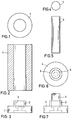
- the mold made of tool steel consists of a cylindrical lower part 1 with a smaller cylindrical extension 2 concentric to the lower part 1, both of which have a continuous, stepped axial bore 3.
- the lower part 1 serves to receive the tubular outer part 4 of the mold, which is centered by the extension 2, which engages the socket in the socket.
- a cylindrical rod 5 is inserted as a mandrel into the bore 3 of the lower part as far as it will go, onto which molded parts of the type shown in FIGS. 8 to 21 can be threaded.
- the molded parts fit exactly into the annular space 6 between the rod and the tube 4.
- the rod 5 Before the rod 5 is inserted, it is surrounded with a wire mesh. To do this, take a length of a wire predetermined by the volume of the ring, e.g. 250 cm of a 1 mm thick silver wire, winds it in a loop or meandering shape around the rod 4, so that the loops extending in the axial direction are, for example, about 4 cm long.
- the rod is wrapped in such a way that approximately half the wire length is used to surround the rod in a meandering or loop-like manner.
- the other half of the wire length is used to weave the loops together. To do this, thread the remaining wire length alternately above and below the wire turns, whereby the wire is passed around the bar several times at different heights.
- the beginning and end of the wire are stored in the braid so formed so that they are as inside as possible in the later ring.
- a pressure tube is then placed on the molded part serving as the upper punch, which is introduced into the annular space 6 and this pressure tube is pressed down hydraulically or via a lever mechanism, as is known per se in presses, and as a result the mesh is compressed, compressed and solidified while simultaneously strong plastic deformation of the wire.
- the shape of the lower punch and / or upper punch used depends solely on the desired shape of the ring.
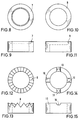
- the molded part shown in FIGS. 8 and 9 gives rings with a roof-shaped beveled flank 7
- the molded part shown in FIGS. 10 and 11 gives rings with a single beveled flank 8
- the molded part shown in FIGS. 12 and 13 gives rings with a toothed flank 9
- the molding shown in FIGS. 14 and 15 results in rings with a flank on which saddles 10 are arranged in a crosswise arrangement
- the molding shown in FIGS. 16 and 17 results in rings with a flat flank, which are rectangular runs to the cylinder axis.
- flank does not mean that it is smooth; rather, it is furrowed by the tangled course of the wire that appears in the flank, but there is a flat tangent surface for the flank, just flank 11 of the molded part (FIG. 16).
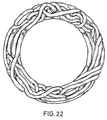
- FIGS. 18 and 19 leads to a ring with a rounded cross section. Such a ring is shown greatly enlarged in FIG. 22.
- the molded part shown in FIGS. 20 and 21 leads to a ring with a wavy flank 12.
Landscapes
- Engineering & Computer Science (AREA)
- Manufacturing & Machinery (AREA)
- Mechanical Engineering (AREA)
- Adornments (AREA)
- Conductive Materials (AREA)
- Manufacture And Refinement Of Metals (AREA)
Applications Claiming Priority (2)
| Application Number | Priority Date | Filing Date | Title |
|---|---|---|---|
| DE9304010U | 1993-03-10 | ||
| DE9304010U DE9304010U1 (de) | 1993-03-10 | 1993-03-10 | Schmuckstück |
Publications (2)
| Publication Number | Publication Date |
|---|---|
| EP0614627A1 EP0614627A1 (de) | 1994-09-14 |
| EP0614627B1 true EP0614627B1 (de) | 1997-06-11 |
Family
ID=6890820
Family Applications (1)
| Application Number | Title | Priority Date | Filing Date |
|---|---|---|---|
| EP94101597A Expired - Lifetime EP0614627B1 (de) | 1993-03-10 | 1994-02-03 | Schmuckstück, insbesondere aus Metall |
Country Status (5)
| Country | Link |
|---|---|
| US (1) | US5511391A (enExample) |
| EP (1) | EP0614627B1 (enExample) |
| JP (1) | JP3696264B2 (enExample) |
| AT (1) | ATE154210T1 (enExample) |
| DE (2) | DE9304010U1 (enExample) |
Families Citing this family (9)
| Publication number | Priority date | Publication date | Assignee | Title |
|---|---|---|---|---|
| US5639527A (en) * | 1996-02-16 | 1997-06-17 | Hurwitz; Scott L. | Braided wire sheathing having chrome appearance |
| USD412459S (en) * | 1997-04-21 | 1999-08-03 | Della Marie Collins | Ring |
| US5988639A (en) * | 1998-02-13 | 1999-11-23 | Kinderworks Corporation | Puzzle device |
| DE29806370U1 (de) | 1998-04-07 | 1998-07-23 | Herbert Betzler Inh. Ulrike Betzler-Schröder, 58762 Altena | Schmuckstück |
| DE102009007793A1 (de) * | 2009-02-06 | 2010-08-12 | Rhodius Gmbh | Ziergegenstand |
| IT1393006B1 (it) * | 2009-03-09 | 2012-04-11 | Omega Art S R L | Procedimento per la produzione di catenella tubolare in metallo con effetto elastico e diamantato con peso molto inferiore ai tubolari fatti con processi tradizionali, nel campo gioielleria, bigiotteria, collane, braccialetti, altri accessori personali. |
| JP5897187B1 (ja) * | 2015-06-04 | 2016-03-30 | 株式会社ナガホリ | 組合せ装飾体および組合せ装飾体の製造方法 |
| JP6159835B2 (ja) * | 2016-02-29 | 2017-07-05 | 株式会社ナガホリ | 組合せ装飾体用製造金型 |
| JP7045745B1 (ja) | 2021-11-09 | 2022-04-01 | 株式会社クロスフォー | 装身具部品製造方法、装身具製造方法、装身具の部品及び装身具 |
Family Cites Families (15)
| Publication number | Priority date | Publication date | Assignee | Title |
|---|---|---|---|---|
| US89240A (en) * | 1869-04-20 | Improvement in steam-generators | ||
| US728827A (en) * | 1902-09-08 | 1903-05-26 | John Anthony | Ornamental finger-ring. |
| US837615A (en) * | 1906-05-16 | 1906-12-04 | George W Dover | Setting. |
| US1972128A (en) * | 1933-02-20 | 1934-09-04 | James D Bobbroff | Finger ring |
| US2027060A (en) * | 1934-02-03 | 1936-01-07 | L G Balfour Company | Finger ring |
| US2054408A (en) * | 1935-08-17 | 1936-09-15 | Gen Findings & Supply Co | Band |
| US2596965A (en) * | 1950-05-20 | 1952-05-13 | Troy Ellen | Ornamentation for stockings and other stretchable materials |
| US2859971A (en) * | 1955-03-18 | 1958-11-11 | Joseph W Grant | Puzzle ring |
| US2920442A (en) * | 1956-07-23 | 1960-01-12 | Kunzmann Chain Company | Ornamental chain with links having an upset joint having a stone receiving recess |
| FR1484733A (fr) * | 1966-04-22 | 1967-06-16 | Procédé pour produire une face plane ou glacée sur une chaîne milanaise ou bande maillée similaire | |
| FR2145123A5 (enExample) * | 1971-07-08 | 1973-02-16 | Morabito Pascal | |
| CH612604A5 (enExample) * | 1976-05-31 | 1979-08-15 | Gori & Zucchi Spa | |
| US4493196A (en) * | 1983-09-15 | 1985-01-15 | Max Bogner | Ring construction and method of making same |
| IT1187350B (it) * | 1985-04-02 | 1987-12-23 | Valtiero Tizzi | Procedimento per ottenere elementi tubolari compositi a strisce longitudinali variegate,vuoti o con anima interna sfilabile,e prodotto ottenuto con tale procedimento |
| WO1992002157A1 (fr) * | 1990-07-31 | 1992-02-20 | Mitsubishi Materials Corporation | Structure a mailles metalliques pour articles de parure et procede de fabrication de cette structure |
-
1993
- 1993-03-10 DE DE9304010U patent/DE9304010U1/de not_active Expired - Lifetime
-
1994
- 1994-02-03 DE DE59403064T patent/DE59403064D1/de not_active Expired - Fee Related
- 1994-02-03 EP EP94101597A patent/EP0614627B1/de not_active Expired - Lifetime
- 1994-02-03 AT AT94101597T patent/ATE154210T1/de not_active IP Right Cessation
- 1994-02-23 JP JP02563194A patent/JP3696264B2/ja not_active Expired - Fee Related
- 1994-03-01 US US08/204,118 patent/US5511391A/en not_active Expired - Lifetime
Also Published As
| Publication number | Publication date |
|---|---|
| EP0614627A1 (de) | 1994-09-14 |
| JPH0747006A (ja) | 1995-02-21 |
| JP3696264B2 (ja) | 2005-09-14 |
| US5511391A (en) | 1996-04-30 |
| DE59403064D1 (de) | 1997-07-17 |
| ATE154210T1 (de) | 1997-06-15 |
| DE9304010U1 (de) | 1993-05-13 |
Similar Documents
| Publication | Publication Date | Title |
|---|---|---|
| EP1309257B1 (de) | Verfahren zum herstellen eines haftverschlussteils | |
| DE3600681C2 (enExample) | ||
| DE69422771T2 (de) | Verfahren zur Herstellung einer chirurgischen Nähnadel | |
| DE3884590T2 (de) | Verfahren und Vorrichtung zur plastischen Formgebung von Rädern mit Innenschrägverzahnung und Rädern mit Schrägverzahnung. | |
| DE3621329A1 (de) | Schmuck-tau-kette | |
| DE19716292C2 (de) | Strangpreßvorrichtung | |
| EP0894450B1 (de) | Reinigungskamm mit Zähnen, die in ihrer peripheren Oberfläche eine Rauhigkeit aufweisen, und Methode zur Herstellung eines Reinigungskamms mit hoher mechanischer Festigkeit | |
| EP0614627A1 (de) | Schmuckstück, insbesondere aus Metall | |
| DE2705762A1 (de) | Verfahren zur herstellung von armbaendern, ringen, ketten, ziergeraeten, briefoeffnern, teile fuer kolliers o. dgl., ausgehend von einem zusammengesetzten, rohrfoermigen teil aus metallen unterschiedlicher farbe und dadurch erhaltene waren | |
| DE3206979C2 (de) | Verfahren zum Herstellen eines aus zwei Sinterlegierungen bestehenden Ventilsitzes | |
| DE1922605B1 (de) | Verfahren und Vorrichtung zur Herstellung von Gliederreihen aus Kunststoff fuer Reissverschluesse | |
| EP0564667A1 (de) | Bimetallischer Münzrohling | |
| DE202010008275U1 (de) | Flächenelement, insbesondere Zifferblatt einer Uhr oder Schmuckelement | |
| DE4317210C2 (de) | Halbzeug zur Herstellung von Schmuck und Verfahren zu dessen Bearbeitung | |
| CH365029A (de) | Verfahren zur Herstellung von mit Ansätzen versehenen Mittelteilen von Uhrenschalen | |
| DE3204527A1 (de) | Verfahren zur herstellung eines schmuckstueckes aus einem rundstab aus edelmetall, insbesondere aus platin, sowie danach hergestellte schmuckstuecke | |
| DE4022965C1 (enExample) | ||
| DE3204343C2 (de) | Verfahren zur Fertigung eines Fingerrings und hiernach hergestellter Fingerring | |
| DE1296375B (de) | Verfahren zum Herstellen eines endlosen Treibriemens | |
| DE68909369T2 (de) | Schmuckkette. | |
| DE3311865C1 (de) | Verfahren zur pulvermetallurgischen Herstellung einer Warmarbeits-Werkzeugform | |
| DE2116766A1 (de) | Verfahren zur Herstellung einer Fahrrad-Tretkurbel | |
| DE102021100591B3 (de) | Herstellungsverfahren für ein Schmuckstück und Schmuckstück | |
| DE102008034986B4 (de) | Uhrlünette und Verfahren zu deren Herstellung | |
| DE69107454T2 (de) | Schmuck und Verfahren zu dessen Herstellung. |
Legal Events
| Date | Code | Title | Description |
|---|---|---|---|
| PUAI | Public reference made under article 153(3) epc to a published international application that has entered the european phase |
Free format text: ORIGINAL CODE: 0009012 |
|
| AK | Designated contracting states |
Kind code of ref document: A1 Designated state(s): AT BE CH DE DK ES FR GB GR IE IT LI NL PT SE |
|
| 17P | Request for examination filed |
Effective date: 19940916 |
|
| 17Q | First examination report despatched |
Effective date: 19960109 |
|
| GRAG | Despatch of communication of intention to grant |
Free format text: ORIGINAL CODE: EPIDOS AGRA |
|
| GRAH | Despatch of communication of intention to grant a patent |
Free format text: ORIGINAL CODE: EPIDOS IGRA |
|
| GRAH | Despatch of communication of intention to grant a patent |
Free format text: ORIGINAL CODE: EPIDOS IGRA |
|
| GRAA | (expected) grant |
Free format text: ORIGINAL CODE: 0009210 |
|
| AK | Designated contracting states |
Kind code of ref document: B1 Designated state(s): AT BE CH DE DK ES FR GB GR IE IT LI NL PT SE |
|
| PG25 | Lapsed in a contracting state [announced via postgrant information from national office to epo] |
Ref country code: NL Free format text: LAPSE BECAUSE OF FAILURE TO SUBMIT A TRANSLATION OF THE DESCRIPTION OR TO PAY THE FEE WITHIN THE PRESCRIBED TIME-LIMIT Effective date: 19970611 Ref country code: IT Free format text: LAPSE BECAUSE OF FAILURE TO SUBMIT A TRANSLATION OF THE DESCRIPTION OR TO PAY THE FEE WITHIN THE PRE;WARNING: LAPSES OF ITALIAN PATENTS WITH EFFECTIVE DATE BEFORE 2007 MAY HAVE OCCURRED AT ANY TIME BEFORE 2007. THE CORRECT EFFECTIVE DATE MAY BE DIFFERENT FROM THE ONE RECORDED.SCRIBED TIME-LIMIT Effective date: 19970611 Ref country code: GR Free format text: LAPSE BECAUSE OF FAILURE TO SUBMIT A TRANSLATION OF THE DESCRIPTION OR TO PAY THE FEE WITHIN THE PRESCRIBED TIME-LIMIT Effective date: 19970611 Ref country code: GB Effective date: 19970611 Ref country code: FR Effective date: 19970611 Ref country code: ES Free format text: THE PATENT HAS BEEN ANNULLED BY A DECISION OF A NATIONAL AUTHORITY Effective date: 19970611 Ref country code: DK Effective date: 19970611 |
|
| REF | Corresponds to: |
Ref document number: 154210 Country of ref document: AT Date of ref document: 19970615 Kind code of ref document: T |
|
| REG | Reference to a national code |
Ref country code: CH Ref legal event code: EP |
|
| REF | Corresponds to: |
Ref document number: 59403064 Country of ref document: DE Date of ref document: 19970717 |
|
| PG25 | Lapsed in a contracting state [announced via postgrant information from national office to epo] |
Ref country code: SE Effective date: 19970911 Ref country code: PT Effective date: 19970911 |
|
| NLV1 | Nl: lapsed or annulled due to failure to fulfill the requirements of art. 29p and 29m of the patents act | ||
| EN | Fr: translation not filed | ||
| GBV | Gb: ep patent (uk) treated as always having been void in accordance with gb section 77(7)/1977 [no translation filed] |
Effective date: 19970611 |
|
| PG25 | Lapsed in a contracting state [announced via postgrant information from national office to epo] |
Ref country code: AT Free format text: LAPSE BECAUSE OF NON-PAYMENT OF DUE FEES Effective date: 19980203 |
|
| PG25 | Lapsed in a contracting state [announced via postgrant information from national office to epo] |
Ref country code: LI Free format text: LAPSE BECAUSE OF NON-PAYMENT OF DUE FEES Effective date: 19980228 Ref country code: CH Free format text: LAPSE BECAUSE OF NON-PAYMENT OF DUE FEES Effective date: 19980228 Ref country code: BE Free format text: LAPSE BECAUSE OF NON-PAYMENT OF DUE FEES Effective date: 19980228 |
|
| PG25 | Lapsed in a contracting state [announced via postgrant information from national office to epo] |
Ref country code: IE Free format text: LAPSE BECAUSE OF NON-PAYMENT OF DUE FEES Effective date: 19980330 |
|
| REG | Reference to a national code |
Ref country code: IE Ref legal event code: FD4D Ref document number: 74612 Country of ref document: IE |
|
| PLBE | No opposition filed within time limit |
Free format text: ORIGINAL CODE: 0009261 |
|
| STAA | Information on the status of an ep patent application or granted ep patent |
Free format text: STATUS: NO OPPOSITION FILED WITHIN TIME LIMIT |
|
| 26N | No opposition filed | ||
| BERE | Be: lapsed |
Owner name: GEBR. NIESSING G.M.B.H. & CO. Effective date: 19980228 |
|
| REG | Reference to a national code |
Ref country code: CH Ref legal event code: PL |
|
| PGFP | Annual fee paid to national office [announced via postgrant information from national office to epo] |
Ref country code: DE Payment date: 20071215 Year of fee payment: 15 |
|
| PG25 | Lapsed in a contracting state [announced via postgrant information from national office to epo] |
Ref country code: DE Free format text: LAPSE BECAUSE OF NON-PAYMENT OF DUE FEES Effective date: 20090901 |