EP0612469A1 - Zubereitung mit akarizider Wirkung - Google Patents
Zubereitung mit akarizider Wirkung Download PDFInfo
- Publication number
- EP0612469A1 EP0612469A1 EP93103068A EP93103068A EP0612469A1 EP 0612469 A1 EP0612469 A1 EP 0612469A1 EP 93103068 A EP93103068 A EP 93103068A EP 93103068 A EP93103068 A EP 93103068A EP 0612469 A1 EP0612469 A1 EP 0612469A1
- Authority
- EP
- European Patent Office
- Prior art keywords
- preparations according
- washing
- mites
- wash
- waschen
- Prior art date
- Legal status (The legal status is an assumption and is not a legal conclusion. Google has not performed a legal analysis and makes no representation as to the accuracy of the status listed.)
- Granted
Links
- 230000000895 acaricidal effect Effects 0.000 title claims abstract description 27
- 238000002360 preparation method Methods 0.000 title claims abstract description 20
- 238000005406 washing Methods 0.000 claims abstract description 42
- 241000238876 Acari Species 0.000 claims abstract description 29
- 239000003599 detergent Substances 0.000 claims description 31
- 239000004480 active ingredient Substances 0.000 claims description 10
- 239000012141 concentrate Substances 0.000 claims description 10
- 239000000654 additive Substances 0.000 claims description 8
- 239000007788 liquid Substances 0.000 claims description 7
- 239000000203 mixture Substances 0.000 claims description 6
- 239000004753 textile Substances 0.000 claims description 4
- 229940052296 esters of benzoic acid for local anesthesia Drugs 0.000 claims description 3
- 235000019445 benzyl alcohol Nutrition 0.000 claims description 2
- 125000001797 benzyl group Chemical group [H]C1=C([H])C([H])=C(C([H])=C1[H])C([H])([H])* 0.000 claims description 2
- 239000000463 material Substances 0.000 claims description 2
- 125000001997 phenyl group Chemical group [H]C1=C([H])C([H])=C(*)C([H])=C1[H] 0.000 claims description 2
- WVDDGKGOMKODPV-UHFFFAOYSA-N Benzyl alcohol Chemical compound OCC1=CC=CC=C1 WVDDGKGOMKODPV-UHFFFAOYSA-N 0.000 claims 3
- 125000000217 alkyl group Chemical group 0.000 claims 1
- 239000000835 fiber Substances 0.000 claims 1
- 239000013543 active substance Substances 0.000 abstract description 2
- SESFRYSPDFLNCH-UHFFFAOYSA-N benzyl benzoate Chemical compound C=1C=CC=CC=1C(=O)OCC1=CC=CC=C1 SESFRYSPDFLNCH-UHFFFAOYSA-N 0.000 description 25
- 206010013786 Dry skin Diseases 0.000 description 15
- 229960002903 benzyl benzoate Drugs 0.000 description 12
- 238000000034 method Methods 0.000 description 8
- 235000014113 dietary fatty acids Nutrition 0.000 description 7
- 239000000194 fatty acid Substances 0.000 description 7
- 229930195729 fatty acid Natural products 0.000 description 7
- 150000004665 fatty acids Chemical class 0.000 description 7
- LFQSCWFLJHTTHZ-UHFFFAOYSA-N Ethanol Chemical compound CCO LFQSCWFLJHTTHZ-UHFFFAOYSA-N 0.000 description 6
- 239000003795 chemical substances by application Substances 0.000 description 6
- RTZKZFJDLAIYFH-UHFFFAOYSA-N Diethyl ether Chemical compound CCOCC RTZKZFJDLAIYFH-UHFFFAOYSA-N 0.000 description 5
- -1 dioctyl ester Chemical class 0.000 description 5
- 238000002474 experimental method Methods 0.000 description 5
- 150000002191 fatty alcohols Chemical class 0.000 description 5
- KWYUFKZDYYNOTN-UHFFFAOYSA-M potassium hydroxide Inorganic materials [OH-].[K+] KWYUFKZDYYNOTN-UHFFFAOYSA-M 0.000 description 5
- 239000000126 substance Substances 0.000 description 5
- 238000012360 testing method Methods 0.000 description 5
- XLYOFNOQVPJJNP-UHFFFAOYSA-N water Substances O XLYOFNOQVPJJNP-UHFFFAOYSA-N 0.000 description 5
- 229910001868 water Inorganic materials 0.000 description 5
- DNIAPMSPPWPWGF-UHFFFAOYSA-N Propylene glycol Chemical compound CC(O)CO DNIAPMSPPWPWGF-UHFFFAOYSA-N 0.000 description 4
- 230000000694 effects Effects 0.000 description 4
- FKKAGFLIPSSCHT-UHFFFAOYSA-N 1-dodecoxydodecane;sulfuric acid Chemical class OS(O)(=O)=O.CCCCCCCCCCCCOCCCCCCCCCCCC FKKAGFLIPSSCHT-UHFFFAOYSA-N 0.000 description 3
- 206010020751 Hypersensitivity Diseases 0.000 description 3
- DGAQECJNVWCQMB-PUAWFVPOSA-M Ilexoside XXIX Chemical compound C[C@@H]1CC[C@@]2(CC[C@@]3(C(=CC[C@H]4[C@]3(CC[C@@H]5[C@@]4(CC[C@@H](C5(C)C)OS(=O)(=O)[O-])C)C)[C@@H]2[C@]1(C)O)C)C(=O)O[C@H]6[C@@H]([C@H]([C@@H]([C@H](O6)CO)O)O)O.[Na+] DGAQECJNVWCQMB-PUAWFVPOSA-M 0.000 description 3
- HEMHJVSKTPXQMS-UHFFFAOYSA-M Sodium hydroxide Chemical compound [OH-].[Na+] HEMHJVSKTPXQMS-UHFFFAOYSA-M 0.000 description 3
- 239000013566 allergen Substances 0.000 description 3
- 229960004784 allergens Drugs 0.000 description 3
- MTHSVFCYNBDYFN-UHFFFAOYSA-N diethylene glycol Chemical compound OCCOCCO MTHSVFCYNBDYFN-UHFFFAOYSA-N 0.000 description 3
- 150000003839 salts Chemical class 0.000 description 3
- 229910052708 sodium Inorganic materials 0.000 description 3
- 239000011734 sodium Substances 0.000 description 3
- 239000012209 synthetic fiber Substances 0.000 description 3
- 229920002994 synthetic fiber Polymers 0.000 description 3
- IJGRMHOSHXDMSA-UHFFFAOYSA-N Atomic nitrogen Chemical compound N#N IJGRMHOSHXDMSA-UHFFFAOYSA-N 0.000 description 2
- NIQCNGHVCWTJSM-UHFFFAOYSA-N Dimethyl phthalate Chemical compound COC(=O)C1=CC=CC=C1C(=O)OC NIQCNGHVCWTJSM-UHFFFAOYSA-N 0.000 description 2
- 208000026935 allergic disease Diseases 0.000 description 2
- 230000007815 allergy Effects 0.000 description 2
- 150000001412 amines Chemical class 0.000 description 2
- 150000002148 esters Chemical class 0.000 description 2
- 150000002170 ethers Chemical class 0.000 description 2
- 235000019387 fatty acid methyl ester Nutrition 0.000 description 2
- 230000007935 neutral effect Effects 0.000 description 2
- 238000011197 physicochemical method Methods 0.000 description 2
- 229920000151 polyglycol Polymers 0.000 description 2
- 239000010695 polyglycol Substances 0.000 description 2
- 230000008569 process Effects 0.000 description 2
- YGSDEFSMJLZEOE-UHFFFAOYSA-N salicylic acid Chemical compound OC(=O)C1=CC=CC=C1O YGSDEFSMJLZEOE-UHFFFAOYSA-N 0.000 description 2
- 239000004094 surface-active agent Substances 0.000 description 2
- 210000002268 wool Anatomy 0.000 description 2
- TYTGWHZODQKWEF-UHFFFAOYSA-N 1-o-dodecyl 4-o-sulfo butanedioate Chemical compound CCCCCCCCCCCCOC(=O)CCC(=O)OS(O)(=O)=O TYTGWHZODQKWEF-UHFFFAOYSA-N 0.000 description 1
- TURPNXCLLLFJAP-UHFFFAOYSA-N 2-[2-(2-hydroxyethoxy)ethoxy]ethyl hydrogen sulfate Chemical compound OCCOCCOCCOS(O)(=O)=O TURPNXCLLLFJAP-UHFFFAOYSA-N 0.000 description 1
- QTBSBXVTEAMEQO-UHFFFAOYSA-M Acetate Chemical compound CC([O-])=O QTBSBXVTEAMEQO-UHFFFAOYSA-M 0.000 description 1
- 240000001889 Brahea edulis Species 0.000 description 1
- 244000060011 Cocos nucifera Species 0.000 description 1
- 235000013162 Cocos nucifera Nutrition 0.000 description 1
- 201000004624 Dermatitis Diseases 0.000 description 1
- 206010061217 Infestation Diseases 0.000 description 1
- 201000008197 Laryngitis Diseases 0.000 description 1
- ZLMJMSJWJFRBEC-UHFFFAOYSA-N Potassium Chemical compound [K] ZLMJMSJWJFRBEC-UHFFFAOYSA-N 0.000 description 1
- 241000238711 Pyroglyphidae Species 0.000 description 1
- DBMJMQXJHONAFJ-UHFFFAOYSA-M Sodium laurylsulphate Chemical compound [Na+].CCCCCCCCCCCCOS([O-])(=O)=O DBMJMQXJHONAFJ-UHFFFAOYSA-M 0.000 description 1
- 239000000642 acaricide Substances 0.000 description 1
- 239000002253 acid Substances 0.000 description 1
- 150000007513 acids Chemical class 0.000 description 1
- 230000009471 action Effects 0.000 description 1
- 230000000996 additive effect Effects 0.000 description 1
- 150000001298 alcohols Chemical class 0.000 description 1
- 150000001338 aliphatic hydrocarbons Chemical class 0.000 description 1
- 125000000129 anionic group Chemical group 0.000 description 1
- 150000004945 aromatic hydrocarbons Chemical class 0.000 description 1
- 208000006673 asthma Diseases 0.000 description 1
- 150000003938 benzyl alcohols Chemical class 0.000 description 1
- GZASGKSFGDNCJI-UHFFFAOYSA-N benzyl benzoate;2-benzylbenzoic acid Chemical compound OC(=O)C1=CC=CC=C1CC1=CC=CC=C1.C=1C=CC=CC=1C(=O)OCC1=CC=CC=C1 GZASGKSFGDNCJI-UHFFFAOYSA-N 0.000 description 1
- 239000003139 biocide Substances 0.000 description 1
- 238000009835 boiling Methods 0.000 description 1
- 206010006451 bronchitis Diseases 0.000 description 1
- 239000000872 buffer Substances 0.000 description 1
- 244000309464 bull Species 0.000 description 1
- 125000002091 cationic group Chemical group 0.000 description 1
- 239000003093 cationic surfactant Substances 0.000 description 1
- 230000001684 chronic effect Effects 0.000 description 1
- 238000004140 cleaning Methods 0.000 description 1
- 150000001875 compounds Chemical class 0.000 description 1
- 230000003750 conditioning effect Effects 0.000 description 1
- 239000000470 constituent Substances 0.000 description 1
- 230000008021 deposition Effects 0.000 description 1
- XXJWXESWEXIICW-UHFFFAOYSA-N diethylene glycol monoethyl ether Chemical compound CCOCCOCCO XXJWXESWEXIICW-UHFFFAOYSA-N 0.000 description 1
- 229940075557 diethylene glycol monoethyl ether Drugs 0.000 description 1
- FBSAITBEAPNWJG-UHFFFAOYSA-N dimethyl phthalate Natural products CC(=O)OC1=CC=CC=C1OC(C)=O FBSAITBEAPNWJG-UHFFFAOYSA-N 0.000 description 1
- 229960001826 dimethylphthalate Drugs 0.000 description 1
- 201000010099 disease Diseases 0.000 description 1
- 208000037265 diseases, disorders, signs and symptoms Diseases 0.000 description 1
- 125000003438 dodecyl group Chemical group [H]C([H])([H])C([H])([H])C([H])([H])C([H])([H])C([H])([H])C([H])([H])C([H])([H])C([H])([H])C([H])([H])C([H])([H])C([H])([H])C([H])([H])* 0.000 description 1
- 238000001035 drying Methods 0.000 description 1
- 239000000428 dust Substances 0.000 description 1
- 239000003995 emulsifying agent Substances 0.000 description 1
- 230000001804 emulsifying effect Effects 0.000 description 1
- 239000000945 filler Substances 0.000 description 1
- 235000013305 food Nutrition 0.000 description 1
- 238000009472 formulation Methods 0.000 description 1
- 229930182478 glucoside Natural products 0.000 description 1
- 150000002334 glycols Chemical class 0.000 description 1
- 230000036541 health Effects 0.000 description 1
- 230000005802 health problem Effects 0.000 description 1
- 229940046533 house dust mites Drugs 0.000 description 1
- 125000002887 hydroxy group Chemical group [H]O* 0.000 description 1
- 230000006872 improvement Effects 0.000 description 1
- 238000010348 incorporation Methods 0.000 description 1
- 239000003112 inhibitor Substances 0.000 description 1
- 238000011835 investigation Methods 0.000 description 1
- 229940071180 lauryl sulfosuccinate Drugs 0.000 description 1
- 150000002688 maleic acid derivatives Chemical class 0.000 description 1
- 229910052757 nitrogen Inorganic materials 0.000 description 1
- 239000002736 nonionic surfactant Substances 0.000 description 1
- 230000008520 organization Effects 0.000 description 1
- FJKROLUGYXJWQN-UHFFFAOYSA-N papa-hydroxy-benzoic acid Natural products OC(=O)C1=CC=C(O)C=C1 FJKROLUGYXJWQN-UHFFFAOYSA-N 0.000 description 1
- 239000012188 paraffin wax Substances 0.000 description 1
- 239000002304 perfume Substances 0.000 description 1
- 238000000053 physical method Methods 0.000 description 1
- 229920000233 poly(alkylene oxides) Polymers 0.000 description 1
- 229920000642 polymer Polymers 0.000 description 1
- 235000011118 potassium hydroxide Nutrition 0.000 description 1
- 159000000001 potassium salts Chemical class 0.000 description 1
- 239000000843 powder Substances 0.000 description 1
- 239000003755 preservative agent Substances 0.000 description 1
- 150000003856 quaternary ammonium compounds Chemical class 0.000 description 1
- 206010039083 rhinitis Diseases 0.000 description 1
- 229960004889 salicylic acid Drugs 0.000 description 1
- 239000000344 soap Substances 0.000 description 1
- 235000019333 sodium laurylsulphate Nutrition 0.000 description 1
- 239000002904 solvent Substances 0.000 description 1
- 210000002023 somite Anatomy 0.000 description 1
- 125000000020 sulfo group Chemical group O=S(=O)([*])O[H] 0.000 description 1
- BDHFUVZGWQCTTF-UHFFFAOYSA-M sulfonate Chemical compound [O-]S(=O)=O BDHFUVZGWQCTTF-UHFFFAOYSA-M 0.000 description 1
- 208000024891 symptom Diseases 0.000 description 1
- 239000002562 thickening agent Substances 0.000 description 1
- 239000004711 α-olefin Substances 0.000 description 1
Classifications
-
- A—HUMAN NECESSITIES
- A01—AGRICULTURE; FORESTRY; ANIMAL HUSBANDRY; HUNTING; TRAPPING; FISHING
- A01N—PRESERVATION OF BODIES OF HUMANS OR ANIMALS OR PLANTS OR PARTS THEREOF; BIOCIDES, e.g. AS DISINFECTANTS, AS PESTICIDES OR AS HERBICIDES; PEST REPELLANTS OR ATTRACTANTS; PLANT GROWTH REGULATORS
- A01N25/00—Biocides, pest repellants or attractants, or plant growth regulators, characterised by their forms, or by their non-active ingredients or by their methods of application, e.g. seed treatment or sequential application; Substances for reducing the noxious effect of the active ingredients to organisms other than pests
-
- A—HUMAN NECESSITIES
- A01—AGRICULTURE; FORESTRY; ANIMAL HUSBANDRY; HUNTING; TRAPPING; FISHING
- A01N—PRESERVATION OF BODIES OF HUMANS OR ANIMALS OR PLANTS OR PARTS THEREOF; BIOCIDES, e.g. AS DISINFECTANTS, AS PESTICIDES OR AS HERBICIDES; PEST REPELLANTS OR ATTRACTANTS; PLANT GROWTH REGULATORS
- A01N37/00—Biocides, pest repellants or attractants, or plant growth regulators containing organic compounds containing a carbon atom having three bonds to hetero atoms with at the most two bonds to halogen, e.g. carboxylic acids
- A01N37/10—Aromatic or araliphatic carboxylic acids, or thio analogues thereof; Derivatives thereof
-
- C—CHEMISTRY; METALLURGY
- C11—ANIMAL OR VEGETABLE OILS, FATS, FATTY SUBSTANCES OR WAXES; FATTY ACIDS THEREFROM; DETERGENTS; CANDLES
- C11D—DETERGENT COMPOSITIONS; USE OF SINGLE SUBSTANCES AS DETERGENTS; SOAP OR SOAP-MAKING; RESIN SOAPS; RECOVERY OF GLYCEROL
- C11D3/00—Other compounding ingredients of detergent compositions covered in group C11D1/00
- C11D3/16—Organic compounds
- C11D3/20—Organic compounds containing oxygen
- C11D3/2003—Alcohols; Phenols
- C11D3/2041—Dihydric alcohols
- C11D3/2044—Dihydric alcohols linear
-
- C—CHEMISTRY; METALLURGY
- C11—ANIMAL OR VEGETABLE OILS, FATS, FATTY SUBSTANCES OR WAXES; FATTY ACIDS THEREFROM; DETERGENTS; CANDLES
- C11D—DETERGENT COMPOSITIONS; USE OF SINGLE SUBSTANCES AS DETERGENTS; SOAP OR SOAP-MAKING; RESIN SOAPS; RECOVERY OF GLYCEROL
- C11D3/00—Other compounding ingredients of detergent compositions covered in group C11D1/00
- C11D3/16—Organic compounds
- C11D3/20—Organic compounds containing oxygen
- C11D3/2093—Esters; Carbonates
-
- C—CHEMISTRY; METALLURGY
- C11—ANIMAL OR VEGETABLE OILS, FATS, FATTY SUBSTANCES OR WAXES; FATTY ACIDS THEREFROM; DETERGENTS; CANDLES
- C11D—DETERGENT COMPOSITIONS; USE OF SINGLE SUBSTANCES AS DETERGENTS; SOAP OR SOAP-MAKING; RESIN SOAPS; RECOVERY OF GLYCEROL
- C11D3/00—Other compounding ingredients of detergent compositions covered in group C11D1/00
- C11D3/48—Medical, disinfecting agents, disinfecting, antibacterial, germicidal or antimicrobial compositions
-
- C—CHEMISTRY; METALLURGY
- C11—ANIMAL OR VEGETABLE OILS, FATS, FATTY SUBSTANCES OR WAXES; FATTY ACIDS THEREFROM; DETERGENTS; CANDLES
- C11D—DETERGENT COMPOSITIONS; USE OF SINGLE SUBSTANCES AS DETERGENTS; SOAP OR SOAP-MAKING; RESIN SOAPS; RECOVERY OF GLYCEROL
- C11D3/00—Other compounding ingredients of detergent compositions covered in group C11D1/00
- C11D3/16—Organic compounds
- C11D3/20—Organic compounds containing oxygen
- C11D3/2003—Alcohols; Phenols
- C11D3/2006—Monohydric alcohols
- C11D3/2034—Monohydric alcohols aromatic
Definitions
- the physical methods include lowering the humidity in the interior, covering upholstered objects such as mattresses with mite and allergy-tight covers, and killing the mites by extremely deep ones Temperatures with the help of liquid nitrogen.
- a mite-killing wash is impossible even if the washing machines are not designed to withstand higher temperatures. For example, this is often the case in the United States.
- liquid mite-killing agents and for agents that are used diluted with liquids, it should also be noted that the liquids must first dry until the actual active substance and then a dry residue is formed. This has a 10 to 90% higher content of benzyl benzoate than the starting agent.
- Benzyl alcohols, high-boiling esters of benzoic or salicylic acid and mixed and simple phthalic esters such as dimethyl phthalate, diethyl ester, dibutyl ester, dioctyl ester or benzyl butyl ester can be used as acaricidal active ingredients.
- Benzyl alcohol, alkyl, phenyl or benzyl esters of benzoic acid are preferred, the aromatic radicals of the active compounds generally being unsubstituted. However, they can also be substituted once, twice or three times.
- Benzyl benzoate (benzyl benzoate) is particularly preferred.
- the preparations can contain further additives or auxiliaries known per se.
- Suitable additives are, for example, surfactants, thickeners, emulsifiers, solvents, fillers, perfumes and preservatives.
- the surfactants which are customary in textile cleaning processes are anionic, nonionic, cationic or amphoteric substances, such as sulfonated aromatic hydrocarbons, e.g. n-alkylbenzenesulfonates; sulfonated aliphatic hydrocarbons, e.g. secondary alkanesulfonate; sulfonated alpha olefin, sulfated fatty alcohol e.g. Sodium lauryl sulfate; sulfated fatty alcohol ether, e.g. Sodium lauryl propyl glycol ether sulfate; sulfonated fatty acid methyl esters, e.g.
- anionic, nonionic, cationic or amphoteric substances such as sulfonated aromatic hydrocarbons, e.g. n-alkylbenzenesulfonates; sulfonated aliphatic hydrocarbons, e.g. secondary
- nonionic surfactants are: fatty alcohol ethoxylate, alkylphenol ethoxylate, fatty acid ethoxylate, fatty acid alkylolamide, fatty acid alkylolamide ethoxylate, fatty amine ethoxylate, polyalkylene oxide block polymers.
- Quaternary ammonium compounds can be mentioned as cationic surfactants.
- ampholytes are betaines.
- Further additives or auxiliaries can, for example, C12-C18 fatty acids, mixtures thereof or their sodium or potassium salts, C12-C16 fatty alcohols with 1-10 hydroxyl groups, ethers such as diethylene glycol monoethyl ether, alkylphenols, fatty amines, alkyl glucosides, fatty acid mono-, di- or -polyalkylolamides or alkylbenzenesulfonic acids as well as potassium or sodium hydroxide, water, alcohols such as ethanol and glycols such as ethylene diglycol or 1,2-propylene glycol.
- ethers such as diethylene glycol monoethyl ether, alkylphenols, fatty amines, alkyl glucosides, fatty acid mono-, di- or -polyalkylolamides or alkylbenzenesulfonic acids as well as potassium or sodium hydroxide
- water alcohols such as ethanol and glycols such as
- the preparations according to the invention can be present as acaricidal mild detergents or as acaricidal detergent additives, particularly preferably as concentrates.
- the preparations, especially the mild detergents can be alkaline, i.e. be soap-based or pH-neutral.
- the textile articles of daily use to be treated with the preparations according to the invention originate from those areas in which the presence of mites has been determined. These are, in particular, all types of clothing, carpets, bed linen, blankets, pillows, beds, mattresses, pillow and bed fillings, upholstered furniture and all other washable materials.
- the Objects are made of natural or synthetic fibers.
- the washing temperature is 20-55 ° C, a temperature of 25-50 ° C is particularly preferred.
- Acaricidal mild detergent (alkaline) % By weight Water, dist. 44.1 Fatty acids (C12-C18) 12.0 Potash lye (45%) 6.5 Lutensol AO 10® 10.0 Marlon A 365® (65%) 15.4 Ethanol 6.0 Ethylene diglycol 1.0 Benzyl benzoate 5.0 100.0 ⁇ % By weight ⁇
- the acaricidal washing effect was investigated on dirty and extremely mite-infested sections of carpets.
- the average number of mites for the 1/4 square meter carpet samples used for the investigations was approximately 38500 mites (this corresponds to approximately 150,000 pieces / m2). Parts of 175 cm2 were examined.
- the following examples A and B describe the washing tests and give the mite population found accordingly.
- the mite population was determined using the heat evacuation method (Rev. fr. Allergol. 28 , 115-122 (1988)). It is a direct count.
- Tests 1 and 2 did not wash. They show the original number of mites as a zero level. After washing with an acaricidal mild detergent - trials 3 to 6 - only 0 or 1 mite remain. Washing with a non-acaricidal detergent cannot eliminate the mites, it can only reduce them. This is shown in experiments 7 and 8. The number of mites remaining in these cases (approx. 200 to 700) means no significant improvement in biological experiments, because the surviving mites quickly reproduce to the original ones under the same climatic conditions and comparable food supply Amounts.
- a strongly mite-infested carpet was also used for the tests according to Example B.
- the number of mites was approx. 16,000 per 1/4 sqm (which corresponds to approx. 64,000 mites per m2).
- test 1 again shows the approximate original number of mites on one of the sections of approx. 260 cm2.
- the average number of mites for the 1/4 square meter carpet is approximately 16300 (this corresponds to approximately 65000 per m2).
- the amount of detergent can usually be reduced by 10 to 20% with the same washing result.
- 90 ml of commercially available detergent were used in the tests.
- the number of mites found in the wash liquor after washing with detergent and acaricidal additive 1 ⁇ is between 0 and 1.
- the desired mite kill is achieved.
- the agents themselves are eliminated by the usual rinsing processes.
Landscapes
- Life Sciences & Earth Sciences (AREA)
- Chemical & Material Sciences (AREA)
- Wood Science & Technology (AREA)
- Health & Medical Sciences (AREA)
- Engineering & Computer Science (AREA)
- Organic Chemistry (AREA)
- General Health & Medical Sciences (AREA)
- Oil, Petroleum & Natural Gas (AREA)
- Chemical Kinetics & Catalysis (AREA)
- Plant Pathology (AREA)
- Zoology (AREA)
- Environmental Sciences (AREA)
- Emergency Medicine (AREA)
- Dentistry (AREA)
- Pest Control & Pesticides (AREA)
- Agronomy & Crop Science (AREA)
- Toxicology (AREA)
- Agricultural Chemicals And Associated Chemicals (AREA)
- Detergent Compositions (AREA)
- Medicines Containing Material From Animals Or Micro-Organisms (AREA)
Abstract
Description
- Allergien, die durch Hausstaubmilben bzw. allgemein durch Milben im Hausbereich hervorgerufen werden, erweisen sich, weltweit zunehmend, als sehr ernste Gesundheitsprobleme. Die durch Milbenallergene ausgelösten Krankheiten wie Laryngitis, Rhinitis, Bronchitis mit Steigerung bis zu lebensbedrohendem Asthma oder Dermatitis mit der Möglichkeit der Entwicklung chronischer Symptome entstehen und belasten die Patienten das ganze Jahr über. Grund dafür ist, daß die Allergene der Hausstaubmilben während des gesamten Jahres in den milbenbefallenen Innenräumen und Gegenständen vorhanden sind und z.B. mit Kleidungsstücken, Textilien oder mit Möbeln im gesamten Lebensbereich des Menschen verteilt werden. Der wichtigste Kontaktbereich ist wegen des Befalles und der Expositionsdauer das Bett (Acarologia, T. XXXII, fasc. 4, 1991). Seit Beginn der achziger Jahre wurden die Möglichkeiten und Methoden zur Bekämpfung der Milben und zur Beseitigung der von ihnen produzierten Allergenen mit wachsender Intensität untersucht.
- Auch die Welt-Gesundheitsorganisation (WHO) hat sich für die Ergebnisse und Empfehlungen interessiert und sie in ihrem Bulletin veröffentlicht (Bull. WHO 66(6), 769-780 (1988)).
- In der Literatur werden physikalische, chemische und physikalisch-chemische Methoden zur Milbenabtötung diskutiert.
- Abgesehen von der Beseitigung von Gegenständen, in denen sich Milben bevorzugt aufhalten und die verzichtbar sind, gehören zu den physikalischen Methoden die Erniedrigung der Luftfeuchtigkeit in Innenräumen, das Einhüllen von Polstergegenständen wie Matratzen mit milben- und allergendichten Überzügen sowie das Abtöten der Milben durch extrem tiefe Temperaturen mit Hilfe von flüssigem Stickstoff.
- Die chemischen Methoden sind durch die Anwendung verschiedener Akarizide gekennzeichnet. Am besten untersucht und wissenschaftlich belegt sind unter diesen Präparaten diejenigen auf Basis von verfestigtem Benzylbenzoat (Indoor Environ 1, 212-218 (1992).
- Auch bei Anwendung der genannten Methoden zur Milbenbekämpfung verbleiben eine ganze Reihe von Gegenständen, die milbenbefallen sein können, von den Patienten in ihrem täglichen Leben benötigt werden und auf den beschriebenen Wegen nicht behandelt werden können. Es sind die Gegenstände, die normalerweise duch die physikalisch-chemische Methode des Waschens gereinigt werden.
- Die Milbenabtötung beim Waschen ist in zahlreichen Studien untersucht worden. Diese haben immer wieder ergeben, daß eine Milbenabtötung erst dann eintritt, wenn der Waschvorgang bei Temperaturen von 55 °C oder höher durchgeführt wird (J. Allergy Clin. Immunol. 90, 599-608 (1992)).
- Die Wirkung von Detergentien und sonstigen chemischen Substanzen, die in Waschmitteln vorhanden sind, spielt dabei überhaupt keine Rolle.
- Dies bedeutet für die Praxis, daß viele Gegenstände, die Waschvorgänge bei Temperaturen von 55° oder höher nicht vertragen, auf diesem Wege nicht milbenfrei gemacht werden können. Zu solchen Gegenständen gehören z.B. Kleidungsstücke, Wäsche und Bettwäsche aus synthetischen Fasern oder Wolle, die bei niedrigen Temperaturen durch Handwäsche oder in der Waschmaschine zu behandeln sind, aber auch Kissen, Bettdecken, Teppiche und dergl., die aus Wolle und/oder synthetischen Fasern bestehen oder damit gefüllt sind. Gegenstände dieser Art werden zwar vielfach beim Waschen bei höheren Temperaturen nicht gerade zerstört, sie klumpen aber oft zusammen und werden dabei unbrauchbar oder unansehnlich. Insbesondere bei Kinderbetten stellen sich diese Probleme häufig.
- Ein milbenabtötendes Waschen ist auch dann unmöglich, wenn die Waschmaschinen nicht für die Anwendung von höheren Temperaturen ausgelegt sind. Dies ist beispielsweise vielfach in den USA der Fall.
- Überraschenderweise hat sich gezeigt, daß das Problem des milbenabtötenden Waschens - entgegen den Ergebnissen aller bisher durchgeführten Studien - mit den erfindungsgemäßen Mitteln doch auch bei niedrigen Temperaturen gelöst werden kann.
- Entscheidend für die Erfindung war die Feststellung, daß bei einem Waschvorgang Anteile von Benzylbenzoat in der Größenordnung unter einem Promille trotz der konkurrierenden Anwesenheit von grenzflächenaktiven und emulgierenden Bestandteilen der handelsüblichen Waschmittel und auch der weiteren Zusätze wie Ablagerungsverhinderungsmittel, Konditionierungsmittel, Füllsubstanzen u.a. genügen, um die gewünschte Milbenabtötung bei niedrigen Temperaturen herbeizuführen.
- Dies war keineswegs zu erwarten, denn nach den bisherigen Kenntnissen, wie sie beispielsweise in EP 0 173 229 B1 oder in Allergologie 9, 171-176 (1986) beschrieben sind, sind Konzentrationen zwischen 0,5 und 20 % Benzylbenzoat erforderlich, um die Milben wirksam abzutöten.
- Bei diesen Mengenangaben für flüssige milbenabtötende Mittel und für Mittel, die mit Flüssigkeiten verdünnt angewandt werden, ist noch zu beachten, daß die Flüssigkeiten zunächst antrocknen müssen bis die eigentliche Wirksubstanz und dann daraus ein Trockenrückstand entstanden ist. Dieser hat einen noch um 10 bis 90 % höheren Gehalt an Benzylbenzoat als das Ausgangsmittel.
- Dieses Wissen um die Mengenverhältnisse in akarizid wirksamen Produkten hat offenbar dazu geführt, daß von Versuchen zur Milbenabtötung in Waschprozessen abgesehen wurde. Bei vergleichbaren prozentualen Anteilen hätte man mit Wirkstoffmengen von 1 bis 2 l Benzylbenzoat bei Waschflotten von 25 l oder mehr rechnen müssen. Im Falle des Waschens ist auch ein Konzentrieren des akariziden Wirkstoffes durch Antrocknen nicht möglich, da die jeweilige Waschflotte äbgesaugt und unmittelbar danach durch Spülflotten ersetzt wird.
- Die erfindungsgemäßen Mittel eignen sich hauptsächlich für zwei Anwendungsrichtungen:
- (A) Inkorporierung der akariziden Zübereitungen in bekannte oder den bekannten analogen Rezepturen flüssiger oder pulverförmiger Waschmittel.
- (B) Herstellung eines Konzentrates, welches gegebenenfalls als Zusatz den handelsüblichen Waschmitteln beigefügt werden kann, mit diesen Mitteln verträglich ist und somit in den vorgeschriebenen Anwendungskonzentrationen die gewünschte Wirkung herbeiführt.
- Die zuletzt genannte Anwendungsrichtung ist die bevorzugte.
- Als akarizide Wirkstoffe können Benzylalkohole, hochsiedende Ester der Benzoe - oder Salicylsäure sowie gemischte und einfache Phthalsäureester, wie z.B. Phthalsäuredimethylester, -diethylester, -dibutylester, -dioctylester-, oder -benzylbutylester verwendet werden. Bevorzugt sind Benzylalkohol, Alkyl-, Phenyl- oder Benzylester der Benzoesäure, wobei die aromatischen Reste der Wirkstoffe in der Regel unsubstituiert sind. Sie können aber auch ein-, zwei- oder dreifach substituiert sein. Besonders bevorzugt ist Benzoesäurebenzylester (Benzylbenzoat).
- Neben den eigentlichen Wirkstoffen, die gegebenenfalls auch in Mischungen eingesetzt werden können, können die Zubereitungen weitere an sich bekannte Zusatz- oder Hilfsstoffe enthalten. Geeignete Additive sind beispielsweise Tenside, Verdickungsmittel, Emulgatoren, Lösungsmittel, Füllmittel, Parfüme sowie Konservierungsmittel.
- Im einzelnen werden als Tenside beispielsweise die bei textilen Reinigungsverfahren üblichen anionaktiven, nicht ionogenen, kationaktiven oder amphoteren Stoffe, wie sulfonierte aromatische Kohlenwasserstoffe, z.B. n-Alkylbenzolsulfonate; sulfonierte aliphatische Kohlenwasserstoffe, z.B. sekundäres Alkansulfonat; sulfoniertes Alpha-Olefin, sulfatierter Fettalkohol, z.B. Natriumlaurylsulfat; sulfatierter Fettalkoholether, z.B. Natriumlaurylpropylglykolethersulfat; sulfonierte Fettsäuremethylester, z.B. Palmkernsulfofettsäuremethylester; Natriumparaffinsulfonat; sulfonierte Maleinsäureester, z.B. Laurylsulfosuccinat; carboxymethylierte Fettalkoholpolyglykolether, z.B. Laurylpolyglykoletheracetat, verwenden. Als nichtionische Tensid-Beispiele sind zu nennen: Fettalkoholethoxylat, Alkylphenolethoxylat, Fettsäureethoxylat, Fettsäurealkylolamid, Fettsäurealkylolamidethoxylat, Fettaminethoxylat, Polyalkylenoxid-Blockpolymerisate. Als kationische Tenside sind quaternäre Ammoniumverbindungen zu nennen. Beispiele für Ampholyte sind Betaine.
- Weitere Zusatz- oder Hilfsstoffe können beispielsweise C₁₂-C₁₈ Fettsäuren, Gemische derselben oder ihre Natrium- oder Kaliumsalze, C₁₂-C₁₆ Fettalkohole mit 1-10 Hydroxygruppen, Ether wie Diethylenglykolmonoethylether, Alkylphenole, Fettamine, Alkylglucoside, Fettsäuremono-, di- bzw. -polyalkylolamide oder Alkylbenzolsulfonsäuren sowie Kalium- oder Natriumhydroxid, Wasser, Alkohole wie Ethanol und Glykole wie Ethylendiglykol oder 1,2-Propylenglykol sein.
- Bewährt haben sich auch Mischungen von Zusatzstoffen wie Marlowet RNP/K®, Marlowet R40/K®, Elfan 243®, Lutensol®, Marlon A® oder Comperlan®, die im Handel angeboten werden.
- Die erfindungsgemäßen Zubereitungen können als akarizide Feinwaschmittel oder als akarizide Waschmittelzusätze, besonders bevorzugt als Konzentrate, vorliegen. Die Zubereitungen, insbesondere die Feinwaschmittel, können alkalisch, d.h. seifenhaltig oder pH-neutral sein.
- Besonders bewährt haben sich erfindungsgemäße Zubereitungen, zur Abtötung von Milben bei Waschvorgängen, der folgenden Zusammensetzung:
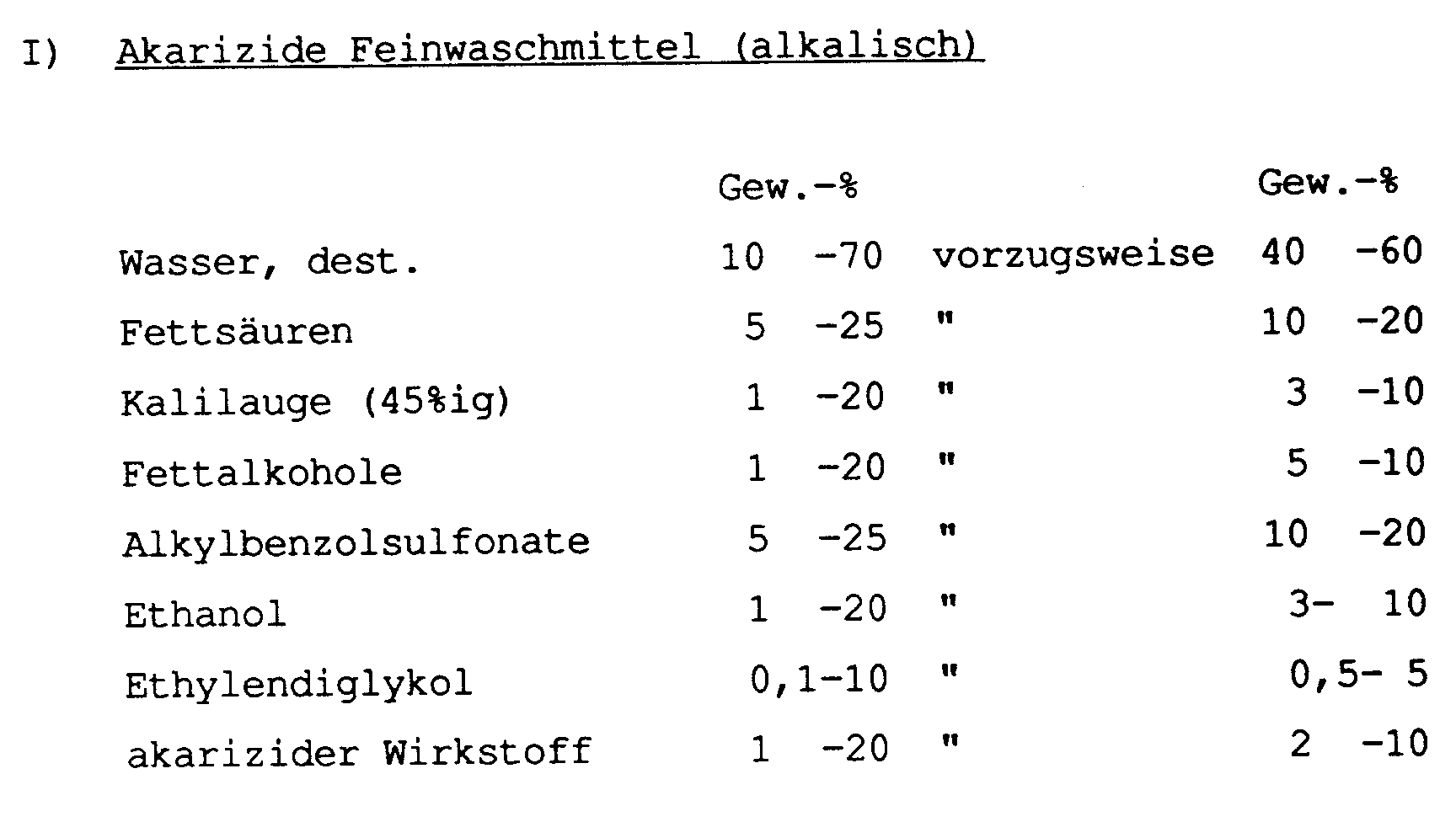

- Die mit den erfindungsgemäßen Zubereitungen zu behandelnden textilen Gebrauchsgegenstände entstammen denjenigen Bereichen, in den das Vorkommen von Milben festgestellt wurde. Dies sind insbesondere Kleidungsstücke jeglicher Art, Teppiche, Bettwäsche, Decken, Kopfkissen, Betten, Matratzen, Füllungen von Kissen und Betten, Auflagen von Polstermöbeln und alle anderen waschbaren Materialien. Dabei können die Gegenstände aus natürlichen oder synthetischen Fasern bestehen. Die Waschtemperatur beträgt 20-55 °C, besonders bevorzugt ist eine Temperatur von 25-50 °C.
- Die nachfolgenden Beispiele erläutern die Erfindung ohne diese in ihrer Anwendung zu beschränken.
-
Akarizides Feinwaschmittel (alkalisch) Gew.-% Wasser, dest. 44,1 Fettsäuren (C₁₂-C₁₈) 12,0 Kalilauge (45%ig) 6,5 Lutensol AO 10® 10,0 Marlon A 365® (65%ig) 15,4 Ethanol 6,0 Ethylendiglykol 1,0 Benzylbenzoat 5,0 

-
Akarizides Feinwaschmittel (neutral) Gew.-% Wasser, dest. 52,0 Lutenosol AO 10® 10,5 Lutenosol AO 3® 3,5 Marlon A 365® (65%ig) 21,5 Ethanol 6,0 Ethylendiglykol 1,0 Kokosfettsäurediethanolamid 0,5 Benzylbenzoat 5,0 

-
Akarizides Feinwaschmittel (neutral) Gew.-% Wasser, dest. 57,5 Lutenosol AO 10® 5,0 Marlon A 365® (65%ig) 7,5 Marlowet RNP® 20,0 1,2-Propylenglykol 5,0 Benzylbenzoat 5,0 

-
Akarizides Waschmittelkonzentrat Gew.-% Wasser, dest. 10,0 Marlowet RNP/K® 40,0 Laurylethersulfat, Mg-Salz 20,0 Benzylbenzoat 30,0 

-
Akarizides Waschmittelkonzentrat Gew.-% Marlowet RNP/K® 45,0 Marlowet R 40/K® 5,0 Laurylethersulfat, Mg-Salz 20,0 Benzylbenzoat 30,0 

-
Akarizides Waschmittelkonzentrat Gew.-% Marlowet RNP/K® 35,0 Marlowet R 40/K® 5,0 Laurylethersulfat, Mg-Salz 30,0 Benzylbenzoat 30,0 

- Die vorstehend genannten akariziden Waschmittel- bzw. Waschmittelkonzentrate wurden hinsichtlich ihrer Wirksamkeit bei der Abtötung von Milben während des Waschvorganges untersucht.
- Die akarizide Waschwirkung wurde an verschmutzten und extrem milbenbefallenen Teilstücken von Teppichen untersucht. Die durchschnittliche Milbenzahl bei den für die Untersuchungen benutzten Teppichproben von 1/4 qm Größe lag bei ca. 38500 Milben (das entspricht ca. 150 000 Stck./m²). Untersucht wurden jeweils Teilstücke von 175 cm².
- Die folgenden Beispiele A und B beschreiben die Waschversuche und geben die entsprechend aufgefundene Milbenpopulation an. Die Milbenpopulation wurde nach dem Wärmeflucht-Verfahren (Rev. fr. Allergol. 28, 115-122 (1988)) ermittelt. Es handelt sich dabei um eine direkte Zählung.
- Feststellung der Wirkung des akariziden Feinwaschmittels aus Beispiel 2.
- Versuchsdurchführung im handelsüblichen Waschvollautomat.
- Einstellung:
- Pflegeleicht; Hauptwäsche; fein
- Bedingungen:
- 25 l Waschlauge, Waschtemperatur 30 °C
- Waschgegenstände:
- verschmutzte und stark milbenbefallene Teppichstücke (ca. 14 x 12,5 cm) als Teilstücke aus naturanalogem Milben-Biotop auf einem Teppich (100 x 25 cm)
- Bei den Versuchen 1 und 2 wurde nicht gewaschen. Sie zeigen als Null-Stufe die ursprünglichen Milbenzahlen. Nach dem Waschen mit einem akariziden Feinwaschmittel - Versuche 3 bis 6 - bleiben davon lediglich 0 oder 1 Milbe übrig. Das Waschen mit einem nicht akariziden Waschmittel kann die Milben nicht beseitigen, sondern nur reduzieren. Dies zeigen die Versuche 7 und 8. Die Anzahl der in diesen Fällen verbleibenden Milben (ca. 200 bis 700) bedeutet bei biologischen Versuchen keine ins Gewicht fallende Verbesserung, denn die überlebenden Milben vermehren sich bei gleichen Klimabedingungen und vergleichbarem Futterangebot schnell wieder zu den ursprünglichen Mengen.
- Feststellung der akariziden Wirkung des Waschmittelkonzentrats aus Beispiel 5.
- Die Feststellung der Wirkung erfolgte als Zusatz zu handelsüblichen Waschmitteln.
- Versuchsdurchführung im handelsüblichen Waschvollautomat.
- Einstellung:
- Pflegeleicht; Hauptwäsche; fein
- Bedingungen:
- 25 l Waschlauge, Waschtemperatur 30 °C
- Waschgegenstände:
- verschmutzte und stark milbenbefallene Teppichstücke (ca. 14 x 12,5 cm) als Teilstücke aus naturanalogem Milben-Biotop auf einem Teppich (100 x 25 cm)
- Auch für die Versuche entsprechend Beispiel B wurde ein stark milbenbefallener Teppich benutzt. In diesem Falle lag die Milbenzahl bei ca. 16000 pro 1/4 qm (was ca. 64000 Milben pro m² entspricht).
- Die Null-Stufe ohne Waschen (Versuch 1) zeigt wiederum die ungefähre ursprüngliche Milbenzahl an einem der Teilstücke von ca. 260 cm². Die durchschnittliche Milbenzahl für den Teppich von 1/4 qm Größe liegt bei ca. 16300 (das entspricht ca. 65000 pro m²).
- Mit den Versuchen 2 bis 4 werden die Milbenzahlen festgestellt (an jeweils einem Teilstück), die nach dem Waschen mit drei handelsüblichen Flüssigwaschmitteln zu finden sind. Für die Restbestände von 500 bis 1200 Milben pro Teppichteilstück gilt das bereits Gesagte. Die Waschmittelmengen lagen bie 120 ml pro 25 l Waschflotte.
- Fügt man die akariziden Zusatz-Konzentrate in der Menge von 25 ml der Waschflotte von 25 l zu, so kann die Waschmittelmenge in der Regel bei gleichem Waschergebnis um 10 bis 20 % verringert werden. Bei den Versuchen wurden 90 ml handelsübliches Waschmittel verwendet. Die nach dem Waschen mit Waschmittel und akarizidem Zusatz 1 ‰ in der Waschflotte gefundenen Milbenzahlen liegen zwischen 0 und 1. Damit ist die gewünschte Milbenabtötung erreicht. Die Mittel selbst sind durch die üblichen Spülvorgänge beseitigt.
| Versuch | Methode | Waschmittelmenge [g] | Konz. d. Wirkstoffs [‰] | Durchführung | lebende Milben [Stck.] |
| 1 | 0-Stufe | 0 | 0 | kein Waschen | 2770 |
| 2 | 0-Stufe | 0 | 0 | kein Waschen | 2600 |
| 3 | Waschen | 170 | 0,34 | Waschen, Trocknen | 0 |
| 4 | Waschen | 170 | 0,34 | Waschen, Trocknen | 0 |
| 5 | Waschen | 120 | 0,24 | Waschen, Trocknen | 1 |
| 6 | Waschen | 120 | 0,24 | Waschen, Trocknen | 0 |
| 7 | Waschen | 1701) | wirkstofffrei | Waschen, Trocknen | 198 |
| 8 | Waschen | 1701) | wirkstofffrei | Waschen, Trocknen | 662 |
| 1) Feinwaschmittel gemäß Bsp. 2 ohne Benzylbenzoat |
| Versuch | Methode | Waschmittelmenge [ml] | Konzentrat [ml] | Konz.d. Wirkstoffs | Durchführung | lebende Milben [Stck.] |
| 1 | 0-Stufe | 0 | 0 | 0 | kein Waschen | 1683 |
| 2 | Waschen | 120 | 0 | 0 | Waschen, Trocknen | 926 |
| 3 | Waschen | 120 | 0 | 0 | Waschen, Trocknen | 1232 |
| 4 | Waschen | 120 | 0 | 0 | Waschen, Trocknen | 521 |
| 5 | Waschen | 90 | 25 | 0,3 | Waschen, Trocknen | 0 |
| 6 | Waschen | 90 | 25 | 0,3 | Waschen, Trocknen | 0 |
| 7 | Waschen | 90 | 25 | 0,3 | Waschen, Trocknen | 0 |
| 8 | Waschen | 90 | 25 | 0,3 | Waschen, Trocknen | 1 |
| 9 | Waschen | 90 | 25 | 0,3 | Waschen, Trocknen | 0 |
| 10 | Waschen | 90 | 25 | 0,3 | Waschen, Trocknen | 1 |
Claims (10)
- Zubereitung zur Abtötung von Milben, dadurch gekennzeichnet, daß sie mindestens einen akariziden Wirkstoff enthält und bei Waschvorgängen eingesetzt werden kann.
- Zubereitungen nach Anspruch 1, dadurch gekennzeichnet, daß der Waschvorgang bei Temperaturen unterhalb von 55 °C erfolgen kann.
- Zübereitungen nach Anspruch 1, dadurch gekennzeichnet, daß als akarizide Wirkstoffe Benzylalkohol und/oder Alkyl-, Phenyl- oder Benzylester der Benzoesäure, wobei die aromatischen Reste auch ein-, zwei- oder dreifach sübstituiert sein können, verwendet werden.
- Zubereitungen nach Anspruch 1, dadurch gekennzeichnet, daß neben den akariziden Wirkstoffen weitere Zusatz- oder Hilfsstoffe darin enthalten sind und diese in Form eines Konzentrates vorliegen.
- Zubereitungen nach Anspruch 1, dadurch gekennzeichnet, daß sie in einer Mischung mit einem handelsüblichen pulverförmigen oder flüssigen Waschmittel vorliegen.
- Verwendung von Zubereitungen gemäß der Ansprüche 1-4 zur Abtötung von Milben während eines Waschvorganges in waschbaren Materialien.
- Verwendung von Zubereitungen gemäß Anspruch 5, dadurch gekennzeichnet, daß die Milben in Textilien oder Bettwäsche und in Gegenständen mit Füllungen, wie Kissen oder Decken, abgetötet werden.
- Verwendung von Zubereitungen gemäß der Ansprüche 1-4, dadurch gekennzeichnet, daß die Milbenabtötung sowohl in Kunst- als auch in Naturfasern während des Waschens erfolgt.
- Verwendung von Zubereitungen gemäß der Ansprüche 5-7, dadurch gekennzeichnet, daß die Konzentration des akariziden Wirkstoffes 0,04-0,01 % in bezug auf das Gesamtvolumen der Waschlösung beträgt.
- Verwendung von Zubereitungen gemäß der Ansprüche 5-8, dadurch gekennzeichnet, daß gleichzeitig die Waschmittelmenge bei unverändertem Waschergebnis um 10-20 % reduziert werden kann.
Priority Applications (6)
| Application Number | Priority Date | Filing Date | Title |
|---|---|---|---|
| DK93103068T DK0612469T3 (da) | 1993-02-26 | 1993-02-26 | Præparat med akaricid virkning |
| EP93103068A EP0612469B1 (de) | 1993-02-26 | 1993-02-26 | Zubereitung mit akarizider Wirkung |
| ES93103068T ES2132145T3 (es) | 1993-02-26 | 1993-02-26 | Preparado con accion acaricida. |
| AT93103068T ATE179047T1 (de) | 1993-02-26 | 1993-02-26 | Zubereitung mit akarizider wirkung |
| DE59309531T DE59309531D1 (de) | 1993-02-26 | 1993-02-26 | Zubereitung mit akarizider Wirkung |
| GR990401704T GR3030619T3 (en) | 1993-02-26 | 1999-06-30 | Preparation with acaricidal activity. |
Applications Claiming Priority (1)
| Application Number | Priority Date | Filing Date | Title |
|---|---|---|---|
| EP93103068A EP0612469B1 (de) | 1993-02-26 | 1993-02-26 | Zubereitung mit akarizider Wirkung |
Publications (2)
| Publication Number | Publication Date |
|---|---|
| EP0612469A1 true EP0612469A1 (de) | 1994-08-31 |
| EP0612469B1 EP0612469B1 (de) | 1999-04-21 |
Family
ID=8212640
Family Applications (1)
| Application Number | Title | Priority Date | Filing Date |
|---|---|---|---|
| EP93103068A Expired - Lifetime EP0612469B1 (de) | 1993-02-26 | 1993-02-26 | Zubereitung mit akarizider Wirkung |
Country Status (6)
| Country | Link |
|---|---|
| EP (1) | EP0612469B1 (de) |
| AT (1) | ATE179047T1 (de) |
| DE (1) | DE59309531D1 (de) |
| DK (1) | DK0612469T3 (de) |
| ES (1) | ES2132145T3 (de) |
| GR (1) | GR3030619T3 (de) |
Cited By (8)
| Publication number | Priority date | Publication date | Assignee | Title |
|---|---|---|---|---|
| WO1998000513A1 (en) * | 1996-06-28 | 1998-01-08 | Colgate-Palmolive Company | Microemulsion all purpose liquid cleaning compositions |
| WO1998000497A3 (en) * | 1996-06-28 | 1998-06-25 | Colgate Palmolive Co | Microemulsion all purpose liquid cleaning compositions |
| GB2322300A (en) * | 1997-02-20 | 1998-08-26 | Reckitt & Colman Inc | Miticidal and disinfectant composition |
| WO2000009796A1 (en) * | 1998-08-12 | 2000-02-24 | S.C. Johnson & Son, Inc. | Fabric treatments and methods for using them |
| US6117440A (en) * | 1997-08-06 | 2000-09-12 | Reckitt Benckiser Inc. | Compositions effective for controlling dust mites and the allergens produced by dust mites |
| WO2002056687A1 (de) * | 2001-01-17 | 2002-07-25 | S.C. Johnson & Son, Inc. | Mittel zur bekämpfung von schädlingen |
| CN103849494A (zh) * | 2014-02-13 | 2014-06-11 | 上海方木精细化工有限公司 | 婴幼儿洗衣液 |
| CN111117795A (zh) * | 2019-12-31 | 2020-05-08 | 长沙如洋环保科技有限公司 | 一种杀菌除螨的环保浓缩型洗衣液及其制备方法 |
Citations (2)
| Publication number | Priority date | Publication date | Assignee | Title |
|---|---|---|---|---|
| EP0125103A2 (de) * | 1983-05-07 | 1984-11-14 | The Procter & Gamble Company | Zusammensetzungen von oberflächenaktiven Stoffen |
| WO1989012673A1 (en) * | 1988-06-21 | 1989-12-28 | Vax Appliances Limited | Fabric cleaning and sanitizing compositions |
Family Cites Families (1)
| Publication number | Priority date | Publication date | Assignee | Title |
|---|---|---|---|---|
| DE3430611A1 (de) * | 1984-08-20 | 1986-02-20 | Werner & Mertz Gmbh, 6500 Mainz | Mittel zur abtoetung von hausstaubmilben und dessen verwendung |
-
1993
- 1993-02-26 DE DE59309531T patent/DE59309531D1/de not_active Expired - Lifetime
- 1993-02-26 ES ES93103068T patent/ES2132145T3/es not_active Expired - Lifetime
- 1993-02-26 AT AT93103068T patent/ATE179047T1/de active
- 1993-02-26 DK DK93103068T patent/DK0612469T3/da active
- 1993-02-26 EP EP93103068A patent/EP0612469B1/de not_active Expired - Lifetime
-
1999
- 1999-06-30 GR GR990401704T patent/GR3030619T3/el unknown
Patent Citations (2)
| Publication number | Priority date | Publication date | Assignee | Title |
|---|---|---|---|---|
| EP0125103A2 (de) * | 1983-05-07 | 1984-11-14 | The Procter & Gamble Company | Zusammensetzungen von oberflächenaktiven Stoffen |
| WO1989012673A1 (en) * | 1988-06-21 | 1989-12-28 | Vax Appliances Limited | Fabric cleaning and sanitizing compositions |
Non-Patent Citations (2)
| Title |
|---|
| CHEMICAL PATENTS INDEX, DOCUMENTATION ABSTRACTS JOURNAL Section Ch, Week 9046, 1990 Derwent Publications Ltd., London, GB; Class C, AN 90-346214 & JP-A-02 251 669 (NIPPON TERPENE) 9. Oktober 1990 * |
| EXPERIMENTAL & APPLIED ACAROLOGY Bd. 3, Nr. 3, 1987, AMSTERDAM Seiten 179 - 181 G. SCHOBER ET AL. 'control of house-dust mites with home disinfectants' * |
Cited By (10)
| Publication number | Priority date | Publication date | Assignee | Title |
|---|---|---|---|---|
| WO1998000513A1 (en) * | 1996-06-28 | 1998-01-08 | Colgate-Palmolive Company | Microemulsion all purpose liquid cleaning compositions |
| WO1998000497A3 (en) * | 1996-06-28 | 1998-06-25 | Colgate Palmolive Co | Microemulsion all purpose liquid cleaning compositions |
| GB2322300A (en) * | 1997-02-20 | 1998-08-26 | Reckitt & Colman Inc | Miticidal and disinfectant composition |
| US5916917A (en) * | 1997-02-20 | 1999-06-29 | Reckitt & Colman Inc. | Dust mite control compositions containing benzyl benzoate and alcohol |
| US6117440A (en) * | 1997-08-06 | 2000-09-12 | Reckitt Benckiser Inc. | Compositions effective for controlling dust mites and the allergens produced by dust mites |
| US6428801B1 (en) | 1997-08-06 | 2002-08-06 | Reckitt Benckiser Inc. | Methods for controlling dust mites and the allergens produced by dust mites |
| WO2000009796A1 (en) * | 1998-08-12 | 2000-02-24 | S.C. Johnson & Son, Inc. | Fabric treatments and methods for using them |
| WO2002056687A1 (de) * | 2001-01-17 | 2002-07-25 | S.C. Johnson & Son, Inc. | Mittel zur bekämpfung von schädlingen |
| CN103849494A (zh) * | 2014-02-13 | 2014-06-11 | 上海方木精细化工有限公司 | 婴幼儿洗衣液 |
| CN111117795A (zh) * | 2019-12-31 | 2020-05-08 | 长沙如洋环保科技有限公司 | 一种杀菌除螨的环保浓缩型洗衣液及其制备方法 |
Also Published As
| Publication number | Publication date |
|---|---|
| EP0612469B1 (de) | 1999-04-21 |
| DE59309531D1 (de) | 1999-05-27 |
| GR3030619T3 (en) | 1999-10-29 |
| ES2132145T3 (es) | 1999-08-16 |
| ATE179047T1 (de) | 1999-05-15 |
| DK0612469T3 (da) | 1999-10-25 |
Similar Documents
| Publication | Publication Date | Title |
|---|---|---|
| DE60025045T2 (de) | Mit essentiellen ölen formulierte antimikrobielle zusammensetzung | |
| DE60114174T2 (de) | Antimikrobielle zusammensetzung | |
| DE69832601T2 (de) | Alkylpolyglycosidhaltige, gegen pseudomonas mikroorganismen wirksame desinfektionsmittel | |
| DE60024860T2 (de) | Hautreinigungsmittel zur entfernung von tinte | |
| DE69713808T2 (de) | Desinfizierungs- und reinigungszusammensetzungen mit verbessertem ausblüheffekt | |
| DE3430611A1 (de) | Mittel zur abtoetung von hausstaubmilben und dessen verwendung | |
| EP1515755B1 (de) | Verfahren zur Verringerung des Wirkstoffverlustes | |
| EP0333143B1 (de) | Biozide Seifen | |
| EP0640285B1 (de) | Waschende Händedesinfektions- und Händedekontaminationsmittel auf Basis naturidentischer, aromatischer Alkohole | |
| AT397254B (de) | Flüssige reinigungsmittel | |
| EP0612469B1 (de) | Zubereitung mit akarizider Wirkung | |
| DE19642957A1 (de) | Reinigungsmittel | |
| DE1812534A1 (de) | Reinigungsmittel fuer harte Oberflaechen | |
| DE2060849A1 (de) | Waschmittel zum gleichzeitigen Reinigen und Weichmachen | |
| EP3984365B1 (de) | Mopps und tücher getränkt mit einer wässrigen desinfektionsmittelzusammensetzung enthaltend peressigsäure | |
| DE4215689A1 (de) | Stickstofffreie Wirkstoffkomponente in Wäscheweichspülerformulierungen | |
| EP0940145B1 (de) | O/W-Mikroemulsionen mit einem Gehalt an einem oder mehreren Alkylthiouronium und/oder alpha-omega-Alkylendithiouroniumsalzen als mikrobiozide Wirkstoffe sowie die Verwendung derselben zur manuellen und/oder maschinellen Instrumentendesinfektion | |
| DE2623249A1 (de) | Wasserfreie jodophore reinigungsloesung | |
| EP4179873A1 (de) | Wässrige desinfektionsmittelzusammensetzung, tücher oder mopps getränkt mit der desinfektionsmittelzusammensetzung, verfahren zur desinfektion harter oberflächen und verwendung | |
| DE19737072C2 (de) | Reinigungsmittel mit hohem Reinigungserfolg und vernachlässigbarer allergener Wirkung | |
| DE3045436A1 (de) | Pulverfoermiges teppichreinigungsmittel | |
| EP0385369A2 (de) | Verfahren zur antimikrobiellen Konservierung von Tensiden | |
| DE20017213U1 (de) | Milbizide | |
| DE69115832T2 (de) | Desinfektionsmittel für die Agronahrungsmittelindustrie sowie die Veterinärmedizin | |
| DE19821106A1 (de) | Milbentötendes - Reinigungsmittel für Textilien auf Basis ätherischer Pflanzen- und Baumöle |
Legal Events
| Date | Code | Title | Description |
|---|---|---|---|
| PUAI | Public reference made under article 153(3) epc to a published international application that has entered the european phase |
Free format text: ORIGINAL CODE: 0009012 |
|
| AK | Designated contracting states |
Kind code of ref document: A1 Designated state(s): AT BE CH DE DK ES FR GB GR IE IT LI LU MC NL PT SE |
|
| 17P | Request for examination filed |
Effective date: 19950207 |
|
| 17Q | First examination report despatched |
Effective date: 19950307 |
|
| GRAG | Despatch of communication of intention to grant |
Free format text: ORIGINAL CODE: EPIDOS AGRA |
|
| GRAG | Despatch of communication of intention to grant |
Free format text: ORIGINAL CODE: EPIDOS AGRA |
|
| GRAH | Despatch of communication of intention to grant a patent |
Free format text: ORIGINAL CODE: EPIDOS IGRA |
|
| GRAH | Despatch of communication of intention to grant a patent |
Free format text: ORIGINAL CODE: EPIDOS IGRA |
|
| GRAA | (expected) grant |
Free format text: ORIGINAL CODE: 0009210 |
|
| AK | Designated contracting states |
Kind code of ref document: B1 Designated state(s): AT BE CH DE DK ES FR GB GR IE IT LI LU MC NL PT SE |
|
| REF | Corresponds to: |
Ref document number: 179047 Country of ref document: AT Date of ref document: 19990515 Kind code of ref document: T |
|
| REG | Reference to a national code |
Ref country code: CH Ref legal event code: EP |
|
| REG | Reference to a national code |
Ref country code: IE Ref legal event code: FG4D Free format text: GERMAN |
|
| REF | Corresponds to: |
Ref document number: 59309531 Country of ref document: DE Date of ref document: 19990527 |
|
| ET | Fr: translation filed | ||
| REG | Reference to a national code |
Ref country code: ES Ref legal event code: FG2A Ref document number: 2132145 Country of ref document: ES Kind code of ref document: T3 |
|
| GBT | Gb: translation of ep patent filed (gb section 77(6)(a)/1977) |
Effective date: 19990723 |
|
| REG | Reference to a national code |
Ref country code: PT Ref legal event code: SC4A Free format text: AVAILABILITY OF NATIONAL TRANSLATION Effective date: 19990624 |
|
| REG | Reference to a national code |
Ref country code: DK Ref legal event code: T3 |
|
| PLBE | No opposition filed within time limit |
Free format text: ORIGINAL CODE: 0009261 |
|
| STAA | Information on the status of an ep patent application or granted ep patent |
Free format text: STATUS: NO OPPOSITION FILED WITHIN TIME LIMIT |
|
| 26N | No opposition filed | ||
| REG | Reference to a national code |
Ref country code: GB Ref legal event code: IF02 |
|
| PGFP | Annual fee paid to national office [announced via postgrant information from national office to epo] |
Ref country code: CH Payment date: 20120214 Year of fee payment: 20 Ref country code: IE Payment date: 20120210 Year of fee payment: 20 Ref country code: LU Payment date: 20120301 Year of fee payment: 20 Ref country code: MC Payment date: 20120130 Year of fee payment: 20 Ref country code: FR Payment date: 20120221 Year of fee payment: 20 |
|
| PGFP | Annual fee paid to national office [announced via postgrant information from national office to epo] |
Ref country code: PT Payment date: 20120224 Year of fee payment: 20 Ref country code: DE Payment date: 20120222 Year of fee payment: 20 |
|
| PGFP | Annual fee paid to national office [announced via postgrant information from national office to epo] |
Ref country code: IT Payment date: 20120218 Year of fee payment: 20 Ref country code: GB Payment date: 20120222 Year of fee payment: 20 Ref country code: SE Payment date: 20120215 Year of fee payment: 20 Ref country code: BE Payment date: 20120214 Year of fee payment: 20 Ref country code: DK Payment date: 20120210 Year of fee payment: 20 Ref country code: GR Payment date: 20120113 Year of fee payment: 20 |
|
| PGFP | Annual fee paid to national office [announced via postgrant information from national office to epo] |
Ref country code: NL Payment date: 20120217 Year of fee payment: 20 |
|
| REG | Reference to a national code |
Ref country code: DE Ref legal event code: R071 Ref document number: 59309531 Country of ref document: DE |
|
| REG | Reference to a national code |
Ref country code: DE Ref legal event code: R071 Ref document number: 59309531 Country of ref document: DE |
|
| BE20 | Be: patent expired |
Owner name: *MERCK PATENT G.M.B.H. Effective date: 20130226 |
|
| REG | Reference to a national code |
Ref country code: DK Ref legal event code: EUP |
|
| REG | Reference to a national code |
Ref country code: NL Ref legal event code: V4 Effective date: 20130226 Ref country code: PT Ref legal event code: MM4A Free format text: MAXIMUM VALIDITY LIMIT REACHED Effective date: 20130226 |
|
| REG | Reference to a national code |
Ref country code: CH Ref legal event code: PL |
|
| REG | Reference to a national code |
Ref country code: GB Ref legal event code: PE20 Expiry date: 20130225 |
|
| PGFP | Annual fee paid to national office [announced via postgrant information from national office to epo] |
Ref country code: AT Payment date: 20120126 Year of fee payment: 20 |
|
| REG | Reference to a national code |
Ref country code: SE Ref legal event code: EUG |
|
| REG | Reference to a national code |
Ref country code: AT Ref legal event code: MK07 Ref document number: 179047 Country of ref document: AT Kind code of ref document: T Effective date: 20130226 |
|
| PG25 | Lapsed in a contracting state [announced via postgrant information from national office to epo] |
Ref country code: GB Free format text: LAPSE BECAUSE OF EXPIRATION OF PROTECTION Effective date: 20130225 Ref country code: DE Free format text: LAPSE BECAUSE OF EXPIRATION OF PROTECTION Effective date: 20130227 |
|
| REG | Reference to a national code |
Ref country code: GR Ref legal event code: MA Ref document number: 990401704 Country of ref document: GR Effective date: 20130227 |
|
| PG25 | Lapsed in a contracting state [announced via postgrant information from national office to epo] |
Ref country code: PT Free format text: LAPSE BECAUSE OF EXPIRATION OF PROTECTION Effective date: 20130306 |
|
| PGFP | Annual fee paid to national office [announced via postgrant information from national office to epo] |
Ref country code: ES Payment date: 20120307 Year of fee payment: 20 |
|
| REG | Reference to a national code |
Ref country code: ES Ref legal event code: FD2A Effective date: 20130702 |
|
| PG25 | Lapsed in a contracting state [announced via postgrant information from national office to epo] |
Ref country code: ES Free format text: LAPSE BECAUSE OF EXPIRATION OF PROTECTION Effective date: 20130227 |
|
| REG | Reference to a national code |
Ref country code: IE Ref legal event code: MK9A |
|
| PG25 | Lapsed in a contracting state [announced via postgrant information from national office to epo] |
Ref country code: IE Free format text: LAPSE BECAUSE OF EXPIRATION OF PROTECTION Effective date: 20130226 |