EP0611183B1 - Procédé d'élimination du mercure dans des hydrocarbures par passage sur un catalyseur présulfure - Google Patents
Procédé d'élimination du mercure dans des hydrocarbures par passage sur un catalyseur présulfure Download PDFInfo
- Publication number
- EP0611183B1 EP0611183B1 EP94400194A EP94400194A EP0611183B1 EP 0611183 B1 EP0611183 B1 EP 0611183B1 EP 94400194 A EP94400194 A EP 94400194A EP 94400194 A EP94400194 A EP 94400194A EP 0611183 B1 EP0611183 B1 EP 0611183B1
- Authority
- EP
- European Patent Office
- Prior art keywords
- catalyst
- process according
- sulphur
- feedstock
- mercury
- Prior art date
- Legal status (The legal status is an assumption and is not a legal conclusion. Google has not performed a legal analysis and makes no representation as to the accuracy of the status listed.)
- Expired - Lifetime
Links
Images
Classifications
-
- C—CHEMISTRY; METALLURGY
- C10—PETROLEUM, GAS OR COKE INDUSTRIES; TECHNICAL GASES CONTAINING CARBON MONOXIDE; FUELS; LUBRICANTS; PEAT
- C10G—CRACKING HYDROCARBON OILS; PRODUCTION OF LIQUID HYDROCARBON MIXTURES, e.g. BY DESTRUCTIVE HYDROGENATION, OLIGOMERISATION, POLYMERISATION; RECOVERY OF HYDROCARBON OILS FROM OIL-SHALE, OIL-SAND, OR GASES; REFINING MIXTURES MAINLY CONSISTING OF HYDROCARBONS; REFORMING OF NAPHTHA; MINERAL WAXES
- C10G67/00—Treatment of hydrocarbon oils by at least one hydrotreatment process and at least one process for refining in the absence of hydrogen only
- C10G67/02—Treatment of hydrocarbon oils by at least one hydrotreatment process and at least one process for refining in the absence of hydrogen only plural serial stages only
- C10G67/06—Treatment of hydrocarbon oils by at least one hydrotreatment process and at least one process for refining in the absence of hydrogen only plural serial stages only including a sorption process as the refining step in the absence of hydrogen
-
- B—PERFORMING OPERATIONS; TRANSPORTING
- B01—PHYSICAL OR CHEMICAL PROCESSES OR APPARATUS IN GENERAL
- B01J—CHEMICAL OR PHYSICAL PROCESSES, e.g. CATALYSIS OR COLLOID CHEMISTRY; THEIR RELEVANT APPARATUS
- B01J37/00—Processes, in general, for preparing catalysts; Processes, in general, for activation of catalysts
- B01J37/20—Sulfiding
-
- C—CHEMISTRY; METALLURGY
- C10—PETROLEUM, GAS OR COKE INDUSTRIES; TECHNICAL GASES CONTAINING CARBON MONOXIDE; FUELS; LUBRICANTS; PEAT
- C10G—CRACKING HYDROCARBON OILS; PRODUCTION OF LIQUID HYDROCARBON MIXTURES, e.g. BY DESTRUCTIVE HYDROGENATION, OLIGOMERISATION, POLYMERISATION; RECOVERY OF HYDROCARBON OILS FROM OIL-SHALE, OIL-SAND, OR GASES; REFINING MIXTURES MAINLY CONSISTING OF HYDROCARBONS; REFORMING OF NAPHTHA; MINERAL WAXES
- C10G45/00—Refining of hydrocarbon oils using hydrogen or hydrogen-generating compounds
- C10G45/02—Refining of hydrocarbon oils using hydrogen or hydrogen-generating compounds to eliminate hetero atoms without changing the skeleton of the hydrocarbon involved and without cracking into lower boiling hydrocarbons; Hydrofinishing
- C10G45/04—Refining of hydrocarbon oils using hydrogen or hydrogen-generating compounds to eliminate hetero atoms without changing the skeleton of the hydrocarbon involved and without cracking into lower boiling hydrocarbons; Hydrofinishing characterised by the catalyst used
-
- B—PERFORMING OPERATIONS; TRANSPORTING
- B01—PHYSICAL OR CHEMICAL PROCESSES OR APPARATUS IN GENERAL
- B01J—CHEMICAL OR PHYSICAL PROCESSES, e.g. CATALYSIS OR COLLOID CHEMISTRY; THEIR RELEVANT APPARATUS
- B01J23/00—Catalysts comprising metals or metal oxides or hydroxides, not provided for in group B01J21/00
- B01J23/16—Catalysts comprising metals or metal oxides or hydroxides, not provided for in group B01J21/00 of arsenic, antimony, bismuth, vanadium, niobium, tantalum, polonium, chromium, molybdenum, tungsten, manganese, technetium or rhenium
- B01J23/24—Chromium, molybdenum or tungsten
-
- B—PERFORMING OPERATIONS; TRANSPORTING
- B01—PHYSICAL OR CHEMICAL PROCESSES OR APPARATUS IN GENERAL
- B01J—CHEMICAL OR PHYSICAL PROCESSES, e.g. CATALYSIS OR COLLOID CHEMISTRY; THEIR RELEVANT APPARATUS
- B01J23/00—Catalysts comprising metals or metal oxides or hydroxides, not provided for in group B01J21/00
- B01J23/38—Catalysts comprising metals or metal oxides or hydroxides, not provided for in group B01J21/00 of noble metals
- B01J23/40—Catalysts comprising metals or metal oxides or hydroxides, not provided for in group B01J21/00 of noble metals of the platinum group metals
- B01J23/44—Palladium
-
- B—PERFORMING OPERATIONS; TRANSPORTING
- B01—PHYSICAL OR CHEMICAL PROCESSES OR APPARATUS IN GENERAL
- B01J—CHEMICAL OR PHYSICAL PROCESSES, e.g. CATALYSIS OR COLLOID CHEMISTRY; THEIR RELEVANT APPARATUS
- B01J23/00—Catalysts comprising metals or metal oxides or hydroxides, not provided for in group B01J21/00
- B01J23/70—Catalysts comprising metals or metal oxides or hydroxides, not provided for in group B01J21/00 of the iron group metals or copper
- B01J23/74—Iron group metals
Definitions
- the present invention relates to the removal of mercury and possibly arsenic in hydrocarbons with a catalyst for transformation of compounds containing mercury to elemental mercury and a mass of capture of the mercury, said process allowing the capture of mercury with very high efficiency from the initial start-up period of the process.
- liquid condensates byproducts of gas production
- crude oils may contain many trace metal compounds and often in the form of organometallic complexes. These compounds metallic are very often poisons of catalysts used during the transformation of these cuts into products commercial.
- Mercury is particularly toxic to the activity of precious metals and more is a powerful corrosive against aluminum parts, seals and welds.
- Applicant's processes present good performances for the demercurization of liquid hydrocarbons serving as charges for various treatment processes.
- the Applicant's US Patent 4,911,825 clearly shows the advantage of capturing mercury in a process in two stages where the first stage consists in putting in contact the charge in the presence of hydrogen with a catalyst containing at least one metal from the group consisting of nickel, cobalt, iron and palladium.
- Mercury is not (or very little) captured by the catalyst but is captured, in the second step, by a mass containing sulfur or a metal sulfide, this metal possibly copper, iron, silver.
- Applicant's patent WO-90/10684 describes a process for removing mercury from hydrocarbons liquids.
- This invention relates to catalysts having the property of resisting sulfur poisoning (thioresistance). These new catalysts allow the mercury capture under conditions too severe for catalysts described in the prior art.
- This process is particularly useful for the purification of difficult loads such as, for example, diesel from a crude oil fractionation in which the content of sulfur is often between 0.4 and 1.0% by weight.
- mercury capture efficiency at the start of implementation of the demercurization process is weak in the first hundreds of hours of diet then increases. He was also discovered that the efficiency of mercury capture is less good for very low sulfur loads, for example less than 0.02% wt. In the latter case, it is necessary to increase the operating temperature of the reactor of several tens of degrees and / or the flow of hydrogen to allow sufficient capture of mercury.
- the present invention proposes to remedy these disadvantages.
- the object of the present invention is a method removal of mercury and possibly arsenic in which the catalyst for transformation of compounds containing mercury to elemental mercury is pretreated before being put in contact with the hydrocarbon charge to be purified.
- a mixture of the charge with hydrogen is brought into contact with a presulfurized catalyst containing at least one metal of the group formed by iron, nickel, cobalt, chromium, molybdenum, tungsten and palladium or at least 5% of the metal is in the state of sulfide and in general at most 50%, then the product obtained is brought into contact with a collection mass of elemental mercury containing sulfur or a sulfide of metal.
- the catalyst used in the composition of this invention consists of at least one metal M chosen from the group formed by iron, nickel, cobalt, molybdenum, tungsten and palladium and a support.
- Metal M must be find in sulfide form for at least 5% by weight of its all and at most, in general, 50%.
- the nickel or the association of nickel with palladium Preferably the nickel or the association of nickel with palladium.
- the solid mineral dispersant (support) can be chosen from the group formed by alumina, silica-aluminas, silica, zeolites, activated carbon, clays and aluminous cements. It will preferably have a large surface, a sufficient pore volume and an adequate average pore diameter.
- the BET surface should be greater than 50 m 2 / g and preferably between about 100 and 350 m 2 / g.
- the preparation of a solid (or catalytic precursor) containing at least one metal M in metallic form or in the form of supported metal oxide is sufficiently known to those skilled in the art not to be described in the context of the present invention.
- the content of metal M (calculated as oxide) in the catalyst is preferably at least 5% by weight and at most 60% by weight, and even more advantageously at most 40%, or even 30%.
- the case of palladium is particular, we can have at most 0.2% by weight of palladium (calculated as metal).
- the addition of sulfur can be done, off site, by impregnating the catalytic precursor either by ammonium sulphide and / or a colloidal suspension of sulfur in water either by an agent sulfur, i.e. sulfur and / or one or more compounds sulfur, in an organic solution.
- a reducing agent is by example, formaldehyde, acetaldehyde, hydrazine, methyl formate, formic acid, etc.
- the catalyst Before being brought into contact with the load to be treated, the catalyst is, if necessary, reduced by hydrogen or by a gas containing hydrogen at a temperature of 120 to 600 ° C and preferably from 140 to 400 ° C.
- the solid thus prepared, presulfurized then reduced constitutes the catalyst in its active form of the present invention.
- the mass of mercury capture that follows the catalyst in the process of the invention should have low solubility in the load to be treated and a strong affinity for mercury elementary.
- the assembly constituted by the catalyst and the mass of mercury capture can be implemented either in two reactors either in one.
- the catalyst and capture mass are arranged in two beds separated. In both configurations the collection mass is found after the catalyst.
- the report volume of catalyst at capture mass may vary between 1:10 and 5: 1.
- operating in a temperature range can range from 120 to 250 ° C, more preferably from 130 to 200 ° C or 130-200 ° C, preferably 140-190 ° C and even more preferably from 140 to 190 ° C.
- the pressures operating temperatures are preferably chosen from 1 to 40 bars and more advantageously from 5 to 35 bars.
- the mercury capture mass works below 220 ° C, more preferably below 180 ° C and more preferably below 150 ° C.
- the speeds spatial calculated with respect to the capture mass can be from 1 to 50 h-1 and more particularly from 1 to 30 h-1 (volume of liquid per volume of mass per hour).
- the hydrogen flow rate reported to the catalyst is understood by example between 1 and 500 volumes (gas under normal conditions) by volume of catalyst per hour.
- the gaseous or liquid charges to which the invention more particularly applies contain from 10 -3 to 5 milligrams of mercury per kilogram of charge (mg / kg or ppm) and possibly from 0 to 1000 milligrams of sulfur per kilogram of charge. They can also contain arsenic, generally from 0 to 5 mg / kg of load.
- Catalyst A Fifteen kilograms of a macroporous alumina support in the form of beads of 5 ⁇ 10 -3 mm in diameter and having a specific surface of 160 m 2 / g, a total pore volume of 1.05 cm 3 / g and a macroporous volume (diameter> 0.1 ⁇ m) of 0.4 cm 3 / g are impregnated with 20% by weight of nickel in the form of an aqueous nitrate solution. After drying at 120 ° C for 5 h and thermal activation at 450 ° C for 2 h under air sweep, beads containing 25.4% by weight of nickel oxide are obtained.
- Catalyst B Five kilograms of catalyst A are impregnated to dryness with a solution containing 175 g of DEODS diethanoldisulphide (including 74 g of sulfur) in 5150 cm 3 of a solution of methyl formate 15% in a white spirit. The catalyst thus prepared is activated at 150 ° C for 1 h.
- Capture mass Fifteen kilograms of the support used for the preparation of catalyst A are impregnated with 10% in weight of copper in the form of an aqueous solution of nitrate of copper trihydrate. After drying at 120 ° C for 5 h and activation thermal at 450 ° C for 2 h under air sweeping, beads containing 12.5% by weight of copper oxide. These marbles are then impregnated with a solution of 10% by weight of ammonium sulfide. The product is activated at 120 ° C for 2 h under a stream of nitrogen. This mass was used in the reactor II for all the examples below.
- the tests are carried out with two reactors in series: a reactor I in which the catalyst is placed (50 cm 3 ) and a reactor II, after reactor I, in which the capture mass (50 cm 3 ) is placed.
- the catalyst works in all the examples below at 180 ° C and the mass of mercury capture at 20 ° C.
- the flow is ascending in the two reactors.
- Catalyst A in reactor I was reduced to 400 ° C under a flow rate of 20 l / h of hydrogen at 2 bar of pressure for 4 h. Then, the reactor was cooled to the reaction temperature 180 ° C. A heavy condensate of liquefied gas with hydrogen is then passed over the catalyst and then over the collection mass. The charge flow rate is 400 cm 3 / h and that of hydrogen 3.5 l / h. The test is carried out under a pressure of 35 bars.
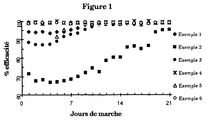
- the test was conducted for a period of 20.5 days. A process effluent sample was collected and analyzed every day. Capture results expressed in percent of efficiency are shown in Figure 1. Note that the efficiency uptake is high, however in the first two hundred hours of operation, the capture efficiency is slightly higher weak than at the end of the test. A small amount of arsenic (5 to 10 ⁇ g / kg) was detected during the first 72 hours.
- the first reactor was charged with 50 cm 3 of catalyst B, presulfurized as described above. All the other test conditions are identical to those indicated in Example 1 including the charge (condensate A).
- the results obtained in the presence of catalyst B showed a high capture efficiency from the start of the test and the maintenance of this efficiency throughout the duration of the test.
- the arsenic content remains below the detection limit ( ⁇ g / kg) throughout the test.
- Example 4 the first reactor was charged with 50 cm 3 of catalyst B. This time, the catalyst was reduced to 300 ° C. at a flow rate of 20 l / h of hydrogen at 2 bars of pressure for 6 h before cooling it to reaction temperature 180 ° C. Condensate B was used as the charge to be purified. The other operating conditions are the same as those of Example 1. The results of this test clearly show a marked improvement in the performance of the mercury capture according to the invention.
Landscapes
- Chemical & Material Sciences (AREA)
- Oil, Petroleum & Natural Gas (AREA)
- Engineering & Computer Science (AREA)
- Chemical Kinetics & Catalysis (AREA)
- Organic Chemistry (AREA)
- General Chemical & Material Sciences (AREA)
- Materials Engineering (AREA)
- Catalysts (AREA)
- Production Of Liquid Hydrocarbon Mixture For Refining Petroleum (AREA)
- Solid-Sorbent Or Filter-Aiding Compositions (AREA)
Applications Claiming Priority (2)
| Application Number | Priority Date | Filing Date | Title |
|---|---|---|---|
| FR9301443A FR2701270B1 (fr) | 1993-02-08 | 1993-02-08 | Procédé d'élimination du mercure dans les hydrocarbures par passage sur un catalyseur présulfuré. |
| FR9301443 | 1993-02-08 |
Publications (2)
| Publication Number | Publication Date |
|---|---|
| EP0611183A1 EP0611183A1 (fr) | 1994-08-17 |
| EP0611183B1 true EP0611183B1 (fr) | 1998-07-22 |
Family
ID=9443892
Family Applications (1)
| Application Number | Title | Priority Date | Filing Date |
|---|---|---|---|
| EP94400194A Expired - Lifetime EP0611183B1 (fr) | 1993-02-08 | 1994-01-28 | Procédé d'élimination du mercure dans des hydrocarbures par passage sur un catalyseur présulfure |
Country Status (7)
| Country | Link |
|---|---|
| US (1) | US5601701A (enExample) |
| EP (1) | EP0611183B1 (enExample) |
| JP (1) | JP3486757B2 (enExample) |
| KR (1) | KR100284222B1 (enExample) |
| DE (1) | DE69411775T2 (enExample) |
| FR (1) | FR2701270B1 (enExample) |
| MY (1) | MY110136A (enExample) |
Families Citing this family (30)
| Publication number | Priority date | Publication date | Assignee | Title |
|---|---|---|---|---|
| US6350372B1 (en) | 1999-05-17 | 2002-02-26 | Mobil Oil Corporation | Mercury removal in petroleum crude using H2S/C |
| FR2803597B1 (fr) * | 2000-01-07 | 2003-09-05 | Inst Francais Du Petrole | Procede de captation du mercure et d'arsenic d'une coupe d'hydrocarbures distillee |
| GB2365874B (en) * | 2000-06-29 | 2004-12-08 | Wcp Internat Ltd | Purifying hydrocarbons |
| EP1682241A4 (en) * | 2003-10-31 | 2009-07-15 | Metal Alloy Reclaimers Inc Ii | METHOD FOR REDUCING INORGANIC CONTAMINATION FROM WASTE STREAMS |
| US7745369B2 (en) * | 2003-12-19 | 2010-06-29 | Shell Oil Company | Method and catalyst for producing a crude product with minimal hydrogen uptake |
| US7959796B2 (en) * | 2003-12-19 | 2011-06-14 | Shell Oil Company | Systems, methods, and catalysts for producing a crude product |
| US20070000810A1 (en) * | 2003-12-19 | 2007-01-04 | Bhan Opinder K | Method for producing a crude product with reduced tan |
| US20070000808A1 (en) * | 2003-12-19 | 2007-01-04 | Bhan Opinder K | Method and catalyst for producing a crude product having selected properties |
| US20100098602A1 (en) * | 2003-12-19 | 2010-04-22 | Opinder Kishan Bhan | Systems, methods, and catalysts for producing a crude product |
| TWI415930B (zh) * | 2005-04-06 | 2013-11-21 | Shell Int Research | 減少液態含烴原料總酸值(tan)的方法 |
| EP1874896A1 (en) * | 2005-04-11 | 2008-01-09 | Shell International Research Maatschappij B.V. | Method and catalyst for producing a crude product having a reduced nitroge content |
| WO2006110595A1 (en) * | 2005-04-11 | 2006-10-19 | Shell Internationale Research Maatschappij B.V. | Method and catalyst for producing a crude product having a reduced nitrogen content |
| JP2008536003A (ja) | 2005-04-11 | 2008-09-04 | シエル・インターナシヨネイル・リサーチ・マーチヤツピイ・ベー・ウイ | Mcr含有量の少ない原油生成物の製造方法及び触媒 |
| CA2604015C (en) * | 2005-04-11 | 2014-02-18 | Shell International Research Maatschappij B.V. | Systems, methods, and catalysts for producing a crude product |
| JP5192653B2 (ja) * | 2006-03-31 | 2013-05-08 | 日本インスツルメンツ株式会社 | 水銀還元用触媒、水銀変換ユニットおよびこれを用いた排気ガス中の全水銀測定装置 |
| GB0611316D0 (en) * | 2006-06-09 | 2006-07-19 | Johnson Matthey Plc | Improvements in the removal of metals from fluid streams |
| CA2655600A1 (en) * | 2006-06-22 | 2007-12-27 | Shell Internationale Research Maatschappij B.V. | Method for producing a crude product with a long-life catalyst |
| US20090188836A1 (en) * | 2006-10-06 | 2009-07-30 | Opinder Kishan Bhan | Methods for producing a crude product |
| US8741243B2 (en) * | 2007-05-14 | 2014-06-03 | Corning Incorporated | Sorbent bodies comprising activated carbon, processes for making them, and their use |
| CN101687173B (zh) * | 2007-05-14 | 2013-11-13 | 康宁股份有限公司 | 包含活性炭的吸附体、其制备方法及其应用 |
| US7998898B2 (en) * | 2007-10-26 | 2011-08-16 | Corning Incorporated | Sorbent comprising activated carbon, process for making same and use thereof |
| US20100239479A1 (en) * | 2007-08-29 | 2010-09-23 | Corning Incorporated | Process For Removing Toxic Metals From A Fluid Stream |
| KR20100133394A (ko) * | 2008-03-10 | 2010-12-21 | 바스프 에스이 | 탄화수소 스트림으로부터 수은을 제거하는 방법 |
| US8124213B2 (en) * | 2008-05-30 | 2012-02-28 | Corning Incorporated | Flow-through sorbent comprising a metal sulfide |
| US20090297885A1 (en) * | 2008-05-30 | 2009-12-03 | Kishor Purushottam Gadkaree | Composite Comprising An Inorganic Substrate With A Coating Comprising Activated Carbon And Metal Sulfide |
| US8691722B2 (en) * | 2008-07-03 | 2014-04-08 | Corning Incorporated | Sorbent comprising activated carbon particles, sulfur and metal catalyst |
| US7901486B2 (en) * | 2008-10-02 | 2011-03-08 | Conocophillips Company | Removal of heavy metals from hydrocarbon gases |
| US8569205B2 (en) * | 2009-07-06 | 2013-10-29 | MAR Systems, Inc. | Media for removal of contaminants from fluid streams and method of making same |
| KR101796792B1 (ko) * | 2011-02-09 | 2017-11-13 | 에스케이이노베이션 주식회사 | 촉매를 이용하여 수소화 처리 반응을 통해 황 및 수은이 포함된 탄화수소 원료로부터 이들을 동시에 제거하는 방법 |
| US9023196B2 (en) | 2013-03-14 | 2015-05-05 | Chevron U.S.A. Inc. | Process, method, and system for removing heavy metals from fluids |
Family Cites Families (10)
| Publication number | Priority date | Publication date | Assignee | Title |
|---|---|---|---|---|
| US4046674A (en) * | 1976-06-25 | 1977-09-06 | Union Oil Company Of California | Process for removing arsenic from hydrocarbons |
| US4338288A (en) * | 1978-09-14 | 1982-07-06 | Mobil Oil Corporation | Sorbent for removing metals from fluids |
| US4709118A (en) * | 1986-09-24 | 1987-11-24 | Mobil Oil Corporation | Removal of mercury from natural gas and liquid hydrocarbons utilizing downstream guard chabmer |
| US5053209A (en) * | 1988-01-09 | 1991-10-01 | Mobil Oil Corporation | Removal of mercury from natural gas and liquid hydrocarbons utilizing silver on alumina adsorbent |
| FR2628338B1 (fr) * | 1988-03-10 | 1991-01-04 | Inst Francais Du Petrole | Procede pour l'elimination du mercure dans les hydrocarbures |
| EP0357873B1 (en) * | 1988-08-10 | 1992-08-26 | Jgc Corporation | Method for removing mercury from hydrocarbons |
| FR2644472B1 (fr) * | 1989-03-16 | 1991-06-21 | Inst Francais Du Petrole | Procede pour l'elimination du mercure et eventuellement d'arsenic dans les hydrocarbures |
| US5401392A (en) * | 1989-03-16 | 1995-03-28 | Institut Francais Du Petrole | Process for eliminating mercury and possibly arsenic in hydrocarbons |
| US5202301A (en) * | 1989-11-22 | 1993-04-13 | Calgon Carbon Corporation | Product/process/application for removal of mercury from liquid hydrocarbon |
| FR2664507B1 (fr) * | 1990-07-13 | 1995-04-14 | Eurecat Europ Retrait Catalys | Procede de pretraitement d'un catalyseur par un melange d'un agent soufre et d'un agent reducteur organique. |
-
1993
- 1993-02-08 FR FR9301443A patent/FR2701270B1/fr not_active Expired - Lifetime
-
1994
- 1994-01-28 DE DE69411775T patent/DE69411775T2/de not_active Expired - Lifetime
- 1994-01-28 EP EP94400194A patent/EP0611183B1/fr not_active Expired - Lifetime
- 1994-02-08 US US08/193,590 patent/US5601701A/en not_active Expired - Lifetime
- 1994-02-08 JP JP01458694A patent/JP3486757B2/ja not_active Expired - Lifetime
- 1994-02-08 KR KR1019940002379A patent/KR100284222B1/ko not_active Expired - Lifetime
- 1994-02-08 MY MYPI94000285A patent/MY110136A/en unknown
Also Published As
| Publication number | Publication date |
|---|---|
| DE69411775D1 (de) | 1998-08-27 |
| FR2701270A1 (fr) | 1994-08-12 |
| US5601701A (en) | 1997-02-11 |
| MY110136A (en) | 1998-02-28 |
| EP0611183A1 (fr) | 1994-08-17 |
| DE69411775T2 (de) | 1998-12-03 |
| KR940019838A (ko) | 1994-09-15 |
| JP3486757B2 (ja) | 2004-01-13 |
| FR2701270B1 (fr) | 1995-04-14 |
| KR100284222B1 (ko) | 2001-05-02 |
| JPH06256773A (ja) | 1994-09-13 |
Similar Documents
| Publication | Publication Date | Title |
|---|---|---|
| EP0611183A1 (fr) | Procédé d'élimination du mercure dans des hydrocarbures par passage sur un catalyseur présulfure | |
| EP0332526B1 (fr) | Procédé pour l'élimination du mercure et éventuellement d'arsenic dans les hydrocarbures | |
| EP0484234B1 (fr) | Procédé d'élimination de mercure et de l'arsenic éventuellement présent dans un fluide, en présence d'une masse de captation de mercure et/ou d'arsenic | |
| EP0463044B1 (fr) | Procede pour l'elimination du mercure et eventuellement d'arsenic dans les hydrocarbures | |
| EP0484233B1 (fr) | Procédé de préparation d'une masse solide de captation de mercure | |
| EP1923452A1 (fr) | Procédé de désulfuration profonde des essence de craquage avec une faible perte en indice d'octane | |
| FR2987368A1 (fr) | Procede d'elimination de mercure contenu dans une charge hydrocarbure avec recycle d'hydrogene | |
| EP0570261B1 (fr) | Procédé de captation de mercure et d'arsenic dans une coupe d'hydrocarbure | |
| EP0599702B1 (fr) | Procédé d'elimination de mercure et eventuellement d'arsenic dans des hydrocarbures | |
| EP0611182B1 (fr) | Procédé d'elimination d'arsenic dans des hydrocarbures par passage sur une masse de captation présulfurée | |
| EP0487370B1 (fr) | Procédé d'élimination d'arsenic dans un gaz par passage sur une masse à base d'un support et de sulfure de cuivre | |
| BE1012739A3 (fr) | Masse d'elimination d'arsenic et de mercure dans des hydrocarbures a base de nickel supporte. | |
| FR2857276A1 (fr) | Procede d'elimination de composes soufres par oxydation directe | |
| FR2762004A1 (fr) | Procede pour l'elimination d'arsenic dans les charges hydrocarbonees liquides | |
| EP0169828B1 (fr) | Procédé pour enlever le sulfure de carbonyle des charges d'hydrocarbures liquides oléfiniques | |
| FR2659977A1 (fr) | Procede pour enlever l'hydrure d'antimoine de charges d'hydrocarbures liquides. | |
| WO2023117552A1 (fr) | Procede de rejuvenation de masses de captation de metaux lourds | |
| EP0458675B1 (fr) | Nouveau procédé de régénération d'un catalyseur usagé par une solution aqueuse de péroxyde d'hydrogène stabilisée par un composé organique | |
| FR2512830A1 (fr) | Procede d'adoucissement d'hydrocarbures | |
| BE905986R (fr) | Procede pour enlever le sulfure de carbonyle des charges d'hydrocarbures liquides. | |
| FR2808532A1 (fr) | Procede de captation de mercure et d'arsenic comprenant une evaporation puis une condensation de la charge hydrocarbonnee | |
| FR2806092A1 (fr) | Procede d'elimination d'arsenic en presence d'une masse d'absorption comprenant de l'oxyde de plomb partiellement presulfure | |
| FR2980721A1 (fr) | Mise en forme de masses de captation pour la purification d'une charge gaz ou liquide contenant du mercure | |
| FR2673192A1 (fr) | Procede pour l'elimination du mercure et eventuellement d'arsenic dans les charges des procedes catalytiques producteurs d'aromatiques. . | |
| LU85308A1 (fr) | Procede pour enlever le sulfure de carbonyle des charges d'hydrocarbures liquides |
Legal Events
| Date | Code | Title | Description |
|---|---|---|---|
| PUAI | Public reference made under article 153(3) epc to a published international application that has entered the european phase |
Free format text: ORIGINAL CODE: 0009012 |
|
| AK | Designated contracting states |
Kind code of ref document: A1 Designated state(s): DE FR GB NL |
|
| 17P | Request for examination filed |
Effective date: 19950217 |
|
| 17Q | First examination report despatched |
Effective date: 19961227 |
|
| GRAG | Despatch of communication of intention to grant |
Free format text: ORIGINAL CODE: EPIDOS AGRA |
|
| GRAG | Despatch of communication of intention to grant |
Free format text: ORIGINAL CODE: EPIDOS AGRA |
|
| GRAG | Despatch of communication of intention to grant |
Free format text: ORIGINAL CODE: EPIDOS AGRA |
|
| GRAH | Despatch of communication of intention to grant a patent |
Free format text: ORIGINAL CODE: EPIDOS IGRA |
|
| GRAH | Despatch of communication of intention to grant a patent |
Free format text: ORIGINAL CODE: EPIDOS IGRA |
|
| GRAA | (expected) grant |
Free format text: ORIGINAL CODE: 0009210 |
|
| AK | Designated contracting states |
Kind code of ref document: B1 Designated state(s): DE FR GB NL |
|
| GBT | Gb: translation of ep patent filed (gb section 77(6)(a)/1977) |
Effective date: 19980803 |
|
| REF | Corresponds to: |
Ref document number: 69411775 Country of ref document: DE Date of ref document: 19980827 |
|
| PLBE | No opposition filed within time limit |
Free format text: ORIGINAL CODE: 0009261 |
|
| STAA | Information on the status of an ep patent application or granted ep patent |
Free format text: STATUS: NO OPPOSITION FILED WITHIN TIME LIMIT |
|
| 26N | No opposition filed | ||
| PGFP | Annual fee paid to national office [announced via postgrant information from national office to epo] |
Ref country code: GB Payment date: 20001227 Year of fee payment: 8 |
|
| REG | Reference to a national code |
Ref country code: GB Ref legal event code: IF02 |
|
| PG25 | Lapsed in a contracting state [announced via postgrant information from national office to epo] |
Ref country code: GB Free format text: LAPSE BECAUSE OF NON-PAYMENT OF DUE FEES Effective date: 20020128 |
|
| GBPC | Gb: european patent ceased through non-payment of renewal fee |
Effective date: 20020128 |
|
| REG | Reference to a national code |
Ref country code: FR Ref legal event code: CD |
|
| REG | Reference to a national code |
Ref country code: DE Ref legal event code: R081 Ref document number: 69411775 Country of ref document: DE Owner name: IFP ENERGIES NOUVELLES, FR Free format text: FORMER OWNER: INSTITUT FRANCAIS DU PETROLE, RUEIL-MALMAISON, FR Effective date: 20110331 |
|
| PGFP | Annual fee paid to national office [announced via postgrant information from national office to epo] |
Ref country code: DE Payment date: 20130304 Year of fee payment: 20 Ref country code: FR Payment date: 20130222 Year of fee payment: 20 |
|
| PGFP | Annual fee paid to national office [announced via postgrant information from national office to epo] |
Ref country code: NL Payment date: 20130121 Year of fee payment: 20 |
|
| REG | Reference to a national code |
Ref country code: DE Ref legal event code: R071 Ref document number: 69411775 Country of ref document: DE |
|
| REG | Reference to a national code |
Ref country code: NL Ref legal event code: V4 Effective date: 20140128 |
|
| PG25 | Lapsed in a contracting state [announced via postgrant information from national office to epo] |
Ref country code: DE Free format text: LAPSE BECAUSE OF EXPIRATION OF PROTECTION Effective date: 20140129 |