EP0583062B1 - Graphitisierte Kohlenstoffasern - Google Patents
Graphitisierte Kohlenstoffasern Download PDFInfo
- Publication number
- EP0583062B1 EP0583062B1 EP93305272A EP93305272A EP0583062B1 EP 0583062 B1 EP0583062 B1 EP 0583062B1 EP 93305272 A EP93305272 A EP 93305272A EP 93305272 A EP93305272 A EP 93305272A EP 0583062 B1 EP0583062 B1 EP 0583062B1
- Authority
- EP
- European Patent Office
- Prior art keywords
- carbon fibers
- grown
- vapor
- graphitized carbon
- vgcf
- Prior art date
- Legal status (The legal status is an assumption and is not a legal conclusion. Google has not performed a legal analysis and makes no representation as to the accuracy of the status listed.)
- Expired - Lifetime
Links
Images
Classifications
-
- D—TEXTILES; PAPER
- D01—NATURAL OR MAN-MADE THREADS OR FIBRES; SPINNING
- D01F—CHEMICAL FEATURES IN THE MANUFACTURE OF ARTIFICIAL FILAMENTS, THREADS, FIBRES, BRISTLES OR RIBBONS; APPARATUS SPECIALLY ADAPTED FOR THE MANUFACTURE OF CARBON FILAMENTS
- D01F9/00—Artificial filaments or the like of other substances; Manufacture thereof; Apparatus specially adapted for the manufacture of carbon filaments
- D01F9/08—Artificial filaments or the like of other substances; Manufacture thereof; Apparatus specially adapted for the manufacture of carbon filaments of inorganic material
- D01F9/12—Carbon filaments; Apparatus specially adapted for the manufacture thereof
- D01F9/127—Carbon filaments; Apparatus specially adapted for the manufacture thereof by thermal decomposition of hydrocarbon gases or vapours or other carbon-containing compounds in the form of gas or vapour, e.g. carbon monoxide, alcohols
-
- B—PERFORMING OPERATIONS; TRANSPORTING
- B82—NANOTECHNOLOGY
- B82Y—SPECIFIC USES OR APPLICATIONS OF NANOSTRUCTURES; MEASUREMENT OR ANALYSIS OF NANOSTRUCTURES; MANUFACTURE OR TREATMENT OF NANOSTRUCTURES
- B82Y30/00—Nanotechnology for materials or surface science, e.g. nanocomposites
-
- C—CHEMISTRY; METALLURGY
- C04—CEMENTS; CONCRETE; ARTIFICIAL STONE; CERAMICS; REFRACTORIES
- C04B—LIME, MAGNESIA; SLAG; CEMENTS; COMPOSITIONS THEREOF, e.g. MORTARS, CONCRETE OR LIKE BUILDING MATERIALS; ARTIFICIAL STONE; CERAMICS; REFRACTORIES; TREATMENT OF NATURAL STONE
- C04B14/00—Use of inorganic materials as fillers, e.g. pigments, for mortars, concrete or artificial stone; Treatment of inorganic materials specially adapted to enhance their filling properties in mortars, concrete or artificial stone
- C04B14/38—Fibrous materials; Whiskers
- C04B14/386—Carbon
-
- C—CHEMISTRY; METALLURGY
- C04—CEMENTS; CONCRETE; ARTIFICIAL STONE; CERAMICS; REFRACTORIES
- C04B—LIME, MAGNESIA; SLAG; CEMENTS; COMPOSITIONS THEREOF, e.g. MORTARS, CONCRETE OR LIKE BUILDING MATERIALS; ARTIFICIAL STONE; CERAMICS; REFRACTORIES; TREATMENT OF NATURAL STONE
- C04B30/00—Compositions for artificial stone, not containing binders
- C04B30/02—Compositions for artificial stone, not containing binders containing fibrous materials
-
- D—TEXTILES; PAPER
- D01—NATURAL OR MAN-MADE THREADS OR FIBRES; SPINNING
- D01F—CHEMICAL FEATURES IN THE MANUFACTURE OF ARTIFICIAL FILAMENTS, THREADS, FIBRES, BRISTLES OR RIBBONS; APPARATUS SPECIALLY ADAPTED FOR THE MANUFACTURE OF CARBON FILAMENTS
- D01F11/00—Chemical after-treatment of artificial filaments or the like during manufacture
- D01F11/10—Chemical after-treatment of artificial filaments or the like during manufacture of carbon
- D01F11/12—Chemical after-treatment of artificial filaments or the like during manufacture of carbon with inorganic substances ; Intercalation
- D01F11/129—Intercalated carbon- or graphite fibres
-
- H—ELECTRICITY
- H01—ELECTRIC ELEMENTS
- H01M—PROCESSES OR MEANS, e.g. BATTERIES, FOR THE DIRECT CONVERSION OF CHEMICAL ENERGY INTO ELECTRICAL ENERGY
- H01M4/00—Electrodes
- H01M4/02—Electrodes composed of, or comprising, active material
- H01M4/36—Selection of substances as active materials, active masses, active liquids
- H01M4/58—Selection of substances as active materials, active masses, active liquids of inorganic compounds other than oxides or hydroxides, e.g. sulfides, selenides, tellurides, halogenides or LiCoFy; of polyanionic structures, e.g. phosphates, silicates or borates
- H01M4/583—Carbonaceous material, e.g. graphite-intercalation compounds or CFx
- H01M4/587—Carbonaceous material, e.g. graphite-intercalation compounds or CFx for inserting or intercalating light metals
-
- H—ELECTRICITY
- H01—ELECTRIC ELEMENTS
- H01M—PROCESSES OR MEANS, e.g. BATTERIES, FOR THE DIRECT CONVERSION OF CHEMICAL ENERGY INTO ELECTRICAL ENERGY
- H01M4/00—Electrodes
- H01M4/86—Inert electrodes with catalytic activity, e.g. for fuel cells
- H01M4/96—Carbon-based electrodes
-
- Y—GENERAL TAGGING OF NEW TECHNOLOGICAL DEVELOPMENTS; GENERAL TAGGING OF CROSS-SECTIONAL TECHNOLOGIES SPANNING OVER SEVERAL SECTIONS OF THE IPC; TECHNICAL SUBJECTS COVERED BY FORMER USPC CROSS-REFERENCE ART COLLECTIONS [XRACs] AND DIGESTS
- Y02—TECHNOLOGIES OR APPLICATIONS FOR MITIGATION OR ADAPTATION AGAINST CLIMATE CHANGE
- Y02E—REDUCTION OF GREENHOUSE GAS [GHG] EMISSIONS, RELATED TO ENERGY GENERATION, TRANSMISSION OR DISTRIBUTION
- Y02E60/00—Enabling technologies; Technologies with a potential or indirect contribution to GHG emissions mitigation
- Y02E60/10—Energy storage using batteries
-
- Y—GENERAL TAGGING OF NEW TECHNOLOGICAL DEVELOPMENTS; GENERAL TAGGING OF CROSS-SECTIONAL TECHNOLOGIES SPANNING OVER SEVERAL SECTIONS OF THE IPC; TECHNICAL SUBJECTS COVERED BY FORMER USPC CROSS-REFERENCE ART COLLECTIONS [XRACs] AND DIGESTS
- Y02—TECHNOLOGIES OR APPLICATIONS FOR MITIGATION OR ADAPTATION AGAINST CLIMATE CHANGE
- Y02E—REDUCTION OF GREENHOUSE GAS [GHG] EMISSIONS, RELATED TO ENERGY GENERATION, TRANSMISSION OR DISTRIBUTION
- Y02E60/00—Enabling technologies; Technologies with a potential or indirect contribution to GHG emissions mitigation
- Y02E60/30—Hydrogen technology
- Y02E60/50—Fuel cells
-
- Y—GENERAL TAGGING OF NEW TECHNOLOGICAL DEVELOPMENTS; GENERAL TAGGING OF CROSS-SECTIONAL TECHNOLOGIES SPANNING OVER SEVERAL SECTIONS OF THE IPC; TECHNICAL SUBJECTS COVERED BY FORMER USPC CROSS-REFERENCE ART COLLECTIONS [XRACs] AND DIGESTS
- Y10—TECHNICAL SUBJECTS COVERED BY FORMER USPC
- Y10T—TECHNICAL SUBJECTS COVERED BY FORMER US CLASSIFICATION
- Y10T428/00—Stock material or miscellaneous articles
- Y10T428/29—Coated or structually defined flake, particle, cell, strand, strand portion, rod, filament, macroscopic fiber or mass thereof
- Y10T428/2904—Staple length fiber
-
- Y—GENERAL TAGGING OF NEW TECHNOLOGICAL DEVELOPMENTS; GENERAL TAGGING OF CROSS-SECTIONAL TECHNOLOGIES SPANNING OVER SEVERAL SECTIONS OF THE IPC; TECHNICAL SUBJECTS COVERED BY FORMER USPC CROSS-REFERENCE ART COLLECTIONS [XRACs] AND DIGESTS
- Y10—TECHNICAL SUBJECTS COVERED BY FORMER USPC
- Y10T—TECHNICAL SUBJECTS COVERED BY FORMER US CLASSIFICATION
- Y10T428/00—Stock material or miscellaneous articles
- Y10T428/29—Coated or structually defined flake, particle, cell, strand, strand portion, rod, filament, macroscopic fiber or mass thereof
- Y10T428/2913—Rod, strand, filament or fiber
- Y10T428/2918—Rod, strand, filament or fiber including free carbon or carbide or therewith [not as steel]
Definitions
- the present invention relates to vapor-grown and graphitized carbon fibers, a process for the preparation of the carbon fibers grown in a vapor phase and then graphitized, molded members of the vapor-grown and graphitized carbon fibers, and composite members thereof. More particularly, the present invention relates to vapor-grown and graphitized carbon fibers suitable for composite members such as composite materials, composite molded members or the like, or molded members formed substantially solely with the vapor-grown and graphitized carbon fibers, a process for the preparation of the vapor-grown and graphitized carbon fibers, the molded members thereof comprising solely or substantially solely of the vapor-grown and graphitized carbon fibers, and composite members comprising the vapor-grown and graphitized carbon fibers and a matrix.
- Carbon fibers grown in a vapor phase which may be designated as vapor-grown carbon fibers can be prepared by subjecting a carbon compound to heating at temperature ranging from 800°C to 1,300 °C in the presence of a catalyst comprising iron or nickel in the superfine particle form.
- the resulting vapor-grown carbon fibers then can readily be converted into the carbon fibers having a graphite structure by heating the vapor-grown carbon fibers.
- the crystal lattice planes in the direction parallel to the fiber axis have less defects and can be compared to the annual growth rings of a tree.
- the carbon fibers grown in the vapor phase and then graphitized have a high degree of physical strength and elastic modulus and are highly conductive thermally and electrically.
- the vapor-grown and graphitized carbon fibers so prepared are less defective in crystalline structure so that they are less wettable with other materials and high in elastic modulus. Hence, the shape of a molded member formed from vapor-grown and graphitized carbon fibers cannot be sustained due to the high packing density. Further, the resulting molded members become very fragile even if the shapes of the vapor-grown and graphitized carbon fibers could be sustained.
- a lithium secondary battery has drawn attention due to its high energy density, there is the risk that may occur if its electrode is not sealed in a complete way because a metallic lithium that is highly active to oxygen and moisture is employed for the electrode. Further, it can suffer from the disadvantage that the electrodes are short-circuited due to the formation of needle-like crystals of lithium, i.e. dendrite, on the surface of the lithium electrode. Hence, a growing interest has been shifted to the lithium ion secondary battery which uses as the electrode a carbon that can form an intercalation compound with the lithium ions, because the lithium ion secondary battery does not cause those risk and disadvantage, even if the lithium ion secondary battery should sacrifice the energy density so high as prevailing in the lithium secondary battery to some extent.
- the compound that contains a largest amount of lithium ions is a compound of first stage and the ratio of carbon atoms to lithium atoms is six to one (6 : 1). If all the carbons are used for producing intercalation compounds and all the lithium atoms intercalated on a charging process are fully de-interculated on the discharging, the quantity of electricity that can be discharged is a maximum of 372 mAh per gram of carbon. Although a variety of efforts have been made so far to attain the theoretical quantity of dischargeable electricity, however, no compound of first stage having a satisfactorily high quantity of electricity is found yet.
- the primary object of the present invention is to provide vapor-grown and graphitized carbon fibers capable of formulating composite members such as composite materials consisting substantially of the vapor-grown and graphitized carbon fibers or composite molded members.
- Another object of the present invention is to provide a process for the preparation of the vapor-grown and graphitized carhon fibers.
- a further object of the present invention is to provide molded members having the vapor-grown and graphitized carbon fibers contained at a high packing density.
- a still further object of the present invention is to provide composite members containing the vapor-grown and graphitized carbon fibers.
- the present invention consists of the vapor-grown and graphitized carbon fibers as defined in appended claim 1.
- the present invention further consists of the process for the preparation of the vapor-grown and graphitized carbon fibers, which is characterized by subjecting vapor-grown carbon fibers, which are not fractured to a substantial extent, to graphitization by heating them at temperature of 2,000°C or higher and then by fracturing the resulting vapor-grown and graphitized carbon fibers at a high impact so as for the resulting vapor-phase and graphitized carbon fibers to have a spin density of 8 x 10 18 spins/g or less, when measured by the electron spin resonance absorption method.
- the present invention additionally concerns molded members consisting substantially solely of the vapor-grown and graphitized carbon fibers.
- the present invention concerns composite members comprising of the vapor-grown and graphitized carbon fibers and a matrix.
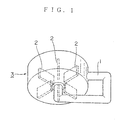
- Figure 1 is a schematic representation showing the structure of an example of a high-impact treatment apparatus so adapted as to be employed appropriately for the process according to the present invention.
- Vapor-grown and graphitized carbon fibers may also be abbreviated to VGCF in this specification.
- the VGCF according to the present invention have a mean fiber diameter of 5 ⁇ m or smaller, preferably from 0.1 ⁇ m to 3 ⁇ m, and more preferably from 0.3 ⁇ m to 2 ⁇ m; a mean fiber length of 90 ⁇ m, or shorter; and a mean aspect ratio of from 1 to 18, preferably from 2 to 16, more preferably from 5 to 15.
- the VGCF having such characteristics can be used to form molded members and composite members with high packing density.
- the VGCF have a mean fiber diameter of from 1.5 ⁇ m to 3.0 ⁇ m with a view to retaining a high charge volume of negative electrode in a secondary battery.
- the mean fiber diameter of VGCF is smaller than 1.5 ⁇ m, the charge volume of the negative electrode in a secondary battery becomes small.
- the mean fiber diameter of VGCF is larger than 3.0 ⁇ m, the shape of electrode becomes degraded and the electrode's cycle of charge and discharge characteristics are reduced.
- the VGCF according to the present invention have a spin density of 8 x 10 18 spins/g or less, preferably 7 ⁇ 10 18 spins/g or less, when measured by the electron spin resonance absorption method.
- the resulting carbon fibers can be used to produce a coating layer or can be molded into an article which retains its shape and can also be used as a material having a high amount of discharge. Therefor the carbon fibers can be used as a battery electrode for use with intercalation compounds of the lithium ion.
- the VGCF according to the present invention have an interplanar distance (d 002 ) of the graphite lattice which may be usually 3.45 ⁇ or shorter, preferably from 3.35 ⁇ to 3.42 ⁇ , more preferably from 3.35 ⁇ to 3.37 ⁇ , and the thickness of the graphite lattice plane in the condensed benzene ring's form, that is, the thickness (L c ) of the laminated lattices in the crystal which may be usually 30 ⁇ or thicker, preferably 300 ⁇ or thicker, more preferably 1,000 ⁇ or thicker, when considered from the point of view that highly developed graphitization contributes to form good retention of shape of molded members made by VGCF, good formation of intercalation compound made by VGCF and lithium, good formation of molded members having high electrical conduction, and good composite members forming thin layer and having large strength and highly conductive thermally and electrically.
- d 002 interplanar distance of the graphite lattice which may be usually 3.45 ⁇ or
- the VGCF according to the present invention may be appropriately employed for the preparation of composite members, such as the composite materials and composite molded members .
- the composite materials may be prepared by compounding the VGCF with a plastic material, a rubbery material, a metallic material, a ceramic material, a paint or an adhesive, with a high packing density.
- the composite molded members consisting solely or substantially solely of the VGCF may be prepared by compounding a large quantity of the VGCF with the possible smallest amount of a binder, if necessary.
- the composite materials and the composite molded members may be used as highly electrically conductive materials, highly thermally conductive materials or carriers for catalysts .
- the VGCF according to the present invention that is, the VGCF suitable for the composite materials, can be prepared by the procedures of the process according to the present invention as will be described hereinafter in more detail.
- the VGCF can be prepared by heating the vapor-grown carbon fibers at a temperature of, for example, 2,000°C or higher and thereby subjecting the vapor-grown carbon fibers to graphitization, followed by fracturing the resulting vapor-grown and graphitized carbon fibers at a high impact.
- the vapor-grown and graphitized carbon fiber may be designated as pre-VGCF as distinct from VGCF of present invention because of the fracturing step.
- the vapor-grown carbon fibers can be prepared by the vapor phase method as will be described hereinafter.
- the vapor phase method to be applied to the formation of the vapor-grown carbon fibers to be used for the present invention may include a so-called substrate method, i.e. the method for the growth of the carbon fibers on a substrate and a so-called fluidized growth method, i.e. the method for the growth of the carbon fibers in a flow.
- the substrate method involves flowing hydrocarbon gas as a carbon-source gas over a base with a catalyst metal such as a transition metal or a transition metal compound deposited thereon in a high temperature furnace, thereby depositing carbon fibers on the surface of the substrate.
- the fluidized growth method involves flowing a mixture of a metallic compound, serving as a catalyst metal, and a carbon compound, serving as a carbon source, in a vapor phase through a reactor tube heated at high temperature, without the use of any base, thereby forming carbon fibers in flowing gas in the reactor furnace.
- the vapor-grown carbon fibers to be used as a raw material for the process according to the present invention can be prepared by processes disclosed, for example, in Japanese Patent Unexamined Publication (kokai) Nos. 52-107,320, 57-117,622, 58-156,512, 58-180,615, 60-185,818, 60-224,815, 60-231,821, 61-132,600, 61-132,630, 61-132,663, 61- 225,319, 61-225,322, 61-225,325, 61-225,327, 61-225,328, 61-227,425, and 61-282,427.
- the vapor-grown carbon fibers to be employed for the process according to the present invention can then be treated by graphitization that involves heating them at temperature of approximately 2,000 °C or higher to thereby yield the pre-VGCF.
- the graphitization may usually be carried out in an atmosphere in which an inert gas, for example nitrogen, helium or argon is present.
- the time required for the graphitization may be usually five minutes or longer.
- the pre-VGCF prepared in the manner as described hereinabove are then treated by fracturing them at a high impact to form VGCF.
- the pre-VGCF of the state of the art are usually fractured prior to the graphitization to reduce the bulkiness of the carbon fibers.
- the spin density can be reduced. thereby improving the physical properties of the resulting molded members and composite members.
- the process for the preparation of the VGCF according to the present invention comprises fracturing the pre-VGCF by applying the high impact thereto.
- the methods for milling and crushing are generally adopted in order to make finely divided particles of materials further smaller.
- the ball mill, roll mill or such other procedures may grind or crush the pre-VGCF to such an extent that a portion of the VGCF cannot sustain their fibrous shapes any more and it is difficult to control the ball mill, roll mill or such other procedures so as to make the fiber length a desired value. Further, these milling processes require a longer time for treatment.
- the process according to the present invention is carried out by fracturing the pre-VGCF solely by applying the high impact thereto.
- the process according to the present invention can, within a treatment time as short as several minutes, conveniently adjust mean fiber length and so on, of the VGCF so as to have as defined by the present invention.
- an example of the treatment for fracturing the pre-VGCF involves applying the high impact to the pre-VGCF through the high-impact treatment apparatus as shown in the Figure.
- the high-impact treatment apparatus comprises a cylindrical container 3 having a plurality of impact blades 3 arranged radially so as to be rotatable and a self-circulation path 1 having its one end mounted to a peripheral side of the cylindrical container 3 and having the other end mounted to a central portion of a flat plate of the container 3 so as to form a passage for air flow.
- the high-impact treatment apparatus may allow the pre-VGCF to be placed therein and to apply the high impact to the pre-VGCF by rotating the impact blades 2 at a high speed.
- the fiber length of the VGCF can be adjusted mainly by changing the power of the high impact in the treatment by applying the high impact to the pre-VGCF.
- the high impact can be applied by rotating the impact blades of the high-impact treatment apparatus although it is also possible to strike the pre-VGCF to the blades or the inner peripheral wall of the cylindrical container in a one-way direction or in reciprocating directions. The rotation of the impact blades is preferred because it is easier in operation than the other procedures.
- the application of the high impact to the pre-VGCF allows the fibers to be cut or fractured at two occasions: at the first occasion when the fibers are caused to be struck to the impact blades and at the second occasion when they are caused to be struck to the inner peripheral wall of the container.
- the conditions for applying the high impact to the pre-VGCF may vary greatly with the kind of the high-impact treatment apparatus.
- the various conditions can conveniently be chosen to thereby have the pre-VGCF ground or fractured so as to make the VGCF have a spin density of 8 x 10 18 spins/g or less, when measured by the electron spin resonance absorption method.
- the velocity of rotation of the impact blades applying the high impact to the pre-VGCF (or the velocity at which the pre-VGCF are struck to the inner peripheral wall of the container of the high-impact treatment apparatus) can appropriately be chosen in accordance with the desired fiber dimension or the desired aspect ratio, the velocity of the rotation of the impact blades may preferably be set to 40 meters per second, more preferably to 60 meters per second.
- the higher velocity can offer the better effect upon the fracture of the pre-VGCF.
- the operation of the apparatus at the velocity exceeding 100 meters per second may suffer from the disadvantages, however, that the apparatus should become larger in size due to the necessity of a protective device for safety measures, the way of operating the apparatus may become complex, and the operation may cause the economical inconvenience.
- the time required for the fracture of the pre-VGCF may appropriately be within 5 minutes and a longer treatment time is economically disadvantageous.
- the velocity of the rotation of the rotatable impact blades is determined as the velocity at which their outermost ends of the impact blades rotate, because the velocity of the rotation at the outermost ends of the impact blades is the fastest and it can offer the greatest effect upon the fracture of the pre-VGCF.
- the treatment by fracturing the pre-VGCF in the manner as described hereinabove can form the VGCF having the spin density of 8 x 10 18 spins/g or less, when measured by the electron spin resonance absorption method.
- Decreasing of the spin density means decreasing the amount of oxygen radical on the surface of VGCF.
- the generated oxygen radicals exist mainly on the surface of fracturing section or cutting section through which lithium ion can enter VGCF in lithium secondary battery and therefrom the oxygen radicals react with the other compounds for example solvents to form solid electrolyte interface (SEI) which prevents lithium ion to enter VGCF.
- SEI solid electrolyte interface
- VGCF having such functional groups can agglomerate together and molded members of VGCF and composite members of VGCF can be formed with high packing density, good shape retentivity, high impact strength and high thermal and electrical conductivity.
- the effects to be achieved by the present invention can be created because there exist a large number of functional groups on the fracture surfaces of the carbon fibers, which can work effectively with the matrix or the binder so that the VGCF are provided with a sufficient degree of wettability with the matrix or the binder.
- the molded members according to the present invention consist solely or substantially solely of the VGCF as described hereinabove.
- the molded members may contain a binder capable of binding the VGCF together in such an amount as failing to adversely affect the objects of the present invention.
- the amount of the binder may be usually less than 20% by weight.
- the molded members can be formed and processed by molding or forming processes, for example, by hydrostatic pressure-isotropic pressure molding techniques, hot press method or cast film process with solvent.
- the molded members consist solely or substantially solely of the VGCF
- all fibers of the VGCF come into contact with one another in the molded members, thereby imparting highly electrical and thermal conductivity.
- the molded members consisting solely or substantially solely of the VGCF according to the present invention can offer the advantage that they are superior in characteristics as a carrier for a catalyst.
- the vapor-grown and graphitized carbon fibers of the invention can be used for a negative electrode of a lithium ion secondary battery.
- composite materials and composite molded members each consisting of the VGCF according to the present invention and the matrix.
- the composite materials may include, for example, those which have the VGCF according to the present invention dispersed in a matrix such as a thermosetting resin and a thermoplastic resin.
- the composite molded members may include, for example, those which are molded members consisting of the VGCF according to the present invention and the matrix.
- a resin such as a thermosetting resin, a thermoplastic resin, a metal, a rubber material, an adhesive composition or a paint composition.
- the matrix to be used for the composite molded members there may be used, for example, a resin, a metal or a rubbery material.
- the quantity of the VGCF according to the present invention to be used for the composite materials or the composite molded members may be usually 50% by weight or more with respect to the total weight of the composite members.
- the composite materials can impart good properties to the molded state of the molded products and they can be densely packed at high VGCF proportion, the products such as paints and adhesives can provide the resulting film with a high physical strength, high electrical conductivity, and a high thermal conductivity.
- the composite molded members can offer excellent processing characteristics so that their processed surfaces are provided with beautiful finish, in addition to the other physical characteristics that can be achieved by the composite materials.
- the composite members according to the present invention such as the composite materials and the composite molded members, can be used as a high electrically and thermally conductive material and as a carrier for a catalyst.
- Vapor-grown carbon fibers having a mean fiber diameter of 0.8 ⁇ m, a mean fiber length of 132 ⁇ m and a mean aspect ratio of 165 were placed in an atmosphere in which argon gas is filled, and the carbon fibers were subjected to graphitization at 2,800°C for 30 minutes. Thereafter, the resulting pre-VGCF were fractured by applying a high impact at 8,000 rpm (peripheral speed: 100 meters per second) for 2 minutes with a high-impact treatment apparatus or a hybridizer (Model: NHS-1; K.K. Nara Kikai Seisakusho) while flowing gas at a high speed. After the fracture treatment has been finished, 100 fibers were chosen in arandom way and they were observed with a scanning electronmicroscope.
- the pre-VGCF were subjected to the fracturing treatment for 2 minutes, they were mixed with a mixture of a phenol resin with methanol so as to account for 60% by weight, 70% by weight, and 80% by weight, respectively, when translated into the percentage by weight after vaporization of methanol. Thereafter, bubbles present in the resulting mixture were removed and the mixture was coated on a glass plate, followed by drying it at 80 °C for 10 minutes and then at 150 °C for 10 minutes to vaporize methanol and to become set. Then, the appearance of the coating was observed and the surface resistance thereof was measured. The results are shown in Table 1 below.
- Vapor-grown carbon fibers having a mean fiber diameter of 0.8 ⁇ m , a mean fiber length of 132 ⁇ m and a mean aspect ratio of 165 were fractured by applying a high impact at 8,000 rpm for 2 minutes with a high-impact treatment apparatus or a hybridizer (Model: NHS-1; K.K. Nara Kikai Seisakusho), and the fractured carbon fibers were then placed in an atmosphere in which argon gas is filled and subjected to graphitization at 2,800 °C for 30 minutes.
- the resulting carbon fibers had a mean aspect ratio of 12.
- the resulting vapor-grown and graphitized carbon fibers were then measured for spin density in the same manner as in Example 1.
- Vapor-grown carbon fibers having a mean fiber diameter of 1.3 ⁇ m, a mean fiber length of 110 ⁇ m and a mean aspect ratio of 84.6 were placed in an atmosphere in which argon gas is filled, and the vapor-grown carbon fibers were subjected to graphitization at 2,500°C for 20 minutes. Thereafter,the resulting pre-VGCF were fractured by applying a high impact at 7,200 rpm (peripheral speed: 90 meters per second) for 2 minutes with the high-impact treatment apparatus while flowing gas at a high speed. After the fracture treatment has been finished, 100 fibers were chosen in a random way and they were observed with a scanning electron microscope.
- the VGCF were mixed with a polyethylene fine powder so as to account for 0.5% by weight and 10% by weight.
- the resulting mixture was packed into a rubber tube having an inner diameter of 25 mm and a length of 60 mm and the rubber tube was pressurized at 7,000 kg/cm 2 with a pressurizing machine (Model: BIP; Nikkiso K.K.) to form a molded member.
- Example 2 The procedures in Example 2 were followed in the same manner, except for fracturing the pre-VGCF at a high impact while flowing gas at a high speed and then graphitizing it. The results are shown in Table 4 below.
- the resulting VGCF had a mean aspect ratio of 17 and a spin density of 9.1 x 10 18 spins/g.
- Proportion of Binding Material (% by weight) Apparent Density State of Coating 0 1.16 ⁇ 5 1.22 ⁇ 10 1.45 ⁇ Notes: " ⁇ " - State of coating sustained, and ready for use " ⁇ " - State of coating sustained, yet the surface of the coating may break upon operations
- Example 2 The procedures in Example 2 were followed in the same manner, except for fracturing the vapor-grown carbon fibers at 2,000 rpm (a peripheral speed: 25 meters per second) while flowing gas at a high speed and then graphitizing it.
- the resulting VGCF had a mean aspect ratio of 53 and a spin density of 9.3 x 10 18 spins/g.
- the results are shown in Table 5 below.
- Proportion of Binding Material (% by weight) Apparent Density State of Coating 0 - ⁇ 5 - ⁇ 10 1.26 ⁇ Notes: " ⁇ " - State of coating sustained, yet the surface of the coating may break upon operation " ⁇ " - No shape formed and coating may break upon touch
- Carbon fibers grown in the vapor phase by the flow method and having a mean fiber diameter of 2.3 ⁇ m and a mean fiber length of 200 ⁇ m or larger were graphitized at 2,800 °C in argon gas.
- the resulting vapor-grown and graphitized carbon fibers were charged in the hybridizer and fractured at 8,000 rpm for 3 minutes.
- a solution was prepared by placing 0.05 gram of polyvinylidene fluoride in an agate mortar and admixing it with 0.5 ml of 1-methyl-2-pyrrolidone.
- an electrode was prepared by coating the resulting paste on the top of 10 mm x 40 mm nickel mesh washed well with acetone so as to cover its area of 10 mm x 10 mm surface of the nickel mesh, followed by drying the coating at 100°C for 23 hours in vacuo.
- a three-electrode cell was assembled with the resulting electrode in a glove box having an atmosphere in which oxygen and water content were replaced sufficiently with argon gas.
- the counter electrode and the reference electrode there were used each a 10 mm x 40 mm x 2 mm metallic lithium.
- an electrolyte there was used a solution prepared by dissolving LiClO 4 in a 1:1 mixture of ethylene carbonate and diethyl carbonate so as to have LiClO 4 contained at the concentration of 1 mole per liter.
- Each of the electrodes was connected with a charge-discharge unit and allowed to stand until the voltage became constant. Thereafter, the charge and the discharge cycles between 0 V and 2.5 V of potential difference between the working electrode and the reference electrode were repeated. The results up to three cycles are shown in Table 6 below.
- Carbon fibers having a mean fiber diameter of 2.3 ⁇ m and a mean fiber length of 200 ⁇ m or larger grown in the vapor phase by the flow method were fractured with the hybridizer at 8,000 rpm for 3 minutes to thereby yield the carbon fibers, followed by carrying out the graphitization by heating the carbon fibers at 2,800 °C in argon gas.
- the grown-in-the-vapor-phase and graphitized carbon fibers were then formed into a three-electrode cell in the same manner as in Example 3.
- the VGCF according to the present invention are suitable for the preparation of composite members such as composite materials, which are compounded at a high packing density with a material such as a plastic material, a rubbery material, a metallic material, a ceramic material, a paint composition or an adhesive composition, and composite molded members consisting solely or substantially solely of the VGCF fractured in accordance with the present invention, which may contain a small amount of a binding material.
- a material such as a plastic material, a rubbery material, a metallic material, a ceramic material, a paint composition or an adhesive composition
- composite molded members consisting solely or substantially solely of the VGCF fractured in accordance with the present invention, which may contain a small amount of a binding material.
- the process for the preparation of the VGCF according to the present invention comprises subjecting the carbon fibers grown in the vapor phase to graphitization and then fracturing them by applying a high impact thereto, thereby providing the VGCF with the fracture plane having a less amount of oxygen radicals.
- the molded members according to the present invention consist solely or substantially solely of the VGCF so that the VGCF can be in contact with one another to such a sufficient extent that they are provided with remarkably high electrical and thermal conductivity. They can also be used appropriately as a carrier for a catalyst.
- the molded members are excellent for use as an electrode for lithium ion secondary battery in which lithium forms intercalation with carbon.
- the composite members according to the present invention can impart a good state to their molded products and contain the VGCF at a high packing density.
- the resulting film can give a highly strong film and a highly electrically and thermally conductive film.
- the composite members are formed into the molded members, the resulting molded members can demonstrate superior working characteristics e.g. their finished surfaces will be beautiful after they are worked, in addition to those properties as described hereinabove.
- the molded members and the composite members according to the present invention can be employed as a material having a high degree of electrical and thermal conductivity and as a carrier for a catalyst.
Landscapes
- Chemical & Material Sciences (AREA)
- Engineering & Computer Science (AREA)
- Chemical Kinetics & Catalysis (AREA)
- Ceramic Engineering (AREA)
- Materials Engineering (AREA)
- General Chemical & Material Sciences (AREA)
- Nanotechnology (AREA)
- Physics & Mathematics (AREA)
- Structural Engineering (AREA)
- Inorganic Chemistry (AREA)
- Organic Chemistry (AREA)
- Electrochemistry (AREA)
- Textile Engineering (AREA)
- Thermal Sciences (AREA)
- Condensed Matter Physics & Semiconductors (AREA)
- General Physics & Mathematics (AREA)
- Crystallography & Structural Chemistry (AREA)
- Composite Materials (AREA)
- Civil Engineering (AREA)
- Inorganic Fibers (AREA)
- Carbon And Carbon Compounds (AREA)
- Ceramic Products (AREA)
Claims (19)
- Kohlenstofffasern, welche bei 800 bis 1300 °C in einer Dampfphase gezüchtet, graphitisiert und dann gebrochen bzw. frakturiert sind, mit einem durchschnittlichen Faserdurchmesser von 5 µm oder weniger, einer mittleren Faserlänge von 90 µm oder weniger, einem mittleren Längenverhältnis bzw. Seitenverhältnis von 1 bis 18, erhältlich durch Aufbringung einer hohen Stoßenergie in einer Frakturierungsvorrichtung über eine Zeit, welche zur Verringerung der Spindichte, gemessen bei g=2,015, auf einen Wert von 8 ×10¹⁸ spin/g oder weniger bei Messung mittels der Elektronenspin-Resonanzabsorptionsmethode ausreicht, wobei die Kohlenstofffasern eine Morphologie aufweisen, welche das Erscheinungsbild der Jahresringe eines Baumes besitzt.
- Dampfgezüchtete und graphitisierte Kohlenstofffasern nach Anspruch 1, wobei die dampfgezüchteten und graphitisierten Kohlenstofffasern einen mittleren Faserdurchmesser im Bereich von 01 µm bis 3 µm aufweisen.
- Dampfgezüchtete und graphitisierte Kohlenstofffasern nach Anspruch 1, wobei die dampfgezüchteten und graphitisierten Kohlenstofffasern einen mittleren Faserdurchmesser im Bereich von 0,3 µm bis 2 µm aufweisen.
- Dampfgezüchtete und graphitisierte Kohlenstofffasern nach Anspruch 1, wobei die dampfgezüchteten und graphitisierten Kohlenstofffasern ein Längenverhältnis von 2 bis 16 aufweisen.
- Dampfgezüchtete und graphitisierte Kohlenstofffasern nach Anspruch 1, wobei die dampfgezüchteten und graphitisierten Kohlenstofffasern ein Längenverhältnis von 5 bis 15 aufweisen.
- Dampfgezüchtete und graphitisierte Kohlenstofffasern nach Anspruch 1, wobei die dampfgezüchteten und graphitisierten Kohlenstofffasern einen Zwischenebenenabstand (d002) eines Kohlenstoffgitters von 3,45 Å oder weniger aufweisen.
- Dampfgezüchtete und graphitisierte Kohlenstofffasern nach Anspruch 1, wobei die dampfgezüchteten und graphitisierten Kohlenstofffasern einen Zwischenebenenabstand (d002) eines Kohlenstoffgitters von 3,35Å bis 3,42Å aufweisen.
- Dampfgezüchtete und graphitisierte Kohlenstofffasern nach Anspruch 1, wobei die dampfgezüchteten und graphitisierten Kohlenstofffasern einen Zwischenebenenabstand (d002) eines Kohlenstoffgitters von 3,35Å bis 3,37Å aufweisen.
- Dampfgezüchtete und graphitisierte Kohlenstofffasern nach Anspruch 1, wobei die dampfgezüchteten und graphitisierten Kohlenstofffasern eine Dicke (Lc) eines laminierten Gitters bzw. laminierter Gitter in einem Kristall von 30 Å oder mehr aufweisen.
- Dampfgezüchtete und graphitisierte Kohlenstofffasern nach Anspruch 1, wobei die dampfgezüchteten und graphitisierten Kohlenstofffasern eine Dicke (Lc) eines laminierten Gitters bzw. laminierter Gitter in einem Kristall von 300 Å oder mehr aufweisen.
- Dampfgezüchtete und graphitisierte Kohlenstofffasern nach Anspruch 1, wobei die dampfgezüchteten und graphitisierten Kohlenstofffasern eine Dicke (Lc) eines laminierten Gitters bzw. laminierter Gitter in einem Kristall von 1000 Å oder mehr aufweisen.
- Verfahren zur Herstellung von dampfgezüchteten und graphitisierten Kohlenstofffasern nach Anspruch 1, mit folgenden Schritten: Aussetzung im wesentlichen nicht frakturierter, in einer Dampfphase gezüchteter Kohlenstofffasern einer Graphitisierung bei einer Temperatur von 2000°C oder mehr, und dann Aussetzung der sich ergebenden dampfgezüchteten und graphitisierten Kohlenstofffasern einer Frakturbehandlung durch Aufbringung eines starken Stoßes, so daß sich eine Spinndichte von 8 × 10¹⁸ spin/g oder weniger ergibt, dies gemessen mit der Elektronenspin-Resonanzabsorptionsmethode.
- Verfahren zur Herstellung dampfgezüchteter und graphitisierter Kohlenstofffasern nach Anspruch 12, wobei die Frakturbehandlung innerhalb einer Vorrichtung zur Behandlung mit starken Stößen bzw. zur High-Impact-Behandlung durchgeführt wird, welche einen zylindrischen Behälter mit einer Anzahl von Auftreff- bzw. Stoßklingen, die derart radial angeordnet sind, daß sie drehbar sind, und einen Selbstzirkulationsweg, der als Fließdurchgang dient und derart angeordnet ist, daß er eine peripher äußere Seitenwand des zylindrischen Behälters mit einem mittleren Abschnitt einer Stirnfläche des zylindrischen Behälters verbindet, aufweist.
- Verfahren zur Erstellung von dampfgezüchteten und graphitisierten Kohlenstofffasern nach Anspruch 13, wobei die Stoßklingen mit einer Geschwindigkeit von 40 Metern pro Sekunde oder mehr gedreht werden.
- Geformtes Element, im wesentlichen bestehend aus Dampfgezüchteten und graphitisierten Kohlenstofffasern nach Anspruch 1.
- Geformtes Element nach Anspruch 15, wobei das geformte Element einen mittleren Faserdurchmesser von 1,5 µm bis 3,0 µm aufweist.
- Verbundelement mit dampfgezüchteten und graphitisierten Kohlenstofffasern nach Anspruch 1 und einer Matrix.
- Verbundelement nach Anspruch 17, wobei die Dampfgezüchteten und graphitisierten Kohlenstofffasern in einem Verhältnis von 50 Gewichtsprozent oder mehr vorliegen.
- Sekundärbatterie mit einer negativen Elektrode mit einem anodenaktiven Material, dadurch gekennzeichnet, daß das anodenaktive Material dampfgezüchtete und graphitisierte Kohlenstofffasern nach einem der Ansprüche 1 bis 11 aufweist.
Applications Claiming Priority (3)
| Application Number | Priority Date | Filing Date | Title |
|---|---|---|---|
| JP17868792 | 1992-07-06 | ||
| JP178687/92 | 1992-07-06 | ||
| JP17868792 | 1992-07-06 |
Publications (2)
| Publication Number | Publication Date |
|---|---|
| EP0583062A1 EP0583062A1 (de) | 1994-02-16 |
| EP0583062B1 true EP0583062B1 (de) | 1999-09-29 |
Family
ID=16052796
Family Applications (1)
| Application Number | Title | Priority Date | Filing Date |
|---|---|---|---|
| EP93305272A Expired - Lifetime EP0583062B1 (de) | 1992-07-06 | 1993-07-06 | Graphitisierte Kohlenstoffasern |
Country Status (4)
| Country | Link |
|---|---|
| US (1) | US5409775A (de) |
| EP (1) | EP0583062B1 (de) |
| CA (1) | CA2099808C (de) |
| DE (1) | DE69326587T2 (de) |
Cited By (3)
| Publication number | Priority date | Publication date | Assignee | Title |
|---|---|---|---|---|
| US5556723A (en) * | 1993-09-17 | 1996-09-17 | Kabushiki Kaisha Toshiba | Negative electrode for use in a secondary battery |
| EP0981659A4 (de) * | 1998-03-13 | 2000-07-05 | Superior Graphite Co | Verfahren zum expandieren von lamellengraphit und daraus hergestellte gegenstände |
| US6406790B1 (en) | 1999-09-30 | 2002-06-18 | Yazaki Corporation | Composite material and manufacturing method therefor |
Families Citing this family (26)
| Publication number | Priority date | Publication date | Assignee | Title |
|---|---|---|---|---|
| US5512393A (en) * | 1992-07-06 | 1996-04-30 | Nikkiso Company Limited | Vapor-grown and graphitized carbon fibers process for preparing same molded members thereof and composite members thereof |
| CA2162456C (en) * | 1994-11-09 | 2008-07-08 | Keijiro Takanishi | Cathode material, method of preparing it and nonaqueous solvent type secondary battery having a cathode comprising it |
| EP0817293A4 (de) * | 1996-01-08 | 1998-05-27 | Toray Industries | Sekundärbatterie |
| JP3538500B2 (ja) * | 1996-06-12 | 2004-06-14 | 日機装株式会社 | 非水電解液系二次電池 |
| US6007894A (en) * | 1997-07-10 | 1999-12-28 | Mcdonnell Dougal Corporation | Quasi-isotropic composite isogrid structure and method of making same |
| US5853865A (en) * | 1997-07-21 | 1998-12-29 | General Motors Corporation | Treatment of vapor-grown carbon fibers for fiber-polymer matrix composites |
| US6221489B1 (en) * | 1998-11-19 | 2001-04-24 | Showa Denko Kabushiki Kaisha | Carbonaceous fiber acute-angled at both ends and production process therefor |
| US6566420B1 (en) * | 1999-01-13 | 2003-05-20 | Alliant Techsystems Inc. | EPDM rocket motor insulation |
| GB2363615B (en) * | 1999-09-30 | 2002-05-29 | Yazaki Corp | Composite material and manufacturing method therefor |
| US20010051127A1 (en) * | 2000-06-12 | 2001-12-13 | Showa Denko K.K. | Carbon fiber, method for producing the same and apparatus therefor |
| AU2002311751A1 (en) * | 2001-01-10 | 2002-10-15 | Alliant Techsystems Inc. | Fiber-reinforced rocket motor insulation |
| US7150911B2 (en) * | 2001-02-08 | 2006-12-19 | Showa Denko Kabushiki Kaisha | Electrical insulating vapor grown carbon fiber and method for producing the same, and use thereof |
| JP3981567B2 (ja) * | 2001-03-21 | 2007-09-26 | 守信 遠藤 | 炭素繊維の長さ調整方法 |
| JP3785454B2 (ja) * | 2001-04-18 | 2006-06-14 | 独立行政法人物質・材料研究機構 | 炭素細線及び炭素細線の製造方法 |
| DE60314338T2 (de) * | 2002-07-22 | 2008-02-14 | Toyoda Gosei Co., Ltd., Nishikasugai | Kunststoffteil und Verfarhen zur Herstellung desselben |
| AU2003275720A1 (en) * | 2002-10-28 | 2004-05-13 | Bussan Nanotech Reserch Institute Inc. | Method and apparatus for heat treatment of powder of fine carbon fiber |
| JP4191456B2 (ja) * | 2002-11-19 | 2008-12-03 | 日立マクセル株式会社 | 非水二次電池用負極、非水二次電池、非水二次電池用負極の製造方法および非水二次電池を用いた電子機器 |
| US20050112450A1 (en) * | 2003-09-08 | 2005-05-26 | Intematix Corporation | Low platinum fuel cell catalysts and method for preparing the same |
| KR100779124B1 (ko) * | 2003-09-16 | 2007-11-28 | 쇼와 덴코 가부시키가이샤 | 기상성장 탄소섬유와 무기 미립자의 복합물 및 그 용도 |
| US7749935B2 (en) * | 2004-01-27 | 2010-07-06 | Showa Denko K.K. | Catalyst carrier and fuel cell using the same |
| US7767746B2 (en) * | 2006-05-09 | 2010-08-03 | Alliant Techsystems Inc. | Basalt fiber and nanoclay compositions, articles incorporating the same, and methods of insulating a rocket motor with the same |
| US7628879B2 (en) * | 2007-08-23 | 2009-12-08 | The Boeing Company | Conductive scrim embedded structural adhesive films |
| US8505432B2 (en) | 2010-09-10 | 2013-08-13 | Alliant Techsystems, Inc. | Multilayer backing materials for composite armor |
| US20120065294A1 (en) | 2010-09-10 | 2012-03-15 | Alliant Techsystems Inc. | Insulative compositions, article incorporating the same and methods of forming the same |
| US9126374B2 (en) | 2010-09-28 | 2015-09-08 | Russell B. Hanson | Iso-grid composite component |
| CN113249826B (zh) * | 2021-06-24 | 2022-06-10 | 广东中科爱嵘新材料科技有限公司 | 一种高碳元素含量的石墨化碳纤维及其制备方法 |
Family Cites Families (25)
| Publication number | Priority date | Publication date | Assignee | Title |
|---|---|---|---|---|
| JPS5927404B2 (ja) * | 1976-03-08 | 1984-07-05 | 帝人株式会社 | ポリエステル繊維 |
| JPS57117622A (en) * | 1981-01-14 | 1982-07-22 | Showa Denko Kk | Production of carbon fiber through vapor-phase process |
| US4518575A (en) * | 1982-01-28 | 1985-05-21 | Phillips Petroleum Company | Catalytic fibrous carbon |
| JPS58156512A (ja) * | 1982-03-08 | 1983-09-17 | Nippon Steel Corp | 微小炭素繊毛が密生した繊維状炭素材 |
| JPS58180615A (ja) * | 1982-04-10 | 1983-10-22 | Morinobu Endo | 気相法による炭素繊維の製造方法 |
| JPS60224815A (ja) * | 1984-04-19 | 1985-11-09 | Nikkiso Co Ltd | 気相法炭素繊維の製造法 |
| JPS60185818A (ja) * | 1984-03-01 | 1985-09-21 | Nikkiso Co Ltd | 気相法炭素繊維の製造方法 |
| US4572813A (en) * | 1983-09-06 | 1986-02-25 | Nikkiso Co., Ltd. | Process for preparing fine carbon fibers in a gaseous phase reaction |
| JPS60224816A (ja) * | 1984-04-20 | 1985-11-09 | Nikkiso Co Ltd | 気相成長による炭素繊維の製造方法 |
| JPS60231821A (ja) * | 1984-04-25 | 1985-11-18 | Asahi Chem Ind Co Ltd | 炭素質繊維の製造法 |
| JPS61225322A (ja) * | 1985-03-23 | 1986-10-07 | Asahi Chem Ind Co Ltd | 炭素質繊維の製法 |
| JPS61282427A (ja) * | 1985-06-06 | 1986-12-12 | Asahi Chem Ind Co Ltd | 炭素質繊維の製造方法 |
| JPS61132600A (ja) * | 1984-11-30 | 1986-06-20 | Asahi Chem Ind Co Ltd | ウイスカ−状炭素質体 |
| JPS61132663A (ja) * | 1984-11-30 | 1986-06-20 | 旭化成株式会社 | 炭素質繊維集合体 |
| JPS61225325A (ja) * | 1985-03-23 | 1986-10-07 | Asahi Chem Ind Co Ltd | 炭素質繊維 |
| JPS61225319A (ja) * | 1985-03-23 | 1986-10-07 | Asahi Chem Ind Co Ltd | 炭素質繊維 |
| JPS61225327A (ja) * | 1985-03-23 | 1986-10-07 | Asahi Chem Ind Co Ltd | 炭素質短繊維の製造法 |
| JPS61225328A (ja) * | 1985-03-23 | 1986-10-07 | Asahi Chem Ind Co Ltd | 炭素質繊維の製造法 |
| JPS61132630A (ja) * | 1984-11-30 | 1986-06-20 | Asahi Chem Ind Co Ltd | 炭素質繊維 |
| US5165909A (en) * | 1984-12-06 | 1992-11-24 | Hyperion Catalysis Int'l., Inc. | Carbon fibrils and method for producing same |
| US5171560A (en) * | 1984-12-06 | 1992-12-15 | Hyperion Catalysis International | Carbon fibrils, method for producing same, and encapsulated catalyst |
| JPS61227425A (ja) * | 1985-03-30 | 1986-10-09 | Nec Corp | 多値化回路 |
| US4900483A (en) * | 1987-10-29 | 1990-02-13 | Exxon Research And Engineering Company | Method of producing isotropically reinforced net-shape microcomposites |
| US5210116A (en) * | 1988-01-19 | 1993-05-11 | Yazaki Corporation | Resin composite material containing graphite fiber |
| JPH01213409A (ja) * | 1988-02-17 | 1989-08-28 | Showa Denko Kk | 微細繊維複合有機短繊維の製造方法 |
-
1993
- 1993-07-05 CA CA002099808A patent/CA2099808C/en not_active Expired - Lifetime
- 1993-07-06 EP EP93305272A patent/EP0583062B1/de not_active Expired - Lifetime
- 1993-07-06 US US08/085,940 patent/US5409775A/en not_active Expired - Lifetime
- 1993-07-06 DE DE69326587T patent/DE69326587T2/de not_active Expired - Lifetime
Cited By (4)
| Publication number | Priority date | Publication date | Assignee | Title |
|---|---|---|---|---|
| US5556723A (en) * | 1993-09-17 | 1996-09-17 | Kabushiki Kaisha Toshiba | Negative electrode for use in a secondary battery |
| EP0981659A4 (de) * | 1998-03-13 | 2000-07-05 | Superior Graphite Co | Verfahren zum expandieren von lamellengraphit und daraus hergestellte gegenstände |
| US6287694B1 (en) | 1998-03-13 | 2001-09-11 | Superior Graphite Co. | Method for expanding lamellar forms of graphite and resultant product |
| US6406790B1 (en) | 1999-09-30 | 2002-06-18 | Yazaki Corporation | Composite material and manufacturing method therefor |
Also Published As
| Publication number | Publication date |
|---|---|
| EP0583062A1 (de) | 1994-02-16 |
| CA2099808A1 (en) | 1994-01-07 |
| CA2099808C (en) | 2000-11-07 |
| DE69326587T2 (de) | 2000-05-11 |
| US5409775A (en) | 1995-04-25 |
| DE69326587D1 (de) | 1999-11-04 |
Similar Documents
| Publication | Publication Date | Title |
|---|---|---|
| EP0583062B1 (de) | Graphitisierte Kohlenstoffasern | |
| US11757089B2 (en) | Carbon matrix composite material, preparation method therefor and lithium ion battery comprising same | |
| JP3635044B2 (ja) | リチウム二次電池用負極材料、その製造方法、及びリチウム二次電池 | |
| US10522834B2 (en) | Multiple-element composite material for anodes, preparation method therefor, and lithium-ion battery having same | |
| CN105655564B (zh) | SiOx/C复合负极材料及其制备方法和应用 | |
| CN101323447B (zh) | 锂离子电池负极的石墨粉及其制备方法 | |
| KR101131937B1 (ko) | 리튬 이차 전지용 음극 활물질, 이의 제조방법 및 이를 포함하는 리튬 이차 전지 | |
| CN111244400B (zh) | 一种硅氧碳复合材料、锂离子电池及其制备方法、应用 | |
| US20040258606A1 (en) | Fine carbon fiber, method for producing the same and use thereof | |
| CN112018346A (zh) | 一种磷掺杂CoSe2/Mxene复合材料及其制备方法 | |
| CN108281634A (zh) | 一种石墨烯包覆锂离子电池石墨负极材料的方法及其应用 | |
| JP4081621B2 (ja) | リチウム二次電池用負極炭素材およびリチウム二次電池 | |
| CN105870415B (zh) | 一种氧化硅/碳/金属元素复合材料、制备方法及其应用 | |
| CN104254490A (zh) | 用作锂离子电池负极材料的介孔硅/碳复合材料以及其制备方法 | |
| CN114105133B (zh) | 一种石墨-硅/硅氧化物-碳复合材料及其制备方法和应用 | |
| CN110993926A (zh) | 一种锂离子电池用高稳定性硅碳复合材料的制备方法 | |
| CN118495536A (zh) | 一种煤沥青基硅碳复合前驱体材料以及由其制备的硅碳负极材料和它们的制备方法 | |
| JP3597099B2 (ja) | 圧密化黒鉛粒子、その製造方法、及びリチウム二次電池用負極材料 | |
| JP3406583B2 (ja) | リチウム二次電池負極用黒鉛−炭素複合材料、その製造方法及びリチウム二次電池 | |
| US5512393A (en) | Vapor-grown and graphitized carbon fibers process for preparing same molded members thereof and composite members thereof | |
| JP2804217B2 (ja) | 黒鉛化気相成長炭素繊維、黒鉛化気相成長炭素繊維の製造方法、成形体及び複合体 | |
| Liu et al. | SnO2@ C composite as anode material of lithium-ion batteries with enhanced cycling stability | |
| CN206210928U (zh) | 一种Si‑C复合锂离子电池负极材料的生产系统 | |
| CN112768666A (zh) | 一种锂离子电池硅碳负极材料及其制备工艺和设备 | |
| CN113690421A (zh) | 一种碳包覆磷酸铁锂复合材料及其制备方法和用途 |
Legal Events
| Date | Code | Title | Description |
|---|---|---|---|
| PUAI | Public reference made under article 153(3) epc to a published international application that has entered the european phase |
Free format text: ORIGINAL CODE: 0009012 |
|
| AK | Designated contracting states |
Kind code of ref document: A1 Designated state(s): DE FR GB IT |
|
| 17P | Request for examination filed |
Effective date: 19940405 |
|
| 17Q | First examination report despatched |
Effective date: 19970305 |
|
| GRAG | Despatch of communication of intention to grant |
Free format text: ORIGINAL CODE: EPIDOS AGRA |
|
| GRAG | Despatch of communication of intention to grant |
Free format text: ORIGINAL CODE: EPIDOS AGRA |
|
| GRAG | Despatch of communication of intention to grant |
Free format text: ORIGINAL CODE: EPIDOS AGRA |
|
| GRAH | Despatch of communication of intention to grant a patent |
Free format text: ORIGINAL CODE: EPIDOS IGRA |
|
| GRAH | Despatch of communication of intention to grant a patent |
Free format text: ORIGINAL CODE: EPIDOS IGRA |
|
| GRAA | (expected) grant |
Free format text: ORIGINAL CODE: 0009210 |
|
| AK | Designated contracting states |
Kind code of ref document: B1 Designated state(s): DE FR GB IT |
|
| PG25 | Lapsed in a contracting state [announced via postgrant information from national office to epo] |
Ref country code: IT Free format text: LAPSE BECAUSE OF FAILURE TO SUBMIT A TRANSLATION OF THE DESCRIPTION OR TO PAY THE FEE WITHIN THE PRE;WARNING: LAPSES OF ITALIAN PATENTS WITH EFFECTIVE DATE BEFORE 2007 MAY HAVE OCCURRED AT ANY TIME BEFORE 2007. THE CORRECT EFFECTIVE DATE MAY BE DIFFERENT FROM THE ONE RECORDED.SCRIBED TIME-LIMIT Effective date: 19990929 |
|
| REF | Corresponds to: |
Ref document number: 69326587 Country of ref document: DE Date of ref document: 19991104 |
|
| ET | Fr: translation filed | ||
| PLBE | No opposition filed within time limit |
Free format text: ORIGINAL CODE: 0009261 |
|
| STAA | Information on the status of an ep patent application or granted ep patent |
Free format text: STATUS: NO OPPOSITION FILED WITHIN TIME LIMIT |
|
| 26N | No opposition filed | ||
| REG | Reference to a national code |
Ref country code: GB Ref legal event code: IF02 |
|
| PGFP | Annual fee paid to national office [announced via postgrant information from national office to epo] |
Ref country code: GB Payment date: 20120625 Year of fee payment: 20 |
|
| PGFP | Annual fee paid to national office [announced via postgrant information from national office to epo] |
Ref country code: FR Payment date: 20120720 Year of fee payment: 20 Ref country code: DE Payment date: 20120725 Year of fee payment: 20 |
|
| REG | Reference to a national code |
Ref country code: DE Ref legal event code: R071 Ref document number: 69326587 Country of ref document: DE |
|
| REG | Reference to a national code |
Ref country code: GB Ref legal event code: PE20 Expiry date: 20130705 |
|
| PG25 | Lapsed in a contracting state [announced via postgrant information from national office to epo] |
Ref country code: DE Free format text: LAPSE BECAUSE OF EXPIRATION OF PROTECTION Effective date: 20130709 |
|
| PG25 | Lapsed in a contracting state [announced via postgrant information from national office to epo] |
Ref country code: GB Free format text: LAPSE BECAUSE OF EXPIRATION OF PROTECTION Effective date: 20130705 |