EP0553761B1 - Cloth suitable for ink-jet textile printing and ink-jet textile printing method - Google Patents
Cloth suitable for ink-jet textile printing and ink-jet textile printing method Download PDFInfo
- Publication number
- EP0553761B1 EP0553761B1 EP93101121A EP93101121A EP0553761B1 EP 0553761 B1 EP0553761 B1 EP 0553761B1 EP 93101121 A EP93101121 A EP 93101121A EP 93101121 A EP93101121 A EP 93101121A EP 0553761 B1 EP0553761 B1 EP 0553761B1
- Authority
- EP
- European Patent Office
- Prior art keywords
- ink
- cloth
- parts
- fibers
- printing
- Prior art date
- Legal status (The legal status is an assumption and is not a legal conclusion. Google has not performed a legal analysis and makes no representation as to the accuracy of the status listed.)
- Expired - Lifetime
Links
- 239000004744 fabric Substances 0.000 title claims description 121
- 238000007639 printing Methods 0.000 title claims description 119
- 238000000034 method Methods 0.000 title claims description 48
- 239000004753 textile Substances 0.000 title claims description 45
- 239000000835 fiber Substances 0.000 claims description 87
- XLYOFNOQVPJJNP-UHFFFAOYSA-N water Substances O XLYOFNOQVPJJNP-UHFFFAOYSA-N 0.000 claims description 34
- 235000002639 sodium chloride Nutrition 0.000 claims description 24
- 239000000126 substance Substances 0.000 claims description 17
- WCUXLLCKKVVCTQ-UHFFFAOYSA-M Potassium chloride Chemical compound [Cl-].[K+] WCUXLLCKKVVCTQ-UHFFFAOYSA-M 0.000 claims description 16
- FAPWRFPIFSIZLT-UHFFFAOYSA-M Sodium chloride Chemical compound [Na+].[Cl-] FAPWRFPIFSIZLT-UHFFFAOYSA-M 0.000 claims description 16
- 150000003839 salts Chemical class 0.000 claims description 12
- UMGDCJDMYOKAJW-UHFFFAOYSA-N thiourea Chemical compound NC(N)=S UMGDCJDMYOKAJW-UHFFFAOYSA-N 0.000 claims description 10
- XSQUKJJJFZCRTK-UHFFFAOYSA-N Urea Chemical compound NC(N)=O XSQUKJJJFZCRTK-UHFFFAOYSA-N 0.000 claims description 9
- 239000000463 material Substances 0.000 claims description 9
- TWRXJAOTZQYOKJ-UHFFFAOYSA-L Magnesium chloride Chemical compound [Mg+2].[Cl-].[Cl-] TWRXJAOTZQYOKJ-UHFFFAOYSA-L 0.000 claims description 8
- -1 alkali-metal salt Chemical class 0.000 claims description 8
- 239000001103 potassium chloride Substances 0.000 claims description 8
- 235000011164 potassium chloride Nutrition 0.000 claims description 8
- 239000011780 sodium chloride Substances 0.000 claims description 8
- 229920006158 high molecular weight polymer Polymers 0.000 claims description 7
- PMZURENOXWZQFD-UHFFFAOYSA-L Sodium Sulfate Chemical compound [Na+].[Na+].[O-]S([O-])(=O)=O PMZURENOXWZQFD-UHFFFAOYSA-L 0.000 claims description 6
- 239000007788 liquid Substances 0.000 claims description 6
- 229910052938 sodium sulfate Inorganic materials 0.000 claims description 6
- 239000003513 alkali Substances 0.000 claims description 5
- 235000011152 sodium sulphate Nutrition 0.000 claims description 5
- 238000005406 washing Methods 0.000 claims description 5
- QGZKDVFQNNGYKY-UHFFFAOYSA-N Ammonia Chemical compound N QGZKDVFQNNGYKY-UHFFFAOYSA-N 0.000 claims description 4
- UXVMQQNJUSDDNG-UHFFFAOYSA-L Calcium chloride Chemical group [Cl-].[Cl-].[Ca+2] UXVMQQNJUSDDNG-UHFFFAOYSA-L 0.000 claims description 4
- 229910052784 alkaline earth metal Chemical class 0.000 claims description 4
- 239000001110 calcium chloride Substances 0.000 claims description 4
- 229910001628 calcium chloride Inorganic materials 0.000 claims description 4
- 229910001629 magnesium chloride Inorganic materials 0.000 claims description 4
- 239000003960 organic solvent Substances 0.000 claims description 4
- 239000004372 Polyvinyl alcohol Substances 0.000 claims description 3
- 150000001412 amines Chemical class 0.000 claims description 3
- 238000010586 diagram Methods 0.000 claims description 3
- 229920002451 polyvinyl alcohol Polymers 0.000 claims description 3
- IXPNQXFRVYWDDI-UHFFFAOYSA-N 1-methyl-2,4-dioxo-1,3-diazinane-5-carboximidamide Chemical compound CN1CC(C(N)=N)C(=O)NC1=O IXPNQXFRVYWDDI-UHFFFAOYSA-N 0.000 claims description 2
- 244000215068 Acacia senegal Species 0.000 claims description 2
- BVKZGUZCCUSVTD-UHFFFAOYSA-M Bicarbonate Chemical class OC([O-])=O BVKZGUZCCUSVTD-UHFFFAOYSA-M 0.000 claims description 2
- 229920002134 Carboxymethyl cellulose Polymers 0.000 claims description 2
- 108010010803 Gelatin Proteins 0.000 claims description 2
- 229920002907 Guar gum Polymers 0.000 claims description 2
- 229920000084 Gum arabic Polymers 0.000 claims description 2
- 239000004354 Hydroxyethyl cellulose Substances 0.000 claims description 2
- 229920000161 Locust bean gum Polymers 0.000 claims description 2
- 229920003171 Poly (ethylene oxide) Polymers 0.000 claims description 2
- VMHLLURERBWHNL-UHFFFAOYSA-M Sodium acetate Chemical compound [Na+].CC([O-])=O VMHLLURERBWHNL-UHFFFAOYSA-M 0.000 claims description 2
- 229920002472 Starch Polymers 0.000 claims description 2
- SAQSTQBVENFSKT-UHFFFAOYSA-M TCA-sodium Chemical compound [Na+].[O-]C(=O)C(Cl)(Cl)Cl SAQSTQBVENFSKT-UHFFFAOYSA-M 0.000 claims description 2
- 240000004584 Tamarindus indica Species 0.000 claims description 2
- 235000004298 Tamarindus indica Nutrition 0.000 claims description 2
- 229920001615 Tragacanth Polymers 0.000 claims description 2
- 235000010489 acacia gum Nutrition 0.000 claims description 2
- 239000000205 acacia gum Substances 0.000 claims description 2
- 229910021529 ammonia Inorganic materials 0.000 claims description 2
- 239000000305 astragalus gummifer gum Substances 0.000 claims description 2
- 239000004202 carbamide Substances 0.000 claims description 2
- 150000004649 carbonic acid derivatives Chemical class 0.000 claims description 2
- 239000001768 carboxy methyl cellulose Substances 0.000 claims description 2
- 235000010948 carboxy methyl cellulose Nutrition 0.000 claims description 2
- 239000008112 carboxymethyl-cellulose Substances 0.000 claims description 2
- 239000005018 casein Substances 0.000 claims description 2
- BECPQYXYKAMYBN-UHFFFAOYSA-N casein, tech. Chemical compound NCCCCC(C(O)=O)N=C(O)C(CC(O)=O)N=C(O)C(CCC(O)=N)N=C(O)C(CC(C)C)N=C(O)C(CCC(O)=O)N=C(O)C(CC(O)=O)N=C(O)C(CCC(O)=O)N=C(O)C(C(C)O)N=C(O)C(CCC(O)=N)N=C(O)C(CCC(O)=N)N=C(O)C(CCC(O)=N)N=C(O)C(CCC(O)=O)N=C(O)C(CCC(O)=O)N=C(O)C(COP(O)(O)=O)N=C(O)C(CCC(O)=N)N=C(O)C(N)CC1=CC=CC=C1 BECPQYXYKAMYBN-UHFFFAOYSA-N 0.000 claims description 2
- 235000021240 caseins Nutrition 0.000 claims description 2
- 239000008273 gelatin Substances 0.000 claims description 2
- 229920000159 gelatin Polymers 0.000 claims description 2
- 235000019322 gelatine Nutrition 0.000 claims description 2
- 235000011852 gelatine desserts Nutrition 0.000 claims description 2
- 235000010417 guar gum Nutrition 0.000 claims description 2
- 239000000665 guar gum Substances 0.000 claims description 2
- 229960002154 guar gum Drugs 0.000 claims description 2
- 235000019447 hydroxyethyl cellulose Nutrition 0.000 claims description 2
- 235000010420 locust bean gum Nutrition 0.000 claims description 2
- 239000000711 locust bean gum Substances 0.000 claims description 2
- 229920000609 methyl cellulose Polymers 0.000 claims description 2
- 239000001923 methylcellulose Substances 0.000 claims description 2
- 235000010981 methylcellulose Nutrition 0.000 claims description 2
- 150000007524 organic acids Chemical class 0.000 claims description 2
- 235000010413 sodium alginate Nutrition 0.000 claims description 2
- 239000000661 sodium alginate Substances 0.000 claims description 2
- 229940005550 sodium alginate Drugs 0.000 claims description 2
- 239000008107 starch Substances 0.000 claims description 2
- 235000019698 starch Nutrition 0.000 claims description 2
- 229910052783 alkali metal Inorganic materials 0.000 claims 3
- 229920000663 Hydroxyethyl cellulose Polymers 0.000 claims 1
- 150000008044 alkali metal hydroxides Chemical class 0.000 claims 1
- 150000001340 alkali metals Chemical class 0.000 claims 1
- 235000019422 polyvinyl alcohol Nutrition 0.000 claims 1
- 239000001632 sodium acetate Substances 0.000 claims 1
- 235000017281 sodium acetate Nutrition 0.000 claims 1
- 229920003169 water-soluble polymer Polymers 0.000 claims 1
- 239000000976 ink Substances 0.000 description 90
- HEMHJVSKTPXQMS-UHFFFAOYSA-M Sodium hydroxide Chemical compound [OH-].[Na+] HEMHJVSKTPXQMS-UHFFFAOYSA-M 0.000 description 54
- MTHSVFCYNBDYFN-UHFFFAOYSA-N diethylene glycol Chemical compound OCCOCCO MTHSVFCYNBDYFN-UHFFFAOYSA-N 0.000 description 44
- 239000002759 woven fabric Substances 0.000 description 37
- 239000000243 solution Substances 0.000 description 28
- 229920000742 Cotton Polymers 0.000 description 24
- 241000219146 Gossypium Species 0.000 description 23
- 239000000985 reactive dye Substances 0.000 description 23
- 238000011156 evaluation Methods 0.000 description 22
- YODZTKMDCQEPHD-UHFFFAOYSA-N thiodiglycol Chemical compound OCCSCCO YODZTKMDCQEPHD-UHFFFAOYSA-N 0.000 description 16
- 229950006389 thiodiglycol Drugs 0.000 description 16
- 238000004519 manufacturing process Methods 0.000 description 15
- 239000004115 Sodium Silicate Substances 0.000 description 14
- 235000019795 sodium metasilicate Nutrition 0.000 description 14
- NTHWMYGWWRZVTN-UHFFFAOYSA-N sodium silicate Chemical compound [Na+].[Na+].[O-][Si]([O-])=O NTHWMYGWWRZVTN-UHFFFAOYSA-N 0.000 description 14
- 229910052911 sodium silicate Inorganic materials 0.000 description 14
- 239000000975 dye Substances 0.000 description 13
- 230000008569 process Effects 0.000 description 12
- RTZKZFJDLAIYFH-UHFFFAOYSA-N Diethyl ether Chemical compound CCOCC RTZKZFJDLAIYFH-UHFFFAOYSA-N 0.000 description 10
- 240000000047 Gossypium barbadense Species 0.000 description 8
- 235000009429 Gossypium barbadense Nutrition 0.000 description 8
- 229910021586 Nickel(II) chloride Inorganic materials 0.000 description 8
- 229910000358 iron sulfate Inorganic materials 0.000 description 8
- BAUYGSIQEAFULO-UHFFFAOYSA-L iron(2+) sulfate (anhydrous) Chemical compound [Fe+2].[O-]S([O-])(=O)=O BAUYGSIQEAFULO-UHFFFAOYSA-L 0.000 description 8
- QMMRZOWCJAIUJA-UHFFFAOYSA-L nickel dichloride Chemical compound Cl[Ni]Cl QMMRZOWCJAIUJA-UHFFFAOYSA-L 0.000 description 8
- OTYBMLCTZGSZBG-UHFFFAOYSA-L potassium sulfate Chemical compound [K+].[K+].[O-]S([O-])(=O)=O OTYBMLCTZGSZBG-UHFFFAOYSA-L 0.000 description 8
- 229910052939 potassium sulfate Inorganic materials 0.000 description 8
- 235000011151 potassium sulphates Nutrition 0.000 description 8
- NWONKYPBYAMBJT-UHFFFAOYSA-L zinc sulfate Chemical compound [Zn+2].[O-]S([O-])(=O)=O NWONKYPBYAMBJT-UHFFFAOYSA-L 0.000 description 8
- 229910000368 zinc sulfate Inorganic materials 0.000 description 8
- 229960001763 zinc sulfate Drugs 0.000 description 8
- LYCAIKOWRPUZTN-UHFFFAOYSA-N Ethylene glycol Chemical compound OCCO LYCAIKOWRPUZTN-UHFFFAOYSA-N 0.000 description 7
- 230000000052 comparative effect Effects 0.000 description 7
- 238000001035 drying Methods 0.000 description 7
- KFZMGEQAYNKOFK-UHFFFAOYSA-N Isopropanol Chemical compound CC(C)O KFZMGEQAYNKOFK-UHFFFAOYSA-N 0.000 description 6
- 239000007864 aqueous solution Substances 0.000 description 6
- 239000003795 chemical substances by application Substances 0.000 description 6
- 238000004040 coloring Methods 0.000 description 6
- FBAFATDZDUQKNH-UHFFFAOYSA-M iron chloride Chemical compound [Cl-].[Fe] FBAFATDZDUQKNH-UHFFFAOYSA-M 0.000 description 6
- 238000010025 steaming Methods 0.000 description 6
- KXXFHLLUPUAVRY-UHFFFAOYSA-J [Na+].[Na+].[Na+].[Cu++].[O-]C(=O)C1=CC=C(C=C1N=N[C-](N=NC1=C([O-])C(NC2=NC(F)=NC(NCCOCCS(=O)(=O)C=C)=N2)=CC(=C1)S([O-])(=O)=O)C1=CC=CC=C1)S([O-])(=O)=O Chemical compound [Na+].[Na+].[Na+].[Cu++].[O-]C(=O)C1=CC=C(C=C1N=N[C-](N=NC1=C([O-])C(NC2=NC(F)=NC(NCCOCCS(=O)(=O)C=C)=N2)=CC(=C1)S([O-])(=O)=O)C1=CC=CC=C1)S([O-])(=O)=O KXXFHLLUPUAVRY-UHFFFAOYSA-J 0.000 description 5
- 238000004043 dyeing Methods 0.000 description 5
- 125000001495 ethyl group Chemical group [H]C([H])([H])C([H])([H])* 0.000 description 5
- 239000000203 mixture Substances 0.000 description 5
- CDBYLPFSWZWCQE-UHFFFAOYSA-L Sodium Carbonate Chemical compound [Na+].[Na+].[O-]C([O-])=O CDBYLPFSWZWCQE-UHFFFAOYSA-L 0.000 description 4
- 229920000642 polymer Polymers 0.000 description 4
- 230000009467 reduction Effects 0.000 description 4
- ZUHZGEOKBKGPSW-UHFFFAOYSA-N tetraglyme Chemical compound COCCOCCOCCOCCOC ZUHZGEOKBKGPSW-UHFFFAOYSA-N 0.000 description 4
- JIAARYAFYJHUJI-UHFFFAOYSA-L zinc dichloride Chemical compound [Cl-].[Cl-].[Zn+2] JIAARYAFYJHUJI-UHFFFAOYSA-L 0.000 description 4
- KWYUFKZDYYNOTN-UHFFFAOYSA-M Potassium hydroxide Chemical compound [OH-].[K+] KWYUFKZDYYNOTN-UHFFFAOYSA-M 0.000 description 3
- DNIAPMSPPWPWGF-UHFFFAOYSA-N Propylene glycol Chemical compound CC(O)CO DNIAPMSPPWPWGF-UHFFFAOYSA-N 0.000 description 3
- UIIMBOGNXHQVGW-UHFFFAOYSA-M Sodium bicarbonate Chemical compound [Na+].OC([O-])=O UIIMBOGNXHQVGW-UHFFFAOYSA-M 0.000 description 3
- 238000010276 construction Methods 0.000 description 3
- SWXVUIWOUIDPGS-UHFFFAOYSA-N diacetone alcohol Natural products CC(=O)CC(C)(C)O SWXVUIWOUIDPGS-UHFFFAOYSA-N 0.000 description 3
- 238000007641 inkjet printing Methods 0.000 description 3
- 239000010410 layer Substances 0.000 description 3
- 229910052751 metal Inorganic materials 0.000 description 3
- 239000002184 metal Substances 0.000 description 3
- 229920000728 polyester Polymers 0.000 description 3
- 238000011084 recovery Methods 0.000 description 3
- 150000005846 sugar alcohols Polymers 0.000 description 3
- ZUCXUTRTSQLRCV-UHFFFAOYSA-K trisodium;1-amino-4-[3-[[4-chloro-6-(3-sulfonatoanilino)-1,3,5-triazin-2-yl]amino]-2,4,6-trimethyl-5-sulfonatoanilino]-9,10-dioxoanthracene-2-sulfonate Chemical compound [Na+].[Na+].[Na+].CC1=C(S([O-])(=O)=O)C(C)=C(NC=2C=3C(=O)C4=CC=CC=C4C(=O)C=3C(N)=C(C=2)S([O-])(=O)=O)C(C)=C1NC(N=1)=NC(Cl)=NC=1NC1=CC=CC(S([O-])(=O)=O)=C1 ZUCXUTRTSQLRCV-UHFFFAOYSA-K 0.000 description 3
- DSKGJDYCSBLEMI-UHFFFAOYSA-K trisodium;7-[[4-[(4-amino-6-chloro-1,3,5-triazin-2-yl)amino]-2-(carbamoylamino)phenyl]diazenyl]naphthalene-1,3,6-trisulfonate Chemical compound [Na+].[Na+].[Na+].C=1C=C(N=NC=2C(=CC3=CC(=CC(=C3C=2)S([O-])(=O)=O)S([O-])(=O)=O)S([O-])(=O)=O)C(NC(=O)N)=CC=1NC1=NC(N)=NC(Cl)=N1 DSKGJDYCSBLEMI-UHFFFAOYSA-K 0.000 description 3
- SVTBMSDMJJWYQN-UHFFFAOYSA-N 2-methylpentane-2,4-diol Chemical compound CC(O)CC(C)(C)O SVTBMSDMJJWYQN-UHFFFAOYSA-N 0.000 description 2
- CSCPPACGZOOCGX-UHFFFAOYSA-N Acetone Chemical compound CC(C)=O CSCPPACGZOOCGX-UHFFFAOYSA-N 0.000 description 2
- PEDCQBHIVMGVHV-UHFFFAOYSA-N Glycerine Chemical compound OCC(O)CO PEDCQBHIVMGVHV-UHFFFAOYSA-N 0.000 description 2
- XEEYBQQBJWHFJM-UHFFFAOYSA-N Iron Chemical compound [Fe] XEEYBQQBJWHFJM-UHFFFAOYSA-N 0.000 description 2
- PXHVJJICTQNCMI-UHFFFAOYSA-N Nickel Chemical compound [Ni] PXHVJJICTQNCMI-UHFFFAOYSA-N 0.000 description 2
- 229920000297 Rayon Polymers 0.000 description 2
- WYURNTSHIVDZCO-UHFFFAOYSA-N Tetrahydrofuran Chemical compound C1CCOC1 WYURNTSHIVDZCO-UHFFFAOYSA-N 0.000 description 2
- GSEJCLTVZPLZKY-UHFFFAOYSA-N Triethanolamine Chemical class OCCN(CCO)CCO GSEJCLTVZPLZKY-UHFFFAOYSA-N 0.000 description 2
- 229910052791 calcium Inorganic materials 0.000 description 2
- 239000011575 calcium Substances 0.000 description 2
- 125000002091 cationic group Chemical group 0.000 description 2
- 229920002678 cellulose Polymers 0.000 description 2
- 235000010980 cellulose Nutrition 0.000 description 2
- 150000001875 compounds Chemical class 0.000 description 2
- 229940093476 ethylene glycol Drugs 0.000 description 2
- 239000011521 glass Substances 0.000 description 2
- 230000006872 improvement Effects 0.000 description 2
- 230000001788 irregular Effects 0.000 description 2
- 238000005259 measurement Methods 0.000 description 2
- 230000005499 meniscus Effects 0.000 description 2
- 150000002739 metals Chemical class 0.000 description 2
- LGQLOGILCSXPEA-UHFFFAOYSA-L nickel sulfate Chemical compound [Ni+2].[O-]S([O-])(=O)=O LGQLOGILCSXPEA-UHFFFAOYSA-L 0.000 description 2
- 229910000363 nickel(II) sulfate Inorganic materials 0.000 description 2
- 229920001223 polyethylene glycol Polymers 0.000 description 2
- BWHMMNNQKKPAPP-UHFFFAOYSA-L potassium carbonate Chemical compound [K+].[K+].[O-]C([O-])=O BWHMMNNQKKPAPP-UHFFFAOYSA-L 0.000 description 2
- YPFDHNVEDLHUCE-UHFFFAOYSA-N propane-1,3-diol Chemical compound OCCCO YPFDHNVEDLHUCE-UHFFFAOYSA-N 0.000 description 2
- 235000017557 sodium bicarbonate Nutrition 0.000 description 2
- 229910000029 sodium carbonate Inorganic materials 0.000 description 2
- 238000001179 sorption measurement Methods 0.000 description 2
- 239000004094 surface-active agent Substances 0.000 description 2
- JLGLQAWTXXGVEM-UHFFFAOYSA-N triethylene glycol monomethyl ether Chemical compound COCCOCCOCCO JLGLQAWTXXGVEM-UHFFFAOYSA-N 0.000 description 2
- 239000011592 zinc chloride Substances 0.000 description 2
- 235000005074 zinc chloride Nutrition 0.000 description 2
- PUPZLCDOIYMWBV-UHFFFAOYSA-N (+/-)-1,3-Butanediol Chemical compound CC(O)CCO PUPZLCDOIYMWBV-UHFFFAOYSA-N 0.000 description 1
- ZWVMLYRJXORSEP-UHFFFAOYSA-N 1,2,6-Hexanetriol Chemical compound OCCCCC(O)CO ZWVMLYRJXORSEP-UHFFFAOYSA-N 0.000 description 1
- RYHBNJHYFVUHQT-UHFFFAOYSA-N 1,4-Dioxane Chemical compound C1COCCO1 RYHBNJHYFVUHQT-UHFFFAOYSA-N 0.000 description 1
- AZXGXVQWEUFULR-UHFFFAOYSA-N 2',4',5',7'-tetrabromofluorescein Chemical compound OC(=O)C1=CC=CC=C1C1=C2C=C(Br)C(=O)C(Br)=C2OC2=C(Br)C(O)=C(Br)C=C21 AZXGXVQWEUFULR-UHFFFAOYSA-N 0.000 description 1
- LCZVSXRMYJUNFX-UHFFFAOYSA-N 2-[2-(2-hydroxypropoxy)propoxy]propan-1-ol Chemical compound CC(O)COC(C)COC(C)CO LCZVSXRMYJUNFX-UHFFFAOYSA-N 0.000 description 1
- IHZXTIBMKNSJCJ-UHFFFAOYSA-N 3-{[(4-{[4-(dimethylamino)phenyl](4-{ethyl[(3-sulfophenyl)methyl]amino}phenyl)methylidene}cyclohexa-2,5-dien-1-ylidene)(ethyl)azaniumyl]methyl}benzene-1-sulfonate Chemical compound C=1C=C(C(=C2C=CC(C=C2)=[N+](C)C)C=2C=CC(=CC=2)N(CC)CC=2C=C(C=CC=2)S([O-])(=O)=O)C=CC=1N(CC)CC1=CC=CC(S(O)(=O)=O)=C1 IHZXTIBMKNSJCJ-UHFFFAOYSA-N 0.000 description 1
- ORLGPUVJERIKLW-UHFFFAOYSA-N 5-chlorotriazine Chemical group ClC1=CN=NN=C1 ORLGPUVJERIKLW-UHFFFAOYSA-N 0.000 description 1
- INOIOAWTVPHTCJ-UHFFFAOYSA-N 6-acetamido-4-hydroxy-3-[[4-(2-sulfooxyethylsulfonyl)phenyl]diazenyl]naphthalene-2-sulfonic acid Chemical compound CC(=O)NC1=CC=C2C=C(C(N=NC3=CC=C(C=C3)S(=O)(=O)CCOS(O)(=O)=O)=C(O)C2=C1)S(O)(=O)=O INOIOAWTVPHTCJ-UHFFFAOYSA-N 0.000 description 1
- OYPRJOBELJOOCE-UHFFFAOYSA-N Calcium Chemical compound [Ca] OYPRJOBELJOOCE-UHFFFAOYSA-N 0.000 description 1
- 244000025254 Cannabis sativa Species 0.000 description 1
- 235000012766 Cannabis sativa ssp. sativa var. sativa Nutrition 0.000 description 1
- 235000012765 Cannabis sativa ssp. sativa var. spontanea Nutrition 0.000 description 1
- 229920001479 Hydroxyethyl methyl cellulose Polymers 0.000 description 1
- 229930194542 Keto Natural products 0.000 description 1
- FYYHWMGAXLPEAU-UHFFFAOYSA-N Magnesium Chemical compound [Mg] FYYHWMGAXLPEAU-UHFFFAOYSA-N 0.000 description 1
- SECXISVLQFMRJM-UHFFFAOYSA-N N-Methylpyrrolidone Chemical compound CN1CCCC1=O SECXISVLQFMRJM-UHFFFAOYSA-N 0.000 description 1
- 239000007832 Na2SO4 Substances 0.000 description 1
- 239000002202 Polyethylene glycol Substances 0.000 description 1
- GOOHAUXETOMSMM-UHFFFAOYSA-N Propylene oxide Chemical group CC1CO1 GOOHAUXETOMSMM-UHFFFAOYSA-N 0.000 description 1
- VYPSYNLAJGMNEJ-UHFFFAOYSA-N Silicium dioxide Chemical compound O=[Si]=O VYPSYNLAJGMNEJ-UHFFFAOYSA-N 0.000 description 1
- XUIMIQQOPSSXEZ-UHFFFAOYSA-N Silicon Chemical compound [Si] XUIMIQQOPSSXEZ-UHFFFAOYSA-N 0.000 description 1
- QAOWNCQODCNURD-UHFFFAOYSA-L Sulfate Chemical compound [O-]S([O-])(=O)=O QAOWNCQODCNURD-UHFFFAOYSA-L 0.000 description 1
- UWHCKJMYHZGTIT-UHFFFAOYSA-N Tetraethylene glycol, Natural products OCCOCCOCCOCCO UWHCKJMYHZGTIT-UHFFFAOYSA-N 0.000 description 1
- 235000021307 Triticum Nutrition 0.000 description 1
- 244000098338 Triticum aestivum Species 0.000 description 1
- 240000008042 Zea mays Species 0.000 description 1
- 235000005824 Zea mays ssp. parviglumis Nutrition 0.000 description 1
- 235000002017 Zea mays subsp mays Nutrition 0.000 description 1
- HCHKCACWOHOZIP-UHFFFAOYSA-N Zinc Chemical compound [Zn] HCHKCACWOHOZIP-UHFFFAOYSA-N 0.000 description 1
- 238000010521 absorption reaction Methods 0.000 description 1
- 230000009471 action Effects 0.000 description 1
- 239000000654 additive Substances 0.000 description 1
- 238000004026 adhesive bonding Methods 0.000 description 1
- 150000001298 alcohols Chemical class 0.000 description 1
- 150000001342 alkaline earth metals Chemical class 0.000 description 1
- 150000005215 alkyl ethers Chemical class 0.000 description 1
- 229910052782 aluminium Inorganic materials 0.000 description 1
- XAGFODPZIPBFFR-UHFFFAOYSA-N aluminium Chemical compound [Al] XAGFODPZIPBFFR-UHFFFAOYSA-N 0.000 description 1
- PNEYBMLMFCGWSK-UHFFFAOYSA-N aluminium oxide Inorganic materials [O-2].[O-2].[O-2].[Al+3].[Al+3] PNEYBMLMFCGWSK-UHFFFAOYSA-N 0.000 description 1
- 238000010420 art technique Methods 0.000 description 1
- ITHZDDVSAWDQPZ-UHFFFAOYSA-L barium acetate Chemical compound [Ba+2].CC([O-])=O.CC([O-])=O ITHZDDVSAWDQPZ-UHFFFAOYSA-L 0.000 description 1
- 229910001422 barium ion Inorganic materials 0.000 description 1
- 230000015572 biosynthetic process Effects 0.000 description 1
- 239000007853 buffer solution Substances 0.000 description 1
- VSGNNIFQASZAOI-UHFFFAOYSA-L calcium acetate Chemical compound [Ca+2].CC([O-])=O.CC([O-])=O VSGNNIFQASZAOI-UHFFFAOYSA-L 0.000 description 1
- 239000001639 calcium acetate Substances 0.000 description 1
- 229960005147 calcium acetate Drugs 0.000 description 1
- 235000011092 calcium acetate Nutrition 0.000 description 1
- 229910001424 calcium ion Inorganic materials 0.000 description 1
- 235000009120 camo Nutrition 0.000 description 1
- 125000004432 carbon atom Chemical group C* 0.000 description 1
- 239000001913 cellulose Substances 0.000 description 1
- 229910010293 ceramic material Inorganic materials 0.000 description 1
- 230000008859 change Effects 0.000 description 1
- 235000005607 chanvre indien Nutrition 0.000 description 1
- HFIYIRIMGZMCPC-UHFFFAOYSA-J chembl1326377 Chemical compound [Na+].[Na+].[Na+].[Na+].[O-]S(=O)(=O)C1=CC2=CC(S([O-])(=O)=O)=C(N=NC=3C=CC(=CC=3)S(=O)(=O)CCOS([O-])(=O)=O)C(O)=C2C(N)=C1N=NC1=CC=C(S(=O)(=O)CCOS([O-])(=O)=O)C=C1 HFIYIRIMGZMCPC-UHFFFAOYSA-J 0.000 description 1
- 239000000460 chlorine Substances 0.000 description 1
- 229910052801 chlorine Inorganic materials 0.000 description 1
- 235000005822 corn Nutrition 0.000 description 1
- 239000013078 crystal Substances 0.000 description 1
- 239000003599 detergent Substances 0.000 description 1
- 150000001983 dialkylethers Chemical class 0.000 description 1
- ZBCBWPMODOFKDW-UHFFFAOYSA-N diethanolamine Chemical compound OCCNCCO ZBCBWPMODOFKDW-UHFFFAOYSA-N 0.000 description 1
- 239000002270 dispersing agent Substances 0.000 description 1
- 239000000428 dust Substances 0.000 description 1
- 230000000694 effects Effects 0.000 description 1
- 150000002170 ethers Chemical class 0.000 description 1
- 230000001747 exhibiting effect Effects 0.000 description 1
- 235000013312 flour Nutrition 0.000 description 1
- 239000006081 fluorescent whitening agent Substances 0.000 description 1
- 150000004676 glycans Chemical class 0.000 description 1
- 235000011187 glycerol Nutrition 0.000 description 1
- 150000004820 halides Chemical class 0.000 description 1
- 238000005338 heat storage Methods 0.000 description 1
- 239000011487 hemp Substances 0.000 description 1
- 229940051250 hexylene glycol Drugs 0.000 description 1
- WGCNASOHLSPBMP-UHFFFAOYSA-N hydroxyacetaldehyde Natural products OCC=O WGCNASOHLSPBMP-UHFFFAOYSA-N 0.000 description 1
- 238000005470 impregnation Methods 0.000 description 1
- 229910052742 iron Inorganic materials 0.000 description 1
- 150000002576 ketones Chemical class 0.000 description 1
- 229910052749 magnesium Inorganic materials 0.000 description 1
- 239000011777 magnesium Substances 0.000 description 1
- 239000013028 medium composition Substances 0.000 description 1
- 238000002074 melt spinning Methods 0.000 description 1
- 229910000000 metal hydroxide Inorganic materials 0.000 description 1
- 238000002156 mixing Methods 0.000 description 1
- 230000007935 neutral effect Effects 0.000 description 1
- 229910001120 nichrome Inorganic materials 0.000 description 1
- 229910052759 nickel Inorganic materials 0.000 description 1
- 239000004745 nonwoven fabric Substances 0.000 description 1
- 125000006353 oxyethylene group Chemical group 0.000 description 1
- 229920003023 plastic Polymers 0.000 description 1
- 239000004033 plastic Substances 0.000 description 1
- 229920001451 polypropylene glycol Polymers 0.000 description 1
- 229920001282 polysaccharide Polymers 0.000 description 1
- 239000005017 polysaccharide Substances 0.000 description 1
- 229910052700 potassium Inorganic materials 0.000 description 1
- 229910000027 potassium carbonate Inorganic materials 0.000 description 1
- 229910001414 potassium ion Inorganic materials 0.000 description 1
- 238000002360 preparation method Methods 0.000 description 1
- 238000002203 pretreatment Methods 0.000 description 1
- 239000011241 protective layer Substances 0.000 description 1
- 235000018102 proteins Nutrition 0.000 description 1
- 108090000623 proteins and genes Proteins 0.000 description 1
- 102000004169 proteins and genes Human genes 0.000 description 1
- KXXXUIKPSVVSAW-UHFFFAOYSA-K pyranine Chemical compound [Na+].[Na+].[Na+].C1=C2C(O)=CC(S([O-])(=O)=O)=C(C=C3)C2=C2C3=C(S([O-])(=O)=O)C=C(S([O-])(=O)=O)C2=C1 KXXXUIKPSVVSAW-UHFFFAOYSA-K 0.000 description 1
- 150000003242 quaternary ammonium salts Chemical class 0.000 description 1
- 230000005855 radiation Effects 0.000 description 1
- 239000002964 rayon Substances 0.000 description 1
- 229920005989 resin Polymers 0.000 description 1
- 239000011347 resin Substances 0.000 description 1
- 230000035939 shock Effects 0.000 description 1
- 229910052710 silicon Inorganic materials 0.000 description 1
- 239000010703 silicon Substances 0.000 description 1
- 229910052814 silicon oxide Inorganic materials 0.000 description 1
- 239000011734 sodium Substances 0.000 description 1
- 229910052708 sodium Inorganic materials 0.000 description 1
- 229910000030 sodium bicarbonate Inorganic materials 0.000 description 1
- 239000007787 solid Substances 0.000 description 1
- 239000000758 substrate Substances 0.000 description 1
- 230000008961 swelling Effects 0.000 description 1
- YLQBMQCUIZJEEH-UHFFFAOYSA-N tetrahydrofuran Natural products C=1C=COC=1 YLQBMQCUIZJEEH-UHFFFAOYSA-N 0.000 description 1
- ZIBGPFATKBEMQZ-UHFFFAOYSA-N triethylene glycol Chemical compound OCCOCCOCCO ZIBGPFATKBEMQZ-UHFFFAOYSA-N 0.000 description 1
- 150000004072 triols Chemical class 0.000 description 1
- IHVXOVVDYSKGMH-UHFFFAOYSA-K trisodium 2-[[6-[(4-amino-6-chloro-1,3,5-triazin-2-yl)-methylamino]-1-hydroxy-3-sulfonatonaphthalen-2-yl]diazenyl]naphthalene-1,5-disulfonate Chemical compound [Na+].[Na+].[Na+].CN(c1ccc2c(O)c(N=Nc3ccc4c(cccc4c3S([O-])(=O)=O)S([O-])(=O)=O)c(cc2c1)S([O-])(=O)=O)c1nc(N)nc(Cl)n1 IHVXOVVDYSKGMH-UHFFFAOYSA-K 0.000 description 1
- JGIGXKSJLSQJGQ-UHFFFAOYSA-K trisodium 5-[[4-chloro-6-(N-methylanilino)-1,3,5-triazin-2-yl]amino]-4-hydroxy-3-[(2-sulfonatophenyl)diazenyl]naphthalene-2,7-disulfonate Chemical compound [Na+].[Na+].[Na+].CN(c1ccccc1)c1nc(Cl)nc(Nc2cc(cc3cc(c(N=Nc4ccccc4S([O-])(=O)=O)c(O)c23)S([O-])(=O)=O)S([O-])(=O)=O)n1 JGIGXKSJLSQJGQ-UHFFFAOYSA-K 0.000 description 1
- MBAYVHBJJXOOIY-UHFFFAOYSA-K trisodium 7-[[4-chloro-6-(3-sulfonatoanilino)-1,3,5-triazin-2-yl]-methylamino]-4-hydroxy-3-[(2-sulfonatophenyl)diazenyl]naphthalene-2-sulfonate Chemical compound [Na+].[Na+].[Na+].CN(c1ccc2c(O)c(N=Nc3ccccc3S([O-])(=O)=O)c(cc2c1)S([O-])(=O)=O)c1nc(Cl)nc(Nc2cccc(c2)S([O-])(=O)=O)n1 MBAYVHBJJXOOIY-UHFFFAOYSA-K 0.000 description 1
- WTPOYMNMKZIOGO-UHFFFAOYSA-K trisodium;2,5-dichloro-4-[4-[[5-[[4-chloro-6-(4-sulfonatoanilino)-1,3,5-triazin-2-yl]amino]-2-sulfonatophenyl]diazenyl]-3-methyl-5-oxo-4h-pyrazol-1-yl]benzenesulfonate Chemical compound [Na+].[Na+].[Na+].CC1=NN(C=2C(=CC(=C(Cl)C=2)S([O-])(=O)=O)Cl)C(=O)C1N=NC(C(=CC=1)S([O-])(=O)=O)=CC=1NC(N=1)=NC(Cl)=NC=1NC1=CC=C(S([O-])(=O)=O)C=C1 WTPOYMNMKZIOGO-UHFFFAOYSA-K 0.000 description 1
- QODWDUXKFKJVCQ-UHFFFAOYSA-K trisodium;2-[[4-[[4-[(4-amino-6-chloro-1,3,5-triazin-2-yl)amino]-5-sulfonatonaphthalen-1-yl]diazenyl]-2,5-dimethylphenyl]diazenyl]benzene-1,4-disulfonate Chemical compound [Na+].[Na+].[Na+].CC=1C=C(N=NC=2C(=CC=C(C=2)S([O-])(=O)=O)S([O-])(=O)=O)C(C)=CC=1N=NC(C1=CC=CC(=C11)S([O-])(=O)=O)=CC=C1NC1=NC(N)=NC(Cl)=N1 QODWDUXKFKJVCQ-UHFFFAOYSA-K 0.000 description 1
- 235000013311 vegetables Nutrition 0.000 description 1
- 125000000391 vinyl group Chemical group [H]C([*])=C([H])[H] 0.000 description 1
- 229920002554 vinyl polymer Polymers 0.000 description 1
- 229910052725 zinc Inorganic materials 0.000 description 1
- 239000011701 zinc Substances 0.000 description 1
- DGVVWUTYPXICAM-UHFFFAOYSA-N β‐Mercaptoethanol Chemical compound OCCS DGVVWUTYPXICAM-UHFFFAOYSA-N 0.000 description 1
Images

Classifications
-
- D—TEXTILES; PAPER
- D06—TREATMENT OF TEXTILES OR THE LIKE; LAUNDERING; FLEXIBLE MATERIALS NOT OTHERWISE PROVIDED FOR
- D06P—DYEING OR PRINTING TEXTILES; DYEING LEATHER, FURS OR SOLID MACROMOLECULAR SUBSTANCES IN ANY FORM
- D06P5/00—Other features in dyeing or printing textiles, or dyeing leather, furs, or solid macromolecular substances in any form
- D06P5/30—Ink jet printing
-
- Y—GENERAL TAGGING OF NEW TECHNOLOGICAL DEVELOPMENTS; GENERAL TAGGING OF CROSS-SECTIONAL TECHNOLOGIES SPANNING OVER SEVERAL SECTIONS OF THE IPC; TECHNICAL SUBJECTS COVERED BY FORMER USPC CROSS-REFERENCE ART COLLECTIONS [XRACs] AND DIGESTS
- Y10—TECHNICAL SUBJECTS COVERED BY FORMER USPC
- Y10S—TECHNICAL SUBJECTS COVERED BY FORMER USPC CROSS-REFERENCE ART COLLECTIONS [XRACs] AND DIGESTS
- Y10S8/00—Bleaching and dyeing; fluid treatment and chemical modification of textiles and fibers
- Y10S8/916—Natural fiber dyeing
- Y10S8/918—Cellulose textile
-
- Y—GENERAL TAGGING OF NEW TECHNOLOGICAL DEVELOPMENTS; GENERAL TAGGING OF CROSS-SECTIONAL TECHNOLOGIES SPANNING OVER SEVERAL SECTIONS OF THE IPC; TECHNICAL SUBJECTS COVERED BY FORMER USPC CROSS-REFERENCE ART COLLECTIONS [XRACs] AND DIGESTS
- Y10—TECHNICAL SUBJECTS COVERED BY FORMER USPC
- Y10S—TECHNICAL SUBJECTS COVERED BY FORMER USPC CROSS-REFERENCE ART COLLECTIONS [XRACs] AND DIGESTS
- Y10S8/00—Bleaching and dyeing; fluid treatment and chemical modification of textiles and fibers
- Y10S8/92—Synthetic fiber dyeing
-
- Y—GENERAL TAGGING OF NEW TECHNOLOGICAL DEVELOPMENTS; GENERAL TAGGING OF CROSS-SECTIONAL TECHNOLOGIES SPANNING OVER SEVERAL SECTIONS OF THE IPC; TECHNICAL SUBJECTS COVERED BY FORMER USPC CROSS-REFERENCE ART COLLECTIONS [XRACs] AND DIGESTS
- Y10—TECHNICAL SUBJECTS COVERED BY FORMER USPC
- Y10T—TECHNICAL SUBJECTS COVERED BY FORMER US CLASSIFICATION
- Y10T442/00—Fabric [woven, knitted, or nonwoven textile or cloth, etc.]
- Y10T442/20—Coated or impregnated woven, knit, or nonwoven fabric which is not [a] associated with another preformed layer or fiber layer or, [b] with respect to woven and knit, characterized, respectively, by a particular or differential weave or knit, wherein the coating or impregnation is neither a foamed material nor a free metal or alloy layer
- Y10T442/2762—Coated or impregnated natural fiber fabric [e.g., cotton, wool, silk, linen, etc.]
- Y10T442/277—Coated or impregnated cellulosic fiber fabric
Definitions
- This invention relates to a cloth suitable for ink-jet textile printing and an ink-jet textile printing method and, in particular, to a cloth suitable for ink-jet textile printing which is mainly composed of cellulosic fibers and which exhibits a high degree of exhaustion and high coloring property when used in the formation of a printed image by ink-jet textile printing, making it possible to obtain a clear and fine pattern, and to an ink-jet textile printing method using such a cloth.
- screen textile printing and roller textile printing are the most common methods of textile printing.
- a problem with these methods is that they require preparation of a plate, so that they are not suitable for the production of a variety of articles in small quantities. Further, it is hard to quickly adapt these methods to the fashions of the day.
- an electronic textile-printing system requiring no plate making is presently desired.
- a number of textile-printing methods based on ink-jet recording have been proposed, which are designed to address these problems.
- Japanese Patent Laid-Open No. 62-53492 discloses a kind of cloth having an ink-reception layer
- Japanese Patent Publication No. 3-46589 proposes a cloth impregnated with a reduction preventing agent or an alkaline substance.
- the JP-A-62-162 086 discloses a pre-treatment of a cloth to be dyed by ink-jet process by a salt of Ca-, Ba- or K-ions and a cationic substance such as amine, amine salt or quaternary ammonium salt.
- a cloth suitable for ink-jet textile printing comprising at least 70% of cellulosic fibers, said fibers having an average fiber length of 25 to 60mm as determined by the staple diagram method according to JIS L 1019, the cloth having a moisture regain of 13.5 to 108.5% by weight, as determined according to JIS L 1019.
- This invention further provides a cloth suitable for ink-jet textile printing which comprises at least 70% of cellulosic fibers having an average thickness of 0.66 to 2.42 dtex (0.6 to 2.2d) and an average natural twist of 70 to 150/cm, the cloth having a moisture regain of 13.5 to 108.5% by weight, as determined according to JIS L 1019.
- a cloth suitable for ink-jet textile printing which comprises at least 70% of regenerated cellulosic fibers and which has a moisture regain of 13.5 to 108.5% by weight, as determined according to JIS L 1019.
- an ink-jet textile-printing method in which a textile printing ink is imparted to a cloth as specified above, and wherein, after imparting ink to the cloth, a dyeing process is conducted, and then a washing process is conducted.
- the present inventors found that, apart from the improvements effected, for example, by conducting pre-processes on the cloth as in the prior art, it is possible to remarkably improve the various properties of the cloth, such as coloring property, degree of exhaustion, fixing property, blurring retardation and feeding property, by keeping the moisture percentage, which is a basic characteristic of the material, within a fixed range.
- the present inventors have found that it is possible to still further improve the various properties of the cloth, such as coloring property, degree of exhaustion, fixing property, blurring retardation and feeding property, by keeping the average length of the fibers composing the cloth within a fixed range, which length is a basic characteristic of the material, in addition to controlling the moisture regain of the cloth, thus attaining the present invention.
- the present inventors have also found that it is possible to still further improve the various properties of the cloth, such as coloring property, degree of exhaustion, fixing property, blurring retardation and feeding property, by keeping the average thickness and average natural twist of the fibers composing the cloth, which are basic characteristics of the material, within fixed ranges, in addition to controlling the moisture percentage of the cloth, thus attaining the present invention.
- An ink-jet textile printing which uses, as stated above, an ink having a much lower viscosity as compared with conventional printing paste, forming images by a dot expression of this ink, involves an extremely large number of restrictions with respect to the physical conditions of the cloth. This is particularly true in the case of a cloth mainly composed of cellulosic fibers.
- the cloth suitable for ink-jet textile printing of the present invention comprises at least 70% of cellulosic fibers with an average fiber length of 25 to 60mm and has a moisture regain of 13.5 to 108.5% by weight or a cloth which comprises at least 70% cellulosic fibers with an average thickness of 0.66 to 2.42 dtex (0.6 to 2.2d) and an average natural twist of 70 to 150/cm and which has a moisture regain of 13.5 to 108.5% by weight.
- the cloth of the present invention is mainly composed of cellulosic fibers i.e. comprises at least 70% cellulosic fibers.
- the cellulosic fibers are fibers whose main component is cellulose, and include natural cellulosic fibers, such as cotton and hemp, and regenerated cellulosic fibers, such as rayon and cupra.
- cotton fibers which are cellulosic fibers obtained from vegetable seeds, are suitable for use in the present invention.
- a "cloth suitable for textile printing” implies a woven fabric, a non-woven fabric, a knitted fabric, and a plush fabric. Although it is naturally desirable for the cloth to be made of 100% cellulosic fibers, a blended woven or unwoven fabric or the like, consisting of cellulosic fibers and other materials, can also be used as a cloth suitable for ink-jet textile printing according to this invention, if the blending ratio is 70% or more or, more preferably, 80% or more.
- the moisture regain which is a characterizing factor of the cloth suitable for ink-jet textile printing of this invention, ranges from 13.5 to 108.5%, more preferably, from 14.5 to 88.5%, and most preferably, from 15.5 to 68.5% by weight.
- a moisture regain of less than 13.5% results in problems in coloring property and degree of exhaustion.
- a moisture regain of more than 108.5% results in problems in feeding property and blurring.
- the measurement of the moisture regain of the cloth was conducted referring to Japanese Industrial Standard L 1019. That is, 100g of a sample were accurately weighed and put in a desiccator at 105 ⁇ 2°C to be dried until a constant weight was reached.
- the cloth suitable for ink-jet textile printing of this invention is characterized in that the cellulosic fibers composing the cloth have an average fiber length of 25 to 60mm.
- the above average fiber length ranging from 25 to 60mm, which characterizes the cloth suitable for ink-jet textile printing of this invention, ranges, more preferably, from 30 to 55mm and, most preferably, from 35 to 50mm.
- An average fiber length of less than 25mm is not desirable since it leads to blurring generation and problems in resolution.
- An average fiber length of more than 60mm leads to problems in feeding property and degree of exhaustion, so that it is also not desirable.
- the above average fiber length was obtained by the staple diagram method, referring to Japanese Industrial Standard L 1019.
- the cloth suitable for ink-jet textile printing is characterized in that the cellulosic fibers composing the cloth have an average thickness of 0.66 to 2.42 dtex (0.6 to 2.2d) and an average natural twist of 70 to 150/cm.
- the above average thickness ranging from 0.66 to 2.42 dtex (0.6 to 2.2d), which characterizes the cloth suitable for ink-jet textile printing of this invention, ranges, more preferably, from 0.77 to 2.22 dtex (0.7 to 2.0d), and most preferably, from 0.88 to 1.98 dtex (0.8 to 1.8d).
- An average fiber thickness of less than 0.66 dtex (0.6d) is not desirable since it leads to a reduction in the degree of exhaustion and problems in feeding properties.
- An average fiber thickness of more than 2.42 dtex (2.2d) leads to generation of blurring and problems in resolution, so that it is also not desirable.
- the above average natural twist ranging from 70 to 150/cm, which characterizes the cloth suitable for ink-jet textile printing of this invention, ranges, more preferably, from 80 to 150/cm and, most preferably, from 90 to 150/cm.
- a natural twist of less than 70/cm is not desirable since it results in a reduction in degree of exhaustion, generation of blurring, and problems in resolution.
- a natural twist of more than 150/cm leads to problems in feeding property, so that it is also not desirable.
- a Micronaire fineness was obtained by the Micronaire method and converted to a weight per 9000m, which was expressed in d (denier).
- conventional pre-processes as mentioned above may be performed, as needed, on the cloth suitable for ink-jet textile printing of this invention. It should be noted, in particular, that, in some cases, it is more desirable to impregnate the cloth with 0.01 to 5 wt % of an alkaline substance with respect to the weight of the dried cloth, thereby controlling the moisture regain of the cloth, or to impregnate the cloth with 0.01 to 20 wt % of a substance selected from the following group: a water-soluble metallic salt, a water-soluble high molecular weight polymer, urea, and thiourea, thereby controlling the moisture regain of the cloth.
- a substance selected from the following group: a water-soluble metallic salt, a water-soluble high molecular weight polymer, urea, and thiourea thereby controlling the moisture regain of the cloth.
- alkaline substance examples include: alkaline-metal hydroxides, such as sodium hydroxide and potassium hydroxide; amines, such as mono-, di- and triethanolamines; and carbonates or bicarbonates of alkaline metals, such as sodium carbonate, potassium carbonate and sodium bicarbonate.
- Organic-acid metallic salts such as calcium acetate and barium acetate, ammonia and ammoniates, are also included.
- sodium trichloroacetate or the like which becomes an alkaline substance by steaming or hot air.
- Sodium carbonate and sodium bicarbonates which are used in dyeing with reactive dyes, are examples of a particularly desirable alkaline substance.
- water-soluble high molecular weight polymer examples include: starch substances, such as corn and wheat flour; cellulose-type substances, such as carboxymethyl cellulose, methyl cellulose and hydroxyethyl cellulose; polysaccharides, such as sodium alginate, gum arabic, locust bean gum, tragacanth gum, guar gum and tamarind seeds; protein substances, such as gelatin and casein; natural water-soluble high molecular weight polymers, such as tannin-type substances and lignin-type substances.
- starch substances such as corn and wheat flour
- cellulose-type substances such as carboxymethyl cellulose, methyl cellulose and hydroxyethyl cellulose
- polysaccharides such as sodium alginate, gum arabic, locust bean gum, tragacanth gum, guar gum and tamarind seeds
- protein substances such as gelatin and casein
- natural water-soluble high molecular weight polymers such as tannin-type substances and lignin-type substances.
- Examples of a synthetic high molecular weight polymer include: polyvinyl alcohol compounds, polyethylene oxide compounds, acrylic-type water-soluble high molecular weight polymers, and maleic-anhydride-type water-soluble high molecular weight polymers. Of these, the polysaccharide-type high polymers and the cellulose-type high polymers are especially preferable.
- water-soluble metallic salt includes compounds forming typical ionic crystals and having a pH ranging from 4 to 10, like halides of alkaline metals or alkaline earth metals.
- Typical examples of the alkaline-metal salt include: NaCl, Na 2 SO 4 , KCl and CH 3 COONa.
- Typical examples of the alkaline-earth-metal salt include: CaCl 2 and MgCl 2 . Of these, salts of Na, K and Ca are especially preferable.
- the textile-printing ink used for the ink-jet textile-printing cloth of this invention is not particular limitation as long as the ink is capable of dyeing cellulosic fibers.
- An ink-jet textile-printing ink composed of a reactive dye and an aqueous liquid medium is preferably employed.
- a reactive dye is preferable which has at least 5 to 30 wt% of vinyl sulfonic groups and/or monochlorotriazine groups.
- Typical concrete examples of such a dye include: C.I. Reactive Yellow 2, 15, 37, 42, 76 and 95; C.I. Reactive Red 21, 22, 24, 33, 45, 111, 112, 114, 180, 218 and 226; C.I. Reactive Blue 15, 19, 21, 38, 49, 72, 77, 176, 203 and 220; C.I. Reactive Orange 5, 12, 13 and 35; C.I. Reactive Brown 7, 11, 22 and 46; C.I. Reactive Green 8 and 19; C.I. Reactive Violet 2, 6 and 22; and C.I.
- Reactive Black 5, 8, 31 and 39 Other preferable dyes include reactive dyes having at least two reactive groups. Examples of such dyes include: C.I. Reactive Yellow 168 and 175; C.I. Reactive Red 228 and 235; C.I. Reactive Blue 230 and 235; C.I. Reactive Orange 95; and C.I. Reactive Brown 37. These dyes, which have two or more reactive groups in one dye molecule, can be used alone or in the form of a mixture, or as a mixture having different hues. The present invention, however, is not limited to these dyes.
- One or more of these dyes are contained in an ink.
- the amount of dye used generally ranges from 5 to 30 wt%, more preferably, from 5 to 25 wt% and, most preferably, from 5 to 20 wt%, with respect to the total ink amount.
- Dye less than 5 wt% results in insufficient coloring density, and more than 30 wt% results in insufficient ink ejection property.
- approximately 10 to 20,000 ppm of chlorine ions and/or sulfate ions are added, with respect to the amount of reactive dyes contained in the ink, and approximately 0.1 to 30 ppm in total of at least one kind of substance selected from the group: silicon, iron, nickel and zinc, is added to the ink.
- an ink is used on the cloth suitable for ink-jet textile printing of this invention, it is possible to obtain a clearly printed dyed article with a high degree of exhaustion, high density and with no blurring. Further, use of such an ink makes possible a textile printing with high ejection performance, which generates no clogging or the like in the head nozzle for a long period of time.
- the ink in addition to the above-mentioned metallic salts, it is desirable for the ink to contain a total amount of calcium and/or magnesium of 0.1 to 30 ppm, more preferably, 0.2 to 20 ppm and, most preferably, 0.3 to 10 ppm, thereby attaining further improvement particularly in the degree of exhaustion.
- Water which is a preferred component of the liquid medium composing the ink of the ink-jet textile printing of this invention, composes 30 to 90 wt%, more preferably, 40 to 90 wt% and, most preferably, 50 to 85 wt%, with respect to the total ink amount.
- organic solvent examples include: ketones or keto alcohols, such as acetone and diacetone alcohol; ethers, such as tetrahydrofuran and dioxane; addition polymers of oxyethylene or oxypropylene, such as diethylene glycol, triethylene glycol, tetraethylene glycol, diproplyene glycol, tripropylene glycol, polyethylene glycol and polypropylene glycol; alkylene glycols having two to six carbon atoms, such as ethylene glycol, propylene glycol, trimethylene glycol, butylene glycol and hexylene glycol; triols, such as 1,2,6-hexanetriol; thiodiglycol; glycerin; low alkylethers of polyhydric alcohols, such as ethyleneglycol monomethyl
- the content of the above water-soluble organic solvents is generally 3 to 60 wt% and, more preferably, 5 to 50 %, with respect to the total weight of the ink.
- Liquid mediums as mentioned above may be used alone or in a mixture.
- the most desirable liquid-medium composition contains at least one type of polyhydric alcohol.
- a composition consisting of thioglycol alone or a mixture of diethyleneglycol and thiodiglycol is especially preferable.
- additives include: viscosity controlling agents, such as polyvinyl alcohol, celluloses and water-soluble resins; various surface active agents of cationic or nonionic type; surface tension controlling agents, such as diethanolamine and triethanolamine; pH regulators with buffer solution, anti-mildew agents, etc.
- ink-jet textile-printing method of this invention textile printing is performed on an ink-jet textile-printing cloth according to this invention, using a textile-printing ink as described above.
- Any known ink-jet recording system may be employed.
- the most effective example of the ink-jet recording system is disclosed in Japanese Patent Laid-Open No. 54-59936, in which the volume of ink increases rapidly by the action of heat energy and, as a result of this change in state, the ink is ejected through the nozzles.
- the ejected droplets be within the range of 20 to 200 pl (10 -12 l) and the ink application within the range of 4 to 40 nl/mm 2 .
- An example of an apparatus suitable for textile printing using the ink-jet textile-printing cloth of this invention is one which imparts heat energy corresponding to recording signals to the ink in the recording-head chamber, causing ink droplets to be generated by heat energy.
- Figs. 1, 2 and 3 show an example of the construction of the head which constitutes the principal section of the apparatus.
- a head 13 is formed by gluing a plate made of glass, a ceramic material or plastic and having a groove 14 passing ink, to a heat generating head 15 used in thermal recording (though the drawings show a head, the present invention is not limited to such a head).
- the heat generating head 15 is composed of a protective layer 16 made of silicon oxide or the like, aluminum electrodes 17-1 and 17-2, a heat-generating-resistor layer 18 made of nichrome or the like, a heat storage layer 19, and a substrate 20 made of a material having satisfactory radiation properties, such as alumina.
- Ink 21 reaches an ejection orifice (a minute hole) 22, forming a meniscus 23 by a pressure P.
- Fig. 3 shows the outward appearance of a multi-head formed by arranging a number of heads together as shown in Fig. 1.
- Fig. 1 is a sectional view of the head 13 taken along the ink flow passage
- Fig. 2 is a sectional view taken along the line A-B of Fig. 1.
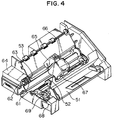
- Fig. 4 shows an example of an ink-jet recording apparatus with such a head incorporated therein.
- Numeral 61 indicates a blade serving as a wiping member, one end of which is held by a blade holding member forming a fixed end, thus exhibiting a cantilever-like structure.
- the blade 61 is arranged adjacent to the area where recording is performed by the recording head. In this example, the blade 61 is held in a position in which it protrudes into the path of movement of the recording head.
- Numeral 62 indicates a cap, which is arranged at a home position adjacent to the blade 61 and which is adapted to move in a direction perpendicular to the direction of movement of the recording head, abutting the ejection surface of the head, thereby effecting capping.
- Numeral 63 indicates an absorbing member provided adjacent to the blade 61 and held, like the blade 61, in a position in which it protrudes into the path of movement of the recording head.
- the blade 61, the cap 62 and the absorbing member 63 constitute an ejection-performance recovery section 64, which removes water, dust, etc. from the ink-ejection surface by the blade 61 and the absorbing member 63.
- Numeral 65 indicates a recording head which has an energy generating means and which ejects ink onto a cloth containing cellulosic fibers and opposed to the ejection surface of the head having ejection outlets, thereby effecting recording.
- Numeral 66 indicates a carriage for moving the recording head 65, which is mounted thereon. The carriage 66 is slidably engaged with a guide shaft 67, and a part of the carriage 66 is connected with a belt 69 (the connection is not shown) driven by a motor 68. Due to this arrangement, the carriage 66 can move along the guide shaft 67, making it possible for the recording head 65 to move across the area where recording is performed and the area adjacent thereto.
- Numeral 51 indicates a cloth feeding section for inserting the cloth of this invention, which is mainly composed of cellulosic fibers.
- Numeral 52 indicates a paper feeding roller driven by a motor (not shown). Due to this construction, the cloth of this invention is fed to a position where it faces the ejection-outlet surface of the recording head. As the recording proceeds, the cloth is transferred to a cloth discharge section where cloth-discharge rollers 53 are arranged.
- the cap 62 of the ejection-performance recovery section 64 is withdrawn from the path of movement of the recording head 65, whereas the blade 61 continues to protrude into the path of movement. As a result, the ejection-outlet surface of the recording head 65 is wiped.
- the cap 62 is brought into abutment with the ejection-outlet surface of the recording head 65 so as to effect capping, the cap 62 is moved in such a way as to protrude into the path of movement of the recording head.
- the cap 62 and the blade 61 are at the same positions as those where the above-described wiping is performed. As a result, the ejection-outlet surface of the recording head 65 is also wiped in the course of this movement.
- the above movement of the recording head to the home position is performed not only upon completion of recording or at the time of ejection-performance recovery, but also during the movement of the recording head across the recording area for the purpose of recording. That is, during recording movement, the recording head moves at fixed intervals to the home position adjacent to the recording area, effecting the above-mentioned wiping.
- the textile-printing ink which has been imparted, by the method of this invention, to the ink-jet textile-printing cloth of this invention, is only sticking to the cloth.
- the two processes may be effected by conventionally known methods, such as steaming, HT steaming or thermofixing.
- the above fixation and removal can be effected by conventionally known methods in which washing is conducted after processing by the alkali-pad steaming method, alkali blotch steaming method, alkali shock method, alkali cold fixation method or the like.
- a woven fabric of 100% viscose rayon was immersed in a water vessel, and its moisture regain was adjusted to 25% by adjusting the squeezing ratio.
- a georgette cloth of 100% cotton having an average fiber length of 35mm was immersed in a water vessel, and its moisture regain was adjusted to 20% by adjusting the squeezing ratio.
- a woven fabric of 100% cotton formed by using Egyptian cotton having an average fiber length of 35mm was immersed in a water vessel, and its moisture regain was adjusted to 16% by adjusting the squeezing ratio. Printing was performed on this woven fabric in the same manner as in Example 1, and the dyed article was evaluated for clarity and blurring retardation. The evaluation results are given in Table 1.
- a georgette cloth of 100% cotton formed by using American raw cotton having an average fiber length of 45mm was immersed in a water vessel, and its moisture regain was adjusted to 50% by adjusting the squeezing ratio. Printing was performed on this georgette cloth in the same manner as in Example 1, and the dyed article was evaluated for clarity and blurring retardation. The evaluation results are given in Table 1.
- a woven cloth of Egyptian cotton (100% cotton) having an average fiber thickness of 1.32 dtex (1.2d) and an average natural twist of 101/cm was immersed in a water vessel, and its moisture percentage was adjusted to 20% by adjusting the squeezing ratio. Printing was performed on this woven fabric in the same manner as in Example 1, and the dyed article was evaluated for clarity and blurring retardation. The evaluation results are given in Table 1.
- a georgette cloth (100% cotton) having an average fiber thickness of 1.1 dtex (1.0d) and an average natural twist of 110/cm was immersed in a water vessel, and its moisture percentage was adjusted to 40% by adjusting the squeezing ratio. Printing was performed on this georgette cloth in the same manner as in Example 1, and the dyed article was evaluated for clarity and blurring retardation. The evaluation results are given in Table 1.
- a woven fabric of 100% cotton having an average fiber length of 45mm was immersed in a water vessel, and its moisture regain was adjusted to 6% by drying after adjusting the squeezing ratio to 20%.
- Printing was performed on this woven fabric in the same manner as in the above examples, using the same ink-jet textile-printing inks (A) to (N) as used in the above examples, and the dyed article was evaluated for clarity and blurring retardation.
- the evaluation results are given in Table 1.
- the densities of the printed articles were lower than those of Example 1, resulting in poorer degree of exhaustion.
- a woven fabric of 100% cotton having an average fiber length of 45mm was immersed in a water vessel, and its moisture regain was adjusted to 110%.
- Printing was performed on this woven fabric in the same manner as in the above examples, using the same ink-jet textile-printing inks (A) to (N) as used in the above examples, and the dyed article was evaluated for clarity and blurring retardation.
- the evaluation results are given in Table 1.
- the densities of the printed articles were lower than those of Example 1, resulting in poorer degree of exhaustion. Further, problems were also found in terms of conveyance properties and feeding precision.
- Printing was performed on this woven fabric in the same manner as in the above examples, using the same ink-jet textile-printing inks (A) to (N) as used in the above examples, and the dyed article was evaluated for clarity and blurring retardation.
- the evaluation results are given in Table 1.
- Printing was performed on this woven fabric in the same manner as in the above examples, using the same ink-jet textile-printing inks (A) to (N) as used in the above examples, and the dyed article was evaluated for clarity and blurring retardation.
- the evaluation results are given in Table 1.
- a woven fabric of 100% cotton formed by using Egyptian cotton having an average fiber thickness of 0.55 dtex (0.5d) and an average natural twist of 145/cm, was immersed in a water vessel, and its moisture percentage was adjusted to 20% by adjusting the squeezing ratio.
- Printing was performed on this woven fabric in the same manner as in the above examples, using the same ink-jet textile-printing inks (A) to (N) as used in the above examples, and the dyed article was evaluated for clarity and blurring retardation. The evaluation results are given in Table 1.
- a woven fabric of 100% cotton formed by using Egyptian cotton having an average fiber thickness of 2.53 dtex (2.3d) and an average natural twist of 70/cm, was immersed in a water vessel, and its moisture regain was adjusted to 20% by adjusting the squeezing ratio.
- Printing was performed on this woven fabric in the same manner as in the above examples, using the same ink-jet textile-printing inks (A) to (N) as used in the above examples, and the dyed article was evaluated for clarity and blurring retardation. The evaluation results are given in Table 1.
- the ink-jet textile-printing method of this invention excels in ink fixation and cloth feeding properties, making it possible to efficiently provide excellent dyed articles.
Landscapes
- Engineering & Computer Science (AREA)
- Textile Engineering (AREA)
- Coloring (AREA)
- Ink Jet Recording Methods And Recording Media Thereof (AREA)
Applications Claiming Priority (2)
| Application Number | Priority Date | Filing Date | Title |
|---|---|---|---|
| JP3406492 | 1992-01-27 | ||
| JP34064/92 | 1992-01-27 |
Publications (2)
| Publication Number | Publication Date |
|---|---|
| EP0553761A1 EP0553761A1 (en) | 1993-08-04 |
| EP0553761B1 true EP0553761B1 (en) | 1997-09-17 |
Family
ID=12403838
Family Applications (1)
| Application Number | Title | Priority Date | Filing Date |
|---|---|---|---|
| EP93101121A Expired - Lifetime EP0553761B1 (en) | 1992-01-27 | 1993-01-26 | Cloth suitable for ink-jet textile printing and ink-jet textile printing method |
Country Status (4)
| Country | Link |
|---|---|
| US (2) | US5494733A (enExample) |
| EP (1) | EP0553761B1 (enExample) |
| JP (1) | JP2952128B2 (enExample) |
| DE (1) | DE69313885T2 (enExample) |
Families Citing this family (45)
| Publication number | Priority date | Publication date | Assignee | Title |
|---|---|---|---|---|
| DE69333919T2 (de) * | 1992-07-27 | 2006-08-17 | Kanebo, Ltd. | Bedruckter stoff und verfahren zur herstellung |
| JP2895695B2 (ja) * | 1992-12-17 | 1999-05-24 | キヤノン株式会社 | インクジェット捺染用布帛、インクジェット捺染方法及び捺染物 |
| JP2895696B2 (ja) * | 1992-12-17 | 1999-05-24 | キヤノン株式会社 | インクジェット捺染用布帛、それを用いたインクジェット捺染方法及び捺染物 |
| JP3450372B2 (ja) * | 1993-04-14 | 2003-09-22 | キヤノン株式会社 | インクジェット捺染用インク、係るインクを用いたインクジェット捺染方法、及び機器 |
| US5515093A (en) * | 1993-06-25 | 1996-05-07 | Canon Kabushiki Kaisha | Ink jet printing method and print medium for use in the method |
| JP3270598B2 (ja) | 1993-11-08 | 2002-04-02 | キヤノン株式会社 | インクジェット捺染用布帛並びにインクジェット捺染方法並びに捺染物 |
| US5867197A (en) * | 1994-07-21 | 1999-02-02 | Canon Kabushiki Kaisha | Ink-jet printing cloth, ink-jet printing process and production process of print |
| JP3584094B2 (ja) * | 1994-10-25 | 2004-11-04 | キヤノン株式会社 | インクジェット捺染用布帛、捺染方法及び捺染物 |
| JPH08176973A (ja) * | 1994-10-25 | 1996-07-09 | Canon Inc | インクジェット捺染方法および捺染物 |
| US5781216A (en) * | 1994-10-28 | 1998-07-14 | Canon Kabushiki Kaisha | Ink-jet printing cloth, textile printing method of the same and print resulting therefrom |
| US5755861A (en) * | 1995-05-19 | 1998-05-26 | Brother Kogyo Kabushiki Kaisha | Ink composition, process for its preparation, and ink-jet recording process |
| DE69606594T2 (de) * | 1995-09-01 | 2000-09-21 | Asahi Glass Co. Ltd., Tokio/Tokyo | Tintenstrahlaufzeichnungsmittel zweckdienlich für eine pigmenthaltige Tinte |
| EP0888155A4 (en) | 1996-02-09 | 2005-01-26 | Mattel Inc | DIGITAL FASHION CREATION USING DOLL PRINTING ARTICLES AND COMPUTER GENERATED |
| JPH09279489A (ja) * | 1996-02-15 | 1997-10-28 | Canon Inc | インクジェット捺染用布帛、インクジェット捺染方法および捺染物 |
| JP3673610B2 (ja) * | 1996-02-15 | 2005-07-20 | キヤノン株式会社 | インクジェット捺染用布帛、インクジェット捺染方法および捺染物 |
| JP3695833B2 (ja) * | 1996-04-05 | 2005-09-14 | 株式会社ルネサステクノロジ | Pll回路 |
| JPH1018184A (ja) * | 1996-05-02 | 1998-01-20 | Canon Inc | インクジェット捺染方法及び捺染物 |
| US6074761A (en) | 1997-06-13 | 2000-06-13 | Ppg Industries Ohio, Inc. | Inkjet printing media |
| US5880196A (en) * | 1997-06-13 | 1999-03-09 | Ppg Industries, Inc. | Inkjet printing media |
| US6613821B2 (en) | 1998-10-09 | 2003-09-02 | Canon Kabushiki Kaisha | Cloth treating agent, cloth, textile printing process and print |
| DE60035558T2 (de) | 1999-10-01 | 2008-03-20 | Canon K.K. | Druckverfahren und damit hergestellte Drucke sowie mit diesem Verfahren hergestellter Artikel |
| US6769829B1 (en) | 2000-06-30 | 2004-08-03 | Avery Dennison Corporation | Drawable and/or traceable binder |
| ATE331068T1 (de) * | 2000-07-26 | 2006-07-15 | Seiren Co Ltd | Verfahren zur herstellung eines gewebes für tintenstrahldruck |
| US6962735B2 (en) * | 2001-08-31 | 2005-11-08 | Milliken & Company | Textile printing substrate |
| US6808776B2 (en) * | 2002-03-11 | 2004-10-26 | Avery Dennison Corporation | Water-absorbent film construction |
| US7917646B2 (en) * | 2002-12-19 | 2011-03-29 | Intel Corporation | Speculative distributed conflict resolution for a cache coherency protocol |
| AU2003243975B2 (en) * | 2003-05-02 | 2010-04-22 | Canon Kabushiki Kaisha | Aqueous fluorescent ink, recorded image using same, and judging method |
| US7249837B2 (en) * | 2003-05-12 | 2007-07-31 | Abramek Edward T | Printing on flocked paper and films |
| WO2005044932A1 (en) * | 2003-11-11 | 2005-05-19 | Canon Kabushiki Kaisha | An ink comprising a block copolymer dispersing agent having a hydrophilic and a hydrophobic segment and an ink-applying process and apparatus using the same |
| US20060162586A1 (en) * | 2005-01-27 | 2006-07-27 | Fresener Scott O | Method for inkjet printing light colors on dark textiles |
| US20060207448A1 (en) * | 2005-01-27 | 2006-09-21 | Fresener Scott O | Method for printing white on dark textiles using screen-printers and inkjet printers |
| JP4808418B2 (ja) * | 2005-02-28 | 2011-11-02 | キヤノンファインテック株式会社 | インクジェット用水系インク、インクジェット記録方法、インクカートリッジおよびインクジェット記録装置 |
| JP2007277362A (ja) * | 2006-04-05 | 2007-10-25 | Canon Inc | インクジェット記録用インク、記録方法及び記録装置 |
| JP5064783B2 (ja) * | 2006-12-20 | 2012-10-31 | キヤノン株式会社 | インク及びインクジェット記録方法 |
| EP2173823B1 (en) * | 2007-07-23 | 2017-05-17 | Canon Kabushiki Kaisha | Ink jet recording ink |
| US8506067B2 (en) * | 2007-07-23 | 2013-08-13 | Canon Kabushiki Kaisha | Ink jet image-forming method, ink jet color image-forming method and ink jet recording apparatus |
| WO2009014242A1 (en) * | 2007-07-23 | 2009-01-29 | Canon Kabushiki Kaisha | Ink jet recording ink, ink jet image-forming method and ink jet recording apparatus |
| JP5787482B2 (ja) * | 2009-01-22 | 2015-09-30 | キヤノン株式会社 | インクジェット記録用インク及びインクジェット画像形成方法 |
| JP2010188721A (ja) * | 2009-01-22 | 2010-09-02 | Canon Inc | インクジェット画像形成方法及びインクジェット記録装置 |
| US10167399B2 (en) | 2016-01-22 | 2019-01-01 | Canon Kabushiki Kaisha | Ink, ink cartridge, and image recording method |
| EP3196261B1 (en) | 2016-01-22 | 2019-06-19 | Canon Kabushiki Kaisha | Ink, ink cartridge, and image recording method |
| JP2017197709A (ja) | 2016-01-22 | 2017-11-02 | キヤノン株式会社 | インク、インクカートリッジ、及び画像記録方法 |
| EP3196259A1 (en) | 2016-01-22 | 2017-07-26 | Canon Kabushiki Kaisha | Ink, ink cartridge, and image recording method |
| JP2017128700A (ja) | 2016-01-22 | 2017-07-27 | キヤノン株式会社 | インク、インクカートリッジ、及び画像記録方法 |
| WO2017159551A1 (en) | 2016-03-16 | 2017-09-21 | Fujifilm Corporation | Inks |
Family Cites Families (12)
| Publication number | Priority date | Publication date | Assignee | Title |
|---|---|---|---|---|
| JPS5459936A (en) * | 1977-10-03 | 1979-05-15 | Canon Inc | Recording method and device therefor |
| US4702742A (en) * | 1984-12-10 | 1987-10-27 | Canon Kabushiki Kaisha | Aqueous jet-ink printing on textile fabric pre-treated with polymeric acceptor |
| EP0202656B1 (en) * | 1985-05-21 | 1992-01-29 | Canon Kabushiki Kaisha | Ink jet printing method |
| US4725849A (en) * | 1985-08-29 | 1988-02-16 | Canon Kabushiki Kaisha | Process for cloth printing by ink-jet system |
| JPS6253492A (ja) * | 1985-08-29 | 1987-03-09 | キヤノン株式会社 | 捺染方法 |
| US4849770A (en) * | 1985-12-13 | 1989-07-18 | Canon Kabushiki Kaisha | Ink for use in ink jet and ink jet printing method using the same |
| US4957553A (en) * | 1986-12-01 | 1990-09-18 | Canon Kabushiki Kaisha | Ink for ink-jet recording and ink-jet recording process employing the same |
| JPS63162773A (ja) * | 1986-12-26 | 1988-07-06 | Canon Inc | インクジエツト用インク及びそれを用いたインクジエツト記録方法 |
| JPH0346589A (ja) * | 1989-07-13 | 1991-02-27 | Mitsubishi Electric Corp | 測距装置 |
| US5250121A (en) * | 1991-09-26 | 1993-10-05 | Canon Kabushiki Kaisha | Ink-jet textile printing ink and ink-jet textile printing process |
| JP2713685B2 (ja) * | 1991-12-27 | 1998-02-16 | キヤノン株式会社 | インクジェット捺染方法、同方法で捺染され布帛、及び捺染された布帛の製造方法 |
| JP2895697B2 (ja) * | 1992-01-27 | 1999-05-24 | キヤノン株式会社 | 捺染用布帛、それを用いたインクジェット捺染方法及び捺染物 |
-
1992
- 1992-12-25 JP JP4357689A patent/JP2952128B2/ja not_active Expired - Fee Related
-
1993
- 1993-01-25 US US08/008,332 patent/US5494733A/en not_active Expired - Lifetime
- 1993-01-26 DE DE69313885T patent/DE69313885T2/de not_active Expired - Lifetime
- 1993-01-26 EP EP93101121A patent/EP0553761B1/en not_active Expired - Lifetime
-
1995
- 1995-11-08 US US08/555,077 patent/US5645631A/en not_active Expired - Lifetime
Non-Patent Citations (1)
| Title |
|---|
| JIS L 1019-1977 * |
Also Published As
| Publication number | Publication date |
|---|---|
| DE69313885T2 (de) | 1998-02-12 |
| US5645631A (en) | 1997-07-08 |
| JP2952128B2 (ja) | 1999-09-20 |
| EP0553761A1 (en) | 1993-08-04 |
| JPH05279972A (ja) | 1993-10-26 |
| DE69313885D1 (de) | 1997-10-23 |
| US5494733A (en) | 1996-02-27 |
Similar Documents
| Publication | Publication Date | Title |
|---|---|---|
| US5645631A (en) | Cloth suitable for ink-jet textile printing and ink-jet textile printing method | |
| EP0553759B1 (en) | Cloth suitable for textile printing and ink-jet textile printing method | |
| KR0153308B1 (ko) | 잉크 제트 날염용 직물, 잉크 제트 날염 방법 및 그 날염용 직물을 사용하는 날염물 생산 방법 | |
| EP0617161B1 (en) | Ink-jet printing process for textiles | |
| US5698478A (en) | Ink jet printing cloth, textile printing process, and print | |
| JP3011830B2 (ja) | インクジェットプリント方法及びプリント物 | |
| US5603756A (en) | Ink-jet textile printing ink, ink-jet printing process and instrument making use of the same, and processed article obtained | |
| US5584918A (en) | Ink-jet textile printing ink, printing process and instrument making use of the same, and prints obtained | |
| KR0161998B1 (ko) | 잉크젯 날염용 포백 및 잉크젯 날염 방법 및 날염물 | |
| US5854649A (en) | Ink-jet printing cloth and ink-jet printing process | |
| EP0602940B1 (en) | Ink-jet printing cloth, ink-jet printing process, and print | |
| JP3234643B2 (ja) | 捺染方法および捺染物 | |
| JPH08120576A (ja) | インクジェット捺染用布帛、捺染方法及び捺染物 | |
| JPH08127979A (ja) | インクジェット捺染用布帛、捺染方法及び捺染物 | |
| JP3495782B2 (ja) | インクジェット捺染用布帛、インクジェット捺染方法および捺染物 |
Legal Events
| Date | Code | Title | Description |
|---|---|---|---|
| PUAI | Public reference made under article 153(3) epc to a published international application that has entered the european phase |
Free format text: ORIGINAL CODE: 0009012 |
|
| AK | Designated contracting states |
Kind code of ref document: A1 Designated state(s): CH DE FR GB IT LI |
|
| 17P | Request for examination filed |
Effective date: 19931221 |
|
| 17Q | First examination report despatched |
Effective date: 19950703 |
|
| GRAG | Despatch of communication of intention to grant |
Free format text: ORIGINAL CODE: EPIDOS AGRA |
|
| GRAH | Despatch of communication of intention to grant a patent |
Free format text: ORIGINAL CODE: EPIDOS IGRA |
|
| GRAH | Despatch of communication of intention to grant a patent |
Free format text: ORIGINAL CODE: EPIDOS IGRA |
|
| GRAA | (expected) grant |
Free format text: ORIGINAL CODE: 0009210 |
|
| AK | Designated contracting states |
Kind code of ref document: B1 Designated state(s): CH DE FR GB IT LI |
|
| REG | Reference to a national code |
Ref country code: CH Ref legal event code: EP |
|
| REF | Corresponds to: |
Ref document number: 69313885 Country of ref document: DE Date of ref document: 19971023 |
|
| ITF | It: translation for a ep patent filed | ||
| REG | Reference to a national code |
Ref country code: CH Ref legal event code: NV Representative=s name: BOVARD AG PATENTANWAELTE |
|
| ET | Fr: translation filed | ||
| PLBE | No opposition filed within time limit |
Free format text: ORIGINAL CODE: 0009261 |
|
| STAA | Information on the status of an ep patent application or granted ep patent |
Free format text: STATUS: NO OPPOSITION FILED WITHIN TIME LIMIT |
|
| 26N | No opposition filed | ||
| REG | Reference to a national code |
Ref country code: GB Ref legal event code: IF02 |
|
| PGFP | Annual fee paid to national office [announced via postgrant information from national office to epo] |
Ref country code: CH Payment date: 20090116 Year of fee payment: 17 |
|
| PGFP | Annual fee paid to national office [announced via postgrant information from national office to epo] |
Ref country code: IT Payment date: 20090121 Year of fee payment: 17 |
|
| PGFP | Annual fee paid to national office [announced via postgrant information from national office to epo] |
Ref country code: FR Payment date: 20090121 Year of fee payment: 17 |
|
| REG | Reference to a national code |
Ref country code: CH Ref legal event code: PL |
|
| REG | Reference to a national code |
Ref country code: FR Ref legal event code: ST Effective date: 20100930 |
|
| PG25 | Lapsed in a contracting state [announced via postgrant information from national office to epo] |
Ref country code: LI Free format text: LAPSE BECAUSE OF NON-PAYMENT OF DUE FEES Effective date: 20100131 Ref country code: FR Free format text: LAPSE BECAUSE OF NON-PAYMENT OF DUE FEES Effective date: 20100201 Ref country code: CH Free format text: LAPSE BECAUSE OF NON-PAYMENT OF DUE FEES Effective date: 20100131 |
|
| PG25 | Lapsed in a contracting state [announced via postgrant information from national office to epo] |
Ref country code: IT Free format text: LAPSE BECAUSE OF NON-PAYMENT OF DUE FEES Effective date: 20100126 |
|
| PGFP | Annual fee paid to national office [announced via postgrant information from national office to epo] |
Ref country code: DE Payment date: 20110131 Year of fee payment: 19 |
|
| PGFP | Annual fee paid to national office [announced via postgrant information from national office to epo] |
Ref country code: GB Payment date: 20110125 Year of fee payment: 19 |
|
| GBPC | Gb: european patent ceased through non-payment of renewal fee |
Effective date: 20120126 |
|
| PG25 | Lapsed in a contracting state [announced via postgrant information from national office to epo] |
Ref country code: GB Free format text: LAPSE BECAUSE OF NON-PAYMENT OF DUE FEES Effective date: 20120126 Ref country code: DE Free format text: LAPSE BECAUSE OF NON-PAYMENT OF DUE FEES Effective date: 20120801 |
|
| REG | Reference to a national code |
Ref country code: DE Ref legal event code: R119 Ref document number: 69313885 Country of ref document: DE Effective date: 20120801 |